Everyone in town had an opinion about Bruno before they ever touched him, but on the coldest night of my seventy-eighth year, the dog they called dangerous became the only living soul standing between me and death.
At first, Bruno only whined.
A deep, worried sound came from behind the kitchen door.
I could hear his nose working beneath it.
Sniffing.
Searching.
Trying to understand why I was outside when I should have been walking back through that doorway with the little metal bucket I used for the chickens.
“Bruno.”
My teeth were beginning to chatter.
“Boy, I need you.”
His claws scratched once across the wood.
Then again.
“Come on.”
The scratching became harder.
I closed my eyes.
Part of me wanted to laugh.
Of all the things I had worried about when I first brought Bruno home, destroying my kitchen door had never been one of them.
For seven years, he had been almost absurdly careful inside the house.
He had never chewed furniture.
Never torn up a cushion.
Never knocked food off the counter even when his nose was exactly the right height to do it.
Henry had done more damage to that kitchen with one plumbing repair than Bruno had done in seven years.
But now I heard claws digging into wood.
Again.
Again.
Again.
“Bruno…”
I wanted to tell him he couldn’t open it.
The kitchen door opened inward, and I had pulled it firmly shut behind me.
The latch was old but solid.
Bruno could scratch until his paws bled and still not reach me.
My breath shortened.
The cold was getting worse.
I knew enough about winter to understand the danger.
Living in the mountains teaches you things whether you want to learn them or not.
Cold doesn’t always hurt forever.
That is what makes it dangerous.
First you hurt.
Then you shiver.
Then, if you stay outside long enough, eventually you may begin to feel less.
That relief is not kindness.
It is warning.
I looked at my hands.
They were trembling uncontrollably.
I tried flexing my fingers.
Still working.
Good.
I forced myself to breathe slowly.
In through my nose.
Out through my mouth.
Henry had taught me that during one of my cancer treatments when panic made the room feel smaller.
“Don’t fight the whole war at once, Maggie,” he had said. “Just win the next minute.”
Henry was the only person who called me Maggie.
I heard his voice now as clearly as if he were kneeling beside me.
Win the next minute.
“All right,” I whispered.
One minute.
Bruno scratched harder.
I heard the door shake inside its frame.
Then he barked.
One huge bark.
It echoed through the house and came muffled through the wood.
I smiled despite the pain.
“There you are.”
Another bark.
“Yes. I’m here.”
He could hear me.
That mattered.
I wasn’t alone.
It may sound foolish because a closed door still stood between us, but panic loosened its grip slightly.
Bruno knew.
Whatever happened, someone knew where I was.
Someone cared that I had not come back inside.
That knowledge can be more powerful than people realize.
When Henry died, the worst part had not been sleeping alone.
Not exactly.
It was knowing there was no longer anyone in the house who would notice the small changes.
Henry noticed if I sneezed twice.
If I came in ten minutes late from the barn.
If I skipped breakfast.
If my hands were colder than usual.
After forty-six years, we had become each other’s early warning systems.
Then suddenly I could disappear inside my own life and nobody would notice until I failed to answer the phone.
Bruno had changed that.
If I sat too long, he came looking.
If I cried, he rested his head on my lap.
If I didn’t get up at our usual time, he stood beside the bed breathing heavily until I opened my eyes.
Now, on the ice, I realized something with painful clarity.
He had noticed again.
The scratching became frantic.
“Easy, Bruno.”
He barked.
The door shuddered.
“Don’t hurt yourself.”
As if he cared what I thought.
A loud crack came from inside.
I opened my eyes.
For a moment, the scratching stopped.
My heart pounded.
“Bruno?”
Silence.
Then another impact.
Not claws this time.
His body.
He was throwing his shoulder against the door.
“Bruno!”
Bang.
The frame shook.
Bang.
A piece of wood snapped.
I knew that sound.
Thirty years in an old farmhouse teaches you the language of wood.
Something around the lower frame had given way.
Bruno barked again.
Then came another crash.
The door jumped.
Cold air rushed through a new gap.
I could actually see movement inside.
“Come on, baby.”
I hadn’t called him baby since his first month with me.
Bang.
The latch tore loose.
The kitchen door swung open.
Bruno exploded through it.
For seven years, people had stepped away when they saw that dog coming toward them.
That night, watching nearly one hundred pounds of black-and-tan Rottweiler race across my frozen yard, I had never seen anything more beautiful.
His paws slipped once on the ice.
He recovered.
Then he reached me.
Bruno stopped so quickly his body almost folded.
He sniffed my face.
My shoulders.
My hands.
Then his tongue covered my cheek.
“Oh, Bruno.”
He whined.
Not the ordinary little sound he made when dinner was late.
This was low and continuous.
Almost trembling.
His entire body was tense.
“I fell.”
He sniffed my hip.
I cried out before he even touched it.
He pulled back immediately.
His ears flattened.
“I know.”
I put one hand against his neck.
“You found me.”
He licked my face again.
Warm.
His breath was warm too.
For those first few seconds, I simply held onto his fur.
Bruno stood close enough that I could feel heat through his body.
I buried my fingers behind his collar.
“Good boy.”
His tail did not move.
That frightened me.
Bruno’s tail usually moved whenever I spoke gently to him.
Now he was staring at my face with an intensity I had never seen.
I knew that expression.
He was trying to solve something.
I had seen it years earlier after Henry collapsed in the kitchen during one of his final months.
Bruno had paced between Henry and me while I called the ambulance.
He had known something was wrong.
He hadn’t understood what.
Now there was nobody standing.
Nobody holding a phone.
Nobody giving instructions.
Just me on the ground.
“Bruno.”
He leaned closer.
“I need help.”
His ears moved.
“Help.”
I pointed toward the house.
“Phone.”
Bruno looked at my hand.
Then toward the house.
For one wild second I wondered whether he could somehow bring me the phone.
We had never taught him that.
Henry once trained him to carry the newspaper from the porch, but Bruno had decided after three days that newspapers were beneath him.
“Phone,” I repeated.
He turned toward the house.
Took three steps.
Then stopped.
Looked back.
“No, wait.”
What good would it do if he went inside?
The phone was on the kitchen table.
Too high.
He couldn’t dial anyone.
I lowered my hand.
Think, Margaret.
Win the next minute.
The road.
Our road ran about sixty yards beyond the front fence.
Not busy.
But not completely deserted.
A few neighbors drove home that way.
Delivery trucks occasionally passed.
Maybe someone would come.
But how could I make Bruno understand?
I pointed.
“Road.”
He stared at me.
“Go.”
Nothing.
“Go, Bruno.”
He remained beside me.
That was the problem with loyalty.
He did not want to leave.
I pushed gently at his shoulder.
“Go find someone.”
His body resisted.
“Come on.”
He whined.
“Bruno, go!”
The sharpness in my voice made him step back.
I hated it.
He looked hurt.
“I’m sorry.”
I reached for him again.
“Go get help.”
Help.
That word he knew.
Not because he had training.
Because I had used it countless times in ordinary life.
“Bruno, help me with these chickens.”
“Bruno, help me find my glove.”
Mostly nonsense.
But he knew the tone.
He stared toward the road.
Then back at me.
“Go.”
This time he turned.
He ran.
Not toward the house.
Toward the front of the property.
I watched him disappear around the side of the barn.
Then fear returned.
What had I done?
Bruno was loose.
Near a road.
At night.
A large Rottweiler with a reputation he had never earned.
What if somebody saw him and panicked?
What if someone hit him?
What if he didn’t understand and simply ran?
“Bruno!”
Too late.
He was gone.
The yard became silent again.
For the first time since the fall, I truly felt alone.
The broken kitchen door stood open.
Warm yellow light spilled onto the snow.
Thirty feet.
Maybe twenty-eight.
Impossible.
I tried moving again.
Pain shot through my hip so violently that I screamed.
My stomach turned.
I stopped.
“Don’t be stupid, Margaret.”
Henry would have said that too.
He loved me dearly.
He was also blunt.
I shifted my shoulders enough to get part of my back off the ice.
The chicken coop stood behind me.
Could I reach it?
No.
Could I drag myself toward the house using my elbows?
Perhaps.
At what cost?
If the fracture displaced further, I could cause bleeding.
I didn’t know exactly what was broken, but I knew my body was telling me very clearly not to move.
So I stayed.
The sky above the mountains had turned dark blue.
Stars appeared one by one.
Normally, I loved those stars.
Henry and I used to sit on the porch after supper and watch them.
He pretended to know constellations.
Most of the time he was wrong.
“That’s Orion.”
“Henry, that’s an airplane.”
“Fast constellation.”
Now the stars looked cold.
Far away.
I began shivering harder.
I pulled my coat tighter around my chest.
My left leg felt strange.
Heavy.
The pain had become less sharp unless I moved.
That scared me more than the pain itself.
“Stay awake.”
I said it aloud.
“Stay awake, Margaret.”
My voice sounded like someone else’s.
I started talking about anything I could think of.
The chickens.
“I still have to collect eggs tomorrow.”
Henry.
“You are going to be furious if I freeze to death while closing a chicken coop.”
Susan, my daughter.
“She’ll sell the farm.”
That thought offended me enough to keep me alert.
“She’ll absolutely sell it.”
I imagined Susan standing in my kitchen with that worried crease between her eyebrows.
She had asked me to move closer to her at least a dozen times.
“Mom, you’re alone up there.”
“I have Bruno.”
“Bruno cannot call 911.”
Apparently, Susan had identified the flaw in my retirement plan.
I laughed weakly.
It hurt.
“Fine, Susan. You win.”
Wind came down from the mountains.
I closed my eyes for what I intended to be one second.
Immediately, Henry’s face appeared.
Not sick.
Not the Henry from the hospital.
Young Henry.
Thirty years old.
Hair thick and dark.
Standing beside our first truck.
For years after he died, my memories had started with his final months.
The oxygen machine.
The medication schedule.
The hospital bed.
Grief had pushed the rest of his life behind the ending.
But on that ice, I saw him young.
Laughing.
“You’re not getting me yet,” I whispered.
My eyes opened.
I didn’t know whether I meant Henry or death.
Maybe both.
Somewhere far away, Bruno barked.
I held my breath.
Another bark.
Then another.
Not near the house.
Near the road.
“He made it.”
I smiled.
“That’s my boy.”
What happened next, I learned mostly from other people.
At the time, I saw none of it.
But I have heard the story so many times that it lives in my mind almost like a memory.
Bruno reached the road.
It was dark enough that the only illumination came from the snow reflecting moonlight and the porch light behind him.
He apparently ran twenty or thirty yards in one direction.
Then back.
There were no cars.
So he stood in the center of the pavement and barked.
Again.
Again.
Again.
My neighbor Daniel later told me he heard Bruno from inside his house nearly a mile away.
He didn’t recognize the bark.
His wife did.
“That sounds like Margaret’s dog.”
Daniel went to the window.
Couldn’t see anything.
They were discussing whether he should drive up when headlights appeared on the road.
A pickup truck belonging to a man named James Holloway was coming home from the hardware store in town.
James knew me.
Not well.
Mountain communities are like that.
You may speak to someone twice a year and still know what truck they drive.
James later told me that at first he thought a deer was standing in the road.
Then his headlights hit Bruno.
He slammed on his brakes.
Bruno did not move.
Imagine that.
A huge Rottweiler planted directly in front of your truck on a dark mountain road.
Most people would have stayed inside.
James opened his window.
“Hey! Move!”
Bruno barked.
James honked.
Bruno came closer.
That was when James nearly drove around him.
Then Bruno ran toward my farm.
Stopped.
Looked back.
Barked.
Returned to the truck.
Ran toward the farm again.
James told me later, “Margaret, I know this sounds ridiculous, but that dog was telling me to follow him.”
It does not sound ridiculous to me.
James pulled onto the shoulder.
He got out.
Bruno ran twenty yards toward my driveway.
Stopped.
Looked back.
James followed.
Bruno ran again.
By then, James knew.
Something was wrong.
He called 911 while following Bruno.
Daniel had also gotten into his truck by then, so when James reached my driveway, another set of headlights was coming from the opposite direction.
Bruno ignored Daniel.
He went straight toward the backyard.
Straight toward me.
I heard him before I saw him.
His bark.
Then human voices.
At first I thought I was imagining them.
Cold and pain do strange things.
“Ma’am?”
I opened my eyes.
Light swept across the yard.
“Margaret?”
James.
I recognized his voice.
“Back here.”
It came out like a whisper.
Bruno reached me first.
Then James appeared around the barn with a flashlight.
His face changed the second he saw me.
“Oh my God.”
“I slipped.”
He took off his coat and laid it over me.
“Don’t move.”
“I wasn’t planning to.”
That was when Daniel reached us.
Bruno stood between all of us.
He was panting hard.
Foam gathered slightly around his mouth from running.
Daniel approached.
Bruno growled.
Only once.
Low.
Protective.
Daniel froze.
“Bruno.”
The growl stopped.
His head turned toward me.
“It’s Daniel. He’s helping.”
Bruno stepped aside.
That moment stayed with Daniel more than anything.
For years, Daniel had been wary of Bruno.
Not cruel.
Just cautious.
He had once told Henry he didn’t understand why anyone would keep “that kind of dog” around livestock.
Now Bruno looked at me, heard my voice, and allowed him through.
Daniel knelt.
“Ambulance is coming.”
“How long?”
“Not long.”
My teeth were chattering too hard to speak clearly.
James put another blanket around me.
He kept talking.
Both men did.
They knew not to move me.
Daniel went inside through the broken kitchen door and returned with more blankets.
When he saw the damage, he whistled.
“Your dog did that?”
I tried to smile.
“He’s been remodeling.”
James laughed.
That laugh mattered.
It made the situation feel survivable.
Sirens finally reached us.
Red light moved across the snow.
Bruno reacted immediately.
His body stiffened.
Two paramedics entered the yard.
One carried equipment.
The other pushed the stretcher.
Bruno stepped in front of me.
“Bruno.”
He did not move.
“Boy.”
His ears turned.
“They’re helping.”
One paramedic stopped.
Smart man.
He did not force the issue.
“What’s his name?”
“Bruno.”
“Can you hold his collar?”
I could barely move my arm.
Daniel reached.
Bruno backed away.
“No.”
I looked at the paramedic.
“Let me.”
I held out my hand.
“Bruno.”
He came.
I grabbed his collar weakly.
“It’s okay.”
The paramedic approached slowly.
Bruno watched every movement.
“Good dog,” the man said.
Bruno did not care about compliments.
He cared about me.
The paramedics cut part of my pants so they could examine my hip.
The moment I cried out, Bruno lunged one step.
Daniel grabbed his collar.
“Easy!”
Bruno barked.
“Bruno!”
He looked at me.
“I’m okay.”
A lie.
But it worked.
He stopped.
The paramedic said, “He’s very attached to you.”
“You could say that.”
They gave me pain medication.
The world softened around the edges.
They checked my temperature.
Too low.
Not disastrously.
Yet.
The paramedic looked at James.
“How long was she outside?”
“I don’t know.”
I answered.
“Maybe thirty minutes.”
It could have been more.
Time had stopped behaving normally.
The paramedic shook his head.
“You’re lucky.”
I looked at Bruno.
“No.”
My voice was weak.
“I’m loved.”
They placed me on a scoop stretcher.
Moving me was agony even with medication.
I screamed.
Bruno screamed too.
I had never heard a dog make that sound.
He pulled against Daniel.
“Bruno!”
I reached for him.
“Come.”
He pressed his head against my hand.
“I’m okay.”
His eyes were wide.
“No hospital drama.”
His tongue touched my fingers.
Then they lifted me.
Bruno followed the stretcher all the way to the ambulance.
When they tried to close the doors, he attempted to climb in.
“No dogs, ma’am,” the paramedic said apologetically.
I understood.
Still, I cried.
Not from my hip.
“Daniel.”
“I’ve got him.”
“Don’t leave him alone.”
“I won’t.”
“Promise.”
“I promise.”
Bruno put his front paws on the rear step of the ambulance.
Daniel pulled gently.
Bruno resisted.
I looked at him through the open doors.
“Home.”
He froze.
“Go with Daniel.”
His ears lowered.
“Bruno, home.”
That was one command he knew very well.
He stepped down.
The doors began closing.
The last thing I saw was Bruno standing beside Daniel in the red emergency lights.
Watching me.
Then darkness.
The emergency room was a blur.
X-rays.
Questions.
Bright lights.
A nurse cutting away more of my clothing.
Another nurse asking when I had last eaten.
Someone saying “femoral neck fracture.”
Someone else saying “displaced.”
An orthopedic surgeon appeared sometime after midnight.
Dr. Patel.
Small woman.
Calm voice.
She showed me an image of my hip.
I did not need medical training to see the problem.
One part was no longer where it belonged.
“You’ll need surgery.”
“When?”
“Tomorrow morning if your labs look good.”
“Will I walk?”
“Yes.”
She said it with enough confidence that I believed her.
“Normally?”
“That depends on rehabilitation.”
“I have chickens.”
She blinked.
“Your chickens will have to wait.”
“I have a dog.”
“Your dog will also have to wait.”
I closed my eyes.
Bruno.
“Can someone call Daniel?”
The nurse found his number through my phone, which Daniel had brought to the hospital.
At one thirty in the morning, I called.
He answered immediately.
“Margaret?”
“How is he?”
Daniel laughed softly.
Not because anything was funny.
Because he knew exactly who I meant.
“He’s sitting outside your bedroom door.”
“Did he eat?”
“A little.”
“Water?”
“Yes.”
“Is the kitchen door—”
“I put plywood over it.”
I relaxed.
“Thank you.”
“Margaret?”
“Yes?”
“That dog saved your life.”
I could not answer.
My throat closed.
Daniel continued.
“If he hadn’t blocked James’s truck, you could’ve been out there for hours.”
“I know.”
“I was wrong about him.”
That surprised me.
Daniel was not a man who enjoyed admitting mistakes.
“About what?”
“Bruno.”
I opened my eyes.
The hospital ceiling blurred through tears.
“He’s a good dog.”
“I know.”
“I mean really good.”
“Yes.”
There was silence.
Then Daniel said, “Get some sleep. We’ve got the farm.”
We.
Not I.
The word comforted me.
Surgery took place the following morning.
I remember being wheeled toward the operating room and thinking about the strangest things.
The chicken coop door might still be open.
There was soup in the freezer.
Bruno’s medication was in the cabinet above the refrigerator.
I had not told anyone that he preferred his breakfast mixed with warm water.
Then the anesthesiologist told me to breathe.
Everything disappeared.
When I woke, my daughter Susan was beside the bed.
She had driven through half the night.
“Mom.”
Her face crumpled.
“Oh, sweetheart.”
She hugged me carefully.
“You terrified me.”
“I’m sorry.”
“What were you doing outside without your phone?”
“Closing the chickens.”
“At night?”
“They don’t close themselves.”
Susan gave me exactly the look I had expected.
“You’re moving.”
“No.”
“Mom.”
“No.”
“You could have died.”
“Yes.”
She stopped.
That answer took the wind out of her.
I held her hand.
“I know.”
Tears filled her eyes.
“I almost lost you.”
“But you didn’t.”
“Because of Bruno.”
I smiled.
“Because of Bruno.”
Susan had never disliked him, but she had always been nervous around him.
When I adopted him, she had called three times in one week.
“Please be careful, Mom.”
“He’s fine.”
“He’s a Rottweiler with an aggression history.”
“He’s a dog with an abuse history.”
“That doesn’t mean he can’t hurt you.”
“No. But neither does being hurt mean he will hurt me.”
We had agreed to disagree.
Now Susan looked toward the hospital window.
“Daniel told me what he did.”
“Yes.”
“He broke through the door?”
“Yes.”
“Ran to the road?”
“Yes.”
“Stopped a truck?”
“So they tell me.”
She shook her head.
“That sounds like a movie.”
“It felt much less glamorous from the ice.”
For the first time since arriving, Susan laughed.
Then she wiped her eyes.
“I owe that dog.”
“No.”
I squeezed her hand.
“You owe him trust.”
She looked at me.
That mattered more.
The next three weeks were some of the hardest of my life.
A broken hip at seventy-eight is not a small event.
Surgery was one battle.
Standing again was another.
The first time the physical therapist came, I hated her within seven minutes.
Her name was Rachel.
She was twenty-nine and cheerful.
I distrusted both qualities.
“We’re going to sit on the edge of the bed.”
“I’m already sitting.”
“You’re reclining.”
“I prefer reclining.”
She smiled.
“Edge of the bed.”
“I broke my hip yesterday.”
“Correct.”
“Shouldn’t healing involve rest?”
“It involves movement too.”
“I want another therapist.”
“You can complain while moving.”
I did.
Loudly.
The first attempt to stand made sweat break across my forehead.
My hands shook on the walker.
Rachel supported me.
“Good.”
“This is not good.”
“You’re standing.”
“I used to do this without applause.”
“Today you get applause.”
I took one step.
Pain.
Another.
More pain.
Five steps.
Then back to the bed.
I cried after she left.
Not because I was weak.
Because I had never understood how quickly independence could disappear.
Three days earlier, I had fed chickens.
Made tea.
Carried wood.
Driven myself into town.
Now I needed help getting to the bathroom.
Age had always been gradual.
This was abrupt.
A line.
Before the ice.
After the ice.
One afternoon, I told Susan, “Maybe you were right.”
She looked up from her book.
“About what?”
“Moving.”
Her face changed.
She knew what it cost me to say that.
“We don’t have to decide now.”
“I can’t even walk.”
“You walked twelve feet this morning.”
“With two people and a machine.”
“A walker is not a machine.”
“It has more engineering than I do.”
She smiled.
Then became serious.
“Mom, you don’t have to prove anything. If you want to come live near me, we’ll figure it out.”
I looked out the window.
The mountains were visible faintly beyond the town.
My farm was out there.
My porch.
Henry’s workshop.
The apple tree he planted the year Susan was born.
The chicken coop we rebuilt after the storm of 2004.
Bruno.
“I’m not ready.”
“Then don’t.”
That was new.
For years Susan and I had been fighting a battle neither of us named.
She wanted me safe.
I wanted to remain myself.
We both treated those goals as if they were enemies.
Maybe they weren’t.
A week after surgery, Daniel called.
“I’ve got someone here who’s being impossible.”
In the background, I heard a bark.
My heart stopped.
“Bruno?”
Another bark.
I sat straighter.
“Put me on speaker.”
Daniel did.
“Bruno!”
Silence.
Then whining.
A sound came from the phone like frantic sniffing.
“Oh, baby.”
The whining grew louder.
“I’m okay.”
My eyes filled.
“I’m okay.”
Bruno barked once.
The nurse at the doorway smiled.
“Is that your dog?”
“Yes.”
“The famous one?”
I frowned.
“Famous?”
She showed me her phone.
The local newspaper had run a short article.
ROTTWEILER LEADS DRIVER TO INJURED OWNER AFTER FARM ACCIDENT.
There was an old photograph of Bruno beside my porch.
I groaned.
“Daniel.”
“What?”
“You talked to the newspaper.”
“They called me.”
“You answered.”
“That is generally how phones work.”
“I look terrible in that photograph.”
“You’re not in it.”
“Exactly. Bruno looks better than I do.”
Daniel laughed.
Apparently James had told the sheriff’s deputy, who told someone else, and the story traveled.
That happens quickly in small towns.
Suddenly people who had avoided Bruno for seven years were asking Daniel whether they could bring him treats.
“Don’t let them feed him garbage.”
“I know.”
“He’s sensitive to—”
“Margaret.”
“Yes?”
“I’ve been listening to you explain that dog for seven years. I know.”
That stopped me.
Daniel knew.
Of course he did.
Bruno had been part of our neighborhood long enough that even people who feared him had learned his routines.
“Can he visit?”
I asked.
“I’ll ask the hospital.”
Hospitals have rules.
Large Rottweilers are apparently not automatically included in patient visitation.
I understood.
But two days later, after some arrangement with administration, vaccination records, and what sounded like significant persuasion from one of my doctors, they allowed a short visit in a ground-floor rehabilitation courtyard.
Susan refused to tell me until it was confirmed.
She helped me into a wheelchair.
“Where are we going?”
“Outside.”
“It’s cold.”
“You’ve become strangely concerned about cold.”
“Very funny.”
She wheeled me down a corridor.
Through a set of glass doors.
The air outside was crisp.
Snow remained along the edges of the courtyard.
Then I heard claws on concrete.
My whole body reacted before my mind did.
Bruno came around the corner with Daniel.
He saw me.
Stopped.
For one second, he simply stared.
Then he pulled.
Daniel nearly lost the leash.
“Easy!”
Bruno came toward me as fast as Daniel could safely allow.
I began crying.
There was no stopping it.
“Bruno.”
He reached the wheelchair.
His whole body shook.
He sniffed my hands.
My face.
The hospital blanket.
The brace around my leg.
Then he tried to climb into my lap.
“No, no.”
I laughed through tears.
“You are not a lapdog.”
He disagreed.
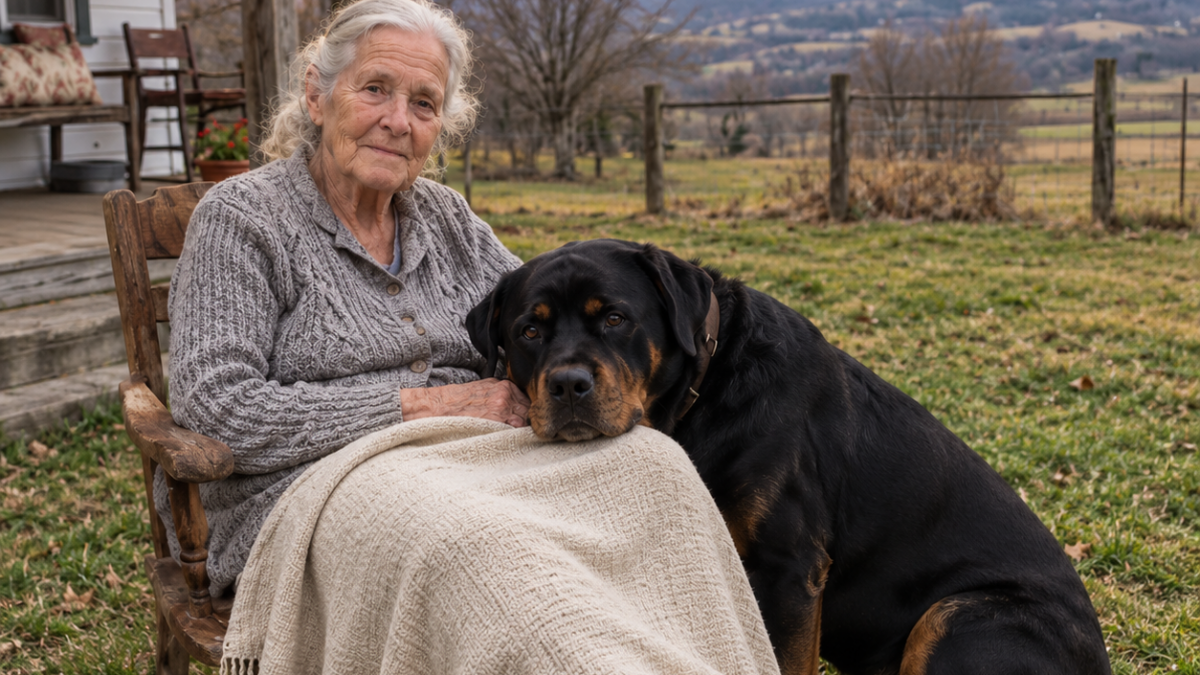
His head settled across my knees.
I put both hands around his broad skull.
“Oh, my boy.”
His breathing changed.
Fast at first.
Then slower.
Slower.
He closed his eyes.
Daniel turned away.
Susan was crying openly.
Even Rachel, my merciless physical therapist, wiped her face.
I whispered into Bruno’s fur.
“You came.”
His tail moved.
“You broke my door.”
Tail.
“You terrified James.”
More tail.
“You saved me.”
His head pressed more heavily into my lap.
And there, in that hospital courtyard, I understood something that I had not been able to articulate before.
Seven years earlier, Bruno had been sitting in a shelter because people believed the worst thing that had happened to him defined what he would become.
Abuse.
Fear.
An incident nobody fully understood.
Dangerous.
Those words had followed him.
I had chosen to believe behavior could change when circumstances changed.
Safety could teach something fear never could.
Patience could rebuild what violence damaged.
Now the same dog was sitting beneath my hands after tearing through a door, running into the road, and bringing help to me.
Maybe loyalty had always been inside him.
Maybe all he needed was somewhere safe enough to spend it.
Bruno stayed twenty minutes.
When Daniel finally stood, Bruno refused to leave.
“Home,” I told him.
He pressed his head against me.
“I’m coming.”
He looked up.
“Not today.”
Tail stopped.
“But I’m coming home.”
I pointed at Daniel.
“Go.”
Bruno stood.
Then, incredibly, he walked to Susan.
She froze.
He placed his head beneath her hand.
Susan looked at me.
“Mom.”
“Pet him.”
“I know.”
She stroked his head.
Bruno leaned.
Susan laughed while crying.
“He’s heavy.”
“He commits.”
When they left, I watched until he disappeared.
Then I looked at Rachel.
“When do we walk?”
She smiled.
That was the first time I had asked.
Recovery changed after that.
Not magically.
Pain still hurt.
My hip still needed healing.
But the goal had a face.
A black-and-tan face with brown eyes.
Every extra step meant one step closer to my porch.
Rachel knew exactly how to exploit this.
“Two more.”
“No.”
“Bruno.”
I glared at her.
“That’s unfair.”
“Two more.”
I took four.
The first day I walked fifty feet with the walker, Susan took a video for Daniel.
He played it for Bruno.
Apparently Bruno licked the phone.
Progress.
I began practicing stairs.
Slowly.
My farmhouse had three porch steps.
Rachel set up a small training staircase.
“This is ridiculous.”
“Up.”
“I have climbed mountains.”
“Today you climb three steps.”
“I dislike you.”
“I know.”
One.
Two.
Three.
At the top, I cried.
Rachel hugged me.
I stopped disliking her for approximately twenty seconds.
By the third week, the doctor said I could continue recovery at home if arrangements were made.
Susan and I made a list.
Grab bars.
Walker.
Raised toilet seat.
Temporary bed downstairs.
Someone checking daily.
No going to the chicken coop alone.
That final condition offended me.
“I have lived there thirty years.”
“And nearly froze there.”
“I had Bruno.”
“That is not the argument you think it is.”
She was right.
We compromised.
A neighbor would handle the chickens for several more weeks.
I would carry my phone outside.
Always.
And we installed a small emergency alert button that Susan could monitor.
I hated it.
Then I thought about the ice.
“I’ll wear it.”
The morning I went home, snow was beginning to melt.
Not much.
But water dripped from the hospital roof.
Spring was still far away, yet something had shifted.
Daniel drove me.
Susan followed with my things.
As we turned onto the farm road, my heart began pounding.
The house appeared.
The barn.
The coop.
The mountains.
Home.
Bruno was behind the fence.
He saw the truck.
He began barking.
Not alarm.
Joy.
Daniel stopped near the porch.
Before anyone could help me out, Bruno was circling the truck.
Susan held his collar.
“Easy, big guy.”
I opened the door.
“Bruno.”
He went still.
I lowered one foot.
Then the other.
Walker first.
My hands gripped the handles.
Bruno approached carefully.
That surprised everyone.
No jumping.
No pushing.
He seemed to understand immediately that something about me had changed.
He stood beside my right leg.
The uninjured side.
I took one step.
He moved with me.
Second step.
He moved.
Third.
His body remained close enough that I could feel heat from him.
“Look at you.”
We reached the porch.
Three steps.
The same number I had practiced.
I lifted the walker.
Susan stood behind me.
Daniel beside me.
Bruno waited.
One.
Two.
Three.
Porch.
I exhaled.
Then Bruno leaned gently against me.
Not enough to unbalance me.
Just enough to touch.
“I missed you too.”
Inside, the kitchen door was new.
Daniel had replaced it.
Stronger frame.
Better latch.
I stared.
“Why stronger?”
Daniel smiled.
“Insurance.”
I looked at Bruno.
“If he wants through, I’m not betting on the door.”
The first weeks at home were frustrating.
Everything took longer.
Making tea.
Getting dressed.
Bathing.
Moving from one room to another.
My body, which I had taken for granted for seventy-eight years, now required planning.
Bruno adapted faster than I did.
He learned to stay on my good side.
He stopped rushing through doorways.
If I stood from a chair, he stood too.
When I used the walker, he walked beside it without touching.
At night, he slept downstairs beside my temporary bed.
The first evening home, I woke at two in the morning.
Bruno was sitting upright.
Watching me.
“What?”
He came closer.
Sniffed my face.
“I’m alive.”
His tail moved.
“Go to sleep.”
He lay down.
Ten minutes later, I woke again.
He was watching.
“Oh, for heaven’s sake.”
But I understood.
For three weeks, I had disappeared from his world.
The last time he had seen me at home, strangers had taken me away on a stretcher.
He needed proof I was staying.
So did I.
By March, I graduated from walker to cane.
Rachel visited once a week.
Yes, the same Rachel.
She had become one of my favorite people, though I never told her because she would become unbearable.
We practiced in the yard.
The first time I approached the place where I had fallen, I stopped.
The ice was gone.
Only wet grass remained.
Still, my heart raced.
Bruno noticed.
He stepped closer.
I stared at the ground.
“You remember?”
He sniffed the grass.
I did.
Every detail.
The crack.
The pain.
The stars.
Cold entering my body.
The closed door.
For weeks after coming home, I had avoided that section of yard.
Fear can attach itself to places.
A patch of ordinary ground becomes a memory.
Rachel stood behind me.
“We can go around.”
I looked at her.
Then at Bruno.
“No.”
One step.
My cane sank slightly into the soft ground.
Second.
Bruno walked beside me.
Third.
I crossed the place where I had fallen.
Nothing happened.
Of course nothing happened.
But when I reached the other side, I turned.
The yard looked ordinary again.
I began crying.
Rachel said nothing.
She knew better now.
Bruno leaned against my leg.
“There you are.”
A few days later, I made it to the chicken coop.
Daniel had been caring for the hens.
They seemed offended by my absence.
“Don’t start,” I told them.
Bruno sat outside.
I gathered three eggs.
My hands shook.
Not from weakness.
From memory.
Seven months earlier, this would have been nothing.
Now carrying three eggs back to the house felt like reclaiming a country.
On the porch, I held them up.
“Look.”
Bruno looked unimpressed.
“Philistine.”
I laughed.
That evening, I made scrambled eggs.
I gave Bruno a little.
He had earned breakfast for life.
The newspaper story about him spread farther than I expected.
People sent letters to the farm.
Some were from Rottweiler owners.
Some from people who had adopted abused dogs.
One came from a woman whose German shepherd had alerted her family during a seizure.
A schoolteacher asked if she could read Bruno’s story to her class.
I said yes.
A local television station called.
I said no.
There are limits.
The strangest change happened in town.
Before the accident, I could walk Bruno down Main Street and watch people give us space.
Afterward, strangers approached.
“Is that Bruno?”
They wanted photographs.
They wanted to pet him.
Bruno accepted attention with the same solemn expression he used for everything.
One day outside the feed store, a man approached with his little daughter.
The girl was maybe seven.
She hid partly behind him.
“Is he the dog from the paper?”
“Yes.”
“Can she pet him?”
“If Bruno agrees.”
I crouched as much as my hip allowed.
“Hold out your hand.”
The girl did.
Bruno sniffed.
Then lowered his head.
She touched him.
Her face lit up.
“He’s soft.”
“Don’t tell him. He has a reputation.”
Her father laughed.
I recognized him then.
Years earlier, he had been one of the people who told Henry we were irresponsible for keeping Bruno.
He recognized me too.
His smile faded slightly.
“Margaret.”
“Tom.”
He looked at Bruno.
“I guess I was wrong.”
That happened often now.
People told me they had misjudged him.
I appreciated the honesty.
But part of me also became protective in a different way.
Bruno had not suddenly become good because he performed something heroic.
He had been good the day before my accident.
He had been good when nobody knew his name.
He had been good when people crossed the street.
Saving me did not create his worth.
It merely made other people notice it.
That distinction mattered.
One afternoon, Susan sat with me on the porch.
Bruno rested between us.
She rubbed his ears.
“I was wrong too.”
“You were worried.”
“I was afraid of him.”
“Because you loved me.”
“That doesn’t make it fair.”
I looked at her.
“No.”
She continued stroking Bruno.
“I saw his history and assumed it was his future.”
I thought about that.
Humans do that to one another too.
We take the worst thing someone survived.
The worst mistake.
The worst day.
The worst rumor.
And turn it into a permanent identity.
Bruno never had the language to defend himself.
He only had years of behavior.
Seven years of gentleness.
Apparently, the world needed one dramatic night to believe what I had known all along.
Susan leaned down.
“Sorry, Bruno.”
He licked her nose.
She recoiled.
“Oh!”
I laughed so hard my hip hurt.
“That’s forgiveness.”
“His breath is terrible.”
“Forgiveness isn’t always pleasant.”
By April, I could walk most of the property with a cane.
By May, some days I needed no cane indoors.
The mountains lost their snow caps slowly.
Wildflowers returned.
The first warm evening of spring, I made tea and carried it to the porch.
Bruno followed.
For five years after Henry died, this had been our ritual.
Me in the old chair.
Bruno beside me.
Mountains turning purple in the distance.
But that evening felt different.
I had seen winter from the ground.
I had watched stars appear while wondering if they might be the last ones I ever saw.
Now warm air moved across my face.
A meadowlark called near the fence.
Bruno placed his head on my knee.
I looked down.
“You know you’re famous?”
His eyes closed.
“People think you’re a hero.”
Nothing.
“They’re right.”
His breathing slowed.
“But I knew before they did.”
That was true.
Not that I had predicted he would rescue me.
I hadn’t.
I knew he was loyal.
There is a difference.
Heroism is usually one moment.
Loyalty is all the ordinary days before it.
Bruno’s rescue began long before December 14.
It began when he followed me to the coop in summer.
When he waited beside the bathroom door after I was sick.
When he placed himself between me and a strange coyote near the barn but never chased farther than necessary.
When he slept beside Henry’s empty chair after the funeral because I kept sitting there crying.
The road.
The broken door.
Those were only louder versions of what he had always been.
Present.
That was Bruno’s great gift.
Presence.
People underestimate it because it looks like doing nothing.
Henry taught me otherwise.
During my cancer treatment, there were days when he could fix nothing.
Couldn’t take away nausea.
Couldn’t make the scan results come faster.
Couldn’t promise me what would happen.
So he sat.
Held my hand.
Stayed.
Bruno had the same gift.
Maybe that was why I trusted him from the beginning.
Something in his silence reminded me of Henry.
That summer, I visited the shelter where I had adopted him.
The building looked almost exactly the same.
Same concrete runs.
Same echo of barking.
A young woman at the desk replaced the employee who had first introduced me to Bruno.
When I gave my name, she smiled.
“Bruno’s Margaret?”
Apparently, I had lost my individual identity.
“Yes.”
She came around the desk.
“Can I meet him?”
Bruno was waiting outside with Susan because the shelter was noisy.
We brought him into the courtyard.
Several staff members appeared.
Someone had printed the newspaper article and pinned it to a bulletin board.
There was Bruno’s photograph beneath the headline.
I stood staring at it.
“Seven years ago, he was back there.”
One of the workers nodded.
“We found his old file.”
“I remember.”
“Would you like to see it?”
I hesitated.
“Yes.”
Inside were notes.
Male Rottweiler.
Approximately three years old.
Fearful.
History of physical mistreatment.
Defensive behavior during restraint.
Not recommended for inexperienced adopter.
Potential bite risk.
Then one handwritten note from a staff member:
Responds strongly to calm female handler. Seeks contact after trust established. May do well in quiet adult home.
I touched the line.
There.
Someone else had seen him.
Not completely.
But enough.
“Who wrote this?”
The employee checked.
“A woman named Kelly. She left years ago.”
“Can you find her?”
Two weeks later, Kelly called me.
She remembered Bruno immediately.
“I worried about him for years.”
Her voice broke.
“I always wondered where he went.”
I told her.
Everything.
The farm.
Henry.
The accident.
The door.
The road.
The rescue.
When I finished, Kelly was crying.
“I knew there was a good dog in there.”
I looked at Bruno sleeping near my chair.
“You were right.”
“No,” she said. “You were brave enough to give him the chance.”
I shook my head though she could not see me.
“Maybe we both were.”
After the call, I found myself thinking about chances.
The shelter gave Bruno one.
I gave him one.
Then seven years later, I fell on the ice and he gave me one.
Life has strange bookkeeping.
Eventually, summer arrived.
My cane spent more time leaning against walls.
I could walk to the chicken coop alone again.
I still carried my phone.
Always.
Susan would have driven across three states to personally scold me if I didn’t.
The emergency button remained around my neck.
I complained about it daily.
I wore it anyway.
The new kitchen door stayed.
Bruno inspected it occasionally.
Daniel had installed it so well that it could probably survive a bear.
I told him this defeated the purpose.
“Next time Bruno needs through, what then?”
Daniel stared.
“Next time take your phone.”
Fair.
The accident changed more than my body.
My neighbors changed too.
Or perhaps I changed enough to notice them.
Daniel and his wife, Emily, began visiting once or twice a week.
Before December, we had waved across fields.
Now they drank tea on my porch.
James stopped by whenever he passed.
I learned he had two daughters.
One wanted to become a veterinarian.
The paramedics who treated me—James Mercer and Michael Reed, different James—visited once in spring.
They brought Bruno a ridiculous bag of treats.
“He’s getting fat.”
James Mercer shrugged.
“He earned them.”
“No dog earns diabetes.”
We rationed.
I realized something then.
I had thought living alone meant being alone.
It doesn’t have to.
Independence had become a wall I defended so fiercely that I sometimes kept people outside it.
The accident cracked more than my hip.
It cracked that wall.
I learned to accept help.
Meals.
Rides.
Someone fixing the gutter.
Susan arranging groceries.
Daniel repairing the fence.
At first, every favor embarrassed me.
Then I remembered Bruno.
When I adopted him, he had refused to take food from my hand for almost two weeks.
He wanted it.
But trust frightened him.
Eventually, hunger and patience won.
Maybe receiving help is also an act of trust.
That was difficult for an old woman to learn.
Bruno made it easier.
One year after the accident, December 14 returned.
Snow had fallen overnight.
Not much.
A thin clean layer across the farm.
I stood at the kitchen window.
My hip ached in cold weather now.
Dr. Patel said it probably always would.
Metal and winter had become roommates.
Bruno stood beside me.
He was older.
Grayer around the muzzle.
Slower.
“Anniversary.”
He looked at me.
“Not the romantic kind.”
I put on my coat.
Then stopped.
The chicken coop.
For one second, fear moved through me.
Same date.
Same cold.
Same task.
I almost asked Daniel to do it.
Then I looked at Bruno.
“No.”
I put my phone in my pocket.
Emergency button around my neck.
Boots with ice grips.
Cane.
I opened the door.
Bruno followed.
The cold hit my face.
We walked slowly.
Past the barn.
Past the place where the ice had been.
I paused there.
Snow covered everything.
Bruno sniffed.
Then continued.
I closed the coop.
Checked the latch.
Turned.
The kitchen lights glowed ahead.
This time my phone was in my pocket.
This time my feet were steady.
This time Bruno was already beside me.
We walked home.
At the doorway, I stopped.
The old broken door was gone.
But I still remembered the sound.
Wood splitting.
Hope coming through.
I put my hand on Bruno’s neck.
“Thank you.”
His tail moved.
“You don’t know why I’m thanking you, do you?”
He looked up.
Maybe he did.
That evening, people gathered at my house.
Not because I planned it.
Susan did.
She came for the weekend.
Daniel and Emily brought food.
James came with his family.
Even one of the paramedics stopped by after shift.
Someone had brought a cake.
On it was a badly drawn dog paw.
“No,” I said.
Susan laughed.
“Yes.”
“This is ridiculous.”
“It’s Bruno’s rescue anniversary.”
“He doesn’t understand anniversaries.”
Bruno was eating pieces of chicken from Daniel.
“He understands catering.”
We sat around the kitchen table.
The room was loud.
Warm.
Full.
Five years earlier, after Henry died, I had believed fullness belonged to another chapter of my life.
I had been wrong.
It just returned in a different shape.
Later, after everyone left, Susan found me on the porch.
Bruno lay at my feet.
“You okay?”
“Yes.”
She sat.
Snow reflected moonlight.
“Do you still think about that night?”
“Every time I cross the yard.”
“Does it scare you?”
“Sometimes.”
She waited.
“But not the way it did.”
Susan looked at Bruno.
“He’s getting old.”
“I know.”
“You okay with that?”
“No.”
She smiled sadly.
“Me neither.”
I reached down.
Bruno lifted his head into my hand.
“When I adopted him, everyone told me he might be dangerous.”
“I remember.”
“Then after he saved me, everyone started calling him a hero.”
Susan nodded.
“I don’t think either word describes him.”
“What does?”
I looked at my dog.
“Mine.”
Susan leaned her head against my shoulder.
We sat together.
Bruno between us.
That was enough.
Another year passed.
My hip grew stronger.
Bruno grew slower.
Time is not fair enough to let both happen in the direction you want.
He developed arthritis.
Then a heart murmur.
Medication helped.
Our morning trips to the coop became leisurely affairs.
He stopped running.
Then stopped trotting.
Mostly he walked.
I matched his pace.
People sometimes asked whether I was afraid of another emergency with him getting older.
Of course.
But after what happened, I had stopped organizing my life around fear.
Fear once told people Bruno was dangerous.
Fear almost kept me from adopting him.
Fear could now tell me loving an old dog would end painfully.
Fear is often correct about danger.
It is terrible at measuring what danger is worth facing.
One evening, I sat on the porch with tea.
Bruno struggled to stand.
I put the cup down.
“Easy.”
He rose.
His back legs trembled.
He walked toward me.
Then leaned.
Still leaning.
Seven years became eight.
Then nine.
The gesture never changed.
I wrapped my arm around him.
“You know, everybody thinks you saved me one time.”
His ear moved.
“They’re wrong.”
I looked toward the mountains.
“You saved me after Henry too.”
That realization had taken years.
When my husband died, Bruno had not fixed grief.
Nothing could.
But he gave grief somewhere to rest.
He forced me into mornings.
Walks.
Meals.
Vet appointments.
Small obligations.
Then, on December 14, he saved my body too.
Perhaps rescue is rarely one event.
Maybe we rescue one another repeatedly.
In small ways.
Then occasionally in ways loud enough for newspapers.
Bruno never understood why strangers recognized him.
I’m glad.
Heroism would have been terrible for his personality.
He already believed the entire farm existed for his comfort.
The chickens were entertainment.
The porch was his.
My bed belonged to him whenever thunderstorms came.
I was staff.
Fame could only have made things worse.
One afternoon, a school group visited.
Their teacher had asked whether they could meet Bruno for a lesson about working with animals and avoiding assumptions.
I agreed reluctantly.
Not because I disliked children.
I had simply learned that twenty children and one elderly Rottweiler required planning.
They sat in a semicircle on the grass.
Bruno lay beside me.
A little boy raised his hand.
“Was he really dangerous?”
I thought before answering.
“He was frightened.”
“That’s not the same?”
“No.”
The boy frowned.
“But frightened dogs can bite.”
“Yes.”
“So wasn’t he dangerous?”
Smart child.
“Any dog can be dangerous under the wrong circumstances.”
I rested my hand on Bruno.
“The important thing is to respect what an animal is telling you, not pretend fear doesn’t matter.”
A girl asked, “Why did you adopt him?”
“Because I saw he wanted to trust someone.”
“Were you scared?”
“A little.”
Bruno looked offended.
“Don’t listen to him. I was.”
The children laughed.
Another girl asked the question nobody else had.
“Did he know he was saving you?”
I looked at Bruno.
“I don’t know.”
“What do you think?”
I watched his chest rise and fall.
“I think he knew I needed him.”
That answer felt true.
After the children left, their teacher thanked me.
One of the boys came back.
He placed a folded piece of paper in my hand.
At home, I opened it.
He had drawn Bruno.
Huge.
Much larger than the house.
I was on the ground beside him.
Above us, in careful block letters:
GOOD DOGS DON’T HAVE TO LOOK FRIENDLY TO BE GOOD.
I laughed.
Then I cried.
I put it on the refrigerator.
Bruno sniffed it.
“That’s you.”
He sneezed.
“Art critic.”
Years passed more gently after that.
Not without loss.
Daniel’s wife became ill.
One of my hens finally died at an age I considered unreasonable.
Susan became a grandmother, which made me a great-grandmother and forced me to confront arithmetic I did not enjoy.
The mountains remained.
Seasons changed.
Bruno remained beside me.
Until age began taking pieces of him.
First hearing.
I would call and he wouldn’t respond unless he could see me.
Then eyesight dimmed slightly.
Then stairs became difficult.
We built a ramp beside the porch.
The first time he used it, he gave me a look suggesting ramps were an insult.
“Welcome to aging.”
He continued.
We understood each other.
One winter afternoon, almost three years after the accident, Bruno stopped near the patch of yard where I had fallen.
He stared toward the road.
I wondered if he remembered.
People say dogs remember places.
Smells.
Events.
Fear.
I don’t know how memory feels inside a dog.
But he stood there for nearly a minute.
Then looked at me.
I walked beside him.
“We made it.”
He leaned against my leg.
“Yes.”
I put my hand on his back.
“We made it.”
That evening, I thought about Henry.
How grief had changed.
At first, losing Henry had felt like an amputation.
Something essential removed.
Over time, the wound became part of the shape of me.
I still missed him.
But missing him no longer meant I wanted to leave the world that continued without him.
Bruno helped with that too.
I used to think loyalty meant refusing to change after someone leaves.
Now I think loyalty can mean carrying what they gave you into whatever comes next.
Henry taught me courage.
Bruno taught me trust.
Both made me less alone.
One Sunday morning, Susan arrived unexpectedly.
She found me on the porch brushing Bruno.
His coat had grayed around the eyes.
“Mom.”
“You’re early.”
She sat.
For a while, she watched me.
“What?”
“Nothing.”
“That means something.”
She smiled.
“I was thinking about how scared I was when you adopted him.”
“You’ve apologized.”
“I know.”
“He forgave you.”
“He licked my nose.”
“Same thing.”
She rubbed Bruno’s chest.
“I think I understand now.”
“What?”
“You didn’t rescue him because you were sure he was safe.”
I waited.
“You rescued him because you believed he could become safe with someone who treated him differently.”
I nodded.
“That’s closer.”
She looked toward the mountains.
“And he believed the same about you.”
I laughed.
“What was unsafe about me?”
“You were lonely.”
That stopped me.
Susan continued gently.
“After Dad died, you were surviving. But you weren’t letting anybody close.”
Bruno rested his chin on my knee.
I looked down.
Maybe Susan was right.
We call some wounds invisible because nobody can see them.
But dogs see differently.
Or smell differently.
Or simply respond without needing explanation.
Bruno did not ask me to discuss grief.
He sat beside it.
That was enough.
The night of my accident became a family story eventually.
Every December, someone retold it.
Details changed.
James swore Bruno stood in the exact center of the road “like a police officer.”
Daniel insisted the kitchen door had exploded.
Susan claimed I argued with paramedics about the chickens while hypothermic.
That part was probably true.
I corrected everyone.
Nobody listened.
Bruno slept through most versions.
That made sense.
He had done his part.
Years later, when I looked back, the moment that moved me most was not Bruno standing in the road.
Not the broken door.
Not the newspaper.
It was the first sound.
Claws on the kitchen floor.
Because that was the moment I knew someone had heard me.
There are few things more terrifying than calling for help and hearing nothing.
There are few things more beautiful than hearing someone coming.
Bruno came.
That was what mattered.
One winter evening, I sat exactly where I am sitting now.
On the porch.
Blanket around my shoulders.
Tea cooling beside me.
Bruno’s head on my knee.
His breathing deeper than it used to be.
I ran my fingers through the fur behind his ears.
“You were supposed to be dangerous.”
One eye opened.
“Terrifying.”
His eye closed.
“Absolute menace.”
Tail moved once.
I smiled.
“You destroyed a door.”
Tail.
“I’ll give them that.”
The mountains were turning purple.
Snow reflected pink light.
For a moment, life felt impossibly full.
Not because nothing bad had happened.
A great deal had.
Henry was gone.
My hip contained metal.
Bruno was old.
I was older.
But fullness is not the absence of loss.
It is having enough love left inside the losses that they do not become the entire story.
I leaned down.
“You know what I think?”
Bruno sighed.
“I think everyone deserves at least one creature in this world who comes when they call.”
His head grew heavier against me.
“And I got you.”
Today, when people ask about the night Bruno saved my life, I tell them the truth.
Yes, I fell.
Yes, I broke my hip.
Yes, my phone was inside.
Yes, Bruno tore through the kitchen door.
Yes, he ran to the road.
Yes, he stopped a driver and led him back.
Those facts matter.
But they are not the whole story.
The whole story began seven years earlier in a shelter kennel.
A frightened Rottweiler sat at the back while people decided what his past meant about his future.
An aging widow sat on a bench and waited.
Neither of us did anything heroic.
I didn’t march into the kennel.
He didn’t suddenly trust me.
We waited.
Then Bruno approached.
Slowly.
He lowered his head beneath my hand.
And I chose him.
That was the first bridge.
Trust.
Years later, on a freezing December night, when my body failed and there was no human close enough to hear me, I called across that bridge.
Bruno crossed it.
No hesitation.
No instructions.
No training.
He crossed because for seven years, we had built something strong enough to hold both of us.
People called that loyalty.
Maybe.
I call it love.
Not sentimental love.
Not the kind printed on greeting cards.
The kind that scratches through a wooden door.
The kind that runs into darkness.
The kind that stands in the middle of a road and refuses to move.
The kind that returns with help.
The kind that stays beside a hospital bed.
The kind that forgives years of being misunderstood without ever knowing forgiveness was required.
Bruno is sleeping beside me now.
His muzzle is almost white.
When he dreams, his paws sometimes move.
Perhaps he is running down that road again.
I hope not.
I hope wherever dogs go in dreams, he runs somewhere warm.
Somewhere without fear.
Without ice.
Without closed doors.
But when he wakes, he still checks for me.
And I still check for him.
That is our arrangement.
I am eighty-one now.
My hip aches before snowstorms.
I carry my phone everywhere.
Susan still checks whether I am wearing the emergency pendant.
I lie occasionally.
She catches me.
The chickens are still unreasonable.
The farm still requires more work than any sane woman my age should perform.
The mountains still take my breath away.
And Bruno is still here.
Slower.
Older.
But here.
Every morning, we walk to the coop together.
Every evening, we sit on the porch.
Sometimes people passing on the road wave.
Some recognize him.
“The hero dog.”
I smile.
Bruno doesn’t care.
He doesn’t know hero.
He knows breakfast.
Porch.
Home.
Margaret.
Maybe that is enough.
Maybe those are the only important words anyway.
One evening recently, I stood to go inside.
Bruno tried to rise.
His legs slipped slightly.
I reached for him.
“Easy.”
He steadied himself against me.
For a second, I saw the strange reversal.
Years earlier, I had fallen and could not stand.
Bruno had become my bridge back to safety.
Now his old body sometimes leaned on mine.
I smiled.
“My turn.”
We walked toward the door together.
Slowly.
His shoulder against my leg.
My hand against his back.
Neither of us moving very gracefully.
But moving.
Together.
At the threshold, Bruno stopped.
He looked toward the darkening yard.
Toward the chicken coop.
Toward the road.
I followed his gaze.
The place where I had almost died no longer looked frightening.
It looked like home.
That surprised me.
Perhaps healing is not forgetting what happened in a place.
Perhaps it is being able to stand there again without letting the worst night own every night after it.
I touched Bruno’s head.
“Come on.”
He entered.
I closed the door.
The new door.
The strong one.
Then I laughed.
Because if Bruno ever needed through it again, I knew exactly what would happen.
The door would lose.
That is Bruno.
The dog everyone called dangerous.
The dog people crossed roads to avoid.
The dog a shelter almost believed had no future.
The dog who heard one weak voice through a closed door on a freezing night and refused to accept that the door meant he could not reach me.
I have lived more than eighty years.
I have loved a husband.
Raised children.
Buried people I thought I could not live without.
Survived cancer.
Survived winter.
Survived loneliness.
Survived the fall.
People sometimes ask what all those years have taught me.
I could give a complicated answer.
But Bruno would make it simple.
Look longer before you judge.
Stay when someone needs you.
And when the person you love calls from the other side of a closed door, find a way through.
Bruno did.
And because he did, I am still here.
Still watching sunsets.
Still drinking tea.
Still arguing with chickens.
Still missing Henry.
Still loving this old dog.
Still living.
The world once looked at Bruno and saw something dangerous.
That night, lying helpless beneath the stars, I saw what I had always seen.
My friend.
My family.
My way home.
And when I whispered his name into the freezing dark, he did what Bruno had always done.
He came.








