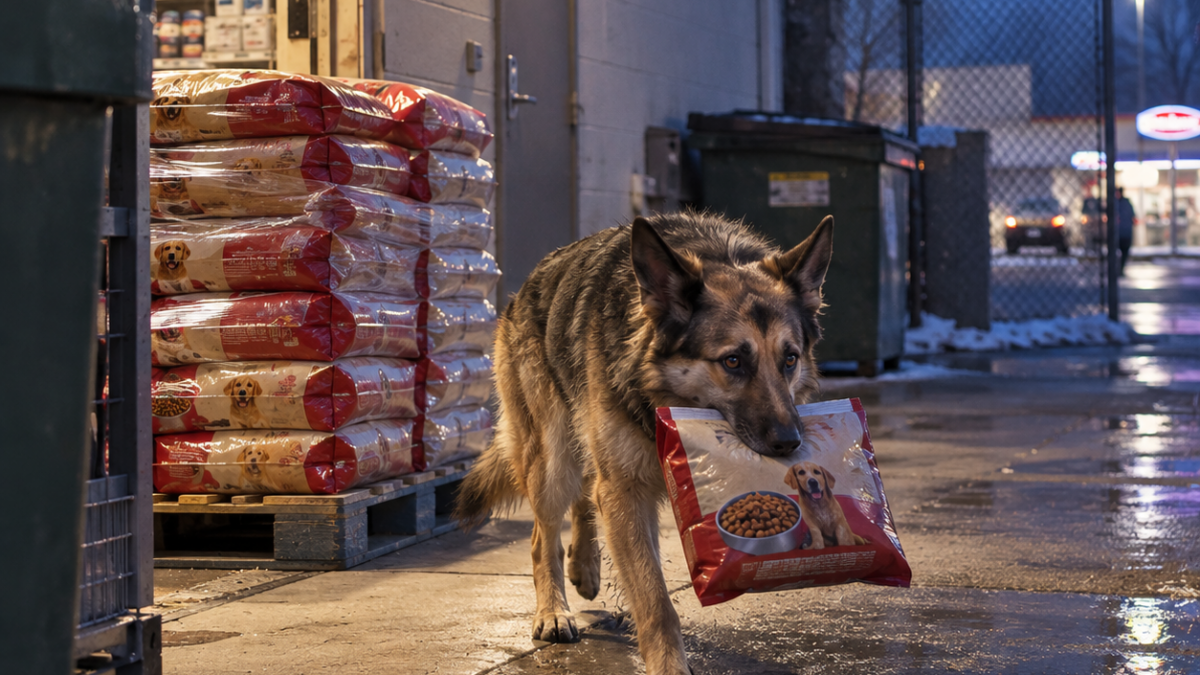
Every night, a starving German Shepherd mix stole exactly one sealed bag of kibble from behind my store and disappeared before sunrise.
The dispatcher told me the first thing I needed to hear.
“Do not crawl under the truck.”
I looked at the puppies.
“I wasn’t planning to.”
That was a lie.
Every part of me wanted to get down on my stomach, reach beneath the axle, and start pulling puppies out.
But the dispatcher continued.
“Luis, listen to me. If the tires are flat and the ground is uneven, that vehicle could shift.”
I looked at the truck again.
It leaned slightly toward the drainage ditch.
Rust covered the wheel housing.
The pavement beneath it had crumbled into gravel and dirt.
“How long?”
“Rescuers are on the way.”
“It’s going to rain.”
“I know.”
“The water runs directly under this lot.”
“I understand.”
The mother dog stood beside the rear wheel.
Her chest rose and fell rapidly.
She looked at me.
Then toward the puppies.
Then back at me.
I suddenly understood how much pressure my presence was creating.
So I backed away.
Twenty feet.
Then I sat down.
Sideways.
No direct eye contact.
I kept my hands visible.
I had no formal rescue training.
But I had worked around enough frightened animals to know that staring and advancing rarely improved anything.
I placed a shallow bowl of water halfway between us.
Then waited.
The mother did not approach.
A truck passed on the road.
Headlights swept across the lot.
She flattened herself beside the wheel.
One puppy cried.
She immediately turned her head toward it.
“Easy,” I said.
Her ear moved.
“That’s yours. I know.”
At 3:04, headlights entered the lot.
Not emergency lights.
An unmarked utility van.
Two people stepped out.
The first was Dana Pike, a field coordinator in her forties wearing work pants and a navy jacket.
The second was Marcus Lee, carrying crates, towels, folding barriers, and what looked like a long camera on a flexible pole.
Neither of them approached the dog directly.
That impressed me.
Dana came to me.
“How many?”
“Six.”
“You’re sure?”
“I counted twice.”
“Any wandering away?”
“No.”
“Injuries?”
“The smallest one isn’t eating.”
Dana crouched at a distance.
The mother watched.
Dana counted the visible heads.
“One.”
Pause.
“Two.”
Another puppy moved.
“Three.”
Then four.
A fifth shifted behind a torn sheet of plastic.
The sixth remained somewhere deeper.
Marcus slowly walked around the truck.
He did not crawl under.
He inspected the tires.
Frame.
Angle.
Ground.
“This thing needs stabilization.”
Dana nodded.
They called the fire department’s nonemergency line.
I looked at her.
“We’re waiting again?”
“We’re staying alive.”
“What about the puppies?”
“We can’t save them if the truck drops.”
I knew she was right.
That didn’t make standing there easier.
The first drops of rain began.
Soft taps against the truck’s metal roof.
The mother looked upward.
Then six small cries rose from underneath.
She pressed her body against the opening.
Almost covering it.
I moved without thinking.
Dana touched my arm.
“Don’t.”
“She’s trying to block the rain.”
“I know.”
“What do we do?”
“We give her space.”
That felt like doing nothing.
Sometimes apparently doing nothing is the hardest part of rescue.
You see suffering within arm’s reach.
Every instinct tells you to act.
But the wrong action can make the situation worse.
So we waited.
Dana placed food in three places.
The mother ignored all of it.
Then Dana tossed one piece of kibble toward her.
The dog approached.
Picked it up.
I thought:
Finally.
She turned.
Carried the piece beneath the truck.
A puppy ate it.
Dana tried again.
Same thing.
Every piece we offered became another delivery.
I stared at the mother’s body.
Ribs.
Spine.
Hips.
Her legs trembling.
“You’ve got to eat too.”
She ignored me.
Dana looked at her.
“She might once the puppies are safe.”
“Might?”
“We don’t know what else is going on physically.”
She was right.
We could see severe weight loss.
We couldn’t diagnose it in a parking lot.
Parasites.
Disease.
Malnutrition.
All possibilities.
But one thing was obvious.
This dog was disappearing while six puppies kept growing.
The fire crew arrived at 3:38.
They brought wheel chocks and wooden cribbing.
The mother stiffened at the additional people.
Dana immediately widened the distance around her.
Nobody rushed.
The firefighters stabilized the truck from outside the puppy area.
Every support was tested.
Retested.
Only then did Marcus prepare the inspection camera.
The mother didn’t like it.
The moment the pole moved toward the opening, she stepped forward.
Her mouth closed.
Her body leaned onto her front feet.
Dana stopped.
“Good girl.”
The dog stared.
“No one’s taking them.”
We waited until her posture softened.
Then Dana let her smell the pole.
The mother sniffed once.
Retreated.
Marcus slid the camera beneath the axle.
The screen showed five puppies grouped over flattened cardboard.
Dusty.
Thin.
Alive.
Then he moved farther.
“There.”
Dana leaned closer.
I stepped behind her.
The black-and-tan puppy lay in a shallow depression.
One rear paw was trapped beneath a loop of packing strap.
The plastic strap wasn’t cutting into the skin.
Not yet.
But every time the puppy tried to crawl, the loop tightened enough to stop movement.
I looked at the mother.
“She’s been feeding that one.”
Dana nodded.
“She knew it couldn’t reach the food.”
I remembered watching her carry the unopened corner of the bag directly to the smallest shape.
Not random.
Not instinct without precision.
She knew exactly which puppy couldn’t come forward.
“How do we get it?”
Marcus studied the opening.
“Not from here.”
The gap was too narrow for an adult arm at the correct angle.
On the opposite side, a cracked sheet of plastic formed a windbreak.
Probably discarded debris.
Possibly moved by weather.
Maybe even dragged there by the mother.
Behind it was a larger opening.
Removing the plastic would expose the puppies to rain.
Dana anticipated the problem.
Before anyone touched it, she clipped a waterproof tarp above the area.
Then towels were placed on a low rescue board.
The mother watched everything.
Still nervous.
But something had changed.
Every time she told us we were too close, we stopped.
She was learning that humans might listen.
That mattered.
At 4:07, Dana put an open transport crate beside the truck.
She lined it with a piece of cardboard from near the puppies’ shelter so it smelled familiar.
Food went inside.
The mother approached.
Front paws over the threshold.
She looked at the puppies.
Then backed out.
Dana did not close the door.
No trick.
No trap.
The crate remained open.
Marcus removed the plastic panel.
Rain struck the tarp.
Five puppies became clearly visible.
The sixth remained behind the axle.
The mother circled the truck.
She examined the changed opening.
I remained in one place.
I wanted her to know where at least one human was at all times.
Marcus extended a padded cutting tool toward the trapped puppy.
The mother growled.
He stopped instantly.
Dana looked at me.
“Do you have another food pouch?”
“In the truck.”
“Bring one.”
I returned with a sealed two-pound pouch.
The plastic crackled in my hands.
The mother’s ears lifted.
That sound meant something to her.
Food.
Survival.
Delivery.
I put the pouch on the ground.
She picked it up.
For one second, I thought she would disappear with it.
Instead, she carried the whole pouch to the crate.
Placed it inside.
Then returned to the trapped puppy.
Dana whispered, “Did you see that?”
“Yeah.”
“She’s stocking the safe place.”
The dog had not entered.
But she had put food there.
That told us more than any command could.
Marcus tried again.
This time the mother remained close but didn’t growl.
The cutting tool reached the strap.
One squeeze.
The loop opened.
The black-and-tan puppy pulled its paw free.
It crawled forward.
Stopped.
Made a thin crying sound.
The mother immediately lowered herself beside the opening.
Her body became a wall.
Not attacking.
Protecting.
Dana waited.
Nobody grabbed.
Nobody rushed.
We had solved one problem.
Now we needed to prove the solution included all seven dogs.
Dana explained the plan.
“One puppy at a time.”
“Why?”
“She needs to see where they go.”
I understood.
If five puppies disappeared into human hands while the mother remained outside, she might panic.
Retreat beneath the truck.
Or force herself through an unsafe gap.
The crate was placed where she could inspect it.
Marcus lined six towels in a row.
The injured black-and-tan puppy came first.
He used the rescue board.
Supported chest and hips.
No pulling by the leg.
The puppy slid forward.
The mother stood.
Her body stiffened.
Dana moved away from the crate.
Marcus placed the puppy inside on a towel.
The mother approached immediately.
She smelled the puppy’s face.
Belly.
Leg.
Rear paw.
When the puppy touched her nose, the tension in her shoulders loosened.
Then she returned to the truck.
Next came a cream female.
Then a tan male.
Each time, the mother inspected the crate.
Three puppies inside.
Three beneath.
The rain intensified.
Water began spreading through the gravel behind the tires.
The flattened cardboard grew dark around the edges.
The firefighters checked the supports again.
Stable.
But time was becoming less generous.
The fourth puppy backed farther beneath the axle when Marcus reached.
He immediately withdrew.
Nobody blindly reached into the dark.
Instead, the camera went back in.
Dana placed softened food along the rescue board.
The puppy smelled it.
The mother moved to the opening.
She picked up the nearest piece.
Then stepped backward.
The puppy followed her nose.
Forward.
Another step.
Another.
When it reached the edge, Marcus wrapped it gently in a towel.
Four.
The mother inspected the crate.
Four small bodies.
Then turned back.
The fifth puppy had wedged behind a rusted wheel shield.
That part actually belonged to the truck.
It could not simply be removed.
Marcus moved to the opposite side.
Placed the rescue board in a position that prevented the puppy from retreating deeper.
Dana put food near the safe exit.
The mother began pacing.
Her back feet slipped twice on wet gravel.
I wanted to walk over and steady her.
I didn’t.
Concern can still feel like pursuit to a frightened animal.
“Easy,” I called.
Her head turned.
“They’re bringing them to you.”
Maybe she understood nothing.
I needed to say it anyway.
The fifth puppy eventually followed the food.
It emerged covered in dust.
Shook once.
Then disappeared into a towel and into the crate.
Five.
The mother went to the crate.
She touched every puppy with her nose.
Then looked at the truck.
Again.
Dana checked the camera.
The original bedding space appeared empty.
I exhaled.
“All six?”
She didn’t answer.
The mother walked toward another section of the chassis.
She scratched the gravel.
Once.
Everybody stopped.
Marcus repositioned the camera.
A small tan puppy was pressed behind a bent metal shield closer to the center.
Nearly invisible.
I stared at the crate.
“Wait. I thought we counted six.”
“We did.”
Dana pointed.
“The trapped puppy was one of those six. This is the last one. It moved.”
The mother hadn’t lost count.
We nearly had.
The five puppies in the crate started crying when she moved away.
She ignored them long enough to place her nose against the truck frame.
Waiting.
Showing us.
“There,” I whispered.
The fire crew added a second cribbing point.
That allowed Marcus to push the rescue board several inches deeper without putting his torso underneath.
The tan puppy turned.
Its paws slipped on wet gravel.
Marcus used a rolled towel as a soft barrier.
Not pushing the puppy.
Just blocking the wrong direction.
First attempt.
Failed.
Second.
The puppy crawled onto the board.
At 4:46 in the morning, the final puppy came out.
The mother reached it before Marcus could place it in the crate.
She smelled the face.
Belly.
Paws.
Then followed it to the other five.
Six.
All there.
Dana backed away.
I put a bowl of wet food just inside the crate.
The mother looked beneath the truck one more time.
She walked around the chassis.
Checked both openings.
Then returned.
Front paws entered the crate.
She paused.
Smelled one puppy.
Then another.
Then all six.
Her hind legs crossed the threshold.
Dana quietly closed the door.
The mother didn’t fight.
Didn’t bark.
Didn’t throw herself against the crate.
She turned.
Curled her body around the litter.
Her ribs were so sharp she could barely cover them.
Then she placed her chin beside the unopened food pouch she had carried inside.
For the first time since I had found her, she allowed somebody else to watch the entrance.
I don’t know why that hit me harder than everything else.
Maybe because until then she had behaved as though survival depended entirely on her staying awake.
Her finding food.
Her carrying it.
Her guarding them.
Her counting.
Her noticing which puppy was trapped.
Her protecting every opening.
Now the crate door was closed.
Six puppies were pressed against her.
And she rested.
Only for a few seconds.
But she rested.
The van left for the veterinary clinic just after five.
I followed in my pickup.
Sunrise began turning the horizon pale behind us.
I had not slept.
Didn’t care.
At the clinic, staff moved the entire covered crate into a quiet exam room before opening it.
Nobody immediately separated the puppies from their mother.
The veterinarian, Dr. Helen Brooks, watched them first.
“How old?”
Dana asked.
“Five to six weeks, probably.”
She examined the mother.
Weight.
Forty-one pounds.
Dr. Brooks looked at her frame.
“She should be closer to fifty-five or fifty-six.”
I stared.
Fifteen pounds.
On a dog who had still been nursing six puppies.
Her ribs, spine, and hip points were prominent.
Muscle loss ran along her back and thighs.
Dr. Brooks assigned a body condition score of two out of nine.
Severe low body condition.
She was dehydrated.
Bloodwork suggested poor nutrition and a parasite burden.
But her organs were still functioning.
“She got lucky,” I said.
Dr. Brooks shook her head.
“She worked very hard to stay alive.”
The puppies were weighed.
All underweight.
The black-and-tan puppy’s rear paw was swollen but not fractured.
No open wound.
Then came the smallest tan puppy.
The one the mother had kept feeding separately.
Its temperature was low.
Too low.
It was wrapped in warmed towels.
Fluids.
Monitoring.
I stood uselessly near the wall.
The mother watched every movement.
We needed a name for the paperwork.
Dana looked at me.
“You found her.”
“That doesn’t mean I get naming rights.”
“You’ve been calling her ‘the mother’ for six hours.”
I looked at the dog.
She looked back.
“Mara.”
Dana smiled.
“Mara?”
“Yeah.”
“Why?”
“I don’t know.”
It fit.
The smallest puppy was named Button.
Because when I first saw it under the truck, curled almost motionless in the dirt, I had thought it looked no bigger than one of the large buttons on my work jacket.
Mara’s first real treatment challenge was food.
You might think the solution for a starving dog is simple.
Feed her.
It wasn’t.
Dr. Brooks explained that after prolonged undernutrition, suddenly allowing unrestricted food could create serious complications.
Small meals.
Measured portions.
Hydration.
Parasite treatment.
Slow rebuilding.
Her first bowl was placed directly in front of her.
Mara smelled it.
Then looked toward the puppies.
Technicians offered softened puppy food in another tray.
Five puppies gathered around it.
Button remained under a warming towel.
Mara took one mouthful from her own bowl.
For one second, I thought she was finally eating.
She carried the food to the puppies.
Dropped it beside them.
Returned.
Took another mouthful.
Same thing.
A technician gently blocked her path with a knee.
Not forcefully.
Just a soft barrier.
Another worker made sure the puppies already had food.
Mara stared.
Her own bowl was moved closer.
The technician held out a small portion.
“Come on, Mama.”
Mara hesitated.
Then she ate.
One bite.
Another.
A third.
The first food we knew she had swallowed for herself.
She immediately stopped and looked toward Button.
The technician brought the warmed puppy closer.
Mara smelled its face.
Button moved weakly.
Mara looked back at the bowl.
Then ate again.
That was the pattern.
She could nourish herself only after verifying everyone else had enough.
Dr. Brooks told me not to romanticize it too much.
Maternal behavior.
Stress.
Survival instincts.
All true.
But I had watched this dog cross industrial lots on trembling legs night after night carrying sealed food.
I had watched her choose six smaller stomachs over her own.
Whatever language we used, the fact remained.
She had kept them alive by disappearing herself.
I went home at nine in the morning.
Elena, my wife, was standing in the kitchen.
She looked at me.
“You’ve been gone all night.”
“I found the dog.”
“What dog?”
I had not told her about my plan to follow Mara.
I told her everything.
By the time I reached the trapped puppy, Elena had one hand over her mouth.
When I finished, she said:
“You’re going back.”
It wasn’t a question.
“Yes.”
“Sleep first.”
“I’m not tired.”
“You look dead.”
“I want to check Button.”
“Who is Button?”
“The little one.”
Elena stared.
“You named puppies?”
“I named one.”
“You are absolutely in trouble.”
“I know.”
I slept four hours.
Then went to the store.
Closed early.
Loaded clean towels into my truck.
Bought six tiny toys from my own shelves.
Then drove to the clinic.
When I entered the kennel corridor, Mara stiffened.
She recognized my boots.
That surprised me.
I stopped immediately.
Dana was there.
“Sit here.”
She pointed to the hallway.
So I did.
No dramatic reunion.
No attempt to touch Mara.
I sat outside.
Dana handed me one of the same small kibble pouches Mara had been stealing.
I opened it quietly.
The sound carried.
Crinkle.
Mara’s head lifted.
I poured the veterinarian-approved portion into her bowl.
Then pushed the bowl through.
Mara approached the gate.
Smelled my fingers.
Went back to the puppies.
For a while, she lay beside them.
Then something new happened.
While all six slept, Mara stood.
Walked to her own bowl.
And ate.
She didn’t carry it away.
Didn’t wake the puppies.
She ate.
I remained sitting for almost an hour.
There was something almost unbearable about watching such an ordinary thing.
A dog eating dinner.
Because for Mara, keeping food for herself had become unfamiliar.
On the fourth day, she did something I still think about.
I walked into the clinic.
Mara stood.
No retreat.
She picked up an empty food pouch lying near her bedding.
Carried it to the kennel gate.
Placed it down.
The bag was empty.
It didn’t matter.
I crouched.
“Hey.”
Her tail did not wag.
We were nowhere near that.
But she stayed.
That was enough.
After one week, Mara and the puppies moved to an experienced foster home with a rescuer named Renee Whitaker.
Converted laundry room.
Washable floors.
Exercise pens.
Direct access to a fenced yard.
The family stayed together.
Mara had four measured meals a day.
The puppies got softened food separately.
The first feeding in foster care looked exactly like the clinic.
Mara carried food from her bowl toward the puppy pen.
Renee moved it back.
Mara carried it again.
Renee stopped fighting the behavior.
Instead, she put six small portions in front of the puppies first.
Then sat beside Mara’s full bowl.
Only after Mara watched every puppy eating did she begin eating herself.
That became the routine.
Six bowls first.
Then one.
Week after week.
Mara gained weight slowly.
Forty-one pounds.
Forty-four.
Forty-eight.
Her coat began to shine.
The sharp ridge of her spine softened.
Muscle returned over her hips.
She still looked thin.
Recovery from starvation is not a before-and-after photograph.
It is tissue rebuilding.
Muscle returning.
Organs adapting.
Trust appearing and disappearing.
The puppies recovered faster.
They climbed barriers.
Chewed towels.
Learned human voices predicted food instead of danger.
Button remained smaller.
But the paw swelling disappeared.
Its temperature stabilized.
Soon it followed the others everywhere.
I visited when the rescue allowed.
I never forced interaction.
Sometimes Mara came near.
Sometimes she stayed away.
I learned not to make progress about myself.
Then, during the fourth week, there was a setback.
A paper grocery bag fell from Renee’s kitchen counter.
It landed near Mara’s feeding area.
Mara bolted.
She shoved herself beneath a utility table.
Refused food for the rest of the day whenever any bag moved.
When Renee called, I felt guilty.
“Because of the food pouches?”
“We don’t know.”
“But the sound—”
“Luis.”
“What?”
“This is recovery.”
That answer frustrated me.
Renee continued.
“She isn’t a machine. We don’t fix one behavior and move on.”
Meals were prepared out of sight.
No crinkling packages.
Metal bowls.
Predictable placement.
I visited two days later.
I brought one sealed kibble pouch.
Then immediately regretted it.
Mara saw the bag.
Her body tightened.
So I put it down.
Then slid it away.
No food.
No expectation.
I extended my empty hand.
Mara looked at the pouch.
Then at me.
She approached.
Slow.
Smelled my fingers.
Stayed beside me for perhaps forty seconds.
That taught me more than the empty pouch she once carried to the gate.
She didn’t need the object connecting our first encounter anymore.
She needed the person connected to it to stop asking.
By week six, the puppies were ready for adoption.
Vaccinations.
Microchips.
Behavior assessments.
Individual applications.
They were not treated like six interchangeable cute puppies.
Each one had a temperament.
Needs.
Energy level.
Two went to homes with older children.
Two active siblings were adopted into neighboring homes.
Button went to a quiet family experienced with cautious dogs.
The final puppy left on a Saturday.
I was there.
Mara watched the last crate leave.
Then returned to the empty pen.
She smelled every blanket.
Walked in circles.
Checked corners.
For several minutes, she searched.
My chest tightened.
I remembered the abandoned truck.
Her counting six.
Always six.
Renee sat nearby.
Nobody distracted Mara.
Nobody shoved affection into the space.
Eventually, Mara returned to her bowl.
She ate.
Her maternal work was over.
Now came the strange part.
What happens to the mother after everyone celebrates the puppies?
Applications came quickly for them.
Mara waited.
Adult German Shepherd mixes often do.
Cautious dogs especially.
Some people saw intake photos and focused on the bones.
Others wanted a dog who would immediately run into their arms.
That wasn’t Mara.
If you approached too directly, she stepped away.
If food packaging crinkled, she still checked the exits.
If strangers stood over her, she froze.
She wasn’t aggressive.
She was careful.
I understood careful.
One afternoon, I asked Dana:
“Can she visit the store?”
“Why?”
“I don’t know.”
That wasn’t true.
The loading dock was where our story started.
I wanted to know what she would do there if food was offered and no puppies waited in the dark.
The rescue approved a controlled visit.
Sunday morning.
Store closed.
Parking lot empty.
Donation crate replaced with a weatherproof bin used by rescue partners.
Mara arrived wearing a secure harness.
The second the car door opened, her nose moved.
Fast.
She recognized the place.
Then she looked toward the route she had taken through the broken fence.
The abandoned truck was gone.
Property management had removed it.
I felt strangely relieved.
I had imagined bringing her back to the exact spot.
Dana talked me out of it.
“There’s no benefit.”
She was right.
Healing is not always confronting the original location.
Sometimes you leave it behind.
I sat beside the loading door.
Placed a bowl of food between us.
Then waited.
Mara approached.
Smelled the bowl.
Looked toward the old route.
Looked at me.
Then ate.
Half the meal.
Right there.
Outside.
No puppies visible.
No package to carry.
No reason to leave.
When she finished, she lay down three feet from my boots.
I looked toward Dana.
She smiled.
I did not.
If I smiled, I was going to cry.
For the first time outside a clinic or foster home, Mara ate as if she believed another meal would exist tomorrow.
That thought followed me home.
Elena was cooking.
I sat at the kitchen table.
“She ate at the store.”
Elena turned.
“All of it?”
“Half.”
“That’s good.”
“She lay near me.”
Elena studied my face.
Then smiled.
“No.”
“What?”
“I know that look.”
“What look?”
“The one that means you’re about to pretend you haven’t already made a decision.”
I stared.
“Elena.”
“Yes?”
“What if—”
“Yes.”
“You don’t even know what I was going to ask.”
“Yes.”
“We already have Roscoe.”
Our senior dog, Roscoe, slept near the refrigerator.
Elena looked down.
Roscoe did not move.
“He’s calm.”
“Mara may not like him.”
“Then the rescue will tell us no.”
“We’d need slow introductions.”
“Yes.”
“She has medical follow-ups.”
“Yes.”
“Behavior work.”
“Yes.”
“Elena.”
She wiped her hands.
“Luis, I didn’t say we keep her because you found her.”
I waited.
“I said we apply.”
That distinction mattered.
So we did.
The rescue did not approve us because I was emotionally invested.
They inspected the yard.
Reviewed schedules.
Met Roscoe.
Completed controlled introductions.
Required a two-week foster-to-adopt trial.
Exactly as they should have.
Mara’s first night at our house was uneventful.
That was perfect.
Quiet room.
Open crate.
Bed.
Water.
Food.
No pressure.
I sat outside the doorway.
She remained near the back wall.
I read something on my phone.
Didn’t look at her.
Eventually she lay down.
Second night.
Same.
Third evening, I brought a chair.
Mara moved from the wall.
She rested near my foot.
Not touching.
Close.
I stayed still.
By the second week, she followed Elena into the yard.
She walked parallel to Roscoe.
No tension.
Roscoe barely acknowledged her.
His greatest concern in life was whether dinner happened at exactly 5:30.
Mara seemed to respect that.
Her weight reached fifty-two pounds.
Muscle continued returning.
Her gait became stronger.
The notch in her ear somehow looked less tragic when the rest of her filled out.
She remained careful with food sounds.
That never disappeared completely.
If a plastic bag crinkled, her ears lifted.
Sometimes she walked toward the doorway.
Checked.
Then returned.
We stopped storing dog food in noisy bags near her.
At the shop, I changed the donation system.
Weatherproof bin.
Food accepted during business hours.
Staff coordinated with rescue partners.
No more loose packages sitting overnight where wildlife could reach them.
I stopped calling the missing food theft.
That word embarrassed me now.
Mara had not been stealing inventory.
She had been solving a problem with the only system available to her.
Months after the rescue, I brought Mara to the store one quiet Sunday.
Just us.
Elena waited inside.
The loading light was off.
The parking lot where I had sat in my truck that night was empty.
I took one sealed two-pound pouch.
Placed it on the concrete.
Mara noticed instantly.
She approached.
Smelled one corner.
The same corner type she used to grip.
For a few seconds, she stared toward the broken-fence route.
I could see the old pattern waking.
Bag.
Route.
Truck.
Puppies.
Carry.
Then she turned.
Walked back to me.
Left the pouch unopened.
I crouched.
“Mara.”
She stopped.
Her tail moved.
Just once.
I laughed.
“You don’t need it?”
She walked past me toward the store door.
The bag stayed behind.
At home that afternoon, Elena filled Mara’s bowl.
Mara ate.
Drank water.
Walked into the living room.
Then stretched across the rug beside my chair.
A food package opened in the kitchen.
She didn’t move.
Her eyes stayed closed.
That was when I knew the foster-to-adopt period had never really stood a chance.
Mara was home.
Button’s family sent updates.
The smallest puppy grew into a healthy, cautious young dog.
Same dark saddle.
Same alert expression.
Even the ear shape looked like Mara’s, though there was no notch.
The other five thrived in their separate homes.
Mara didn’t know that in human terms.
She didn’t understand adoption updates.
Photographs.
Vaccination records.
Group chats.
What she understood was simpler.
The bowl returned.
Water returned.
The door opened.
People left.
People returned.
Hands approaching did not take food away from the lives she was trying to protect.
One evening, several months after adoption, rain started.
Hard rain.
The kind that would have flooded the ditch beside the abandoned truck.
Mara woke from the rug.
Her ears lifted.
For a moment, her body stiffened.
I sat beside her.
“Hey.”
She looked at me.
No puppies cried beneath metal.
No ditch filled around them.
No truck leaned over her shelter.
Roscoe snored near the couch.
Elena read by the window.
Mara lowered her head.
The rain continued.
She went back to sleep.
That was another kind of rescue.
Not pulling her from danger.
Letting her nervous system discover that the danger was no longer happening.
The unopened pouch from that first night stayed in my office at the store.
People asked why.
I never gave the complete answer.
Some thought it was sentimental.
Maybe it was.
For me, it was evidence.
Not evidence of what Mara had taken.
Evidence of what she had refused to keep for herself.
Every night, while her body disappeared, she carried food through an industrial lot.
She brought it beneath a broken truck.
She fed six puppies.
One couldn’t reach the food.
So she carried pieces farther.
She knew who was missing.
She knew who was trapped.
She knew which opening mattered.
And when strangers arrived, she didn’t trust us because we were kind.
She trusted us because we stopped when she told us to stop.
That lesson changed how I looked at animals.
Probably people too.
We think trust is created by approaching.
Helping.
Doing.
Sometimes trust begins when someone advances toward you and then respects your no.
Mara noticed that.
Dana stepped back.
Marcus stopped when she growled.
I stayed seated.
Nobody took the puppies where she couldn’t see them.
Nobody closed the crate until she entered.
Nobody made her surrender motherhood before she was ready.
We didn’t overpower her.
We included her.
That mattered.
A year after Mara came home, the rescue held a small adoption reunion in a park.
Not every puppy attended.
Some lived too far away.
Button came.
I was nervous.
I didn’t know how Mara would react.
Would she recognize her?
Would Button recognize Mara?
Would it create stress?
Dana reminded me not to expect a movie scene.
“Dogs change.”
“I know.”
“Scent changes.”
“I know.”
“Memory isn’t sentimental like ours.”
“I know.”
She smiled.
“You keep saying that.”
“Because I know.”
Button arrived with her family.
She was no longer tiny.
Still smaller than the others had grown.
Tan coat.
Dark saddle.
Cautious eyes.
Mara saw her.
Stopped.
Button stopped too.
They approached slowly.
Smelled each other.
Faces.
Shoulders.
Then Mara’s nose moved toward Button’s rear paw.
The same paw?
No.
Button had been the smallest.
The black-and-tan puppy had been trapped.
My brain had fused those memories because that night felt like one continuous emergency.
Mara sniffed Button anyway.
Button wagged.
Mara wagged once.
Then both walked toward a water bowl.
That was it.
No dramatic reunion.
No crying.
No supernatural recognition I could prove.
And somehow, it was better.
Button had a family.
Mara had a family.
Nobody needed to crawl beneath a truck.
Nobody was hungry.
Normal was the happy ending.
On the drive home, Mara slept in the back seat.
Elena turned toward me.
“You disappointed?”
“No.”
“You wanted something bigger.”
“No.”
She smiled.
“You absolutely did.”
I looked in the mirror.
Mara’s head rested on the seat.
“No.”
I paused.
“I think I wanted her to know.”
“Know what?”
“That she did it.”
Elena looked at me.
“She doesn’t need to know the way you mean.”
I stayed quiet.
“She raised them.”
“Yes.”
“They survived.”
“Yes.”
“She survived.”
“Yes.”
“That is the knowing.”
Elena always did that.
Reduced things until they were impossible to argue with.
Back at the store, Mara became an occasional Sunday visitor.
Never during busy hours.
Too many strangers.
But early mornings, she came with me.
She walked the loading area.
Smelled the donation bin.
Lay near the door.
Customers sometimes asked about her.
I told the short version.
“She used to come here for food.”
One woman asked:
“Was she a stray?”
“Yes.”
“And you adopted her?”
“Eventually.”
“What happened to the puppies?”
“They’re good.”
“That’s amazing.”
I would nod.
But the part that stayed with me most wasn’t the adoption.
It was the moment under the truck when Mara placed the sealed pouch in the crate.
She didn’t enter.
Just put the food there.
Even frightened, she was planning for the next place her puppies might need to eat.
She thought ahead despite barely having enough energy to stand.
I had spent my first few days calling her clever.
Later I understood that cleverness wasn’t the whole thing.
Her entire life had narrowed to one task:
Keep six small bodies alive.
When that task ended, she had to learn another skill.
Keeping herself alive.
That took longer.
Renee once explained it to me.
“Caregivers sometimes forget themselves.”
“Dogs too?”
“Apparently.”
She smiled.
I thought about people I knew.
Mothers.
Fathers.
Spouses.
Nurses.
Rescuers.
People who gave everything outward until nobody noticed how empty they had become.
Mara made that visible.
A bowl in front of her.
Puppies already fed.
Still unable to eat.
Eventually she learned.
That was the real transformation.
Not gaining eleven pounds.
Not the shiny coat.
Not the adoption photo.
The first time she saw food and believed enough existed for everyone, including her.
One Sunday afternoon, I sat behind the store with Mara beside me.
No customers.
No forklifts.
No rescue vans.
The industrial road was quiet.
I opened a food pouch.
Crinkle.
Mara lifted her head.
Looked at me.
Then placed it back on her paws.
I poured some into a bowl.
She ate.
Slowly.
Then drank water.
No checking.
No carrying.
No disappearing through fences.
I watched her.
A year earlier, I had followed what I thought was a thief.
That memory embarrassed me less over time because it taught me something useful.
You can watch a behavior and misunderstand the entire story.
A missing bag can look like theft.
A growl can look like aggression.
A dog refusing food can look stubborn.
A frightened mother avoiding a crate can look uncooperative.
Context changes everything.
Mara wasn’t stealing.
She was delivering.
She wasn’t threatening us.
She was protecting six lives.
She wasn’t refusing help.
She was demanding that help include her puppies.
Once we understood that, the rescue became possible.
Later that year, a local rescue organization asked whether I would continue donating food.
I laughed.
“Of course.”
We created a more formal arrangement.
Damaged but safe food was logged.
Collected routinely.
Nothing left unsecured overnight.
The system became boring.
That was good.
Some stories should end in boring systems that prevent the next emergency.
A young employee at my shop once asked why Mara’s unopened pouch still sat on the office shelf.
I told him.
He stared through the office window toward Mara lying near the loading door.
“She carried these every night?”
“Yes.”
“And didn’t eat?”
“Not that we saw.”
“Why?”
I looked at her.
“Because six mouths were louder to her than her own stomach.”
He stood quietly.
Then asked:
“Why keep the bag?”
I thought.
“To remember not to judge the first thing I see.”
That was the answer I finally settled on.
Years passed.
Mara matured.
The angular face softened.
A few lighter hairs appeared around her chin.
She never became a dog who loved strangers immediately.
I was glad.
She was allowed to keep some caution.
Healing did not owe us a personality change.
She liked Elena.
Tolerated my employees.
Adored Roscoe in a quiet way.
When he became too old to walk far, Mara slowed beside him.
That moved me.
The mother in her never fully disappeared.
When Roscoe stumbled, Mara stopped.
When he slept deeply, she often lay where she could see him.
One evening, Roscoe refused dinner.
Mara walked to his bowl.
I expected her to eat it.
Instead, she smelled the food.
Then smelled him.
Then came to me.
Stared.
“What?”
She looked toward Roscoe.
Then me.
Elena said:
“She’s telling you something.”
Roscoe went to the veterinarian the next morning.
It was arthritis pain.
Medication adjustment.
Nothing severe.
But Mara had noticed before we did.
Of course she had.
She had spent part of her life counting six bodies beneath a truck.
Nothing in her family disappeared without her knowing.
When Roscoe eventually died two years later, Mara searched the house.
Every room.
Yard.
His bed.
The spot by the refrigerator.
She did not eat dinner that night.
I sat beside her.
For once, there was no puppy to save.
No bowl to move.
No problem to solve.
Just loss.
I understood enough by then not to force anything.
I stayed.
The next morning, Mara ate half.
Then all of dinner.
She slept beside Roscoe’s old bed for weeks.
We left it there.
Eventually she stopped.
Grief has its own pace.
She taught us that too.
The feed store remained mine for several more years.
Every new employee heard Mara’s story.
Not because I wanted a mascot.
Because I wanted them to understand why we worked with rescue groups.
Why damaged food still mattered.
Why inventory wasn’t always the most important loss.
Why a hungry animal might be carrying a bigger story than the one visible under a security light.
Mara grew older.
She still visited the store.
Still remembered the loading door.
But she stopped checking the old route.
That was the part I watched.
At first, every visit:
Door.
Fence.
Route.
Back to me.
Later:
Door.
Food.
Me.
Then one day:
Me.
Nothing else.
I realized she hadn’t glanced toward the old truck site once.
I said her name.
“Mara.”
She looked up.
“Good.”
That was all.
I did not need to make the moment larger.
The old survival map had finally faded enough that she didn’t need to consult it.
At home, she slept more deeply.
Sometimes on her back.
All four paws loose.
A dog cannot guard six puppies from that position.
That was why I loved seeing it.
Vulnerability as evidence of safety.
One morning, years after the rescue, I found the original unopened pouch while cleaning my office.
The plastic had faded.
The expiration date was long past.
I almost threw it away.
Then stopped.
Elena came in.
“You still have that?”
“Yes.”
“You keeping it forever?”
“I don’t know.”
She looked at the pouch.
Then at Mara sleeping outside.
“You know, the bag isn’t the story.”
“I know.”
“Then maybe you don’t need it.”
I thought about that.
Maybe objects can become scaffolding.
Useful while memory is still building.
Then one day, the structure stands without them.
I carried the pouch outside.
Mara woke.
Smelled it.
Nothing.
No tension.
No looking toward the fence.
I opened a trash bin.
Dropped it inside.
The bag that had once symbolized everything disappeared beneath cardboard.
Mara yawned.
I laughed.
“You don’t care at all.”
She stood.
Walked toward me.
Pressed her shoulder against my leg.
I rested my hand on her back.
“No.”
I smiled.
“You moved on before I did.”
That afternoon, she ate from her bowl at home while Elena cooked dinner.
Afterward, Mara drank water.
Walked into the living room.
Turned twice.
Lay beside my chair.
I heard Elena open a food package in the kitchen.
Crinkle.
Mara’s ear moved.
That was all.
No fear.
No urgency.
No mission.
Nothing waiting beneath a truck.
Nothing needing her to run into the dark.
I reached down.
Her eyes opened.
“You hungry?”
Tail.
I laughed.
“Of course.”
I gave her one approved treat.
She ate it immediately.
For herself.
That simple act still meant something to me.
Because Mara’s story had begun with disappearance.
Every night she appeared.
Took one bag.
Vanished.
I thought the mystery was where the food went.
I was wrong.
The real mystery was how an animal that empty kept giving.
And the real ending was not the night we saved the puppies.
It was the day Mara finally understood that survival no longer required her to empty herself first.
Food would return.
Water would return.
People would return.
Safety would return.
Morning would return.
And there would always be enough for her too.
That was the lesson she had to learn after keeping six puppies alive.
Maybe it is a lesson more of us need than we admit.
Giving everything can look noble from the outside.
Sometimes it is.
Sometimes it is simply what love demands in a crisis.
But eventually the crisis ends.
And when it does, the one who carried everyone else deserves a bowl of her own.
Mara finally learned to eat from hers.
Then she slept.
And for once, she left nothing behind for somebody else.








