By the time the HOA president pointed at my farm store and ordered a contractor to tear it down, the county sheriff had already been standing in line for ten minutes with a basket of peaches under one arm.
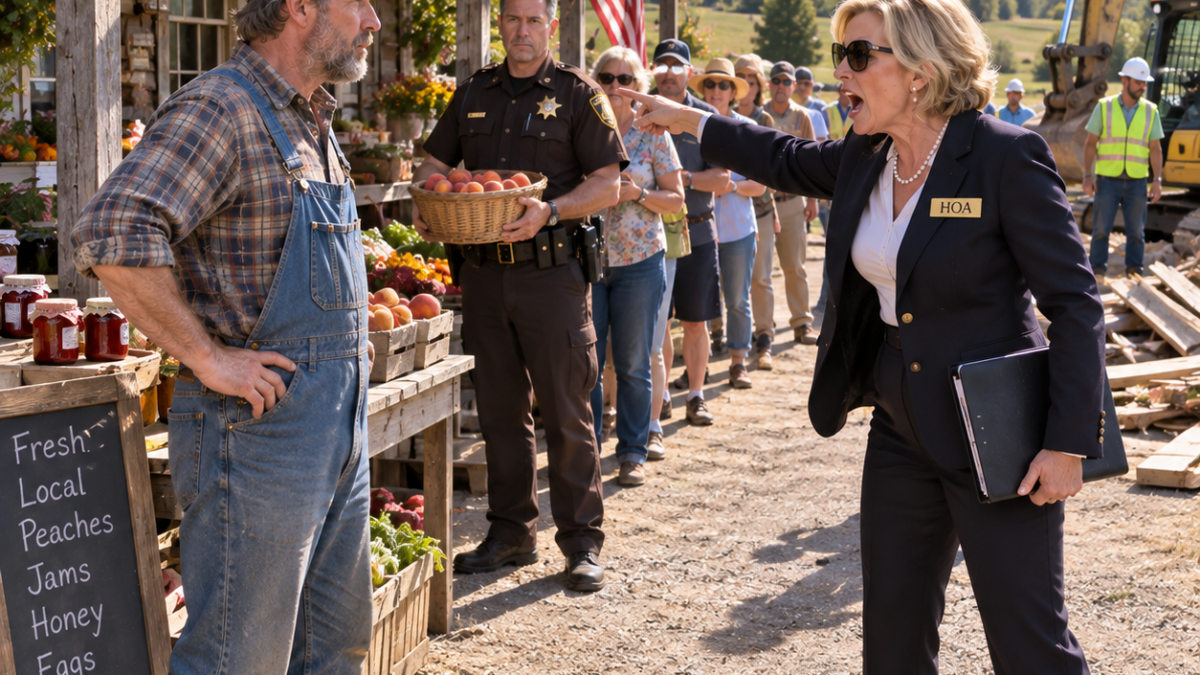
Sheriff Bennett did not raise his voice.
That was what made everyone hear him.
He stepped out of line, walked down from the porch, and stopped on the gravel between Dean Pritchard and the trailer.
His hands stayed loose at his sides.
He didn’t touch his radio.
He didn’t put one hand on his belt.
He simply looked at the skid steer, then Dean, then Celeste.
“Hold up a minute.”
Dean stopped with one boot on the trailer ramp.
Celeste turned too quickly.
“Sheriff, this is an association compliance matter.”
Bennett nodded once.
“Maybe.”
That one word changed the air.
Across County Road 18, two Wexford Fields volunteers in matching Harvest Homes badges stood beside a golf cart.
They had been pretending not to watch.
Now they were staring openly.
Mrs. Taggart held her canvas grocery bag against her chest.
Laya Boon had shifted closer to her car because her baby was asleep in the back seat.
Mr. Hollis stood near the honey shelf holding a jar he had not yet paid for.
I stayed behind the counter because my knees had started feeling unreliable.
Sheriff Bennett looked at Dean.
“You’re the contractor?”
“Yes, sir. Dean Pritchard. Pritchard Property Services.”
“You’re here to remove that sign?”
Dean glanced at Celeste.
“And portions of the roadside structure. That’s the work order.”
“Who issued the order?”
It was such a small question.
No drama.
No accusation.
Just six words.
Celeste lifted the red-striped packet.
“The association issued compliance direction under its authority over the entrance corridor.”
Bennett kept looking at Dean.
“That isn’t what I asked him.”
Dean swallowed.
Celeste’s voice sharpened.
“Sheriff, with respect, this is private association enforcement. Ms. Reigns has been noticed repeatedly.”
Bennett finally looked at her.
“Authorized by who to enter her farm and remove her structure?”
“The structure is a nuisance.”
“Did Marrow County issue a removal order?”
Her chin lifted.
“County nuisance provisions are referenced in the compliance materials.”
“That is not the question.”
The silence after that seemed wider than the road.
Celeste looked toward the volunteers across the way.
I could almost see the calculations happening behind her expression.
Preview traffic.
Realtors.
Residents.
Witnesses.
She had spent three weeks controlling the language.
Entrance experience.
Visual clutter.
Roadside nuisance.
Presentation concern.
County review.
All soft phrases.
Official-sounding phrases.
But Sheriff Bennett wasn’t asking for language.
He was asking for paper.
Dean stepped down from the trailer.
“I received the work order from Kingsley Community Management,” he said. “They sent me the packet. I was told the HOA had authority.”
Celeste snapped her head toward him.
“Dean.”
He lifted both hands slightly.
“I’m not saying anything that isn’t true.”
Sheriff Bennett looked at me.
“Ms. Reigns, do you have anything you want me to look at?”
Only then did I reach beneath the counter.
The folder was exactly where Aaron had always told me to keep it.
County Farm Store.
His handwriting was still on the tab.
Square letters pressed so deeply into the cardboard I could feel the grooves beneath my thumb.
I carried the plastic sleeve down the porch steps.
Inside were the county zoning determination, Francis Ellery’s email from the day before, my preservation notice, the farm direct-sales registration, and the certified agricultural-adjacency disclosure.
“My store is approved for agricultural direct sales,” I said.
My voice sounded steadier than I felt.
“County planning confirmed yesterday that there is no active nuisance case, no abatement order, and no county-issued removal order involving this property.”
I handed him Francis’s email.
“I also sent written notice to Wexford Fields, Kingsley, and Mr. Pritchard that no removal was authorized.”
Bennett read.
Celeste made a small impatient sound.
“She has been sending selective documents all week.”
Bennett did not look up.
“This is from Marrow County Planning.”
“Yes.”
“Francis Ellery?”
“Yes.”
He read another line.
Then another.
Finally he said, “It states the red-striped document you forwarded is not a county-issued removal order.”
Celeste crossed her arms.
“That does not resolve the association’s nuisance authority.”
Bennett folded the email back into the sleeve.
“May I see the packet you gave the contractor?”
For the first time since she arrived, Celeste hesitated.
Only briefly.
But everyone saw it.
“This contains internal association material.”
“You referenced county nuisance enforcement while directing a contractor to remove private property.”
“I did not say the county ordered removal.”
Mrs. Taggart spoke from the porch.
“Yes, you did.”
Her voice trembled.
She did not.
“You said County Nuisance Enforcement.”
Laya nodded.
“You did.”
Celeste turned toward them.
“Residents are misunderstanding a complex matter.”
Sheriff Bennett held out his hand.
Dean walked back to the truck before Celeste could stop him.
He retrieved the folder from the cab and handed it over.
“This is what I got.”
Bennett opened the packet on the hood of the flatbed.
The top sheet had a red stripe and the title:
ENTRANCE CORRIDOR COMPLIANCE SUMMARY.
Below it were photographs of my farm store.
Cropped photographs.
The orchard behind the building had been cut out.
The county road was barely visible.
My gravel pull-off had been circled in red.
My hand-painted sign was labeled:
VISUAL NUISANCE.
Bennett turned one page.
Then another.
“No county case number.”
Another page.
“No county signature.”
Another.
“No court order.”
Another.
“No owner authorization.”
He looked at Dean.
“Do not unload that skid steer.”
Dean nodded immediately.
“Understood.”
Celeste stepped forward.
“Sheriff, you are interfering with association business.”
“No.”
Bennett closed the packet.
“I’m preventing a property dispute from becoming an unlawful removal while I’m standing here watching it happen.”
Nobody moved.
Across the road, a golf cart slowed near the Wexford entrance.
Two realtors sat beneath the brushed-gold Harvest Homes banner.
They stopped pretending not to watch.
Bennett took out a small black notebook.
“Ms. Warrick, I’m documenting that you presented this as a county-related nuisance matter, directed a contractor to remove property, and could not provide a county order, court order, or owner authorization.”
“That is not accurate.”
“Then I’ll include your statement too.”
He held up the red-striped packet.
“Do you want this document included in the incident report exactly as presented?”
Celeste opened her mouth.
Nothing came out.
The only sound for several seconds was the hum of the egg cooler behind me.
Then a peach shifted inside one of the baskets with a soft thump.
Celeste finally said, “The association reserves all rights.”
Bennett nodded.
“I’m sure it does.”
Dean folded his orange vest over one arm.
“I’m going to move the truck.”
“Good idea.”
The skid steer never touched the ground.
The flatbed backed away from my gravel entrance and parked on the county shoulder.
The two Wexford volunteers climbed into their golf cart and disappeared behind the landscaping.
The realtors across the road suddenly became fascinated with arranging name tags.
My knees started shaking hard enough that I went back behind the counter before anyone noticed.
Mrs. Taggart noticed anyway.
She reached over and put two fingers on my wrist.
“Breathe, honey.”
I did.
It hurt.
Sheriff Bennett took statements from Dean first.
Then me.
Then Mrs. Taggart.
Then Laya.
He photographed the packet, the work order, the trailer, the skid steer, my sign, and the county documents.
What struck me most was what he did not do.
He did not treat Celeste like a criminal.
He did not shout.
He did not threaten handcuffs.
He treated her like a person whose words now had to be written down accurately.
That frightened her more than anger would have.
When he finished, he returned to the counter.
His peach basket was still sitting where he left it.
“I need to pay for these.”
For the first time all morning, I almost smiled.
“Sheriff, after all that—”
“Molly.”
His voice softened.
“Don’t make me steal peaches in uniform.”
The laugh that came out of me sounded broken.
But it was still a laugh.
He paid cash.
I gave him a receipt.
Then he wrote the incident number on the back of one of my paper bags.
“Keep this.”
“I will.”
“You did the right thing calling the county before today.”
“I didn’t call you.”
“I know.”
He lifted the peaches.
“I was buying breakfast.”
Then he walked out.
I watched his sheriff’s SUV pull back onto County Road 18.
Only after it disappeared did I let myself sit on the stool behind the register.
My hands would not stop shaking.
Laya stood near the counter.
Her baby was still sleeping in the car, visible through the open store doorway.
“I’m sorry,” she said.
“For what?”
“For buying into all of it.”
“You didn’t send the contractor.”
“No.”
She looked toward Wexford Fields.
“But I bought the story.”
I followed her gaze.
Across the road, the subdivision entrance had been decorated to look like a farm.
Bales of straw.
Decorative corn bundles.
Perfect pumpkins.
Fake apples in wooden baskets.
A chalkboard sign advertising:
FARMHOUSE WELCOME STATION.
Thirty yards away, my actual farm store had almost been torn down for conflicting with the entrance experience.
“You know what I finally understand?” I said.
Laya looked at me.
“Celeste doesn’t hate farms.”
“No?”
“She hates farms she doesn’t control.”
Laya’s eyes went to the fake apple baskets.
Then she laughed once.
Quietly.
Sadly.
“Yeah.”
The roadside-sales post disappeared from the Wexford portal before noon.
No correction.
No apology.
It simply vanished.
That told me more than an apology would have.
People delete things quickly when lawyers start asking who wrote them.
On Monday morning, Kingsley Community Management emailed me.
The tone had changed completely.
No “available remedies.”
No “entrance corridor presentation.”
No warning about “continued nuisance activity.”
The message said:
The matter is under review by association counsel. No vendor activity will proceed pending verification of authority.
I printed it.
Put it in Aaron’s folder.
On Tuesday, Francis Ellery from Marrow County Planning sent a formal clarification letter.
Not just to me.
To Kingsley.
To Wexford Fields.
To Celeste.
She stated that Rains Farm Store had no active county nuisance case.
No abatement order.
No removal authorization.
She also wrote one sentence I read three times.
County code terminology must not be presented in a manner that implies county enforcement where no such enforcement action exists.
That was Francis’s professional way of saying:
Stop borrowing our authority.
By Wednesday morning, Laya sent me a screenshot.
A new portal message had appeared.
CORRECTION REGARDING ENTRANCE CORRIDOR NOTICE.
The association acknowledged that prior communications “may have caused confusion regarding county involvement.”
That phrase made me laugh.
Confusion.
As if confusion had rented a flatbed.
As if confusion had loaded a skid steer.
The post confirmed there was no county removal order.
It told residents not to assume Rains Farm Store was operating unlawfully.
It said future communications involving neighboring agricultural parcels would require management review and board verification.
Celeste’s name did not appear.
The violation letter was withdrawn later that afternoon.
The threatened removal costs were removed.
Kingsley initially tried to note the reversal on my “owner account.”
I had to explain twice that I did not have an owner account.
I did not belong to Wexford Fields.
That had been the problem from the beginning.
They had treated proximity like jurisdiction.
The subdivision had grown up beside my farm and eventually forgotten which one existed first.
Three weeks earlier, none of this had seemed possible.
Back then, the farm store still appeared on the front page of an old Wexford sales brochure.
I had found the brochure while cleaning out the drawer beneath the register.
Aaron kept things.
Receipts.
Old seed catalogs.
Price cards.
Bent screws that “might fit something later.”
The brochure was inside a clear sleeve beneath cards advertising three-dollar tomato baskets.
The photograph showed our store in early summer.
White shed.
Peach trees.
Aaron standing in the doorway with one hand on the frame.
He was healthy in that picture.
Not young.
But healthy.
Before the hospital rooms.
Before the medication trays.
Before he stopped carrying fifty-pound feed sacks because he could no longer pretend thirty pounds wasn’t heavy.
Beside the photograph, Wexford Fields had printed in gold letters:
LUXURY HOMES SURROUNDED BY AUTHENTIC FARM-COUNTRY CHARM.
Authentic.
I remember sitting there staring at the word after Celeste’s first warning arrived.
When Wexford Fields was only stakes in dirt and a temporary sales trailer, the developers loved us.
They asked permission to photograph the orchard.
They bought honey for open houses.
One sales agent asked Aaron if she could set peach baskets beside the model-home fireplace.
He stared at her.
“Peaches?”
“Yes.”
“By a fireplace?”
“For atmosphere.”
Aaron came home laughing so hard he could barely explain it.
“They’re selling roots now, Molly.”
He let them use the baskets.
He was proud that the little store made the new neighborhood feel established.
He wrote RAINS FARM STORE across the wooden sign himself.
Green paint.
Two coats.
Then one more because he didn’t trust the first two.
After he died, people told me I did not have to keep the store.
They meant it kindly.
Running an orchard alone was hard.
Bookkeeping.
Pruning.
Irrigation.
Packing.
Egg pickup.
Market permits.
Preserve batches.
The store added hours I didn’t need.
I could sell wholesale.
Lease the trees.
Sell the road frontage.
Rest.
Everyone offered rest.
Closing the store felt like letting silence take another room.
So I kept Saturdays.
Sweep the porch before sunrise.
Eggs in the cooler.
Honey where morning light could hit the jars.
Preserves labels forward.
Peaches sorted gently.
Aaron always said customers bought honey with their eyes before their mouths.
I had thought that was nonsense until I tried putting the jars in shadow.
He was right.
The store was not profitable enough to make me rich.
It was important enough to keep me moving.
Then one Tuesday morning, Laya Boon walked onto the porch carrying her baby.
She had the expression people wear when they are about to tell you something they wish they didn’t know.
“Molly?”
“Yes?”
“Are you opening during Harvest Preview weekend?”
“I open every Saturday.”
She looked across the road.
Wexford crews were planting white flowers around the entrance sign.
“People are talking.”
“About what?”
She shifted the baby higher.
“The entrance corridor.”
I thought she meant road construction.
Then she said:
“Celeste called the store visual clutter.”
I remember repeating it.
“Visual clutter?”
Laya winced.
“I probably shouldn’t have said anything.”
“No.”
I put down the carton of eggs I was holding.
“I’d rather know.”
She bought two dozen eggs she did not need.
After she left, I stood on the porch and looked across at Wexford Fields.
Fresh mulch.
White flowers.
Stone monument.
A new temporary arch advertising Harvest Homes.
Everything clean.
Coordinated.
Expensive.
Then I looked at my store.
Dust on the porch.
Peach crates.
Green sign.
Tin roof.
Real dirt where customers stepped out of trucks.
The next afternoon, a Wexford sales van slowed at my entrance.
Celeste sat in the passenger seat with a tablet.
She looked at my store.
Then the entrance sign.
Then typed something.
I waved.
She didn’t.
The first warning arrived two days later.
The envelope carried the Wexford logo.
Dear Ms. Reigns,
Rains Farm Store constitutes an unauthorized roadside commercial use, unapproved structure, and presentation concern within the Wexford Fields entrance corridor.
The association has received complaints regarding traffic, signage, and nuisance activity.
Continued operation during Harvest Homes preview weekend may cause confusion for invited guests and prospective buyers.
Then the bold sentence.
You are directed to cease public sales and remove the unauthorized farm store display within seven days.
I read it.
Then read it again.
The old brochure was sitting three feet away.
The same store was “authentic charm” when they were selling homes.
Now it was a presentation concern.
I wanted to write Celeste immediately.
Something cruel.
Something about Aaron.
Something about fake country people using real farmers as scenery.
But Aaron had a saying.
“Anger makes bad paperwork.”
Whenever a supplier sent us something stupid, he would tell me:
“Read it. Work outside. Come back when your jaw stops moving.”
So I did.
I moved irrigation hose until dusk.
When I came back inside, I read the letter again.
Then I noticed what it did not say.
It never said my farm was part of Wexford Fields.
Because it wasn’t.
Rains Farm had existed almost forty years before the first subdivision lot.
The only legal relationship between us was a limited frontage-maintenance agreement Aaron had signed when developers widened the entrance shoulder.
Wexford could mow the shared shoulder.
Maintain the ditch.
Clear the culvert.
That was it.
They couldn’t regulate my porch.
Couldn’t approve my sign.
Couldn’t turn a peach sale into an HOA violation.
The next morning, I photographed the Wexford entrance.
White flowers.
Gold banner.
Directional signs.
Temporary decorations.
Celeste was standing beside a landscaping crew.
“I’m documenting the entrance changes,” I told her.
“There’s no reason to make this adversarial.”
“I received a letter telling me to remove my farm store.”
“You received a courtesy warning before enforcement.”
“My farm isn’t a Wexford lot.”
“Your frontage is tied to association-maintained entrance property.”
“The ditch is.”
She tapped her tablet.
“The association has broad authority to protect the presentation of the entrance corridor.”
“Show me.”
Her smile changed.
“Legalistic conversations create unnecessary tension.”
“I’m asking what rule you’re using.”
“We have responsibility for the entrance experience.”
The entrance experience.
Not a recorded covenant.
Not a zoning ordinance.
An experience.
Then she did something I still remember more clearly than the removal order.
She lowered her voice.
“Molly, I understand this store means something to you. Everyone knows that. But grief doesn’t exempt property from community impact.”
For one second, I could not breathe.
Aaron’s name was nowhere in the conversation.
She had brought him into it anyway.
I put my phone into my pocket.
“Do not use my husband to sell your point.”
Her face changed.
Just slightly.
Enough.
“I’m trying to spare you embarrassment.”
“No.”
I looked across at the perfect entrance.
“You’re trying to remove the only real farm thing from a neighborhood selling farm charm.”
She walked away.
That afternoon, Laya sent me a screenshot from the resident portal.
ENTRANCE CORRIDOR UPDATE — ROADSIDE SALES ACTIVITY.
It said the association had received complaints about unauthorized commercial activity.
It said the roadside farm store was “under review for county nuisance concerns.”
Residents were advised not to encourage noncompliant activity.
My name wasn’t mentioned.
It didn’t need to be.
Customers started hesitating.
Two vehicles pulled into my gravel area, then backed out.
One woman stopped, stared at the store, and drove away.
That hurt more than Celeste’s letter.
Paper stays on paper.
A portal post puts suspicion into other people’s faces.
I saved the screenshot.
Then I pulled Aaron’s old County Farm Store file.
There were three internal folders.
Zoning.
Sales and taxes.
Food labels and product records.
The zoning letter was on top.
Marrow County Planning and Zoning.
Eight years old.
Accessory agricultural retail use permitted for direct sale of farm-produced goods from existing agricultural parcel.
One sentence.
Plain.
One document said permitted.
One HOA letter said unauthorized.
Only one came from somebody empowered to decide.
I kept going.
Farm direct-sales registration.
State tax certificate.
Cottage-food registration.
Batch logs.
Label approvals.
Frontage agreement.
Then behind that agreement I found something I had forgotten.
WEXFORD FIELDS AGRICULTURAL ADJACENCY DISCLOSURE.
Recorded buyer notice.
The second paragraph said Wexford purchasers acknowledged proximity to active agricultural parcels, including orchards, farm stands, seasonal produce sales, machinery movement, dust, bees, odors, and early-morning operations.
Farm stands.
Their own disclosure warned buyers that farm stands existed beside them.
The same HOA telling residents my store might be illegal had sold houses with documents saying the opposite.
I sat in Aaron’s chair for a long time.
Then I emailed Celeste.
Kingsley Management.
The Wexford board secretary.
I attached everything.
County zoning approval.
Farm registration.
Tax certificate.
Cottage-food paperwork.
Frontage agreement.
Agricultural-adjacency disclosure.
Then I asked one question:
Please identify the specific recorded covenant, county order, court order, or other lawful authority permitting Wexford Fields HOA or its agents to direct removal of Rains Farm Store.
I wrote another sentence.
You already knew.
Then deleted it.
Aaron would have.
The reply came at 6:18 the next morning.
Your repeated reliance on selective documents does not alter the association’s responsibility to protect owners from nuisance activity and preserve entrance-corridor presentation.
The board is reviewing available remedies.
No attachment.
No rule.
No case number.
No order.
I drove to the county recorder and obtained a certified copy of the agricultural-adjacency disclosure.
The county clerk turned her monitor toward me.
“It’s recorded with the buyer packet.”
“The original packet?”
“Yes.”
“Still part of resale disclosure?”
“Looks that way.”
The printer started.
She handed me the stamped copy.
Wexford’s own logo sat at the bottom.
Celeste was not merely ignoring my paperwork.
She was ignoring hers.
The next morning, Wexford began decorating itself like a farm.
Hay bales.
Decorative corn.
Pumpkins.
Fake apples.
A “Farmhouse Welcome Station.”
Across the road, I was cleaning fuzz off actual peaches.
That was when I understood the issue completely.
They wanted country life as long as they could stage it.
Real farms had trucks.
Dust.
Handwritten signs.
Customers.
Unpredictability.
Real farms did not match a color palette.
Later that morning, Laya showed me a message thread.
Someone on the lifestyle committee had written:
Farm stand must be gone before Saturday walkthrough.
Celeste replied:
The preview route cannot include conflicting roadside commercial activity. Kingsley is checking remedy options.
Laya looked sick.
“I thought buying here was part of the point.”
“So did I.”
Fifteen minutes after she left, Celeste walked over.
“I hoped we could speak privately.”
“I’m open.”
She glanced at the customers.
“That is part of the problem.”
“A county-approved farm store being open?”
“A temporary pause would benefit everyone.”
“The preview.”
“Property values.”
“My zoning letter is in your inbox.”
“The board is reviewing it.”
“You told residents I’m under county nuisance review.”
“It is under review.”
“By the county?”
She did not answer.
I asked again.
“Do you have a county case number?”
“Molly, this is becoming unproductive.”
“Do you have a county order?”
“You have been advised of noncompliance.”
“By you.”
She leaned closer.
“You’re confusing sympathy with permission.”
I looked at her Harvest Homes lanyard.
“My store belonged here when you needed brochure photographs.”
“That brochure is outdated.”
“It has your logo.”
“That doesn’t grant an exemption.”
“I don’t need your exemption.”
Her face cooled completely.
“Then whatever happens next is something you chose.”
That evening, an unknown number sent me a photograph.
Vendor: Pritchard Property Services.
Requested by: Kingsley Community Management.
Task: Remove roadside farm stand/display prior to Saturday preview walkthrough.
Under the image, one sentence:
They’re not waiting for permission.
The next morning, before opening, I called Marrow County Planning.
Francis Ellery answered.
I gave her my parcel.
Asked whether there was any nuisance case.
I heard typing.
Then:
“I see the prior zoning determination.”
My hand tightened around the phone.
“Active agricultural parcel. Direct farm sales.”
“Yes.”
“No active zoning violation.”
I sat down.
“No nuisance case?”
“No.”
“Abatement order?”
“No.”
“Removal order?”
“No.”
For a moment, relief made me lightheaded.
Then I looked at the contractor work order.
“Someone has been telling people there’s county nuisance authority.”
Francis paused.
“General inquiries do not create enforcement authorization.”
“If the county had ordered removal?”
“You would have a case number, notice, staff contact, appeal rights, and signed order.”
She said something I wrote down exactly.
“We do not issue demolition permission by rumor.”
I emailed her Celeste’s red-striped packet.
Francis stayed on the line.
A minute later:
“This is not a county document.”
“You’re sure?”
“No county header. No case number. No staff signature. No appeal language. It uses code terminology, but Planning and Zoning did not issue this.”
She emailed me confirmation.
I printed two copies.
One under the counter.
One in Aaron’s folder.
I did not tell Celeste exactly what I had.
Not yet.
At 12:17, Dean Pritchard called.
“I’m confirming Saturday access.”
“What access?”
“The removal job.”
“There is no removal order.”
“I’m going by what they sent.”
“What did they send?”
“Compliance packet. Maps. Photos. Work order.”
“County case number?”
“I don’t remember one.”
“Court order?”
“No.”
“Permission from me?”
“No.”
“Then why are you coming onto my farm?”
Silence.
Dean wasn’t cruel.
That mattered.
He sounded like a contractor suddenly realizing the client had placed him in the middle of a legal boundary dispute.
“I do association cleanups all the time,” he said. “Signs. Sheds. Dumped furniture.”
“This is not association property.”
“I’m calling Kingsley.”
“Please do.”
An hour later, he texted.
Board says they have authority. Job remains scheduled.
So I called Kingsley.
A compliance manager named Marian Stratton answered.
I asked who authorized entry onto my farm.
She said the board had delegated compliance authority.
I asked whether the county had issued removal authorization.
She told me to review the materials already provided.
“The county confirmed this morning there is no case, no order, and no removal authorization.”
Silence.
Then:
“Submit supplemental documents.”
“I already have.”
“They will be reviewed.”
“The contractor is scheduled Saturday.”
“Then I suggest you avoid interfering with association vendors.”
My screwdriver fell from my hand.
I had been kneeling beside the egg cooler.
It hit the concrete with a sharp clatter.
I stood.
“Marian, listen carefully.”
She went quiet.
“Rains Farm Store is private agricultural property. Wexford Fields has no county order, no court order, and no owner authorization for removal. Any contractor entering for that purpose will be unauthorized.”
“Your position is noted.”
“My position is documented.”
I hung up.
Then I sent written preservation and no-entry notice to everyone.
Celeste.
Kingsley.
Board secretary.
Dean.
No destruction.
No alteration.
No entry for removal.
Preserve every email, work order, photograph, notice, and communication.
Saturday morning came anyway.
I slept two hours.
At 5:30, I put on Aaron’s old work shirt.
At 6:15, I opened the store.
Eggs.
Honey.
Preserves.
Peaches.
County folder under the counter.
Everything normal.
I needed normal.
Mrs. Taggart arrived at 6:40.
“You didn’t have to come.”
“I needed eggs.”
“You bought eggs yesterday.”
“I bake when I’m angry.”
Mr. Hollis came for honey.
Laya came for peaches.
Then at 7:10, Sheriff Cal Bennett pulled in.
For a second, everyone went quiet.
He stepped out in uniform.
“Morning, Molly.”
“Morning, Sheriff.”
“You got early Red Havens?”
“First crates.”
“My sister says she can tell yours from grocery peaches across a room.”
“She can.”
He picked up a basket.
That was it.
He didn’t ask about Celeste.
He didn’t ask about removal.
He stood in line.
A customer.
Then Dean’s truck came over the rise.
Celeste behind him.
And the entire week collapsed into ten minutes.
After Sheriff Bennett stopped the removal, I thought I would feel victorious.
I didn’t.
I felt exhausted.
That night, I carried Aaron’s folder into the house and left it on the kitchen table.
The old clock above the pantry was still five minutes slow.
Aaron’s mother had owned it.
No matter how often he adjusted it, the clock lost five minutes.
He used to say:
“Some things just insist on being themselves.”
I sat there looking at his handwriting.
County Farm Store.
Then I cried.
Not because of Celeste.
Not entirely.
Because for three weeks I had been defending a building everyone else saw as lumber, permits, signage, and commercial use.
To me it was a Saturday morning with Aaron still inside it.
The porch boards we sanded.
The shelf he built slightly crooked.
The little nail near the door where he hung his hat.
The green sign.
The bell.
Every time Celeste called it clutter, I heard her reducing pieces of him into a presentation problem.
That was what hurt.
The law mattered.
Ownership mattered.
But grief makes arguments about property feel like arguments about memory.
On Friday, Dean Pritchard returned.
No truck.
No skid steer.
He parked properly in the gravel pull-off.
Walked inside.
Picked up a jar of apple butter.
Then stood at the counter holding his cap in both hands.
“I should’ve pushed harder before I showed up.”
“You stopped when it mattered.”
“I almost didn’t.”
“But you did.”
He looked around the store.
“I changed our intake form.”
“What does that mean?”
“No association removals unless we receive recorded authority, owner authorization, court order, or government order.”
“In writing?”
“In writing.”
I nodded.
“That’s a good change.”
He paid for the apple butter.
Then hesitated.
“Was your husband the one who built this?”
“Mostly.”
Dean ran one finger along the edge of the counter.
“Good work.”
“He would’ve liked hearing that.”
Two weeks later, I installed a small metal placard beside the store door.
RAINS FARM STORE.
COUNTY-CONFIRMED AGRICULTURAL DIRECT SALES.
ESTABLISHED BY AARON AND MOLLY REIGNS.
I had debated including our names.
Then I decided I was tired of people treating the store like it appeared out of nowhere.
I screwed the placard into the wall.
Then ran my thumb over Aaron’s name.
The letters blurred.
I stayed there until I could see them again.
Wexford Fields adopted new rules after the incident.
Any enforcement action affecting neighboring agricultural parcels required full board review.
Legal verification.
Written authority.
Kingsley Management could not independently dispatch a vendor for removal.
The entrance committee could still choose flowers.
Banners.
Preview signs.
Fake apples if they wanted.
It could not turn appearance preferences into demolition orders.
Celeste stayed on the committee.
People expected me to care.
I didn’t.
I cared about the paperwork changing.
I cared that the agricultural disclosure returned to the front of Wexford’s buyer packet.
I cared that new owners were plainly told they were buying beside a working farm.
I cared that customers stopped looking over their shoulders before parking.
The first Saturday after the correction, people returned slowly.
Mrs. Taggart brought muffins.
Laya brought the baby.
Mr. Hollis bought honey.
A couple I had never met came from the far side of Wexford and purchased tomatoes, eggs, and two jars of preserves.
The woman looked at the metal placard.
“That new?”
“Yes.”
“Looks official.”
“It is.”
She smiled.
“Good.”
At 11:30, a pickup pulled into the gravel.
Sheriff Bennett stepped out.
Jeans.
Faded Marrow County softball shirt.
No uniform.
No badge visible.
No duty belt.
Just Cal.
He walked inside and squinted at the preserve shelf.
“You got any peach left?”
“One jar.”
He picked it up.
“My sister will say I waited too long.”
“She’ll be right.”
He smiled.
“I hate that.”
I put the jar into a paper bag.
He looked toward the doorway.
The old green farm-store sign moved slightly in the breeze.
“You doing okay?”
It was the first time he had asked.
Not during the incident.
Not while taking statements.
Now.
When he was off duty.
I folded the top of his bag.
“Most days.”
He nodded.
“That’s usually the honest answer.”
I stamped the bag with the old green ink stamp Aaron had ordered years ago.
RAINS FARM STORE.
The lettering was fading.
I should have replaced it.
I hadn’t.
Sheriff Bennett looked at the imprint.
“Old stamp?”
“Very.”
“Keep it.”
“I plan to.”
He picked up the bag.
Then looked back at me.
“For what it’s worth, I really was just there for peaches.”
“I know.”
“People keep telling my sister I planned the whole thing.”
“You standing in line with fruit was pretty dramatic.”
“I had no idea.”
“That made it better.”
He laughed.
Then the bell over the door rang when he left.
For weeks, that sound had made my stomach tighten.
The first warning.
Celeste’s visits.
Customers hesitating.
Dean’s truck.
Every bell had felt like the beginning of another problem.
That morning, I heard it the way Aaron used to.
A customer leaving.
Another one coming.
A normal Saturday.
Later, after closing, I carried the empty peach baskets onto the porch.
Across County Road 18, the Harvest Homes banner was gone.
The fake hay bales had been removed.
The pumpkins disappeared.
The white flowers remained.
Wexford Fields looked like a subdivision again.
My orchard looked like an orchard.
Neither one needed to pretend to be the other.
Laya stopped by while I was sweeping.
Her baby was awake this time, kicking both feet against the car-seat straps.
“Molly?”
“Yes?”
“They changed the buyer packet.”
“I heard.”
“The farm-disclosure page is first now.”
“Good.”
She leaned against the porch post.
“I used to think property value meant everything looked controlled.”
I swept peach leaves toward the step.
“And now?”
She looked across at the subdivision.
“Maybe it means you know what you’re buying beside.”
“That helps.”
She smiled.
“My husband wants to bring his parents Saturday.”
“Tell him we open at sunrise.”
“He says that’s too early.”
“Then he gets the bruised peaches.”
Laya laughed.
After she drove away, I stayed on the porch.
The late sun came through the peach trees.
Honey jars glowed inside the window.
Aaron had been right about that.
They always did look better in light.
For a long time after his death, I thought keeping the store open meant keeping him with me.
Maybe part of it did.
But that wasn’t the whole truth anymore.
The store had become mine too.
My Saturdays.
My decisions.
My fight.
My customers.
The green letters were his.
The hands opening the door at sunrise were mine.
I touched the little metal county placard beside the door.
Then I went inside.
The certified farm-store paperwork stayed in the plastic folder beneath the counter.
Not because I expected another skid steer.
Because proof is easier to keep than to rebuild.
Beside the folder, I kept the old Wexford brochure.
Authentic farm-country charm.
I could have thrown it away.
I didn’t.
Not as evidence against them.
As a reminder.
There is a difference between loving the idea of something and respecting the thing itself.
Wexford Fields had loved the idea of farms.
Until the farm refused to become scenery.
They had loved the store when it made their development look rooted.
Until it reminded buyers those roots belonged to somebody else.
Aaron would have understood that immediately.
He never cared whether the neighborhood liked the farm.
He cared whether people respected the fence line.
The deed.
The work.
The truth.
I locked the cash box.
Turned off the cooler light.
Then stepped onto the porch.
The bell rang once behind me.
Soft.
Ordinary.
I looked across County Road 18 toward Wexford Fields.
Then back at the orchard.
Nothing had moved.
Nothing had been torn down.
The farm store stood exactly where Aaron and I had built it.
And after weeks of official-looking letters, staged photographs, whispered rumors, and one contractor sent to erase it before a sales tour, that simple fact felt bigger than any victory speech could have.
The store was still open.
And this time, nobody across the road could pretend they had the authority to decide otherwise.








