By sunrise, the woman who had shut down our neighborhood watch was standing barefoot behind police tape, staring at her black SUV balanced on four concrete blocks.
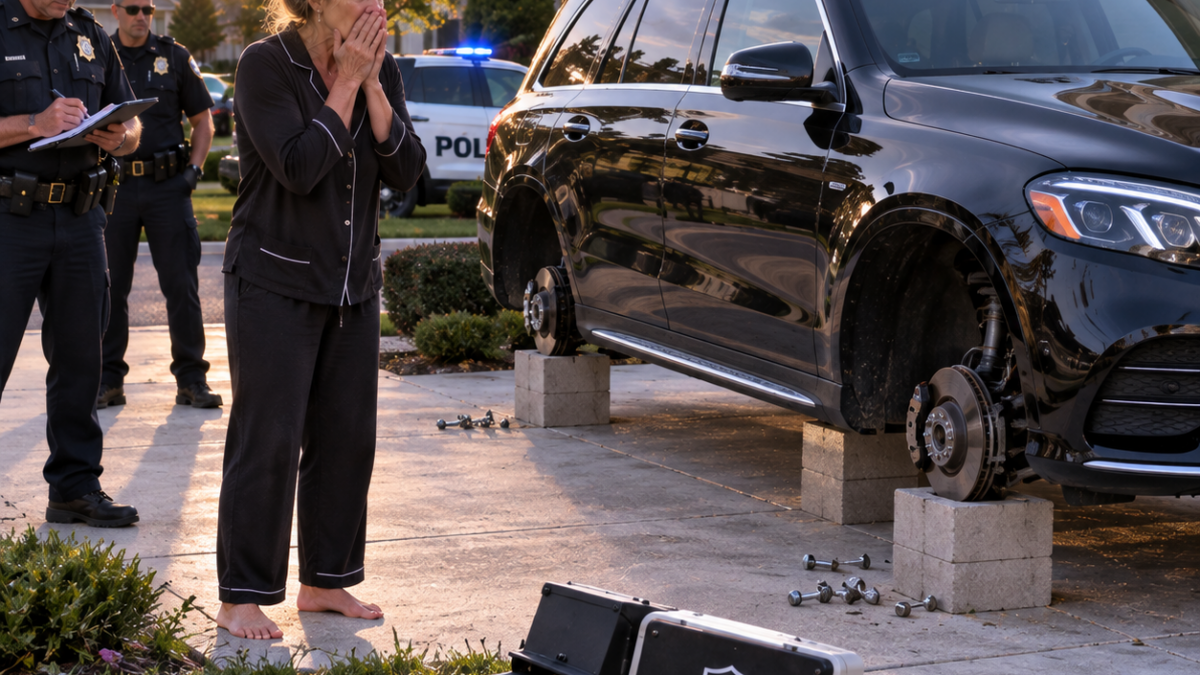
Keisha’s finger froze above the mouse.
Nobody in the conference room moved.
Outside the glass wall, workers were tying cream-colored banners between temporary posts for Fairhaven Trace’s “Luxury Resale Weekend.” The banners moved gently in the morning breeze.
Inside, the room had gone still.
Cedric Hall, our HOA president, leaned toward the monitor.
“Deleted by whom?”
Keisha clicked the administrator detail.
“No individual name,” she said. “It records the administrator role.”
“What role?”
She swallowed.
“Resident Experience and Communications.”
Every eye went to Lucinda.
She sat perfectly straight, one hand resting on the glossy resale packet she had brought into the meeting.
“That proves nothing by itself,” she said.
And technically, she was right.
A committee account could be used by more than one authorized person.
I had learned a long time ago that suspicion was not evidence just because it made emotional sense.
“The report didn’t delete itself,” I said.
Lucinda turned toward me.
“You’ve wanted to say this is my fault since you saw my SUV.”
“No.”
“You’re enjoying this.”
That accusation surprised me enough that I almost laughed.
Instead, I looked through the glass wall at the event workers outside.
One of them pulled a banner tighter.
“I would rather your wheels still be on your car.”
Her jaw tightened.
Cedric held up a hand.
“This isn’t helping. Keisha, show us what happened to the report.”
She opened the routing history.
Our watch system looked simple on a resident’s phone.
A volunteer tapped “Neighborhood Watch Report,” entered the time, location, description, and optional image, then submitted it.
But behind that button, the report split into two paths.
The first path was private.
It went to Sentinel Row Security and the management office.
The second path was public-facing.
Management could turn a report into a sanitized resident notice if there was a legitimate safety reason to do so.
No names.
No license plates.
No accusations.
If someone reported a vehicle checking garage doors at 2:00 a.m., security got the detailed observation.
Residents might only receive something like: “Security is reviewing unusual vehicle activity in the west section. Please secure garages and report relevant observations.”
Lucinda had always hated that second part.
She believed even sanitized notices made Fairhaven Trace look dangerous.
What she apparently had not understood—or had chosen not to understand—was that the public notice was only half the system.
Keisha opened Hannah’s first report.
11:38 p.m.
Received.
11:51 p.m.
Reclassified: fear-based content.
11:53 p.m.
Resident notice removed.
11:54 p.m.
Private security intake closed.
Andre Velasquez, the Sentinel Row supervisor, was attending by video.
He leaned toward his camera.
“Closed?”
Keisha nodded slowly.
“You never received it?”
Andre shook his head.
“No.”
Lucinda crossed her arms.
“There was no crime in the report.”
“That isn’t the threshold,” Andre said.
“It was a van driving slowly.”
“It was repeated unusual vehicle movement late at night. We review it. That’s our job.”
“And what would you have done?”
“Compared it against gate activity, patrol logs, vendor schedules, and any matching reports.”
Lucinda gave a small, frustrated laugh.
“So every delivery driver gets investigated?”
“No,” Andre said. “Information gets checked.”
That distinction was why I respected him.
He had spent twenty years in private security and had no patience for neighborhood cowboys.
When I first proposed the watch program two years earlier, Andre had rejected my original draft because I had used the phrase suspicious vehicle.
“Suspicious according to whom?” he had asked.
I changed it.
Our charter eventually became almost boring in its precision.
Describe behavior.
Describe time.
Describe direction.
Describe visible characteristics.
Do not assign motive.
Do not identify guilt.
Do not pursue.
Do not confront.
Do not detain.
One volunteer had broken that rule the previous year by posting a license plate publicly.
I removed him myself.
Lucinda knew that.
But her objection had never really been about discipline.
Three weeks before her wheels disappeared, Fairhaven Trace had begun preparing for its biggest resale event in years.
Several high-end homes were going on the market at once.
Real estate agents had coordinated tours.
The HOA had approved decorative banners, temporary catering tents, fresh landscaping, and additional cleaning crews.
Then two watch reports mentioned service vehicles behaving unusually around the west loop.
No crime occurred.
One turned out to be a moving truck searching for the correct address.
The second van left before security reached it.
Lucinda took both incidents as evidence that the watch was harming the neighborhood’s image.
“Buyers see warnings,” she told me at a committee meeting, “and they assume crime.”
I remember answering, “Removing a warning doesn’t remove whatever caused it.”
She stared at me over a polished conference table.
“It can remove unnecessary panic.”
Now, in the same room, we were looking at an unnecessarily deleted report.
Cedric turned to Keisha.
“Who had authority to close the private security route?”
Keisha didn’t answer immediately.
“That’s what I need to determine.”
Lucinda slid her resale packet aside.
“My committee had authority over resident communications.”
“The public notice,” Keisha said.
“The feature.”
“They aren’t the same thing.”
“They’re accessed through the same feature.”
I watched Cedric’s expression change.
He hated ambiguity.
He was a retired commercial lender, the kind of man who read every footnote before signing anything.
“Bring up the permissions history,” he said.
Keisha did.
At 11:46 p.m. nine nights earlier, the communications administrator account had logged in.
At 11:51, Hannah’s report was classified as fear-based content.
At 11:53, the resident-facing version was removed.
At 11:54, the private security path was closed.
Then Keisha found an action note.
She read it silently.
Cedric noticed.
“What?”
She rotated the screen toward us.
The note said:
Hold vehicle-related watch content pending resale communications review.
Beneath it were two initials.
LB.
Nobody needed them explained.
Lucinda looked at the screen.
“That note concerned resident communications.”
Andre’s voice came from the monitor.
“Then why was my intake closed?”
Lucinda didn’t answer.
The printer behind Keisha suddenly started.
A single page came through.
The sound of the rollers felt absurdly loud.
Cedric picked up the routing record.
“You initiated this?”
“I initiated a review of the watch channel.”
“Did you know it also fed security?”
“I knew management used some reports operationally.”
“That isn’t what I asked.”
Lucinda’s eyes moved toward Keisha.
“The portal presented it as one feature.”
Keisha’s face tightened.
“That may be where my office failed.”
Lucinda seized on it immediately.
“Exactly.”
Keisha held up a hand.
“I said may.”
Before anyone could continue, voices rose from the lobby.
The deleted report had somehow become neighborhood news.
That was the thing about trying to suppress fear.
Sometimes the empty space became louder than the information you removed.
A woman named Tessa Haines walked into the doorway holding her phone.
Her twelve-year-old daughter caught the school bus before sunrise during winter.
Tessa looked furious.
“You deleted a warning about a van?”
Lucinda stood.
“This is a closed administrative meeting.”
“My daughter walks Harrow Lane in the dark.”
“It wasn’t a warning. It was an unverified resident observation.”
“That security never got.”
More people gathered behind Tessa.
Someone had taken a photograph of Lucinda’s wheel-less SUV.
Someone else had posted Hannah’s old van description.
The pieces were already being assembled publicly.
Badly.
A man near the reception desk said, “Was it one of the landscape companies?”
Another answered, “I saw an irrigation van over there last week.”
That was exactly what I had feared.
I stepped into the lobby.
“Stop.”
Several people turned.
“If you have camera footage, preserve it. If you personally observed something, give it to police or security. Do not start naming contractors.”
Tessa looked at me.
“But Hannah saw the same van twice.”
“She reported matching visible characteristics.”
“That sounds like the same van.”
“It might be. It might not.”
Someone muttered, “Come on.”
I felt the old pressure build behind my ribs.
Years earlier, when my brother Adam was nineteen, a porch package disappeared in our parents’ neighborhood.
A camera captured a dark pickup.
Adam drove a dark pickup.
By lunchtime, a neighbor had posted a photograph of Adam’s truck beside the blurry video.
Different wheelbase.
Different bumper.
Different cab.
Nobody cared.
For three days, strangers slowed in front of my parents’ house.
Someone called Adam a thief at a gas station.
Police later identified a completely different truck.
The original accusation had been shared more than eighty times.
The correction got six reactions.
That experience stayed with me.
Not as trauma.
As instruction.
“I’m not asking you to ignore anything,” I told the residents. “I’m asking you to separate observation from accusation.”
Lucinda came into the lobby behind me.
“This is exactly what I was trying to prevent.”
Tessa turned on her.
“You prevented security from seeing it.”
“That was not my intention.”
The room changed.
Those six words were the first thing Lucinda had said all morning that sounded unrehearsed.
Keisha looked at her.
“Then we need to find out exactly what your intention changed.”
By noon, the police investigator had requested every original video related to the white van.
Hannah brought in the confirmation email from her first report.
It contained something we had forgotten.
An attached still image.
The picture was grainy.
The van was half-turned beneath a streetlamp.
We could see the ladder rack.
The dark break in the right taillight.
The missing rear passenger hubcap.
But one detail mattered more than all of those.
At the edge of the frame stood a blue contractor-gate sign.
Andre leaned toward the monitor.
“That vehicle was headed toward the contractor lane.”
Nine nights later, Hannah had seen a matching van moving the same direction.
That didn’t identify the driver.
But it gave us a route.
Andre, Keisha, and I spent the afternoon collecting timestamps instead of opinions.
At 1:11 a.m. on the theft night, one doorbell camera captured a white service van traveling west on Harrow Lane.
At 1:14, another camera caught it passing closed garages.
Broken right taillight.
Ladder rack.
Missing rear hubcap.
No readable license plate.
Infrared glare turned the plate into a glowing rectangle.
Keisha froze the image.
“That’s close.”
“Close isn’t identity.”
Lucinda stood behind us.
“At least you admit that.”
“I’ve never said otherwise.”
She looked at me.
“You understand what happens if residents see this. Every contractor with a white van becomes a suspect.”
“Which is why they won’t see it unless police release it.”
For the first time all day, we agreed on something.
Then Andre called.
“I found the patrol record.”
We met him at the contractor gate.
Fairhaven Trace had two vehicle entrances.
Residents used the main gate.
Contractors and event vendors used a narrower access lane beside the model-home area.
On a normal night, Sentinel Row’s western patrol vehicle would pass Harrow Lane every several minutes.
But the theft night wasn’t normal.
A landscaping trailer being used for resale weekend had been left partly across the patrol turnaround.
The security driver had attempted the normal loop, found the route blocked, backed out, then taken the longer perimeter road.
He reached the west section at 1:26.
Hannah had seen the van at 1:17.
Lucinda stared at the trailer.
“That belongs to an event contractor.”
Andre nodded.
“It explains the patrol delay.”
“It doesn’t prove the van entered here.”
“No.”
Keisha checked her phone.
“Milo is pulling the gate-controller history.”
Milo Hart worked for GateCore, the company maintaining our access system.
Twenty minutes later, his voice came through the security booth speaker.
“I found something.”
Keisha leaned toward the phone.
“What?”
“Access event at 1:15 a.m.”
Andre looked at me.
One minute after the second camera had seen the white van.
Milo continued.
“And another at 11:39 p.m. nine nights earlier.”
One minute after Hannah’s first report.
Keisha whispered, “Same credential?”
Milo paused.
“Yes.”
The security booth went silent.
“What kind?” Andre asked.
“Temporary contractor code.”
Lucinda looked through the booth window at the line of vendors preparing for the resale weekend.
“Assigned to whom?”
Another pause.
“Blue Arc Irrigation.”
Peter Dawes, a resident who had followed us to the booth, immediately pulled out his phone.
I pointed at him.
“Don’t.”
He frowned.
“What?”
“Do not post that company name.”
“Their code opened the gate twice.”
“A code assigned to them opened the gate.”
“That’s the same thing.”
“No, it isn’t.”
Lucinda surprised me.
“For once, Luke is right.”
Peter stared at both of us.
“You two have spent all day fighting, and now you’re defending a contractor?”
“We’re defending the difference between access and guilt,” I said.
Keisha opened the vendor management software.
Blue Arc had repaired an irrigation line near the model homes.
Normal job.
Valve replacement.
Pressure test.
Cleanup.
Work completed.
Then Keisha stopped.
“What?”
She enlarged the screen.
“The work order closed twelve days ago.”
Three days before Hannah’s first sighting.
Andre read the date.
“They shouldn’t have had access.”
Lucinda shook her head.
“Contractors come back.”
“Not without a reopened work order.”
Keisha opened the service notes.
Blue Arc’s supervisor had signed out at 4:26 p.m.
No follow-up scheduled.
No overnight work.
No return authorization.
Then Milo sent the credential detail.
Temporary vendor.
Expiration rule: work order closure.
Status:
Active.
I stared at that word.
Lucinda did too.
Keisha called Blue Arc’s operations manager.
His name was Warren Norris.
When she explained that a code assigned to his company had been used after midnight, he answered immediately.
“That code should be dead.”
“Did any employee return to Fairhaven Trace after the work order closed?”
“Not under that job.”
“Overnight?”
“No.”
“Could the code have been shared?”
“It wasn’t supposed to be.”
Lucinda leaned toward the phone.
“Not supposed to be?”
Warren’s voice hardened.
“Our crew gets a temporary access credential. When the job closes, management terminates it.”
Keisha slowly turned her screen toward Cedric.
The code was still active.
Warren continued.
“If your system left that credential alive, I need to check our dispatch archive. But I am telling you now, nobody from my office scheduled overnight work.”
Association counsel, who had joined by phone, interrupted.
“Preserve everything. Do not email or text the credential. Provide the records directly to police and management.”
Warren agreed.
When the call ended, Peter folded his arms.
“So their code was used twice and we’re still pretending this doesn’t matter?”
“It matters,” I said.
“Then say what it means.”
“It means the gate accepted a credential assigned to a closed Blue Arc work order.”
“That’s lawyer talk.”
“It’s accurate talk.”
He shook his head.
“You’ve become useless.”
Maybe to him, I had.
But I knew what happened when useful information was turned into premature certainty.
I laid Hannah’s report beside the gate log.
First night.
11:38 p.m.
White service van heading toward contractor lane.
11:39 p.m.
Temporary credential accepted.
Second night.
1:14 a.m.
Matching van passing west garages.
1:15 a.m.
Same credential accepted.
Then I placed the closed work order beside them.
There was a connection.
A real one.
But the connection was to a credential, not a human being.
Andre tapped Hannah’s original report.
“If this had reached us nine nights ago, we would have checked the gate log.”
Lucinda looked at him.
“You don’t know that.”
“Yes, I do. That’s our procedure.”
“And what would you have found?”
“A closed work order with active access.”
“And?”
“We would have asked management to disable it pending review.”
Lucinda’s face changed.
Just slightly.
“You’re saying the theft would not have happened.”
“No,” I said.
She looked at me.
“I’m saying we lost nine days in which the access could have been examined.”
That sentence mattered.
I could have made a stronger accusation.
A more dramatic one.
But it would have been dishonest.
Cedric turned toward Keisha.
“Why was the credential active?”
She searched the work-order history.
Closing a vendor job was supposed to send an automatic termination message to GateCore.
For Blue Arc, the message had never been sent.
Milo confirmed it.
“The controller never received an expiration instruction.”
Lucinda seized on that.
“Then management caused this.”
Keisha did something I respected.
She did not defend herself.
“Yes,” she said. “That is one failure.”
Lucinda blinked.
“One?”
Andre pointed at Hannah’s report.
“This could have exposed the failure.”
Keisha nodded.
“If it had reached security.”
Cedric asked Milo, “Can the code still be used right now?”
“Yes.”
“Disable it.”
Lucinda turned.
“You’re going to suspend contractor access during resale setup?”
“We’re going to suspend one credential tied to a closed job.”
Milo preserved the controller configuration first.
Timestamp.
Permission set.
Access history.
Then he changed Blue Arc’s old credential from Active to Quarantined.
3:18 p.m.
The color changed from green to gray.
I felt relief.
Small relief.
Containment was not resolution.
Then Milo said, “I ran the stale-credential check.”
Keisha leaned closer.
“And?”
“There are three more.”
The room went quiet again.
A florist.
An audio-visual vendor.
A pool maintenance company.
All had completed jobs.
All still had active temporary credentials.
None showed overnight usage.
But that wasn’t the point.
A security weakness did not need four crimes to be a security weakness.
By late afternoon, the contractor gate looked completely different.
Every vendor entering for resale weekend had to be individually verified.
No shared credentials.
No stale codes.
No automatic assumptions.
The line backed up.
Lucinda hated it.
“This is ridiculous,” she said as catering trucks waited along the access road.
Cedric stood beside the gate cabinet.
“Which part?”
“Buyers arrive tomorrow.”
“And contractors arrive today.”
“We have identified the problem.”
“We identified four problems.”
“Three were never abused.”
“That we know of.”
Lucinda exhaled sharply.
“You’re turning this neighborhood into a fortress because someone stole wheels.”
A woman behind us answered before Cedric could.
“No.”
We turned.
Monica Sayers had just arrived.
She represented the HOA’s insurance carrier on loss-control issues.
She carried a thin folder under one arm.
“You’re correcting controls because the controls failed.”
Lucinda stared at her.
Monica opened the folder.
“I reviewed this property last year.”
Keisha looked uneasy.
“I remember.”
“I recommended automatic credential expiration, quarterly access audits, and a documented route for resident observations to reach licensed security.”
She placed a letter on the folding table.
“Management acknowledged all three.”
Cedric read the response.
“Deferred pending portal modernization.”
I looked toward the management office.
The new portal had beautiful photographs.
Animated event calendars.
Clean icons.
A polished resident dashboard.
It also allowed one communications decision to interrupt an operational security route.
Sometimes modernizing what something looked like was easier than understanding what it did.
Lucinda read Monica’s letter.
“The board approved the portal.”
Monica nodded.
“I’m not here to assign criminal responsibility. I’m here to determine why documented controls remained incomplete.”
That sentence became important later.
Because the police investigation and the HOA failure were not the same investigation.
One asked:
Who stole Lucinda’s wheels?
The other asked:
Why could someone repeatedly enter through a credential that should have expired, and why did a resident report about that activity never reach security?
We could answer the second question without pretending to know the first.
That evening, Warren Norris from Blue Arc arrived with the company’s archived dispatch records.
Peter saw the company logo on his shirt and immediately raised his phone.
Warren stopped walking.
“So this is how it’s going to be.”
Peter pointed toward him.
“Your code opened our gate after midnight.”
“A code assigned to an old work order,” Warren answered.
“Same thing.”
“No,” I said.
Peter turned.
“Stay out of it.”
“No.”
“You’ve protected this guy all day.”
“I’ve never met him.”
“You know what I mean.”
Warren held his sealed folder against his side.
“My crews were not scheduled here.”
Peter laughed.
“And we should believe you?”
“No,” I said. “That’s why he brought records.”
Warren looked at me.
“Thank you.”
“Don’t thank me yet.”
He almost smiled.
Keisha opened the folder inside the security booth.
Crew assignments.
Vehicle numbers.
Dispatch times.
Job sheets.
And the original temporary access notice.
One line was printed in bold:
ACCESS TERMINATES UPON WORK ORDER CLOSURE.
Monica photographed it.
“This confirms the expected control.”
Lucinda crossed her arms.
“It still doesn’t identify who used the credential.”
“Correct,” Monica said.
I noticed Lucinda studying her.
She was beginning to realize something.
Nobody in that room was going to give her a villain simply because one would make the story easier.
Not Blue Arc.
Not management.
Not her.
Evidence would have to earn every conclusion.
Then Keisha’s phone vibrated.
She read the message.
“I found the shutdown request.”
Cedric stepped closer.
“The original?”
“Yes.”
We returned to the conference room.
The request category was:
Emergency Communications Moderation.
The subject line read:
Vehicle-Related Watch Content.
The instructions were direct.
Suspend watch feature immediately.
Remove watch liaison administrative access.
Hold vehicle-related submissions pending communications review.
Lucinda sat down slowly.
“My committee had that authority.”
Keisha opened the responsibility matrix attached to the management agreement.
Three columns.
Resident Communications.
Incident Routing.
Gate Access.
Under communications, Lucinda’s committee appeared.
Under incident routing:
Management.
Sentinel Row.
Under gate access:
Management.
GateCore.
Lucinda’s committee appeared nowhere in those columns.
“That matrix isn’t the committee charter,” Lucinda said.
“No,” Cedric replied. “So let’s read the charter.”
We did.
Her committee could review resident messaging.
Approve event communications.
Moderate public portal content.
Coordinate branding and community notices.
It had no operational security authority.
Lucinda leaned toward Keisha.
“Your office processed the request.”
“Yes.”
“Your staff removed Luke’s permissions.”
“Yes.”
“Your software closed the private path.”
“Yes.”
“Then management made the operational decision.”
Keisha held her gaze.
“No.”
Lucinda’s voice sharpened.
“How can you possibly say no after admitting all of that?”
“Because implementing a request without understanding its operational effect is not the same as having authority to order the effect.”
“That sounds like word games.”
“It isn’t.”
Keisha pulled up the internal message chain.
Her staff had asked two questions before disabling the feature.
One message read:
Does watch function also route directly to Sentinel Row?
The second read:
Security approval required before disabling?
Lucinda’s response beneath both was one word.
Proceed.
Then another sentence:
This is a communications action, not a security change.
Nobody spoke for several seconds.
Lucinda looked at the screen.
“I relied on how the feature was represented.”
Cedric’s voice remained calm.
“Your own staff warning told you there might be a security function.”
“Management should have verified it.”
Keisha nodded.
“Yes.”
Lucinda looked almost relieved.
Then Keisha continued.
“My office failed.”
The relief disappeared.
“We should have stopped your request and checked the security agreement.”
She slid the responsibility matrix toward Lucinda.
“But you initiated the shutdown, characterized it as communications-only, and told staff to proceed after they raised the security question.”
Lucinda’s face went pale.
“Two failures,” Keisha said. “Not the same failure.”
Association counsel asked us to open the Sentinel Row services addendum.
The relevant clause was short.
Material suspension of resident incident intake required management review, Sentinel Row notification, and full board authorization.
None existed.
Lucinda tapped the paper.
“It says incident intake.”
Andre answered from the speaker.
“That’s what was suspended.”
“I suspended resident content.”
“You suspended the feature carrying both.”
“Because management designed it badly.”
Keisha closed her eyes briefly.
“I won’t argue with that.”
For the first time, the entire mess became clear enough to describe without exaggeration.
The portal was badly designed.
Management failed to terminate contractor credentials.
Management failed to stop a communications committee from affecting a security route.
Lucinda exceeded her committee’s authority.
And the watch report that might have exposed the stale credential nine nights earlier never reached the people whose job was to check it.
Different mistakes.
Connected consequences.
Lucinda looked at me.
“You really believe your watch would have stopped what happened?”
“No.”
She seemed almost offended by the answer.
“No?”
“I believe your wheels might still have been stolen.”
That silenced everyone.
I continued.
“I also believe security might have checked that credential nine nights earlier and disabled it. Both things can be true because we can’t rewrite what didn’t happen.”
Andre nodded from the speaker.
“Exactly.”
Lucinda stared down at the table.
“You’re building a case against me without even saying I caused it.”
“I’m not building a case against you.”
“What would you call this?”
“A timeline.”
She looked up.
“And that’s supposed to be better?”
“Yes.”
“Why?”
“Because timelines don’t need villains.”
She laughed once.
There was no humor in it.
“Easy for you to say. Your car isn’t sitting on blocks.”
She was right.
And that mattered too.
I had become so focused on precision that I had almost forgotten Lucinda was still a theft victim.
Her morning had started with police outside her house.
Her property had been damaged.
Her privacy had become neighborhood gossip.
And every administrative failure we uncovered made people look at her less like a victim and more like someone receiving punishment.
That wasn’t fair either.
“I’m sorry your SUV was hit,” I said.
Lucinda looked suspicious.
“You don’t have to say that.”
“I know.”
She looked away.
Cedric closed the contract folder.
“We need to verify the access system in the field.”
Milo joined by phone.
“The dashboard shows the Blue Arc credential was active before quarantine.”
“Is that enough?” Monica asked.
“No.”
Lucinda looked up.
“What do you mean?”
“The management dashboard and the gate controller aren’t identical systems. The field controller can cache permissions. It can also reject a credential because of local timing rules or synchronization.”
Cedric frowned.
“So we don’t actually know the code could still open the physical gate?”
“We know it recorded accepted entries. But if you want defensible loss-control findings, we should reproduce the configuration under controlled conditions.”
Lucinda immediately objected.
“Absolutely not.”
Cedric looked at her.
“Why?”
“Because you’re turning my theft into a demonstration.”
Milo answered carefully.
“The test will not identify who stole anything.”
“Then it proves nothing.”
“It proves whether the stale credential condition was operational.”
Lucinda looked at me.
“You want this.”
“I want the question answered.”
“What happens if the gate doesn’t open?”
“We record that it didn’t.”
“And if it does?”
“We record that.”
She studied my face as though trying to find the trap.
There wasn’t one.
The test was scheduled for Sunday night, after resale weekend ended.
Lucinda wanted Monday.
“Let the buyers finish first,” she said.
Cedric refused.
“We don’t postpone security verification to protect an event schedule.”
Sunday at 9:40 p.m., the contractor lane closed.
The last catering van left.
Temporary tents stood dark beside the model homes.
Cream banners fluttered beneath the entrance lights.
By ten, Fairhaven Trace felt empty.
Andre positioned a marked Sentinel Row vehicle twenty yards from the gate.
Milo opened the controller cabinet.
Keisha held the preserved credential configuration.
Cedric carried the written authorization.
Monica had a clipboard.
Association counsel watched from inside the security booth.
A police crime-prevention liaison observed without participating.
Lucinda arrived in a loaner SUV.
She stepped out wearing a long dark coat.
No jewelry.
No committee folder.
She looked tired.
“Who’s directing this?”
“Milo,” Cedric said. “Under the written test scope.”
She looked at me.
“And Luke?”
“I’m here because the disabled report path is part of the control review.”
“You’ve spent two days connecting that report to this gate.”
“I’ve connected timestamps.”
“Always that answer.”
“Because it keeps being true.”
Andre placed two orange barriers across the lane.
“No uncontrolled entry during the test.”
A second guard stood near the manual release.
Milo synchronized the controller clock with his laptop.
“10:03 and fourteen seconds.”
Keisha checked the management system.
“Matched.”
Milo opened the preserved Blue Arc credential.
Temporary vendor.
Work order closed.
No overnight restriction.
No anti-passback rule.
Last accepted use:
1:15 a.m., theft night.
Lucinda pointed.
“There. It already says accepted.”
Milo nodded.
“The dashboard says accepted. We’re verifying whether the preserved permission state activates the field equipment.”
Lucinda shook her head.
“This is theater.”
I looked toward the empty lane.
“No. Theater already happened.”
She turned.
“What’s that supposed to mean?”
“Banners. Resale weekend. Worrying about what things looked like.”
Her eyes narrowed.
I regretted the sentence immediately.
Not because it was entirely wrong.
Because it was cheap.
Lucinda had been humiliated enough.
“I shouldn’t have said it that way.”
She stared at me.
“You think?”
“Yes.”
That seemed to disarm her more than an argument would have.
Milo read the test protocol.
One credential restoration.
One entry attempt.
Controller log recorded.
Camera recorded.
Credential immediately quarantined afterward.
Andre drove the marked vehicle into position.
Milo temporarily restored the preserved code.
The status changed from gray to amber.
“Test window open.”
Keisha carried a sealed paper to the keypad.
Lucinda stood beside me behind the observation line.
“If that gate stays down,” she whispered, “this ends.”
“No.”
She looked at me.
“No?”
“It answers one question.”
“And if it opens?”
“Same thing.”
Keisha entered the first digit.
Beep.
Second.
Beep.
Third.
Fourth.
The sounds traveled through the quiet access lane.
She pressed Enter.
For half a second, nothing happened.
Lucinda exhaled.
Then the keypad light turned green.
A relay clicked inside the controller cabinet.
The gate motor came alive.
The arm began to rise.
Nobody spoke.
Andre eased the marked security SUV forward.
It passed beneath the gate.
Milo’s screen refreshed.
AUTHORIZED ENTRY.
TEMPORARY VENDOR.
ASSOCIATED WORK ORDER: CLOSED.
Lucinda stared through the glass.
Her mouth opened slightly.
No words came.
Milo saved the event.
Time.
Credential.
Controller response.
Video frame.
Gate position.
Then he disabled the credential.
Amber became gray.
“Quarantined. 10:19 p.m.”
The gate lowered behind Andre’s vehicle.
Softly.
Mechanically.
Ordinarily.
That was the unsettling part.
Nothing looked broken.
No sparks.
No forced gate.
No alarm.
The system had simply obeyed permission that should no longer have existed.
Lucinda stepped into the booth.
“This still does not identify who took my wheels.”
“You’re right,” I said.
She looked almost angry that I agreed.
I pointed to the timeline.
“First night. Hannah reports the van at 11:38. One minute later, stale credential accepted.”
Then the second timeline.
“Theft night. Matching van recorded at 1:14. One minute later, same credential accepted.”
Then the test.
“Tonight. Closed work order. Same preserved access condition. Gate opens.”
Andre came inside.
“If Hannah’s first report reached us, I would have checked the gate records.”
Lucinda turned toward him.
“You cannot promise that.”
“I can promise it was procedure.”
“And then?”
“I would have flagged the credential.”
“Would you have stopped the theft?”
Andre shook his head.
“I don’t know.”
That answer finally broke something in Lucinda.
Not dramatically.
She just looked down.
For two days, she had been fighting an accusation nobody responsible was actually making.
Maybe because she expected it.
Maybe because part of her felt the connection before the rest of us proved it.
Monica closed her clipboard.
“We can establish control failure.”
Cedric asked, “Recommendations?”
She listed them.
Every temporary contractor credential tied to an active work order.
Automatic termination at closure.
Individual event codes instead of shared ones.
Quarterly access audits.
Camera angle correction.
No event equipment blocking security patrol routes.
Private watch intake under management and Sentinel Row authority only.
Public resident notices subject to communications review.
No communications committee authority to disable private incident intake.
Then I added one thing.
“No criminal accusations through the resident portal.”
Lucinda looked at me.
“You’re protecting Blue Arc again.”
“I’m protecting everyone.”
“Even me?”
“Yes.”
She looked surprised.
Three days later, the HOA issued a written correction.
I helped draft it.
So did Keisha.
So did association counsel.
Lucinda reviewed it but did not control the language.
The statement did not say our neighborhood watch could have prevented the theft.
It did not say Blue Arc employees stole Lucinda’s wheels.
It did not say Lucinda caused the crime.
It said exactly what Fairhaven Trace could prove.
A resident observation concerning a white service van had been submitted nine nights before the theft.
The resident-facing notice was removed.
The private security route was also closed.
A temporary contractor credential remained active after its work order ended.
That credential recorded two overnight gate entries corresponding closely with the reported vehicle activity.
Management had failed to complete the required credential termination.
The communications committee had ordered suspension of the watch feature without required operational authorization.
Management had implemented that request without completing the required security review.
The criminal investigation remained with police.
That last sentence mattered.
The HOA could correct its own failures without pretending to solve a crime.
The board meeting the following Tuesday was the quietest contentious meeting I had ever attended.
No shouting.
No packed hallway.
No theatrical resignations.
Cedric walked through the findings one by one.
Keisha accepted responsibility for the failed credential process.
“I should have had a manual audit in place,” she said. “I didn’t.”
She also accepted responsibility for allowing staff to process Lucinda’s shutdown request.
Lucinda sat two seats away.
When her turn came, she did not give the speech I expected.
She looked at the room.
“I believed the watch had become a public-relations risk.”
Nobody reacted.
She continued.
“I treated a system I did not fully understand as a communications feature.”
Tessa Haines sat in the second row.
“My daughter walks those streets.”
Lucinda looked at her.
“I know.”
“Then why shut it down?”
Lucinda’s fingers tightened around a pen.
“Because I thought repeated warnings were making residents fear ordinary activity.”
“And you were wrong?”
Lucinda took a long breath.
“I was wrong to shut down a channel without verifying what else it did.”
That was not a confession to causing the theft.
It was not an apology for every disagreement.
It was narrower.
And because it was narrower, I believed it.
The board approved the corrective actions.
Lucinda remained vice president.
Some residents wanted her removed completely.
I opposed it.
That surprised almost everyone.
Peter stopped me outside the clubhouse.
“You fought her for three days, and now you want her to stay?”
“I want the board to fix the system.”
“She exceeded her authority.”
“Yes.”
“So remove her.”
“She lost administrator access. Her committee lost operational control over security routing. That addresses the failure.”
“You’re too soft.”
“No.”
I looked back through the clubhouse doors.
“I’m trying not to turn accountability into revenge.”
Peter shook his head and walked away.
Maybe he thought I was weak.
I could live with that.
The board made one more decision that evening.
Money budgeted for a second decorative resale pavilion was reassigned to the gate-control update and camera improvements.
That was the closest Fairhaven Trace came to poetry.
Six feet of camera relocation did more for neighborhood security than an entire lawn of cream banners.
The contractor camera was lowered and shifted so plates remained visible through the turn.
Every temporary vendor credential now displayed the associated work order and expiration time.
No generic event credentials.
No shared codes.
No quarterly audit that everyone forgot until month five.
GateCore created a weekly automated exception report.
If a closed work order had an active credential, management and security both received an alert.
Our neighborhood watch changed too.
The name “watch” almost disappeared entirely.
Lucinda argued it sounded too much like amateur policing.
On that point, I agreed.
We renamed the private system Resident Observation Intake.
Not catchy.
Perfect.
Volunteers still reported the same way.
Time.
Location.
Behavior.
Direction.
Visible details.
But the public-facing portion was completely separated.
A volunteer could no longer accidentally post anything to residents.
Every observation went directly to security and management.
If residents needed a notice, management created one later.
Lucinda’s committee could review wording.
It could not stop the private report.
Nobody on the volunteer team had authority to identify suspects.
Including me.
Especially me.
Cedric asked me to join the board the following spring.
We were standing in the clubhouse parking lot when he brought it up.
“You understand these systems better than most directors.”
“That doesn’t mean I should control them.”
“You already have influence.”
“I’d rather have rules.”
He smiled.
“That may be the best argument for putting you on the board.”
I still declined.
My father used to say some people wanted the chair at the head of the table because it made them feel responsible.
Others avoided the chair because they already felt responsible enough.
I understood him better as I got older.
Lucinda found me before I left.
Her loaner vehicle sat beside Keisha’s car.
It was smaller than her old SUV.
She looked almost uncomfortable standing near it.
“I read the final correction language,” she said.
“Okay.”
“You removed the sentence saying my decision contributed to the theft.”
I nodded.
“Why?”
“We can’t prove it.”
“It would have made your argument stronger.”
“It would have made the statement weaker.”
She looked toward the dark model-home lawn.
The resale banners were gone.
Small pale rectangles remained where the posts had covered the grass.
“I thought the warnings were becoming the danger,” she said.
“Sometimes they can.”
She looked at me.
“You still believe that?”
“Yes.”
That surprised her.
I continued.
“Bad warnings destroy trust. Public accusations destroy people. That’s why the watch had rules.”
“Then why did we need it?”
“Because silence can fail too.”
She looked down at her keys.
For the first time since I had known her, she seemed less interested in winning a conversation than understanding it.
“I treated the channel like a branding problem.”
“Yes.”
“And you treated it like infrastructure.”
“Yes.”
She gave a tired smile.
“That sounds annoyingly simple.”
“Most bad systems look simple from the screen.”
She laughed quietly.
Then her expression changed.
“I should have verified what the private route did.”
“Yes.”
That was enough.
I didn’t need her to say she had caused the theft.
She hadn’t.
Not in any way we could establish.
I didn’t need her removed from office.
I didn’t need an apology in front of residents.
I needed the gate to expire credentials.
I needed observations to reach security.
I needed public accusation to stay separate from private reporting.
The rest was ego.
Two weeks later, I called my brother Adam.
He lived two states away now.
I told him the whole story.
When I finished, he laughed.
“So after all that, your victory was better paperwork?”
“Pretty much.”
“Dad would be proud.”
“Dad hated paperwork.”
“Dad hated other people’s paperwork. He loved his.”
That made me laugh.
Then Adam went quiet.
“You thought about my truck, didn’t you?”
“Every time somebody tried naming that irrigation company.”
“People still doing that?”
“Some.”
“You stopped them?”
“As much as I could.”
He was silent for a moment.
Then he said, “Thanks.”
“For what?”
“For remembering what that felt like.”
I looked at the yellow legal pad on my desk.
Dates.
Times.
Directions.
Facts.
When Adam had been accused years earlier, I had wanted someone to erase every post.
To shut everything down.
To silence the neighborhood.
Now I understood something I hadn’t then.
Deletion wasn’t enough.
A trustworthy system had to carry corrections as reliably as it carried warnings.
Otherwise rumor always won the race.
By the end of the month, Lucinda’s SUV was repaired.
New wheels.
New tires.
The damaged hubs replaced.
Minor frame inspection from the concrete pavers.
No lasting structural damage.
Police had not announced an arrest.
They had taken the gate records, camera footage, vendor records, and other evidence.
Then the case went where it belonged.
With investigators.
Not with our Facebook group.
Not with the HOA board.
Not with me.
One evening, I happened to be in the security booth when Lucinda drove through the resident entrance for the first time in her repaired SUV.
The gate reader recognized her tag.
The arm lifted.
She slowed beside the booth.
Andre waved.
Lucinda looked past him toward the contractor lane.
Milo’s new status screen showed every temporary credential beside an active work order.
Green meant active job.
Gray meant expired.
No orphaned codes.
No mystery permissions.
Lucinda gave Andre a small nod.
Then she drove home.
The gate lowered behind her.
Nothing dramatic happened.
No applause.
No confrontation.
No final speech.
At 9:26 that night, my phone gave one notification.
Resident Observation Intake.
Bel Mere Court.
I opened it.
Garage door open.
No person observed.
No vehicle observed.
No criminal activity claimed.
Timestamp attached.
The report went directly to Sentinel Row and Keisha.
Andre called the homeowner.
Less than a minute later, a porch light came on.
A man stepped into his driveway wearing gym shorts and a T-shirt.
He looked toward the garage.
Then upward.
His entire expression changed.
He had forgotten to close the door.
He walked inside.
A second later, the panels began descending.
One section.
Then another.
Then another.
The security log changed from OPEN to RESOLVED.
No neighborhood alert was sent.
No contractor was photographed.
No plate was posted.
No stranger became a suspect.
No committee had to decide whether the neighborhood looked safe.
The right information had simply reached the right person.
I watched the garage door close on the security monitor.
Andre leaned back in his chair.
“That’s pretty boring.”
I smiled.
“Exactly.”
Outside, Fairhaven Trace was quiet.
Not because nobody was watching.
Not because every warning had been erased.
And not because we had somehow eliminated every risk.
It was quiet because, finally, our system had learned the difference between seeing something, reporting something, and claiming to know what it meant.
Sometimes justice looked like an arrest.
Sometimes accountability looked like a resignation.
But that night, after weeks of arguments, police tape, deleted reports, disabled permissions, angry residents, and one SUV left sitting on four concrete blocks, the thing that felt most satisfying was much smaller.
A report arrived.
Someone checked it.
The problem was resolved.
And nobody innocent had to become the villain first.








