By sunrise, the HOA’s showcase lawn looked like somebody had driven a plow through it in the dark.
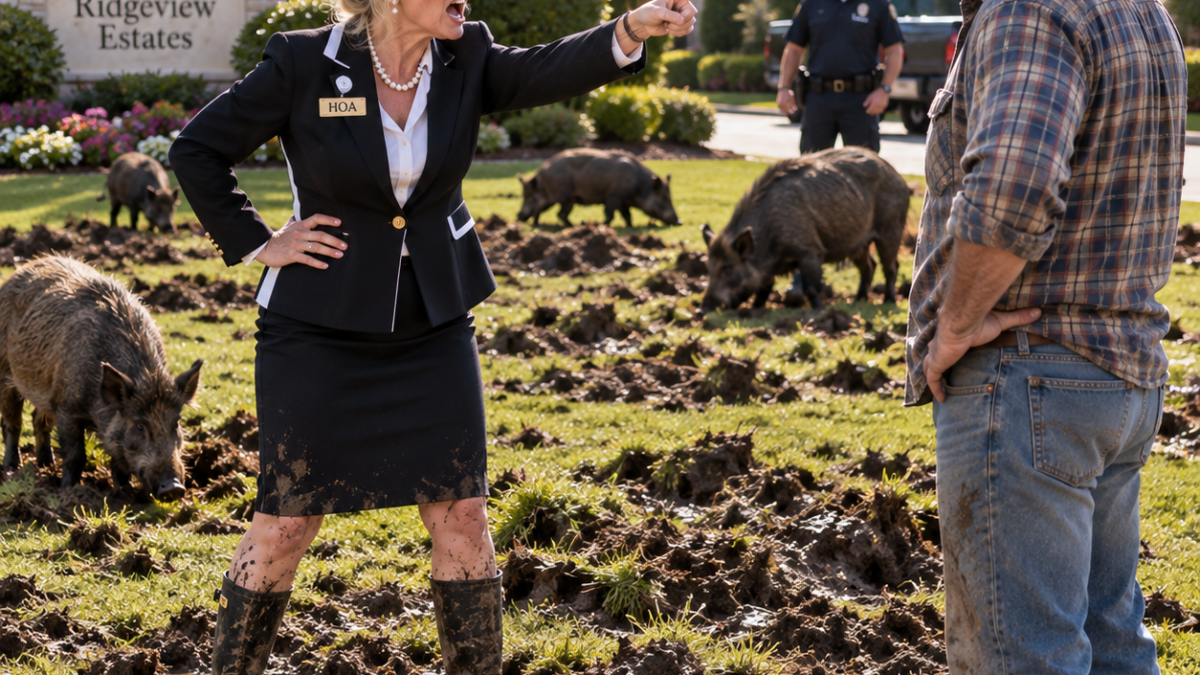
Kendra looked at Drew.
Not at me.
At Drew.
That told me she already knew there was paperwork.
She just did not know how much of it I had.
“What warning?” she asked.
Drew’s eyes dropped to the tablet in his hands.
I had worked with county agencies long enough to recognize the look.
It was the expression of a person mentally reviewing every email he hoped had been vague enough.
I opened my folder again.
“Do you want the first warning or the last one?”
Kendra’s polished expression slipped.
Only for a moment.
Then she recovered.
“This is not the time to turn an unfortunate wildlife incident into a personal dispute.”
I looked down at the mud covering the lawn.
“Kendra, your lawn is currently explaining the dispute better than I can.”
The landscaper coughed into one fist.
Maybe to hide a laugh.
Maybe not.
Drew stepped forward.
“Adele, let’s move this conversation inside.”
“No.”
His eyebrows lifted.
“No?”
“The physical route is here.”
I pointed.
“Creek bottom. Fence opening. Shortcut. Lawn.”
The young couple who had come to see the model home turned toward the opening.
You could see it from where we stood.
A bright square cut into the dark fence line.
The white rope still sagged between temporary posts.
Kendra followed their eyes and immediately shifted position, placing herself between them and the view.
“We need to let maintenance begin.”
“No cleanup at the opening yet.”
Her head turned back.
“You do not control our landscaping operation.”
“No. But if you erase the tracks before your insurer sees them, you may wish you hadn’t.”
That landed.
Drew stopped moving.
Kendra stared at me.
“You contacted our insurance?”
“I contacted the risk contact listed on the association’s certificate.”
“This is not your claim.”
“My fence was cut.”
“That does not give you authority over the HOA’s property.”
“Correct.”
I nodded toward the route.
“And your event map did not give you authority over mine.”
Nobody spoke for a second.
The broken sprinkler clicked again.
Water pooled inside a deep hoof mark.
Kendra finally turned to Drew.
“Pause cleanup around the route.”
Drew nodded.
That was the first useful decision Willow Bend had made all week.
Three weeks earlier, none of this had seemed inevitable.
It had started with an email.
A harmless-looking email.
That was usually how trouble arrived in places like Willow Bend Estates.
Nobody wrote:
WE WOULD LIKE PERMISSION TO CUT YOUR PRIVATE HOG FENCE SO MODEL-HOME BUYERS CAN SAVE THREE MINUTES WALKING FROM OVERFLOW PARKING.
They wrote:
We would like to discuss improving pedestrian flow and visual transition between the community and adjacent heritage green space.
Heritage green space.
That was their name for my orchard when they were selling houses.
Bellamy Orchard had been in Earl’s family for forty-eight years.
Twelve acres.
Mostly pecans.
A small equipment shed.
A gravel drive.
A creek bottom where cedar, elm, and hackberry made the ground stay damp long after the rest of the county dried out.
My mailbox still had BELLEMY ORCHARD painted across it in Earl’s crooked black letters.
Willow Bend used photographs of my trees in their sales brochures.
They called the orchard “a preserved rural backdrop.”
Nobody from Willow Bend had ever helped me replace an irrigation valve.
Nobody had pruned a pecan.
Nobody had hauled away a sapling after feral hogs uprooted it.
They liked the idea of farmland.
The working parts offended them.
My fence was one of those working parts.
Heavy woven wire.
Hog panel at the bottom.
Steel posts.
Braced corners.
An apron pinned into the soil where the creek bank softened.
Not attractive.
Effective.
Nine years before Kendra decided it interrupted her pedestrian plan, Earl and I had learned what happened without it.
That morning was still easy to remember.
Gray light.
Wet soil.
Twenty-seven young pecans destroyed.
Some ripped from the ground.
Others snapped at the root.
Drip tubing torn through three rows.
Mud turned over in dark slabs.
Earl stood beside me with both hands on his hips.
He did not swear often.
That morning he swore once.
Then he got quiet.
“What do we do?” I asked.
He looked toward the creek.
“Stop asking the hogs to respect a line they can walk through.”
That was Earl.
Never sentimental when there was work to do.
We called the agricultural extension office.
We talked to a fencing contractor.
Then Earl built what he jokingly called “the Berlin Wall for pigs.”
It was not a wall.
It was layered resistance.
Hogs push low.
They root.
They lift weak wire with their snouts.
They remember gaps.
They follow drainage corridors because those places offer shade, damp soil, roots, insects, and cover.
Earl strengthened the creek bend.
Then the low west corner.
Then he added a bottom apron where the ground stayed soft.
He kept records in a little notebook in our kitchen drawer.
Rainfall.
Tracks.
Repairs.
Pressure points.
He could be maddening about details.
If I asked whether a fence section was fine, he would say, “Fine today is not the same as ready for Friday.”
When he got sick, I took over the notebook.
After he died, I kept maintaining the fence.
Not because every wire reminded me of him.
Some did.
Mostly because the fence worked.
There was another reason.
When Willow Bend expanded toward my land, the county had required a recorded agricultural buffer agreement.
My orchard remained agricultural.
The subdivision acknowledged the boundary.
The HOA could not alter buffer features on my property without written consent.
The document was not complicated.
That made what followed harder to excuse.
Kendra’s first email arrived six weeks before the showcase.
Adele,
We are developing pedestrian-flow improvements for the upcoming Willow Bend Showcase Weekend and would appreciate an opportunity to discuss the visual transition between Bellamy Orchard and our model-home corridor.
I read it twice.
Then looked out my kitchen window.
Nothing outside had changed.
That was usually when I became suspicious of words like transition.
I replied:
The western fence is a permitted hog-resistant agricultural barrier associated with the recorded buffer. I do not consent to removing, opening, lowering, screening, or otherwise altering it for event traffic.
Kendra answered twenty-one minutes later.
I’m sure we can find a neighborly solution.
I took Earl’s notebook out of the kitchen drawer.
That might sound paranoid.
But I had spent eighteen years working for county public works and agricultural services.
Different titles.
Same basic work.
Road edges.
Drainage.
Fence lines.
Access disputes.
The arguments that followed when people ignored all four.
One lesson repeated itself.
If someone hears no and answers neighborly, they often mean they haven’t accepted no yet.
Kendra requested an on-site conversation two days later.
I agreed only to identify the exact section she was talking about.
She arrived in a golf cart.
Drew drove.
A young woman from the sales office sat beside them holding a cardboard tube.
Kendra wore white sneakers.
Fresh white.
Not orchard shoes.
She stepped out smiling.
“Adele. Thank you for meeting us.”
“I didn’t agree to a meeting. I said I’d show you the fence section.”
The smile stayed.
“Of course.”
The saleswoman unrolled a glossy map over the hood of the golf cart.
Model homes.
Parking.
Refreshments.
Sales tent.
Walking routes.
A dotted white line ran from overflow parking, crossed the Willow Bend greenbelt, passed directly through my fence, and ended at the showcase lawn.
I looked at the map.
Then at Kendra.
“That route crosses my property barrier.”
“It follows the safest pedestrian flow.”
“Safe for who?”
“Guests. Families. Children.”
“Your alternative?”
“Service road.”
“Which is still entirely on Willow Bend land.”
Drew cleared his throat.
“It would increase vehicle-pedestrian interaction.”
Kendra tapped the dotted line.
“We are not proposing permanent removal.”
“That sentence worries me more than it comforts me.”
“Just a temporary pass-through.”
“How?”
“A simple opening. Rope markers. Maybe decorative posts.”
I stared at her.
She smiled.
“Something tasteful.”
“That fence isn’t there to be tasteful.”
“I understand you have a rural-use concern.”
“No.”
I pointed toward the creek.
“I have a feral-hog concern.”
The saleswoman looked toward the trees.
Kendra gave me the kind of patient smile people use with children and stubborn relatives.
“With respect, Adele, Willow Bend has no documented hog activity on the showcase lawn.”
“Because my fence is closed.”
“That is one interpretation.”
“No. That is nine years of the fence doing its job.”
Drew raised his tablet.
“Perhaps we should discuss access authority.”
I turned toward him.
“Good.”
That seemed to surprise him.
“Show me the easement.”
“What?”
“The recorded right allowing the HOA to create a walkway through my barrier.”
He blinked.
“If there is a temporary access license, show me that.”
“Adele—”
“Board authorization. Insurance approval. Written consent from the property owner. Pick whichever one you have.”
Kendra’s smile disappeared.
“We are not litigating at a fence line.”
“You brought a route map through my fence.”
I tapped the glossy paper.
“That makes authority a reasonable question.”
Nobody spoke.
A dry pecan leaf rattled against the wire.
Kendra looked past me at the orchard.
“You need to understand how this appears to buyers.”
There it was.
Not safety.
Not children.
Not traffic.
Buyers.
“I understand exactly how it appears.”
She waited.
“It appears the HOA wants to use my property boundary as a sales shortcut.”
“That is unfair.”
“What is unfair is drawing a public walkway through land you don’t control.”
Her face tightened.
“It’s one fence opening.”
“It’s a hog barrier.”
Kendra sighed.
Small.
Impatient.
It told me more than everything else she had said.
The word hog embarrassed her.
It did not belong in the clean world she was trying to sell.
Drew stepped in.
“What if the association drafts a temporary access agreement?”
“Send it in writing.”
Kendra relaxed slightly.
“Good.”
“Include insurance coverage, restoration scope, wildlife risk review, exact dimensions, temporary hog-rated protection, and the board authority authorizing the request.”
Her eyebrows rose.
“That is excessive.”
“That is what you should have done before printing a map.”
The saleswoman quietly rolled it back into the tube.
Kendra looked at me for several seconds.
“We are trying to make this community successful.”
“My fence helps.”
She got back into the golf cart.
“We’ll review options.”
That evening, the resident portal changed.
SHOWCASE WEEKEND PEDESTRIAN SAFETY PLAN.
The post explained that a temporary route was being proposed to reduce pedestrian exposure to service-road traffic.
It also said:
One adjacent property owner has declined to cooperate with the proposed safety improvement.
No name.
It did not need one.
My orchard was the only adjacent private property.
The next morning, my trail camera sent a motion alert at 8:12.
White pickup.
Utility trailer.
Three men.
Orange cones.
Shovels.
Landscape fabric.
Bolt cutters.
The magnetic sign on the truck read:
NORWOOD OUTDOOR SERVICES.
I had never hired Norwood.
I pulled on my boots.
By the time I reached the lower line, one worker was shaking a can of orange marking paint.
Another carried cones.
The older man held a folded work order.
I started recording.
“Morning.”
He turned.
“Morning. You Ms. Bellamy?”
“I am.”
“Name’s Miguel Santos. Crew lead.”
“Who sent you, Mr. Santos?”
He glanced toward Willow Bend.
“Management work order.”
“For what?”
He unfolded it.
“Temporary pedestrian access opening. Orchard Edge route.”
“Does that order say Bellamy Orchard approved cutting the fence?”
Miguel looked at the wire.
Then the paper.
“No, ma’am. Says HOA authorized.”
“The HOA doesn’t own this fence.”
The worker with the paint stopped shaking the can.
Miguel rubbed his neck.
“I asked about that.”
“What were you told?”
“That management cleared it.”
“Who?”
He hesitated.
“Mr. Larkin’s office.”
I called Drew.
Speakerphone.
He answered.
“Drew, you have a contractor at my fence with bolt cutters.”
Pause.
“It is not being removed.”
“That’s not what I said.”
“The event route requires temporary access.”
“Do you have written consent from me?”
“We’ve discussed the temporary nature.”
“Do you have consent?”
Silence.
I looked at Miguel.
He was listening.
“The fence is part of a hog-resistant agricultural buffer,” I said. “If you cut it, you create an opening into an active creek corridor.”
Drew sighed.
“Your position is noted.”
“That is not authorization.”
“The contractor has authorization to proceed.”
“From whom?”
The line went dead.
Miguel looked embarrassed.
“Ma’am, I don’t like being in the middle.”
“Then document that I objected before you cut it.”
He nodded slowly.
“I can note homeowner objection.”
“And write hog-resistant barrier.”
His eyes lifted.
“Hogs?”
“Yes.”
He turned toward the creek.
Really looked this time.
Shaded soil.
Brush.
A narrow run through the trees.
“Willow Bend didn’t mention that.”
“No.”
I looked toward their model homes.
“They keep leaving that part out.”
For one second, I thought Miguel might leave.
Instead, he wrote on the work order.
Then told his crew to measure seven feet.
Seven feet.
Wide enough for two people to walk side by side.
Wide enough for a sounder too.
The bolt cutters closed on the first wire.
Metal snapped.
The sound went through me.
That fence had rattled in storms.
It had hummed in wind.
I had heard hogs test it from the creek side.
I had never heard someone deliberately cut through it.
The woven wire went first.
Then the reinforced panel.
A worker folded the sharp ends backward.
Two temporary posts went in.
White rope stretched between them.
Decorative.
Neat.
Useless.
When they finished, the fence had a square mouth.
Miguel brought me the work order.
“I noted your objection.”
I read his handwriting.
OWNER OBJECTED PRIOR TO WORK.
HOG-RESISTANT BARRIER CONCERN.
“May I photograph this?”
He hesitated.
Then held it still.
After the crew left, I documented everything.
Cut wire.
Posts.
White rope.
Tire marks.
Orange paint.
Direction of the event route.
Then I walked the inside fence line toward the creek bend.
Fresh soil had been turned outside the fence.
Not old.
Sharp edges.
Rooting marks.
I crouched.
One hoofprint sat in the damp ground.
The opening was less than thirty yards away.
That was when I stopped hoping common sense would solve it.
I went inside and wrote a certified letter.
Not emotional.
Not long.
The HOA’s contractor had cut Bellamy Orchard’s hog-resistant fence without owner consent.
The barrier existed because of documented feral hog activity.
I had objected before the alteration.
The opening should be restored immediately or secured before nightfall using equivalent hog-rated panels.
Leaving the opening unsecured created a foreseeable risk.
I attached photographs.
Then drove to the post office.
The clerk, Lydia, knew me.
“Willow Bend?”
“Fence trouble.”
She made a face.
In our county, that explained plenty.
From there I drove to the county annex.
I requested the agricultural buffer agreement.
Fence permit notes.
The old maintenance sketch.
Everything tying that fence to the recorded boundary.
By three o’clock, I had a folder that made Kendra’s phrase temporary adjustment look very small.
The shortcut remained open.
Their white rope fluttered in the afternoon wind.
I stayed on my side.
That mattered.
If I crossed over and blocked the HOA route myself, Kendra would stop discussing the unauthorized cut.
She would talk about me disrupting their event.
So I did not touch their cones.
Did not move their rope.
Did not enter their greenbelt.
I placed two warning signs on my own posts.
HOG BARRIER CUT WITHOUT OWNER CONSENT.
DO NOT ENTER BELLAMY ORCHARD.
At 4:26, Drew emailed.
The association acknowledges your concerns. The temporary opening is part of an approved pedestrian safety plan. References to wildlife activity remain speculative. Restoration will be evaluated following Showcase Weekend.
Speculative.
I was standing twenty yards from fresh hog rooting when I read that word.
I printed the email.
At 5:10, Kendra posted another community update.
Guests were instructed to use the marked Orchard Edge pedestrian route the following day.
And to “avoid unnecessary interaction with adjacent property owners.”
That was me again.
I had gone from uncooperative neighbor to unnecessary interaction.
By dusk, I pulled the memory cards from the lower trail camera.
Raccoon.
Opossum.
Miguel’s truck.
Then one clip stopped me.
2:17 a.m.
Three feral hogs moved along the creek side.
They reached the west bend.
One pushed at the reinforced lower wire.
It held.
The hog tested again.
Then moved on.
Eight hours later, Norwood cut the opening.
At 6:04 that evening, another clip showed movement in the brush.
Waiting.
I saved the footage twice.
Then stared at the work order photograph.
Under the main description was a smaller line.
ROUTE PRIORITY: MODEL HOME GUEST FLOW.
Not emergency access.
Not public safety correction.
Guest flow.
The next morning, I called the county agricultural extension office.
A woman named Carla Kimura answered.
I told her where I lived.
Her first question surprised me.
“South Branch drainage?”
“Yes.”
Paper moved.
“Your corridor is under an active feral hog advisory.”
I stood still.
“What advisory?”
“Movement advisory. Distributed three weeks ago.”
“To who?”
“Landowners and associations along the corridor.”
“Willow Bend?”
“Yes.”
My grip tightened around the phone.
“Can you send me a copy?”
“Of course.”
“Does it address barrier openings?”
Pause.
Then:
“It recommends maintaining reinforced barriers during active movement periods. Temporary openings should be avoided unless equivalent protection is installed.”
Equivalent protection.
Steel panels.
Not decorative rope.
Carla emailed it fifteen minutes later.
The map had the South Branch drainage highlighted.
Three recent rooting reports were marked.
One below my orchard.
One behind Marigold Bend.
One near Willow Bend’s showcase lawn.
I laid Carla’s advisory beside Kendra’s event map.
The dotted shortcut crossed the same area.
Until that moment, I thought Kendra had been dismissive.
Now I knew the HOA had received prior notice.
I forwarded the advisory to Drew, Kendra, and the board.
My message contained one question.
Please explain why Willow Bend approved an unsecured opening through a reinforced hog barrier inside the advisory corridor after receiving this notice.
Drew called almost immediately.
“Adele, we need context.”
“I agree.”
“It’s an advisory, not a prohibition.”
“I did not call it a prohibition.”
“What are you calling it?”
“Prior notice.”
Silence.
“Who received it?”
“I need to verify distribution.”
“Did Kendra?”
“It may have been forwarded to the event committee.”
That was the wrong answer for him to give.
“Kendra saw it.”
“I said it may have been forwarded.”
“Send me the forwarding email.”
“That’s internal correspondence.”
“It concerns an opening cut into my fence after a wildlife advisory.”
His voice hardened.
“Your position is clear.”
“No.”
I looked out the kitchen window.
“The mud will be clear if you leave that gap open.”
He did not answer.
An hour later, Kendra called.
“Adele, this is getting out of hand.”
“The fence is open.”
“You are circulating county material as if there is a legal emergency.”
“I circulated a notice you received before cutting my fence.”
“It is general guidance.”
“It identifies the corridor.”
“You keep making it sound as if Willow Bend invited hogs into the neighborhood.”
“No. I’m saying you opened the thing keeping them out.”
“We cannot redesign an event around every rural concern.”
I looked at Earl’s notebook.
LOWER WEST CORNER HOLDING.
“This isn’t every rural concern.”
My voice stayed calm.
“It is the exact concern the county warned you about.”
“The board will not be bullied by paperwork.”
I almost laughed.
That sentence told me exactly how Kendra understood rules.
When her documents ordered something, they were authority.
When mine stopped her, they were bullying.
“Close the opening before dark.”
“The approved event plan will proceed.”
She hung up.
At 6:30, Willow Bend issued the final Showcase Weekend notice.
The last paragraph directed guests to use the Orchard Edge shortcut.
I printed it.
The following morning, Willow Bend looked perfect.
Cars aligned along Marigold Bend.
Fresh banners.
White flowers.
Lemon cookies.
Bottled water.
Sales folders.
A sign near the main tent read:
WILLOW BEND ESTATES
ROOTED IN NATURAL BEAUTY.
That almost got me.
Rooted.
I drove along the public road and parked near my orchard gate.
I did not attend the event.
I stayed on my property.
From there, I could see families walking through the opening.
A sales agent stood beside it.
“Right this way. Orchard Edge Road is faster.”
Road.
That was what the cut had become.
Not an opening through private fencing.
A road.
I took photographs.
At 9:24, I sent another email.
FINAL WARNING — UNSECURED HOG-RESISTANT FENCE OPENING.
County advisory attached.
Fresh rooting attached.
Photographs attached.
Request:
Close opening before nightfall or install equivalent hog-rated panels.
I also left Drew a voicemail.
Then I waited.
Around noon, Kendra spotted me.
She crossed the lawn quickly.
“Adele, you’re making guests uncomfortable.”
“I haven’t spoken to your guests.”
“You’re photographing families.”
“I’m photographing the opening your contractor cut.”
“This is a community event.”
“It’s a sales event using a private fence alteration you never had permission to make.”
“Do not do this in front of buyers.”
“I did it before buyers arrived.”
Drew came up behind her.
“We received your latest email.”
“Then close the route.”
“We can’t change pedestrian flow mid-event.”
“You can secure it before dark.”
Kendra glanced toward the tent.
“You keep saying dangerous as though there is a wild hog standing here now.”
“That’s not how wildlife barriers work.”
A little boy came through the gap holding his mother’s hand.
He read my warning sign.
“Mom, what’s a hog barrier?”
His mother hurried him along.
Kendra’s face reddened.
“This is exactly the atmosphere we were trying to avoid.”
“Then you shouldn’t have cut it.”
Drew stepped in.
“We’ll review reinforcement after the event.”
“Before dark.”
“Tomorrow morning if necessary.”
I stared at him.
“You have the county advisory.”
He looked down.
“You have camera footage.”
Nothing.
“You have my written warning.”
Kendra answered for him.
“The event plan remains in place.”
I wrote the sentence down as soon as they left.
At 4:00, I noticed mud on the lower part of one white rope post.
Dark creek mud.
I photographed it.
Sent it.
No reply.
By dusk, the tents were folding.
Cars left.
Sales agents collected signs.
But the opening stayed.
The rope remained.
The gap remained.
I walked the fence one final time.
The creek bottom had become quiet.
Heavy quiet.
The kind Earl used to notice.
I checked our old gate.
Locked.
Reinforcement secure.
Then I stood twenty yards from the seven-foot hole and watched darkness fill the trees.
At 5:42 the next morning, my phone lit up.
Trail camera.
I sat on the edge of the bed.
I already knew.
The video was black and white.
Brush moved first.
Then one hog appeared.
Low.
Heavy.
It walked directly toward the cut.
Two more followed.
Then four smaller animals.
They did not test Earl’s corner.
They did not push under wire.
They did not search for weakness.
They walked through the seven-foot opening.
1:13 a.m.
Then followed Willow Bend’s shortcut.
At 6:20, the resident portal began filling.
WHAT HAPPENED TO THE MODEL-HOME LAWN?
IS THAT ANIMAL DAMAGE?
WHY IS MARIGOLD BEND COVERED IN MUD?
I printed stills.
Put on boots.
Took the public road around.
The lawn looked worse than the camera suggested.
Sod rolled back.
Irrigation damaged.
Flower beds torn.
Deep tracks everywhere.
But the important thing was not the amount of damage.
It was the route.
The mud started at the fence opening.
Crossed the greenbelt.
Followed the event shortcut.
Then widened over the irrigated showcase lawn.
Creek.
Gap.
Shortcut.
Lawn.
Kendra saw me.
“You knew.”
“I warned you.”
“You stood there yesterday taking pictures.”
“Yes.”
“You knew this could happen.”
“That’s why I told you to close it.”
“You could have repaired your fence yourself.”
I looked at her.
“That sentence is going to matter.”
Her eyes narrowed.
“It is your fence.”
“It was my fence when it was whole.”
I pointed toward the gap.
“It became your opening when your contractor cut it and your signs directed people through it.”
Drew arrived.
“Let’s slow down.”
Kendra turned toward the residents gathering nearby.
“These animals came from her side.”
I almost admired the speed.
Her property.
Her creek.
Her animals.
Their damage.
I pulled out the camera still.
“1:13 a.m.”
Drew accepted it reluctantly.
“The hogs entered through your event opening.”
Kendra refused to look.
“You can’t prove those are the same animals.”
“I don’t need to identify individual hogs.”
Several people turned toward me.
“I need the route, time, opening, prior warnings, and work order.”
I tapped the folder.
“I have those.”
The landscaper near the broken irrigation box stood up.
Mud covered his knees.
“That track line starts at the gap.”
Kendra spun toward him.
“You’re an animal expert?”
“No, ma’am.”
He looked down at the torn sod.
“But I can follow mud.”
That was the first honest sentence from their side that morning.
I opened my phone.
New email.
Drew.
Kendra.
Board address.
Carla Kimura.
And Dina Forsyth, the association’s property-risk contact.
Subject:
REQUEST FOR IMMEDIATE FIELD REVIEW — FENCE BREACH AND HOG DAMAGE.
Attachments:
Trail camera.
Intact-fence photo.
Cut-fence photo.
Contractor work order.
Miguel’s written note.
County advisory.
Certified warning.
Drew’s email calling the risk speculative.
Portal route announcement.
Final warning.
Mud-path photographs.
I wrote:
The damage path appears to originate at the unauthorized temporary opening cut into the Bellamy Orchard hog-resistant fence. Please conduct field review before cleanup alters physical evidence.
Send.
Kendra saw Dina’s name.
“You contacted insurance.”
“I contacted the listed risk representative.”
“This isn’t your claim.”
“My fence.”
“Your fence caused nothing.”
“Your opening did.”
She looked furious.
“Let them decide.”
At 8:03, Dina replied.
Do not alter breach area or primary damage path before review.
Site visit: 1:30 p.m.
Drew read it.
Then again.
The sprinkler clicked behind us.
Tiny broken clock.
Dina arrived at 1:27.
Gray SUV.
No logo.
Practical shoes.
Clipboard.
Carla Kimura arrived five minutes later.
She made her role clear.
“I’m here to explain the county advisory and feral hog behavior. I’m not issuing citations.”
Kendra said, “Good. Because this has been exaggerated.”
Dina looked across the damaged lawn.
Then toward the fence.
“Let’s begin without conclusions.”
Miguel had been called back too.
He stood near the greenbelt in his Norwood shirt.
Not happy.
Residents gathered along the sidewalk.
Dina asked one question.
“Has anything been moved?”
Drew answered.
“Cleanup was paused.”
Kendra added, “At considerable inconvenience.”
Dina wrote something.
Then said:
“Walk me through it.”
We started at the lawn.
Carla crouched at the edge of one rooted area.
“This is feral hog damage.”
No drama.
Just fact.
“Hogs roll sod searching for roots, insects, and soft material. Irrigated ground attracts rooting.”
Kendra crossed her arms.
“Nobody disputes wildlife caused the damage.”
Dina looked up.
“The issue is entry path and foreseeable risk.”
That changed the entire afternoon.
We followed the mud.
Across the lawn.
Onto the shortcut.
Shoe prints from Saturday overlapped with hoofprints from Sunday.
Human traffic and hog traffic sharing the same route.
Dina stopped at the white rope.
“What was this intended to do?”
Kendra answered.
“Mark the pedestrian opening.”
“Animal barrier?”
“No.”
Carla touched the rope.
“This wouldn’t materially slow a hog.”
Dina turned to Miguel.
“You cut the fence?”
“Yes, ma’am.”
“Under whose authority?”
“Willow Bend work order.”
He produced his copy.
Dina read aloud.
“Temporary pedestrian access opening. Orchard Edge route.”
Then:
“Route priority model-home guest flow.”
No commentary.
None needed.
Kendra’s face went still.
Dina asked me for the timeline.
I gave it in order.
Intact fence.
Event map.
Contractor arrival.
Work order.
Miguel’s note documenting my objection.
Certified warning.
Drew’s speculative email.
County advisory.
Final warning.
Portal direction telling guests to use the shortcut.
Trail-camera footage.
I handed copies.
Not originals.
Carla recognized the advisory immediately.
“That’s the current South Branch notice.”
Dina asked:
“What does it recommend?”
“Maintain reinforced barriers during active movement. If an opening is necessary, install equivalent temporary panels.”
Kendra spoke.
“It didn’t order us.”
“No,” Carla said.
“It warned you.”
Silence.
Drew tried.
“The association believed the temporary opening was reasonable.”
Dina looked at him.
“After the owner objected?”
No answer.
“After identifying the barrier as hog-resistant?”
Drew swallowed.
“After receiving county notice of active movement?”
His tablet suddenly became fascinating.
Kendra stepped forward.
“Adele could have installed panels herself.”
I turned.
“You directed guests through the opening.”
“So?”
“If I had entered your marked route and blocked it, you would have accused me of event interference.”
Dina nodded.
“She’s correct.”
Kendra stared at her.
Dina continued.
“Once the association created and controlled the temporary opening, securing or closing it became the association’s responsibility.”
Nobody moved.
Dina walked to the fence.
From there the whole route was visible.
Dark creek bottom.
Cut wire.
White rope.
Shortcut.
Mud.
Damaged lawn.
She wrote for almost a minute.
Then said:
“This was foreseeable.”
Kendra’s mouth tightened.
“That’s your opinion.”
“It’s my risk finding.”
Dina closed the clipboard halfway.
“It’s supported by the barrier function, physical path, written objection, county advisory, and continued use after notice.”
Drew’s shoulders dropped.
Miguel stared at the wire.
Dina added:
“No cleanup at the breach until documentation is complete. Shortcut closed immediately. And no communication assigning blame to Ms. Bellamy until the association reviews the record.”
For once, Kendra had nothing polished to say.
By Monday morning, the Orchard Edge shortcut disappeared from the resident portal.
No correction.
Just gone.
Screenshots are patient.
I had them.
At 9:18, Drew emailed:
TEMPORARY EVENT ROUTE CORRECTION.
The association acknowledged the route was closed pending review.
No additional alteration of homeowner property without written consent.
Fence restoration would be coordinated.
Then the phrase:
without admission of broader liability.
I forwarded it to Dina.
One question:
Does restoration mean hog-rated restoration, not decorative fence repair?
She replied six minutes later.
Equivalent barrier restoration required for risk closure.
Clean sentence.
Finally.
At noon, Miguel returned.
No bolt cutters.
Steel posts.
Heavy hog panel.
Woven wire.
Brace hardware.
Tension wire.
Bottom apron mesh.
He got out.
Removed his cap.
“Ms. Bellamy, I’m sorry.”
Nobody else was close enough to hear.
That made it matter.
“I know you got put in the middle.”
“I still cut it.”
“Yes.”
He looked toward the creek.
“We’re putting it back the way it was.”
“No.”
He looked worried.
“Ma’am?”
“Put it back stronger.”
Miguel almost smiled.
“That I can do.”
The repair took most of the day.
New posts went deeper.
Panel extended beyond the original cut.
Woven wire overlapped.
The bottom apron was pinned tight.
Miguel added a brace where the temporary passage had weakened the line.
When he finished, he handed me the completion sheet.
The description read:
RESTORE HOG-RESISTANT AGRICULTURAL BUFFER FENCE AT UNAUTHORIZED EVENT OPENING.
I photographed that too.
Two days later, Willow Bend held a special board session.
I did not attend.
My documents attended for me.
Dina sent the risk finding.
Carla sent the advisory record.
Miguel sent his work order and completion sheet.
I sent my timeline.
By Thursday afternoon, formal correction arrived.
Willow Bend withdrew any statement suggesting I caused or contributed to the hog damage.
The association acknowledged the event opening had been created without written owner consent.
The board adopted a new requirement:
No agricultural buffer fence could be altered by committee direction, management, vendor instruction, or event staff without owner permission, documented authority, risk review, and equivalent temporary protection.
Then page two.
Community Image Chair authority would no longer include unilateral route changes, temporary property access, or field instructions affecting private boundaries.
Kendra kept her elected board seat.
She did not keep those powers.
I was satisfied with that.
I had never needed to watch her resign.
I needed her committee to stop treating property lines like suggestions.
The HOA repaired its lawn through its own property process.
Replacement sod.
Irrigation repair.
Flowers.
Labor.
Whatever the total was, nobody sent it across my fence.
Friday brought something unexpected.
A new compliance map.
AGRICULTURAL BUFFER — BELLAMY ORCHARD EDGE.
Nine years.
My fence had been quietly protecting the subdivision for nine years.
Now Willow Bend had finally put the barrier into its own records.
That felt stranger than victory.
More like someone pronouncing your name correctly after deliberately saying it wrong for years.
The last repair was a sign.
Miguel installed it six feet from the restored section on Willow Bend’s side.
AGRICULTURAL BUFFER FENCE.
NO ACCESS OPENING WITHOUT WRITTEN OWNER CONSENT.
FERAL HOG ADVISORY AREA.
Kendra was there.
Clean shoes again.
Sunglasses.
Arms crossed.
She did not speak.
I did not need her to.
Mrs. Taggart crossed the street after the crew left.
Wind pulled at her cardigan.
She looked at me.
“I thought you were being difficult.”
I smiled.
“Most apologies start somewhere around there.”
She looked embarrassed.
“My grandson asked what a hog barrier was.”
“What did you tell him?”
She smiled.
“That it’s something smart people don’t cut.”
I laughed.
“That works.”
That evening, when everybody left, I walked the lower line alone.
The repaired section looked brighter than the rest.
New wire.
New posts.
Fresh hardware.
But the shape was right.
Bottom apron tight.
Brace square.
Creek side protected.
I walked toward the old gate Earl built.
One of his original staples was still buried deep in the wood.
Rust darkened it.
Years had pressed it deeper.
I put my thumb against the metal.
For a moment, I could see Earl standing there again.
Hat pushed back.
Wire pliers in one hand.
Telling me a barrier was only as good as the weakness you were willing to ignore.
The evening insects started.
Somewhere deeper in the creek bottom, brush moved.
I waited.
Then looked down.
Fresh hog tracks.
They approached the restored fence.
Close.
Closer.
Then stopped.
No tracks on my side.
No torn ground beyond the wire.
Nothing through the lower gap because there was no lower gap.
I followed the prints several feet.
They turned along the outside edge.
Exactly the way Earl’s notebook said they used to.
LOWER WEST CORNER HOLDING.
I stood there longer than I needed to.
After everything that week—Kendra’s event map, Drew’s emails, the bolt cutters, the decorative rope, the ruined lawn, the insurer, the board review—the final answer was almost painfully ordinary.
The hogs were still out there.
The orchard was still here.
Willow Bend still had model homes.
People still bought houses.
The creek still flooded when rain came hard.
The fence was never magic.
It never made feral hogs disappear.
It did one job.
It kept a known risk on the side where it belonged.
And when the HOA finally stopped treating that job like an inconvenience, the lawns stayed green, the orchard stayed protected, and the one thing Earl had trusted most did exactly what he built it to do.
The fence held.








