At one in the morning, a starving dog stepped into the headlights of my empty bus and refused to let me pass.
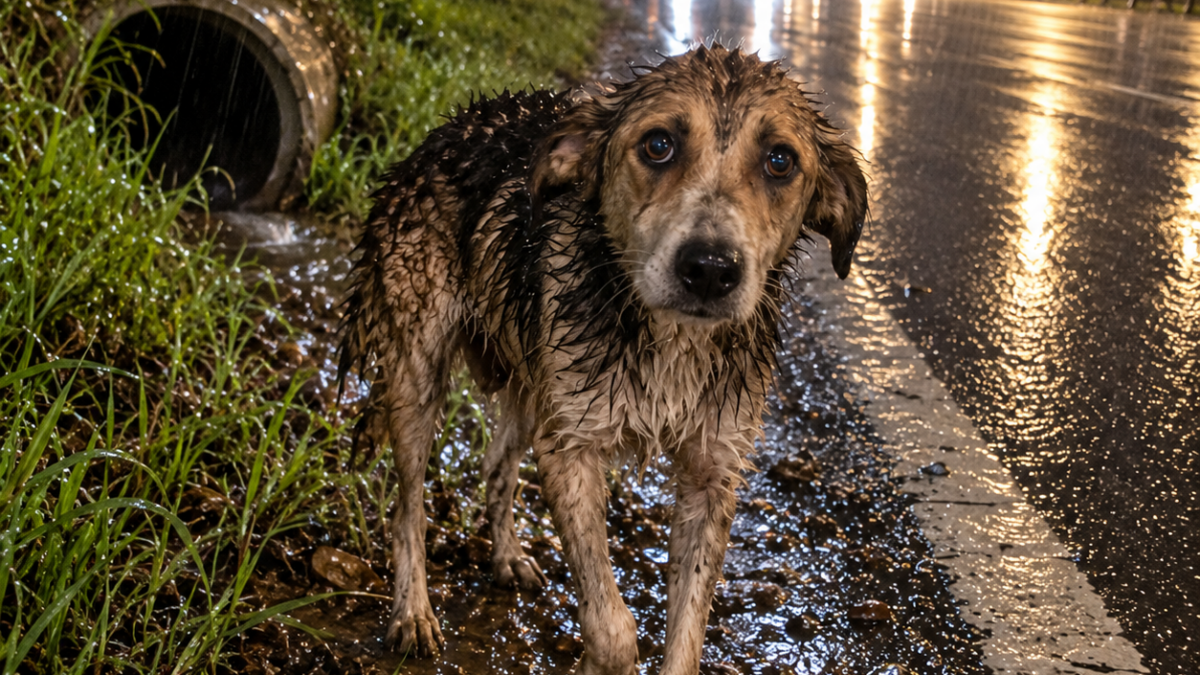
I moved closer to the drainage pipe.
The sound came again.
A tiny whimper.
Then another.
I crouched beside the opening and aimed my flashlight inside.
For several seconds, all I could see was wet concrete.
Rainwater ran in a thin stream along the bottom of the pipe.
Then something shifted farther back.
I leaned closer.
“Oh, God.”
Five puppies were huddled together in the darkness.
They were so small that at first they looked like one trembling mass of wet fur.
One lifted its head.
Another tried to crawl over its sibling and immediately collapsed.
The mother stood beside me.
She didn’t bark anymore.
She didn’t have to.
I looked at her, then back at the puppies.
“They’re yours.”
She stepped toward the pipe and let out a soft whine.
Everything suddenly made sense.
She hadn’t been wandering the highway because she was lost.
She had gone looking for help.
How long she had been doing it, I didn’t know.
Maybe twenty minutes.
Maybe hours.
But judging by her exhaustion, I suspected it had been a long time.
I lowered myself onto my knees.
The pipe was wide enough for water to pass beneath the highway but too narrow for me to crawl into comfortably. The entrance dropped several inches below the surrounding ground, and the wet concrete was slick.
The puppies were trapped several feet inside.
The mother could probably enter, but that wouldn’t solve anything. She was already severely underweight, and there was no safe way for her to carry five puppies out one at a time without risking dropping them.
“All right,” I whispered. “We’ll figure this out.”
I don’t know why I said “we.”
Maybe because from the moment she led me there, it already felt like the two of us had become partners.
I reached into the pipe.
The nearest puppy was just beyond my fingertips.
I stretched farther.
My shoulder pressed against the concrete edge.
Nothing.
“Come on.”
The puppy whimpered.
The mother moved beside me.
I backed out.
“Okay. I need something longer.”
I hurried toward the bus.
The dog immediately followed.
“No, stay with them.”
She kept following anyway.
Apparently she had already spent too much time away from them.
I climbed aboard the bus and looked around for anything useful.
There wasn’t much.
An emergency blanket.
My rain jacket.
A small first-aid kit.
A maintenance flashlight.
A broom.
I considered using the broom to move the puppies closer, but one wrong push could injure them.
I grabbed my jacket, blanket, flashlight, and a pair of work gloves.
When I stepped off the bus, the mother was waiting.
“Let’s go.”
She led me back as though she knew exactly what I had been doing.
This time I laid my jacket across the muddy ground and stretched flat on my stomach.
I slid one arm into the drainage pipe.
My cheek pressed against cold concrete.
The smell inside was a mixture of mud, rainwater, and wet dog.
“Come on, little guy.”
My fingertips touched fur.
The puppy squealed.
The mother instantly moved closer.
“It’s okay,” I told her. “I know. Easy.”
I hooked my hand gently beneath the puppy’s chest and dragged him toward me a few inches.
Then another few.
Finally I got both hands around him.
He weighed almost nothing.
His little body was ice cold.
I tucked him inside the emergency blanket.
The mother rushed over and began licking his face.
“One.”
She barely acknowledged me.
Her attention was entirely on her baby.
I reached in again.
The second puppy was harder because the others had shifted deeper into the pipe.
I stretched until my shoulder hurt.
My fingers caught a tiny back leg.
I stopped.
I wasn’t going to pull him by the leg.
I withdrew my arm, repositioned myself, then reached again.
This time I managed to slide my hand beneath his belly.
When I brought him out, the mother immediately inspected him.
The puppy made a tiny squeaking sound.
“Two.”
The third came easier.
The fourth didn’t.
By then, my uniform was soaked through.
Mud covered my knees and elbows.
My hands were numb.
I could hear water moving faster through the pipe as the rain intensified.
That frightened me.
I had no idea how quickly the drainage system could fill.
I had seen flash flooding around roads before.
Water didn’t need to rise several feet to kill newborn puppies.
A few inches could be enough.
I pulled out my phone.
One bar.
I called the dispatcher.
“James?”
“I found puppies.”
There was silence.
“Puppies?”
“Five of them. Drainage pipe. Mother led me here.”
“Are you serious?”
“Completely.”
“Do you need emergency services?”
“I need animal rescue. Shelter. Anybody who can help.”
“Where exactly are you?”
I gave him the highway marker.
He said he would make calls.
“Don’t crawl into anything,” he warned me.
“I’m not crawling in.”
At least not yet.
I disconnected.
The mother stood over the four puppies I had removed.
They were pressed against her stomach beneath the emergency blanket.
That left one.
The smallest.
And naturally, he was farthest inside.
I shined my flashlight.
He wasn’t moving much.
“Come on, buddy.”
I stretched.
Nothing.
I shifted deeper.
Still nothing.
The mother began whining.
“I know.”
She looked into the pipe.
Then at me.
“I know.”
I grabbed the broom.
I hated the idea, but I didn’t have another option.
Using the handle, I carefully slid it along the side of the pipe, well away from the puppy.
The goal wasn’t to push him.
I hoped he might instinctively crawl away from the object and toward me.
It didn’t work.
He barely moved.
That was worse.
I dropped the broom.
Rainwater ran down my face.
I stared into the pipe.
I had spent most of my adult life being cautious.
Bus drivers have to be.
A forty-thousand-pound vehicle filled with passengers punishes impulsive decisions.
You learn patience.
Distance.
Judgment.
But lying there beside that pipe, staring at a puppy slowly losing strength, I stopped thinking like a bus driver.
I took off my belt and emptied everything from my pockets.
Then I pushed my upper body inside.
The concrete scraped my shoulders.
“James,” I muttered to myself, “this is exactly what he told you not to do.”
I slid farther.
My chest was inside now.
My hips remained near the opening.
The mother paced beside my legs.
“Don’t bite me.”
She didn’t.
I stretched until pain shot through my shoulder.
My fingers touched the puppy.
Cold fur.
I moved another inch.
Now I could reach him.
I closed my hand gently around his body.
He didn’t react.
That terrified me.
I pulled myself backward.
For a moment, my jacket snagged on rough concrete.
Panic flashed through me.
I twisted free.
Then I slid out into the rain holding the smallest puppy against my chest.
He was completely limp.
“No.”
The mother rushed toward us.
“No, no, no.”
I wrapped him in my shirt and rubbed him gently.
Nothing.
I put my ear near his nose.
I couldn’t tell if he was breathing.
The mother began licking him.
Hard.
Fast.
Almost frantic.
“Come on, little man.”
I rubbed his chest.
His body felt impossibly fragile.
Seconds passed.
The rain seemed louder.
Then his mouth opened.
A tiny sound escaped him.
Barely a whimper.
But it was there.
I laughed.
Then I realized I was crying.
“That’s it.”
He made another sound.
The mother licked across his eyes.
“You’re okay.”
I placed him against her with the others.
All five puppies pressed toward the warmth of her belly.
The mother lowered herself carefully around them.
Then something happened that I’ll remember longer than almost anything else from that night.
She looked at me.
Not the desperate stare from the highway.
Something different.
She slowly moved away from the puppies, took two steps toward me, and rested her head across my muddy knee.
I put my hand on her neck.
For the first time, she let me touch her.
“You did it,” I whispered.
She closed her eyes.
“No. Actually, you did all of it.”
She had found me.
She had stopped the bus.
She had convinced a stranger to follow her.
All I had done was listen.
We sat beneath the rain together.
I tried using the bus as temporary shelter, but the mother panicked when I started carrying the puppies away from the drainage area.
She followed the first one, then turned back toward the remaining four.
So I stopped.
She wasn’t ready to trust me that much yet.
Instead I brought more supplies down.
An old towel from the maintenance compartment.
A cardboard box.
Another emergency blanket.
Eventually I arranged all five puppies inside the box and showed them to her before moving it.
She followed.
Every three steps, she pushed her nose against the edge to check them.
When we reached the bus, I set the box near the front doors.
The mother hesitated at the first step.
Her body was exhausted, but there was something about the bus that frightened her.
Maybe the noise.
Maybe the height.
Maybe she had never been inside a vehicle.
I sat on the step.
“Nobody’s making you.”
She stared at her puppies.
Then she looked at me.
One paw went onto the step.
Then the other.
She climbed aboard.
The moment she reached the box, she curled herself around it.
I turned the heater higher.
Warm air filled the front of the bus.
The mother trembled uncontrollably.
I thought she was frightened until I realized the shaking was probably from cold and exhaustion.
I found a bottle of water and poured some into the bottom of a clean container from my lunch.
She drank so fast I had to pull it away.
“Easy.”
She looked at me.
“I’ll give it back. Just slow down.”
I waited thirty seconds and offered more.
This time she drank more carefully.
Food was harder.
I had half a turkey sandwich.
I removed the bread, cheese, sauce, everything except plain pieces of turkey, and offered her a little at a time.
She swallowed almost without chewing.
Her hunger was heartbreaking.
I wondered how long she had gone without food.
Yet five puppies had somehow survived.
She had been feeding them with a body that had almost nothing left to give.
That realization hit me harder than seeing her ribs.
She hadn’t simply been hungry.
She had been starving while continuing to nurse her babies.
Every calorie she found went into keeping them alive.
My dispatcher called.
“Animal rescue’s coming. Twenty minutes, maybe twenty-five.”
“Good.”
“How are they?”
“Alive.”
“All of them?”
I looked down.
The smallest puppy had wedged himself beneath his mother’s front leg.
“All five.”
The dispatcher exhaled.
“You’re going to make me explain why a bus is forty-five minutes late getting back.”
“Tell them I had passengers.”
“Passengers?”
“Six of them.”
He laughed.
“You’ve lost your mind.”
“Probably.”
Then he became serious.
“Good work, James.”
I looked at the dog.
“I think she did the hard part.”
While we waited, I sat in the driver’s seat.
The mother stayed near the front door with the puppies.
Every few minutes she lifted her head and checked me.
I didn’t understand it then, but later one of the shelter workers explained that dogs often remember the person associated with safety after an extreme event.
At that moment, however, I wasn’t thinking about animal psychology.
I was wondering who had abandoned her.
Because the more I looked at her, the more convinced I became that she hadn’t always been feral.
She understood people.
She recognized gentle voices.
She knew what a vehicle was, even if she was hesitant to enter it.
She allowed touch once she felt safe.
Someone had owned her.
Someone had known her.
And somehow she had ended up pregnant, starving, and sheltering her puppies inside a highway drainage pipe.
That thought made me angry.
But she didn’t seem angry.
Dogs rarely waste energy asking the questions humans do.
Who did this?
Why?
Was it fair?
They deal with what comes next.
And her next concern was simple.
Keep the puppies warm.
Keep them alive.
The rescue van arrived around two in the morning.
Two women stepped out wearing waterproof jackets.
One introduced herself as Elena.
The other was a veterinary technician named Rachel.
When they climbed aboard, the mother immediately stood over her puppies.
A low growl came from her throat.
“Easy,” Elena said.
I crouched beside the dog.
“It’s okay.”
The growling stopped.
Rachel looked at me.
“She trusts you.”
“Apparently.”
“Stay close.”
They examined the puppies one at a time.
Low body temperatures.
Dehydration.
Possible parasites.
One had labored breathing.
The smallest concerned Rachel most.
She wrapped him in a warming pack.
“We need to get them in quickly.”
“What about her?”
“She’s coming too.”
They tried to place the mother on a lead.
She resisted.
Then Elena handed me the leash.
“Try.”
I clipped it to a temporary slip collar.
The dog followed immediately.
Rachel smiled.
“You’ve been adopted.”
“I already have an apartment where dogs technically aren’t allowed.”
“Don’t tell her that.”
We loaded the puppies first.
The mother climbed into the rescue van behind them.
Before Elena closed the door, I reached inside and touched the dog’s head.
“You’re safe now.”
She licked my hand.
That nearly broke me.
Maybe it sounds ridiculous.
I had known her for less than two hours.
I didn’t even know her name.
But I had watched her risk everything for her babies.
And when those doors closed, I suddenly felt as if someone I cared about was leaving.
Elena handed me a card.
“Call tomorrow.”
“I will.”
“Actually,” she said, looking at my soaked uniform, “call after you sleep.”
I looked down at myself.
Mud.
Water.
Dog hair.
My supervisor was going to love this.
When I finally returned the bus to the depot, it was nearly three.
My supervisor, Carl, stood with his arms crossed.
I climbed down.
He looked at me.
Then at the muddy floor.
Then back at me.
“You drive through a swamp?”
“Sort of.”
The dispatcher leaned out of the office.
“Ask him about his six passengers.”
Carl frowned.
Twenty minutes later, both men had heard the entire story.
Carl stared at me when I finished.
“Five puppies?”
“Five.”
“And the mother stopped you?”
“Pretty much.”
He shook his head.
“Clean the bus tomorrow.”
“That’s it?”
“James, I’m not writing you up for saving puppies.”
The dispatcher called from across the room.
“Put that in writing.”
Carl pointed at him.
“Don’t push it.”
I drove home in my car as dawn started lightening the horizon.
I should have been exhausted.
I was.
But sleep wouldn’t come.
Every time I closed my eyes, I saw headlights reflecting off wet asphalt.
A skinny dog running back and forth.
Five tiny bodies inside a concrete pipe.
The smallest puppy lying motionless in my hands.
At seven thirty, I gave up trying to sleep.
I called the number Elena had given me.
“This is James. The bus driver.”
I immediately felt foolish.
Of course they knew I was the bus driver.
The receptionist said, “One moment.”
A minute later, Rachel answered.
“James?”
“How are they?”
“The puppies are stable.”
I closed my eyes.
“All five?”
“All five.”
I sat down on the edge of my bed.
“And the mother?”
“Exhausted, underweight, dehydrated, covered in fleas, but stronger than she looks.”
“Can I see them?”
There was a pause.
“You’re supposed to be sleeping.”
“So I’ve been told.”
She laughed.
“Come after ten.”
I arrived at ten fifteen carrying a bag of dog food I had bought on the way.
The woman at the desk took one look at it and smiled.
“We already feed them.”
“I figured.”
“But we’ll use it.”
Rachel led me through a hallway lined with kennels.
Barking erupted around us.
Some dogs jumped against their gates.
Others watched quietly.
At the end was a larger enclosure.
The mother was lying on several blankets.
Her puppies were lined against her belly.
She lifted her head.
For half a second, she simply stared at me.
Then her tail moved.
Once.
Twice.
Then faster.
“Well,” Rachel said. “I guess she remembers you.”
I crouched beside the kennel.
The mother’s tail thumped against the blanket.
“Hey, girl.”
She stood and came toward me.
The difference from the night before was striking.
She still looked painfully thin.
But her eyes were brighter.
She pressed her forehead against the gate.
Rachel opened it.
I stepped inside.
The mother leaned against my legs.
“Does she have a name?”
“Not officially.”
“What have you been calling her?”
Rachel smiled.
“Bus Stop.”
“No.”
“Then you name her.”
I looked down at the dog.
The rainstorm had ended before dawn.
Outside the shelter windows, sunlight was beginning to break through the clouds.
“Hope.”
Rachel repeated it.
“Hope.”
The dog’s tail moved.
“Seems appropriate,” I said.
So Hope became her name.
The puppies got temporary names too.
Miles.
Rosie.
Benji.
Scout.
And the smallest, the one from the back of the pipe, was called Lucky.
Lucky was the weakest.
For the first forty-eight hours, the shelter veterinarian wasn’t confident he would survive.
He struggled to maintain his temperature.
He didn’t nurse as strongly as the others.
The staff supplemented his feeding.
I visited after work every day.
At first, I told myself I was only checking on them.
By the fourth day, everyone at the shelter knew my schedule.
“Your family’s in room three,” the receptionist would say.
My family.
I always laughed.
But some part of me liked hearing it.
Hope improved rapidly once she had reliable food and clean water.
They fed her several small meals every day because giving too much food too quickly after prolonged starvation could be dangerous.
Her ribs remained visible, but her energy returned.
Her personality began emerging too.
She was gentle.
Quiet.
Ridiculously affectionate once she trusted someone.
And she hated being separated from the puppies.
Even when staff moved them a few feet away for weighing, she watched every second.
One evening, I sat beside her while Rachel examined Lucky.
Hope paced.
“He’s okay,” I told her.
She ignored me.
Rachel laughed.
“You’re talking like she understands English.”
“I’m starting to think she understands more than I do.”
When Lucky was returned, Hope inspected him from nose to tail.
Then she gave me a look that seemed almost accusing.
“See? Fine.”
She lay down again.
I started wondering about her past.
The shelter scanned for a microchip.
Nothing.
They posted her photograph online.
No one came forward.
No missing-dog report matched her description.
A local animal-control officer checked nearby neighborhoods.
Nothing.
Then Elena told me something I hadn’t considered.
“She may have been dumped after becoming pregnant.”
“People do that?”
“More often than you want to know.”
I looked through the glass at Hope.
She was asleep with five puppies piled around her.
“Why?”
“Sometimes owners don’t want the expense. Sometimes they don’t spay their dog, she gets pregnant, and suddenly she’s a problem.”
I felt my jaw tighten.
“She isn’t a problem.”
“I know.”
I drove my route that night angrier than usual.
At the stop near the hospital, an elderly woman climbed aboard.
She had ridden my bus for years.
Her name was Mrs. Porter.
“You look upset, James.”
“I’m fine.”
“You always say that when you’re not.”
I smiled.
“Long week.”
She sat near the front.
Someone must have already shared the highway story online because she glanced at me and said, “You’re that driver, aren’t you?”
“What driver?”
“The dog.”
I groaned.
“You saw that?”
“My granddaughter showed me.”
Apparently one of the shelter volunteers had posted a picture of Hope and her puppies with a short explanation.
The post had spread.
Nothing huge.
But enough that passengers started recognizing me.
I didn’t enjoy that part.
People called me a hero.
It felt wrong.
Hope had been the one running through traffic.
Hope had been the one starving herself to keep five babies alive.
I had stopped a bus.
That was all.
Whenever someone praised me, I told them the same thing.
“I just followed her.”
Three weeks passed.
The puppies transformed.
Miles became the adventurous one.
He climbed over everything.
Rosie was affectionate and wanted constant attention.
Benji loved food more than seemed physically possible for something so small.
Scout barked at objects that offended him, including once, for reasons no one understood, an empty paper cup.
Lucky stayed smaller than the others but grew stronger every day.
The first time I watched him run across the shelter playroom, I had to turn away so nobody saw what it did to me.
Rachel saw anyway.
“You okay?”
“Something in my eye.”
“Inside the building?”
“Very dusty building.”
She let me have the lie.
Hope gained nearly twelve pounds.
Her coat changed from dull brown-gray to a warm golden tan with darker markings around her face.
Once the starvation no longer defined her appearance, she was beautiful.
Adoption applications began arriving.
First for the puppies.
Then for Hope.
I expected that to make me happy.
Instead it hurt.
I had become used to seeing them.
My routine had changed completely.
Finish shift.
Visit shelter.
Sit with Hope.
Get climbed on by five puppies.
Go home covered in dog hair.
Repeat.
Then one afternoon Elena said, “Miles has a family.”
I stared at her.
“Already?”
“Good family. Two kids, fenced yard, veterinarian reference, everything checked.”
“That’s great.”
She studied my face.
“You don’t look like you think it’s great.”
“No. I do.”
Miles left two days later.
Hope watched Elena carry him toward the lobby.
She stood at the kennel gate.
I stood beside her.
Her ears stayed forward.
She whined once.
“He’ll be okay.”
I wished somebody could explain adoption to dogs.
Your baby isn’t disappearing.
He’s going somewhere safe.
He’ll have a bed.
He’ll have toys.
He’ll have people.
But all Hope knew was that one of her puppies had gone through a door and hadn’t returned.
That evening, she searched the enclosure repeatedly.
She smelled the bedding.
Checked corners.
Walked to the door.
Then back to the remaining puppies.
I sat on the floor.
Eventually she came to me and put her head in my lap.
“I’m sorry.”
The next morning, the adopting family sent photographs.
Miles was asleep on a couch between two children.
He had a red blanket and a stuffed dinosaur almost as big as he was.
I showed the picture to Hope.
“I know this means nothing to you.”
She sniffed my phone.
“That’s him.”
She licked the screen.
I laughed.
“Okay. Maybe it means something.”
Rosie went next.
Then Benji.
Each goodbye was difficult.
Each photograph afterward made it easier.
Scout was adopted by a retired firefighter and his wife.
That left Lucky.
By then he was healthy enough for adoption.
Several people applied.
A young nurse named Emily was eventually selected.
She worked at the same hospital where many of my regular passengers got on and off.
When she came to meet Lucky, he climbed straight into her lap and fell asleep.
“Looks like he’s made the decision,” I said.
Emily smiled.
“I’ve been reading about him since the rescue.”
“He’s tougher than he looks.”
“I know.”
She looked at Hope.
“Will she be okay when the last one leaves?”
That question stayed with me.
After Lucky went home, Hope returned to the kennel alone.
For the first time since I had met her, there were no puppies beside her.
She walked in.
Stopped.
Looked around.
Then looked at me.
I sat down.
“Just us.”
She came over slowly.
Her head lowered onto my leg.
I scratched behind her ears.
“You did your job.”
She closed her eyes.
“All five.”
Her tail tapped once.
“Every single one made it.”
For several minutes neither of us moved.
I realized then that Hope had spent every moment since I met her living for somebody else.
She had starved for the puppies.
Risked the highway for them.
Trusted a stranger for them.
Endured examinations, kennels, and separation for them.
Now they were safe.
For the first time, her life could belong to her.
I looked down.
“So what happens to you?”
I already knew the answer.
Hope was available for adoption.
Applications were coming in.
I also knew something else.
I wanted her.
That surprised me more than it should have.
I had spent weeks pretending I didn’t.
There were problems.
My apartment building had restrictions.
My work schedule was terrible.
I lived alone.
Adopting a dog wasn’t something a person should do simply because of an emotional connection.
Hope deserved stability.
Not another uncertain home.
So I didn’t apply.
A week later, Elena called me before my shift.
“We have a family meeting Hope tomorrow.”
My chest tightened.
“That’s good.”
“They’re excellent applicants.”
“Good.”
“James.”
“What?”
“You don’t have to keep saying good.”
I stared across the depot parking lot.
“What do you want me to say?”
“Whatever’s true.”
I was quiet.
Finally I said, “I don’t know.”
“You know.”
I did.
But wanting Hope and being right for Hope were two different things.
The next afternoon I met the family.
Mark and Dana Whitfield.
Their daughter, Sophie, was eleven.
They lived about twenty minutes outside the city in a house with a fenced backyard.
Dana worked from home.
They had previously owned an older rescue dog who had died the year before.
They were patient.
Soft-spoken.
Prepared.
Everything I wasn’t sure I could offer.
Hope liked them immediately.
Sophie sat on the shelter floor instead of approaching too quickly.
Hope sniffed her.
Sophie didn’t reach out.
She waited.
Eventually Hope put her nose beneath the girl’s hand.
Sophie smiled.
“Hi.”
Something inside me hurt.
But it was a good hurt.
Because I knew.
This was what Hope deserved.
The adoption wasn’t finalized that day.
There was a home visit.
Paperwork.
Veterinary planning.
A few more meetings.
Then the date was set.
Hope would leave on Saturday morning.
I took the morning off.
I wanted to be there.
The night before, I drove the highway route again.
It was clear.
No rain.
When I reached the section where I had first seen her, I slowed slightly.
The drainage area was visible beyond the shoulder.
I had passed it dozens of times since.
But that night I pulled over.
Maybe I shouldn’t have.
Maybe it was sentimental.
But I walked back to the pipe.
It looked ordinary.
Just concrete beneath a road.
No sign remained that five lives had nearly ended there.
I crouched near the opening.
Three weeks earlier, it had terrified me.
Now it was empty.
Dry.
Silent.
I thought about how close I had come to driving past.
If I had been looking at the radio.
If I had been ten minutes earlier.
If Hope had given up.
If another car had struck her.
People like to imagine important moments arrive with warnings.
They don’t.
Sometimes they arrive as inconveniences.
A delay.
A strange noise.
A dog standing where she shouldn’t be.
And you have no idea until afterward that your decision in the next thirty seconds will matter for years.
Saturday morning was sunny.
Hope had gained enough weight that someone seeing her for the first time would never guess what she had looked like beside the highway.
The shelter staff gathered in the lobby.
Elena had tears in her eyes.
Rachel insisted she didn’t.
Nobody believed her.
Sophie knelt beside Hope with a new blue collar.
“Can I put it on?”
“Sure,” Elena said.
Hope sat patiently.
The collar clicked into place.
There was a little silver identification tag.
HOPE WHITFIELD.
I read it twice.
She had a last name now.
A home.
A family.
Mark opened the car door outside.
There was a dog bed across the back seat.
Hope climbed halfway in.
Then stopped.
She turned.
Her eyes found me.
Everyone became quiet.
I crouched.
“Come here.”
She jumped back down.
She walked toward me.
Not ran.
Not frantic.
Just walked.
I put both hands around her neck.
“You’re going home.”
Her tail moved.
“You don’t need me anymore.”
She licked my chin.
I laughed because otherwise I would have cried harder than I already was.
“Remember when you nearly got me fired?”
Rachel said, “That is not how I remember it.”
Hope leaned into me.
I whispered against her ear.
“You saved them.”
Then I pulled back.
“Now go have your life.”
Sophie opened the car door again.
Hope climbed inside.
This time she stayed.
Sophie sat beside her.
As the car pulled away, Hope stood with her front paws near the window.
She watched us.
She watched me.
The car turned onto the road.
Then she disappeared.
I stood in the parking lot for several seconds.
Elena touched my shoulder.
“She’s going to be okay.”
“I know.”
“You gave her that.”
I shook my head.
“No.”
I looked toward the road where the car had vanished.
“She gave it to herself. I just happened to stop.”
Life returned to normal after that.
Or mostly normal.
I still drove nights.
Still brought the empty bus back along the highway.
Still saw Mrs. Porter twice a week.
Still argued with Carl about impossible schedules.
But something had changed.
I noticed things more.
Movement near roads.
Animals beneath bridges.
People sitting alone at stops after midnight.
I suppose once you learn how easily desperation can hide in ordinary places, it’s difficult to stop seeing it.
The Whitfields sent updates.
Hope discovered couches.
Apparently she believed all couches belonged to her.
Hope disliked vacuum cleaners.
Hope loved Sophie.
Hope slept beside Sophie’s bed almost every night.
Hope was frightened during thunderstorms.
On rainy nights, she sometimes paced near the windows.
That part hurt to hear.
Trauma doesn’t disappear because life improves.
But Dana said Sophie had learned what to do.
She would sit on the floor, wrap a blanket around Hope, and stay there until the storm passed.
The first time Dana sent me a photograph of them like that, I stared at it for a long time.
Sophie was asleep against the couch.
Hope was curled beside her.
Safe.
Dry.
Loved.
The puppies sent updates too.
Miles grew enormous.
Rosie became obsessed with tennis balls.
Benji remained committed to eating everything that wasn’t nailed down.
Scout developed a habit of carrying his retired firefighter owner’s slippers around the house.
Lucky stayed the smallest.
Emily brought him to the shelter reunion six months later.
Yes, there was a reunion.
Elena organized it.
She called me three weeks beforehand.
“We’re getting the family together.”
“What family?”
“Don’t pretend you don’t know.”
All five puppy families agreed.
The Whitfields brought Hope.
I arrived last because my shift ran late.
The shelter had reserved a fenced outdoor area.
I could hear barking before I entered.
When I opened the gate, five nearly grown dogs were racing across the grass.
I barely recognized them.
Then I saw Hope.
She was near Sophie.
Healthy.
Strong.
Her coat shone in the afternoon sun.
I stopped.
Hope looked toward me.
For one second, neither of us moved.
Then she ran.
People later told me she started running before I said her name.
I don’t remember.
I only remember kneeling and getting knocked backward when she hit me.
“Hope!”
She licked my face.
I laughed.
“Okay! Okay!”
Her entire body wiggled.
She made a whining sound I had never heard from her before.
The puppies noticed the commotion.
One by one they ran over.
Soon I was buried beneath dogs.
Lucky climbed partly into my lap.
“You’re not so little anymore.”
Emily smiled.
“He still thinks he is.”
The sight of Hope with the puppies fascinated everyone.
Would she recognize them?
We didn’t know.
Dogs experience family relationships differently than people.
But something was there.
Hope sniffed each dog carefully.
With Lucky, she lingered.
Then she licked the side of his face.
I had to look away.
Rachel saw me.
“Dust again?”
“Outdoor dust.”
“Of course.”
We stayed for hours.
I listened to the families tell stories.
Miles had learned to open cabinet doors.
Rosie slept upside down.
Benji once stole an entire loaf of bread.
Scout barked every time the television doorbell rang.
Lucky followed Emily into every room, including the bathroom.
Hope had become Sophie’s shadow.
Every story was ordinary.
That’s what made them extraordinary.
They had been given the chance to become ordinary dogs.
To steal bread.
Destroy toys.
Sleep on couches.
Annoy their families.
Wait by doors.
Grow old.
None of it had been guaranteed inside that drainage pipe.
Toward sunset, people began leaving.
I found myself alone near the fence with Mark.
Hope was lying in the grass while Sophie scratched her stomach.
“She loves that kid,” I said.
Mark smiled.
“The feeling’s mutual.”
“Thank you for taking her.”
He looked surprised.
“Thank us?”
“Yeah.”
“James, we should be thanking you.”
I shook my head.
He didn’t argue.
After a moment, he said, “Sophie was having a hard year before Hope.”
I looked at him.
He hesitated.
“Middle school. Friends changing. Her grandmother died. Our old dog died a few months afterward. She stopped talking to us much.”
I watched Sophie laugh as Hope rolled onto her back.
“Then we saw the shelter story.”
Mark smiled.
“She talked about Hope for three straight days.”
I laughed.
“Sounds familiar.”
“She said a dog willing to run into traffic for her babies deserved somebody who would never abandon her.”
That sentence stayed with me.
A dog willing to run into traffic for her babies deserved somebody who would never abandon her.
Sophie had been eleven years old and somehow understood Hope better than most adults ever would.
Before leaving, I knelt beside Hope.
“See you around, highway girl.”
She licked my hand.
Mark heard me.
“Highway girl?”
“That’s what I called her in my head before she became Hope.”
He smiled.
“Hope’s better.”
“It is.”
Years have passed since that night.
I still drive buses.
People sometimes ask whether the story changed my life.
That’s a big phrase.
Changed my life.
I didn’t quit my job.
I didn’t move to the countryside and open an animal sanctuary.
I didn’t become famous.
Most passengers who get on my bus today have no idea any of it happened.
But yes.
It changed me.
Before Hope, I believed helping usually required preparation.
Training.
Money.
A plan.
I thought people who saved lives were firefighters, paramedics, doctors, rescue workers.
People who woke up expecting to face emergencies.
I was a tired bus driver who wanted a shower.
Hope taught me that sometimes being useful begins with something much simpler.
Notice.
Stop.
Listen.
Follow.
That’s all she needed from me at first.
She didn’t need me to understand the whole problem.
She couldn’t explain.
She couldn’t point at a map.
She couldn’t tell me there were five puppies trapped beneath the road.
She could only run toward me, run toward the darkness, then look back and hope I understood.
And somehow, that was enough.
One winter evening several years later, my phone rang.
It was Sophie.
She was older by then.
A teenager.
“Mr. James?”
“That’s me.”
“It’s Sophie.”
“I know. What’s wrong?”
Nothing was wrong.
Hope was getting gray around her muzzle.
Sophie wanted me to know.
“I thought maybe you’d want to visit.”
So I did.
Their house was exactly the sort of place I once imagined Hope deserved.
Warm kitchen.
Fenced yard.
Family photographs on the walls.
A basket of dog toys near the fireplace.
Hope was asleep on a thick bed.
When I entered, she lifted her head.
For one terrible second, I wondered whether she would remember me.
Then the tail started.
Thump.
Thump.
Thump.
“Hey, girl.”
She stood more slowly than she once had.
But she came to me.
I sat on the floor.
She pressed herself against my chest.
Her face had changed.
White fur surrounded her nose and eyes.
But when she looked at me, I saw the same dog from the highway.
Only now there was no rain.
No traffic.
No fear.
Sophie sat nearby.
“She still hates storms.”
“I heard.”
“But she doesn’t pace as much anymore.”
“Good.”
“She sleeps in my room.”
“Of course she does.”
Hope rested her head across my leg.
Sophie smiled.
“My mom says she does that because she remembers you.”
“Maybe.”
“Do you think she does?”
I scratched behind Hope’s ear.
“I think dogs remember how people make them feel.”
Sophie thought about that.
“Then she definitely remembers.”
We talked for more than an hour.
The puppy families still exchanged photos occasionally.
Lucky was healthy.
So were the others.
Five puppies who should have died beneath a highway had become five senior dogs with families.
I couldn’t quite comprehend the size of that.
Five homes had memories because Hope refused to quit.
Children had grown up beside those dogs.
People had cried into their fur.
Taken them on vacations.
Celebrated birthdays.
Sat beside them during hard nights.
Thousands of tiny moments had grown from one desperate mother refusing to leave a drainage pipe.
Before I went home, I took Hope into the backyard.
The evening was cool.
She moved slowly beside me.
We sat near the fence.
“I’ve been meaning to tell you something.”
Her ears shifted.
“I’m sorry it took me so long.”
She looked toward me.
“Everyone always said I saved you.”
I rubbed her neck.
“But you saved me too.”
That might sound dramatic.
My life hadn’t been in danger.
But before Hope, I had been moving through my days half asleep.
Work.
Home.
Bills.
Repeat.
I wasn’t unhappy.
I was simply disconnected.
I had become very good at reaching destinations without noticing the road.
Hope changed that.
After her, I started volunteering at the shelter twice a month.
Nothing heroic.
I drove animals to veterinary appointments when transportation was needed.
I helped move food donations.
Sometimes I simply sat with frightened dogs.
Eventually my apartment building changed management and allowed pets.
I adopted an older black Labrador named Walter.
Nobody wanted Walter because he was nine.
I saw him sitting quietly in a kennel one afternoon.
Elena looked at me.
“No.”
I pointed at her.
“Don’t.”
“James.”
“I know that voice.”
“He’s been here four months.”
“Absolutely not.”
Walter came home with me three days later.
Hope had done that too.
She opened a door inside me and apparently forgot to close it.
Years later, when Walter died, I understood the price of loving animals.
You almost always outlive them.
That hurts more than I knew.
But Hope also taught me something about that.
The ending doesn’t erase what came before it.
Loss doesn’t make love a bad bargain.
A short safe life is still better than a long frightened one.
And sometimes one night of kindness changes everything that comes afterward.
I visited Hope whenever I could.
As she aged, our greetings became quieter.
No more running.
No knocking me over.
She would see me, lift her head, and slowly walk across the room.
I would sit on the floor.
She would lean against me.
That became enough.
Then one autumn morning, Dana called.
Her voice told me everything before she said it.
Hope was struggling.
Her legs had become weak.
The veterinarian had found several age-related problems.
She wasn’t suffering badly yet, but time was short.
“Would you like to come?”
“Yes.”
I left work early.
Carl wasn’t my supervisor anymore, but when I explained the situation to the new manager, she waved me away.
“Go.”
The Whitfield house was quiet.
Hope was on her bed near the window.
Sophie, now nearly grown, sat beside her.
When I entered, Sophie stood and hugged me.
“She hasn’t eaten much today.”
I knelt.
Hope opened her eyes.
The tail moved.
Barely.
But it moved.
I swallowed.
“Still know me, huh?”
Her nose touched my hand.
I sat beside her.
For several minutes, no one spoke.
Then Sophie said, “I always wondered what would’ve happened if you hadn’t stopped.”
I looked at Hope.
“I don’t think about that.”
“I do sometimes.”
“Don’t.”
She looked at me.
“Why?”
“Because I did stop.”
She nodded.
“And that’s the only version of the story we have to live with.”
The veterinarian came later.
Hope wasn’t euthanized that day.
She still had good time left.
Medication helped.
She had several more months.
Months of lying in sunny patches.
Eating pieces of chicken Sophie sneaked under the table.
Slow walks.
Quiet nights.
Christmas with her family.
Then, early the following spring, Hope’s body finally reached its limit.
I was there.
So was the entire Whitfield family.
She lay on her favorite blanket.
Sophie had one hand against her cheek.
I kept mine on her shoulder.
Hope was old.
Safe.
Surrounded.
Nothing like the starving animal I had first seen beneath the headlights.
Sophie whispered, “You’re okay.”
Hope breathed slowly.
I remembered rain hitting concrete.
Five puppies crying inside a pipe.
A terrified mother looking at me as though I were her final chance.
Now she wasn’t terrified.
There was no highway.
No cold.
No reason to run.
I leaned closer.
“You got them all out, Hope.”
Her eyes moved toward me.
“All five.”
I don’t know whether she understood.
I choose to believe some part of her did.
“You did your job.”
My voice broke.
“Everybody’s safe.”
Sophie kissed her forehead.
Hope exhaled.
And sometime shortly afterward, with her family touching her, she was gone.
I cried harder than I expected.
So did Mark.
So did Dana.
Sophie stayed beside Hope for a long time.
Eventually she looked at me.
“She had a good life.”
“She had a great one.”
“Because you stopped.”
I shook my head.
“Because she didn’t.”
Sophie understood.
Hope had refused to stop fighting.
That was the beginning of everything.
We buried a small box beneath a tree in the Whitfields’ backyard.
Inside were photographs.
Her blue collar.
A handwritten note from Sophie.
And the worn emergency blanket from the shelter.
Elena had kept it all those years.
I didn’t ask what Sophie’s note said.
Some words belong only to the person who writes them and the one they’re meant for.
The puppy families were told.
Every one of them sent photographs.
Miles asleep with gray fur around his muzzle.
Rosie beside a Christmas tree.
Benji with his face still suspiciously close to food.
Scout carrying a slipper.
Lucky curled beside Emily.
Five lives.
Five families.
One mother.
People occasionally still ask me about the dog who stopped my bus.
They usually want to know whether the story really happened the way I tell it.
Did she actually run into the road?
Yes.
Did she really lead me to the puppies?
Yes.
Were there really five?
Yes.
Did every puppy survive?
Yes.
And did Hope really find a family?
Yes.
Every time I answer those questions, I picture her during two moments.
The first is beneath the highway lights.
Her body thin and trembling.
Rain dripping from her fur.
Running toward the road.
Turning back.
Begging a stranger to understand.
The second is years later.
Hope lying on a warm carpet while Sophie did homework beside her.
Gray around the muzzle.
Half asleep.
Safe enough to dream.
Those two images contain almost her entire story.
Desperation.
Then peace.
Sometimes people expect me to say I learned that humans should be more like dogs.
I don’t know about that.
Dogs can be frightened.
Stubborn.
Confused.
Imperfect.
Just like us.
But I did learn something from one dog.
Love can make an exhausted body keep moving.
Love can send a terrified mother toward something as frightening as a highway because the danger of doing nothing is worse.
Love can make an animal who has every reason not to trust people decide to trust one stranger.
And love can ask nothing more complicated from that stranger than this:
Stop.
Pay attention.
Follow me.
I’m James.
I’m still a bus driver.
I’ve driven thousands of miles since that rainy night.
I’ve transported people who were celebrating.
People who were grieving.
People heading toward new jobs, hospital rooms, airports, schools, court dates, first dates, and last goodbyes.
Most of the time, I never know what story walks off my bus.
That’s probably true for all of us.
We pass lives every day without knowing what’s happening inside them.
We see someone at the grocery store.
A neighbor behind a closed door.
A stranger beside a road.
An animal standing in the rain.
We don’t know what they’re carrying.
We don’t know what they’re trying to protect.
We don’t know what small decision from us might change what happens next.
The highway where I found Hope has been repaired since then.
The drainage system was replaced.
The exact pipe where the puppies were trapped is gone.
For a while that bothered me.
It felt as though somebody had removed a monument.
Then I realized the pipe was never the important part.
Hope was.
And her story didn’t remain beneath that road.
It went home with six families.
It went with Miles.
Rosie.
Benji.
Scout.
Lucky.
Sophie.
The shelter workers.
Me.
Maybe that’s how the best parts of a life continue after someone is gone.
Not in one place.
In everyone changed by having known them.
Sometimes, very late at night, I still drive that same stretch of highway with an empty bus.
The road is quiet.
Streetlights pass over the windshield.
If it’s raining, I always think of her.
And no matter how many years have passed, I can still see a small, starving dog standing at the edge of my headlights.
She runs forward.
Stops.
Looks back.
Waiting.
Trusting.
Refusing to leave without me.
In my memory, I always follow.
Because that was the night a dog taught me that heroes don’t always arrive wearing uniforms.
Sometimes they’re soaked to the skin.
Sometimes every rib is showing.
Sometimes they’re frightened almost beyond endurance.
And sometimes the bravest thing in the world is simply refusing to give up on the lives you love.
Hope never gave up.
Not on Miles.
Not on Rosie.
Not on Benji.
Not on Scout.
Not on Lucky.
She kept running until somebody finally stopped.
And because she did, five puppies lived long enough to grow old in homes of their own.
A frightened little girl found the dog who would become her best friend.
A tired bus driver learned to notice the world again.
And a starving mother who once slept beneath a highway spent the rest of her life knowing exactly what she had fought so hard to give her babies.
Safety.
Warmth.
Family.
Home.








