At 6:12 on Monday morning, I stood beside the lake my father built and watched an HOA marina slowly settle into black mud.
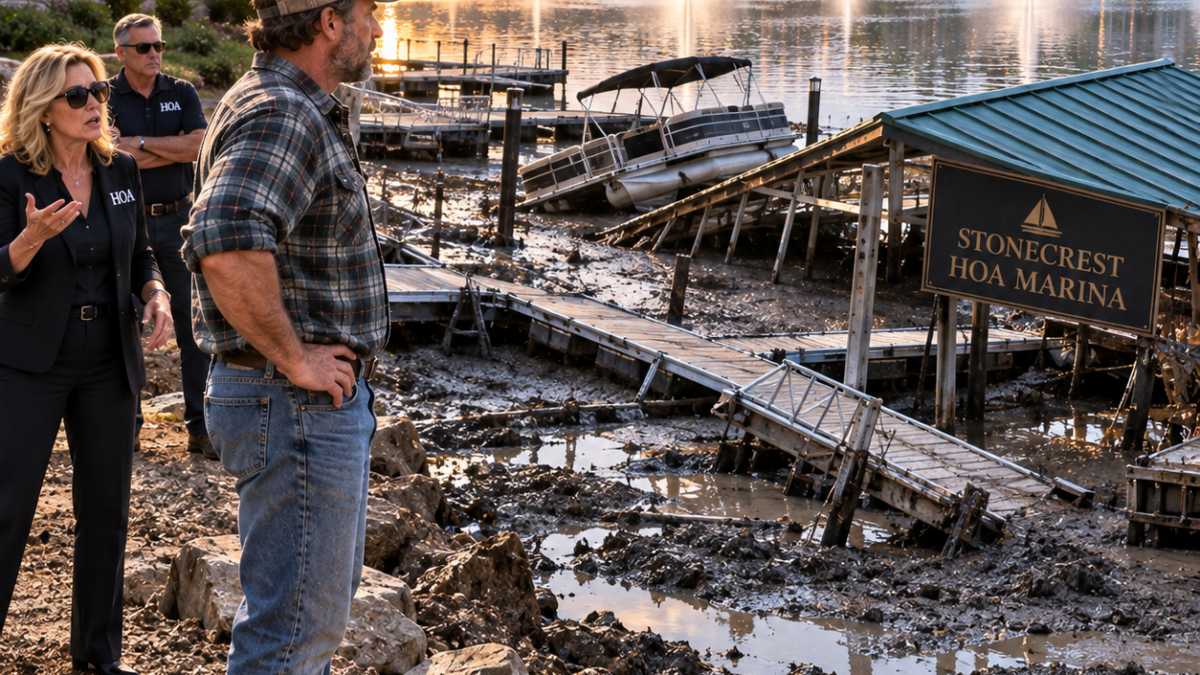
Theo Albbright read the invoice over my shoulder.
“Phase two of what?”
He was seventy-two, retired from county survey work, and one of those men who could make a question sound heavier simply by refusing to rush it.
I turned the page.
Another charge.
Continuous lake makeup during extended fountain display hours.
No gallon count.
No runtime.
Just the service code appearing again and again.
Six consecutive dates.
Theo tapped it with one finger.
“Makeup water usually replaces what a system loses.”
“Yes.”
“How much does a closed fountain system lose?”
“Not enough to put a twenty-two-acre lake seven inches down in less than a week.”
He straightened slowly.
Outside the control-house window, the clubhouse fountains were visible through gaps in the trees.
They were off that morning.
The stone court around them was still wet.
I had spent most of my adult life around reservoirs, municipal intakes, pump stations, and control structures.
Water always leaves evidence.
A wet line.
A current trace.
A sound inside a pipe.
Mud where there should be depth.
People leave evidence too.
Usually in paperwork.
The third invoice carried a secondary code.
TEMPORARY LAKE FEED — PHASE 2 CONTINUATION.
That word bothered me more than anything else.
Temporary.
Alder Cove had unveiled the fountain court nearly five months earlier.
There had been photographs in the community newsletter.
Champagne.
A ribbon cutting.
A board announcement calling the project “the centerpiece of a new waterfront identity.”
If the lake feed was still temporary, then something about the permanent system had never been completed.
I closed the file.
“Come with me.”
“To the fountain court?”
“Yes.”
Theo grabbed his hat.
We drove around to the clubhouse side and parked near the public walking path.
From the front, the fountain court looked finished enough to belong in a real-estate brochure.
Pale stone.
Bronze plaques.
Trimmed hedges.
Twelve stainless-steel nozzles set inside a long reflecting basin.
But once we walked around the side, I saw temporary construction fencing still running behind the landscaping wall.
Beyond it sat a concrete reservoir.
Empty.
Unfinished.
No tile.
No recirculation pumps.
No completed return manifold.
Orange electrical conduit hung loose from one wall.
Theo stopped beside the fence.
“That’s supposed to be the return reservoir.”
“Yes.”
A laminated rendering stood nearby.
In the rendering, water fell through the decorative court, collected, passed through filtration, and returned to the fountain pumps.
A closed loop.
The real system had only half of that path.
I followed the visible drain trench until it disappeared beneath the back wall.
I knew where that line went.
The old construction road below the dam.
Outside the lake’s natural catchment.
If the temporary discharge line was still connected, then every gallon pulled from Ror Lake traveled through the fountains and left the watershed entirely.
Nothing returned.
A utility cart rolled toward us.
The driver wore a gray contractor shirt with Croll Fountain Systems embroidered over the chest.
He stepped out carrying a clipboard.
“Can I help you gentlemen?”
“I’m Jonas Ror.”
His expression changed.
Just slightly.
“Ben Croll.”
“I know.”
Theo leaned against the railing.
“You signed these.”
I showed Ben the invoice.
His eyes moved over the page.
“I signed field invoices.”
“This system is still on temporary lake feed?”
“The permanent return system is pending final completion.”
“So yes.”
“It’s operating under an interim configuration.”
“A once-through configuration.”
His jaw tightened.
“That’s a commissioning term.”
“It’s also where the water goes.”
Theo pointed toward the drainage side.
“Out below the dam.”
Ben looked at him.
“And you are?”
“The man measuring the docks your fountain put in the mud.”
I raised a hand.
“The commissioning report limited temporary operation to short tests, correct?”
Ben looked at me.
“Where did you get the commissioning report?”
“Seth sent the production packet after I invoked the operating agreement.”
He lowered the clipboard slightly.
“It permits temporary testing.”
“Short testing?”
“Yes.”
“Not four hours every evening.”
“No.”
“Not sunrise calibration.”
He didn’t answer.
“And not below the protected elevation.”
His silence answered that one too.
I opened the next document.
“The system was also supposed to have a low-water shutdown relay.”
Ben looked past me.
Toward the pump enclosure.
“What exactly are you asking?”
“Was the relay changed?”
“You need to ask the client about operating decisions.”
“I’m asking about contractor work.”
He looked down at his clipboard.
A voice came from behind us.
“You should direct all questions to management.”
Elaine.
She approached from the clubhouse wearing sunglasses and carrying a folder printed with the Moonlight on the Water Gala logo.
“This area remains under contractor control.”
“We’re standing on a public walkway.”
“You’re interfering with preparations.”
“I’m reading the commissioning report.”
“The system passed visual acceptance.”
“Visual acceptance doesn’t make it closed loop.”
Her mouth tightened.
“The permanent reservoir is a completion item.”
“It’s the part that sends the water back.”
“The project delivers significant value to the community.”
Theo looked toward the unfinished basin.
“It doesn’t deliver water back to the lake.”
Elaine ignored him.
I held up the report.
“The low-water relay was supposed to stop the pumps before the lake crossed the red mark.”
“The threshold has been interrupting calibration.”
That was the first time she admitted knowing about the shutdowns.
I studied her.
“Then the protection was doing its job.”
“It’s an outdated operating threshold interfering with a modern amenity.”
“No, Elaine. It’s a limit written into an agreement your association accepted.”
She stepped closer.
“This neighborhood did not invest millions of dollars in waterfront improvements so one decades-old marker could dictate every operating decision.”
“My father didn’t paint that mark because he liked red.”
“Your father could not have anticipated Alder Cove as it exists today.”
“Water levels haven’t modernized.”
Her expression changed.
Not anger exactly.
Something colder.
“The board will review whether the existing threshold remains appropriate.”
“You can review it.”
I looked at the marina across the lake.
“But until it changes legally, it’s still the threshold.”
Ben started toward the pump enclosure.
As he passed me, I noticed the date on his work order.
Thursday, June 6.
That mattered.
Because Thursday evening was when the gauge began falling faster.
I wrote the date in my notebook.
Ben unlocked the metal pump-enclosure door.
A green indicator light glowed through the ventilation slots.
The moment he stepped inside, it changed to amber.
A pump started.
I felt the vibration through the stone path.
Seconds later, Theo and I walked to the back side of the court.
Water began flowing through the temporary discharge line below the dam.
Not a trickle.
A strong, continuous stream.
Ror Lake was entering at one side of the fountain system.
And leaving the watershed from the other.
Theo stood with his hands on his hips.
“There’s your leak.”
“No.”
He looked at me.
“There’s no leak.”
I watched the discharge.
“This is exactly what they designed it to do temporarily.”
“That’s worse.”
“In a way.”
“A leak could be an accident.”
“Yes.”
He looked toward Elaine.
“This requires somebody to keep turning the pumps on.”
The rest of the records arrived Thursday morning.
Twenty-three files.
Lighting alignment sheets.
Nozzle inspections.
Cleaning reports.
Photographs carefully framed so the unfinished reservoir never appeared.
Then I opened the controller log.
9:42 p.m., Thursday, June 6.
LOW WATER ALARM.
Stop command issued.
Pump current dropped.
Eleven seconds later, current returned.
10:07 p.m.
Same thing.
10:31.
Again.
11:04.
Again.
The system knew.
It had repeatedly tried to protect the lake.
And something repeatedly overrode it.
Theo arrived with coffee while I was printing the alarm sequence.
I handed him the pages.
He read the first two events.
“The controller tried to stop the pumps.”
“Yes.”
“And they came back on.”
“Yes.”
The next file was a current graph.
Steady draw through the alarm periods.
The pumps weren’t idling.
They weren’t falsely reporting activity.
They were moving water.
Then I found the service note.
One page.
Three lines.
TEMPORARY CONTINUITY JUMPER INSTALLED ACROSS LOW-WATER RELAY TO PREVENT REPEATED INTERRUPTION DURING EXTENDED DISPLAY TESTING.
Theo put his coffee down.
“Does that mean what it sounds like?”
“The relay could still detect low water.”
“But?”
“It couldn’t shut the pumps off.”
He stared at me.
“Somebody physically bypassed the safety.”
“Yes.”
The service note had Ben Croll’s electronic approval.
6:18 p.m.
The first low-water alarm occurred at 9:42.
Three hours and twenty-four minutes later.
Next came the work order.
Client instruction:
MAINTAIN UNINTERRUPTED FOUNTAIN OPERATION THROUGH GALA PREPARATION PERIOD.
Authorized contact:
Elaine Corwin.
Then I found the email.
Sent at 5:51 p.m., twenty-seven minutes before Ben approved the jumper.
From Elaine.
To Seth.
The language was calm.
Businesslike.
That almost made it worse.
The repeated shutdowns are interfering with rehearsal photography and guest-facing gala preparation. Please authorize Croll to maintain continuity through gala week.
Then the final line.
The lake has ample visual reserve and any temporary reduction can be corrected after the event.
I read that sentence twice.
Theo stood silently across the workbench.
“She knew.”
“Yes.”
“She knew the relay was stopping the pumps.”
“Yes.”
“She knew the level was going down.”
“Yes.”
“And decided they could put the water back afterward.”
I looked at the brass gauge through the window.
“She treated the lake like scenery.”
Theo sat down.
“Visual reserve.”
“That’s what she called it.”
I reached for an old drafting pencil lying beside the records.
It had belonged to my wife, Evelyn.
After she died, I found it in the control house inside a coffee can filled with spare hooks, string, and little handwritten notes she used during summer fishing mornings.
Evelyn had loved children on the lake.
She would sit near the North Marina untangling lines, tying hooks, and teaching kids how to hold sunfish without getting stuck by the spines.
She understood something I had needed years to learn.
Owning water did not mean keeping people away from it.
It meant making sure the people who had rights to it could still use it after everyone with an ego had gone home.
I circled Elaine’s timestamp.
5:51.
Then Ben’s approval.
6:18.
Then the first alarm.
9:42.
No speech improved that timeline.
At 10:30, I prepared an emergency review notice.
It stated three things plainly.
The required protective control had been deliberately bypassed.
Decorative withdrawal had continued after the lake dropped below the protected operating elevation.
All controller logs, relay hardware, contractor work orders, and board communications had to be preserved immediately.
Then I repeated the sentence I had written in my first notice.
Resident recreational access remains protected.
Before I sent it, Mara Keading called.
“Jonas.”
Her voice was tight.
“Have you seen the resident portal?”
“No.”
“You need to.”
I opened it.
Elaine had posted three minutes earlier.
IMPORTANT LAKE ACCESS UPDATE.
She wrote that the “private lake owner” had refused to support temporary stabilization measures and was threatening operational restrictions that could affect marina access during gala weekend.
She assured residents the board remained committed to protecting recreation and property values.
There was no mention of the unfinished reservoir.
No mention of once-through operation.
No mention of the low-water alarms.
No mention of the jumper.
Comments were already multiplying.
Can Jonas close the docks?
Is the HOA losing access?
Can he charge us to use the lake?
Why should one man control everybody’s shoreline?
Theo read over my shoulder.
“She got ahead of you.”
“No.”
I attached Elaine’s portal post to my preservation notice.
“She got ahead of the evidence.”
I sent the notice to Seth.
Every board member.
Croll Fountain Systems.
The HOA’s insurance contact.
And the management company.
Delivery confirmations appeared one by one.
Elaine’s came last.
Less than a minute later, the fountain pumps started again.
By Friday afternoon, nobody at the North Marina whispered when I walked toward them anymore.
The mud had become more persuasive than rumors.
Three dock owners stood beside Mara.
Theo had set his laser level on the concrete landing.
He was checking the hinge plates.
Henry Morse pointed toward his pontoon.
“My insurance agent asked whether the marina is closing.”
“It isn’t.”
“Elaine said you might terminate the lake agreement.”
“I’m not.”
“Then why did she say access is threatened?”
Before I could answer, Elaine approached from behind them carrying a glossy blue folder.
“That’s not what the board said.”
Mara turned.
“Your post said Jonas was refusing stabilization.”
“He rejected a temporary operating adjustment.”
“What adjustment?”
I asked.
Elaine looked at me.
“You know exactly what I mean.”
“No. There was a request to continue pumping.”
Seth followed several steps behind her, tablet held close to his chest.
He looked tired.
Henry pointed toward his boat.
“Can someone please tell me whether this slip is safe?”
Theo answered first.
“Some are. Yours needs to move.”
He pointed toward the outer hinge.
“The plate rotated because the float is grounded. Two bolts are carrying more load than they were designed for.”
Henry swallowed.
“Can I back it out?”
“Raise the motor completely,” I said. “We’ll walk it along the deeper side.”
Elaine’s head snapped toward me.
“You do not direct marina operations.”
“I’m telling him how not to damage his boat.”
“That is management’s responsibility.”
“Then manage it.”
Mara looked at Elaine.
“My son’s boat dragged through mud yesterday.”
“That slip has always been shallow.”
“Not like this.”
Elaine opened the blue folder.
“The board has retained an independent maintenance consultant.”
“Has that consultant inspected the hinge?”
“A preliminary review is underway.”
“Has he measured the lake?”
“He is reviewing all relevant conditions.”
Theo lifted his survey sheet.
“I measured it.”
Elaine ignored him.
She handed me the folder.
“The board has proposed an emergency operational amendment.”
I opened it.
My stomach went cold.
They wanted to lower the protected minimum by nine inches.
Enough to make the current water level compliant.
Enough to allow fountain operation to continue.
Enough to leave the North Marina sitting in mud while the HOA declared everything officially normal.
Mara looked over my shoulder.
“You’re changing the legal minimum?”
“We’re modernizing an outdated threshold.”
I looked at Elaine.
“The agreement requires my written consent.”
“The association believes it has authority to update standards connected to community amenities.”
“The association can believe whatever it likes.”
I closed the folder.
“The elevation doesn’t move until I sign.”
Elaine’s voice dropped.
“This lake supports the value of hundreds of homes.”
“So do the docks.”
“Your father understood that private ownership carries obligations.”
“My father put the red mark into the agreement.”
“He built this lake when the surrounding property was nothing like Alder Cove today.”
“Yes.”
I pointed toward the outer dock.
“And the water still has to be high enough to float that.”
Several residents moved closer.
Elaine’s controlled expression finally started slipping.
“You’re treating a family relic as a permanent barrier to progress.”
“The lake isn’t a relic.”
“The operating schedule is.”
“The docks are in mud.”
“That is temporary.”
“So is shutting down the fountains.”
She looked toward the clubhouse.
White tents were being erected on the lawn.
Workers hung strings of lights along the fountain court.
The revised gala schedule was clipped behind the proposed amendment.
The fountain display had originally been scheduled to end at nine.
Now it ran until eleven.
Two additional hours.
Two more hours of water leaving Ror Lake, passing through twelve decorative jets, and discharging downstream.
“My answer is no,” I said.
Elaine took the folder from my hand.
“Then you’ll be responsible for what happens next.”
Saturday morning began with boats leaving the shallow slips.
Not because Elaine ordered it.
Because Mara called every dock owner she knew before sunrise.
By seven, three pontoons and two fishing boats had been moved to deeper water.
Theo marked a safe route with orange floats.
Henry and I guided his pontoon by rope so the propeller never touched the mud shelf.
He looked toward the clubhouse lawn.
“They’re still having the gala.”
“Yes.”
“Tonight?”
“Yes.”
“Even after all this?”
I looked across the water.
Workers were placing white tablecloths.
“Apparently.”
At 6:30 that morning, I sent one final deadline.
Stop temporary fountain pumping by noon.
Preserve the intake cabinet and low-water relay.
Allow inspection under the emergency provisions of the lake agreement.
I copied the entire board.
Seth.
Ben Croll.
Grace Nolan, the HOA carrier’s property-risk engineer.
And Reena Solles from Hion Dam and Reservoir Services.
Hion was the independent engineering firm named in the operating agreement.
Reena had already reviewed the dam operating certificate, commissioning documents, alarms, and photographs.
Her reply arrived at 7:12.
I WILL BE ON SITE BY 3:00 P.M.
DO NOT ALTER THE FOUNTAIN INTAKE OR RELAY CABINET BEFORE INSPECTION.
At 8:40, Seth called.
He sounded different.
Lower.
More careful.
“Grace Nolan wants the insurance renewal file.”
“She should have it.”
“There’s a problem.”
“What?”
“The board renewal package describes the fountain court as a completed recirculating system.”
I looked across the lake.
At the unfinished reservoir.
“Who certified that?”
Silence.
“Seth?”
“Elaine signed the board certification.”
“And management transmitted it?”
“Yes.”
“Did you know the reservoir wasn’t finished?”
“There were completion items.”
“That’s not what I asked.”
A long pause.
“Yes.”
“Was the temporary lake feed disclosed?”
“No.”
“The once-through discharge?”
“No.”
“The relay jumper?”
“I didn’t know about that until the supplemental production.”
“But you knew it wasn’t closed loop.”
“Yes.”
I closed my eyes.
Outside, a rental truck backed across the gala lawn.
Workers unloaded serving carts.
“Seth.”
“Yes?”
“Do not let anybody touch that relay cabinet.”
“I’ve issued a preservation notice.”
“To Elaine?”
“Yes.”
“Did she acknowledge it?”
“No.”
At 10:30, Grace Nolan called me directly.
“Mr. Ror?”
“Yes.”
“I reviewed the commissioning report, operating agreement, and contractor service note.”
“All right.”
“I’m not adjudicating ownership.”
“I understand.”
“My role is loss control.”
“Understood.”
“If the condition described in those records is verified, I will issue a stop-use requirement and refer the file to the carrier’s authorized coverage team.”
Elaine had called the lake “visual reserve.”
The insurance carrier was beginning to call it property-loss exposure.
At noon, my shutdown deadline expired.
No confirmation came.
Instead Seth forwarded a three-line response from Elaine.
The board disputes the owner’s authority to suspend association amenities.
Gala activities will proceed.
All systems remain under association and contractor supervision.
Mara read the message beside the South Finger.
“She chose the fountains.”
“She chose not to stop them voluntarily.”
“What’s the difference?”
I looked toward the clubhouse.
“Tonight, maybe a lot.”
At 2:47, a dark blue utility truck came through the gate.
Reena stepped out wearing field boots and a gray Hion shirt.
She carried a hard case and a rolled copy of the operating plan.
Her first look was not toward me.
It was toward the brass staff gauge.
Then the marina.
Then the fountains.
“How long have those outer floats been grounded?”
“Definitely since Monday. Possibly Sunday night.”
“And extended fountain operation?”
“Since the previous Thursday.”
She crouched beside the gauge.
Photographed the water line.
Checked the elevation.
“This is below minimum.”
“Yes.”
“Dam outlet?”
“Closed.”
“Spillway?”
“Dry.”
“Tributary?”
“Still flowing.”
She stood.
“Then we start with the intake.”
Grace arrived fifteen minutes later with Seth.
By four, workers were turning on the fountain lights.
At 4:20, catering staff carried trays into the clubhouse.
At 4:35, Mara and Theo moved the final boat from the shallowest north slip.
Reena studied the live controller from the old control-house terminal.
The fountain pumps were temporarily idle.
The low-water alarm remained active.
“The controller knows the lake is low,” she said.
Grace looked at the alarm history.
“And the shutdown remains bypassed.”
“We verify physically,” Reena said.
At 4:58, the current line jumped.
The pump hum reached us a second later.
Across the lake, the first fountains rose.
Then the second bank.
Then all twelve.
A new alarm appeared.
Red.
LOW WATER.
The pumps did not stop.
Reena watched for ten seconds.
Then rolled up the operating plan.
“We inspect now.”
The gala was already underway when we crossed the service path.
Guests stood beneath white tents holding wineglasses.
A string quartet played beside the stone cascade.
The fountains rose above them in bright arcs.
Behind the celebration, the North Marina leaned over exposed mud.
We must have looked strange walking toward the pump enclosure.
Reena in work boots carrying a hard case.
Grace with a thick insurance folder.
Seth clutching his tablet.
Theo holding survey sheets.
Mara following in boat shoes stained brown with lake mud.
And me carrying the agreement my father had signed decades before anyone imagined a luxury fountain court on that shoreline.
Elaine reached the enclosure first.
She wore a dark blue dress.
Her expression was perfectly controlled.
“You are not opening that cabinet.”
Reena stopped several feet away.
“My name is Reena Solles, Hion Dam and Reservoir Services.”
“I know who you are.”
“Then you know Hion is the independent engineering firm identified in the operating plan.”
“This is association equipment.”
“The fountain hardware is,” I said. “The intake is connected to lake-controlled infrastructure.”
Elaine turned toward Seth.
“Did you authorize this?”
“The emergency notice was delivered.”
“That’s not what I asked.”
“No.”
He looked directly at her.
“It isn’t.”
Ben Croll arrived in a utility cart.
His eyes went immediately to Grace’s insurance folder.
“What exactly are we doing?”
“Verifying the low-water relay,” Reena said.
He looked at Elaine.
She said nothing.
Grace stepped forward.
“I need the physical condition documented before continued operation.”
Elaine stared at her.
“You’re here for the insurance carrier. Not to manage our event.”
“That’s correct.”
Grace’s voice was calm.
“I’m here to evaluate active property-loss exposure.”
The quartet continued behind us.
The fountains kept throwing water into the air.
A few residents began watching.
Reena opened the operating plan.
“This emergency-control section authorizes Hion to inspect and isolate lake-intake equipment after modification or defeat of a protective control.”
“This dispute has not been adjudicated,” Elaine said.
“It doesn’t need to be adjudicated for inspection,” I replied.
“You’re using an old agreement to seize control of a modern amenity.”
“I’m using it to stop a lake from being drained below the elevation that keeps your marina functional.”
Reena looked toward Seth.
“Record the time.”
He checked his tablet.
“5:21.”
Reena turned to Ben.
“Do you have the cabinet key?”
He put his hand into his pocket but did not remove it.
“I need client authorization.”
“You have the emergency notice,” Seth said.
“My client is the association.”
Elaine folded her arms.
“And the association does not authorize access.”
Reena set her hard case on the ground.
“The owner invoked the inspection provision. Management confirmed delivery. The intake is active below operating minimum.”
Ben looked from Reena to Elaine.
Then toward the fountain pumps.
Slowly, he pulled out the key.
Elaine’s face changed.
“Ben.”
He stopped.
Grace spoke.
“If the carrier is expected to evaluate exposure involving this system, I need its current condition preserved and documented.”
Ben handed Reena the key.
The metal cabinet door opened.
No one spoke.
Reena photographed everything before touching anything.
Indicator lights glowed behind transparent covers.
One red light remained steady.
LOW WATER.
She compared the panel with the commissioning diagram.
Then leaned closer.
“There.”
She used the capped end of a pen to indicate a small connection across two relay terminals.
A simple metal jumper.
Grace photographed it.
Seth recorded the cabinet serial number.
Ben stared at the wiring.
Reena looked at him.
“Your crew installed this?”
His jaw moved.
“Yes.”
“Under which work order?”
He gave the number.
It matched mine.
“Who described the relay operation as nuisance interruptions?”
“That language came from the client.”
“Were you told the lake had already crossed the protected elevation?”
Ben hesitated.
“We were told the relay was interrupting calibration.”
“That wasn’t my question.”
“No.”
He swallowed.
“We were not provided the operating agreement.”
Elaine stepped closer.
“The contractor operated within an approved service scope.”
Grace turned.
“Approved by whom?”
“The board.”
“After the low-level alarms?”
“The threshold is overly conservative.”
Reena looked at the panel.
“The alarm is active right now.”
“The condition is temporary.”
“So is shutdown.”
I hadn’t meant to say it sharply.
But it landed.
Elaine looked at me.
The fountains rose behind her.
The dock sat in mud beyond them.
Grace closed her folder.
“Continued operation under a bypassed protective-control condition creates unacceptable property-loss exposure.”
“You’re escalating this during a community event.”
Grace didn’t blink.
“The condition was escalated before I arrived.”
Reena closed the cabinet without locking it.
Then put one hand near the dedicated fountain-intake isolation control.
“Will the association shut the intake down voluntarily?”
Everything seemed to get quieter even though nothing had stopped.
The quartet.
The conversations.
The pumps.
Elaine looked toward the white arcs.
Then toward the guests.
She said nothing.
Reena waited.
Five seconds.
Ten.
Then she looked at me.
“Mr. Ror, are you invoking the temporary-control provision under the lake agreement and operating plan?”
“Yes.”
Seth lifted his tablet.
“Time is 5:29.”
Grace opened her folder.
“For the record, after verified alteration of required low-water protection, continued operation creates unacceptable property-loss exposure. I am issuing a documented stop-use condition.”
Elaine turned toward her.
“You cannot cancel our coverage.”
“I did not say I was canceling coverage.”
Grace’s tone remained flat.
“I said any refusal to cease operation will be referred immediately to the authorized coverage team.”
Reena looked at Ben.
“Does this intake serve any essential system?”
“No.”
“Domestic water?”
“No.”
“Fire protection?”
“No.”
“Dam control?”
“No.”
“Fountain feed only?”
“Yes.”
Reena nodded.
“Good.”
She placed a lockout device on the dedicated isolation.
I did not touch it.
I did not touch the valve.
I did not touch the cabinet.
I stood beside the path holding the agreement while a licensed independent engineer did what Elaine had refused to allow all week.
The first change was sound.
The pump pitch dropped.
Half a note.
Then another.
Across the gala lawn, the tallest bank of fountain jets lost pressure.
Guests turned.
The white arcs shortened.
The second bank weakened.
Spray that had cleared the stone wall began falling short.
The quartet played three more measures.
Then one violinist lowered her bow.
The cascade thinned.
Elaine stepped forward.
“What are you doing?”
Reena did not look up.
“Isolating the dedicated intake under the temporary-control provision.”
“You’re shutting down a board-approved system.”
“I’m shutting down an altered intake operating below protected elevation.”
The third fountain bank collapsed.
For one strange second, a single white arc remained.
Perfect.
Bright.
Hanging over the polished stone.
Then it bent.
Fell.
And disappeared into the basin.
Silence moved across the gala in sections.
The guests closest to the fountains stopped first.
Then the serving staff.
Then the people near the marina path.
Nobody needed me to explain anything.
The evidence stood in two directions.
Silent fountains in front of them.
Grounded docks behind them.
Mara walked to the edge of the lawn.
She pointed across the lake.
“That’s where the water went.”
Henry Morse stared at the tilted dock finger where his pontoon had sat that morning.
Elaine raised her voice.
“This display has been interrupted because Jonas Ror chose to escalate a private ownership dispute during a community event.”
Grace answered before I could.
“This is not an ownership determination.”
She held up the written stop-use notice.
“This is a verified protective-control failure connected to ongoing property-loss exposure.”
Seth looked at Elaine.
“The low-water alarm was active when the cabinet opened.”
Ben spoke next.
“And the service note matches the jumper.”
Elaine turned toward him.
“You approved that work.”
“Under the association’s work order.”
“You knew what it was for.”
“I was told calibration shutdowns were interfering with testing.”
“You installed the jumper.”
“Yes.”
He did not try to escape that.
“But I was not provided the operating agreement or told the lake was below the protected threshold.”
His answer did not absolve him.
It did place the decisions in order.
Reena removed the jumper only after photographing it and documenting its position.
She sealed it in a tamper-evident evidence bag.
Then she placed a numbered preservation seal over the cabinet.
Seth recorded the seal number.
Grace signed the stop-use condition.
The fountains remained silent.
And for the first time in days, I could hear Ror Lake again.
A small wave reached the south shoreline.
Soft.
Natural.
Almost too quiet to notice.
Elaine looked around the lawn.
Guests stood holding drinks.
Several had their phones out.
Nobody was looking at the stage.
She turned to me.
“You embarrassed this entire community.”
“The docks were already in the mud before anybody arrived.”
“You could have handled this privately.”
“I tried.”
“You issued threats.”
“I asked you to stop the pumps.”
“You threatened association rights.”
“I repeatedly protected resident rights in writing.”
Mara stepped between us.
Not aggressively.
Just enough.
“My boat was dragging through silt yesterday.”
Elaine looked at her.
Mara’s voice stayed low.
“This isn’t about embarrassment.”
Theo approached carrying his survey sheet.
“The first dock finger needs to be unloaded before recovery begins.”
That changed the conversation.
Not instantly.
But enough.
People stopped watching Elaine and me.
They started looking toward their boats.
Toward the marina.
Toward the actual work.
Reena checked the brass gauge again.
“The lake won’t recover tonight.”
“How long?” Henry asked.
“Depends on inflow and weather.”
“Can we pump water back?”
“No.”
Her answer was immediate.
“You do not correct one operating mistake by creating another.”
She pointed toward the docks.
“As the level rises, grounded floats may lift unevenly. Hinges need support. Boats need to stay out of the shallow slips until structural checks are complete.”
Grace looked at Seth.
“I want documented inspections before north slips reopen.”
He nodded.
“I’ll arrange temporary storage.”
Elaine said nothing.
The fountain lights continued glowing beneath empty nozzles.
They looked absurd without water.
Reena handed me the isolation record.
One line mattered most.
RECREATIONAL LAKE ACCESS REMAINS IN FORCE.
Only the decorative intake had been stopped.
I folded the page.
Placed it inside the agreement.
Reena stood beside my father’s brass gauge.
“Stopping the loss was the easy part.”
I looked at the grounded docks.
“What’s the hard part?”
“Bringing the water back without letting those structures damage themselves on the way up.”
She was right.
Sunday morning began with supports.
No emergency refill.
No temporary hoses.
No attempt to rush twenty-two acres of water back into place.
The spring-fed tributary would restore the level naturally.
The HOA paid for temporary boat storage six miles away.
Structural crews placed adjustable supports beneath the twisted gangways.
Theo marked each piling with recovery measurements.
Reena inspected the staff gauge twice a day.
Grace required written progress reports.
The fountain court remained silent.
For the first week, nothing looked better.
The mud stayed exposed.
The dock still leaned.
The gala tents came down, leaving pale rectangles in the grass.
People wanted visible repair.
They got paperwork first.
On Monday, Alder Cove posted a correction.
It stated that I had not opened the dam outlet.
I had not withheld water.
I had not intentionally lowered Ror Lake.
It confirmed that the fountain system had been operating through a temporary once-through configuration.
It confirmed pumping continued after the protected minimum was reached.
It confirmed residents retained their recreational rights.
Elaine’s name was absent from that notice.
It appeared two days later in a board resolution.
She was formally censured.
She remained on the board.
But her authority over water systems, infrastructure amenities, and contractor work orders was removed.
No dramatic resignation.
No police.
No courtroom.
No shouting meeting.
Just a list of decisions she could no longer make alone.
Seth brought the resolution to my control house.
He set another document beside it.
“The board approved a lake-stewardship committee.”
“Who?”
“You. Two elected dock owners. One Hion representative.”
“Authority?”
“Runtime records, alarm history, intake changes, and operating modifications available to all four members.”
“No unilateral contractor changes?”
“No.”
“No bypassing protective controls?”
“Obviously.”
I looked at him.
“That should have been obvious before.”
He nodded.
“Yes.”
For a moment neither of us spoke.
Then Seth looked toward the unfinished fountain reservoir.
“I should have pushed harder when the insurance paperwork called the project complete.”
“Yes.”
“I knew there were completion items.”
“You knew enough to ask.”
“Yes.”
“I didn’t.”
“No.”
He absorbed that.
I didn’t tell him it was all right.
It wasn’t.
But there is a difference between forgiveness and pretending something did not happen.
Seth had preserved records when the dispute became serious.
He had stopped defending incomplete explanations.
He had finally allowed the paperwork to say what the physical evidence already showed.
“The correction is a start,” I said.
“I know.”
Dock repairs took almost a month.
One hinge plate required replacement.
Two gangway connections needed reinforcement.
The grounded floats were inspected for stress cracking.
Crews stabilized shoreline mud so the rising lake wouldn’t carry loose sediment into deeper water.
The HOA paid from project reserves while responsibility between the association and fountain contractor was negotiated.
Dock owners were not assessed.
The fountain project became something entirely different.
No more temporary discharge.
The unfinished return reservoir had to be completed.
Lined.
Pressure tested.
Connected to proper return pumps and filtration.
The construction outfall was capped.
Reena wrote a new operating provision.
Decorative fountains could use Ror Lake only for limited makeup water.
Any lake withdrawal required documentation.
The low-water relay could not be altered without approval from the stewardship group and independent engineer.
Nobody objected.
At least not out loud.
By the third week, the dark mud line beneath the marina narrowed.
By the fourth, the water reached the lower edge of the grounded floats.
Mara came down every morning before work.
Theo brought his measuring rod.
Henry came even though his pontoon remained in storage.
We never celebrated early.
Reena had warned us about the first lift.
That was when uneven stress could damage the repaired hinges.
On the twenty-seventh morning, wind moved lightly across the lake from the west.
I stood beside the brass gauge.
Theo was fifty feet down the shoreline.
He suddenly called my name.
“Jonas.”
I looked up.
He pointed.
The outside corner of the first dock had moved.
Less than an inch.
But it had moved.
The float was no longer pressed into mud.
Mara arrived ten minutes later.
She stepped cautiously onto the gangway.
The structure shifted beneath her.
Just a small natural movement.
The kind nobody had appreciated before losing it.
She stopped halfway down.
“This is where Evelyn used to sit.”
I looked toward the corner railing.
For a second I could see my wife there.
Coffee in one hand.
A can of hooks beside her.
A child holding a bluegill too tightly.
Evelyn laughing.
“Relax your fingers, sweetheart. The fish is more scared than you are.”
I had spent years thinking that protecting something meant holding it close.
Elaine had made the opposite mistake.
She thought control meant permission to use something until somebody physically stopped her.
Neither idea was stewardship.
The lake belonged to me legally.
But Alder Cove residents had recorded rights.
Those rights mattered.
My responsibility was not merely to stop the pumps.
It was to make sure Mara and Leo and Henry could return to the water after people who had done nothing wrong were pulled into a fight they never asked for.
By the fifth week, the gauge reached the protected red line.
Reena signed the recovery report.
Grace cleared the temporary marina restriction after the final structural inspection.
Boats returned one at a time.
Mara’s fishing boat came first.
Leo stood at the stern watching the depth beneath the motor.
“Plenty?” Mara asked.
He looked down.
Then grinned.
“Plenty.”
Theo stood beside me.
“Seven inches.”
I nodded.
“Funny number.”
“What do you mean?”
“Sounds small when somebody says it in a meeting.”
He looked at the lake.
“Doesn’t look small now.”
“No.”
Across the water, the fountain court remained dry.
Ten weeks later, the permanent closed-loop system passed independent commissioning.
Reena was there.
So was Seth.
So was Ben Croll.
The new reservoir was full.
Return pumps were active.
Flow meters were installed on the makeup line.
The low-water relay had two independent verification points.
Nobody could bridge it with a simple continuity jumper and pretend that was normal calibration.
Elaine did not attend the commissioning.
I didn’t ask why.
When the fountains finally ran again, they looked almost exactly as they had before.
Twelve white arcs.
Polished stone.
Reflections in the clubhouse windows.
But I noticed something Elaine probably never had.
The staff gauge barely moved.
Water rose from the fountain basin.
Fell.
Returned through filtration.
Rose again.
A real closed loop.
Nothing dramatic.
Nothing disappearing downstream.
Late that afternoon, after everyone left, I walked to the end of the restored North Marina.
The dock moved beneath my weight.
Just enough.
A small wave passed under the floats and tapped the repaired piling.
Once.
Then again.
I looked toward the red line.
The water held steady.
The fountain court worked.
The marina floated.
The residents kept their rights.
And my father’s old agreement had survived because, in the end, it had never been designed to stop a community from enjoying the lake.
It had been designed to stop anyone—owner, board member, contractor, or HOA president—from enjoying it so recklessly that there was no lake left for everybody else.








