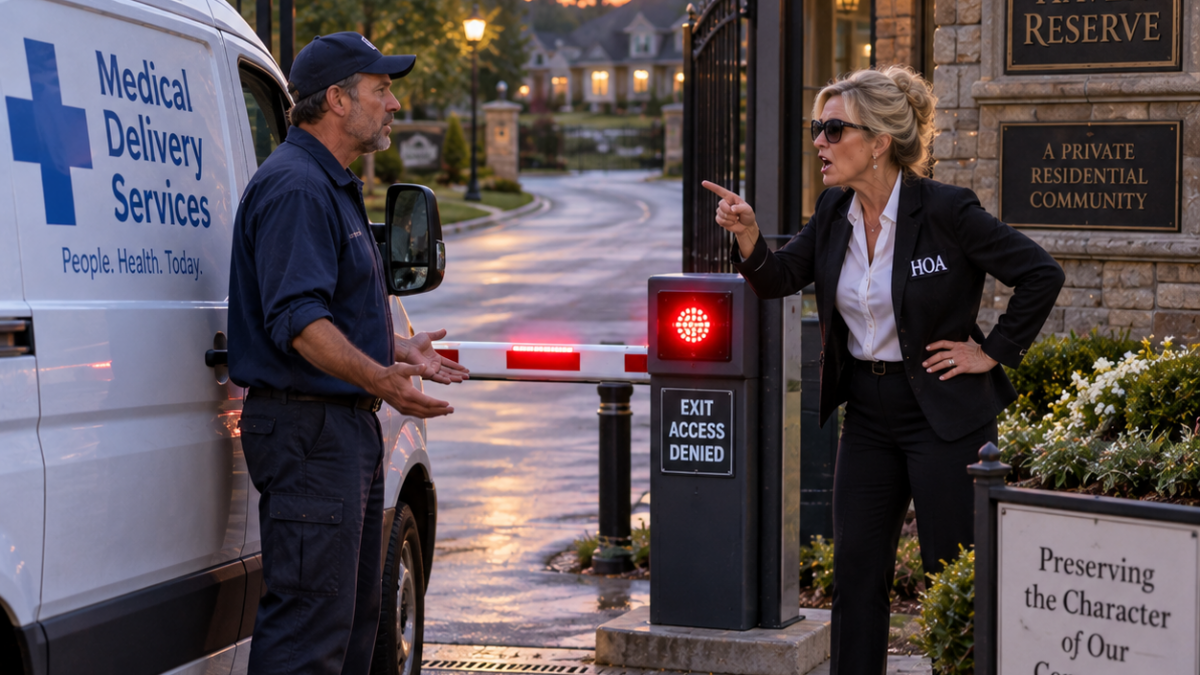
At 5:18 on a Tuesday morning, the gate to my own neighborhood flashed red and refused to let my medical delivery van out.
Robert Shaw.
For a few seconds I just stared at the name.
Then I opened the full assignment.
Robert Shaw. Laurel Creek Drive. Stone Haven Reserve.
I knew the last name immediately.
Meredith Shaw.
I read the notes again because part of me expected the connection to disappear if I looked carefully enough.
Home-care bed.
Transfer support equipment.
Installation required before return-home transport.
There was no diagnosis listed. There didn’t need to be. In my line of work, those short notes told you enough.
Someone had spent time in a hospital or rehabilitation facility.
Someone had reached the point where doctors believed home was possible.
And now the last few feet of that journey depended on a room being ready.
I called Nadia.
She answered from the branch office.
“What’s up?”
“Did you assign my Friday Stone Haven stop?”
“Dispatch did.”
“You know who Robert Shaw is?”
I heard her typing.
“No. Should I?”
“Meredith Shaw’s father.”
The typing stopped.
“Oh.”
That was all Nadia said.
It was one of the reasons I liked working for her. She didn’t turn every uncomfortable situation into theater.
After a moment she asked, “Do you want me to reassign it?”
I looked through the windshield at the chain-link fence surrounding the lot where I now had to leave my van every night.
A ridiculous thought passed through my head.
Let Meredith solve it.
Let her explain to another driver why the HOA president of gate rules suddenly needed a company-marked medical van inside her neighborhood.
The thought lasted maybe three seconds.
Then I pictured a man I had never met sitting somewhere with a packed bag.
I thought about my mother.
Years earlier, she had broken her hip and spent several weeks in rehabilitation. On the morning she was supposed to come home, one piece of equipment wasn’t ready.
No catastrophe happened.
No lawsuit.
No ambulance.
Just another night in a room she hated after she had already put on her going-home clothes and packed her bag.
She sat beside the window and kept asking me whether anyone had called.
That memory had stayed with me longer than some genuinely frightening moments in my life.
Small delays become very large when you are the person waiting.
“No,” I told Nadia. “Keep the assignment.”
“You’re sure?”
“Robert didn’t block my van.”
“That wasn’t my question.”
“I know.”
She was quiet.
Then she said, “All right. But we do this properly. I’m not sending you to that gate hoping somebody feels generous.”
“Agreed.”
“I’ll verify the household authorization and the discharge coordination.”
“Thanks.”
I ended the call.
The irony was obvious.
But irony wasn’t the job.
Getting the equipment installed was.
The next morning, Piedmont intake confirmed everything.
Robert Shaw was scheduled to return home after a rehabilitation stay. The downstairs guest room at Meredith’s house had been cleared for him. A home-care bed and transfer supports had been ordered.
The equipment had to be installed before the transport company would release his return trip.
At 9:12, Declan called.
“I assume you saw the service request.”
“I did.”
“I didn’t know Piedmont had the assignment.”
“Neither did I until yesterday.”
He exhaled.
“This is going to be difficult.”
“The installation isn’t.”
“You know what I mean.”
I did.
He asked whether another technician could bring the equipment in a smaller vehicle.
“Maybe,” I said. “But the load is already configured for my van, and the regular entrance doesn’t have the clearance.”
“Could your company transfer it?”
“Probably.”
There was a pause.
Then I said, “Would that fix the policy?”
“No.”
“It would just hide it for one delivery.”
“Yes.”
Neither of us said Meredith’s name.
We didn’t have to.
At 10:03, my personal phone rang.
Meredith Shaw.
I nearly let it go to voicemail.
Then I answered.
“Alex.”
Her voice sounded different.
Not kinder.
Faster.
“I understand your company has my father’s equipment assignment.”
“Yes.”
“He’s coming home tomorrow.”
“That’s what the service record says.”
“I need you to make the delivery.”
“I’m scheduled to.”
“Then there’s no problem.”
I looked through the office window at my van sitting behind the secured fence.
“There’s still a gate problem.”
“We can authorize you for this delivery.”
“Who is we?”
“The committee.”
“Can the committee remove the denial flag?”
Silence.
Then she said, “We can instruct security to admit you.”
“Declan told us operational changes go through management.”
“This is a one-time service exception.”
There it was.
For weeks, my van had been a dangerous precedent.
Now, because the equipment belonged to her father, the dangerous precedent could apparently become a one-time exception.
I could have enjoyed that moment.
I didn’t.
Robert was still the person waiting.
“What happens,” I asked, “when the guard sees a red denial on my plate?”
“They can use judgment.”
“They were instructed not to override active restrictions.”
“This situation is different.”
“Why?”
Her voice tightened.
“Because my father needs the equipment.”
I looked down at my desk.
“That makes the delivery important. It doesn’t change the gate status.”
“My father does not need to be dragged into your dispute.”
“I agree.”
“Then deliver the equipment.”
“I intend to.”
“Good.”
“But my employer needs written authorization the guard can actually rely on.”
“You’re making this procedural.”
“It became procedural when the gate turned red.”
She inhaled sharply.
“What exactly do you need?”
“A written authorization tied to the delivery, the vehicle plate, and the active restriction. From whoever actually has authority to override it.”
“That may take time.”
“So does rescheduling somebody’s trip home.”
Silence.
The sentence had landed.
I regretted it almost immediately, not because it was unfair, but because it sounded like I was using Robert against her.
I lowered my voice.
“Meredith, I’m not trying to prove something with your father. I want his room ready. But I’m not asking a guard to violate instructions just because the patient happens to be related to you.”
She didn’t answer.
“I’ll be ready for the scheduled window,” I continued. “If Stone Haven gives security a valid authorization, I’ll come through.”
She hung up without saying goodbye.
Ten minutes later, Declan forwarded me the email she had sent to management.
The subject line said:
ONE-TIME MEDICAL SERVICE EXCEPTION — ROBERT SHAW RESIDENCE.
I read it twice.
She still wasn’t asking Stone Haven to correct the rule.
She was asking them to step around it.
For her.
Friday morning became an exercise in contradiction.
Management approved the service call.
Security verified Robert’s address.
My company confirmed the dispatch.
The van was loaded.
The denial remained active.
At 11:26, the head of contract security called Piedmont.
His name was Silas March.
Nadia put him on speaker.
“I have the approved service note,” he said.
“And?” I asked.
“And I have an active denial on the same plate.”
Nadia leaned toward the phone.
“What will your guard actually see?”
“Primary screen: credential denied. Secondary note: authorized service at Laurel Creek Drive.”
“That’s contradictory.”
“Yes.”
“Can the guard choose the service note?”
“No.”
The answer came immediately.
I appreciated that.
A clear no was more useful than six vague yeses.
Meredith joined the next call.
“This is absurd,” she said before anyone had finished introductions. “My father’s service is approved.”
Silas remained calm.
“The address is approved.”
“The vehicle is the service vehicle.”
“The vehicle is also under an active denial.”
“Then use common sense.”
There was a short silence.
Then Silas said, “Common sense is not a credential category.”
Nadia looked at me.
I had to turn toward the window before she saw the smile I couldn’t quite stop.
Meredith did not find it amusing.
“You’re telling me a security officer cannot recognize a medical delivery?”
“I’m telling you I will not instruct an officer to disregard a red restriction based on a verbal exception.”
“This isn’t just someone asking.”
“No,” Silas said. “Which is exactly why I need one controlling instruction in writing.”
Everything stopped for a second.
Because that was the problem.
It had always been the problem.
Not my van.
Not Meredith’s father.
Not whether a guard could recognize medical equipment.
Stone Haven had created multiple layers of instruction and forced the person at the gate to guess which one mattered most.
Now Meredith was experiencing the exact same system from the other side.
At 12:18, a discharge coordinator named Phoebe Wells called our intake department.
Nadia brought me into her office.
“Keep this narrow,” she said.
“I know.”
“No diagnosis discussion.”
“Understood.”
She returned the call.
Phoebe explained that Robert’s return-home transport could not be released until the required equipment was installed and the downstairs setup was confirmed.
The original transport target was Saturday late morning.
Our Friday installation had intentionally left room for problems.
Now that margin was vanishing.
“If installation moves to tomorrow,” Phoebe said, “I need confirmation early enough to keep transport coordinated.”
“What time?” Nadia asked.
“Ten-thirty would be safest.”
Nadia wrote it down.
10:30 SATURDAY.
After the call, she closed the office door.
“I’m not sending you into a known denial this afternoon.”
“I agree.”
“You could sit at that gate for an hour.”
“I know.”
“Then I have a failed stop and thousands of dollars of equipment tied up in the van.”
“I know.”
She leaned back.
“You keep saying that.”
“What else am I supposed to say?”
“Tell me you’re angry.”
I looked at her.
She shrugged.
“You are.”
“Yes.”
“Good. You’re still human.”
I sat down.
“What bothers me isn’t even Meredith anymore.”
“What bothers you?”
“That everybody understands the problem now and the gate is still red.”
Nadia nodded.
“That’s usually when systems get most dangerous.”
“What do you mean?”
“When everyone assumes somebody else is about to fix them.”
At 1:07, Declan called again.
The one-time exception had failed.
Management could authorize Robert’s service call.
Security could verify the address.
But as long as the active vehicle restriction remained in place, Silas would not order his officers to ignore it without a controlling override.
The Friday delivery was moved to Saturday morning.
First window.
I called Meredith before she could call me.
“The installation has been rescheduled.”
“You canceled it?”
“No. Piedmont moved it because access is unresolved.”
“My father is supposed to come home tomorrow.”
“He still may.”
“The bed has to be there.”
“I know.”
Her voice changed.
Not much.
Just a slight crack in the polished certainty I had heard at every committee meeting.
“What is stopping this?”
I answered quietly.
“The same thing that stopped me Tuesday.”
She said nothing.
Neither did I.
There was no satisfaction in it.
No victory.
Just two adults on opposite ends of a phone realizing that a rule sounds very different when somebody you love is standing behind it.
That afternoon, Silas sent management a written request.
Declan forwarded it to me.
The first paragraph asked for clarification regarding the active commercial-vehicle denial and requested written identification of whoever had authority to suspend, remove, or supersede it.
Then Silas added one final question.
Who authorized the denial classification in the first place?
Until then, the fight had been about whether the gate should open.
Now Stone Haven had to answer how it had been closed.
Saturday began before sunrise.
I arrived at Piedmont at 6:20.
The warehouse smelled like cardboard, metal, and burnt coffee.
Nadia was already there.
“You sleep?”
“Some.”
“Liar.”
“Enough.”
We loaded Robert’s bed components first.
Frame.
Mattress.
Transfer rails.
Support equipment.
Hardware.
Everything was checked twice.
At 6:47, my phone buzzed.
Declan.
He had sent a screenshot from the gate-management audit.
I enlarged it.
Monday, 8:52 p.m. — Committee request submitted.
Monday, 10:06 p.m. — Commercial vehicle restriction profile selected.
Monday, 11:14 p.m. — Credential status changed to DENY.
The final entry contained a user field.
Not Meredith.
Not Declan.
Generic administrative account.
I called him.
“Who used the login?”
“I’m checking.”
“Was the restriction approved?”
“That’s the problem.”
I stopped pulling the cargo strap.
“What problem?”
“The management approval field is blank.”
Nadia, standing beside me, looked up.
“Blank as in hidden?”
“No,” Declan said. “Blank as in there is no approval entry.”
I put the phone on speaker.
“The system shouldn’t have activated the restriction without management authorization,” he continued.
“But it did.”
“Yes.”
“Then who activated it?”
“I’m pulling the session history now.”
Silas joined the call twenty minutes later.
Security hadn’t created the denial.
His staff had simply received an active status through the access system.
They had not reviewed the committee charter.
They had not seen my vehicle variance.
They had no reason to know a procedural step had been skipped.
Their job started after the screen said DENY.
“That’s why my officers treated it as controlling,” Silas said.
Meredith joined at 7:15.
I could hear a car door close on her end.
“My father’s installation is this morning,” she said. “We are not turning this into an internal audit.”
Silas answered before Declan could.
“It already is one.”
“Declan, can you remove the restriction?”
“Not until I verify what happened.”
“You already verified the service is legitimate.”
“That is a separate issue.”
The silence afterward was almost painful.
For days, Meredith had rejected my argument that parking and access were separate issues.
Now Declan was using the same distinction to explain why her father’s approved service call did not automatically erase my denied credential.
“This is ridiculous,” she said.
Declan’s voice stayed measured.
“The committee made a recommendation. A recommendation is not an activation.”
“The intent was obvious.”
Silas interrupted.
“Intent is not what my officers see at the gate.”
That sentence ended the argument.
At 7:28, Declan found the session record.
The generic administrative login belonged to a temporary account created during a software update the previous month.
It had been left active with permissions it should not have retained.
Meredith’s committee request entered the workflow after normal office hours.
Selecting the restriction profile should have moved it into a pending-management-review queue.
Instead, because of the temporary account’s permissions, the request activated immediately.
No management signature.
No separate security review.
No completed action on my existing variance.
A recommendation had crossed a checkpoint without anyone noticing.
Meredith’s tone changed.
“Are you accusing me of accessing management software?”
“No,” Declan said.
That mattered.
There was no evidence Meredith had hacked anything, stolen a password, or personally changed the system.
She had submitted an aggressive committee request.
The system had treated that request as authority it did not actually possess.
Declan explained it carefully.
“I’m saying the workflow processed a committee recommendation as though it were final authorization.”
“The committee handles gate policy.”
“The committee recommends gate policy.”
“We have gone over this.”
“Yes,” he said. “And now the audit shows why the difference matters.”
At 7:41, another file arrived from Silas.
The restriction profile had not affected only my van.
It had also been connected to the broader rule for company-marked vehicles not already listed in Stone Haven’s vendor schedule.
That explained the earlier service holds.
Pest control.
Flooring.
A respiratory-equipment company.
Meredith dismissed them.
“They were all resolved.”
“After manual intervention,” Silas said.
“No service was permanently denied.”
I had been quiet until then.
I spoke.
“That doesn’t mean the system worked.”
Nobody answered.
I continued.
“A system that creates the wrong problem and then depends on individual people to repair it every time isn’t working.”
Meredith responded immediately.
“This is still about your van.”
“No. My plate was just the one that forced everyone to look.”
“You’re exaggerating three short delays.”
“I’m not calling them disasters.”
“Then what are you calling them?”
“Warnings.”
Silence.
I looked at the loaded equipment beside me.
“The gate was making people ask the wrong question.”
“What question?”
“Does this vehicle have company lettering?”
I paused.
“The question should have been: Is this authorized service?”
At 8:03, Declan froze every committee-originated credential change pending review.
Meredith objected.
“My father’s delivery is in less than an hour.”
“The service authorization remains valid,” he said.
“And Alex’s denial?”
“Still active while I establish authority for suspension.”
Nadia pointed at the clock.
8:05.
The van was loaded.
We were ready.
The gate wasn’t.
At 8:16, Declan sent the full audit summary.
The last line read:
STATUS REVIEW UNRESOLVED.
I started the van.
Nadia stood beside the open driver’s door.
“You’re still going.”
“I have a valid dispatch.”
“And a red gate.”
“I know.”
She stared at me for several seconds.
Then she handed me the signed equipment manifest.
“Call before you leave the lane.”
“I will.”
The drive to Stone Haven took fourteen minutes.
I knew every turn.
I knew every traffic light.
I knew exactly where the entrance monument appeared between the trees.
But as I approached the service lane, I felt a tightness in my chest I hadn’t expected.
For nineteen months, that road had been routine.
Now it felt like a test.
At 8:42, I turned in.
The gate was already down.
Silas stood outside the booth holding a tablet.
Meredith’s car was parked near the entrance monument.
She was standing beside it.
Declan arrived less than a minute later.
I rolled to the reader.
The scanner flashed.
ACCESS DENIED.
Same red box.
Same plate.
Same result.
Silas walked to my window.
“I was hoping it would clear before you arrived.”
“So was I.”
He looked into the back.
“You have the full setup?”
“Everything.”
“I have Robert’s service authorization.”
“Still not enough?”
“Not while the restriction is active.”
8:44.
I called Nadia.
“I’m here.”
“And?”
“Red.”
She exhaled slowly.
“Stay with the van.”
“That’s the plan.”
Meredith walked toward us.
She looked different from the woman who had sat across conference tables criticizing the appearance of my work vehicle.
Her hair was pulled back loosely.
No tablet.
No folder.
No committee-chair posture.
Just a daughter whose father was supposed to come home.
“My father is waiting,” she said.
“I know.”
“Then why are we still standing here?”
Silas answered.
“Because the system still shows an active denial.”
“I authorized the service.”
“You authorized the request.”
“Management verified it.”
Declan joined us.
“Yes.”
Meredith turned sharply.
“Then remove the restriction.”
“I’m establishing the proper corrective authority.”
“You already know the approval step was skipped.”
“Yes.”
“Then it’s invalid.”
“Possibly.”
“Possibly?”
Declan’s voice remained calm.
“A failed process tells me the status was improperly activated. I still need to document who has authority to reverse an active operational instruction.”
Meredith looked at me.
“You hear this?”
“I do.”
“And you’re okay with it?”
“No.”
That surprised her.
I nodded toward Silas.
“But I’m also not asking him to pretend the screen says something else.”
A landscaping truck pulled into the lane behind us.
Silas waved it toward a temporary holding area.
Another delivery vehicle approached and stopped.
Within minutes, the medical van had become the center of a traffic problem created by a rule designed to make Stone Haven look orderly.
Declan opened his laptop on the hood of his car.
Silas stood beside him.
I got out.
The morning was cool, but heat had begun rising from the pavement.
The documents told a remarkably simple story.
Robert’s service was authorized.
My work-vehicle arrangement had never been formally revoked.
The committee could recommend credential changes.
It could not activate them.
The denial had gone live without required management approval.
There had been no security emergency.
No threat.
No event that justified immediate suspension.
Nothing was disputed anymore except the mechanism required to undo the mistake.
At 8:58, Phoebe called Nadia.
Nadia patched me in.
“Is installation underway?” Phoebe asked.
“Not yet.”
“Do you expect access soon?”
I looked at Declan.
He said nothing.
“I can’t promise it.”
“All right. I need an update before 10:30 if we’re keeping the current transport plan.”
“Understood.”
The call ended.
Meredith had heard every word.
She turned to Declan.
“What more do you need?”
“The delegation record.”
“We already reviewed committee authority.”
“Yes. Now I’m applying it to the active restriction.”
Silas looked at the red reader.
“I can enforce whatever controlling instruction management gives me. I just need one.”
Meredith stepped toward Declan.
“Then give him one.”
“I need to answer one question first.”
“What?”
Declan looked down at the committee charter.
Then at the audit.
Then at me.
Finally at Meredith.
“Did your committee ever have the authority to block Alex’s vehicle in the first place?”
For the first time all week, Meredith did not answer immediately.
The gate arm remained down between us.
At 9:04, Declan began reviewing the facts aloud.
“Robert Shaw’s service request is authorized by the household.”
“Yes,” Silas said.
“Verified by management.”
“Yes.”
“Matched to a Piedmont dispatch.”
I held up the manifest.
“Yes.”
“The overnight parking rule does not create a blanket prohibition against authorized service access.”
Nobody disagreed.
“The committee may recommend access changes.”
Silas nodded.
“It may not implement operational credential changes independently.”
Another nod.
“Alex’s existing vehicle arrangement was never revoked.”
I watched Meredith.
She looked at the pavement.
“And the audit shows the denial went active without documented management approval.”
She finally spoke.
“The request was made in good faith.”
Declan looked at her.
“I’m not reviewing motive.”
That sentence changed the temperature.
Meredith had spent days defending why she believed her request was reasonable.
Declan was no longer asking why.
He was asking whether she had authority.
At 9:11, Silas asked the practical question.
“If the restriction was activated without required approval, can management suspend it pending formal review?”
Declan searched the procedure.
“Yes.”
“Who?”
“The community manager, provided the improper entry is documented and security receives written controlling instruction.”
Meredith took one step closer.
“So you could have done this earlier.”
“Earlier,” Declan said, “I knew there was a policy dispute. Now I know there was an improperly activated restriction.”
Five days.
That distinction had taken five days.
Silas rotated his tablet.
“I need it in writing.”
Declan typed.
The only sound near us was the idling van and traffic moving through the resident gate fifty yards away.
I checked the time.
9:14.
Robert was still waiting.
The equipment was twenty feet from an entrance it could not cross.
Then Declan hit Send.
Silas’s tablet chimed.
He opened the message.
Read it once.
Then again.
“Temporary suspension of commercial-vehicle denial classification.”
He read my plate number.
“Pending formal management review.”
He looked at me.
“Try the reader.”
I got back into the van.
Meredith stepped away from the lane.
I put the transmission into drive.
Moved forward.
Six feet.
The scanner picked up the plate.
The screen paused.
Red vanished.
For one long second, the display went blank.
Then a green box appeared.
AUTHORIZED.
The gate arm lifted.
No one clapped.
No one smiled.
No one needed to.
I drove through.
The same road I had used for nineteen months looked strangely unfamiliar.
Not because the houses had changed.
Not because the landscaping looked different.
Because for five days, ordinary movement had become something somebody else had to grant me.
Robert’s house stood near the end of Laurel Creek Drive.
Meredith arrived a few minutes after I did.
She opened the garage.
“You can bring everything through here.”
“Thanks.”
The downstairs guest room had already been cleared.
A nightstand sat beside the wall.
Fresh sheets were folded on a chair.
Someone had placed a small lamp beside the bed space.
On the dresser was a framed photograph.
Robert stood beside a fishing boat holding a bass with the serious expression of a man pretending he wasn’t proud of it.
It was the first thing I knew about him that had nothing to do with access codes.
I carried in the first frame section.
Meredith held the door.
“Against the left wall?” I asked.
“That’s what the therapist recommended.”
I measured the clearance.
“We’ll need more room on this side.”
She moved the nightstand without arguing.
That was new.
For the next forty minutes, we barely discussed the HOA.
I assembled the frame.
Connected the motor.
Installed the rails.
Checked the transfer supports.
Tested everything.
Meredith brought me the outlet strip and asked whether it was safe.
I told her I preferred plugging the bed directly into the wall.
She removed the strip.
At one point, while I was kneeling beside the frame, she said, “He hates needing this.”
I tightened a bracket.
“Most people do.”
“He keeps calling it temporary.”
“Maybe it is.”
“The therapist says we don’t know.”
I looked at her.
“That’s probably why he calls it temporary.”
She gave a small nod.
For once there was nothing to win.
No policy language.
No committee authority.
Just a daughter worried about how her father would react to a room that looked different from the one he had left.
At 10:02, I finished.
I ran every check again.
Bed elevation.
Head adjustment.
Rail lock.
Transfer support.
Clearance.
Power.
Then I called Nadia.
“Installation complete.”
“You sure?”
“Yes.”
“All equipment?”
“Checked.”
“I’ll notify Phoebe.”
Less than five minutes later, Phoebe confirmed that the home setup was cleared and Robert’s transport could proceed.
I packed my tools.
Meredith stood in the doorway.
“Alex.”
I turned.
“Thank you.”
It wasn’t an apology.
I didn’t need it to be one.
“Your father had an authorized service call.”
Her eyes moved toward the bed.
“Yes.”
That was all.
Outside, I called Silas.
“Finished.”
“Good.”
“What’s my gate status?”
“Suspended denial. You’re authorized.”
“Just my plate?”
“No.”
I waited.
“All committee-originated credential changes are frozen until management review is complete.”
The gate had opened for my van.
The larger problem had finally been stopped too.
I drove out of Stone Haven at 10:24.
The scanner caught my plate before I came to a full stop.
AUTHORIZED.
The arm rose.
Robert came home that afternoon.
I didn’t see him arrive.
By then I was thirty miles away installing a shower-transfer bench for a woman whose son kept apologizing for asking me to move it half an inch farther left.
That was my actual job.
Not winning arguments.
Not fighting HOA committees.
Getting ordinary things right because ordinary things mattered enormously inside somebody else’s house.
On Monday afternoon, Stone Haven stopped calling the situation a “commercial vehicle dispute.”
The management notice used a different phrase.
ACCESS CONTROL PROCESS FAILURE.
It was less dramatic.
It was also accurate.
Declan sent me the corrective summary before the board meeting.
The temporary commercial-vehicle restriction was rescinded.
Any future credential change originating from a committee recommendation would require documented management approval before activation.
Overnight parking enforcement would remain separate from operational service access.
Security officers would receive one controlling status instead of multiple overlapping notes.
Resident work-vehicle arrangements would be reviewed under their own written conditions.
Vendor access would remain under the vendor system.
Medical and home-support services would have a documented verification path.
In other words, Stone Haven finally did what I had been asking them to do from the beginning.
Stop treating every vehicle with a logo as though it were the same thing.
My own arrangement remained active.
Same conditions.
Same approved plate.
Same service lane.
No special exception.
That mattered to me.
I didn’t want a favor because Robert Shaw happened to need my equipment.
I wanted the approval I had already earned to mean what it said.
Meredith kept her seat on the Gate and Access Committee.
Some residents thought she should resign.
I didn’t care.
The board removed the committee’s ability to send operational credential changes directly into the management workflow.
Recommendations stayed recommendations until somebody with actual authority reviewed them.
That was enough.
I wasn’t interested in humiliation.
I was interested in a system that could no longer confuse confidence with authority.
On Tuesday evening, someone knocked on my front door.
I had just finished dinner.
When I opened it, an older man stood on my porch with one hand wrapped around a cane.
Meredith stood beside him.
He looked familiar.
Then I remembered the photograph.
Fishing boat.
Bass.
Same serious eyes.
“You Alex Rowan?”
“Yes, sir.”
“I’m Robert Shaw.”
“I figured.”
He glanced at Meredith.
“She said you’d know.”
Meredith looked toward the porch floor.
Robert held out his hand.
“I wanted to meet the man who put my bed together.”
I shook it.
“How’s it working?”
“Too well.”
I waited.
He nodded toward his daughter.
“She keeps telling me not to get up without help.”
“That sounds like a family issue.”
Robert laughed.
Meredith almost did.
Almost.
He adjusted his cane.
“I understand there was some trouble getting you through the gate.”
“There was.”
“And you came anyway.”
“I had the assignment.”
“That’s what my daughter said.”
Meredith finally looked at me.
“I told him the access issue delayed the installation.”
Robert raised an eyebrow.
“She used the word ‘issue.’”
“I’m standing right here, Dad.”
“I noticed.”
For the first time, the whole week felt strangely small.
Three people on a porch.
No laptops.
No red screens.
No conference table.
No gate arm.
Robert looked toward my driveway.
The Piedmont van was parked there.
Same blue lettering Meredith had spent weeks complaining about.
He studied it for a moment.
“That the famous vehicle?”
“Dad.”
“What?”
I laughed.
“Yes, sir. That’s the one.”
He nodded thoughtfully.
“Looks like a van.”
Meredith closed her eyes.
“Thank you.”
Robert grinned.
I liked him immediately.
Then his expression softened.
“My wife died four years ago.”
I wasn’t sure why he was telling me that, so I waited.
“She worked thirty-two years for an airline. Operations.”
“That sounds stressful.”
“She loved it. Used to say everybody plans the flight and forgets the last ten feet.”
I looked at him.
“What did she mean?”
“Getting from the car to the wheelchair. From the airport door to the pickup. From the hospital to the bed at home.”
He tapped his cane once against the porch boards.
“The last ten feet.”
Something tightened in my throat.
My mother’s packed bag came back to me.
That rehabilitation room.
The window.
Her asking whether anyone had called.
Robert continued.
“People think the big part is the hard part. Surgery. Flight. Hospital. Whatever.”
He looked toward my van.
“But sometimes the whole thing fails because somebody forgot the last ten feet.”
I nodded.
“Your wife sounds like she understood logistics.”
“She understood people.”
He extended his hand again.
This time he held mine for an extra second.
“Thank you for remembering the last ten feet.”
“You’re welcome.”
He turned toward the walkway.
Meredith immediately watched his footing.
“I’ll be in the car,” he said.
“You’re not supposed to walk that fast.”
“I’m using a cane.”
“That doesn’t make you twenty.”
“It helps.”
He kept moving.
Meredith waited until he was out of comfortable earshot.
Then she looked at me.
“The board adopted Declan’s procedure this morning.”
“I heard.”
“It passed unanimously.”
I nodded.
She looked down the street.
For once, she seemed to be choosing her words instead of arranging them.
“I should have separated the parking issue from the access system.”
There it was.
Not exactly an apology.
But close enough that pretending otherwise would have been petty.
“Yes,” I said.
She looked back at me.
“I still think marked commercial vehicles need standards.”
“So do I.”
That surprised her.
“You do?”
“Of course.”
“You argued against the rule all week.”
“No. I argued against using one rule to do five different jobs.”
She was silent.
I pointed toward the driveway.
“If somebody starts running a landscaping company from their house with six trucks lined up every night, that’s one issue.”
She nodded.
“If a resident has an approved work vehicle under written conditions, that’s another.”
Another nod.
“If a plumber comes in for a scheduled repair, that’s another.”
“Yes.”
“And if a medical delivery is authorized for a resident, that’s another.”
Meredith let out a long breath.
“I made them all the same because the vehicles looked the same.”
“They looked commercial.”
“Yes.”
“But purpose matters.”
She glanced toward the car where Robert waited.
“I know.”
For the first time, I believed she did.
Not because she had been defeated.
Because the rule had become human to her.
She had watched a service van sit twenty feet outside a gate while equipment for her father waited inside.
She had heard a discharge coordinator explain that his ride home depended on what happened next.
She had stood where Glenn had stood that first Tuesday morning, looking at a red status and realizing the person at the gate couldn’t fix the rule just because everyone suddenly wished it were different.
Meredith straightened.
“I’m not going to pretend we agree on everything.”
“I’d be worried if we did.”
That got a small smile.
“Good night, Alex.”
“Good night.”
She walked toward the car.
Robert waved through the passenger window.
I waved back.
Then they drove away.
The next morning, my alarm went off at 4:52.
I made coffee.
Pulled on my work shirt.
Checked the route.
Three deliveries before noon.
One pickup.
One repair.
Nothing in Stone Haven.
I carried my bag outside.
The Piedmont van sat in the driveway exactly where it had before the whole mess began.
Same lettering.
Same high roof.
Same plate.
Nothing about the vehicle had changed.
At 5:17, I turned onto the service lane.
The booth lights were on.
Glenn was working.
He saw me and lifted one hand through the glass.
I slowed near the reader.
For just a second, I remembered Tuesday.
The red screen.
The lowered arm.
The strange feeling of being trapped inside the neighborhood where I paid dues and property taxes because somebody had confused a policy recommendation with permission to control movement.
The scanner caught my plate.
Green.
AUTHORIZED.
The gate rose.
Glenn leaned toward his open window.
“Look at that.”
“What?”
“It works.”
I laughed.
“Miracle.”
“You have a good route, Alex.”
“You too.”
I drove through.
No phone call.
No supervisor.
No exception.
No committee email.
No daughter begging for access because the patient happened to be her father.
Just a gate opening when an authorized vehicle approached.
The road beyond Stone Haven was still dark.
My headlights reached across the pavement.
The coffee beside me was already going cold.
My first delivery was waiting.
A family had moved furniture.
Someone had taken time off work.
A room had been cleared.
Somebody somewhere was probably sitting with a bag packed, watching a clock, wondering when home would finally feel close enough to touch.
I turned toward the highway.
Behind me, the gate lowered normally.
And for the first time all week, nobody needed special treatment.
The system simply did what it should have done from the beginning.








