At 4:47 that afternoon, every air conditioner in our neighborhood stopped at the exact same second.
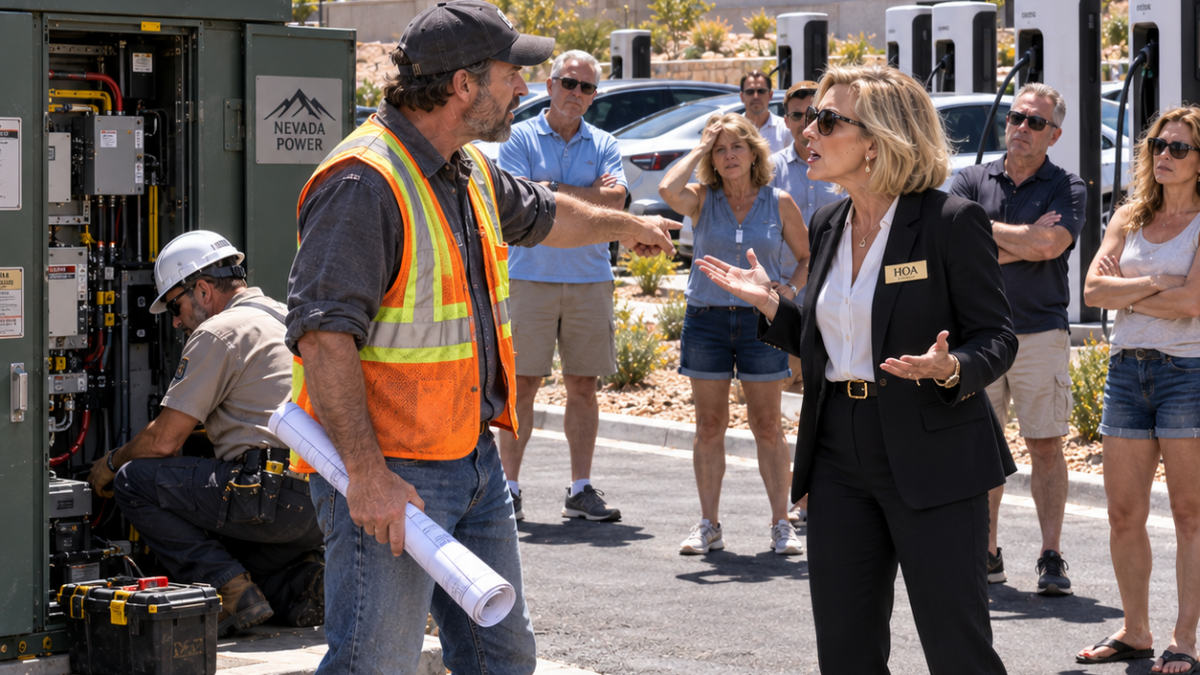
The utility engineer’s name was Darius Vance.
He was gray at the temples, maybe late fifties, and he moved with the kind of deliberate calm that comes from spending a career around equipment powerful enough to punish impatience.
Camille stood across from him with her phone pressed against her palm.
Around us, Helio Point looked like somebody had switched off an entire scale model.
No porch lights.
No clubhouse cooling.
No pool pumps.
No monument lighting.
No EV chargers.
Just eighty-four stucco homes collecting heat under a Nevada afternoon sun.
Darius looked again at the printed commissioning sheet.
“Who authorized the configuration change?”
Camille answered carefully.
“It was a temporary demonstration profile supported by the charging vendor.”
Darius tapped the page.
“This approval is for the capped profile.”
“The hardware supports higher output.”
“That isn’t what this document says.”
Her jaw tightened.
“The chargers were functioning as designed.”
“So was the protective equipment.”
That stopped her.
Darius looked toward the service yard.
“The system disconnected because a protective limit was exceeded.”
Camille glanced at me.
I said nothing.
There was nothing useful to add.
For three weeks, she had treated my warning like an argument between personalities.
Now the argument had become voltage, temperature, current, and a mechanical trip.
Those things did not care who chaired the board.
Leah Moreno, the licensed operator assigned to Helio Point, returned from the private switchgear area wearing a hard hat and safety vest.
“The customer-side protection opened,” she told Darius. “No reclose attempted.”
“Good.”
Camille stepped closer.
“How quickly can we restore power?”
Darius looked toward the townhomes.
“Occupied residences are the priority.”
“Exactly. So reconnect us.”
“Not until the customer-side system is ready.”
“The chargers are offline.”
“They are de-energized because the entire site is de-energized. That is not the same as being isolated.”
Camille’s expression changed.
She hated distinctions when the distinction got in her way.
Darius continued.
“The EV feeder needs to be physically opened and locked out. Non-essential loads remain off. The private operator verifies your switchgear. Then we restore residential feeders in stages.”
“What about the clubhouse?”
“Non-essential.”
“The pool equipment?”
“Non-essential during restoration.”
“The pavilion?”
He looked directly at her.
“Definitely non-essential.”
Behind us, dozens of showcase guests stood beneath the dead canopy beside cars that could no longer charge.
Some were investors.
Some were prospective buyers.
Others were existing residents who had come because Camille spent two months presenting the pavilion as proof that Helio Point was becoming the most technologically advanced community in the development corridor.
The silver banner still hung overhead.
CONNECTED DESERT LIVING.
Without power, it looked almost sarcastic.
Camille lowered her voice.
“We have an active event.”
Darius nodded.
“You had an active event.”
Her face went still.
He didn’t say it cruelly.
That was probably why it landed.
Leah turned to her crew.
“EV feeder first.”
Two electricians moved behind the restricted barrier.
I stayed where I was.
That mattered.
Camille had already suggested to security that I might interfere with the showcase.
I had no intention of giving her anything she could use to confuse the record later.
So I stood beside Jonah Parish and his mother, Ruth.
Ruth was seventy-six and used a powered lift chair because arthritis in her knees made standing difficult.
When the power failed, the chair’s small battery backup had held long enough to raise her.
Now Jonah had moved her into a shaded walkway.
“You knew they’d have to shut the chargers off,” he said.
“I knew the homes had to come first.”
“That isn’t quite the same answer.”
“No.”
He looked toward his mother.
Three weeks earlier, Jonah had challenged me near the mailbox because he thought I was trying to kill the EV project.
I couldn’t blame him.
The resident portal had described my technical objections as “personal concerns regarding future demand projections.”
That phrase had done exactly what Camille wanted.
It made engineering limits sound like opinions.
Jonah had paid two assessments toward the pavilion.
He wanted the chargers.
So did I.
I owned an EV myself.
That was the most frustrating part of the entire conflict.
I wasn’t against the project.
I was against pretending infrastructure could support promises it physically could not.
From behind the barrier came a heavy mechanical sound.
Leah called out.
“Charger feeder open.”
One of the electricians repeated it.
“Open confirmed.”
A red lock was attached to the disconnect.
Then a large tag.
DO NOT ENERGIZE.
A technician from Charge Access, connected through Leah’s tablet, disabled remote restart.
“Full showcase profile inactive,” he said.
“Controller locked.”
Leah looked toward Darius.
“EV feeder isolated.”
“Residential inspection?”
“Continuing.”
Camille crossed her arms.
“This is unnecessary.”
Leah turned toward her.
“No. This is the condition for bringing your homes back.”
Not your event.
Not your amenity.
Your homes.
The wording mattered.
A family from Building Four brought bottled water into the walkway.
Someone opened the clubhouse doors manually to create cross ventilation.
A resident used a portable battery pack to keep his father’s oxygen concentrator topped up.
We started making a list of anyone who depended on powered medical equipment.
That was when the outage stopped being an infrastructure story for me.
It became a neighborhood again.
Mrs. Harris from Unit 12 worried about insulin in her refrigerator.
A young father in Building Seven had a garage door stuck halfway open.
A woman named Keisha had been working from home when her computer shut down in the middle of a client presentation.
None of those things was catastrophic.
But all of them were real.
That was always the problem with people who talked about “acceptable risk” in a conference room.
They imagined failure as a number.
A probability.
A colored box on a matrix.
Once it happened, failure had names.
At 5:21, Leah finished her first inspection.
“No visible damage,” she reported. “Protective equipment reset and verified. Non-essential loads isolated.”
“Charger feeder?”
“Locked.”
“Controller?”
“Secured.”
Darius nodded.
“Then we bring residential feeders back one section at a time.”
Camille stepped forward.
“Atlas Meridian has authorized restoration of the full property.”
Darius didn’t even look at her.
“Atlas Meridian doesn’t control the utility connection.”
“They still hold the developer board seats.”
“That doesn’t change the service agreement.”
She opened her mouth.
He held up one finger.
Not rude.
Just final.
“The utility service reconnects when the customer-side system meets the approved condition.”
Leah moved to her radio.
“Ready for master service.”
Darius answered.
“Reconnect master service for residential restoration only.”
A utility worker walked toward the service equipment.
There was a mechanical close somewhere beyond the wall.
For one breath, nothing happened.
Then Leah called out.
“Voltage verified.”
“Feeder one.”
A second switch closed.
The first row of townhomes came alive.
A porch light flashed.
Then a kitchen.
An air conditioner started with a deep mechanical thump.
Residents turned toward the sound.
Someone clapped once.
Nobody joined.
It didn’t feel like something to celebrate.
It felt like something we never should have lost.
“Load stable,” Leah called.
“Feeder two.”
Another row illuminated.
Garage lights.
Stairwells.
Refrigerators restarting.
The hum of compressor units slowly returned.
One section at a time.
Never more than Leah wanted.
Never faster than Darius approved.
Camille stood beside the ribbon-cutting platform with her phone hanging at her side.
Above her, the silver banner remained.
Behind her, every charger screen stayed black.
By the time the final residential feeder closed, Helio Point looked almost normal again.
Almost.
The homes had power.
The clubhouse did not.
The pool equipment remained off.
The landscaping lights stayed dark.
The monument sign at the entrance was black.
And twenty-four EV ports sat beneath the canopy with a red lockout tag on their feeder.
Jonah’s phone buzzed.
He looked at it.
“My mother’s chair is charging again.”
“Good.”
Ruth called from behind us.
“I can hear you.”
Jonah turned.
“I know, Mom.”
“Then stop talking about me like I’m furniture.”
A few people laughed.
Ruth smiled.
For the first time since the outage, the air around us loosened.
Then Darius signed the preliminary restoration sheet.
Camille approached him.
“When can the charger feeder come back?”
“When the site returns to an approved operating configuration.”
“We can reload Revision C.”
“That will be reviewed after residential stability is confirmed.”
“So the pavilion stays offline?”
“Yes.”
“For how long?”
“As long as necessary.”
She stared at him.
Across the community, air conditioners were running again.
The homes glowed.
The charging pavilion remained dark.
For once, the contrast explained everything I had failed to explain through emails, diagrams, and meetings.
People understood priorities when they could see them.
Homes first.
Amenities second.
Darius handed the restoration sheet to Aaron Garland.
“One more thing.”
Aaron looked up.
“The preliminary incident file needs the name and authority of whoever approved the configuration change.”
His eyes moved toward Camille.
So did mine.
So did Leah’s.
Nobody said anything.
Darius closed his clipboard.
“Then that’s your next task.”
The lights were back.
But the record of how they had gone out was only beginning.
Three weeks earlier, none of this had seemed inevitable.
That was important to me.
Because after a failure, everybody rewrites the past as if the outcome had been obvious.
It hadn’t been.
The pavilion could have opened safely.
The chargers could have operated.
The showcase could have happened.
The homes never needed to lose power.
All Camille had to do was respect the limit already built into the commissioning plan.
The first time I reviewed the project, the charging pavilion still smelled like new concrete.
Twelve white pedestals stood beneath a silver canopy.
Each pedestal served two vehicles.
Twenty-four ports total.
Camille had called it “our smartest visible investment.”
I had called it “a new load on an old limit.”
She hated that phrase.
We were standing beside the construction barrier with Aaron and Matteo Ruiz, the Charge Access commissioning technician.
Camille held her launch schedule on her phone.
“The showcase is in twenty-two days.”
Matteo looked toward the unfinished cabinet.
“Visual readiness and electrical readiness are different things.”
Camille smiled.
“That’s why we have experts.”
Then she turned to me.
“Elena, show us what you think is unresolved.”
I opened the one-line electrical diagram.
Helio Point had one master service from Mojave Valley Electric.
The utility controlled the service connection and transformer.
Once power crossed into Helio Point, the HOA’s private system distributed it.
Residential buildings.
Clubhouse.
Pool pumps.
Monument lighting.
Landscaping circuits.
EV chargers.
All behind the same service point.
I traced the line with my finger.
“Residential feeders split here.”
Camille looked toward the transformer pad.
“That system has handled the neighborhood for two summers.”
“Without twenty-four charging ports.”
“They won’t all charge at once.”
“They don’t need to.”
“What does that mean?”
“Residents arrive home in late afternoon. Air conditioners are running hardest. The clubhouse is cooling. Pool equipment is on. Then vehicles begin charging.”
Aaron nodded toward Matteo.
“The system balances charging load.”
“Yes,” Matteo said. “The controller can limit aggregate charger demand.”
Camille immediately smiled.
“Then we have our solution.”
I shook my head.
“You have a temporary operating condition.”
She turned toward me.
“The controller manages the chargers.”
“It manages charger demand. It doesn’t add transformer capacity.”
“You keep making those sound different.”
“They are different.”
Matteo nodded.
“The hardware can serve all twenty-four ports, but under the existing site limit, available power is shared.”
Camille looked at him.
“The brochure says fast charging.”
“The equipment supports fast charging.”
“That is not the same as providing it?”
“Not if the site limit is lower than the chargers’ combined potential output.”
Her face changed.
That was when I realized this wasn’t only about electricity.
It was about optics.
The showcase materials had promised twenty-four fast-charging connections.
Camille didn’t want guests seeing estimated charging times stretch when multiple cars plugged in.
The engineering limit threatened the marketing story.
And to her, the marketing story had become the project.
“What exactly are you recommending?” she asked me.
“The transformer and protective-equipment upgrade before unrestricted operation.”
“And if we don’t approve the capital expense?”
“Keep the charger bank below the approved aggregate cap.”
She tapped the cost estimate.
“This is six figures.”
“Yes.”
“For a theoretical peak.”
“For capacity.”
“Your interpretation.”
“The calculation is eleven pages.”
“Calculations model possibilities.”
“Loads are not possibilities when you connect them.”
Aaron shifted.
“Could commissioning proceed with software management?”
Matteo answered.
“Yes. Under a capped profile, assuming the final utility condition matches.”
Camille lifted her phone.
“There. We proceed.”
“That isn’t what he said.”
“Elena, the board needs workable answers.”
“The workable answer is the upgrade or the cap.”
“We are not spending that amount before turnover.”
She said it instantly.
No discussion.
No request for revised pricing.
No alternative design.
That was when I understood the transformer decision had been made before the meeting.
Camille looked at Aaron.
“Prepare the board summary. Note that software load management addresses the demand issue.”
I interrupted.
“Addresses it only while the cap remains active.”
She looked at me.
“The physical upgrade is deferred.”
“Until when?”
“Until actual usage supports it.”
“That means you want the system to prove the problem first.”
“It means we are not spending homeowner money based on a prediction.”
The meeting ended ten minutes later.
At home, I found the board summary already waiting.
TRANSFORMER UPGRADE NOT APPROVED.
SOFTWARE MANAGEMENT ACCEPTED.
COMMISSIONING TO PROCEED.
I opened a reply.
My first sentence was soft.
The additional charging load may create concern during coincident peak conditions.
I stared at it.
Then deleted it.
Years earlier, I had written another warning for another project.
I had been younger.
Less certain about how hard to push.
The original sentence said:
Continued operation at proposed load creates a foreseeable loss-of-service risk.
A senior manager had called it too severe.
I changed “creates” to “may create.”
I changed “loss-of-service risk” to “operational concern.”
Everybody liked the revised memo.
Four months later, the feeder failed.
Nobody was hurt.
That fact became an excuse.
Management called the failure “unexpected demand.”
The warning had been softened so thoroughly that afterward everybody could pretend it had never really warned them.
I had carried that lesson for years.
So this time I wrote:
UNRESTRICTED CHARGER OPERATION REQUIRES THE APPROVED TRANSFORMER UPGRADE.
UNTIL THAT UPGRADE IS COMPLETE, THE AGGREGATE LOAD CAP MUST REMAIN ACTIVE.
I attached the calculation and diagram.
Seven minutes later, Camille replied.
Thank you. The project is utility approved and will proceed under vendor management.
Utility approved.
Four words.
Too clean.
I had already seen enough of the Mojave Valley Electric correspondence to know their approval was conditional.
The next morning, Aaron sent two supplemental records.
The second was the full utility letter.
Page three contained the sentence Camille’s summary had omitted.
Commissioning on the existing service was permitted only while approved aggregate load management remained active.
Unrestricted charging required the transformer upgrade and additional protective review.
I printed it.
Walked outside.
Stood beside the pavilion.
The electrical diagram stopped being lines on paper.
I could see the actual path.
The charger feeder entered a cabinet along the service lane.
Clubhouse loads branched nearby.
Residential distribution ran beyond the same private gear.
Eighty-four homes.
One shared capacity limit.
The charging pavilion was not independent infrastructure.
It was another load on the same system.
That afternoon, I asked Camille to correct the resident portal.
“One sentence,” I said.
“What sentence?”
“The charger pavilion will operate under the utility-approved aggregate cap until the transformer upgrade is complete.”
A pause.
“That makes the project sound unfinished.”
“It is unfinished.”
“Elena.”
The warning in her voice was deliberate.
“We are not alarming homeowners before a showcase.”
“Then don’t alarm them. Just tell them the operating condition.”
“It is technical language.”
“It is the approval.”
She refused.
The portal continued saying:
FULLY UTILITY APPROVED.
Two days later, Charge Access arrived for commissioning.
Six test vehicles sat beneath the canopy.
Matteo stood beside a temporary monitoring screen.
“Controller online.”
“Confirmed.”
“Site profile loaded.”
“Confirmed.”
“Aggregate limit active.”
That was the phrase I had been waiting for.
Two vehicles connected.
Then three.
Then four.
The charger output didn’t keep rising.
Instead, power divided.
Estimated charging time increased.
Camille noticed immediately.
“Why did those times change?”
Matteo kept watching the monitor.
“The controller is distributing available site capacity.”
“The brochure says fast charging.”
“The hardware supports fast charging.”
“You already said that.”
“Yes.”
“So why are those cars slowing down?”
“Because the site is capped.”
Her jaw tightened.
“We need all twenty-four ports operating during the showcase.”
“They can all operate.”
“At full performance?”
“Not under this profile.”
Camille looked at me.
“You knew this.”
“I knew the cap would work.”
“This is not working.”
“It is doing exactly what it was designed to do.”
“It is throttling the product.”
“It is preventing the product from overloading the service.”
Aaron stepped between us.
“Can we keep the language neutral?”
Matteo didn’t look up.
“The system is operating as commissioned.”
A fifth test car connected.
One screen changed from thirty-two minutes to fifty-one.
Another moved from forty to sixty-eight.
Camille stared at the numbers.
“This is what buyers will see?”
“They’ll see shared site capacity.”
“What if you remove the limit?”
Matteo finally looked at her.
“We’re not doing that during commissioning.”
“I asked what the equipment can do.”
“The controller has higher profiles.”
“So the hardware can perform.”
“The hardware and the site are not the same thing.”
That ended the conversation temporarily.
At the end of testing, Matteo read the final configuration aloud.
“Helio Point Aggregate Cap Revision C.”
Another technician repeated it.
Aaron entered it into the acceptance record.
Then Matteo handed the document across the barrier.
“Owner representative acknowledgment.”
Camille reached for it.
Her eyes moved down the page.
Stopped.
I knew exactly where.
TEMPORARY AGGREGATE CONTROLLER LIMIT REQUIRED UNDER EXISTING SERVICE APPROVAL.
She signed.
Not because she agreed.
Because without that signature, the pavilion could not be released.
Afterward, she asked Matteo one question.
“How difficult is it to change profiles?”
His face became careful.
“Configuration changes require authorized access. The owner remains responsible for site limits.”
“That wasn’t my question.”
“It’s my answer.”
By one o’clock, the resident portal announced successful commissioning.
By two, the showcase team uploaded a video promising “full-speed charging across twenty-four connections.”
At 6:38 that evening, Aaron accidentally forwarded me an internal message.
ENABLE FULL SHOWCASE MODE.
The email didn’t prove they had changed anything.
It proved somebody planned to.
I sent a records-preservation request.
Launch authorization.
Controller history.
Vendor support records.
Two days later, an automated index arrived.
Near the bottom was one line:
CONTROLLER CONFIGURATION CHANGE — SCHEDULED SHOWCASE DAY 2:30 P.M.
That was enough to make my stomach tighten.
The underlying record arrived the following morning.
Revision C — active.
Full Showcase Mode — scheduled.
Effective time — 2:30 p.m.
Authorization account:
ATLAS-LAUNCH-ADMIN.
Approval note:
AUTHORIZED BY C. DORSEY FOR TEMPORARY DEMONSTRATION PERFORMANCE.
I sat at my kitchen table for a long time.
Nobody had misunderstood the cap.
Nobody had accidentally forgotten it.
They had scheduled its removal.
Another file showed the vendor ticket.
REQUEST ENABLE MAXIMUM AVAILABLE PAVILION PERFORMANCE FOR INVESTOR DEMONSTRATION.
And directly beneath it:
SITE OWNER ACKNOWLEDGES RESPONSIBILITY FOR OPERATION WITHIN APPROVED ELECTRICAL CAPACITY.
Twice.
Charge Access had not told Camille the setting was safe.
It had reminded her that Helio Point was responsible for staying within its electrical limits.
I called Aaron.
“You produced the controller history.”
“Yes.”
“Who controls Atlas-Launch-Admin?”
“I can’t discuss internal credentials.”
“The authorization says C. Dorsey.”
“You have the record.”
“Did a licensed operator approve the change?”
Silence.
“The launch team requested vendor support.”
“That wasn’t my question.”
“I’m not qualified to interpret configuration logs.”
“You don’t have to interpret a name.”
“Elena.”
His voice dropped.
“We preserved the records. That’s what you asked us to do.”
“I asked management to preserve the cap.”
“That decision is above me.”
Then he hung up.
I found Camille at the clubhouse.
Event staff were arranging chairs.
The wall display cycled through renderings.
Pool.
Townhomes.
EV pavilion.
I held up the controller history.
“You authorized full showcase mode.”
She barely glanced at it.
“I authorized a demonstration profile.”
“The existing service approval requires Revision C.”
“This is temporary.”
“Temporary does not mean approved.”
“The vendor made the profile available.”
“The vendor also told you site capacity remained your responsibility.”
She handed the pages back.
“You are treating a software setting like someone physically removed a transformer.”
“The software cap is the reason the existing transformer can support the chargers.”
“For a few hours.”
“Physical capacity doesn’t change because the event is short.”
“We are expecting eighty guests.”
“Then keep Revision C.”
“No.”
The answer came instantly.
I stared at her.
“You signed the commissioning acceptance.”
“I signed acceptance of a functioning system.”
“You signed the required profile.”
“I signed what was needed to release the pavilion.”
“That does not make the condition optional.”
Her polished expression disappeared.
“You have spent two weeks trying to become the only responsible person in this community.”
“This isn’t about me.”
“It has become entirely about you.”
“No. It’s about eighty-four homes sharing one service.”
She stepped closer.
“Property values depend on confidence.”
“Electrical protection doesn’t.”
“The transition depends on confidence.”
“Capacity still doesn’t.”
“If you keep circulating worst-case claims, you will damage both.”
I tapped her authorization field.
“This is not a worst-case claim. It is your configuration change.”
“You don’t have authority to stop the event.”
“I know.”
“You don’t operate the system.”
“I know.”
“You don’t direct Charge Access.”
“I know.”
“Then stop behaving as if you do.”
“I’m asking the person who approved this to cancel it.”
She folded her arms.
“The change stands.”
That sentence took me straight back to the feeder failure years earlier.
The schedule stands.
The opening stands.
The concern is manageable.
I took out my phone.
Wrote one message.
Sent it to Camille.
Aaron.
The board.
Vantage Crest’s regional manager.
The transformer upgrade is incomplete. Existing utility approval depends on the commissioned aggregate cap. Full Showcase Mode removes that operating safeguard during peak residential demand and creates a foreseeable loss-of-service risk.
I read it once.
Didn’t soften anything.
Sent.
Camille’s phone buzzed.
She read it.
“This is reckless.”
“No.”
I put my phone away.
“This is precise.”
On showcase day, at 2:31 p.m., Revision C disappeared from the dashboard.
Full Showcase Mode replaced it.
The first cars plugged in nine minutes later.
At 3:00, guests arrived.
At 3:18, charging demand exceeded commissioning levels.
At 3:26, it continued upward.
The clubhouse doors opened constantly as guests moved between air-conditioned interiors and the pavilion.
Catering equipment ran.
Pool pumps ran.
Monument lighting came on early for photography.
And across Helio Point, residents were coming home.
Garage motors.
Air conditioners.
Refrigerators.
Ovens.
Every load stacking behind the same master service.
At 3:31, I called Leah.
“Are you seeing community load?”
“Yes.”
“Revision C inactive?”
“Yes.”
“Did your company authorize that?”
“No.”
“Can you restore it?”
“Controller configuration is under the owner’s Charge Access account.”
“The utility approval depends on the cap.”
“I know.”
“Then why is the profile active?”
“My authority begins at the private switchgear.”
She paused.
“Elena, do not approach the electrical yard.”
“I haven’t.”
“I know. Security has been told you may interfere with the event.”
I went quiet.
“Who told them?”
“You know.”
At 3:39, a guard took position near the service path.
Camille took a microphone.
“Helio Point was designed for the future,” she told guests. “The pavilion responds intelligently to real-time demand.”
That would have been true under Revision C.
Without it, the chargers simply took more power.
At 4:07, Leah called.
“Temperature warning.”
“How severe?”
“Early warning. Not trip condition.”
“Management notified?”
“Yes.”
“Can you reduce non-essential loads?”
“With authorization.”
“The pool pumps?”
“With authorization.”
“Monument lights?”
“Yes.”
“Chargers?”
“Obviously.”
“And Camille?”
Leah was quiet.
“She says demonstration fluctuations are expected.”
At 4:22, management sent residents a portal notice.
SHOWCASE ACTIVITY MAY CAUSE TEMPORARY CHARGING FLUCTUATIONS. NO SERVICE INTERRUPTION IS EXPECTED.
At 4:31, Leah notified Mojave Valley Electric that Helio Point was operating outside its commissioning profile.
At 4:42, seventeen vehicles were charging.
At 4:44, Leah gave management a direct instruction.
Reduce charger demand immediately.
Camille refused to interrupt the demonstration.
At 4:45, Leah told Aaron she was invoking emergency operator authority.
She and her electrical crew started toward the switchgear.
At 4:46, total demand crossed the limit from my report.
At 4:47, protection beat them to it.
The system opened.
Every home went dark.
That was the part Camille couldn’t reframe afterward.
Protection had not failed.
It had worked.
The failure was everything that happened before it had to.
Three mornings after the blackout, we met again at the charging pavilion.
The feeder was still locked out.
Twenty-four screens remained dark.
Atlas Meridian and the developer-controlled board had adopted an emergency operating resolution the previous afternoon.
All charger configuration authority was transferred to a licensed third-party operator.
Silverline Grid Services.
Marcus Stafford, their operations manager, stood inside the marked work zone with Leah, Aaron, and a Charge Access technician connected remotely.
I stayed outside the barrier.
Camille stood across from me.
Her arms were folded.
Marcus held a checklist.
“We are removing all launch-team administrator credentials.”
Camille looked at Aaron.
“That authority was never intended to be permanent.”
Marcus didn’t look up.
“It existed.”
He turned toward the tablet.
“That’s what matters.”
The Charge Access technician opened the account list.
ATLAS-LAUNCH-ADMIN.
COMMUNITY EXPERIENCE.
VANTAGE DEMO.
One by one, they disappeared.
“Launch administrator revoked.”
“Confirmed.”
“Community Experience access revoked.”
“Confirmed.”
“Demonstration profile deleted.”
“Confirmed.”
Full Showcase Mode vanished.
Revision C remained.
Marcus continued.
“Future configuration changes require written licensed-operator approval, confirmation against the utility service condition, and an owner-visible change record.”
Camille stepped closer.
“You are making ordinary event operation unnecessarily rigid.”
Leah looked at her.
“Ordinary event operation did not open the service protection.”
Camille’s mouth tightened.
“Unauthorized load did.”
The preliminary report had already circulated.
No sabotage.
No mysterious public-grid failure.
No defective charging hardware.
The system had operated outside the commissioned aggregate limit.
The change was authorized through Camille’s launch account.
Charge Access had explicitly reminded the owner that site capacity remained the owner’s responsibility.
Then the protective equipment opened under elevated demand.
Atlas Meridian issued a corrected homeowner notice.
The earlier claim of “vendor malfunction caused by unexpected demand” was withdrawn.
The new notice stated plainly that the interruption occurred after the charging system was operated outside the approved commissioning profile.
It did not name Camille.
It didn’t need to.
Under the emergency resolution, she lost authority over electrical settings, commissioning changes, and infrastructure communications.
She remained HOA president during the developer transition.
But she could no longer adjust electrical operation because a brochure looked better when charging times were shorter.
Marcus reached the final item.
“Restoration profile remains Revision C until transformer and protective-equipment upgrades are completed and accepted.”
Aaron nodded.
“Atlas Meridian approved its contribution yesterday.”
Jonah was standing nearby with Ruth.
“How much?”
“Eighty percent of the transformer project and all recommissioning costs.”
“And the rest?”
“Capital reserve.”
“No special assessment?”
“No.”
Jonah looked at me.
“I can live with that.”
Ruth lifted one eyebrow.
“I was already living without a transformer assessment.”
Everyone laughed.
Then Aaron added one more thing.
“The planned smart fountain project is cancelled.”
Jonah looked toward the clubhouse.
“I can live without that too.”
Ruth nodded.
“I was already living without one.”
Even Camille almost smiled.
Almost.
Marcus asked Charge Access to reload Revision C.
The charger screens woke one at a time.
Not all at maximum power.
Not pretending Helio Point had capacity it didn’t possess.
A test car connected.
Then another.
The controller divided the available power.
Aggregate demand held below the approved limit.
Leah checked her meter.
“Stable.”
Marcus checked the utility condition.
“Within profile.”
The Charge Access technician saved the configuration record.
Time.
Account.
Reason.
Approver.
Visible.
Nothing could disappear into a private launch schedule again.
Marcus removed the lockout tag.
Then attached a permanent operating notice beneath the cabinet handle.
RESIDENTIAL SERVICE PRIORITY.
APPROVED PROFILE REQUIRED.
LICENSED OPERATOR AUTHORIZATION ONLY.
Camille read it.
“This makes the pavilion look restricted.”
“It is restricted,” I said.
She turned toward me.
Not angry anymore.
Not apologetic either.
Mostly tired.
“You got what you wanted.”
“No.”
“The chargers are limited.”
“For now.”
“My authority is limited.”
“Over electrical settings.”
“The developer is paying for the upgrade.”
“Yes.”
“What exactly did you want, Elena?”
I looked toward the townhomes.
Air conditioners hummed.
A garage door opened.
A kitchen light came on inside Ruth’s building.
“The system operated the way it was approved.”
“That sounds like the same thing.”
“It isn’t.”
She stared at me for a moment.
Then walked toward the clubhouse.
Jonah stayed.
“I thought you were trying to stop the project.”
“I know.”
“I was wrong.”
“You were worried about another assessment.”
“I was also listening to the person with the microphone.”
He looked at the charging screens.
“They still work.”
“Yes.”
“Just slower.”
“When a lot of people plug in.”
“Until the transformer is upgraded.”
“Yes.”
He nodded.
“That seems a lot less dramatic now.”
“The safest systems usually do.”
Ruth rolled her chair closer.
“That line sounded rehearsed.”
“It wasn’t.”
“It should be.”
A week later, Silverline submitted the upgrade schedule.
The work would require utility coordination.
New transformer capacity.
Revised protective settings.
Testing.
A formal acceptance process.
Until then, Revision C stayed active.
The clubhouse could not add any new high-demand equipment.
Residential feeders received priority in every operating plan.
Configuration authority remained with the licensed operator.
The rules were boring.
That was their value.
Nobody bought champagne for a properly set protective relay.
Nobody cut ribbons for conservative load profiles.
Nobody took investor photographs beside a transformer.
Infrastructure usually became visible only when it failed.
For years, I had hated that.
After Helio Point, I started seeing it differently.
Invisible infrastructure was often infrastructure doing its job.
At dusk one evening, I walked past the service lane with my old warning email open on my phone.
The one from years earlier.
The warning I had softened.
May create potential concern.
I read the phrase again.
Then the final incident report from that project.
Unexpected demand.
For a long time, I blamed the manager who had asked me to soften the language.
That wasn’t entirely fair.
He had asked.
I had agreed.
I had changed precise words because I wanted the message accepted.
The equipment never cared.
That was the lesson I finally stopped carrying as regret.
This time, when Camille called my warning reckless, I hadn’t changed a word.
Foreseeable loss-of-service risk.
The power had gone out anyway.
Clear language did not prevent the failure.
But it prevented the truth from disappearing after it.
That mattered.
Two months later, Mojave Valley Electric arrived before sunrise with the new transformer.
It came on a flatbed truck large enough that half the neighborhood came outside to watch.
Jonah brought coffee.
Ruth brought herself.
She parked her lift chair beneath a tree and announced that if anybody took a photograph of her in pajamas, she would sue.
Theo from Building Three asked whether the transformer was “the famous one.”
I told him transformers preferred privacy.
Camille did not attend.
The work took most of the day.
Homes experienced a planned outage during the final cutover.
This time everybody knew exactly when it would happen.
Residents with medical equipment received direct coordination.
Garage doors were opened ahead of time.
Refrigerators stayed closed.
Portable batteries were distributed.
At 2:16, Leah called me.
“We’re ready for energization.”
I was standing outside the barrier.
“Good.”
“You want to watch?”
“I already am.”
Darius was there too.
He had returned for the utility side acceptance.
Marcus stood with the Silverline crew.
The sequence was slow.
Transformer energized.
Voltage confirmed.
Private switchgear closed.
Residential feeders restored.
Common loads verified.
Then the charging pavilion.
Last.
Exactly where it belonged.
Marcus loaded the new approved profile.
No temporary cap this time.
The system had the physical capacity to support the higher setting.
They connected four test vehicles.
Then eight.
Then twelve.
Demand rose.
The transformer held.
Air conditioners across Helio Point kept running.
Sixteen vehicles.
Still stable.
Twenty.
Stable.
Twenty-four.
The chargers distributed power without crossing the new service limit.
Nobody’s lights blinked.
Nobody’s garage door stopped.
Nobody’s medical equipment went dead.
Nothing dramatic happened.
Ruth watched her own porch light across the courtyard.
“That’s it?”
“That’s it.”
She looked disappointed.
“All that money and it doesn’t even make a sound?”
“It makes a little sound.”
“I can’t hear it.”
“That’s good.”
She considered that.
“Engineering is terrible entertainment.”
“Usually.”
Jonah laughed.
Camille appeared near the clubhouse sometime during the final testing.
No vest.
No microphone.
No banner.
She stood alone for several minutes.
Eventually, she walked toward me.
“Full output?”
“Approved output.”
She gave me a tired look.
“You really can’t say anything normally, can you?”
I smiled.
“Twenty-four ports are active.”
“Better.”
She looked at the pavilion.
The screens showed shorter charge times now.
The performance she had wanted for the showcase.
Only now, the infrastructure behind the performance actually existed.
“I still think the original project could have been handled without turning into all of this,” she said.
“So do I.”
That surprised her.
“You do?”
“Yes.”
“How?”
“Approve the upgrade.”
She looked away.
For a second, I thought she was going to argue.
Instead, she nodded.
“One decision.”
“One decision.”
She crossed her arms.
“You know why I rejected it.”
“Cost.”
“More than cost.”
I waited.
“Atlas Meridian was weeks from transition. The pavilion was supposed to be the signature handoff project. Investors were coming. Buyers had been promised something visible. Another six-figure infrastructure line would have looked like we built the community wrong.”
I looked toward the service yard.
“So you decided not to show them the part they couldn’t see.”
“Yes.”
It was the most honest thing she had said to me.
“The transformer wasn’t glamorous,” I said.
“No.”
“But it was the part making the glamorous thing possible.”
“I understand that now.”
There was no grand apology.
No confession.
No friendship.
Just understanding.
That was enough.
She looked toward the townhomes.
“I hated that resident notice.”
“The correction?”
“Yes.”
“Why?”
“Because it made the failure sound simple.”
“It was simple.”
“It made it sound like I changed one setting and eighty-four homes went dark.”
“You changed one setting. Many other conditions combined with it.”
“That is exactly my point.”
“But the setting was the condition that allowed those loads to overlap safely.”
She rubbed her forehead.
“You always have another sentence.”
“It’s a professional defect.”
That made her laugh.
A real laugh.
Brief.
Unexpected.
Then she nodded toward the pavilion.
“Think people will use all twenty-four?”
“Eventually.”
“And the transformer?”
“Will sit behind a wall where nobody notices it.”
“That seems unfair.”
“To the transformer?”
“To everything it took to get here.”
I looked at the rows of homes.
Porch lights were coming on as evening settled.
“The things that matter most aren’t always the things people see.”
Camille looked at me.
“That sounded rehearsed too.”
“Ruth said the same thing.”
“I’m starting to like Ruth.”
“Everybody does.”
Weeks passed.
The pavilion became ordinary.
That was probably the best ending it could have had.
Residents plugged in after work.
The controller balanced demand.
People complained about parking etiquette instead of transformers.
Someone left a charging cable on the ground and another resident posted a six-paragraph message about “community respect.”
Normal HOA life resumed.
The investor banner disappeared.
The showcase photographs disappeared from the clubhouse screen.
Helio Point stopped being a case study in somebody’s sales deck and became a neighborhood again.
One evening, I walked past Ruth and Jonah near the pavilion.
Ruth’s chair battery indicator was green.
Jonah was connecting his car.
“Full speed?” I asked.
He checked the screen.
“Pretty close.”
“Any complaints?”
“One.”
“What?”
“My mother says her chair charges slower than my car.”
Ruth looked at me.
“It does.”
“Different equipment.”
“I know that.”
“Then why complain?”
“Because I’m retired. I need hobbies.”
Jonah shook his head.
I kept walking.
At the service lane, I stopped for a moment.
Behind the block wall, the new transformer hummed.
Low.
Steady.
Unremarkable.
Across Helio Point, eighty-four homes glowed in the evening heat.
Kitchen lights.
Bedroom windows.
Garage lamps.
Porch fixtures.
The clubhouse was on.
The pool pumps were running.
The monument sign had finally been restored.
And beneath the pavilion, the chargers were operating at the performance Camille had wanted all along.
Only now, that performance wasn’t borrowed from capacity the neighborhood didn’t have.
The lights that mattered were no longer competing with the lights that looked impressive.
And from then on, whenever Helio Point had to choose between the two, the homes came first.








