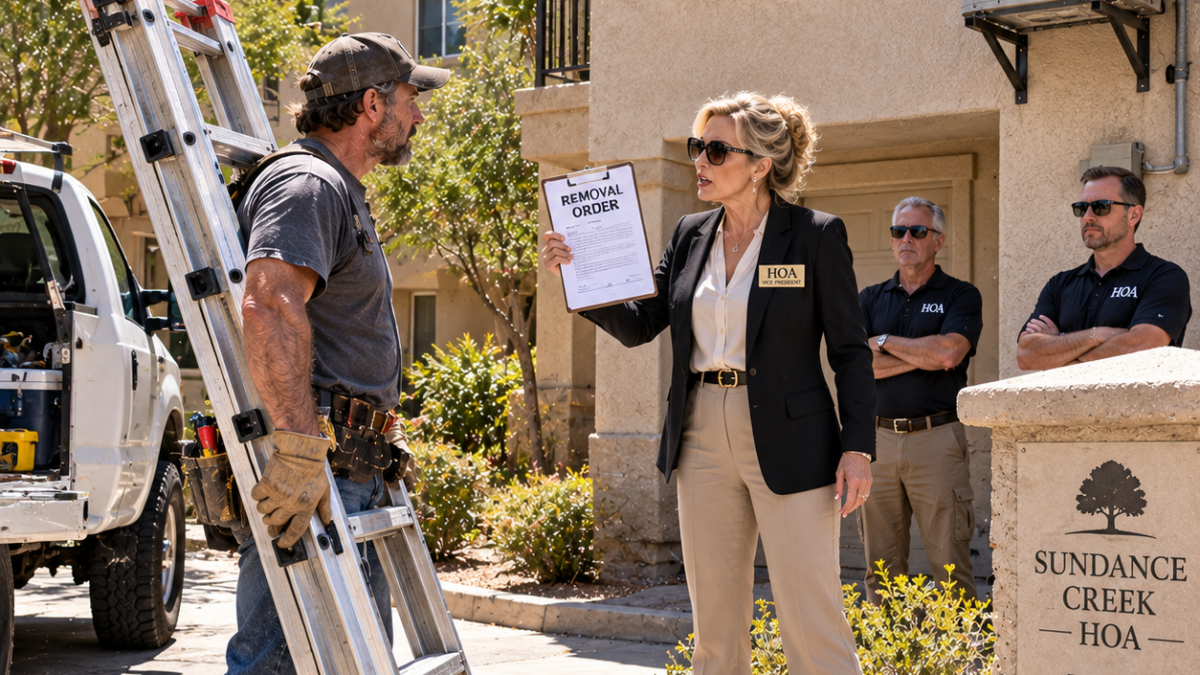
At 3:15 Friday afternoon, with the temperature sitting at 110 degrees, an HOA contractor pulled into our courtyard carrying a twelve-foot ladder to remove the only air conditioner keeping my family’s upstairs bedroom safe.
Rachel wrote four words on a yellow legal pad.
Find the adopted language.
That was it.
No speech about suing the HOA.
No threat.
No dramatic claim that we had already won.
My wife had been practicing law for eleven years, mostly commercial contracts and employment disputes, and one thing I had learned from watching her work was that lawyers who actually knew what they were doing were often less theatrical than everyone expected.
They did not begin with outrage.
They began with documents.
I looked at the portal.
The daily fine would post again the next morning.
“So what do we do?”
“You request exactly what they’re relying on.”
“I already asked.”
“You asked over the phone.”
“I called twice.”
Rachel nodded.
“That tells you what they were willing to say. Now make them identify what they are willing to put in writing.”
She slid the yellow pad toward me.
“Three things. The adopted rule governing window cooling. The emergency appeal procedure. And whatever created the emergency cooling form you found.”
I opened the HOA document index.
Several resolutions were listed by year.
One caught my attention.
2023-07.
No description.
Just the number.
“Add that.”
I typed the request.
The next morning, at exactly 7:30, the portal added another $100.
CONTINUING NON-COMPLIANCE PENALTY — DAY TWO.
Total balance:
$700.
I stopped staring at the number.
For two days, every new charge had felt like evidence that I was losing.
Now it looked different.
It looked like another timestamp.
Rachel left for work around eight.
I told her I was going to the management office in person.
“You want me there?”
The question was gentle.
That made saying no harder.
“I need to do this.”
She studied me for a second.
“Okay.”
Then she pointed toward the stack of papers.
“Don’t argue conclusions.”
“What does that mean?”
“Ask for the records. If they give you the wrong thing, say it’s the wrong thing. If they refuse, ask them to document the refusal.”
“That sounds uncomfortable.”
“It probably will be.”
I almost laughed.
For most of my adult life, discomfort had been a warning sign that I should become more agreeable.
My mother raised me that way.
We moved through rental houses when I was growing up.
She was a single parent for several years.
Every maintenance request felt like something that might irritate the landlord.
A leaking faucet.
A heater that took three tries to ignite.
A window that wouldn’t lock.
My mother would rehearse what she was going to say before calling.
“I’m sorry to bother you.”
“Whenever you have time.”
“It’s probably nothing.”
I inherited the habit so completely that I sometimes apologized before asking someone to fix something they were legally required to fix.
Even with Wesley, standing beneath my daughter’s bedroom window in 110-degree heat, I had told him I was sorry the AC was visible.
Rachel had heard me.
She did not criticize me afterward.
She just said:
“You don’t have to make an emergency invisible.”
I thought about that sentence during the drive to Sunstone Community Management.
The office was three miles away in a low tan building beside a bank.
The parking lot shimmered.
A digital sign across the street showed 107 degrees even though it wasn’t yet eleven.
Inside, the lobby smelled like lemon cleaner and warm printer paper.
A framed poster behind the reception desk said:
CONSISTENCY BUILDS COMMUNITY.
Diane recognized me immediately.
“Mr. Cole.”
“Morning.”
“I saw your document request.”
“Then you know why I’m here.”
She printed six pages.
The first was the same architectural appearance summary.
Then came instructions for submitting photos.
A fine schedule.
A general architectural application guide.
I read the stack twice.
“Resolution 2023-07 isn’t here.”
“The summary contains the current standard.”
“The footer says the summary isn’t controlling.”
Diane folded her hands.
“Mr. Crane has confirmed that the emergency exception is no longer applicable.”
“Where is that written?”
“It was connected to an earlier event.”
“Does the resolution say that?”
“I don’t have the resolution in this packet.”
“That’s why I requested it.”
A printer started behind the wall.
For several seconds, that was the only sound.
Then Diane lowered her voice.
“Mr. Cole, I understand your air conditioner failed. But management administers the documents provided by the board.”
“I understand.”
That phrase came out automatically.
I caught myself.
Then continued.
“But your own index lists an adopted resolution that isn’t in the compliance packet.”
“I can submit a follow-up records request.”
“How long?”
“Standard response time is ten business days.”
“My violation appeal deadline is tomorrow.”
“You don’t technically have an active appeal yet.”
I placed the fine notice on the counter.
“The HOA is collecting penalties.”
“Yes.”
“But I don’t have an appeal?”
“The appeal procedure begins after final architectural determination.”
“My emergency request hasn’t been decided.”
“That is correct.”
“Then the decision isn’t final.”
“The violation exists independently.”
“So I can be fined before the emergency review is complete, but I cannot appeal the emergency decision because the emergency decision has not been made.”
Diane’s expression tightened slightly.
I could tell she did not like the sentence.
I did not particularly enjoy saying it.
But the sentence was accurate.
“I need the emergency appeal form.”
“There is no separate form in the current packet.”
“Then I’m submitting the appeal myself.”
I took a signed letter out of my folder.
I had written it the night before.
It identified the violation.
The failed central AC.
The heat emergency.
The pending repair.
The temporary unit.
The unresolved emergency notice.
Then it requested an immediate stay of fines and physical enforcement until the emergency request was reviewed.
Diane read the first page.
“I can upload this as homeowner correspondence.”
“Please upload it as an emergency appeal.”
“The system may not have that category.”
“Then put the words emergency appeal in the description.”
She looked at me for several seconds.
Then she reached for a date stamp.
10:14 a.m.
She stamped my copy.
I asked for her initials beside it.
She did.
When I left, I realized something halfway across the parking lot.
I had not apologized once.
Back home, the little window unit was still holding our entire family’s life inside one bedroom.
Sophie sat on the carpet coloring.
Rachel was working from a folding chair near the window.
I handed her the stamped appeal.
She checked the time.
“Good.”
“That’s all?”
“That timestamp is more useful than anything dramatic I could say about it.”
She set the paper aside.
“Did they give you the resolution?”
“No.”
“Then we find it ourselves.”
We searched the resident portal again.
Current governing documents.
Declaration.
Bylaws.
Fine schedule.
Architectural summary.
No resolution.
Then I noticed a smaller link beneath the folder list.
ANNUAL OWNER DISCLOSURES.
I opened it.
2026.
2027.
2028.
2029.
The 2023 packet was 142 pages.
I downloaded it.
Search:
July 2023.
One result appeared.
Page 98.
I clicked.
The scan was slightly crooked.
A blue board stamp crossed the bottom.
RESOLUTION 2023-07.
Temporary Mechanical Equipment During Declared Service Emergencies.
I felt something in my stomach shift.
“Rachel.”
Her chair rolled beside mine.
“Keep going.”
The first page described a transformer failure three summers earlier.
Central cooling had failed in twenty-one homes during an excessive heat event.
Residents needed temporary cooling faster than normal architectural review could operate.
The board adopted an emergency procedure.
There was also a separate emergency appeal process.
I scrolled to the signature page.
Five directors had signed.
One name stopped me.
Wesley Crane.
Rachel saw it too.
“Don’t jump ahead.”
“He signed this.”
“Yes.”
“He told me it was obsolete.”
“I know. Keep reading.”
I returned to the operative section.
Halfway down page 100 was a bold heading.
RULE 8.4 — EMERGENCY TEMPORARY COOLING EXCEPTION.
Only eleven lines.
Rachel pointed at the first paragraph.
“Read it.”
I did.
During a declared heat emergency, an owner may operate temporary window-mounted cooling equipment when the residence’s central system is inoperable and repair has been scheduled.
I stopped.
Rachel said, “Next.”
The owner had to provide:
A licensed technician’s report.
Evidence of scheduled repair.
Safe temporary installation.
Written notice to management.
I had all four.
The final line was even simpler.
The temporary equipment could remain until central cooling was restored or the declared heat emergency ended, whichever came first.
There was no requirement for thirty-day architectural approval.
No special board vote.
No community-wide mechanical failure requirement.
No expiration date.
No sunset clause.
No sentence saying it only applied to the transformer event that inspired it.
Rachel pulled my timeline closer.
“Technician’s report?”
“Monday.”
“Repair scheduled?”
I opened Mesa Peak’s email.
“Monday, 12:58.”
“Heat emergency?”
I held up the county alert.
“Installation photographs?”
“Uploaded with the notice.”
“Written notice?”
“5:42 Monday.”
She checked each line.
“You satisfy the rule.”
I wanted to feel triumphant.
Instead I opened Wesley’s latest message.
YOUR RELIANCE ON OBSOLETE EMERGENCY MATERIALS IS MISPLACED.
“Obsolete,” I said.
“He signed it.”
Rachel opened the meeting minutes linked behind the resolution.
The meeting happened during the transformer failure.
Twenty-one central systems down.
Excessive heat.
Normal review could not respond quickly enough.
Halfway down page four was the motion.
Vice President Wesley Crane moved to adopt an emergency exception permitting temporary visible cooling during declared heat conditions when a residence had documented mechanical failure.
The vote was unanimous.
Rachel leaned back.
“So he wrote it?”
“He moved to adopt it.”
“Same difference.”
“No.”
She looked at me.
I almost smiled.
“You’re correcting me now?”
“Yes.”
“Good.”
She tapped the minutes.
“He supported it. That matters. But don’t claim he personally drafted it unless the record says that.”
I nodded.
Then she opened the emergency appeal procedure.
Section three dealt with enforcement.
Her eyes stopped.
She read the line again.
“What?”
She turned the screen.
A timely emergency appeal stays escalating penalties and physical enforcement until emergency review is completed.
I looked at my stamped receipt.
10:14 that morning.
“The fine posted at 7:30.”
“Yes.”
“So that one was already there.”
“Yes.”
“But tomorrow’s can’t post.”
“Shouldn’t.”
“And they can’t remove the AC.”
“Shouldn’t.”
I frowned.
“You keep saying shouldn’t.”
“Because I don’t control them.”
That was Rachel.
Never promising what somebody else would do.
Only identifying what they were required to do.
We assembled a five-page packet.
Cover letter.
Rule 8.4.
Luis’s technician report.
Repair confirmation and county heat alert.
Emergency notice and appeal timestamps.
The board minutes went in separately.
I highlighted Wesley’s motion.
My email was four sentences.
I meet every condition in Rule 8.4.
Resolution 2023-07 remains in the HOA’s annual disclosure archive and contains no repeal or expiration date.
My emergency appeal was filed at 10:14 this morning.
Please stay enforcement and escalating penalties as required by the adopted emergency procedure.
I sent it to Diane.
Management records.
The board secretary.
Wesley.
His answer arrived nine minutes later.
Resolution 2023-07 addressed a specific community-wide service interruption. The current appearance summary reflects the board’s present enforcement position. An individual mechanical failure does not justify a visible exterior exception. Remove the unit by noon tomorrow.
Rachel read it.
“He changed his argument.”
“How?”
“Yesterday the resolution was obsolete.”
“And now?”
“Now it exists, but you supposedly don’t qualify.”
I reopened Rule 8.4.
A residence’s central system.
Singular.
Nothing about twenty-one homes.
Nothing about a transformer.
Nothing about neighborhood-wide failure.
I replied with one question.
Please identify the adopted amendment or repeal that replaced Resolution 2023-07.
Wesley didn’t answer by email.
He called.
I put him on speaker.
Rachel stayed silent.
“Ethan, you are trying to turn an emergency accommodation into a permanent loophole.”
“The replacement part hasn’t even shipped.”
“That isn’t the point.”
“What is?”
“You’ve placed visible mechanical equipment facing a shared courtyard.”
“The rule you voted for permits temporary equipment.”
“That rule responded to an exceptional event.”
“So is this.”
“If I accept your interpretation, every homeowner with an aging compressor will claim an emergency.”
“Then require a technician’s report.”
Silence.
The rule already required one.
Wesley knew that.
Finally he said, “The visual exception has to be contained before it spreads.”
“My family is not a precedent. Our AC is broken.”
“You have until noon tomorrow.”
The line went dead.
At 12:42 Thursday afternoon, an automated email arrived from Desert Line Exterior Services.
ACCESS CONFIRMATION — RED MESA COURTYARD UNIT 18.
I opened it.
Thank you for coordinating access.
I had coordinated nothing.
Service window:
Friday, 3:00–5:00 p.m.
Scope:
Remove unauthorized exterior support bracket and coordinate removal of visible window-mounted cooling equipment.
Approving party:
Wesley Crane.
My chest tightened.
Rachel read over my shoulder.
“Download that.”
I did.
The work order called the courtyard facade an HOA-maintained common element.
That part was true.
The HOA maintained exterior paint.
Stucco.
Rooflines.
Drainage.
Permanent attachments.
But our window opening was not a common hallway.
The sash and lock were inside our protected area.
The appliance belonged to us.
The power cord ran into our bedroom.
The support was removable.
Nothing penetrated the stucco.
The work order did not authorize anyone to enter the house.
Rachel opened the enforcement procedure.
“An ARC officer can issue notices.”
“Wesley did.”
“Physical interference is different.”
She ran a finger down the page.
“Needs board or management authorization.”
“He approved the work order.”
“That may be the problem.”
I drafted a response.
I do not consent to entry into Unit 18, disconnection or removal of the appliance, alteration of the window assembly, or contact with owner property.
The HOA-maintained facade may be visually inspected from the common courtyard.
Emergency Appeal EA-18-447 is pending and stays physical enforcement.
I copied everyone.
Sunstone.
Wesley.
Desert Line.
This time I did not write I’m sorry anywhere.
At 1:10, Desert Line replied.
They would conduct an exterior assessment that afternoon.
No interior entry was scheduled.
They did not cancel Friday.
At 2:15, a white service van stopped outside the courtyard.
The man who stepped out introduced himself as Marcus Okafor, Desert Line field foreman.
Gray work shirt.
Clipboard.
Laser measure.
Camera.
No ladder.
Wesley arrived five minutes later.
Marcus stood under our window.
“Support removable?”
“Yes.”
“Anything fastened through stucco?”
“No.”
He photographed the unit from three angles.
Wesley pointed upward.
“The support is the violation.”
Marcus crouched.
“To remove the support, we need the unit unloaded first.”
“Then remove the unit.”
Marcus stood.
“From outside?”
“Coordinate whatever access is required.”
I held up the work order.
“No access has been coordinated.”
Wesley turned.
“The courtyard facade is common property.”
“The bedroom isn’t.”
“The equipment extends beyond the building envelope.”
“That doesn’t authorize anyone to enter my house.”
Marcus looked between us.
“Who is giving us interior access tomorrow?”
“No one,” I said.
At exactly the same time, Wesley said, “Management will handle access.”
Marcus looked at him.
Then at me.
I took out my stamped appeal.
“This was filed before the removal work order.”
Wesley barely looked.
“The appearance standard prohibits the equipment.”
“The adopted resolution permits it.”
“We’ve discussed your interpretation.”
“This isn’t about interpretation. Can this contractor enter my bedroom while an emergency appeal is pending?”
Mrs. Patel’s door opened across the courtyard.
She stood in the shade.
No dog this time.
Marcus flipped to page two.
“Mr. Crane, I need the removal sequence.”
“Detach the exterior support and remove the visible equipment.”
“To remove it safely, someone has to secure sixty pounds of appliance from inside.”
Wesley’s jaw tightened.
“That is why the order says coordinate removal.”
Marcus tapped the paper.
“It doesn’t identify interior access authority.”
“There will be management authorization.”
He looked at the page again.
It did not magically appear.
That was the moment I felt my old instinct return.
Soften it.
Apologize.
Tell Wesley I understood his position.
Tell Marcus I did not want to cause trouble.
I swallowed all of it.
“You may inspect the common facade,” I said. “You may not enter my home, touch the appliance, disconnect it, or alter the window.”
Wesley took a step toward me.
“You are obstructing authorized maintenance.”
“No.”
I heard Rachel in my own voice.
“I’m defining the boundary of your authorization.”
Marcus wrote something.
Wesley noticed.
“What are you writing?”
“Owner denies interior access. Appliance is owner property. Bracket cannot be removed safely while unit remains loaded.”
Wesley lowered his voice.
“This doesn’t need to become confrontational.”
Marcus gave him the first honest look anyone had given Wesley all week.
“We’re standing under someone’s bedroom window discussing removing their air conditioner.”
He closed the clipboard.
“It already is.”
Wesley ignored that.
“The board expects compliance tomorrow.”
Marcus handed me his business card.
“If management sends authorization, the crew window remains three to five.”
“I won’t be providing interior access.”
“I noted that.”
After Wesley walked away, Marcus looked up at the AC.
“They told us to come back tomorrow with the ladder.”
Then he left.
By Thursday night, the whole house had surrendered to one room.
Sophie’s mattress stayed beside our bed.
Rachel worked from a folding chair.
We ate dinner upstairs because the kitchen still felt hot after sunset.
At 9:30, the hallway sensor read ninety-three.
Inside the bedroom:
seventy-seven.
Mesa Peak sent another update.
Replacement control board delayed in transit.
Possible Friday arrival.
Possibly Monday.
Friday’s removal remained scheduled.
I printed the email.
Our downstairs table had become a timeline.
One stack:
Heat alert.
HVAC failure.
Thermostat records.
Installation photographs.
Another:
Resolution 2023-07.
Rule 8.4.
Board minutes.
A third:
Emergency appeal.
Enforcement stay.
Removal order.
Marcus’s field notes.
Rachel came downstairs.
“You built a binder.”
“No binder.”
“You have three clipped evidence stacks.”
“I need to be able to hand Marcus one page without explaining our marriage.”
“Fair.”
She sat down with her laptop.
Then she typed a new email.
To:
Sunstone Community Management.
Red Mesa board secretary.
Janet Thorne, independent association counsel.
Subject:
URGENT VERIFICATION REQUEST BEFORE SCHEDULED PHYSICAL ENFORCEMENT.
Rachel did not identify herself as my attorney.
She was a homeowner.
My wife.
An owner listed on the deed.
The email asked three questions.
Was Resolution 2023-07 still adopted?
Did Emergency Appeal EA-18-447 stay physical enforcement?
Could an ARC vice president authorize removal of owner property without separate management or board approval?
Attached:
Resolution.
Appeal receipt.
Enforcement procedure.
Work order.
She read it once.
Then sent it.
“That’s all?”
“That’s all.”
“What if they ignore it?”
“Then we preserve that too.”
At 10:12 p.m., an assistant from Thorne Legal replied.
Counsel had received the documents and would review before the scheduled service window.
No conclusion.
No promise.
Just a timestamp.
I added it to the chronology.
Friday morning, Wesley sent a community-wide notice.
EXTERIOR COOLING EQUIPMENT REMINDER.
He did not name me.
The notice said visible window units remained prohibited and could be removed at the owner’s expense.
At 10:30, the portal posted another daily penalty.
DAY THREE.
$100.
Total:
$800.
I looked at it for about two seconds.
Then saved a screenshot.
The number no longer felt like authority.
It felt like evidence.
Mrs. Patel knocked ten minutes later.
“Is that community notice about you?”
“I assume so.”
She looked toward the stairs.
“Can I see what your house actually got to?”
I showed her the thermostat history.
Ninety-one in the hallway after midnight.
Ninety-four upstairs before we isolated the bedroom.
Seventy-seven inside the cooled room.
She read it twice.
“I thought you just liked it cold.”
“I would prefer the central system to work.”
“Wesley said portable units were available.”
“Not large enough. Luis documented that.”
Mrs. Patel looked embarrassed.
“I still hate how window units look.”
“That’s fair.”
“But they shouldn’t take this one down.”
That was all.
I didn’t need everyone to think the machine was beautiful.
I needed them to understand it was temporary and necessary.
At noon, Marcus emailed.
Crew arrival:
3:15.
One sentence had been added.
CREW WILL REVIEW AUTHORITY DOCUMENTS ON SITE BEFORE ANY CONTACT WITH OWNER EQUIPMENT.
I printed it.
Rachel found me upstairs twenty minutes later talking to the wall.
“You’re rehearsing.”
“Yes.”
“What are you going to say?”
I pulled the card from my pocket.
“You may inspect the HOA-maintained facade. You may not enter the residence, disconnect the unit, alter the window assembly, or contact owner property while—”
“Too long.”
I stopped.
“Again.”
“You may inspect the facade. You may not touch the AC or enter our home.”
“That.”
I kept the card anyway.
Sophie was coloring beside the bed.
She showed me a picture.
A blue square house under a giant yellow sun.
A white box stuck from the upstairs window.
Three stick figures stood inside one blue room.
“What’s this?”
“Our cold house.”
“One cold room.”
She thought.
“Then it’s the part that works.”
At 1:40, the portal changed.
Emergency Appeal:
UNDER LEGAL REVIEW.
At 2:10, the county heat alert refreshed.
CURRENT TEMPERATURE: 109.
EXPECTED HIGH: 110.
At 2:45, Rachel placed Rule 8.4, the appeal receipt, and the authority section into a thin red folder.
At 3:08, a diesel engine slowed near the entrance.
At 3:10, Mrs. Patel opened her door.
At 3:12, Wesley walked into the courtyard holding the work order inside a clear plastic sleeve.
At 3:15, the Desert Line truck turned in.
The twelve-foot ladder was strapped to the roof.
The temporary AC rattled above us.
Marcus stepped out.
A younger worker began loosening the ladder straps.
Wesley pointed toward our window.
“Proceed with the exterior removal.”
Marcus didn’t move.
“Before we unload, I need to confirm today’s authorization.”
“You have the order.”
“I have yesterday’s order.”
He looked at me.
“Any change in access?”
I took the card from my pocket.
Then put it back.
“You may inspect the facade. You may not touch the AC or enter our home.”
The younger worker lowered one end of the ladder.
He left the other end secured.
Wesley lifted the work order.
“The support violates the current standard.”
“My appeal is under legal review.”
Rachel came through the front door.
Thin red folder.
No briefcase.
No suit.
No performance.
She stopped beside me.
Opened Resolution 2023-07.
Then looked directly at Wesley.
“I’m a homeowner reading the document you signed.”
Wesley’s eyes moved to the page.
Rachel read the first sentence.
“During a declared heat emergency, an owner may operate temporary window-mounted cooling equipment when the resident’s central system is inoperable and repair has been scheduled.”
Wesley raised one hand.
“We have already addressed that obsolete material.”
“The current summary says adopted governing documents control,” I said.
Then I held out the appeal receipt.
“The appeal procedure also stays physical enforcement.”
Wesley didn’t take it.
Marcus did.
He read the timestamp.
10:14 Thursday morning.
Then checked the work order.
Approved at 12:42 Thursday afternoon.
“The appeal came first.”
Nobody said anything.
Mrs. Patel stood inside her doorway.
Two neighbors watched through second-floor windows.
The AC hummed.
Marcus handed back the appeal.
“Do you have separate removal authorization?”
Wesley pointed to the courtyard.
“This is exterior maintenance.”
“That wasn’t my question.”
“The facade is association-maintained.”
“The AC isn’t,” I said.
Marcus nodded.
“And it isn’t attached to the stucco. We confirmed that yesterday.”
Wesley gestured upward.
“It extends beyond the building envelope.”
Marcus looked at the younger worker.
“To unload it safely, somebody needs to be inside.”
“Mr. Cole’s refusal to cooperate does not eliminate enforcement authority.”
“No,” Marcus said. “But it eliminates our access.”
The younger worker released the ladder strap.
Wesley turned.
“Set the ladder.”
Marcus stepped between him and the truck.
“Not until the paperwork is clear.”
“This is a contracted service.”
“And we’re the contractor.”
For the first time, Wesley looked like a man realizing that an order written inside his own system had to survive contact with people outside that system.
I showed Marcus Luis’s report.
Failed control board.
Repair pending.
Then the county heat emergency.
Then installation photos.
Then the timestamped notice.
Then the appeal.
I had imagined this moment for two days.
In every version, I either gave a five-minute speech or froze.
Standing there, I realized none of the documents needed help from my nerves.
Marcus reread the work order.
“Scope says remove bracket and coordinate equipment removal.”
“Yes,” Wesley said.
“There is no coordinated removal.”
“Because the owner is obstructing.”
“I’m standing three feet away.”
Marcus almost smiled.
Then he looked at Rachel.
“Does the appeal procedure contain an enforcement hold?”
Rachel opened the folder.
“This section.”
Marcus read.
Physical enforcement is stayed pending emergency appeal review.
“That applies to valid emergency claims,” Wesley said.
I pointed toward the portal on my phone.
“It hasn’t been denied.”
“Under review,” Rachel added.
Marcus nodded.
“Then the hold is active until someone authorized decides otherwise.”
Wesley pulled out his phone.
“I’m calling Sunstone.”
He walked several feet away.
“No, the crew is already here.”
Pause.
“The owner is obstructing.”
I almost laughed.
Marcus shook his head.
Rachel’s phone vibrated.
Email.
Thorne Legal.
Counsel had completed preliminary review and was contacting Sunstone.
Across the courtyard, Wesley stopped talking.
His phone lowered.
Then rang again.
He answered.
Diane’s voice was loud enough that we could hear several words.
“Wesley, do not authorize contact with the equipment until counsel completes the hold review.”
Marcus heard it too.
The younger worker took his hand completely off the ladder.
“This isn’t over,” Wesley said.
Marcus uncapped his pen.
“Maybe not.”
He looked at the work order.
“But this order isn’t enough.”
Wesley turned away and continued the call.
“What exactly did counsel say?”
Diane’s voice carried.
“Janet Thorne reviewed the resolution, appeal procedure, and work order.”
“A preliminary review isn’t a final opinion.”
“No. But the instruction is immediate. No physical enforcement until the emergency appeal is decided.”
Wesley stared across the courtyard.
“The unit violates the current appearance standard.”
There was a pause.
Then Diane said something that changed his face.
“Counsel addressed that. Resolution 2023-07 remains listed as adopted. We have not located an amendment or repeal.”
Marcus lowered his pen.
Rachel opened the red folder again.
She placed one page on the hood of the truck.
“The summary isn’t controlling.”
She pointed to the footer.
“It says so.”
Wesley ended the call.
“You are presenting one side of an unresolved governance issue.”
Rachel didn’t react.
“I’m reading the rule the board adopted.”
She pointed to Rule 8.4.
“Declared heat emergency.”
Then Luis’s report.
“Central system inoperable.”
Repair confirmation.
“Repair scheduled.”
Installation photos.
“Temporary installation.”
Notice receipt.
“Written notice.”
Then the appeal procedure.
“And physical enforcement stays paused while an emergency appeal is pending.”
She closed the folder.
That was it.
No threat of court.
No claim of damages.
No mention that she was a lawyer.
Just the HOA’s own paperwork.
I handed Marcus the appeal timestamp again.
He compared it with the work order.
“Appeal filed at 10:14.”
He pointed to the second page.
“Removal approved at 12:42.”
“The removal was being discussed before that,” Wesley said.
Marcus looked at him.
“Discussion isn’t authorization.”
Wesley looked toward his worker.
“Put the ladder down. You can inspect the bracket.”
“We inspected it yesterday.”
“The exterior remains noncompliant.”
“That may be your position.”
Marcus held up the new email on his phone.
“It isn’t an instruction my company can act on.”
Wesley stepped closer.
“You’re under contract with Red Mesa Courtyard.”
“We’re under contract to perform authorized work.”
A new message appeared.
Sunstone had forwarded counsel’s hold directly to Desert Line.
Marcus read it.
Then turned the screen toward Wesley.
SERVICE HOLD.
DO NOT CONTACT OWNER EQUIPMENT.
DO NOT ENTER UNIT.
AWAIT WRITTEN AUTHORIZATION FOLLOWING EMERGENCY REVIEW.
Wesley read without touching the phone.
“This is an unnecessary delay.”
Marcus put the phone away.
“It’s a necessary limit.”
Then he wrote across the work order.
AUTHORIZATION DISPUTED.
SERVICE HOLD RECEIVED.
He signed.
Dated it.
The younger worker tightened the ladder strap.
Click.
One clean metal sound.
The ladder remained on the truck.
Nobody applauded.
That was important to me.
Mrs. Patel did not cheer.
The neighbors did not laugh at Wesley.
Nobody took victory pictures.
They watched.
That was enough.
Wesley looked at me.
“You understand this does not approve the installation.”
“I understand the appeal has to be decided before you remove it.”
“You’re treating a temporary hold like a victory.”
“I’m treating it like another night my daughter gets to sleep in a cooled room.”
He looked up at the window.
“The board will review this.”
“That should have happened before the fine.”
Marcus tore off the contractor copy.
His company sent me a photograph of the marked original.
“Keep that with your records.”
Wesley looked at him.
“You should not provide documents directly to the homeowner.”
“It records why we did not perform the job.”
“That communication belongs through management.”
“It already went through management.”
Marcus opened the truck door.
Rachel stopped him.
“One more page.”
She took out the adoption sheet.
Wesley’s signature sat under the board stamp.
She handed it to him.
“You moved to adopt Rule 8.4.”
He stared at his own name.
“That was a different emergency.”
“The rule says declared heat emergency and failed central system,” I said.
“It doesn’t say twenty-one homes have to fail first.”
He returned the page.
For the first time, he looked tired instead of angry.
“The board never intended permanent visual exceptions.”
“Neither did we.”
I pointed upstairs.
“The replacement part is still in transit.”
He had nothing to say to that.
Because the argument he wanted was about appearance.
The documents were about timing.
Emergency authority.
Temporary use.
Appeal rights.
Contractor access.
Marcus started the truck.
The ladder left exactly where it had arrived.
On the roof.
Wesley stood beneath our window for another few seconds.
Then walked away.
At 5:26, the portal still showed:
$800.
At 5:41, I refreshed.
The balance disappeared.
A new line replaced it.
ENFORCEMENT ACTIVITY TEMPORARILY SUSPENDED.
At 6:03, Sunstone emailed us.
All fines, daily penalties, contractor activity, and physical removal measures were paused pending formal emergency review and correction of the governing-document record.
I read it twice.
Upstairs, the window unit cycled off.
For several seconds, the house became almost quiet.
Not cool.
Only one room was cool.
But quiet enough that I could hear Sophie laughing at something Rachel said.
Saturday morning, my phone rang at 7:30.
Mesa Peak Heating and Air.
The replacement control board had arrived.
Luis was back before noon.
He removed the failed board.
Installed the new one.
Tested the compressor.
Checked pressures.
Then came inside.
He stood under the kitchen vent.
Raised one hand.
Cold air moved across his palm.
“You’re back.”
Those words hit me harder than I expected.
For almost a week, every room outside our bedroom had felt borrowed from the heat.
Now the air began changing slowly.
The hallway cooled.
The kitchen walls stopped radiating warmth.
Sophie carried her pillow back to her bedroom.
Then she peeled her handmade sign off our door.
COLE FAMILY COOL ZONE.
“You keeping that?” I asked.
She shrugged.
“You keep everything.”
Rachel laughed.
“She’s not wrong.”
Luis asked us to leave the window unit installed overnight.
“Central system needs to prove it can hold through the hottest part of the afternoon and into morning.”
That made sense.
By eight Sunday morning, the downstairs thermostat read seventy-six.
Upstairs:
seventy-seven.
I unplugged the temporary unit.
The silence was different.
This time, cool air kept moving from the vents.
Rachel held the sash.
I lifted the unit inward.
We placed it on a folded towel.
The temporary support came away.
No hole.
No stucco damage.
No frame alteration.
I stepped into the courtyard and looked up.
The building looked exactly the way Wesley wanted it to look.
That had never been the real issue.
The formal HOA correction arrived Monday afternoon.
Sunstone explained that the board had completed an emergency written consent action that morning.
All five directors received counsel’s review.
Our appeal record.
The contractor hold.
The proposed settlement.
The first page was about our account.
Original $500 fine:
VOID.
Day-one penalty:
REMOVED.
Day-two penalty:
REMOVED.
Day-three penalty:
REMOVED.
Contractor charge:
REMOVED.
Balance:
$0.
I stared at that line.
Rachel didn’t.
She kept reading.
The second page reimbursed documented costs.
Window AC purchase.
Temporary support.
Certified copies.
Record fees.
Other documented emergency appeal expenses.
Only receipts.
No windfall.
No damages award.
Just repayment of costs we should not have had to absorb because someone ignored the emergency rule.
Then Rachel reached page three.
She stopped.
“What?”
“This is the important part.”
I sat beside her.
The board was changing the process.
During any declared heat emergency, temporary cooling notices had to be reviewed within four hours.
Not thirty days.
An emergency appeal automatically paused fines.
Automatically paused contractor action.
Any physical work order touching owner property required written authorization from management plus a board officer who had not issued the original violation.
The architectural summary would be replaced.
Rule 8.4 would appear in full.
The emergency appeal procedure would be linked directly beside it.
Then came the final paragraph.
Rachel read silently.
I waited.
“Well?”
She turned the page.
Wesley would remain vice president of the Architectural Review Committee until the next election.
I frowned.
“He stays?”
“He stays with less power.”
The settlement removed his ability to issue or approve physical contractor enforcement on his own.
He could cite a violation.
He could participate in committee review.
He could not turn his own citation into a removal order without independent authorization.
I expected that to bother me.
It didn’t.
A week earlier, I probably would have wanted him removed completely.
Now that felt too simple.
If Wesley disappeared and the same process remained, the next person could make the same mistake.
Changing the system mattered more.
At six that evening, Sunstone posted the new governing-document packet.
The one-page appearance summary disappeared.
In its place:
Resolution 2023-07.
Rule 8.4.
Emergency appeal procedure.
A new cover page.
SUMMARIES DO NOT REPLACE ADOPTED RULES.
Mrs. Patel texted me a screenshot.
ABOUT TIME.
That was as close as our courtyard came to celebrating.
The next afternoon, I was carrying the cleaned window unit toward the garage when Wesley came through the courtyard.
He stopped.
Looked up at the empty window.
“Central system repaired?”
“Yes.”
He nodded.
“The summary should have included the exception.”
Not an apology.
I didn’t ask him to make it one.
“The appeal should have stopped the work order.”
His eyes moved toward the garage.
For a second, I thought he would argue.
Instead he said:
“Yes.”
One word.
That was the most responsibility I had heard from him all week.
He continued toward Building D.
I carried the AC into our garage.
The unit had drained.
Filter clean.
Support bracket beside it.
Manufacturer instructions on top.
Rachel stood in the doorway.
“Where are you putting it?”
“Front shelf.”
“Not the back?”
“No.”
She raised an eyebrow.
I took a black marker.
On the side of the box, I wrote:
EMERGENCY COOLING — RULE 8.4.
Rachel laughed.
“Subtle.”
“I’m evolving.”
“You built three evidence piles.”
“They were clipped stacks.”
“Of course.”
I slid the box onto the shelf.
Easy to reach.
Nothing in front of it.
For most of my life, preparedness meant something different.
It meant figuring out how much discomfort I could tolerate before asking someone for help.
It meant trying not to inconvenience people.
Trying not to sound demanding.
Trying not to make a problem visible.
That week changed something small in me.
Not because my wife was a lawyer.
Not because an HOA got embarrassed by its own document.
Not because a contractor refused an unclear order.
Because every important moment came down to the same thing.
We asked what the rule actually said.
We documented the heat.
We documented the failure.
We filed the emergency notice.
We filed the appeal.
We defined the boundary when a contractor came to our home.
And when the HOA finally corrected itself, the best part was not watching Wesley lose an argument.
The best part was knowing the next family might never have to make one.
A month later, another central AC failed in Building C.
I found out because Mrs. Patel texted me.
UNIT 27 HAS A WINDOW AC.
I looked out toward the courtyard.
There it was.
A small white unit beneath an upstairs window.
No violation tag.
No contractor truck.
No ladder.
Nothing dramatic.
A few hours later, I checked the portal.
Emergency cooling notice.
APPROVED.
Temporary through scheduled repair date or end of heat emergency.
Time from submission to approval:
Two hours, eleven minutes.
That was all.
No $500 fine.
No daily penalties.
No frightened family trying to explain why ninety-degree bedrooms were dangerous.
No committee officer telling them to wait thirty days.
No lawyer needed.
I showed Rachel.
She smiled.
“That’s better.”
“Boring.”
“The best procedures are.”
That evening, Sophie found the old sign in a desk drawer.
COLE FAMILY COOL ZONE.
She taped it to the side of the AC box in the garage.
I didn’t remove it.
The house was cool.
Our account balance was zero.
The window was empty.
And on the front shelf sat the sixty-pound machine that had kept one room livable when everything else failed.
Beside it was the rule that said we had every right to use it.








