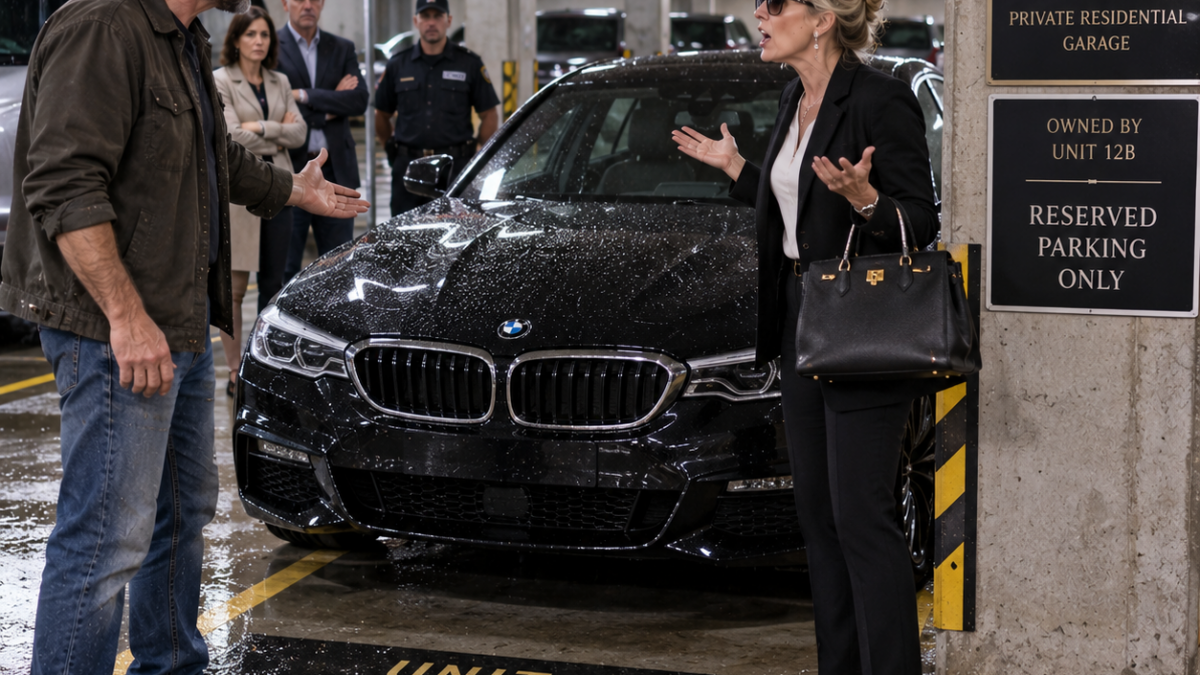
At 12:14 on a rainy Friday morning, I drove into the underground garage I owned and found the HOA vice president’s black BMW parked in the only space I had ever reserved for myself.
By 7:30 Friday morning, Marissa’s version of events had traveled farther than anything I could have corrected overnight.
The elevator stopped on the twenty-fourth floor.
A man named Aaron who had lived three doors from me for almost three years stepped inside.
He saw me.
Then immediately looked down at his phone.
The mirrored elevator wall made it impossible not to see the headline reflected across his screen.
PRIVATE OWNER THREATENS ACCESS TO COMMUNITY GARAGE.
Marissa had pinned the post.
She had also added an update while I was sleeping.
“The board is reviewing outdated developer documents being used to challenge established parking operations. Residents are advised not to engage directly with the private owner while the matter is under review.”
Private owner.
Not Elliot.
Not the guy who held the elevator when someone was running with grocery bags.
Not the person who had personally helped arrange temporary parking when the lower level flooded two winters earlier.
Not the man who had spent five years charging exactly zero dollars for 199 garage stalls.
I became a category overnight.
Aaron didn’t say anything.
Neither did I.
The elevator reached the lobby.
Three residents stood near the package room with their phones out.
Naomi Chen looked up when I passed.
Naomi had taught high school history for thirty-two years.
She was retired now, but she still carried herself like a woman who could hear a missing fact from across a room.
“Elliot.”
I stopped.
“Morning.”
“Does the HOA own the garage?”
“No.”
The younger man beside her frowned.
“Then why does the post call it the community garage?”
“That would be a question for Marissa.”
He crossed his arms.
“Are you planning to start charging us?”
“No.”
“Can you prove that?”
I looked at him.
“I can prove what I own. I can also prove what I’ve charged.”
Naomi’s eyes narrowed slightly.
“What have you charged?”
“Nothing.”
The younger man looked surprised.
Naomi didn’t.
She glanced toward the elevators.
“Then somebody should probably put that in writing.”
“I’m collecting the record first.”
That sentence spread too.
By the time I reached my office downtown, I had thirteen messages.
Some were reasonable.
Will my assigned stall still be available?
My mother uses an accessible space. Is that changing?
Do I need to move my car?
Others had already accepted Marissa’s framing.
You cannot hold a whole building hostage over one parking spot.
Parking is essential infrastructure.
This feels like extortion.
I answered only the safety questions.
No access changes had been made.
No resident needed to move a vehicle.
No parking fees had been announced.
Everything else went into a folder.
At 9:18, I received an email from Bryce Holden, the building manager.
Bryce had been at Crown Meridian for eighteen months.
He was careful with language.
Careful with blame.
Careful with everything except, apparently, ownership records.
His subject line read:
NOTICE REGARDING PARKING OPERATIONS.
The email directed me not to remove signs, interfere with parking assignments, contact towing vendors, or restrict access while the board reviewed what it called “established community use.”
Attached was a proposed violation notice.
The alleged violation was not that I had parked somewhere improperly.
It was “disruption of association operations.”
I called Bryce.
He answered on the fourth ring.
“Elliot.”
“Did you verify who owns G01 before sending this?”
A pause.
“The board has directed management to maintain existing operations.”
“That wasn’t my question.”
“I understand.”
“Did you check the recorded unit schedule?”
Another pause.
“Marissa provided the association parking ledger.”
“The internal parking ledger is not recorded ownership.”
“There may be competing interpretations.”
“There are no competing owners, Bryce.”
His voice lowered.
“The hearing process will give everyone an opportunity to submit documents.”
“Who changed the parking ledger?”
“I can’t discuss internal administration before the review.”
“Who authorized the new sign over G01?”
“I need to end this call.”
He hung up.
That told me more than another five minutes of conversation probably would have.
Around noon, I returned to Crown Meridian.
Marissa’s BMW was gone.
For half a second, I thought she had decided to de-escalate.
Then I saw the column.
The temporary plastic sign had been replaced.
A professionally printed aluminum plaque had been bolted into the concrete.
BOARD PRIORITY — SPACE G01.
The original OWNER RESERVED paint was still visible beneath it.
Someone had added their authority without even removing the evidence underneath.
I photographed the new sign.
Then I opened the resident parking map on my phone.
G01 no longer appeared as owner reserved.
It was now labeled:
ASSOCIATION OPERATIONAL USE.
Updated at 8:42 that morning.
An internal webpage could not change title.
A new label could not rewrite a recorded declaration.
But that wasn’t the real danger.
The danger was that every resident who opened the building’s parking page would now see Marissa’s claim presented as a fact.
The elevator opened behind me.
Naomi stepped out carrying groceries.
She followed my eyes to the new plaque.
“That wasn’t there yesterday.”
“No.”
“Can they do that?”
“They can print a sign.”
“That isn’t what I asked.”
I looked at her.
“No. They cannot transfer recorded ownership by changing a website.”
Naomi put down her grocery bag.
Then she took out her phone and photographed the column.
I looked at her.
“What?”
“There should be two records.”
“Of what?”
“What they changed.”
I almost smiled.
At 2:06 that afternoon, a certified envelope arrived at my office.
Inside was the formal disciplinary hearing notice.
Wednesday.
6:30 p.m.
Board conference room.
Proposed fine:
$2,500.
Additional daily fine:
$500 for each day I interfered with “community garage administration.”
I turned to the attached agenda.
Item one was my alleged violation.
Item two was bigger.
CONTINUITY AND PERMANENT COMMUNITY CONTROL OF GARAGE UNIT G.
I leaned back.
They weren’t just defending Marissa’s parking spot anymore.
They were preparing to decide whether I should continue owning the garage at all.
That weekend, I did nothing publicly.
No portal post.
No angry email.
No residents’ meeting.
No threat.
Monday morning, I opened a metal cabinet in my office that I hadn’t touched in almost three years.
The lock stuck halfway.
I pressed my thumb against the door and turned the key again.
Inside were two black legal binders.
The first held my purchase documents for Unit 31A.
The second was thicker.
On the spine:
CROWN MERIDIAN — GARAGE UNIT G.
I carried it to the conference table.
When Crown Meridian was developed, it had not been structured as one ordinary residential condominium.
The eighty-four residential units sat above a separately numbered commercial condominium unit.
Garage Unit G.
That distinction had existed since the building was created.
It wasn’t a loophole.
It wasn’t a typo.
It was how the developer financed the final stage of construction.
The tower had been nearly complete when the developer started running out of cash.
Contractors were still owed money.
The lender was tightening deadlines.
They needed liquidity.
At the time, my logistics company was growing quickly.
Ward Knight Logistics handled medical samples, emergency equipment, high-value freight, and overnight commercial deliveries.
I had cash.
The developer offered Garage Unit G to me for $2 million.
I bought it.
The closing statement was in the binder.
Purchase price:
$2,000,000.
Behind it sat the recorded declaration.
Then the unit schedule.
Then the map.
I unfolded the map across my conference table.
The street ramp was common property.
That mattered.
Several feet beyond the bottom of the ramp, a thick recorded line crossed the drawing.
Everything past that line was Garage Unit G.
Both underground levels.
The internal access equipment.
The cameras inside the unit boundary.
The parking stalls.
Two hundred of them.
G01 was a small rectangle beside the main elevator lobby.
The most recent appraisal sat in a separate envelope.
$39.6 million.
I left it there.
The money mattered.
But it wasn’t why I kept G01.
I traveled constantly.
Some weeks I landed at midnight after fourteen hours of flights and meetings.
G01 meant I could pull in, grab my suitcase, and reach the elevator without crossing half the garage.
Every other stall had been made available to residents.
Not because I had to.
Because I wanted the building to function.
When I was seventeen, my mother rented an apartment from a landlord who used parking as leverage during a dispute.
He locked her out of her assigned space.
For three weeks, we parked four blocks away.
In Seattle rain.
Carrying groceries.
Walking my little sister home at night.
All while the parking space sat empty behind a gate.
I never forgot it.
After buying Garage Unit G, I signed a license with the HOA.
Annual fee:
$0.
Residents and authorized building vehicles could use 199 stalls.
The license did not transfer title.
It did not create a permanent easement.
It specifically said long-term use would not create an implied or prescriptive right.
And near the middle of the parking schedule was one sentence.
G01 reserved exclusively to owner of Garage Unit G.
I photographed the pages.
Then I called Yolanda Ortiz.
Yolanda had represented my company through vendor disputes, a warehouse fire, two lease defaults, and one very ugly insurance fight.
When something became serious, she didn’t raise her voice.
She got quieter.
“Send me the binder.”
“I have the ownership pages ready.”
“The binder.”
“It’s several hundred pages.”
“Yes.”
I looked at the map.
“Marissa says the documents are outdated.”
“Recorded title does not expire because someone prints a newer parking sign.”
“She says five years of continuous use created community rights.”
“Was the use licensed?”
“Yes.”
“Does the license disclaim an easement?”
“Yes.”
“Send that clause too.”
By noon, Yolanda had built a document request list.
Every version of the parking ledger.
Access logs.
Portal edit history.
Camera footage.
Board minutes.
Vendor invoices involving G01.
Credential work orders.
Developer transition documents.
I sent the request to Bryce and copied Marissa.
Bryce acknowledged it in fourteen minutes.
Marissa said nothing.
At 3:20, management produced the first batch.
It was incomplete.
No board minutes.
No portal logs.
No camera footage.
But there was one folder marked ACCESS VENDOR.
Inside were six invoices from Cobalt Entry Systems.
Five were routine.
Reader maintenance.
Camera calibration.
Replacement fobs.
The sixth had been issued eight days before I came home.
I opened it.
The work description contained one sentence.
CREATE BOARD PRIORITY CREDENTIAL CLASS WITH ASSIGNMENT OVERRIDE FOR G01.
Requested by:
M. Trent.
I read it again.
Then once more.
The change had been ordered before I returned from my trip.
Marissa had not improvised after taking my spot.
She had prepared the system first.
I called Yolanda.
“Tell me what you found.”
I read the work description aloud.
Her keyboard clicked quietly.
“Send the original file.”
“Already on the way.”
“Do not contact the vendor yet.”
“Why?”
“Because I want the instruction that came before the invoice.”
I looked at the recorded garage map.
Then the service ticket.
Someone had created an executive credential inside property the association did not own.
Yolanda said, “This is no longer just a parking dispute.”
“I know.”
“No. I mean operationally. Someone changed access rules inside another owner’s unit.”
As she spoke, a new email arrived.
From Marissa.
Subject:
CEASE INTERFERENCE WITH BOARD-CONTROLLED ACCESS SYSTEMS.
The first sentence warned that any attempt to reverse the Board Priority setting would be treated as intentional interference with “essential building infrastructure.”
Tuesday morning, Yolanda and I met with management.
Marissa was already seated.
Three neat stacks of documents sat in front of her.
Portal screenshots.
The revised parking ledger.
A blue folder titled:
GARAGE CONTINUITY FRAMEWORK.
Bryce sat at the far end of the conference table.
His legal pad was blank.
Marissa smiled when we entered.
“Ms. Ortiz.”
“Ms. Trent.”
Then she looked at me.
“Elliot, I hope we can lower the temperature.”
I sat down.
“The temperature was fine until your BMW showed up in G01.”
“This is larger than one stall.”
“That became clear when you proposed fining me for owning it.”
Bryce looked at his blank pad.
Marissa opened the first folder.
“Crown Meridian has relied on this garage continuously for five years.”
“Under a license,” Yolanda said.
“Residents purchased their homes understanding protected parking was part of the building.”
“They received parking under a license.”
“Continuous access creates expectations.”
“Expectations are not title.”
Marissa’s expression stayed controlled.
“Those expectations affect property values, financing, and building stability.”
Yolanda folded her hands.
“Show me the association’s recorded ownership interest.”
Marissa pushed the parking ledger toward her.
Yolanda did not touch it.
“I asked for the recorded ownership interest.”
“The ledger reflects established operations.”
“The ledger was edited Friday.”
“It was corrected.”
“By whom?”
“The board authorized management to maintain continuity.”
“That does not answer the question.”
Bryce shifted.
Marissa opened the blue folder.
“The real issue is a structural problem created by the original developer.”
She slid a document toward us.
PROPOSED GARAGE CONTINUITY AND TRANSFER FRAMEWORK.
The first page described Garage Unit G as “essential residential infrastructure held under an outdated private arrangement.”
The proposed solution was simple.
Transfer ownership to the association.
Purchase price:
$2 million.
Exactly what I had paid five years earlier.
I looked at Marissa.
“The current appraisal is $39.6 million.”
“That appraisal assumes unrestricted commercial control over a residential necessity.”
“It assumes ownership.”
“It assumes leverage.”
“I haven’t changed a single resident’s parking rights.”
“You are threatening enforcement.”
“I asked you to move your BMW.”
“And now two hundred households are forced to confront the danger of one private owner controlling essential infrastructure.”
“There are eighty-four residential units.”
Her rhythm broke for the first time.
Then she said, “You understand the point.”
“I understand you added 116 households.”
Bryce finally wrote something.
Yolanda turned to the signature page.
“If my client signs this, what happens to the disciplinary action?”
Marissa answered immediately.
“Resolved.”
“The fine?”
“Withdrawn.”
“The hearing?”
“Canceled.”
“The resident portal post?”
“We would clarify that the ownership issue had been addressed.”
Yolanda looked at her.
“So the HOA will withdraw a disciplinary proceeding if my client transfers property worth nearly forty million dollars for two million.”
“That is an inflammatory characterization.”
“It is also mathematically accurate.”
Marissa leaned back.
“The original purchase price reflects the intended relationship between the garage and the building.”
“The recorded declaration reflects the intended relationship,” Yolanda said.
“The association should own essential building infrastructure.”
“It doesn’t.”
“Perhaps the declaration should be interpreted according to current dependency.”
“By whom?”
“The people affected.”
I looked through the glass wall into the lobby.
Naomi was standing near the mail desk.
Marissa pushed the transfer document closer.
“Sign the preliminary agreement, Elliot. We remove the post. We end the hearing. Residents get certainty.”
I left the paper untouched.
“Remove the Board Priority sign.”
Her jaw tightened.
“Restore G01.”
No answer.
“Reverse the credential override.”
“The system is under association administration.”
“The hardware is inside my unit.”
“Your position is noted.”
“Correct the portal.”
“We are not negotiating language before the ownership issue is resolved.”
I looked at Yolanda.
“We’re done.”
“Almost.”
She removed a thick envelope and placed it on top of the violation notice.
“This is a litigation preservation demand.”
Bryce’s pen stopped.
Yolanda continued.
“It covers portal posts and edits, cameras, access logs, parking ledger versions, board communications, vendor instructions, developer records, and every document related to Garage Unit G.”
Marissa looked at Bryce.
“Route future requests through association counsel.”
“You may,” Yolanda said. “But nobody deletes, edits, overwrites, or permits automatic expiration of relevant records.”
“We have routine retention policies.”
“Those policies changed the moment you received formal notice of a dispute.”
Marissa closed the blue folder.
“The hearing remains scheduled.”
“So does your preservation obligation.”
We stood.
Bryce remained seated.
Halfway across the lobby, my phone vibrated.
A message from him.
There is an older transition archive.
Then another.
Search exact term: parking continuity.
I stopped beside the elevator.
Yolanda read the messages.
“Do you trust him?” I asked.
“No.”
She took screenshots.
“But I trust that he is afraid of something in that archive.”
By late Tuesday morning, Yolanda had six documents arranged on her conference table.
Not chronologically.
By consequence.
My photograph of Marissa’s BMW in G01.
Beside it, the contract reserving G01 exclusively to me.
The photograph of the Board Priority plaque.
Beside it, the vendor invoice creating the override.
Marissa’s resident portal post.
Beside it, the recorded unit schedule.
The proposed disciplinary notice.
Beside it, the declaration defining Garage Unit G as separately owned.
The transfer framework offering me $2 million.
Beside it, the $39.6 million appraisal.
Finally, the access record.
Beside it, the clause prohibiting unilateral assignment changes.
Yolanda looked at the table.
“This is how we keep the law from sounding like a lecture.”
“By making people see what each action did.”
“Exactly.”
She took a legal pad.
“Cure demand stays narrow.”
She wrote:
1. Restore G01.
2. Remove Board Priority signage.
3. Correct false portal statements.
4. Withdraw proposed violation.
5. Remove garage transfer item.
6. Reverse unauthorized credential changes.
“That’s it?” I asked.
“That is enough.”
“What about damages?”
“Later.”
“Defamation?”
“Later.”
“Who authorized the vendor changes?”
“Also later.”
She opened the parking license.
“The purpose of a cure notice is to give them a clean path to stop.”
“And if they don’t?”
She pointed to a paragraph.
Five business days after an uncured material breach, the license terminated.
Then a separate seventy-two-hour vehicle removal period began.
I read the clause slowly.
Licensed use created no ownership interest.
No permanent easement.
No prescriptive right.
No implied easement.
If the HOA refused six corrections, 199 resident stalls would lose their license.
I leaned back.
“Most residents did nothing wrong.”
“No.”
“That matters.”
“It should matter to the board too.”
She slid another folder toward me.
Commercial parking alternatives.
Three garages within six blocks.
Cheapest:
About $65,000 per month.
Highest:
Just over $80,000.
That did not include security staffing or accessible-space logistics.
Five years of free parking had hidden the value of what residents were receiving.
At 11:00, Naomi joined us on video.
She had requested non-confidential pages confirming the $0 license and the number of resident stalls.
She appeared wearing reading glasses.
A calculator sat beside her.
“I ran a conservative estimate.”
Yolanda almost smiled.
“I suspected you would.”
Naomi continued.
“If protected parking averaged only three hundred dollars per month, 199 spaces would equal $716,400 per year.”
She turned a page.
“Over five years, before security and access costs, more than three and a half million dollars.”
“I never treated that as lost income.”
“That doesn’t make it worthless.”
“No.”
“It makes the arrangement generous.”
That word hit harder than I expected.
For four days, Marissa had described me as a private investor threatening the building.
Nobody had said generous.
Naomi removed her glasses.
“Are you going to close the garage?”
“I’m giving the board a way to prevent that.”
“Will residents see the cure notice?”
“Not before the board gets it.”
“Good.”
“Why?”
“Because then we’ll know whether they’re solving the problem or defending the story they already told.”
Yolanda sent the cure demand at 1:03 p.m.
Bryce acknowledged receipt at 1:19.
Marissa replied at 1:27.
Not privately.
To the entire board.
And the resident portal.
She called the notice “economic intimidation.”
She accused me of using technical language and speculative valuation to threaten an essential community service.
One thing was missing.
She did not say the association owned the garage.
That mattered.
By 3:00, Bryce sent part of the developer transition archive.
Meeting schedules.
Handover checklists.
Warranty documents.
Old parking charts.
Yolanda opened the index.
Halfway down page four was an entry.
GARAGE UNIT G PARKING CONTINUITY MEMORANDUM.
File number.
Date.
Author.
But no memorandum.
She checked again.
Then called Bryce.
“Your index identifies a parking continuity memorandum.”
“Yes.”
“It is not in the production.”
“I sent everything in the transition folder.”
“No. You sent an index proving something is missing.”
Silence.
Paper moved near his phone.
“I’ll check the archive.”
“Check the preservation hold while you’re there.”
“I understand.”
“Do you?”
Another pause.
“I’ll call you back.”
After the call, I stared at the missing line.
“What do you think is in it?”
Yolanda closed the folder.
“Something Marissa hoped you’d never request by name.”
Bryce called Thursday morning at 8:12.
“I found the memorandum.”
“Where?” Yolanda asked.
“In the transition archive.”
“That is not an answer.”
A pause.
“Stored under acquisition planning instead of parking operations.”
“Who moved it?”
“I don’t know.”
“Send the native file. Folder metadata. Index history.”
“I can send the memorandum now.”
“Send all of it.”
Four minutes later, the file arrived.
GARAGE UNIT G PARKING CONTINUITY MEMORANDUM.
Three years old.
Prepared by Crown Meridian’s former manager during the developer transition.
Attached:
Title examiner’s summary.
Garage use chart.
Draft board minutes.
The first page was painfully clear.
Garage Unit G separately owned.
Resident parking provided under $0 license.
G01 reserved to garage owner.
Association holds no permanent vehicle easement.
Continuous use does not change title.
Yolanda scrolled.
Then stopped.
“Here.”
An email chain.
Marissa had just joined the board when the memo was prepared.
She asked three questions under three headings.
Acquisition.
Continuity.
Control.
Could the association buy Garage Unit G at the owner’s original purchase price?
No right to compel sale.
Could continuous resident use become permanent?
No. Licensed use did not create ownership.
Could the board reclassify the garage as a common amenity by policy?
No.
The declaration could only change through a lawful transaction involving the owner.
Marissa had received every answer.
At the bottom of the chain was her response.
Then continuity needs to be addressed before the next budget cycle.
I read it twice.
She knew.
Not vaguely.
Not partially.
She had studied the exact legal boundaries three years earlier.
Before the BMW.
Before the Board Priority sign.
Before the access override.
Before telling residents my documents were outdated.
Before offering me $2 million for property worth almost forty.
The anger I felt then wasn’t loud.
It didn’t make me want to yell.
It settled behind my ribs.
Heavy.
For five years, I had assumed the board misunderstood the arrangement.
Marissa understood it better than most of them.
She had simply decided the arrangement itself was unacceptable.
At 10:00, Yolanda sent the memorandum to every board member with four questions.
Does the board dispute that Garage Unit G is separately owned?
Does the board dispute that the license creates no easement?
Does the board dispute that G01 is owner reserved?
Does the board still refuse the cure?
Naomi called before noon.
“I saw the memorandum.”
“How?”
“It was included in the records sent to resident representatives.”
She paused.
“She asked about buying the garage three years ago.”
“Yes.”
“So the portal post wasn’t a mistake.”
“No.”
Naomi exhaled.
“People forgive mistakes faster than plans.”
By afternoon, the resident portal changed tone.
Residents stopped asking whether I was trying to seize community parking.
They started asking why Marissa had described recorded documents as outdated after personally reviewing them.
Someone posted the garage use chart.
Someone else highlighted the line saying no permanent easement existed.
Marissa responded at 2:16.
She did not claim HOA ownership.
Instead, she wrote:
PRIVATE OWNERSHIP CANNOT BE ALLOWED TO ENDANGER BUILDING CONTINUITY.
The argument had moved.
Ownership was no longer the claim.
Necessity was.
At 5:30, the board held an emergency virtual meeting.
Five directors appeared on screen.
Board President Martin Fraser looked exhausted.
Bryce kept his camera off.
Martin opened.
“We are here to determine whether the association will comply with the cure demand.”
Naomi, Malcolm Reese, and Dr. Simone Shaw had submitted a resident statement asking the board to preserve free parking by restoring G01 and correcting the portal.
Marissa interrupted before Martin finished reading.
“This is not about one stall.”
Martin rubbed his forehead.
“It can be resolved by restoring one stall.”
“The cure validates private control over essential infrastructure.”
“The license already recognizes private ownership,” another director said.
Marissa’s expression hardened.
“The license is the problem.”
There it was.
Not confusion.
Not outdated documents.
The agreement itself.
Martin called the vote.
Comply with the six-item cure and preserve the parking license.
Two yes.
Three no.
Marissa cast the final no.
The screen updated.
CURE REJECTED.
Yolanda closed the meeting window.
“They just made the record for us.”
She already had the complaint drafted.
We did not ask the court for forty million dollars.
We did not ask the judge to decide who had lied online.
We did not ask for damages.
The immediate motion was narrow.
If the written parking license terminated under its own terms, and if all vehicles were removed, the HOA could not interfere with me securing the interior boundary of Garage Unit G.
The complaint was filed before 7:00.
At 7:43, the clerk issued notice.
Short hearing.
Tuesday morning.
The cure deadline expired Tuesday afternoon.
For the first time since I found that BMW in G01, the next deadline belonged to the contract.
Not Marissa.
Tuesday morning, the courtroom clock was three minutes slow.
Yolanda noticed too.
The clerk called our case at 9:02 while the wall clock still read 8:59.
The hearing lasted less than twenty minutes.
Association counsel argued dependency.
Yolanda argued title and contract.
The judge studied the recorded map.
Then she said something I remember word for word.
“Dependency is not the same as ownership.”
She looked at Yolanda.
“No vehicles are trapped.”
“Agreed.”
“Pedestrian egress remains open.”
“Yes.”
“Fire and emergency access remains available.”
“Yes.”
“Accessible temporary parking must be arranged before closure.”
“It will be.”
The judge signed an interim order.
It did not decide the final lawsuit.
It did not award damages.
It did not declare anyone dishonest.
It did one thing.
Once the license terminated, every vehicle was removed, and safety conditions were met, the association could not interfere with the owner securing the interior boundary of Garage Unit G.
Outside the courthouse, rain darkened the sidewalk.
Yolanda handed me the signed order.
“This does not close the garage.”
“I know.”
“It only prevents interference once conditions are satisfied.”
“I know.”
“You keep saying that.”
“Because I understand the difference.”
Understanding it didn’t make the next three days easy.
At 5:00 Tuesday afternoon, the cure period expired.
Nothing had been corrected.
Board Priority sign still up.
Portal post still active.
Fine still pending.
Garage transfer agenda still open.
Override still in the system.
At 5:01, the parking license terminated.
At 5:03, the seventy-two-hour vehicle removal window began.
I sent every resident a plain-language notice.
No accusation.
No threats.
Just logistics.
Vehicles must leave Garage Unit G by 5:03 Friday.
Two nearby temporary lots had been reserved.
Accessible parking would be available at street level and across the block.
A shuttle would run every thirty minutes during peak hours.
Pedestrian exits would remain open.
Emergency systems would remain active.
And one sentence appeared near the bottom.
I remain willing to sign a replacement $0 parking license immediately if the board completes the six requested corrections.
By 6:00, the Crown Meridian lobby was full.
Not angry.
Worried.
Naomi stood near the package room with Malcolm and Dr. Simone Shaw.
Marissa came down from the boardroom carrying a folder.
Martin followed.
Naomi stepped forward.
“We need five minutes.”
“The board has responded.”
“No,” Naomi said. “The board voted. That is not the same thing as answering us.”
Residents formed a loose half-circle.
Simone spoke.
“I have three patients in this building who cannot comfortably walk from the commercial garage.”
Marissa answered, “Temporary accommodations have been made.”
Simone shook her head.
“By Elliot.”
Malcolm held up the cure notice.
“You can preserve parking tonight by restoring one stall and correcting one false statement.”
“It isn’t one statement,” Marissa said. “It is control of essential infrastructure.”
Naomi looked directly at her.
“Then why did you ask to buy it three years ago?”
Marissa’s expression tightened.
“That memorandum is being taken out of context.”
“It contains the context.”
Martin rubbed his forehead.
“Marissa, we should reconvene.”
“No.”
Her voice sharpened.
“If Elliot closes this garage, residents will finally understand what kind of owner he is.”
I was standing near the mailroom.
She turned toward me.
“You won’t do it.”
I answered quietly.
“I gave the board six ways to prevent it.”
“You are using families as leverage.”
“I arranged temporary parking while you kept my fine active.”
For the first time, several residents looked away from me.
And toward her.
Marissa closed her folder.
“The association will not validate coercion.”
Then she walked toward the elevator.
Cars started leaving Wednesday.
Slowly at first.
People moved them before work.
After dinner.
During lunch breaks.
The garage changed every hour.
Rows that had always been full became open concrete.
Tire noise echoed farther.
Empty stalls reflected fluorescent lights.
I spent most of Thursday downstairs with the parking coordinator, Cobalt technicians, and a list of residents who needed help.
At 7:20 that evening, I helped Mrs. Alvarez move her folding walker into a shuttle van.
She touched my sleeve.
“I know this isn’t because of us.”
“That doesn’t make it easier.”
“No.”
She looked toward the nearly empty garage.
“But it matters.”
Friday morning, eleven vehicles remained.
At 4:40, six.
At 4:52, two.
At 4:57, the last resident sedan crossed the recorded boundary and climbed the ramp.
The plate system changed.
VEHICLES PRESENT: 0.
Cobalt performed a camera sweep.
Upper level clear.
Lower level clear.
G01 sat empty beside the elevator.
Still carrying the Board Priority plaque.
At 5:03, Yolanda sent me one message.
Removal window closed. Site clear.
Saturday morning, I entered Garage Unit G at 4:38.
Two hundred empty stalls made the place feel twice as large.
No engines.
No doors.
No shopping carts.
No radios.
A wrench fell on the lower level.
The echo traveled for several seconds.
Cobalt Entry Systems arrived first.
Victor Mills stood beside the plate recognition console.
“Vehicle count remains zero.”
He turned the tablet toward us.
Final plate exit:
4:57 p.m. Friday.
No access credentials accepted since 5:03.
Camera grid clear.
At 4:46, Kestrel Secure Fabrication arrived.
Two trucks.
Dark steel barrier sections.
Their foreman, Joel Croft, walked the legal boundary with Yolanda, Victor, and the building’s fire contractor.
The common vehicle ramp ended before the recorded line.
Joel placed temporary yellow tape across the concrete.
“This side remains common property.”
He pointed beyond it.
“Barrier anchors go here.”
Yolanda checked the survey.
“Entirely inside Garage Unit G.”
The emergency release connected to the fire panel.
Pedestrian doors remained functional for exit.
The accessible street-level drop-off was active.
Victor tested the emergency release.
Green indicator.
Then the fire contractor tested it remotely.
The steel track disengaged.
Heavy click.
Yolanda logged the time.
Nothing was improvised.
That mattered.
At 5:11, Bryce appeared at the bottom of the ramp.
Raincoat.
Yesterday’s shirt underneath.
Red folder against his chest.
He saw the barrier sections.
“You cannot install that.”
Joel looked at Yolanda.
She looked at Bryce.
“Why?”
“The board passed an emergency resolution at 3:40 this morning.”
He handed her the document.
It declared Garage Unit G “essential residential infrastructure.”
It directed management to preserve uninterrupted vehicle access.
Yolanda read the first page.
“Did the board acquire title at 3:40 this morning?”
Bryce looked exhausted.
“The resolution authorizes me to stop this.”
“It authorizes you to ask.”
“The association disputes termination.”
“The court already addressed interference.”
“The contractors weren’t present.”
“They don’t need to be. They’re working for the owner.”
Bryce’s phone rang.
He checked it.
Association counsel.
Yolanda held out her hand.
“Speaker.”
The attorney’s voice filled the empty garage.
“The association demands an immediate pause pending emergency review.”
Yolanda opened the court order.
“The garage has been empty since yesterday. Vehicle removal is complete. Accessible alternatives are operating. Emergency release has been tested. All conditions are satisfied.”
“The new board resolution changes the circumstances.”
“No. It changes the board’s position.”
“You are creating an operational crisis.”
“The association had five business days to cure and seventy-two hours to remove vehicles.”
“We will seek relief this morning.”
“You may.”
Then Yolanda read the operative paragraph aloud.
The association and its agents shall not interfere with the owner’s securing of the interior boundary of Garage Unit G after completion of removal and safety requirements.
Silence.
Then the call ended.
Bryce lowered the phone.
“I was told to stop you.”
“I know.”
“And now?”
Yolanda looked at him.
“Now you decide whether you want to violate the order personally.”
He looked at the steel.
The empty stalls.
The yellow boundary tape.
Then stepped aside.
Joel gave the signal.
Before the first barrier section was anchored, Yolanda pointed toward G01.
“That comes down.”
A worker carried a drill to the column.
One bolt.
Then another.
BOARD PRIORITY came off at 5:29.
Underneath remained the faded white paint.
OWNER RESERVED.
Yolanda placed the removed plaque into an evidence sleeve.
The installation continued.
Steel track.
Anchors.
Manual release.
Electrical connection.
At 6:07, the final section moved into position.
The lock engaged.
A sign was fixed to the center.
PRIVATE GARAGE UNIT G
LICENSE TERMINATED
NO VEHICLE ENTRY
Beyond the barrier stretched two hundred empty stalls.
The street above was beginning to brighten.
Then headlights appeared at the top of the ramp.
A black SUV.
Victor looked at the plate feed.
He didn’t need to tell me.
Marissa’s BMW descended slowly.
Halfway down, she saw the barrier.
Brake lights.
The SUV stopped six feet from the steel.
Its headlights shone through the bars and stretched across the empty garage.
G01 sat visible beside the elevator.
The Board Priority sign was gone.
OWNER RESERVED showed again.
Marissa lowered the window.
“What is this?”
Yolanda stood beside the contractor’s completion board.
“The parking license terminated. The garage was cleared. Court conditions were satisfied.”
“I asked what this is.”
“A secured private unit.”
Marissa opened her door and stepped onto the ramp.
Same dark coat.
Different face.
Behind her, another vehicle appeared.
Martin’s sedan.
Then the treasurer.
Then two more board members.
Red brake lights filled the ramp.
Victor checked the access console.
“All board credentials are rejecting at the interior boundary.”
Marissa pointed toward the sign.
“You cannot shut down essential building infrastructure.”
Yolanda held up the recorded unit schedule.
“The building retains access to every common element it owns.”
“The garage has served this building since opening.”
“Under a license.”
“The board passed an emergency resolution.”
“A board resolution does not create title.”
Marissa turned.
“Bryce. Tell them to open it.”
Bryce stood on the common side of the boundary.
He said nothing.
“Bryce.”
He looked at her.
“The interim order prohibits interference after the conditions are met.”
“You work for the association.”
“I am following the order.”
Residents were beginning to gather near the upper lobby glass.
Nobody entered the ramp.
Nobody needed to.
Two hundred empty parking stalls made the point without noise.
Marissa faced Yolanda.
“Do you understand what this does to property values?”
“The cure demand gave the board six ways to avoid this.”
“This is punishment.”
“It is termination of a free license following documented breach.”
“You hide behind technical language.”
Yolanda opened the continuity memorandum.
“Three years ago, you asked whether the association could acquire Garage Unit G for Mr. Ward’s original purchase price.”
“That was planning.”
“You received a title summary confirming private ownership, no easement, and no authority to reclassify the garage.”
Marissa’s eyes flicked toward the residents.
“This building cannot function without parking.”
Naomi’s voice came from the top of the ramp.
“It could have continued functioning if you restored one space.”
Everyone looked up.
Naomi stood beside Malcolm and Simone.
Marissa’s face tightened.
“You do not understand the governance issues.”
Naomi held up the cure notice.
“We asked you to accept this before the residents had to move their cars.”
Simone added, “Before my patients had to use temporary transportation.”
Malcolm pointed toward the shuttle outside.
“You said Elliot was bluffing.”
Martin stepped out of his car.
“Marissa, move the BMW. We’re blocking the ramp.”
She ignored him.
Instead, she looked at me.
“You planned this.”
I said nothing.
“You planned the timing.”
Nothing.
“The cameras. The contractors. The audience.”
Her voice cracked slightly.
“You wanted to humiliate me.”
I looked through the steel barrier.
At G01.
Empty.
Exactly as it should have been the night I came home.
“I asked for one empty space.”
That was all.
No appraisal speech.
No reminder about five years of free parking.
No accusation.
A resident near the top of the ramp said quietly:
“She took one spot and lost all of them.”
Martin closed his eyes.
Then he looked at Yolanda.
“What will reopen the garage?”
Marissa turned sharply.
“You are not negotiating on a ramp.”
Martin looked at her.
“We should have negotiated before the ramp.”
Yolanda opened a folder.
“Four immediate conditions.”
“Read them.”
“First, written correction acknowledging Garage Unit G is privately owned and was never HOA common property.”
Martin nodded.
“Second, withdraw Mr. Ward’s proposed violation and disciplinary proceeding.”
Another nod.
“Third, eliminate the Board Priority credential class and require dual authorization for any access changes.”
Marissa’s face hardened.
“Fourth, Ms. Trent has no authority over garage access, parking assignment, or acquisition discussions while the association negotiates a replacement license through independent counsel.”
“You cannot remove me from elected office.”
“This condition concerns authority over my client’s property.”
Naomi stepped closer to the sidewalk railing.
“Then decide.”
The treasurer shut off her engine.
One by one, the other board members did too.
Martin looked through the barrier.
“How quickly can this reopen?”
“When the correction is posted, the violation withdrawn, and an enforceable interim agreement signed.”
Marissa shook her head.
“You are surrendering the building to him.”
Martin looked at her.
“No.”
His voice echoed slightly.
“We are admitting the garage was never ours.”
The words traveled all the way up the concrete ramp.
The garage remained closed through the weekend.
That was when Crown Meridian discovered what free parking had been hiding.
Shuttle every thirty minutes.
Groceries carried across the street in rain.
Delivery drivers unloading at the curb.
Residents arranging rides.
Every inconvenience had a date attached to it.
A vote.
And six rejected corrections.
Monday at 8:05, Martin called Yolanda.
“The board is ready to sign an interim agreement.”
“Interim isn’t enough.”
“What else?”
“Independent association counsel. Resident representation. Full written correction before access resumes.”
By noon, we were back in the management office.
Martin sat across from us.
Naomi.
Malcolm.
Dr. Simone Shaw.
An attorney named Rebecca Sloan now represented the association.
Marissa was not there.
Neither was her blue transfer folder.
Rebecca opened.
“The board has voted to withdraw the proposed violation and cancel the disciplinary hearing.”
Yolanda checked the draft.
“Portal correction?”
“Approved.”
“Ownership acknowledgment?”
“Approved.”
“Board Priority credentials?”
“Terminated.”
“Future access changes?”
“Two-person authorization. One board representative and one management representative. No assignment affecting Garage Unit G without written owner consent.”
Naomi leaned forward.
“Resident notice?”
“One designated resident representative receives notice of proposed parking-license changes.”
I looked at Martin.
“What happened to Marissa?”
He folded his hands.
“The board removed her as vice president.”
Nobody spoke.
“The Parking and Building Access Committee removed her as chair. She is excluded from negotiations concerning Garage Unit G, property acquisition, access-control administration, and the parking ledger.”
“Is she still a director?”
“Yes. That is an elected position. Membership procedures control removal.”
I nodded.
I had never demanded that she leave the board.
I wanted her authority to stop crossing a boundary she already understood.
Rebecca turned to the replacement parking license.
Annual fee:
$0.
199 stalls.
Residents and authorized building vehicles.
G01 reserved exclusively to owner of Garage Unit G.
No ownership interest.
No permanent easement.
No implied right through use.
No unilateral reassignment.
Same basic language as before.
The difference was everyone at the table had now read it.
Martin slid one more page toward me.
New parking assignments.
Marissa’s BMW:
G183.
Lower level.
Far stairwell.
No executive designation.
No special credential.
No elevator priority.
Naomi looked at me.
“Did you choose that?”
“No.”
Martin almost smiled.
“The independent manager did.”
Good.
Fair was better than revenge.
Marissa was still a resident.
She deserved exactly what every other resident received.
Nothing less.
Nothing more.
At 3:17 Monday afternoon, the resident portal changed.
New pinned notice.
CROWN MERIDIAN GARAGE OWNERSHIP AND ACCESS CORRECTION.
It stated that Garage Unit G was separate private property owned by Elliot Ward.
It acknowledged that residents used 199 stalls under a $0 license.
It withdrew the statement that the garage was an HOA-owned common amenity.
It withdrew the violation.
It confirmed G01 had been improperly reassigned and relabeled.
Marissa’s original post disappeared from the pinned position.
Residents began commenting.
Thank you for keeping parking free.
Why did nobody explain ownership before?
Who approved Board Priority access?
Naomi did not comment.
She printed the correction.
At 4:00, Yolanda sent me the final non-interference agreement.
I signed.
Martin signed.
Rebecca signed as independent counsel.
Naomi signed as resident representative.
At 4:26, I called Kestrel.
“Open it.”
The lock released.
Heavy click.
The steel barrier began rising.
Residents waited outside the vehicle lane.
The first car belonged to Mrs. Alvarez.
Her daughter drove.
They stopped beside me.
Mrs. Alvarez lowered the window.
“You kept your promise.”
“So did you.”
“What promise did I make?”
“You moved your car when we asked.”
She smiled.
“That was easier than moving a board.”
Cars entered one by one.
Green light.
Then another.
Then another.
By evening, the garage sounded like itself again.
Engines.
Doors.
Shopping carts.
A child laughing near the elevator.
Cobalt deleted the Board Priority credential class.
Every resident fob returned to the same access level.
No executive override.
No hidden assignment privilege.
The following morning, painters came to G01.
They removed adhesive marks.
Patched the bolt holes.
Then painted fresh white letters across the back of the space.
OWNER RESERVED.
Three weeks later, I returned from another business trip.
After midnight.
Again.
My headlights moved across the first level.
The garage was full.
Almost.
G01 was empty.
Exactly one vacant stall beside the elevator.
Farther down, residents’ vehicles filled the spaces I had licensed to them for free.
On the lower level, Marissa’s BMW sat in G183.
No plaque.
No special paint.
No executive marker.
Just another vehicle in another parking stall.
I held my fob to the reader.
Green.
The gate opened.
For a second, I remembered being seventeen.
Walking beside my mother through Seattle rain.
Plastic grocery bags cutting into my fingers.
An empty parking space sitting behind a locked gate because a landlord wanted leverage.
I had spent years making sure I never became that man.
Setting a legal boundary had not changed that.
Residents still parked for free.
Nobody lost access permanently.
Nobody paid me a monthly fee.
Nobody was punished for a board member’s decision.
The garage was still mine.
And the one space I had asked everyone to leave me—the one small rectangle out of two hundred—was finally empty.








