“YOU SHOULD HAVE SOLD IT TO ME!” HOA President Smiled as My Farmhouse Burned—Then I Walked Into Court in a Judge’s Robe
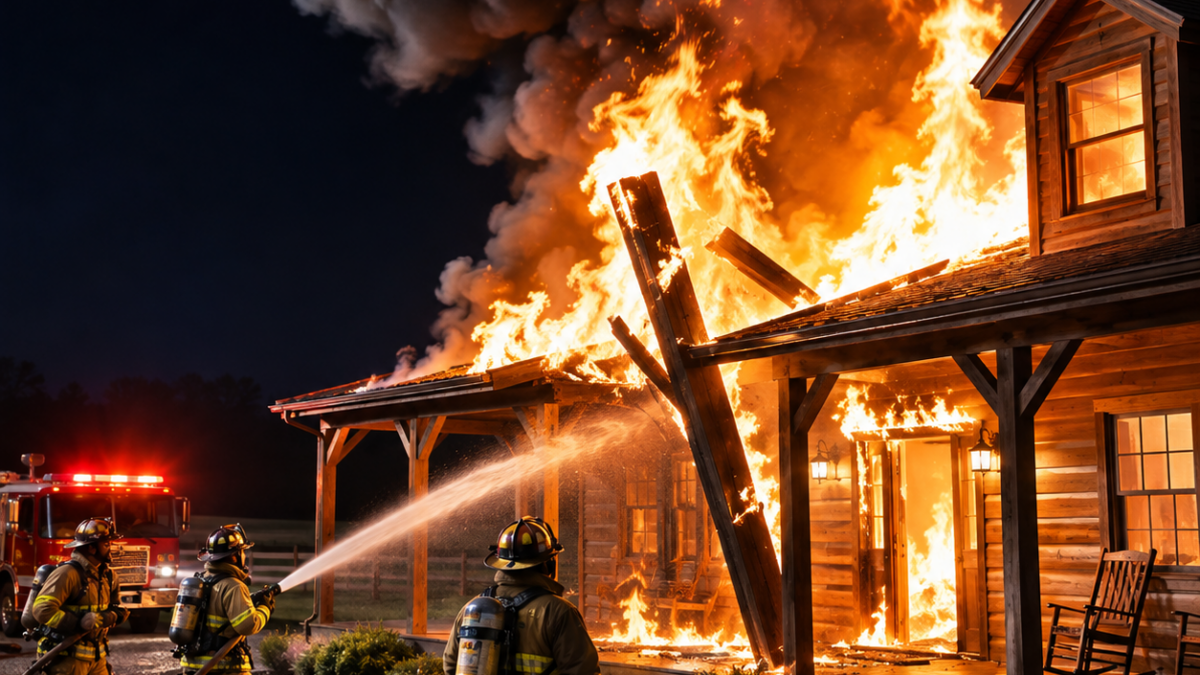
PART2:
For the first time that night, Patricia looked uncertain.
“I said this didn’t have to happen.”
Warren immediately looked down.
Nathan studied him.
Then Patricia.
“Interesting.”
“What?”
“You’ve spent four months threatening me over this land.”
He pointed toward the burning farmhouse.
“Now my house burns and you’re already talking about buying.”
Her expression hardened.
“Don’t make accusations you can’t prove.”
Nathan took out his phone.
“I haven’t accused anyone.”
He photographed her.
Warren.
The other board members.
Vehicles.
License plates.
Then he saw the eastern security camera.
Crooked.
Cable disconnected.
He photographed that too.
Patricia approached.
“Old houses have electrical problems.”
Nathan slowly turned.
“Who said this was electrical?”
Her mouth opened.
Nothing came out for half a second.
Then:
“I was suggesting a possibility.”
“Let the investigator suggest possibilities.”
She stopped talking.
PART3:
That was four months after the dispute began.
Briarwood Heights bordered the eastern side of Cole Ridge Ranch.
Nathan owned nearly four hundred acres.
Cattle pasture.
Hardwood ridge.
Two ponds.
The farmhouse.
Barn.
Guest cabin.
And an eastern strip of land that suddenly became very valuable when Briarwood began constructing an eight-million-dollar clubhouse.
Their existing construction route required trucks to make a difficult two-mile loop along Quarry Road.
Patricia wanted a shorter route across Nathan’s pasture.
First offer:
$180,000.
He declined.
Second:
$225,000.
He declined again.
“My father raised cattle here.”
Patricia smiled as though explaining something to a child.
“We’re talking about a road, Nathan.”
“A road through his pasture.”
“Your pasture.”
“Exactly.”
“We can landscape it.”
“No.”
“We’ll install fencing.”
“No.”
“There’s no reason to be emotional.”
“I’m not.”
Nathan looked directly at her.
“I’m saying no.”
After that came HOA notices.
$750 equipment-trailer violation.
Fence citation.
Gravel-driveway violation.
Exterior maintenance warning.
Nathan wasn’t a member of Briarwood Heights.
His ranch predated the subdivision.
His deed carried no HOA covenants.
He repeatedly requested documentation establishing jurisdiction.
Patricia never produced it.
Then survey crews appeared.
Nathan found red stakes forty-two feet inside his fence.
He photographed each.
Called the survey company.
“Who authorized entry?”
The project manager checked.
“Patricia Langford.”
“Did she provide an easement?”
Long pause.
“I don’t have one in front of me.”
“Thank you.”
Nathan documented that too.
At a Briarwood meeting, Patricia claimed the HOA held “historical access rights.”
Nathan stood during public comment.
“Recording number?”
“What?”
“The easement.”
He looked toward the board.
“What is the county recording number?”
Patricia glanced at Warren.
“Our attorneys have reviewed the matter.”
“Then the number should be easy.”
Silence.
“You’re obstructing community development.”
Nathan nodded.
“Please put that answer in the minutes.”
From the back of the room, HOA treasurer Elaine Mercer watched carefully.
Two weeks later Patricia sent Nathan a written demand.
The final sentence said:
You will regret making this difficult.
Then his farmhouse burned.
Fire investigator Daniel Reeves arrived shortly after midnight.
He asked:
“Anybody have a reason to deliberately damage your property?”
Nathan handed him a folder.
“Start here.”
Reeves went through months of letters.
Photos.
Survey activity.
Offers.
HOA notices.
Then Nathan showed him the damaged camera.
“Don’t touch it,” Reeves said.
“I haven’t.”
“Other cameras?”
“Three around the house.”
“Working?”
Nathan looked toward the flames.
“I’ll know soon.”
Before dawn, Nathan crossed the property to the guest cabin.
He opened his laptop.
Three cameras stopped recording shortly before the fire.
Not simultaneously.
7 minutes apart.
One at the driveway.
One behind the barn.
One along the east fence.
All disconnected.
Whoever did it knew where they were.
But they didn’t know about the fourth.
Eight hundred feet uphill.
Beside an old water tank.
Independent battery.
Cellular backup.
Installed after cattle thieves hit a neighboring ranch.
Nathan opened the archive.
9:41 p.m.
Headlights.
Pickup truck.
Two figures.
One walked toward the farmhouse.
One remained beside the truck.
9:53.
Both returned.
10:02.
Smoke.
Nathan’s hands became cold.
He copied the footage twice.
Then called Reeves.
“I found something.”
The investigator arrived before sunrise.
Watched silently.
Then:
“Don’t post this.”
“I wasn’t planning to.”
“Original file stays untouched.”
“Understood.”
Three weeks later, Patricia walked into county court expecting Nathan to be frightened.
Her HOA had filed a civil action asking a judge to recognize its alleged historical access corridor across Cole Ridge.
She came with Warren and counsel.
Nathan wasn’t sitting at the respondent’s table.
Patricia smiled.
“Maybe he finally understands how expensive this is going to become.”
Then the bailiff called the room to order.
The side door opened.
Nathan Cole walked in wearing a black judicial robe.
Patricia’s smile vanished.
“What the hell?”
Warren stared.
For twenty-three years, Nathan had served as a county judge.
Cole Ridge was the place he went to get away from court.
Patricia had spent months researching his property and apparently very little time researching him.
But Nathan did not sit down to hear his own lawsuit.
He was scheduled for a brief unrelated administrative matter that morning.
He completed it.
Formally stepped aside.
Left the bench.
Another judge took over Patricia’s case.
Her attorney leaned close.
“Judge Cole cannot preside over his own dispute.”
Nathan knew.
The robe was never the weapon.
The documents were.
When proceedings began, Nathan sat beside his attorney, Rebecca Shaw.
Patricia’s lawyer claimed historical access.
Rebecca asked:
“Where is the recorded grant?”
“Historical documentation exists.”
“Recorded easement?”
“Not presently available.”
Rebecca introduced Nathan’s certified survey.
Then photographs of the stakes.
Violation notices against property outside Briarwood.
Board minutes.
Finally Patricia’s letter.
You will regret making this difficult.
Her attorney objected.
Rebecca said:
“It establishes the history surrounding the access dispute.”
The court admitted it for that limited purpose.
Then Rebecca raised the fire.
“Separate investigation,” Patricia’s lawyer objected.
“We agree.”
Rebecca nodded.
“We are not asking this court to determine criminal responsibility.”
“Then why mention it?”
“To ensure relevant records are preserved.”
The court ordered appropriate preservation.
Patricia relaxed.
Until Rebecca continued:
“Investigators have footage from a security camera the association apparently didn’t know existed.”
Warren’s face changed.
Patricia turned toward him.
“What camera?”
Rebecca continued.
“A vehicle entered Cole Ridge shortly before the fire.”
Patricia gripped her chair.
“That’s impossible.”
Nobody spoke.
Nathan looked directly at her.
“Why?”
Her mouth opened.
Warren leaned over.
“Patricia, stop talking.”
Too late.
After the hearing, Nathan’s phone rang.
Daniel Reeves.
“We identified the pickup.”
“Who owns it?”
“Warren Pike’s consulting company.”
Nathan looked toward the courtroom.
Warren was already moving toward the exit.
“Doesn’t prove he drove it.”
“No.”
Reeves continued.
“But a business camera on Quarry Road caught a second vehicle.”
“Whose?”
“Patricia Langford’s.”
Nathan stopped.
Then Reeves told him about the audio.
One of the people near the farmhouse had been speaking on a phone.
The words were faint.
Enhancement helped.
Insurance policy.
Payment.
Deadline.
Then a second property.
Elaine Mercer.
Nathan went straight to Reeves’s office.
Rebecca came with him.
Reeves played the audio.
Static.
Wind.
Then a man’s voice.
Not perfectly clear.
But enough.
“…policy is replacement cost…”
Pause.
“…once Cole gets the payout…”
Wind.
“…Patricia says he’ll sell after this.”
Nathan’s hands tightened.
Then:
“…payment doesn’t release unless access is signed by nine tomorrow…”
More static.
Another fragment.
“…Mercer still has the backup.”
Then:
“…if she doesn’t hand it over, we deal with her place next.”
Nathan felt something cold move through him.
Rebecca stopped the recording.
“Again.”
They played it again.
Same words.
Reeves said:
“We’re not relying on audio alone.”
“Whose voice?”
“Working on it.”
“What payment?”
“Don’t know yet.”
“What backup?”
“We don’t know.”
Nathan thought about Elaine.
Treasurer.
Quiet woman.
Sat in the back of the HOA meeting.
Watched Patricia carefully.
“We need to contact her.”
“Already did.”
Reeves leaned forward.
“She wouldn’t discuss it by phone.”
“Why?”
“She asked whether Patricia knows we’re contacting her.”
Nathan understood immediately.
“When can we see her?”
“Tonight.”
Elaine lived twelve miles from Briarwood on a fourteen-acre parcel her late husband had inherited.
Older brick house.
Detached accounting office.
Large equipment shed.
She opened the door before they knocked.
Rebecca introduced herself.
Reeves showed credentials.
Elaine looked at Nathan.
“I’m sorry about your house.”
“Thank you.”
She led them to the kitchen.
Then closed every blind.
Reeves asked:
“Why are you afraid?”
Elaine sat.
“Because Patricia knows I found the transfers.”
“What transfers?”
Elaine looked toward Nathan.
“The clubhouse isn’t costing eight million dollars.”
Rebecca asked:
“How much?”
“Actual construction contract is about $6.2 million.”
Nathan stared.
“Then why does the HOA describe it as an eight-million-dollar project?”
“Because roughly $1.8 million is in consulting, acquisition, infrastructure, contingency, and development-management charges.”
“Paid to whom?”
Elaine reached beneath the table.
Pulled out a portable hard drive.
“That’s why they’re afraid of me.”
She had been treasurer for three years.
At first, everything looked normal.
Large development.
Large invoices.
Change orders.
Consultants.
Then she noticed recurring payments to Pike Development Advisory.
Warren’s company.
Not surprising by itself.
He was the development consultant.
But invoices were vague.
Access strategy.
Stakeholder coordination.
Land integration.
Government liaison.
One month:
$38,000.
Next:
$41,500.
Then $72,000.
Elaine asked for supporting work product.
Warren provided three-page summaries.
She asked Patricia.
Patricia said:
“Development consulting is expensive.”
Elaine kept looking.
Then found payments to another company.
Langford Community Strategies LLC.
Owner:
Patricia Langford.
Rebecca stared.
“The HOA president was paying her own company?”
“Through a development-services subcontract.”
“Disclosed?”
“No.”
“How much?”
“Two hundred eighty-six thousand dollars over eighteen months.”
Nathan leaned back.
“And the board?”
“I don’t think most knew.”
“You?”
“I didn’t.”
“Why would the treasurer not know?”
Elaine looked embarrassed.
“Patricia had a separate capital-project account.”
Reeves asked:
“Authorized?”
“Originally.”
“For what?”
“Clubhouse construction.”
“But?”
“Patricia and Warren controlled access.”
Elaine discovered something else.
A success payment.
$450,000.
Due from a development partner if Patricia and Warren secured direct access from Briarwood to County Route 11 through Nathan’s ranch.
Nathan stared.
“Four hundred fifty thousand?”
Elaine nodded.
“Split?”
“Two hundred twenty-five thousand to Pike Development Advisory.”
That number felt familiar.
Exactly Patricia’s final offer to Nathan.
“And the other half?”
“Langford Community Strategies.”
Rebecca said:
“So Patricia offered Nathan $225,000…”
“…while expecting to receive roughly the same amount personally if he agreed.”
Elaine nodded.
“Except that wasn’t all.”
Of course it wasn’t.
The access corridor would also increase the value of land immediately behind Briarwood.
Land held through an LLC called BLH North Ventures.
Nathan asked:
“Who owns it?”
Elaine said:
“I couldn’t prove it at first.”
“Now?”
“Patricia’s husband owns forty percent.”
Warren Pike owned another thirty.
The remaining shares belonged to investors connected to the clubhouse developer.
A road through Cole Ridge wouldn’t merely save construction trucks two miles.
It would unlock a future 112-home expansion on the northern tract.
Nathan’s pasture was the missing connection.
“How much is that land worth with access?”
Elaine answered:
“Current appraisal is around $3.7 million.”
“And with development entitlement?”
“Potentially twelve.”
Now Nathan understood the pressure.
The fake HOA violations.
Survey stakes.
Offers.
Threats.
A burned farmhouse.
This had never been about saving construction time.
It was about turning landlocked acreage into a multimillion-dollar development.
Reeves pointed toward Elaine’s hard drive.
“What is the backup?”
“Everything.”
Emails.
Account statements.
Invoices.
Board packets.
Original budget versions.
Internal correspondence.
And one document Patricia probably never expected Elaine to find.
An insurance file.
Nathan looked at Reeves.
“The audio.”
Elaine nodded.
Briarwood carried a construction completion and financial-risk policy tied to the clubhouse project.
The policy covered certain losses if outside events delayed completion.
Not illegal.
Large projects carry insurance.
The problem was an amendment submitted two months earlier.
It listed the Cole Ridge access corridor as an “anticipated secured construction route.”
It also represented that negotiations were substantially complete.
They weren’t.
Nathan had said no.
Repeatedly.
Yet Warren’s development budget assumed access would exist by Friday morning.
If it did not, the next construction draw would be delayed.
And the project would miss a lender milestone.
The success payment disappeared.
Potential penalties followed.
Nathan said:
“So nine o’clock the morning after my house burned…”
Elaine nodded.
“…was the lender certification deadline.”
Rebecca asked:
“And the insurance policy?”
Elaine’s expression tightened.
“Warren had been preparing a delay claim.”
“Based on what?”
“Loss of access.”
Nathan stared.
“To a route they never had.”
“Yes.”
“How does burning my house help?”
Elaine hesitated.
“It wasn’t about making the access route physically available.”
“Then?”
“Patricia believed the fire would break you.”
Nathan said nothing.
“She said if the house was gone, your emotional attachment to the ranch would be gone too.”
His face hardened.
Elaine continued quietly.
“She expected your homeowner’s insurance to pay you enough to rebuild somewhere else.”
Rebecca whispered:
“Oh my God.”
Elaine looked at Nathan.
“I heard her say, ‘He’ll take the insurance money and the land offer. Nobody rebuilds alone at his age.’”
Nathan didn’t move.
Nobody spoke for several seconds.
Then he asked:
“My age?”
Elaine almost smiled.
“Her words.”
Nathan was fifty-six.
He suddenly hated that detail more than the rest.
Not because it was insulting.
Because it showed how carefully Patricia had converted his life into numbers.
Widower.
No children living on the property.
Large ranch.
Old farmhouse.
Insurance coverage.
Emotional loss.
Sale probability.
She had reduced a human being to leverage.
Reeves asked:
“Why was your property mentioned?”
Elaine looked toward the detached office.
“Because Patricia knows I copied the records.”
“She told you?”
“She demanded the drive.”
“When?”
“Monday.”
“What did you say?”
“No.”
“What happened?”
“Tuesday, someone followed me home.”
Nathan’s eyes moved to the window.
“Vehicle?”
“Black pickup.”
“Plate?”
“No.”
“Anything else?”
Elaine nodded.
“Yesterday Patricia called.”
“What did she say?”
“That financial records belong to the HOA.”
“Do they?”
“Copies do.”
Reeves asked:
“What else?”
Elaine swallowed.
“She told me keeping them at my home created ‘an unacceptable risk.’”
Nathan understood.
The second property on the audio.
Her house wasn’t part of the access plan.
Her evidence was.
Reeves stood.
“Tonight you’re not staying here.”
Elaine looked irritated.
“This is my home.”
“I understand.”
“I’m not leaving because Patricia scares me.”
“This isn’t about whether you’re scared.”
Nathan said quietly:
“Elaine.”
She looked at him.
“My house burned three weeks ago.”
That ended the argument.
Reeves arranged protection and evidence transfer.
The hard drive went through formal chain of custody.
Elaine stayed with her sister.
Her property received cameras.
Nothing happened that night.
Because now the people who had been operating in darkness knew investigators were watching.
The fire investigation accelerated.
Laboratory analysis found ignitable-liquid residues near the eastern porch.
Not an electrical fire.
Arson.
The hidden camera’s audio was enhanced.
One voice was tentatively identified as Warren Pike.
Phone records strengthened it.
At 9:44 p.m. the night of the fire, Warren’s phone connected to a tower covering Cole Ridge.
At 9:46, he called Patricia.
Call lasted six minutes.
Patricia’s vehicle was captured by the Quarry Road business camera at 9:38.
Then again leaving at 10:11.
Warren’s pickup followed.
Investigators still needed more.
Presence was not ignition.
The fact that Patricia and Warren were near Nathan’s property did not prove either set the fire.
Nathan understood that better than almost anyone.
He had spent twenty-three years watching people confuse suspicion with proof.
So he stayed out of it.
No interviews.
No courthouse gossip.
No public statements accusing Patricia.
That frustrated reporters.
One asked:
“Judge Cole, do you believe the HOA president burned your house?”
Nathan answered:
“I believe the investigators should follow the evidence.”
“That’s it?”
“Yes.”
“You don’t have an opinion?”
“I have many opinions.”
He continued walking.
“They are not evidence.”
That clip aired repeatedly.
Patricia did the opposite.
She went on local television.
Called Nathan vindictive.
Claimed he was using his judicial position to intimidate a community organization.
Said:
“This is what happens when powerful government officials don’t get their way.”
Nathan watched from the guest cabin.
Rebecca sat beside him.
“She wants you angry.”
“I know.”
“She wants you to respond.”
“I know.”
“Are you going to?”
“No.”
“Good.”
Nathan looked at the burned foundation outside.
“I’m going to rebuild.”
Rebecca turned.
“Here?”
“Exactly here.”
That was the first decision since the fire that felt entirely his.
Patricia had assumed the loss would disconnect him from the ranch.
Instead it did the opposite.
Two days later, the independent judge ruled on Briarwood’s access case.
No recorded easement.
No deeded access.
No prescriptive claim established on the evidence presented.
No HOA authority over Cole Ridge.
The case was dismissed without granting Briarwood the corridor it sought.
Patricia walked out furious.
Warren did not attend.
Because that morning, investigators executed search warrants.
His office.
His truck.
Patricia’s HOA office.
Langford Community Strategies.
Pike Development Advisory.
They recovered laptops.
Phones.
Account records.
And construction-planning documents.
Then they found something inside Warren’s truck.
A small red plastic fuel container.
That alone meant little.
People carry fuel.
But laboratory testing found the same uncommon gasoline additive profile detected in samples from Nathan’s porch.
Still not perfect proof.
Then came surveillance.
A convenience store six miles from Cole Ridge.
9:09 p.m.
Warren’s pickup.
Warren on camera buying fuel.
Cash.
Small container.
The clerk remembered because Warren asked whether the station sold disposable gloves.
They did.
He bought a box.
Investigators found the receipt.
Nathan learned about it only after an arrest warrant was issued.
Warren Pike was arrested first.
Patricia forty-eight hours later.
Not at an HOA meeting.
Not in dramatic fashion.
State investigators met her outside her attorney’s office.
She surrendered.
Charges initially included conspiracy, arson-related offenses, attempted coercion, financial fraud, and other counts connected to association funds and development documents.
The exact charges changed as the case progressed.
Nathan never celebrated.
The farmhouse was still gone.
His father’s desk.
Mother’s photographs.
Family Bible.
Original building plans.
Fire doesn’t return things because somebody gets arrested.
Then Warren asked to cooperate.
That was when the larger story came apart.
He admitted being on the property.
Admitted obtaining fuel.
Admitted helping disable three cameras.
Admitted knowing the fourth camera existed only after the civil hearing.
He claimed Patricia devised the intimidation plan.
Patricia’s attorney called him a liar trying to save himself.
That was predictable.
So investigators looked for corroboration.
They found messages.
Patricia to Warren, two days before the fire:
If he loses the house, he loses his reason to stay.
Warren:
This is getting out of hand.
Patricia:
Then get control of it. Deadline is Friday.
Another:
Insurance makes him whole. We’re not taking anything he can’t replace.
Nathan stared at that sentence when prosecutors later showed it to him.
We’re not taking anything he can’t replace.
He thought about his mother’s handwriting on the kitchen doorframe where she’d measured grandchildren.
His father’s boots by the mudroom.
The brass clock that had belonged to his grandfather.
Forty years of family Christmas photographs.
Replaceable.
People who treat money as the measure of harm often imagine insurance can reverse anything.
It can’t.
Another message discussed Elaine.
Mercer has copies.
Get them back.
Then:
If she forces this, she loses more than a board seat.
No explicit order to burn Elaine’s property.
But enough to explain the audio.
Investigators believed Elaine’s home was the next intended pressure point.
Whether the plan would actually have been carried out could not be proven.
Nobody pretended otherwise.
That distinction mattered to Nathan.
The financial case was easier.
Elaine’s files were devastating.
$286,000 paid to Patricia’s company.
$347,000 to Warren’s consulting entities.
Expenses tied to development land in which Patricia’s family and Warren held interests.
The undisclosed $450,000 success agreement.
Misleading presentations to the Briarwood board.
Capital-project money used for work that benefited the future expansion tract.
The clubhouse wasn’t merely an expensive neighborhood amenity.
It had been positioned as the centerpiece of a much larger development plan.
Briarwood homeowners thought they were paying assessments for their own facility.
Some of their money had helped prepare access and infrastructure analysis for property controlled by Patricia’s private investment partners.
The HOA board suspended Patricia immediately.
Then removed her.
Elaine resigned as treasurer.
Not because she’d done anything wrong.
Because she was exhausted.
Nathan called her.
“You don’t owe them another year.”
“I keep thinking I should stay and help fix it.”
“You already did.”
“That doesn’t feel like enough.”
“It rarely does.”
She was quiet.
Then:
“Are you rebuilding?”
“Foundation assessment starts Monday.”
“Same house?”
“Close.”
“Green shutters?”
Nathan smiled.
“My mother picked those.”
“Then green shutters.”
“Definitely.”
Briarwood elected a new board.
Their first act was to abandon the access claim.
Second:
Hire an independent forensic accountant.
Third:
Send Nathan a formal apology.
He read it.
Filed it.
Did not frame it.
A month later, acting president Charles Bennett came to Cole Ridge.
He stopped outside the fence.
Called first.
Nathan appreciated that.
“You can come in.”
Charles drove to the guest cabin.
He looked toward the ruins.
“I’m sorry.”
“Thank you.”
“We should have questioned her earlier.”
“Yes.”
Charles seemed surprised by the answer.
Nathan wasn’t cruel.
Just unwilling to provide absolution nobody had earned.
Charles continued.
“We want to repair the relationship.”
“With me?”
“With neighboring landowners generally.”
“Good.”
“What would that take?”
“Respect the property line.”
Charles waited.
“That simple?”
“Yes.”
“We’d like permission to continue using the old walking trail near the north fence.”
“That trail is on Briarwood land.”
“The last hundred feet crosses yours.”
Nathan thought.
“Nonmotorized?”
“Yes.”
“Daylight?”
“Yes.”
“No construction equipment?”
Charles almost smiled.
“No construction equipment.”
“Then we can discuss a written revocable license.”
“Not an easement?”
“No.”
Charles nodded.
Fair.
That was how neighbors were supposed to handle property.
Ask.
Write it down.
Respect the answer.
No survey stakes at midnight.
No invented HOA authority.
No burning house.
The criminal case took eleven months.
Nathan’s role remained limited.
Witness.
Victim.
Property owner.
He did not preside over any related proceeding.
Did not contact prosecutors about strategy.
Did not use courthouse staff.
Did not discuss the case with judges assigned to it.
Some reporters found that disappointing.
They wanted the headline:
JUDGE DESTROYS HOA PRESIDENT IN HIS OWN COURTROOM.
That never happened.
It would’ve been unethical.
The truth was better.
Nathan walked into court wearing a robe one morning because that was his job.
Then stepped aside because the case touched his property.
Patricia had mistaken the robe for the threat.
It wasn’t.
Her own emails were.
Her bank records.
Warren’s receipt.
Camera footage.
Elaine’s backups.
The preserved letter saying:
You will regret making this difficult.
The case against Warren resolved first.
He pleaded guilty under an agreement that required cooperation.
His testimony described the plan.
Patricia wanted pressure.
Not, according to Warren, necessarily to kill Nathan.
She believed he would be away at a judicial dinner that night.
Nathan had canceled because of a headache.
That detail disturbed him more than almost anything else.
If Warren was truthful, Patricia had not expected him inside.
That did not make the fire less criminal.
It did mean the risk had been even more reckless than deliberate.
Warren said the objective was to damage the farmhouse badly enough that Nathan would stop viewing Cole Ridge as a family home.
Make the insurance process exhausting.
Offer him $225,000 for the corridor immediately afterward.
Use the Friday lender deadline to secure the access commitment.
Release the $450,000 success payment.
Then move ahead with the expansion.
“What if he still refused?” prosecutors asked.
Warren looked down.
“Patricia said nobody refuses forever.”
That was her philosophy.
Persistence becomes authority.
Pressure becomes consent.
Money eventually becomes ownership.
She had been wrong every time.
Patricia maintained that Warren acted beyond anything she intended.
Then prosecutors introduced her messages.
Her undeclared financial interest.
Her presence near Cole Ridge.
Her statements at the fire.
Her attempts to obtain Elaine’s records.
The case eventually resolved through a plea agreement rather than a full trial.
The most serious potential charges carried substantial exposure.
Her agreement included felony convictions related to conspiracy, financial fraud, and the arson scheme.
Other counts were dismissed.
She received a significant prison sentence, followed by supervised release, and restitution obligations.
Warren received less because of cooperation.
Nathan attended sentencing.
He did not wear a robe.
Dark suit.
Blue tie.
Rebecca beside him.
Elaine two rows behind.
Patricia entered without the red blazer she wore at HOA meetings.
Without Warren.
Without a board.
Without the small audience that once nodded while she told Nathan he was obstructing community development.
The prosecutor asked Nathan whether he wanted to make a victim-impact statement.
He stood.
Walked to the lectern.
Looked at Patricia.
Then at the judge.
“My father built that house.”
His voice remained steady.
“He wasn’t wealthy.”
“He worked until his hands stopped closing properly in winter.”
“My mother painted the rooms herself because they couldn’t afford contractors.”
“They raised their family there.”
“I understand that property can be valued in dollars.”
He paused.
“But the defendant repeatedly treated dollars as though they were the only value that mattered.”
He looked at Patricia.
“She believed an insurance policy could replace a home.”
“She believed a larger offer could replace a refusal.”
“She believed enough pressure could replace consent.”
Nathan looked back toward the judge.
“The hardest thing I lost in that fire was not the building.”
“It was the assumption that when someone says no, another person will eventually accept it.”
He sat.
Patricia spoke later.
She apologized.
Nathan listened.
He did not decide whether to believe her.
That was no longer necessary.
The court imposed sentence.
The financial judgments followed.
Assets connected to Patricia’s development interests were sold.
Part of the proceeds went toward restitution.
Briarwood recovered some misapplied funds.
Insurance covered some construction losses but contested intentional misconduct.
The $8 million clubhouse became a smaller $6.4 million project after the expansion infrastructure was removed.
No road through Cole Ridge.
No 112-home northern addition.
The land behind Briarwood was eventually sold to a conservation-minded developer who built thirty-two homes with access from another county road.
More expensive.
Legal.
Nathan rebuilt.
Not an exact replica.
That would’ve been impossible.
But close.
Same footprint.
Same broad porch.
Same view across the cattle pasture.
Green shutters.
Rebecca came by when the framing went up.
“You could build somewhere else.”
“I know.”
“You could move the house higher on the ridge.”
“I know.”
“Better view.”
“I know.”
“So why here?”
Nathan looked at the foundation.
“Because Patricia doesn’t get to choose where my home belongs.”
Rebecca nodded.
Reasonable.
During reconstruction, workers found something in the surviving stone chimney.
A small metal box Nathan’s father had embedded behind a loose hearth stone.
Inside:
Old photographs.
A copy of the original deed.
A handwritten note.
Nathan recognized his father’s handwriting immediately.
It wasn’t a dramatic family secret.
Just practical instructions.
Nathan—if you’re reading this, either you’re fixing something I should have fixed or you’re tearing down something I built wrong. The east fence belongs inside our survey line, not on it. Don’t let anybody move it because they’re too lazy to look at the plat.
Nathan sat on the temporary floor and laughed until he cried.
His father had been dead twelve years.
Still arguing about property boundaries.
The note went into a fireproof safe in the new house.
Elaine visited after construction finished.
She brought a small housewarming gift.
A framed photograph.
The old farmhouse before the fire.
Nathan looked at it.
“Where did you get this?”
“HOA archive.”
He raised an eyebrow.
“Technically Patricia used it in a presentation about the access corridor.”
“That sounds like her.”
“I cropped the survey arrows out.”
“Thank you.”
They stood on the porch.
Elaine looked toward the eastern pasture.
“Briarwood asked whether you’d ever reconsider an emergency-access agreement.”
Nathan smiled.
“Did they?”
“Ambulance and fire only.”
“That I might consider.”
She looked surprised.
“After everything?”
“Emergency access isn’t a development road.”
“No.”
“And the new board asked before sending surveyors.”
“That helps.”
Nathan eventually granted a narrow emergency-services easement.
Recorded.
Specific.
Gated.
Fire department and EMS only.
No construction traffic.
No residential access.
No expansion rights.
No implied HOA authority.
Rebecca wrote seventeen pages to say that.
Nathan joked his father would’ve done it in four sentences.
The easement probably saved somebody’s life two years later when an ambulance used it to reach a Briarwood resident during flooding.
Nathan heard about it.
Felt good.
That was another thing Patricia never understood.
No did not mean never to everything.
It meant no to the thing being demanded.
People who respect boundaries sometimes receive cooperation later.
People who burn through boundaries usually don’t.
Nathan remained on the bench until retirement.
He became more careful after the case.
Not more suspicious.
More aware.
Whenever property disputes came before him, he remembered how easy it had been for Patricia to describe Nathan’s refusal as obstruction.
Two sides could genuinely disagree.
But language mattered.
“Community need.”
“Historical use.”
“Improvement.”
“Access.”
“Compliance.”
Those words sounded neutral.
Sometimes they concealed a very simple reality:
Someone wanted something belonging to someone else.
Courts existed to separate the vocabulary from the evidence.
Years later, a young attorney arguing an easement case told Nathan:
“My client has been using this path for fifteen years. It has effectively become theirs.”
Nathan looked down from the bench.
“Effectively is not a recording number, counsel.”
The attorney paused.
Nathan almost smiled.
He had heard that question somewhere before.
Cole Ridge Ranch remained four hundred acres.
The cattle stayed.
Eastern pasture stayed unpaved.
The farmhouse stood again.
Some nights Nathan still woke around ten.
Not every time.
But sometimes wind moved through the trees and his body remembered flames.
He’d walk to the kitchen.
Check the camera feeds.
Then stop himself.
Trauma creates rituals if you let it.
So he learned to make coffee instead.
One morning he walked uphill to the old water tank.
The hidden camera was still there.
Newer now.
Higher resolution.
Same angle.
He stood beside it looking down toward the house.
Eight hundred feet.
Patricia never knew it existed until Rebecca mentioned it in court.
One overlooked camera had preserved enough truth to break open the case.
But Nathan knew better than to turn that into a simple moral.
It wasn’t the camera alone.
It was everything.
The letter.
The survey records.
The invoices.
Elaine’s backups.
Warren’s truck.
Patricia’s SUV.
Convenience-store footage.
Phone records.
Digital messages.
Financial transfers.
The success agreement.
A fuel receipt.
Dozens of ordinary records that became powerful because someone had preserved them.
Nathan had spent twenty-three years telling litigants the same thing.
Bring evidence.
Not anger.
Not certainty.
Not reputation.
Evidence.
Then the worst night of his life forced him to live by his own advice.
Briarwood Heights eventually stopped being news.
New families moved in.
Some had never heard Patricia’s name.
Good.
Communities should not be sentenced to remember one corrupt leader forever.
The HOA amended its bylaws.
Conflict-of-interest disclosure mandatory.
No private development compensation.
Independent review of capital contracts.
Two signatures on large transfers.
Treasurer access to every association account.
No land-use claim against neighboring property without recorded documentation reviewed by independent counsel.
Elaine laughed when she read that last provision.
“Apparently they needed a rule saying you can’t invent an easement.”
Nathan said:
“Civilization advances.”
She had one regret.
“I should’ve gone to someone sooner.”
“You eventually did.”
“After your house burned.”
“Yes.”
She looked down.
Nathan understood what she wanted.
Forgiveness.
Not from him.
From herself.
He wouldn’t give her a lie.
“You were scared.”
“I was.”
“You also stayed.”
“Yes.”
“And you kept copies.”
“Yes.”
“That mattered.”
Elaine nodded.
Enough.
Warren wrote Nathan once from prison.
Rebecca delivered the letter after checking it.
Nathan considered throwing it away.
Didn’t.
Warren apologized.
Said Patricia had convinced him no one would be hurt.
Said he’d told himself the house was property, not a person.
Said after the fire he realized how ridiculous that distinction was.
Nathan read the letter once.
Put it away.
No response.
Not every apology requires access to the person harmed.
Patricia never wrote.
Nathan preferred that.
On the fifth anniversary of the fire, he sat on the rebuilt porch just after sunset.
A truck drove slowly along the county road.
For half a second his shoulders tightened.
Then the truck continued.
Normal.
He looked toward the hill.
Camera indicator blinked faintly.
The farmhouse lights reflected against the windows.
Green shutters.
Stone chimney.
His father’s old note locked inside the safe.
Five years earlier, Patricia Langford stood across the fence watching flames and told him:
“You should have sold it to me.”
She thought the fire would remove his reason to stay.
She thought insurance money would make loss negotiable.
She thought the lender deadline would force the access agreement.
She thought Elaine’s records could be reclaimed.
She thought Warren would remain loyal.
She thought an HOA title made her authority larger than the deed beneath it.
Every assumption failed.
Not because Nathan was a judge.
That part made a good headline.
Nothing more.
He never ruled on her case.
Never used his robe against her.
Never ordered an arrest.
Never controlled the investigation.
The system worked precisely because he stepped away from the parts he could not ethically touch.
He became what every other property owner should be allowed to become when someone attacks their rights.
A witness.
A complainant.
A person with evidence.
And the evidence was enough.
Nathan looked across the pasture.
No road.
No clubhouse trucks.
No red survey stakes.
Just grass bending in the evening wind.
Sometimes people asked what he considered the moment Patricia lost.
Was it when she saw him in the judicial robe?
No.
When Rebecca mentioned the hidden camera?
Closer.
When investigators identified Warren’s truck?
Important.
When Elaine produced the backup drive?
Devastating.
But Nathan always thought it happened earlier.
10:07 that Thursday night.
The farmhouse burning.
Patricia standing beside the fence.
She looked at a man watching his childhood home disappear and believed she had finally created enough pain to make his answer change.
Then she smiled and said:
“You should have sold it to me.”
She believed she was describing the past.
What she had actually done was explain the motive for everything investigators were about to find.








