“You Don’t Get to Wear My Daddy” — The Little Girl Cut the Biker’s Oldest Patch, and the Whole Diner Went Silent
PART3:
At least that’s what we thought.
Lucy was eight now.
Small.
Brown hair cut just below her shoulders.
Huge gray-green eyes.
Pink sneakers.
Denim dress.
She walked in holding a paper bag from the craft store.
Mara was distracted.
She’d come to meet her sister for lunch, but her sister hadn’t arrived yet.
Lucy saw the motorcycles outside first.
Then the riders.
Then Hammer.
She stopped.
I noticed because children usually stared at the whole club.
Lucy stared at one patch.
Her father’s.
I didn’t understand that immediately.
She did.
Kids notice details adults expect them to forget.
Lucy dropped Mara’s hand.
“Lucy?”
The girl walked toward Hammer.
He hadn’t seen her.
His back faced the door.
Colt saw her coming.
Colt Reynolds was fifty-one, broad, gray mustache, left leg stiff from an old crash.
His expression changed.
“Ray.”
Hammer turned his head.
Then he saw Lucy.
Everything in his face stopped.
I had never seen Hammer frightened.
I had seen him break up a parking-lot fight between two drunk men twice his age.
I’d seen him pull a burning battery out of a truck.
I’d seen him stand three feet from a wildfire line helping evacuate horses.
But when he saw Lucy Hale walking toward him, his face looked like a man who had just heard a dead person’s voice.
Lucy stopped behind him.
“That’s my daddy’s.”
Nobody spoke.
Hammer slowly stood.
He was enormous beside her.
Mara saw where Lucy was going.
Her face went white.
“Lucy.”
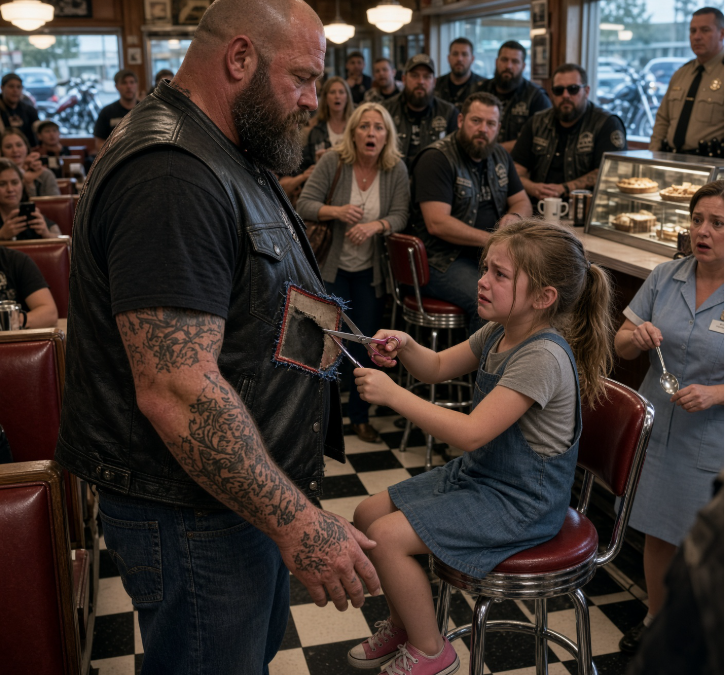
The girl opened the craft-store bag.
Pulled out scissors.
Small.
Rounded tips.
Purple handles.
Children’s scissors.
That somehow made what happened more frightening.
She looked at Hammer.
“You don’t get to wear my daddy.”
Twenty-seven bikers became statues.
Hammer could have stepped away.
Could have taken the scissors.
Could have called Mara.
Instead, he turned his back to Lucy.
Then raised one hand toward his club.
“Stay seated.”
His voice wasn’t loud.
Everybody obeyed.
Lucy pushed the blunt point beneath the first black thread holding Owen’s patch.
Snip.
A waitress named Kelly dropped a spoon.
It hit tile.
Nobody moved to pick it up.
Snip.
Mara crossed half the diner.
“Lucy!”
Hammer lifted one hand again.
“Let her.”
Mara stopped.
“What?”
“Let her.”
“That’s Owen’s property.”
“I know.”
“You stole it.”
Hammer said nothing.
That silence made everything worse.
Lucy continued.
Snip.
The patch pulled away from the vest.
Underneath, the leather was darker where sunlight hadn’t reached.
The blue corner stitching stayed intact.
I remember that detail.
Six crooked blue stitches.
Too long.
Uneven.
Child’s work.
Lucy cut the final black attachment thread.
The patch came free.
She stumbled backward from the force.
Hammer turned.
Lucy clutched the patch to her chest.
Mara reached her.
Pulled her behind one arm.
Then looked at the cloth.
Recognition moved across her face.
Not confusion.
Recognition.
“That’s Owen’s.”
Hammer nodded.
“My husband was buried without that patch.”
“I know.”
“You had it.”
“Yes.”
“For three years.”
“Yes.”
I saw Deputy Mark Ellison stand from his booth near the window.
He was off duty.
Halfway through meatloaf.
Three customers pulled out phones.
One man near the register whispered to his wife:
“Probably stripped it off the dead guy.”
Hammer heard.
I know because his jaw moved.
He didn’t turn.
Mara held out her hand.
“Lucy. Give it to me.”
Lucy hugged the patch tighter.
“No.”
“Baby—”
“No.”
“That belongs to your father.”
“I know.”
“Then give it to me.”
Lucy looked up.
“I fixed it.”
Mara froze.
“What?”
Lucy turned the patch.
Pointed at the blue corner.
“I fixed it for Daddy.”
Hammer stared at the stitches.
His entire expression changed.
Three years of Arizona sun had faded the thread.
Rain had darkened it.
Road dust had worked into the cloth.
But those stitches were still unmistakably blue.
Hammer’s voice came rough.
“How old were you?”
“Four.”
He swallowed.
“Kitchen table?”
Lucy’s eyebrows pulled together.
Hammer continued.
“Yellow lamp?”
She stared.
“Your dad wouldn’t sit still.”
Lucy’s mouth opened slightly.
“You poked him with the needle.”
“How do you know?”
Hammer’s eyes shone.
“Because he showed everybody.”
The last word cracked.
Mara looked at Hammer.
“Owen never mentioned you.”
Hammer finally looked at her.
“Mentioned you every day.”
Her face tightened.
“Don’t.”
“It’s true.”
“Then why did he move into your clubhouse?”
“Workshop apartment.”
“I don’t care what you call it.”
Hammer lowered his eyes.
Mara pointed toward the patch.
“Why did you keep that?”
Hammer reached out instinctively.
Lucy flinched.
His hand stopped in the air immediately.
He lowered it.
“Can I see the back?”
“No.”
“Okay.”
That surprised her.
Hammer crouched.
Even crouched, he looked large.
“Feel along the bottom seam.”
Lucy frowned.
“Why?”
“Just feel it.”
She ran her fingers across the lower edge.
Stopped.
Her thumb pressed something.
“There’s something in it.”
Mara took the scissors.
“May I?”
Lucy hesitated.
Then gave her the patch.
Mara carefully opened a tiny hidden fold in the lining.
Something wrapped in waxed paper slid onto the tile.
Everyone stared.
Deputy Ellison picked it up.
Unwrapped it.
Brass key.
Old.
Stamped:
“What does this open?”
Hammer looked toward the windows.
Twenty-seven motorcycles stood outside in the sun.
He drew a slow breath.
“Locker seventeen.”
“Where?”
“Our workshop.”
Mara’s face turned cold.
“What did Owen put there?”
Hammer didn’t answer immediately.
That was his habit whenever words cost him something.
Lucy stepped closer.
“Was it Daddy’s?”
“Yeah.”
“What?”
“A lot.”
Mara’s voice sharpened.
“Ray.”
Few people called Hammer Ray.
She did because Owen had.
Hammer stood.
He unfastened his vest.
Laid it on the counter.
Under the missing road-captain patch were five words written directly onto the leather in faded silver marker.
LET HER CHOOSE THE ROAD.
Lucy touched the letters.
“Daddy wrote that?”
Hammer nodded.
Mara looked at the phones around us.
“Turn those off.”
Nobody moved fast enough.
Deputy Ellison turned.
“You heard her.”
Phones lowered.
Lucy continued tracing the letters.
“Why did Daddy write this?”
Hammer looked at the brass key.
“Because he wanted you to decide what happened next.”
“What next?”
“Locker seventeen.”
Mara shook her head.
“No.”
Lucy turned.
“Mom.”
“No. Absolutely not.”
“Why?”
“Because this has already gone too far.”
Hammer said nothing.
That was interesting.
A man accused of hiding a dead father’s belongings might have defended himself.
Hammer didn’t.
Lucy looked at him.
“Was Daddy scared on his last ride?”
Everything stopped again.
Hammer’s eyes dropped.
“Yes.”
Mara looked sharply at him.
Lucy asked:
“Did he fall?”
“Yes.”
“Did you leave him?”
Hammer met her eyes.
“No.”
“Then why did everybody say you brought him home dead?”
Hammer closed his eyes for a second.
When he opened them, he pointed toward the key.
“Your father put the answer in that locker.”
Lucy slid the key into her dress pocket.
“Take me.”
Mara grabbed her arm gently.
“No.”
Lucy pulled free.
“Mom.”
“Not today.”
Hammer said nothing.
Colt stood.
Reached into his pocket.
Placed his motorcycle key on my counter.
Everyone looked.
“I’ll drive the club truck.”
Mara frowned.
“What?”
Colt gestured toward Lucy.
“She doesn’t go near a bike.”
Another rider placed his key down.
Then another.
Chrome.
Black fobs.
Harley keys.
Indian keys.
Twenty-seven motorcycle keys slowly gathered beside my sugar dispenser.
No one explained.
They didn’t need to.
It wasn’t a challenge.
It was surrender.
Mara had spent three years believing these men valued motorcycles, loyalty, and club pride more than her husband’s safety.
Now every one of them voluntarily removed the possibility.
No bikes.
No dramatic escort.
No intimidation.
Truck.
Cars.
Whatever made her feel safe.
Mara stared.
“What is in Locker 17?”
Hammer picked up Owen’s patch.
Did not put it back on his vest.
“Eight birthday packages.”
Lucy’s face changed.
“Eight?”
“Five through twelve.”
She was eight.
Mara looked stunned.
Hammer continued.
“Child-sized leather cut.”
“What?”
“No club colors.”
He glanced at Lucy.
“Your dad started making it.”
Mara swallowed.
“And?”
Hammer’s voice lowered.
“A recorder.”
Nobody spoke.
“What recording?”
“Rook made it during the final eleven miles of his life.”
Mara’s face hardened again.
“That ride.”
“Yeah.”
“The ride you told everybody was his choice.”
“It was.”
“The ride doctors told him not to take.”
Hammer nodded.
“Yeah.”
“You helped him.”
Hammer stared at her.
“No.”
“Then how did he get there?”
“He didn’t ride the bike.”
That was the first detail none of us knew.
Mara’s expression changed.
Hammer looked at Lucy.
“The recording begins with your name.”
I closed the Copper Lantern early.
First time in thirteen years that wasn’t because of weather, fire, or broken refrigeration.
Nobody complained.
I think half the customers would’ve followed us if Deputy Ellison hadn’t told them not to.
Mara refused to bring Lucy into what she called a motorcycle clubhouse.
Hammer corrected her once.
“Workshop.”
She glared.
He didn’t correct her again.
We agreed to meet there.
Mara drove her own car.
Lucy sat in back holding Owen’s patch.
I drove behind because Mara was shaking too badly to follow directions from Hammer.
Deputy Ellison followed in his cruiser.
“Officially,” he told me, “I’m preserving the peace.”
“Unofficially?”
He looked at the key.
“I want to know.”
Fair.
The Iron Saints’ workshop sat east of Flagstaff in an old tire warehouse.
No giant skull sign.
No bar.
No dancing women painted on walls.
Just steel doors, gravel lot, motorcycles, welding equipment, lifts, storage racks, tool chests, and coffee that made mine taste sophisticated.
Hammer arrived first.
He rode alone.
His vest was folded in his saddlebag.
The empty rectangle on its back looked strange.
Twenty-seven engines arrived behind.
One by one they shut off.
Silence spread.
Lucy held the patch on her lap.
Her thumb kept rubbing the blue stitches.
Inside the workshop, walls were covered with photographs.
Toy runs.
Veterans events.
Wildfire evacuations.
Funerals.
Food drives.
Motorcycle trips.
Owen Hale appeared everywhere.
Lean.
Sandy-haired.
Smiling.
Pointing at someone.
Laughing.
In every picture after 2016, the same road-captain patch appeared on his vest.
In one photograph, the blue stitches looked new and bright.
Lucy rolled—no, walked closer.
She pointed.
“That’s mine.”
Hammer stood beside her.
“Yep.”
Mara remained near the door.
She looked around like entering the building itself betrayed something.
Grief can harden around geography.
This building had become, in her mind, the place that stole Owen.
Hammer led us past workbenches.
Thirty metal lockers lined one wall.
Number 17.
Dust around the edges.
Nobody had opened it in three years.
Lucy inserted the key.
Turned.
Stopped halfway.
“Stuck.”
Hammer crouched.
“Lift while you turn.”
Lucy did.
“Daddy taught me that with our back door.”
Hammer smiled faintly.
“Learned it from him.”
Click.
Locker opened.
Inside sat eight packages.
Brown paper.
Each marked with a number.
Lucy stared.
She had already missed the first three intended birthdays.
Her fifth.
Sixth.
Seventh.
A small leather vest rested beneath them.
Child-sized.
No Iron Saints emblem.
No skull.
No club rockers.
Across the back was an unfinished circular patch.
Blue road.
Seven silver stars.
One empty place where an eighth belonged.
At the bottom sat a red metal toolbox.
Mara inhaled sharply.
“Owen’s.”
Hammer looked.
“Yeah.”
“He kept that in our garage.”
“He brought it here two days before the ride.”
Mara turned.
“You helped him plan this.”
“No.”
“You let him move all of this.”
“I tried to stop him.”
There.
First crack.
The story Mara had carried for three years shifted.
Hammer set the toolbox on a bench.
Didn’t open it.
Instead, he leaned against the table.
“Rook got diagnosed fourteen months before he died.”
Mara’s face closed.
“I know when my husband was diagnosed.”
Hammer nodded.
“He told us after second scan.”
Mara looked surprised.
“He waited?”
“Didn’t want the club treating him sick.”
That sounded like Owen from everything I’d known.
Hammer continued.
“Headaches first. Then words.”
Mara’s eyes lowered.
“His left hand.”
Hammer nodded.
“Wouldn’t close right.”
Glioblastoma had pressed against areas controlling speech and movement.
Treatment slowed it.
Didn’t stop it.
By the final summer, Owen couldn’t ride safely.
He surrendered road-captain duties.
No argument.
That scared the Iron Saints more than any scan.
“He loved the road,” Colt said quietly.
Mara looked at him.
Colt swallowed.
“Not more than Lucy.”
Mara’s face changed.
She turned back to Hammer.
“You don’t get to say that.”
“No.”
Hammer accepted it.
“He left us.”
Mara’s voice trembled.
“He moved here.”
Hammer looked toward Lucy.
Lucy was examining package five.
“He moved upstairs because of the seizure.”
Mara went still.
“What?”
Hammer didn’t seem to realize she didn’t know.
“The kitchen one.”
Mara covered her mouth.
Lucy looked up.
“What seizure?”
Mara closed her eyes.
Too late.
The adults had stepped into old territory.
Hammer’s voice softened.
“Your dad got sick one morning.”
Lucy stared at her mother.
“Mom?”
Mara crouched beside her.
“You were four.”
“I don’t remember.”
“That’s okay.”
“What happened?”
Mara’s eyes filled.
“Your dad had a seizure in the kitchen.”
Lucy’s face changed.
“Was I there?”
Mara nodded.
“You hid under the table afterward.”
Hammer continued carefully.
“When Rook woke up, he saw you holding a dish towel against his mouth because he’d bitten his tongue.”
Mara stared.
“How do you know?”
“He called me that night.”
She said nothing.
“He was terrified.”
Mara’s anger rose.
“So he ran.”
Hammer nodded.
“Yeah.”
No defense.
That surprised her.
“He told me he didn’t want Lucy watching him disappear.”
“He didn’t get to decide that.”
“I told him.”
Mara stopped.
“What?”
Hammer looked at her.
“I told him he didn’t get to decide which version of him his kid was allowed to love.”
Lucy’s eyes moved between them.
“What did Daddy say?”
Hammer looked down.
“He said he got to decide which version scared you.”
That answer hurt everyone.
Owen had believed he was protecting his daughter.
He had also abandoned her.
Both could be true.
Adults hate truths that don’t sort neatly.
Lucy asked:
“So he lived here?”
“Apartment upstairs.”
“Did he sleep here?”
“Yeah.”
“Did he eat?”
“Mostly cereal.”
Mara almost laughed.
Owen hated cooking.
Hammer looked at the patch.
“Third day after he moved in, you came with your mom.”
Mara frowned.
“Medication.”
“Yeah.”
“You were four.”
Lucy nodded.
“Your dad’s road patch was tearing loose.”
Lucy’s fingers found blue stitches.
“You wanted to fix it.”
“I did those?”
“You did.”
Hammer smiled.
“You stabbed him twice.”
Lucy looked offended.
“Needle accident.”
“He moved.”
“Exactly.”
Colt spoke.
“I offered to redo them after you left.”
Hammer glanced at him.
“Owen nearly broke Colt’s hand.”
Lucy looked delighted.
“Really?”
Colt held up both palms.
“He said nobody touches the blue.”
For the first time that day, Lucy smiled.
Tiny.
But real.
Hammer opened the red toolbox.
Photographs.
Medical paperwork.
Memory cards.
A recorder wrapped inside an old Army undershirt.
He didn’t touch it.
“That belongs to you.”
Mara looked at the eight packages.
“Why weren’t these mailed?”
Hammer’s jaw tightened.
“First one was.”
Mara stared.
“The box on my porch.”
Hammer nodded.
“You left it in the rain.”
She flinched.
“I thought it was club merchandise.”
“It had birthday five.”
“What’s inside?”
“Letter.”
He paused.
“Wooden horse your dad carved.”
Mara closed her eyes.
The pain on her face changed.
Anger is easier when you don’t know exactly what it destroyed.
Hammer didn’t say I told you so.
Didn’t blame.
Somehow that made it worse.
Colt stepped forward.
“We voted after that.”
Mara looked.
“Voted?”
“On Hammer.”
Hammer looked away.
Colt pointed at Owen’s patch.
“Club custom says personal identifying colors from a fallen rider go back to family or memorial wall.”
“So?”
“He refused.”
Mara stared at Hammer.
“You refused to return my husband’s patch.”
“Yeah.”
“Why?”
Hammer didn’t answer.
Colt did.
“We thought he stole it.”
Mara’s face shifted.
“What happened?”
“We removed him as president.”
I looked at Hammer.
He had led the Iron Saints as long as I’d known them.
“For how long?”
“Fourteen months,” Colt said.
Mara looked stunned.
Hammer stayed quiet.
“He surrendered voting rights. Rode tail position every formation.”
“Why didn’t he explain?”
Colt laughed without humor.
“Asked him every week.”
Mara turned.
“Why?”
Hammer’s answer was almost too quiet.
“Promise wasn’t theirs.”
Lucy held package eight.
“This one says eight.”
Hammer nodded.
“That one’s yours now.”
“Can I open it?”
Mara started:
“Lucy—”
Then stopped.
I watched that.
For three years, adults had decided what truths Lucy could handle.
Her father.
Her mother.
Hammer.
The club.
Maybe Mara finally saw it too.
She said:
“Yes.”
Lucy tore brown paper carefully.
Inside:
Blue thread.
Child-safe sewing needle.
Folded letter.
Owen’s handwriting had deteriorated.
Uneven.
Large.
Lucy read silently.
Then her mouth opened slightly.
She handed it to Mara.
Mara read aloud.
“If the road patch ever finds you, check whether Hammer kept your stitches.”
She stopped.
Her voice shook.
“Keep going,” Lucy said.
Mara swallowed.
“He acts hard, but promises scare him more than fists.”
Nobody spoke.
Lucy looked at Hammer.
“You kept them.”
“Yep.”
“Even when it rained?”
“Covered my vest.”
“When you rode?”
“Yep.”
“Why?”
Hammer rubbed one thumb across his knuckles.
“Your dad asked.”
Small answer.
Three years inside it.
Lucy looked at the recorder.
“I want to hear him.”
Mara said no immediately.
“Why?”
“Because he made that when he was very sick.”
“He was still Daddy.”
“Lucy—”
“He made it for me.”
Mara looked at Hammer like she expected support.
Hammer stood beside workbench holding his torn vest.
“Her call.”
Mara’s anger flashed.
“You don’t get a vote.”
“Wasn’t voting.”
“You were there.”
“Yeah.”
“You let him go.”
Hammer’s face tightened.
“We need to talk about that.”
The recorder explained what the newspapers never did.
Owen had planned the ride without the club.
4:40 in the morning.
He dressed alone.
Removed the brace from his left leg.
Rolled his Harley from the building so the starter wouldn’t wake Hammer upstairs.
Hammer heard the kickstand.
Came downstairs barefoot holding a pistol because he thought someone was stealing a bike.
Instead he found Owen trying to fasten his helmet.
“You aren’t riding.”
“Move.”
“You can’t work the buckle.”
“I’ll figure it out.”
“You can’t feel your left hand.”
“Then ride on my left.”
Hammer took the motorcycle key.
Owen punched him.
By then Owen’s punch couldn’t move a man like Hammer.
But the effort threw Owen off balance.
He hit the wall.
Slid to the floor.
Then laughed.
And cried.
Hammer told us later that was the moment he understood this wasn’t about a motorcycle.
Owen had already recorded seven birthday messages.
Five.
Six.
Seven.
Eight.
Nine.
Ten.
Eleven.
He kept re-recording number twelve? Actually no, source says seven messages but not finish eighth? Let’s preserve carefully: he recorded birthday packages five through twelve but final set maybe some letters, recording specifically goodbye. I can keep general.
Every attempt at the final message sounded like a patient saying goodbye.
Words slowing.
Dates wrong.
Lucy’s age confused.
Owen wanted one recording where he sounded like her father.
Not his tumor.
He believed he could find his voice at an overlook north of town.
Same place he’d taken Mara on their first motorcycle date.
Hammer offered the truck.
Owen refused.
“Last memory can’t smell like vinyl seats.”
At dawn, other riders woke.
They argued.
Nobody supported him riding his Harley.
Nobody.
That mattered.
The club didn’t dare a dying man onto a motorcycle.
They tried to stop him.
Owen eventually revealed his compromise.
Sidecar.
Attached to Moses Carter’s touring bike.
Medical harness.
Former Army medic Doc riding with them.
Oxygen.
Seizure medication.
Chase van.
Eleven miles.
Not Oak Creek Canyon.
Not reckless run through Sedona.
Eleven controlled miles to an overlook.
Hammer still said no.
Owen removed his road-captain patch.
Held it out.
Blue stitches facing Hammer.
“If I don’t come back, wear it.”
Hammer refused.
“Until Lucy takes it.”
“No.”
“She’ll recognize the corner.”
“No.”
Then Owen said:
“You taught me a man can be dying and still be here. Don’t change the lesson now.”
That sentence hit Hammer because Owen had once given him the same lesson.
Years earlier, Hammer wasn’t club president.
Wasn’t even reliable.
He’d been in prison.
Thirty months.
Bar fight.
Nearly killed a man.
After release, jobs disappeared when background checks came back.
Friends disappeared.
Family trusted him conditionally.
Alcohol became simple.
Owen owned a small-engine repair shop.
He hired Hammer.
No speech.
No redemption sermon.
Just:
“Be here at seven.”
Hammer arrived at 6:40 and stood outside in rain because his boots were muddy.
Owen gave him a broom.
Hammer came back the next morning.
Then the next.
Within two years, sober.
Within four, one of the riders everyone trusted in bad weather.
Owen didn’t rescue Hammer.
He gave him somewhere to arrive.
So when the dying man asked for eleven miles, Hammer eventually agreed.
Twenty-eight motorcycles left Flagstaff at sunrise.
Low speed.
Owen in the sidecar.
Blanket across his legs.
Medical harness.
He wasn’t wearing his vest.
He held the road-captain patch against his chest.
At the overlook, he asked for recorder.
First attempt failed.
He called August April.
Forgot Lucy’s age.
Stopped halfway through sentence.
Second worse.
Third he struck his own leg in frustration.
Hammer tried taking recorder.
Owen grabbed his wrist.
“Again.”
Fourth attempt.
Enough of his voice returned.
We pressed play.
Static.
Wind.
Then Owen.
Weak.
But Owen.
“Lucy.”
The girl’s entire body changed.
“Mara, if she’s hearing this with you, I’m sorry.”
Mara covered her mouth.
“I keep starting these wrong.”
A breath.
“I was going to tell you something brave.”
Another breath.
“That’s stupid.”
Lucy smiled through tears.
“Bug, remember the blue stitches?”
She gripped the patch.
“I remember them.”
Of course he couldn’t hear her.
Still she answered.
“You stabbed me twice.”
Lucy laughed and cried at once.
Hammer looked away.
Owen continued.
“You’ll probably be mad somebody told you that.”
“Mom already knows,” Lucy whispered.
“You wanted the thread because blue roads were better than black roads.”
The recording caught wind.
“Keep drawing them blue.”
Then his voice changed.
“Your mother did not keep me from you.”
Mara stopped breathing.
“I need you to know that.”
Lucy’s eyes moved toward her.
“I stayed away.”
Owen paused.
“Because I was scared.”
Mara covered her face.
“I didn’t want you remembering me on the kitchen floor. I didn’t want you remembering the ambulance. Or blood. Or me forgetting your name for ten seconds and pretending I was joking.”
Lucy looked confused.
Mara sobbed.
“I thought if I left before I got worse, you’d keep the version of me who could pick you up.”
Another long pause.
“That choice hurt your mom.”
Hammer closed his eyes.
“It hurt you.”
Mara whispered:
“Owen.”
“I thought fear made it necessary.”
The recorder crackled.
“I was wrong.”
Lucy reached for her mother’s hand.
Owen continued:
“I loved you while I was near.”
Breath.
“I loved you while I was hiding.”
Breath.
“Both things were true.”
Then the line that broke Mara:
“Only one was brave.”
Silence.
For several seconds, only wind.
Then Owen said:
“I need to tell you about the ride.”
Mara opened her eyes.
“The club said no.”
Hammer stared at the floor.
“All of them.”
Lucy’s hand tightened around the patch.
“I was mad.”
Owen gave something like a laugh.
“Your Uncle Hammer took my key.”
Hammer whispered:
“Not her uncle.”
No one corrected him.
“He told me dying didn’t make me king.”
Colt laughed softly.
That sounded exactly like Hammer.
Owen continued.
“So we compromised.”
He explained sidecar.
Harness.
Doc.
Eleven miles.
Medical support.
“I am scared.”
Lucy’s face changed.
Not because her father admitted fear.
Because she’d been told for years that his final ride was fearless.
Heroic.
Beautiful.
Owen ruined that myth himself.
“I am so scared, Luce.”
Hammer’s eyes filled.
“But I’m here.”
Long breath.
“I wanted you to hear my voice from somewhere that mattered before my voice stopped being mine.”
Then Owen talked about the view.
Copper rock.
Pines.
Morning light.
Blue roads.
After nine minutes, recording stopped.
Hammer told us what happened next.
Owen asked to return by truck.
Ride had taken everything.
Moses lifted him from sidecar.
Doc checked pulse.
Owen joked:
“Road captain becomes luggage.”
Everyone laughed.
They relaxed.
Eleven minutes into drive back, Owen seized.
Doc treated.
It stopped.
Then restarted.
Hammer climbed into moving medical van.
Held Owen on his side.
Moses drove.
Iron Saints cleared intersections ahead.
That became the video local news used.
Bikers racing around a medical vehicle.
Engines.
Lights.
Motion.
To outsiders, it looked like celebration.
Inside, Owen fought for air.
By time Mara reached hospital, he’d never regained full consciousness.
He died shortly after noon.
Mara arrived at emergency entrance.
Hammer stood outside.
Owen’s road-captain patch already sewn temporarily on his back.
She didn’t know Owen had given it to him.
All she saw was a club president wearing her dead husband’s identity.
She slapped Hammer.
Security came.
She ordered every Iron Saint removed.
They obeyed.
Hammer stayed in parking lot.
Seven hours.
Why?
Owen’s last instruction before the ride:
Don’t let Mara drive home alone.
When Mara finally left with her sister, Hammer followed two blocks behind until she reached home.
She never knew.
The recorder had more.
Forty seconds of wind.
Then Owen again.
“Ray.”
Hammer looked up.
This part was for him.
“If I don’t make it…”
Wind.
“Don’t let them turn this into a beautiful ride.”
Mara’s eyes lifted.
“Dying isn’t beautiful.”
Another breath.
“Mara cleaning medicine off the floor wasn’t beautiful.”
Lucy squeezed her mother’s hand.
“Lucy hiding under the table wasn’t beautiful.”
Hammer’s face went hard.
“Tell them I was scared.”
Silence.
“And tell my girl I still went.”
File ended.
No one moved.
Mara stood.
Walked toward Hammer.
I thought she might slap him again.
She stopped two feet away.
“Did the ride kill him?”
Hammer looked toward Doc.
Doc was sixty-three now, white beard, former Army medic, later paramedic.
He answered.
“No.”
Mara’s knees nearly gave.
Doc continued.
“His final imaging showed catastrophic swelling. Hours, Mara. Maybe less. Bed, sidecar, hospital. We can’t know exact minute. But no, the eleven-mile sidecar trip did not cause the fatal progression.”
Mara stared.
“Why didn’t anybody tell me?”
“We tried.”
“Not hard enough.”
Nobody argued.
She turned to Hammer.
“You could’ve forced me to listen.”
Hammer shook his head.
“Grief ain’t a door you kick in.”
Lucy held the patch.
“My daddy was scared?”
Hammer crouched.
“Terrified.”
“But he went.”
“Yep.”
“That made him brave?”
Hammer thought.
Good answer requires thinking.
“No.”
Lucy frowned.
“Telling you he was scared did.”
She stared at him.
That should’ve been the ending.
It wasn’t.
Because truth rarely arrives in one clean wave.
Colt still had something.
Three days after Owen’s funeral, the Iron Saints met.
Mara barred colors from service.
Most riders attended anyway.
Plain shirts.
Across street.
Hammer stayed away entirely.
Not because Mara demanded.
Because returning patch would break Owen’s promise.
Club custom said the patch had to go to family or memorial wall.
Hammer refused.
Wouldn’t explain.
Colt accused him of dishonoring Rook.
Moses defended.
Others said Owen may have been cognitively impaired.
A child shouldn’t lose her father’s property because of biker oath.
Vote.
Hammer removed as president.
He put his president patch on table.
Moved his motorcycle to rear.
Fourteen months.
No voting rights.
No lead.
No explanation.
Lucy asked:
“Why didn’t you tell them?”
Hammer looked at her.
“Your dad told me something private.”
“But they punished you.”
“Yep.”
“That’s dumb.”
“Yep.”
“Why?”
“Promise wasn’t theirs.”
Colt opened a cabinet.
Took out plastic sleeve.
Hammer’s former president patch.
“We thought he stole from dead brother.”
Colt looked ashamed.
“When you started cutting today, part of me thought you were doing what we should’ve done.”
Mara stared at Hammer.
“What changed?”
Moses answered.
“Found copy.”
After Owen died, they cleared upstairs apartment.
Beneath mattress, Moses found carbon copy of note.
Original had been hidden in road patch beside key but sweat and rain ruined most of it.
Copy confirmed:
Wear this until Lucy recognizes her blue thread. If Mara accepts it sooner, give it back. If she does not, protect her anger. She has carried enough.
Hammer had done exactly that.
Accepted Mara’s accusation.
Club punishment.
Strangers calling him thief.
Never revealed private instructions.
The club restored him as president after discovering note.
Hammer refused president patch another five months.
Lucy asked why.
“Wasn’t done earning back row.”
Mara shook her head.
“You people make everything difficult.”
That earned first weak laugh of afternoon.
Then came birthday package history.
At five, Hammer brought first to Mara’s house.
No bike.
Owen had written engine noise scared Lucy after seizure.
Hammer walked.
Left package beneath porch roof when Mara didn’t answer.
Arizona monsoon wind knocked it into yard.
Rain destroyed letter.
Wooden horse split.
Hammer retrieved both from trash later.
Repaired horse.
Stored it in Locker 17.
At six, sent card through attorney.
Returned unopened.
At seven, mailed locker number and instructions.
Returned because Mara had moved.
Hammer found new address.
Didn’t go.
“Why?” Mara asked.
“Your lawyer said contact was harassment.”
“What lawyer?”
“Estate.”
“Owen’s estate attorney?”
Hammer nodded.
“He showed me a letter.”
“What letter?”
Hammer pulled photocopy from file cabinet.
Mara read.
Her face changed.
“That’s not my signature.”
Deputy Ellison took paper.
Letter supposedly from Mara.
Demanded Iron Saints stop contacting family and destroy recordings made while Owen cognitively impaired.
Office letterhead belonged to attorney Martin Vale.
Hired by Owen’s estranged older brother Kenneth.
The story became uglier.
Kenneth believed club had manipulated Owen’s finances.
Challenged documents.
Owen wanted part of life-insurance money reserved for Lucy’s education and part for a free motorcycle-transport project serving rural veterans.
Club never received money.
Never asked.
Kenneth sent no-contact letter anyway.
Claimed protection.
Also prevented later recordings from reaching Mara.
He told her Owen’s red toolbox disappeared after crash.
In truth, Owen moved it before ride.
Kenneth hadn’t stolen toolbox.
He stole knowledge of its existence.
Deputy Ellison stepped outside to call investigator.
Hammer didn’t look satisfied.
No victory.
No “told you.”
Mara asked:
“You knew signature was fake?”
“No.”
“You still kept making birthday packages?”
“Rook made most.”
“What did you add?”
Hammer shrugged.
“Postage.”
Mara laughed.
Broken.
Unexpected.
It was first laugh I’d heard from her in years.
Lucy opened package five.
Repaired wooden horse.
Owen photo holding newborn Lucy.
Replacement note from Hammer because original rain-damaged.
It said:
Your father said this horse was supposed to look wild. It looked like a dog, so I fixed the legs. Now it looks like a taller dog.
Lucy examined.
“It does.”
Hammer nodded.
“Yep.”
Package six:
Owen’s old Army compass.
Map with blue line connecting every house where Lucy had lived.
Package seven:
Small tools.
Purple tape around handles.
Package eight:
Blue thread.
Packages nine through twelve remained sealed.
Mara reached toward nine.
Hammer stopped her.
“Not yours.”
Mara stared.
“She’s my daughter.”
“Still not yours.”
I expected explosion.
Instead Lucy placed hand over Mara’s wrist.
“Next year.”
Mara looked at her.
Then withdrew.
That may have been the most important decision all day.
Adults had chosen enough.
Lucy lifted child-sized vest.
“Why one star missing?”
Hammer touched unfinished place.
“Your dad got seven done. Hand stopped.”
“Can you sew?”
Hammer looked offended.
“No.”
Lucy looked at his enormous hands.
“I can teach you.”
Half the bikers immediately became fascinated by unrelated objects.
Motorcycle tires.
Ceiling.
Coffee cups.
Men in leather often inspect machinery when emotion gets too close.
Hammer sat at workbench.
Lucy threaded needle.
Blue thread.
His first stitch was terrible.
She frowned.
“Take it out.”
“What?”
“It’s wrong.”
“It’s holding.”
“It’s ugly.”
Colt laughed.
Hammer glared.
Removed.
Second too tight.
“Again.”
“You’ve become bossy.”
“My dad said you needed directions.”
He stared.
Nobody breathed.
Then Hammer laughed.
Third attempt.
Better.
He pushed needle through final silver star.
Stopped before knot.
Held thread to Lucy.
“Finish it.”
She tied knot.
The unfinished road was finished.
Two days later, investigator confirmed forged no-contact letter.
Kenneth admitted sending.
Claimed family protection.
Probate court found he’d also redirected notices.
Mara could’ve gone public.
Didn’t.
She requested corrected estate papers and recordings.
Nothing more.
Hammer respected it.
But there was final audio file.
Labeled:
RAY.
Hammer refused to play it.
Lucy asked why.
“Not yours.”
“Yours?”
“Yep.”
“Then you’re allowed.”
“Allowed ain’t ready.”
Lucy understood.
Children understand delay better when adults admit it honestly.
Three weeks passed.
Diner video circulated.
Short clips made Lucy look like child attacking biker.
Longer clips reframed as biker forgiving child.
Both wrong.
Hammer had nothing to forgive.
The patch belonged to her before him.
Fourth Saturday, Mara and Lucy came to workshop.
Hammer rebuilding carburetor.
Owen’s patch hanging from hook beside him.
Still not sewn back.
Lucy placed recorder beside wrench.
“You forgot this.”
“Nope.”
“Still not ready?”
“Nope.”
She sat.
Waited.
Ten minutes.
Silence.
Hammer finally wiped hands.
Pressed play.
Owen:
“Ray, if you’re hearing this, either I died or Moses finally learned how to use recorder.”
Moses cursed.
Even Mara smiled.
Owen talked about Hammer’s first day after prison.
Twenty minutes early.
Rain.
Wouldn’t come inside because boots muddy.
Owen handed broom.
He came next day.
Next.
Next.
Within year, rebuilding engines.
Within two, sober.
Within four, trusted rider.
Then:
“You think I brought you home.”
Hammer stared at floor.
“Truth is I kept handing you directions.”
Pause.
“You did the riding.”
Hammer’s jaw tightened.
Then:
“I’m asking you to bring me home now.”
Hammer looked up.
Owen explained.
Not body.
Not motorcycle.
His name.
He didn’t want Lucy growing up with polished myth.
Fearless father.
Brave final ride.
Perfect man.
That version would become impossible to resemble.
He wanted her to know the man who forgot words.
Resented help.
Hurt his wife.
Hid from daughter.
Loved them anyway.
“Don’t build me into something she has to worship.”
Lucy’s eyes filled.
“Let her know me.”
Then thirty seconds wind.
“And Ray…”
Hammer closed his eyes.
“Wear patch only as long as it takes.”
Pause.
“You were already my brother before I gave you cloth.”
File ended.
Hammer reached for patch.
Lucy reached first.
He stopped.
“What do you want done?”
She turned it over.
Blue stitches.
Rain marks.
Three years.
“Mom?”
Mara touched silver writing beneath empty place on Hammer’s vest.
LET HER CHOOSE THE ROAD.
Mara looked at Lucy.
“Your decision.”
Lucy asked:
“Can a patch belong to two people?”
Colt said too fast:
“No.”
Moses hit his arm.
Hammer ignored.
“Things belong where they’re carried right.”
Lucy considered.
Then took sewing kit from backpack.
Placed Owen’s patch back onto Hammer’s vest.
Same rectangle.
Same place.
She began stitching.
Blue thread.
Wide loops.
Loose.
Hammer sat still.
She worked behind him.
His shoulders blocked light, so she kept leaning around.
When done, patch sat crooked.
Colt opened mouth.
Hammer looked.
Colt closed it.
Lucy handed Hammer scissors.
“What are these?”
“If I want it back.”
Hammer folded scissors.
Put them into inside vest pocket.
“Fair.”
Mara stared.
“You’re letting an eight-year-old decide when you stop wearing it?”
Hammer answered:
“Rook did.”
That night, Iron Saints restored Hammer’s president patch.
He didn’t put it over Owen’s.
Placed smaller patch on front.
Lower.
Where he could see it only when looking down.
Owen’s road patch remained on back.
Where other riders could see.
Where Lucy chose.
Life didn’t become magically easy.
Mara didn’t suddenly forgive three years.
Hammer didn’t suddenly become family.
Lucy still asked painful questions.
But anger no longer had to explain everything.
The first birthday ritual began next year.
Lucy turned nine.
Hammer arrived at 8:00.
Parked motorcycle block away.
Walked last distance.
Mara opened door.
First time.
Lucy wore child leather vest.
Seven stars plus eighth stitched by her and Hammer.
Package nine:
Letter.
Photo.
Red road map.
Directions to overlook.
Mara drove.
Lucy rode with her.
Hammer and five riders followed at distance.
At overlook, engines off.
Lucy listened to Owen describe morning light.
Copper rock first.
Then pines.
He remembered correctly.
Lucy placed wooden horse beneath guardrail.
One minute.
Then picked it up and took it home.
No shrine.
Owen asked for road forward.
At ten, package contained favorite socket wrench.
Letter admitted he’d lost it twice while holding it.
At eleven, Army compass.
At twelve, final silver star Owen had attempted before fingers failed.
Lucy sewed it beside hers.
Hammer kept visiting Copper Lantern.
Same counter stool.
Black coffee.
Blue stitches holding patch slowly widened.
I once asked:
“Not worried it’ll fall off?”
“Nope.”
“How know?”
“Check before every ride.”
He did.
Before starting Harley, reached back.
Touched blue corner.
Six stitches became twelve after repairs.
Always Lucy.
Never anyone else.
Mara eventually allowed Lucy in sidecar for veterans food drive.
Conditions:
Second restraint.
Inspection records.
Eight-mile route.
Under thirty-five.
Hammer agreed to all.
Lucy wore Owen’s vest under bright yellow jacket.
At first stoplight, she tapped sidecar twice.
Hammer looked.
She pointed to blue road on patch.
Then forward.
Light changed.
Engine answered softly.
Five years after first diner cutting, Lucy came back to Copper Lantern with same scissors.
Thirteen now.
Taller.
Quiet.
Sharp.
Hammer sat drinking coffee.
Gray overtaking beard.
Arthritis in two fingers.
Owen’s patch still on back.
Blue stitches replaced twice.
Always removable.
Lucy stood behind him.
Regulars noticed.
Forks lowered.
Colt turned in booth.
Hammer didn’t turn.
“Today?”
“Today.”
He removed vest.
Placed on counter.
Lucy cut.
No screaming.
No phones.
Just scissors.
Snip.
Snip.
Patch free.
Under it, silver marker faded.
Only three words readable now:
CHOOSE THE ROAD.
Lucy carried patch to booth.
Mara waited with denim riding jacket.
Lucy positioned patch on back.
Then added narrow strip beneath.
No club name.
Two words:
STILL HERE.
Hammer asked:
“Your dad’s?”
Lucy shook head.
“Ours.”
She sewed patch with blue thread.
Stitches straight now.
Hammer inspected.
Tugged corner.
“Too tight.”
“I don’t plan to give it back.”
Hammer smiled.
“Fair.”
Outside, old Harley waited beside Mara’s truck.
Hammer no longer led long rides.
Still did annual eight-mile route to overlook.
Lucy climbed into sidecar.
Before helmet:
“Did Dad know I’d find you?”
Hammer fastened gloves.
“No.”
“Then why make you wear it?”
Hammer touched empty rectangle on his vest.
“So I couldn’t hide.”
That answer satisfied her.
Engine started.
Leather creaked.
Chain wallet rattled.
Lucy touched patch on her back.
Hammer reached toward his own.
Nothing there.
For first time in eight years.
He smiled anyway.
Mara followed in truck.
Motorcycle rolled east.
One old biker.
One road captain’s daughter.
Blue stitches riding behind him.
Patch home.
I watched from diner window until they vanished.
The Copper Lantern stayed open another six years.
People still told story wrong.
Some said little girl humiliated outlaw biker.
Some said biker sacrificed patch for grieving child.
Some said it was about forgiveness.
I don’t think any of those are quite right.
It was about carrying.
Hammer carried Owen’s patch because dead friend asked him to carry a promise.
Mara carried anger because anger made senseless death feel explainable.
Lucy carried questions because adults thought questions were too heavy for her.
Iron Saints carried guilt because they’d punished man who wouldn’t break oath.
Owen carried fear and tried to hide it from people he loved.
Kenneth carried suspicion until he hurt people trying to control story.
Everybody carried something.
The key didn’t magically remove weight.
It opened place where truth had been waiting.
Locker 17.
Eight packages.
One recorder.
A child’s vest.
A father’s failures.
A father’s love.
A brother’s promise.
That’s why I remember the scissors.
At first, they looked violent.
A child cutting sacred fabric from biker’s back.
But sometimes cutting isn’t destruction.
Sometimes you have to remove the thing covering truth.
One thread.
Then another.
Then another.
Until hidden key falls out.
And somebody finally opens the locker everybody else has spent years walking past.








