With Two Hours Left to Save Her Farm, She Offered Her Beloved Horse for $10—But the Rancher Refused the Sale and Said, “I’d Rather Give You Both a Home.”
PART3:
The house was small but sound. The barn leaned slightly but had dignity. The chickens were unimpressed by everything, including poverty. The kitchen garden had gone brown at the edges because I had been too busy sewing, baking, preserving, hauling, mending, and bargaining to tend it the way my father would have wanted.
Fourteen months earlier, there had still been two of us.
My father and me.
James Callum was the sort of man people respected even when they disagreed with him, because he never spent words carelessly. He had a square face, a quiet voice, and a way of looking at a problem until the problem seemed to feel ashamed of itself and become easier. He taught me the ledger before the saddle, arithmetic before embroidery, and land values before recipes.
“Land is lost more often through bad arithmetic than bad weather,” he used to say.
I had rolled my eyes as a girl.
I did not roll them now.
He had died in late autumn, when frost already silvered the grass each morning. It was his heart, the doctor said, though I had sometimes wondered if grief and work had worn it out long before it stopped. My mother had been gone twelve years by then. Father never remarried. He said once that a man could love one woman his whole life and not feel cheated.
He left me the farm.
The chickens.
The ledgers.
A debt I thought I understood.
And Hope.
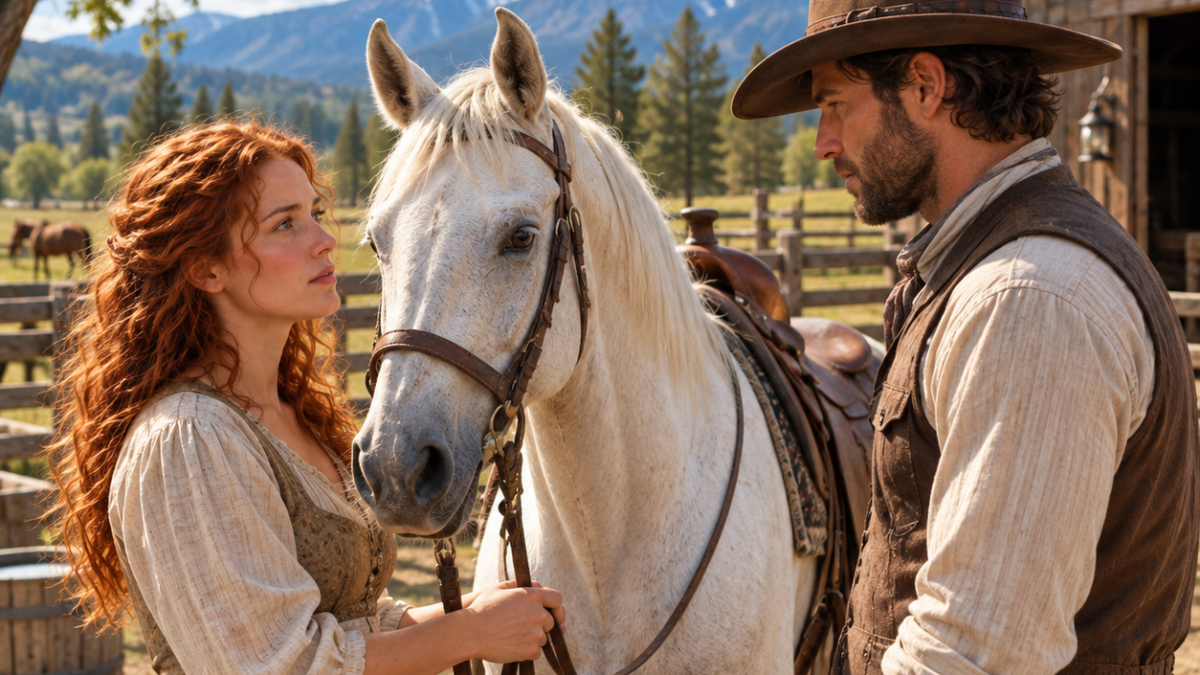
Hope was in the paddock that afternoon, bright against the dull winter-brown pasture, a white gelding with a silver mane, a proud neck, and eyes too gentle for the world he had carried me through.
My father brought him home when Hope was two years old.
I was seventeen.
The horse stepped down from the trailer tossing his head like he had arrived to inspect us rather than be owned.
“This one is for you,” Father said.
“For me?”
“He’ll take care of you when I can’t.”
I laughed then, because my father was strong, and seventeen-year-old daughters are foolish enough to think strong fathers are permanent.
Hope took care of me after Father died.
He carried me to market with preserves tied behind the saddle. He carried packages of sewing to ranch wives who paid fair wages for neat work. He carried flour when I could afford flour, feed when I could not avoid feed, and once carried me home through rain so hard I could not see past his ears.
When I cried, I did it in the barn with my face pressed into his neck because a horse does not ask whether your grief is reasonable.
Hope was worth far more than ten dollars.
That was the cruelty of the day.
I did not need what he was worth.
I needed what would close the gap before sundown.
I stood at the paddock fence with my hand on Hope’s nose and did the arithmetic one more time.
Four dollars and forty cents in my purse.
Fourteen due.
Nine dollars and sixty cents short.
I could not sell the chickens fast enough. I had already sold preserves. The cured meat was gone. Mrs. Caldwell would not pay until Friday. The Halpern shirts were unfinished. I owned nothing else that would bring money before sundown except the horse my father had told me to protect.
But he had also told me something else.
In the last month of his life, when breath had already become work for him, he called me to his bedside. It was late afternoon. The window was open because he said the house smelled too much like medicine. Hope was in the paddock, grazing with the same calm confidence he always had.
Father watched him for a long time.
“If you ever have to let Hope go,” he said, “take him to Robert Shaw.”
I had looked at him sharply.
“Don’t talk like that.”
“Nora.”
His voice stopped me.
He rarely said my name that way unless foolishness was wasting time.
“He knows horses. He’s a fair man. He’ll treat the animal right.”
I had remembered those words for fourteen months without needing them.
At three that afternoon, I needed them.
I went inside, took off my apron, put on my coat, and wrapped the four dollars and forty cents in a cloth before placing it in my pocket. I did not trust myself to count it again.
Then I saddled Hope.
He turned his head and pushed his nose into my shoulder.
I almost unsaddled him then.
Almost.
Instead, I pressed my forehead to his.
“I’m sorry,” I whispered.
Hope breathed against my coat, warm and steady.
The Shaw Ranch was twelve minutes away on horseback.
Twelve minutes from my struggling forty acres to one of the strongest ranches in the valley.
Robert Shaw owned five hundred acres of good land, the kind that made men speak differently when they crossed it. His main house sat solid and square against the mountain backdrop, larger than necessary but not showy. His barn was the biggest private barn in the county, red-painted, high-roofed, and built to last. Cattle moved in the south pasture like a dark tide.
Robert had inherited the place at twenty-eight, after his father’s death, and in six years he had improved it by the simple method of working harder than anyone else and asking questions of men who knew things he did not. That last quality made him unusual. Many men inherited land and immediately believed wisdom came with the deed.
Robert did not.
He had known my father the way good neighbors know each other. Shared fence line. Shared respect. Occasional conversation at the Cedar Falls market. Once, when a late frost threatened half the valley’s early planting, Robert and Father had spent an entire afternoon arguing about the best timing for replanting oats. They disagreed completely and parted smiling.
That was friendship for men like them.
I had seen Robert often enough since Father’s death.
At market.
At church.
From a distance across the valley.
He greeted me politely. Removed his hat. Asked after the farm, never in a way that sounded like pity. I appreciated that. I appreciated it so much that sometimes I resented him for never offering more.
But capable proud people are hard to help.
I knew that because I was one.
When I reached the Shaw Ranch gate, Robert was in the corral working with a young sorrel. He moved slowly, patiently, lead rope loose in his hand. The horse was nervous, but Robert was not forcing obedience. He was asking for trust.
I noticed that before I meant to.
A ranch hand named Tom stood near the fence, watching with his hat pushed back. Tom had worked for the Shaws longer than most people remembered, lean as a fence rail, sharp-eyed, and impossible to surprise unless the surprise was foolishness, in which case he noticed twice as much.
Robert saw me at the gate.
Whatever he read in the way I sat, it made him hand the sorrel’s lead to Tom immediately.
He walked over, taking off his hat as he came.
“Nora.”
“Robert.”
I had rehearsed three versions of what I planned to say.
None survived the sight of him standing there, steady and quiet, waiting for the truth.
“I need to sell Hope.”
His eyes moved to the horse.
Then back to me.
He said nothing.
It was the right thing.
If he had asked why too quickly, I might have broken or lied or turned Hope around and ridden home to lose everything with dignity. His silence gave me room to finish.
“Harlan Voss is calling the debt today. Before sundown. I’m short nine dollars and sixty cents, and I have nothing left to sell except Hope.”
I lifted my chin.
“My father said if I ever had to let him go, to bring him to you. He said you’d treat him right.”
Robert looked at Hope for a long moment.
Hope looked back with calm attention, as if measuring the man himself.
“How much do you need?” Robert asked.
“Ten dollars.”
He did not react.
“That covers the gap and gets me through the month.”
“I know what he is worth,” I said, because pride still had one hand around my throat. “I know ten dollars is not what he is worth, but it is what I need, and it is what I am asking.”
Tom shifted near the corral.
I did not look at him.
Robert put his hat back on.
“Come inside.”
My stomach clenched.
“I’m not here to negotiate shame.”
His gaze returned to mine.
“No. You are not. We need to talk about something other than a sale.”
I wanted to refuse.
I followed him because there was no better option available.
Robert tied Hope himself in the shade near the barn and told Tom to give him water and hay.
“Not feed?” Tom asked.
“Hay first. He’s been ridden.”
Tom looked from Robert to me to Hope and said nothing, which told me he had just added the moment to whatever mental book he kept on everyone.
Robert held the kitchen door for me.
The Shaw kitchen was large, warm, and badly organized.
I noticed before I sat down.
I could not help it.
The pantry shelves were crowded, but not sensibly. Bulk flour sat too close to kerosene. Salt pork was stored where air would not move properly. Coffee was kept in a tin that did not seal. Sugar was near the lamp oil, which was wrong for reasons both practical and moral. Someone had tried to maintain order without understanding how order worked.
Robert made coffee.
I did not refuse it.
My legs were more tired than I had acknowledged on the ride.
He set a cup in front of me, then sat across the table.
“You’re short nine dollars and sixty cents.”
“Yes.”
“The remaining principal after today is eight.”
“Yes.”
“Monthly payment is two.”
“Yes.”
He drank his coffee and went still.
I had seen that stillness before at market, when he listened to grain prices or cattle weights or some complicated account of a broken wagon axle. It was the stillness of a man calculating something he intended to get right.
“I am not looking for charity,” I said.
“I know that.”
“I mean it.”
“I heard you the first time.”
His tone was even, not offended.
“I am not offering charity.”
I waited.
“I am looking for someone who can manage the household operation here,” he said. “Accounts. Provisions. Scheduling. Wages paid properly. Supplies ordered before we run out instead of after Tom announces supper is impossible because no one noticed beans were gone.”
“I heard that,” Tom called faintly from outside.
Robert ignored him.
“My housekeeper left in August to care for her sister. Since then, I have five men, one cook who threatens to quit every Wednesday, and no system for anything inside this house.”
He glanced toward the pantry.
I followed his gaze.
“That is apparent.”
For the first time that day, the corner of his mouth moved.
“The position pays three dollars a week. You would keep your own property. You could ride over daily, or stay here when the weather or work requires. Hope can be kept here when needed. Better feed. Better paddock. He could still be yours.”
I stared at him.
A dangerous feeling rose in me.
Hope.
Not the horse.
The other kind.
“That is a fair wage for that work,” I said carefully.
“It is what the work is worth.”
“If I take it, I cover Voss today out of an advance and I’m clear of the deficit in three weeks.”
“Yes.”
“You would advance ten dollars against wages.”
“Yes.”
“And I keep Hope.”
“Yes.”
I looked toward the pantry again because looking at Robert was suddenly too difficult.
“Why didn’t you come before?”
He looked at his cup.
“Because you didn’t ask.”
Something inside me stiffened.
“And because your father told me once that you had more pride than good sense,” he added, “which he meant as the highest compliment he knew how to give.”
My throat tightened.
Robert held my gaze.
“I respected that. I respected it too long, maybe.”
He paused.
Then said the sentence that changed everything.
“I’d rather give you both a home. The position and the paddock for Hope. That is not charity. That is a practical arrangement.”
A practical arrangement.
I wanted to laugh.
I wanted to cry.
I wanted to accuse him of kindness and thank him for hiding it inside usefulness.
Instead, I sat in Robert Shaw’s kitchen with four dollars and forty cents to my name and less than two hours until sundown, thinking of my father’s final instruction.
Take him to Robert Shaw.
He’ll treat the animal right.
I had thought he meant the horse.
“All right,” I said. “I’ll take the position.”
Robert stood.
“I’ll get the ten dollars.”
I paid Harlan Voss at 4:45.
He received the money with the expression of a man who had expected a different outcome and disliked being corrected by reality.
I placed the bills on his desk.
“Fourteen.”
He counted slowly.
Of course he did.
Then he looked at me.
“Where did you get it?”
“The debt is paid through this month.”
“That is not what I asked.”
“No,” I said. “It is what matters.”
His eyes narrowed.
“Be careful, Miss Callum. A woman alone should consider who she becomes indebted to.”
“I do.”
“And?”
“And I have decided I prefer honest work to dishonest mercy.”
His face went still.
I had struck something.
Good.
He wrote the receipt with a hard hand and slid it across the desk.
I tucked it into my pocket before leaving.
Outside, Hope stood tied beside the rail. I walked to him and put my forehead against his.
“You’re still mine,” I whispered.
He nudged my shoulder as if he had never doubted it.
I rode home in the late afternoon light, made supper, fed the chickens, checked the barn, put the receipt in my father’s ledger, and went to bed before dark because if I stayed awake, I would have to feel everything.
I began work at the Shaw Ranch on Wednesday.
By Friday, I had reorganized the pantry, created a supply rotation chart, separated kerosene from foodstuffs, corrected two wage entries, discovered three supplier overpayments, and offended Tom twice.
The first offense involved sugar.
Tom appeared in the kitchen doorway while I was moving tins from one shelf to another.
“The sugar was where I could find it,” he said.
“The sugar was stored next to kerosene.”
“I knew where it was.”
“It was also a fire hazard.”
Tom looked at the new location of the sugar.
Then at me.
Then back at the sugar.
“Robert know you moved everything?”
“Robert hired me to manage the house. The pantry is in the house.”
Tom leaned against the doorframe, considering me as if I were a horse with an unexpected gait.
“You’ve been here three days.”
“The pantry needed attention on day one. I was being patient.”
He nodded slowly.
“Robert’s going to notice.”
“Good.”
Tom went outside.
I later learned he found Robert at the south pasture fence and said, without preamble, “The new housekeeper moved the sugar.”
Robert asked, “Is that a problem?”
Tom considered.
“No.”
Then he walked away.
That evening, when Robert came in for supper and could not immediately find the flour, he stood in the kitchen doorway and said nothing because the room smelled of fresh bread and he understood, in the specific manner of a man who had been eating disorganized meals for six years, that the flour question could wait.
On Friday, I called him in about the overpayments.
He sat at the kitchen table while I laid out three supplier accounts.
“Six months,” I said. “Eleven dollars and forty cents in overpayments. Not theft necessarily. Sloppy invoicing, repeated because no one checked line by line.”
Robert looked at the figures.
“You found this in three days?”
“The filing system had room for improvement.”
“How much room?”
“Considerable room.”
He looked at the ledger again.
“My father taught me to keep farm books before he taught me to saddle a horse,” I said. “He said land was lost more often through bad arithmetic than bad weather.”
Robert’s eyes lifted.
“He said that about you.”
I stopped.
“What?”
“The last time I spoke to your father. About a month before he died.”
Robert picked up the pencil beside the ledger.
Set it down again.
“He said the Callum farm would survive him because Nora kept better books than he did.”
My eyes burned.
I looked down before he could see too much.
“I thought he meant it as comfort,” Robert said. “I am beginning to think he meant it as information.”
I swallowed.
“I’ve written to the three suppliers. You should have corrections by the end of the month.”
Robert studied me for a long moment.
“Three dollars a week,” he said.
“That was the agreement.”
“It is not enough for what you are doing.”
My heart hardened instantly, not against him exactly, but around myself.
“Do not change the terms.”
He looked at me carefully.
“I mean to pay fairly.”
“I know what you mean.”
“Then—”
“Robert.”
My voice was quiet, but it stopped him.
“I need to know what the terms are.”
Understanding moved across his face.
Not all of it.
Enough.
The agreement had to remain the agreement until I understood what else it might become.
He nodded.
“Three dollars. As agreed.”
“Thank you.”
He went back to the cattle.
I went back to the ledger.
Tom, who had been working on a harness in the adjacent room and had heard every word, said nothing.
But later, when he passed through the kitchen, he moved the sugar back to its new place after using it.
That was his apology.
December came without negotiation.
Snow filled the lower fence rails. The morning ride that had once taken twelve minutes became forty minutes of careful work through drifts that Hope navigated patiently. Twice I arrived with my skirts wet to the knee and my fingers stiff enough to make writing painful.
On the day Robert said the east bedroom was unused, he did it without ceremony.
“It makes no practical sense for you to ride forty minutes in the dark when the work is here.”
I looked at him over the ledger.
“That sounds like a conclusion you reached before telling me.”
“Yes.”
“At least you admit it.”
“I am learning.”
I moved into the east bedroom two days later and told myself it was practical.
It was practical.
It was also dangerous in the way warmth is dangerous when you have been cold too long.
I learned the sounds of the Shaw house.
The third floorboard in the hall creaked before dawn when Robert woke. He took coffee black and read for twenty minutes at the kitchen table before going out. When something worried him, he read the same page twice without noticing. There were many second reads in December.
Tom whistled badly while bringing in wood. The cook, Mrs. Elby, threatened to quit every Wednesday and never on any other day. Hope settled into the Shaw paddock as if he had been expecting better accommodations all along.
And me?
I began to feel at home in rooms that did not belong to me.
That frightened me more than Voss ever had.
One evening, I found Robert in the barn after supper working on a harness by lamplight. That was not unusual. What was unusual was the leather-handled tool lying on the bench beside him.
I saw the mark first.
A small stamp burned near the grip.
J.C.
My father’s mark.
“That was his,” I said.
Robert froze.
Then looked at the tool.
“He lent it to me four years ago.”
His voice was different.
“I kept meaning to return it.”
He turned it over in his hands.
“After he died, I thought…”
He stopped.
The barn was cold. Lamplight caught the worn handle. I could almost see my father’s fingers there.
“I kept it because it was the last thing he lent me,” Robert said. “I should have brought it to you. I didn’t know how.”
I crossed the barn and took the tool from his hands.
It fit my palm the way grief fits old habits.
“He trusted you with it.”
“Yes.”
“He talked about me?”
“Every time I saw him.”
“Often?”
“Every time,” Robert repeated.
I looked away.
A person can survive loneliness by telling herself she is not missed, not discussed, not carried in other people’s thoughts. Then someone tells her the dead spoke of her with pride, and loneliness loses some of its old excuses.
I handed the tool back.
“Keep it.”
“Nora—”
“He’d want it used.”
Robert held it carefully.
That night, I lay awake in the east bedroom listening to the house settle around me and did not examine too closely the warmth growing under my ribs.
Warmth becomes hope if named too early.
Hope becomes dangerous when held without terms.
On the first Monday of January, I rode to Cedar Falls to pay the monthly installment on the Voss debt.
Two dollars exact.
I had prepared the envelope Sunday evening and written the amount on the outside.
At the lending office, the clerk took the envelope and opened the ledger.
Then frowned.
“Miss Callum.”
“Yes?”
“The account was settled.”
I stared at him.
“What?”
“In full.”
He turned the ledger toward me and pointed to the line.
January 15th. Payment of eight dollars against full remaining principal. Account closed.
Paid by Robert Shaw.
For a moment, the room tilted.
I had been at the Shaw Ranch on January fifteenth. That morning, I had reorganized the provision schedule. That afternoon, I had helped Tom correct a wheel spoke he insisted was fine until it was very much not fine.
Robert had said nothing.
I folded the two-dollar envelope and put it back in my pocket.
“Did Mr. Voss enter this himself?”
The clerk hesitated.
“Yes.”
“Was he pleased?”
The clerk’s eyes flicked toward the closed office door.
“No, ma’am.”
That was something.
Not enough.
I thanked him and walked outside.
The cold hit my face.
I stood on the boardwalk thinking about practical arrangements, agreed terms, three dollars a week, do not change the terms, my father’s tool, Robert reading the same page twice, and eight dollars paid without a word.
Then I mounted Hope and rode back.
I did not decide what I would say.
I decided only that I would say it before I found a reason not to.
Robert was at the south fence when I arrived.
He looked up, saw my face, and knew.
“You went to the lending office.”
“Yes.”
He looked toward the mountains.
“Robert.”
“It was eight dollars.”
“It was not. That is not the point.”
“I know that is not the point.”
“Do you?”
He turned back to me.
“I should have told you. I didn’t because I knew you wouldn’t accept it if I asked first.”
A pause.
“I was right about that.”
“That does not make it right.”
His face tightened.
“No.”
I waited.
There are moments when a man shows you whether apology is pride wounded or respect returning.
Robert took his hat off slowly.
“I was wrong,” he said. “Helping you did not give me the right to decide for you. The eight dollars can remain a loan. You can repay it through wages. Or I can ask Voss to reverse the entry, and we settle it another way. Or I can accept that I acted wrongly and let you decide a consequence I have not thought of. Those options are genuine.”
I looked at Hope grazing a few yards away, peaceful and fat on better hay than I could have given him that winter.
“That,” I said, “is the first thing you have said today that sounds like respect.”
“Yes,” Robert said quietly. “I know.”
“You are better at solving problems than asking permission to solve them.”
“I am working on the asking.”
“Are you?”
“I am not naturally good at it.”
“Why? Because you dislike talking?”
“When I care about something, I tend to act instead of speak,” he said. “It is a consistent failing.”
The honesty took some of my anger and left me unsure what to do with the rest.
“I paid the eight dollars because I was not comfortable watching you carry it,” he continued. “Not because you couldn’t manage it. You clearly can manage it better than I managed my own accounts for six years. Because I did not want you to have to. That is the honest reason. I should have found a way to be honest about it at the time instead of acting alone.”
I stood at the fence in the January cold and looked at a man who had paid eight dollars, said nothing for three weeks, then offered me genuine options and admitted a failing without decoration.
Behind us, Tom was pretending to check the east section of fence and failing to pretend he was not listening.
“Give me until Sunday,” I said.
Robert nodded.
“To decide about the eight dollars?”
“No. I already know about the eight dollars.”
He looked at me.
“Not to decide whether I care for you. I know whether I care for you.”
His face changed then.
Very slightly.
But I saw it.
“To decide whether I can trust you with that knowledge.”
He did not argue.
Did not persuade.
Did not reach for me.
“Sunday,” he said.
I mounted Hope and rode home.
Behind me, I heard Tom say, “April.”
Robert said, “What?”
“I’m betting April for the proposal.”
I almost laughed despite myself.
I came back Sunday.
Not with an answer ready, but with the answer I had known and spent three days deciding I could trust.
Robert was on the porch when I arrived, which meant he had been watching for me.
I noted that.
I tied Hope at the post and walked up the steps. Robert stood but did not crowd me.
I sat on the porch step.
After a moment, he sat beside me.
We looked out at the Montana winter together. Snow lay clean across the lower pasture. Hope stood at the post with the calm patience of an animal who had known since November where he belonged.
“The eight dollars,” I said.
“Yes.”
“I will repay it through wages. Two dollars a month until settled.”
“All right.”
“And next time you ask me first.”
“Yes. I will.”
I looked toward Hope.
“My father knew you.”
Robert was quiet.
“He trusted you with his tool and his horse and his last instruction. I have been trying to understand what he knew that I didn’t.”
Robert looked at me.
“What did he know?”
“That you solve problems before you explain them.”
Despite himself, Robert’s mouth moved.
“And?”
“That you were working on the explaining.”
He looked down.
“He also knew I have more pride than good sense, which means I need someone honest enough to say when I am using pride to hide fear.”
Robert’s eyes returned to mine.
“You were honest on Friday,” I said. “That mattered.”
His hand rested on the porch step between us, not touching mine.
“Nora.”
“Yes.”
“I would like to court you. Properly.”
“I know.”
“You know?”
“I have watched you try to compliment my bread for two months and fail by discussing oven heat.”
He looked uncomfortable.
“The oven heat matters.”
“It does. I will let you court me.”
He breathed out slowly.
“But Robert?”
“Yes?”
“Next time you want to do something for me, ask first.”
“I will.”
We sat there in the cold until Hope lifted his head, looked at us both, and went back to waiting.
March came with mud, snowmelt, swollen creeks, and the kind of relief that makes even sensible people smile at dirty roads.
Robert courted the way he did most things: practically, carefully, without performance.
He brought wildflowers once with the stiff discomfort of a man who knew the gesture was correct but not entirely sure how to hold the flowers. I put them in the window above the kitchen sink and did not mention that three stems were crushed from his grip.
He tried to tell me my Easter dress suited me.
“That dress suits you,” he said.
“The dress?”
“The color.”
“Only the color?”
He looked toward Tom, who was near the barn door.
Tom immediately discovered urgent work elsewhere.
Robert looked back at me.
“The dress suits you,” he said again.
It was not an improvement.
But it was honest, and honesty had begun to matter to me more than polish.
Harlan Voss did not vanish.
Men like him rarely do when they have merely been paid, not humbled.
In April, he filed a complaint with the county office claiming Robert’s payment of my remaining debt constituted improper interference in a lending contract and that the original penalties had been miscalculated in his favor. It was nonsense dressed in legal language, but nonsense in a county ledger can still cost a person time and money.
More importantly, he began spreading rumors.
That Robert had bought more than the debt.
That I had moved into the Shaw Ranch before marriage.
That Hope’s paddock was payment for favors no decent woman would name.
That my father would have been ashamed.
That last one reached me through Mrs. Caldwell, who repeated it not because she believed it, but because she was angry enough to want me prepared.
For three minutes after she told me, I could not speak.
Then I walked to the barn, put my face against Hope’s neck, and let the rage move through me without giving it reins.
When I returned to the house, Robert was in the kitchen.
He saw my face.
“What happened?”
“Voss invoked my father.”
Robert went still.
“How?”
I told him.
I expected anger.
He gave me something colder.
“We answer with records.”
The public hearing took place the following Wednesday.
The county office was packed because Cedar Falls adored legal proceedings involving reputation almost as much as it adored weddings.
Voss stood in his black coat with his account book.
Robert stood beside me with my father’s ledger under one arm.
Tom stood behind us because, as he said, “Some foolishness requires witnesses.”
Harlan argued that I had been financially vulnerable, that Robert had used debt payment to influence my position, that my employment and residence at the Shaw Ranch raised questions about whether wage arrangements were legitimate.
The clerk looked uncomfortable.
The room listened greedily.
Then I opened my father’s ledger.
I showed the original debt. The payments. The principal reduction. The penalty structure. The dates. The line where Voss had added a second late fee not permitted by his own contract. The interest compounded three days early. The account balance that should have been lower by two dollars and thirty cents before Robert ever paid the final amount.
Harlan’s face changed.
Not enough for everyone.
Enough for me.
Robert then laid out the Shaw Ranch wage records, with my payments entered properly, including my repayment schedule for the eight dollars.
Tom stepped forward and testified, with deeply annoying satisfaction, that I had reorganized the pantry, corrected supplier overpayments, built a provisions schedule, managed accounts, and “frightened the sugar into a better location,” all within the first week.
The room laughed.
The clerk did not.
He was too busy recalculating Voss’s figures.
By the end, the complaint was dismissed.
More than dismissed.
The county ordered review of several Voss accounts where similar penalty structures appeared.
That was how men like Harlan Voss truly began to lose power.
Not through one dramatic shout.
Through arithmetic.
Through ledgers.
Through women who had been taught to keep books.
Harlan closed his account book with shaking hands.
As we left, he stepped near enough to mutter, “You think you’ve won respect by making yourself Shaw’s kept woman?”
Robert moved before I could.
Not to strike him.
To stand close enough that Voss had to look up.
“Nora Callum keeps my ranch from losing money I didn’t know I was losing,” Robert said evenly. “She kept her father’s farm alive fourteen months longer than half the men in this county could have managed. She owes you nothing. Not money. Not shame. Not silence.”
Harlan’s mouth tightened.
Then I stepped beside Robert.
“And if you speak of my father again,” I said, “you had better bring cleaner books than the ones you brought today.”
Tom, behind us, muttered, “That was better than punching him.”
Robert said, “Barely.”
By May, Harlan Voss’s lending office had more audits than clients.
By June, he left Cedar Falls.
No one mourned loudly.
Some did not mourn at all.
On an April evening before all that dust had fully settled, I was making supper when Robert came in from the south pasture with the specific quality of a man who had decided something and was not going to wait much longer.
He washed his hands.
Sat at the kitchen table.
Looked at them.
Then at me.
“I used to think this house was quiet because I preferred it that way,” he said. “Now I know it was only waiting for someone whose absence I would notice.”
I stopped stirring.
Turned around.
Robert looked at me with the same direct eyes that had been honest since November, even when honesty arrived late.
“Nora Callum,” he said, “will you marry me?”
It was a question.
It was also the only honest statement left between us.
I walked to the table and sat across from him.
He placed his hands on the wood.
I put mine over them.
“Yes,” I said.
Simple.
Because everything that mattered between us had already been complicated honestly enough.
We married in June in the Cedar Falls church on a Saturday with the valley green from snowmelt and the mountains clear enough to look newly made.
The whole town came.
Some out of affection.
Some out of curiosity.
Some, I suspect, to confirm that no scandal had killed us.
Tom sat in the third row, which he claimed gave him the best view of both the ceremony and any poor decision Robert might make with his collar.
I wore a cream linen dress I had sewn myself, simple and practical enough to wear again, because I remained Nora Callum, and Nora Callum did not make things useful only once.
Robert wore his good shirt.
He had one good shirt.
He wore it with the discomfort of a man who preferred work clothes and was willing to suffer briefly for significant occasions.
Before the ceremony, in the small room at the back of the church, Robert knocked.
“You are not supposed to see me,” I said through the door.
“I have something that cannot wait without becoming dramatic.”
That sounded serious enough to allow him inside.
He entered holding my father’s leather-handled tool, cleaned, oiled, and wrapped in cloth.
“He left it with me,” Robert said. “It should go back to the Callum property.”
I held it for a long moment.
The stamp on the handle.
The worn leather.
The memory of Father’s hands.
Then I looked at the man my father had trusted before I understood why.
I handed it back.
“Keep it.”
“Nora—”
“Between the two properties, it will get more use.”
Robert held the tool.
No more words were needed.
After the ceremony, outside in the June sun, Tom appeared beside Robert.
“April twenty-third,” Tom said.
Robert looked at him.
“What?”
“I won by seven days.”
“You bet April.”
“I bet before May. April twenty-third is before May.”
“That is technically a win?”
“It is completely a win.”
Tom held out his hand.
Robert stared at him, then took a silver dollar from his pocket and paid him.
Tom accepted it with the satisfaction of a man who had been right since November.
“You should have bet February,” Robert said.
“I knew February,” Tom said. “I just didn’t think you did.”
Then he walked away.
Robert looked across the churchyard at me. I was speaking with the reverend’s wife, laughing at something I do not remember now. Hope stood tied near the fence wearing a ribbon Emmy Caldwell had insisted he needed, looking long-suffering but handsome.
Robert later told me he thought then about a gate in November, a white horse, and a woman naming a price that was not what the horse was worth because it was what she needed. He thought about a lamp burning late on the Callum ridge. He thought about a leather-handled tool, supplier ledgers, second reads, and one dead man’s careful instruction.
Then he crossed the churchyard and took my hand.
The Callum property did not go to auction.
That was my decision.
Robert did not argue.
The forty acres were mine. My father’s work. My fourteen months of holding it together. I was not giving them up simply because I had married a man with five hundred.
Our properties ran alongside each other the way two lives can run together without one swallowing the other. The Shaw Ranch remained the Shaw Ranch. The Callum place remained the Callum place. Hope had the run of both and used this privilege shamelessly. Once, he stole Tom’s hat from a fence post and was found wearing it in the south pasture with no remorse.
I continued managing the Shaw accounts. By the end of the first year, I also managed books for two neighboring operations. I charged fair wages. I did not undercharge. Robert ran the land with the same patient attention he had always brought to it, understanding that the land gave back what you gave it.
Which, I came to learn, was how he understood most things.
On an evening in our second spring, we sat on the porch in the last light while Hope grazed in the near pasture. The air smelled of wet grass and coffee. The mountains had gone purple along their edges.
I thought about that Monday afternoon in November.
Two hours until sundown.
Four dollars and forty cents.
A white horse I had ridden twelve minutes to the one man my father trusted.
I thought about ten dollars that became an east bedroom, a reorganized pantry, a tool on a workbench, wildflowers in a window, a public hearing, a silver dollar lost to Tom, and a kitchen table where Robert had asked me to marry him with his hands lying honestly on the wood.
Robert came out with two cups of coffee.
He handed one to me.
“Robert.”
“Yes?”
“My father knew.”
He looked toward Hope.
Then at me.
“Yes,” he said. “I think he did.”
“He never said you would give me a home.”
“No.”
“He never said you were the man I would marry.”
“No.”
“He only said you’d treat the animal right.”
Robert smiled faintly.
“He did not waste words.”
“No,” I said, holding my coffee in the Montana spring evening, looking at everything my father had left me—the farm, the horse, the books, the last instruction, and the man it had led me to.
“He never wasted one.”
Nora Callum rode to the Shaw Ranch gate on a Monday afternoon with a white horse and a price that was not what the horse was worth.
I was not selling Hope.
Not truly.
I was following the last instruction my father ever gave me.
Take him to Robert Shaw.
He’ll treat the animal right.
Robert did.
He treated the horse right.
He treated the accounts right.
And eventually, he treated me right too.
Honestly.
Patiently.
Imperfectly at first, because people are not ledgers and love does not balance cleanly the first time through.
But he learned to ask.
I learned to trust.
And both of us learned that a woman who has held forty acres together alone does not need rescuing.
She needs fair terms.
She needs those terms honored.
She needs a partner who will admit when he is wrong, stand beside her in public, and understand that love is not deciding for someone because you care about them.
Love is asking.
Love is listening.
Love is telling the truth before the debt comes due.
And sometimes, love is a white horse named Hope, carrying you to the one gate your father trusted, long before you understand why.








