“Why Does My K9 Know You?” — The Commander Froze When the Nurse Whispered the Name He Hadn’t Heard in Six Years
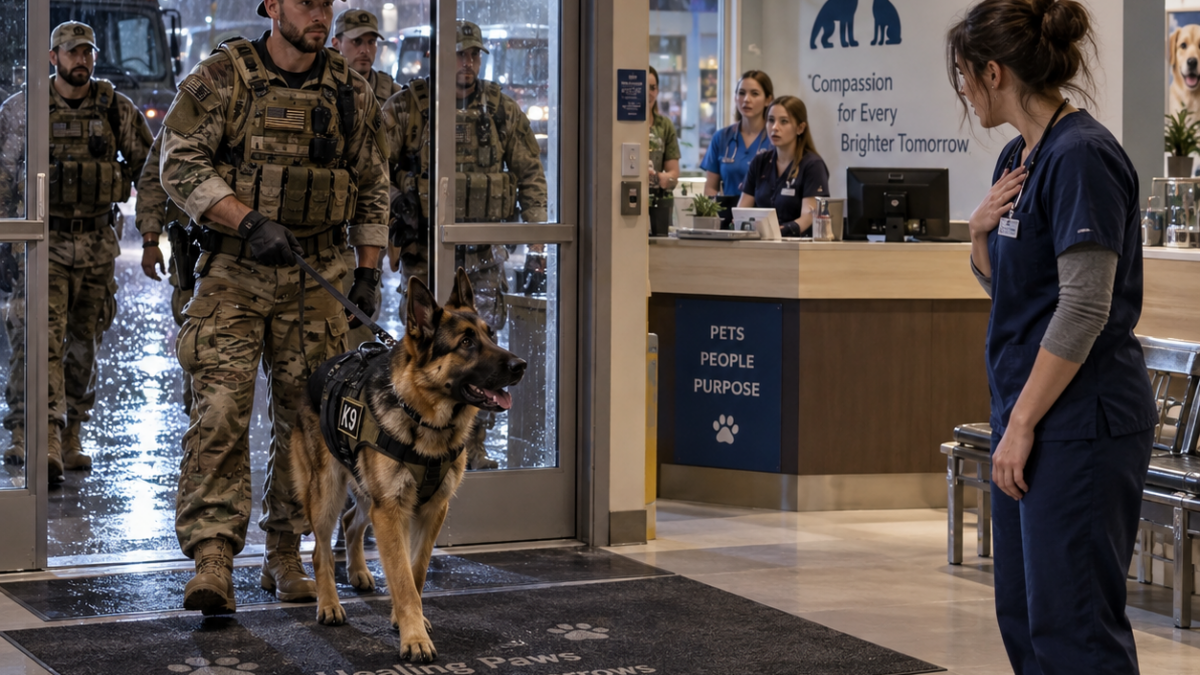
PART3:
Julian kept watching the nurse.
“I think so.”
The doctor glanced toward Saber.
Then toward her.
“Elena?”
The name was printed on her hospital badge.
ELENA VALE, RN.
“Does the dog know you?”
She stood.
“No.”
Saber looked from Julian to Elena.
Then toward the hallway.
Then back at her.
Julian had worked with the dog for five years.
He knew excitement.
He knew prey drive.
He knew curiosity.
He knew defensive behavior.
This was none of them.
This was recognition restrained by confusion.
Julian lowered his voice.
“Who are you?”
The nurse gave him a small, humorless smile.
“My badge answers that.”
“I can read.”
“Then you have your answer.”
Saber stepped closer again.
Elena backed away.
Julian noticed that too.
Not away from the dog.
Away from him.
He frowned.
“Saber doesn’t do this with strangers.”
“Maybe I smell like someone.”
“Maybe.”
She looked down.
Julian watched her face.
“That someone wouldn’t happen to be you?”
“No.”
Again, too quickly.
The veterinarian waiting for Saber’s evaluation called Julian from the exam room.
“Commander?”
Julian hesitated.
His appointment was routine.
Saber had completed his final operational deployment months earlier.
His retirement medical review was almost ceremonial.
Mobility.
Neurological assessment.
Blood work.
Nothing urgent.
Nothing complicated.
At least it had not been complicated twenty minutes earlier.
Julian pointed toward the examination room.
“Come.”
Saber obeyed.
But three steps later, he looked back.
Elena had already sat down.
Her attention was fixed on the patient chart again.
Or pretending to be.
Saber looked forward.
Then back.
The leash tightened.
“Saber.”
The dog finally followed.
The veterinarian, Dr. Olivia Grant, examined him thoroughly.
Heart.
Lungs.
Hips.
Eyes.
Reflexes.
Paws.
Old scars.
Saber tolerated everything with the quiet dignity of an aging professional who believed medical exams were beneath him.
“You’re still in excellent shape,” Olivia said.
Julian rubbed the dog’s neck.
“He thinks so.”
“He’s earned his retirement.”
“That’s what everyone keeps telling me.”
“You disagree?”
Julian looked at Saber.
Five years together had taught him that retirement was not always a gift to working dogs.
Sometimes it was confusion.
One morning they had a mission.
The next they had a backyard.
“You tell him.”
Olivia smiled.
“I prescribe sunshine, food, walks, and no one shooting at either of you.”
“Very scientific.”
“I went to school for years.”
Saber suddenly lifted his head.
His attention moved past Olivia.
The exam room had a glass wall facing the corridor.
Elena stood outside.
She was speaking with another nurse.
Saber watched her.
Olivia followed his gaze.
“That’s interesting.”
“You saw what happened?”
“Half the hallway saw what happened.”
“He doesn’t know her.”
“Apparently he disagrees.”
“Dogs can confuse scent.”
“Yes.”
“But?”
Olivia glanced at him.
“But he isn’t behaving confused.”
Julian knew it.
That was exactly what bothered him.
Saber’s eyes did not leave Elena.
Olivia lowered her voice.
“Maybe she smells like someone he knew.”
Outside the glass wall, Elena stopped writing.
She had heard.
Julian saw her hand freeze.
Someone.
Something shifted in his memory.
A voice from years earlier.
A woman kneeling beside a younger Saber.
Don’t force him, Julian. Watch him first.
He pushed the thought away.
Impossible.
The exam ended twenty minutes later.
Saber was cleared.
Julian clipped on his leash.
They stepped into the corridor.
Elena immediately picked up a stack of folders and started toward another wing.
Saber turned to follow.
Julian stopped him.
“Elena.”
She paused.
He approached.
She looked tired now.
Not frightened.
Cornered.
“I need to ask you something.”
“You already did.”
“And I didn’t believe your answer.”
“That sounds like your problem.”
For the first time, Julian almost smiled.
That tone.
Something about it.
A familiarity he couldn’t place.
He looked at her more carefully.
Mid-thirties, maybe.
Dark hair.
Brown eyes.
A faint scar near her left eyebrow.
No makeup except whatever nurses wore to survive twelve-hour shifts.
Different face than the memory in his head.
Or maybe not different.
Older.
Quieter.
Changed.
“Why does my dog know you?”
“He doesn’t.”
“He does.”
“He’s probably confused.”
“No.”
Her jaw tightened.
“You’re very sure of yourself.”
“I’ve had him five years.”
Elena looked at Saber.
“You’ve had him five years?”
“Yes.”
Something changed in her face.
A calculation.
Then she whispered, “That explains it.”
Julian went still.
“What explains it?”
She realized what she had said.
“Nothing.”
“You said that explains it.”
“I meant his retirement behavior.”
“No, you didn’t.”
She stepped back.
“Commander, I have patients.”
Julian’s voice dropped.
“How did you know he remembers something from before me?”
Elena stared at him.
Because that was exactly what she had implied.
She recovered quickly.
“I work around service animals.”
“Not enough to know his history.”
“I guessed.”
Julian looked at Saber.
The dog looked at her.
Neither believed the nurse.
At noon, Julian sat in the hospital cafeteria with coffee he had no intention of finishing.
Saber lay beneath the table.
Julian searched his own memory.
Saber’s records before Julian became his handler were incomplete.
That wasn’t unusual.
Military working dogs changed trainers, assignments, facilities.
Most paperwork focused on performance.
Behavior.
Health.
Certifications.
The people around them sometimes became footnotes.
Julian remembered one name.
Serena.
No.
That was ridiculous.
Serena Vale had vanished six years earlier.
She had been a Navy K9 behavioral specialist attached to Julian’s unit before Saber officially became his dog.
Brilliant.
Stubborn.
Uncomfortable with authority whenever authority became lazy.
She could read working dogs faster than anyone Julian had ever met.
He had watched her stop a training exercise because she noticed one dog’s breathing change.
A trainer had accused the animal of refusing commands.
Serena found a cracked tooth.
Another time, a dog suddenly became reluctant to enter a transport vehicle.
Everyone assumed he was developing avoidance behavior.
Serena crawled underneath the truck.
Found an electrical fault causing mild current through the metal floor.
She noticed what people ignored.
That was why Julian trusted her.
And probably why she made some officers uncomfortable.
Then she disappeared.
One week she was part of the team.
The next her access was suspended.
Her name vanished from schedules.
Her locker emptied.
Julian was told she had resigned.
Personal reasons.
He had called.
Number disconnected.
Emailed.
No response.
Asked command.
Stop asking.
He had eventually accepted the answer because the military taught people how to continue without closure.
It did not teach them how to stop wanting it.
But Serena had looked different.
Shorter hair.
Sharper features.
And the nurse’s badge said Elena.
Saber lifted his head.
Julian followed his gaze.
Elena walked past the cafeteria windows.
She did not look inside.
Saber stood.
“Seriously?”
The dog moved toward the door.
Julian followed.
They reached the corridor.
Elena had disappeared around a corner.
Saber stopped beside the chair where she had sat that morning.
He sniffed it.
Then sat.
Julian crouched.
“What do you remember?”
Saber rested his chin briefly on Julian’s knee.
Then lifted it.
Elena returned carrying a medication tray.
The dog stood instantly.
Julian’s doubt disappeared.
“Elena.”
She stopped.
“Please don’t.”
It was the first honest thing she had said to him.
He heard the fear underneath it.
Julian stepped closer.
“You know him.”
She looked around.
Patients.
Staff.
Visitors.
Too many eyes.
“Not here,” she whispered.
Julian nodded.
A vacant consultation room stood nearby.
He opened the door.
Elena hesitated.
Then entered.
Saber followed without waiting to be commanded.
Julian closed the door.
Elena sat.
Julian remained standing.
“Tell me.”
“I knew a dog like Saber.”
“Still not an answer.”
“It was a long time ago.”
“Military?”
She looked at him.
“Yes.”
“What unit?”
“Does it matter?”
“It matters to me.”
Saber approached her.
No caution now.
He sat directly in front of her.
Then placed his head against her knee.
Elena stopped breathing.
Her hand hovered above him.
Julian watched the fight happen inside her.
Six years of fear against muscle memory.
Muscle memory won.
Her fingers touched Saber’s head.
The dog closed his eyes.
Elena’s eyes filled with tears.
Julian’s chest tightened.
“Who are you?”
She stroked the fur between Saber’s ears.
“My name wasn’t Elena then.”
Every sound in the room seemed to disappear.
Julian stared.
“What was it?”
She looked up.
The next two words reached backward through six years and hit him with the force of an explosion.
“Serena Vale.”
Julian did not move.
Could not.
He had imagined this woman dead.
Captured.
Married.
Gone willingly.
Living somewhere quiet.
He had imagined every possibility except this.
A nurse in a civilian hospital.
Twenty feet from a rehabilitation waiting room.
His voice came out low.
“Serena?”
She nodded.
He looked at her.
Really looked.
The scar near her eyebrow had not been there.
Her hair used to be almost black and cut to her shoulders.
She had been twenty-nine.
She was thirty-five now.
Time had softened and hardened different parts of her.
But the eyes were the same.
The same eyes that had once looked at him over a frightened K9 and said, You can demand obedience or you can earn trust. Decide which one you want.
Julian took one step back.
“You’re alive.”
A wounded smile touched her face.
“That was the idea.”
Anger arrived after shock.
Fast.
Hot.
Six years compressed into one question.
“Why did you leave?”
Serena’s hand stopped moving.
“I didn’t.”
Julian frowned.
“What?”
“I didn’t leave the way you were told.”
“You resigned.”
“Yes.”
“You disappeared.”
“Yes.”
“That sounds like leaving.”
“I was removed first.”
Julian stared.
“By whom?”
She looked toward the closed door.
“Julian…”
He froze.
She had not called him Julian yet.
The sound hurt more than he expected.
“By whom?”
“I don’t know exactly.”
“That makes no sense.”
“It didn’t then either.”
Saber suddenly stood.
He walked to the wall behind Julian.
A framed photograph hung there.
Hospital charity event.
Military appreciation week.
Six or seven years old.
Julian barely noticed it.
Saber did.
The dog stared.
Then looked toward Serena.
She saw the photograph.
Her face went pale.
Julian turned.
Several uniformed personnel stood outside St. Catherine’s entrance in the picture.
Beside them were two military working dogs.
One was unmistakably Saber.
Younger.
Leaner.
Ears too large for his head.
And near the far edge of the group stood Serena.
Julian moved closer.
“You were here.”
“Yes.”
“When?”
“Six years ago.”
“Why?”
Her voice dropped.
“Because this is where they brought Saber after the mission.”
Julian turned sharply.
“What mission?”
Serena looked at him.
“You never knew.”
“Knew what?”
“That he was injured.”
Julian stared.
“He wasn’t injured.”
“He was.”
“No.”
“Yes.”
“He passed post-operation medical clearance.”
Serena’s eyes hardened.
“That clearance was false.”
For several seconds, Julian forgot to breathe.
“What?”
She sat back.
Saber returned to her.
“He landed badly during extraction.”
“I was there.”
“You were thirty yards away coordinating evacuation.”
“He kept working.”
“Because he was trained to.”
Julian looked at the dog.
Saber seemed unaware that a six-year lie had just cracked open above him.
“How bad?”
“Strained shoulder. Soft-tissue damage. Nothing that would have ended his career.”
“Then why falsify it?”
“Because he wasn’t fit to continue the next phase.”
Julian’s expression changed.
“The second operation.”
Serena nodded.
It had happened less than seventy-two hours later.
Julian remembered arguing that the team needed additional rest.
He had been told every member was cleared.
Including the dog.
“You’re saying someone changed his medical status to keep the timeline.”
“That’s what I discovered.”
“Who?”
“I never proved it.”
“Who had authority?”
“Several people.”
“Names.”
She looked at him.
“You haven’t changed.”
“No.”
“You still think if you push hard enough, truth becomes simple.”
“No. I think if someone stole six years from both of us, I want a name.”
Serena’s eyes filled.
“You think I don’t?”
Julian stopped.
She looked away.
For the first time, anger gave him enough room to see her.
Not the nurse.
Not the specialist he remembered.
A woman who had built an entirely different life because something in the old one had frightened her badly enough to disappear.
He sat across from her.
“What happened?”
Serena looked at Saber.
Then began.
Six years earlier, she had noticed the dog favoring his left shoulder after the operation.
Subtle.
Most people missed it.
Saber still ran.
Still responded.
Still ate.
But when he settled, he shifted weight away from one side.
Serena requested evaluation.
The initial notes recommended forty-eight to seventy-two hours of restricted activity.
Hours later, a revised report appeared.
Cleared without restrictions.
Serena assumed the veterinarian had changed the assessment.
She checked.
He hadn’t.
Dr. Malcolm Reeves, the military veterinarian on rotation, denied altering it.
The authorization attached to the amendment carried Julian Archer’s name.
Julian stood.
“My name?”
“Yes.”
“I never signed medical overrides.”
“I knew that.”
“You knew?”
“You argued more than anyone about keeping dogs out when they weren’t ready.”
“Then why didn’t you bring it to me?”
“I tried.”
He stared.
“When?”
“The night before the second deployment.”
“I never saw you.”
“They called me into command first.”
“Who?”
“Our operations officer.”
Captain Warren Hale.
Julian remembered him.
Precise.
Ambitious.
The kind of officer who never raised his voice because rank did enough work for him.
“What did Hale say?”
“That I was accusing senior personnel of falsifying operational medical records without evidence.”
“You had the original record.”
“I had a screenshot.”
“Where?”
“Gone.”
“How?”
“My secure account was locked two hours later.”
Julian stared.
“My access was suspended pending review.”
“For what?”
“Improper handling of restricted medical data.”
“That’s insane.”
“It was effective.”
She gave a humorless smile.
“I filed a formal complaint.”
“What happened?”
“It disappeared.”
“Complaints don’t disappear.”
“Mine did.”
Julian’s jaw tightened.
“And then?”
Serena looked down at her hands.
“Someone came to my apartment.”
“Who?”
“I never saw him.”
“What?”
“An envelope was pushed under the door.”
“What was inside?”
“A photograph.”
“Of what?”
“You.”
Julian went very still.
“And Saber.”
Silence.
“On the back it said that continuing the complaint could bring scrutiny to anyone connected to the altered record.”
Julian understood.
“They threatened us.”
“They never used the word threat.”
“They didn’t need to.”
“No.”
“Why didn’t you tell me?”
“Because the forged authorization used your name.”
Julian’s face hardened.
“You thought I did it?”
“No.”
“Then what?”
“I thought someone was setting up a trail that led to you.”
The anger inside him changed shape.
Serena continued.
“If I accused the wrong person, they could claim you authorized Saber’s deployment despite knowing he was injured.”
“I would have fought it.”
“I know.”
“Then why—”
“Because you had a career.”
“So did you.”
“I know.”
“You had a life.”
“I know.”
“You could have trusted me.”
Serena looked at him.
“That was the problem.”
Julian fell silent.
“I trusted you too much.”
“What does that mean?”
“It means if I told you, you would have done exactly what you’re doing now.”
“Find the truth?”
“Charge straight at it.”
“Yes.”
“And if they had already used your name once, I didn’t know what they would do next.”
“You decided for me.”
Her eyes filled.
“Yes.”
Julian stood.
“That wasn’t your decision.”
“I know.”
“You let me believe you abandoned the team.”
“I know.”
“I spent six years wondering what I had missed.”
“I know.”
“I looked for you.”
She flinched.
“You did?”
“For two years.”
Her face crumpled slightly.
“I searched old addresses. Personnel contacts. Friends. Every transfer list I could access.”
“Julian…”
“I thought maybe you hated us.”
“I never hated you.”
“I thought maybe something happened to you.”
“Something did.”
He stopped.
That silenced them both.
Saber rose.
He walked to Julian.
Looked at him.
Then back at Serena.
Then sat between them.
Serena almost smiled.
“He wants you to calm down.”
Julian stared at the dog.
“You’re still translating him?”
“He’s obvious.”
“You always said that.”
“You always refused to believe me.”
“I believed you.”
“No. You tolerated me being right.”
For the first time that morning, Julian laughed.
One short breath.
Saber relaxed.
Then Serena did too.
Julian sat again.
“Why nursing?”
She looked around the consultation room.
“Because I needed work where helping still mattered.”
“You could have done anything.”
“I didn’t know who I was after leaving.”
“So you became Elena.”
“I used my middle name.”
“You kept Vale.”
“Changing everything felt like letting them erase Serena completely.”
“Did anyone know?”
“No.”
“What about your family?”
“My mother knew enough to keep quiet. She never knew details.”
“You’ve lived here six years?”
“Yes.”
“In the same hospital where Saber was treated?”
“That was the point.”
Julian frowned.
“Why come back to the place connected to all of it?”
“Because this hospital wasn’t the thing that hurt me.”
She looked down at Saber.
“It was the place where I stayed with him.”
Julian waited.
Serena’s voice softened.
“When they brought Saber here that night, he wouldn’t lie down.”
The dog’s ears moved at his name.
“He was young. He kept watching the treatment-room door. Every time it opened, someone new came through. Different uniform. Different smell. Different hands.”
Julian imagined him.
A younger Saber.
In pain.
Confused.
“He didn’t know who was taking him next.”
“And you stayed.”
“Until morning.”
“All night?”
“Yes.”
“Why?”
“He was scared.”
Julian glanced down.
“That doesn’t sound like him.”
“He was young.”
Saber lowered his head onto Serena’s shoe.
Julian looked at them.
“He remembers.”
Serena touched the dog’s ear.
“He remembers everything important.”
There was a knock.
Hospital administrator Rebecca Shaw entered with a folder.
“I’m sorry. Security said you requested access to archived records involving a prior military canine program.”
Julian looked at Serena.
“I didn’t.”
“I did,” Serena said.
“When?”
“While you were in the cafeteria.”
Julian almost smiled.
Still three steps ahead.
Rebecca placed the folder on the table.
“We found something unusual.”
Serena stiffened.
“What?”
“Your hospital employment record begins six years ago. That’s normal. But in the old rehabilitation archive, we found military animal evaluation documents stored separately from patient records.”
She opened the folder.
Saber’s head rose.
Julian leaned forward.
There it was.
Service identification.
Training number.
Medical observations.
Handler history.
And one handwritten notation.
PRIMARY BEHAVIORAL SPECIALIST: S. VALE.
Julian looked at Serena.
“You were his primary specialist?”
“For eight months.”
“That isn’t in his current records.”
“I know.”
Rebecca turned another page.
“There’s more.”
Attached was a scan of the original injury assessment.
Left shoulder strain.
Temporary restriction recommended.
And beneath it—
An amendment.
Medically cleared.
Authorization:
COMMANDER JULIAN ARCHER.
Julian stared at his own name.
“That isn’t my signature.”
Rebecca looked at him.
“You’re certain?”
“I’m looking at it.”
Serena said quietly, “That’s what I tried to report.”
Julian’s anger became colder.
Much colder.
“Who had access to this archive?”
Rebecca shook her head.
“Six years ago? Hospital medical staff, military liaison personnel, probably the attached veterinary team.”
“Dr. Malcolm Reeves?”
Rebecca checked.
“Yes.”
Serena closed her eyes.
The name brought something back.
Julian saw it.
“What?”
She looked at him.
“Reeves told me the original assessment was correct.”
“So?”
“He was the first person who confirmed the alteration.”
“Then why did he never support your complaint?”
“I don’t know.”
Rebecca turned another page.
“There’s a reference to an envelope transferred into secure hospital records.”
Serena stared.
“What envelope?”
“Not here.”
“Where?”
“Archive storage.”
Hospital security retrieved it twenty minutes later.
The envelope was yellowed.
Sealed.
Serena’s old name was typed across the front.
SERENA VALE — CONFIDENTIAL.
Her hands trembled.
“I’ve never seen that.”
Julian opened it.
Inside was one photograph.
Serena.
Julian.
Saber.
Six years younger.
Standing beside a military transport vehicle.
Julian remembered the day.
Hot.
Dusty.
Saber had stolen half a sandwich from a medic.
Serena had laughed until she cried.
He turned the photograph over.
Five handwritten words.
She knows what happened. Watch her.
Serena’s face drained of color.
Saber stood.
His body became rigid.
He stepped between Serena and the consultation-room door.
Julian immediately noticed.
“What is it?”
Serena stared at the dog.
“Saber.”
Footsteps moved outside.
Stopped.
The dog’s ears pointed toward the door.
Hospital security officer Marcus Lee stepped closer to the glass panel.
Looked out.
“Nobody.”
Julian frowned.
Saber remained tense.
Then Serena understood.
“He remembers the sound.”
“What sound?”
“Footsteps stopping outside a closed room.”
Julian looked at her.
“That night?”
“At the clinic.”
She nodded.
“Every time someone stopped outside the treatment door, Saber reacted before they entered.”
The security officer checked again.
Empty hallway.
Saber slowly relaxed.
The danger had not been a person.
It was memory.
Julian stared at the dog.
Even after six years, some fear had remained inside him too.
Serena rested a hand on Saber’s shoulder.
“You’re okay.”
The dog sat.
Julian looked at her.
“You really were his person.”
“For a while.”
“No.”
His voice softened.
“You still are.”
She looked away.
The photograph remained between them.
The handwritten warning changed everything.
This was no longer a disagreement about medical paperwork.
Someone had deliberately watched Serena after she raised questions.
Rebecca contacted the hospital’s legal department.
Julian contacted Naval investigative authorities.
By late afternoon, nothing looked cinematic.
No armed officers stormed hallways.
No dramatic arrests.
Real investigations rarely begin that way.
They begin with copies.
Dates.
Signatures.
Access logs.
Chain-of-custody forms.
Old emails.
Questions asked twice.
Then again.
Julian stayed.
Serena attempted to finish her shift.
She lasted thirty minutes before the nursing supervisor ordered her to go home.
“You’ve given medication to three patients while looking like you might faint,” she said. “Go.”
“I’m fine.”
“That is the least convincing sentence you’ve said today.”
Serena gathered her things.
Outside the hospital, Julian waited beside Saber.
“You don’t have to follow me.”
“I know.”
“Then why are you?”
“Because you disappeared once.”
She looked at him.
“That was cheap.”
“It was.”
“And effective.”
“Yes.”
She almost smiled.
They sat in the hospital courtyard instead.
Saber lay between them.
For several minutes, neither spoke.
Then Julian said, “I’m angry.”
Serena nodded.
“You should be.”
“I don’t know what part I’m angriest about.”
“I can make a list.”
“That sounds like you.”
She looked toward the trees.
“I thought I was protecting everyone.”
“Maybe you were.”
Serena turned.
He continued.
“That doesn’t mean it didn’t hurt people.”
“I know.”
“You should have told me.”
“I know.”
“I would have believed you.”
She swallowed.
“I know that now.”
“You knew it then.”
“That was why I couldn’t.”
He shook his head.
“I still don’t understand.”
“If you believed me, you would have fought.”
“Yes.”
“And if they wanted you involved, I would have handed them exactly what they wanted.”
“You don’t know that.”
“No.”
Her voice cracked.
“I didn’t know anything.”
There it was.
Not secrecy.
Fear.
Pure, exhausted uncertainty.
“I was twenty-nine years old. My clearance vanished overnight. My complaint disappeared. Someone used your signature. Someone put photographs under my apartment door. I didn’t know which part of the system was safe.”
Julian looked down.
Saber had placed one paw over Serena’s shoe.
She continued.
“I kept thinking if I made one wrong move, they’d take him.”
Julian looked at the dog.
“Saber?”
“Yes.”
“Why?”
“Because the easiest way to bury a falsified medical record is to remove the animal attached to it.”
Julian’s stomach turned.
“You thought they’d retire him?”
“Or transfer him.”
“Or worse.”
She didn’t answer.
He understood.
Military working dogs were valuable assets.
But assets existed inside systems.
Systems could fail.
“I couldn’t risk it.”
“So you sacrificed yourself.”
“That sounds nobler than it felt.”
“What did it feel like?”
“Like running.”
Julian looked at her.
“Maybe it was both.”
Serena’s eyes filled.
For six years, no one had allowed both things to be true.
She had protected something.
And she had been afraid.
She had survived.
And she had lost too much.
The investigation expanded over the next several weeks.
Old records surfaced.
The original medical evaluation had indeed been altered after Dr. Malcolm Reeves signed it.
Reeves had not made the alteration.
He had objected.
But instead of formally challenging senior command, he documented his concern privately and placed copies inside St. Catherine’s archive.
Cowardice?
Caution?
Survival?
Investigators would decide.
Captain Warren Hale’s name appeared repeatedly.
So did another officer attached to operational scheduling.
The second mission had been politically important.
Delaying it would have triggered questions.
Someone decided one injured K9 was a manageable problem.
Serena had become a larger one when she noticed.
The authorization bearing Julian’s name was confirmed fraudulent.
An archived access log showed it had been uploaded from a terminal used by operations personnel.
Serena’s complaint had not vanished accidentally.
It had been diverted.
Then marked resolved.
Without investigation.
The threatening photograph could not be conclusively traced.
But evidence established enough.
She had not invented the discrepancy.
She had not mishandled records.
She had not abandoned her post without cause.
She had been pressured out after reporting misconduct.
Julian learned these things one document at a time.
Each one made him angrier.
Not only at the people who caused it.
At himself.
He replayed the weeks before Serena left.
The signs he missed.
She had stopped eating with the team.
Started looking over her shoulder.
Left meetings early.
Once, he had asked if she was sleeping.
She told him she was fine.
He accepted it.
A month after the investigation reopened, he found her sitting in the same hospital courtyard.
Saber lay beside her.
Julian sat.
“You were right.”
She looked at him.
“I know.”
The answer almost made him laugh.
“You could at least pretend humility.”
“I lost six years. I’m keeping this one.”
“Fair.”
He handed her a folder.
“Your military record has been corrected.”
She did not touch it.
He placed it beside her.
“The finding says you acted within duty requirements when you reported the discrepancy.”
Still she did not reach.
“Serena.”
Her eyes remained on Saber.
“I thought this would feel different.”
“What?”
“Being proven right.”
Julian understood.
“Truth doesn’t give time back.”
“No.”
“It doesn’t repair everything.”
“No.”
“But it stops the lie.”
That made her look at him.
He nodded toward the folder.
“Sometimes that’s enough for the first day.”
She finally took it.
Her hands trembled.
The hospital eventually cleared Serena completely.
Naval investigators referred several individuals for formal review.
Warren Hale, now retired, faced an administrative and legal inquiry.
The officer responsible for the digital amendment could no longer hide behind a six-year-old access trail.
Dr. Reeves provided testimony.
He admitted he should have spoken sooner.
That confession angered Serena more than she expected.
She met him once.
Not privately.
Investigators were present.
Reeves looked older than she remembered.
Smaller somehow.
He would not meet her eyes at first.
“You knew.”
He nodded.
“You knew what happened to me.”
“Yes.”
“And you said nothing.”
“I documented what I could.”
“You hid it in an archive.”
“I was afraid the records would be destroyed.”
“So you protected paper.”
Reeves flinched.
Serena’s voice remained calm.
“And left me alone.”
“I thought you had resigned voluntarily.”
“You knew my access was suspended.”
He looked down.
“Yes.”
“You knew my complaint was blocked.”
“Yes.”
“You knew someone forged Julian’s authorization.”
“I suspected.”
“Then don’t tell me you didn’t know.”
The room became silent.
Reeves finally looked at her.
“I was afraid.”
Serena stared.
For years, she had imagined the people behind the system as monsters.
Some were.
Others were simply frightened people who chose self-protection and allowed cruelty to continue.
That truth was almost harder.
Reeves whispered, “I’m sorry.”
Serena stood.
“I believe you.”
His face changed.
“But forgiveness isn’t the same as pretending your silence was harmless.”
She left.
Julian waited outside with Saber.
“How did it go?”
“I didn’t hit him.”
“Excellent.”
“I considered it.”
“Less excellent.”
She looked at Saber.
“He was afraid.”
“Reeves?”
“Yes.”
Julian nodded.
“That doesn’t excuse him.”
“No.”
Serena exhaled.
“But I understand him.”
Julian looked at her.
“That frightens you?”
“A little.”
“Why?”
“Because for six years I’ve wanted the story to be simple.”
“Bad people did bad thing?”
“Yes.”
“And instead?”
“Some bad people. Some weak people. Some scared people. One stubborn dog.”
Julian smiled.
“Definitely the dog’s fault.”
Saber sneezed.
Serena laughed.
It was the first time Julian had heard that laugh in six years.
The sound hurt.
Then healed something.
Not completely.
But enough.
Three months after Saber walked into St. Catherine’s and recognized a nurse named Elena, the hospital director asked Serena into her office.
“I want to offer you a new role.”
Serena immediately distrusted the sentence.
“What role?”
“Clinical coordinator for working-animal and emergency behavioral care.”
She stared.
“We don’t have that.”
“We do if you accept.”
The director slid a proposal across the desk.
The program would train hospital staff to recognize stress signals in service dogs, police dogs, military animals, and therapy dogs entering civilian medical environments.
It would also include protocols for handlers undergoing treatment.
Serena read the pages.
“Why me?”
“Because you understand what professionals miss when they focus only on the obvious.”
Serena looked down.
For years, that ability had cost her everything.
Now someone was offering to build a job around it.
“I need time.”
“Take it.”
She accepted the next morning.
Julian visited during her first week.
Saber walked beside him more slowly now.
Retirement had finally begun settling into the dog’s body.
The hospital staff knew him.
A receptionist kept biscuits beneath her desk.
Two physical therapists greeted him by name.
Saber ignored them with the dignity of a former military professional being bribed by civilians.
He stopped outside Serena’s office.
The door was open.
She looked up.
“You know you can come in.”
Saber entered.
Sat.
Julian leaned against the doorway.
“He still remembers.”
Serena smiled.
“He remembers everything.”
“Everything important.”
She looked at him.
“That’s what I used to tell you.”
“I remember.”
She crouched.
Saber leaned forward.
She placed both hands gently around his face.
For several seconds, no one spoke.
No mystery.
No investigation.
No fear.
Just recognition.
“You found me,” Serena whispered.
Saber’s tail moved once.
Julian smiled.
“He found you years ago.”
She looked up.
“What?”
“He used to do something after you left.”
“What?”
“Whenever somebody said your name, he looked toward the door.”
Serena froze.
“You never told me.”
“I didn’t understand what it meant.”
“Julian.”
“I also thought telling you now might make this harder.”
“What?”
“Being found.”
Her eyes softened.
“I don’t think that’s the hard part anymore.”
“What is?”
“Believing I’m allowed to stay.”
Julian’s smile disappeared.
“You are.”
She looked away.
“I’m working on it.”
One afternoon several weeks later, Serena returned to the hospital records office.
The archivist had finished cataloging the military files.
The original photograph of Serena, Julian, and Saber had been cleared for return.
She held it beneath the fluorescent lights.
They looked impossibly young.
Julian smiling.
Serena squinting into the sun.
Saber between them.
She turned it over.
There was another note below the threatening message.
Faded.
Written in smaller handwriting.
She had never noticed it.
He will know you when we don’t.
Serena stared.
Julian found her ten minutes later.
“What happened?”
She handed him the photograph.
He read the words.
“Who wrote that?”
“I don’t know.”
“Reeves?”
“Maybe.”
“You could ask.”
She thought about it.
Then shook her head.
“No.”
Julian looked surprised.
“You, voluntarily leaving a mystery unsolved?”
“Character growth.”
“Terrifying.”
She smiled.
Then placed the photograph on her desk.
Visible.
Not hidden in a drawer.
Months passed.
Saber’s retirement became permanent.
No missions.
No tactical evaluations.
No deployments.
He spent most mornings sleeping in sunlight.
Julian complained that the dog had become lazy.
Serena called it good judgment.
Whenever hospital policy allowed, Saber accompanied Julian to St. Catherine’s.
Sometimes he spent an hour in Serena’s office.
Sometimes he visited rehabilitation patients.
Veterans responded to him differently.
Some smiled.
Some cried.
Some said nothing and simply placed a hand on his back.
One afternoon, Saber stopped again.
Serena immediately tensed.
Old instinct.
“What is it?”
The dog turned toward a patient room.
Then looked back at her.
She followed.
Inside, an elderly man sat propped against pillows.
The moment he saw Saber, his face brightened.
“That dog looks familiar.”
Serena smiled.
“He gets that a lot.”
The man studied her.
Then his expression changed.
“Not the dog.”
Serena paused.
“You.”
She frowned.
“Have we met?”
“Years ago.”
“Where?”
“Navy clinic.”
Her chest tightened.
The man smiled.
“My son was Daniel Mercer.”
The name struck somewhere deep.
Daniel.
Twenty-two.
Traumatic brain injury.
Angry.
Terrified.
Wouldn’t let staff touch him.
Everyone called him difficult.
Serena had been assisting in an animal-behavior consultation nearby when she heard him shouting.
She remembered entering his room.
Remembered sitting five feet away.
Not speaking.
Waiting.
Eventually Daniel asked why she wasn’t leaving.
She had answered:
Because scared people need someone to stay.
Serena covered her mouth.
“I remember.”
The old man smiled.
“He survived.”
Her eyes filled.
“I didn’t know.”
“He asked about you for years.”
Julian appeared behind her.
“What happened?”
Serena couldn’t answer immediately.
The veteran reached for her hand.
“You told me my son wasn’t a problem.”
She looked at him.
“You said he was scared.”
Saber leaned against her leg.
“You were right.”
Serena cried.
Quietly.
For six years she had believed disappearing meant becoming forgotten.
Now pieces of her old life were returning one by one.
Not accusations.
Not threats.
Memories.
Proof that the person she had been had mattered.
That evening, Julian and Serena walked outside the hospital.
Saber moved between them.
The setting sun turned the windows gold.
Julian looked at her.
“You know what’s strange?”
“What?”
“You spent six years trying not to be found.”
She smiled.
“And now people keep finding me.”
“Maybe you weren’t as invisible as you thought.”
“How do you know?”
Julian looked at Saber.
“Because he never believed you disappeared.”
The dog walked several yards ahead.
Then stopped.
Turned.
Waited.
Serena laughed.
“There he is.”
“Still waiting.”
They walked toward him.
Saber continued only when they reached his side.
Years passed.
The story of the K9 who recognized a nurse became part of St. Catherine’s quiet history.
New employees heard pieces.
An old military dog had once stopped in the rehabilitation corridor.
He had recognized a woman everyone else knew by another name.
His memory reopened an old investigation.
But Serena never liked the way people told it as if Saber possessed some supernatural ability.
“He was a dog,” she told a new nurse once.
“A very good dog.”
“But he remembered you after six years.”
“Yes.”
“How?”
Serena looked toward the framed photograph on her desk.
“Scent. Voice. Movement. Association. Dogs remember things differently from us.”
The nurse smiled.
“That’s less romantic.”
“No.”
Serena shook her head.
“I think it’s more romantic.”
“How?”
“Because he didn’t need magic.”
She touched the edge of the photograph.
“He just paid attention.”
Julian retired from active service years later.
Saber became slower.
His muzzle turned white.
Stairs became difficult.
His hearing faded.
But whenever he entered St. Catherine’s, he still knew Serena’s corridor.
On one of his last visits, he stopped outside her office.
Serena was speaking with a young nurse.
She saw him.
Everything else stopped mattering.
“Well, look who finally came to work.”
Julian smiled.
“He’s management now.”
Saber walked in.
Slowly.
Serena crouched.
The dog rested his head against her shoulder.
She closed her eyes.
Six years of absence had once seemed enormous.
Now it was simply part of a much longer story.
She whispered, “You found me.”
Julian heard.
“He always does.”
When Saber died the following spring, he was at Julian’s home.
Serena was there too.
The old dog lay on a blanket near the window.
No hospital.
No uniforms.
No commands.
Just sunlight.
Julian sat near his head.
Serena rested a hand over his shoulder.
Saber’s breathing slowed.
He looked once at Julian.
Then at Serena.
His tail moved against the blanket.
One soft thump.
Serena began crying.
“You can stop watching us now.”
Julian lowered his head.
“You’ve done enough.”
Saber exhaled.
And quietly, the dog who had spent his life noticing what humans missed finally rested.
Afterward, Julian gave Serena Saber’s old identification tag.
She refused at first.
“He was yours.”
Julian shook his head.
“He was ours before either of us understood what that meant.”
She kept it.
The tag sat beside the old photograph on her desk for years.
Patients asked about it.
New nurses asked about the dog.
Serena told the story differently depending on the day.
Sometimes she told them about a young Belgian Malinois frightened in a medical room.
Sometimes about falsified records.
Sometimes about a commander who spent years looking for someone he believed had chosen to leave.
But as Serena grew older, the part that mattered most changed.
It was no longer about proving she had been right.
It was no longer about the officers who had failed.
It wasn’t even about the investigation.
It was about what happened when Saber saw her.
He did not ask why she disappeared.
He did not punish her.
He did not demand an explanation before recognizing her.
He simply knew her.
Years later, on Serena’s final day at St. Catherine’s, she walked through the rehabilitation corridor one last time.
The hospital looked different.
Fresh paint.
New equipment.
Different chairs.
Younger faces.
But the floor beneath her shoes was the same.
She stopped near the place where she had been sitting when Saber first saw her again.
For a moment, she could picture it.
Light blue scrubs.
Chart across her knees.
A retired military dog suddenly refusing to move.
“Serena.”
She turned.
Julian stood at the far end of the corridor.
Older now.
Gray at the temples.
He walked with a slight stiffness in one knee.
In his hand was a small wooden box.
She smiled.
“You came.”
“You thought I wouldn’t?”
“You enjoy being difficult.”
“I learned from you.”
He reached her.
“What’s the box?”
“Open it.”
Inside was Saber’s retired service collar.
Serena stared.
“I thought you kept this.”
“I did.”
“Julian.”
“Read the plate.”
A new engraving had been added beneath Saber’s name.
HE REMEMBERED.
Serena laughed through tears.
“That is unbelievably sentimental.”
“I’m retired.”
“Apparently dignity retired too.”
“Years ago.”
She touched the collar.
They stood there quietly.
The exact spot where six years of silence had ended.
Julian looked down the corridor.
“You know what I think?”
“That has historically been dangerous.”
“I spent years looking for the wrong thing.”
Serena looked at him.
“What were you looking for?”
“The woman who disappeared.”
She waited.
He continued.
“I should have been looking for the woman who survived.”
Her eyes filled.
“And did you find her?”
Julian smiled.
“No.”
Serena frowned.
He touched the engraved plate.
“Saber did.”
For several seconds, she could not speak.
Then she closed the wooden box.
Outside, late-afternoon sunlight filled the windows.
Staff moved through the hospital.
Wheelchairs rolled.
Phones rang.
Somewhere a patient laughed.
Life continued in all the ordinary ways it always had.
There was no applause.
No dramatic ceremony.
Just two people standing in a corridor where something lost had once been returned.
Serena had spent six years believing survival required becoming invisible.
Julian had spent six years believing someone he trusted had chosen silence over him.
Both had been wrong in ways that hurt.
Saber had never understood either mistake.
He remembered a scent.
A voice.
A hand resting between his ears through a frightening night.
He remembered the person who stayed when he was scared.
That had been enough.
And maybe, Serena eventually understood, people were not so different.
We remember who stayed.
We remember who noticed.
We remember who believed us when being believed was inconvenient.
We remember the person who sat beside us when everyone else had decided the practical thing was to move on.
Distance can blur faces.
Time can change names.
Fear can convince good people to disappear from lives they never wanted to leave.
But some bonds survive because they were built before anyone knew they would need to endure separation.
Serena once thought she had erased herself to protect the people she loved.
Years later, she understood the harder truth.
Love does not always ask us to disappear for someone.
Sometimes it asks us to trust them enough to let them stand beside us.
Julian learned something too.
Searching for someone is not the same as understanding why they became lost.
For years, he had wanted Serena to explain why she left.
Eventually he learned to ask a different question.
What happened that made staying feel impossible?
That question changed everything.
And Saber?
Saber never needed either question.
The old K9 had walked into St. Catherine’s on an ordinary Tuesday morning, stopped in the middle of a quiet corridor, and recognized the one person everyone else had learned to call by another name.
No file told him.
No investigator pointed her out.
No photograph reminded him first.
He simply looked at Serena Vale—
and knew.
Sometimes memory is stronger than distance.
Sometimes loyalty outlives anger.
Sometimes the person who disappears from your life is not trying to forget you.
Sometimes they are frightened.
Sometimes they believe leaving is the only way to protect what they love.
And sometimes, after enough years have passed, they need someone stubborn enough to recognize them before they remember how to come home.
For Serena, that someone happened to have four paws, a graying muzzle, and a memory stronger than every lie that had been written into the record.
Everyone else had spent six years asking where she went.
Saber asked nothing.
He found her.
And for the first time since the night she disappeared, Serena finally stopped running.








