“Who Did This!” Navy SEAL Roared as His K9 Found His Mother Bleeding — What Happened Next…
PART3:
A second later, a howl tore through the kitchen.
I had heard Brutus make that sound once before, years earlier, when our point man bled out under a collapsed wall and there was nothing left to do but wait for the helicopter.
My body moved before thought.
I turned the corner into the kitchen.
The world stopped.
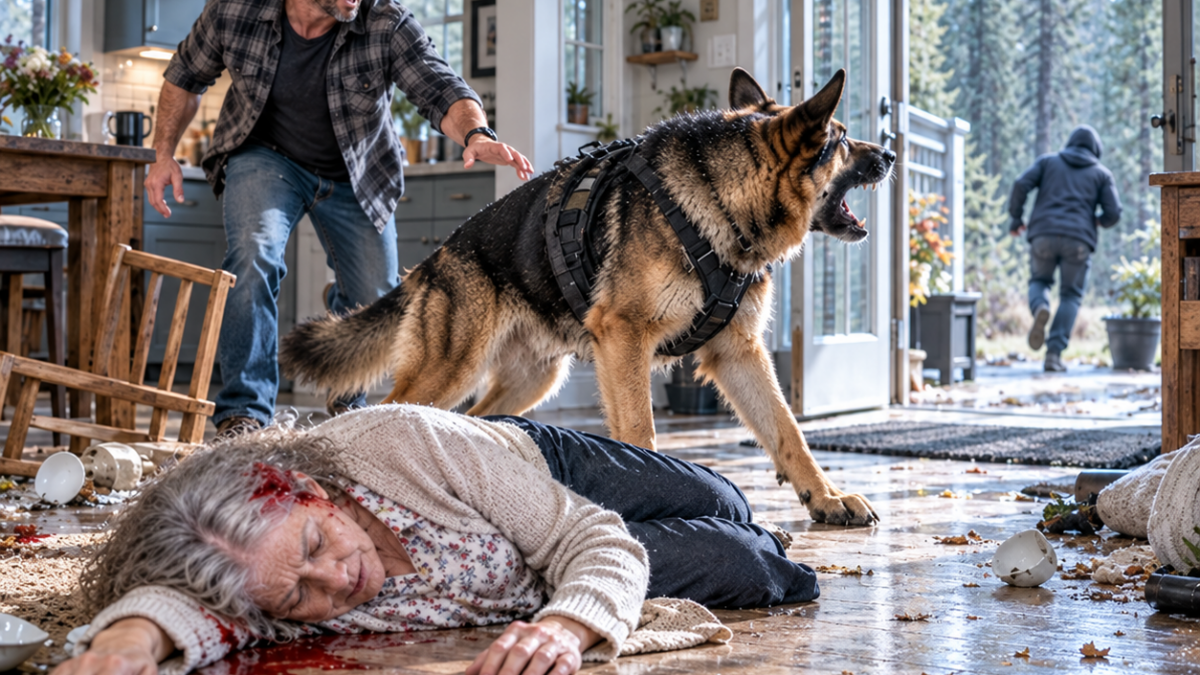
My mother lay crumpled on the terracotta tile.
Her white floral blouse was soaked crimson. One chair lay broken beside her. Groceries were scattered across the floor—apples rolling under the table, a torn paper bag, a carton of eggs smashed open. Porcelain plates from the counter had shattered in a wide arc, as if she had thrown whatever she could reach.
Brutus circled her in frantic, tight loops, whining, nudging her pale hand, then looking at me as if demanding I fix what he had found.
My gun hit the floor.
“Mom.”
I dropped to my knees beside her.
Her skin was ice cold.
For one terrible second, I found nothing.
Then beneath my fingers at her neck—
A pulse.
Weak.
Threaded.
Barely there.
Alive.
“Mom, look at me.”
Her eyelids did not move.
Blood still seeped sluggishly from a deep laceration at the side of her head. Her left forearm had a defensive wound, long and ugly, where she had tried to protect herself.
My mother had fought.
That knowledge did something to me.
I ripped off my flannel shirt, bunched it tight, and pressed it against the head wound with enough pressure that I knew it would hurt if she could feel it.
“Hold on,” I said. “You hold on.”
I grabbed my phone.
“911, what is your emergency?”
“I need EMTs at 4420 Pine Creek Road right now. Female victim, sixty-two, severe blunt force trauma, major bleeding, altered consciousness. Send medevac if you have it. Now.”
“Sir, are you safe? Is the attacker still on the premises?”
I looked across the kitchen.
The back door stood open.
Curtains moved in the night breeze.
On the tile near the threshold, there was a bloody boot print.
Large.
Aggressive tread.
Not a sneaker.
Not random.
My eyes moved over the room.
The purse still sat on the counter.
Television untouched.
The silver cabinet closed.
My mother’s jewelry box would be upstairs.
The house had not been searched like a robbery.
It had been entered like a mission.
“Unknown,” I said into the phone. “But the attacker is gone.”
Then the rage hit.
Not loud at first.
A black pressure rising behind my ribs.
Brutus barked once, sharp and desperate.
I stared at the blood on my hands, at my mother’s gray face, at the open door where someone had walked away after trying to kill the only family I had left.
The roar came out of me before I could stop it.
“Who did this?”
The walls threw it back.
Brutus answered with a bark that shook the room.
I kept pressure on the wound until the sirens came.
I kept talking to her.
About nothing.
About everything.
The time she burned the Thanksgiving rolls and blamed the oven.
The first baseball glove she bought me after working extra shifts.
The way she used to tell me that courage without kindness was just violence wearing a uniform.
Her hand never moved.
But her pulse stayed.
Thin.
Stubborn.
Hers.
The EMTs tried to move me aside.
I almost didn’t let them.
A paramedic with calm eyes put one hand on my shoulder and said, “Chief, you helped keep her alive. Let us take over.”
That word—Chief—told me someone had seen my old Navy ID or my plates or my face and understood enough.
I stepped back.
Brutus pressed against my leg, trembling.
When they loaded Martha into the ambulance, he tried to climb in after her.
“Brutus, heel.”
He obeyed, but only barely.
His eyes stayed on the doors until they slammed shut.
At St. Charles Medical Center, the waiting room lights were too bright.
Hospitals always smell wrong to me. Antiseptic, coffee, plastic, fear. A battlefield at least admits what it is. A hospital tries to hide the war behind polished floors.
I sat in a chair with my mother’s dried blood on my hands.
Brutus lay at my feet, awake, alert, refusing to sleep.
Four hours passed.
A trauma surgeon named Dr. William Hayes came out once to say they were controlling bleeding and relieving swelling around her brain. He used careful words. The kind doctors use when hope exists but cannot be trusted too far.
I nodded like I understood.
I did not.
My mother was behind swinging doors, fighting for her life because someone had come into her home with intent.
Intent mattered.
Intent was the difference between violence and accident.
Between chaos and mission.
Heavy footsteps approached.
“Derek Bowman?”
I looked up.
The man standing over me wore a rumpled suit and a badge he flashed too quickly. Late forties. Thick mustache. Eyes too bored for the room.
“Detective Mitchell Broady, Deschutes County Sheriff’s Office.”
He pulled out a notepad.
“I know it’s a tough night, son, but I need to ask you a few questions.”
I stood.
Brutus rose with me.
“Did you find anything at the house?”
Broady clicked his pen.
“Looks like a standard home invasion. Couple of meth heads cruising up from Highway 97, probably looking for quick cash. Your mother surprised them. Things got out of hand.”
I stared at him.
“A standard home invasion?”
“That’s what it looks like.”
“They didn’t take her purse. Didn’t take the TV. There’s jewelry upstairs in plain sight. They forced a solid oak door hard enough to shear the deadbolt and then left without stealing a dime?”
“People panic.”
“The back porch motion light was unscrewed.”
Broady’s pen stopped.
“Not broken,” I said. “Unscrewed. Someone disabled the perimeter lighting before entry.”
His expression tightened.
“You notice that while your mother was bleeding?”
“I notice things.”
“I’m sure you do. But this isn’t overseas, Chief. This is Oregon.”
Brutus growled.
Low.
Broady glanced at him with irritation, not fear.
That told me more about him than he intended.
“We’ll dust for prints,” he said. “We’ll canvass. But transient types don’t usually leave much behind. You focus on your mother.”
“I am focusing on her.”
Broady snapped his notepad shut.
“We’ll call if we get a lead.”
He walked away.
Brutus watched him go, a vibration still rolling in his chest.
I put my hand on the dog’s head.
“I know.”
At dawn, I went back to the farmhouse.
The deputies had strung yellow crime-scene tape across the porch but left the property unsecured. No cruiser. No guard. No one preserving the perimeter. If the attacker came back, he would have had better access than I did.
I ducked under the tape.
Brutus moved at my left thigh.
“Find it,” I whispered. “Find the scent.”
He went to work.
He did not linger at the front door.
He circled around back, past the open kitchen door, nose low to the dewy grass. He tracked through brush toward the cedar line where our property met dense forest.
I followed, eyes scanning.
The bloody boot print in the kitchen replayed in my mind.
Size twelve, maybe larger.
Deep lug.
Tactical tread.
Brutus stopped near a rusted wire fence at the property line.
He sat sharply.
One bark.
Positive indication.
I crouched beside him.
The ground beneath the cedar canopy was soft mud, sheltered from frost and wind.
There it was.
The same boot print.
Perfectly preserved.
But that was not what chilled me.
Half buried beside it was a small black object.
I used a pen to turn it over.
Matte black.
Machined.
Specialized.
A suppressor baffle.
Not a full suppressor. A component. The kind of thing most civilians would not recognize if they stepped on it. But I knew the threading. Knew the finish. Knew enough from years around armories and specialized weapons to understand what it meant.
Whoever came for my mother had been armed for silence.
This was not a robbery.
This was a planned hit.
But why would anyone send a trained operator after a retired schoolteacher?
My phone buzzed.
Hospital.
I answered before the second ring.
“Bowman.”
“Mr. Bowman, this is Dr. Hayes.”
My grip tightened.
“She’s alive,” he said quickly. “She briefly regained consciousness.”
I closed my eyes.
“But she was extremely delirious. We had to sedate her again for her safety.”
“What did she say?”
A pause.
“She repeated a name. Several times.”
“What name?”
“Wade. She kept saying, ‘Don’t let Wade find it. Don’t let Wade find the box.’”
The forest went silent.
Wade.
Wade Lawson.
My mother’s younger brother.
My uncle.
A man who vanished fifteen years earlier after a scandal involving embezzled funds, illegal contracting, and a private military firm in Seattle called Vanguard Tactical. The family story was that Wade disappeared before charges could stick. Some thought he was dead. Some thought South America. My mother rarely spoke of him except with the exhausted sadness of someone who loved a person she no longer trusted.
Don’t let Wade find the box.
I looked at the suppressor baffle in the mud.
The pieces aligned into something ugly.
Someone had not come for my mother.
They had come for what Wade left behind.
And Martha Bowman had nearly died because she had hidden it.
I pocketed the baffle.
“Brutus,” I said, voice dropping. “We’re going to find the box.”
Back inside, the house felt different.
Not violated anymore.
Active.
A puzzle with blood still drying on the floor.
My mother was a woman of routines. She alphabetized spices. Organized receipts by month. Labeled Christmas bins by room. If she had hidden something important, she would not choose an obvious place. Not a bedroom safe. Not under a mattress. Not a desk drawer.
Wade, on the other hand, had always been paranoid.
Paranoid men like dead spaces.
Old walls.
False bottoms.
Unused vents.
I stood at the bottom of the stairs and looked up.
The attic.
Dust hit my face when I pulled down the ladder.
Brutus climbed after me with practiced agility, despite his age. The attic smelled of insulation, cardboard, cedar, and old heat. A single pull-chain bulb swung overhead, casting thin yellow light over boxes of decorations, school papers, photo albums, and things my mother had kept because memory has its own filing system.
“Search,” I said.
Brutus swept the space.
Ten minutes passed.
Then he stopped near the brick chimney and began pawing at a wrought-iron vent grate that had not connected to any real system in decades.
“Good boy.”
The grate was rusted in place.
I pried it loose with my knife. Metal shrieked. One screw snapped. The grate came free.
Inside the soot-dark cavity, my fingers brushed cold steel.
I pulled out a heavy lockbox.
Combination padlock.
Old, but solid.
I did not shoot it.
My mother had always hated unnecessary damage.
Instead, I carried it downstairs to my father’s old workbench, clamped the lock, and cut through it with a bolt cutter from the garage.
The box opened.
Inside were bearer bonds, routing numbers, account ledgers, and a titanium encrypted flash drive. But the leather-bound book on top drew my eye first.
I opened it.
Handwritten columns.
Dates.
Payments.
Names.
Officials.
Judges.
Police.
Contractors.
Vanguard Tactical.
Wade had not only stolen money.
He had kept records.
Insurance.
Blackmail.
A directory of corruption.
My finger stopped on one line.
Detective Mitchell Broady. Deschutes County Sheriff’s Office. Monthly retainer. Local suppression. Incident control.
My jaw locked.
Broady was not lazy.
He was cleanup.
He had come to the hospital to see whether my mother could identify her attacker. He had dismissed the case because that was his job.
Brutus’s ears turned.
He froze.
Then a low vibration moved through him.
I shut the ledger.
Someone was outside.
I killed the lights and moved to the front window.
Two black SUVs rolled up the gravel drive with headlights off.
Four men got out.
Not junkies.
Not thieves.
They moved like professionals.
Disciplined spacing.
Weapons held low.
Dark clothing.
No wasted motion.
I did not smile.
That happens in movies.
In real life, when men come to kill you in your mother’s house, you become very calm.
I put the ledger and drive into a pack, then grabbed my father’s old hunting rifle from the study, the one he had taught me to clean before he let me fire it. I was not outfitted for war. No team. No armor. No comms.
But I had the house.
I had darkness.
I had Brutus.
And they did not know how angry grief can make a careful man.
I did not intend to kill anyone unless forced.
I intended to survive long enough to make the truth impossible to bury.
I took position in the upstairs hall, the staircase below me a narrow choke point.
The back door broke inward.
Footsteps entered.
A voice whispered, “Find Bowman. Find the box.”
Brutus waited beside me, silent.
I tapped his shoulder twice.
Hold.
His muscles trembled with restraint.
The first man appeared at the bottom of the stairs, light sweeping upward.
I fired into the banister beside him.
Wood exploded near his face.
He ducked back, shouting.
“Contact!”
The shot did what I needed.
It broke their confidence.
Men expecting an easy cleanup do not like being reminded the house can shoot back.
I moved before they could settle.
Brutus launched down the side hall, not at throats, not at faces, but at weapon arms and balance—the way he had been trained. A scream erupted from the dining room as he took a man to the floor and pinned him long enough for me to advance.
Another intruder fired blindly into the dark.
I dropped low, moved behind the wall, and returned controlled fire into the floor near his boots.
He stumbled back.
“Federal agents are inbound,” I shouted, though I had no idea if that was true yet. “Drop your weapons and live.”
One ran.
One surrendered.
One tried to raise his weapon toward Brutus.
I shot the rifle from his hands before his finger finished tightening.
He went down screaming, alive and terrified.
The fourth bolted out the front door.
I caught him on the porch.
We hit the gravel hard. He fought well. Professional. Strong. Scared now. I drove my forearm across his throat and pinned his wrist until the pistol fell from his grip.
“Who sent you?”
He spat blood.
I pressed harder.
“Name.”
“Briggs,” he choked. “Conrad Briggs.”
Vanguard.
Wade’s old boss.
“Where?”
“Old logging mill outside Sisters. Highway 242. That’s all I know.”
I cuffed him with zip ties from his own kit and called the only person I trusted before calling anyone local.
Cameron Walsh.
Former Navy intelligence officer. Current federal contractor. Owed me a life debt he hated acknowledging.
He answered on the first ring.
“You better not be calling because you’re bored.”
“I need FBI Portland. Now. Corruption involving Vanguard Tactical, local sheriff’s detective on payroll, armed assault at my mother’s residence. I have evidence.”
The line went quiet.
Then Cameron said, “Send me everything.”
I photographed the ledger.
The drive.
The baffle.
The men.
The weapons.
The boot prints.
The timestamped damage.
Cameron moved fast.
Within twenty minutes, he had the data mirrored, encrypted, and pushed to contacts who still answered when he used certain words.
“You stay put,” he said.
“No.”
“Derek.”
“Briggs runs before sunrise if he knows the team failed.”
“You are not law enforcement.”
“No. But I’m the only one who knows where he is right now.”
“Don’t do something stupid.”
“I’m going to do something necessary.”
I hung up.
Then I called 911 and reported armed intruders alive on my property.
I did not wait for Broady’s department to arrive.
I left the captured men restrained in the foyer, unloaded their weapons, and placed the evidence that mattered in my pack.
Brutus watched me.
He was breathing hard, but steady.
“You good?”
His tail moved once.
“Then we move.”
The old logging mill outside Sisters sat in a pocket of freezing fog and dead industry. Rusted gates. Corrugated steel. Stacks of rotting timber. A warehouse large enough to hide trucks, men, and secrets. I parked two miles out and approached on foot with Brutus close beside me.
I did not go there to execute Conrad Briggs.
That is important.
Men like Briggs expect violence.
They understand it.
They buy it.
They hire it.
They prepare for it.
What they fear is exposure.
What they fear is daylight.
So while I moved through the fog, Cameron moved through networks. FBI Portland. State police. Federal warrants pending. Media packets sealed and timed. The ledger and drive were no longer only in my hands. Briggs could kill me and still lose.
That knowledge made me calm.
Two guards patrolled outside.
I avoided them.
There is a difference between a firefight and an approach.
A firefight is what happens when plans fail.
An approach is what prevents one.
Brutus and I moved through brush, drainage cuts, broken fencing, and shadow until we reached the far side of the warehouse. A side door near the loading dock had an old keypad and newer wires.
Temporary security.
Rushed.
Arrogant.
Inside, voices carried.
I recognized Briggs from photos Cameron sent: late fifties, silver hair, expensive suit, the kind of man who looked calm because other people panicked for him.
He stood in a glass-walled office near the back, arguing with someone on the phone.
“I don’t care if Bowman was a SEAL,” he snapped. “He is one man. Get the ledger back.”
I stepped into view with my weapon low.
“Too late.”
Briggs turned.
For the first time that night, his face showed honest fear.
His bodyguards raised weapons.
“Drop them!” I shouted.
Brutus barked once, violent and sharp.
Before anyone fired, floodlights exploded across the yard outside.
Red and blue strobed through the warehouse windows.
A loudspeaker thundered.
“Federal agents! Weapons down!”
Briggs stared at me.
Then at the windows.
Then at the flash drive in my hand.
His mouth opened slightly as he understood.
“You sent it.”
“To everyone.”
His face twisted.
“You have no idea what you’re holding.”
“Yes,” I said. “I do.”
A bodyguard lowered his weapon first.
Then another.
Briggs backed toward his desk.
“You think prison scares me? I know people everywhere.”
“Not everywhere.”
I tossed a printed copy of the ledger page onto the floor between us.
Broady’s name landed face up.
“Your everywhere is shrinking.”
The warehouse doors blew open under federal entry.
Agents poured in.
Commands filled the air.
Brutus stayed at my side, trembling with discipline, waiting for the command I did not give.
Conrad Briggs did not die that night.
That would have been too simple.
He was handcuffed in the office he thought made him untouchable. Detective Broady was arrested at the precinct before dawn. The sheriff’s office became a crime scene. Vanguard Tactical’s old ghosts started climbing out of sealed boxes and hidden accounts. Wade Lawson’s name returned to the world, not as a family shame whispered over Thanksgiving, but as a key witness in absentia whose paranoia had preserved evidence powerful men thought buried.
My mother woke two days later.
Really woke.
Not fully recovered.
Not fine.
But herself enough to recognize me.
I was sitting beside her hospital bed, peeling an apple with a pocketknife because she always said sliced apples tasted better than bitten ones. Brutus slept at the foot of the bed with his chin on her blanket-covered feet.
Her head was bandaged. Bruises darkened one side of her face. Her left arm was wrapped. But her eyes were clear.
“You look tired,” she said.
I almost laughed.
“You were attacked, Mom.”
“You still look tired.”
“Good to know your priorities survived.”
She smiled faintly.
Then her gaze moved to Brutus.
“He found me?”
“Yes.”
Her hand lowered to his head.
Brutus opened his eyes, then sighed like an old soldier finally relieved of watch.
“I remember pieces,” she whispered.
“You don’t have to talk about it.”
“I need to.”
So I listened.
She told me Wade had come to her years ago, frightened and thinner than she remembered, carrying a steel box and begging her not to ask questions. He told her if he disappeared, the box might keep people alive someday. She hid it because he was her brother and because she had always believed even broken people deserved one person who remembered them before they broke.
Then, two nights ago, someone came.
Asked for Wade.
Asked for the box.
She refused.
They hurt her.
She threw plates.
She reached for the phone.
Then nothing.
Her fingers tightened in Brutus’s fur.
“Did they find it?”
“No.”
“Good.”
“They found consequences.”
She looked at me, reading more than I said.
“Derek.”
“I didn’t kill Briggs.”
She studied my face.
“I’m glad.”
“I wanted to.”
“I know.”
“That bother you?”
“No,” she said softly. “Only if you had let wanting decide.”
I looked down.
My mother had raised me too well for revenge and too fiercely for passivity. That was a hard combination to carry.
“Broady was arrested,” I said. “Briggs too. Federal charges. Racketeering, attempted murder, corruption, conspiracy. More coming.”
“And Wade?”
“Still missing.”
She closed her eyes.
“He always ran.”
“Yes.”
“But he left the truth.”
I nodded.
Brutus shifted, pressing closer to her feet.
Two weeks later, sunlight filtered through the blinds of her private hospital room. Not ICU now. Recovery. A gentler word. A room with flowers, real blankets, and nurses who spoke to her like a person instead of a chart.
She was sitting up against pillows, color returning to her cheeks.
I offered her an apple slice.
She took it.
“You should be resting,” I said.
“I have been sleeping for two weeks.”
“You nearly died.”
“And now I’m awake, which means I get to be difficult.”
Brutus snored softly at her feet.
I leaned back in the chair.
“Conrad Briggs was indicted on thirty-two federal charges.”
“Only thirty-two?”
“For now.”
“And Detective Broady?”
“Arrested. Cooperating. Trying to trade names for mercy.”
Her mouth tightened.
“I hope they give him less mercy than he gave me.”
That was the hardest thing about healing after violence.
People expect the wounded to become saints.
My mother remained human.
I respected her more for it.
She looked toward the window.
“Your uncle’s sins found my house.”
“His evidence saved other people.”
“Both can be true.”
“Yes.”
She turned back to me.
“I’m sorry you had to fight Wade’s war.”
I leaned forward and took her hand.
“It stopped being Wade’s war when they came for you.”
Her eyes filled.
“You came home to rest.”
“I came home.”
“That’s not the same thing?”
I looked at Brutus.
At his gray muzzle.
At the rise and fall of my mother’s breathing.
At my own hands, finally clean.
“I’m learning.”
The farmhouse took months to feel safe again.
Crime-scene cleaners came first.
Then carpenters.
Then a new door.
New locks.
New lighting.
A security system I installed myself and tested until even Brutus looked annoyed.
The kitchen tile where she had fallen was replaced. My mother said she did not want to see the stains. I did not argue. Some memories do not need preserving.
Neighbors brought casseroles, coffee, flowers, and apologies for not hearing anything that night.
My mother told them to stop apologizing and start visiting.
They did.
The house filled with voices again.
At first, she slept downstairs because stairs exhausted her. Brutus slept outside the guest room door. I slept on the couch with a pistol in reach until my mother finally said, “If you keep guarding me like a prisoner, I’m going to start charging rent.”
That was when I knew she was improving.
One evening in late spring, I found her on the porch in a shawl, watching Brutus patrol the yard.
“He checks the tree line every night,” she said.
“So do I.”
“I know.”
I sat beside her.
The new porch light glowed above us.
Not too bright.
Just enough.
“Are you scared here?” I asked.
She considered lying.
Then didn’t.
“Sometimes.”
“We can move.”
“No.”
“Mom—”
“No,” she said again. “They broke the door. They didn’t get the house.”
I understood that.
Maybe too well.
She reached for my hand.
“Do you feel safe here?”
I looked at the pines.
The gravel drive.
The rebuilt door.
The kitchen window.
Brutus standing at the edge of the yard, nose lifted to the wind.
“No.”
She squeezed my fingers.
“Do you think you might someday?”
I watched Brutus turn back toward us.
“Maybe.”
“That’s enough for now.”
Yes.
It was.
The news called Briggs a mastermind.
They called Broady a corrupt detective.
They called the assault on my mother a shocking escalation in a long-running conspiracy.
They called Brutus a hero K9, which he accepted with far less interest than he accepted bacon.
They called me relentless.
I did not correct them.
But the truth was simpler.
I came home and found my mother bleeding.
My dog found the trail.
My mother, half-conscious and fighting through pain, gave us the name.
My uncle’s buried sins opened a door.
A corrupt detective underestimated grief.
A powerful man learned that secrets do not stay buried just because money stands over the grave.
And one old house in Bend, Oregon, survived another storm.
People ask what I felt when I roared, “Who did this?”
I felt rage.
Of course I did.
But beneath the rage was fear.
Raw.
Childlike.
The terror of a son who walked into a kitchen and found the woman who raised him almost gone.
That question was not only a threat.
It was a plea.
Who did this?
Who entered the one place I thought she was safe?
Who touched my mother?
Who made my dog howl like that?
Who turned home into a battlefield before I even unpacked?
The answer took me through mud, evidence, betrayal, gunmen, corruption, and a ledger hidden in the bones of the house.
But the answer that mattered most was not a name.
Not Wade.
Not Broady.
Not Briggs.
The answer was this:
Men who believed power meant they could harm the vulnerable and decide the truth afterward.
They were wrong.
My mother lived.
Brutus found the trail.
The evidence survived.
The law finally caught up.
And I came home enough to understand that protecting family is not only the violent moment when danger breaks down the door.
It is also the quiet after.
Changing bandages.
Making soup.
Replacing tile.
Installing porch lights.
Sitting beside a hospital bed while someone sleeps.
Letting your K9 rest because the fight is over.
Or as over as fights like that ever are.
Tonight, the porch light is on.
My mother is inside, correcting a crossword puzzle in pen because she says pencils are for people who lack conviction. Brutus is asleep beneath the kitchen table, one ear pointed toward the back door even in dreams.
I sit on the porch with coffee gone cold in my hand and listen to the Oregon wind move through the trees.
The house is not innocent anymore.
Neither am I.
But it is standing.
So is she.
So is the dog who led me from blood to truth.
Sometimes that is what victory looks like.
Not clean.
Not easy.
Not the way stories make it sound.
Just breath still moving in the body you love.
A light repaired over the door.
A loyal animal sleeping because he no longer has to howl.
And a son who came home too late to stop the first blow, but not too late to make sure the people behind it never touched his family again.








