We Went to Adopt the Cat Everyone Wanted — But My Son Chose the One Nobody Could Touch
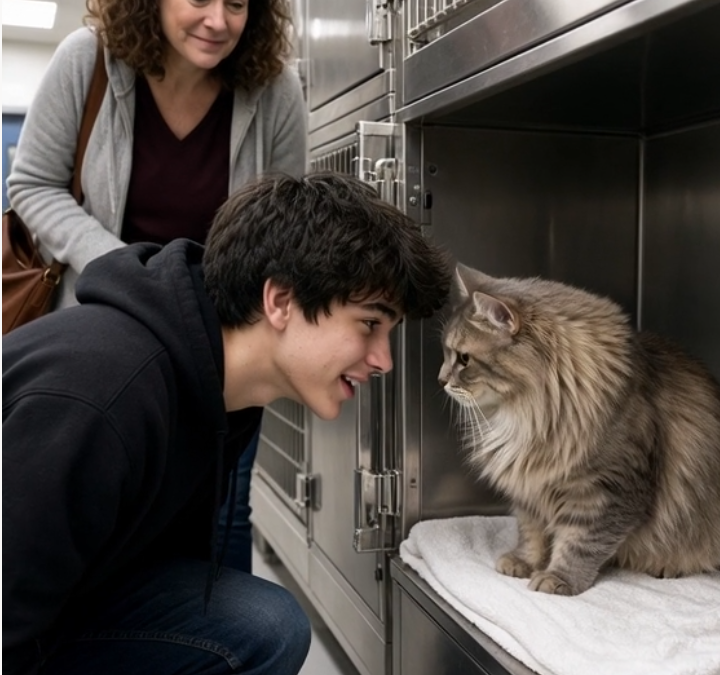
We Went to Adopt the Cat Everyone Wanted — But My Son Chose the One Nobody Could Touch
We went to the shelter for a cat everyone wanted, but my son chose the one nobody could touch.
She had been returned twice for being too frightened to love, while my son had spent years pretending he did not care that nobody chose him either.
What happened after they found each other quietly changed our home, our school, and everyone who had ever mistaken fear for brokenness.
That morning, our living room looked like we were expecting royalty.
There was a soft gray bed beside the front window. A small ceramic bowl sat near the kitchen wall. A basket of toys rested beneath the coffee table, each one chosen carefully by my thirteen-year-old son, Evan, after he had spent nearly an hour reading online reviews.
A blue feather wand.
A stuffed mouse filled with catnip.
A little ball with a bell inside.
And a folded cream-colored blanket that Evan had carried from the laundry room and placed inside the bed with both hands.
“She might like this,” he said.
That was the most hopeful I had heard him sound in months.
I looked at him standing there in the middle of the living room, thirteen years old, thin from another growth spurt, his dark hair falling into his eyes. He wore an old green sweatshirt and socks that did not match. One had tiny planets on it. The other had a faded basketball logo.
He was trying to act casual.
But he kept glancing at the bed.
He had also vacuumed the floor twice.
He had asked me whether cats preferred white noise.
He had moved the water bowl three times because he had read that cats did not like eating too close to their litter box.
He had even searched whether a cat would feel safer if the curtains were open or closed.
I pretended not to notice how much he cared.
Children hate being caught hoping.
Especially children who have already learned how badly hope can hurt.
Our house had been too quiet for too long.
Not empty exactly.
There were always dishes in the sink, homework on the table, laundry waiting to be folded, and the hum of the refrigerator filling the spaces between us.
But it was quiet in the way a place becomes quiet when people stop laughing without realizing it.
Evan came home from school, dropped his backpack by the stairs, and disappeared into his room.
I made dinner.
He usually came down after I called him twice.
“How was your day?”
“Fine.”
“Did you finish your science project?”
“Almost.”
“Are you hungry?”
“Not really.”
Then he would eat half a sandwich, stare at the table, and return upstairs.
He was not rude.
That would have been easier.
Rudeness gives you something to confront.
Evan was polite.
He held doors open.
He thanked cashiers.
PART2:
He said excuse me when other people bumped into him.
He did everything right, then slowly vanished in plain sight.
So when he asked if we could adopt a cat, I said yes before fear could talk me out of it.
We had owned a cat once before.
Her name had been Tilly, and she had lived with us for eleven years. Tilly slept on Evan’s pillow when he was little. She followed him from room to room. She had been there when his father left, when I lost my job, when Evan started middle school, and when my mother died.
Then, one winter morning, Tilly stopped eating.
The veterinarian found a tumor.
We had to let her go.
Evan was eleven.
He did not cry at the clinic.
He stood beside the examination table with both hands in the pockets of his jacket while I held Tilly’s head.
Afterward, in the car, he stared out the window.
At home, he carried Tilly’s blanket upstairs and put it in the closet.
He did not mention her again for almost a year.
Then, one evening, he asked whether some cats had trouble finding new homes.
I told him they did.
“Why?”
“Some are older. Some are shy. Some need medication.”
He thought about that.
“What if nobody wants them?”
I said the usual thing.
“Someone usually comes along.”
PART3:
But I knew that was not always true.
A week later, he showed me a picture on his tablet.
It was a long-haired gray-and-white cat with enormous green eyes. Her name was Juniper. The shelter description called her affectionate, playful, and good with children.
Evan stared at the picture for almost ten minutes.
“That one,” he said.
We drove to the shelter the following Saturday.
The parking lot was crowded. Families were coming and going with cardboard carriers. A little boy held a kitten against his chest while his father tried to keep the animal from climbing up his jacket.
Inside, the front room was bright and noisy.
Kittens pawed at the glass.
Young cats rolled onto their backs.
A large orange tabby stretched in full view of everyone passing by.
People stopped there.
People smiled there.
A woman picked up a kitten and pressed its nose to her daughter’s cheek.
A teenage girl squealed when a black-and-white cat rubbed against the bars of its cage.
Evan stood quietly beside me.
His eyes tracked every animal.
Then he saw Juniper.
Except someone else was already filling out the paperwork.
A couple stood at the front desk with a carrier. The woman was holding a clipboard. The man was laughing as Juniper climbed over his arm like she had already decided he belonged to her.
Evan’s shoulders dropped.
The shelter volunteer looked at us with a sympathetic smile.
“I’m sorry,” she said. “They were approved just a few minutes ago.”
“Oh,” I said. “That’s okay.”
Evan nodded.
He did not say anything.
The volunteer glanced at the computer.
“There’s another long-haired girl,” she said. “She’s been here a while.”
“How long?” I asked.
The woman hesitated.
“Long enough.”
I noticed the phrase.
Not two months.
Not six weeks.
Long enough.
She led us past the bright cages near the front and down a narrow hallway.
The noise changed as we walked.
Behind us, kittens meowed and children laughed. In front of us, the hallway grew quieter. The walls were painted the same cheerful yellow, but the light seemed dimmer. A mop bucket sat near a storage closet. A bulletin board displayed faded adoption photos, some curling at the edges.
“This room is for cats who need more space,” the volunteer explained.
Her name tag said LUCY.
Evan walked beside me without speaking.
At the end of the hallway, Lucy opened a door with a small window.
Inside were four larger enclosures.
One held a senior black cat sleeping with his face pressed into a stuffed rabbit. Another held two orange brothers curled together in a hammock. The third was empty except for a folded towel and a sign that read, “Adoption pending.”
The fourth enclosure looked empty at first.
Then I saw the eyes.
Two green eyes stared out from behind an overturned cardboard box.
Lucy lowered her voice.
“This is Marlowe.”
Evan stepped closer.
The card clipped to the enclosure door was much shorter than the others.
MARLOWE
Female, approximately 4 years old
Long-haired gray and white
Quiet home required
No dogs
Experienced adopter preferred
Underneath, in smaller print, someone had handwritten:
Please move slowly. Do not reach.
Evan read the card twice.
“Why does it say not to reach?” he asked.
Lucy’s smile faded.
“Marlowe gets scared when people try to touch her before she’s ready.”
“How scared?”
Lucy looked at me first, then back at Evan.
“She hides. Sometimes she swats if someone corners her.”
Evan nodded, as if that made perfect sense.
“How long has she been here?”
Lucy hesitated again.
“Eight months this time.”
“This time?” I asked.
Lucy’s fingers tightened slightly around the folder she carried.
“She was adopted twice and returned.”
Evan looked at the green eyes behind the box.
“Why?”
“The first family thought she would warm up faster. They had young kids. It was too much for her.”
“And the second?”
Lucy’s voice softened.
“The second adopter said she was impossible.”
I felt Evan stiffen beside me.
Impossible.
I hated that word.
People used it when patience became inconvenient.
Lucy continued carefully.
“Marlowe hid under a bed for most of the two weeks she was there. The adopter tried to pull her out because she thought Marlowe needed to ‘get used to people.’ Marlowe scratched her. Not badly, but enough. She came back the next morning.”
Evan’s eyes remained on the cat.
“She was scared.”
“Yes.”
“Then why did they pull her out?”
Lucy swallowed.
“I don’t know.”
Evan lowered himself to sit on the floor outside the enclosure.
Not crouch.
Not lean.
Sit.
The way he sat in school hallways when he wanted to disappear during parent-teacher conferences or basketball games or any place where other kids moved too loudly around him.
I opened my mouth to tell him the floor was dirty.
Then I closed it.
Marlowe’s eyes shifted toward him.
Evan did not move.
He tucked his mismatched socks beneath him and rested his hands in his lap.
“Hi,” he said quietly. “You don’t have to come out.”
Marlowe stayed hidden.
Lucy looked at me.
Most people, I realized, did not sit down for Marlowe.
Most people looked at the warning card, heard the word scratched, and moved back toward the kittens.
“Evan,” I said gently, “we can look at other cats too.”
He did not answer right away.
Then he said, “I want to stay here a minute.”
So we stayed.
The shelter sounds drifted through the wall: doors opening, dogs barking somewhere far away, a little girl laughing, a phone ringing at the front desk.
Marlowe did not come out.
Evan did not look disappointed.
He watched her the way some people watch candles.
Patiently.
After almost ten minutes, one gray paw appeared beside the box.
Then disappeared.
Evan’s mouth moved slightly, but he did not smile fully.
He knew better than to celebrate too loudly.
Another minute passed.
Marlowe leaned forward just enough for us to see more of her face.
She was beautiful, but not in the easy way Juniper had been beautiful.
Juniper had looked like a cat in an advertisement: fluffy, bright-eyed, confident. Marlowe’s beauty felt hidden under worry. Her fur was long and smoky gray over her back, white across her chest and front paws. One ear had a tiny split near the tip. Her whiskers looked too long for her narrow face. Her green eyes were huge and watchful.
She looked ready to run from a world that had only ever reached too fast.
Evan whispered, “She’s not impossible.”
Lucy’s eyes filled.
“No,” she said. “She isn’t.”
I looked at my son sitting on the floor, so still, so careful, so completely himself in a way I had not seen in months.
And fear rose inside me.
Not because of Marlowe.
Because of Evan.
I knew that look on his face.
The look of recognition.
Children can see themselves in things adults call damaged.
I did not want him to choose pain because it felt familiar.
I did not want him to take home a cat who might hide from him for months and deepen the quiet that already scared me.
I did not want his hope placed in another small body that might not be able to return it.
But then Marlowe did something tiny.
Almost nothing.
She blinked.
Slowly.
Once.
Evan inhaled like someone had handed him a secret.
I felt my fear loosen.
Not disappear.
Just loosen.
Lucy said, “You don’t have to decide today.”
Evan finally looked up at me.
His face was calm, but his eyes were not.
“Mom,” he said.
Just that.
Not please.
Not I want her.
Not this one.
He only said my name as if he trusted me to understand.
I did.
That was how we went to adopt the cat everyone wanted and applied for the one nobody could touch.
The shelter did not approve us immediately.
That was the first hard lesson.
Lucy took us into a small office near the back. A woman named Denise, the adoption coordinator, joined us with Marlowe’s file. She was kind, but serious.
“I want to be very clear,” Denise said, folding her hands on the desk. “Marlowe is not an easy placement.”
Evan sat beside me, hands tucked under his thighs.
“I know.”
“She may hide for weeks.”
He nodded.
“She may not allow touch for a long time.”
He nodded again.
“She may never become a lap cat.”
“That’s okay.”
Denise studied him.
A lot of adults do that to children like Evan.
They study them when they do not react the expected way.
“What if she never wants to be picked up?” Denise asked.
“I don’t like being picked up either,” Evan said.
Denise blinked.
Then her expression softened.
“That’s fair.”
I tried not to smile.
Denise turned to me.
“Marlowe will need a quiet introduction room. No forced handling. No reaching into hiding spaces. No chasing. No visitors for the first few weeks. She needs routine and patience.”
“We can do that,” I said.
Denise looked back at Evan.
“And if she scratches?”
“I’ll move slower next time,” he said.
I felt something twist in my chest.
Denise was silent for a moment.
Then she closed the file.
“I’m going to approve a foster-to-adopt trial.”
Evan sat up straighter.
“Trial?”
“Thirty days. We’ll check in weekly. If Marlowe is too stressed or if you change your mind, she comes back here. No shame. No blame.”
Evan looked toward the door that led back to the cat room.
“She’s already come back twice.”
“I know.”
He swallowed.
“We’re not bringing her back because she’s scared.”
Denise’s eyes flicked to me.
I heard the question there.
Can he handle this?
I did not know.
But I also knew that adults had been asking versions of that question about Evan for years.
Can he handle middle school?
Can he handle group work?
Can he handle lunchroom noise?
Can he handle presenting in front of class?
Can he handle being invited to a birthday party where he knows only one person?
The better question had always been:
Can the world handle him gently enough?
I looked at Denise.
“We understand this is a commitment,” I said. “If Marlowe is willing to try, we are too.”
Marlowe came home three days later.
The shelter staff placed a towel over the carrier to keep her calm. Evan sat in the back seat beside it, one hand resting on the seat but not touching the carrier. He had written a list on an index card and taped it to his bedroom door that morning.
Marlowe Rules
- Do not reach.
- Do not chase.
- Sit low.
- Talk softly.
- Let her decide.
- Tiny bravery still counts.
When we opened the carrier in the spare room, Marlowe did not move for seventeen minutes.
Evan sat against the opposite wall with his knees up and a book open on his lap.
I hovered in the doorway until he looked at me.
“Mom.”
“I know.”
“You’re hovering.”
“I’m being supportive.”
“You’re breathing loudly.”
I almost laughed.
“Sorry.”
I left the room and stood outside the door like a ridiculous spy.
Eventually, I heard the faintest sound.
A step.
Another.
Then nothing.
When Evan came downstairs an hour later, he looked exhausted and radiant.
“She went under the chair,” he said.
“That’s good?”
“That’s really good.”
So began the smallest season of our lives.
For the first week, Marlowe lived under the old armchair in the spare room.
Food disappeared overnight. The litter box was used. A toy mouse moved from one side of the room to the other, though we never saw her touch it.
Evan visited before school and after school and before bed.
He did not try to pet her.
He sat on the floor and read quietly.
At first, he read his homework.
Then comic books.
Then random articles from his tablet.
One night, I passed the hallway and heard him reading aloud in a soft, serious voice.
“Cats can hear sounds at frequencies much higher than humans. That probably sounds terrible sometimes. I also hate the cafeteria.”
A pause.
Then he added, “Not because of the food. The food is bad, but that’s not why.”
I leaned against the hallway wall.
“They make you sit at tables,” he continued. “And if you sit alone, everyone sees. But if you sit with people who don’t want you there, that’s worse.”
My breath caught.
Evan had never told me that.
He had told Marlowe.
Under the chair, there was no response.
But Evan stayed.
“She might not come out,” he said.
Another pause.
“I wouldn’t either.”
After that, I stopped asking him what they talked about.
Some conversations are only possible when nobody expects an answer.
By the second week, Marlowe began coming out at night.
We knew because the motion camera Evan had convinced me to buy captured grainy footage of her exploring the room at 2:13 a.m. She sniffed the scratching post. She batted the ball with the bell once, then startled at the sound and ran back under the chair. Evan watched that twelve-second video before school at least nine times.
“She played,” he said.
“She attacked a bell and fled.”
“That counts.”
It did.
On day eleven, I saw her for the first time outside the chair.
I opened the spare room door to place fresh water inside and froze.
Marlowe stood on the windowsill.
Sunlight touched her fur, turning gray into silver. Her tail hung low, but not tucked. Her eyes widened when she saw me.
I lowered my gaze immediately.
“Sorry,” I whispered. “Just water.”
She did not run.
I placed the bowl down slowly and backed out.
At dinner, I told Evan.
His fork stopped halfway to his mouth.
“She stayed?”
“She stayed.”
He smiled down at his plate.
Not a big smile.
But real.
At school, things were not improving.
I wanted to believe Marlowe would change everything instantly.
That was selfish.
Healing does not work like a movie.
Evan still came home quiet. He still disappeared upstairs. He still answered “fine” when I asked about his day.
Then one Thursday, his English teacher called.
Mrs. Keller had a voice that sounded permanently tired.
“Mrs. Parker, I wanted to let you know there was an incident today.”
My heart sank.
“Is Evan okay?”
“He’s not hurt.”
That is not the same thing, I thought.
“What happened?”
“We were doing peer presentations. Evan refused to present.”
“He refused?”
“He stood up, then just froze. Some students laughed. I tried to redirect, but he left the room without permission.”
I closed my eyes.
“Where did he go?”
“To the counselor’s office. He’s there now.”
“I’m coming.”
When I arrived at the school, Evan was sitting in the counselor’s office with his backpack at his feet and his sweatshirt sleeves pulled over his hands.
The counselor, Mr. Alvarez, sat nearby but not too close.
I had always liked him. He never spoke to Evan in the fake cheerful voice some adults used when they were uncomfortable.
“Hey,” I said softly.
Evan did not look up.
Mrs. Keller stood near the door, arms crossed.
“We need to discuss expectations,” she said.
I looked at my son.
“What happened?”
“I couldn’t do it.”
His voice was flat.
Mrs. Keller sighed.
“He prepared. I know he did. The issue is that when students opt out, it becomes—”
“He didn’t opt out,” Mr. Alvarez said quietly.
Mrs. Keller paused.
“He left.”
“He panicked.”
The word hung there.
Evan’s shoulders tightened.
I saw it happen.
That awful shrinking.
That instant shame.
Mrs. Keller’s face softened slightly, but she still looked frustrated.
“I understand anxiety is involved, but we also have standards.”
Mr. Alvarez turned toward her.
“Standards without support are just traps.”
I wanted to hug him.
Mrs. Keller flushed.
“That’s not fair.”
“No,” he said. “But it’s accurate.”
I sat beside Evan.
“Did someone laugh?”
He shrugged.
That meant yes.
“Who?”
Another shrug.
Mrs. Keller said, “A few students reacted inappropriately. I addressed it.”
Evan looked up then.
“After.”
One word.
Sharp as glass.
Mrs. Keller had no answer.
On the drive home, Evan stared out the window.
I wanted to say a hundred things.
I am sorry.
You are not broken.
Middle school is a poorly supervised social experiment.
Please tell me when things hurt.
Instead, I said, “Do you want fries?”
He looked at me.
“What?”
“Fries.”
“I failed a presentation.”
“I know.”
“And your plan is fries?”
“My plan is carbs first, emotional processing later.”
For the first time that day, he almost smiled.
We got fries.
At home, he took the bag upstairs to the spare room.
I did not stop him.
Later, when I passed the door, I heard him talking to Marlowe.
“I froze,” he said.
Silence.
“Not like cold. Like my body just stopped.”
A faint rustle.
“They laughed.”
Long pause.
“I know people probably laughed at you too when you came back.”
The room stayed quiet.
Evan’s voice dropped.
“But you’re still here.”
I stood in the hallway with tears in my eyes.
Then I heard something else.
A soft step.
Then another.
I pressed my hand to my mouth.
When Evan came downstairs that night, his eyes were red, but he looked different.
“She came out,” he said.
I stayed very still.
“How close?”
He held his hands about two feet apart.
“She ate a fry.”
“She cannot have fries.”
“I know. It fell. She chose crime.”
I laughed so hard I cried.
By the end of the third week, Marlowe had expanded her kingdom to half the spare room.
She still hid when I entered.
But with Evan, she stayed visible.
Sometimes.
She sat under the desk while he did homework. She watched him build model airplanes. She sniffed his shoes and then looked offended, which was fair.
On day twenty-one, she touched his sock.
He came downstairs pale with wonder.
“She touched me.”
“With what?”
“Her nose.”
“Did you move?”
“No.”
“Did you breathe?”
“Barely.”
“Did you cry?”
He gave me a look.
“No.”
Then, after a pause, “Maybe a little after.”
I pulled him into a hug before he could dodge.
He allowed it for exactly three seconds.
Progress all around.
The foster-to-adopt check-in came on day twenty-eight.
Denise called from the shelter.
“How is Marlowe doing?”
Evan sat beside me at the kitchen table with a notebook open.
I put the call on speaker.
“She comes out every day now,” he said.
“That’s wonderful.”
“She eats when I’m in the room. She touched my sock. She played with the feather wand twice, but only if I drag it away from her and don’t make it jump.”
Denise laughed softly.
“Very specific.”
“I made a chart.”
Of course he had.
He turned the notebook toward me.
Marlowe Brave List
Day 1: Left carrier.
Day 4: Ate while I was in hallway.
Day 8: Moved mouse toy.
Day 11: Stayed on window when Mom came in.
Day 14: Played with bell ball but got mad at it.
Day 16: Ate near me.
Day 19: Came out after school.
Day 21: Nose touched sock.
Day 24: Slept under desk while I did math.
Day 26: Blinked at me twice.
Denise was quiet after he read it.
Then she said, “Evan, I wish every adopter made lists like that.”
He looked embarrassed.
“It helps.”
“With what?”
He shrugged even though she could not see him.
“Seeing that things are changing even when they feel like they aren’t.”
I looked away.
Denise said gently, “That’s very wise.”
“Can we keep her?” he asked suddenly.
There it was.
The question he had been holding like a breath for four weeks.
Denise answered without hesitation.
“Yes.”
Evan closed his eyes.
I signed the final adoption papers the next afternoon.
Marlowe Parker.
Ours.
Not because she had become easy.
Because she had become home.
The change in our house was slow, but undeniable.
Evan spent less time behind his closed bedroom door and more time on the spare room floor. He started eating dinner at the table again, partly because Marlowe began sitting just outside the kitchen doorway at meals, pretending she had no interest in us while clearly monitoring the possibility of chicken.
He told me small things.
Not everything.
But small things.
A boy named Tyler had started calling him “Statue” after the presentation incident.
The cafeteria was loudest on pizza days.
Science class was better because his lab partner, Maya, did not talk much either.
He hated when adults said “use your words” because sometimes words were exactly the problem.
I listened.
Really listened.
The way Evan listened to Marlowe.
No reaching.
No chasing.
No forcing him out from under the emotional furniture before he was ready.
One night, while I washed dishes, Evan leaned against the counter.
“Do you think Marlowe was different before?”
“Before the shelter?”
He nodded.
“Probably.”
“Do you think she was happy?”
“I hope so.”
“What if she wasn’t?”
I turned off the water.
“Then she can still be happy now.”
He looked toward the spare room.
“Even if she stays scared?”
“Yes.”
“How?”
“Because scared and happy can exist in the same life. One doesn’t cancel the other.”
He considered that for a long time.
Then he said, “That seems important.”
“It is.”
The next week, Mr. Alvarez called me.
Not because of an incident.
Because of an idea.
“Evan wrote something,” he said.
My stomach tightened automatically.
“What kind of something?”
“An essay for English. Mrs. Keller gave students an option to write a reflection instead of presenting, after we discussed accommodations.”
I kept quiet.
“He wrote about Marlowe.”
“Oh.”
“It’s very good.”
That surprised me less than it should have. Evan wrote beautifully when he did not think anyone would read it.
“Mrs. Keller would like to ask his permission to share it with the class.”
“No.”
The word came out too fast.
Mr. Alvarez waited.
I took a breath.
“I mean, not unless Evan wants that. And not in a way that makes him feel displayed.”
“I agree.”
“What does Evan say?”
“He said he would think about it.”
That afternoon, I asked him.
He was sitting on the spare room floor. Marlowe lay three feet away, paws tucked, eyes half-closed.
“I don’t know,” he said.
“About sharing the essay?”
“Yeah.”
“You don’t have to.”
“I know.”
“Do you want to?”
“I want them to understand.”
“That’s different from wanting attention.”
He nodded.
“What if they laugh again?”
I sat beside him, leaving enough space.
“Then they’re wrong again.”
He looked at Marlowe.
She opened one green eye.
“I wrote that she wasn’t mean,” he said. “Just scared.”
“That sounds true.”
“I wrote that people kept trying to touch her because they wanted proof she was lovable.”
My throat tightened.
“And?”
“And maybe she didn’t owe people proof.”
Marlowe blinked slowly.
I whispered, “Evan.”
He looked at me.
“That’s beautiful.”
He shrugged, but his face colored.
“I don’t know if they’ll get it.”
“Some will.”
“Some won’t.”
“No.”
He sighed.
“Marlowe wouldn’t care if they got it.”
“No,” I said. “She would probably go under the chair.”
He smiled.
“Smart.”
In the end, Evan allowed Mrs. Keller to read his essay aloud, but he asked not to stand at the front of the room.
That mattered.
So did the fact that she honored it.
He sat at his desk while she read.
The essay was titled “The Cat Nobody Could Touch.”
Mrs. Keller emailed me a copy afterward.
I read it sitting alone at the kitchen table, crying so hard the words blurred.
Marlowe was not broken when we met her. She was doing exactly what her life had taught her to do. If a hand had always meant danger, then hiding from hands was not bad behavior. It was memory.
People kept saying she needed to learn to trust. That is true. But I think people also needed to learn to be trustworthy.
At the shelter, everyone wanted the cats who came forward. I understand why. It feels good to be chosen quickly. But Marlowe stayed in the back, and I think she was still asking a question. Not “Will you love me?” but “Will you leave if I can’t love you back right away?”
Some animals need time. Some people do too.
I used to think brave meant not being afraid. Now I think brave can mean eating while someone sits nearby. Sleeping where someone can see you. Touching a sock with your nose. Coming back out after you hid.
Marlowe is brave every day.
Maybe some people are too.
Mrs. Keller said the room was silent when she finished.
Not awkward silent.
Listening silent.
Then Maya, Evan’s lab partner, raised her hand and said, “My rabbit took six months to let me pet him.”
Another student said his rescue dog still hated men in hats.
A girl in the back said she cried in bathrooms during assemblies because loud rooms made her chest hurt.
Tyler, the boy who had called Evan “Statue,” said nothing.
But the next day, he stopped saying it.
That would have been enough for me.
But Evan’s essay kept moving.
Mrs. Keller asked if she could share it with the school counselor for a kindness bulletin. Evan agreed if his last name was removed. Mr. Alvarez shared it with the principal. The principal read a paragraph during a staff meeting about supporting quiet students.
A week later, Willow Creek Middle School began a “quiet lunch” option for students who needed a calmer place to eat.
Not punishment.
Not isolation.
A room in the library with soft lights, small tables, books, and no forced conversation.
Evan went the first day.
So did Maya.
So did eleven other students.
By Friday, there was a waiting list.
Parents began emailing the school.
Some angry.
Most grateful.
One father wrote, “My daughter came home and said lunch didn’t hurt today.”
When Mr. Alvarez told me that, I sat in my car outside the school and cried.
All because of a cat under a chair.
All because of a boy who understood hiding was not the same as giving up.
Marlowe’s world grew too.
She left the spare room for the first time on a Sunday afternoon in May.
Evan sat in the hallway with the feather wand, dragging it lazily across the floor. Marlowe followed it to the doorway, then stopped. Her front paws crossed the threshold. Her back paws remained in the room.
For nearly five minutes, she stayed that way.
Half in the old world.
Half in the new one.
Evan did not move.
I stood in the kitchen pretending to read mail upside down.
Finally, Marlowe stepped into the hallway.
One step.
Then another.
Evan whispered, “Tiny bravery counts.”
She sniffed the baseboard.
Then walked straight into the living room, climbed into the soft gray bed beside the front window, circled twice, and lay down on the cream-colored blanket Evan had placed there weeks before she came home.
The bed that had waited for her.
The blanket that had been ready.
Evan sat in the hallway with tears running down his face.
I did not say anything.
Neither did he.
Marlowe closed her eyes in the sunlight.
After that, the living room slowly became hers.
She still ran when the doorbell rang. She still hid from visitors. She still refused to be picked up. But every evening, she came downstairs and settled near Evan’s feet while he did homework.
One night, months after the adoption, I woke to get a glass of water and found Evan asleep on the couch.
His notebook lay open on his chest.
Marlowe was curled against his side.
Not touching much.
Just enough.
One white paw rested on the edge of his sweatshirt.
I stood in the dark hallway and pressed a hand to my mouth.
I had wanted a cat to make the house less quiet.
I had not understood that quiet itself could change.
The old quiet had been emptiness.
This quiet was trust.
The shelter called in July.
For a moment, seeing the number on my phone made my stomach drop.
Old fear.
Had something gone wrong with the paperwork?
Had someone claimed Marlowe?
Had we misunderstood the adoption terms?
But it was Denise.
“Everything is fine,” she said quickly, as if hearing my panic through the phone.
I sat down.
“Thank God.”
“I’m sorry. I should have started with that.”
“What’s up?”
“We’re doing a training for volunteers about shy and fearful cats. Lucy mentioned Evan’s brave list and his essay.”
“Oh.”
“We were wondering if he’d allow us to read part of it.”
I looked toward the living room, where Evan was lying on the floor with Marlowe three feet away, both of them watching a nature documentary with equal seriousness.
“I’ll ask him.”
Evan listened to the request without expression.
Then he said, “Will Marlowe have to go?”
“No.”
“Will people come here?”
“No.”
“Will they say her name?”
“Only if you say yes.”
He thought for a long time.
Then he said, “They can use it. But they should know she still doesn’t like being touched by strangers. Not like a sad thing. Just a fact.”
“I’ll tell them.”
“And they should stop saying cats are spicy when they’re scared.”
I blinked.
“What?”
“People online say spicy. Like it’s funny when cats hiss.”
“Oh.”
“It’s not funny if they’re terrified.”
I looked at my son, who at thirteen had understood something many adults never did.
“I’ll tell them that too.”
The shelter training changed more than I expected.
Lucy emailed us afterward.
Today we changed Marlowe’s old kennel card template into a new one for fearful cats. We’re calling it “Let Me Decide.” It explains consent, patience, hiding spaces, slow introductions, and what bravery can look like. Evan’s words helped us do that.
Attached was a photo of the new sign.
LET ME DECIDE
Some cats need time before touch.
Hiding is communication.
Fear is not failure.
Patience saves lives.
Evan read it twice.
Then he said, “Good.”
That was all.
But he printed the photo and taped it inside his closet door.
Beside Tilly’s old picture.
In August, just before school started, something happened I had stopped waiting for.
Evan invited someone over.
Maya.
His lab partner.
I tried to behave normally when he told me.
I failed.
“You can stop smiling,” he said.
“I’m not smiling.”
“You look weird.”
“I always look weird.”
“More weird.”
Maya came on a Thursday afternoon carrying a backpack and a container of homemade cookies. She was small, serious, and wore noise-reducing earbuds around her neck. She greeted me politely, then said, “I understand Marlowe may not come out.”
Evan looked relieved.
“She probably won’t.”
“That’s okay.”
They sat in the living room and worked on a summer reading assignment. Marlowe watched from under the couch.
After an hour, Maya said, without looking away from her book, “My rabbit used to hide behind the washing machine.”
Evan said, “Did he come out?”
“Yes. For cilantro.”
“Marlowe likes chicken.”
Maya nodded.
“Reasonable.”
That was their whole conversation for ten minutes.
I loved Maya immediately.
Marlowe did not come out that day.
But she did not run upstairs either.
When Maya left, Evan said, “She’s okay.”
“Maya?”
“Marlowe.”
“Ah.”
Then, after a pause, “Maya too.”
It was the closest he had come to admitting friendship.
Middle school did not become easy.
Of course it did not.
There were still hard days. Loud days. Days when Evan came home and went straight upstairs. Days when Tyler made a comment under his breath. Days when teachers forgot accommodations and had to be reminded. Days when I wanted to storm into the school and wrap my son in bubble wrap until adulthood.
But there were also different days now.
Quiet lunch.
Maya.
Mr. Alvarez.
Mrs. Keller checking in before presentations instead of after panic.
A small group of students who started spending library lunch drawing, reading, doing homework, or simply existing without performance.
Evan was not suddenly popular.
He did not want to be.
But he was less alone.
There is a difference.
One afternoon in October, the school hosted a community night about student mental health and belonging. Mr. Alvarez asked if Evan would allow his essay to be displayed anonymously on a table of student writing.
Evan said yes.
Then he changed his mind.
Then he changed it back.
At the event, I watched parents stand at the table and read his words.
Some cried.
Some took photos.
One mother pressed her hand to her mouth and whispered, “This is my son.”
A father said, “I think I’ve been pulling my kid out from under the bed.”
He did not mean literally.
Everyone understood.
Mrs. Keller stood beside me.
“I owe Evan an apology,” she said quietly.
I looked at her.
“For the presentation day?”
“For that and before that. I thought I was helping him by holding the same expectation for everyone.”
I waited.
She continued.
“But equal isn’t always fair.”
“No,” I said. “It isn’t.”
Her eyes were wet.
“I’m learning.”
That mattered.
Not as much as doing better.
But it mattered.
Evan stood across the room with Maya and two other quiet-lunch students. He looked uncomfortable but present. When Mr. Alvarez gestured for him to join a photo with the library group, Evan shook his head immediately.
Mr. Alvarez gave him a thumbs-up and did not ask again.
That mattered too.
On the way home, Evan said, “Mrs. Keller apologized.”
“She did?”
“Yeah.”
“How did that feel?”
“Awkward.”
“Good awkward or bad awkward?”
“Both.”
I nodded.
“Most real things are both.”
He looked out the window.
“Tyler’s mom read my essay.”
“Oh?”
“She cried.”
I kept my eyes on the road.
“What did Tyler do?”
“He left.”
“Are you okay?”
“Yeah.”
A few minutes later, he added, “He hasn’t called me Statue in a long time.”
“I noticed.”
“I don’t forgive him exactly.”
“You don’t have to.”
“But I don’t think he knows what to do when people are scared.”
“That’s generous.”
“It’s not generous. It’s just maybe true.”
I glanced at him.
Marlowe had changed him.
Not into someone softer.
He had always been soft.
She had made him less ashamed of it.
That winter, one year after Tilly died, Marlowe climbed into Evan’s lap for the first time.
It happened during a snow day.
School was closed. I was working from home at the dining table. Evan sat on the couch under a blanket, reading a fantasy novel thick enough to injure someone. Marlowe lay on the back of the couch, tail tucked.
Snow tapped against the windows.
The house was warm.
Ordinary.
Then Marlowe stood.
She stretched, stepped carefully down onto the cushion, and paused beside Evan’s leg.
He went completely still.
I saw it from the dining room.
She placed one paw on the blanket.
Then another.
Evan did not breathe.
Marlowe climbed into his lap, turned in a tight circle, and settled with her long gray tail wrapped over her nose.
Evan stared at her.
Then at me.
His eyes were enormous.
I silently held up both hands as if surrendering.
Do not move.
He looked back down.
Marlowe closed her eyes.
Ten minutes passed.
Then twenty.
My laptop went dark because I had stopped working.
Finally, Evan whispered, “Mom.”
“I know.”
“She chose.”
“I know.”
He began to cry.
Quietly.
Carefully.
Trying not to shake too much.
Marlowe opened one eye, decided the crying was not worth leaving over, and went back to sleep.
Evan laughed through tears.
That laugh filled the house.
It was not loud.
It was not dramatic.
But it reached corners that had been quiet for years.
Later, after Marlowe left his lap to eat dinner as if she had not just rearranged our entire universe, Evan went upstairs.
He came back holding Tilly’s old blanket.
The one he had put in the closet after she died.
He stood in the living room for a moment.
Then he folded it and placed it beside Marlowe’s gray bed.
I did not speak.
He said, “She might like this too.”
Marlowe sniffed it that evening.
The next morning, she was sleeping on it.
Some griefs do not leave.
They become part of the bedding of a new life.
Years later, people would say Evan rescued Marlowe.
That was true, in the simple way people like to tell stories.
But it was also incomplete.
Marlowe rescued Evan from believing he was too quiet to be chosen.
Evan rescued me from thinking my son’s silence meant he did not want to be reached.
Together, they rescued our house from the kind of quiet that grows when everyone is trying not to hurt.
Marlowe never became the cat everyone could touch.
She remained selective.
She hid from most visitors. She disliked sudden movements. She refused to be picked up her entire life. She trusted slowly and loved specifically. When she allowed affection, it felt like receiving something rare.
Evan never became the boy who loved crowds.
He remained thoughtful, quiet, easily overwhelmed by noise, deeply observant, and more patient than the world deserved. He learned to speak when he needed to, but he also learned that silence did not make him empty.
Their friendship became a language.
A blink.
A pause.
A hand held still.
A paw placed lightly on a blanket.
Tiny bravery, counted daily.
The shelter used Evan’s brave list in training for years.
Willow Creek Middle School kept the quiet lunch program long after Evan left eighth grade.
Mrs. Keller changed her presentation policy so students could demonstrate learning in different ways.
Mr. Alvarez kept a printed copy of Evan’s essay in his office, with Evan’s permission, and gave it to students who thought fear made them broken.
Maya remained his friend.
Tyler never apologized directly, but on the last day of middle school, he placed a folded note on Evan’s desk.
It said:
I read the cat thing. I was a jerk. Sorry.
Evan brought it home and showed me.
“What are you going to do?” I asked.
He shrugged.
“Keep it, maybe.”
“Why?”
“To remember people can be dumb and still change a little.”
That felt like wisdom I had not taught him.
Maybe Marlowe had.
On the anniversary of her adoption, we drove to the shelter with donations: blankets, food, toys, and a stack of printed “Tiny Bravery Counts” cards Evan had designed for shy-cat adopters.
Lucy still worked there.
When she saw Evan, she smiled so widely her eyes filled.
“How’s Marlowe?”
Evan pulled out his phone.
The most recent photo showed Marlowe lying on his desk while he tried to do homework, one paw resting on his notebook as if preventing academic progress.
“She helps,” he said.
Lucy laughed.
“She looks comfortable.”
“She is.”
That word held everything.
Comfortable.
For a cat once called impossible.
For a boy once mistaken for unreachable.
Before we left, Lucy asked if Evan wanted to see the cats.
He hesitated.
Then nodded.
We walked through the bright front room with the kittens and the confident cats and the families smiling at cages.
Then we went down the narrow hallway.
In the quiet room, a small brown tabby sat hidden behind a litter box, only her ears visible.
A card on the door read:
PENNY
Very shy
Needs patient home
Please sit quietly
Evan lowered himself to the floor.
He was taller now, fourteen, all knees and elbows, his hair still falling into his eyes.
He sat the way he had sat for Marlowe.
Not demanding.
Not performing kindness.
Just present.
Penny’s ears twitched.
Evan smiled faintly.
“Hi,” he whispered. “You don’t have to come out.”
Lucy stood beside me.
I cried silently.
She pretended not to notice.
After a while, Penny leaned forward just enough to show one eye.
Evan did not move.
Tiny bravery counted.
It always had.
That night, when we came home, Marlowe met Evan at the door.
Not me.
Evan.
She stood in the hallway with her tail high, then immediately turned and led him toward the kitchen because affection was lovely but dinner mattered.
He laughed and followed her.
I stood in the entryway, holding the empty donation boxes, listening to my son talk to his cat.
“Yeah, yeah, I know. You almost starved. Your bowl has been empty for twelve minutes. A tragedy.”
Marlowe chirped.
He gasped.
“Don’t use that tone with me.”
She chirped again.
He laughed harder.
The sound moved through the house, warm and alive.
I thought back to the day we had prepared for Juniper, the beautiful cat everyone wanted. The soft gray bed. The ceramic bowl. The basket of toys. The cream blanket folded with such careful hope.
I thought of Evan’s face when Juniper was already chosen.
How easily that could have been the end of the story.
Instead, a volunteer had said, “There’s another long-haired girl.”
Long enough.
That was what Lucy had said.
Marlowe had been waiting long enough.
So had Evan.
Maybe we all had.
That night, Marlowe slept at the foot of Evan’s bed.
Tilly’s old blanket lay beneath her.
The blue feather wand rested on the floor.
Evan’s notebook sat open on his desk. Inside was a new list, written in his careful handwriting.
Things Marlowe taught me:
Scared is not the same as mean.
Quiet is not the same as empty.
Trust cannot be rushed.
Some people need you to sit on the floor.
Tiny bravery counts.
Being chosen slowly still means being chosen.
I read it after he fell asleep because I was his mother and therefore morally inconsistent about privacy when notebooks were left open in plain sight.
Then I stood in his doorway.
My son slept curled on his side, one hand hanging off the bed.
Marlowe’s paw rested just beneath his fingers.
Not quite touching.
Close enough.
That was their way.
And as I watched them, I finally understood something I wish I had known much earlier.
Love does not always arrive loudly.
Sometimes it does not run to the front of the cage.
Sometimes it does not raise its hand in class.
Sometimes it does not ask for help in words.
Sometimes love sits in the back corner with wide green eyes, waiting to see if anyone will stop long enough to understand.
Sometimes love is a boy on a shelter floor whispering, “You don’t have to come out.”
Sometimes love is a frightened cat touching a sock with her nose.
Sometimes love is not fixing fear, but making room for it until safety grows beside it.
We had gone to the shelter for the cat everyone wanted.
But Evan chose the one nobody could touch.
And in the end, she touched everything.








