We Rushed to the Hospital at 3 A.M.—When We Came Home With Our Newborn, Our Cat Had Barricaded the Front Door With Everything From the Nursery
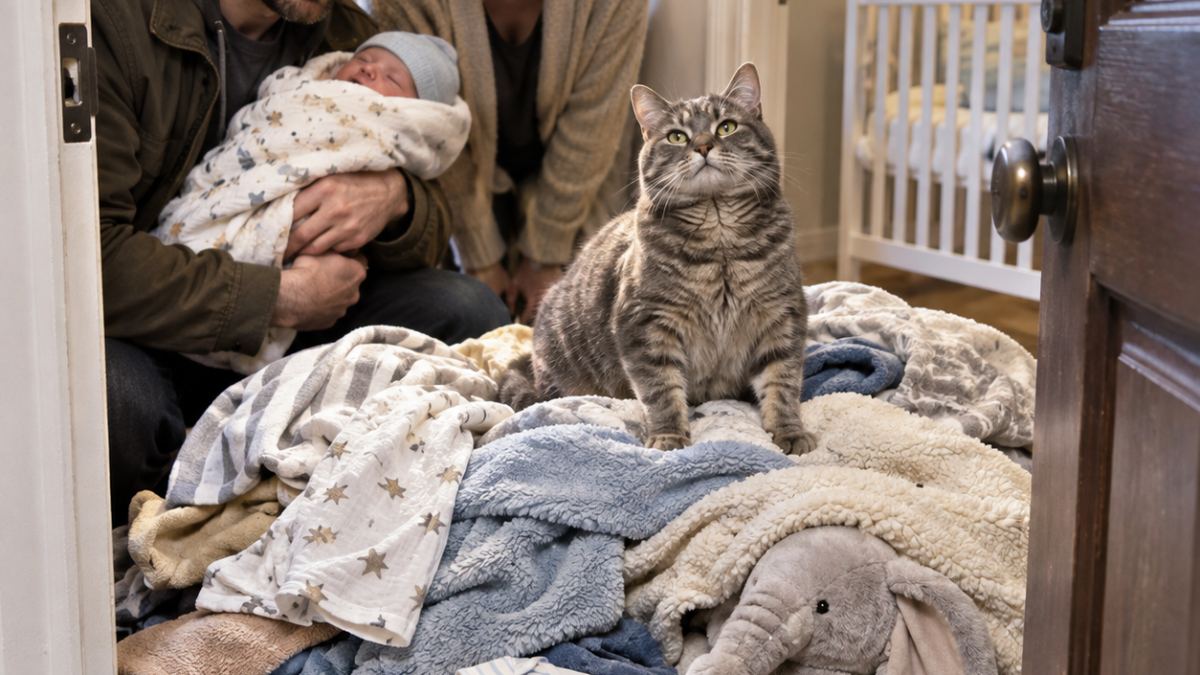
We Rushed to the Hospital at 3 A.M.—When We Came Home With Our Newborn, Our Cat Had Barricaded the Front Door With Everything From the Nursery.
My wife went into labor three weeks early at three in the morning, and forty-eight hours later I came home carrying our newborn only to discover that our four-year-old cat had dragged blankets, baby clothes, towels, and even a stuffed elephant into a wall against the front door.
Our neighbor swore Leon had behaved normally while we were gone, which meant sometime during the final night of our absence he had quietly opened a dresser drawer, emptied the nursery piece by piece, and built the strangest barricade I had ever seen.
But when I noticed exactly which objects he had chosen—and where he had placed every one of them—I began to wonder whether Leon had been trying to stop us from leaving again, or preparing for someone he somehow knew was coming home.
My wife woke me by saying my name once.
Not loudly.
That was what frightened me.
“Daniel.”
I opened my eyes.
The bedroom was dark except for the blue numbers on the alarm clock.
3:07 a.m.
Claire was sitting upright beside me.
One hand pressed against the mattress.
The other rested low against her stomach.
For several seconds, neither of us spoke.
Then I saw her expression.
“You okay?”
She inhaled slowly.
“I think so.”
That was not an answer.
I pushed myself up.
“What happened?”
Another contraction hit before she could answer.
I watched her close her eyes.
Her fingers tightened around the sheet.
“Claire?”
“Just…”
She breathed.
“Give me a second.”
I was instantly awake.
Our baby was not supposed to come for another three weeks.
We had been told repeatedly that first babies were often late.
We had built our entire sense of readiness around that idea.
Three more weeks.
Three more weekends.
Three more grocery runs.
Three more opportunities to become the kind of adults who knew what they were doing.
The hospital bag was technically packed, but there were still things sitting beside it.
Phone charger.
Hairbrush.
A pair of socks Claire wanted.
Insurance paperwork I had promised to put in the folder and had not.
The nursery was ready in the way rooms are ready before the person they belong to exists inside them.
Crib assembled.
Diapers stacked.
Baby clothes washed.
Blankets folded.
PART2:
A pale green stuffed elephant sitting in the corner of the crib even though the parenting book said absolutely nothing should be in the crib once the baby was actually sleeping there.
Everything waiting.
Everything hypothetical.
Our daughter still existed mostly as movement under Claire’s skin and blurry ultrasound photographs attached to the refrigerator.
Then Claire opened her eyes and said, “I think my water broke.”
I stared at her.
She stared at me.
Neither of us moved.
Then Leon jumped onto the bed.
He was our four-year-old gray tabby.
Large enough that visitors regularly asked whether he was “part Maine Coon,” which he was not.
He was simply enormous.
Gray stripes.
White chin.
Green eyes.
A tail that looked as if it belonged to an animal twice his size.
Leon had slept between our feet almost every night since we adopted him.
He stepped directly onto my ankle.
Normally I would have pushed him away.
That morning I barely noticed.
“Okay,” I said.
Claire gave me a look.
“Okay?”
PART3:
“I mean, okay, we know what this is.”
“Do we?”
“No.”
Another contraction came.
That ended the conversation.
The next twenty minutes were chaos disguised as preparation.
I put on two different socks.
Could not find my wallet.
Found my wallet in the refrigerator because apparently I had placed it there after getting water the night before.
Claire changed clothes.
Then changed them again.
I called the hospital.
A nurse asked questions with the calm of somebody who had spoken to a thousand terrified first-time fathers.
How far apart are the contractions?
Any bleeding?
How far are you from the hospital?
How many weeks?
Thirty-seven.
Technically early term.
Still three weeks ahead of the date we had circled on every calendar in the house.
“Come in,” the nurse said.
Claire leaned over the kitchen counter through another contraction.
Leon stood three feet away.
Watching.
I remember that now.
At the time, I didn’t think anything of it.
Cats watch everything.
They watch you brush your teeth.
Watch you cook.
Watch you carry laundry.
Watch the wall for ten minutes because apparently the wall has committed some offense invisible to humans.
Leon watched us move through the house at three in the morning.
He watched me grab the blue hospital bag.
Watched Claire put on her coat.
Watched me return twice because I had forgotten her water bottle and then the folder with the insurance cards.
Finally, Claire stood by the door.
I opened it.
Leon came toward us.
“Not you, buddy.”
I used my foot gently to block him.
He stopped.
Looked at me.
Then at Claire.
She crouched as much as her body allowed.
“We’ll be back.”
She scratched under his chin.
“You’re getting a baby.”
Leon blinked.
“He has absolutely no idea what that means,” I said.
Claire managed a smile.
“Neither do we.”
Then we left.
I closed the door.
Locked it.
And drove my wife to the hospital while she breathed through contractions and I pretended every red light was a personal attack.
What I did not know was that Leon stayed beside that door after we disappeared.
And somewhere inside that strange, observant little brain of his, something had changed.
The drive took eighteen minutes.
It felt like three hours.
At one point Claire grabbed the handle above the passenger door and said, “Daniel, stop talking.”
“I’m not talking.”
“You’re narrating.”
Apparently I had been giving live updates.
“We’re almost there.”
“Traffic is clear.”
“That guy is driving too slow.”
“I can see the hospital.”
She was right.
I shut up.
The maternity entrance glowed beneath fluorescent lights.
I pulled into the drop-off lane.
A nurse appeared with a wheelchair.
Claire said she could walk.
The nurse said, “I know. Sit anyway.”
I loved her immediately.
By 4:02 a.m., we were in triage.
By 4:40, a doctor confirmed labor.
By 5:15, the phrase “three weeks early” had stopped sounding like a problem and started sounding like our new schedule.
Our daughter was coming.
Ready or not.
Claire was scared.
So was I.
But fear looks different when one person is actually doing the physical work.
My job became holding things.
Her hand.
Her water cup.
A cold cloth.
My own panic.
The sun came up behind the hospital blinds.
Then climbed.
Then moved across the room.
Labor took longer than television had taught me to expect.
There were no clean transitions.
No dramatic announcement followed by a baby thirty seconds later.
There was waiting.
Walking.
Monitoring.
Pain.
Nurses coming and going.
A doctor checking numbers.
My wife swearing at me once because I offered her ice chips during the wrong contraction.
I apologized.
She apologized.
Then told me she might swear again.
She did.
At 2:36 that afternoon, our daughter was born.
Seven pounds, one ounce.
Dark hair.
Angry lungs.
Tiny clenched fists.
The first sound she made rewired something inside me so quickly I could almost feel it happen.
One second I was a man standing beside a hospital bed.
Then somebody placed a crying human being against my wife’s chest.
And suddenly the entire world had one center.
Claire cried.
I cried.
The nurse pretended not to notice me crying.
Our daughter opened one eye.
Then closed it.
“She’s beautiful,” I said.
Claire laughed weakly.
“She looks furious.”
“She can be both.”
We named her Emma.
We had chosen the name months earlier but had told almost nobody.
For the next two days, the outside world became irrelevant.
Feedings.
Diapers.
Temperature checks.
Nurses.
Sleep in pieces so small they barely counted.
I texted our families.
Sent photographs.
Forgot whom I had sent them to and sent some people the same picture twice.
Claire’s mother called six times.
My brother asked whether the baby “looked like anybody yet.”
She looked like a very small elderly person who had just been deeply inconvenienced.
We told him that.
He said it was normal.
Meanwhile, Leon was home.
Our neighbor, Mrs. Patterson, had agreed weeks earlier to check on him if labor happened unexpectedly.
She lived across the hall.
Retired teacher.
Seventy-one.
Owned no pets because she said, “I spent thirty-eight years caring for other people’s children. I’ve completed my service.”
But she liked Leon.
Mostly because Leon liked her.
On Tuesday afternoon, she texted:
Leon fed. Water good. He stared at me while I cleaned litter. I feel judged.
I replied:
That means he likes you.
Wednesday morning:
All good. He ate everything. Sitting at window.
Then:
He tried to inspect my purse.
Normal.
Perfectly normal.
We had no reason to worry.
I remember lying in the hospital recliner Wednesday night with Emma asleep in the bassinet beside Claire.
The room was dark.
Claire whispered, “Do you think Leon knows?”
“Knows what?”
“That something changed.”
I looked at our daughter.
“He smelled the nursery for months.”
“That isn’t what I mean.”
“What do you mean?”
“I don’t know.”
She looked toward the bassinet.
“He knows we left differently.”
That stayed with me.
We had left the apartment plenty of times.
Work.
Dinner.
Trips.
Once we had been gone four nights for a wedding.
But this time had been different.
Three in the morning.
Claire in pain.
Both of us tense.
Hospital bag.
No normal routine.
And for months beforehand, the apartment itself had been changing.
The nursery used to be my office.
Then one weekend the desk disappeared.
A crib arrived.
Boxes arrived.
Furniture moved.
The walls were painted.
Claire washed tiny clothes.
Folded blankets.
Opened lotions.
Set up diaper supplies.
Leon inspected all of it.
He climbed into empty boxes.
Sat beneath the crib while I assembled it.
Stole one baby sock.
Was found sleeping in the car-seat box.
Walked across the instruction manual while I tried to install a changing table.
Once, Claire found him sitting inside the empty crib.
She took a picture.
Later, after reading the infant-safety guidelines, we started keeping the nursery door mostly closed when we were not inside.
Leon did not approve.
He would sit outside.
Sometimes push one paw underneath the door.
He knew something important was happening.
He just did not know what.
Neither did we.
Thursday afternoon we were discharged.
Leaving the hospital with a newborn felt illegal.
I mean that sincerely.
A nurse walked us to the entrance.
Checked the car seat.
Smiled.
And then simply let us leave with a human being.
No test.
No supervisor.
No final exam.
I drove home at half the speed limit.
Claire sat in the back beside Emma.
Every few minutes:
“Is she breathing?”
“Yes.”
“How do you know?”
“I see her chest.”
“You’re driving.”
“I’m checking in the mirror.”
“Watch the road.”
“I am.”
“Daniel.”
“Right.”
Emma slept through all of it.
When we pulled into our apartment parking lot, I felt something I had not expected.
Nervousness.
The hospital had been controlled.
Nurses nearby.
Buttons to press.
People who knew what every sound meant.
Home was ours.
No staff.
No backup.
Just us.
And Leon.
I parked.
Carried the bags first.
Then came back for Claire and the baby.
Mrs. Patterson opened her door before we reached ours.
“Oh!”
She put both hands over her mouth.
“Let me see.”
Claire tilted the carrier slightly.
Mrs. Patterson peered in.
“Oh, she’s perfect.”
“She screamed for forty minutes last night,” I said.
“Still perfect.”
Then she looked at our apartment door.
Her expression changed slightly.
“Leon was fine when I checked yesterday.”
I smiled.
“I’m sure he’s preparing our eviction.”
“He did seem a little strange.”
Claire looked at her.
“What do you mean?”
“Not bad.”
Mrs. Patterson waved it off.
“He sat near the hallway more than usual. That’s all.”
I put the key into the lock.
Turned it.
Pushed.
The door opened about eight inches.
Then stopped.
I frowned.
Pushed harder.
Nothing.
“Daniel?”
“Something’s behind it.”
Mrs. Patterson stepped closer.
“What?”
“I don’t know.”
I pushed again.
The door moved another inch and stopped.
Something soft compressed behind it.
I could hear fabric shifting.
Then a meow.
Claire looked at me.
“Leon?”
Another meow.
Close.
Very close.
I put my face near the opening.
At first all I saw was gray fur.
Then a green eye.
“Buddy?”
Leon was sitting directly behind the door.
Not on the floor.
Higher.
I moved my head.
There was something beneath him.
A pile.
“What the hell?”
Claire shifted the car seat.
“What?”
“I don’t know.”
I squeezed through the gap sideways.
The first thing I saw was a blanket.
One of Emma’s blankets.
White with tiny yellow stars.
Then another.
Pink.
Then a crib sheet.
A burp cloth.
Three newborn onesies.
A towel.
A stuffed elephant.
Claire’s robe.
My blue T-shirt.
Everything piled directly against the front door.
A barricade.
There is no other word.
Leon sat on top.
Perfectly upright.
Tail wrapped around his paws.
Watching me.
For several seconds, I said nothing.
My brain tried to classify the scene.
Burglary?
Impossible.
Wind?
No.
Earthquake?
We lived in Oklahoma, not California.
Cat?
Apparently.
“Claire.”
“What?”
“You need to see this.”
“I’m holding the baby.”
“Give me a second.”
I started moving things.
Leon protested.
One sharp meow.
“Excuse me.”
I lifted the blanket.
He put one paw on it.
“Leon.”
Another meow.
Mrs. Patterson called through the opening.
“What happened?”
“I think our cat built a wall.”
Silence.
Then:
“A what?”
I removed enough items to open the door.
Claire stepped inside.
She took one look.
Stopped.
Leon had repositioned himself on top of the remaining pile.
My wife stared at him.
Then at the nursery blanket.
Then the onesies.
Then her robe.
“What did you do?”
Leon meowed once.
Exactly once.
Not guilty.
Not apologetic.
If anything, offended by the question.
Then he saw the infant carrier.
Everything about him changed.
His head lifted.
Pupils widened.
Ears forward.
He jumped from the pile.
Walked toward us.
I moved instinctively between him and the carrier.
Not because Leon had ever been aggressive.
Because I was a father of forty-eight hours and apparently every molecule of oxygen near my daughter had become a threat assessment.
Claire touched my arm.
“It’s okay.”
We set the carrier on the floor.
Leon approached slowly.
One step.
Pause.
Another.
He smelled the air.
Emma moved inside the blanket.
Leon stopped.
His nose twitched.
Then he walked right up to the carrier.
I held my breath.
Claire did too.
Leon stretched his neck.
Sniffed the edge.
Sniffed Emma’s blanket.
Then her head.
Ten seconds.
Maybe less.
It felt longer.
Emma made one tiny newborn sound.
Leon’s ears flicked.
He sniffed again.
Then stepped backward.
Turned.
Walked into the living room.
Jumped onto the couch.
Circled once.
Lay down.
That was it.
Inspection complete.
The small milk-smelling creature had arrived.
Apparently the matter was settled.
Claire looked at me.
I looked at her.
Mrs. Patterson was still standing in the doorway.
Finally she said, “Well.”
No one had anything better.
We started examining the pile.
That was when it became strange.
This had not been random chaos.
Leon had not simply knocked things over.
He had selected objects.
Two baby blankets.
One crib sheet.
One muslin swaddle.
Three onesies.
A changing-table towel.
The stuffed elephant.
Claire’s bathrobe.
My T-shirt.
Every one of them smelled strongly like one of three things:
The baby.
Claire.
Me.
The pile contained almost nothing else.
No kitchen towels.
No couch blanket.
No random socks.
No toy from the living room.
No shoes.
No paper.
No garbage.
He had gone into the nursery.
Taken soft things.
Then added objects that smelled like us.
And carried them to the doorway through which we had disappeared.
Claire sat slowly on the couch.
Emma was in her arms now.
Leon watched from the opposite cushion.
“He did this.”
“Clearly.”
“No, I mean…”
She pointed.
“He picked these.”
I looked again.
The onesies had been inside a dresser.
Drawer closed.
“How did he get those?”
Claire stared.
“That drawer was shut.”
We both went into the nursery.
The bottom dresser drawer was open two inches.
Inside, the carefully folded clothes were disturbed.
Not destroyed.
Not scattered everywhere.
Only several pieces missing.
I crouched.
There were scratch marks along the wooden edge.
Tiny parallel lines.
Leon had hooked a claw beneath the drawer lip.
Pulled.
Probably repeatedly.
Until it opened.
Then removed the clothes.
One by one.
My wife looked at me.
“That is insane.”
I tested the drawer.
It resisted at first.
Then opened.
A cat could absolutely do it.
Especially a cat who had spent four years studying cabinets as if preparing for a burglary career.
I walked back toward the entrance.
The stuffed elephant had been in a basket beside the crib.
Easy.
The blanket had been folded on the rocking chair.
Easy.
The towel had been on the changing table.
The robe came from the bathroom.
My shirt came from the laundry hamper.
That one bothered me most.
The hamper was in our bedroom.
Leon had walked through the apartment collecting specific smells.
Then assembled them.
All at the door.
I called Mrs. Patterson.
“When did you last come in?”
“Yesterday afternoon. Around four.”
“Was this pile here?”
“No.”
“You’re sure?”
“I came through that door.”
Right.
Obvious.
“So this happened after four yesterday.”
“Apparently.”
Claire looked at the clock.
It was 2:20 Thursday afternoon.
Less than twenty-three hours.
Probably overnight.
One cat.
One night.
One barricade.
Mrs. Patterson looked at Leon.
“I fed you.”
Leon blinked.
“You acted completely normal.”
Another blink.
“I feel deceived.”
I laughed.
It was the first normal laugh I had managed since leaving the hospital.
That night, we did almost nothing well.
Emma cried.
Then slept.
Then cried.
Then ate.
Then immediately produced a diaper situation that made me question the physics of her digestive system.
Claire was sore.
Exhausted.
Emotional.
I was useless in twelve different ways.
At one point I tried to warm a bottle and forgot to put water in the warmer.
At another, I spent five minutes searching for a pacifier that was in my shirt pocket.
The apartment looked wrecked.
Hospital bags.
Baby gear.
Laundry.
Flowers.
Food containers from family.
Nothing like the controlled little life we had left Tuesday morning.
And Leon?
He watched.
From a distance.
He did not climb into the crib.
Did not jump on Claire while she held Emma.
Did not behave possessively.
He simply observed.
Whenever the baby cried, his ears pointed toward the nursery.
Once, around eleven, Emma made a particularly loud sound.
Leon was in the kitchen.
He ran down the hallway.
Stopped at the nursery door.
Looked inside.
Then looked at me.
As if reporting a problem.
“I hear her.”
He meowed.
“I am literally going there.”
Another meow.
“Thank you, nurse Leon.”
Claire laughed from the rocking chair.
“Don’t mock him. He’s the only one with a system.”
At two in the morning, I woke on the couch.
Emma had finally gone down.
Claire was asleep in bed.
Leon was nowhere.
I found him beneath the crib.
Curled into a tight gray circle.
I stood in the doorway.
He had never slept there.
Before the baby, his places were predictable.
Our bed.
The couch.
Dining chair.
Window ledge.
The ridiculous heated mat my mother had bought him two Christmases earlier.
Never beneath the crib.
I crouched.
“Hey.”
Leon opened one eye.
“Come to bed.”
He closed it.
That was apparently his answer.
The next night, same thing.
And the next.
By the fourth night, we stopped trying to move him.
Three weeks later, he still slept there.
That was when I began thinking about the barricade differently.
At first, it was funny.
The story people wanted to hear.
Our cat built a wall when the baby was born.
Friends laughed.
My brother asked whether Leon had applied for a building permit.
Claire’s mother said he was “nesting.”
People wanted photographs.
I had taken one the moment I squeezed through the door.
Leon sitting on top of the pile.
Gray chest out.
Green eyes.
Blankets and onesies beneath him.
The stuffed elephant sideways near the bottom.
His expression genuinely looked like:
Problem solved.
We sent the photo to family.
It spread through group texts.
Everybody had theories.
“He was mad you left.”
“He thought you abandoned him.”
“He was bringing you gifts.”
“He wanted the baby stuff near the door because you took the baby.”
“He was making a nest.”
“He was preventing you from escaping again.”
That last one was my favorite.
But Claire took it more seriously.
About a week after we came home, we were sitting in the nursery.
Emma asleep against her chest.
Leon under the crib.
Claire said, “Think about what the apartment smelled like to him.”
I looked at her.
“What?”
“For weeks.”
She gestured around.
“Laundry detergent. Baby lotion. The new furniture. The blankets. All these clothes.”
“Okay.”
“I was in here constantly.”
True.
“So were you.”
Also true.
“He knew something was happening.”
I looked beneath the crib.
Leon’s eyes were open.
“You think he knew about the baby?”
“Not like we did.”
“No due date marked on his calendar?”
Claire gave me a look.
“I mean he knew this room mattered.”
That seemed obvious.
“When we left,” she continued, “it was three in the morning. We weren’t normal.”
“No.”
“I was scared.”
“Yes.”
“You were terrified.”
“I was extremely calm.”
“You put your wallet in the refrigerator.”
“Unrelated.”
She smiled.
Then became serious again.
“He watched us leave with the bag.”
“And?”
“And we didn’t come back.”
“For two days.”
“To him, that might be a long time.”
I looked at Leon.
“And then he went to the room where all the new smells were.”
“Yes.”
“And carried everything to the front door.”
Claire nodded.
“Maybe he thought that stuff was connected to why we left.”
That idea stayed with me.
Cats live in a world made heavily of scent.
We think in explanations.
Schedules.
Dates.
Language.
Leon had none of those.
No calendar.
No pregnancy app.
No doctor appointments.
No idea what thirty-seven weeks meant.
But he had evidence.
Claire’s body changing.
Our routines changing.
Furniture moving.
A new room being prepared.
New smells gathering.
Then one night:
Pain.
Urgency.
Suitcase.
Door.
Gone.
I imagined the apartment after we left.
Silent.
Leon walking from the door to the bedroom.
Bedroom empty.
Back to the door.
Maybe sitting there.
Waiting.
Eventually daylight.
Mrs. Patterson arriving.
Food.
Water.
Door opens.
Not us.
Door closes.
Another night.
Another morning.
Maybe sometime after Mrs. Patterson’s Wednesday visit, something changed.
Maybe Leon entered the nursery.
Smelled Claire on the rocker.
Smelled detergent on the blankets.
Baby lotion.
Fabric.
All the scents associated with the strange preparation consuming our attention.
Maybe he took the first blanket.
Dragged it to the front entrance.
Why?
We will never know.
That matters.
I have no interest in pretending I can translate a cat’s mind into a human sentence.
Maybe he was anxious.
Maybe he was arranging familiar scents.
Maybe he liked carrying soft objects.
Maybe his actions were simpler than the story we gave them.
But then came the second blanket.
The towel.
The onesies.
The elephant.
The robe.
My shirt.
One object could be random.
Two, coincidence.
A dozen objects selected from three separate rooms and placed at one exit feels like intention, even if the intention cannot be translated exactly.
Claire had two theories.
The first:
Leon believed the door was where things disappeared.
So he blocked it.
The second:
Leon believed whatever was coming belonged with all those new smells.
So he moved them near the door.
A barrier.
Or a welcome mat.
I could not decide which was more ridiculous.
Or more beautiful.
Then something happened during our second week home that made the story harder for me to laugh off.
Emma had a rough night.
Gas.
Maybe reflux.
Nobody was certain.
From midnight until nearly three, she would fall asleep for five minutes and wake screaming.
Claire was crying from exhaustion.
I was close.
Finally, around 2:40, Emma settled in the crib.
Claire went to bed.
I stayed in the rocking chair because I did not trust myself to move without waking the baby.
Leon was underneath the crib.
He had been there most of the night.
At some point, Emma stirred.
Not crying.
Just movement.
A little newborn grunt.
Leon raised his head.
Listened.
She settled.
He lowered his head again.
Five minutes later, another sound.
Same thing.
Head up.
Wait.
Head down.
That was when I realized he was not simply sleeping under the crib because he liked the location.
He was monitoring her.
Not in a mystical way.
Not because he understood fatherhood.
He had incorporated her into his territory.
Into his routine.
Into the list of things whose sounds mattered.
I whispered, “You know she lives here.”
His tail flicked.
“She’s staying.”
Another flick.
“So are you.”
I do not know why I said that.
Maybe because underneath all the jokes about the barricade was something I had not wanted to consider.
Had Leon actually thought we were leaving permanently?
We adopted him when he was about nine months old.
He had been found behind an apartment complex.
No chip.
No collar.
Thin but healthy.
The rescue knew almost nothing about him.
Had somebody abandoned him before?
Possible.
Had he simply wandered off?
Also possible.
We had no history.
Animals arrive with chapters we cannot read.
For four years, Leon had been secure.
Same apartment.
Same people.
Same bed.
Same routines.
Then the apartment changed.
Then Claire changed.
Then we disappeared in the middle of the night.
Maybe that old uncertainty existed somewhere in him.
Not as a human memory.
As a pattern.
Door.
People leave.
Silence.
That possibility changed the way I looked at the pile.
The barricade stopped being merely funny.
It became sad.
Then funny again.
Then both.
Parenthood was doing that to everything.
Every emotion arrived with an opposite attached.
Joy and terror.
Love and exhaustion.
Gratitude and grief for the life that existed forty-eight hours earlier.
Nobody warned me that becoming a father would involve mourning freedom while simultaneously knowing I would burn that freedom to the ground for the child sleeping in the next room.
Claire felt it too.
One afternoon, about ten days after Emma was born, I found her sitting on the edge of the bed crying.
Emma was asleep.
Nothing had happened.
That was the problem.
“What’s wrong?”
“I don’t know.”
I sat beside her.
She laughed through tears.
“I’m happy.”
“Okay.”
“I’m so happy.”
“Okay.”
“And I want to sleep for fifteen years.”
“Also reasonable.”
“And I miss being pregnant.”
“You hated the last month.”
“I know.”
She cried harder.
“And I miss going to the grocery store alone.”
I put my arm around her.
“I can watch Emma.”
“That’s not the point.”
“I know.”
“I love her.”
“I know.”
“I don’t want you to think—”
“I don’t.”
She looked at me.
“How?”
“Because I love her and yesterday I spent ten minutes remembering what it felt like to decide to go get coffee and then just go.”
Claire laughed.
“Terrible parents.”
“Clearly.”
Leon jumped onto the bed.
He sniffed Claire’s knee.
Then climbed into her lap despite there being very little room left because motherhood had apparently not altered his sense of entitlement.
Claire stroked his back.
“You got replaced too, huh?”
Leon purred.
I almost corrected her.
Then stopped.
Because maybe that was part of the story too.
Babies do not enter empty homes.
They enter systems already alive.
Marriages.
Pets.
Schedules.
Relationships.
Everything reorganizes.
Leon used to sleep on our bed.
Now he slept beneath the crib.
No one moved him.
He chose.
His routines changed because ours had.
He had given up the warmest spot in the house to become a gray lump beneath a baby bed.
I started taking photographs.
Not staged ones.
Leon near the nursery door.
Leon sitting beside the diaper box.
Leon on the rug while Claire fed Emma.
Leon sniffing a discarded baby sock.
Once I caught Emma’s tiny hand reaching from Claire’s arms while Leon sat nearby.
Her fingers brushed his fur.
He looked at her hand.
Then at me.
His expression clearly communicated:
This creature has touched me without authorization.
He did not move away.
By the end of the third week, Emma’s smell had become part of the apartment.
Milk.
Baby shampoo.
Diapers.
Laundry.
Everything.
The nursery no longer smelled like preparation.
It smelled lived in.
The barricade objects were back in their proper places.
Mostly.
The stuffed elephant had become Leon’s.
We surrendered that battle.
He began carrying it out of the nursery at night.
Never to the front door again.
Usually into the hallway.
Sometimes beside the crib.
Once we found it in our bed.
Claire said, “He stole Emma’s elephant.”
I said, “He believes it’s evidence.”
“Of what?”
“No idea.”
Leon slept beside it.
We bought Emma another elephant.
It seemed easier.
Then Mrs. Patterson said something that gave us one more piece.
She came over one afternoon with soup.
Retired teachers apparently believe soup solves parenthood.
She sat at the kitchen table while Claire fed Emma.
Leon was under the crib.
Mrs. Patterson said, “I remembered something.”
“What?”
“Wednesday.”
“The day before we came home?”
“Yes.”
She thought.
“When I came in, Leon was sitting by your bedroom door.”
“Okay.”
“He followed me to the kitchen. Ate. Everything normal.”
“Right.”
“But when I left…”
She hesitated.
“What?”
“He brought something into the hallway.”
Claire and I looked at each other.
“What?”
“I didn’t really pay attention. I thought it was one of his toys.”
“What color?”
Mrs. Patterson frowned.
“White, maybe?”
The star blanket.
Possibly.
“Did he carry it toward the door?”
“I think so.”
That meant the barricade might have started while she was there.
Or immediately after.
Leon had waited until the second day.
Something about that struck me.
The first day, perhaps he expected us back.
The second day, maybe expectation became concern.
Again, human interpretation.
I know.
But stories exist because humans are pattern-making animals too.
We looked for meaning.
Leon looked for us.
A month after Emma was born, we had our first major argument.
Claire and I.
Not about Leon.
About everything.
Sleep.
Dishes.
Her mother visiting too often.
My work emails.
Who had changed the last diaper.
Who was more tired.
Which is the stupidest competition two new parents can have because everyone loses.
It began with bottles left in the sink.
Escalated to something about me checking my phone during dinner.
Then somehow became about whether Claire felt alone.
“I’m right here.”
“That’s not the same as being here.”
That shut me up.
Because I knew exactly what she meant.
Presence is not proximity.
You can be in a room and absent.
I had learned that in my first marriage-like fears before I ever married anyone.
I had seen couples do it.
Parents.
Families.
People staying physically while leaving emotionally.
We argued quietly because Emma was sleeping.
Which somehow made it worse.
Then she cried.
Immediately, both of us stopped.
Leon ran from the hallway.
Three adults—if we counted the cat, which in that moment I did—converged on the nursery.
Emma was fine.
Hungry.
Claire picked her up.
I stood beside her.
Leon took his place under the crib.
Claire looked down at him.
Then at me.
“We’re idiots.”
“Yes.”
“I’m sorry.”
“Me too.”
That night, after Emma slept, I found the old photograph of the barricade on my phone.
I stared at it.
Leon on the pile.
Everything important collected at the exit.
It occurred to me that perhaps the thing I loved most about the image had nothing to do with what Leon had intended.
It was what the image had come to mean to us.
Things were leaving.
So he gathered them.
Something had changed.
So he responded.
He could not ask what was happening.
Could not read the calendar.
Could not tell us he was confused.
So he moved the world physically.
Blanket.
Shirt.
Robe.
Sock.
Elephant.
Door.
Problem.
Solution.
Humans complicate fear.
We disguise it.
Analyze it.
Argue over it.
Cats drag a blanket.
There was something almost enviable about that.
When Emma was six weeks old, Claire’s parents visited.
Her mother, Susan, loved Leon but was nervous about him around the baby.
Not because he had done anything.
Because she had read things.
“Cats can jump into cribs.”
“We know.”
“And suffocation—”
“We keep the nursery monitored.”
“I’m just saying.”
“We know.”
“What if he scratches her?”
“He hasn’t.”
“What if he gets jealous?”
Claire looked at me.
I stayed out of it.
Smartest decision I had made since the birth.
Susan eventually said, “Maybe close the nursery at night.”
Claire answered, “He sleeps under the crib.”
“That’s exactly why.”
“No, Mom.”
Her tone changed.
“He sleeps there because that’s where he wants to be.”
Susan looked toward the nursery.
“What if he goes inside the crib?”
“We’ll handle it if that happens.”
“He’s an animal.”
“Yes.”
Claire’s voice softened.
“So are we.”
That ended the discussion.
Later, Susan watched Leon sit three feet from Claire while she fed Emma.
No reaching.
No pushing.
Just watching.
Her fear gradually eased.
Before she left, she took a picture of him beneath the crib.
She sent it to her sister.
Within a week, apparently half Claire’s extended family had it.
Leon became “the bodyguard.”
We did not call him that.
It felt too human.
Too heroic.
He was simply Leon.
A cat whose preferred sleeping location had changed.
That was enough.
The first time Emma laughed, Leon was there.
Not because he cared.
Because she laughed while staring at him.
She was almost three months old.
Claire had her on a blanket in the living room.
Leon walked past.
Emma’s eyes followed him.
He stopped.
She kicked both legs.
He flicked his tail.
Emma made a sound.
Not quite a laugh.
Then he flicked again.
This time:
A real laugh.
High.
Sudden.
Pure.
Claire gasped.
“Did you hear that?”
“I heard.”
“Do it again.”
She was talking to the cat.
Leon stared.
“Leon.”
Nothing.
She moved his tail gently.
He walked away.
Emma laughed again.
For the next several weeks, Leon was the funniest thing in existence.
He walked.
Funny.
He groomed himself.
Hysterical.
He sneezed once and Emma laughed so hard she got hiccups.
Leon accepted fame with dignity.
Mostly by ignoring her.
Then she began reaching.
That created rules.
Gentle hands.
No grabbing.
No tail.
No ears.
At first the rules were for us more than Emma.
We guided her fingers.
Opened her hand.
Let her touch Leon’s shoulder.
If he moved away, interaction over.
That mattered to me.
“He gets to leave,” I would say.
Claire understood immediately.
We wanted Emma to grow up learning something simple:
Love does not cancel boundaries.
Animals are not toys.
Affection is not ownership.
Leon had the right to say enough by moving away.
Later, when Emma became a toddler, that lesson would matter more.
But I am getting ahead of myself.
The barricade photograph lived on my phone.
I never posted it publicly.
At first that was accidental.
Then intentional.
It felt ours.
A strange family artifact.
The first photograph of Leon as a big brother, if you wanted to use the human word.
When Emma was six months old, we printed it.
Claire put it inside a small frame on a shelf in the nursery.
Next to a hospital photograph of the three of us.
In one:
Claire exhausted.
Me terrified.
Emma two hours old.
In the other:
Leon on a mountain of stolen fabric.
Two versions of the same event.
Humans went to a hospital.
Cat reorganized house.
Every once in a while, I wondered what Leon would have done if we had been gone one more day.
Would the wall have grown?
Would he have emptied the rest of the drawer?
Dragged pillows?
Our comforter?
Furniture?
Would we have returned to find the entire apartment compressed against the door?
Probably not.
But I liked imagining it.
Emma was eight months old when Leon did something that brought the original night back to me sharply.
She had started crawling.
Badly.
Mostly backwards.
One afternoon Claire took her into the hallway while I folded laundry.
Leon was sleeping near the window.
Emma crawled toward the front door.
Leon woke.
Watched.
She slapped both hands against the wood.
Leon stood.
Walked over.
Then sat directly between Emma and the door.
Claire laughed.
“Daniel.”
I looked.
Emma tried moving around him.
Leon shifted.
Still blocking.
“No way.”
Claire grabbed her phone.
Emma crawled left.
Leon stepped left.
Right.
Leon moved right.
Finally Emma reached for his tail.
He wisely abandoned the mission.
We laughed about it.
But that night I looked at the barricade photograph again.
The same door.
Different problem.
Maybe coincidence.
Probably coincidence.
Still.
I started thinking about the word home.
Before Emma, home had meant our apartment.
Claire.
Leon.
My side of the bed.
Coffee maker.
Keys in the bowl.
Shoes near the door.
After Emma, home changed without moving.
Same walls.
Different center.
Leon seemed to understand that before I did.
His sleeping spot shifted.
His attention shifted.
His routes through the apartment shifted.
Mine did too.
I stopped thinking of the nursery as “the nursery.”
It became Emma’s room.
Then, eventually, just her room.
That difference sounds trivial.
It isn’t.
A nursery is a plan.
A child’s room is a life.
At one year old, Emma could say three recognizable words.
Mama.
Dada.
No.
Her fourth word was probably “Leo.”
Not Leon.
Leo.
She would point.
“Eeo.”
Leon pretended not to care.
But if Emma cried, he appeared.
If she napped, he often slept nearby.
If she was on the floor, he chose elevated furniture more frequently, which suggested intelligence rather than devotion.
When she began walking, he became an expert in escape routes.
Parenthood taught him too.
At eighteen months, Emma discovered the framed barricade photograph.
She pointed.
“Eeo.”
“Yes,” I said.
“That’s Leon.”
She pointed at the pile.
“Blankie.”
“Yes.”
“Mine.”
“Yes.”
Technically most of it had been hers.
Claire laughed from the hallway.
“You’re going to have to tell her that story eventually.”
“I’m telling it now.”
“She thinks the cat stole her blanket.”
“He did.”
“Missing some context.”
Emma pointed at the stuffed elephant in the picture.
“Ellie!”
The original elephant still belonged partly to Leon.
We had never reclaimed it.
Emma had grown up with the replacement.
One day, years later, she would learn there were two elephants because the cat had stolen the first one during the night she came home.
But at eighteen months, she simply laughed.
When Emma turned two, we moved.
That was the first time since her birth I saw Leon truly anxious again.
Boxes appeared.
Furniture shifted.
His routines broke.
He began following us constantly.
The memory of the barricade returned immediately.
Claire noticed too.
“We need to do this differently.”
So we did.
We did not pack everything at once.
We kept Leon’s bed, bowls, and favorite objects in one room until moving day.
We put him in a quiet bedroom with familiar blankets while movers worked.
And when we drove to the new house, Leon rode with us.
Not in the moving truck.
Not later.
With us.
Emma was in her car seat.
Leon in his carrier.
Claire beside them.
Family transport.
At the new house, we opened his carrier in one prepared room.
His bed.
Food.
Water.
Litter.
The stolen elephant.
And one of Emma’s baby blankets.
The same yellow-star blanket from the barricade.
Claire had kept it.
Leon sniffed it.
Then lay on it.
“Think he remembers?” I asked.
“Not the way we do.”
“No.”
“But maybe something.”
The first night in the new house, we wondered where Leon would sleep.
Our bedroom?
The couch?
His heated mat?
At midnight I checked Emma’s room.
She was asleep in her toddler bed.
Leon lay beneath it.
I stood in the doorway for a long time.
Three years earlier, he had moved himself beneath her crib.
Now, in a new home full of unfamiliar smells and strange walls, he had made the same choice.
That was when I stopped caring which theory about the barricade had been correct.
Maybe he had tried to stop anything else from leaving.
Maybe he had assembled the baby smells for her return.
Maybe it had been anxiety.
Maybe instinct.
Maybe none of our language fit.
I did not need to know.
We ask animals to explain themselves too much.
Sometimes behavior is enough.
Leon did not know what pregnancy was.
He did not know we were going to a hospital.
He did not know what labor meant.
He could not understand why Claire’s body changed.
He could not read a due date.
He could not understand “three weeks early.”
He could not comprehend that the hospital would keep us two days.
He could not know that when the door finally opened again, we would carry a new person through it.
But he knew the apartment smelled different.
He knew we had prepared a room.
He knew we left frightened at three in the morning.
He knew we did not come back when expected.
He knew where we had gone out.
He knew which objects smelled like us.
And apparently he knew how to open a dresser drawer.
He worked with the information available to him.
Honestly, so did we.
That is what becoming parents felt like too.
Everyone pretends there is a clear division.
Before.
After.
You prepare.
Read.
Buy things.
Take classes.
Install car seats.
Fold clothes.
Then the baby arrives and suddenly you know what to do.
No.
You work with the information available.
Baby cries.
Try feeding.
Still cries.
Try diaper.
Still cries.
Walk.
Rock.
Check temperature.
Call pediatrician.
Google something you immediately regret Googling.
Try again.
We were not so different from Leon.
He moved blankets.
We moved through guesses.
Emma is four now.
Leon is eight.
His gray stripes have not changed much, though a little white has appeared around his chin.
He still sleeps in Emma’s room.
Not every night.
But most.
She has a real bed now.
Purple blanket.
Stuffed animals.
Books everywhere.
The crib is gone.
The nursery furniture mostly gone.
The old yellow-star blanket lives folded in her closet.
The barricade photo sits on her bookshelf.
She knows the story now.
At least her version.
“Leon thought we disappeared,” she tells people.
Then:
“So he blocked the door.”
Claire corrects her sometimes.
“We don’t know exactly what he thought.”
Emma insists:
“He didn’t want anybody leaving.”
Four-year-olds prefer certainty.
She also believes Leon “made her room ready.”
Sometimes she combines both explanations.
“He blocked the door until I got home.”
Maybe that is the best version.
Last month, Emma asked a question that caught me off guard.
We were looking at old baby photographs.
Hospital.
Car seat.
Claire holding her.
Me asleep in a chair.
Then the barricade.
Emma pointed at Leon.
“Was he scared?”
I paused.
“Maybe.”
“Because you left?”
“Maybe.”
“Did he think you weren’t coming back?”
I looked at her.
Children ask questions that adults spend years learning how to avoid.
“I don’t know.”
Emma became quiet.
Then:
“But you did.”
“Yes.”
“We all came back.”
“Yes.”
She thought about that.
Then she walked out of the room.
Two minutes later she returned carrying Leon.
He is nearly fifteen pounds.
She is not supposed to carry him without help.
His expression communicated profound dissatisfaction.
She deposited him beside me.
“There.”
“What?”
“He knows.”
Leon jumped down immediately.
Emma followed.
I sat on the floor holding the photograph.
We all came back.
That sentence hit harder than it should have.
Because children eventually learn that not everyone does.
People leave.
Pets die.
Families change.
Homes change.
Nothing can make life permanently safe.
The best we can do is build enough repeated returns that love becomes believable.
Maybe that was what Leon learned after we brought Emma home.
Maybe that was what all of us learned.
At first, the front door had become evidence of disappearance.
Then we walked through it carrying Emma.
After that, we used it thousands of ordinary times.
Work.
Groceries.
School.
Dinner.
Walks.
Doctor visits.
We leave.
We return.
Again.
Again.
Again.
The wall never appeared again.
Not once.
We have gone on vacations.
Stayed overnight with family.
Spent weekends away.
Leon has never rebuilt it.
Maybe because whatever question he had that night was answered when the door opened.
I sometimes imagine the hours before we returned.
Wednesday night.
Apartment dark.
Mrs. Patterson gone.
Leon alone.
Maybe he sat at the window.
Maybe listened to footsteps in the hallway.
Maybe ran to the door when the elevator opened.
Maybe smelled the nursery.
Then began.
Blanket first.
Dragged down hallway.
Dropped near door.
Back again.
Crib sheet.
Towel.
Onesie.
Another onesie.
Elephant.
Claire’s robe.
My shirt.
One trip at a time.
A cat solving a problem no one else knew existed.
Then morning.
Perhaps he sat on top because the work was finished.
Perhaps he waited there.
And finally:
Key in lock.
Door moving.
Familiar smell.
My voice.
Claire.
Then something new.
He inspected Emma.
Ten seconds.
Walked away.
Problem solved.
The photograph is still my favorite picture from the first week of my daughter’s life.
That sounds terrible.
We have beautiful photographs.
Claire holding Emma in the hospital.
Emma wrapped in the white blanket.
Her tiny fingers around mine.
All three of us together.
But those pictures show what the birth meant to us.
The barricade shows what her arrival did to the world she entered.
Our home changed.
Even the cat knew.
Sometimes I look at that pile and notice the details.
Claire’s robe.
My shirt.
Emma’s clothes.
Our scents together.
It accidentally became a family portrait before we had even taken one.
Not faces.
Smells.
Fabric.
Objects.
Everybody gathered at the door.
Years later, that still gets me.
The door was the place we disappeared.
So Leon filled it with us.
Maybe that is all the explanation I need.
Tonight, as I write this, Emma is asleep.
Claire is reading in bed.
Leon is in Emma’s room.
I checked.
Of course I checked.
He is lying beneath her bed.
Not directly underneath her anymore.
A little closer to the foot.
The stolen elephant is beside him.
Yes.
The original one.
Its ear is frayed now.
Emma knows it technically belongs to her.
She has never asked for it back.
“It’s Leon’s baby elephant,” she says.
Fair enough.
I stood in the doorway a few minutes ago.
Leon opened one eye.
Emma slept above him.
For a second, I saw the whole timeline at once.
Three in the morning.
Claire saying my name.
Hospital bag.
Door closing.
Two days missing.
Blankets moving through a dark apartment.
A gray cat sitting on his ridiculous wall.
A newborn carrier entering.
Ten seconds of sniffing.
Then the couch.
Then the crib.
Then years.
People often say animals do not understand what is happening in human lives.
Maybe they are right.
Leon certainly did not understand pregnancy the way we did.
He did not know the medical terms.
He did not understand birth.
He could never have explained why we left.
But understanding is not one thing.
Humans understand with words.
Dates.
Plans.
Explanations.
Animals understand patterns.
Smells.
Absence.
Return.
Who belongs where.
Leon could not read a pregnancy book.
Could not calculate a due date.
Could not ask why Claire was hurting at three in the morning.
Could not understand why two people left and three came home.
But he knew how to watch.
He knew how to notice.
He knew how to open a drawer.
He knew how to carry a blanket.
He knew where the door was.
And when something new entered our home smelling like every strange object we had been preparing for weeks, he sniffed her head, accepted the answer, and moved his sleeping place beneath her crib.
Maybe he never thought he was protecting her.
Maybe “protecting” is our word.
Maybe he simply decided:
This one belongs here.
For me, that is enough.
More than enough.
Because on the morning we became parents, Claire and I thought the most important change in our apartment would be bringing our daughter through the front door.
We were wrong.
The change had already begun while we were gone.
In the dark, one object at a time, Leon had gathered every scent that meant family and carried it to the place where family had disappeared.
Then he waited.
And when the door finally opened again, none of us left.
We came home.