We Found a Tiny Kitten by the Highway—Then the Truth About Who Left Him There Changed Everything
PART2:
“Just to understand the market,” Daniel kept saying.
The third house was small.
Two bedrooms.
Fenced backyard.
Yellow kitchen.
I loved it.
Daniel spent twenty minutes asking about the roof.
On the drive home, he told me the mortgage payment would stretch us too far.
He was right.
I knew he was right.
I still felt disappointed.
That was why I was staring out the passenger window when I saw the shape near the shoulder.
Gray.
Small.
Motionless.
We passed it.
Then it twitched.
“Wait.”
Daniel glanced at me.
“What?”
“Slow down.”
“For what?”
“I saw something.”
He checked the mirror.
PART3:
“There’s nobody behind us.”
“Back up.”
“Cora.”
“Please.”
He sighed.
Pulled onto a gravel turnout.
Reverse lights came on.
We rolled slowly backward along the shoulder.
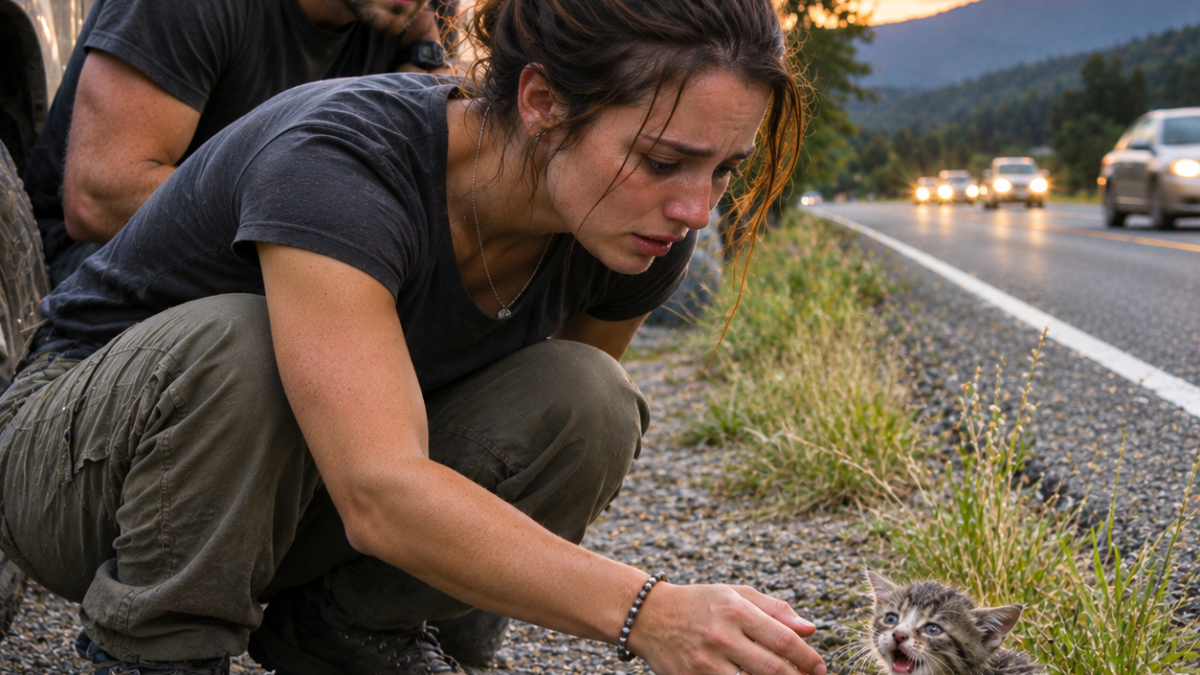
Then I saw him.
A kitten.
Tiny.
Blue-gray tabby with white around his chest and chin.
Maybe seven or eight weeks old.
He sat less than three feet from the asphalt.
Cars passed close enough that the wind from them flattened his fur.
“Oh my God.”
I opened the door.
Daniel grabbed my wrist.
“Watch traffic.”
“I know.”
I waited for a pickup to pass, then crossed behind the car.
The kitten did not run.
That frightened me immediately.
Healthy kittens run.
Scared kittens especially.
He stayed where he was.
His sides looked narrow.
Too narrow.
His fur was dusty.
His ears seemed too large for his head.
His eyes were half open.
He made one sound.
A weak scratchy cry.
Not loud.
Almost apologetic.
I crouched.
“Hey.”
Daniel came up behind me.
“How the hell did he get here?”
There were no houses nearby.
No driveway.
No cardboard box.
No person walking along the shoulder.
Just trees.
Ditch water.
A narrow fence running beside a field.
And traffic.
I took off my sweatshirt.
The kitten watched.
“Easy.”
I reached.
He did not hiss.
Did not swat.
Did not even step away.
When I lifted him, he pressed himself against my chest so violently that his claws caught the fabric of my T-shirt.
Not aggression.
Panic.
Like letting go meant falling.
I wrapped the sweatshirt around him.
“There you go.”
His body was cold.
“Cora.”
Daniel’s tone had changed.
He was worried now.
“I know.”
“He looks bad.”
“I know.”
We carried him to the car.
I found a water bottle.
Daniel handed me the plastic cap.
I poured a little.
The kitten drank too fast.
“Slow.”
I pulled it away.
He searched frantically.
“Give him another second,” Daniel said.
“I know.”
I offered more.
He drank.
Then made that same rough cry and buried his face against my arm.
Something inside me cracked.
Not dramatically.
Just enough.
Daniel saw it.
That mattered later.
“We need a vet,” I said.
He checked the time.
“It’s almost six.”
“Emergency clinic.”
“That’s going to be expensive.”
I looked at him.
He immediately shook his head.
“I didn’t say don’t.”
“Okay.”
“I’m saying we should understand what we’re doing.”
“He could die.”
“I know.”
“Then drive.”
He did.
The clinic sat in a strip center twenty minutes away.
Every mile, the kitten cried.
Small sounds against my sleeve.
Each time I spoke, he quieted briefly.
“Still here.”
Another cry.
“I know.”
Daniel looked over at us at a red light.
He said nothing.
At the clinic, a receptionist took one look and called a technician.
They placed us in an exam room.
Bright white walls.
Stainless steel table.
A poster about heartworm prevention.
The kitten stayed inside my sweatshirt until the veterinarian arrived.
Dr. Helen Marsh was in her forties, dark hair tied back, calm voice.
She examined him carefully.
“Male.”
I looked at Daniel.
For some reason that detail made him more real.
“Approximately seven to eight weeks. Underweight. Pretty dehydrated.”
“Anything broken?”
“Doesn’t look like it.”
She opened his mouth.
“Gums are pale.”
“What does that mean?”
“Could be dehydration. Parasites. Fleas. Nutritional issues.”
She ran a scanner over him.
“No microchip.”
Daniel asked, “Is he going to be okay?”
Dr. Marsh paused.
“I think he has a very good chance.”
My shoulders dropped.
“But he needs warmth, fluids, controlled feeding, deworming, flea treatment, and observation.”
Daniel leaned against the wall.
“Can the shelter take him?”
I turned.
He saw my face.
“Cora.”
“I didn’t say anything.”
“You were about to.”
Dr. Marsh looked between us.
“We can stabilize him tonight and coordinate with county shelter intake tomorrow.”
“How much?” Daniel asked.
She told us.
I winced.
Daniel did too.
We were not poor.
But we lived carefully.
Rent.
Student loan.
Car payment.
The hypothetical house fund.
The number she gave us was not catastrophic.
It was inconvenient.
Daniel hated inconvenient expenses because he believed enough of them eventually became catastrophes.
I looked at the kitten.
He was standing now.
Barely.
One paw against my wrist.
“I’ll pay it.”
Daniel looked at me.
“With what?”
“My savings.”
“That savings is for—”
“I know what it’s for.”
His jaw tightened.
Dr. Marsh quietly stepped out.
The door closed.
Daniel lowered his voice.
“Cora, we are not keeping him.”
“I didn’t say we were.”
“You’re already acting like he’s ours.”
“He was starving beside a highway.”
“That doesn’t make him ours.”
“I know.”
“Our lease charges a pet deposit.”
“I know.”
“And pet rent.”
“I know.”
“We’re both gone all day.”
“I know.”
“Your weekends are insane.”
“I know.”
“Then stop saying ‘I know’ like none of it matters.”
That hurt.
Because he was not yelling.
Because he was making sense.
Because the kitten was curled in my sweatshirt like his entire life had become the warm shape of my arms.
“I’m not asking you to keep him.”
“Good.”
The answer came too fast.
I looked at Daniel.
He realized it.
His face softened slightly.
“I’m sorry.”
I looked away.
“We stabilize him.”
“Yes.”
“Shelter tomorrow.”
“Yes.”
“And we don’t turn this into something else.”
I hated that sentence.
Not because it was cruel.
Because I knew I was already going to fail at it.
Dr. Marsh returned.
I signed the forms.
Before they took the kitten back, a technician asked whether I wanted to hold him while she prepared fluids.
He returned to my arms.
Immediately, the crying stopped.
Completely.
His body went loose.
His tiny head pressed into the bend of my wrist.
Daniel saw it.
I watched his expression change.
Just for a second.
Then he looked away.
“Cora,” he said quietly.
“What?”
“Don’t make this mean more than it does.”
I swallowed.
“I’m not.”
That was my first lie.
Not to him.
To myself.
The clinic kept the kitten overnight.
We drove home without him.
My sweatshirt stayed there because it smelled familiar and the technician thought it might comfort him.
I sat in the passenger seat wearing only my T-shirt beneath my coat.
Daniel turned up the heat.
For ten minutes, neither of us spoke.
Then he said, “You did a good thing.”
I stared out the window.
“It doesn’t feel good.”
“He’s safe.”
“Right.”
“You heard the vet.”
“I know.”
“He’ll probably get adopted immediately. Tiny kitten, pretty coloring.”
“Probably.”
“You saved him.”
I finally looked at Daniel.
“No.”
“What?”
“We stopped.”
“That counts.”
“It doesn’t feel finished.”
He tightened his hands on the wheel.
“That’s exactly what I’m worried about.”
We did not argue.
I almost wish we had.
Arguments end.
This sat between us.
At home, I showered.
Ate half a sandwich.
Tried to watch television.
At 11:43, I checked the clinic’s phone number.
At midnight, I checked again.
At 1:20, I woke from a dream I could not remember.
Daniel was asleep beside me.
I stared at the ceiling.
All I could hear was the quiet.
Not the kitten crying.
The absence of it.
The next morning, the clinic called.
“He did well overnight.”
I sat up.
Daniel opened one eye.
“He’s brighter, he ate small amounts, and he’s responding well to fluids.”
I smiled.
“Good.”
“We can transfer him to the county shelter later today unless you want to discuss foster options.”
I looked toward Daniel.
He was watching me.
“Shelter,” I said.
The word tasted wrong.
“Okay.”
The receptionist gave me the intake information.
I hung up.
Daniel touched my arm.
“That was the right choice.”
I nodded.
It probably was.
That day I built centerpieces for a wedding of two hundred and forty guests.
White roses.
Italian ruscus.
Candles.
Gold stands.
I smiled at the bride.
Solved a ribbon problem.
Drove thirty miles to replace six missing boutonnières.
Answered emails.
Ate a granola bar over a sink.
And thought about the kitten every twelve minutes.
By five, I gave up pretending.
The county shelter was fifteen minutes from my parents’ house.
I told myself I was only going to check.
That lie was worse than the first one.
The shelter was older than the clinic.
Concrete block walls.
Metal kennel doors.
Dogs barking from another section.
A volunteer brought me to the cat area.
“Highway kitten?”
“Yes.”
“Little blue tabby?”
“Yes.”
She smiled.
“He’s doing better.”
He was in a lower kennel.
Blanket.
Food.
Water.
When I approached, he was curled in the back.
“Hey.”
His head lifted.
Then his entire body changed.
He stood so fast he slipped.
Came to the front.
Pressed both paws against the bars.
No crying.
Just reaching.
The volunteer looked at me.
“Well.”
“What?”
“He hasn’t done that for everybody.”
I opened my fingers against the metal.
He pushed his nose between the bars.
“Can I hold him?”
“Sure.”
The second he reached my chest, he relaxed.
Not normal relaxed.
Total.
Like a switch.
The volunteer rubbed one finger behind his ear.
“He likes you.”
“I found him.”
“Oh.”
“That’s all.”
She smiled in a way I did not appreciate.
“Sure.”
I stayed forty-five minutes.
Then left.
Two days later, I went back.
Then again.
I stopped telling Daniel immediately.
Not because he had forbidden me.
He had not.
Because every visit made my earlier promise less true.
At first I said I was seeing my parents.
That was true.
I usually stopped there afterward.
My mother, Linda, noticed something was wrong the second time.
“You look guilty.”
“I do not.”
“You have looked guilty since you were six.”
“I’m twenty-eight.”
“Same eyebrows.”
I told her.
All of it.
She listened while slicing apples at the kitchen counter.
When I finished, she said, “Bring him here.”
I stared.
“What?”
“If the shelter allows foster.”
“Mom.”
“What?”
“Dad will say no.”
My father walked in from the garage.
“No to what?”
Mom looked at me.
I sighed.
“Cat.”
Dad stopped.
“No.”
Mom nodded.
“See?”
I laughed for the first time in days.
Then Dad asked, “What kind of cat?”
Twenty-four hours later, both my parents were standing at the shelter.
My mother held the kitten.
My father pretended not to care.
The kitten climbed onto his jacket.
Dad froze.
“Take him.”
I laughed.
“He likes you.”
“He’s climbing.”
“That’s how cats show interest.”
“Then I prefer disinterest.”
The foster coordinator explained the process.
Temporary foster.
Medication.
Weight checks.
Follow-up.
Potential adoption once stray hold and health clearance were complete.
My parents agreed.
I should have called Daniel before signing anything.
I know that.
Instead, I wrote my mother’s address.
Emergency contact.
My phone number.
And carried the kitten outside in a borrowed carrier.
That was the beginning of the secret.
At my parents’ house, he became Hollis.
The name came a week later.
Mom wanted Smokey.
Dad wanted Winston.
I vetoed both.
“Hollis,” I said.
The kitten looked up.
Dad shrugged.
“He doesn’t care.”
“I care.”
“Hollis sounds like a hardware salesman.”
“Perfect.”
The name stayed.
Hollis improved quickly.
His appetite returned.
His fur softened.
His ribs became less visible.
He chased tissue paper.
Attacked shoelaces.
Discovered curtains.
Nearly fell into a laundry basket.
But what changed most was his relationship to fear.
The first week, every sound made him flatten.
Dishwasher.
Truck outside.
Doorbell.
My father sneezing.
He would freeze.
Then look for me.
If I was there, he ran to my arms.
If I was not, he hid.
I visited every evening.
Sometimes before work.
Sometimes after.
My mother said I was driving twenty extra miles a day for a cat I insisted was temporary.
I told her to mind her business.
She said, “You are my business.”
I stopped asking for sympathy.
Daniel knew I was spending more time at my parents’.
He did not know why.
Not exactly.
I told him the kitten had been moved there “for a little while.”
That was technically true.
He looked at me for a long time.
“Your parents are fostering him?”
“Yes.”
“Since when?”
“Yesterday.”
“You signed him out?”
“My mom did.”
“Cora.”
“He needed somewhere quiet.”
“I thought we agreed.”
“We agreed not to bring him home.”
“That’s not what you meant.”
He stared.
“No.”
“What did you mean?”
“That we weren’t becoming responsible for him.”
“My parents are responsible.”
“You’re there every night.”
“So?”
“So don’t insult me.”
His voice was calm.
That made it worse.
“I’m not.”
“You found a loophole.”
“I helped him.”
“You made a decision behind my back.”
“It wasn’t your decision.”
“No. But our life is.”
That stopped me.
Daniel walked into the kitchen.
I followed.
“I didn’t bring him here.”
“You’re building toward bringing him here.”
“I don’t know that.”
“Yes, you do.”
I hated him for saying it.
Because he was right.
We slept badly that night.
Hollis did not come up again for two days.
Then something changed.
A woman walked into the county shelter on Tuesday morning carrying a folder and demanded the blue-gray kitten found near Highway 74.
Her name was Meredith Shaw.
She said Hollis belonged to her.
The shelter called my mother.
My mother called me.
I left work so fast I forgot my coat.
At the shelter, Meredith was already in the lobby.
She looked nothing like the villain I wanted.
Mid-thirties.
Brown hair.
Expensive boots.
Navy coat.
Tired face.
She held photographs.
“That’s him,” she said when she saw me.
I looked at the photos.
Hollis.
Smaller.
Sitting on a beige couch.
Another with a red collar.
Another in a kitchen.
My stomach dropped.
“You own him?”
“Yes.”
“What’s his name?”
“Blue.”
The kitten had not responded to that at the shelter.
Not proof of anything.
Cats ignore names professionally.
The foster coordinator, Casey, sat between us.
“Meredith has provided photos and veterinary paperwork.”
I looked at Casey.
“So she gets him?”
“If ownership is verified.”
My chest tightened.
Meredith’s eyes moved to me.
“You’re the person who found him.”
“Yes.”
“I’ve been looking everywhere.”
“Near Asheville?”
“Yes.”
“How did he end up beside a highway?”
Her expression changed.
“He escaped.”
“From where?”
“My sister’s house.”
“Where?”
She named a road twelve miles away.
A seven-week-old kitten had not traveled twelve miles.
I said that.
Meredith stiffened.
“I don’t know what happened.”
“Was he outside?”
“No.”
“Then how—”
Casey interrupted.
“Cora.”
I stopped.
Meredith looked offended.
“I came here to get my cat, not be interrogated.”
“He was starving.”
Her face tightened.
“I know.”
“He was severely dehydrated.”
“I know.”
“His paws were dirty and irritated.”
“I said I know.”
“Then explain it.”
“Cora.”
Casey’s voice sharpened.
Meredith stood.
“I’m leaving. Call me when this is handled.”
She walked out.
I looked at Casey.
“You believe her?”
“I believe documents.”
“What documents?”
“Vet records, photos, purchase paperwork.”
“Purchase?”
“She says she purchased him from a breeder.”
I felt sick.
“Then why was he unchipped?”
“Not legally required.”
“So we just hand him back?”
“If ownership is legitimate, yes.”
I drove to my parents’ house.
Hollis ran toward me the second I entered.
I lifted him.
He pressed into my chest.
My mother watched.
“What are we going to do?”
I hated the pronoun.
We.
Because legally there might be no we.
Daniel came home at seven.
I told him everything.
He listened.
When I finished, he said, “If she proves ownership, you have to give him back.”
I stared.
“You’re serious?”
“Yes.”
“You saw what condition he was in.”
“I know.”
“You don’t care?”
“That is not fair.”
“Then say something that sounds like you care.”
His face hardened.
“I care enough not to pretend wanting him makes him ours.”
I stood.
“Forget it.”
“Cora.”
“No.”
“You’re doing this again.”
“Doing what?”
“Turning every limit into betrayal.”
That hit harder than he knew.
“What does that mean?”
“It means I said no to bringing home a cat, so now I’m the man who hates animals. I say legal ownership matters, so now I don’t care whether he lives.”
“I didn’t say that.”
“You don’t have to.”
We stared at each other.
Then Daniel said quietly, “You have been lying to me for weeks.”
The word landed.
Lying.
I wanted to defend myself.
Couldn’t.
“I didn’t lie.”
“Where have you been every night?”
“My parents.”
“To see Hollis.”
“Yes.”
“Did you tell me that?”
“Not every time.”
“So you lied by omission.”
I looked away.
Daniel continued.
“I am not angry because you love the cat.”
“What are you angry about?”
“Because you decided the only way to get what you wanted was to work around me.”
That sentence followed me for days.
The shelter began verification.
I began investigating on my own.
Not stalking.
Not vigilante nonsense.
I searched public information.
Meredith Shaw.
Asheville.
I found her.
Interior designer.
Social media.
Photos.
One photograph showed Hollis—or Blue—on her couch.
Posted three weeks before I found him.
Caption:
Newest little man in the family.
So she had possessed him.
That much was true.
Then I noticed something.
Another kitten in the photo.
Orange.
Same age.
Comment underneath:
Is his brother still available?
Meredith replied:
Yes, breeder still has two.
I searched the breeder name tagged in an earlier comment.
Blue Ridge Exotics.
No real business address.
Facebook page.
Siamese.
Ragdolls.
Persians.
Designer kittens.
Cash deposits.
No website.
No veterinary information.
I sent the link to Casey.
She replied:
We’ll review.
That night, Daniel caught me at the kitchen table.
Laptop open.
“What are you doing?”
“Research.”
“Cora.”
“There’s something wrong.”
“How do you know?”
“I don’t.”
He pulled out a chair.
“That sentence is important.”
“I know.”
“Do you?”
I looked at him.
He sat.
“Show me.”
That surprised me.
I turned the laptop.
He read.
Quietly.
Then said, “This breeder looks sketchy.”
My chest loosened slightly.
“Exactly.”
“That still doesn’t prove Meredith dumped him.”
“I know.”
“Do you?”
I almost smiled.
“Shut up.”
He looked at me.
Then at Hollis’s picture.
“What exactly do you think happened?”
“I don’t know.”
“Then let’s find out.”
Let’s.
The word mattered.
Daniel was good at research when he stopped trying to prevent chaos and decided to solve it instead.
Within an hour, he found the business registration associated with Blue Ridge Exotics.
Owner: Rebecca Sloan.
Address outside Hendersonville.
Two prior consumer complaints.
One alleging a sick kitten sold without health certificate.
Another claiming deposit fraud.
Then Daniel found something else.
A county animal-control inspection report from eighteen months earlier.
Warning for exceeding permitted number of intact animals.
No charges.
But enough.
“This doesn’t prove anything about Hollis,” he said.
“No.”
“But I’d send it.”
We did.
The next morning, Casey called.
“Meredith’s paperwork has an inconsistency.”
My heart jumped.
“What?”
“The veterinary record she submitted lists the kitten as twelve weeks old at the time she bought him.”
“He was seven or eight weeks when we found him.”
“Exactly.”
“Could the vet be wrong?”
“Possible.”
“What else?”
“The clinic named on the record says they never saw that kitten.”
I stood.
“Fake?”
“We’re investigating.”
“What happens to Hollis?”
“He stays in foster.”
“For how long?”
“Until we know more.”
I exhaled.
Then Casey added, “Cora, do not contact Meredith.”
“I haven’t.”
“Good.”
“Why?”
“She became hostile when we asked for original documentation.”
My fear shifted into anger.
Hollis stayed with my parents.
I kept visiting.
Daniel came once.
That was the first time he met Hollis properly.
He stood in my parents’ living room with his hands in his coat pockets.
Hollis saw him.
Stopped.
Daniel did not move toward him.
Good instinct.
My mother whispered, “Sit on the floor.”
Daniel gave her a look.
She gave one back.
He sat.
Hollis watched from behind my leg.
Daniel said quietly, “You’ve made my life incredibly complicated.”
“Hollis doesn’t speak English.”
“I’m talking to you too.”
I laughed.
Hollis crept forward.
One step.
Paused.
Another.
Sniffed Daniel’s shoe.
Daniel did not reach.
Hollis circled.
Then placed one paw on Daniel’s sock.
Just one.
Daniel looked at me.
I saw something happen behind his face.
Not surrender.
Recognition.
That mattered more.
On the drive home, he was quiet.
Then he said, “He’s tiny.”
“He’s gained almost a pound.”
“He was smaller?”
“Yes.”
Daniel tightened his hands on the steering wheel.
After another mile:
“I thought you were exaggerating.”
I turned.
“About what?”
“How attached he is to you.”
“He’s getting better.”
“Yeah.”
Daniel stared ahead.
“Cora.”
“What?”
“I didn’t say no because I hated the idea of a cat.”
“I know.”
“No, you don’t.”
I waited.
He exhaled.
“When I was eleven, my mom brought home a dog.”
I had never heard this story.
“German shepherd mix. Ranger.”
“What happened?”
“My parents were already fighting constantly. My dad lost work. Money got bad. Ranger got sick.”
He paused.
“They couldn’t afford the surgery.”
My chest tightened.
“They surrendered him.”
“Oh.”
“My mother told me we were taking him to the vet.”
Daniel swallowed.
“We weren’t.”
I said nothing.
“He stood at the shelter door pulling toward us. I remember his collar slipping halfway over his ears because he was trying to get back.”
His voice changed.
“I didn’t understand why my dad kept walking.”
“Daniel.”
“They told me he’d get adopted.”
“Did he?”
“I don’t know.”
That was the answer.
Not pet deposits.
Not scratched furniture.
Not schedules.
Fear.
Daniel had built a rational argument around an old wound.
Same thing I had done in reverse.
I turned toward him.
“You could’ve told me.”
“You could’ve told me where you were going every night.”
Fair.
We drove the rest of the way quietly.
But the silence was different.
Three days later, the shelter called again.
This time, not Casey.
An animal-control investigator named Officer Maya Fields.
She asked whether I would provide a formal statement about where we found Hollis.
I did.
Exact location.
Approximate time.
Condition.
Traffic direction.
Anything unusual?
I thought.
Then remembered a vehicle.
A white cargo van parked farther up the shoulder when we first approached.
At the time I assumed road work.
I mentioned it.
“Any markings?”
“No.”
“License plate?”
“No.”
“Driver?”
“I didn’t see.”
Daniel had.
When Maya called him, he remembered a magnetic logo on the side.
Something blue.
Maybe mountains.
We searched.
Blue Ridge Exotics logo was blue mountains.
The next question changed everything.
“Would you be willing to return to the location with us?”
Yes.
We met Maya and another officer on the highway shoulder two days later.
Hollis stayed home.
The place looked smaller.
Ordinary.
Grass had browned more.
Traffic still screamed past.
Maya photographed the area.
Then crossed toward a utility pole.
Mounted high on the pole was a Department of Transportation camera.
My pulse jumped.
“Does that record?”
“Traffic management camera.”
“For how long?”
“Depends on the system.”
Could be gone.
Could still exist.
Maya submitted a request.
Then she found something in the ditch.
A faded cardboard carrier.
Collapsed.
Water damaged.
Partly hidden in weeds.
My stomach turned.
Inside were clumps of litter.
A torn fleece pad.
And a printed sticker.
B.R.E.
Daniel looked at me.
Blue Ridge Exotics.
The case grew from there.
Not quickly.
Real investigations are mostly waiting.
Phone calls.
Records.
Permissions.
People checking things.
For almost a week, nothing happened.
Then Maya called.
“We have footage.”
I sat down.
“What does it show?”
“A white cargo van stopping approximately forty minutes before you found the kitten.”
My throat went dry.
“Can you see who?”
“Not clearly.”
“What happens?”
“Vehicle plate is partially visible.”
“Registered to?”
She paused.
“Blue Ridge Exotics LLC.”
I closed my eyes.
Hollis had not escaped.
Someone had left him.
The question became who and why.
Animal control obtained a warrant to inspect the breeder’s property after connecting the abandoned carrier, vehicle footage, and earlier compliance issues.
They found twenty-three cats.
Eleven kittens.
Several sick.
Some underweight.
Flea infestation.
Unsanitary rooms.
Records inconsistent.
Rebecca Sloan was cited immediately.
But Hollis’s story still had a missing piece.
Meredith.
Why had she claimed him?
Her fake paperwork.
Her photographs.
Her urgency.
The answer came from an employee.
Nineteen-year-old college student named Kaylee who had worked weekends cleaning cages.
She contacted investigators after the inspection.
She had been afraid to speak.
According to Kaylee, Hollis had been sold to Meredith two weeks before we found him.
That part was true.
But Meredith returned him after nine days.
Why?
Diarrhea.
Vomiting.
A veterinary exam suggested parasites and possible congenital issues.
Meredith demanded a refund.
Rebecca refused.
They argued.
Eventually Rebecca agreed to take him back if Meredith signed a statement that he had been healthy upon purchase.
Meredith did.
Hollis returned to Blue Ridge Exotics.
Three days later, Rebecca decided he was “unsellable.”
That word appears in the investigative report.
Unsellable.
Not sick.
Not frightened.
Not alive.
Unsellable.
Kaylee overheard Rebecca say she was not spending another vet bill on “a seventy-dollar problem.”
Hollis had actually sold for more than a thousand dollars.
The seventy dollars referred to what Rebecca claimed his treatment would cost.
Kaylee saw him placed into the van.
She thought he was going to a clinic.
Later, she noticed the carrier came back empty.
When the viral local post about the highway kitten circulated through community groups, Meredith recognized him.
She panicked.
If investigators traced the kitten to the breeder, her false health statement and the return could become part of the case.
So she tried to reclaim him before questions started.
Not because she missed him.
Because she wanted control of the evidence.
That revelation hurt in a way I did not expect.
I had wanted a villain.
I got two frightened, selfish adults making decisions around a tiny animal as though his life were a liability on paper.
Rebecca abandoned him.
Meredith tried to retrieve him to protect herself.
Both had explanations.
Neither had an excuse.
Charges followed.
Animal cruelty.
Abandonment.
Record falsification connected to commercial breeding documentation.
Multiple civil violations.
The remaining cats were removed pending proceedings.
Meredith was not charged with abandonment because evidence showed she was not the person who left Hollis on the highway.
But investigators documented her role in submitting false ownership and veterinary records.
She eventually admitted it.
The shelter permanently rejected her claim.
The day Casey called to tell me, I cried in the floral cooler at work.
My coworker found me sitting between buckets of eucalyptus.
“Wedding emergency?”
“No.”
“Family?”
“No.”
“Cat?”
I nodded.
She handed me tissues.
“Thought so.”
That evening, I drove to my parents’ house.
Hollis ran toward me.
I sat on the floor.
He climbed into my lap.
I held him.
“You’re safe.”
He purred.
My mother stood in the doorway.
“So.”
I knew that tone.
“So what?”
“His stray hold is cleared.”
“Yes.”
“Legal custody transfers to the shelter tomorrow.”
“I know.”
“And the foster coordinator asked whether we want to adopt.”
I stared at her.
My mother’s face softened.
“You know what you want.”
Yes.
I did.
I wanted Hollis.
The problem was that wanting him did not make my relationship irrelevant.
I drove home.
Daniel was cooking pasta.
“Can we talk?”
He turned off the burner.
“That sounds dangerous.”
“Hollis is available.”
He nodded.
“I figured.”
“My parents can adopt him.”
“But?”
I looked at him.
“I want him with us.”
There.
No manipulation.
No loophole.
No secret.
Daniel leaned against the counter.
“I know.”
“I also know what our lease costs.”
“Okay.”
“I know my schedule.”
“Okay.”
“I know your history now.”
He looked down.
“And I know I handled this badly.”
That got his attention.
“I should have told you what I was doing.”
“Yes.”
“I should not have made you the obstacle and then worked around you.”
He said nothing.
“I’m sorry.”
That mattered.
People underestimate apologies because bad apologies are common.
A real apology does not explain why your behavior should be forgiven.
It names what you did.
Daniel nodded.
“Thank you.”
I swallowed.
“But I still want him.”
“I know.”
“I’m not asking you to pretend.”
“Good.”
“I’m asking whether there is a version of our life where you can want him too.”
Daniel looked toward the dark window.
Long silence.
Finally he said, “I don’t know.”
It hurt.
But it was honest.
So I nodded.
“Okay.”
He looked surprised.
“Okay?”
“I’m not hiding things anymore.”
For the next four days, we discussed it.
Like adults.
Mostly.
Pet deposit.
Monthly pet rent.
Veterinary insurance.
Food.
Litter.
Travel.
My wedding weekends.
Daniel’s work.
Who cleans the box.
Who handles morning feedings.
What happens if he becomes chronically ill.
That question nearly ended the conversation.
Daniel said, “We have to discuss worst cases.”
I said, “You can’t budget love like a roof repair.”
He said, “That is exactly how people end up surrendering animals when something goes wrong.”
That stopped me.
Because Ranger.
Because he was right.
We made an emergency pet fund.
Daniel contributed first.
I noticed.
Said nothing.
Then one Sunday, we visited Hollis together again.
Hollis started in my lap.
As always.
Daniel sat at the other end of the couch.
No reaching.
No forcing.
My mother and I went into the kitchen.
I looked back.
Hollis had lifted his head.
Watched me leave.
Normally he would follow.
Instead, halfway off the cushion, he stopped.
Turned.
Looked at Daniel.
Daniel remained still.
Hollis walked toward him.
One step.
Two.
Then climbed into Daniel’s lap.
Not dramatically.
Not instantly relaxed.
He circled once.
Paused.
Then folded down.
Daniel looked terrified to breathe.
I stood in the kitchen doorway.
My mother whispered, “Don’t ruin it.”
“I’m not.”
Ten minutes passed.
Daniel finally lowered one hand.
Touched Hollis’s back.
Hollis stayed.
Daniel’s face changed.
The wall cracked.
Later, in the car, he drove in silence.
Then said, “Okay.”
I looked at him.
“What?”
“Let’s figure out how to bring him home.”
My eyes filled.
He pointed at me.
“No crying while I’m driving.”
“I’m not.”
“You are.”
“I have allergies.”
“It’s November.”
“Seasonal.”
He laughed.
That laugh changed the car.
We did not bring Hollis home immediately.
That mattered.
I wanted the decision to be real, not emotional momentum.
We paid the deposit.
Bought supplies.
Moved poisonous plants.
Covered cables.
Found a local veterinarian.
Set up a quiet corner.
Daniel researched litter boxes for three hours.
I made fun of him.
Then he bought the most expensive one.
“You said cats track litter.”
“I did.”
“This has a high wall.”
“He weighs four pounds.”
“He will grow.”
I smiled.
“What?”
“Nothing.”
“Cora.”
“You’re planning for his future.”
“Someone has to.”
Adoption day arrived on a cold Tuesday.
At the shelter, Casey placed paperwork in front of us.
ADOPTER 1: CORA BENNETT.
ADOPTER 2: DANIEL REED.
Daniel looked at the page.
Then at me.
“You ready?”
“No.”
“Same.”
We signed.
Hollis entered the carrier.
My mother cried.
My father pretended to inspect a window.
“You know you can visit,” I told them.
Dad nodded.
“Sure.”
Mom said, “He means tomorrow.”
“I do not.”
He visited two days later.
At our apartment, Hollis remained inside the carrier for eleven minutes.
I sat nearby.
Daniel sat farther away.
No coaxing.
The door stayed open.
Finally, one paw.
Then his head.
He stepped out.
Sniffed the rug.
Listened to the refrigerator.
Flattened at the furnace clicking on.
Then recovered.
He explored the couch.
Kitchen threshold.
Coffee table.
Hallway.
Every few steps, he looked back.
At me first.
Then Daniel.
By evening, he had disappeared under the couch twice.
Eaten three bites.
Used the litter box.
Attacked a shoelace.
Progress.
At nine, Daniel and I sat on the couch watching television.
Hollis emerged.
He looked at me.
Then Daniel.
Walked between us.
Climbed onto the blanket.
Turned once.
Lay down exactly in the middle.
I felt Daniel’s hand find mine beneath the blanket.
Neither of us spoke.
That was the first night our apartment felt different.
Not because there was a cat in it.
Because we had made a decision together.
A month later, the breeder case became public.
A local reporter called.
Someone had given her my name from the initial highway report.
I almost refused.
Daniel said, “Think about why you’d do it.”
“What does that mean?”
“Do you want attention?”
“No.”
“Do you want revenge?”
I thought.
“Maybe a little.”
“Fair.”
I laughed.
“What else?”
“I want people to know those kittens weren’t products.”
“Then say that.”
So I did.
The interview was brief.
I never mentioned Meredith by name.
I did not call Rebecca a monster.
I described Hollis.
How small he was.
How he drank from a bottle cap.
How he pressed into my sweatshirt.
How easily we could have driven past.
The reporter asked, “Do you consider yourself his rescuer?”
I looked at Hollis.
He was attacking the microphone cable.
“No.”
She smiled.
“No?”
“We stopped the car. A lot of people helped after that.”
Daniel sat off camera.
I looked at him.
“And I think rescue is what happens after the dramatic part too.”
“What do you mean?”
“Keeping the vet appointment. Paying the bill. Changing your schedule. Being honest with the people you live with.”
Daniel smiled slightly.
I continued.
“Stopping is one moment. Staying is the rest of it.”
That quote ended up in the article.
I was embarrassed for a week.
My mother printed it.
Of course she did.
Rebecca Sloan eventually pleaded guilty to multiple animal-welfare violations and one criminal abandonment charge connected specifically to Hollis.
Her breeding operation was shut down.
She was prohibited from commercially breeding animals during her probation.
Several of the recovered cats required treatment.
Most were eventually placed through rescue organizations.
Kaylee, the young employee who spoke up, testified.
She later started veterinary technician school.
Meredith entered a civil agreement related to the false documentation and paid fines.
She sent the shelter a written statement admitting she had tried to reclaim Hollis because she was afraid her connection to the breeder would become public.
She apologized.
I did not respond.
Not every apology requires access.
That is another thing I learned.
Justice came quietly.
Not handcuffs in a parking lot.
Not a courtroom packed with cameras.
Paperwork.
Fines.
Licenses.
Orders.
Animals removed.
A business closed.
A frightened witness finally believed.
The consequences were enough to stop the same people from repeating the same choices easily.
That mattered more than humiliation.
Our relationship did not become perfect because Hollis came home.
That would be a lie.
Actually, Hollis exposed things.
I tended to avoid conflict until I had already made a decision privately.
Daniel tended to call fear “practicality” and believe a spreadsheet made it objective.
I would say yes too quickly.
He would say no too quickly.
Hollis forced us to learn the space in between.
One night, about three months after the adoption, Daniel came home to find Hollis vomiting.
Three times.
Within fifteen minutes.
I panicked.
Daniel did not.
He called the vet.
Collected information.
Checked whether Hollis had eaten anything strange.
Found a torn piece of ribbon beneath the dining table.
My ribbon.
Floral ribbon from work.
At the emergency clinic, X-rays showed a possible foreign body.
They kept him overnight.
The estimate was enormous.
I cried in the parking lot.
Daniel opened our banking app.
Transferred money from the pet emergency fund.
Then from his personal savings.
I stared.
“That was house money.”
“He is currently in the house.”
“Daniel.”
“What?”
“You don’t have to—”
“Yes.”
He looked at me.
“I do.”
Hollis passed the ribbon without surgery.
The bill still hurt.
Daniel complained for two weeks.
But he never once said I told you so.
That mattered.
Six months later, we renewed our lease.
With pet rent.
Daniel called it “Hollis tax.”
Hollis did not contribute.
A year later, we bought a small house.
Not the yellow kitchen house.
A cheaper one.
Older.
Three bedrooms.
A fenced backyard we did not technically need for a cat.
Daniel spent six weekends fixing the deck.
I planted herbs.
Hollis claimed the front window before we finished unpacking.
The first night there, he panicked when a truck downshifted on the road.
The sound resembled the highway.
He woke from sleep.
Body low.
Eyes wide.
He looked for me.
Then something happened that made my throat tighten.
Daniel was closer.
Hollis ran to him.
Daniel scooped him up.
No hesitation.
“Got you.”
Two words.
Hollis pressed his face against Daniel’s chest.
I stood in the hallway.
The kitten who had once believed my arms were the only safe place in the world had another set now.
Healing.
People misunderstand it.
They think healing means forgetting the first fear.
It doesn’t.
Sometimes healing means the fear comes back and you discover you have more places to go.
Daniel and I got engaged the next spring.
No elaborate proposal.
No photographer.
We were replacing a kitchen cabinet hinge.
Very romantic.
He stopped.
Pulled a ring box from the drawer.
I stared.
“You hid that beside screws?”
“Low probability of discovery.”
I laughed.
Then cried.
Hollis jumped onto the counter.
Daniel said, “He is not part of this.”
Hollis sat directly between us.
He was absolutely part of it.
We married eight months later.
Small ceremony.
My parents’ backyard.
I did my own flowers, which everyone told me was insane.
They were right.
Daniel made the seating chart.
Hollis stayed inside during the ceremony because outdoor cats were one argument neither of us planned to have.
But he appeared in half the getting-ready photographs.
In one, he is sitting on my veil.
In another, Daniel is holding him while tying his tie.
That photograph is my favorite.
Not because it is perfect.
Because Daniel does not know the camera is there.
He is looking down at Hollis.
Completely soft.
Completely unguarded.
The man who once said pets were hair, bills, responsibility, and travel problems.
He was right about all of those things.
Our couch had hair.
Our monthly expenses increased.
We planned trips around care.
Our furniture acquired scratches.
Nothing about his original concerns became false.
They simply stopped being the whole truth.
Hollis also gave us mornings.
Routine.
Laughter.
Arguments about who forgot to buy food.
Photos.
Emergency vet panic.
A warm body at our feet.
The absurd privilege of being missed when we left a room.
He made our life less efficient.
Much more alive.
Several years later, I drove that highway again.
Same road.
Different car.
Hollis was not with me.
Cats still do not belong loose in cars no matter what Facebook says.
Daniel was driving.
We had been discussing whether to have a child.
Another complicated conversation.
Another future neither of us could spreadsheet into certainty.
Then I saw the shoulder.
The place.
“Slow down.”
Daniel looked at me.
He knew.
He pulled over.
We sat.
Cars passed.
Wind pushed grass toward the ditch.
Nothing remained from that night.
No carrier.
No sign.
No dramatic memorial.
Just road.
I stared through the windshield.
“What if I hadn’t seen him?”
Daniel rested one hand on the steering wheel.
“You did.”
“What if we hadn’t stopped?”
“But we did.”
“He was so small.”
“I know.”
I turned.
Daniel smiled.
“You want me to say fate?”
“No.”
“Good, because I won’t.”
I laughed.
He continued.
“But maybe seeing something creates a responsibility.”
“What do you mean?”
“Everybody passed him.”
“We don’t know that.”
“No.”
He looked toward the shoulder.
“But once you saw him, pretending you hadn’t would have been a choice.”
That stayed with me.
We cannot rescue everything.
That lesson matters too.
There are too many animals.
Too many people.
Too many tragedies.
No person survives by feeling personally responsible for all suffering they notice.
But sometimes life places one small thing directly in front of you.
Not the whole world.
One thing.
And asks what you will do now that you have seen it.
Hollis is seven years old as I tell this.
No longer tiny.
He grew into a twelve-pound blue tabby with white socks, broad cheeks, and the confidence of a creature who has forgotten he was once nearly invisible.
He sleeps on Daniel’s chest more than mine.
This betrayal remains under review.
He still dislikes trucks.
Still hates closed carriers.
Still comes running when I shake the treat jar.
He has no memory I can verify of a highway.
But his body remembers certain sounds.
His body also remembers being held.
When frightened, he searches for arms.
The difference is that now he has choices.
Mine.
Daniel’s.
Sometimes my mother’s when she visits.
That is what safety became for him.
Not never being afraid.
Having somewhere to go when fear arrives.
And Hollis changed something in Daniel and me that mattered even more than our feelings about animals.
He taught us how badly love suffers when one person makes decisions for two people, even for good reasons.
I had been so sure my compassion justified secrecy.
It did not.
Daniel had been so sure his fear justified closing the door before we even examined what was possible.
It did not.
We were both trying to protect ourselves.
I protected myself from losing Hollis by hiding how much he mattered.
Daniel protected himself from attachment by turning attachment into a list of costs.
Neither strategy was honest.
A starving kitten forced us to become honest.
That may be the strangest part.
People told us we rescued Hollis.
The newspaper said it.
The shelter said it.
My mother still says it.
Maybe we did.
But Hollis found me at a point in my life when I had become skilled at shrinking what I wanted so nobody could accuse me of being difficult.
I would say, “Whatever works.”
“I don’t care.”
“It’s fine.”
Daniel’s practical opinions often became the plan because I hated tension.
Then I would quietly resent him.
Hollis made that impossible.
I wanted him.
Clearly.
Deeply.
Inconveniently.
For once, I had to say it.
Not manipulate.
Not hint.
Not compromise before anyone asked.
I had to stand in our kitchen and say:
This matters to me.
Daniel had to learn something too.
His whole adult life had been built around preventing the moment his eleven-year-old self experienced at a shelter door.
If you never attach, nobody can take the attachment away.
If you calculate first, maybe nothing can surprise you.
If you say no before wanting begins, you stay safe.
Hollis climbed into his lap anyway.
Safety lost.
Love won.
Not without cost.
That is the part sentimental stories leave out.
Love costs.
Time.
Money.
Sleep.
Freedom.
Grief eventually.
Daniel knows that now better than anyone.
Hollis will not live forever.
We know.
We choose him anyway.
Maybe that is maturity.
Not finding relationships with no risk.
Understanding the risk and staying.
A few months ago, I found my old sweatshirt in a storage bin.
The one from the highway.
Gray.
Faded.
One tiny pulled thread near the chest where Hollis’s claw caught it.
I brought it downstairs.
Daniel looked at it.
“Is that—”
“Yeah.”
Hollis was sleeping on the couch.
I placed the sweatshirt beside him.
He sniffed it once.
No dramatic recognition.
No sudden memory.
He stepped onto it.
Turned around.
Lay down.
Daniel laughed.
“He doesn’t remember.”
“Probably not.”
I sat beside him.
“That’s okay.”
And it was.
Animals do not owe us memory for what we did.
Hollis does not have to remember the highway for the rescue to matter.
He does not have to remember dehydration.
The clinic.
The shelter.
Meredith.
The breeder.
The foster room.
My sweatshirt.
His life is not valuable because he can appreciate what he escaped.
It is valuable because he is here.
Healthy.
Safe.
Annoying.
Loved.
Ordinary.
That is the real victory.
A rescued animal becoming ordinary.
No emergency.
No viral story.
No countdown.
Breakfast late by four minutes.
Nap in sunlight.
Complaint about closed bathroom door.
That is what survival should lead to.
One night last winter, Daniel and I sat in the living room during a storm.
Rain against the windows.
Wind pushing branches across the roof.
A truck passed outside.
Hollis woke.
His eyes went wide.
For a moment, I saw the kitten by the road again.
Small body.
Dusty fur.
Cars passing.
Then Hollis looked at me.
Looked at Daniel.
And instead of running immediately into either set of arms, he lowered his head again.
Went back to sleep.
I almost cried.
Daniel noticed.
“What?”
“Nothing.”
“You’re doing the face.”
“What face?”
“The cat made a normal movement and now you’re having an emotional event face.”
I laughed.
“He didn’t need us.”
Daniel looked at Hollis.
Then understood.
“Yeah.”
That was healing too.
Not only having somewhere safe to run.
Eventually learning you do not always have to run.
People ask sometimes whether I think Hollis was “meant” for us.
I never know how to answer.
If I say yes, it makes abandonment sound like part of a beautiful plan.
I refuse to believe cruelty is necessary for love to happen.
Rebecca did not need to leave him beside a highway for our family to deserve him.
Meredith did not need to lie.
Hollis did not need to suffer.
Nothing good that came later makes those things good.
But terrible choices do not get to own every consequence forever.
Something harmful happened.
Then thousands of other choices followed.
We stopped.
The vet treated him.
The shelter protected him.
My parents fostered him.
Kaylee told the truth.
Maya investigated.
Daniel listened.
I apologized.
He opened himself.
We adopted.
Those choices changed the direction of one small life.
Maybe that is the closest thing to fate I believe in.
Not that everything happens for a reason.
That after something happens, we get to decide what reason our next action will give it.
The highway could have been the end of Hollis’s story.
It became the place where another one began.
And when I remember that evening now, I no longer think first about the cars that passed him.
I think about the moment I saw the gray shape twitch.
I think about saying, “Wait.”
That one word.
Wait.
Slow down.
Look again.
Something is there.
Someone is there.
I was talking to Daniel.
Maybe I was talking to myself too.
Our whole life was moving quickly then.
Work.
Money.
House plans.
Marriage conversations.
Everything evaluated by whether it fit.
Hollis did not fit.
That was the point.
Some of the most important things in your life will not arrive at a convenient time with a responsible budget and a clear place on the calendar.
Sometimes they appear beside a road just before dark.
Too small.
Too thin.
Crying so quietly the whole world can pass without hearing.
You do not always have to take them home.
But you should at least slow down long enough to see what is asking you not to drive away.
I thought I stopped that evening because a kitten needed saving.
Years later, I understand something else.
Daniel and I needed to stop too.
We needed to stop hiding fear inside practicality.
Stop hiding desire inside silence.
Stop treating love like something that counted only when it was convenient.
Hollis forced us to become the kind of people who could make a difficult decision together and stay when the cost became real.
He did not save our relationship by being cute.
He changed it by making dishonesty impossible.
And that tiny kitten cars could barely see became the clearest presence in our home.
Even now, when something startles Hollis awake, he sometimes looks for arms.
Just not mine alone anymore.
That may be the part of this whole story I love most.
The frightened kitten who once clung to one stranger because he believed safety could disappear at any second eventually learned that love was not one pair of arms.
It was a place.
And after everything that happened beside that highway, Hollis finally had one.








