We Came to Adopt One Calm Adult Cat—Then a Terrified Kitten Reached Through the Kennel Door for the Only Friend He Had Left.
PART3:
There is a kind of quiet you choose.
And there is a kind that remains after everything you loved stops making noise.
Those are not the same thing.
Susan handled it by staying busy.
She cleaned closets that did not need cleaning.
Reorganized the pantry twice.
Joined a gardening club.
Started taking morning walks with our neighbor, Diane.
I handled it differently.
I got quieter.
I came home from work.
Changed clothes.
Made dinner if it was my turn.
Watched television.
Read.
Sometimes Susan and I sat in the same room for two hours without speaking.
We weren’t angry.
We weren’t unhappy with each other.
We were simply grieving in parallel.
Two people sharing one house and somehow moving through separate weather.
One night, Susan said:
“I think we should get another cat.”
I stared at the television.
“No.”
She didn’t argue.
A week later she said it again.
“I don’t mean Walter.”
“I know.”
“We’re not replacing him.”
“I know.”
“I just hate this.”
That made me look at her.
She gestured around the living room.
“The house.”
“What about it?”
“It feels like everybody left.”
I didn’t have an answer.
Because I felt it too.
So eventually, we agreed.
One cat.
Adult.
Easy.
Affordable.
Nothing complicated.
The rescue center sat in a converted veterinary building twenty minutes away.
The front lobby smelled faintly of disinfectant, litter, and something sweet coming from a candle the staff had probably lit in a losing battle against the first two smells.
A volunteer named Maria greeted us.
“Looking for anybody specific?”
Susan answered immediately.
“Older.”
I added:
“Calm.”
Maria smiled.
“That’s refreshing.”
“Why?”
“Most people come asking for kittens.”
“We’re past kitten age.”
Susan nudged me.
“Speak for yourself.”
“I enjoy sleeping.”
Maria laughed.
She led us through the first room.
Cats everywhere.
One black cat asleep in a hammock.
A white senior cat staring through the kennel bars with the expression of someone waiting for a bus.
A long-haired tortoiseshell who hissed at me before I’d done anything.
Susan whispered:
“That one likes you.”
“Clearly.”
Then we entered the adult-cat room.
That’s where we met Oliver.
Brown tabby.
Seven years old.
Wide face.
Half-closed green eyes.
He was sitting near the front of his enclosure as if he had been expecting us specifically.
Maria opened the kennel.
Oliver stepped out.
Susan sat on a bench.
He walked straight to her.
Sniffed her knee.
Then placed both front paws on the seat, climbed beside her, and curled up.
No hesitation.
No drama.
Susan scratched beneath his chin.
Oliver closed his eyes.
I smiled.
“This is the one.”
Susan looked up.
“You think?”
“Look at him.”
Oliver was already halfway asleep.
“This cat has retirement figured out.”
Maria laughed.
“He’s very easygoing.”
“Good with being alone?”
“Yes.”
“Nighttime?”
“Usually sleeps through.”
“Climbing?”
“Not especially.”
“Curtains?”
“No known crimes against curtains.”
Perfect.
Everything on Susan’s list.
Oliver even had a little paunch.
I liked him immediately.
Susan did too.
I could tell.
She looked down at him with that softened expression she used to have when Walter climbed into her lap.
For the first time in months, I imagined another cat sleeping beside our kitchen table.
The thought didn’t hurt.
That surprised me.
We asked about adoption paperwork.
Maria said:
“Take your time. You can meet everybody first.”
“We’ve probably decided.”
Susan scratched Oliver’s ear.
He began purring.
Then we heard a crash from farther down the hallway.
Metal bowl.
Something hitting tile.
Several cats startled.
And from a back room came a thin, sharp cry.
Not unusual at a rescue.
Cats vocalize.
Kittens complain.
We would have kept walking.
Then we passed the enclosure.
Two kittens were pressed together in the far corner.
One orange.
One gray and black.
Five months old according to their card.
The orange kitten was called Ginger.
She had a white chin, bright amber eyes, and ears slightly too large for the rest of her.
Her fur stuck out in several directions as if she’d been assembled during a windstorm.
Beside her was Smudge.
Gray-black coat.
Thin.
Dark stripe across his nose.
Small bald patch near one shoulder where the rescue had treated some skin irritation.
He wasn’t conventionally beautiful.
His legs looked too long.
His tail too thin.
His face worried.
That was the only word for it.
Worried.
They were sitting so close their bodies almost overlapped.
When we approached, Ginger raised her head.
Smudge moved behind her.
Not away.
Behind.
She shifted left.
He shifted left.
She sniffed toward us.
His nose appeared beneath her shoulder.
Susan crouched.
“Oh.”
I knew that sound.
“No.”
She looked at me.
“I didn’t say anything.”
“You made the sound.”
“What sound?”
“The dangerous sound.”
She smiled.
“They’re cute.”
“They’re kittens.”
“I can see that.”
Their kennel card hung on the door.
Susan read.
I watched her expression change.
GINGER & SMUDGE
5 MONTHS
BONDED PAIR
MUST BE ADOPTED TOGETHER
Below that:
Rescued from abandoned rental property.
Susan read it twice.
Then looked inside.
Smudge had moved one paw onto Ginger’s front leg.
Like he was making sure she remained there.
I read the card too.
“Two.”
“Yes.”
“We said one.”
“I know.”
“Kittens.”
“I know.”
“We said adult.”
“I remember the conversation, Mark.”
“Just establishing facts.”
She smiled.
“We’re not adopting them.”
“Good.”
“I didn’t say I wanted to.”
“Good.”
“You’re being weird.”
“I recognize patterns.”
We continued.
But Susan looked back.
Once.
Then again.
By the time we returned to Oliver’s room, I had counted four glances.
Oliver climbed into Susan’s lap again.
That should have settled it.
He was exactly what we wanted.
Quiet.
Friendly.
Predictable.
When Susan put her hand beside him, he rested his chin on it.
I felt something loosen inside me.
“Yes.”
She looked at me.
“Yes?”
“This feels right.”
She nodded.
“Yeah.”
Then Maria said:
“Would you like some time with him in the visiting room?”
We did.
Oliver spent ten minutes doing almost nothing.
Which was perfect.
He explored two corners.
Sat beside Susan.
Accepted treats.
Ignored a toy.
Then stretched out on the floor.
I said:
“He’s basically me.”
Susan laughed.
“Oliver has better social skills.”
We were ready.
Then Susan asked:
“Can I ask about those two kittens?”
I closed my eyes.
Maria smiled.
“Ginger and Smudge?”
“Yes.”
“What happened to them?”
Maria’s smile faded.
“They were found inside an abandoned rental house.”
“Owners left?”
“Tenant disappeared.”
“What about the cats?”
“Neighbor heard crying.”
My stomach tightened.
“How long were they alone?”
“We don’t know exactly.”
Maria leaned against the counter.
“Probably several days.”
“They had water from a leaking faucet.”
“Not much food.”
“Were they born there?”
“Possibly.”
“The rescue that transferred them to us said they were already inseparable when animal control entered.”
Susan looked toward the back room.
“Why do they have to stay together?”
“Smudge doesn’t do well without Ginger.”
“How badly?”
Maria hesitated.
“You can see if you want.”
That should have been our warning.
Instead, we followed.
Maria opened the kennel.
Ginger came forward first.
Smudge remained behind.
Maria said:
“I’m just going to take Ginger into the visiting area.”
She picked her up.
The moment Ginger’s paws left the enclosure floor, Smudge froze.
His body went rigid.
Then the door shut.
Smudge changed.
Completely.
He ran toward the clear kennel door.
Hit it with both front paws.
Cried.
Not a normal meow.
I had owned cats most of my adult life.
I knew angry sounds.
Hungry sounds.
Attention sounds.
The sound Smudge made wasn’t any of them.
It was panic.
He scratched at the clear panel.
Tried pushing his nose through the gap near the frame.
Ginger heard him.
She twisted in Maria’s arms.
“Mrrrrow!”
Maria held her carefully.
Ginger wasn’t trying to explore.
She wasn’t interested in us.
Her eyes never left Smudge.
Smudge cried again.
Longer.
Higher.
His paws slid down the door.
He stood on his back legs and reached.
Ginger reached too.
Maria immediately turned around.
“Okay.”
She opened the enclosure.
The second Ginger landed, Smudge wrapped both front legs around her neck.
Literally.
Not metaphorically.
He pressed his face against her chest.
Ginger pushed her head over his shoulder.
Both were breathing hard.
Susan covered her mouth.
I looked away.
Because that scene reached somewhere I didn’t want it to.
Our daughter leaving.
Walter’s empty bed.
Susan standing in Claire’s old bedroom after the moving truck left.
Me sitting alone in the kitchen two weeks later realizing I had made coffee for three people out of habit.
Separation changes ordinary spaces.
Maybe Smudge didn’t understand abandonment.
Maybe I’m assigning human words to an animal.
But he understood absence.
That was obvious.
Maria closed the door.
“They’ve improved.”
Susan turned.
“That’s improved?”
Maria nodded.
“When they first arrived, Smudge wouldn’t eat unless Ginger was touching him.”
I swallowed.
“And Ginger?”
“She looks after him.”
As if to prove it, Ginger began licking Smudge’s forehead.
Slowly.
He closed his eyes.
I looked at the card again.
Bonded pair.
Must leave together.
My practical brain immediately began doing arithmetic.
Two adoption fees.
Two vaccinations.
Two annual exams.
Two sets of unexpected veterinary problems.
More food.
More litter.
More scratching posts.
Possibly twice the furniture damage.
Susan knew what I was thinking.
“Mark.”
“No.”
“I haven’t said anything.”
“You don’t have to.”
She looked through the enclosure door.
“We only came for one.”
“Yes.”
“I know.”
“We talked about the budget.”
“I know.”
“We’re comfortable with one.”
“I know.”
“Kittens live a long time.”
“I know.”
“We’ll be in our seventies.”
“I know.”
She said it softly.
Not defensively.
That made it worse.
If Susan had argued, I could have argued back.
Instead, she simply stood there with tears in her eyes and accepted that the right decision might hurt.
We returned to Oliver.
Susan sat beside him again.
He purred.
He was still perfect.
That’s important.
Oliver wasn’t the consolation cat.
He wasn’t less deserving.
He wasn’t boring.
He was exactly the animal we had come to find.
And because of that, leaving him hurt too.
There isn’t always one obvious good choice.
Sometimes every choice means leaving something behind.
Susan stroked Oliver’s head.
Then whispered:
“He’ll get adopted.”
I looked at her.
“You don’t know that.”
“He’s wonderful.”
“Yes.”
She swallowed.
“So are they.”
We sat there for another minute.
Then Susan stood.
“I think we should go home.”
“Without a cat?”
“For today.”
That surprised me.
“Why?”
“Because I don’t want to make a decision while I’m crying.”
Reasonable.
Very Susan.
We thanked Maria.
She said:
“No pressure.”
“Oliver will still be here tomorrow if nobody adopts him.”
That sentence hurt more than intended.
We walked toward the lobby.
Susan held my hand.
At the front desk, another employee was cleaning Ginger and Smudge’s enclosure.
She needed to move Ginger temporarily.
We didn’t know that.
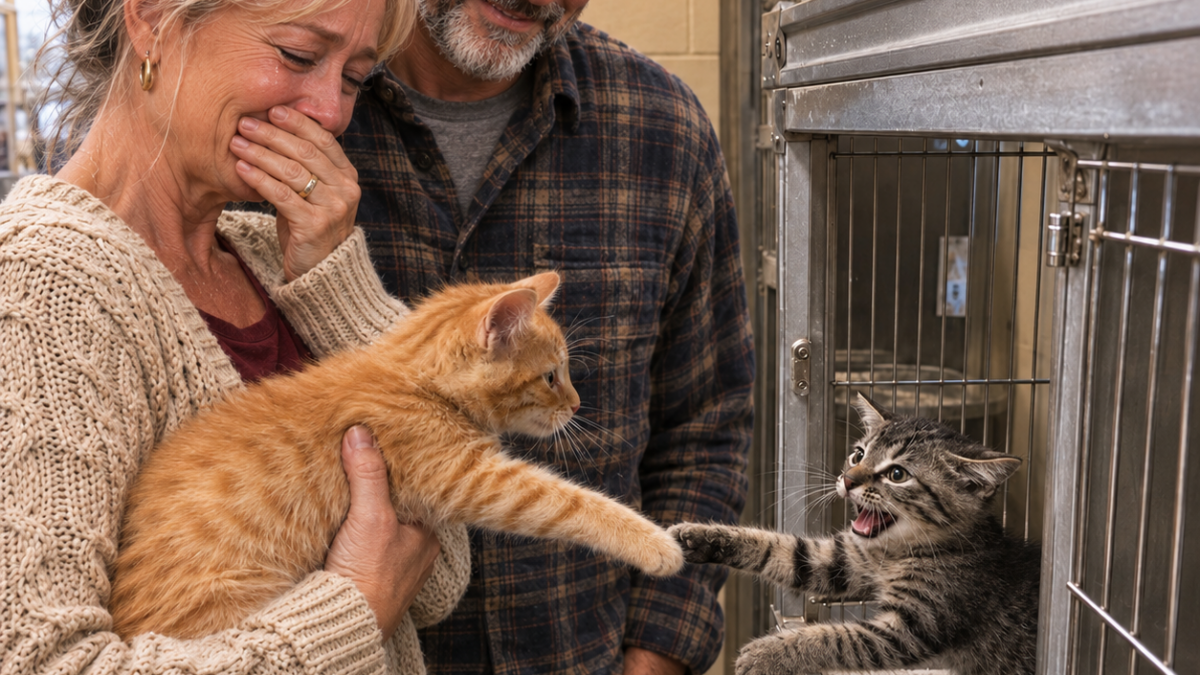
We were almost at the door when the cry came.
Smudge.
I stopped.
Susan stopped.
We turned.
Through the hallway, I could see the enclosure.
Ginger was in the worker’s arms.
Smudge stood upright.
One paw through the narrow opening before the door closed completely.
Ginger stretched backward.
Their paws touched.
Just barely.
Two tiny feet meeting through a gap.
Then the employee shifted.
Their paws separated.
Smudge screamed.
Susan’s hand was still on the front-door handle.
She didn’t move.
Neither did I.
The cry came again.
I thought about our plan.
One adult cat.
Calm.
Affordable.
Easy.
I thought about Walter.
Sixteen years.
All the ordinary inconvenience that had come with loving him.
Veterinary emergencies.
Destroyed furniture.
Vomiting on rugs.
Getting woken at four-thirty because he had decided breakfast time was negotiable.
The final year alone had cost more medically than several years before it.
None of that was what I remembered when he died.
I remembered him beside Susan’s chair.
Sleeping on Claire’s backpack.
Purring against my chest the night my father died.
Love has expenses.
But expense isn’t the same thing as waste.
Then I thought about Susan and me after Claire moved.
We had been lonely.
But when I woke at two in the morning and remembered my daughter lived fifteen hundred miles away, Susan was there.
When Susan cried after Walter’s final veterinary appointment, I held her.
We had each other.
These two kittens had been abandoned inside an empty house.
No familiar person.
No explanation.
No certainty anyone would ever return.
All they had was the body beside them.
I looked at Susan.
She was crying silently.
I said:
“We’ll need another litter box.”
She looked at me.
For one second she didn’t understand.
Then:
“What?”
“Two cats.”
Her eyes widened.
“Mark.”
“Two litter boxes.”
“Probably three, technically.”
“Why three?”
“They recommend one per cat plus one.”
I stared.
“You knew that?”
“I may have read something.”
“When?”
“Yesterday.”
“You were planning this.”
“I was researching.”
I laughed.
She started laughing too.
Through tears.
“Are you serious?”
I looked toward the back room.
Ginger had been returned.
Smudge was wrapped around her again.
“Yes.”
Susan hugged me.
Hard.
Then immediately pulled away.
“What about Oliver?”
That stopped us.
I looked toward his room.
He still mattered.
So we did something I think people sometimes forget adoption requires.
We asked questions.
How long had Oliver been there?
Three days.
Any applications?
Two families scheduled to meet him that afternoon.
Good.
Ginger and Smudge?
Six weeks.
Several people had wanted Ginger.
Nobody wanted both.
One applicant asked whether the rescue could separate them.
They refused.
Another family worried about Smudge’s anxiety.
One person said he wasn’t cute enough.
Six weeks.
Five-month-old kittens usually attract attention.
But two together meant double commitment.
And Smudge made people hesitate.
I looked at Susan.
She knew.
We filled out the paperwork.
Two names.
Ginger.
Smudge.
When Maria realized what we were doing, she smiled.
“You sure?”
“No,” I said.
Susan hit my arm.
“Yes.”
I corrected:
“We are responsibly terrified.”
“That’s healthier.”
The first challenge was the carrier.
We had brought one.
Of course.
One cat.
Maria found a larger rescue carrier.
Ginger went inside first.
Smudge followed immediately.
No crying.
Susan noticed.
“See?”
I pretended not to.
On the drive home, Ginger meowed seventeen times.
Smudge once.
I counted because anxiety makes me strange.
Susan sat in the passenger seat with one hand resting against the carrier.
“We have kittens.”
“Yes.”
“Two kittens.”
“Yes.”
“You agreed.”
“I was there.”
“Just confirming.”
“Please stop.”
She smiled all the way home.
The first three hours were deceptive.
We set them up in the guest bedroom.
Food.
Water.
Litter.
Beds.
Blanket from the rescue.
Ginger emerged from the carrier within thirty seconds.
Smudge did not.
Ginger inspected the room.
Window.
Bed.
Closet.
Chair.
Then returned to the carrier.
She touched noses with Smudge.
Came out again.
Smudge followed halfway.
Retreated.
Susan sat on the floor.
I sat beside her.
We didn’t reach.
Eventually Ginger approached.
Sniffed Susan.
Stepped onto her leg.
Smudge watched.
Ginger sniffed me.
Smudge watched.
It was like she was testing the world for him.
If Ginger survived something, Smudge would consider it.
By bedtime, Ginger had explored the entire guest room.
Smudge had explored twelve inches beyond the carrier.
Progress.
At 2:47 a.m., something crashed.
I sat upright.
“What was that?”
Susan was already awake.
“Lamp?”
We walked into the hallway.
Guest-room door had been left slightly open.
My mistake.
Two streaks shot past us.
Orange.
Gray.
Then something else fell over.
The lamp had survived.
A decorative basket hadn’t.
Ginger ran into the living room.
Smudge followed.
They hit the rug.
Turned.
Ran back.
I stood in the hall wearing pajama pants.
Susan leaned against the wall laughing.
“This is your fault.”
“My fault?”
“You said second litter box.”
“You cried first.”
At 3:15, we got them back into the guest room.
At 3:22, Ginger discovered she could climb curtains.
I stared at Susan.
“Your list specifically mentioned this.”
“I know.”
“First night.”
“I know.”
“First night.”
She kissed my cheek.
“Go to bed.”
The first week was chaos.
Ginger climbed onto the kitchen counter before we finished putting away her food.
Smudge spent two full days mostly beneath the couch once we allowed them into the living room.
Ginger stole a chicken breast from my plate.
Smudge knocked over my water glass trying to flee from a paper grocery bag.
They discovered the staircase.
They discovered toilet paper.
They discovered that anything on a shelf could become floor decoration.
One morning I found Ginger sitting inside the bathroom sink while Smudge attacked his own reflection in the mirror.
I stood there.
“Why?”
Neither answered.
At least Walter had possessed dignity.
Mostly.
But beneath all the chaos was the thing we’d seen at the rescue.
Ginger looked after Smudge.
Every new room began the same way.
Ginger first.
Smudge waiting at the threshold.
She walked in.
Sniffed.
Explored.
Sometimes came back.
Then he entered.
If something frightened him, Ginger returned.
When the vacuum cleaner turned on accidentally while Smudge was nearby, he ran beneath the dining table.
Ginger ran after him.
She didn’t appear frightened.
She simply sat beside him.
That became their pattern.
Smudge trusted the world in proportion to how much Ginger trusted it.
And slowly, something else happened.
He began trusting us too.
Not dramatically.
Inches.
The first time he ate while I sat nearby.
The first time he remained in the room when Susan stood.
The first time he accepted a treat from my fingers.
The first time he slept without pressing against Ginger.
Small victories.
Three weeks after adoption, Susan was sitting on the living-room floor.
Ginger was chasing a crumpled paper ball.
I’d bought expensive toys.
Naturally, paper won.
Smudge watched from beneath the couch.
Susan didn’t look at him.
That was something we’d learned.
Don’t turn progress into pressure.
Ginger batted the paper beneath a chair.
Susan laughed.
Then I saw movement.
Smudge emerged.
Slowly.
One paw.
Then another.
He sniffed the rug.
Walked toward Susan.
Stopped.
She kept watching Ginger.
Smudge climbed into her lap.
Susan froze.
I froze.
Ginger did not care and continued attacking paper.
Smudge circled once.
Then collapsed into Susan’s legs.
Eyes closed.
Susan looked at me.
Tears immediately.
I mouthed:
“Don’t move.”
She whispered:
“I wasn’t planning to.”
He slept there forty-three minutes.
Susan’s legs went numb.
She refused to shift.
Afterward, she said:
“That was worth every lamp.”
“One lamp.”
“So far.”
The house changed.
That’s the part I hadn’t expected.
Not because two kittens made noise.
Obviously they did.
But their presence changed Susan and me.
We talked more.
Not about anything profound.
“Did you feed them?”
“Where’s Ginger?”
“Why is there litter in the bathtub?”
“Smudge let me touch his paw.”
“Did you see what Ginger just did?”
Ordinary things.
But ordinary things were what grief had taken.
After Walter died and Claire moved, every conversation had felt like it needed a reason.
The kittens gave us hundreds of reasons that didn’t matter.
And somehow that mattered enormously.
We laughed again.
Not constantly.
But easily.
One evening Ginger climbed inside an empty cereal box and got stuck.
Smudge panicked because half of his sister had disappeared.
Susan and I spent ten minutes trying to help while laughing so hard neither of us was useful.
When Ginger finally backed out, Smudge immediately licked her face.
I said:
“He’s checking whether she survived.”
Susan looked at me.
“So are we.”
That silenced me.
She didn’t mean the cereal box.
I knew.
A month after we brought them home, I walked into the living room early one morning.
Sunlight came through the front window.
Ginger and Smudge were asleep together on Walter’s old chair.
We hadn’t put them there.
We had never encouraged them to use it.
For months after Walter died, neither Susan nor I had sat there much.
It felt like his chair.
That morning, Ginger lay on her side.
Smudge curled against her belly.
One orange paw rested across his back.
Exactly like the shelter.
Susan came up behind me.
I felt her hand slide into mine.
For a while, neither of us spoke.
Then she whispered:
“We thought we were rescuing them.”
I nodded.
“Maybe.”
She looked around the room.
Toys on the floor.
Scratching post beside the couch.
Water fountain humming in the corner.
One blanket dragged halfway beneath a chair.
The house looked lived in again.
Susan said:
“I think they rescued this place.”
I knew what she meant.
The house itself had never been broken.
We had.
Not completely.
Not dramatically.
Just in those quiet places where grief makes you smaller without asking permission.
Ginger and Smudge didn’t fix our loss.
They didn’t replace Walter.
They didn’t bring Claire closer.
They simply demanded that we participate in life again.
Feed us.
Watch this.
Clean this up.
Look what I found.
Come sit down.
Be here.
That was enough.
Several months later, Maria from the rescue emailed.
She wanted photographs.
Susan sent approximately sixty-three.
I told her that was unreasonable.
She reduced it to thirty-eight.
Maria posted one.
Ginger and Smudge asleep together.
Caption:
Still inseparable.
The comments were full of strangers saying how sweet they looked.
Nobody saw the nights.
The fear.
The work.
The first two days Smudge hid.
The budget spreadsheet Susan made so we’d feel comfortable with double veterinary expenses.
The extra litter.
The broken lamp.
The scratched chair.
That’s okay.
Love often looks simple from outside.
It rarely is.
At their first annual veterinary visit, Ginger weighed eleven pounds.
Far more than her skinny kitten body had predicted.
Smudge reached nine.
His bald patch was long gone.
His coat looked glossy.
The veterinarian examined him.
“Anxiety?”
“Better.”
“How much better?”
I looked at Susan.
She smiled.
“He steals my pillow now.”
The vet laughed.
“That’s clinical progress.”
Ginger remained the brave one.
Mostly.
Then came the thunderstorm.
A violent summer storm hit one night.
Lightning.
Wind.
Thunder shook the windows.
Ginger vanished.
We found her behind the washing machine.
Trembling.
Smudge was beside her.
Not behind.
Beside.
His body pressed against hers.
She had been his courage for a year.
Now he was hers.
I sat on the laundry-room floor.
Susan beside me.
Neither tried to move them.
Smudge began licking Ginger’s ear.
I looked at Susan.
“Look at him.”
She nodded.
“He learned.”
Maybe that’s what healing is.
Not becoming fearless.
Learning enough safety that when the person who carried you becomes afraid, you can carry some of them too.
Years passed.
Claire came home for Christmas and immediately accused us of loving the cats more than her.
Susan denied it.
I said:
“Depends which cat.”
Claire threw a pillow at me.
Ginger slept on her suitcase.
Smudge eventually allowed Claire to hold him.
That was significant.
He had become affectionate with us but remained cautious around visitors.
Claire sat quietly on the floor.
Waited.
Same way Susan had.
Eventually he climbed into her lap.
Claire whispered:
“Mom.”
“I know.”
“Don’t move.”
Susan laughed.
“Welcome to the family.”
The phrase caught me.
Family.
That was what Ginger and Smudge had been before us.
Two terrified kittens in an abandoned house.
No humans.
No certainty.
Just each other.
Then they became part of ours.
Not because they fit our plan.
They absolutely did not.
They became family because somewhere between the rescue kennel and our front door, their needs became ours.
That’s the strange thing about family.
You can plan bedrooms.
Budgets.
Schedules.
Retirement.
You can decide exactly what you think you’re capable of handling.
Then a frightened animal reaches through a kennel door.
And suddenly the shape of your life changes.
People sometimes ask whether we regret not adopting Oliver.
That question still hurts a little.
We checked.
Of course we did.
The day after bringing Ginger and Smudge home, Susan called the rescue.
Oliver had been adopted.
A retired couple.
Quiet home.
No other animals.
Exactly the life he’d deserved.
Susan cried when Maria told her.
Happy tears this time.
I said:
“See?”
She nodded.
“We all got what we needed.”
I don’t know whether life works that neatly very often.
That time it did.
Ginger and Smudge are adults now.
They still sleep together.
Not every night.
Smudge has become more independent.
Sometimes he sleeps in our bedroom while Ginger stays downstairs.
That would have been impossible when he was five months old.
The first time it happened, I woke at three in the morning and found Smudge alone at the foot of our bed.
I nearly woke Susan.
Then decided not to.
I just watched him.
He was asleep.
Completely relaxed.
No Ginger.
No panic.
In the morning, I told Susan.
She smiled for a long time.
“He knows she’ll still be there.”
Yes.
That was it.
He finally learned separation didn’t always mean abandonment.
Sometimes someone leaves the room.
Then comes back.
Sometimes a daughter moves three states away and still calls every Sunday.
Sometimes a beloved cat dies and love doesn’t disappear with him.
Sometimes your wife walks into another room and you don’t have to follow because the home remains safe.
Ginger taught Smudge that.
Maybe they taught us too.
I’m older now than I was when we walked into that rescue.
The plan had been one easy cat.
I laugh about that.
Ginger still climbs counters.
Smudge still becomes suspicious whenever somebody moves furniture.
Vet bills are absolutely higher with two cats.
Litter is more expensive than I remembered.
We have three litter boxes.
Susan was right.
I hate that.
The lamp they broke is still gone.
We never replaced it.
There’s a small scratch on the hallway wall from one of their early nighttime races.
I could repair it in ten minutes.
I haven’t.
Some marks become history.
Walter’s ceramic food dish remains in the cabinet.
We didn’t reuse it.
That belonged to him.
His photograph sits beside it.
Ginger and Smudge have their own bowls.
Their own beds.
Their own stories.
That matters.
New love doesn’t require old love to disappear.
There is room.
More than we think.
One quiet Sunday morning, I found Susan sitting in Walter’s old chair with Ginger in her lap and Smudge beside her.
She was looking at a photograph on her phone.
Walter.
I sat down nearby.
“You okay?”
“Yes.”
“You miss him?”
“Every day.”
She scratched Ginger beneath the chin.
Then smiled.
“And I love these idiots.”
Ginger bit her gently.
Susan laughed.
“See?”
I said:
“Walter would’ve hated them.”
“Absolutely.”
“He would’ve moved out.”
“Probably.”
We laughed.
There it was again.
Grief and joy sharing the same room without canceling each other.
I wish someone had told me earlier that healing wasn’t choosing one.
You can miss what was.
And love what is.
One doesn’t betray the other.
The rescue center sends us an anniversary email every year.
On the fifth one, Susan suggested we visit.
I wasn’t sure.
Then we went.
The building smelled the same.
Disinfectant.
Litter.
Cat food.
Maria still volunteered there.
She recognized us immediately.
“Ginger and Smudge.”
Susan laughed.
“You remember?”
“How could I forget?”
We showed photographs.
Maria stared at Smudge.
“He looks completely different.”
He did.
No bald patch.
No hollow cheeks.
No frightened eyes.
Large gray-black cat stretched across our couch as if he paid the mortgage.
Then Maria told us something we’d never known.
“Do you remember the first day you visited?”
“Yes.”
“After you left with them, one of our volunteers cried.”
Susan smiled.
“Why?”
“Because Smudge had been passed over eight times.”
I stared.
“Eight?”
“People wanted Ginger.”
“But when we told them they had to take both…”
She shrugged.
“Some couldn’t.”
“Some didn’t want the anxious one.”
I looked at Susan.
Maria continued.
“We were beginning to wonder whether they’d be here until they were adults.”
Susan’s eyes filled.
I thought about the front door.
My hand almost outside.
One more cry behind us.
Ten more seconds.
We nearly left.
I asked:
“What would have happened if someone had insisted on Ginger alone?”
“We wouldn’t have allowed it.”
“Even if Smudge stayed months longer?”
“Yes.”
“Why?”
Maria looked at me like the answer was obvious.
“Because sometimes adoption isn’t about getting an animal out fastest.”
“It’s about sending them home safely.”
I never forgot that.
On the drive home, Susan looked out the window.
Then said:
“Eight times.”
“I know.”
“People didn’t want him.”
“Some people couldn’t take two.”
“I know.”
She was quiet.
Then:
“We almost didn’t.”
“Yes.”
Another silence.
“I’m glad we turned around.”
I reached over.
Took her hand.
“Me too.”
When we got home, Ginger met us at the door.
Smudge appeared behind her.
Some things never change.
Susan crouched.
“We went to the place where we found you.”
Ginger sniffed her purse.
Smudge looked suspicious.
I said:
“They don’t care.”
“They care spiritually.”
“That’s not a thing.”
She ignored me.
That evening, the four of us sat in the living room.
Susan reading.
Me pretending to read while mostly watching television.
Ginger asleep by the window.
Smudge stretched beside her.
At some point, Ginger got up for water.
Years earlier, Smudge would have followed instantly.
He didn’t.
He opened one eye.
Watched her leave.
Then closed it.
He knew.
She would come back.
Five minutes later, Ginger returned.
Walked straight to him.
Curled down.
Placed one orange paw across his back.
Exactly as she had in the shelter.
I looked at Susan.
She had seen it too.
Neither of us said anything.
We didn’t need to.
I sometimes wonder what would’ve happened if we had stayed with our original plan.
Oliver would have come home with us.
He would have been wonderful.
Our house probably would have become warmer again.
We would have loved him.
There isn’t a bad version of that future.
But this is the one we got.
The noisy one.
The expensive one.
The two-litter-bags-at-a-time one.
The one with broken lamps.
The one where a frightened gray kitten learned to sleep alone.
The one where an orange kitten who had spent her first months protecting her brother eventually learned she could be frightened too because he would protect her back.
The one where two middle-aged people who thought they wanted something easy discovered maybe easy wasn’t what their house needed.
We had come to the rescue thinking we understood our limits.
Maybe we did.
Budgets matter.
Age matters.
Energy matters.
People should never adopt animals they cannot responsibly care for just because a moment feels emotional.
I still believe that.
We went home and changed our budget.
Canceled a couple of unnecessary subscriptions.
Created a veterinary emergency fund.
Bought insurance.
Made the decision practical enough to support the emotional one.
Love isn’t an excuse to be irresponsible.
But responsibility isn’t always choosing the least complicated option either.
Sometimes it’s looking carefully at what a choice will require and saying:
Yes.
We can carry that.
The day we adopted them, I thought Ginger and Smudge needed someone who wouldn’t separate them.
Years later, I think we needed the same lesson.
Susan and I had been living together but grieving separately.
Those kittens did not magically fix our marriage because our marriage wasn’t broken.
They simply pulled us back into the same life.
We laughed at the same disasters.
Celebrated the same tiny victories.
Sat on the same floor waiting for Smudge.
Woke together when Ginger knocked something over.
Shared responsibility.
Shared worry.
Shared joy.
They gave our grief somewhere to move.
That is what I think about whenever people call adoption a rescue.
The word makes it sound one-directional.
Person saves animal.
Maybe sometimes.
But families are more complicated.
Ginger and Smudge were abandoned.
We gave them food.
Shelter.
Veterinary care.
Warm beds.
Safety.
Yes.
We rescued them.
But they walked into a house where two people had slowly forgotten how much life could fit into ordinary days.
And they filled it.
Not quietly.
Absolutely not quietly.
They filled it with running paws.
Paper balls.
Broken lamps.
Purring.
Scratching.
3 a.m. races.
Litter tracked across floors I had just cleaned.
One cat crying whenever the other disappeared.
Then eventually learning she would come back.
That’s what they gave us.
Noise.
Need.
Routine.
Connection.
Life.
Years ago, at the rescue center, Susan and I stood with our hands almost on the exit.
We had already chosen what made sense.
One calm adult cat.
Then Smudge cried.
Ginger reached backward.
Their paws touched for one second.
That image stayed with me.
Two animals with almost nothing left trying desperately not to lose the one thing they still had.
I looked at Susan.
Thought about our daughter miles away.
Walter gone.
Our silent rooms.
Then I said the sentence that changed our home.
“I guess we’ll need a second litter box.”
I was wrong, of course.
We needed three.
But Susan still says it was the smartest wrong thing I’ve ever said.
Because sometimes family doesn’t arrive in the form you planned for.
Sometimes it is frightened.
Inconvenient.
More expensive than expected.
Sometimes it knocks over your lamp at three in the morning.
Sometimes it comes in pairs.
And sometimes the most important decision you make isn’t choosing who to take home.
It’s deciding who you refuse to leave behind.








