Waitress Hid a Crying Child Behind the Counter — He Didn’t Notice the 20 Hells Angels
PART3:
“Evening,” I answered. “Kitchen’s closed, but I’ve got coffee.”
“I’m not here for coffee.”
He leaned both hands on the counter and looked around the empty diner.
“I’m looking for my son. Little boy. Name’s Toby. He ran off. You seen him?”
My fingers tightened around the rag.
I made my face tired.
Bored.
Mildly concerned.
“No, sir. Been dead in here since nine. Highway closure killed the night.”
His eyes moved over me.
Then the booths.
Then the restrooms.
Then back to me.
“My boy gets confused,” he said. “He has a condition.”
I turned my back to grab the coffee pot from the burner.
Partly because it made me look calm.
Partly because I needed one second to breathe.
“I can call highway patrol for you,” I said. “They might have a unit near the closure.”
“No.”
He said it too fast.
The mask cracked for only a moment, but I saw what was underneath.
“No police,” he added, smoothing his voice again. “It’s a family matter.”
Behind the counter, Toby stayed silent.
I prayed he would not sneeze.
I prayed he would not shift.
I prayed the man would not hear my heartbeat, because it felt loud enough to rattle the coffee cups.
Then he looked down.
The mud.
I had forgotten the mud.
Tiny barefoot prints led from the front door across the tile.
They stopped at my side of the counter.
The man’s head lifted slowly.
His eyes changed.
“You’re lying to me.”
I did not answer.
He stepped toward the swinging gate that led behind the counter.
I moved first, placing myself directly in front of it.
“I think you need to leave,” I said.
The polite waitress voice was gone.
He smiled, but there was no humor in it.
“You’re brave, aren’t you?”
I reached under the register.
My hand closed around the cast-iron skillet I kept there for emergencies. It was heavy, grooved, and old enough to have survived three managers, two robberies, and countless breakfasts.
I had never used it as a weapon.
That night, I was ready.
“That’s my property behind your counter,” he said.
The word property made something cold pass through me.
Not son.
Not child.
Property.
His right hand slid beneath his jacket.
I saw the bulge at his waistband.
A gun.
“Move,” he said.
“No.”
His face darkened.
“Move now, or I’ll put a hole in you, step over your body, and drag him out myself.”
I felt fear then.
Real fear.
Not the kind that makes you scream.
The kind that makes everything clear.
The pie case.
The swinging gate.
The boy under the counter.
The gun under the jacket.
The skillet in my hand.
The distance between his fingers and the weapon.
The fact that I might die in a diner that smelled like burnt coffee and bleach.
But I did not move.
“You pull that gun,” I said, my voice shaking only a little, “and one of us is leaving this diner in a bag.”
He laughed.
Then his hand started to draw.
That was when the ground began to tremble.
At first, I thought it was thunder.
Then the coffee in the pot rippled.
The windows rattled in their frames.
The vibration grew deeper, louder, rolling across the gravel lot and through the floor beneath my shoes.
Engines.
Not one.
Not two.
Many.
The roar of motorcycles swallowed the storm.
Headlights cut through the rain outside, one after another, until the parking lot filled with white beams, chrome, wet leather, and thunder.
The man froze with his hand still under his jacket.
I looked past him through the front window.
Twenty motorcycles rolled into O’Malley’s lot.
Twenty Harleys.
Twenty riders.
Every one of them soaked from the storm.
And every one of them wearing the kind of leather cut most men had enough sense not to disrespect.
The Hells Angels had arrived.
Now, before anyone misunderstands, I am not telling this story to make saints out of men who would never claim to be saints. I knew exactly who they were. Everybody on Highway 40 knew. They were rough men. Dangerous men. Men with pasts written in scars, records, and rumors.
But they were also regulars.
They rode through every few months on long runs across the desert. They drank black coffee, ordered too much food, tipped better than businessmen, and never once treated me like I was invisible.
Their road captain was a huge man named Thomas Jenkins.
Nobody called him Thomas.
Everybody called him Bear.
Bear was six-five, nearly three hundred pounds, with a gray beard, a scar through one eyebrow, and hands big enough to wrap around a coffee mug like it was a toy.
The door opened so hard the bell nearly snapped off.
Bear stepped in first.
Behind him came the others.
Wet leather.
Heavy boots.
Denim.
Rainwater dripping onto my floor.
Twenty bikers entered the diner like the storm had grown legs.
Bear looked at me.
Then at the man near the counter.
Then back at me.
“Evening, Sam.”
His voice was deep enough to live in the walls.
“Hey, Bear,” I managed. “Rough night for a ride.”
“Monsoon out there.”
His eyes moved across my face, and I knew immediately he saw too much. Bear was not a man who missed trembling hands or shattered nerves.
Still, he played it normal.
“We need the back booths. Coffee. Burgers. Whatever you got.”
“I’ll fire the grill.”
The man with the gun made the worst mistake of his life.
He turned toward Bear like Bear was an inconvenience.
“Excuse me,” he snapped. “The diner is closed. We’re having a private conversation.”
The room went still.
Not quiet.
Still.
Twenty bikers stopped moving.
One near the jukebox slowly turned.
Another lowered his gloves.
Bear looked at the man as if he had just heard a raccoon speak English.
“What did you say to me, slick?”
“I said this doesn’t concern you,” the man barked. “Take your friends and leave.”
Bear took one slow step forward.
“I’ve been riding in the rain for six hours. I’m cold. I’m wet. I want coffee. And right now, the only thing standing between me and that coffee is you running your mouth.”
The man’s control snapped.
He pulled the revolver and aimed it at my chest.
“Open the gate!” he screamed. “Give me the kid!”
The room exploded into motion.
I will not describe every second of what happened, because some things do not need to be dressed up with detail to be understood.
The bikers moved faster than men their size should have been able to move.
One struck the man’s arm before he could steady his aim.
Another slammed him sideways into the counter.
Bear came in like a wall collapsing.
The gun went off.
The sound split the diner open.
Glass shattered behind me.
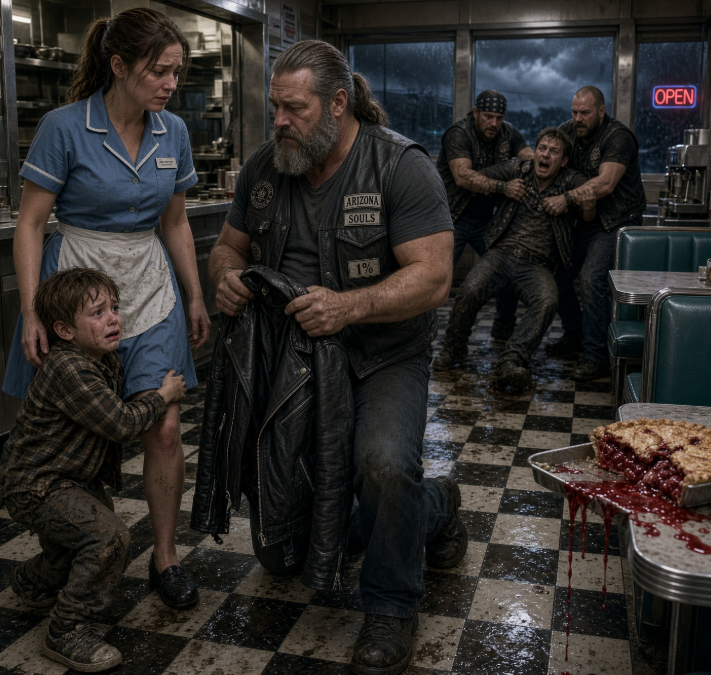
The pie case burst, spraying cherry filling and safety glass across the counter. I felt heat near my ear and realized the bullet had missed me by inches.
Then the revolver hit the floor and skidded under a stool.
Two bikers pinned the man’s arms.
One kicked the gun farther away.
Bear planted one boot near the man’s shoulder and looked down at him with a kind of calm fury I had never seen before.
“You pulled a gun on our girl,” Bear said.
The man groaned.
“You brought a gun into my coffee shop,” Bear continued, “and pointed it at a woman.”
He looked at one of the others.
“Call it in.”
The biker nodded and pulled out a phone.
That mattered.
Because in another version of that night, anger could have taken over completely.
But Bear looked at me, then at the muddy footprints, then at the space behind the counter.
“You hiding a kid back there, Sam?”
I lowered the skillet.
My hands were shaking so badly I almost dropped it.
“Yes.”
Bear’s face changed.
Not softened exactly.
Bear did not soften like normal people.
But something in him became careful.
I knelt behind the counter.
“Toby,” I whispered. “Sweetheart, it’s safe now. He can’t hurt you.”
For a moment, nothing moved.
Then a small face appeared from the dark.
Toby crawled out covered in flour dust, grease, mud, and tears. The moment he saw me, he threw himself into my apron and buried his face against my stomach.
I wrapped both arms around him.
“You’re okay,” I whispered. “I’ve got you.”
Around us, the bikers went silent.
These were men who could stare down threats without blinking, but the sight of that child undid something in every one of them.
Bear crouched slowly, which looked like a mountain deciding to become smaller.
“Hey there, little brother,” he said gently. “I’m Bear. You don’t have to be scared of us.”
Toby peeked out from behind me.
His eyes flicked toward the man on the floor.
“Is he dead?”
“No,” Bear said. “But he’s not going to hurt you again.”
Toby’s fingers tightened around my apron.
Bear’s voice dropped even lower.
“Is he your dad?”
Toby shook his head.
The room seemed to stop breathing.
“He’s not my dad,” Toby whispered.
My arms tightened around him.
Bear looked at me.
I felt the blood drain from my face.
“Toby,” I said softly, “who is he?”
The words came out broken.
“He broke into our house.”
No one moved.
“He hurt my mommy. She wouldn’t wake up.”
My throat closed.
Toby began to shake harder.
“Then he put her in the back of his car. He said if I made a sound, he’d put me there too. I jumped out when he stopped for gas.”
The rain outside suddenly sounded very far away.
The man on the floor began struggling.
“You little liar!”
Bear’s boot shifted.
The man stopped talking.
One of the bikers near the window looked toward the dark SUV in the lot.
Bear did not have to say much.
“Clutch. Rev. Check the vehicle. Don’t touch more than you have to. Look. Then come back.”
Two bikers went out into the rain.
I pulled Toby closer and turned his face against my shoulder so he would not look at the man.
“You did so good,” I whispered. “You ran. You found help. You did exactly right.”
“I left Mommy.”
“No,” I said, fighting to keep my voice steady. “You survived. That is not the same thing.”
A few minutes later, the door opened again.
The two bikers came back in.
They were pale.
One of them, a wiry man called Clutch, looked at Bear and nodded once.
That was all.
We all understood.
Toby’s mother was gone.
I closed my eyes.
For one second, I hated the whole world.
Then Toby whimpered, and I remembered he was still in it.
That meant the world was not allowed to be only hate.
Bear turned to me.
“Sam. Take him to the office. Lock the door. Put something on the TV. Don’t let him hear any more than he already has.”
I nodded.
The manager’s office was small, with a desk, an old chair, a safe, a first-aid kit, and a tiny television mounted in the corner. I carried Toby there, locked the door, and sat with him on the floor.
His whole body shook.
I cleaned the cut above his eyebrow with trembling hands.
He did not cry when it stung.
That hurt more than if he had screamed.
Children are supposed to protest pain.
They are not supposed to endure it silently because worse things have already happened.
I found a blanket in the storage cabinet and wrapped it around him.
“You’re cold,” I said.
He stared at the door.
“Is he coming?”
“No.”
“Promise?”
I looked into his eyes.
“I promise.”
I turned on the television and found cartoons, but Toby did not watch them. He leaned against my side, stiff at first, then little by little his body gave up the fight and sagged against me.
I kept one arm around him.
Outside the office, I could hear low voices.
Boots moving.
A chair scraping.
Someone talking on the phone.
The man’s voice once, pleading now, no longer smooth or powerful.
Then sirens.
When the state troopers arrived, their red and blue lights painted the rain against the office blinds. I opened the door only after Bear knocked and said, “Troopers are here, Sam.”
The diner looked unreal.
The pie case was shattered.
Coffee had spilled across the counter.
Muddy prints covered the floor.
The man was restrained, alive, and surrounded by officers.
The revolver sat inside a clear plastic kitchen bag on the counter where no one had touched it barehanded.
Bear stood nearby with a mug of coffee like this was the most ordinary night of his life.
A state trooper named Sergeant Miller approached me.
“Ma’am, are you Samantha Brody?”
“Yes.”
“This the child?”
Toby hid behind me.
“Yes.”
“We need medical to look at him.”
“I know.”
“And we’ll need your statement.”
“I know that too.”
His expression softened slightly.
“You did good tonight.”
I looked down at Toby.
“No,” I said. “He did.”
The ambulance arrived first.
Then more law enforcement.
Then crime scene investigators.
The diner filled with radios, flashlights, questions, wet uniforms, and the terrible reality of what Toby had survived.
He refused to let go of my hand.
So I rode with him to the hospital.
He slept for ten minutes in the ambulance, then woke up gasping and calling for his mother.
I held him while the paramedic looked away.
At the hospital, doctors treated the cut on his head, checked him for exposure, bruising, shock, and dehydration. A social worker arrived. Then a detective. Then a child advocate with gentle eyes and a stuffed dinosaur tucked under one arm.
Toby answered questions when he could.
When he could not, he looked at me.
Each time, I told him, “You’re safe.”
I said it so many times that night the words began to feel like a prayer.
By sunrise, the storm had moved east.
The sky over Kingman turned pale and exhausted.
I sat in a hospital chair with coffee gone cold in my hand while Toby slept under a white blanket.
A detective told me they had identified the man as Richard Caldwell.
He was not Toby’s father.
He had known Toby’s mother casually through work done at her home. The details would come later, in reports, hearings, courtrooms, and nightmares. What mattered that morning was simple.
He had entered their home.
He had killed Toby’s mother.
He had tried to take Toby with him.
And Toby, six years old, barefoot in a storm, had escaped at a gas station and run until he found the only light open on that stretch of highway.
My diner.
My empty, miserable, rain-battered diner.
People call things coincidence when they are too frightened to call them miracles.
I do not know which one that night was.
I only know that Toby found the door.
And when he did, I opened it.
The first few days after were a blur.
I gave statements.
I cleaned blood and glass from the diner because I could not stand the idea of anyone else touching that spot.
I sat with Toby whenever child services allowed it.
At first, they treated me kindly but carefully.
I was not family.
I was a waitress who had hidden him behind a counter.
A witness.
A temporary safe face.
The system has rules, and I understood why. I had grown up inside those rules. I had been moved through homes, case plans, hearings, placements, and good intentions that sometimes arrived too late.
Toby had no living relatives who could take him.
That sentence did something to me.
No living relatives.
Six years old.
Mother gone.
No father in the picture.
No grandparents able to take him.
No aunt stepping forward.
No safe home waiting.
I knew what came next.
Foster care.
Maybe a good placement.
Maybe not.
Maybe kind people.
Maybe crowded rooms.
Maybe a child waking up in a strange bed wondering why the woman who saved him did not come back.
So I came back.
Again.
And again.
At first, I visited because he asked for me.
Then I visited because I could not imagine not going.
Then one evening, after he had been placed in emergency foster care, I arrived with a small backpack full of pajamas, socks, coloring books, and a stuffed bear wearing a tiny leather vest Bear had somehow found.
Toby held it against his chest.
“Is Bear bad?” he asked me.
I sat beside him.
“What do you mean?”
“People said motorcycle men are bad.”
I thought carefully before answering.
“People are not always one thing,” I said. “Some people do bad things. Some people do good things. Some people have done both. That night, Bear helped keep you safe.”
Toby looked at the stuffed animal.
“He said he was the good guy tonight.”
I smiled a little.
“That sounds like Bear.”
“Are you the good guy?”
My throat tightened.
“I’m trying to be.”
He leaned against me.
“That’s okay.”
The legal process took a long time.
Richard Caldwell was charged, tried, and eventually sentenced to life in prison without parole. He confessed after the evidence became impossible to deny. He never appealed.
People asked if that made me feel better.
It did and it didn’t.
Justice can lock a dangerous man away.
It cannot give a child his mother back.
It cannot erase the sound of a little boy whispering, Hide me.
It cannot unshatter the moment he learned the world could become unsafe inside his own home.
The real battle, for me, began after the headlines stopped.
I applied to become Toby’s guardian.
People told me it would be hard.
They were right.
Background checks.
Home inspections.
Financial reviews.
Parenting classes.
Interviews.
Court dates.
Questions about my childhood.
Questions about my work schedule.
Questions about why a single diner waitress thought she could raise a traumatized child.
That one made me angry.
Not because it was unfair to ask if I was prepared.
But because no one asked Richard Caldwell if he was qualified to destroy a child’s life.
The system needed proof I could love Toby safely.
Fine.
I gave proof.
I changed shifts.
I moved into a bigger apartment.
I learned trauma-informed parenting.
I met with therapists.
I sat through interviews that made me feel like every mistake I had ever made might be weighed against a little boy’s need for home.
Bear and the others helped in their own strange way.
They did not interfere.
They did not threaten anyone.
They showed up where showing up mattered.
Bear wrote a character letter that was mostly unreadable because his handwriting looked like barbed wire dragged through mud.
Clutch fixed my car for free and told me if I argued, he would charge me double.
One of the older bikers donated furniture anonymously, except everyone knew it was him because he delivered it himself and said, “This fell off a truck,” which was his way of being generous without feeling emotionally exposed.
The first time Toby visited my apartment, he stood in the doorway with his little backpack and looked around silently.
I had made up the spare room with dinosaur sheets, a nightlight, books, and the stuffed bear.
He walked to the bed.
Touched the blanket.
Then looked at me.
“Can I sleep with the door open?”
“Yes.”
“Can the hallway light stay on?”
“Yes.”
“Can I have cereal for dinner?”
I almost laughed.
“Yes.”
He nodded, as if negotiating a treaty.
That night, he woke screaming three times.
The first time, I ran to him and found him sitting upright, eyes open but not fully awake.
“Mommy,” he sobbed.
I sat beside him.
“I’m here.”
“You’re not Mommy.”
“I know.”
That was the hardest answer.
“I know I’m not.”
He cried until he hiccupped, then fell asleep holding my sleeve.
The second time, he asked if the man was at the window.
The third time, he did not speak at all.
He just crawled into the hallway and lay outside my bedroom door.
After that, I put a sleeping bag on the floor beside my bed.
For three months, he started the night in his room and ended it there.
Healing was not pretty.
People like rescue stories with clean endings.
A child is saved.
The villain is arrested.
The brave waitress becomes a mother.
The bikers become legends.
Everyone cheers.
That is not how trauma works.
Toby hoarded food under his pillow.
He flinched when men raised their voices on television.
He panicked if I was five minutes late.
He hated dark SUVs.
He asked the same question every night for weeks.
“You’re coming back?”
Every night I answered the same way.
“Yes. I’m coming back.”
Then one night he asked, “Even if I’m bad?”
I sat down on the edge of his bed.
“Especially then.”
He frowned.
“That doesn’t make sense.”
“It will.”
The first time he laughed without stopping was because Bear tried to sit in one of my kitchen chairs and broke it.
It happened three months after Toby moved in.
Bear had come by with two of the guys to install a better deadbolt and security camera. Toby watched from the hallway, cautious but curious.
Bear lowered himself into the chair.
The chair made one tiny warning sound.
Then collapsed.
Bear landed on the floor with a crash that shook the apartment.
For one terrifying second, I thought Toby would panic.
Instead, he stared.
Then he giggled.
Then he laughed so hard he had to sit down.
Bear remained on the floor, dignity destroyed, and pointed at him.
“You saw nothing.”
Toby laughed harder.
That was the first time I saw the little boy he might have been before that night.
It did not last long.
But it existed.
And once something exists, you can build toward it.
A year after the diner, the court granted me full guardianship.
Later, adoption.
I wore my diner uniform to the hearing because Toby asked me to.
“That’s what you wore when you found me,” he said.
I did not correct him.
Technically, he found me.
When the judge asked if he understood what adoption meant, Toby looked at me first.
Then he said, “It means she comes back.”
The judge had to pause.
So did I.
After the hearing, Bear and the others waited outside the courthouse.
Twenty motorcycles lined the curb like a steel wall.
Toby walked out holding my hand.
Bear knelt, which still looked like a building lowering itself.
“Well?” he asked.
Toby smiled.
“She’s my mom now.”
Bear looked away fast.
“Damn allergies,” he muttered.
“There are no plants here,” I said.
“Court allergies.”
The bikers gave Toby a tiny leather vest.
No patches.
No club markings.
Just his name stitched on the front.
TOBY.
He wore it over his button-down shirt all the way home.
O’Malley’s changed after that night.
A few weeks after the incident, Bear came back to the diner during daylight. He walked up to the front door and placed a small decal near the open sign.
“Bear,” I said, “what is that?”
“Insurance.”
It was a red-and-white support decal.
I crossed my arms.
“You know I can’t have anything too intimidating on the door.”
He looked at me.
“Sammy, a murderer chased a child into your diner and pointed a gun at you. Intimidating is now part of the brand.”
I should have argued.
I did not.
The truth was, after that decal went up, no one caused trouble at O’Malley’s.
Truckers lowered their voices.
Drifters behaved.
Drunks apologized before getting too drunk.
People who had once snapped their fingers for coffee suddenly remembered my name.
The diner became known along Highway 40 as the place you did not disrespect.
Not because of me.
Because everyone knew who considered me family.
Years later, Toby asked me to take him back there.
He was eleven by then, taller, stronger, still quiet in new places but no longer afraid of every shadow.
“Are you sure?” I asked.
He nodded.
“I want to see where I ran to.”
So I drove him down Highway 40 on a clear afternoon.
No rain.
No storm.
No dark SUV.
Just desert light and the hum of tires.
The diner looked smaller in daylight. Most frightening places do.
Toby stood outside the door for a long time.
I stayed beside him.
“You don’t have to go in.”
“I know.”
He reached for my hand.
Then opened the door.
The bell chimed.
For a second, I was back there.
Rain.
Blood.
Mud.
Hide me.
Then Toby squeezed my hand, and the memory loosened.
O’Malley’s was full that day. Truckers in booths. A family at the window table. Two bikers at the counter drinking coffee. The pie case had been replaced years ago, but I still sometimes imagined cherry filling and glass on the floor.
Toby looked behind the counter.
At the space beneath the fryer.
“That’s where I hid?”
“Yes.”
“It’s small.”
“You were small.”
He thought about that.
“Was I brave?”
I knelt in front of him.
“You were the bravest person I have ever known.”
His eyes filled, but he did not cry.
Not there.
Not then.
Bear arrived twenty minutes later because apparently news traveled faster than weather.
He walked in, older now, beard whiter, shoulders still massive.
Toby smiled.
“Hey, Bear.”
Bear opened his arms.
Toby hugged him.
Not like a frightened child.
Like family.
Bear looked over Toby’s head at me.
I nodded once.
We were okay.
Not untouched.
Not unscarred.
But okay.
That night, after Toby fell asleep at home, I sat at the kitchen table and thought about how many things had to happen for him to survive.
The highway closure.
The empty diner.
The unlocked door.
The motorcycles arriving at exactly the right moment.
A biker crew too cold and hungry to ride past.
A child brave enough to run.
A waitress stubborn enough to stand between him and a gun.
People call me a hero sometimes.
I still hate that word.
Heroes sound fearless.
I was terrified.
My hands shook for an hour after the gunshot. I had nightmares for months. I kept seeing the muddy footprints on the floor and wondering what would have happened if I had noticed them sooner.
But maybe courage is not the absence of fear.
Maybe courage is a shaking hand wrapped around a cast-iron skillet.
Maybe it is saying no when a dangerous man tells you to move.
Maybe it is a six-year-old boy jumping from a monster’s car and running barefoot through rain toward the only light he can see.
Maybe it is twenty men in wet leather deciding that whatever they had been before, tonight they would be protectors.
Maybe it is coming back, day after day, after the dramatic part is over.
Coming back to court.
To therapy.
To nightmares.
To cereal dinners.
To broken chairs.
To adoption hearings.
To the ordinary work of making a frightened child believe the door will open and the right person will be there.
That is what saved Toby in the end.
Not just the night in the diner.
Everything after.
The promise repeated until he believed it.
You are safe.
I am here.
I am coming back.
Years later, Toby still keeps the little leather vest in his closet.
The stuffed bear sits on a shelf above his desk.
He does not remember every detail from that night, and I am grateful for that. Children should not have to carry every second of the worst thing that ever happened to them.
But he remembers the bell above the door.
He remembers the smell of coffee.
He remembers my apron.
He remembers Bear kneeling and saying, “We’re the good guys tonight.”
And he remembers that when he asked me to hide him, I did.
Sometimes, when the rain hits the windows hard enough, Toby gets quiet.
I do too.
Then I make hot chocolate, and he pretends he is too old for marshmallows but takes them anyway.
We sit at the kitchen table.
We let the storm pass.
Because storms do pass.
That is something I learned at O’Malley’s.
A storm can turn the whole world black.
It can shake the windows.
It can drive a terrified child through your door.
It can bring evil right behind him.
But sometimes, if you hold your ground long enough, thunder answers from the parking lot.
Sometimes help arrives wearing wet leather and riding Harleys.
Sometimes a waitress becomes a mother.
Sometimes a child who ran for his life grows up safe enough to laugh.
And sometimes the smallest light on the darkest road is enough to change where a story ends.








