Two Shelter Kittens Screamed Every Time We Separated Them—So I Risked Breaking the Rules to Keep Them Together
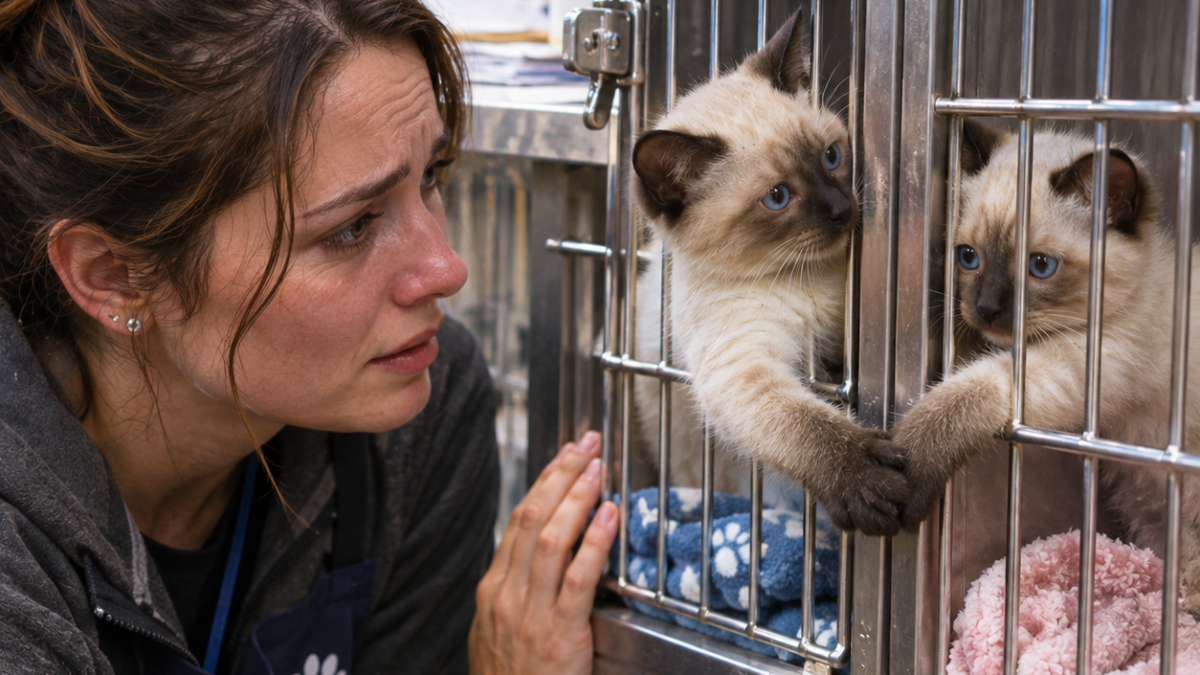
Two Shelter Kittens Screamed Every Time We Separated Them—So I Risked Breaking the Rules to Keep Them Together.
The shelter ordered me to separate two terrified Siamese kittens because keeping them together would make them harder to adopt—and when I refused, I was warned that my job could disappear before they did.
Three days later, a wealthy adopter demanded the “prettier” kitten alone, my supervisor told me to stop being emotional, and the brother left behind screamed until his body simply shut down.
I thought risking my career was the worst thing that could happen, until I discovered someone had been quietly changing their records to make splitting them look harmless—and by then, one kitten was already scheduled to leave.
My name is Tessa Morgan.
I was twenty-nine years old when two ten-week-old kittens taught me that sometimes doing the right thing does not feel brave.
Sometimes it feels like nausea.
Sometimes it feels like your supervisor standing six feet away with a clipboard while you deliberately ignore a rule you have followed hundreds of times.
Sometimes it feels like understanding perfectly well why the rule exists and breaking it anyway.
And sometimes it sounds like two tiny animals screaming for each other from opposite sides of a room.
The call came at 6:17 on a Thursday morning in Syracuse.
My work phone only rang that early for three reasons.
Loose dog in traffic.
Injured animal.
Or kittens somewhere inconvenient.
This one was kittens.
A woman named Mrs. Delaney lived beside an abandoned row house scheduled for demolition near the old industrial district. For three nights she had heard crying beneath the porch.
She had tried food.
Nothing came out.
She had called animal control the day before, but there had been an emergency involving an injured shepherd on the interstate.
So at 6:17, the message came to our shelter.
Possible kittens.
Cold weather.
Abandoned structure.
I was technically not on shift until eight.
I went anyway.
That probably tells you most of what you need to know about why I worked in animal rescue.
It also explains why, at twenty-nine, I had approximately six hundred dollars in savings and three different pairs of shoes permanently stained with things I had stopped trying to identify.
I worked intake at Central New York Companion Animal Alliance.
Everyone called it CNYCA, although half the staff pronounced it differently.
We were not one of those beautiful shelters you see in glossy fundraising videos.
No huge atrium.
No waterfall fountain.
No walls covered in inspirational quotations.
We had aging linoleum, fluorescent lights, too few kennels, one ancient coffee machine, and a ventilation system that made every winter smell faintly like disinfectant and wet dog.
We also took almost everything.
Old.
Injured.
Scared.
Pregnant.
Untrained.
Unwanted.
The animals nobody photographed before surrendering because there was nothing cheerful about the moment.
That morning I pulled on jeans, two sweatshirts, an old green shelter jacket, grabbed a hard-sided carrier and thermal blanket, and drove through mist that had not decided whether it wanted to become rain or snow.
Syracuse in late November can make six in the morning look like the middle of the night.
The abandoned row house leaned slightly toward the street.
Not enough to fall.
PART2:
Enough to make me distrust it.
The front steps were soft with rot.
Plywood covered two windows.
Spray paint marked one side.
Mrs. Delaney waited on the sidewalk wearing slippers inside rubber boots.
“You came fast.”
“I live ten minutes away.”
“I heard them around four.”
“Both?”
“At least two.”
She pointed beneath the porch.
“Sometimes one sounds louder.”
I crouched.
Shone my phone flashlight into the crawl space.
At first, there was nothing.
Old leaves.
Broken plaster.
A soda bottle.
Then two blue eyes reflected the light.
Then two more.
“Oh.”
I lay flatter.
They were beautiful.
That was my first thought, and I hated myself a little for having it because beauty should not determine urgency.
Still, they were.
Two Siamese seal-point kittens.
PART3:
Cream-colored bodies darkening around their ears, paws, and tails.
Masks like spilled ink across their little faces.
Their coats were damp from the mist blowing beneath the porch.
One was crouched several inches in front of the other.
Not accidentally.
Protectively.
The kitten in back shook so hard I could see it in the beam of my flashlight.
The one in front was shaking too.
He just hid it better.
“Hey, babies.”
The front kitten’s ears flattened.
He did not hiss.
Did not run.
He placed one paw behind himself until it touched his sibling.
The shaking kitten pressed into it.
I have seen bonded animals before.
Littermates.
Mother and kitten.
Dogs surrendered from the same home.
Animals who like each other.
Animals who tolerate each other.
Animals who panic briefly when separated because everything is unfamiliar.
This was different.
I knew that before I touched them.
I reached slowly under the porch.
“Come on.”
The braver kitten backed up until his body hit his sibling.
I moved my hand closer.
He sniffed.
I thought I might be able to grab him.
Then his sibling realized what was happening.
The sound that came from beneath that porch still bothers me when I remember it.
Not a normal kitten meow.
Thin.
Raw.
Almost breathless.
The kind of sound an animal makes when fear is bigger than its body.
The quieter kitten flattened.
His eyes stayed open.
But something in them disappeared.
He stopped trembling.
At first that seemed good.
Then I realized why.
He had shut down.
I froze.
“No.”
Mrs. Delaney crouched behind me.
“What?”
“I separated their contact.”
“You didn’t touch them.”
“I know.”
The front kitten stretched one paw backward.
The other kitten did not respond.
He stretched farther.
Touched his sibling’s chest.
Immediately, the smaller kitten blinked.
Then began trembling again.
I whispered, “Okay.”
The brave one watched me.
“Not one at a time.”
I backed away.
Turned the carrier on its side at the porch opening.
I tucked the thermal blanket inside, creating a warm tunnel.
Then I placed my open palm just inside the dark space.
No grabbing.
No reaching.
Nothing that felt like a trap.
Five minutes passed.
My wrist began hurting.
Mrs. Delaney offered coffee.
I shook my head.
The front kitten sniffed.
One step.
Stopped.
Looked back.
Then did something that made me forget the cold.
He reached backward.
His sibling lifted one paw.
Their toes touched.
The smaller kitten came forward.
One step.
Then another.
The brave kitten entered the carrier first but did not move all the way inside.
He waited.
His brother caught up.
Then they disappeared into the blanket together.
I closed the door.
Mrs. Delaney exhaled.
“Lord.”
“Yeah.”
Inside the carrier, they immediately pressed against each other.
One body over the other.
Paws intertwined.
I loaded them into the passenger seat.
Mrs. Delaney leaned near the carrier.
“You’ll keep them together?”
I answered too quickly.
“I’ll try.”
That word would haunt me for the next week.
Try.
The shelter was eighteen minutes away.
Every red light, both kittens woke.
The braver one would lift his head.
Then reach behind himself.
Search.
Find fur.
Only then settle.
I started talking to them.
“I’m Tessa.”
No response.
“You guys look expensive.”
The braver kitten blinked.
“That wasn’t an insult.”
Another red light.
His paw moved until it found his brother.
The smaller kitten pressed his nose into the back of his neck.
I remember thinking, before any shelter policy, before paperwork, before names:
This is not optional for them.
That thought should have been enough.
In rescue, unfortunately, nothing is ever that simple.
When I entered intake, my coworker Jenna Hall looked up from a stack of forms.
Jenna was thirty-seven, had worked there eleven years, and could identify most dog breeds by hearing their bark from another room.
She also had the emotional presentation of a woman who would help you bury a body while complaining about the hole.
“You’re early.”
“Porch kittens.”
She stood.
“How many?”
“Two.”
“Healthy?”
“Cold. Scared.”
“Feral?”
“Don’t think so.”
She grabbed forms.
“Two cards. Two medical numbers. Two kennels.”
I set the carrier down.
“Hold on.”
Jenna looked at me.
I opened the carrier door half an inch.
Inside, they looked like one animal folded in half.
The braver kitten’s head rested across his sibling’s shoulder.
The smaller one had both front paws wrapped over the other’s leg.
Jenna’s expression softened.
“Oh.”
“They can’t be separated.”
“That’s a strong opening statement.”
“I tried outside.”
“What happened?”
“One shut down.”
Jenna crouched.
The brave kitten watched her.
The smaller one hid deeper.
“Could just be acute stress.”
“Maybe.”
She stood.
“Dan’s shift lead.”
I groaned.
Dan Holloway was forty-eight and had worked shelter operations for twenty years.
He was not cruel.
That distinction matters.
Dan had seen too many animals and too few resources for sentimentality to survive intact.
He loved animals.
He simply loved them through numbers now.
Capacity.
Length of stay.
Adoption rate.
Return percentage.
Isolation days.
Medical cost per intake.
He walked over carrying his clipboard.
“What have we got?”
“Two Siamese kittens,” Jenna said.
Dan looked through the carrier.
“Those’ll move.”
“Together,” I said.
His eyes moved to me.
“You bonded them already?”
“I didn’t bond them. They arrived bonded.”
“They’re ten weeks old.”
“Exactly.”
“That’s not how clinical bonding is assessed.”
“I know.”
Dan crouched.
The braver kitten watched him.
“They’re littermates.”
“I know.”
“Littermates cling when frightened.”
“I know.”
“Tessa.”
“I know what you’re saying.”
He stood.
“We’re at ninety-four percent cat capacity.”
“I know.”
“Pairs stay longer.”
“I know.”
“Then why are we doing this?”
“Because one of them shuts down when he loses contact.”
Dan’s face did not change.
“How long were they separated?”
“Seconds.”
“So you don’t know whether that’s a lasting response.”
I hated that he was technically right.
That is one of the hardest parts of arguing for compassion in a professional setting.
Sometimes the other person has legitimate facts.
“They need assessment.”
Dan nodded.
“Good. Two kennels beside each other.”
I exhaled.
“Beside?”
“We have intake protocol.”
There it was.
Protocol.
Animals entering from unknown environments were separated for individual medical observation, fecal screening, appetite monitoring, and accurate records.
There were reasons.
Real reasons.
If one kitten had diarrhea, we needed to know which.
If one stopped eating, we needed to know which.
If one developed symptoms of something contagious, separating them initially could protect both.
I understood every line of the policy.
Understanding did not make what happened next easier.
We set two kennels side by side.
I moved slowly.
Brave kitten first.
He stiffened when I lifted him but did not fight.
I placed him in the left kennel.
The smaller kitten began crying before my hands even reached him.
“I know.”
I lifted him.
His body felt almost boneless with fear.
Placed him in the right kennel.
Closed the door.
They saw each other.
For one second, silence.
Then both moved.
The brave kitten shoved his face between the bars.
The smaller one came forward.
Their paws reached.
Missed.
Reached again.
Touched.
The crying stopped.
Everyone in intake went quiet.
Jenna whispered, “Okay.”
Dan stared.
The braver kitten hooked two toes around his brother’s paw.
The smaller kitten leaned sideways until his shoulder touched the bars.
The brave one pressed his head against the same spot.
Metal between them.
Contact anyway.
Dan cleared his throat.
“Keep the kennels adjacent.”
I looked at him.
“That’s your compromise?”
“For now.”
I almost smiled.
Then a voice behind us said, “Why are two prime-age Siamese kittens occupying two units?”
Every staff member recognized that voice.
Martin Vale.
Our executive director.
Martin was fifty-four, polished, expensive haircut, expensive winter coat, and the only person in our shelter who could walk through intake without getting animal hair on himself.
He had been hired eighteen months earlier after running development for a larger nonprofit in Albany.
The board loved him.
Donors loved him.
Grant makers loved him.
Martin could speak for twelve minutes about “compassion-driven efficiency” without using a single sentence anyone in kennels understood.
He also increased donations by thirty-one percent in his first year.
That mattered.
Money buys vaccines.
Money buys food.
Money pays emergency surgery bills.
That complexity also mattered.
Dan straightened.
“New intake.”
Martin looked at the kittens.
“They’re gorgeous.”
His entire tone changed.
“Those photographs will do very well.”
I disliked the sentence immediately.
“They’re extremely dependent on each other,” I said.
Martin glanced at me.
“Tessa.”
“Yes.”
“Let’s not diagnose emotional pathology before breakfast.”
My face warmed.
“I’m not diagnosing anything.”
“Good.”
He smiled.
“Then let’s get clean individual photos and move them quickly.”
“We need behavior observation first.”
“Of course.”
He looked at Dan.
“But we’re not creating artificial barriers to adoption.”
“No,” Dan said.
Martin continued down the hall.
Jenna waited until he disappeared.
Then whispered, “I love when compassion has quarterly targets.”
Dan gave her a look.
“Enough.”
But his mouth almost moved.
By nine-thirty, veterinary intake showed neither kitten had immediate medical problems.
Mild dehydration.
Underweight.
Fleas.
No microchips.
No obvious respiratory infection.
Male.
Approximately eleven weeks.
We needed names for records.
Jenna looked at them.
“Simon and Garfunkel.”
“No.”
“Why?”
“Because everyone names bonded pairs something embarrassing.”
“Hall and Oates.”
“No.”
“Peanut and Butter.”
“I will quit.”
Dan walked by.
“Atlas and Finn.”
Jenna stared at him.
“What?”
Dan shrugged.
“My kids like mythology.”
That was how the brave kitten became Atlas.
The quieter one became Finn.
Atlas adapted faster.
He ate with people nearby.
Accepted touch.
Watched everything.
Finn ate only when Atlas was visible.
Finn startled when doors closed.
Finn flattened when a dog barked in the next room.
And every few minutes, regardless of what else he was doing, Finn checked for Atlas.
Not always dramatically.
Sometimes just one glance.
Sometimes a paw through the bars.
Atlas did the same.
By noon, I had written three pages of behavioral notes.
Martin came through intake again.
He picked up the forms.
Read.
Then looked at me.
“You wrote ‘separation distress’ six times.”
“Because he shows separation distress.”
“You’ve observed them for five hours.”
“Yes.”
“That is not enough time to establish a fixed bond.”
“I didn’t write fixed.”
Martin handed the form back.
“Language matters.”
“I know.”
“Words like distress discourage adopters.”
My pulse increased.
“Shouldn’t adopters know?”
“They should know useful information.”
“That is useful.”
“For whom?”
I stared.
Martin smiled faintly.
“Tessa, you care. That’s valuable. But rescue fails when staff confuse emotional interpretation with placement strategy.”
I felt Jenna go still beside me.
“What would you like me to write?”
“Observed littermate attachment. Monitor.”
“That’s less specific.”
“It’s more professional.”
He walked away.
I looked at the form.
Jenna whispered, “Don’t.”
“Don’t what?”
“Get yourself fired before lunch.”
I changed nothing.
The photo session was scheduled for one.
We photographed animals separately because the website required individual profiles.
Again, there were reasons.
The photo room was small.
White paper backdrop.
Ring light.
Camera.
One stool.
Jenna lifted Atlas from the carrier.
Finn immediately cried.
Atlas went rigid.
“Quick,” Jenna said.
She placed Atlas on the table.
The transformation was instant.
He stopped behaving like Atlas.
No scanning.
No curiosity.
No reaching.
His eyes fixed somewhere beyond us.
His breathing became shallow.
I stepped closer.
“Atlas.”
Nothing.
Behind us, Finn’s cries sharpened.
Atlas’s ears flicked.
His head lowered.
“Tessa,” Jenna said quietly.
“I know.”
“We need the shot.”
“Wait.”
Dan appeared at the door.
“Everything okay?”
“No.”
“Camera room’s backed up.”
“Atlas is shutting down.”
“He’s still standing.”
I turned.
“That doesn’t mean he’s okay.”
Finn threw himself against the carrier door.
Once.
Twice.
Not hard enough to injure himself.
Hard enough to tell us what we were doing was wrong.
“Stop,” I said.
Dan exhaled.
“Tessa.”
“One minute.”
“We have eight animals waiting.”
“One minute.”
Martin’s voice came from behind Dan.
“What’s happening?”
Of course.
Jenna lowered the camera.
“No clean shot yet.”
Martin entered.
He assessed Atlas.
“Looks fine.”
“He’s frozen.”
“He’s a nervous kitten.”
“He wasn’t nervous like this until we separated him.”
Martin’s eyes moved to the carrier.
Finn cried.
“Put the carrier outside.”
“No.”
The word left my mouth before I planned it.
Silence.
Martin looked at me.
“What?”
“If we remove Finn completely, Atlas gets worse.”
“We cannot let one kitten’s anxiety dictate basic procedure.”
I felt heat rise into my face.
“He’s not dictating anything.”
Martin gave me the patient smile adults use on children.
“You’re anthropomorphizing.”
I almost backed down.
Then Atlas’s legs began trembling.
That decided it.
I lifted Finn’s carrier onto the edge of the table.
Martin said, sharply, “Tessa.”
I did not open it.
I simply moved it close.
Atlas stretched one paw.
Finn shoved his paw through an air slot.
Their toes touched.
Atlas inhaled.
His shoulders lowered.
His eyes blinked.
Once.
Twice.
Then he looked at me.
Present again.
Jenna slowly lowered the camera.
Dan stared.
Martin’s jaw tightened.
“There.”
I pointed.
“Watch him.”
Nobody spoke.
Atlas kept one paw against the carrier.
His breathing slowed.
Finn stopped crying.
Dan looked at Martin.
“We can document it.”
Martin responded without looking away from me.
“We can document acute littermate dependency.”
“Separation distress,” I said.
His eyes met mine.
“That wording is not yours to decide.”
That was the first time I realized this was not going to be an argument about kittens.
It was going to be an argument about authority.
The photos went online that afternoon.
Separately.
Atlas had a beautiful photograph.
Blue eyes.
Dark mask.
Alert expression.
Finn looked smaller.
Softer.
His profile picture caught him glancing slightly off camera because Atlas’s carrier had been positioned beside the photographer.
By four, Atlas had twelve online inquiries.
Finn had three.
I stared at the numbers.
There it was.
The thing everyone had warned me about.
People wanted Atlas.
The confident one.
The photogenic one.
The kitten who looked ready.
Finn’s profile showed a quieter animal.
Nothing wrong with him.
But shelter adoption is not a fair marketplace.
Confidence sells.
Youth sells.
Color sells.
A good picture sells.
Animals do not understand any of that.
They only experience the result.
At five-thirty, Carla Nguyen asked me into her office.
Carla managed intake and adoptions.
Forty-three.
Single mother.
Smart.
Tired.
She had been the person who trained me when I started.
I trusted her more than almost anyone there.
Which made the conversation worse.
“Close the door.”
I did.
She gestured to the chair.
I sat.
She rotated her computer screen.
Atlas’s profile.
“Fifteen inquiries.”
“I know.”
“Finn has four.”
“I know.”
“Two people requested Atlas-only appointments tomorrow.”
I stared at the screen.
“And?”
“And Martin wants us to schedule them.”
I felt my stomach tighten.
“They need to go together.”
Carla rubbed the bridge of her nose.
“Tessa.”
“You saw them.”
“I saw.”
“Then why are we doing this?”
“Because I also see thirty-seven cats waiting for placement.”
“That’s not their fault.”
“No.”
“And I see eleven intake requests we turned away this week because we’re full.”
“That’s not their fault either.”
“No.”
Her voice hardened slightly.
“And that sentence doesn’t create space.”
I looked down.
Carla leaned forward.
“I need you to hear what I’m saying, not what you think I’m saying.”
“Okay.”
“I believe you.”
I looked up.
“I believe they’re unusually attached.”
“Then—”
“I also know bonded pairs average longer stays here.”
“They’re kittens.”
“Which is exactly why Martin wants to use the adoption window.”
I hated how reasonable it sounded.
Carla continued.
“If they stay two months waiting for the perfect home, they get older. Interest drops. Stress rises. Then what?”
“So we split them because people prefer convenience?”
“We find them homes.”
“Separate homes.”
“If necessary.”
Something in my face must have changed.
Carla softened.
“This is the job.”
“No.”
“What?”
“This is one version of the job.”
“Tessa.”
“The animals are supposed to matter more than the metric.”
“They do.”
“Then why do the metrics always win?”
Carla sat back.
I knew I had gone too far.
For several seconds, neither of us spoke.
Then she said quietly, “Because when metrics collapse, funding collapses. Staffing collapses. Intake collapses. And then animals die outside because there is nowhere to put them.”
I looked away.
That truth hurt more than Martin’s arrogance.
Carla continued.
“I am not your enemy.”
“I know.”
“But you are getting too involved.”
The phrase hit something old in me.
I had been accused of that before.
Three years earlier, I fostered a senior beagle named Chester.
Weekend decompression.
That was all.
Chester had arthritis, one cloudy eye, and absolutely no respect for personal space.
Two days became a week.
A week became two.
I let him sleep in my bed.
I learned which medication he spit out unless hidden in cream cheese.
I rearranged my mornings around his slow walks.
Then the perfect family appeared.
Retired couple.
Fenced yard.
Home all day.
They adored him.
I smiled while they drove away.
Then sat in my car behind the shelter and cried so hard I could not turn the key.
After Chester, I made rules for myself.
Care completely during the shift.
Then go home.
Do not imagine futures.
Do not name animals privately.
Do not check adopted profiles at midnight.
Do not become indispensable to anything temporary.
Efficiency became armor.
Atlas and Finn were breaking it.
Carla pushed a printed form toward me.
“Here’s the compromise.”
I read.
Separate profiles.
Separate meet-and-greets.
Preference for joint placement, not requirement.
My stomach turned.
“You want ‘preferably together.’”
“Yes.”
“That means separately.”
“It leaves options.”
“It gives people permission.”
“It gives them homes.”
I looked at her.
She looked exhausted.
Not cruel.
Not uncaring.
That almost made me agree.
“Can I take them home?”
Carla blinked.
“What?”
“Evaluation foster.”
“Tessa.”
“Two nights.”
“No.”
“Why?”
“Because your judgment is already compromised.”
I laughed once.
“That’s convenient.”
“Don’t do that.”
“Do what?”
“Turn concern into persecution.”
I regretted it immediately.
Carla’s face closed.
“Go home.”
“I’m sorry.”
“Your shift is over.”
I stood.
At the door, she said, “We’ll talk tomorrow.”
I left.
But I did not go home.
I sat in my car for forty minutes.
Rain ticked against the windshield.
My phone showed Atlas’s profile.
Twenty-three inquiries.
Finn: six.
Then I got a notification.
The shelter had edited both descriptions.
I opened Atlas’s.
Playful, affectionate, confident young Siamese mix looking for his forever home!
No mention of Finn.
I opened Finn’s.
Sweet, gentle kitten who may take a little time to warm up.
No mention of Atlas.
My hands went cold.
I knew I had written the notes correctly.
I opened the internal database from my work tablet.
Behavior section.
Changed.
My detailed separation observations had been condensed.
Strong littermate attachment observed. No aggression. Suitable for individual placement pending standard adjustment.
Suitable for individual placement.
I had never written that.
I called Jenna.
She answered immediately.
“You saw it.”
“Yes.”
“I didn’t touch the record.”
“Who did?”
“Admin override.”
“Martin?”
“I don’t know.”
“Who else has access?”
“Carla. Dan. Martin.”
I stared at the screen.
“Can you see audit history?”
“Not from home.”
“I can tomorrow.”
“Tessa.”
“What?”
“Do not go to war over this at midnight.”
“They changed a behavior record.”
“I know.”
“That can affect placement.”
“I know.”
“So why are you telling me to sleep?”
“Because tired people make dramatic decisions.”
“I’m already dramatic.”
“That is exactly my concern.”
I hung up.
I did not sleep.
At 7:30 the next morning, I arrived early.
Atlas and Finn were asleep against opposite sides of the kennel bars.
Paws touching.
I checked the database.
Audit history required supervisor credentials.
Dan walked in.
I intercepted him.
“Who changed my notes?”
He looked at me.
“What notes?”
I showed him.
His forehead tightened.
“I didn’t.”
“Carla?”
“Ask Carla.”
“Martin?”
His expression changed.
Tiny.
Enough.
“Dan.”
“Drop it.”
That answer told me more than yes would have.
“Did Martin tell you to change them?”
“I said drop it.”
“Why?”
“Because you are turning two kittens into a career problem.”
My pulse rose.
“Someone falsified a behavior record.”
“Condensed.”
“Changed.”
“Tessa.”
“Did you approve individual placement?”
Dan looked toward the hallway.
Then back.
“No.”
There it was.
My anger became very quiet.
“Then why does the record say standard placement?”
He lowered his voice.
“Because Martin believes behavioral language is slowing adoptions.”
“This isn’t language.”
“I know.”
“Then help me.”
“I have a mortgage.”
The answer stunned me.
Not because it was cowardly.
Because it was honest.
Dan looked tired.
“My youngest starts college next year.”
I said nothing.
“Martin renewed my position after the budget review. He can unrenew it.”
“So we let him rewrite animal records?”
“I didn’t say that.”
“You’re letting him.”
His jaw tightened.
“Be very careful how you speak to me.”
I stepped back.
There was the authority.
Fear above.
Authority below.
Everyone passing pressure down the chain until it landed on the animals who had no voice at all.
At nine, Atlas’s first meet-and-greet arrived.
A woman named Sandra Pike.
Fifties.
Beautiful wool coat.
Large diamond ring.
She walked into the adoption room already smiling.
“Oh, he is even prettier in person.”
Atlas sat in my lap.
Finn was in his carrier three feet away.
Sandra reached.
Atlas tolerated the touch.
Then looked toward Finn.
“Very social.”
“He’s attached to his brother.”
Sandra’s smile faded.
“The other one?”
“Yes.”
“I only want one.”
“They do best together.”
“I have a Persian at home.”
“Then two kittens may be too much.”
She laughed.
“No, no. I specifically want this one.”
She touched Atlas’s head.
“He has the better markings.”
Something inside me hardened.
“They’re living animals, not a matched furniture set.”
Sandra pulled her hand back.
“I’m aware.”
“I’m sorry.”
She looked at my badge.
“Tessa?”
“Yes.”
“I have adopted from this shelter twice.”
“I’m glad.”
“And donated to three campaigns.”
I said nothing.
Her voice cooled.
“I was told these kittens were individually available.”
“Management listed them that way.”
“So what is the issue?”
“The issue is their behavior suggests separation causes significant distress.”
“That sounds temporary.”
“Maybe. But we don’t know.”
Sandra glanced toward Finn’s carrier.
He was crouched in the back.
She lowered her voice.
“That one is clearly the nervous one.”
“Finn.”
“Fine. Finn. He’ll probably do better somewhere quiet.”
“He does better with Atlas.”
“And Atlas might do better without carrying another animal’s anxiety.”
The sentence hit me hard.
Because it sounded plausible.
Because it was cruel without sounding cruel.
Because people can justify almost anything if they dress preference as concern.
Atlas turned.
Reached toward the carrier.
Finn answered with one paw.
Sandra watched.
“That dependency is unhealthy.”
I stood.
“We’re done.”
Her eyebrows rose.
“Excuse me?”
“I don’t think this is the right match.”
“You don’t decide that.”
“I facilitate the meeting and document suitability concerns.”
She laughed.
Actually laughed.
“You think I’m unsuitable because I don’t want two cats?”
“No.”
“Then what?”
“Because you’re already talking about separating them as though one is a burden on the other.”
Her face changed.
She stood.
“I want your manager.”
Of course.
Carla arrived.
Sandra explained.
Her version transformed me into an emotional employee who had insulted her financial status and refused a standard adoption.
I stood there burning.
Carla listened.
Then asked me to step outside.
In the hallway she whispered, “What did you say?”
“The truth.”
“That is not an answer.”
“She called Finn a burden.”
“She said that?”
“Not the word.”
Carla closed her eyes.
“Tessa.”
“She said Atlas was carrying his anxiety.”
“That is an opinion.”
“Exactly.”
“An opinion doesn’t make her unfit.”
“No. But wanting one because his markings are better and dismissing the distress does.”
Carla looked toward the room.
“She is a board donor.”
I stared.
“Of course she is.”
“Stop.”
“No, seriously. Of course.”
“You are dangerously close to insubordination.”
“And you are dangerously close to sending Atlas home with somebody who sees Finn as defective.”
Carla’s face hardened.
“Go to break.”
“It’s ten fifteen.”
“Go.”
I left.
Twenty minutes later, Sandra left without Atlas.
I felt relief.
Then Martin summoned me.
His office was upstairs.
Shelter staff joked that upstairs had different oxygen because everyone who worked there eventually forgot what barking sounded like.
Martin sat behind his desk.
Sandra was gone.
Carla sat in the corner.
HR coordinator Melissa Brooks had a laptop open.
That was when I realized this was formal.
Martin folded his hands.
“Tessa, we need to discuss your conduct.”
I sat.
He listed everything.
Challenging photograph protocol.
Refusing instructions.
Contradicting approved adoption language.
Discouraging a donor applicant.
Using “emotionally loaded behavioral interpretations.”
I waited.
Then asked, “Who changed my intake notes?”
Melissa looked up.
Martin did not.
“This meeting is about your performance.”
“It directly relates.”
“Your initial notes were edited for clarity.”
“By whom?”
“Management.”
“Which manager?”
Martin leaned back.
“You appear to believe documentation belongs personally to whoever types it.”
“No. I believe observed behavior shouldn’t be changed to make an animal easier to market.”
Carla closed her eyes.
Martin’s voice chilled.
“That is a serious accusation.”
“It’s a serious action.”
Melissa typed.
Good.
Let her type.
Martin said, “You are not a behavioral veterinarian.”
“I didn’t diagnose a disorder.”
“You used clinical language.”
“I wrote what happened.”
“You interpreted what happened.”
“Finn stopped responding when Atlas was removed. Atlas displayed shallow breathing, freezing, and recovered when contact was restored.”
Martin smiled faintly.
“And you believe that proves lifelong inseparability?”
“No.”
“Then what exactly is your complaint?”
“That we don’t know yet.”
I leaned forward.
“And you changed the record to imply we do.”
Silence.
For the first time, Carla looked at Martin instead of me.
Martin said, “We are not warehousing highly adoptable kittens for weeks based on an employee’s intuition.”
“Then let me foster them for evaluation.”
“No.”
“Why?”
“Because you are clearly overattached.”
“Then someone else.”
“We need placement.”
“Together.”
He slapped one palm lightly against the desk.
Not violent.
Enough to end the conversation.
“No.”
I went still.
Martin’s face remained controlled.
“You need to understand something about nonprofit animal welfare. Every additional day these kittens occupy capacity has consequences. Food. Labor. Housing. Opportunity cost. Animals waiting outside.”
“I understand.”
“Do you?”
“Yes.”
“Because your behavior suggests you believe caring deeply exempts you from operational reality.”
I looked him directly in the eye.
“No. I think operational reality is becoming an excuse to stop looking at the animal in front of us.”
Melissa stopped typing for half a second.
Martin’s expression changed.
There are moments when you know you have crossed the invisible line between disagreement and threat.
That was one.
“You are receiving a written warning.”
Carla looked up sharply.
“For what?” I asked.
“Insubordination and inappropriate interaction with an adopter.”
“Can I attach a response?”
“Yes.”
“I will.”
Martin nodded.
“Good.”
He slid the warning toward me.
I read every word.
Then wrote beside my signature:
Signature acknowledges receipt only, not agreement. I dispute the characterization and request preservation of all original behavioral notes and edit logs for Atlas and Finn.
Melissa looked at me.
Martin’s eyes narrowed.
I handed it back.
On my way downstairs, my hands shook so badly I had to grip the railing.
Bravery.
Remember what I said?
It does not feel heroic.
It feels like adrenaline and nausea.
Jenna met me at the bottom.
“You got written up.”
“News travels.”
“Martin walked past looking like he swallowed a battery.”
“Good.”
“No, not good.”
She grabbed my arm.
“What are you going to do?”
“Find a foster.”
“We called everyone.”
“Then I’ll foster them.”
“Carla said no.”
“Short-term emergency behavior evaluation is allowed with supervisor approval.”
“And who will approve you?”
I looked across intake.
Dan was standing beside Atlas and Finn.
He had heard.
His face said no.
His eyes said something else.
At lunch, Dan found me in the supply room.
“Forty-eight hours.”
I turned.
“What?”
“I can authorize a short behavioral foster as shift lead if Carla doesn’t formally block it.”
My heart jumped.
“Why?”
“Because I want data.”
“Dan—”
“Do not make this sentimental.”
“I won’t.”
“Document eating separately. Litter separately. Distance tolerance. Sleep. Response to environmental stimuli.”
“I know how to foster.”
“I know.”
He looked toward the door.
“And if they behave normally apart?”
“I’ll document that too.”
Dan nodded.
“That is why I’m doing it.”
I understood what he meant.
Not because he trusted my conclusion.
Because he trusted me not to manufacture one.
That mattered more.
At five, I carried Atlas and Finn out together.
Martin saw.
“What’s this?”
“Approved evaluation foster.”
“By whom?”
Dan stepped forward.
“Me.”
Martin looked at him.
Dan’s shoulders stiffened.
“Forty-eight hours. We need clearer behavioral evidence.”
Martin stared long enough that everyone nearby became interested in their paperwork.
Then he said, “Fine.”
One word.
Threat inside it.
At home, I set up my spare bedroom.
Two litter boxes.
Two bowls.
Separate feeding stations.
One shared sleeping area.
Camera.
Notebook.
I promised myself I would observe professionally.
The kittens ruined that plan within ten minutes.
Atlas stepped from the carrier.
Finn stayed inside.
Atlas explored six feet.
Turned.
Returned.
Touched Finn.
Explored farther.
Finn followed.
They moved through my apartment like climbers connected by a rope.
One advanced.
Checked.
Waited.
The other followed.
At seven, I tested feeding distance.
Bowls four feet apart.
Atlas ate.
Finn stared at his bowl.
Atlas stopped eating.
Walked to Finn.
Touched noses.
Returned.
Finn followed and ate from his own bowl.
I moved them six feet apart.
Finn stopped again.
Atlas abandoned his food.
At eight, I tried a controlled closed-door separation for thirty seconds.
I hated myself before I started.
Atlas in bedroom.
Finn in hall with me.
Door closed.
Five seconds.
Finn froze.
Ten.
Atlas scratched.
Fifteen.
Finn began crying.
Twenty.
He flattened.
Eyes unfocused.
I opened the door.
Atlas rushed out.
Not toward freedom.
Toward Finn.
He pressed his forehead beneath Finn’s chin.
Finn came back almost immediately.
Blinking.
Breathing.
I stopped the test.
I wrote:
Separation beyond visual/tactile contact triggers rapid distress response in both kittens. Finn displays freeze/shutdown behavior. Atlas actively attempts reunion. Recovery after physical contact under 60 seconds.
At 2:03 a.m., I woke because something touched my cheek.
Atlas.
He stood beside my pillow.
Finn sat near the bedroom doorway.
Atlas looked at me.
Then walked back to Finn.
They curled together.
I lay awake staring at the ceiling.
This was not cute.
It was beautiful.
But not cute.
Their bond had probably formed because fear required it.
Maybe under the porch.
Maybe before.
Maybe after being abandoned.
One became brave because the other needed him.
The other remained functional because the brave one stayed.
People romanticize dependency when it photographs well.
Real dependency can be exhausting.
Restrictive.
Messy.
It can also be survival.
The next afternoon, I tested distance without barriers.
Atlas stayed in the living room.
Finn explored the hallway.
At eight feet, Finn looked back.
Atlas looked up.
No panic.
At twelve feet, Finn returned.
Progress.
That mattered too.
They were not incapable of independence.
They simply needed security before independence could grow.
That distinction became the heart of my report.
I wrote fourteen pages.
Observations.
Times.
Distances.
Feeding.
Startle responses.
Recovery.
Recommendations.
Joint placement strongly recommended due to acute distress under forced separation. Gradual development of independent confidence likely in stable shared home.
I emailed it to Carla, Dan, Martin, and the shelter veterinarian.
Then I wrote their public adoption post.
Not marketing.
Truth.
Atlas and Finn are two young Siamese brothers found beneath an abandoned Syracuse row house. Atlas is the explorer. Finn is the watcher. Separately, each becomes frightened. Together, they are learning that the world can be safe. We are seeking a home willing to adopt both and let their confidence grow without taking away the relationship that helped them survive.
I attached a photograph.
Not the polished white-background shots.
A candid picture.
Atlas looking out the window.
Finn beside him.
Their tails touching.
I stared at the post button.
My hand shook.
Then I clicked.
For twenty minutes, nothing.
Then comments.
Two kittens is too expensive.
You’re making adoption harder.
They’re babies. Split them now and they’ll adjust.
This is anthropomorphism.
Someone will take one.
You people create your own overcrowding.
Then worse.
One comment said:
Employees get emotionally obsessed and then expect donors to pay for it.
I knew immediately who had written it.
Not Sandra directly.
A friend of hers.
Same local charity circles.
My stomach turned.
The post spread.
Not virally.
Locally.
Enough.
People argued.
Some defended me.
Some attacked.
Some accused the shelter of manipulating adopters.
Some accused me of manipulating the shelter.
Martin called me at 7:10 p.m.
“Delete it.”
“What?”
“The post.”
“It’s on the official page.”
“You do not have authorization for paired-adoption restrictions.”
“Carla gave me posting access months ago.”
“Not for this.”
“The behavior report supports it.”
“I said delete it.”
“No.”
Silence.
Then Martin said quietly, “You are making a mistake.”
“I’m telling the truth.”
“You are a shelter employee publicly contradicting placement policy.”
“I’m describing two animals.”
“You’re embarrassing the organization.”
That sentence changed something in me.
“Why is accurate behavior embarrassing?”
He hung up.
Ten minutes later, the post disappeared.
The next morning, I returned the kittens after forty-eight hours.
Their kennels had been moved apart.
Not side by side.
Across the aisle.
I stopped.
“Who did this?”
Jenna looked furious.
“Martin.”
“When?”
“Before we opened.”
Finn saw Atlas.
Cried.
Atlas started pacing.
I crossed the room.
Moved Finn’s kennel.
Jenna grabbed the other side.
Together we pushed it back beside Atlas.
Martin entered.
“Put it back.”
“No.”
Every staff member nearby froze.
Martin walked toward me.
“Your foster evaluation is complete.”
“Yes.”
“And management has determined they are individually adoptable.”
“Based on what?”
“Based on veterinary consultation and standard kitten-placement practice.”
“Our veterinarian signed my recommendation.”
His face changed.
I had copied everyone.
I knew.
Dr. Patel, our shelter veterinarian, had replied that morning:
Behavior described is consistent with clinically meaningful separation distress. Joint placement is reasonable and medically/behaviorally preferable if feasible.
Martin said, “Preferable is not mandatory.”
“No.”
“So move the kennel.”
“Why?”
“Because individual adopters are arriving today.”
My blood went cold.
“Who?”
“Atlas has an approved adopter.”
I stared at him.
“What?”
“Sandra Pike completed her application through another adoption counselor.”
Jenna whispered, “Jesus.”
Martin continued.
“She is scheduled at four.”
“You approved her?”
“Yes.”
“After my report?”
“Yes.”
“Does she know about Finn?”
“She has been informed.”
“And she still wants Atlas only.”
“That is her choice.”
“No.”
Martin’s eyebrows lifted.
I heard my own heartbeat.
“No,” I repeated.
“This is not appropriate.”
“What is inappropriate is an employee attempting to dictate approved placements.”
“You are sending one kitten away while we have documented evidence the other shuts down.”
“We are not holding an adoptable animal hostage to another animal’s anxiety.”
I felt like he had slapped me.
Hostage.
Atlas was a hostage now.
Finn was a problem.
Their bond had become the villain because it complicated the metric.
Carla appeared.
“Martin.”
“Not now.”
“You need to reconsider.”
I turned.
Carla looked at me.
Then Martin.
“I reviewed Tessa’s foster report.”
Martin’s jaw tightened.
“And?”
“I agree with paired placement.”
For the first time, I saw genuine surprise on his face.
Dan stepped out from intake.
“So do I.”
Martin looked at him.
Dan swallowed.
Then said, “We tested it. The distress is repeatable.”
Jenna raised one hand.
“Also me, for whatever my nonmanagement vote is worth.”
Martin’s face reddened.
“This is not a democracy.”
“No,” Carla said. “It’s an animal welfare organization.”
Silence.
Martin looked around at the staff watching.
Humiliation changes people.
Some shrink.
Some become cruel.
Martin chose cruel.
He pointed at me.
“This started because one employee became emotionally compromised.”
Carla said, “Stop.”
“No. We are full. We have animals waiting. And now staff are challenging leadership in the hallway over two highly adoptable kittens because Tessa cannot maintain professional boundaries.”
My face burned.
Everyone heard.
Volunteers.
Technicians.
Adoption staff.
A family in the lobby.
Public humiliation.
I wanted to disappear.
Then Finn screamed.
Not meowed.
Screamed.
We all turned.
A maintenance employee had moved Atlas’s kennel backward to clear the aisle.
The gap between the brothers had widened maybe four feet.
Finn was throwing himself against his door.
Atlas reached through his bars.
Could not reach him.
“Stop.”
I moved toward Finn.
Martin said, “Leave it.”
I turned.
“What?”
“Let him settle.”
“He won’t.”
“You don’t know that.”
“I do.”
“We cannot reward distress every time—”
Finn stopped screaming.
Completely.
His body collapsed into a crouch.
Eyes open.
Gone.
I felt ice move through me.
“Finn.”
Nothing.
I opened the kennel.
Martin said, “Tessa.”
I ignored him.
Lifted Finn.
He did not resist.
That was worse.
I carried him to Atlas.
The moment Atlas touched his face, Finn blinked.
Then inhaled sharply.
Then began shaking.
Jenna covered her mouth.
A volunteer started crying.
Nobody spoke.
Because there are moments when argument dies.
Evidence is standing in front of you.
Martin looked around.
He saw everyone watching him.
And instead of changing, he said the sentence that ultimately ended his career.
“Put them in isolation until the behavior stops.”
Carla stared.
“What?”
“Reduce reinforcement.”
“You want to separate them until they stop reacting?”
“Yes.”
Dr. Patel had just entered the hallway.
She had heard.
“No.”
Martin turned.
She stepped closer.
“That is not a clinically appropriate desensitization plan.”
“This is operations.”
“This is animal welfare.”
“They cannot be permanently dependent.”
“You do not treat acute fear by flooding an animal until it stops expressing fear.”
Martin looked furious.
“We need these kittens placed.”
Dr. Patel replied, “Then place them together.”
Applause would have made the scene cinematic.
There was none.
Just silence.
Much worse for Martin.
Because everybody understood.
He walked away.
At 11:40, my login stopped working.
Administrative leave.
Pending review of conduct.
I was escorted from the building.
Not by security.
We did not have security.
By Melissa from HR, who looked more embarrassed than I felt.
I carried my water bottle and backpack outside.
Carla came to the door.
“I’m sorry.”
“Are they together?”
“Yes.”
“That’s all I care about right now.”
It was not all I cared about.
I cared about rent.
Health insurance.
Reputation.
The job I had built my adult life around.
I cried in my car for ten minutes.
Then my phone rang.
Jenna.
“Don’t panic.”
“Excellent opening.”
“The kittens are still together.”
I closed my eyes.
“Okay.”
“And something else happened.”
“What?”
“Martin ordered IT to replace your behavior report in the case file.”
I sat up.
“What?”
“He wants only the condensed note visible.”
“Can he do that?”
“Apparently.”
“That’s falsifying records.”
“Dan says audit history exists.”
My fear changed direction.
“Preserve it.”
“What?”
“Screenshot everything you can legally access.”
“Tessa—”
“Not confidential adopter data. Just version history and my report.”
“You sound like a lawyer.”
“I sound unemployed.”
I called an employment attorney that afternoon.
Then I called one of our former board members.
Not to complain.
To ask a question.
“Does CNYCA have a whistleblower policy?”
She became very quiet.
“Yes.”
“Who receives animal-welfare documentation complaints involving the executive director?”
Another pause.
“The board governance chair.”
By three, I had sent a formal report.
Not emotional.
No accusations I could not prove.
Dates.
Times.
Original observations.
Edited wording.
Dr. Patel’s recommendation.
The instruction to isolate the kittens until distress behavior stopped.
My suspension.
I attached my original foster evaluation.
At 5:06, the board chair called.
Her name was Evelyn Brooks.
Seventy-one.
Retired judge.
She asked one question.
“Are the animals currently safe?”
“Yes.”
“Together?”
“Yes.”
“Good.”
Then:
“Do not contact staff about internal records until we review this.”
I agreed.
That night, I sat at home alone.
My spare room still had two kitten bowls on the floor.
A small blanket.
A toy mouse Finn had ignored.
For the first time, I wondered whether I had destroyed my career over two kittens who might be adopted the next day and never remember me.
Then I hated myself for framing it that way.
Doing the right thing does not require being remembered.
Saturday was the adoption event.
I was forbidden from attending as staff.
So I did the hardest thing possible.
Nothing.
At nine, Jenna texted:
THEY’RE HERE TOGETHER.
At ten:
4 PEOPLE ASKED ABOUT ATLAS ONLY. NO.
At eleven:
MARTIN IS NOT HERE. BOARD TOLD HIM TO STAY HOME.
That got my attention.
At 11:32:
WE HAVE A FAMILY LOOKING AT BOTH.
I stared at the screen.
Then nothing.
Twenty minutes.
Thirty.
Forty.
I called.
Jenna whispered.
“They’re still here.”
“Who?”
“Parents and teenage son. Nice. Quiet.”
“Tell me everything.”
“Tessa, I’m working.”
“Jenna.”
“The boy noticed the checking behavior before anyone explained it.”
My chest tightened.
“What did he say?”
“‘He keeps making sure his brother’s there.’”
That was straight from the moment described in the source, and it mattered because it was the first time an adopter noticed the bond before staff explained it.
I sat down.
“Are they taking both?”
“Maybe.”
“Maybe?”
“They’re asking questions.”
“That’s good.”
“Tessa.”
“What?”
“The mom asked something weird.”
“What?”
“She asked whether adopting both is actually best for them or whether we’re romanticizing their story.”
I closed my eyes.
“That’s exactly the right question.”
“I know.”
“What did Carla say?”
“That they regulate each other, but the goal is confidence, not lifelong panic if they’re three feet apart.”
“Good.”
“The dad said their family understands leaning on each other.”
“What does that mean?”
“Don’t know yet.”
At 1:08, Jenna called again.
“They submitted.”
I stood.
“Both?”
“Both.”
I covered my mouth.
“Approved?”
“Pending home review.”
“Who are they?”
“Laura and Michael Bennett. Son’s Caleb. Fifteen.”
“Other animals?”
“Old cat died last spring. No current pets.”
“Kids?”
“Just Caleb.”
“Work?”
“Tessa.”
“What?”
“You’re not processing the application.”
“Sorry.”
She laughed.
Then became quiet.
“They asked about you.”
My stomach tightened.
“Why?”
“Carla told them there was a staff member fighting for paired placement.”
“She shouldn’t have.”
“She didn’t give details.”
“What did they say?”
“That whoever it was should know they weren’t scared of two.”
I cried.
Not dramatically.
Just tears appearing before I had permission.
Meanwhile, the board investigation accelerated.
Martin’s problem was not that he disagreed with me.
Managers are allowed to disagree.
His problem was documentation.
IT restored the version history.
My original behavior notes had been altered under Martin’s credentials.
Three other animal files had similar changes.
A senior dog’s bite-warning note changed from “growled when approached while eating” to “food motivated.”
A cat with litter-box avoidance after stress had its note changed from “needs low-stimulation home” to “adjusts with routine.”
A fearful hound’s profile had been rewritten from “requires slow handling” to “shy at first.”
None of those changes were dramatic enough to look sinister alone.
Together, they showed a pattern.
Reduce barriers.
Increase placement speed.
Improve numbers.
The board pulled return data.
That was where the story became worse.
Returns had increased twenty-two percent in eight months.
But Martin’s reports to donors emphasized initial placements, not returns.
He had created the appearance of improvement by moving animals faster.
Some came back.
Some placements failed.
Staff absorbed the consequences.
Animals absorbed the rest.
Then finance found the reason.
A large foundation grant renewal included benchmarks tied partly to average length of stay and monthly placements.
Martin’s annual performance bonus was tied to hitting those benchmarks.
There it was.
Not cartoon greed.
Not bags of money.
A bonus.
A résumé.
Numbers.
Enough to bend judgment.
Enough to turn inconvenient behavioral facts into language problems.
Enough to describe two frightened brothers as inventory blocking capacity.
My suspension was lifted on Monday.
Martin’s was not.
I returned through the employee entrance.
Nobody applauded.
Thank God.
Jenna handed me coffee.
“You look terrible.”
“I missed you too.”
Dan approached.
For a second, neither of us knew what to say.
Then he said, “I should have spoken sooner.”
I looked at him.
“Yes.”
He nodded.
No excuse.
That mattered.
“I was scared.”
“I know.”
“That doesn’t make it okay.”
“No.”
He swallowed.
“My daughter told me the same thing.”
I smiled slightly.
“She sounds smart.”
“She’s annoying.”
“Same thing.”
Carla hugged me.
That surprised both of us.
Then she pulled away quickly.
“Never mention this.”
“Already documented.”
She laughed.
For the first time in days, the shelter felt like the place I remembered.
Messy.
Exhausting.
Imperfect.
But trying.
Atlas and Finn were in foster with the Bennetts for a five-day trial.
I did not visit.
That was deliberate.
I wanted the family to become their safe people.
Not me.
On day one, Laura sent a video through the shelter.
Atlas explored the room.
Finn stayed near the carrier.
Atlas walked three feet.
Looked back.
Finn followed.
Day two.
Finn ate without Atlas standing beside him.
Atlas slept on the bed while Finn played with a toy beneath the desk.
Day three.
Caleb did homework on the floor.
Finn climbed into his lap.
Atlas remained on the windowsill.
No panic.
That video made me cry harder than any of the earlier ones.
Because progress did not mean breaking the bond.
It meant the bond was working.
Security was creating independence.
Exactly what I had hoped.
On day four, something happened.
Laura called the shelter.
Finn had gotten trapped briefly in a bedroom when the door swung shut.
Atlas was in the hallway.
Twenty seconds.
Finn cried.
Atlas scratched.
Caleb opened the door.
Reunion.
Both settled within a minute.
Laura sounded frightened.
“We’re not failing them, are we?”
Carla handed me the phone.
I said, “No.”
“Should they be less dependent by now?”
“It’s been four days.”
“I just don’t want to make it worse.”
“You’re not.”
“What should we do?”
“Practice tiny safe separations later. Seconds. With food. Never forced panic.”
“Okay.”
“And don’t measure progress by whether they stop caring where the other one is.”
Silence.
Then Laura said, “Caleb said something like that.”
“What?”
“He said maybe being brave doesn’t mean not needing anyone.”
I smiled.
“Your son is smarter than most adults.”
“I know.”
The adoption was finalized Friday.
Atlas Bennett.
Finn Bennett.
Caleb refused to rename them.
“They already know who they are,” he said.
I drove them to the house because I wanted one last observation for the file.
That was my excuse.
The truth was I needed to see where they were going.
The Bennetts lived in a modest two-story home outside the city.
Nothing impressive.
Nothing curated.
Shoes by the door.
Mail on the counter.
Family photos.
A coat hanging over a chair instead of on the hook three feet away.
A lived-in home.
The kitten room had two beds.
One litter area.
Separate food bowls.
Cardboard boxes.
Window perch.
A cheap tunnel.
Caleb had taped a handwritten sign beside the door.
ATLAS + FINN HQ
I pretended that did not affect me.
Laura opened the carrier.
Nobody reached in.
Nobody called.
Nobody tried to take a photograph.
They sat.
Atlas stepped out.
Three steps.
Turned.
Finn appeared.
Their paws touched.
Then Atlas kept walking.
Finn followed.
They crossed the room together.
At the food bowls, Atlas ate.
Finn waited.
Looked around.
Then chose the other bowl.
They ate three feet apart.
I watched.
No one else understood how big that was.
Caleb did.
He whispered, “Look.”
“I see.”
Atlas finished first.
Walked toward the window.
Finn stayed at his bowl.
Atlas looked back once.
Finn looked up.
Neither moved.
Then both continued what they were doing.
That was the first moment I knew.
They were safe.
Not because they had stopped needing each other.
Because they no longer needed to cling every second to believe the other would remain.
There is a difference.
Caleb sat beside me in the hallway.
“We don’t want to make them independent.”
I looked at him.
He shrugged.
“Not like independent-independent.”
“What do you mean?”
“My dad had cancer two years ago.”
I went still.
“He’s okay now.”
Caleb looked toward the room.
“But everything got weird for a while. Mom slept at the hospital. I stayed with my aunt. I used to text my dad like every hour.”
He picked at the strap of his backpack.
“People kept saying I needed to be strong.”
I waited.
“I hated that.”
“Why?”
“Because they meant act like I wasn’t scared.”
He looked at Finn.
“So when you said these guys need each other, I got it.”
My throat tightened.
Caleb continued.
“Maybe later they won’t freak out if they’re in different rooms.”
“They probably won’t.”
“But that doesn’t mean we have to teach them they’re alone.”
“No.”
I smiled.
“You absolutely do not.”
When I left, Atlas was sitting on the windowsill.
Finn was attacking a felt mouse.
Different parts of the room.
Every few minutes, one glanced toward the other.
Check.
There.
Continue.
I cried in my car.
Again.
Animal rescue involves an unreasonable amount of crying in parked vehicles.
Martin resigned before the board completed termination proceedings.
His public statement said he was “pursuing new opportunities.”
That annoyed me.
Jenna wanted the shelter to publish:
PURSUING NEW OPPORTUNITIES AFTER FALSIFYING CAT NOTES.
Carla declined.
The board instituted changes.
Behavior records could no longer be materially altered without preserving the original entry and listing the editor.
Veterinary or behavioral recommendations required documented override reasons.
Placement metrics were updated to include thirty- and ninety-day retention, not just adoption count.
Staff received a direct welfare-reporting channel to the board.
Executive bonuses could not be tied solely to volume metrics.
Most importantly to me, bonded and highly dependent pairs received individual assessment instead of automatic separation or automatic pairing.
Because I had learned something too.
I had been right about Atlas and Finn.
That did not mean every pair should stay together.
Compassion without evidence can make mistakes just as easily as efficiency without compassion.
The answer was not “always together.”
The answer was look.
Observe.
Listen.
Then tell the truth.
Sandra Pike complained to the board that she had been unfairly denied Atlas.
Her complaint became part of the investigation.
She claimed I had prejudged her because she was wealthy.
That bothered me.
Because part of it was possible.
I had disliked what her money represented before I knew her.
So when the board asked me, I told the truth.
“I reacted emotionally.”
Evelyn Brooks, the retired judge, looked at me across the conference table.
“Were your concerns about the placement still valid?”
“Yes.”
“Why?”
“She wanted Atlas specifically for his appearance, dismissed the behavioral information, and characterized Finn as an unhealthy burden before meeting him.”
“Would you have made the same recommendation if she had never donated a dollar?”
I thought.
“Yes.”
“Good.”
That was it.
No heroic speech.
No perfect innocence.
I was allowed to be flawed and still right about the important thing.
A month later, Sandra adopted a different Siamese kitten from another rescue.
Maybe they were happy.
I hope so.
Justice did not require me to hate her forever.
Dan remained shift lead.
He changed too.
He still talked about capacity.
He still annoyed me with charts.
But every time someone said an animal was “difficult to place,” he started asking a new question.
“Difficult for whom?”
Sometimes the answer was legitimate.
Medical complexity.
Behavior.
Housing restrictions.
Sometimes the answer was simply that the animal did not fit what people wanted.
Those were different problems.
Carla promoted me six months later.
Not because of Atlas and Finn, she insisted.
“Because you’re irritatingly thorough.”
My new title was Foster and Behavioral Placement Coordinator.
Jenna said the shelter had institutionalized my inability to mind my own business.
She was correct.
One of my first changes was a “relationship observation” field for animals entering together.
Not bonded.
Not unbonded.
Just observations.
Who seeks whom?
Who eats when the other is present?
Who panics?
Who relaxes?
Do they sleep together by choice?
Can they function separately?
Does one inhibit the other?
Does one support the other?
Facts first.
Labels later.
The change slowed intake by several minutes.
Martin would have hated it.
I considered that a bonus.
Three months after Atlas and Finn were adopted, I received a video.
No caption.
Just thirty-eight seconds.
Atlas was asleep on a windowsill.
Sunlight across his cream-colored body.
Finn was on the floor.
Alone.
Playing with a spring toy.
He chased it beneath a chair.
Lost it.
Looked up.
Checked the windowsill.
Atlas opened one eye.
Finn returned to the toy.
No crying.
No scrambling.
No panic.
Just a glance.
You there?
There.
Okay.
I watched that video twelve times.
Then sent it to Dan.
He replied:
Good outcome.
That was Dan-language for I am emotional and refuse to discuss it.
I sent it to Carla.
She replied with three crying emojis.
Jenna replied:
I TOLD YOU THOSE LITTLE WEIRDOS WOULD BE FINE.
I saved the video.
A year passed.
Shelter life continued.
There was never a point when everything became easy because we had learned a lesson.
The kennels stayed full.
Money stayed tight.
People surrendered animals for heartbreaking reasons and infuriating reasons.
Staff burned out.
Volunteers quit.
New volunteers arrived.
We celebrated adoptions.
We handled returns.
We lost animals despite spending everything we had trying not to.
Rescue is not a machine where compassion guarantees a happy result.
That is exactly why the small victories matter.
One cold November morning, almost a year after I crawled beneath that abandoned porch, the front desk called me.
“Someone’s here asking for you.”
I walked out.
Caleb stood in the lobby.
He looked taller.
Beside him were Laura and Michael.
Michael looked healthy.
Good color.
Strong.
Caleb carried two framed photographs.
Atlas.
Finn.
Full-grown now.
Their coloring had darkened with age.
Atlas had the broad confident face of a cat who believed windows existed for his benefit.
Finn looked softer but no longer frightened.
In one photograph, they slept curled together.
In the other, Atlas was downstairs on a chair while Finn sat on a staircase several yards away.
Caleb handed me the second photo.
“You should keep this one.”
“Why?”
“Because this is what you were trying to explain.”
I looked at it.
Two cats.
Separate.
Calm.
Connected by nothing visible.
Caleb smiled.
“They don’t scream anymore.”
My eyes burned.
“No?”
“Finn complains if a door closes.”
“That’s reasonable.”
“But mostly they just check.”
Laura laughed.
“They have a system.”
Michael nodded.
“If one leaves a room, the other looks up. Then goes back to whatever he was doing.”
I looked at the photograph.
“So they’re independent.”
Caleb made a face.
“No.”
I laughed.
“No?”
“They’re secure.”
That word stopped me.
Secure.
Not independent.
Not dependent.
Secure.
Maybe that had been the goal all along.
Not teaching them they could survive without each other.
Teaching them that separation did not always mean loss.
That distance was temporary.
That doors reopened.
That when they looked back, somebody would still be there.
I hung Caleb’s photograph beside my desk.
It remains there.
Whenever a new employee starts, eventually somebody asks about it.
Two Siamese cats.
Nothing dramatic.
No caption.
I tell them the story.
Not the polished version.
I tell them everything.
The porch.
The screaming.
The photo room.
The edited records.
My suspension.
Martin.
The board investigation.
The Bennetts.
And I always make sure to include the part where I was wrong about some things too.
I thought being right about the kittens meant everyone opposing me was uncaring.
That was not true.
Dan cared.
Carla cared.
They were scared of different consequences.
Dan feared capacity.
Carla feared animals waiting outside.
I feared splitting a bond I believed was essential.
All three fears were legitimate.
The failure came when leadership decided one kind of fear was inconvenient and rewrote the facts.
That is where efficiency becomes cruelty.
Not when people make difficult choices.
Difficult choices are unavoidable.
Cruelty begins when you stop allowing the vulnerable thing in front of you to complicate your plan.
Atlas and Finn complicated ours.
Thank God they did.
Years later, I still work in rescue.
I am still too attached.
I have accepted this.
I still cry in my car occasionally.
I still take animals home when I probably should not.
I finally foster-failed, too.
A one-eyed gray cat named Bernard lives with me now.
He weighs sixteen pounds and has contributed nothing financially.
Jenna says this proves I learned nothing.
I think I learned exactly enough.
The old version of me believed professional strength meant caring deeply without letting anything touch me.
That was impossible.
You cannot spend your days lifting frightened animals from boxes, cages, porches, highways, and abandoned apartments without letting some part of them follow you home.
The goal is not to feel less.
The goal is to let feeling make you more accurate, not less.
Care enough to notice.
Then document what you notice.
Care enough to fight.
Then make sure you are fighting for the animal, not your ego.
Care enough to stay flexible.
But never so flexible that truth becomes negotiable.
I think about that first morning beneath the porch more often than you would expect.
Two kittens.
Cold.
Damp.
Atlas standing in front.
Finn folded behind him.
I thought Atlas was protecting Finn.
He was.
But years later, I understand Finn was protecting Atlas too.
Atlas could be brave because there was someone behind him worth being brave for.
Finn could move because Atlas moved first.
Neither relationship made the other weaker.
They built enough safety between them to become more than fear.
People do that too.
We pretend independence is the highest form of strength.
Need nobody.
Rely on nobody.
Stand alone.
But almost every strong person I have known became strong because somewhere, sometime, somebody stayed.
A parent.
A sibling.
A friend.
A spouse.
A coworker.
Sometimes a ten-week-old littermate under a rotten porch.
The Bennetts send a Christmas card every year.
Atlas is always somewhere prominent in the photograph.
Window.
Chair.
Countertop.
Finn is usually doing something ridiculous in the background.
They no longer sleep pressed together every night.
Sometimes they choose separate rooms.
Sometimes Atlas sits downstairs while Finn naps upstairs.
Sometimes Finn stays in Caleb’s bedroom and Atlas sleeps with Laura.
But eventually, they reconnect.
Nose touch.
Tail brush.
A glance.
Nothing frantic.
Nothing desperate.
Just confirmation.
I know where you are.
You know where I am.
We’re okay.
That first adoption event, I was terrified telling the truth would scare everyone away.
And it did scare people away.
Many people.
That was the part I had not understood yet.
The truth is supposed to eliminate the wrong homes.
That is not failure.
Every person who walked away because two kittens were inconvenient moved us closer to the family who looked at those same kittens and said:
We do not need them to be brave alone.
I spent years thinking successful rescue meant getting animals adopted as quickly as possible.
Now I think differently.
Speed matters.
Capacity matters.
Money matters.
Space matters.
But none of those things is the final measure.
The real question comes after the photographs.
After the event balloons come down.
After the paperwork gets filed.
After everyone stops congratulating themselves.
Months later, when the house is quiet and nobody is watching—
did the animal end up somewhere it could become more itself instead of less?
Atlas did.
Finn did.
That is enough for me.
I nearly lost my job because I refused to separate two kittens who screamed when apart.
At the time, I thought the irreversible risk was my career.
It wasn’t.
Jobs can change.
Policies can change.
Records can be corrected.
Even reputations can recover.
The irreversible risk was sending Atlas through one door and Finn through another before either had learned that doors could open again.
Once I understood that, the decision stopped feeling reckless.
It became simple.
Not easy.
Never easy.
Simple.
They had already survived being abandoned once.
I was not going to make them survive each other.
And the thing that stays with me most is not the screaming.
It is what came years later.
A photograph of two grown cats in different parts of the same house.
Atlas asleep by a window.
Finn sitting alone on the stairs.
No panic.
No reaching paws.
No bodies pressed desperately against metal bars.
Just Finn looking across the room.
Atlas opening one eye.
One quiet check.
Then both relaxing again.
They no longer needed to hold on every second.
Because finally, they had learned the thing fear had never allowed them to believe beneath that abandoned porch.
Letting go for a moment did not mean losing each other forever.








