Two Pit Bulls Had Only Minutes Left at the Shelter—Then One Woman Arrived After Closing and Realized Saving One Would Mean Breaking the Other’s Heart
PART3:
“You’re going to your car. Start there.”
I grabbed my bag so fast I knocked my notebook onto the floor. Jana picked it up and shoved it toward me.
“Go.”
The elevator took forever.
That is not true, probably.
It took the same amount of time elevators always take.
But when two dogs have a deadline, everything ordinary feels cruel.
I reached my car at 4:37.
The navigation app said Maple Ridge County Shelter was thirty-two minutes away.
Arrival: 5:09.
My stomach dropped.
I knew the shelter closed at five.
The deadline was “that evening,” but shelters often meant before close, before staff left, before the building went dark. I pictured locked doors, empty hallways, Blue and Nyla curled together in a back room while paperwork somewhere declared that no one had come.
I hit start.
Traffic seemed designed personally to punish me.
Every red light felt malicious.
Every slow truck felt like a verdict.
4:47.
I called again.
No answer.
4:53.
Rain began.
Not heavy, just enough to blur the windshield and turn brake lights into bleeding red lines.
4:59.
The navigation app changed my arrival to 5:03.
I said things to the road I would not repeat in church.
At 5:01, I turned into the industrial stretch where the shelter sat between a county storage yard and a closed auto shop. The sky had gone dark enough that the shelter’s security lights were already on.
At 5:03, I pulled into the parking lot.
The front doors were locked.
The lobby lights were off.
For a moment, I sat there with both hands on the steering wheel, breathing hard, rain tapping lightly against the roof.
I had spent the entire drive terrified that I would not make it.
Now I had not made it.
I opened my car door anyway.
The air smelled like wet asphalt and cut grass. A loose adoption flyer slapped against the inside of the glass door. I pressed my face close, trying to see into the lobby.
Dark.
“Please,” I whispered.
I do not know who I was speaking to.
God.
The universe.
The shelter.
The two dogs behind some door inside who did not know a stranger had just driven thirty minutes with her heart in her throat.
Then I heard keys.
Around the side of the building, a woman in a shelter polo walked toward a small white sedan, hood of her raincoat half up, one hand digging through her bag.
I ran.
Not gracefully.
Not like a movie.
I slipped on the wet pavement and caught myself against the wall.
“Excuse me!”
The woman turned, startled.
“Blue and Nyla,” I said, already out of breath. “Are they still here?”
She froze.
For one awful second, her silence felt like the answer.
Then she nodded.
“They’re still inside.”
My knees nearly gave.
“I called. No one answered. I came as fast as I could. I know you’re closed. I know I’m late. I just—please, I saw the post.”
The woman looked at me for a long moment.
She was maybe in her fifties, tired in the way shelter workers are tired—body tired, heart tired, soul tired. Her name tag said Denise.
“You came for both?” she asked.
“Yes.”
The word left my mouth before the practical half of me could object.
Her face softened so quickly that I knew she had expected a different answer.
“Come with me.”
She led me through a side entrance that smelled like disinfectant, damp concrete, and dogs. The hallway was quieter than I expected. Not silent. Shelters are never silent. Somewhere, a dog barked twice. A metal bowl clanged. A dryer hummed in the laundry room. But most of the day’s noise had settled into after-hours exhaustion.
Denise walked fast.
I followed, trying not to ask questions because I was afraid of the answers.
“They were moved out of the main kennel an hour ago,” she said.
My chest tightened.
“Why?”
“Too much stress. Nyla stopped eating when Blue was taken out for evaluation this morning. Blue wouldn’t walk back into the kennel until we brought her near him.”
We reached a door near the back.
Denise paused with one hand on the knob.
“I need to tell you something before we go in.”
I swallowed.
“Okay.”
“They’re sweet. Shut down, but sweet. No bite history here. But they’re scared, and Blue is very protective of her. Not aggressive. Protective. There’s a difference, but not everybody cares enough to notice.”
“I understand.”
“And they are big dogs.”
“I know.”
“Strong dogs.”
“I know.”
“Pit Bulls.”
“I know.”
She studied me.
“You’d be surprised how many people say they’re coming, then remember that part at the door.”
“I didn’t drive here for a breed label.”
Denise’s eyes glistened.
Then she opened the door.
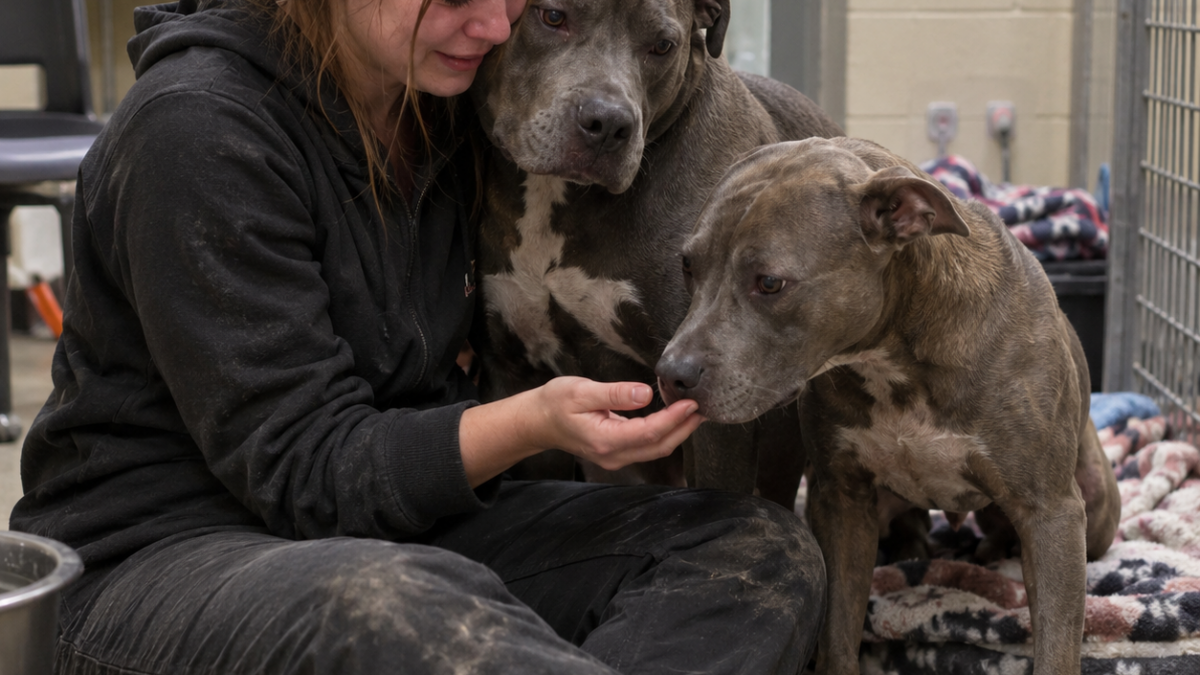
The small room had a blanket in one corner, a stainless-steel water bowl, and a plastic chair against the wall. Blue and Nyla were curled together on the blanket like one animal with two bodies. Blue lifted his head first. Nyla’s eyes opened a moment later.
Neither barked.
Neither ran.
Blue’s body tensed, but he did not move away from Nyla. She stayed tucked behind his shoulder, peering at me with cautious, exhausted eyes.
I sat down on the floor.
Denise stayed by the door.
I did not reach right away.
I remembered something a trainer once told me: frightened dogs do not need your affection first. They need your predictability.
So I sat still.
“Hi,” I said quietly. “I’m Mara.”
Blue watched me.
Nyla watched Blue.
I let my hand rest palm-down on the floor several feet away.
No baby talk.
No sudden movement.
No promise I was not sure yet I could keep.
For a full minute, nothing happened.
Then Nyla rose.
Slowly.
Her body stayed low, not submissive exactly, but careful. She took two steps forward, stopped, looked back at Blue, then came closer. Her nails clicked faintly on the floor. She leaned her head forward and touched my fingers with her nose.
I did not move.
“Hi, sweetheart,” I whispered.
Her nose was cold.
Then Blue stood.
He was bigger than he looked in the photo. Broad chest, blocky head, white patch bright against gray fur. He came forward with deliberate calm, placed himself beside Nyla, and rested his shoulder gently against mine.
Not pushing.
Not demanding.
Just contact.
That was when I understood.
They were not asking me to rescue two dogs.
They were asking me not to break the one thing the shelter had not taken from them.
Each other.
Denise’s voice came softly from the doorway.
“They belonged to an older man named Mr. Alvarez. He had them since they were young. Blue first, then Nyla a year later. From what his daughter told us, he went into assisted living after a stroke. Family couldn’t take them. They tried. Nobody would take both.”
“How long have they been here?”
“Eleven days.”
I looked at the two dogs.
Eleven days in a shelter must feel like eleven years to animals who had known a couch, a yard, an old man’s voice, the rhythm of one home.
“Nyla won’t sleep unless she’s touching him,” Denise said. “Blue checks the door every time someone walks by. First few days, he kept looking behind everyone, like he was waiting for his owner to come in after them.”
My throat tightened.
“Why tonight?”
Denise looked away.
“Overcrowding. Intake from a hoarding case this morning. Twenty-three dogs. We’re out of runs, out of fosters, out of time.”
I knew she hated saying it.
I also knew hatred did not change shelter math.
I looked at Blue, then at Nyla.
“My apartment is small,” I said.
Denise did not answer.
“My schedule is stupid.”
Blue leaned a little more weight against me.
“I planned to foster one dog. Maybe one small dog. Not two large dogs. Definitely not two large Pit Bulls.”
Nyla lowered her head onto Blue’s shoulder.
Blue turned and softly licked the top of her head.
That broke me.
Not loudly.
No dramatic sob.
Just tears filling my eyes so fast I had to look up at the ceiling.
“I can’t separate them,” I whispered.
Denise’s shoulders dropped as if she had been holding her breath since the post went up.
“I was hoping you’d say that.”
The paperwork took thirty minutes.
In that time, the practical half of me returned with a clipboard and began shouting again.
Lease agreement.
Dog deposit.
Food.
Vet care.
Two leashes.
Crates.
Where would crates even fit?
What if they cried all night?
What if the neighbors complained?
What if I failed them after saving them?
Denise seemed to read my face.
“Foster-to-adopt,” she said. “We can start there. I’ll mark you as emergency foster tonight, and we’ll connect you with a rescue partner tomorrow. You won’t be alone.”
“Are you sure?”
“No,” she said honestly. “But I’m sure about one thing. They’re alive tonight because you came.”
At the car, Blue climbed into the back seat first.
Nyla stood beside the open door, trembling.
I tried coaxing.
Nothing.
Denise tried.
Nothing.
Blue turned around, looked at Nyla, then shuffled sideways to make room.
Nyla jumped in immediately.
The moment she landed, she curled against him and tucked her face into his neck.
Denise closed the door gently.
Through the window, Blue looked out at us.
Nyla did not.
She was already pressed against him as if the car might vanish if she let go.
Denise handed me a folder.
“Call me tomorrow.”
“I will.”
“And Mara?”
I looked at her.
“Thank you for coming after closing.”
I glanced at the shelter, dark except for the back hallway light.
“Thank you for opening the door.”
The drive home was quiet.
Two frightened dogs.
One terrified woman pretending she had a plan.
At my apartment complex, the rain had stopped. The parking lot smelled like wet mulch and pavement. I sat in the car for a moment after turning off the engine.
“Okay,” I said, mostly to myself. “We are going to do this calmly.”
Blue stood.
Nyla stood because Blue did.
I had bought two cheap slip leads from the shelter for five dollars each. My hands shook as I looped them carefully, speaking softly the whole time.
The walk from car to apartment took nine minutes because every sound mattered.
A car door slammed across the lot.
Nyla flattened.
Blue placed his body between her and the sound.
A man came down the stairs carrying trash.
Blue froze.
I stopped immediately.
“No rush,” I said. “No rush.”
The man stared.
I stared back with the expression of a woman one inconvenience away from becoming dangerous.
He moved along.
Inside my apartment, Blue inspected every room.
Nyla followed so closely her nose nearly touched his back legs.
Living room.
Kitchen.
Tiny hallway.
Bedroom.
Bathroom.
Closet.
Back to living room.
The entire apartment could have fit inside the shelter’s lobby, but to them it was unknown territory, and unknown territory can hold anything.
I had set up two dog beds because hope makes fools of us all.
They ignored both and squeezed together onto the same folded blanket by the couch.
Blue lay facing the door.
Nyla curled behind him.
I sat on the floor across from them with my back against the couch and looked at what I had done.
Two dogs.
One-bedroom apartment.
No real supplies.
Emergency foster paperwork.
A landlord who thought my life was already too full of animals after my previous temporary foster, a twelve-pound terrier named Biscuit, barked at every leaf outside the window.
My phone buzzed.
Jana.
ARE THEY ALIVE?
I took a photo of Blue and Nyla curled together.
YES.
Her reply came instantly.
OH MY GOD. YOU GOT BOTH.
I looked at them.
Blue’s eyes were still open.
Nyla slept with one paw touching his chest.
I typed back:
I couldn’t take one.
Then I set the phone down and cried quietly into my sleeve because the adrenaline had drained away, leaving only fear and the beginning of love.
The first night, I did not sleep much.
Neither did they.
Every time the building pipes clicked, Blue lifted his head. Every time a neighbor walked past the hallway, Nyla pressed closer to him. Around two in the morning, I got up to use the bathroom, and both dogs scrambled to their feet as if my leaving the room meant something terrible.
“I’m just peeing,” I said, half asleep. “Nobody panic.”
They panicked anyway.
Blue stood outside the bathroom door. Nyla whined once.
When I came out, they looked so relieved I almost cried again.
That became our first routine.
I leave.
I come back.
Small departures.
Small returns.
Bathroom.
Kitchen.
Mailbox.
Trash chute.
Laundry room.
Each time, they watched me with the same question.
Are you leaving us too?
Each time, I returned.
At first, they ate only if the bowls were side by side. If I placed them too far apart, Nyla would not approach hers. Blue would take one bite, look at her, then stop. I learned quickly.
Same room.
Same time.
Enough space that neither felt threatened, close enough that they could see each other.
Blue ate slowly, politely, as if manners mattered even in survival.
Nyla gulped at first, then looked guilty, then licked Blue’s bowl when he finished. He let her.
On day two, I called my landlord.
I had rehearsed the conversation six times.
“Two dogs?” Mr. Keene repeated.
“Temporarily. Emergency foster.”
“Pit Bulls?”
I closed my eyes.
“Yes.”
He sighed in the way men sigh when preparing to say no and enjoy how reasonable they sound.
“Our insurance has breed restrictions.”
“They’re foster dogs. I can provide paperwork. I can get renter’s insurance. I’ll pay an additional deposit.”
“Mara—”
“They were going to die.”
Silence.
I had not meant to say it that bluntly.
But sometimes blunt truth is all that keeps paperwork from winning too easily.
Mr. Keene exhaled.
“I’ll need documentation.”
“I’ll send it today.”
“And they can’t disturb other tenants.”
“They won’t.”
I looked over as Blue sneezed and Nyla startled so hard she fell partly off the blanket.
“They’re very quiet,” I added.
“You have thirty days,” he said. “After that, we revisit.”
Thirty days.
It was not a yes.
It was a door not fully closed.
By day four, the rescue partner came through. A woman named Carla from Second Chance Bully Rescue called me during lunch.
“Denise told me what you did,” she said.
“I don’t know what I’m doing.”
“Good. People who think they know everything usually make my job harder.”
She arranged vaccines, a vet check, food donations, and behavioral support. She explained decompression, two-week shutdown, trigger stacking, slow introductions, leash safety, separation anxiety.
“You saved their lives,” Carla said, “but their bodies don’t know that yet. Give them time.”
Time became the center of everything.
I stopped inviting people over.
I stopped expecting gratitude.
I stopped trying to make them into happy dogs quickly because I wanted proof that I had made the right decision.
Blue and Nyla did not owe me proof.
They needed safety.
Safety is boring at first.
Same food.
Same walk route.
Same blanket.
Same soft voice.
Same person leaving and returning.
For two weeks, their world stayed small.
Then, slowly, tiny miracles began.
Blue discovered the toy basket first.
I had bought a few things from the discount store: ropes, rubber bones, squeaky toys shaped like ridiculous ducks. For days, neither dog touched them.
Then one evening, while I was answering emails on the couch, Blue walked over, selected a yellow duck, carried it to the blanket, and placed it between his paws.
Nyla stared at him as if he had performed magic.
He squeezed it once.
It squeaked.
Both dogs jumped.
I froze, afraid they would shut down.
Blue looked at the duck.
Then at me.
Then squeaked it again.
Nyla’s ears lifted.
By the end of the week, she was carrying toys from room to room like treasures. Not playing with them exactly. Just collecting. The yellow duck in the hallway. A rope toy in the kitchen. A stuffed carrot beside my shoes. Once, I found three toys in the bathtub and had no explanation.
Blue became playful in quieter ways.
He started doing little hops when I picked up the leash. His tail, which had hung low for days, began wagging in slow sweeps. He developed an obsession with pillows and knocked them off the couch every time he got excited, then looked surprised by gravity.
Nyla discovered the refrigerator.
More specifically, she discovered that the sound of the refrigerator opening sometimes meant carrots, cheese, or leftover chicken.
The first time I gave them each a baby carrot, Blue took his gently and carried it to the blanket like a formal gift. Nyla crunched hers in three seconds, then stared at Blue’s carrot with such intensity he turned his body away.
“No stealing,” I told her.
She looked at me.
Then looked at the carrot.
Then looked back at me with the expression of a dog weighing ethics against opportunity.
Progress was not straight.
One Saturday, a neighbor dropped a package outside my door too loudly, and Nyla hid in the bedroom for an hour. Blue refused to leave her. Another time, a man in a baseball cap leaned toward them during a walk and said, “Pretty pits,” and both dogs froze. Blue’s body went rigid. Nyla backed behind him.
“Please don’t approach,” I said.
The man lifted both hands.
“Relax. I know dogs.”
“I know these dogs.”
He rolled his eyes but walked away.
I learned that advocacy often feels like being rude to strangers so your dogs do not have to panic politely.
The first complaint came in week three.
Mr. Keene called me while I was at work.
“A tenant reported large aggressive dogs in the stairwell.”
My stomach dropped.
“They were not aggressive.”
“I’m only telling you what was reported.”
“What happened?”
“Mrs. Dalton says one growled.”
I knew Mrs. Dalton. Third floor. Tiny white dog named Peaches, who barked like a car alarm with fur.
“Did she mention her dog was off leash?”
Pause.
“No.”
“Did she mention her dog ran down the stairs at us?”
Another pause.
“I’ll ask.”
Blue had growled once.
Low.
Warning.
Because Peaches charged at Nyla, barking wildly, and Nyla had tried to melt into the wall. Blue placed himself in front of her and gave one controlled growl that stopped Peaches better than Mrs. Dalton’s screaming did.
It was not aggression.
It was communication.
But Pit Bulls do not always get credit for controlled communication.
I spent that evening writing a calm email with incident details, training plan, leash compliance, and rescue contact information. Carla helped me word it. I sent it to Mr. Keene with copies of vaccine records and renter’s insurance.
Then I sat on the floor with Blue and Nyla and felt the old practical voice return.
This is too much.
You cannot fight everyone.
You cannot protect them from the whole world.
Blue rested his head on my shoulder.
Nyla curled against my leg.
I breathed out.
“Okay,” I whispered. “I hear you.”
The next morning, I bought bright leash sleeves that said DO NOT APPROACH.
Jana said it looked dramatic.
I told her drama was cheaper than eviction.
By the end of the thirty days, Mr. Keene agreed to extend the foster arrangement.
By the end of sixty, he stopped pretending he disliked them.
I caught him one morning standing near the entrance while Blue sat politely beside me.
“He’s calmer than most tenants,” Mr. Keene said.
“That’s not a high bar.”
“No.”
He looked at Blue.
“Handsome dog.”
Blue wagged once, dignified.
Mr. Keene cleared his throat.
“Don’t tell Mrs. Dalton I said that.”
Nyla took longer.
Her fear lived deeper.
She loved me, I think, before she trusted me.
There is a difference.
Love made her follow me room to room. Trust took months.
Trust was the first time she fell asleep while I was still moving around the apartment.
Trust was the first time she ate without checking whether Blue had started.
Trust was the first time she chose a bed five feet from him instead of pressed against his body, then woke up, realized he was still there, and went back to sleep instead of panicking.
One evening, three months after I brought them home, I came back later than usual from work. A meeting ran long. Then traffic backed up after an accident. By the time I reached my apartment, guilt sat heavy in my chest.
I expected fear.
I expected anxious whining, maybe pacing, maybe the old searching eyes.
Instead, when I opened the door, both dogs came running.
Blue nearly knocked over a pillow in his excitement. Nyla spun in a full circle, then another, paws tapping the floor so fast she looked like she was dancing.
I dropped my bag.
They threw themselves against me with the full emotional force of seventy-pound dogs who had no concept of personal space.
I laughed.
Then I saw it.
Really saw it.
There was no fear in their eyes.
No frantic scanning behind me.
No desperate question.
No look toward the door as if someone else might enter and take everything back.
They were simply happy.
Their person was home.
I sat down right there in the entryway because my legs stopped caring about dignity.
Blue pressed his head to my shoulder.
Nyla shoved her face under my arm and sighed.
Not a frightened sigh.
A home sigh.
The kind of sound a body makes when it finally believes the bad part is over.
I thought about the clock.
4:31.
The post.
The drive.
The red lights.
5:03.
The locked doors.
The side entrance.
The room in the back.
I had spent that whole drive convinced I was racing against time and losing.
But sitting there with Blue and Nyla pressed against me, I understood something I had not understood before.
Sometimes rescue is not one grand moment.
Sometimes it is a thousand ordinary returns.
I leave.
I come back.
The bowl is full.
The leash means adventure.
The hand reaching down is gentle.
The door opens.
Nobody disappears.
The world can be trusted a little more today than yesterday.
Two weeks later, Carla called.
“So,” she said.
I knew that tone.
“No.”
“You don’t even know what I’m asking.”
“I know.”
“An adoption application came in for Blue.”
My body went cold.
“Only Blue?”
“Yes.”
“No.”
“Mara.”
“No.”
“They seem like a good family.”
“No.”
“They have a yard.”
“No.”
“They have breed experience.”
“No.”
Carla sighed, but not impatiently.
“You know fostering means letting go sometimes.”
“Yes. Sometimes. Not this time.”
Nyla was asleep beside Blue on the blanket. Her chin rested across his back. Blue opened one eye as if he knew his name had been spoken and the universe was once again making poor decisions.
“I’m not separating them,” I said.
“The rescue won’t force that.”
“I know. But I want to make it official.”
Carla went quiet.
“What are you saying?”
I looked at the two dogs who had entered my life through one last open door.
“I’m saying they’re home.”
Adoption paperwork is much less cinematic than people imagine.
There were forms, fees, signatures, medical records, microchip updates, and one printer jam that made me question every institution involved in animal welfare.
But when it was done, Denise came by my apartment.
She said she was in the area.
She was not.
She brought two bandanas: blue for Blue, lavender for Nyla.
The dogs remembered her.
Blue approached first, tail wagging slowly.
Nyla stayed behind him, then came forward when Denise crouched and opened her hand.
Denise touched Nyla’s cheek and cried immediately.
“She looks different,” she said.
“She is.”
“No,” Denise said, smiling through tears. “I mean her eyes.”
I looked at Nyla.
She was watching Denise calmly, leaning against my knee. Blue stood beside her, bandana slightly crooked because he had already tried to remove it and failed.
Denise shook her head.
“I really thought that night was it.”
“So did I.”
“I had already called my husband in the parking lot,” she admitted. “Told him I didn’t think I could keep doing this job.”
My throat tightened.
“And then this woman comes running around the building asking about both dogs.”
I laughed softly.
“I was a mess.”
“You were exactly what they needed.”
I looked down as Nyla nudged my hand.
“No. I think they were what I needed too.”
People love to say rescued dogs know you saved them.
I do not know if that is true.
I think dogs know what happens next.
They know whether the hand is gentle.
Whether the bowl appears.
Whether the door opens and closes and opens again.
Whether you keep coming back.
Blue and Nyla did not care that I had raced a clock for them. They did not know about traffic lights, deadlines, paperwork, shelter capacity, or the way my heart nearly stopped outside those locked doors.
They knew I stayed.
That mattered more.
A year after adoption day, I took them back to Maple Ridge—not inside the shelter, but to the walking trail behind it where volunteers sometimes exercised dogs. Denise met us there with coffee.
Blue walked proudly at my left.
Nyla walked between us, no longer hiding but still preferring the security of bodies she trusted near her. The shelter building stood beyond the fence, ordinary and heartbreaking. Dogs barked faintly from inside.
Nyla paused when we passed the side entrance.
The same door.
My chest tightened.
Blue stopped too.
For a moment, neither moved.
I wondered what they remembered.
The hallway.
The room.
The smell.
The fear.
Then Blue turned away from the door and leaned into Nyla.
Nyla looked up at me.
I crouched.
“We’re not going in,” I said softly. “Not today. Not ever like that again.”
Nyla touched my chin with her nose.
Blue wagged.
Then they walked forward together.
Denise watched them, wiping her eyes with the sleeve of her jacket.
“They know,” she said.
“Maybe.”
“No,” she said. “They know.”
We continued down the trail as the late afternoon sun came through the trees. Blue found a stick he was very proud of. Nyla tried to take it. He let her. Then regretted it. Then took it back. They pranced ahead, leashes loose, bodies relaxed, two dogs who had once sat behind bars waiting for the world to decide whether they lived.
Now the world was grass, squirrels, warm light, and a woman behind them saying, “Leave it,” with very little authority.
That evening, at home, they curled together on the same blanket they had chosen the first night.
They had three beds by then.
They still preferred one.
I sat beside them and opened the old photo from the shelter post on my phone. I had saved it, though I did not look at it often. It hurt too much at first.
There they were.
Behind bars.
Quiet.
Pressed together.
Waiting.
I looked from the photo to the dogs asleep in front of me.
Blue snored softly.
Nyla’s paw twitched in a dream.
Their bodies still touched.
But now it was not desperation.
It was choice.
That is what healing gave them.
Not separation.
Not forgetting.
Choice.
They could sleep apart now.
Sometimes they did.
They could eat from separate bowls without fear.
They could let me leave the room.
They could greet neighbors, ignore loud noises, walk past barking dogs, and trust that a closed door did not mean abandonment.
And still, when the world grew quiet, they often chose each other.
I understood that better than anyone.
Because I had chosen them too.
People sometimes ask why I kept both when my plan had been one.
I tell them the truth.
Because when I sat on that shelter floor, Nyla touched my fingers first, and Blue rested his shoulder against me second, and between those two small gestures, they asked a question no application form could hold.
Can we stay together?
There are moments in life when the answer you give becomes part of who you are.
I said yes.
Not because it was practical.
It was not.
Not because it was easy.
It was not.
Not because I knew how everything would work.
I did not.
I said yes because some bonds are not obstacles to rescue.
They are the reason rescue matters.
At exactly 4:31 on a Tuesday afternoon, I thought I had found two dogs running out of time.
At 5:03, standing outside locked shelter doors, I thought I had failed them before we ever met.
But one worker opened one last door.
Two frightened Pit Bulls walked out together.
And my small, careful life became larger than my fear.
Sometimes we believe we have already missed our chance.
Sometimes the clock says we are too late.
Sometimes the doors look locked, the lights look dark, and the ending seems already written.
But as long as one person is willing to turn back with the keys…
as long as one door still opens…
as long as love refuses to leave someone behind…
there is still hope.
And Blue and Nyla did not walk through that door alone.
They walked through it together.
Then they brought me with them.








