Two Freezing Puppies Were Found Huddled Together at a Cemetery Gate—Then a Heartbroken Officer and His Wife Stopped, and Their Silent Home Began to Change
PART3:
I had taken the day off. Elise had not slept much the night before; I knew because every time I opened my eyes, she was awake beside me, staring toward the window. Neither of us said much at breakfast. I made coffee. She wrapped blue flowers in damp paper towels. We moved around each other carefully, as if one wrong word might break the fragile structure holding us upright.
The cemetery road was lined with snow. A rising wind moved over the open ground, carrying the sharp warning of another storm. The sky looked low enough to touch.
At Caleb’s grave, Elise knelt first.
She placed the flowers carefully.
I stood behind her with my hands in my coat pockets, staring at my son’s name carved into stone.
Caleb Thomas Whitcomb.
Beloved Son.
Forever Our Light.
Forever.
That word looked almost cruel on granite.
Elise touched the top of the stone with one gloved hand.
“Hi, sweetheart,” she whispered.
I looked away.
Not because I did not want to hear her.
Because I could not survive the tenderness in her voice.
We stayed longer than the weather allowed. Snow from earlier in the week crunched beneath our boots. Wind slipped under my collar. Elise’s cheeks turned red from cold, but she did not move until her fingers trembled too badly to keep resting on the stone.
When we finally walked back toward the car, neither of us spoke.
The empty flower wrapping crackled softly in Elise’s hand. The narrow path from the grave to the cemetery road felt longer than it had coming in. I kept my eyes forward. If I looked too far left, I would see the little garden near the shrubs, the one where Caleb’s birdhouse stood. I was not ready for that.
Caleb and I had built that birdhouse during a volunteer cleanup one spring before he got too sick.
He insisted the roof should be blue.
“Birds like blue,” he told me with the confidence of a five-year-old who had settled the matter permanently.
“Did they tell you that?”
“No, Daddy. It’s the sky color.”
How does a father argue with that?
So we painted the roof blue. Then Caleb painted one crooked stroke beneath the entrance hole, missed the spot he was aiming for, and got more paint on his fingers than on the wood. I had meant to wipe the mistake away. He told me not to because the birds might like “extra sky.”
That crooked blue mark was still there.
I knew because Ellis Fisk, the cemetery caretaker, had once told me he left it untouched whenever he repaired the garden.
I avoided looking at it.
At the bend near the cemetery entrance, Elise stopped.
At first, I kept walking. Then I noticed she was no longer beside me.
“Nolan,” she said softly.
I turned.
She was staring toward the brick wall near the gate.
Something small moved against it.
My police instincts came back before the rest of me did. I scanned the road, the old gatepost, the tire tracks, the line of bare shrubs half-buried in snow.
Then I saw them.
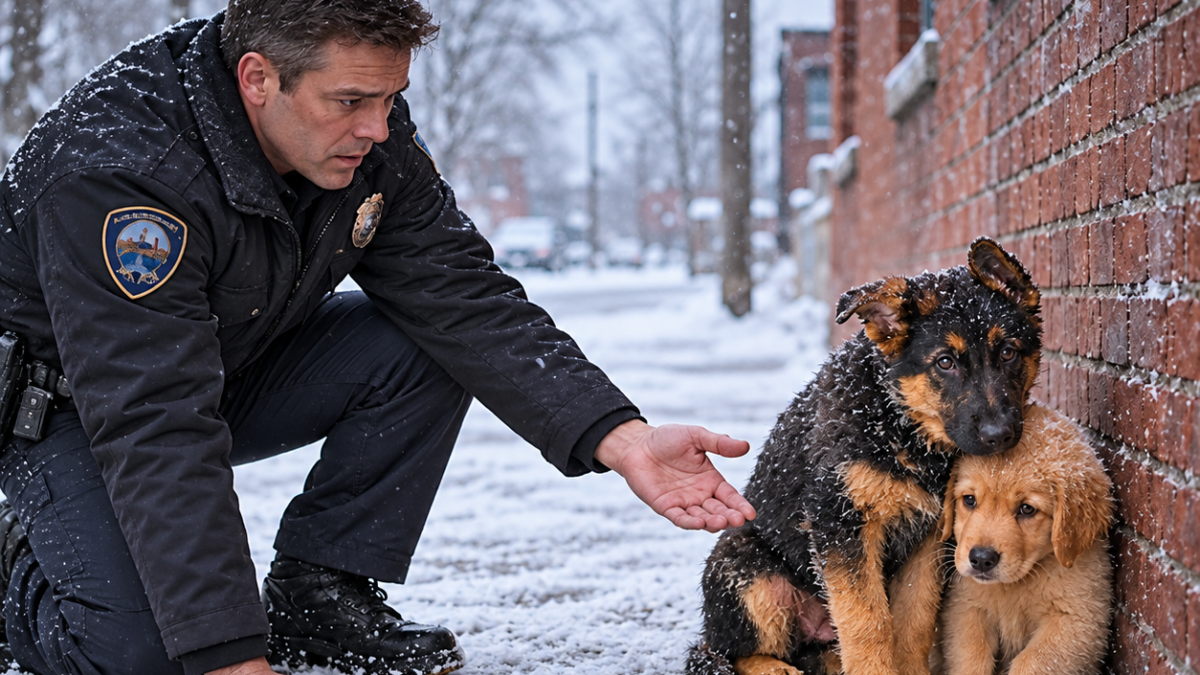
Two puppies were pressed together in the shallow corner where the wall met the post.
One was pale gold, maybe a Golden Retriever mix, though it was hard to tell under the wet, matted fur. Its round puppy face had been made thin by exhaustion. Its body trembled so violently I could see the movement from several feet away.
The other was a German Shepherd, black and tan, with oversized paws and one ear standing higher than the other. It had turned sideways against the wind, shielding the smaller golden with its body.
Both looked half-frozen.
The shepherd lifted its head when I stepped closer.
It looked too weak to stand, but it watched my hands.
“Elise,” I said carefully, “stay back a second.”
She ignored the meaning of that, if not the words, and moved beside me anyway.
“Do you see anyone?” she asked.
I looked toward the cemetery gates, down the road, across the shoulder, toward the line of trees.
No parked car.
No person calling.
No fresh trail of footprints leading to them except ours.
No sign that anyone was coming back.
I crouched several feet away so I would not frighten them.
“Hey there,” I said softly.
The golden raised its nose at the sound of my boots, then tucked itself beneath the shepherd’s neck again. The shepherd’s lips tightened, not quite a growl, but a warning shaped by terror and cold.
Elise removed one glove.
I saw her hesitate.
There was a time when a small, suffering creature would have drawn her forward without a second thought. She would have scooped it up, pressed it to her chest, and asked me to hurry. After Caleb, she reached for nothing quickly. Love had taught her its teeth.
She lowered her hand and let the puppies decide whether to move toward it.
“They’re freezing,” she whispered.
“I know.”
“I packed chicken.”
I looked at her.
Neither of us had eaten the lunch she prepared for the drive home. Plain chicken, crackers, a bottle of water. Practical food for a day that had made food feel impossible.
She went back to the car while I stayed near the wall.
The shepherd watched me every second.
Its body shook so hard its loose puppy fur seemed to ripple. It could not have been more than a few months old, but there was something painfully adult in the way it kept itself between me and the golden.
“You’re a brave one,” I murmured.
The dog’s eyes did not leave mine.
Elise returned with the container and a bottle of water. She placed a small piece of chicken on the cleared edge of sidewalk and moved her hand away.
The shepherd sniffed it.
Took it.
Then turned its head toward the golden.
The golden struggled forward enough to eat the next piece.
That broke something in me.
Not because they were hungry. Hunger was obvious.
Because even starving, even freezing, they checked on each other.
I poured water into the lid of our travel mug and held it low. Both puppies drank, stopping often to look at each other, as if each needed to confirm the other was still there.
“They might belong to someone visiting,” I said.
I heard the uncertainty in my own voice.
Elise heard it too.
“Then we’ll wait.”
That was Elise.
Even through grief, even through cold, she still believed in giving the unknown person a chance to arrive.
We wrapped the puppies in the spare blanket from the car and carried them into the back seat, where the heater had begun to work. The shepherd resisted being lifted until the golden was gathered too. Only then did it stop twisting against my arms.
Inside the car, Elise climbed into the back with them and held the blanket open enough for warm air to reach their bodies. The shepherd kept one paw across the golden’s back.
I called the local non-emergency line, reported where we had found the puppies, left my number, and gave a description in case someone called looking. Then I positioned the vehicle so I could see the cemetery road.
We waited.
Ten minutes.
Twenty.
Thirty.
I watched every vehicle at the far intersection, waiting for one to turn toward the gate. None did.
The wind strengthened. The sky darkened. Snow began to gather in my boot tracks beside the wall. I got out twice to look along the road. The second time, the first flakes of the approaching storm touched my sleeve.
I had spent years answering calls in weather like that. I knew how quickly a familiar road could become dangerous after dark. I knew how fast a small body could lose heat.
Still, I kept looking for an owner.
Because I knew what it meant to search for someone and arrive too late.
When I returned to the car, Elise was watching the golden’s face instead of the road.
“Someone may still come,” she said softly. “But these two can’t wait out here.”
I checked the weather alert on my phone. The storm was moving in sooner than expected.
“I’ll call the clinic.”
The veterinary clinic across town was still open. Dr. Marin Sloan answered after her receptionist put me through, and when I described the puppies’ condition, her tone changed from professional to urgent.
“Bring them in now,” she said. “We’ll be ready.”
I looked one last time through the windshield toward the cemetery gate.
No one was hurrying down the path.
No one was calling.
No one was searching.
I started the engine.
The first thick flakes hit the windshield before we reached the main road.
I drove carefully past shuttered storefronts and houses whose porch lights had begun to glow. In the rearview mirror, Elise bent over the puppies, speaking in a low voice.
“You’re all right,” she murmured. “We’re going to get you warm. We’re going to see a doctor. Just stay with us.”
They could not understand her words.
But Caleb used to ask her to explain every trip before we pulled away from the house.
“Where are we going? How far? Will there be snacks? Is it a doctor where they poke me or a store where I can look at toys?”
Elise always answered every question, even when she was tired. Especially then.
Hearing her explain the trip to those puppies made something twist in my chest.
Behind me, the shepherd shifted closer to the golden whenever the car turned. Its paw returned to the same place across the smaller puppy’s back.
Then Elise went quiet.
Too quiet.
“Nolan,” she said, voice unsteady. “Please tell them we’re close.”
I looked in the mirror.
She had lifted the golden against her coat, one hand supporting its chest. Its head hung lower than before. The shepherd pressed its nose beneath the golden’s ear, then looked up at Elise.
I called the clinic again through the car speaker.
“We’re three streets away,” I told them. “The golden’s fading.”
Marin came on the line herself.
“Keep it warm. Don’t overheat. Support its chest. We’re ready.”
Snow swept across the pavement. Streetlights blurred. My hands tightened around the wheel.
“Hold on,” I whispered, though I did not know whether I meant the puppy, Elise, or myself.
The clinic windows glowed through the storm just as I began to fear I had missed the turn.
I pulled beneath the awning and hurried around to the back door. Elise was still holding the golden, watching its face like it was the only thing in the world. The shepherd remained pressed against her leg, trembling but alert.
I gathered both puppies into the blanket, and we carried them inside together.
Dr. Marin Sloan met us in the examination room.
She was forty-seven, steady-eyed, with dark hair tied loosely behind her head and a few silver strands near her temples. I had met her before on animal welfare calls. She had the calm manner of someone who understood panic and refused to feed it.
She listened to each puppy’s chest, examined paws and ears, checked for identification, took temperatures, and asked questions while her techs moved with quick precision around her.
The golden stirred when Marin touched its shoulder.
Elise released a breath.
“They’ve been out in the cold too long,” Marin said. “They’re exhausted and dehydrated. We need to warm them carefully and keep watching them tonight.”
I explained where we had found them, what we had fed them, how long we had waited, and the call I had made. Marin wrote everything down.
When one of the techs tried to move the shepherd to weigh it, the puppy twisted toward the golden and tried to climb back. Its legs wobbled, but it kept trying until Marin set it close enough to see its companion.
The golden opened one eye and reached its nose toward the shepherd’s paw.
Only then did they both settle.
“Well,” Marin said quietly, “we won’t separate them unless we have to.”
That was the first time Elise looked at me fully since the cemetery.
Not at the puppies.
Not at the doctor.
At me.
There was something in her face I had not seen in a long time.
A question.
Not about the dogs exactly.
About us.
About whether we were still capable of making room for need.
After fluids, warmth, and careful monitoring, the golden lifted its head for a brief moment. It was not much. Not a recovery. Not a promise. But it was enough for Elise to grip the edge of the exam table and whisper, “There you are.”
Marin explained the found-animal process. Because I had reported them, any owner would have to come forward through proper channels. There was no identification on either puppy. Their condition suggested neglect, abandonment, or both. The shelter was already strained because of the storm. If Elise and I were willing, we could take the puppies home temporarily while the notice period began, provided we followed care instructions and returned for checks.
I expected Elise to ask whether the clinic could keep them.
Instead, she looked at the two puppies pressed together beneath warm towels.
“Can we take both?”
Marin looked between us.
“Elise,” I said softly.
She did not take her eyes off the puppies.
“They’ve stayed together through all this,” she said. “I’d like them to stay together tonight.”
Marin nodded.
“As long as you can monitor them and call if anything changes, that may actually help them settle.”
She went over instructions.
What to watch.
When to call.
How much to feed.
How warm to keep them.
Signs of breathing trouble.
Hydration.
Weakness.
I listened closely, folding the paper into my coat pocket afterward.
On ordinary days, I would have remembered every word.
This had not been an ordinary day.
Outside, snow struck the clinic windows in hurried bursts. Inside, the shepherd had finally fallen asleep with its muzzle resting against the golden’s back.
Elise brushed one finger lightly near the golden’s paw.
“Maple,” she said.
I looked at her.
“That’s what I keep thinking when I look at this one.”
The golden opened its eyes.
Maybe it was coincidence.
Elise smiled anyway.
The shepherd stirred at her voice and lifted its uneven ears, tired but determined to account for everything around it.
I remembered the dark shape standing watch against the cemetery wall.
“Then this one is Rook,” I said.
Marin wrote both names on the temporary care sheet.
Maple.
Rook.
Seeing the names startled me.
We had known them only a few hours, yet calling them “the puppies” already felt too distant.
We drove home through streets nearly empty beneath the storm.
Elise sat in the back with Maple and Rook between her and the car door. I drove slowly, the tires crunching through fresh snow, the wipers beating time against the windshield.
When we reached our house, the porch light showed a drift forming against the steps.
For most of the past year, I had returned to that doorway without wanting to open it.
Inside waited Caleb’s photographs. His rain boots. His books. The silence that seemed to grow louder after dark.
That night, I carried two shivering puppies across the threshold.
Elise followed with the clinic papers and the small supply of food Marin had given us.
Neither of us said what we both felt.
How strange it was to bring something alive into that house.
How frightening.
How necessary.
We set up a warm place in the living room away from the draft beneath the front door. I laid down two clean blankets, thinking each puppy might rest more comfortably with its own space.
Rook chose the blanket nearest the wall and lowered itself with a weary sigh.
Maple was placed on the other, only a short distance away.
For a while, both slept.
Elise and I sat on the sofa with our coats still on, listening to the wind move around the house.
“We’ll care for them until the storm passes,” I said.
“And until the notice period ends,” she added.
“Yes.”
“That’s all we have to decide tonight.”
I nodded.
That was safe.
Temporary.
Practical.
Words grief could tolerate.
Near midnight, a soft scraping sound woke us both.
Maple was awake, weakly gripping the edge of its blanket and pulling it toward Rook a few inches at a time. The effort left the little golden trembling, but it kept going.
Rook lifted its head.
Then rose unsteadily and came the rest of the way.
It lay down beside Maple, their shoulders touching exactly as they had beside the cemetery wall.
I got up quietly and drew the loose blanket around them both.
For a moment, I kept one hand on the floor near their paws.
Elise watched from the sofa.
The storm continued beyond the windows.
Neither of us knew what would happen when it ended.
But for that night, two abandoned puppies had found each other again.
By the fifth morning, the storm had left our town buried beneath deep snow, and Maple had discovered my socks.
The golden was still thin beneath its soft fur. A walk from the living room to the kitchen usually ended in a nap. Nevertheless, whenever I left a sock beside my boots, Maple collected it.
The first appeared beneath the sofa.
The second beside Rook’s blanket, carefully placed against the shepherd’s oversized front paws.
Rook sniffed the offering, rested its chin on it, and went back to sleep.
I started keeping my socks out of reach, which only encouraged Maple to broaden its interests.
One morning, a glove disappeared from the bench by the door. Elise followed the faint scrape of leather fingertips across the kitchen floor and found Maple dragging it toward the living room, stopping every few steps to make sure Rook was still watching.
I exchanged the glove for a soft toy.
Maple looked so disappointed that Elise almost smiled.
Almost was as far as she allowed herself to go.
Later that morning, I set my winter police cap beside my coat while searching for my keys.
Maple was under the bench before either of us noticed.
The puppy tugged at the cap until it dropped onto the rug, then pushed its nose inside. When Maple lifted its head, the oversized cap slipped completely over its eyes.
It stood motionless, apparently waiting for the room to come back.
Then it took one uncertain step toward Rook.
Rook leaned forward and touched its nose to the brim.
Maple backed up, sat down, and tried to proceed with the cap still covering most of its face.
Elise laughed.
The sound startled all four of us.
Maple stopped moving.
Rook lifted both ears as far as their uneven shapes allowed.
I looked toward the kitchen doorway.
Elise had one hand over her mouth, but another laugh escaped when I lifted the cap and Maple immediately tried to retrieve it.
Then her expression changed.
Her hand pressed harder against her lips.
Her shoulders drew inward.
The laughter dissolved into tears.
I set the cap on a high shelf and went to her.
“I shouldn’t be able to forget like that,” she said, looking past me toward the hallway.
Caleb’s photograph stood on the narrow table there.
I understood.
For a few seconds, she had watched a foolish puppy with a hat over its eyes, and the weight she carried had loosened.
The relief frightened her almost as much as the grief itself.
I pulled out a kitchen chair and sat beside her.
“You were laughing at Maple,” I said gently. “You didn’t forget our son.”
She lowered herself into the chair and rubbed her wedding ring with her thumb, the way she had during the long months of Caleb’s illness.
“I felt light,” she whispered. “Just for a second.”
“I know.”
“It felt wrong.”
“I know.”
I did know.
I still felt guilty for enjoying a hot meal or sleeping through the night. Grief had turned happiness into something that felt like betrayal.
But beneath the table, Maple settled across our feet while Rook lay nearby, watching the doorway.
Neither puppy asked us to explain our pain.
They simply stayed close.
That became their gift.
Not fixing.
Not replacing.
Staying.
A few days later, Ellis Fisk, the cemetery caretaker, came to the house.
He stood on the porch holding his wool cap between his thick fingers. Ellis was sixty-seven, lean and slightly stooped, with untidy gray hair and a close-trimmed mustache. I had known him for years, though our conversations had grown shorter since Caleb’s burial. Some people avoided grief because they were uncomfortable. Ellis avoided forcing grief to perform.
He glanced at the puppies behind my legs and smiled faintly.
Then he explained why he had come.
The blue birdhouse near the cemetery garden had been damaged. Winter weather had loosened the roof, and the storm had pulled one side free. He had secured it temporarily but thought I might want to look before repairs were made.
I could face difficult calls at work.
I could enter unfamiliar houses.
I could keep my voice steady when other people needed help.
But the thought of standing beneath that little wooden roof tightened my throat until I could barely answer.
“I can’t come today,” I said.
Ellis nodded.
“No hurry.”
After he left, I remained by the door with my keys within reach.
Elise waited in the kitchen without calling to me.
She knew that if she pushed, I might go.
She also knew going before I was ready might break something neither of us knew how to repair.
The next morning, she placed an old photograph beside my coffee.
In it, I knelt beside the unfinished birdhouse while Caleb stood against my shoulder, both of his small hands smeared with blue paint. His hair stuck up under a crooked cap. His face was bright with the serious pride of a child who believed painting a birdhouse was important work.
I looked first at the edge of the photo.
Then at Caleb.
My son had been round-cheeked then, impatient with anything that required waiting.
“I’d like us to repair it,” Elise said. “We can leave his paint where it is.”
I turned my mug by the handle.
I wanted that too.
Wanting did not make the thought of going easier.
“I’ll talk to Ellis when I can manage it,” I said.
Elise nodded.
She had learned how easily those words could stretch into another week.
Still, she did not press.
Before either of us could speak again, a rough little cough came from the living room.
Rook sat near the blanket, head lowered between its shoulders.
Maple nudged a toy toward the shepherd, waiting for the familiar answering movement.
Rook sniffed it without getting up.
Another cough interrupted its attempt to rise.
I called Marin.
Within minutes, I was lifting Rook into the carrier while Maple stood on its hind legs beside my boots, trying to reach its companion. Elise gathered the golden close so I could get through the door.
The road to the clinic was clear, ridges of plowed snow along the curb.
This drive was not frantic like the first one, but the quieter journey left too much room to think.
At every light, I checked the carrier.
Rook watched me through half-open eyes, then lowered its head.
I found myself measuring distance in intersections, remembering another route to another building where doctors used careful voices and I counted every turn as if arriving faster could change the ending.
Marin listened to Rook’s chest for longer than I liked.
She wanted to keep the puppy overnight.
Closer observation.
Breathing concerns.
Care we could not provide at home.
“Maple has never been without Rook since we found them,” I said.
“I know,” Marin answered gently. “But Rook needs to stay where we can keep checking.”
I nodded.
Before leaving, I laid the blanket from home beneath Rook.
The puppy lifted its nose toward my sleeve.
I rested my hand beside it until it settled.
I did not know how to make leaving feel less like a promise I was failing to keep.
At home, Maple sniffed my boots.
Then the empty carrier.
Then the porch.
Elise closed the door gently.
That night, Maple curled in the space where Rook usually rested, one paw stretched across the empty place.
Elise sat on the floor beside the blanket.
I stood in the doorway with the clinic number open on my phone.
Neither of us said what we were remembering.
We did not have to.
The next morning, Maple searched the house.
Under the table.
Beside the sofa.
By the utility room.
At the front door.
Each empty space sent the golden toward another one.
Elise followed with the food bowl, offering without forcing, waiting without pretending.
I stood at the kitchen window with my phone in my hand. Behind it, Caleb’s photograph leaned against the frame.
I looked at the blue paint on his fingers.
Then at my own hands.
I had spent most of the night waiting for something to happen, unable to help Rook and unwilling to disturb Elise whenever she briefly slept.
Then I picked up the photograph.
“I think I can go look at the birdhouse,” I said. “If you’re all right staying here with Maple.”
Elise glanced at the picture in my hand and nodded.
She did not say she had hoped I would go.
She did not ask me to finish anything.
She only said, “Call me if you need to.”
Ellis met me at the cemetery garden with a small toolbox and a folded canvas sheet.
He greeted me quietly and led the way without asking how I felt about being there.
That was why I trusted him.
At the post beside the shrubs, he showed me the damage. One roof panel had split near the fastenings, leaving a gap through which snow had reached the wood beneath.
I touched the edge of the birdhouse.
My hand shook once.
Then steadied.
We took it down and set it on the canvas across a bench. Up close, the damage was manageable. A piece of roof needed replacing. One corner had worked loose.
The crooked blue brushstroke beneath the entrance hole remained exactly where Caleb had left it.
I placed my thumb beside the mark.
Careful not to cover it.
Ellis opened the toolbox and set out what we needed, giving me time to look without turning the moment into a conversation.
We worked in silence.
The familiar movements steadied me.
Measure.
Trim.
Hold.
Fasten.
Check the seam.
Sand the edge.
Once, the wind caught a scrap of sandpaper and pushed it beneath the bench. Ellis retrieved it without comment. I appreciated that more than any reassurance.
For most of the past year, people had watched my face whenever Caleb’s name came up. Ellis watched the seam I was fitting and held the wood while I secured it.
When we turned the birdhouse upright, I noticed a dried blue drip along the underside of the roof.
“I tried to wipe that away,” I said.
Ellis looked up.
“Caleb told me the birds would like blue,” I added. “Because it was the color of the sky.”
Ellis smiled.
“He had strong opinions.”
A laugh moved in my chest.
Small.
Painful.
Real.
“He once asked me to make pancakes shaped like police badges,” I said. “I made three things that looked like potatoes before he told me maybe I should just wear the badge and make circles.”
Ellis chuckled.
I smiled too, though my eyes filled before I could stop them.
For a moment, Caleb’s voice came back more clearly than the memories I usually tried to escape.
Not the hospital voice.
Not the tired one.
The bright one.
The certain one.
The one telling me birds liked blue.
My phone rang while we were reattaching the birdhouse to the post.
Marin.
Rook’s breathing had remained uneven, but there were signs of slight improvement. Not enough to come home yet. Enough to keep hope from going dark.
I gripped the phone while Ellis quietly took the screwdriver from my other hand.
Above us, the blue birdhouse stood straight again.
Rook’s improvement came slowly over the next two days.
Marin’s updates grew more encouraging. Resting more comfortably. Eating a little. Watching movement around the observation area. When she finally called to discuss bringing Rook home, Elise stopped folding a towel and held it against her chest while I listened.
At the clinic, Rook stood when I entered.
The puppy was still thin, and the effort of greeting me ended with it sitting beside my boots, but its tail moved against the blanket.
I crouched and let Rook rest its chin against my knee.
“You scared us,” I whispered.
One uneven ear twitched.
At home, Maple heard the car before Elise did.
The golden hurried to the doorway, nails clicking across the floor, shifting impatiently from paw to paw. I entered with Rook in my arms and asked Elise to hold Maple back until I set the shepherd down.
For one moment, the puppies stared at each other.
Then Maple’s whole body remembered how to move at once.
The golden rushed forward, turned too sharply on the smooth floor, slid onto its side, and rolled onto its back directly in front of Rook.
Elise reached down, but Maple was already wriggling, tail sweeping beneath my boots.
Rook leaned forward, sniffed Maple’s face, and gently placed one paw on the exposed belly.
Maple went still beneath that small weight.
A surprised laugh escaped me.
Elise smiled, breathless.
That evening, I put a non-slip runner across the place where Maple had skidded.
Elise attached the care schedule to the refrigerator.
The house began to change in small ways.
Towels waited beside the back door.
Feeding times appeared on the kitchen calendar.
A jar collected loose change I kept finding beneath puppy bedding because Maple apparently believed coins were treasure.
Rook, as strength returned, developed the habit of sitting beside me while I prepared breakfast, watching each cupboard open as if supervising police evidence.
Elise began setting out a second coffee mug again instead of letting us drink separately whenever we happened to wake.
We took the puppies into the yard for short, supervised outings.
Rook liked to inspect the same corner of the fence.
Maple found the path I shoveled and sat squarely in the middle of it like a golden roadblock.
Grief remained.
It did not vanish because two puppies entered the house.
Elise still sometimes reached for Caleb’s favorite breakfast bowl before remembering it had been moved. I still went quiet when I passed the photograph beside the sink. Some evenings, the house seemed to hold both sorrow and warmth so closely that I could not tell where one ended and the other began.
The puppies did not understand the reasons for our pauses.
But they learned the pauses themselves.
Maple would settle near Elise’s chair when she stayed at the table too long after a meal.
Rook often followed me into the hallway and waited there until I was ready to return.
Eventually, the notice period ended.
No one came forward.
No one claimed them.
No one explained the cemetery wall.
I received confirmation that we could begin applying to adopt both permanently.
I brought the information home in a plain folder and laid it beside the care schedule.
Elise opened it that evening while Maple and Rook rested nearby.
The questions were practical.
Household.
Work hours.
Daily care.
Veterinary arrangements.
Fencing.
Emergency plans.
Most answers described things we were already doing.
Then Elise reached the section asking about plans for the years ahead.
The pen stopped in her hand.
“I want to keep them,” she said, looking toward Maple and Rook. “But I don’t know how to promise myself I could survive losing them.”
I had answers for fences.
Appointments.
Work shifts.
Food schedules.
I had no answer ready for that.
Beneath the table, Rook shifted closer to Maple.
Elise lowered the pen beside the unfinished application.
I moved my chair nearer and took her hand.
For a while, we listened to the puppies breathing and the refrigerator humming behind us.
“I’m afraid too,” I said.
She looked at me.
“But they already look for us when they need something. I want to keep being here when they do.”
Elise looked down at Maple’s golden head resting against Rook’s shoulder.
I could offer no promise about how many years we would have with them.
Only the next morning.
And the one after that.
Only someone beside her when fear returned.
She pressed my fingers gently.
Then reached for the pen.
We finished the application together.
When the adoption was approved, the paperwork went into a folder on the household shelf among insurance documents and service receipts. Its ordinary place surprised me. A decision that had frightened us for weeks now belonged among the things we intended to look after.
That evening, Elise cleared a little space beside the front door for two leashes.
I secured hooks while Maple sat beneath me watching every movement with hopeful attention. Rook waited nearby, head tilted whenever the screwdriver turned.
Once the leashes were hanging, both puppies stood, expecting an outing.
I looked at Elise.
She was wearing house slippers.
She shook her head.
Five minutes later, we were outside together beneath the porch lights while Maple and Rook examined every familiar patch of snow as if it had become new simply because all four of us were there.
Spring reached our town slowly.
Water began running along curbs in the afternoon, though shaded corners still held stubborn banks of snow. Maple’s coat grew fuller. Rook’s legs lengthened until the shepherd sometimes seemed surprised by the distance between its paws and the floor.
Our walks became longer.
Some mornings brought laughter.
Others began with silence at the kitchen window.
We learned to leave room for both.
On a mild morning, Elise asked if we could walk toward the cemetery garden.
She carried a small packet of flower seeds in her coat pocket.
Ellis had shown her a patch of bare soil beside the shrubs, near Caleb’s birdhouse. She wanted to plant something there.
I slowed when we reached the cemetery entrance. The familiar tightness returned beneath my ribs.
Rook paused beside me, then glanced back toward Elise and Maple.
I waited until they caught up before continuing.
This time, I entered the garden with Elise’s hand resting briefly on my arm.
The blue birdhouse stood securely on its post.
Elise knelt near the prepared earth while I held the dogs on the path.
Maple watched her fingers moving through the soil and leaned forward, clearly interested in helping. I shortened the leash gently, and the golden sat with an offended sigh.
Rook lowered itself beside Maple, content to study the shrubs.
Elise scattered the seeds and covered them carefully. The bed looked almost unchanged when she finished, but she brushed the soil from her hands with a patience I had missed seeing.
I looked up at the crooked brushstroke beneath the birdhouse entrance.
Then I told her about the badge pancakes.
She remembered the photo I had forgotten.
Her laugh came softly this time.
When it faded, she stayed beside me, looking at the birdhouse without apologizing for having laughed.
We remained in the garden longer than planned.
We talked about Caleb’s determination to wear rain boots on sunny days. The solemn way he inspected grocery bags for apples. The time he told a nurse my patrol car lights were “mostly for decoration.” Elise corrected me about the boots—he wore them on sunny days because he wanted to be ready if clouds got suspicious.
There were pauses when neither of us could continue.
During one, Maple leaned against Elise’s leg.
She lowered her hand into warm fur.
When we turned toward home, we carried the empty seed packet and a tiredness that followed a difficult but worthwhile morning.
At home, Caleb’s photograph remained beside the window, its familiar smile catching the morning light. Elise looked at it before pouring coffee, then brought me my mug.
We ate breakfast while discussing when to water the seeds and which route to take on our next walk.
Later, when the dogs fell asleep, she placed the empty seed packet on the calendar to mark our first planting day.
The days ahead were still mostly blank.
But for the first time in a long while, Elise had begun to think about what we might put there together.
By the following February, Maple could reach the kitchen counter with her nose, and Rook had grown into the oversized paws that once stumbled across our living room.
Snow covered the town again, softening the streets beyond our windows.
On the anniversary of finding the dogs, Elise woke before me.
I found her in the bathroom a few minutes later, sitting on the edge of the tub with Maple’s golden head pressed through the partly open door and Rook waiting in the hallway behind her.
Elise held something in her trembling hand.
For a second, fear returned so quickly I could not breathe.
Then she looked up.
Her face was wet with tears.
Not only fear.
Something else.
“Nolan,” she whispered. “I think we’re going to have a baby.”
I stared at the test.
Then at her.
The world tilted.
I knelt beside her and rested my forehead against hers.
Neither of us knew whether the sound that escaped us was laughter or crying.
Maybe both.
Maple shoved her nose beneath my elbow, insisting on being included in whatever was happening. Elise lowered one hand into the warm fur and laughed through tears.
We stayed there until our knees grew uncomfortable.
Later that week, Dr. Adrienne Bellamy confirmed the pregnancy. She was gentle, direct, and did not rush us toward uncomplicated happiness. When Elise mentioned Caleb, the doctor stopped writing and listened.
After the appointment, Elise asked if we could stop at the cemetery before going home.
I nodded.
She wanted Caleb included in this day.
I understood.
We stood beside his grave with a small bunch of flowers. Snow rested along the cleared path in uneven ridges.
Elise knelt first.
“We have something to tell you, sweetheart,” she whispered.
I lowered myself beside her.
We told him in a few simple sentences, stopping whenever emotion made words difficult.
Afterward, we walked to the garden and stood beneath the blue birdhouse.
The repaired roof had held through another winter.
Caleb’s crooked brushstroke remained.
“Our son’s place in this family endures,” Elise said softly.
I took her hand.
“Yes.”
At home, Maple greeted us with a delighted turn that nearly swept shoes off the mat. Rook waited for me to hang my coat, then leaned his shoulder against my leg.
Elise stood in the doorway, watching them.
I wondered if she was remembering how small they had seemed in her arms that first day.
She bent to stroke Maple’s head, and the golden rested her chin heavily in Elise’s palm.
The dogs led us into the living room, certain that coming home should always involve everyone.
That evening, Elise tucked the appointment sheet into our household folder and sat beside me on the sofa.
Maple fell asleep with her head across Elise’s feet.
Rook stretched close to me, his warm side resting against my leg.
Their paws touched beneath the edge of the blanket.
Caleb’s photograph stood within sight, and the lamp beside it cast a gentle circle of light across the room.
Elise rested one hand over her still-flat stomach, then slipped the other into mine.
There was room in that quiet evening for our son’s memory.
For two dogs sleeping beside us.
For the new life we were terrified and ready to welcome.
And I understood something then that I could not have understood the day we left flowers at Caleb’s grave.
Healing does not always arrive like joy.
Sometimes it begins as responsibility.
A shivering body against a cemetery wall.
A clinic care sheet taped to a refrigerator.
A broken birdhouse roof.
A walk you are not sure you can take.
A puppy dragging a blanket toward the one it loves.
A laugh that turns into tears.
A fear spoken out loud at the kitchen table.
A decision signed with shaking hands.
For a long time, I thought grief meant keeping love exactly where loss had left it.
Untouched.
Protected.
Silent.
But Maple and Rook taught me that love does not stay whole by being locked away.
Love survives by moving.
By feeding what is hungry.
Warming what is cold.
Repairing what weather has damaged.
Walking back into painful places with someone beside you.
Opening the door even when the house has been silent too long.
I still miss Caleb every day.
That did not change.
It never will.
I miss his voice in the back seat. His blue-painted fingers. His serious opinions about pancakes and birds. His rain boots by the door. His questions. His laugh. The weight of him asleep against my shoulder.
But I no longer believe that loving what comes next means loving him less.
Maple and Rook did not replace our son.
Nothing could.
They simply found us at the edge of the place where our grief had frozen solid and asked, without words, if we could still choose to care.
We did.
And somehow, that choice warmed more than two abandoned puppies.
It warmed the rooms we thought would stay cold forever.








