Two Families Walked Away From the Paralyzed Pit Bull—Then a Retired Mechanic Pulled Out a Tape Measure and Asked, “How Wide Should His Ramp Be?”
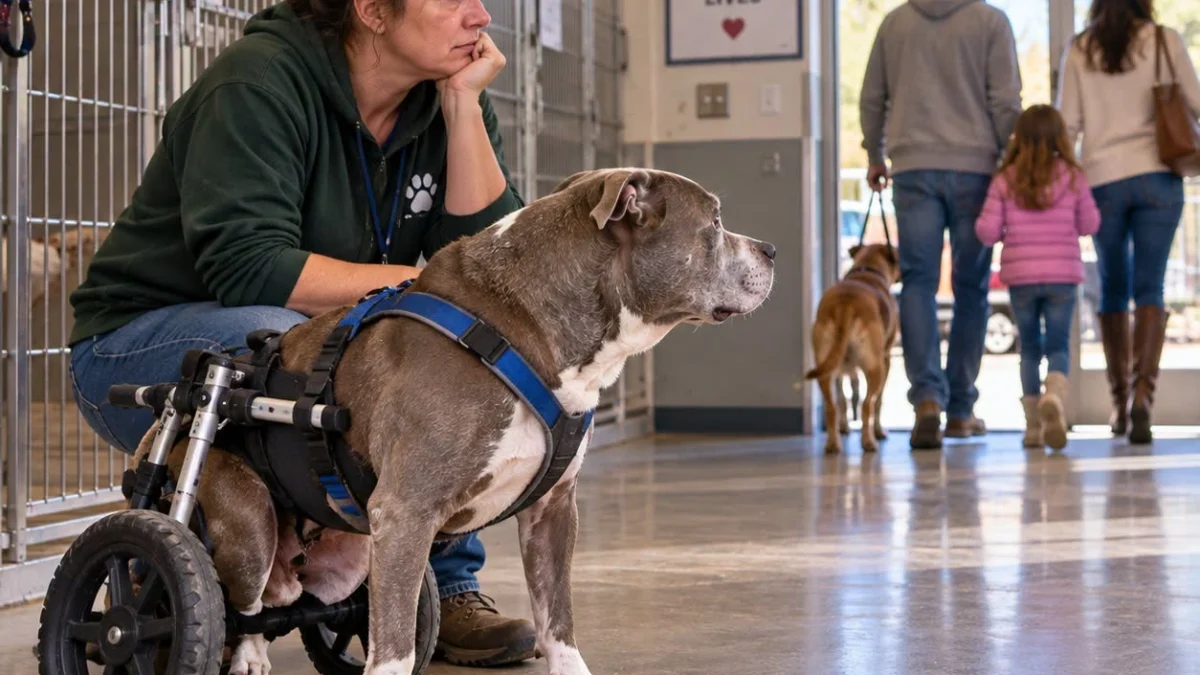
Two Families Walked Away From the Paralyzed Pit Bull—Then a Retired Mechanic Pulled Out a Tape Measure and Asked, “How Wide Should His Ramp Be?”
Two families met Bishop that rainy Saturday, loved his amber eyes and gentle nature, then walked away after realizing the blue-gray Pit Bull would never use his back legs again and would need hands-on medical care for the rest of his life.
By noon, I was beginning to believe the sweetest dog in our Portland shelter might spend years watching people leave through the same door—until a fifty-eight-year-old woman in a faded green raincoat sat beside his wheelchair, pulled a yellow tape measure from her belt, and asked me, “How wide is he from wheel to wheel?”
Then she unfolded a hand-drawn floor plan of her house and said something I still think about whenever people call a disabled animal “broken”: “He’s not the thing that needs fixing. I just need to make sure the house works for him.”
It was 11:42 on a rainy Saturday morning in Portland, Oregon.
My name is Mara Collins.
I was fifty-one years old then, and I had been working with abandoned animals for nine years.
Nine years is long enough to learn that shelter work can make you believe two opposite things at exactly the same time.
You learn how much cruelty people are capable of.
And how much kindness.
You see dogs brought in with collars embedded in their necks.
Cats left inside taped cardboard boxes.
Old animals surrendered because they became inconvenient.
Puppies returned because they grew.
You also see a seventy-year-old widower drive four hours to adopt a deaf hound nobody else wanted.
You watch a family sleep on blankets beside a terrified rescue dog because she is too afraid to enter their house.
You watch grown men cry into the necks of animals they swore they were “just looking at.”
The work changes you.
It teaches you to hope carefully.
Too much hope can hurt in a shelter.
I learned that lesson many times.
Bishop taught it to me again.
He was four years old.
Blue-gray Pit Bull.
Broad white chest.
One white front paw that made it look as though he had stepped in paint.
Tiny notch in his left ear.
Strong shoulders.
Huge head.
Amber eyes.
And if you met Bishop for more than thirty seconds, you usually forgot to be intimidated by the shape of that head because he had the emotional subtlety of a toddler.
If he liked you, you knew.
He would push his forehead against your thigh.
Lean his entire chest into your hands.
Attempt to climb into your lap despite weighing nearly sixty pounds.
And if you stopped scratching his ears before he felt the interaction was complete, he would stare at you with an expression suggesting a serious administrative error had occurred.
Bishop loved people.
That was the miracle.
Because people had not always been particularly good to Bishop.
Animal control found him months earlier on an industrial road south of the city.
A delivery driver had called.
There was a dog beside a chain-link fence.
Dragging himself.
When the officer arrived, Bishop tried to move away.
His front legs worked.
His rear legs didn’t.
He scraped himself several feet across rough pavement before exhaustion stopped him.
No collar.
No microchip.
No owner.
No one ever came forward.
Our veterinary team stabilized him.
A neurologist examined him.
Imaging showed an old spinal injury.
Not recent.
Not something surgery was likely to reverse.
There was no purposeful movement in either rear leg.
His paralysis was considered permanent.
That word frightened adopters.
Permanent.
People can handle a lot when they believe it is temporary.
Temporary illness.
Temporary inconvenience.
Temporary expense.
Permanent asks a different question.
Can you build your life around this if nothing changes?
Bishop needed a wheelchair for mobility outdoors and for appropriate periods inside.
The cart had a black aluminum frame.
Padded supports.
Two bright red wheels.
His powerful front legs did the work.
He could move surprisingly fast.
Too fast, sometimes.
We joked that Bishop had two speeds.
Parked.
And insurance claim.
But the wheelchair was only the visible part.
Bishop needed assistance emptying his bladder according to his veterinary care plan.
His skin needed careful monitoring because reduced sensation could allow injuries to worsen before he showed discomfort.
His back legs required protection from dragging.
He needed time out of the wheelchair.
Safe flooring.
Appropriate lifting support.
Regular veterinary follow-up.
Someone willing to learn.
Someone willing to plan.
Someone willing to accept that loving Bishop would not make his paralysis disappear.
That Saturday was an adoption event.
We had promoted Bishop heavily.
Good photos.
Honest description.
Videos of him cruising around our covered exercise area in those red wheels.
At 9:30, the first family arrived.
Parents.
Teenage son.
The son fell for Bishop immediately.
I mean immediately.
He dropped onto the floor.
Bishop rolled toward him so fast one wheel lifted when he tried to turn.
The boy laughed.
“Whoa!”
Bishop pushed his face into the teenager’s chest.
The boy looked at his parents.
“Please.”
That word always gets me.
Please.
For twenty minutes, I let myself imagine it.
The family had a large home.
Stable income.
Older children.
They asked good questions.
Then the father looked at Bishop’s rear legs.
“Is there another surgery?”
“No.”
“Physical therapy?”
“He does rehabilitation work for strength, comfort, and mobility, but we don’t expect purposeful use of the hind legs to return.”
The mother’s smile changed.
Not cruelty.
Reality.
“So he’ll always need this?”
She touched the wheelchair frame.
“As far as we know, yes.”
They lived in a three-story townhouse.
Bedrooms upstairs.
Backyard down a flight.
No accessible entrance.
They asked whether Bishop could drag himself up stairs.
“No.”
Could he be carried?
“Yes, with safe technique and appropriate support, but carrying a nearly sixty-pound dog repeatedly up several flights would be difficult and not a plan we’d recommend building his daily life around.”
The teenage boy kept petting him.
“I can carry him.”
His father looked at him.
“You’re seventeen.”
“I know.”
“You’re leaving for college next year.”
The boy stopped.
That was the moment.
Not because he loved Bishop less.
Because his father had asked the question adults eventually have to ask.
Who will do this on an ordinary Tuesday three years from now?
They talked privately.
Then the mother returned.
Eyes wet.
“I’m sorry.”
“You don’t have to apologize.”
She looked at Bishop.
“I really wanted this to work.”
“I know.”
The boy hugged him.
Bishop licked his chin.
Then the family walked out.
Bishop rolled after them.
He reached the visitation-room doorway.
Stopped.
Watched.
The boy looked back through the glass.
Then disappeared.
Bishop stayed at the door.
I crouched.
“Come on, buddy.”
He didn’t.
He listened to footsteps leaving the lobby.
Finally I turned his cart gently.
He followed me.
At 10:40, the second family arrived.
Mother.
Father.
Two young children.
The children thought Bishop’s wheelchair was the best thing they’d ever seen.
“Race car dog!”
The younger one shouted.
Bishop approved.
Their mother sat on the floor.
Bishop immediately shoved his enormous head beneath her hand.
The father examined the cart closely.
“What happens at night?”
“He doesn’t stay in this all day.”
“What does he do instead?”
I explained.
We talked about his drag bag.
Positioning.
Rest.
Skin care.
Then medical care.
Bladder routine.
Hygiene.
Monitoring.
Veterinary visits.
The father asked:
“How often?”
I answered according to Bishop’s current care plan.
His face tightened.
The mother stopped rubbing Bishop’s ears.
Not because she suddenly disliked him.
Because she understood.
They already had an elderly dog.
Two children under ten.
Three carpeted levels.
Both adults worked full time.
The mother asked several more questions anyway.
That told me she wanted to find a path.
Eventually she looked at her husband.
Then at me.
“I don’t think we can give him what he needs.”
Her voice was barely above a whisper.
I nodded.
“Thank you for being honest.”
She started crying.
“I feel awful.”
“Don’t.”
I meant it.
An honest no is kinder than an emotional yes that turns into another abandonment.
People sometimes treat choosing not to adopt a high-needs animal like moral failure.
It isn’t.
Knowing your limits can be compassion too.
The children hugged Bishop.
Their father shook my hand.
They left.
Again Bishop followed.
Again the door shut.
Again he waited.
That time I removed the wheelchair.
Set him on his blue blanket.
I thought being away from the entrance might help.
It didn’t.
Bishop used his front legs to pull himself toward the threshold.
Slowly.
Blanket slipping behind him.
He reached the door.
Rested his chin on the floor.
Watched the empty lobby.
I sat beside him.
“Buddy.”
His amber eyes turned toward me.
“I wish I could explain.”
He licked my wrist.
That nearly did me in.
Animals don’t understand practical incompatibility.
They don’t understand that the first family’s staircase was wrong.
They don’t understand work schedules.
Finances.
Backup care.
Long-term planning.
Bishop understood only this:
People came.
They touched him.
They laughed.
He liked them.
Then they went away.
I had worked nine years in shelters.
I knew not to narrate human emotions onto every canine behavior.
I knew Bishop wasn’t sitting there constructing a story about rejection.
But I also knew he had learned patterns.
Doors.
Footsteps.
Arrivals.
Departures.
And by 11:30, I was tired of watching him at that threshold.
Our final scheduled appointment was at 11:35.
I almost forgot.
Then the lobby door opened.
A woman walked in.
Fifty-eight.
Short silver hair.
Work jeans.
Heavy boots.
Faded green raincoat darkened at the shoulders from rain.
Weathered hands.
No makeup.
No purse.
And clipped to her belt—
A yellow tape measure.
Her name was June Walsh.
I had read the application.
Retired municipal-bus mechanic.
One-story bungalow.
Lives alone.
No other animals.
Fenced yard.
Previous dog ownership.
I greeted her.
“June?”
“Yes.”
“Mara.”
We shook hands.
“Thank you for coming.”
“Wouldn’t miss it.”
Something about her tone was different.
No excitement.
No nervous chatter.
She sounded like someone arriving to inspect a job.
I brought Bishop into the room in his wheelchair.
His mood changed immediately.
People.
Bishop loved people.
He rolled toward June.
She didn’t kneel dramatically.
Didn’t squeal.
Didn’t put both hands on his face.
She sat on the floor several feet away.
Waited.
Bishop sniffed her boots.
They smelled like rain.
He sniffed her jeans.
Then her hand.
June kept it relaxed.
“Morning.”
Bishop nudged her fingers.
She scratched beneath his chin.
“That’s a substantial head you’ve got.”
I smiled.
Bishop leaned harder.
June laughed.
Then she looked at his wheelchair.
Really looked.
Not the way people usually did.
Most stared at the wheels and then at the legs.
June looked at frame joints.
Width.
Harness.
Ground clearance.
She reached toward the cart.
Stopped.
“May I?”
“Of course.”
She examined the frame without manipulating anything.
Then looked at me.
“How wide is he, outside wheel to outside wheel?”
I blinked.
“What?”
“Wheel to wheel.”
“About twenty-four inches.”
She pulled the tape measure from her belt.
I stared.
“And how much clearance would you recommend around doorways?”
“At least thirty.”
She extended the tape.
“Thirty-two would be safer?”
“Yes.”
She nodded.
“Thirty-two it is.”
Bishop nudged the metal tape.
It snapped inward slightly.
He jumped.
June laughed.
“Sorry, bud.”
She slowly retracted it.
Then asked:
“What happens if he tips on a ramp when I’m alone?”
I started explaining.
Safe slope.
Side rails.
Wheel clearance.
Harness support.
Traction.
Supervision.
June listened.
Then reached inside her raincoat.
Pulled out a folded piece of graph paper.
Opened it on the floor.
House.
Living room.
Kitchen.
Bedroom.
Hallway.
Door widths.
Back entrance.
Front steps.
Measurements in pencil.
And at the bottom:
POSSIBLE RAMP.
I stared.
“Did you draw this for Bishop?”
June looked surprised.
“Well, yes.”
“You’ve never met him.”
“I know.”
“How did you know the measurements?”
“I didn’t.”
She held up the tape measure.
“That’s why I brought this.”
I almost laughed.
Most potential adopters asked whether Bishop could fit into their lives.
June had apparently come to ask how her life needed to change to fit Bishop.
She pointed.
“Back door’s thirty-four inches.”
Pencil tap.
“Threshold’s about an inch and a half. I can change that.”
Another mark.
“Hallway’s thirty-eight.”
She looked at Bishop.
“That enough to turn?”
“We’d want to test him in a similar space.”
“Fair.”
Front entrance.
“Three steps.”
She frowned.
“That’s the issue.”
“Probably.”
“There’s enough run for a ramp if I turn it once.”
“We’d need to evaluate the rise and slope.”
“Of course.”
She wrote.
Bishop rested his head against her knee.
June stopped writing.
Not because he interrupted her.
Because he had chosen her.
Her hand went behind his left ear.
“Hello there, handsome.”
His eyes closed.
I looked at the door.
For the first time all morning, Bishop wasn’t.
That got me.
But shelter work makes you cautious.
I had seen wonderful first meetings fall apart.
Good intentions are not a care plan.
Love won’t prevent a urinary infection.
Love won’t lift sixty pounds safely if your back can’t handle it.
Love won’t make a steep staircase accessible.
And love does not automatically make someone competent at medical care.
I asked:
“Have you ever cared for a paralyzed dog?”
“No.”
My hope dropped.
Then June said:
“But I’ve taken care of broken things most of my life.”
I must have reacted.
She immediately corrected herself.
“Not him.”
She pointed at Bishop.
“I mean equipment.”
A pause.
“He’s not the thing that needs fixing.”
I stopped.
She continued almost casually.
“I maintained city buses thirty-four years.”
“Portland?”
“Yep.”
“Mechanical?”
“Everything eventually.”
She smiled.
“Hydraulic lifts, restraint systems, electrical, brakes, doors.”
She pointed toward Bishop’s chair.
“I know equipment matters.”
Then she looked down at him.
“But he’s not equipment.”
That sentence has stayed with me longer than almost anything anyone has said in an adoption room.
He’s not the thing that needs fixing.
Bishop had spent months being described according to what had gone wrong.
Broken spine.
Paralyzed legs.
Disabled.
Special needs.
Wheelchair dog.
June saw the same facts.
But her conclusion was different.
His body was Bishop’s body.
The environment was the negotiable part.
She told me about her house.
Small bungalow.
One bedroom.
Hardwood.
Enclosed yard.
No stairs inside.
Parents had owned it.
She bought it from their estate.
Retired three years.
No children living there.
No pets.
“Why Bishop?”
I asked.
That was the first question that made her hesitate.
She looked toward the rain-streaked window.
“I had a dog.”
“What was his name?”
“Walter.”
She smiled.
“Big black Lab mix. Criminal.”
I smiled.
“What crime?”
“Food.”
“All food?”
“All known food.”
Apparently Walter could open refrigerators.
Trash cans.
Cupboards.
Once consumed a birthday cake while leaving the box closed enough that June initially blamed herself for forgetting where she’d put it.
“Thirteen years,” she said.
“What happened?”
“Got old.”
The smile faded.
“Hips went first.”
Then kidneys.
Eventually there were more bad days than good.
June made the decision.
Two years earlier.
“When his hips started getting bad, he couldn’t handle my back steps.”
She nodded toward the graph paper.
“So I built a ramp.”
I looked at her.
“Same house?”
“Same house.”
“Still there?”
“Tore it out last spring. Rot started.”
Her fingers moved across Bishop’s white chest.
“Supports are still easy enough to locate.”
Something in her expression softened.
“Walter loved that ramp.”
“He did?”
“First time he used it without me lifting him, he stood in the yard like he’d personally defeated gravity.”
I laughed.
June looked down at Bishop.
“I saw this boy’s picture Wednesday.”
Her hand rested on his shoulder.
“Kept thinking people would look at the wheels and think of everything he can’t do.”
She paused.
“I started wondering what he could do if the house stopped being in his way.”
I felt my throat tighten.
Still, I pushed.
Because Bishop needed me to.
“Walter lost mobility gradually.”
June nodded.
“He knew your house.”
“Yes.”
“Bishop doesn’t.”
“I know.”
“He’ll need to learn you.”
“Yes.”
“And you’ll need to learn him.”
June looked at me directly.
“That’s why I’m here.”
No defensiveness.
No promise she already knew everything.
Then she said something even better.
“Tell me what I’m missing.”
For forty minutes, we did.
Wheelchair.
Fitting.
Protection.
Transfer.
Rest.
Indoor movement.
Skin.
Medical routine.
Equipment.
Emergency planning.
Cost.
June wrote everything.
When I explained that Bishop couldn’t remain in the cart indefinitely, she asked:
“How does he tell you he’s tired?”
That was a good question.
“He slows down.”
“Anything else?”
“He’ll sometimes stop and wait.”
“Does he complain?”
“Occasionally.”
“Vocal?”
“Mostly looks offended.”
June smiled.
“I understand offended.”
We let Bishop demonstrate.
He rolled around the room.
One wheel caught a floor mat.
I started toward him.
June lifted one hand.
“Can we wait?”
I stopped.
Bishop pushed.
Didn’t work.
Backed up.
Adjusted.
Tried again.
Cleared it.
June grinned.
“Well, look at you.”
Bishop rolled toward her.
She scratched his chest.
The first family had asked whether he would ever run.
June celebrated him solving a floor mat.
Same dog.
Different definition of victory.
Then came the difficult part.
Medical care.
I brought in Elena, one of our veterinary technicians.
Elena knew Bishop better than almost anyone.
She knew his skin.
His habits.
His schedule.
His grumbles.
His preferred resting positions.
She explained the bladder-care routine prescribed by his veterinary team.
June watched.
No disgust.
No pretending it was easy either.
“Show me again.”
Elena did.
June asked:
“What changes mean infection?”
“When do I call?”
“What if he resists?”
“What if I can’t complete it properly?”
“What happens if I’m sick?”
Then:
“Can I practice?”
We supervised.
It was not easy.
Her first attempt wasn’t good.
Hand placement wrong.
Bishop shifted.
June stopped immediately.
“Sorry, buddy.”
She looked at Elena.
“Show me what I’m doing wrong.”
They tried again.
Still difficult.
For the first time all morning, June looked afraid.
Not of Bishop.
Of failing him.
She sat back.
“That’s harder than I thought.”
“Yes.”
“What if I can’t learn?”
I could have encouraged her.
Instead:
“Then he doesn’t go home with you until there is a safe care arrangement.”
She looked down.
Silence.
I thought:
Here it is.
The moment.
Third family leaving.
Then June took out her notebook.
“How many practice sessions can I book?”
I stared.
“What?”
“How many times can I come back?”
Elena smiled.
“As many as we can reasonably schedule.”
June nodded.
“Good.”
She looked toward Bishop.
“Because I’m not taking him home until I can do right by him.”
There are people who tell shelter workers:
“I love him already.”
That is beautiful.
But commitment sometimes sounds less romantic.
Teach me again.
I don’t know yet.
What backup do I need?
I’m not ready to take him until I can care for him safely.
June stayed nearly three hours.
Before leaving, Bishop lay across her boots.
“I need those,” she told him.
He didn’t care.
I laughed.
“He does that when he likes someone.”
June scratched his ear.
“Good to know.”
She stood eventually.
“I have to go build something.”
“June.”
She looked at me.
“I know.”
“What?”
“Not approved.”
She clipped the tape measure back onto her belt.
“I’m not assuming anything.”
Then:
“But if there’s even a chance he comes home, I want the house ready before he does.”
She crouched.
“I’ll be back.”
I hated those words in shelters.
Not because people lie.
Because circumstances do.
People say they’ll return.
Then landlords say no.
Partners disagree.
Work changes.
Fear wins.
Bishop didn’t know any of that.
He followed June to the door.
Red wheels clicking.
She stopped.
Knelt.
Held his face.
“I can’t take you yet.”
Bishop pressed toward her.
“But I’m working on it.”
She kissed the white patch between his eyes.
Then she left.
Bishop watched the door.
I sat beside him.
“She said she’s coming back.”
He rested his chin against my knee.
I hoped she would.
Monday.
8:07 a.m.
Phone.
“Good morning. It’s June Walsh.”
I smiled.
“I know.”
“I have questions.”
“Of course you do.”
“Ramp surface.”
She had already removed a loose hallway rug.
Moved the shoe rack because it stole six inches of clearance.
Measured the front rise.
Calculated room for a landing.
Then she said:
“I bought a bigger water bowl.”
That was what made me emotional.
Not the ramp.
The bowl.
A stainless-steel water bowl for a dog who did not belong to her yet.
“June.”
“Yes?”
“You know approval isn’t finished.”
“I know.”
“Then why—”
“He’ll need somewhere to drink.”
Simple.
Over the next week, she came four times.
Bishop learned her voice.
Tuesday morning she entered:
“Morning, handsome.”
Bishop’s head snapped up.
Then those front legs moved so quickly his red wheels rattled.
He nearly hit donated food bags.
June laughed.
“Hello to you too.”
He shoved himself against her legs.
She looked at me.
“Does he do that with everyone?”
“No.”
That was the truth.
Bishop liked people.
But he had begun recognizing June.
Predictability matters to animals.
The person who returns becomes different from the person who visits.
Wednesday’s training was rough.
Bishop restless.
June tense.
Tension passed down the leash, down her hands, into the room.
Elena stopped them.
June stepped back.
“I don’t want him scared of me.”
“Good.”
They waited.
Reset.
Second attempt better.
Afterward June sat with Bishop’s head in her lap.
“I keep thinking about what happens if I’m sick.”
“Important.”
“Or my back is bad.”
“Yes.”
“Or I get hurt.”
I said:
“You need backup.”
June looked at me.
“Do you think I can do this?”
Dangerous question.
Because I liked her.
Because I wanted Bishop out.
Because saying yes would have felt good.
But Bishop did not need my feelings.
“I think you’re learning.”
She waited.
“I think you take it seriously.”
She waited.
“But wanting it badly isn’t backup care.”
She nodded.
“Fair.”
Then stood.
“I’ll fix that.”
Friday she returned with a phone number.
Tom Alvarez.
Two houses down.
Neighbor seventeen years.
Retired utility worker.
Had cared for an aging dog with mobility problems.
Willing to train.
June also identified a closer veterinary clinic.
A professional sitter willing to discuss specialized care after proper instruction.
“I don’t want his life depending on whether I wake up feeling strong.”
That sentence told me more about June than any adoption application.
Love isn’t promising you’ll never get tired.
Love is making a plan for when you do.
The next Saturday, I went to June’s house with our rehabilitation specialist.
Green raincoat.
Tape measure.
She waited outside.
And behind her—
Ramp.
Wide.
Turned at a landing.
Side rails.
Edge protection.
Textured surface.
Professionally checked.
June didn’t stand there proudly waiting for praise.
She said:
“Tell me what’s wrong with it.”
Our specialist found one threshold transition that should be smoother.
June wrote it down.
No argument.
Inside:
Loose rugs removed.
Safer traction.
Wide pathways.
Low washable bed.
Two stainless bowls.
One filled with water.
On a shelf above them stood a framed photograph.
Big black dog.
Tennis ball.
Troublemaker face.
Walter.
June caught me looking.
“That’s him.”
“He was beautiful.”
“He was a menace.”
Her smile softened.
“Best thirteen years I had.”
I looked at the empty bed.
“You worried another dog will make this hard?”
“Yes.”
That answer mattered.
She didn’t pretend grief was solved.
“I still reach for Walter’s leash sometimes.”
Her eyes watered.
“I don’t think another dog makes you miss the old one less.”
“No.”
She looked toward the dog bed.
“But this place has been too quiet.”
Then:
“And Bishop needs somebody who doesn’t mind a little extra work.”
A pause.
“Seems like we could help each other.”
We approved the layout after adjustments.
But June asked for something I didn’t expect.
“Can Bishop visit first?”
“Before adoption?”
“Yes.”
“Why?”
“What if he hates the ramp?”
I smiled.
“He’s a dog.”
“He gets opinions.”
She was right.
We scheduled a supervised trial.
Wednesday morning.
I drove Bishop.
June waited in the driveway.
He saw her through the van window.
Ears up.
“There’s my boy,” she said.
Then caught herself.
“Sorry.”
I smiled.
We fitted his wheelchair.
Bishop rolled toward her.
June pointed at the ramp.
“Made you a way inside.”
Obviously, he did not understand the sentence.
But tone matters.
He moved toward it.
Stopped.
New surface.
Different incline.
He shifted backward.
I waited.
June waited.
She did not pull.
Didn’t lure frantically.
Didn’t make his hesitation into a crisis.
She sat on the landing.
“You take your time.”
Bishop sniffed.
One paw.
Wheel turned.
Another.
Pause.
June said:
“That’s it.”
Another foot.
Then more.
He reached the landing.
Rolled toward her.
Pressed his nose against her chest.
June laughed and hugged his shoulders.
I turned away.
I cried.
Nine years.
Hundreds of adoptions.
Still.
Bishop did not walk.
Nothing miraculous happened to his spine.
His rear legs remained motionless.
He had simply been given a route to someone who wanted him.
Sometimes accessibility looks so ordinary that we forget how life-changing it is.
Inside, Bishop explored.
Living room.
Kitchen.
Corners.
Table legs.
New smells.
He approached the dog bed.
Rejected it.
June looked offended.
“I spent money on that.”
Bishop continued toward the kitchen.
“We’ll discuss decor later.”
In the hallway, he took a turn wrong.
Wheel brushed wall.
Stopped.
June started forward.
I said:
“Wait.”
Bishop backed.
Adjusted.
Tried again.
Cleared it.
June raised both hands.
“Look at you!”
He rolled toward her like he’d won a medal.
The important part came later.
We removed the wheelchair for rest.
Bishop settled on a padded surface.
June sat nearby.
He watched.
Shifted.
Then placed his head on her thigh.
June froze.
“Oh.”
Her hand settled on his shoulder.
Bishop sighed.
Closed his eyes.
Five minutes.
Ten.
June didn’t move.
Finally:
“I haven’t had a dog fall asleep on me in two years.”
I said nothing.
“Funny what you miss.”
Her fingers moved over Bishop’s ear.
“The weight.”
Tears came.
“The breathing.”
She wiped one away.
“Sitting still because you don’t want to wake them.”
Then she told me:
“I thought after Walter died I was done.”
She packed his toys.
Donated food.
Removed the old ramp.
Kept one thing.
His collar.
Still in a drawer.
“I saw Bishop online.”
She looked at him.
“I started thinking about all the work he’d take.”
Her voice changed.
“And I realized I missed being needed.”
Pause.
“No.”
She corrected herself.
“I missed having someone to care for.”
Then:
“Someone whose little victories mattered to me.”
That was it.
She wasn’t looking for a replacement dog.
She wasn’t trying to recreate Walter.
“I know Bishop isn’t Walter.”
“I know.”
“I don’t want him to be.”
She looked down.
“I want to find out who Bishop is.”
That is one of the best things an adopter has ever said to me.
At the end of the visit, Bishop had to return.
June knelt.
“You’ve got to go back for a little while.”
He leaned into her.
“I still have things to finish.”
When I opened the van, Bishop looked back.
June stood on the walkway.
He would not load.
“Go on, buddy.”
He stared.
“I’ll see you soon.”
His ears lifted.
Only then did he turn.
Driving away, I looked in the mirror.
June remained there.
Hand raised.
For the first time, I wasn’t imagining Bishop’s next meet-and-greet.
I was imagining his adoption day.
One final obstacle remained.
Medical competency.
Thursday.
June arrived early.
Navy sweatshirt.
Old jeans.
Nervous.
“Feels like my mechanic certification.”
Elena supervised.
June prepared.
Positioned Bishop.
Paused when needed.
Corrected herself.
Completed the care safely according to the plan.
Not quickly.
Not elegantly.
Correctly.
When it was over, Elena smiled.
“Much better.”
June looked stunned.
“Really?”
“Yes.”
June’s shoulders dropped.
Then she said:
“Can I practice one more time before I take him?”
Elena laughed.
“Absolutely.”
That woman never wanted the minimum standard.
She wanted competence.
Our adoption team reviewed everything.
Appropriate home.
Ramp.
Traction.
Medical training.
Veterinary plan.
Backup caregiver.
Financial preparation.
Realistic expectations.
Most importantly:
June did not expect Bishop to become a different dog after she loved him.
That is where some adoptions fail.
People fall in love with a future animal.
The dog who will stop being afraid.
Stop needing medication.
Stop reacting.
Start walking.
Become easier.
June wanted Bishop.
The actual Bishop.
Red wheels.
Medical schedule.
Stolen-sock potential and all.
I called at 3:26.
“June?”
“Mara?”
“We approved the adoption.”
Silence.
“June?”
“I’m here.”
“Everything okay?”
“Are you sure?”
“Yes.”
Another silence.
Then:
“Oh.”
I heard movement.
“Oh, my goodness.”
She was crying.
“Can I get him tomorrow?”
“Yes.”
“I have his bed.”
“I know.”
“And water bowl.”
“I know.”
“Tom’s coming Sunday.”
“Good.”
“And I bought him a yellow raincoat.”
I laughed.
“Of course.”
Then June asked:
“Do you think he’ll remember me?”
I looked through the office window.
Bishop on his blue blanket.
Wheelchair against the wall.
“Yes.”
I smiled.
“I think he’ll know exactly who you are.”
Friday morning came gray.
Portland gray.
Wet pavement.
Coffee.
Shelter disinfectant.
I arrived early.
Packed Bishop’s things.
Food.
Medication information.
Records.
Equipment documents.
Drag bag.
Toy.
Blue blanket.
That blanket almost broke me.
Faded.
Repaired corner.
Months of shelter smell.
I considered replacing it.
Didn’t.
Home doesn’t always begin with new things.
Sometimes familiar things help you cross.
9:12.
June’s silver pickup entered.
She came inside in the green raincoat.
Carrying the ridiculous yellow dog raincoat.
Reflective trim.
Carefully chosen so nothing would interfere with wheels.
“Where’s my boy?”
This time she didn’t correct herself.
He was her boy.
I opened the kennel corridor.
Bishop was near the staff room in his wheelchair.
“Guess who’s here?”
Then June’s voice:
“Morning, handsome.”
Bishop exploded forward.
Ears up.
Front paws working.
Red wheels rattling.
June dropped to her knees.
He slammed his chest against her.
One wheel lifted.
“Easy!”
Lick.
Chin.
Cheek.
Nose.
June laughed.
“All right!”
Then stopped.
Her face folded.
She hugged his neck.
“Oh, honey.”
I cried too.
No professionalism left.
Eventually she looked at me.
“Can we go home?”
Not:
Can I take him?
Can I have him?
Can we go home?
“Yes.”
“Good.”
She pressed her forehead against his.
“Because I’ve been wanting to say that all week.”
Paperwork.
Final instructions.
Follow-up.
Equipment check.
Emergency signs.
Then the bag.
I picked up the blue blanket.
Bishop rolled over.
Sniffed it.
I crouched.
“This is yours.”
He looked at me.
“You’re taking it home.”
My throat closed.
Four months earlier Bishop had arrived dirty and frightened.
Unable to move his back legs.
Unsure of every hand.
Now June held his leash.
Yellow raincoat tucked under one arm.
A ramp waited twenty minutes away.
I touched his white chest.
“Go have a good life.”
He licked my hand.
June called:
“Come on, buddy.”
Bishop turned.
Red wheels followed.
I watched him cross the shelter floor.
I have heard wedding music.
Babies crying after birth.
People cheering reunions.
But the soft rattle of those red wheels leaving our shelter remains one of the loveliest sounds I know.
The first weeks were not perfect.
They never are.
Day three, June called.
My heart jumped.
“Bishop okay?”
“He’s fine.”
“What happened?”
“He hates my washing machine.”
I laughed.
“What?”
“Spin cycle. Apparently apocalypse.”
They moved his resting area.
Created a quieter option.
Then:
“He also stole a sock.”
“That sounds healthy.”
“We are negotiating.”
“How’s care?”
“Good.”
“Skin?”
“Good.”
“Appetite?”
“Excellent.”
“Sleep?”
“Mostly.”
Silence.
Then:
“Mara?”
“Yes?”
“I think he likes it here.”
I smiled.
“I think he does too.”
That evening the first photograph arrived.
Bishop on his blue blanket.
Wheelchair beside him.
Walter’s framed photograph above the bowls.
One gray work sock beneath Bishop’s paw.
Caption:
THE SUSPECT REFUSES TO SURRENDER STOLEN PROPERTY.
I saved it.
More came.
Bishop in backyard.
Nose inside weeds.
TWELVE MINUTES INVESTIGATING ONE DANDELION.
Bishop asleep on the yellow raincoat.
APPARENTLY THIS IS A PILLOW.
Then came the hard day.
Fourth week.
Tuesday night.
Bishop didn’t move toward dinner.
Quieter.
Ate less.
June noticed changes during care.
She remembered what Elena taught her.
Called the veterinarian.
Didn’t wait.
Clinic confirmed a urinary tract infection and started treatment.
June called me later.
Voice shaking.
“I missed something.”
“What?”
“I thought I was doing everything right.”
“June.”
“What if I hurt him?”
There it was.
She believed illness meant failure.
I told her what the veterinary team had explained: dogs with Bishop’s condition could develop urinary complications even with careful management, and what mattered now was following his treatment plan, reviewing the routine with his clinicians, and responding promptly to changes.
“How is he?”
“Sleeping.”
“Comfortable?”
“Yes.”
“You noticed something was wrong.”
“Yes.”
“You got him care.”
“Yes.”
“You’re with him.”
“Of course.”
“Then he isn’t facing it alone.”
June cried quietly.
“I knew hard days would happen.”
“I know.”
“I didn’t know I’d be this scared.”
“That’s because he matters now.”
Bishop improved.
The infection resolved with veterinary treatment.
June kept better records afterward.
Appetite.
Activity.
Care.
Anything unusual.
Not because anxiety had taken over.
Because knowledge gave her confidence.
She learned something important.
Good caregiving does not mean preventing every problem.
It means noticing.
Responding.
Seeking help.
Adjusting.
Bishop learned too.
He learned a bad day wasn’t followed by abandonment.
Month two.
Month three.
Life became funny.
Bishop inspected the same kitchen corner every morning.
June called it “opening the facility.”
He learned the mail carrier sometimes had dog biscuits and therefore treated all federal mail delivery as a major event.
He barked at a blowing leaf.
Investigated it twenty minutes.
Saw his red wheels reflected in the patio glass and kept looking behind himself for the “other dog.”
“He wasn’t scared,” June told me.
“He was offended.”
By summer, June took him to an accessible park.
Smooth paths.
Gentle slopes.
Rest breaks.
Water.
Care supplies.
Everything planned.
Some days Bishop traveled half an hour.
Other days he sniffed one tree and declared the expedition complete.
June let his energy decide.
She sent video.
Blue-gray dog moving along a wide path.
Strong front legs.
Red wheels turning.
Tall trees.
Her voice behind the camera:
“Slow down, race car.”
Bishop looked back.
Then sped up.
I watched it six times.
Not because of a miracle.
Bishop still couldn’t walk with his back legs.
No cure.
No dramatic transformation.
Just a dog moving through a world somebody had made accessible.
That was enough.
I remembered the first family asking if surgery would fix him.
The second family recognizing their house and schedule could not safely support him.
Then June.
“How wide should the ramp be?”
That question changed the whole frame.
Not:
How do we make Bishop fit the world?
How do we make this corner of the world fit Bishop?
Tom became his backup person.
Actually trained.
Actually came.
Gardened while Bishop supervised.
One day I visited.
Tom knelt in dirt pulling weeds.
Bishop sat in the wheelchair watching like a foreman.
“He’s no help,” Tom complained.
June laughed.
“Management rarely is.”
Bishop looked satisfied.
I stood there thinking about how disability had filled every conversation in the shelter.
Paralysis.
Wheelchair.
Bladder.
Care.
Risk.
Need.
Here?
Tom complained about weeds.
June told Bishop not to chew the garden hose.
A bird landed on the fence.
Phone rang inside.
Someone needed more coffee.
Bishop’s disability had not disappeared.
It had simply stopped being the most interesting thing about him.
He was part of the afternoon.
That may be one of the best outcomes a shelter can hope for.
Ordinary belonging.
There were difficult days.
June’s arthritis flared.
Wheelchair needed adjustment.
Skin needed extra monitoring.
Weather turned unsafe.
Tom helped.
Sometimes he prepared food.
Sometimes cleaned equipment.
Sometimes simply stayed with Bishop while June rested.
Once June told me:
“I used to think loving somebody meant doing everything yourself.”
“And now?”
“I got old.”
She smiled.
“Now I think love means knowing who to call when your back goes out.”
Bishop didn’t need a martyr.
He needed a network.
June built one.
Eight months after adoption, June invited me for coffee.
Bishop greeted me at the door.
Green collar now.
Wheelchair with fresh rear tires.
He sniffed me.
Remembered.
Leaned into my hand.
“Hey, handsome.”
He licked my wrist.
I remembered that shelter threshold.
Second family leaving.
Blue blanket.
Closed door.
“Look at you.”
June smiled.
“He’s been watching from the window.”
“He knew I was coming?”
“No.”
She laughed.
“He just likes the window.”
That sentence hit me.
Bishop was no longer waiting for someone to choose him.
He was watching the neighborhood.
There is a difference.
Inside, Walter’s photo still stood above the bowls.
Beside it—
Bishop.
Wheelchair.
Ramp.
Head high.
Red wheels bright.
June handed me an album.
First page:
Bishop on shelter blanket.
BEFORE WE MET.
Next:
June with tape measure.
THE DAY WE MET.
Unfinished ramp.
MAKING ROOM.
Bishop climbing.
FIRST VISIT.
Then ordinary pages.
Nap.
Park.
Raincoat.
Leaf.
Sock.
Garden.
Water bowl.
No dramatic captions.
Just life.
Last page.
Bishop asleep.
June beside him.
Hand on shoulder.
Eyes closed.
Someone, probably Tom, took it.
Underneath one word.
HOME.
I closed the album because tears blurred everything.
June looked worried.
“Too much?”
“No.”
I laughed.
“Perfect.”
She touched Bishop.
“He made this place feel like a house again.”
Then:
“I don’t know how long we have.”
I looked at her.
“He’s got health things.”
She shrugged.
“I’m fifty-eight.”
Pause.
“Nobody gets guarantees.”
Her hand moved over Bishop’s head.
“But I know where he’ll sleep tonight.”
Bishop sighed.
“And tomorrow we’ll figure out what he needs.”
She smiled.
“That’s enough.”
Winter came.
Rain.
Cold.
Slippery mornings.
June adjusted.
Ramp checks.
Indoor enrichment.
Shorter outdoor trips when conditions were unsafe.
Veterinary recommendations.
Photos kept arriving.
Bishop buried under fleece.
RETIRED FROM PUBLIC LIFE UNTIL SPRING.
Bishop staring at rain.
HE DISAGREES WITH WEATHER.
Tom on floor.
Bishop’s head on his boot.
ASSISTANT FOREMAN REPORTING.
I kept a folder of them.
When people asked me afterward whether adopting a disabled animal was “worth it,” I became careful.
Bishop’s story does not mean every family should adopt a dog with complex medical needs.
The first two families weren’t bad people.
They were honest.
They recognized barriers.
They chose not to make a promise they could not safely keep.
That is responsible too.
June wasn’t better because she cared more.
She had different circumstances.
One-story home.
Time.
Mechanical skill.
Resources.
Support.
Willingness to train.
Ability to modify the house.
And, most importantly, no fantasy that love would remove Bishop’s needs.
She could make the commitment.
Then she followed through.
Almost one year after his adoption, we held a shelter reunion.
June called beforehand.
“I might bring Bishop.”
“I’d love that.”
“Early.”
“Good.”
“If he hates it, we’re leaving.”
“Perfect.”
Pause.
“Mara?”
“Yes?”
“Can I bring the tape measure?”
I laughed.
“Why?”
“For the photograph.”
Of course.
They arrived early.
I heard:
“Come on, race car.”
I turned.
Bishop.
Blue-gray coat shining.
White chest.
Red wheels.
June in green raincoat.
Yellow tape measure.
He saw me.
Rolled over.
Pressed his nose into my hands.
“Hey, Bishop.”
I scratched him.
“I missed you.”
June warned:
“You start that and you’ve committed to twenty minutes.”
“I accept.”
We talked.
Vet.
Park.
Garbage truck fascination.
Then Bishop rolled toward the outer door.
Stopped by June.
Nose against her hand.
She looked at me.
“He’s done.”
“Already?”
“Enough excitement.”
She clipped the leash.
Bishop moved toward the exit.
Stopped at the threshold.
And I saw it.
One year earlier.
Same doorway.
Families leaving.
Bishop waiting.
Watching.
Unable to understand.
Now his rear legs still didn’t work.
Wheelchair still there.
Care still there.
Nothing about his disability had been magically erased.
But he wasn’t watching somebody leave.
He was waiting for June to open the door.
She looked down.
“Ready to go home?”
His ears rose.
June opened it.
Bishop rolled through.
Did not look back.
I cried.
Of course I did.
A few days later, a photograph arrived.
Me kneeling beside Bishop.
June beside him.
Green raincoat.
Red wheels.
Yellow tape measure in her hand.
On the back was a letter.
She wrote that people probably thought she gave Bishop a second chance.
She believed he gave her one too.
Walter still had his place in her heart.
Opening her home again had not pushed Walter out.
Love did not need one memory to leave before another could enter.
Bishop still couldn’t use his hind legs.
Probably never would.
But every morning he woke expecting breakfast.
Outside.
Ear scratches.
A day.
He made her laugh.
Got her out of bed.
Reminded her that a good life does not always look like the life you once imagined.
Then she wrote something that took me back to that rainy Saturday.
She said she had never known whether she could provide everything Bishop needed.
She had only known she wanted to learn what it would take.
Thank you for letting us try.
I read it three times.
Then put it in Bishop’s adoption file.
For years, I believed the most beautiful moment in shelter work was watching an animal leave.
I was wrong.
The leaving is a photograph.
The life comes afterward.
Tuesday morning when nobody is watching.
Vet appointments.
Wet wheels.
Stolen socks.
Bad weather.
Medical scares.
Tired caregivers.
Backup plans.
Meals.
Naps.
The decision to keep showing up after the emotional high of adoption is gone.
That’s where rescue becomes family.
Months later, June sent one more photograph.
Clear spring morning.
Front door open.
Sun on the ramp.
Bishop halfway down.
Red wheels bright.
One white front paw planted on textured wood.
June holding the door.
Smiling.
Through the window, Walter’s photograph visible.
Beside the ramp, yellow flowers.
Seven words beneath it:
He still loves going out this way.
I stared at that picture.
Then looked toward our shelter corridor.
Another dog was waiting for an appointment.
Different needs.
Different story.
Different person, maybe, walking toward us with a question we hadn’t heard yet.
I straightened my name badge.
And went to meet them.
Because Bishop changed what I listen for.
People think the important adoption question is:
“Can I love this animal?”
Usually, that is the easiest part.
The harder questions sound less romantic.
What does he need?
What do I need to learn?
What must change?
Who helps if I cannot?
What happens on the hard days?
Can I love him without needing him to become easier?
June asked those questions.
That is why Bishop went home.
She never asked me to promise his legs would work.
Never asked whether we had a dog with fewer problems.
Never told me love would somehow solve his paralysis.
She looked at twenty-four inches of wheelchair.
Pulled out a tape measure.
And started making room.
Years in shelter work had taught me to recognize people trying to rescue an animal.
June taught me to recognize something different.
Someone preparing to share a life.
Bishop did not need a person who could make him walk.
He needed somebody who would put rails on the ramp.
Move the shoe rack.
Learn the medical routine.
Call the veterinarian.
Ask for help.
Buy the ridiculous raincoat.
Laugh about the sock.
Sit beside him when things were difficult.
Open the door the next morning.
Again.
Again.
Again.
That was the miracle.
Not recovery.
Not cure.
Access.
Commitment.
Belonging.
The first two families had stood at our shelter door and honestly said:
We cannot safely give him what he needs.
June walked in and asked:
What would it take?
And when we told her—
She did the work.
Sometimes people still ask me about Bishop.
They remember the wheelchair.
I remember the tape measure.
They remember the two families leaving.
I remember the woman measuring her hallway before Bishop had ever set one wheel inside it.
They remember a dog who couldn’t walk.
I remember a dog who moved fast enough that June called him race car.
They see paralysis.
I see red wheels crossing a shelter floor on adoption day.
That is why, after nine years of doing this work, Bishop taught me something I somehow had not fully understood.
A good home is not always a place that happens to fit you.
Sometimes it is a place where somebody looks at the door that is too narrow—
and makes it wider.
Looks at the steps—
and builds a ramp.
Looks at a life that will require more work than expected—
and learns the work.
June never fixed Bishop.
She never needed to.
She changed the world immediately around him until he could move through it safely.
And Bishop changed something in her too.
He did not replace Walter.
He did not erase grief.
He gave her new routines beside old memories.
A second dog photograph beside the first.
Another water bowl.
Another reason to open the door.
That is what their life became.
Not one love replacing another.
More room.
The same thing June had been building from the beginning.
Room in the hallway.
Room at the door.
Room on the ramp.
Room in the house.
Room in a heart that had once believed it was finished.
And maybe that is why I still remember exactly what June said when she first looked at Bishop.
Not:
“Poor dog.”
Not:
“Can he be fixed?”
Not:
“Will he ever be normal?”
She looked at that wheelchair.
Then looked at the house measurements in her hand.
And said:
“Thirty-two inches should do it.”
At the time, I thought she was measuring a ramp.
I understand now that she was measuring something much bigger.
She was measuring how much of her life needed to move aside so Bishop could enter it.
And once she knew—
she made room.








