Two Abandoned Puppies Had Nothing but Each Other—Then One Was Badly Injured, and Rescuers Saw Just How Far Her Brother Would Go to Stay Beside Her
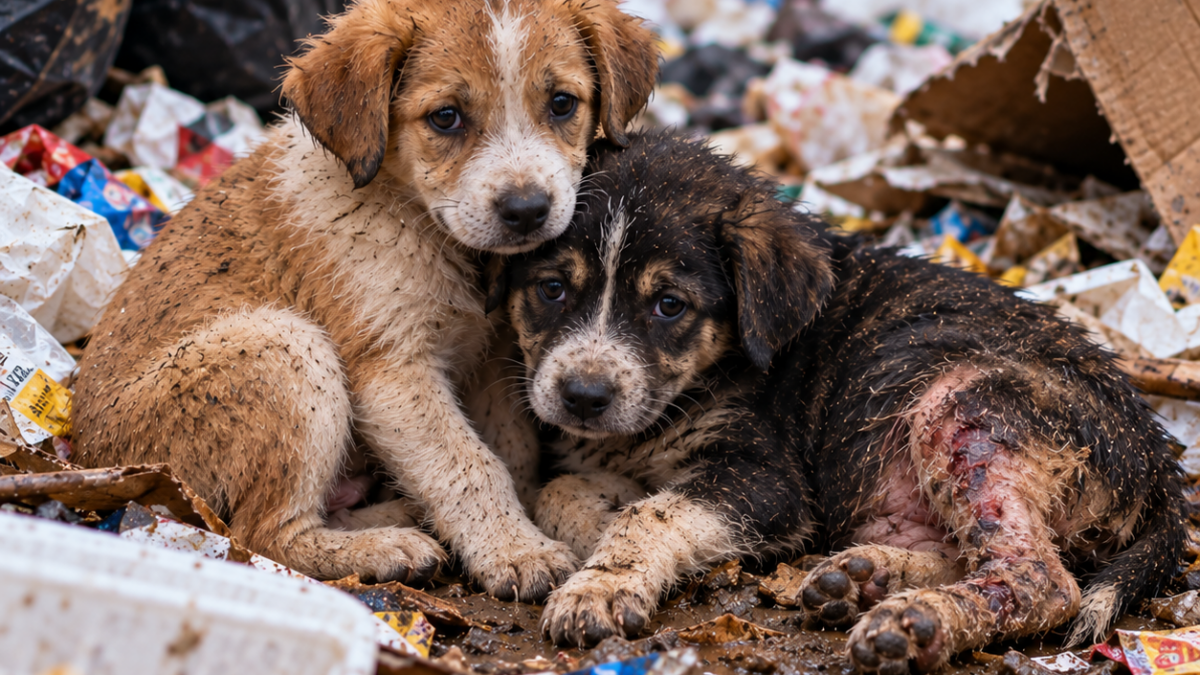
Two Abandoned Puppies Had Nothing but Each Other—Then One Was Badly Injured, and Rescuers Saw Just How Far Her Brother Would Go to Stay Beside Her.
The first time I saw the two puppies, they were lying beside a garbage pile like someone had decided their lives were too small to matter.
One of them could still run, still play, still press his little body against his sister as if he could protect her from everything, but the other puppy could not stand without crying.
And when we finally understood why the little male refused to leave her side, I realized he had been doing the only thing he knew how to do—staying with the one soul who had survived abandonment with him.
I found the video late in the evening.
It had been sent to me by a woman who owned a small shop near the edge of town. She did not know what else to do, so she filmed what she had found: two puppies beside a heap of trash, curled near a torn cardboard box, their tiny bodies pressed together on a patch of dirty ground where no baby animal should ever have been sleeping.
At first, the video looked like so many rescue messages we receive.
A shaky camera.
A frightened voice behind it.
A place people passed every day without stopping.
Then the smaller puppy tried to move.
That was the moment my stomach tightened.
She lifted her head, placed one front paw forward, and tried to push herself up. Her brother bounced around her excitedly, nudging her face, wagging his tail, inviting her to follow him as if he still believed play could fix anything. But when she tried to stand, one of her back legs bent in a way no healthy leg should bend.
She cried.
Not loudly.
That made it worse.
It was the quiet kind of cry puppies make when pain has already become familiar.
The shop owner’s message came right after the video.
I found them near the garbage pile. One of them was already injured when I saw them. Please help. I don’t know what to do.
I watched the video again.
The male puppy kept circling the injured female, then sitting beside her, then standing again whenever someone came too close. He was tiny, maybe two and a half months old, with soft fur and bright eyes that had not yet learned how cruel people could be. But he already understood one thing.
His sister could not run.
So he would not run either.
I sent the video to our rescue group and wrote only one sentence.
We need to go now.
The shop was closing when we arrived.
The woman who called us was waiting outside, nervous and upset, holding a small plastic bag of food she had tried to give them. She pointed behind the building, toward the narrow alley where garbage bags had been stacked near a cracked wall.
“They were there,” she said. “I didn’t touch them because I was afraid I’d hurt the injured one.”
“You did the right thing,” I told her.
We moved slowly.
The smell reached us first—sour trash, wet cardboard, old food, dust, and the faint metallic smell of the alley after rain. A few plastic bags had split open near the wall. Flies moved in slow circles. Somewhere behind the shop, an air conditioner hummed. A motorbike passed on the street, then another, and each time the injured puppy flinched.
They were exactly where the video showed them.
The male puppy saw us first.
He stood immediately.
His little body shook, but he placed himself between us and the female. He did not bark. He did not growl. He was too young for real confidence, too small to scare anyone. Still, he planted all four paws in front of her and stared at us as if saying, You cannot take her unless you take me too.
The female lifted her head.
Her eyes were huge.
She tried to move toward him but stopped the moment her injured leg shifted. Her mouth opened in pain, but no sound came out.
I crouched several feet away.
“Hi, babies,” I whispered. “We’re not here to hurt you.”
The male sniffed the air.
PART2:
He wanted to come closer. I could see it in the way his tail twitched, in the way his nose moved, in the way his puppy curiosity fought with his fear. But every time the female behind him moved, he looked back at her.
“He’s been like that all afternoon,” the shop owner said quietly. “He won’t leave her.”
I swallowed hard.
“What happened to her?”
“I don’t know. She was already like this when I saw them. Maybe someone hit her. Maybe something fell. I don’t know.”
“Did anyone see who left them?”
She shook her head.
“People said they appeared near the garbage in the morning.”
Appeared.
As if puppies appear beside trash by magic.
As if someone had not carried them there, walked away, and trusted that the world would either take pity or finish what they started.
I opened a can of soft food and placed it on a flattened piece of cardboard. The male puppy took one step forward, then looked back at his sister. She sniffed weakly from where she lay.
He went to her first.
Not the food.
Her.
He touched his nose to her cheek.
Only after that did he approach the food.
He took one bite, then carried a messy little mouthful back to her.
That broke me.
He was a baby himself.
He should have been fighting for food, climbing over her, grabbing what he could, surviving the way abandoned animals are forced to survive.
Instead, he brought it to her.
The female tried to lick the food from his mouth. He lowered his head as if he were feeding her.
The shop owner covered her mouth and turned away.
I took out a towel.
“We need to lift her carefully.”
PART3:
The male puppy watched every movement.
“It’s okay,” I whispered. “You’re coming too.”
Maybe he understood my voice.
Maybe he understood the towel.
Maybe he understood nothing except that my hands moved slowly and my eyes stayed soft.
When I slid the towel beneath the female’s body, she stiffened. Her leg trembled. She cried once, a thin sharp sound that made the male puppy rush forward and press his little body against my arm.
“I know,” I said. “I know. I’m sorry.”
We lifted her gently into a carrier lined with blankets.
The male tried to climb in before the door was even open wide enough.
“Wait,” I said softly, but he did not wait.
He squeezed beside her, curled himself against her chest, and started licking her face.
The female stopped shaking almost immediately.
That was when I knew they could not be separated.
Not even for a car ride.
Not unless we had no choice.
On the drive back, the male kept his chin across her shoulder. The female’s eyes stayed half closed, but whenever the car jolted, he lifted his head and looked at her first, not out the window, not at me, not at the road.
Her.
Always her.
At the clinic, our local veterinarian examined them right away.
“They’re young,” she said. “Maybe ten or eleven weeks.”
The male puppy wagged when she touched him.
The female stayed still, exhausted by pain.
I stood beside the exam table with one hand near her head.
“What do you think?”
The vet ran her hands carefully along the injured leg. The puppy whimpered and tried to pull away.
The male, sitting on a towel nearby, stood up at once.
“Easy,” I told him. “She’s helping.”
The vet’s expression tightened.
“This is not simple.”
My heart sank.
“How bad?”
“I need X-rays, but the leg feels unstable. I’m worried the bone is badly displaced.”
“Can you fix it here?”
She looked at me.
That answer came before the words.
“Our clinic isn’t equipped for this kind of fracture. If it’s as complex as I think, she needs an orthopedic assessment in the city.”
The city was hours away.
A long road trip.
A larger hospital.
Higher costs.
More stress for two puppies already abandoned beside garbage.
I looked at the female puppy. She was so small her body barely filled the towel beneath her. Her brother had climbed close enough that his paw touched hers through the space between them.
“What happens if we wait?”
The vet’s voice became gentle.
“If the bone heals wrong, she may have lifelong problems walking. Because she is still growing, time matters.”
I nodded.
There was never really a choice.
“Then we go.”
We decided to keep them with me overnight so they could rest before the long trip. I set up a quiet space in my spare room with soft blankets, water, and food. I expected them to be frightened. I expected them to hide.
They did not.
The male puppy explored immediately.
He sniffed the blanket, the water bowl, the corner of the room, the leg of my chair, then returned to his sister as if reporting that the territory was acceptable. The female watched him with tired eyes.
When I placed food down, he ate only after she started.
When she stopped, he stopped.
When she shifted, he moved closer.
At some point that night, I sat on the floor with them, and the male puppy crawled into my lap.
For a moment, I thought he had finally relaxed.
Then I realized he had positioned himself where he could still see his sister.
I laughed softly.
“You’re not subtle, little man.”
He looked up at me with innocent eyes.
I had not named them yet. I usually tried not to name animals too quickly, especially when I was afraid. Names make them real in a way that hurts if things go wrong.
But they were already real.
The female looked so small beneath the blanket, but there was something bright in her face. Something sweet, stubborn, fragile but not defeated.
“Polly,” I whispered.
Her brother lifted his head.
“And you,” I said, touching his little nose, “are Paul.”
Polly and Paul.
Two puppies abandoned together beside trash.
Two lives suddenly placed in our hands.
That night, I barely slept.
Every time Polly whimpered, Paul woke. Every time Paul stood, I woke. Every time the room became too quiet, I walked in to check whether Polly was breathing normally.
At three in the morning, I found Paul sleeping with his head across Polly’s neck.
She was asleep too.
For the first time since we picked her up, her face looked peaceful.
In the morning, they began the journey to the city.
A volunteer named Daniel drove because he knew the route better than I did. I sat in the back beside the carrier. Paul pressed his nose to the carrier door. Polly lay behind him, wrapped in a blanket.
The first hour was quiet.
Then the road grew rough.
Polly whined.
Paul turned immediately and licked her ear.
She stopped.
He stayed facing her for the rest of the ride.
When we stopped for fuel, I opened the carrier just enough to check them. Paul tried to climb out, then looked back when Polly did not follow. He stepped back inside and lay down beside her again.
Daniel watched from the driver’s seat.
“That little guy isn’t going anywhere without her.”
“No,” I said. “He really isn’t.”
After hours of travel, we finally reached the larger veterinary hospital.
Everything there felt overwhelming.
Bright lights.
Sliding doors.
New smells.
People moving quickly.
Dogs barking somewhere behind a wall.
Phones ringing.
Metal carts rolling.
Polly trembled when we carried her inside.
Paul, who had seemed brave all morning, suddenly became quiet.
He pressed himself against the side of the carrier closest to her.
At reception, I explained what we knew.
Abandoned beside a garbage pile.
One injured before discovery.
Two and a half months old.
Local vet suspected complex fracture.
No known owner.
No known history.
The nurse looked into the carrier.
“Oh, sweetheart,” she said.
Paul wagged once.
Polly stared.
They took Polly first.
That was necessary.
It was also the first time we had to separate them.
When the nurse lifted Polly from the carrier, Paul panicked.
It happened instantly.
He scrambled forward, paws sliding, trying to follow her. His little body hit the carrier door. He cried, high and frantic, the sound of a puppy who had survived abandonment only because one familiar body stayed beside him.
“Paul,” I said, kneeling.
He looked past me toward the door where Polly had disappeared.
The nurse paused.
“She’ll just be in radiology.”
“I know,” I said. “But he doesn’t.”
Paul kept crying.
I took him out carefully and held him against my chest. His heart was beating fast. He stared down the hallway, ears forward, body tense.
The staff gave him his vaccinations and basic exam while Polly was away. Physically, he was fine. Thin, dirty, a few minor skin issues, but nothing serious. No fracture. No fever. No obvious disease.
He should have been the easy one.
But without Polly, he looked lost.
He refused treats.
He refused water.
He refused to sit.
He kept watching the same door.
A technician smiled sadly.
“Bonded.”
“Very,” I said.
When Polly finally came back, groggy from handling but awake, Paul wriggled so hard I nearly dropped him. The moment they were close enough, he pushed his face into hers and made tiny whining sounds.
Polly licked his nose.
That was all it took.
He relaxed.
I watched them and felt something heavy settle in my chest.
This was not just puppy attachment.
This was survival attachment.
They had been left together.
Whatever happened beside that garbage pile, whatever noise, impact, fear, hunger, heat, and confusion filled that day, they had faced it side by side.
Paul did not love Polly because she was familiar.
He stayed with her because familiar had become the only safe thing left.
The orthopedic vet came in with the X-rays on a tablet.
Her name was Dr. Melissa Grant. She had calm eyes and the steady voice of someone used to delivering complicated news without making people panic.
She showed me the images.
Even before she explained, I could see the problem.
Polly’s fibula was badly fractured and displaced. The bone had shifted from where it should have been. There was swelling around the area, but because she was so young, her bones were still growing quickly.
“This is a serious break,” Dr. Grant said. “But there is one thing in her favor.”
“What?”
“Her age.”
I looked at Polly, who was pressed against Paul again.
“She’s still growing rapidly. If we can realign and support the leg properly, there is a chance it will heal without surgery.”
“A chance?”
“A real one. But we have to monitor closely. If the bone does not stay in position, we may need surgical stabilization, possibly with external pins.”
Pins.
Surgery.
A baby puppy who had already been abandoned.
I tried to keep my voice steady.
“What would you do if she were yours?”
Dr. Grant looked at Polly, then at Paul.
“I would try conservative management first, because of her age and the specific fracture pattern. But I would not disappear for a month and hope. She needs repeat X-rays. Medication. Restricted activity. Careful handling. If healing goes wrong, we intervene quickly.”
I nodded.
“We’ll do it.”
Paul tried to chew the corner of my sleeve.
Dr. Grant smiled.
“And this one?”
“This is Paul. He refuses to leave her.”
“I can see that.”
“He’s healthy.”
“He may be the hardest part of her treatment plan.”
She was right.
Polly needed rest.
Paul believed rest was optional and togetherness was mandatory.
The first week at home became a delicate dance of keeping them close enough to feel safe but calm enough for Polly’s leg to heal.
We set up a soft recovery pen in my living room. Polly had a padded bed, water, food, medication, and space to move only a little. Paul had a bed right beside her. Not inside the same small area at first, because he wanted to play and could accidentally hurt her, but close enough that their noses could touch through the barrier.
He hated the barrier.
The first night, he sat against it and stared at me like I had betrayed every law of the universe.
“She needs to rest,” I told him.
He placed one paw through the bars.
Polly touched it with her nose.
Then both puppies fell asleep like that.
For two weeks, our lives narrowed to routine.
Medicine.
Meals.
Cleaning.
Carrying Polly outside.
Stopping Paul from turning every moment into a game.
Checking the splint.
Watching for swelling.
Keeping Polly’s weight supported.
Driving myself half-crazy trying to interpret every tiny movement.
Was she healing?
Was she hurting?
Was the leg aligned?
Was she too quiet?
Was she too playful?
Was Paul too rough?
Was I doing enough?
Rescue is often shown as one dramatic moment: the pickup, the before-and-after photo, the happy adoption. People rarely see the exhausting middle. The part where you wake up at two in the morning because a puppy shifted and you are terrified the leg moved wrong. The part where you count pills. The part where you clean blankets three times a day. The part where you have to tell a healthy puppy he cannot wrestle with his sister because love, in that moment, looks like saying no.
Polly handled it better than any of us.
She had a sweetness that felt almost impossible after what happened. She accepted her medicine. She let me check her bandage. She cried sometimes when she wanted to follow Paul, but she never fought me.
Paul, on the other hand, became a professional escape planner.
He learned how to push the pen with his shoulder.
He learned how to drag blankets toward Polly’s side so he could lie closer.
He learned that if he looked pitiful enough, visiting volunteers would give him treats.
He also learned to bring toys to Polly.
A squeaky duck.
A rope.
A sock he was not supposed to have.
He would carry them to the barrier and drop them near her, then wag as if presenting treasure.
Polly usually ignored the toy and licked his face.
That seemed to satisfy him.
By the end of the first week, they looked less like puppies rescued from a garbage pile and more like puppies who had always belonged in a living room. Their coats softened. Their eyes brightened. Their bellies filled out. Paul began to get round in the way healthy puppies do, all paws and enthusiasm.
Polly grew too.
Even with restricted movement, she seemed stronger. Her face filled in. Her ears lifted more often. When she was comfortable, she would roll halfway onto her back and let me rub her chest.
But every time she saw the carrier, she changed.
She remembered.
On the morning of her two-week checkup, I placed the carrier near the door, and Polly began crying from her recovery pen.
Not a scream.
Not panic.
A soft, worried cry.
Paul immediately pressed against the barrier, upset because she was upset.
“I know,” I said, kneeling. “I know you don’t want to go back.”
She looked at me with those huge eyes.
“We have to see if your leg is healing.”
Paul barked once.
“And you are coming too. Obviously.”
At the hospital, Polly shook inside the carrier. Paul stayed pressed against her the whole way. When we arrived, the staff recognized them immediately.
“There are our famous twins,” one nurse said.
“They’re not twins,” I said.
“They are emotionally twins.”
That was accurate enough.
Polly went back for X-rays. Paul waited with me outside the exam room.
This time, he did not cry as loudly.
But he did not relax either.
He sat facing the door, ears forward, body tense.
A family with a large dog came in. Paul barely looked.
A technician offered him a treat. He sniffed it and dropped it.
“He only eats when she comes back,” I said.
The technician looked down the hallway.
“That’s the sweetest and saddest thing I’ve heard today.”
When Dr. Grant finally returned, she was smiling.
I stood so quickly Paul startled.
“Tell me.”
“The alignment looks good.”
I felt my knees weaken.
“She doesn’t need surgery?”
“Not at this point. The bone is healing naturally. Because she is growing, we still monitor, but I’m very encouraged.”
I looked at Polly in the nurse’s arms.
She looked tired and offended.
Beautiful.
Alive.
Healing.
I covered my face with one hand.
The relief came so fast it almost hurt.
“No surgery,” I whispered.
Dr. Grant nodded.
“No surgery.”
Paul, sensing something had changed, began wagging. When the nurse placed Polly back beside him, he sniffed her from nose to tail as if checking whether the hospital had returned all parts of her correctly.
Then he licked her face.
Polly leaned into him.
For the first time since the rescue, I let myself imagine a future without pain.
Not just survival.
Running.
Playing.
Growing.
A normal life.
On the drive home, Paul slept with his head against Polly’s shoulder. Polly slept too, her injured leg supported carefully beneath the blanket.
I watched them from the back seat and thought about the unknown person who left them near the garbage.
Did they know Polly was hurt?
Did they see her trying to walk?
Did they hear her cry?
Did they leave Paul because he refused to leave her?
There are questions in rescue that never get answered.
Sometimes you think an answer would help.
Often, it does not.
Knowing why someone was cruel does not undo the cruelty.
Knowing who walked away does not make the abandoned feel less abandoned.
Still, we tried to learn what happened.
We spoke to the shop owner again. We asked nearby businesses. We checked if anyone had security footage. We posted carefully worded requests for information without sharing accusations we could not prove.
Eventually, a small piece of the story came through.
A passerby had seen the puppies near the garbage earlier than we realized. Polly had not been injured when they were first left there. Later, someone moving through the area—possibly on a motorbike, possibly carrying goods, no one could say for sure—had caused the injury by accident and kept going.
That knowledge made me angry in a different way.
Abandonment had placed Polly in danger.
Then someone else had hurt her.
Then no one had stopped.
Cruelty is not always one dramatic act.
Sometimes it is a chain of people deciding something is not their responsibility.
The person who left them.
The person who hit her or knocked her down.
The people who noticed but did not act.
The world becomes dangerous very quickly for the small and unwanted.
But then one shop owner refused to keep walking.
And because of that, Polly’s story changed.
The next month was slower, brighter, easier.
Polly’s leg continued healing. She still needed limited activity, which became increasingly difficult because she felt better every day and believed feeling better meant she should be allowed to do everything Paul did.
Paul fully agreed.
I did not.
“You two are conspiring,” I told them one afternoon after catching Paul trying to bring Polly into a wrestling match through the pen bars.
Paul froze with one paw lifted.
Polly looked innocent.
Neither was innocent.
As the weeks passed, Polly began putting more confidence into the injured leg. At first, she touched it lightly to the ground. Then she bore a little weight. Then more. Every small improvement felt enormous.
The first time she took four steady steps without crying, I called three people.
No one answered.
So I told Paul.
“She did it.”
Paul wagged.
He already knew.
He had been watching her more closely than any of us.
When Polly finally received permission for short, controlled play sessions, Paul acted like a prisoner released after years of injustice. He bounced around her in circles, inviting her to chase him, then stopping whenever she slowed. Somehow, he seemed to understand she still needed care.
He would run ahead, then return.
Run ahead, then return.
Always checking.
Always making sure she was coming too.
That became their rhythm.
Polly became braver because Paul believed she could be.
Paul became calmer because Polly needed him to be.
They healed each other in ways no medication could.
I began looking for an adoptive family, but every time I imagined separating them, my chest tightened.
Some bonded animals can adjust apart.
Some cannot.
With Polly and Paul, the answer felt clear.
They had survived abandonment together, fear together, the long drive together, hospital hallways together, recovery together.
Paul had built his whole tiny world around making sure Polly was not alone.
Polly had leaned on him through the worst pain of her life.
I could not look at them and think, We should split this story in half.
So the adoption listing said clearly:
Bonded pair. Must stay together.
Some people loved the idea until they heard “two puppies.”
Then they hesitated.
Two puppies mean two bowls, two beds, two vet schedules, two training needs, two sets of muddy paws, twice the energy, twice the patience.
But to me, they were not twice the work.
They were one promise.
Weeks went by.
Polly grew stronger.
Paul grew sillier.
The first family who visited loved Paul immediately but seemed uncertain about Polly’s medical history.
“She’ll be normal?” the man asked.
“She is healing very well,” I said. “But she will need responsible care as she grows. Follow-up if needed. Gentle exercise. Awareness.”
He looked at Paul chasing a toy.
“And they have to stay together?”
“Yes.”
They did not adopt.
I was sad for an hour.
Then relieved.
The right family does not need to be convinced that love comes with responsibility.
The second family wanted Polly because she was sweet and beautiful, but they thought Paul was too energetic.
No.
The third wanted both, but lived in an apartment and worked twelve-hour shifts.
No.
Then came Emily and Marcus.
They were a young couple who had recently moved into a house with a fenced yard. Emily was a school counselor. Marcus worked from home as a designer. They had lost their older dog the year before and had waited until they felt ready—not just lonely, but ready.
That mattered.
When they came to meet Polly and Paul, Paul ran to them first because Paul believed every visitor existed to admire him. Marcus sat on the floor, and Paul climbed into his lap immediately.
Emily stayed quieter.
She let Polly approach on her own.
Polly watched her for a long moment.
Then limped—barely now, but still a little—toward Emily and placed her chin on Emily’s knee.
Emily’s eyes filled.
“Hi, sweetheart,” she whispered.
Paul looked up from Marcus’s lap, saw Polly with Emily, and seemed to approve.
Then he rolled onto his back dramatically.
Marcus laughed.
“He’s ridiculous.”
“Yes,” I said. “That is his main medical condition.”
We talked for a long time.
About Polly’s leg.
About future care.
About training.
About the fact that they were still puppies and would chew things, have accidents, wake early, grow fast, test limits, and require patience.
Emily listened carefully.
Marcus asked good questions.
Neither rushed.
Before leaving, Emily looked at both puppies and said, “We don’t want to save them from their story and then fail them in the ordinary parts.”
That sentence stayed with me.
Because that is exactly what adoption should mean.
Not just the emotional rescue moment.
The ordinary parts.
Food.
Walks.
Training.
Vet appointments.
Patience.
The boring daily proof that an animal is safe.
The adoption was approved.
The day Polly and Paul went home, I packed their blankets, medications, records, toys, and the little duck Paul had once carried to Polly through the recovery pen.
I told myself I would be fine.
I was not fine.
Paul jumped into the car first.
Then immediately jumped back out because Polly was not in yet.
“Of course,” Marcus said. “My mistake.”
We lifted Polly carefully, though she hardly needed help anymore. She settled into the back seat beside Paul. He placed his head across her shoulders like he had on the first night.
Some things had not changed.
That comforted me.
I crouched beside the open car door.
“You be good,” I told Paul.
He licked my chin.
“You take care of her.”
He wagged.
Then I turned to Polly.
She looked at me with calm eyes.
“You don’t have to be afraid anymore,” I whispered. “You’re going home.”
Emily stood beside me, crying quietly.
“I’ll send updates,” she promised.
“Please.”
The car drove away.
Polly looked out the back window for a moment.
Paul pressed beside her.
Then they turned forward together.
That was how I wanted to remember them.
Not beside the garbage.
Not in the hospital.
Not separated by doors.
Forward.
Together.
The first update came that night.
A photo.
Polly and Paul asleep on a dog bed far too large for them, though they were pressed into the same corner as if space had no meaning without contact.
The message said:
They ate dinner. Paul explored every room. Polly followed him. Now they’re out cold. We love them already.
I read it three times.
Then I cried.
Over the next weeks, the updates kept coming.
Paul discovered stairs and treated them as both mountain and enemy.
Polly learned that the kitchen rug was the best place to nap.
Paul stole one of Marcus’s socks and hid behind a chair with only his tail visible.
Polly began walking more steadily every day.
They went to follow-up appointments, and Dr. Grant remained happy with Polly’s healing. Her bone continued to grow well. Her movement improved. The fear of surgery faded into memory.
One video showed Polly running across the yard.
Not perfectly.
Not as fast as Paul.
But running.
Paul ran ahead, turned back, waited, then bounced in place until she caught up.
Then they ran together.
I watched that video more times than I can admit.
The puppy who had cried beside a garbage pile because her broken leg could not carry her was running through green grass while her brother waited for her.
That was everything.
Months passed.
Polly and Paul grew from round puppies into lanky adolescents with too-long legs, bright eyes, and the kind of energy that makes furniture nervous.
Their coats became glossy.
Their bodies filled out.
Paul’s personality became exactly what we expected: affectionate, dramatic, loyal, and convinced every person wanted to hear his opinion.
Polly became gentler, more thoughtful, but also mischievous in quiet ways. Emily once sent a photo of Polly sitting beside a destroyed pillow while Paul slept innocently nearby.
Message:
She framed him.
I replied:
I believe her.
Emily wrote back:
You shouldn’t.
Polly’s leg never became the tragedy we feared.
She had follow-up care, responsible exercise, and a family who paid attention. Sometimes after too much play, she rested more. Sometimes on cold mornings, she moved carefully at first. But she walked, ran, played, jumped onto the couch when she was not supposed to, and stole Paul’s toys with excellent speed.
What she did not do was live like a broken dog.
Because she was not one.
She was a dog who had been hurt, helped, and given the chance to grow beyond the injury.
There is a difference.
We never learned who abandoned them.
No confession came.
No clear footage surfaced.
No person stepped forward.
At first, that bothered me deeply.
I wanted a name.
I wanted an explanation.
I wanted to look at someone and ask how they could leave two babies beside garbage, one of them too vulnerable to survive if anything went wrong.
But over time, that need changed.
Not disappeared.
Changed.
Because Polly and Paul’s future became louder than their unanswered past.
Their lives filled with things the person who abandoned them never gave them.
Morning walks.
Clean bowls.
Soft beds.
Toys.
Vet care.
Birthday treats.
Names spoken with love.
A yard where Paul could run circles and Polly could chase him at her own pace.
People who noticed if one of them seemed tired.
People who adjusted plans for them.
People who did not see them as a burden.
That was the answer that mattered most.
One year after their rescue, Emily invited me to visit.
I had seen photos and videos, but I had not seen them in person for months. When I walked through the gate, Paul recognized me first.
He froze.
Then erupted.
He sprinted across the yard, barking, spinning, wagging so hard his whole body curved. He hit my knees like a wave of muscle and joy.
“Paul!” Emily shouted. “Manners!”
Paul had no manners.
He had love.
That was different.
Polly came behind him.
Not as wild.
Not as fast.
But steady.
Strong.
Beautiful.
She walked straight to me, placed her front paws gently against my leg, and looked up with those soft eyes I had first seen beside a garbage pile.
I touched her face.
“Look at you.”
Her tail wagged.
Paul shoved himself between us because apparently emotional moments required his supervision.
I sat in the grass with both of them climbing over me like I had been gone for ten years. Emily and Marcus laughed from the porch.
“They’re happy,” Emily said.
I looked at Polly leaning into Paul, Paul leaning into me, both of them healthy and safe beneath an open sky.
“Yes,” I said. “They are.”
Later that afternoon, Polly and Paul fell asleep under a tree.
Paul’s head rested on Polly’s back.
Exactly as it had in the carrier.
Exactly as it had in my spare room.
Exactly as it had in every hard moment.
Only now, nothing was pressing in on them.
No garbage pile.
No pain untreated.
No hospital door separating them.
No uncertain future.
Just shade, grass, and home.
I sat on the porch steps and watched them breathe.
Emily sat beside me.
“Do you ever get used to seeing them after?” she asked.
“No.”
“Is it hard?”
“Sometimes.”
“Why?”
I thought about that.
Because I remember too much, I almost said.
I remember the garbage.
The broken leg.
The way Paul panicked when Polly disappeared behind the clinic door.
The long drive.
The fear of surgery.
The people who never came back for them.
But that was not the whole truth.
“It’s hard,” I said finally, “because you see what almost didn’t happen.”
Emily looked at the dogs.
Polly twitched in her sleep.
Paul sighed.
I continued, “They almost didn’t get this yard. They almost didn’t get you. She almost didn’t get treatment in time. He almost had to watch the only thing he loved disappear.”
Emily wiped her eyes.
“But they did.”
“Yes,” I said. “They did.”
And that was rescue.
Not fixing the past.
Not answering every question.
Not making suffering meaningful just because the ending was beautiful.
Rescue was interrupting the ending someone else had left for them.
It was stepping into the story before the garbage pile became the last chapter.
Polly and Paul’s story began, for us, beside trash.
But it did not end there.
It continued in a carrier where a tiny brother refused to stop touching his sister.
In a hospital hallway where he waited for her.
In X-rays that showed danger but also hope.
In two weeks of careful recovery.
In good news from a doctor.
In a home that accepted both of them together.
In grass.
In socks stolen from laundry.
In videos of Polly running.
In Paul waiting when she slowed.
Years from now, maybe their beginning will feel distant even to the people who love them. Maybe Polly will grow old with only a slight stiffness on rainy days. Maybe Paul will still be dramatic about everything. Maybe Emily and Marcus will tell visitors, “They were rescued together,” and the dogs will be asleep on the couch, completely uninterested in their own legend.
I hope so.
I hope their lives become so full and ordinary that the garbage pile feels impossible.
I hope they become old dogs with gray muzzles, soft beds, favorite blankets, and people who complain lovingly about the space they take up.
I hope Paul never stops checking for Polly.
I hope Polly always knows he is there.
And I hope anyone who hears their story understands this:
Sometimes love looks like a grand rescue.
Sometimes it looks like surgery avoided.
Sometimes it looks like adoption papers signed by the right family.
But sometimes love is much smaller than that.
It is one abandoned puppy refusing to run because his sister cannot.
It is a little body pressed against hers in a carrier.
It is a brother crying outside an exam room until she comes back.
It is waiting.
Staying.
Watching.
Choosing again and again not to leave.
That was what Paul did for Polly before any of us knew their names.
And when the rest of the world had already walked away from them, that tiny act of loyalty may have been the first thing that kept her alive.








