Twenty Bikers Bought All 4,000 of a 10-Year-Old Girl’s Unsold Cookies for $24,000—Then She Learned They Weren’t Taking a Single Box Home
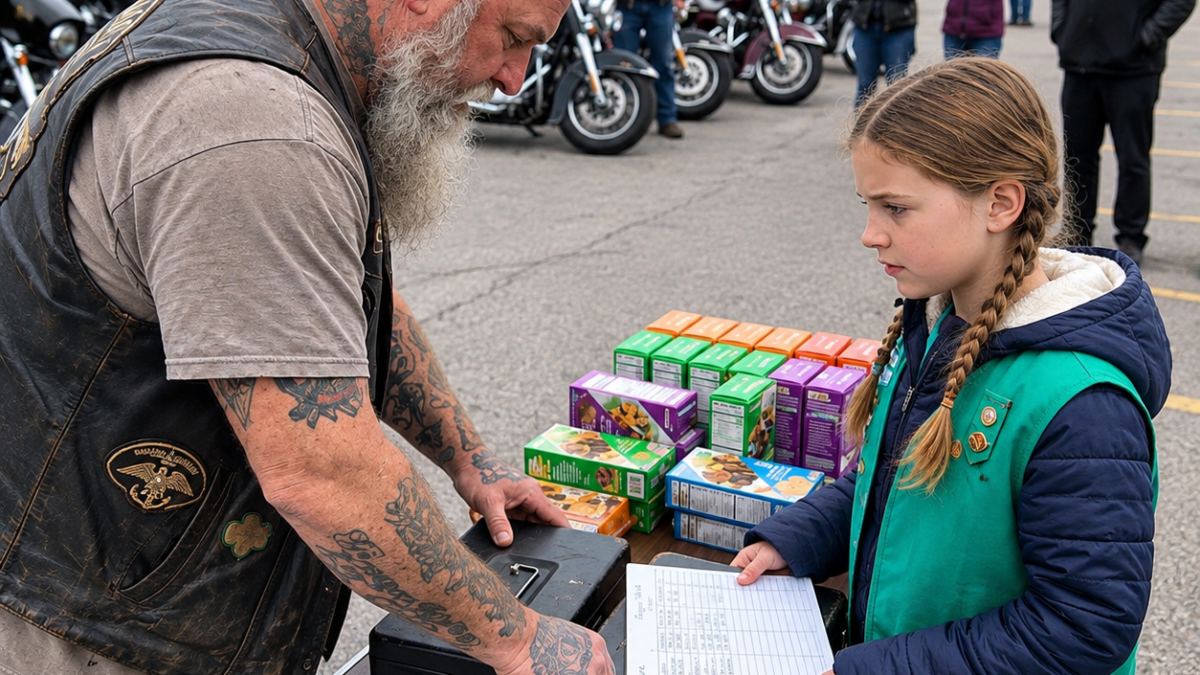
Twenty Bikers Bought All 4,000 of a 10-Year-Old Girl’s Unsold Cookies for $24,000—Then She Learned They Weren’t Taking a Single Box Home.
At 3:42 on a Saturday afternoon, a 285-pound biker set a battered black cashbox beside ten-year-old Lucy Bennett’s unsold cookies and said, “Close the booth”—while nineteen more bikers stood behind him and half the Food Barn parking lot started filming.
Our troop still had 4,000 boxes attached to its account, three days before the financial deadline, because canceled events and an inventory error had left twelve girls staring at roughly $24,000 worth of cookies their families could not possibly absorb.
We thought Marcus “Mack” Delaney had come to buy the cookies and rescue us from one impossible afternoon; we did not know the money in that black box would lead twenty bikers, twelve girls, and one white delivery truck to a children’s home Mack had been too ashamed to enter for forty-two years.
My name is Dana Cole.
Before that Saturday, I thought I understood which problems adults were supposed to keep away from children.
I was wrong.
Troop 417 had started cookie season with confidence.
Too much confidence, maybe.
The previous year had gone well.
Our girls wanted to fund three things.
A summer service trip.
Replacement camping equipment.
And a free pantry outside the community center where we met on Tuesday nights.
Nothing extravagant.
Nothing unusual.
So we placed an aggressive order.
Then March began removing pieces of the plan one by one.
A spring fair was canceled after storms damaged the riverside park.
A small electrical fire closed the hardware store where we were supposed to sell for two weekends.
Then the regional office for one grocery chain accidentally assigned our strongest sales location to another troop.
By the time anyone caught the mistake, both troops already had inventory.
We requested a transfer.
Three offices argued over forms.
The deadline passed.
That was how twelve girls ended up connected to four thousand boxes they had no reasonable chance of selling before Monday.
Our council representative, Marjorie Pike, was trying to help.
I believe that.
But she could not make inventory disappear from a ledger simply because the mistake was not ours.
Another troop had to accept it.
Every nearby troop had reached its limit.
“Do not use the word debt around the girls,” Marjorie told me.
Lucy Bennett sat eight feet away decorating a sign.
Or pretending to.
Children hear the words adults swallow.
Within an hour, she had the troop ledger open.
Purple binder.
Calculator.
Pencil.
At first I thought she liked numbers.
Then I saw what she was doing.
PART2:
Beside every family name, she had written how many cases they had signed out.
Mrs. Alvarez had three stars beside hers.
“Lucy.”
She looked up.
“What are the stars?”
“Nothing.”
“Lucy.”
She closed the binder.
That answer told me everything.
Lucy was ten.
Her mother had died from an aneurysm when Lucy was seven.
Her father had not been part of her life since she was an infant.
Her grandmother Ruth raised her.
Ruth worked mornings in a church kitchen and evenings cleaning dental offices.
They were not starving.
They were not homeless.
But Ruth had once told me something I never forgot.
“We have enough money for rent, groceries, and one emergency at a time.”
Lucy understood what unexpected bills did to a kitchen table.
So did the Alvarez family.
Connie Alvarez worked nights at a nursing home.
One of our fathers had just lost his factory shift.
Another family was already making payments on a hospital bill.
The adults discussed all of that quietly.
Lucy heard anyway.
Friday night, Ruth called me.
She sounded exhausted.
PART3:
“I found her stuffing cookie order forms into mailboxes.”
“In the rain?”
“Yes.”
“She put them in sandwich bags so the ink wouldn’t run.”
I sat down.
Ruth’s voice softened.
“She thinks this belongs to her, Dana.”
“What?”
“Whatever happened.”
“She thinks she failed the girls.”
Saturday morning, I set up one final booth at the Food Barn on Brainerd Road.
Six girls came.
Parents brought coffee.
Blankets.
Markers.
Folding chairs.
And that strained optimism adults wear when children are watching.
Lucy arrived first.
She lined every cookie label toward the parking lot.
Put the ledger beneath our cash box.
Then taped a sign to the canopy.
TROOP 417
WE KEEP OUR PROMISES
“That’s serious for cookies,” I told her.
She looked at me.
“It isn’t about cookies.”
By noon, we had sold 143 boxes.
We needed to sell four thousand.
At 12:30, the girls’ voices had started fading.
At 1:00, one mother quietly asked me whether we should stop.
At 1:15, Lucy was still standing.
“Cookies?”
“No thank you.”
“Thank you anyway.”
“Cookies?”
“Already bought some.”
“Thank you.”
“Cookies?”
“Not today.”
“Okay. Have a good day.”
Two teenage boys laughed at her handmade sign.
She waited until they left.
Then straightened it.
A gust blew three boxes off the table.
Lucy picked each one up.
Wiped dust from the cardboard with her sleeve.
Put them back.
She did not cry.
That somehow made it worse.
The Iron Lanterns entered our story because of a photograph none of us knew had been taken.
Mrs. Dobbins, a retired school secretary, bought two boxes of Thin Mints.
She looked at Lucy.
“What are you worried about?”
Lucy gave the answer we had practiced.
“We have extra inventory and we’re trying to meet our troop goal.”
Mrs. Dobbins had spent thirty years around children.
She knew the difference between ambition and fear.
She stepped away.
Took a photograph from a distance.
Posted it in a neighborhood Facebook group.
The caption was simple:
“These girls inherited a warehouse mistake. If you planned to buy cookies, find Troop 417 before Monday.”
A few dozen people shared it.
Some said they would stop by.
One man commented that parents should teach children consequences.
Another accused us of inventing a crisis to increase sales.
At 12:47, that photograph reached an auto repair shop two miles away.
I did not know that until later.
Marcus Delaney was replacing a transmission mount when his receptionist, Keisha Monroe, walked into the service bay holding her phone.
Everyone called him Mack.
He had been turning wrenches since he was seventeen.
Six-foot-four.
Two hundred eighty-five pounds.
Shaved head.
Iron-gray beard.
Tattooed arms.
Scarred hands.
The word HOLD across his right knuckles.
People who didn’t know him tended to cross parking lots when they saw him approaching.
Keisha held the photograph in front of him.
“Isn’t that the troop near your club?”
Mack looked.
The Food Barn was familiar.
Then he saw Lucy’s green vest.
Only part of it showed beneath her winter coat.
But the trefoil patch near her shoulder was visible.
Keisha said his face changed.
“How many boxes?”
“Four thousand.”
“At what price?”
“Six dollars.”
Mack did the math.
Once.
Twenty-four thousand dollars.
Then he called nineteen men.
The Iron Lanterns looked like an outlaw motorcycle gang to strangers.
They weren’t.
Mechanics.
Pipefitters.
Veterans.
Two truck drivers.
A retired paramedic.
A public defender.
A school custodian.
A funeral-home employee called Preacher who had never attended seminary in his life.
They had club rules.
No drugs on rides.
No violence attached to the patch.
No patched member left a stranded rider.
No hungry child ignored.
No brother asking for help without words.
Mack had written that last rule.
He had also broken it once.
Long before the Iron Lanterns existed.
That history was stitched inside his leather cut.
Beneath the place where most riders put memorial patches.
A small green trefoil.
A faded name.
ELLIE DELANEY.
Only two club members knew what it meant.
The Iron Lanterns had planned their annual Founders Ride that Saturday.
Blue Ridge Parkway.
Hotels booked.
Support trailer rented.
Their emergency fund held $11,860.
Money collected through repair clinics.
Poker runs.
Yard sales.
Jars beside the register at Mack’s shop.
Mack put Mrs. Dobbins’s photograph on the clubhouse table.
“We need twenty-four.”
Wrench, the club treasurer, folded his arms.
“We have eleven-eight.”
“Then we make up the difference.”
Wrench stared.
“For cookies?”
“For the families attached to them.”
Nobody cheered.
That mattered.
Red Dawson needed a roof.
His wife had waited two years.
Nails Carter was behind on child support after a construction injury.
Bishop had spent most of his savings helping his mother buy insulin.
Doc had been saving for a fishing boat for eleven years.
The silence around the table was not selfish.
It was honest.
Wrench said:
“We can help.”
“But clearing twenty-four thousand by this afternoon isn’t helping.”
“It’s lighting ourselves on fire.”
Mack nodded.
“Maybe.”
Then he removed his leather cut.
Turned it inside out.
Showed them the green trefoil.
That was when nineteen men learned about Ellie.
Mack Delaney was fifteen when his mother left him at Hawthorne House with two grocery bags, a denim jacket, and a promise.
“I’ll be back before Sunday.”
Hawthorne was called an orphanage by people who did not understand it.
It housed emergency foster placements.
Sibling groups waiting for homes.
Teenagers whose files had become too complicated for easy promises.
Mack waited beside the front window the first Sunday.
Then the second.
Then the third.
His mother never came back.
A seven-year-old girl named Ellie shared the reading room with him.
Crooked braids.
Two missing front teeth.
A green scouting vest passed down through several girls before her.
She was the only child at Hawthorne who did not seem frightened by Mack’s silence.
Every spring, Ellie sold cookies.
Or tried.
Children at Hawthorne could not walk neighborhoods knocking on doors.
Few adults came through the building carrying spare money.
Ellie never sold much.
She kept one crushed box beneath her bed.
She told Mack she was saving it for the family who would adopt her.
No family did.
On Mack’s sixteenth birthday, another child got sick and the kitchen forgot to save him cake.
He sat behind the loading dock.
Ellie found him.
She brought out the crushed cookie box.
Opened it.
They each ate one.
Then Ellie closed the sleeve.
Wrapped the remaining cookies in paper.
“We save those.”
“For what?”
“Next birthday.”
“What if they remember?”
“What if they don’t?”
Six months later, Ellie collapsed in gym class.
Undiagnosed heart condition.
She died before Mack got back from his vocational program.
Mack kept the green trefoil from her vest.
For forty-two years, he barely spoke her name.
Inside the Iron Lantern clubhouse, nineteen bikers stared at that faded patch.
Mack did not give a speech.
He described the photograph.
The inventory mistake.
The families.
The little girl holding a ledger like it weighed more than she did.
Then he placed an empty envelope on the table.
Wrote:
MACK.
“Twelve hundred each clears it.”
Wrench said:
“That’s not small money.”
“No.”
“Some men don’t have it.”
“I know.”
Nails stared at his boots.
“I’ve got seven-forty after rent.”
“You owe your boy.”
“I can catch that up next month.”
“No.”
Nails looked up.
“I’m part of this club.”
“You’re his father first.”
They argued for thirty-six minutes.
Red called his wife Denise.
“If I put twelve hundred in, roof waits another season.”
Silence on the other end.
Rain had already come through their hallway twice.
Finally Denise asked:
“Will those families know who paid?”
“No.”
“Good.”
Then:
“Take eight hundred.”
“Not twelve.”
“I still need tarps.”
Bishop contributed three hundred.
Would not touch the money set aside for his mother.
Mack did not ask him to.
Cricket sold a rare carburetor assembly.
Doc emptied his fishing-boat envelope.
Preacher contributed $2,600 saved for equipment at the funeral home.
Moose called his adult sons.
They sent money without asking for recognition.
The Founders Ride was canceled.
Hotel deposits lost.
Support-trailer reservation lost.
Wrench counted.
Again.
They were still $3,780 short.
Mack went into the rear bay of his shop.
Removed a canvas cover.
Underneath sat a 1968 Harley-Davidson FLH.
He had been rebuilding it for sixteen years.
Paint done.
Engine complete.
Wiring unfinished.
Seat unfinished.
Everyone in the club knew what it meant.
The motorcycle had belonged to Amos Bell.
A maintenance worker at Hawthorne House.
The first adult in Mack’s childhood who ever came back when he said he would.
Amos taught him to adjust valves.
True wheels.
Change oil.
And distinguish an excuse from a reason.
When Amos died, he left the Harley to Mack in milk crates.
Mack called a collector in Nashville.
Wrench grabbed the phone.
“No.”
“We need thirty-eight hundred.”
“Not that bike.”
“It’s metal.”
“It’s Amos.”
Mack looked at him.
“Amos fed kids.”
The collector paid $4,100.
He promised Mack first refusal if the motorcycle ever came up for sale again.
At 1:54 p.m., the Iron Lanterns had $24,180.
They loaded the black cashbox into Wrench’s touring case.
Twenty motorcycles rolled toward Food Barn.
None of them thought about what twenty large bikers arriving together would look like to six exhausted girls and their mothers.
We did.
At 3:02, we heard them.
Low thunder.
One engine.
Then another.
Then all twenty.
Customers turned.
The assistant manager came outside.
The bikes entered in formation.
Black leather.
Road-stained boots.
Beards.
Tattoos.
Bandanas.
Heavy motorcycles.
One mother moved closer to her daughter.
Another whispered:
“Dana.”
“I see them.”
The assistant manager stepped forward.
“Gentlemen, you can’t block the entrance.”
Mack shut his engine off.
The others followed.
Silence hit the parking lot.
Only cooling metal ticked behind them.
Mack walked toward our table.
The assistant manager intercepted.
“You’re frightening the girls.”
Mack stopped.
He did not argue.
Did not tell the man what kind of club they were.
Did not demand respect.
He looked past him at me.
“How many boxes?”
I started answering.
Lucy beat me.
“Four thousand.”
Mack looked at her.
“All yours?”
“The troop’s.”
“How much?”
“Six dollars.”
“Twenty-four thousand.”
Lucy nodded.
He asked me:
“If somebody buys all of them, are the families clear?”
“I would need council approval for a transaction that large.”
“Call them.”
No laughter behind him.
No smirks.
I called Marjorie.
She thought I was being scammed.
“Dana, do not accept twenty-four thousand dollars in cash from strangers.”
“Not all cash.”
“What?”
“Cashier’s checks.”
“Transfers.”
“Some cash.”
“Twenty bikers showed up with money?”
Mack heard.
“Fair.”
That one word changed the temperature.
He took out his wallet.
Driver’s license.
Set it beside Lucy’s ledger.
“Verify us.”
Then every Iron Lantern did the same.
One by one.
No demand for trust.
They submitted to being checked.
Nails went last.
His envelope was short.
Inside was $740.
Mack had refused to let him give it.
Instead Nails contributed something else.
A truck.
His cousin operated a refrigerated delivery service.
Clean box truck.
Available that afternoon.
Nails had also called six children’s residences between Chattanooga and Knoxville.
Mack apparently had not asked him to.
“I figured nobody needs four thousand boxes at one address.”
Lucy looked up.
“One address?”
Mack gave Nails a look.
Too late.
At 3:09, Marjorie arrived with two council employees, a portable payment terminal, and the expression of a woman expecting to explain a public-relations disaster before dinner.
She verified everything.
Checks.
IDs.
Club account.
Cash.
Banks.
The first payment method failed because our little booth reader was never designed for a transaction that large.
People gathered.
Phones came out.
A local television producer happened to be shopping.
He approached Mack.
“Can I get your name?”
“No.”
“Club name?”
“No.”
“Why are you doing this?”
Mack looked toward Lucy.
“Verify the payment first.”
At 3:37, the transaction cleared.
The receipt curled out of the portable printer.
Marjorie opened the troop account on her tablet.
Four thousand boxes.
Outstanding balance:
$24,000.
Then:
PAID.
I expected Lucy to cheer.
She didn’t.
She leaned closer to the screen.
“Mrs. Alvarez?”
“What?”
“Will Mrs. Alvarez get a bill?”
“No.”
“What about late fees?”
“None.”
“What about the girls who signed forms?”
“They’re clear.”
“All of them?”
“All of them.”
Lucy asked three different ways.
Marjorie answered all three.
Then Lucy set the ledger down.
Her shoulders dropped.
Ruth covered her mouth.
Mrs. Alvarez sat on a cookie case and began shaking.
The assistant manager who had threatened to call security forty minutes earlier came back carrying twenty-one cups.
Coffee for the bikers.
Hot chocolate for Lucy.
The Iron Lanterns had cleared the entire balance.
Everyone thought that was the ending.
Then Lucy looked at the pallets.
“What flavor do you want?”
Mack said:
“All.”
“I know, but how many Thin Mints?”
“All.”
“Peanut butter?”
“All.”
She pointed toward twenty motorcycles.
“They won’t fit.”
Mack looked across the parking lot.
A white refrigerated box truck turned into the entrance.
No logo.
Clean sides.
Inside the windshield hung a little green scouting vest.
Nails drove.
His cousin sat beside him.
Lucy stared.
Mack’s fingers moved beneath his cut.
Toward Ellie’s faded trefoil.
“We’re not taking them home.”
By sunset, Food Barn employees, bikers, parents, girls, and strangers were loading four thousand cookie boxes.
People who had come to film began carrying cases.
The assistant manager brought shrink wrap.
The girls checked counts.
The bikers lifted pallets.
At 5:26, the truck door rolled shut.
Lucy thought we were done.
Mack handed her a spare helmet.
“Get your grandmother.”
Ruth immediately said:
“She is not getting on that motorcycle.”
Mack nodded.
No argument.
“Truck cab, then.”
Lucy looked at him.
“Why?”
“You kept the ledger.”
He pointed toward the truck.
“Now you count where they go.”
Ruth and Lucy rode in the truck with Nails and his cousin.
I followed in my minivan.
Four girls.
Two parents.
More families behind us.
The Iron Lanterns rode ahead.
By then, photographs were spreading online.
The most shared one showed Mack leaning over Lucy’s cookie table while nineteen bikers stood in a dark half-circle behind him.
Without context, it looked like intimidation.
People wrote that a motorcycle gang had threatened children.
That the money was laundering.
That the entire thing was staged publicity.
Somebody posted Mack’s shop address.
At a red light, Preacher started reading comments aloud.
Mack stopped him.
“Put it away.”
“They’re saying—”
“The boxes are paid.”
“The girls are clear.”
“That’s all.”
We drove north.
Highway 153.
Then narrower roads.
Bare trees.
Blue-gray evening settling over the hills.
Lucy kept counting vehicles in the side mirror.
Twenty motorcycles.
One truck.
Nine family cars.
My minivan.
At the entrance to Hawthorne Children’s Home, Mack stopped.
The iron gate stood open.
Beyond it:
White columns.
Long porch.
Brick building.
Newer than the one he remembered in places.
Exactly the same in others.
The other bikers waited behind him.
Mack did not move.
His motorcycle idled.
Lucy lowered the truck window.
“Why did they stop?”
Wrench pulled beside Mack.
Lifted his visor.
“You don’t have to go in.”
“Yes.”
“You bought the cookies.”
“That’s enough.”
“No.”
Mack shut off his engine.
Silence.
Cooling exhaust.
Leather shifting.
A chain tapping against a frame.
Children shouting somewhere beyond the building.
He had not crossed that gate in forty-two years.
He left Hawthorne at seventeen.
Amos Bell drove him to a garage and convinced the owner to hire him sweeping floors.
Mack promised himself he would come back when he had money.
He never did.
At first because it hurt.
Then because the longer he stayed away, the harder returning became.
He donated anonymously.
Fixed Hawthorne vehicles free.
Replaced a kitchen refrigeration system through a fake foundation name.
But never walked through the gate.
Lucy opened the truck door.
Ruth reached for her.
Too late.
Lucy climbed down.
Green vest under a puffy blue coat.
She walked straight toward Mack.
“You said I count where they go.”
Mack stared at the building.
“I did.”
“You can’t count from here.”
Wrench turned his face away.
Mack looked down.
Lucy was tiny beside him.
She did not know Ellie.
Did not know Hawthorne.
Did not know the green patch inside his cut.
She knew only that the enormous biker who cleared her troop ledger was afraid of a front door.
She held out her hand.
Mack slowly removed his right glove.
HOLD blurred across his knuckles.
His scarred hand closed around hers.
They walked through the gate.
Together.
Celia Grant waited on the porch.
Sixty-three.
Silver-haired.
Steady.
Hawthorne’s director.
She recognized Mack before he introduced himself.
“You have Amos’s eyes.”
Mack stopped.
“I’m Marcus Delaney.”
“I know.”
Celia had worked in the Hawthorne kitchen as a teenager.
She remembered him.
The giant silent boy who fixed cabinet hinges.
Saved half his dinner in case a younger child woke hungry.
She remembered Ellie too.
Mack opened his cut.
Showed the green trefoil.
Celia touched it.
“We wondered where that went.”
“I took it.”
“No.”
He looked up.
“She told us to give it to you.”
Mack stopped breathing.
“What?”
“The morning she collapsed.”
“She had it in her pocket.”
“She knew you were leaving soon.”
Celia looked at the patch.
“She said you needed proof somebody had chosen you.”
For forty-two years, Mack believed he had taken the trefoil from Ellie’s belongings after she died.
He carried guilt beside grief.
Now he learned the little girl he thought he had abandoned had deliberately left him something to carry into the world.
His mouth moved.
Nothing came.
Lucy squeezed one of his fingers.
Behind us, the truck opened.
Hawthorne housed forty-seven children.
Far fewer than four thousand cookie boxes could serve.
Nails had planned farther.
Six emergency foster residences.
Three domestic-violence shelters housing children.
A youth crisis center.
Two family visitation programs.
Hawthorne would receive 620 boxes.
The rest would continue through the evening.
But first pallet stayed there.
Children gathered.
Toddlers carried by staff.
Teenagers pretending they cared more about motorcycles than cookies.
One boy stood apart.
Maybe eight.
Sweatpants too short.
Black garbage bag in one hand.
Everything he owned.
He had arrived twenty minutes earlier.
Lucy saw the bag.
Her expression changed.
When Lucy moved into Ruth’s home after her mother died, her clothes had been carried in two trash bags.
She took one box from the pallet.
Walked to him.
“What flavor?”
He shrugged.
“You choose first.”
“Why?”
“Because you got here first.”
It wasn’t true.
It was kind.
He chose Thin Mints.
Opened the box.
Took one cookie.
Broke it in half.
Wrapped one half in a napkin.
Mack watched.
“For later?”
The boy nodded.
Forty-two years earlier, Ellie had saved cookies for Mack’s next forgotten birthday.
Now another child was saving half a cookie because experience had taught him that good things disappeared.
Mack sat on the loading dock.
Opened another box.
Put it beside the boy.
“You don’t need to save that one.”
The boy studied him.
Beard.
Tattoos.
Leather.
Huge scarred hands.
Then asked:
“Are you a criminal?”
Several adults inhaled.
Mack did not look offended.
“Not today.”
The boy laughed.
Celia told me later it was the first sound he had made since arrival.
We thought the cookies were the final gift.
They weren’t.
The Iron Lanterns had $180 left from the purchase fund.
Lucy looked at our troop total.
143 boxes sold before they arrived.
$858.
She asked:
“Can we give ours too?”
Marjorie hesitated.
“That money was for troop activities.”
Lucy looked at the other girls.
“Vote.”
Twelve girls stood beside the truck.
Every hand went up.
Troop 417 donated all $858 to Hawthorne’s emergency clothing fund.
That meant giving up the summer service trip.
Nobody complained.
Then the bikers gave it back.
The following Tuesday, Mack came to our troop meeting alone.
One Harley.
No formation.
No nineteen bikers behind him.
At the community center door, he removed his leather cut.
Folded it over one arm.
Lucy frowned.
“Why?”
“Your meeting.”
“Not my patch.”
She made him put it back on.
The girls had questions on the whiteboard.
How many children arrived each month?
What did they need?
Were teenagers forgotten during toy drives?
Could siblings stay together?
What did kids need on the first night?
Mack answered what he knew.
When he didn’t know, he said so.
Then he placed a bank envelope on the table.
$6,400.
The parking-lot photographs had gone viral after the truth came out.
Donations began arriving at Mack’s shop.
He refused every dollar intended for the Iron Lanterns.
Redirected all of it.
Food Barn gave $1,000.
The assistant manager donated his unexpected local-news interview fee.
The collector who bought Amos’s Harley sent $500 back.
Troop 417’s summer program was restored.
But Lucy changed it.
Instead of a recreational trip, the girls wanted to spend the summer building welcome bags for children entering Hawthorne and the other programs.
Not garbage sacks.
Backpacks.
Pajamas.
Toothbrush.
Soap.
Notebook.
Small flashlight.
One sealed box of cookies.
Mack pointed at the list.
“Why flashlight?”
Lucy looked at him like the answer should have been obvious.
“New bedrooms are dark.”
Mack said nothing for a long time.
His first night at Hawthorne, he slept in his shoes.
He believed his mother might return before sunrise.
The hallway light had gone out.
He had been afraid if he slept too deeply, he would miss her.
The Iron Lanterns joined the project.
Not ceremonially.
Wrench built shelves.
Red repaired bicycles.
Bishop negotiated backpack discounts.
Preacher convinced the funeral home’s embroidery supplier to stitch children’s first names into bags for free.
Nails brought his son.
Because Mack had refused Nails’s $740.
“Pay your boy first.”
Nails did.
Then brought him to the community center.
The boy drew motorcycles on welcome notes.
Mack told Nails:
“You don’t become good by being seen doing one big thing.”
“Go home and keep showing up.”
That line spread through the club.
Red’s roof remained unfinished until September.
His wife Denise never complained about the eight hundred dollars they gave.
Mack eventually learned what they had sacrificed.
One Saturday, twelve Iron Lanterns arrived at Red’s house with roofing material.
They replaced the roof in a weekend.
Bishop’s mother got her insulin.
Doc never bought his fishing boat.
Years later, he admitted he liked imagining himself fishing more than he actually wanted a boat.
The Founders Ride was never rescheduled.
Instead, the Iron Lanterns renamed that weekend:
THE LANTERN RUN.
Every year they delivered welcome bags across Tennessee.
I eventually asked Mack the question everybody else asked.
“Why buy everything before knowing where all four thousand boxes would go?”
He was sitting on a stool at his shop.
Ellie’s trefoil between his fingers.
He said:
“Connie Alvarez was on the ledger.”
I stared.
“What?”
Her husband Luis had once worked for Mack.
Eleven years earlier.
Luis died when a distracted driver crossed the center line on Interstate 24.
Mack helped Connie afterward.
Eventually she asked him to stop sending money.
She wanted her daughters to remember their father without feeling indebted to his employer.
When Mack saw Lucy protecting Mrs. Alvarez’s name in the ledger, it became personal.
“You recognized her daughter?”
“No.”
“The last name.”
“You could have called Connie.”
“She would’ve said no.”
“So you bought four thousand boxes?”
He shrugged.
Helping the entire troop let Connie accept help without being singled out.
That was why Mack wanted to know whether buying every box released every family.
Not just Lucy.
Not just Connie.
Everyone.
And the children’s homes?
Those had always been part of the plan.
Mack never intended twenty bikers to ride home with stacks of cookies.
Each man eventually chose a destination connected to his own life.
Preacher chose a youth grief center.
He had buried his teenage son.
Moose chose a domestic-violence shelter where his sister once stayed.
Cricket chose a foster-family visitation program.
He had spent three years separated from his daughter during her placement.
Every address had a name behind it.
The four thousand boxes were not dumped somewhere for a photograph.
They were distributed over months.
Birthdays.
School achievements.
Supervised reunions.
Difficult intake nights.
Celia kept a box in her office for children arriving after dinner.
The boy with the garbage bag was named Caleb.
He stayed at Hawthorne nine weeks.
Then moved into a foster home with an older couple near Cleveland, Tennessee.
Before leaving, Caleb wrote Mack a note.
Six words.
I DIDN’T SAVE THE SECOND COOKIE.
Mack kept it behind Ellie’s trefoil.
Lucy asked:
“Does that mean he isn’t scared anymore?”
Mack shook his head.
“No.”
“Then what?”
“He learned one good thing might last until morning.”
That was enough.
Local news kept calling the Iron Lanterns heroes.
Mack hated the word.
He told me once:
“Hero makes it sound like one big clean moment.”
“Most people are repaired by boring things.”
“Showing up.”
“Again.”
“And again.”
At the community center, Lucy needed one sentence for a school presentation.
“What did you do?”
Mack looked around at rows of backpacks.
“The kid was worried her troop couldn’t sell enough cookies.”
“So we bought them all and gave them to kids who needed one good day.”
Lucy waited.
Mack added:
“Two birds, one stone.”
Lucy frowned.
“I don’t like hitting birds.”
For the first time since I met him, Mack laughed hard enough to bend forward.
“Fine.”
“Two promises.”
“One ride.”
That phrase went inside every welcome bag.
TWO PROMISES. ONE RIDE.
The story should have ended there.
It didn’t.
Empty cookie boxes kept returning.
Children at Hawthorne turned them into storage bins.
Younger kids covered cardboard with drawings.
Teenagers cut panels and wrote notes for new arrivals.
One said:
YOU DIDN’T DO ANYTHING WRONG BY COMING HERE.
Another:
THE HALLWAY LIGHT STAYS ON.
Celia mounted them near intake.
Mack built the frame.
Then stayed behind after everyone left.
Read each message twice.
Troop 417 began visiting monthly.
Not as rescuers.
They played cards.
Helped with homework.
Decorated cupcakes.
Listened.
Sometimes no one mentioned cookies.
That was healthier.
Lucy and Caleb became friends during his final weeks there.
Neither asked the other why they had ended up with grandparents or foster parents.
They traded books.
Argued about mint chocolate.
On the morning Caleb left, he gave Lucy the napkin that had once held half his first cookie.
Inside he had drawn twenty motorcycles.
And one green dot.
Lucy asked:
“Which one is me?”
“The dot.”
“Why am I tiny?”
Caleb shrugged.
“You made them stop.”
Lucy folded the drawing.
Put it in the troop ledger.
Mack began returning to Hawthorne every Sunday.
At first, always with a repair excuse.
Loose porch rail.
Dryer belt.
Van door.
Broken cabinet.
Eventually Celia ran out of broken things.
She started assigning him ordinary work.
He taught teenagers how to read maintenance manuals.
Helped one rebuild a lawn mower.
Taught another to prepare for a driver’s test without shouting when the kid flooded the engine three times.
The children called him Mr. Mack.
One five-year-old called him Mountain.
He accepted both.
The Iron Lanterns’ reputation changed after the cookie story.
Not completely.
Restaurant customers still stared when twenty leather cuts entered.
Parents still pulled children closer near motorcycles.
Mack did not correct every assumption.
“The people who need us know where the shop is.”
The club rebuilt financially.
Slowly.
Repair clinics.
Charity rides.
Shop jars.
They never recovered every hotel deposit.
Some sacrifices stayed sacrificed.
The 1968 Harley remained with the Nashville collector.
Once each year, he let Mack visit.
Mack would start it.
Listen.
Touch the fuel tank Amos once owned.
Then shut it down.
He never asked to ride.
Three years later, the collector became ill.
Offered to sell it back for the same $4,100.
Mack refused.
“Give it to somebody who needs a first machine.”
The collector donated it to Hawthorne’s vocational program.
Teenagers restored the seat.
Replaced wiring.
Polished chrome.
Mack supervised.
He did not touch a tool unless asked.
When finished, the Harley was mounted inside a small workshop behind the residence.
One plaque:
AMOS BELL.
Another:
ELLIE DELANEY.
Mack objected.
Celia ignored him.
Seven years passed.
Troop 417 changed.
Families moved.
Girls grew.
Some left scouting.
Some came back for service projects.
Lucy stayed.
At seventeen, she was taller than Ruth.
She no longer carried a purple binder everywhere.
But she still checked every number twice.
She used that old cookie disaster to design a regional inventory-sharing system.
Surplus boxes could move between troops before individual families became responsible.
The council tested it.
Then adopted it across three counties.
No troop there got trapped with four thousand boxes again.
Lucy named the system:
LANTERN.
Mack pretended not to understand why.
On the seventh anniversary of the Food Barn purchase, Troop 417 returned to the same parking lot.
The old folding table was gone.
Canopy had been replaced twice.
The assistant manager was now store manager.
He reserved the same patch of pavement.
No crisis.
No pallets.
No debt.
The girls placed twenty cookie boxes on the table.
One for each biker who had answered Mack’s call.
Every box had a name attached.
A child.
A family.
Someone helped through the welcome-bag program.
Nails’s box carried his son’s name.
Red’s carried Denise’s.
Mack’s had two names.
ELLIE.
CALEB.
He held it against his cut for a long time.
Lucy brought out the original ledger.
Beneath the old $24,000 balance were signatures collected through seven years.
Residents.
Shelter workers.
Troop families.
Food Barn employees.
Iron Lanterns.
Four thousand boxes had turned into more than four thousand names.
Mack looked near the bottom.
“You left one line blank.”
Lucy nodded.
Ruth Bennett had died peacefully the previous winter.
Short illness.
The blank line was hers.
Lucy handed Mack a pen.
“I can’t sign her name.”
“No.”
“Sign yours beside it.”
He looked at her.
“Why?”
“Grandma said you were why I stopped believing every problem was mine alone.”
Mack removed his glove.
HOLD had blurred with age.
His hand shook slightly as he wrote:
MARCUS DELANEY.
Then Lucy closed the ledger.
That evening, the Iron Lanterns rode to Hawthorne.
Troop families followed in vans.
The old cookie-storage room had become a welcome center.
Backpacks.
Coats.
Night-lights.
Books.
Notes.
Caleb came too.
Fifteen now.
Living permanently with the couple who had fostered him.
Almost as tall as Lucy.
He walked up to Mack carrying a wrapped cookie.
Opened it.
Broke it in half.
Offered one piece.
Mack smiled.
“For later?”
Caleb shook his head.
“For now.”
They ate together on the loading dock.
Children moved around them.
Motorcycles cooled beyond the fence.
A paper lantern built by Troop 417 turned slowly beneath the porch light.
Lucy sat on Mack’s other side.
Opened the final page of the old ledger.
She had written two lines.
Boxes remaining: 0.
Promises remaining: all of them.
Mack read them.
Said nothing.
Then he opened his leather cut.
Checked the fading green trefoil stitched near his heart.
Behind it rested Caleb’s six-word note.
Lucy’s drawing from the first cookie booth.
And an old photograph of Ellie smiling through two missing front teeth.
Outside, twenty motorcycles started one at a time.
Mack stayed seated until every child went inside.
Then he put on his gloves.
Touched two fingers to Ellie’s patch.
Walked toward the Harleys.
Lucy called after him.
“Two promises, one ride?”
Mack turned.
For forty-two years, he had believed he failed a little girl because he left Hawthorne and never came back.
It took another little girl, a purple ledger, four thousand cookie boxes, and twenty bikers to bring him through that gate again.
He looked at Lucy.
“Every time, kid.”
Then the Iron Lanterns rode away beneath the porch lights.








