Twelve Special Operations Soldiers Backed Away From a 95-Pound K9—Then the Quiet Nurse Stepped Across the Line.
PART2:
“Because your name came up through the canine rehabilitation program you consulted for last year.”
Ava remembered.
Two retired K9s.
Both successful placements.
Nothing unusual.
Delaney continued.
“We have an animal at Iron Creek Special Operations Facility outside Redstone Harbor.”
“What animal?”
“Belgian Malinois.”
“How old?”
“Seven.”
“Service history?”
“Multiple overseas deployments.”
“Problem?”
Delaney hesitated.
That was never good.
“Two handler injuries.”
“How serious?”
“One broken hand.”
“One laceration requiring surgery.”
“Current behavioral designation?”
“Nonrecoverable.”
Ava closed her eyes.
“And why am I being called?”
PART3:
“Because the dog is under an active euthanasia order pending final behavioral review.”
There it was.
“When?”
“Tomorrow morning.”
Ava looked at the clock.
8:12 a.m.
“Tomorrow when?”
“0600.”
She straightened.
“That isn’t an evaluation window.”
“I’m aware.”
“That’s an execution deadline.”
Silence.
Delaney did not argue.
Ava asked, “What’s his name?”
The pause this time was smaller.
“Rex.”
Something moved through Ava so quickly she nearly missed it.
Not recognition.
Not yet.
Something underneath recognition.
A name touching a place in memory that did not immediately open.
“Breed line?”
“European import.”
“Original training program?”
“Restricted.”
Ava’s eyes narrowed.
“How restricted?”
“I can’t discuss that over this line.”
“Then you’re asking me to evaluate a working dog whose foundational training you won’t tell me.”
“Yes.”
“That’s ridiculous.”
“Yes.”
Ava almost smiled.
At least Delaney was honest.
“When do you need me?”
“Tomorrow.”
“What time?”
“0800.”
Ava looked at the hospital termination letter.
Her empty apartment.
Three cardboard boxes near the living-room wall.
A life that had apparently decided to remove every stable thing within twenty-four hours.
“How many evaluators are on your list?”
Delaney answered:
“One.”
Ava was silent.
“You.”
She looked out the kitchen window.
Gray October rain streaked the glass.
“Send the location.”
Iron Creek was forty minutes north of Redstone Harbor, hidden behind enough trees, fencing, and government ambiguity that Ava would have missed the entrance if the navigation system had not told her to turn.
The gate guard checked her identification twice.
Then a third time.
A specialist named Okafor met her at visitor processing.
Young.
Polite.
Not conversational.
He drove her across the installation in a utility vehicle.
Ava watched everything.
Vehicle bays.
Medical building.
Training compounds.
Observation towers.
K9 facility on the eastern perimeter.
Old habit.
She did not map places intentionally anymore.
Her mind simply did it.
Okafor noticed.
“You been on military installations before?”
“Yes.”
“Army?”
“Yes.”
“What’d you do?”
“Nursing.”
That was technically true.
The best kind of answer when you did not want to continue a conversation.
He dropped her at the K9 building.
Temporary badge.
Evaluation yard.
Ava waited in a room that smelled like industrial cleaner and burned coffee.
She was wearing dark pants, boots, and a gray field jacket.
No uniform.
No insignia.
No reason for anyone passing the doorway to see anything except a civilian woman with a clipboard.
Several operators looked in.
One whispered something.
Another laughed.
Ava ignored them.
At 8:17, a man filled the doorway.
Thirty-eight, maybe.
Broad shoulders.
Sergeant stripes.
Name tape:
PIERCE.
“You the evaluator?”
“Ava Mitchell.”
“Chief Handler Logan Pierce.”
No handshake.
Fine with her.
He crossed his arms.
“How much do you know about Malinois?”
“Enough.”
Pierce gave a humorless laugh.
“Lady, Rex has put two handlers in medical in three months.”
Ava’s expression did not change.
“He’s failed every remediation protocol.”
“Whose protocols?”
Pierce paused.
“Base behavioral.”
“Designed for military working dogs?”
“Yes.”
“Designed for his original program?”
Another pause.
“That program isn’t active anymore.”
Not the same answer.
Ava noticed.
Pierce continued.
“Behavioral specialist says he’s unstable.”
“Your opinion?”
“I asked you the question.”
Ava met his eyes.
“What’s the dog’s name?”
Pierce’s expression changed slightly.
“I told you.”
“No.”
“Captain Delaney told me.”
“I wanted to hear what you call him.”
“Rex.”
This time the name struck harder.
A kennel corridor.
Heat.
Dust.
A dark muzzle appearing through chain link.
A young dog refusing food from everyone until Ava sat beside him.
The memory vanished before she could catch it.
Pierce was watching.
“You know the name?”
“Maybe.”
“Maybe?”
“When do I see him?”
Pierce looked irritated.
“Now.”
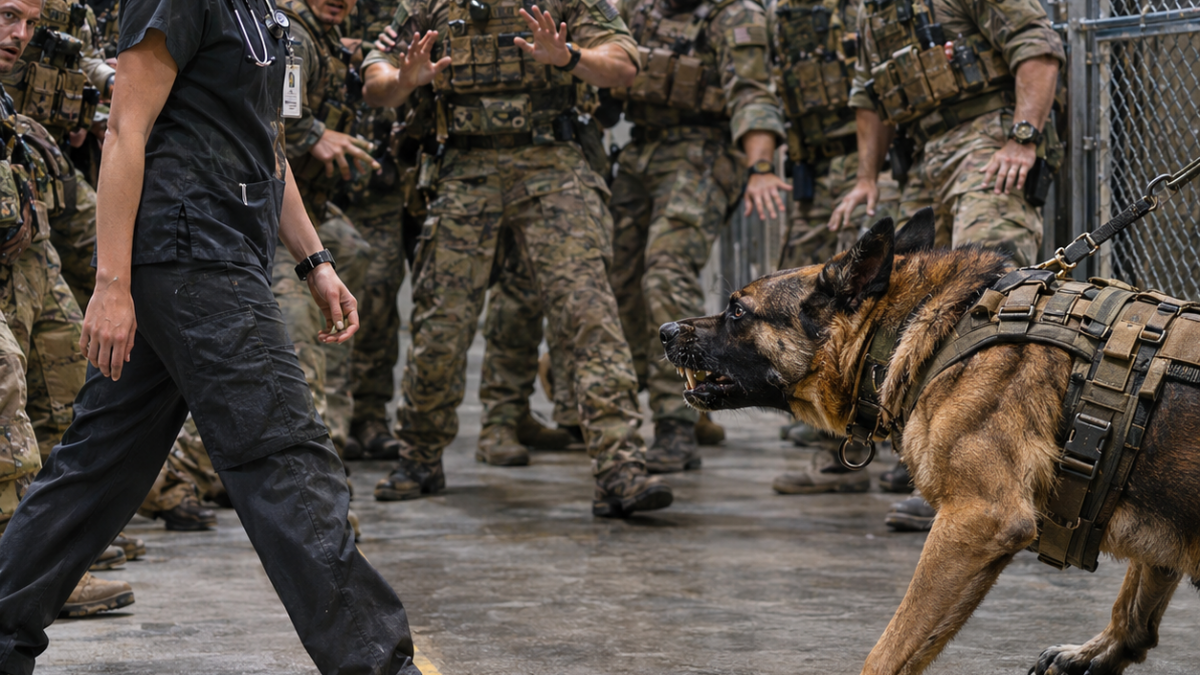
The evaluation yard was surrounded by two layers of chain-link fencing.
The primary enclosure.
Then a secondary safety line.
Twelve operators and handlers had gathered.
SEALs from a training detachment.
Army personnel.
K9 staff.
Somebody had clearly spread the word that the civilian nurse was coming to evaluate the dog who had already put two trained handlers in the infirmary.
Ava heard one man whisper:
“Twenty says she lasts five minutes.”
Another:
“Five?”
Ava did not turn.
Pierce did.
“Knock it off.”
The laughter stopped.
Mostly.
A colonel stood apart near the far fence.
Ethan Voss.
Ava knew the type immediately.
Not because of the rank.
Because of the posture.
Hands behind the back.
Chin slightly elevated.
A man accustomed to entering rooms where the outcome adjusted itself around him.
Pierce explained procedure.
“Rex comes through the north gate.”
“You stay behind this line.”
He pointed.
“You do not cross without a handler.”
“Understood.”
“You do not attempt contact.”
“Understood.”
“You do not issue commands.”
Ava looked at him.
“Why?”
“Because he has a history of unpredictable response.”
“Commands trigger him?”
“Possibly.”
“What commands?”
Pierce hesitated.
Ava waited.
“Current command structure is standard English.”
“Current?”
His jaw tightened.
“Yes.”
“What was original?”
“Unknown.”
That was impossible.
Working-dog files did not simply forget foundational command structures.
“How long has he been isolated?”
Pierce looked away.
“Forty-one days.”
Ava stared.
“Forty-one?”
“He’s considered a safety risk.”
“You put a combat-trained Malinois in isolation for six weeks?”
“He attacked handlers.”
“Before or after isolation?”
Pierce’s voice hardened.
“Ms. Mitchell.”
“Before or after?”
“Before.”
“So you took a dog already showing stress response, removed all task work, removed consistent handler contact, confined him for forty-one days, and now you’re evaluating whether the confinement made him worse.”
Pierce stepped closer.
“You haven’t met the dog.”
“No.”
Ava looked toward the north gate.
“That’s why I’m asking questions before pretending I know him.”
Something changed in Pierce’s face.
Not respect.
Not yet.
But the first crack in dismissal.
He keyed the radio.
“Bring Rex.”
The north door opened.
The sound came first.
Claws.
Concrete.
Then the dog.
Ninety-five pounds of Belgian Malinois exploded into the yard.
Two handlers held a twenty-foot line.
Barely.
Rex pulled them hard enough that one lost half a step.
Scar tissue crossed his muzzle.
Dark coat.
Huge shoulders.
Rear leg slightly stiff.
He did not look insane.
Ava hated that word for animals anyway.
He looked overloaded.
Every muscle performing ten decisions simultaneously.
Where is threat.
Where is exit.
Who is controlling me.
Which command matters.
What comes next.
The handlers unclipped the long line.
Retreated.
Rex moved.
Fast.
Quartering the yard.
Fence.
Gate.
People.
Wind.
Then he saw Ava.
Everything changed.
His head rose.
His body locked.
He stared.
One second.
Two.
Then he ran.
Straight toward her.
People moved behind Ava.
Boots scraped.
Someone swore.
A water barrel crashed over.
Pierce grabbed Ava’s arm.
“Back!”
She stepped out of his grip.
Rex hit the fence separating the primary yard from the secondary line.
Chain link screamed.
Teeth visible.
Body slamming steel.
Several operators moved backward.
Ava did not.
“Mitchell!”
Pierce’s voice cracked.
“I said back!”
Rex hit the fence again.
Ava watched his eyes.
Not the teeth.
Not the body.
Eyes.
There was aggression there.
Fear.
Stress.
But something else.
Confusion.
He knew something.
He did not know what.
Ava stepped toward the secondary gate.
Pierce blocked her.
“No.”
“Move.”
“Absolutely not.”
“Sergeant.”
“That dog will hurt you.”
Ava looked through the fence.
Rex stopped slamming it.
His nose worked.
Once.
Twice.
A sound came out of him.
Soft.
Almost questioning.
Ava’s heart stopped.
Kandahar.
A kennel behind a medical support compound.
A six-month-old Malinois with a torn paw pad who refused to let the assigned technician clean it.
Ava sitting on the floor.
Speaking a German command she had learned from a Belgian trainer.
Fuss.
Heel.
The dog moving to her left side.
Not Rex.
She had never been told his name then.
Dogs in that program used temporary identifiers around non-handler staff.
But the eyes—
She knew those eyes.
“Open it.”
Pierce stared.
“Absolutely not.”
Ava reached for the latch.
Pierce caught her wrist.
“Mitchell, listen to me.”
She turned her head.
“If I’m wrong, you pull me out.”
He looked almost offended.
“If you’re wrong, there may not be time.”
Ava held his gaze.
“Open it.”
Something in her voice landed differently.
Pierce slowly released her.
He unlocked the secondary gate.
“Everyone clear.”
Operators moved.
Ava stepped into the yard.
Rex launched.
Twenty feet.
Fifteen.
Ten.
Someone shouted.
Ava did not move.
Five.
She spoke one word.
“Fuss.”
Rex stopped.
Not slowed.
Stopped.
Rear legs came underneath him.
Body dropped.
He sat.
The entire yard went silent.
Ava heard wind moving against the chain link.
Nothing else.
Rex stared at her.
Then sniffed.
One long pull of air.
Another.
His ears changed.
Forward.
Then slightly back.
The working-dog equivalent of disbelief.
Ava crouched.
“Fuss.”
Rex stood.
Walked toward her.
No charge.
No teeth.
Three careful steps.
He pressed his skull into her palm.
Someone behind the fence whispered:
“No way.”
Ava closed her fingers into the rough fur along Rex’s cheek.
The scar across his muzzle was newer.
His eyes were not.
She knew him.
She just did not yet understand how.
“Hey.”
Rex pushed harder against her.
A full-body exhale came out of him.
Forty-one days.
Maybe longer than that.
Something in Ava cracked.
Not visibly.
She moved both hands along his neck.
Shoulders.
Spine.
Reading him.
Tension.
Muscle atrophy.
Stress.
He remained glued to her left knee.
Pierce approached slowly.
“What the hell did you say?”
“Old command.”
“He hasn’t responded to anyone like that.”
“I noticed.”
“Where did you learn it?”
Ava did not answer.
Rex leaned into her leg.
She looked at Pierce.
“He’s not unrecoverable.”
“You’ve been in there three minutes.”
“He’s been mishandled.”
Pierce’s face hardened again.
“That’s a serious accusation.”
“So is calling an animal dangerous because you broke his command structure.”
Colonel Voss moved forward.
“Ms. Mitchell.”
Ava stood.
Rex rose with her.
Automatically took her left side.
Voss noticed.
Everyone noticed.
“I appreciate your confidence.”
Voss said.
“But our specialist conducted forty days of evaluation.”
“Your specialist evaluated him using the wrong system.”
“You cannot know that after—”
“Sit.”
Ava said.
Rex sat.
Voss stopped talking.
Ava continued.
“Platz.”
Rex went down.
“Steh.”
He stood.
Pierce stared.
Ava looked at Voss.
“Those are not tricks.”
“They are foundational commands.”
“His current file lists English structure.”
“His original architecture is Germanic-European.”
“Someone overwrote it without verifying compatibility.”
Voss’s face remained calm.
“That doesn’t explain the attacks.”
“No.”
Ava said.
“But six handlers in eighteen months might.”
Pierce looked at her.
She had guessed.
His expression confirmed it.
“How many?”
He said quietly.
“Five.”
“Five before the two injuries?”
“Yes.”
Ava looked at Voss.
“You took an animal built around handler continuity and gave him five command identities.”
No answer.
“You isolated him when he deteriorated.”
No answer.
“You classified the deterioration as aggression.”
Voss’s mouth tightened.
“Your recommendation?”
“Immediate suspension of euthanasia.”
“That requires review.”
“The order is tomorrow morning.”
“We can arrange—”
“No.”
Ava’s voice cut cleanly across his.
Several people looked at her.
Voss did too.
She continued.
“If your bureaucracy needs seven days and the dog has twenty-two hours, your bureaucracy is irrelevant.”
Pierce almost smiled.
Voss did not.
“You’re a civilian contractor on a temporary evaluation.”
“I’m the evaluator you called.”
Ava said.
“So evaluate my evaluation.”
Silence.
Voss turned to Pierce.
“Give her secondary access.”
“Sir?”
“Forty-eight hours.”
Ava said:
“Seventy-two.”
Voss looked at her.
“Forty-eight.”
“Rex has been damaged for six weeks.”
“He deserves more than two days.”
“Fifty-six.”
Pierce’s eyebrows rose.
Voss looked annoyed at himself for negotiating.
Ava nodded.
“Fifty-six.”
Rex’s euthanasia order was delayed.
Not canceled.
Ava spent the rest of the day reading his file.
Seven years.
Three deployments.
Commendations.
Explosive detection.
Search.
Tracking.
Handler protection.
Exceptional recovery under fire.
Stable temperament.
Then eighteen months earlier:
Transfer.
New handler.
Four months.
Another transfer.
Incident.
Another handler.
Aggression notation.
Another transfer.
Stress-response failure.
Then handler Garza injured.
Then Morrow.
Then isolation.
Then euthanasia recommendation.
Ava flipped back.
Kandahar.
Program designation partially redacted.
Her stomach tightened.
She knew the code.
She had seen it in her own service record.
Different section.
Same program family.
Eight months of her life.
She had been a combat medic assigned to a joint medical and canine support cell.
That was what she had been told.
She had assisted trainers.
Treated handlers.
Helped with K9 injuries.
Occasionally participated in acclimation work.
She had never been a formal handler.
At least that was what she believed.
A note appeared near Rex’s first deployment record.
MEDICAL SUPPORT SECONDARY—EXCEPTIONAL ANIMAL RAPPORT.
Her name followed.
AVA MITCHELL.
Ava stared.
Her mouth went dry.
She read it again.
Her name.
There.
In Rex’s original file.
She went to the east runs.
Rex was lying beside the fence.
When he saw her, he stood immediately.
No barking.
No lunge.
Just watching.
Ava entered.
Rex crossed the run and shoved his face into her neck.
She sat on the concrete.
He pressed against her.
“Why do you remember me?”
She whispered.
Rex exhaled.
Ava remembered pieces.
A young dog who would not take food.
A training session in dusty heat.
A Belgian instructor laughing because Ava’s pronunciation was terrible.
A Malinois choosing her left side when three other people called.
A night after a casualty intake when she had sat outside and a young dog had rested his chin on her boot.
She had thought those moments were incidental.
Maybe they were not.
Pierce appeared outside the run.
He stopped.
Watched.
Then said:
“Where did you serve?”
Ava looked up.
“Army.”
“Don’t do that.”
“Do what?”
“Give me the answer you give civilians.”
She held his gaze.
Pierce continued.
“I know the command structure you used.”
“Joint European programs.”
“I trained under NATO support.”
Ava said nothing.
“Where?”
He asked.
“Kandahar.”
Pierce went still.
“When?”
“2018 to 2019.”
“What unit?”
“Can’t answer.”
Pierce looked at Rex.
Then Ava.
“The program code in his file.”
“Yes.”
“You recognize it.”
“Yes.”
Pierce breathed out slowly.
“Voss doesn’t know who you are.”
“No.”
“Does anyone here?”
“Apparently not.”
Pierce crouched outside the fence.
“You need to understand something.”
“Voss is going to fight this.”
“Why?”
“He hates being publicly contradicted.”
“That isn’t enough.”
“No.”
Pierce looked toward the hallway.
“There’s more.”
The first injured handler was Garza.
Official report:
Unprovoked bite during leashing.
Actual event, according to Garza:
Voss ordered a high-stress exposure drill outside Rex’s training profile.
Garza objected.
Was told to proceed.
Rex reacted.
Garza’s hand broke when he fell.
The bite came after.
The second incident was nearly identical.
A deliberately escalated exercise.
Wrong commands.
Wrong approach.
Wrong handler.
Rex reacted.
Then Voss used the reactions as evidence.
“Why would he do that?”
Ava asked.
“I don’t know.”
Pierce said.
“But the euthanasia recommendation was filed seventy-two hours after Morrow got hurt.”
Ava looked at Rex.
“He created the behavior.”
Pierce’s jaw tightened.
“I think he created the file.”
That night, Ava called Captain Delaney.
“I need my full service record.”
Silence.
“You know that’s sealed.”
“Unseal it.”
“That requires authority above my office.”
“Get it.”
“Ava—”
“Rex’s euthanasia order is active.”
She looked through the glass.
“He knows me.”
A long pause.
“How?”
“I don’t know yet.”
“That isn’t possible.”
“My name is in his handler notes.”
Delaney went quiet.
Not confused.
Quiet.
Ava noticed.
“You knew.”
“No.”
“Delaney.”
“I knew there were cross-references.”
“You knew my name was in the file.”
“I knew your record and his record touched the same program.”
Ava’s voice lowered.
“How?”
“I can’t answer until the file is released.”
“Then release it.”
“I’ll make the call.”
The next morning Ava began rebuilding Rex.
Not retraining.
Rebuilding.
There was a difference.
She used the original command structure.
Sitz.
Platz.
Steh.
Voran.
Fuss.
Rex responded.
At first with delay.
Then faster.
He made mistakes.
Ava documented them.
She did not pretend he was perfect.
A dog harmed by six weeks of isolation did not become perfect because the right person walked into the yard.
But he was functional.
He was thinking.
He was recovering.
Most importantly:
He was choosing control.
Operators gathered.
The same men who had laughed.
Ava ignored them.
She ran directional work.
Scent.
Hold.
Release.
Search.
Rex’s confidence grew.
Pierce watched everything.
At the end of the second hour, he said:
“This isn’t a dangerous dog.”
“No.”
Ava answered.
“It’s an abused working system.”
Pierce looked at her.
“You say things like he’s a machine.”
“He isn’t.”
“Then why—”
“Because people hear emotion and think bias.”
Ava knelt beside Rex.
“So I give them data.”
She touched the scar on his muzzle.
“And keep the emotion for him.”
That afternoon Colonel Marcus Sayers arrived.
Regional canine oversight.
Seventeen prior nonrecoverable reviews.
Fourteen upheld.
Pierce told Ava quietly:
“He’s here to validate Voss.”
“You know that?”
“I know institutions.”
The evaluation began after dark.
Sayers used standard protocol.
That was the problem.
Rex ignored English commands.
Not aggression.
Not refusal.
Simply no meaningful response.
Sayers wrote notes.
Ava watched.
Then came threat-response testing.
A large specialist entered wearing a bite sleeve.
He was supposed to approach gradually.
He did not.
He came hard.
Fast.
Voice raised.
Sleeve swinging.
Rex reacted exactly as he had been trained.
Engage threat.
He hit the sleeve.
Took the bite.
Controlled target.
The specialist dropped to one knee.
Sayers wrote.
Ava stepped across the observer line.
“That approach exceeded protocol.”
Sayers turned.
“You are observing.”
“I am.”
“You are not part of this evaluation.”
“Your evaluator escalated above first-contact threshold.”
Voss said:
“Ms. Mitchell.”
She ignored him.
“The dog’s response was appropriate to the presented threat.”
Sayers’s face hardened.
“You are challenging a regional assessment?”
Ava pulled the partial service record Delaney had sent hours earlier from her jacket.
“Yes.”
She held it out.
“And I’m submitting evidence.”
Sayers took it reluctantly.
First page.
Six years Army.
Combat medical service.
Two deployments.
Second page.
Classified program affiliation.
His eyes stopped.
Returned to the top.
Read again.
Then looked at Ava.
“Where did you get this?”
“It’s mine.”
Silence.
Pierce stepped off the perimeter.
“The approach velocity was above protocol.”
Every head turned.
Pierce continued.
“That is my official objection.”
Voss looked at him.
“Sergeant.”
Pierce did not back down.
“Sir.”
Sayers looked at Voss.
Then Ava.
Then Rex.
“Hold the determination.”
Voss’s face did something Ava had never seen before.
Fear.
Only for a fraction of a second.
But enough.
That was when Ava understood.
This was not about a difficult dog.
Voss needed Rex dead.
Her phone buzzed.
Unknown number.
One message.
YOU NEED TO SEE THIS NOW.
Attachment.
Transfer authorization.
Rex to Iron Creek.
Requested by:
COLONEL ETHAN VOSS.
Date:
Ninety-three days before Rex had supposedly been transferred there for behavioral rehabilitation.
Ava showed Pierce.
He stared.
“He requested Rex?”
“Yes.”
“Before the incidents?”
“Yes.”
Another message arrived.
Name:
GARZA.
Former handler.
Then four files.
Original injury report.
Not the altered one in Rex’s official folder.
Medical documentation contradicting the command report.
Stress-exposure orders signed by Voss.
And an internal email sent to the behavioral contractor eleven days before Rex’s formal assessment.
The language was careful.
The meaning was not.
Voss had requested a nonrecoverable finding before the assessment had even begun.
Pierce read it.
His voice turned cold.
“He built the entire case.”
“Yes.”
“Why?”
Ava looked toward Rex.
A dog could not testify.
But records could.
And Rex was a living connection to whatever Voss wanted forgotten.
Garza sent another message.
I’VE BEEN WORKING WITH THE INSPECTOR GENERAL.
Ava stared.
Then called Delaney.
“Full record.”
“Tonight.”
“Ava—”
“Tonight.”
“The authorization authority is overseas.”
“Use emergency channels.”
“That is not a small request.”
“No.”
Ava looked through the glass at Rex.
“Neither is killing a dog because a colonel falsified his history.”
Delaney went silent.
“Make the call.”
Twenty-three minutes later:
“The file is being unsealed.”
Delaney said.
“But Ava, understand something.”
“What?”
“When this opens, whatever is inside opens too.”
“I know.”
“No.”
Delaney’s voice changed.
“I don’t think you do.”
Before Ava could ask, the line went dead.
At 10:41 p.m., Voss moved the euthanasia time forward.
Immediate authorization.
Safety emergency.
He had bypassed Sayers’s hold.
Pierce saw the order.
“So this is it.”
Ava said.
“He knows the file is opening.”
Pierce nodded.
“He’s trying to kill Rex before it does.”
They moved toward East Block.
Trumbull, the facility manager, refused to participate.
“I’m not doing it.”
His hands shook.
“Sir or no sir, I’m not killing that dog tonight.”
Pierce said:
“Then don’t.”
The corridor door opened.
Voss entered.
Alone.
“Staff Sergeant Trumbull.”
No answer.
“Prepare the animal.”
Trumbull stood frozen.
“That is a direct order.”
Pierce stepped forward.
“The IG has evidence.”
Voss turned.
“You are forty-eight hours from rotation.”
“I’m aware.”
“You want to destroy your career over a dog?”
Pierce looked toward Rex’s run.
“No.”
He said.
“I’m willing to risk it over what you did to him.”
Voss looked at Ava.
“You.”
The word held real hatred now.
Ava remained still.
“You walked onto my installation forty-eight hours ago.”
“And found your paperwork.”
“You don’t know what you found.”
“I know you ordered stress drills.”
“I know you altered incident reports.”
“I know you predetermined the euthanasia evaluation.”
“I know you requested Rex months before the behavior problems began.”
Ava stepped closer.
“And I know the Inspector General has all of it.”
Voss’s jaw clenched.
“You have no authority.”
“That’s true.”
The answer surprised him.
Ava continued.
“But evidence doesn’t require authority.”
Headlights crossed the windows.
One vehicle.
Then another.
Then a third.
Pierce looked toward the entrance.
A woman in uniform entered with two investigators.
Major Adrienne Sobol.
Inspector General.
She looked at Voss.
“Colonel.”
Nobody moved.
“I need you to step away from the K9 facility.”
Voss stared.
Sobol repeated:
“Now.”
For four years, Ethan Voss had commanded Iron Creek.
Men stood when he entered.
Orders became reality because his signature existed beneath them.
That night, three people watched him decide whether any of that still mattered.
It didn’t.
He stepped back.
Sobol looked at Ava.
“Ms. Mitchell?”
“Yes.”
“Is Rex secure?”
“Yes.”
“Good.”
She held up a tablet.
“I received the unsealed record.”
Ava’s stomach tightened.
Sobol continued.
“The euthanasia order is suspended.”
Ava exhaled.
Then Sobol said:
“There’s a problem.”
Of course there was.
“What?”
“Your service record and Rex’s origin file share a program number.”
“I know.”
“No.”
Sobol looked at her carefully.
“You don’t.”
She handed Ava the tablet.
Handler assignment matrix.
Ava read.
Primary handler.
Secondary personnel.
Medical support.
Then her name.
Not medical support.
SECONDARY HANDLER—CROSS-TRAINED.
RECOMMENDED FOR PRIMARY CONTINUITY.
Ava stared.
“No.”
Sobol said nothing.
Ava read again.
Same words.
Dates.
Kandahar.
Eight months.
Rex.
Her.
“They trained me as his backup handler.”
“Yes.”
“I was told I was medical support.”
“Yes.”
“I wasn’t told.”
“No.”
Ava felt anger rise.
Clean.
Cold.
“Who authorized that?”
Sobol swiped to another page.
Voss’s name appeared.
Ava looked up.
He knew.
Not only who Rex was.
Who she was.
Sobol continued.
“The transfer request for Rex includes a notation referencing your civilian employment.”
Ava’s thoughts stopped.
“My hospital?”
“Yes.”
“Hargrove Regional.”
“Yes.”
Ava thought of the termination letter.
Budget restructuring.
Position eliminated.
“Did he get me fired?”
“We’re investigating.”
Voss said:
“This is absurd.”
Sobol looked at him.
“Sir, you should stop talking.”
He did.
The next morning Ava had to prove Rex could live.
The euthanasia order was suspended.
Not closed.
Military bureaucracy had a particular talent for requiring a higher standard to save something than to condemn it.
Ava entered the evaluation yard at 0800.
Eleven observers.
Sayers.
Sobol.
Pierce.
Legal.
Cameras.
Rex looked tired.
So did Ava.
She began anyway.
Foundational commands.
Clean.
Directional work.
Mostly clean.
Rex overshot one scent cone.
A legal officer wrote something.
Ava ignored him.
Rex corrected.
Found source.
Indicated.
Second search cleaner.
Third nearly perfect.
Then Ava did something not on the evaluation sheet.
She stepped into the open yard.
“Rex.”
His head came up.
“Voran.”
He moved.
“Right.”
Right.
“Left.”
Left.
“Stop.”
Stopped.
“Find.”
Rex began searching.
No target.
No reward.
No sleeve.
No manufactured threat.
Just work.
He quartered the field.
Checked Ava’s position.
Adjusted.
Moved.
Looked alive.
Not merely safe.
Alive.
Pierce’s expression changed.
Sayers stopped writing.
Ava called:
“Fuss.”
Rex returned.
Perfect heel.
Sat against her left knee.
Sayers looked at Pierce.
“Your objection last night.”
“Yes, sir.”
“Official?”
“Yes.”
Sayers turned toward legal.
“The assessment methodology exceeded regional parameters.”
He looked at Ava.
“My preliminary evaluation is void.”
The legal officer stiffened.
“Colonel—”
Sobol entered the yard.
“Legal motion denied.”
Everyone turned.
“Lieutenant Colonel Harwick has recused himself following evidence establishing a prior relationship with Colonel Voss relevant to this investigation.”
Ava looked at Pierce.
Another layer.
Sobol continued.
“The evaluation proceeds.”
At 12:23 p.m., Rex’s euthanasia order was permanently closed.
Ava read the document three times.
Handler compatible.
Operationally functional.
No evidence supporting nonrecoverable designation.
Cleared.
She stopped at the final signature.
Pierce sat beside her on a concrete barrier.
“That it?”
“Yes.”
“Really?”
“Yes.”
He nodded.
Then looked across the compound.
“When you walked in here, I thought you were going to get mauled.”
“I know.”
“I thought you were arrogant.”
“I know.”
“I thought you had no idea what you were doing.”
Ava looked at him.
“I know.”
Pierce laughed.
“Could you let me finish one apology?”
“Possibly.”
He became serious.
“I was wrong.”
Ava studied him.
No excuses.
Good.
“About me?”
“Yes.”
“About Rex?”
He looked toward the yard.
“More importantly.”
Ava nodded.
“Then learn from it.”
“I am.”
Voss was formally charged three days later.
Abuse of command authority.
Falsification.
Obstruction.
Conspiracy to interfere with an Inspector General investigation.
Harwick became the subject of a separate investigation.
The behavioral specialist lost his base contract and later his professional certification.
Garza’s original report was restored.
The handler injuries were reclassified.
Rex’s record was corrected.
But the part Ava did not expect came on Day Eight.
Sobol called her into a conference room.
A man named Aldridge sat waiting.
Civilian suit.
Expensive.
Program-level government quiet.
He opened a folder.
“Ava, what you were told about Kandahar was incomplete.”
She stared at him.
“I’ve gathered that.”
“You were entered into the program as medical support.”
“Yes.”
“Within three months, your designation changed internally.”
“To secondary handler.”
“Yes.”
“Why?”
Aldridge looked at her.
“Rex.”
Ava felt something turn.
“He selected you.”
“That’s not how handler assignment works.”
“Not officially.”
“What does that mean?”
“Rex’s primary handler was injured during acclimation.”
“He rejected three temporary handlers.”
“He continued responding to you.”
“You were not assigned as handler.”
“You were simply present.”
“But he worked for you.”
Ava remembered.
Dust.
Heat.
Young dog.
German commands.
Running medical equipment across a compound while Rex followed.
She thought he had just liked her.
Aldridge continued.
“The program began evaluating you without telling you.”
Ava’s expression hardened.
“That sentence should concern you more than it appears to.”
“It concerns me substantially.”
“Good.”
“What was the program actually doing?”
Aldridge paused.
Then told her.
Handler-animal integration for long-duration classified support operations.
Medical personnel were valuable because medics moved differently through operational environments.
Closer to people.
Less conspicuous.
Greater access.
The K9 program had doubled as a platform for intelligence collection.
Ava had not been merely learning dog handling.
She had been evaluated as an intelligence-support asset.
Without informed consent.
She stood.
“No.”
Aldridge did not stop her.
She paced once.
“That’s why Voss wanted Rex gone.”
“Partly.”
“He approved the original methodology.”
“Yes.”
“If the program reopened under investigation—”
“His authorizations would be examined.”
Ava looked through the window.
Rex was outside with Pierce.
Waiting.
Aldridge continued.
“There’s one more reason.”
Ava turned.
“Voss knew Rex’s handler-continuity profile was tied to you.”
“So?”
“He knew you were working at Hargrove Regional.”
Ava’s face went still.
“He had Rex transferred here.”
“Yes.”
“He had my job eliminated.”
“We believe he influenced the hospital contracting relationship.”
“Why?”
“To create circumstances where you could be recruited as evaluator.”
Ava stared.
The termination.
The phone call.
The one-name list.
None accidental.
“He brought me here.”
“Yes.”
“Why?”
Aldridge answered carefully.
“We believe Voss intended your evaluation to validate Rex’s instability.”
Ava almost laughed.
“He thought I would condemn him.”
“He believed you did not remember Rex.”
“He believed your classified affiliation made you credible enough to legitimize the euthanasia decision.”
Ava sat.
“He used me.”
“Yes.”
“And the dog recognized me.”
“Yes.”
“And that destroyed the plan.”
“Yes.”
Silence.
Ava looked through the window.
Rex saw her.
Even at that distance, his ears lifted.
Aldridge pushed another folder toward her.
“We’re rebuilding the program.”
Ava looked at him.
“No.”
“You haven’t heard—”
“I heard enough.”
“This version would include oversight.”
“No.”
“Full consent.”
Ava paused.
Aldridge noticed.
“Full disclosure.”
“Handlers know what they are entering.”
“Yes.”
“Operational purpose?”
“Disclosed.”
“Exit rights?”
“Yes.”
“Animal welfare authority?”
“Independent.”
Ava looked at the proposal.
“What do you want from me?”
“Program lead.”
She laughed once.
“You fire me from a hospital, nearly kill the dog I trained without knowing I trained him, then offer me a program.”
“I didn’t fire you.”
“You represent the same machine.”
Aldridge accepted that.
“Fair.”
“Why me?”
“Because Rex will not give us eighteen months to build another handler relationship.”
Ava’s expression changed.
“He doesn’t belong to your program.”
“No.”
Aldridge said.
“He belongs to himself.”
That answer surprised her.
“And?”
“We want the person he trusts.”
Ava looked at the folder.
“I need twenty-four hours.”
She spent that night with Rex.
No evaluation.
No notes.
Just sitting.
He lay against her side.
Ava rested one arm across his shoulders.
“You knew me before I knew you.”
Rex’s eyes closed.
“That seems unfair.”
His tail moved once.
She smiled.
“Yeah.”
For years, Ava had thought her life separated neatly into chapters.
Soldier.
Nurse.
Civilian.
Finished.
But the truth had apparently been moving underneath those categories the entire time.
She was angry.
She deserved to be.
People had made decisions about her without telling her.
They had turned aptitude into ownership.
Turned trust into a program metric.
Turned a living dog into classified equipment.
She would not rebuild that version.
The next night Aldridge returned.
“I have conditions.”
He waited.
“Rex’s welfare decisions are mine.”
“Medical or behavioral.”
“If I say stop, operations stop.”
Aldridge nodded.
“Agreed.”
“Every handler gets full disclosure.”
“Agreed.”
“No hidden evaluations.”
“Agreed.”
“No incremental recruitment.”
“Agreed.”
“No one learns six years later that their life meant something different on paper than what they were told.”
Aldridge hesitated.
Ava stared.
“Agreed.”
“And Rex?”
“Permanently cleared.”
“Regardless of program.”
“Yes.”
Ava looked at him.
“Then I’ll lead it.”
The formal proceedings against Voss lasted months.
Accountability rarely looked cinematic.
No final confrontation.
No room where everyone he had harmed stood while he confessed.
Paperwork.
Boards.
Testimony.
Findings.
Charges.
His command ended.
His career ended.
His influence ended.
The important thing was that Rex did not.
Garza called Ava on Day Twelve.
“Is he okay?”
“He’s working.”
A long exhale.
“Good.”
“You saved the documents.”
“I waited three months.”
“You saved them.”
“I was scared.”
“Both can be true.”
Garza was silent.
“Thank you.”
He whispered.
“For what?”
“For not telling me I was brave.”
Ava understood.
A formal recognition was held two weeks later.
She tried to refuse.
Pierce stopped her in the hallway.
“It’s not for you.”
“That’s manipulative.”
“Yes.”
“What is it for?”
“Everyone who watched us treat you like an idiot.”
Ava almost smiled.
Pierce continued.
“They need to see the correction.”
So she went.
Sobol spoke.
Sayers stood in back.
Garza appeared by video.
Operators filled the room.
Some of the same SEALs who had placed bets on Ava’s first morning were in front.
Pierce took the microphone.
“Nine days ago, I told Ava Mitchell not to cross a safety line.”
A few people smiled.
“She crossed it.”
More smiles.
“I believed that decision was reckless.”
He looked directly at Ava.
“I was wrong.”
The room quieted.
“I was wrong about her.”
“I was wrong about Rex.”
“And I was wrong every time I assumed training I understood was the only training that mattered.”
A specialist named Roark spoke from the front.
“I was wrong too.”
Another nodded.
No grand applause.
Ava preferred that.
People admitting error did not need celebration.
It needed memory.
She said:
“Then remember.”
That was all.
Outside the room, Rex waited with Trumbull.
The second Ava emerged, he stood.
Three steps.
Head into her palm.
Same as the first day.
She crouched.
Held his face.
“Hey.”
Rex pressed his forehead against hers.
No command.
No training.
No evaluation.
Just recognition.
Three weeks later, Ava left Iron Creek temporarily.
Her program assignment required clearance updates.
Housing.
Administrative processing.
She had no apartment in Kellerton anymore.
No hospital job.
No idea what the next year would look like.
Pierce walked her to visitor processing.
“You coming back?”
“Yes.”
“When?”
“Four weeks.”
“Rex won’t like that.”
“He’ll survive.”
Pierce smiled.
“He’s survived worse.”
Ava stopped.
“That isn’t the standard anymore.”
Pierce looked at her.
“No.”
She continued.
“The standard isn’t what he can survive.”
“It’s what he deserves.”
Pierce nodded slowly.
“Fair.”
Four weeks later Ava drove back through the Iron Creek gate.
Permanent badge.
Program credentials.
One duffel bag.
Roark met her outside the K9 facility.
“He knows.”
Ava looked at him.
“What?”
“You’re here.”
“How?”
“No idea.”
Roark smiled.
“He’s been standing since your car hit the access road.”
Ava entered East Block.
Rex was waiting.
The run door opened.
He came to her immediately.
No hesitation.
No confusion.
No trace of the animal who had slammed himself against chain link weeks earlier because every familiar thing in his world had been systematically removed.
He pressed his skull into her hand.
Ava closed her fingers behind his ears.
“Okay.”
Rex looked up.
“Let’s work.”
The program Ava built was not the old program.
That was the first rule.
No secrets from handlers about the nature of the work.
No hidden compatibility testing.
No treating animals as replaceable systems.
No command officer could issue unilateral behavioral-disposal orders without independent review.
Handler continuity became mandatory.
Foundational command architecture traveled permanently with every dog.
If an animal transferred, the training transferred with him.
Not a summary.
Everything.
Pierce helped write that section.
Garza reviewed the incident protocol.
Sobol insisted on independent oversight.
Sayers, to Ava’s surprise, submitted recommendations correcting his own evaluation standards.
He never apologized directly.
He did something better.
He changed the procedure.
Ava respected that.
Rex became the demonstration animal for handler-continuity training.
Not because he was perfect.
Because he wasn’t.
New handlers saw the scars.
The stress regressions.
The occasional hesitation.
They saw what happened when a highly trained animal lost consistency.
And what happened when consistency returned.
Roark became one of Ava’s best trainees.
The man who had once bet she would run in five minutes now spent evenings practicing German pronunciation while Rex stared at him with visible disappointment.
“Fuss.”
Nothing.
Ava said:
“Wrong.”
Roark tried again.
“Fuss.”
Rex moved.
Roark grinned.
“Finally.”
Ava shook her head.
“He’s tolerating you.”
“Progress.”
Pierce leaned against the fence.
“High praise from Rex.”
Months passed.
Voss’s case continued.
Harwick’s too.
Ava stopped following every update.
There was a difference between justice and obsession.
She had done her part.
Rex was alive.
Garza’s name was cleared.
Morrow’s report corrected.
Policies changed.
The rest belonged to investigators and courts.
One evening Pierce asked:
“Do you ever think about that first morning?”
“Unfortunately.”
“You crossed the line knowing I told you not to.”
“Yes.”
“You could’ve been wrong.”
“Yes.”
“What made you do it?”
Ava looked across the field.
Rex was working with Roark.
Focused.
Fast.
Alive.
“He stopped looking angry.”
Pierce frowned.
“When?”
“At the fence.”
“What did he look like?”
“Lost.”
Ava watched Rex hit a scent cone and change direction.
“And I knew that look.”
Pierce looked at her.
“From dogs?”
Ava was quiet.
Then:
“No.”
He understood.
She had been lost too.
After Kandahar.
After leaving service.
After trying to turn herself into someone whose previous life had no relevance.
After three years working in a hospital and calling that enough because enough was safer than wanting something she could not name.
She had mistaken quiet for healing.
Sometimes quiet was healing.
Sometimes it was hiding.
Rex had spent forty-one days behind a fence being told that confusion meant he was broken.
Ava had spent years believing the parts of herself that did not fit ordinary civilian life needed to stay buried.
Neither was true.
That did not mean they belonged back in war.
That was another false choice.
They did not need combat to have purpose.
Ava’s new program focused primarily on recovery, training integrity, and safe transitions for specialized working dogs.
Operational work remained limited.
Medical.
Search.
Training.
Evaluation.
Rehabilitation.
Rex was seven.
He had done enough.
Ava refused every suggestion that he redeploy.
A director challenged her once.
“He remains operationally capable.”
Ava answered:
“So are plenty of sixty-year-old soldiers.”
“That doesn’t mean we send them back because we can.”
The director stopped asking.
Rex worked.
But he worked at home.
That mattered.
A year later, Ava officially retired him.
Pierce organized the paperwork.
Roark brought a ridiculous steak.
Trumbull bought a collar with no military markings.
Ava opened the small box.
Blue leather.
Simple metal tag.
REX MITCHELL.
She stared.
Pierce looked uncomfortable.
“What?”
“Mitchell?”
“He needed a legal owner designation.”
“You did that?”
“Technically the program office.”
“Pierce.”
“Okay.”
He smiled.
“I might have suggested it.”
Ava looked at Rex.
He was eating steak.
Completely unconcerned about bureaucracy.
She attached the collar.
For the first time in Rex’s life, the tag did not contain a military asset number.
No unit.
No program.
No classification.
Just a name.
His.
And hers.
That night he slept beside Ava’s bed.
No kennel.
No handler rotation.
No chain link.
At 3:12 a.m., Ava woke from a dream she could not remember.
Rex was already awake.
Looking at her.
She lowered one hand.
He pushed his head beneath it.
“Still here?”
His tail moved once.
“Me too.”
Years later, people at Iron Creek still told the story wrong.
They said a civilian nurse walked into an enclosure with a killer dog and magically calmed him.
False.
They said Rex attacked everyone except her.
False.
They said the SEALs threw her into the yard as some kind of test.
False.
Nobody physically threw Ava anywhere.
The institution had done something more subtle.
It had placed her in a situation designed around assumptions.
Civilian.
Nurse.
Woman.
Temporary badge.
Dog already condemned.
Outcome already written.
Everyone had been expected to stay inside the role assigned to them.
Pierce was supposed to enforce protocol.
Sayers was supposed to validate it.
Garza was supposed to stay quiet.
Ava was supposed to observe from behind the secondary line.
Rex was supposed to confirm the conclusion people had already reached.
None of them did.
That was the real story.
Garza saved evidence.
Pierce challenged command.
Sayers withdrew a flawed assessment.
Sobol arrived when the documents justified arriving.
Ava crossed a line.
And Rex remembered.
The thing that broke Voss’s plan was not secret combat skill.
Not rank.
Not violence.
Memory.
A dog remembered the person who had once made the world make sense.
A woman remembered enough of a language she had not spoken in years.
A handler remembered an incident report differently from how command wrote it.
A sergeant remembered that obedience and integrity were not always the same thing.
The truth survived because enough people refused to forget their piece of it.
Rex lived another five years after retirement.
His muzzle turned white.
His rear leg stiffened.
He stopped jumping into the truck and began waiting for Ava to lift him.
Pierce visited.
Roark too.
Garza finally came once.
He stood in Ava’s yard uncertain whether Rex would remember.
Ava said:
“Only one way to know.”
Garza crouched.
“Hey, Rex.”
The old dog stared.
Sniffed.
Walked forward.
Then pressed his head against Garza’s chest.
Garza cried immediately.
“I’m sorry.”
Ava did not stop him.
Garza held Rex’s face.
“I’m sorry, buddy.”
Rex licked his chin.
Garza laughed through tears.
“He forgives me.”
Ava shook her head.
“Don’t put that on him.”
Garza looked over.
“He doesn’t have to forgive you.”
“What do I call this?”
“Recognition.”
Ava smiled.
“Sometimes that’s enough.”
When Rex’s final year came, Ava knew before the veterinarian said it.
Cancer.
Aggressive.
Treatment might buy months.
Maybe.
At the cost of fatigue, hospitalization, procedures, and stress.
Ava sat on the clinic floor with Rex’s head in her lap.
The veterinarian waited.
“What would you do?”
Ava asked.
Dr. Manning answered carefully.
“If he were mine?”
“Yes.”
“I’d ask whether we’re buying time for him or for us.”
Ava looked down.
Rex was tired.
Still alert.
Still watching her.
He had spent enough of his life being asked to endure because humans had decided endurance was useful.
Ava would not do that again.
They went home.
He had six good weeks.
Chicken.
Sun.
Slow walks.
Pierce visited almost every Sunday.
Roark came once and brought the blue collar’s replacement because the old one had worn.
Ava refused it.
“This one stays.”
“Barely has leather left.”
“It stays.”
One evening Rex could not get up.
Ava sat beside him.
He tried.
Failed.
Looked frustrated.
“Hey.”
She put both hands on his face.
“No.”
His eyes stayed on her.
“You don’t have to work.”
He exhaled.
The veterinarian came to the house that night.
Pierce was there.
Not because Ava asked.
Because he knew.
Rex lay on his blanket.
Ava beside him.
She held the blue collar tag between her fingers.
The vet gave the first medication.
Rex relaxed.
Ava whispered:
“Fuss.”
His ear moved.
She smiled through tears.
“No.”
“Sorry.”
“Old habit.”
She pressed her forehead against his.
“You found me twice.”
Pierce looked away.
Ava continued.
“Once in Kandahar.”
“Once when I didn’t know I was lost.”
Rex breathed slowly.
“You did enough.”
Another breath.
“You’re done.”
His eyes stayed on her.
Ava whispered the command that had once stopped him in a training yard full of men who thought he was dangerous.
“Platz.”
Down.
Rest.
Rex’s eyes closed.
His final breath left quietly.
No chain link.
No work lights.
No audience.
No order.
No deadline.
Just Ava’s hands on him.
Exactly where they belonged.
Months later, Iron Creek renamed its handler-continuity program.
Not after Rex.
Ava refused.
“He wasn’t a slogan.”
Instead, a simple plaque was placed near the evaluation yard.
It did not mention Voss.
Did not mention Ava.
Did not mention the investigation.
It read:
TRAIN THE DOG IN FRONT OF YOU.
LEARN THE HISTORY BEHIND HIM.
NEVER CONFUSE CONFUSION WITH FAILURE.
Pierce added one line beneath it later.
Ava pretended to be irritated.
LISTEN BEFORE YOU DECIDE.
New handlers saw the plaque every morning.
Some asked about Rex.
Some did not.
Ava eventually became director of the program.
Not because she was the best dog handler on the base.
She would have rejected that claim.
Pierce had more conventional K9 experience.
Other trainers had stronger technical specialties.
Ava’s value was different.
She understood what systems did to individuals when systems became more interested in protecting their conclusions than testing whether those conclusions were true.
She had lived it.
So had Rex.
Whenever a young handler came into her office saying:
“This dog is broken.”
Ava’s first question was always:
“According to whom?”
If the handler said:
“Everyone.”
Ava would lean back.
“Good.”
They usually looked confused.
“Why good?”
“Because now we know we need evidence.”
She taught them not to romanticize animals.
Not to pretend every aggression case could be fixed.
Some dogs were unsafe.
Some injuries changed behavior permanently.
Some retirement decisions were compassionate.
Some euthanasia decisions were necessary.
Truth mattered more than saving every animal.
That was exactly why Rex’s case mattered.
He had nearly died because truth had been replaced by convenience.
Because someone wanted the conclusion before the evaluation.
Because a powerful man discovered that enough official paperwork could make a lie look clinical.
Ava’s program was built to make that harder.
Independent review.
Video documentation.
Original command records preserved permanently.
Handler-transfer continuity.
Welfare override.
No one-person disposal authority.
Informed consent for human personnel.
Every change traced back to the mistakes that almost killed Rex.
Years later, Ava stood beside the same secondary line where Pierce had once told her not to cross.
A new evaluator was working with a young Dutch Shepherd.
Pierce, now retired from active service but incapable of actually staying retired, stood beside her drinking terrible coffee.
“You know what’s funny?”
Ava asked.
“Usually when you ask that, no.”
“You were right that first morning.”
Pierce looked offended.
“I’d like that in writing.”
“You told me crossing that line was dangerous.”
“It was.”
“I should have listened.”
He stared.
Ava smiled.
“Then crossed anyway.”
Pierce laughed.
“Still impossible.”
“Consistent.”
The young dog in the yard hesitated at a command.
The evaluator reset.
Tried again.
No punishment.
No frustration.
Different approach.
The dog responded.
Ava watched.
That was the ending she cared about.
Not Voss’s charges.
Not the ceremony.
Not anyone discovering she had once been part of a classified program.
The ending was a dog making a mistake in a training yard and nobody deciding the mistake proved he was broken.
It was a handler asking why.
It was records that followed animals instead of disappearing when convenient.
It was authority forced to explain itself.
It was the absence of another Rex.
Ava looked toward the section of fence where he had once slammed ninety-five pounds of fear, confusion, and recognition into chain link.
She could still see him if she wanted.
Dark muzzle.
Scar.
Amber eyes.
Everyone moving backward.
Her moving forward.
One word.
Fuss.
The whole yard becoming silent.
People later called it remarkable that Rex obeyed her.
Ava never thought that was the remarkable part.
Rex had been trained to obey.
The remarkable part was that after being transferred, isolated, confused, provoked, mislabeled, and nearly condemned by people who had decided what he was before they understood him, he still recognized the one person who had once spoken to him in a language that made sense.
He remembered.
And because he remembered, Ava was forced to remember too.
Not just him.
Herself.
The nurse.
The soldier.
The accidental handler.
The woman who had spent years building a quieter life because quiet felt safe.
The person whose abilities had not disappeared simply because nobody around her knew they existed.
She had arrived at Iron Creek with a temporary badge, no apartment, no job, and a termination letter still sitting on her kitchen counter.
She had expected to evaluate a dog.
Instead, the dog evaluated the life she had built.
He asked one question without words:
Do you still know who you are?
Ava had needed time to answer.
By the end, she did.
She was not the person Voss’s paperwork said she was.
Neither was Rex.
And that was why, on the morning twelve special-operations soldiers stood behind a fence waiting for a quiet nurse to fail, the most dangerous mistake anyone made was believing the story had already been written.
Rex knew better.
The moment Ava stepped into the yard, he remembered the truth.
And this time, so did she.








