Three Weeks After a Fire Destroyed Their Home, a Family Returned Expecting Only Ashes—Then They Found Their Missing Cat Waiting Where the Front Door Used to Be
PART3:
Snow crust cracked under Grace’s bare feet. The temperature had dropped to seven degrees below freezing. She did not feel it at first. She felt only the heat at her back, the coughing in her chest, Hannah sobbing into David’s neck, Avery pulling away from her father and trying to run back toward the house.
“Maple!” Avery screamed.
Grace turned.
The second-floor windows glowed orange from the inside.
“No,” she whispered.
The word was so small, so useless, it disappeared beneath the roar.
Then the window of Avery’s bedroom exploded outward.
Glass burst into the night, glittering like ice. Flame punched through the opening and climbed toward the roof. Avery made a sound that did not seem possible from a thirteen-year-old girl.
“Maple!”
Grace ran toward the house.
She did not think. She did not plan. She did not feel David grab her until he had both arms around her from behind.
“Let me go!” she screamed, kicking, clawing at his hands. “David, let me go! She’s inside!”
“You can’t go in!”
“She’s inside!”
“You’ll die!”
“Then let me die!”
Those words would haunt him later. They would haunt her too, because she had meant them for one terrible second. Maple was not just a pet. Maple was the small warm weight that had slept on Avery’s chest after nightmares. The quiet creature who sat beside Hannah during homework. The little cat with one orange ear, one black ear, and a caramel spot on her white chest that Hannah called her coffee stain. Maple had been there through flu seasons, thunderstorms, David’s layoffs, Grace’s mother’s funeral, Avery’s first heartbreak, and every ordinary evening when the girls came home through the front door and Maple trotted to greet them as if their return was the greatest event of the day.
And now the house was burning around her.
David held Grace so tightly his arms shook.
“I can’t lose you too,” he sobbed against her hair. “Grace, I can’t lose you too.”
That was what finally broke her knees.
They collapsed together in the snow while their daughters cried behind them and their home became a tower of fire.
The volunteer firefighters took forty minutes to arrive.
No one blamed them. The road was narrow, icy, and remote. The Walkers had chosen that house because it gave them privacy, quiet, trees, stars, and the feeling that the world could not reach them unless they invited it in. That night, the world was too far away.
By the time the first engine came grinding up the gravel drive, the roof had started to sag.
Neighbors from farther down the mountain arrived wrapped in coats, boots unlaced, faces pale. Someone put a blanket around Hannah. Someone else wrapped Avery in a parka. Grace did not know whose. She stood barefoot in the snow until a firefighter saw her feet and shouted for someone to get her into a vehicle.
She refused to move.
David stood beside her, one arm around her shoulders, the other around Avery, who was shaking so violently her teeth clicked.
“It’s my fault,” Avery kept saying. “I closed my door. I closed my door and she couldn’t get out.”
“No,” Grace said, but her voice was almost gone. “No, baby.”
“She was on my bed.”
“Avery, no.”
“She was on my bed, Mom.”
A section of the second floor gave way with a deep, groaning collapse.
Flames shot upward.
Avery screamed until no sound came out.
At dawn, the house was gone.
The second floor had fallen into the first. The first had collapsed into the basement. The porch was a black skeleton. The chimney stood alone, absurd and stubborn, rising from ash like a monument to everything they could not save. The front steps remained, leading to nothing. The concrete foundation steamed in the cold. Charred beams lay twisted across what had been the living room, the kitchen, the hallway where Maple used to chase dust motes in the afternoon sun.
There was no body.
The firefighters searched what they could safely search. They warned the family that in a fire that hot, with a small animal, there might be nothing recognizable left. No collar. No bones. No proof. Nothing to bury.
Grace thought that would comfort Avery.
It did not.
“Not finding her is worse,” Avery whispered hours later, sitting in a neighbor’s kitchen wrapped in borrowed sweatpants, staring at hands that still smelled like smoke. “If we found her, I would know. But now I keep thinking maybe she got out. Maybe she was looking for us. Maybe she came to the door and we weren’t there.”
Grace sat beside her and pulled her daughter into her arms.
But she could not answer.
Because she had the same thoughts.
The family moved thirty minutes away into a furnished rental in town, arranged by the insurance company. It was clean, beige, and temporary in every possible way. Temporary couch. Temporary dishes. Temporary beds with mattresses too soft. Temporary curtains that did not block the streetlights. Temporary neighbors who waved politely but did not know that Grace cried in the shower where the girls could not hear.
The first night there, Hannah stood in the living room holding Pancake the stuffed fox and asked where Maple’s food bowl was.
No one answered for a few seconds.
Then David knelt in front of her.
“Honey,” he said gently, “Maple isn’t here.”
Hannah’s face crumpled.
“I know,” she said. “But what if she comes?”
Grace turned away before Hannah could see her expression.
Avery did not cry that night. That frightened Grace more than crying would have.
Avery placed Maple’s surviving photo from Grace’s phone as the lock screen on her own. In the picture, Maple was lying upside down on Avery’s bed, one paw over her face, caramel spot visible, green eyes half-open in annoyance. Avery stared at that photo for hours. She barely ate. She answered questions with shrugs. When classmates from her new school tried to be kind, she became stiff and silent.
Grace found her one afternoon sitting on the bathroom floor with the shower running but her hair dry.
“I left her,” Avery said.
Grace turned off the water and sat down beside her.
“You were unconscious from smoke, sweetheart. Dad carried you.”
“I heard her.”
Grace closed her eyes.
Avery looked at her. “You heard her too.”
Grace could have lied.
She wanted to.
Instead, she said, “Yes.”
Avery pressed both hands over her mouth, but the sob broke through anyway.
Grace held her on the bathroom floor until her own legs went numb.
Insurance moved slowly.
Loss does not understand paperwork, but paperwork does not care.
There were forms for structure damage, forms for contents, forms for temporary housing, forms for smoke exposure, forms for proof of ownership of things that no longer existed. Grace had to list everything room by room: couch, dining table, winter coats, baby photos, Christmas ornaments, laptops, school uniforms, wedding album, grandmother’s quilt, the blue ceramic bowl Hannah made in kindergarten, the box of letters from Grace’s father.
How do you put a price beside the smell of your children’s childhood?
How do you write “one cat bed, plaid, near fireplace” when the cat who slept there has no grave?
David dealt with the insurance adjuster, a narrow-faced man named Mark Ellison who wore shiny shoes inappropriate for burned mountain property. Mark spoke in a tone that suggested sympathy had been professionally installed but never personally used.
“We’ll need to determine origin and cause before moving forward with final settlement,” he said.
“The fire chief said electrical,” David replied.
“Preliminary observations suggest electrical involvement. We need documentation.”
Grace stood nearby, arms wrapped around herself. “Are you saying we did something?”
Mark smiled without warmth. “I’m saying total losses require due diligence.”
Avery heard that from the rental’s hallway later and slammed her bedroom door so hard the cheap frame shook.
“They think we burned our own house?” she demanded when Grace followed.
“No.”
“They do.”
“They have to investigate.”
“Our cat died.”
Grace flinched.
Avery saw it, and guilt flashed across her face. “I’m sorry.”
“No,” Grace said softly. “You don’t have to protect me from that word.”
But she did.
Everyone did.
They said “the fire.” They said “the house.” They said “everything we lost.” They said “Maple” only carefully, like touching a bruise.
Three weeks passed.
January turned into February. Snow fell, melted, froze again. The girls started settling into school in the shallow way children do when they are too young to stop living but old enough to resent survival. Hannah drew houses with orange flames in the margins of worksheets. Avery stopped wearing mascara because she said it was pointless.
David returned to the property alone on February 17 to meet Mark Ellison and a private fire investigator hired by the insurance company.
Grace almost went with him, but Hannah had woken with a fever, and Avery had refused to miss school because “everyone already thinks I’m the burned-house girl.” So David went by himself.
He drove the old Subaru up the mountain road under a low gray sky. The closer he got to the house, the harder it became to breathe. He had been back twice since the fire, both times with officials, both times numb. This was the first time he arrived before anyone else.
The gravel driveway appeared between the trees.
He slowed.
The mailbox was still standing, blackened on one side, the red flag melted into a warped shape. Beyond it, the clearing opened where the house had been. The foundation lay exposed. The chimney rose from the center. Snow had settled over the ash in dirty patches.
David parked.
For a moment, he kept both hands on the steering wheel.
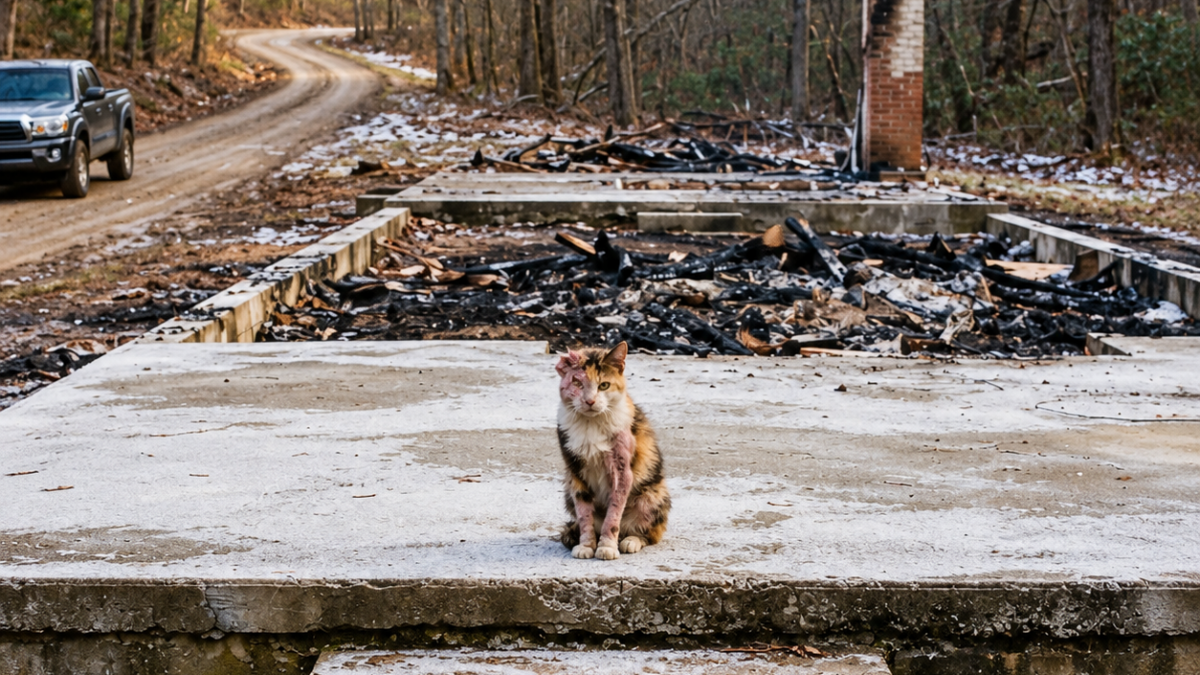
Then he saw something on the concrete slab.
At first, his mind refused to name it.
It was too small to be a person, too still to be a deer, too upright to be debris.
Something was sitting at the far end of the foundation.
Exactly where the front door used to be.
David got out of the car slowly.
The cold hit his face. His boots crunched over frozen gravel. The thing on the slab did not move.
A cat.
He thought it was a stray at first. Some half-starved mountain cat drawn by the shelter of the ruin. Then it turned its head.
David stopped.
His heart did something painful in his chest.
The animal had one green eye.
The other side of its face was a smooth, scarred ruin.
“No,” he whispered.
The cat remained seated, straight-backed, facing the driveway as if it had been waiting for his car.
David took one step. Then another.
The cat’s remaining ear twitched faintly.
There was a caramel-colored spot on its white chest.
David began to run.
“Maple!”
The cat did not run to him. She did not leap, did not meow, did not do any of the joyful things he might once have imagined in a miracle reunion.
She simply watched him come.
That was how he knew how badly she had been hurt.
He fell to his knees on the concrete several feet away, afraid to touch her and afraid not to.
“Maple,” he said again, but now the name broke apart in his mouth.
Up close, she looked impossible.
The right side of her face had been burned beyond anything he had ever seen. Her right ear was gone except for a thick, folded stump of scar tissue. Her right eye was sealed shut, the lid fused into the burned skin of her cheek. Fur was missing from the side of her face down to the jaw, replaced by smooth pink-white scar tissue pulled tight over bone. Her whiskers on that side were gone, nothing left but pale dots where follicles had been destroyed.
Her front right leg was bare in a wide patch from shoulder to elbow, hairless, shiny, marbled by burns. Both front paw pads looked thickened and discolored, like they had walked across heat no living thing should have crossed. Her tortoiseshell coat, once glossy with flecks of black, orange, brown, and cream, was dull and patchy. Her ribs showed. She was so thin he could see the sharp line of her spine beneath fur.
But her left eye was open.
Green.
Clear.
Looking at him.
David reached out one shaking hand. “Baby girl.”
Maple leaned forward.
Not into his palm, but toward the vibration of him. Toward the warmth. Toward the shape she still knew.
When his fingers touched her head, she pressed the burned side of her face into his hand.
David made a sound that was not a sob and not a word.
He pulled out his phone and called Grace.
She answered on the first ring. “Did the adjuster come?”
David tried to speak.
Nothing came out.
“David?”
He covered his mouth with his hand, staring at Maple.
“David, what happened?”
He swallowed. “She’s here.”
Silence.
Then Grace said, “What?”
“She’s here.”
“Who?”
He tried to say the name and failed.
Grace’s voice rose in panic. “David, did you find her? Did you find—”
“Maple,” he said. “Grace, Maple is alive.”
On the other end, something clattered. Maybe the phone. Maybe a glass. Maybe Grace herself hitting the kitchen cabinet.
David pressed his forehead to the cold concrete.
“She’s sitting where the front door was,” he said. “There’s no door anymore, but she’s sitting right there.”
Grace arrived thirty-two minutes later with both girls.
She did not remember the drive clearly afterward. Avery sat in the front seat, silent, seat belt clutched in one fist. Hannah sat in the back crying before she even saw the property, because she understood enough from Grace’s shaking voice that something impossible had happened.
When the rental car pulled into the driveway, David stood near the foundation with Mark Ellison and the fire investigator, both of whom had arrived to find him kneeling beside a cat everyone believed dead. Mark looked unsettled, as if paperwork had failed to prepare him for resurrection.
Avery got out before the car fully stopped.
“Avery!” Grace shouted.
But her daughter was already running.
She slipped once on the frozen ground, caught herself, and kept going. At the edge of the foundation, she slowed. Her face changed as she saw Maple clearly for the first time.
The girl who had not cried in front of strangers for three weeks began to tremble.
She climbed the two concrete steps that no longer led to a porch, then sank to her knees in front of the place where the door had once opened into their home.
Maple turned toward her.
One green eye.
Half a face.
A body marked by everything that had tried to kill her and failed.
Avery reached out, but stopped inches away.
“Oh, Maple,” she whispered.
The cat leaned forward.
Avery’s hand opened.
Maple pressed the burned side of her face directly into the girl’s palm.
Not the uninjured side. Not the side with fur.
The ruined side.
The side without eye, without whiskers, without softness.
The side that had survived.
Avery bent over her and cried with her whole body.
“I’m sorry,” she sobbed. “I’m sorry, I’m sorry, I’m sorry.”
Maple could not hear her.
They did not know that yet, not fully, but Grace suspected it when Maple did not react to Hannah crying, to David speaking, to Mark’s boots scraping concrete. Maple responded to movement. To vibration. To touch.
Not sound.
Grace knelt beside Avery. Hannah pressed into her side, crying too hard to move closer.
“She came back,” Avery said.
Grace looked at the concrete beneath Maple, then at the empty space where their front door had stood for twelve years.
“No, sweetheart,” Grace whispered, tears freezing on her cheeks. “I think she never stopped waiting.”
The emergency veterinary clinic was forty minutes away.
David drove while Grace sat in the back seat with Maple wrapped in his coat. Avery sat beside her, one hand resting lightly against Maple’s thin body so the cat would know she was there. Hannah cried quietly into Pancake.
No one spoke much.
What could they say?
How do you fill a car with words when a miracle is breathing in your lap and every breath hurts?
At the clinic, a technician opened the coat and went still for half a second before training took over.
“We need a burn room,” she called. “Possible severe thermal injury, dehydration, infection, eye involvement.”
Avery clung to the coat. “Can I come?”
The technician’s face softened. “We need to help her first, honey.”
Grace had to physically guide Avery’s fingers away.
Maple was carried through swinging doors.
Again, the family was left with nothing to do but wait.
But this waiting was different from the night of the fire.
That night, waiting had meant watching loss happen where they could not reach it.
This time, waiting meant hope so painful it almost felt cruel.
The veterinarian, Dr. Elise Warren, came out after an initial exam. She had silver threaded through her dark hair and the steady eyes of someone who believed in telling the truth gently, not hiding it.
“She is alive,” Dr. Warren said first.
Grace let out a breath that sounded like breaking glass.
“She is also in very serious condition.”
David held Hannah tighter.
Dr. Warren sat with them in a small consultation room. Maple’s collar, found miraculously still around her neck but partly melted at the buckle, lay in a clear plastic bag on the table.
“She has extensive healed and partially healed burns,” Dr. Warren said. “Which means these injuries are not new. She survived the initial fire and has been living with them for weeks.”
Avery stared at the collar bag.
“Her right eye cannot be saved. It appears the eyelid and surrounding tissue scarred closed while infected. The eye underneath is no longer functional. We will need to remove it surgically once she is stable enough.”
Grace covered her mouth.
“Her right ear has been almost completely destroyed by thermal injury. The left ear canal also shows damage. Based on her lack of response to sound, I believe she is profoundly deaf, likely completely deaf.”
Hannah whispered, “She can’t hear us?”
Dr. Warren looked at her with such kindness that Grace almost cried harder. “I don’t think she can hear voices anymore, sweetheart. But she can still feel you. She can see you with her left eye. She can smell you. She can know you.”
Hannah nodded solemnly, tears dropping onto her stuffed fox.
“She is severely underweight,” Dr. Warren continued. “Dehydrated, anemic, and fighting infection around the right eye and burned tissue. Her paw pads are thickened from burns. Frankly, I don’t know how she survived outside this long.”
No one said anything.
Dr. Warren looked toward the doors where Maple had been taken. “But she did.”
Those three words became the first stone in the foundation of everything that followed.
But she did.
Maple stayed at the clinic for four weeks.
In that time, the Walkers learned the strange, exhausting rhythm of loving someone in critical care. They learned visiting hours, medication names, wound care language, the difference between stable and improving. They learned that hope can be measured in ounces of food, drops of fluid, one infection marker falling, one tiny sign that pain is less than yesterday.
Avery came every day.
The clinic staff began keeping a folding chair beside Maple’s recovery enclosure because Avery refused to stand if she could sit close. She did homework there. She read aloud at first, then stopped when she remembered Maple could not hear, then started again because Dr. Warren told her vibration and presence mattered too.
“She may not hear the words,” Dr. Warren said, “but she knows you’re with her.”
So Avery read.
She read science notes, English assignments, old text messages from before the fire, and sometimes nothing at all, just the same sentence whispered against the glass.
“I came back too.”
On the ninth day, Maple underwent surgery to remove the destroyed right eye and close the socket. The procedure went well, but when Avery saw her afterward with the surgical site shaved and stitched, she turned white and had to sit down.
Grace sat beside her.
“She looks hurt,” Avery whispered.
“She is hurt.”
“I hate that.”
“I know.”
“I hate that we’re happy she’s alive when she has to live like this.”
Grace took her daughter’s hand.
That was the thought none of them had wanted to say.
Dr. Warren, who had entered quietly with Maple’s chart, heard enough to answer.
“Animals don’t think about scars the way we do,” she said. “She knows pain, safety, hunger, warmth, trust. She does not look in a mirror and grieve beauty. That grief belongs to us.”
Avery wiped her face with her sleeve.
Dr. Warren crouched in front of her. “The question is not whether Maple looks like she did before. She won’t. The question is whether she still wants comfort, food, warmth, touch, and her family.”
Avery looked through the glass.
Maple, groggy and bandaged, turned her head slightly toward the movement.
“She does,” Avery whispered.
“Yes,” Dr. Warren said. “She does.”
Meanwhile, the fire investigation changed.
At first, everyone had said electrical fire in that vague way people say “accident” when something is too devastating to examine closely. But the private investigator hired by insurance found evidence that the fire had started in a junction box near the attic insulation. The wiring had been part of a renovation done two years earlier when the Walkers converted the attic storage space and added recessed lighting in the upstairs hall.
David remembered the contractor immediately.
Calder Home Solutions.
Mitch Calder had been charming, fast, and cheaper than the other bids. He had leaned against their kitchen counter drinking coffee and told Grace, “I treat every house like my own.” He had promised permits were handled. He had promised his electrician was licensed. He had promised everything was safe.
Grace had believed him because she wanted to.
Because working families often cannot afford the most expensive quote.
Because the lights turned on when he finished.
Because danger hides behind walls where mothers cannot see it.
The investigator found no record of an electrical permit.
No inspection.
No licensed electrician attached to the job.
When David called Mitch Calder, the number was disconnected.
When Priya, the attorney a neighbor recommended, searched public records, she found three complaints against his business in two counties. Shoddy work. Unfinished repairs. One small electrical fire in a garage that had been settled quietly.
Grace felt sick.
“So someone did this?” Avery asked when she overheard.
“No,” David said carefully. “The fire wasn’t intentional.”
“But someone made it possible.”
No one corrected her.
The insurance company, however, seized on the missing permit for a different reason. Mark Ellison suggested coverage might be “complicated” if unpermitted work contributed to the loss.
David stared at him across a plastic folding table in the rental kitchen.
“We hired a contractor who told us permits were handled.”
“I understand. But policy language—”
“Our house burned down.”
Mark folded his hands. “Mr. Walker, I’m not unsympathetic.”
Grace, standing near the sink, almost laughed. It would have come out sharp enough to cut.
Avery appeared in the hallway.
Her face was pale, but her voice was steady.
“Our cat waited at a door that didn’t exist for three weeks,” she said. “So maybe don’t sit in our kitchen and talk like paper matters more than what happened.”
Mark looked startled.
“Avery,” Grace said softly.
But David did not tell her to leave.
Mark cleared his throat. “I know this is emotional.”
Avery’s eyes filled. “No. You don’t.”
Then she walked away.
That moment did something to David.
Grace saw it.
For three weeks after the fire, he had been quiet in a way that frightened her. He dealt with calls, forms, practicalities. He held the girls. He woke from nightmares and pretended he had only gone to get water. But guilt lived in him too. Guilt that he could not save Maple. Guilt that he had hired Mitch Calder. Guilt that he had held Grace back from the burning house even though holding her back had saved her life.
After Avery spoke, something hardened in him.
Not cruelty.
Resolve.
He contacted the state licensing board. He contacted the township. He contacted every homeowner he knew who had used Calder Home Solutions. He took pictures of every document. He stopped letting Mark Ellison turn grief into technical language no one could fight.
Grace did the same in quieter ways.
She wrote everything down. Dates. Calls. Names. She requested records from the county. She gathered old emails from Mitch Calder, including one where he wrote, “All permit stuff is included, don’t worry about it.” She forwarded everything to Priya.
A week later, the insurance company’s tone shifted.
Not enough to become kind.
But enough to become careful.
Maple came home on March 19.
Not to the mountain house. There was no mountain house.
She came home to the beige rental with the too-soft mattresses and temporary curtains and a food bowl Hannah had decorated with permanent markers. Avery had written MAPLE in purple bubble letters. Hannah had added tiny hearts, one orange ear, one black ear, and a coffee cup beside a caramel spot.
Dr. Warren reviewed the instructions.
“She’s deaf, so approach from the front or touch the floor first. She may startle easily. Her depth perception will be different with one eye. Keep furniture consistent. No unsupervised outdoor time. Her burned paw pads may remain sensitive. Her weight may never fully return to what it was.”
Grace nodded, absorbing every word.
Avery held the carrier in her lap during the drive back.
When they opened it in the rental living room, Maple stepped out slowly.
She was smaller than before. Her body had the careful movement of an animal that had learned pain could come from anywhere. Her right side looked both healed and devastating. The closed eye socket formed a smooth line beneath scarred skin. The ear stump tilted slightly backward. The burned leg looked fragile but functional.
Hannah sat cross-legged on the floor several feet away, hands folded tightly in her lap because she had been told not to grab.
“Hi, Maple,” she whispered, then remembered. “Oh.”
Maple could not hear her.
Hannah pressed both palms flat to the floor and patted once.
Maple’s head turned.
Hannah’s eyes widened. She patted again, gently.
Maple took three uneven steps toward her.
Hannah began crying silently before Maple reached her.
When the cat pressed her head against Hannah’s knee, Hannah whispered, “You found us.”
For the first week, Maple explored the rental in slow circles.
She bumped into chair legs on her blind side. She startled when someone appeared suddenly from the right. She ignored voices completely. But she learned fast. She learned the vibration of David’s heavy steps, Grace’s lighter ones, Avery’s quick restless pacing, Hannah’s skipping thuds. She learned that the refrigerator hum meant the kitchen. She learned that sunlight crossed the living room rug between 2:00 and 4:00.
And every evening, between 6:00 and 6:30, she went to the front door.
The first time, Grace thought Maple needed something.
She checked the food. Water. Litter box. Wounds.
Maple sat facing the door.
Just sat.
Her one green eye fixed on the handle.
“Maybe she thinks someone’s coming,” David said quietly.
Avery stood behind them, arms wrapped around herself.
“She waited there,” she said.
They all knew what she meant.
Not that door. Not that house.
But the idea of door.
The place where leaving became returning.
At 6:27, Maple lowered herself onto her paws and stayed until bedtime.
The next evening, she did it again.
And the next.
It became her ritual.
The rental was not home, but Maple made one part of it sacred by waiting there. No one moved her. No one laughed. No one called it strange. Even when visitors came, even when insurance people stopped by, even when Mark Ellison once stepped over the threshold and Maple sat there staring past him with one eye, the family let her keep her post.
Mark looked down at her, visibly uncomfortable.
“That’s the cat?” he asked.
Avery stood from the couch. “Her name is Maple.”
“Yes. Sorry.”
“She waited on concrete for twenty-one days.”
Mark swallowed. “I heard.”
“No,” Avery said. “You read it in a file. That’s not the same thing.”
Grace almost told her daughter to be polite.
She did not.
By summer, the lawsuit against Mitch Calder had begun moving forward. It turned out he had dissolved one company and started another under his brother-in-law’s name. He denied everything at first. Said the Walkers must have altered the wiring after his job. Said homeowners often “misremembered” conversations. Said no one could prove his work caused the fire.
Then another family came forward.
Then a retired electrician who had briefly worked for him admitted Mitch sometimes did his own wiring without a license to save money.
Then the county found photos from the renovation on Mitch’s old business page, showing open attic walls, exposed wiring, and his company logo in the corner.
Justice did not arrive like thunder.
It arrived like a slow stack of evidence.
The insurance company eventually paid the claim. Not generously. Not emotionally. But enough for the Walkers to begin again. The state opened an investigation into Mitch Calder’s business practices. Civil penalties followed. So did criminal charges related to fraud and unlicensed electrical work in multiple homes. He did not go to prison for Maple’s suffering. The law rarely knows how to measure the pain of a cat or the nightmares of a child. But he lost his license to operate, faced restitution, and stood in a courtroom while families described what his shortcuts had cost them.
Grace attended one hearing.
Mitch Calder looked smaller than she remembered. Less charming without a kitchen counter to lean on, without coffee in his hand, without her trust available for him to use.
When he glanced back and saw her, he looked away quickly.
She had expected rage.
Instead, she felt a cold clarity.
He had not meant to burn down her house.
But he had decided, again and again, that doing things cheaply mattered more than doing them safely. He had gambled with walls, wires, sleeping children, old wood, winter nights.
And Maple had paid for it with half her face.
When Grace spoke to the judge, she did not raise her voice.
“My daughters got out,” she said. “My husband got out. I got out. For that, I am grateful every day. But survival is not the same as being unharmed. My youngest still wakes when she smells toast burning. My oldest carries guilt no child should carry. Our cat survived in the woods for three weeks with burns that should have killed her because someone treated safety like an inconvenience. We are rebuilding, but please understand this was not just property damage. This was a family being torn out of its life in the middle of the night.”
Her voice broke only once.
“The house can be replaced. The trust cannot.”
Afterward, Avery hugged her in the courthouse hallway.
“You sounded strong,” her daughter said.
Grace held her close. “I didn’t feel strong.”
“Maybe that’s what strong is.”
That fall, they moved into a new house.
Not on the mountain.
Grace could not go back to living at the end of a road where sirens took forty minutes. David understood without being told. The new house sat in a small neighborhood on the edge of town, with other porch lights visible at night and a fire station eight minutes away. It was smaller than the old house, a single-story ranch with yellow siding, a maple tree in the front yard, and a front door painted blue because Hannah insisted Maple deserved “a happy door.”
The first thing David did before moving furniture in was test every smoke alarm.
Then he tested every window lock.
Then he hired a licensed electrician, checked every credential himself, and stood nearby while the panel was inspected.
Grace did not tease him.
She checked too.
On the first evening in the new house, they ate pizza on paper plates on the living room floor. Boxes lined the walls. Hannah fell asleep against Grace’s side. Avery leaned against the couch, exhausted but peaceful in a way Grace had not seen since before the fire.
Maple explored slowly.
She walked along the baseboards, sniffed corners, paused at the hallway, then continued to the front door.
There, she sat.
Facing the blue paint.
One green eye fixed on the handle.
David stopped mid-bite.
Avery’s eyes filled.
Hannah, half-asleep, whispered, “She likes it.”
Grace looked at Maple and felt something inside her loosen.
For months, she had thought home was something fire could take.
Walls. Roof. Photographs. Furniture. The dent in the kitchen table from when Avery dropped a snow globe at age six. The pencil marks on the pantry door showing the girls’ heights year by year. The sunny patch where Maple slept.
Fire had taken all of that.
But here was Maple, scarred and deaf and half blind, sitting before a new door with the same fierce faith she had carried to the old one.
Maybe home was not the structure.
Maybe home was the waiting.
Maybe home was the belief that love would keep returning, even after smoke, even after silence, even after the door itself was gone.
Months passed.
Maple adapted to her new life with a stubbornness that humbled everyone.
She learned the layout of the ranch house. She learned that the hallway turned left toward Avery’s room and right toward Hannah’s. She learned that the sun warmed the laundry room floor in the morning. She learned that tapping twice on the floor meant food, three times meant come here, and a flicker of the porch light meant someone was entering.
Avery invented hand signals.
An open palm low to the floor meant Maple could approach. Two fingers brushing the chest meant “I love you.” A gentle tap beside the eye meant “look at me.” Maple did not learn them all like a dog might, but she learned enough. Or maybe the family learned her. They learned the tilt of her head, the slow blink, the way her tail curled when she wanted touch, the way she turned her blind side toward the people she trusted most.
That part destroyed Grace every time.
Maple did not hide the ruined side from them.
She offered it.
To Avery especially.
Whenever Avery sat on the floor after school, Maple would come and press the scarred side of her face into the girl’s palm, the same way she had on the concrete slab. The side that had no whiskers. The side that could not see. The side the world might call ugly.
Avery would cup it gently and sit very still.
One evening, Grace found her daughter doing just that by the front door while rain tapped the windows.
“I used to think she blamed me,” Avery said.
Grace sat beside her.
“Why would she blame you?”
“She was in my room.”
“You were a child escaping a fire.”
“I know that here.” Avery touched her forehead. “Not always here.”
She touched her chest.
Maple’s eye half-closed under her hand.
Grace said, “If Maple blamed you, she wouldn’t give you the most vulnerable side of her face.”
Avery looked down.
“She trusts you with the part that hurts,” Grace said.
Avery cried quietly, and Maple stayed.
Hannah healed differently.
She became practical in the way some children do after terror. She checked the smoke alarms every Sunday with David. She made an evacuation plan and taped it inside her closet. She packed a small emergency bag with socks, a flashlight, Pancake, and three cans of Maple’s food. She asked Dr. Warren if cats could have fire drills.
“Not exactly,” Dr. Warren said, smiling, “but you can practice getting her safely into a carrier.”
So they did.
Maple hated it.
Hannah took it seriously.
Every month, they placed treats inside the carrier until Maple entered voluntarily. They practiced touching the floor so she would turn toward them. They practiced closing the door gently. Hannah made a chart with stickers labeled MAPLE SAFETY.
“It’s not because I think the house will burn,” Hannah explained to a friend one day. “It’s because if something bad happens, you don’t want to be learning during the bad thing.”
Grace overheard and had to leave the room.
The story spread again on the anniversary of the fire.
A local reporter who had covered the investigation asked to write about Maple’s recovery. Grace hesitated. Public attention had not always been kind. People online could turn anything into judgment. Some would say the Walkers should never have left the house without Maple. Some would say they should have searched longer. Some would call the story fake. Some would turn Maple’s burned face into an object of horror instead of survival.
But Dr. Warren told Grace that Maple’s story had already inspired donations for burn care and emergency preparedness at the clinic.
“She could help people understand that animals can survive things we assume they can’t,” Dr. Warren said. “And that families need fire plans that include pets.”
Grace looked at Maple sitting by the door.
“What do you think?” she asked, as if Maple could answer.
Maple blinked once.
Avery said, “I want people to know she came back.”
So they agreed.
The article was titled, “Maple Waited Where the Door Used to Be.”
This time, Grace insisted the reporter include the truth: the unpermitted electrical work, the delayed insurance fight, the veterinary reality, the girls’ trauma, the importance of pet evacuation plans. No miracle without cost. No sweetness without scars.
The photographer came to the house on a bright winter afternoon. Maple sat by the blue front door, sunlight catching the smooth scar tissue on the right side of her face. Her one green eye looked directly into the camera. Hannah sat cross-legged beside her, not touching. Avery stood behind them with one hand lightly on the doorframe.
When the photo appeared online, the comments began again.
But this time, the family did not read all of them.
They had learned that strangers could witness a story without owning it.
Still, some messages reached them.
A firefighter wrote, “I’ve pulled pets from fires and lost some too. This one got me.”
A woman from Oregon wrote, “My house burned when I was nine. I never talked about the cat we lost. Thank you for saying their names matter.”
A father wrote, “We made an evacuation plan tonight because of Maple.”
A girl Avery’s age wrote, “I thought my scar made me ugly. Maple looks like she survived a dragon.”
Avery printed that one and taped it inside her closet.
On January 26, 2024, exactly one year after the fire, the Walkers drove back to the mountain property together.
Grace had dreaded it for weeks. Snow lay thin over the ground. The chimney had been removed by then. The foundation remained, cleaned of debris, waiting for sale. The clearing looked too open without the house. Trees swayed around the empty space as if embarrassed by how much sky they now revealed.
They brought Maple.
Dr. Warren said it was safe if they kept her warm and did not stay long. Maple rode in her carrier wrapped in a fleece blanket, one eye open, unimpressed by the emotional significance of the trip.
David parked where he had parked the day he found her.
For a moment, no one got out.
Then Avery said, “We should.”
The air was cold and sharp. Hannah held Grace’s hand. David carried Maple to the foundation, then opened the carrier near the old front steps.
Maple stepped out carefully.
She sniffed the concrete.
Grace wondered if she remembered by smell, by vibration, by some map of grief written deeper than senses. Maple walked slowly across the slab toward the place where the front door had been.
Then she sat.
The family stood behind her.
No one spoke.
Grace thought she would feel only sorrow. She did feel it. Sorrow lived there permanently, soaked into concrete and ash. But there was something else too.
A strange gratitude.
Not for the fire. Never for the fire.
But for what had refused to be destroyed.
David took Grace’s hand.
Avery knelt beside Maple and placed two fingers gently against her chest in their sign for love.
Hannah whispered, “We came back.”
Maple stared down the driveway.
Waiting, perhaps, for a car that had already arrived.
Or remembering the way love sounded before silence.
Grace crouched and touched the floor lightly so Maple would feel her. The cat turned.
“We’re here,” Grace said, though Maple could not hear. “You don’t have to wait here anymore.”
Maple blinked.
Then, after a long moment, she stood and walked back toward the carrier.
Avery covered her mouth.
David cried openly.
Grace did too.
It felt like permission.
They did not sell the land immediately. They planted a small maple tree near the old front steps in spring. Not as a grave, because Maple was alive. Not as a memorial to death, but as a marker of return.
At the base, Hannah placed a smooth stone painted with one green eye, one orange ear, one black ear, and a blue door.
Avery added the words:
SHE KNEW WHERE TO WAIT.
Maple is eight years old now.
She weighs less than she did before the fire. She will always be small, light, and fragile in certain ways. Her right eye is gone, the socket closed by a clean surgical scar. One ear is only a scarred stump. The other no longer brings sound. The right side of her face is smooth and pale where fur will never grow again. Her burned front leg remains hairless in a wide patch, and on cold mornings she walks with a slight irregular step because her thickened paw pads do not meet the floor the way they used to.
But she is not pitiful.
That is what Grace tells people when they lower their voices too much around her.
Maple is scarred, yes.
She is deaf, yes.
She is half blind, yes.
She is also bossy, stubborn, affectionate on her own schedule, deeply judgmental of cheap cat food, and perfectly capable of stealing chicken from an unattended plate. She still prefers Avery’s bed when thunderstorms roll through, though she cannot hear thunder anymore. Maybe she feels it. Maybe she remembers. She sleeps pressed against Hannah’s backpack on school mornings. She sits on David’s paperwork whenever bills become too stressful, as if reminding him that papers are not the center of life.
And every evening, between 6:00 and 6:30, Maple goes to the front door.
It does not matter that the family is already inside.
It does not matter that she cannot hear the car in the driveway.
It does not matter that no one is missing.
She sits facing the door, one green eye fixed on the handle, waiting in the place where love enters.
Sometimes Hannah sits beside her.
She is ten now, taller, less round-faced, still carrying Pancake on hard nights though she pretends she does not. One evening, she asked Grace the question that had been forming in all of them for a long time.
“Why does she still do it?”
Grace looked at Maple by the blue door.
Avery was at the kitchen table doing homework. David was washing dishes. Rain slid down the front window. The house smelled like soup, pencil shavings, and laundry detergent.
“Because the last time she waited at a door,” Grace said slowly, “we came back.”
Hannah leaned against her.
“But we’re already here.”
“I know.”
“So what is she waiting for?”
Grace thought of the concrete slab, the February cold, David’s broken voice on the phone, Avery’s hand opening, Maple pressing the ruined side of her face into love.
“Maybe she isn’t waiting because we’re gone,” Grace said. “Maybe she’s waiting because she believes love is something worth watching for. Maybe after everything she survived, she decided doors matter. That the place where people come home deserves someone faithful sitting beside it.”
Hannah considered that.
Then she walked to Maple and sat beside her.
For a long time, the girl and the cat faced the door together.
One child who had escaped the fire.
One cat who had walked through what remained of it.
Both alive.
Both changed.
Both still learning that safety could exist again.
Avery wrote about Maple for a school essay that spring.
The assignment was simple: Describe someone brave.
Most students wrote about historical figures, athletes, soldiers, firefighters. Avery wrote about a six-pound tortoiseshell cat who survived a burning house, three weeks in winter, and the long silence afterward.
She ended the essay with a line Grace still keeps folded in her wallet.
“Maple taught me that sometimes the bravest thing is not running into danger, but surviving it and still knowing where home is.”
Her teacher cried.
Avery got an A, but that mattered less than the fact that she read it aloud without blaming herself once.
That was healing.
Not forgetting.
Not pretending.
Healing.
On ordinary nights now, Grace sometimes stands in the hallway and watches her family without saying anything.
David checking the stove twice before bed.
Hannah packing her emergency bag even though she rarely needs to open it.
Avery tapping two fingers against her chest when Maple looks her way.
Maple sitting at the door.
The blue door.
The happy door.
The door that opens every afternoon when the girls come home from school and every evening when David returns from work and every time Grace steps outside to bring in groceries, then comes back to find Maple waiting as if every return is still a miracle worth witnessing.
And maybe it is.
Because Grace knows what people lose.
She knows how fast a life can disappear. A roof. A room. A box of photographs. A safe feeling. A cat in a girl’s bed. A belief that tomorrow will look like yesterday.
She also knows what can remain.
A family in the snow.
A phone call with impossible news.
A scarred face pressing into a child’s palm.
A deaf cat watching a doorknob because once, after twenty-one days of hunger, pain, cold, and silence, the people she loved came back through the shape of a door that no longer existed.
Maple lost her ear.
Her eye.
Her hearing.
Half her face.
Nearly half her weight.
She lost her house, her warmth, her safe rooms, her familiar windows, the bed where she had slept beside Avery, the kitchen sunlight, the sound of her name.
She lost almost everything a living creature can lose and still remain alive.
But she did not lose the map inside her.
She remembered where the door had been.
She remembered where the car arrived.
She remembered where footsteps became family.
So she returned to a slab of frozen concrete and sat in front of a doorway made only of memory.
Burned, starving, deaf, half blind, and alone, she waited.
Not for food.
Not for shelter.
Not even for rescue, exactly.
She waited because love had always come through that place before.
And after three weeks, love came again.
That is what Grace tells herself on the nights when the past feels close.
That is what Avery remembers when guilt whispers that she left Maple behind.
That is what Hannah believes when she checks the smoke alarms and then kisses Maple carefully on the unscarred side and, sometimes, when Maple allows it, on the scarred side too.
That is what David thinks every time he tests a lock, every time he passes the little maple tree planted at the old foundation, every time he sees the blue front door open and Maple lift her head.
The fire took the house.
It took the illusion that safety is guaranteed.
It took pieces of Maple that would never grow back.
But it did not take the part of her that knew how to love.
It did not take the family she chose to wait for.
And it did not take the quiet truth that now lives in that home like a second heartbeat:
Sometimes the door is gone.
Sometimes all that remains is ash, concrete, cold air, and memory.
But if love was real there, if love entered there, if love once came home through that place, then even a burned and broken body may find its way back, sit down in the ruins, lift its one good eye toward the road, and wait until the impossible happens.
Until the car returns.
Until the footsteps come closer.
Until the hand reaches down.
Until the door that no longer exists opens anyway.








