Three Thugs Trapped a Blind Nurse and Her K9 in a Locked Subway—Then She Whispered One Word They’d Regret for the Rest of Their Lives
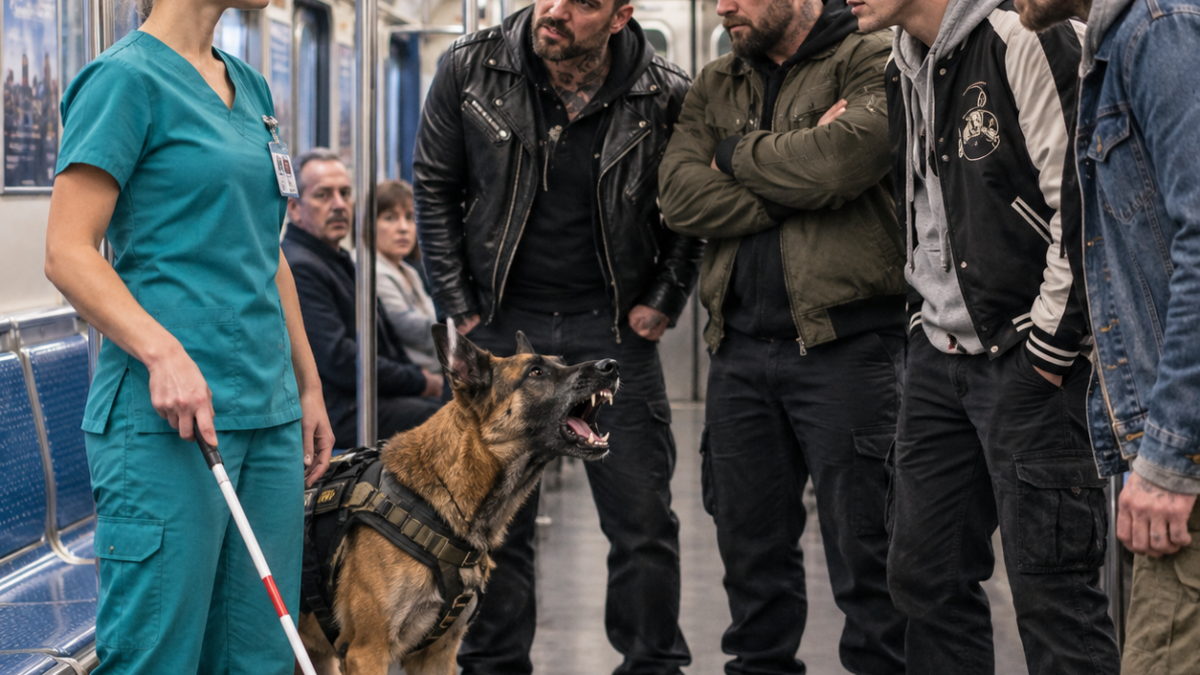
PART3:
Sarah said nothing.
“Phone.”
Nothing.
Then he added, “And the dog.”
Codex’s breathing changed again.
Sarah almost felt sorry for them.
Almost.
“You don’t want the dog.”
The second man snorted.
“What, he gonna lick us to death?”
Sarah heard fabric move.
Then a very specific click.
Metal.
Folding knife locking open.
Her pulse did not race.
That frightened her sometimes, afterward.
The calm.
People liked to imagine courage as a feeling.
Sarah knew better.
Training did not make fear disappear.
Training simply gave fear a smaller room to occupy.
The man with the blade was now approximately nine feet to her left.
Second man ten feet right.
Third man moving behind her.
“Last chance,” Sarah said.
The knife carrier laughed.
“For you?”
“No.”
She dropped her voice.
“Codex.”
The Malinois’s ears lifted.
“Guard.”
The next four seconds sounded like chaos to everyone except Sarah.
Codex launched.
His nails struck tile twice.
Then came the explosive impact of more than ninety pounds of conditioned working dog hitting a grown man in the chest.
A body slammed against the tiled wall.
The knife clattered away.
The second attacker swore.
Sarah pivoted toward his voice.
He rushed.
Too fast.
Too loud.
People who had never fought anyone trained always believed speed created surprise.
Usually it created information.
Sarah heard the intake of his breath.
The scrape of his right shoe.
The movement of his jacket.
She stepped off his centerline.
His arm passed close enough that she felt air against her face.
Sarah drove one compact strike into him.
Not dramatic.
Not cinematic.
Just enough.
Bone met bone.
He stumbled into the bench.
The third man stopped moving.
Sarah turned toward him.
“Whatever you’re holding, put it down.”
Silence.
Codex snarled somewhere to her left.
The first attacker screamed, “Get this thing off me!”
Sarah ignored him.
The third man breathed quickly.
She heard plastic shift in his hand.
“Now.”
Something heavy hit the floor.
A flashlight.
“Hands where I can hear them.”
“What?”
“Get on the ground.”
He did.
Sarah moved backward until her calf touched the bench.
She now had a physical reference point.
“Codex.”
The dog remained engaged.
“Out.”
Immediately the growling stopped.
The injured attacker curled around his arm.
Sarah heard him whimpering.
She reached for her phone.
Then the floor kicked beneath her.
A concussive boom rolled up through the platform.
Everyone screamed.
The lights died.
Sarah did not notice that part.
But the three men did.
“What the hell?”
“Oh God.”
“What happened?”
Sarah heard the electrical system fail in layers.
First the deep hum vanished.
Then ventilation fans slowed.
Then emergency relays clicked.
A faint alarm began somewhere near the tunnel.
The air changed.
Codex returned to her side.
Sarah placed one hand against his shoulder.
“Easy.”
Then she heard something coming from the north tunnel.
Metal.
Brakes.
Not normal braking.
A terrible grinding howl rose beneath the city.
The kind of sound that bypassed thought and went directly into the spine.
Sarah turned toward it.
The train struck something.
Not head-on.
Side impact.
Heavy.
One enormous slam followed by smaller collisions and the violent chorus of glass, metal, and human voices.
Then screaming.
The second attacker whispered, “Jesus.”
Sarah was already moving.
The third man said, “Where are you going?”
“Tunnel.”
“There was a crash.”
“I know.”
“You’re blind!”
Sarah stopped.
Turned toward his voice.
“Yes.”
Then she pointed at the phone she heard him fumbling for.
“Call 911.”
“What?”
“Veilar Station. North tunnel. Partial derailment. Multiple casualties. Electrical failure. Smoke possible.”
She listened.
He said nothing.
“Repeat it.”
“Veilar Station. North tunnel. Train crash. People hurt.”
“Good enough.”
“What about us?”
Sarah took Codex’s harness.
“You wanted to rob a blind woman.”
She turned toward the tunnel.
“Figure it out.”
Four hours earlier, Dr. Garrett Hargrove had stood in Trauma Bay Four at Callaway Regional Medical Center and told Sarah she was a danger to patients.
She remembered his exact words.
She remembered exact words the way some people remembered faces.
It was 6:22 p.m.
Her shift had already lasted eleven hours.
Her scrubs smelled like antiseptic, sweat, and burned coffee.
Her hair had been tied back that morning and had gradually escaped until several strands brushed the side of her face.
Codex rested beneath the workstation, quiet enough that new residents occasionally forgot he was there.
Danny Okafor stood beside Sarah with a tablet.
“Read it again,” Sarah said.
Danny hesitated.
“Sarah—”
“The dosage.”
“Hydromorphone, four milligrams IV.”
“Renal function?”
“GFR twenty-eight.”
Sarah’s hand stopped above her Braille display.
“That’s wrong.”
Danny lowered his voice.
“Hargrove signed it.”
“I heard you.”
“He reviewed her twenty minutes ago.”
“Then he reviewed her badly.”
Danny exhaled.
The trauma department moved around them.
Phones.
Monitors.
Shoes against tile.
A patient crying behind a curtain.
Sarah had spent three years at Callaway learning to hear the hospital the way other clinicians saw it.
She used screen-reading software, Braille labels, voice relay, tactile medication verification systems, and redundancies that had initially irritated colleagues until they realized Sarah made fewer documentation errors than almost anyone on the unit.
Her blindness was not the reason she caught the dosage problem.
Her attention was.
“Get pharmacy,” Sarah said.
Danny looked uneasy.
“Sarah.”
“What?”
“This is Hargrove.”
“And Mrs. Madsen has kidneys regardless of who signed the order.”
Danny almost laughed.
Didn’t.
“Get pharmacy.”
“What’s the problem?”
Hargrove’s voice arrived behind her.
Sarah knew him by sound before he spoke.
Heavy step.
Expensive shoes.
A particular way of clearing his throat before entering conversations he intended to control.
He was fifty-three and had been an attending physician at Callaway for eleven years.
Sarah had once heard a resident describe him as “the kind of doctor who believes hierarchy is a vital sign.”
She had laughed.
Then learned it was accurate.
“The Madsen order,” Sarah said.
“What about it?”
“Dose is too high with her renal function.”
Hargrove exhaled.
“Her pain management is my decision.”
“Your decision is still subject to medication safety.”
“I reviewed the patient.”
“So did I.”
The room quieted slightly.
Hargrove stepped closer.
“You reviewed her chart through another nurse reading it to you.”
Sarah kept her face neutral.
“I reviewed the chart through an approved accessibility workflow.”
“Which means you did not see what I saw.”
“No.”
She tilted her head toward him.
“I saw nothing.”
Several nurses stopped moving.
Sarah continued.
“But I heard a GFR of twenty-eight and an order for four milligrams. Those numbers don’t change because you’re annoyed.”
Danny coughed to hide something dangerously close to laughter.
Hargrove heard it.
His voice hardened.
“You’re challenging an attending physician’s judgment in the middle of my trauma floor.”
“I’m flagging a medication order under hospital protocol.”
“You think you understand the full clinical picture?”
“I understand enough to stop a potentially dangerous dose until it’s reviewed.”
“You understand what people describe to you.”
There it was.
Sarah felt Codex rise beneath the desk.
Not aggressively.
Alert.
She kept one hand down beside him.
Hargrove turned slightly.
Not toward her anymore.
Toward the room.
“You know what concerns me?”
Sarah’s jaw tightened.
Nobody answered.
Hargrove continued.
“We have created a situation where everyone is so terrified of appearing insensitive that we no longer ask whether someone can actually perform the job safely.”
Danny whispered, “Oh, hell.”
Sarah said, “Garrett.”
He kept going.
“A trauma unit is not a social experiment.”
The room went completely still.
Sarah had experienced this kind of moment many times since losing her sight.
Not always this ugly.
Usually subtler.
A pause before someone let her touch equipment.
A doctor explaining something twice after she had already answered correctly.
A patient asking whether “a normal nurse” would also be checking in.
People lowering their voices as if blindness had affected hearing and intelligence simultaneously.
She had learned something important.
Do not rescue people from the discomfort created by their own prejudice.
Let them finish.
Hargrove finished.
“You rely on other people to provide information you physically cannot verify. That makes you a liability.”
Sarah waited two seconds.
Then said, “Are you done?”
His breathing changed.
“I beg your pardon?”
“Because if you are, I’m documenting the medication objection and this conversation.”
“You’re threatening me?”
“No.”
Sarah touched the edge of her tablet.
“I’m creating a record.”
That frightened him.
She heard it.
Not immediately in his words.
In the half-second before them.
“Security.”
Danny stepped closer.
“Dr. Hargrove—”
“Not you.”
Hargrove spoke louder.
“I want Nurse Voss removed from my department pending administrative review.”
Sarah’s pulse finally accelerated.
There it was.
Not because she feared losing the job.
Because the medication order still existed.
“What about Mrs. Madsen?”
“I’ll manage my patient.”
“Danny.”
Sarah turned toward him.
“Call pharmacy yourself.”
Hargrove said, “You’re done giving instructions.”
Sarah faced his voice again.
“No.”
Her tone remained flat.
“I’m done taking yours seriously.”
Two security officers arrived seven minutes later.
They were polite.
That almost made it worse.
The younger one apologized twice while walking her toward the elevator.
Sarah held Codex’s harness in her left hand and carried her bag over one shoulder.
Her back remained straight.
Inside the elevator, the security officer cleared his throat.
“For what it’s worth…”
Sarah waited.
“I heard about the medication thing.”
She said nothing.
“I think you were right.”
“I was right.”
The man went quiet.
Sarah immediately regretted how harsh it sounded.
Then decided she did not.
He asked, “What happens to the patient?”
“Either someone else catches it.”
“And if they don’t?”
Sarah turned her face toward the elevator doors.
“That’s why this matters.”
She walked from Callaway at 7:19 p.m.
The city smelled like rain.
Codex pressed against her leg.
Three years earlier, Sarah had woken in a military hospital with bandages covering both eyes and Colonel Nathan Callum sitting beside the bed.
He had been a major then.
She had been Staff Sergeant Sarah Voss, Air Force medical operations specialist attached to a joint evacuation team.
Her path into medicine had started before the military.
Her mother was a pediatric nurse.
Her father was a firefighter.
Sarah grew up in Ohio believing emergencies were simply a normal reason dinner might get interrupted.
At nineteen, she enlisted.
At twenty-two, she entered advanced medical training.
At twenty-four, she began working combat evacuation missions.
Sarah was not the person kicking doors.
She was the person people called after doors had been kicked.
She stabilized injuries in aircraft vibrating so hard she sometimes had to brace medication against her own body to draw a dose.
She had treated soldiers, civilians, children, allied personnel, and once an enemy fighter whose friends had tried to kill her team forty minutes earlier.
People asked whether that had been difficult.
It hadn’t.
He was bleeding.
She was a medic.
Simple things sometimes remained simple even inside terrible places.
Codex belonged to another team then.
A military working dog.
Belgian Malinois.
Lean.
Relentless.
Suspicious of everyone except his handler and Sarah.
She had stitched his shoulder once after shrapnel tore through the edge of his tactical vest.
Codex remembered her afterward.
Every time he saw Sarah, he attempted to inspect her pockets for the dried meat she had used during treatment.
His handler complained she had corrupted government property.
Sarah considered that one of her better achievements.
Then came the blast.
She remembered sound.
Pressure.
Heat.
The feeling of being lifted sideways inside the vehicle.
Then nothing.
The explosion damaged the optic pathways and caused severe traumatic injury.
For eight days doctors would not tell her whether vision might return.
On day nine, one specialist finally stopped speaking in probabilities.
Permanent.
Sarah remembered the silence afterward.
Then Callum’s voice.
“I’m here.”
She had hated him for saying it.
Not rationally.
She hated everybody who still had eyes that worked.
For eleven days she refused visitors other than immediate medical staff.
She refused counseling.
Refused adaptive technology sessions.
Refused to talk about future employment.
Then an overnight nurse named Bridget Moran entered at 3:02 a.m. and found Sarah awake.
“Can’t sleep?”
Sarah said nothing.
Bridget adjusted something near the bed.
“You’re allowed to be angry.”
“I’m not angry.”
“Fine. You’re extremely pleasant.”
Sarah almost smiled despite herself.
Bridget continued.
“You’re also allowed to grieve.”
“I know.”
“No, you don’t.”
Sarah turned her head.
Bridget was not gentle.
Sarah liked her for that later.
At the time she wanted to throw something.
“You can grieve what happened,” Bridget said, “and still choose what you’re going to do next.”
Sarah’s jaw tightened.
“That sounds like something printed on a hospital wall.”
“Those are usually shorter.”
“Please leave.”
“I will.”
Bridget reached the door.
Then stopped.
“One of those things happened to you.”
Sarah waited.
“The other one belongs to you.”
The door closed.
Sarah hated that sentence for almost a year.
Then built her life around it.
She learned Braille slowly.
Then faster.
Orientation and mobility.
Adaptive computing.
Medical accessibility systems.
She completed nursing credentials she had begun planning before her injury.
People told her how inspiring she was.
She learned to dislike that word because most people used it when they meant surprising.
Codex returned to her life near the end of rehabilitation.
His military handler had been injured and later left service.
Codex was older but healthy.
A joint working-dog transition program evaluated him for specialized assistance work.
Sarah submitted an application mostly because Callum dared her.
“He’s impossible,” Sarah had said.
“So are you.”
“He bites.”
“Only people he dislikes.”
“That’s reassuring.”
“He likes you.”
Codex came home with Sarah six months later.
The first year was chaos.
The second became partnership.
By the third, he knew her rhythms better than most humans did.
He guided her through hospital corridors, city sidewalks, trains, elevators, airports, grocery stores, and the complicated choreography of a life people kept expecting to be smaller than she wanted.
What almost nobody at Callaway knew was that Codex had not forgotten his original training.
Neither had Sarah.
She simply had no reason to use hers.
Until Veilar Station.
The smoke inside the tunnel reached her before the first derailed car did.
Electrical.
Burned insulation.
Dust.
Metal.
Not heavy enough yet to make breathing difficult.
Sarah shortened Codex’s lead.
“Forward.”
He moved carefully.
The tunnel had a narrow maintenance walkway along one side.
Sarah kept one hand against the wall when needed.
Voices grew louder.
“Help!”
“Somebody!”
“My daughter can’t breathe!”
That one changed everything.
Sarah increased her pace.
The first rail car had tilted slightly.
Its doors were jammed.
People pounded from inside.
Sarah approached the opening.
“I’m a nurse!”
The banging stopped for half a second.
“Can anyone open the emergency release?”
“It’s stuck!”
“Move away from the door.”
“What?”
“Move.”
She felt the door seam.
Bent metal.
Not fully crushed.
She braced.
Pushed.
Nothing.
Adjusted position.
Pushed again.
The door moved perhaps an inch.
Someone inside grabbed it.
Together they widened the gap enough for Sarah to squeeze through.
The reaction was immediate.
“Thank God.”
“Who is that?”
“She has a dog.”
“Wait—she’s blind.”
Sarah stood inside the tilted train car.
“Yes.”
Silence.
“Now that we’ve completed the observational portion of the evening, where’s the child who can’t breathe?”
A woman said, “Back here.”
Sarah followed the voice.
The girl was eight.
Nadia.
Asthma.
No inhaler.
Terrified.
Breathing too fast and too shallow.
Sarah knelt.
“Nadia?”
The child sobbed.
“My name is Sarah.”
“I can’t breathe.”
“I know.”
“Mom—”
“Your mom is right here.”
Sarah turned.
“Mom, hold her hand.”
The woman grabbed Sarah instead.
“Please save her.”
Sarah squeezed her wrist.
“I need you calm enough to help me.”
“I can’t.”
“Yes, you can.”
Sarah placed the mother’s hand on Nadia’s shoulder.
“Do that.”
The woman obeyed.
Sarah focused on Nadia.
Not pretending the situation was harmless.
Not telling her to relax.
Children know when adults lie.
“Nadia, listen to my voice.”
The child wheezed.
“You’re having trouble breathing. That’s scary. We’re going to make the next breath easier than this one.”
Sarah repositioned her.
Asked someone to clear debris.
Asked another passenger to identify whether emergency ventilation had activated.
Another person located a first-aid compartment.
No bronchodilator.
Sarah worked with what she had.
She created order.
That was what trauma medicine often was.
Not miracle treatment.
Order.
Who is breathing?
Who is bleeding?
Who can walk?
Who cannot?
What kills first?
What can wait?
One problem at a time until panic becomes tasks.
Codex sat beside Nadia’s mother.
She clutched his fur.
He allowed it.
Sarah heard his collar shift.
“Good boy.”
Nadia’s breathing gradually became less frantic.
Then Sarah heard another voice.
Beyond the damaged connecting door.
Male.
Familiar.
“I need—I’m a physician. Someone needs to get light in here.”
Sarah went still.
Hargrove.
Of course.
Because apparently the universe had developed a sense of humor.
She moved toward the damaged connection.
“Dr. Hargrove.”
Silence.
Then:
“Who is that?”
“Sarah Voss.”
Longer silence.
“How are you here?”
“Less important than how many injured patients are with you.”
Hargrove breathed hard.
“At least six.”
“Critical?”
“One unconscious.”
“Breathing?”
“Yes.”
“Responsive to pain?”
“I—there’s no light.”
Sarah almost laughed.
Not because it was funny.
Because four hours earlier he had explained that sight was the difference between competence and danger.
Now darkness had removed the thing he believed made him superior.
“Use your hands.”
He said nothing.
Sarah continued.
“Find the unconscious patient.”
“I know how to assess a patient.”
“Then do it.”
Silence.
Then movement.
Hargrove began describing what he found.
Sarah guided him through the rest.
Not to humiliate him.
That mattered.
She could have.
For a brief second she wanted to.
Instead she heard Bridget’s old voice in her head.
One thing happened to you.
The other belongs to you.
Sarah chose the patient.
Always the patient.
Hargrove followed her instructions.
By the time responders reached the tunnel, Sarah had Nadia stabilized, organized an evacuation chain, identified three passengers who needed urgent transport, and helped Hargrove maintain the unconscious man’s airway without moving his neck unnecessarily.
Then she heard boots.
Not transit police.
Not firefighters.
Military cadence.
“Clear a path.”
Sarah froze.
Codex stood.
That voice.
Three years vanished.
“Voss?”
She smiled despite exhaustion.
“Major Callum.”
A pause.
“Colonel.”
“Congratulations.”
“This is how you find out?”
“Apparently.”
Callum stepped closer.
Sarah could feel the reaction he was trying to suppress.
“You came into the tunnel before responders?”
“There was a child.”
“Of course there was.”
Codex pressed against Callum’s leg briefly.
“You too, traitor,” Sarah said.
Callum crouched and touched the dog’s shoulder.
Then stood.
“Who’s the physician in the second car?”
Hargrove spoke from behind the damaged connector.
“Dr. Garrett Hargrove. Callaway Regional.”
Callum’s voice changed.
“You were managing those patients?”
“I was doing what I could under extremely compromised circumstances.”
Sarah said nothing.
Callum asked, “Were you the physician receiving clinical guidance through that door?”
Hargrove went silent.
Callum waited.
“Yes.”
“And Nurse Voss was providing it?”
“Yes.”
Another pause.
Callum turned toward Sarah.
“Were you removed from Callaway tonight?”
Hargrove spoke quickly.
“That is an internal hospital matter.”
Callum did not raise his voice.
“Doctor, I didn’t ask you.”
Sarah answered.
“Yes.”
“Why?”
“I flagged a medication order.”
Hargrove said, “That characterization is incomplete.”
Sarah continued.
“Four milligrams hydromorphone. GFR twenty-eight.”
Callum’s silence lasted two seconds.
Then:
“You got removed for flagging that?”
“Among other things.”
Hargrove snapped, “Her conduct was insubordinate.”
Callum turned toward him.
Sarah knew because his boots shifted.
“Dr. Hargrove.”
“Yes?”
“I have spent the last eighteen minutes watching a blind nurse conduct triage inside a dark derailed train while guiding you through an examination you said you could not perform because you lacked lighting.”
Hargrove did not answer.
Callum continued.
“So if your next sentence concerns her competence, choose it carefully.”
The tunnel became quiet enough that Sarah heard Nadia’s mother whisper, “Damn.”
Sarah almost laughed.
The hospital’s trouble began before she returned.
Sandra Wylie, the overnight nursing supervisor, pulled the medication audit log because Danny refused to let the Madsen order disappear.
What she found took four minutes.
Sarah’s original safety flag.
Timestamp: 6:41 p.m.
Hargrove’s first alteration.
7:03.
Second alteration.
7:14.
Clinical rationale added retroactively.
Pain score changed.
Documentation expanded.
Sarah removed from the department at 7:15.
When Sarah arrived back at Callaway shortly after 1:00 a.m. to have her bruised hip and cut hand assessed, she heard Sandra confronting Hargrove near the administrative desk.
“You changed the medication field.”
“I corrected the record.”
“You changed the rationale eleven minutes later.”
“I clarified my assessment.”
“You created documentation after the objection.”
“I updated documentation.”
Sandra’s voice flattened.
“Garrett.”
Silence.
“I have the audit trail.”
Longer silence.
“I performed extremely well tonight under difficult circumstances.”
Sarah stopped walking.
Hargrove continued.
“I assisted multiple injured passengers.”
“You were guided by Sarah through a damaged door.”
“That is a ridiculous simplification.”
“Three transit officers heard it.”
Sarah could almost feel his humiliation from thirty feet away.
Sandra said, “Go home.”
“You have no authority to—”
“I called Dr. Naveen Osei.”
That stopped him.
“He’ll be here at six.”
“What did you tell him?”
“The truth.”
Sarah heard Hargrove coming toward her.
Codex stood beside her.
Hargrove stopped.
“Voss.”
“Dr. Hargrove.”
He remained silent for several seconds.
Then:
“The Madsen dose was not administered.”
Sarah’s shoulders loosened.
“Good.”
“Danny caught it after you left.”
“Good.”
Hargrove seemed to be waiting for more.
Vindication.
Attack.
Anything.
Sarah gave him nothing.
The patient was safe.
That mattered.
The rest would come.
Hargrove walked away.
At 3:40 a.m., Callum returned with Captain Adara Mensah.
Mensah was military legal liaison attached to a joint federal task group.
Her interest was not initially Hargrove.
It was the three men from the platform.
Two had been linked to assaults on disabled commuters in other cities.
Eleven known cases.
Two severe injuries.
Victims targeted near transit exits and isolated platforms.
Sarah listened.
Codex slept with his head on her boot.
“Why me?”
Mensah said, “That’s what we’re trying to determine.”
“Random?”
“Possibly.”
Callum said nothing.
Sarah knew that silence.
“What?”
He exhaled.
“Transit security says the emergency gate was manually altered.”
“When?”
“Six days ago.”
Sarah sat straighter.
“So they prepared the station.”
“Yes.”
Mensah continued.
“One attacker had a partially wiped phone.”
“Partially?”
“Forensics recovered one call from tonight.”
“What time?”
“6:58 p.m.”
Sarah did not move.
The trauma bay returned instantly.
6:41 flag.
Hargrove confrontation.
Security request.
Removal 7:15.
6:58.
Seven minutes after Sarah had told him she would formally document the objection.
Callum asked quietly, “Who knew your route home?”
Sarah felt cold.
“My schedule is in my accommodation file.”
Mensah’s chair shifted.
“Why?”
“The hospital coordinates accessible transit planning for several employees.”
“Who can access it?”
“HR.”
She paused.
“Department heads.”
Callum swore softly.
Sarah said, “Hargrove opened my accommodation file before.”
“You know that?”
“He referenced information from it during a scheduling dispute.”
Mensah stood.
“I’m getting the access log.”
Callum leaned closer.
“You’re not going home alone.”
“Yes, I am.”
“Sarah.”
“I have Codex.”
“That is not the argument you think it is after tonight.”
“It’s exactly the argument.”
“Someone set a station trap around your route.”
“We don’t know that.”
Callum’s voice hardened.
“We know enough.”
Sarah rubbed Codex’s ear.
His stitched ear.
He had been cut during the attack.
Minor.
Still enough to make her angry.
“Fine.”
Callum seemed surprised.
“You’re agreeing?”
“I’m exhausted, not irrational.”
“That distinction has historically been narrow with you.”
She smiled despite herself.
At 6:05, Dr. Naveen Osei arrived.
Chief of Medicine.
Quiet man.
Fifty-eight.
Known for making people uncomfortable because he actually listened when they spoke.
He sat across from Sarah.
“I’ve read the reports.”
“Which ones?”
“All of them.”
“That sounds terrible.”
“It was.”
He asked for her account.
Sarah gave it.
No dramatics.
No insult.
No speculation.
Medication.
Objection.
Hargrove.
Security.
Station.
Attack.
Train.
Nadia.
Hargrove in the second car.
Callum.
Osei listened.
When she finished, he said, “Hargrove filed a counter-report at 2:47.”
Sarah laughed once.
“Of course.”
“He alleges reckless conduct in the tunnel.”
“Reasonable.”
Osei’s eyebrows probably moved.
Sarah could hear the pause.
“You think so?”
“Entering a damaged tunnel before responders arrived carried risk.”
“Would you do it again?”
“Yes.”
“Then why call the criticism reasonable?”
“Because something can be risky and still be necessary.”
Osei nodded.
“He also raises questions about clinical fitness.”
“Because I’m blind.”
“Yes.”
Sarah leaned back.
“He wants the doubt in the record.”
Osei said nothing.
“That’s how it works. He doesn’t need to prove I’m incompetent today. He just needs future administrators to see the question.”
“I’m required to open a review.”
“I know.”
“You are not suspended.”
That surprised her.
Osei continued.
“Hargrove is.”
Sarah remained still.
“The documentation alteration alone requires it.”
“What about Mrs. Madsen?”
“Stable.”
“Does she know?”
“Not yet.”
“She should.”
“The board will determine disclosure.”
“Someone nearly gave her an unsafe dose.”
Osei paused.
“There’s a liability distinction between an order and an administered medication.”
Sarah shook her head.
“Not to a kidney.”
Osei was silent.
Then said, “No.”
That was when she began respecting him.
At 7:03, Sarah finally left.
Her phone rang before she reached the lobby door.
Transit Safety Division.
Deputy Director Holt Faraday.
He confirmed the gate had been deliberately compromised.
Confirmed the wiped phone.
Then asked whether anyone had reason to know Sarah’s schedule.
By noon, Mensah had the access log.
Sarah was sleeping when the call came.
Four hours.
That was all her body allowed.
She woke with Codex pressed against her back.
Her phone announced Mensah’s name.
Sarah answered.
“Tell me.”
“Your accommodation file was accessed at 6:44 p.m.”
Sarah sat upright.
Fourteen minutes before the burner call.
“Whose credentials?”
“Hargrove.”
The room went silent.
Mensah continued.
“His login. His terminal. His access badge.”
Sarah’s stomach tightened.
“Do you have the number trace?”
“Yes.”
“And?”
“Burner phone.”
“Registered?”
“No.”
“Purchased?”
“Fourteen days ago in Merwick.”
Merwick.
One of the earlier assault cities.
Sarah stood.
Codex stood immediately.
“This wasn’t panic.”
“No.”
“He had the number before last night.”
“That is our working assumption.”
Sarah walked toward the kitchen.
“So he anticipated needing these people.”
“Possibly.”
“Or used them before.”
Mensah said nothing.
Sarah stopped.
“How many former Callaway employees are among the eleven victims?”
“We’re checking.”
“Check Hargrove’s department.”
“We are.”
That afternoon Sarah gave a formal federal interview.
Ninety minutes.
Every detail.
Every timestamp.
Every word.
Mensah asked about the medication order.
Sarah confirmed it.
Mensah already had the backup.
Original order preserved at 7:01.
Hargrove’s change at 7:03.
Retroactive rationale later.
“He built a defense after the objection,” Sarah said.
“That is what the evidence suggests.”
“And removed me.”
“Yes.”
Sarah’s mouth tightened.
“But that still doesn’t explain why he had a contact number for men attacking disabled commuters.”
“No.”
Mensah closed the folder.
“That’s the part we’re going to answer.”
Hargrove made the next mistake himself.
Suspended, frightened, and apparently convinced he still understood the hospital better than anyone investigating him, he returned through a staff entrance before his physical badge had been deactivated.
Danny called Sarah.
“He’s here.”
“What?”
“Hargrove.”
“He’s suspended.”
“The building access system hadn’t updated.”
“What’s he doing?”
“He went to records.”
Sarah stopped walking.
“Why?”
“He asked for the Madsen file.”
Pause.
“And yours.”
Her stomach tightened.
“Did they give them to him?”
“No.”
“Where is he now?”
“Security is removing him.”
Danny lowered his voice.
“But he made a phone call.”
“What did he say?”
“Records staff heard him.”
Danny breathed.
“He said, ‘It’s in the third drawer. Move it before six.’”
Sarah’s mind reorganized instantly.
“A physical file.”
“That’s what I thought.”
“Which office?”
“They don’t know.”
Sarah called Callum.
Federal investigators searched Hargrove’s private office.
At 5:28 p.m., they found a steel document case in the lower filing cabinet.
Locked.
Hospital property tag.
Checked out fourteen months earlier.
The same month as the first assault connected to the network.
Inside were complaint files.
Not official copies.
Private ones.
Documents written about nurses, residents, and one attending physician.
Some matched formal incidents.
Many did not.
Performance concerns.
Behavior observations.
Notes describing staff members as difficult, unreliable, unstable, overly confrontational.
Eight people had disability accommodations.
One file had Sarah’s name.
Created four months earlier.
Before the Madsen order.
Before the station.
Before the attack.
Sarah listened to Osei describe it over the phone.
“He was building a record on me.”
“It appears that way.”
“What incident?”
“There’s one dated four months ago.”
“What happened?”
“We cannot find any event matching it.”
Sarah laughed without humor.
“So nothing.”
“Apparently.”
“What does it claim?”
“That you failed to verify a medication because of an accessibility delay.”
Sarah went still.
“That never happened.”
“We know.”
“How?”
“Because every medication incident on your shifts is logged electronically.”
Sarah paced.
“He was preparing.”
Osei said, “Yes.”
“For what?”
Neither answered.
Then the investigation found Brent Fino.
Deputy Director of Hospital Operations.
Nine years at Callaway.
Responsible for routing many administrative complaints.
His face appeared on security footage purchasing the burner phone used to contact the attackers.
Fino disappeared the day investigators searched Hargrove’s office.
State police found him at a highway rest stop before midnight.
Engine off.
Hands already on the dashboard when they approached.
People who run sometimes imagine they are confessing only to fear.
Often they confess to knowledge.
Fino asked for an attorney.
A real one.
By morning, federal investigators had enough to break the architecture open.
Fino and Hargrove had not started as equal conspirators.
Hargrove had begun by using Fino administratively.
Complaints disappeared.
Performance reports grew.
Employees who challenged medication practices found themselves under unusual scrutiny.
Some resigned.
Some were pushed.
Fino learned those employees were vulnerable.
Isolated.
Often unemployed.
Some disabled.
Several dependent on public transit.
Then Fino met a criminal organizer through a separate financial scheme.
The relationship evolved.
Information became currency.
Names.
Schedules.
Transit patterns.
Former Callaway workers who had already been made to look unreliable.
Six of the eleven assault victims had worked at Callaway.
Six.
Sarah sat in the Aldenmore briefing room while Mensah explained it.
Codex lay beneath the table.
“So Hargrove gave him the targets.”
“Not directly in every case.”
“But he created the files.”
“Yes.”
“And Fino passed them to the network.”
“Yes.”
Sarah felt sick.
“What did they want?”
“Money in some cases.”
Mensah paused.
“Intimidation in others.”
“Meaning?”
“Some victims had active complaints or were considering external action.”
Callum said quietly, “Fear discourages persistence.”
Sarah turned toward him.
“Someone thought disabled people would be easier to scare.”
Nobody answered.
That was answer enough.
Yara Obasi had been one of them.
A nurse with partial vision.
Driven from Hargrove’s department eighteen months earlier after a manufactured performance dispute.
Three weeks later, she was assaulted outside a transit stop.
Her bag stolen.
Phone broken.
Complaint records missing afterward.
She had believed the events were unrelated.
When Sarah called her, Yara remained silent for a long time.
Then said, “I knew.”
Sarah leaned closer to the phone.
“Knew what?”
“That something was wrong.”
“With Hargrove?”
“With all of it.”
Her voice shook.
“But everyone kept making each thing small.”
Sarah closed her eyes.
“That’s how systems hide patterns.”
Yara laughed bitterly.
“You sound like you’ve had time to think about this.”
“Not enough.”
“I stopped nursing.”
Sarah knew.
“Why?”
“I couldn’t walk into a hospital without feeling like I had to prove I belonged before touching a patient.”
Sarah swallowed.
“I’m sorry.”
“I don’t want your sympathy.”
“You don’t have it.”
Yara went quiet.
Sarah continued.
“You have my anger.”
That produced a tiny laugh.
“Better.”
Another former nurse, Odet Ferris, described the same process.
Small criticisms.
Unverifiable incidents.
Private meetings.
A formal complaint routed through Fino.
Dismissed.
Three months later, she left.
Sarah spent hours listening to people who had been told, one by one, that their experiences were isolated.
The pattern made her angrier than the attack.
The men in the station had been obvious.
Knife.
Threat.
Three bodies closing in.
Institutional cruelty was cleaner.
Paper.
Meetings.
Language.
Concern.
Fitness.
Professionalism.
Reliability.
The words were respectable.
The consequences were not.
Sarah’s own fitness review happened five days later.
A hospital board member read the conclusion.
“The complaint does not establish a credible clinical fitness concern.”
Sarah said nothing.
“The allegations are directly contradicted by witness statements, federal incident reports, and documented clinical outcomes.”
Still nothing.
“Your review is closed.”
Sarah finally breathed.
“The board also wishes to recognize that your actions in the Veilar incident reflected exceptional professional competence.”
Sarah tilted her head.
“Can I go back to work?”
Dr. Osei almost laughed.
“Tomorrow.”
“Today.”
“Tomorrow.”
“I have patients.”
“And you have bruised ribs.”
“Hip.”
“Also ribs.”
Sarah sighed.
“Fine.”
She took one day.
Walked through Drenwick with Codex.
Coffee shops.
Traffic.
Schools.
Construction.
The city remained itself even while her life was being discussed in federal offices.
That helped.
Then Osei called.
“Sarah.”
His voice was wrong.
Not frightened.
Heavy.
“What?”
“Another nurse.”
“Who?”
“Yara Obasi.”
Sarah stopped.
“What about her?”
“She filed an external complaint after leaving Callaway.”
“I know.”
“It was referred back internally.”
Sarah’s jaw tightened.
“To Fino?”
“Yes.”
“And disappeared.”
“Yes.”
Sarah closed her eyes.
The system had not merely failed.
It had returned victims to the people harming them.
That realization changed the case publicly.
Hargrove’s attorney called everything misunderstanding.
Clinical disagreement.
Administrative irregularities.
Personal notes.
Coincidence.
Fino began cooperating.
Coincidence collapsed.
The three station attackers were charged.
One pleaded early.
The organizer was arrested on an unrelated warrant.
Fino faced conspiracy and obstruction charges.
Hargrove was charged with falsification, endangerment-related offenses, conspiracy, and additional counts arising from his role in the targeting network.
His medical license was suspended.
Callaway forced resignations from administrators connected to Fino.
Complaint routing was rebuilt so department heads could no longer control complaints against themselves.
External review became mandatory.
Sarah cared about that more than Hargrove’s humiliation.
Consequences mattered.
But systems mattered longer.
Three weeks after arraignment, Callum appeared at Callaway wearing civilian clothes.
Sarah recognized him before he spoke.
Codex’s tail struck her leg.
“You’re off duty,” Callum said.
“Almost.”
“You’re writing notes.”
“Yes.”
“That means you’re off duty.”
“It means I’m writing notes.”
“You’ve become more difficult.”
“No.”
Sarah stood.
“I was always difficult.”
They walked outside.
Codex moved between them.
Callum said, “You’re getting a military commendation.”
“No.”
“Yes.”
“For what?”
“Tunnel response.”
“I’m civilian.”
“You were trained by the military.”
“That sounds like the military taking credit.”
“It’s our favorite thing.”
Sarah smiled.
“And Drenwick is giving you a public commendation.”
“Oh God.”
“You’ll survive.”
“Unclear.”
They walked quietly.
Then Callum asked, “Do you remember what you told Yara?”
Sarah knew immediately.
“The feeling doesn’t get to be in charge.”
“Yes.”
“I didn’t invent that.”
“Who did?”
Sarah told him about Bridget.
The overnight nurse.
The rehabilitation room.
Three in the morning.
“You can grieve this and still choose what you’re going to do.”
Callum listened.
“When did you finally understand her?”
Sarah thought.
“Gradually.”
Then smiled.
“Completely?”
“Yes.”
“The tunnel.”
Callum waited.
“I walked into a dark train because there was a child who needed help.”
She adjusted Codex’s harness.
“And for the first time I understood that darkness wasn’t the thing defining the situation.”
“What was?”
“Need.”
Callum said nothing.
Sarah continued.
“Nadia needed a nurse.”
“Not a sighted nurse.”
“No.”
“Just a nurse.”
“Yes.”
Callum exhaled.
“That should’ve been obvious.”
“It is.”
“Apparently not to everyone.”
Sarah smiled faintly.
“That was their failure of imagination.”
Seven months later, Garrett Hargrove went to trial.
Sarah testified on the second day.
The courtroom was full.
Reporters.
Former employees.
Hospital staff.
Yara sat behind the prosecutors.
So did Odet.
Danny sat beside Sandra.
Callum remained near the rear.
Codex lay beside Sarah’s witness chair.
Hargrove’s attorney tried to undermine her medication review.
“You did not visually read Mrs. Madsen’s chart yourself.”
“No.”
“You depended upon another nurse.”
“I used a hospital-approved accessibility process.”
“So your information was secondhand.”
“No.”
“Someone else spoke the numbers.”
“Yes.”
“That is secondhand information.”
Sarah tilted her head.
“When a physician dictates a note and another person enters it, is the physician’s medical judgment secondhand?”
The attorney paused.
“That isn’t what I asked.”
“No.”
Sarah remained calm.
“You asked a less accurate version.”
A few people laughed.
The judge silenced them.
The attorney continued.
“Is it possible Nurse Okafor misread the dosage?”
“Yes.”
“And renal function?”
“Yes.”
“So your conclusion could have been wrong.”
“Which is why I flagged it for review rather than administering medication based on an assumption.”
The attorney stopped.
Sarah continued before he could object.
“And the system backup independently confirms Nurse Okafor read both values correctly.”
The attorney looked toward his notes.
“Nothing further.”
Hargrove was convicted on the most serious documentation and conspiracy-related counts.
Other counts remained tied to separate proceedings.
Fino’s cooperation reduced his sentence but did not erase it.
Several members of the assault network received lengthy prison terms.
The outcomes were not perfect.
Justice rarely arrives in a clean package.
Some charges failed.
Some victims felt sentences were too short.
Some administrators claimed they had never understood what Fino was doing.
Some probably told the truth.
Others probably did not.
Callaway settled civil claims with multiple former employees.
Yara was offered her job back.
She declined.
That surprised Sarah.
“You wanted them to admit what happened.”
“I did.”
“They did.”
“Yes.”
“Then why not return?”
Yara sighed.
“Because justice doesn’t require me to move back into the house that burned.”
Sarah sat with that.
“You staying in healthcare?”
“Maybe.”
Yara paused.
“Different hospital.”
“Good.”
“You?”
Sarah laughed.
“They’d have to physically remove me.”
Yara laughed too.
“They tried.”
“Fair point.”
Odet did not return to nursing.
She became an advocate helping disabled clinicians navigate accommodation disputes.
Danny accepted a charge-nurse promotion.
Sandra retired two years later and immediately began consulting for hospitals on clinical accountability, which Sarah thought was unfair to hospitals everywhere.
Dr. Osei remained.
He publicly admitted administration had missed warning signs.
Not “mistakes were made.”
Not “lessons learned.”
He said:
“We failed people.”
Sarah respected him for using a subject.
Institutions loved passive voice when accountability became uncomfortable.
Sarah returned to Trauma Bay Four.
Same monitors.
Same curtains.
Same bad coffee.
Different procedures.
The first time a new resident questioned how a blind nurse could safely work trauma, Danny answered before Sarah could.
“She catches your mistakes by hearing them.”
Sarah said, “Danny.”
“What?”
“That’s not reassuring.”
“Accurate, though.”
Codex thumped his tail.
Life became ordinary again.
That was the part Sarah valued most.
Not the commendation.
Not the trial.
Ordinary.
Medication checks.
Difficult patients.
Night shifts.
Walking home.
Coffee.
Codex sleeping beneath the workstation.
Nadia visited once.
She came with her mother.
Nine years old now.
Carrying a blue inhaler in a bright orange pouch.
“I don’t forget it anymore,” she announced.
“Excellent.”
Nadia looked at Codex.
“Can I hug him?”
Sarah asked Codex for permission in the form of reading his body.
Relaxed.
Tail.
“Okay.”
Nadia knelt.
Wrapped her arms around the Malinois.
Codex endured it with the solemn patience of a retired soldier accepting a medal.
Nadia’s mother cried.
Sarah pretended not to notice until the woman said, “I thought she was going to die.”
Sarah took her hand.
“So did you.”
“Yes.”
“That’s different.”
The woman laughed through tears.
“Not much.”
Sarah smiled.
“No. Not much.”
Drenwick held the public commendation six weeks after the attack.
Two hundred people filled the council chamber.
Sarah hated every second before it began.
Codex wore a formal service harness.
Callum attended in dress uniform.
Mensah came.
Sandra.
Danny.
Osei.
Yara.
Several former Callaway employees.
The mayor spoke.
Then departed from her prepared remarks.
“This began with a nurse questioning a number.”
Sarah stood quietly.
“That is important.”
The mayor continued.
“Because integrity rarely announces itself as heroism.”
The room became still.
“It looks like someone at the end of a long shift saying, ‘This dose is wrong.’ It looks like documenting an objection when a powerful person tells you to be quiet. It looks like doing your job when doing your job becomes personally expensive.”
Sarah lowered her head.
Codex leaned into her.
The mayor talked about the tunnel.
The passengers.
The investigation.
The reforms.
Then she said something Sarah remembered longer than the formal commendation.
“We are not honoring Nurse Voss because she succeeded despite being blind.”
Sarah lifted her head.
“We are honoring her because she was competent, prepared, courageous, and right—and because too many people confused disability with incapacity until the cost of that confusion became impossible to ignore.”
Sarah swallowed.
Callum stood somewhere to her right.
She could feel his attention.
Afterward, reporters waited outside.
Sarah had avoided interviews while the case developed.
Now Mensah said it was safe to speak.
Yara stood beside her.
Codex sat at her left.
A reporter asked, “Do you feel like you proved people wrong about what blind people can do?”
Sarah disliked the question immediately.
She answered anyway.
“I didn’t overcome blindness.”
The microphones went quiet.
“I’m blind.”
She paused.
“That isn’t a challenge I’m performing my way out of.”
Someone shifted.
Sarah continued.
“What I overcame was a system that treated blindness as evidence that I was less capable of noticing danger than people who could see.”
She touched Codex’s harness.
“That assumption hurt more people than me.”
She turned slightly toward Yara.
“People lost careers.”
Another pause.
“People were attacked.”
Her voice tightened.
“And every incident remained small because the people responsible understood something institutions sometimes forget.”
“What?” a reporter asked.
Sarah faced the sound.
“Isolated people are easier to discredit.”
Nobody interrupted.
“So if you want a lesson from this story, don’t make it about a blind nurse beating up three criminals.”
A few reporters shifted.
“That part lasted seconds.”
She continued.
“Make it about the years before those seconds.”
“Complaints ignored.”
“Records manipulated.”
“People described as difficult because they asked uncomfortable questions.”
“Workers with disabilities treated as liabilities before anyone evaluated their work.”
Sarah breathed.
“The station attack was dramatic.”
“The real harm was quieter.”
She stopped there.
No speech.
No inspirational ending.
Just truth.
Later, she walked away from the cameras with Callum and Codex.
The city was cold.
Traffic moved.
Somebody nearby was roasting chestnuts from a street cart.
Callum said, “You could’ve said something easier.”
“I could’ve.”
“Something about courage.”
“I did.”
“You never used the word.”
“Exactly.”
Callum laughed.
They reached the corner.
Sarah stopped.
“What?”
Callum asked.
“Coffee.”
“At seven at night?”
“I work trauma.”
“Fair.”
They entered a small café.
Codex settled beneath the table.
Callum removed his coat.
Sarah wrapped both hands around the warm cup.
For a while neither spoke.
Then Callum said, “You scared me.”
Sarah knew which night he meant.
“The tunnel?”
“No.”
She waited.
“The hospital.”
“What hospital?”
“Three years ago.”
Sarah became quiet.
Callum continued.
“When you lost your sight.”
She stared into darkness that no longer felt like a place she had been exiled to.
“You never said that.”
“You had enough people telling you how they felt about what happened to you.”
Sarah smiled faintly.
“True.”
“I thought if I said I was scared, you’d think I was scared of what your life would become.”
“Were you?”
“Yes.”
She appreciated the answer.
“What did you think?”
“That you’d disappear.”
Sarah’s fingers tightened slightly around the cup.
“For a while I wanted to.”
“I know.”
“Then Codex ruined it.”
The dog’s tail thumped beneath the table.
Callum smiled.
“Good dog.”
“Traitor.”
The years after Veilar were not simple.
Stories often end after court.
Real lives continue.
Sarah experienced panic the first time she returned to an almost-empty station late at night.
She hated herself for it.
Codex stopped abruptly because her hand tightened around his harness.
Sarah stood on the platform.
Footsteps far away.
Train approaching.
Nothing dangerous.
Still her breathing accelerated.
She whispered, “Ridiculous.”
A woman beside her said, “Are you okay?”
Sarah almost answered yes automatically.
Instead:
“No.”
The stranger stayed until the train came.
Sarah never learned her name.
That mattered.
Because resilience was not the absence of reaction.
Sarah learned that too.
She had nightmares.
Not about the attackers.
About locked doors.
About calling for Codex and hearing nothing.
She returned to therapy.
She told no one at first.
Then realized secrecy was another version of pretending competence meant invulnerability.
Danny found out accidentally.
“You’re seeing somebody?”
“Therapist.”
He blinked.
“Oh.”
Sarah waited.
“That makes sense.”
She narrowed her eyes.
“What were you going to say?”
“Nothing.”
“You thought I meant dating.”
“No.”
“Danny.”
“Yes.”
She laughed.
Codex aged.
That was harder than almost anything.
At ten, he slowed.
At eleven, stairs became harder.
At twelve, the veterinarian recommended retiring him from daily hospital guidance.
Sarah refused for exactly three days.
Then Codex stumbled on a curb he had navigated thousands of times.
She stood frozen.
The dog immediately tried to correct.
Embarrassed, almost.
Sarah crouched beside him.
“No.”
Codex licked her hand.
“You don’t have to prove anything.”
The words felt familiar.
She had heard versions of them in hospitals.
From Bridget.
From Callum.
From herself.
Now she said them to him.
“You already did the job.”
Codex leaned into her.
Sarah cried on the sidewalk.
She eventually transitioned to a younger guide dog named Atlas for hospital travel.
Codex hated Atlas.
Not violently.
Professionally.
He regarded the younger Labrador with the contempt of a retired sergeant watching a recruit organize equipment incorrectly.
Atlas loved him.
This made things worse.
Codex remained at home.
His favorite place was near Sarah’s bedroom doorway.
Every evening when she returned, he stood slowly.
Tail wagging.
Sarah would kneel.
“Report.”
Codex placed his head against her chest.
“Outstanding.”
On the fifth anniversary of Veilar, the city invited Sarah to another ceremony.
She declined.
Instead she visited Codex’s veterinarian.
Cancer.
Aggressive.
Nothing dramatic could be done.
Callum came that evening.
Sarah sat on her apartment floor with Codex’s head in her lap.
“He saved me,” she said.
Callum sat opposite.
“Yes.”
“No.”
She stroked the gray fur around Codex’s muzzle.
“Not the station.”
Callum understood.
Sarah continued.
“After the injury.”
Codex breathed slowly.
“Everybody kept telling me what I could still do.”
She swallowed.
“He never did.”
Callum waited.
“He just expected breakfast.”
That made him laugh.
Sarah cried.
“He expected walks.”
Her voice broke.
“He expected me to get up.”
Codex’s tail moved once.
Sarah pressed her forehead against his.
“I didn’t have to inspire him.”
Callum’s eyes filled.
“I just had to open the door.”
Codex died three weeks later at home.
Sarah held him.
Callum sat nearby.
Danny came.
So did Sandra, who claimed she disliked dogs and then cried harder than anyone.
Sarah kept Codex’s original working harness.
Not displayed.
Not memorialized dramatically.
In a drawer.
Sometimes she touched it.
Leather.
Metal.
Familiar wear.
The handle that had guided her through three years of learning to trust the world again.
The command she gave him at Veilar—guard—became famous in retellings.
People loved that part.
One word.
Dog attacks criminal.
Blind woman fights back.
Sarah understood why.
It made a satisfying story.
But when nursing students later asked about that night, she told them the command that mattered most was not guard.
It was the one she gave herself in the tunnel.
Forward.
She had stood at the mouth of darkness hearing strangers scream.
She could have waited for responders.
Nobody would have blamed her.
She was injured.
Exhausted.
Recently humiliated.
Had just survived an assault.
Forward.
Not recklessly.
Not blindly in the metaphorical sense people loved using around her.
Carefully.
Deliberately.
One hand against the wall.
Codex ahead.
Medical training ready.
Forward.
Years later Sarah became director of clinical safety at Callaway.
She resisted the promotion.
Osei told her she was impossible.
“Administrative work.”
“Yes.”
“I hate committees.”
“Yes.”
“I became a nurse to treat patients.”
“And now you can prevent people from harming thousands of them.”
“That’s manipulative.”
“I learned from you.”
She accepted.
Under Sarah’s leadership, medication concerns could be submitted outside department chains.
Accessibility accommodations were reviewed separately from fitness assessments.
Anonymous safety reports were protected.
Complaint data was audited for patterns.
Not because systems could become perfect.
Because patterns should not have to wait for someone to get cornered in a subway station before they became visible.
Yara eventually returned to hospital nursing.
Not Callaway.
Another city.
She called Sarah after her first shift.
“I threw up before going inside.”
Sarah laughed.
“Excellent.”
“That is not supportive.”
“Did you go in?”
“Yes.”
“Did you finish?”
“Yes.”
“Then excellent.”
Odet became a national advocate for disabled healthcare professionals.
Danny became a nursing administrator and immediately complained that Sarah had ruined his life by making him care about policy.
Sandra sent Sarah Christmas cards containing no holiday message, only criticisms of Callaway’s staffing ratios.
Callum retired from active military service eight years after Veilar.
He and Sarah remained friends.
The kind who could go six months without speaking and resume halfway through an argument.
One rainy November evening, years after Codex was gone, Sarah walked past Veilar Station.
Atlas was beside her.
She stopped.
The city had renovated the entrance.
New gate system.
Updated lighting.
Emergency call stations.
She could hear the difference.
Atlas waited.
Sarah stood outside.
Then descended.
Not because she needed closure.
She disliked that word.
Life rarely closed neatly.
She went down because Veilar remained part of her route.
That was enough.
Platform Three had commuters.
A teenager eating chips.
Someone arguing on the phone.
A baby crying.
A train arriving.
Ordinary.
Sarah walked toward the far bench.
The one near the maintenance alcove.
Atlas stopped beside her.
She sat.
For one moment, memory returned.
Knife click.
Codex launching.
Train screaming.
Nadia gasping.
Hargrove’s frightened voice.
Callum saying her name.
Sarah reached into her pocket.
There was something inside.
Codex’s old identification tag.
She did not usually carry it.
That evening she had.
Metal worn smooth.
Her thumb passed over the raised letters.
CODEX.
She smiled.
“Still causing trouble.”
Atlas placed his head on her knee.
The announcement sounded.
Her train.
Sarah stood.
The doors opened.
She boarded.
No dramatic music.
No applause.
No one recognized her.
She preferred it.
A passenger shifted to make room.
Sarah sat.
Atlas settled beneath her feet.
The train began moving.
Dark tunnel outside.
Sarah felt none of it visually.
She felt acceleration beneath the seat.
Heard wheels against rail.
Air pressure changing through the car.
A city translated into information.
Years earlier people had treated darkness as evidence that Sarah was missing something essential.
They were wrong.
She missed sight.
She never pretended otherwise.
She missed sunrise.
Faces.
Color.
The expression on someone’s face when they were trying not to laugh.
She grieved those things.
Still.
But grief was not incompetence.
Disability was not surrender.
And being underestimated did not make her smaller.
It only revealed the limits of the person doing the measuring.
The train crossed beneath Drenwick.
Sarah rested one hand on Atlas’s harness.
For years people told the story of the night three men trapped a blind nurse and discovered she knew how to fight.
That happened.
But it was not the story Sarah remembered.
She remembered a dangerous medication order.
A nurse speaking up.
A doctor trying to humiliate her.
A gate locking.
A knife opening.
A dog responding.
A train crashing.
A child needing air.
Former nurses finally being believed.
A hospital forced to examine what it had ignored.
And an old lesson from a rehabilitation nurse at three in the morning.
You can grieve what happened to you and still choose what you do next.
One of those things you cannot control.
The other belongs to you.
Sarah had lost her sight.
She had been humiliated.
Targeted.
Underestimated.
Nearly pushed out of the profession she loved.
None of those things belonged to her by choice.
What came next did.
She chose to document the order.
She chose not to shrink when Hargrove mocked her.
She chose to protect herself when three men came out of the shadows.
She chose to enter the tunnel when someone needed help.
She chose to keep asking questions when easier people wanted the questions to stop.
She chose to stand beside Yara.
Odet.
The others.
She chose to go back to work.
She chose to return to the station.
She chose forward.
And that, Sarah eventually understood, was the part nobody could take from her.
Not Hargrove.
Not Fino.
Not three men with a knife.
Not the blast that took her vision.
Not even darkness itself.
The train slowed for her stop.
Atlas stood.
Sarah rose with him.
The doors opened.
Cool evening air reached her face.
She stepped onto the platform.
And kept going.








