Three Months After We Buried Our Only Son, a Shelter Found His Starving Golden Retriever—Then the Dog Saw Me and Somehow Knew Exactly Where Home Was
PART3:
A grocery list was stuck to the refrigerator.
Milk.
Bread.
Eggs.
Trash bags.
Call Mom Sunday.
That one almost destroyed Helene.
We returned home to a house that looked exactly the same and felt completely unfamiliar.
Helene began opening Dan’s bedroom every morning.
She never moved anything.
She would sit on the edge of his bed for five or ten minutes, sometimes longer, and then close the door again.
I went outside.
Dan had loved helping me grow tomatoes when he was little, so that spring I planted three times as many as we could possibly eat. I dug until my shoulders hurt because physical exhaustion was easier than memory.
That was how we lived for three months.
Not healed.
Not even healing.
Just functioning.
Eat because the body demands it.
Sleep when exhaustion wins.
Answer the phone when necessary.
Avoid the grocery aisle with oatmeal.
Look at the calendar.
Survive another square.
Then, on a Thursday morning, the telephone rang.
Helene answered.
I was standing by the window, staring at the garden, when I noticed her stop speaking.
The color disappeared from her face.
“Henry.”
Something about her voice made me turn.
“What?”
She held the phone against her chest.
“It’s an animal shelter.”
I waited.
“They found a golden retriever.”
I frowned.
“So?”
Her eyes filled before she answered.
“He’s microchipped.”
I still did not understand.
“The registration is Dan’s.”
For several seconds, I heard only the kitchen clock.
Tick.
Tick.
Tick.
“Dan didn’t have a dog.”
“I know.”
“He would have told us.”
“I know.”
“What exactly did they say?”
Helene lifted the phone again and asked the woman to repeat everything.
The dog had been found wandering beside a highway access road. He was thin, exhausted, covered in burrs, and badly underweight, but otherwise stable. His chip was intact. The registered owner was Daniel Carter.
Our Daniel.
Same phone number.
Same city address.
Same email.
Even his middle initial.
The shelter had eventually found us because our home number appeared as an old emergency contact.
I sat down.
Helene whispered, “We need to see him.”
I should have questioned it.
I should have asked more.
I should have said that grief makes people chase signs into places where signs do not exist.
Instead I said, “Yes.”
The following morning, the shelter van turned into our driveway.
I watched it through the living room window.
The vehicle moved slowly over the gravel, white with faded blue lettering on the side, one brake light dimmer than the other.
Two employees stepped out.
A young woman with kind eyes and a clipboard.
A young man carrying a folder.
The woman introduced herself as Megan. The man was Luis.
They spoke softly, the way everyone spoke to us now.
Carefully.
As if normal volume might break us.
“We don’t want to overwhelm him,” Megan said. “He’s been through a lot.”
I almost said, So have we.
I did not.
Luis opened the rear door of the van.
I heard a leash clip.
Then paws touched gravel.
The golden retriever emerged slowly.
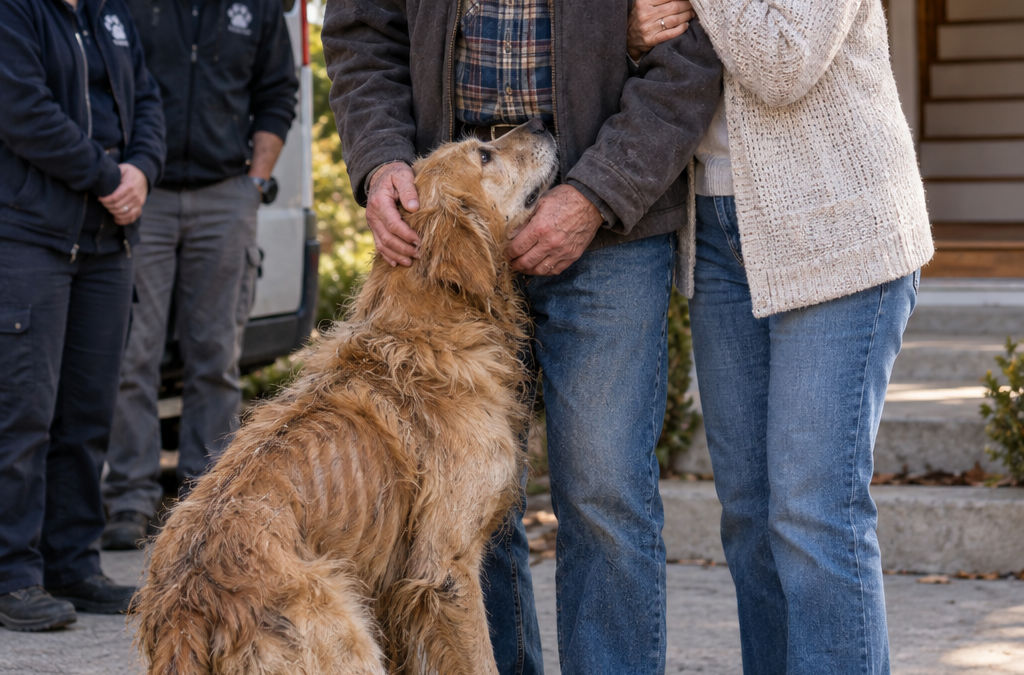
His coat was dirty and tangled, more dull tan than gold in that moment. Burrs clung to his tail and chest. His ribs showed beneath the fur, and he stood with the cautious posture of an animal that had spent too long surviving without knowing where the next safe place would be.
Then he raised his head.
He saw me.
The young woman holding his leash gently encouraged him forward.
The dog did not move.
He simply stared.
Helene’s fingers closed around my arm.
“Henry…”
“I know.”
But I did not know.
Not really.
The retriever lifted his nose.
He smelled the air.
Once.
Twice.
Then his entire expression changed.
The cautious tension disappeared from his face.
His tail moved once.
Then again.
Megan loosened the leash.
The dog started toward me.
Slowly at first.
Then faster.
I did not call him.
I did not kneel.
I could not move.
He stopped inches from my legs, pressed his nose against my pants, and inhaled deeply.
Then the golden retriever wrapped his entire body around my knees and pushed his head against my thigh as if he had finally found someone he had spent months searching for.
Behind me, Helene made a broken sound.
Megan whispered, “He’s never done that with anyone.”
I looked down at him.
His fur smelled like shelter shampoo, rain, dirt, and something wild.
His body trembled against me.
Not fear exactly.
Relief.
Or what looked like relief.
I put one hand on his head.
The second my fingers touched him, he leaned harder into my legs.
“Hey,” I whispered, though my voice did not sound like mine.
The dog closed his eyes.
Helene was crying openly now.
I looked at Megan.
“How?”
She shook her head.
“I don’t know.”
Before I could ask anything else, the dog suddenly lifted his head.
His attention shifted completely away from me.
His ears went forward.
His nose lifted.
He looked past me, through the open front door, directly toward the staircase inside our house.
Helene tightened her grip on my arm.
“He’s looking upstairs.”
“I can see that.”
“Has he ever been here before?” Megan asked.
“No.”
My answer came too quickly.
At least, I thought it did.
Megan looked at me.
“You’re sure?”
“Dan lived almost three hours away.”
“Maybe he brought him?”
“He would’ve told us.”
I said it with more certainty than I felt.
That sentence—he would have told us—had become one of the pillars holding up my understanding of my son after his death.
I had believed I knew Dan’s life.
Not every breakfast he ate or every person he spoke to, obviously, but the important things.
He called us every Sunday.
He told us about work, his apartment, his friends, the woman he dated for almost a year and the breakup that followed. He told Helene when he bought a new coffee maker. He asked me whether I thought a small balcony was enough space to grow herbs, then ignored my advice and killed three basil plants.
If he had adopted a golden retriever large enough to fill half a couch, surely he would have mentioned it.
But the dog was staring up our staircase.
Helene crouched beside him.
The retriever turned briefly and sniffed her face.
Then something extraordinary happened.
He leaned forward and touched his nose to her cheek.
Helene closed her eyes.
The dog stayed there.
One second.
Two.
Then he licked the tear that had reached her jaw.
“Oh,” she whispered.
Her arms went around his neck.
I had not seen my wife hold anything with that kind of desperation since the funeral.
The retriever stood completely still.
Megan discreetly turned away.
Luis pretended to examine paperwork near the van.
Then the dog pulled gently toward the house.
Helene released him.
“Let him.”
I looked at her.
“What?”
“Let him go inside.”
I turned to Megan.
“Is that okay?”
“He’s technically still under shelter custody until you sign the transfer paperwork,” she said. “But yes. We brought him here because we were hoping to confirm whether there was a family connection.”
I took the leash.
The golden retriever stepped through our doorway.
The moment all four paws crossed the threshold, he stopped.
He sniffed.
Long and deep.
Then he looked around the living room.
His body changed again.
Not excitement exactly.
Recognition.
I know how that sounds.
I know animals respond to scent. I understand that dogs can associate smells with people and objects in ways far beyond human ability. I am not trying to turn what happened into something supernatural.
I am telling you what I saw.
The dog walked into our living room as though he had entered a place connected to someone he knew.
He moved toward the couch and sniffed the corner where Dan always sat during visits.
He stopped at the coat rack.
One of Dan’s old denim jackets still hung behind two of mine because Helene had found it in his apartment and could not bring herself to box it away.
The retriever buried his nose in that jacket.
Then he whined.
Helene covered her mouth.
I felt something inside my chest tighten.
“Dan’s jacket.”
Megan looked at me.
“You brought that from his apartment?”
“Yes.”
“When?”
“After the accident.”
The dog pushed his muzzle deeper into the fabric and stood there for almost half a minute.
Then he turned.
Looked at the staircase.
And walked toward it.
I followed.
Helene followed me.
The shelter workers stayed several steps behind.
At the bottom of the stairs, the dog stopped and looked back.
It was such a strange, almost polite gesture that Helene whispered, “He’s asking.”
“Asking what?”
“Permission.”
I did not know whether that was true.
But I unclipped the leash.
“Go ahead.”
The retriever turned immediately.
He climbed.
Not frantically.
Not searching from door to door.
Slowly and deliberately.
At the top of the stairs, three doors faced the hallway.
Our bedroom.
The bathroom.
Dan’s room.
The dog did not investigate the first two.
He turned right.
Walked directly to Dan’s door.
It was partly open.
He pushed it wider with his nose.
Helene grabbed my hand so hard that her wedding ring pressed into my finger.
The retriever entered.
I stopped in the doorway.
He stood in the middle of the room and sniffed the air.
The bed was still made with the same dark blue comforter Dan had used during his last visit. A baseball cap from college sat on the desk. Old books lined one shelf. A framed photograph of the three of us at Yellowstone stood beside the lamp.
The dog walked to the bed.
He sniffed the side.
Then he jumped up.
Helene made a sound beside me.
He turned once on the mattress and lowered himself onto the pillow.
Dan’s pillow.
The one Helene had refused to wash.
The retriever placed his head exactly where our son’s had once rested.
Then he let out a deep sigh.
Not the nervous exhale of a stray dog.
The sound of something ending.
His eyes closed.
Helene sank to her knees.
I caught her shoulder.
“He knows,” she whispered.
I could not answer.
“He knows this room.”
“Maybe the jacket—”
“No.”
She looked at me with tears running down her face.
“Henry, he walked straight here.”
I sat on the edge of the bed.
The dog opened his amber eyes.
He looked at me.
Then closed them again.
For three months I had entered that room feeling only absence.
That morning, for the first time, something living breathed inside it.
I put one hand against the retriever’s side.
His heart was beating quickly.
Gradually, it slowed beneath my palm.
Megan appeared quietly at the doorway.
“I think we should show you the chip record.”
I looked back.
“Why?”
“There’s something strange about the registration date.”
We went downstairs twenty minutes later.
The retriever refused to come.
Helene said, “Let him sleep.”
So we did.
Megan placed several sheets of paper on our kitchen table.
“The chip was originally implanted at a clinic in Dan’s city about five months ago.”
I stared at the date.
Five months.
That meant Dan had registered the dog roughly two months before he died.
“The owner information was updated the same day,” Megan continued. “Daniel Carter. His apartment address. His cell phone. His email.”
“What’s the dog’s name?”
She pointed.
The field read:
DAN.
I frowned.
“That makes no sense.”
Luis leaned over.
“We think somebody at the clinic may have entered the owner’s first name into the animal-name field by mistake. The original intake number is there, but the pet-name field only says Dan.”
Helene gave the smallest broken laugh I had heard since our son died.
“So now we have two Dans.”
I looked at her.
She wiped her eyes.
“What else are we supposed to call him?”
I did not know.
For the first few days, we tried Goldie.
He ignored it.
Buddy.
Nothing.
Charlie.
Not even an ear movement.
But whenever Helene accidentally said Dan’s name while talking about our son, the dog looked up.
Eventually she began calling him Danny.
That got a tail wag.
So Danny he became.
Before Megan and Luis left, I signed the shelter transfer agreement.
There was never really a decision.
The dog was connected to our son.
Even if we understood nothing else, that was enough.
When I wrote my name on the paperwork, Megan hesitated.
“There’s one more thing.”
“What?”
“He didn’t come from your son’s city.”
I looked at her.
“Where was he found?”
“About sixty miles south of it.”
“That means he traveled.”
“Potentially.”
“Do you know for how long?”
“No.”
Luis added, “His condition suggests he’d been outside for weeks, maybe longer.”
Helene stared upstairs.
“Three months?”
Megan did not answer.
But the possibility entered the room.
Three months.
The exact length of time since Dan’s accident.
After the shelter van left, our house felt different.
Not healed.
That word would have been insulting.
But disturbed in a new way.
Grief had settled into every room like dust.
Danny moved through it.
He spent most of that first afternoon asleep on Dan’s bed. Helene checked him every fifteen minutes.
“He’s breathing,” I told her.
“I know.”
“You don’t have to keep looking.”
“I know.”
She went upstairs again anyway.
At dinner, Danny finally came down.
He stood near the kitchen doorway, uncertain.
I set a bowl of food on the floor.
He approached slowly.
Sniffed.
Then ate so quickly I had to stop him halfway because the shelter had warned us not to let an underfed dog consume too much at once.
Danny looked at me as though I had committed a crime.
“You’ll get more.”
His tail moved once.
Helene sat at the table watching.
“He has Dan’s expression when you tell him no.”
I froze.
She froze too.
For three months, saying our son’s name casually had been almost impossible.
We either whispered it with tears or avoided it.
Now it had escaped her naturally.
Attached to a joke.
A dog.
A moment.
Helene looked down.
“I’m sorry.”
“Don’t be.”
She pressed her lips together.
Then, slowly, smiled.
Not much.
But enough that I saw the woman I had married beneath the grief.
Danny finished eating and walked toward her.
He rested his head on her knee.
Helene put both hands around his face.
“You really knew him, didn’t you?”
Danny leaned against her.
That night we expected him to sleep downstairs.
Helene prepared a dog bed near the fireplace.
I found an old blanket.
We turned off the lights.
Danny followed us upstairs.
At the landing, he walked past our bedroom.
Straight into Dan’s.
I stood at the door.
“You can sleep there.”
He jumped onto the bed.
I heard Helene behind me.
“Let him.”
So every night after that, Danny slept in our son’s room.
The first week became a sequence of discoveries.
He knew the sound of Dan’s name.
He knew the jacket.
He knew the bedroom.
He also knew a whistle.
I discovered that accidentally in the garden.
Danny had followed me outside while I checked the tomatoes. He kept his distance at first, sitting near the fence and watching me dig.
I had spent almost every morning there since the funeral.
Sometimes I dug holes that did not need digging.
Sometimes I pulled weeds that barely existed.
The garden gave my hands a job when my mind had none.
Danny watched.
“You don’t garden?”
His ears moved.
“Dan was terrible at it.”
That was not entirely true.
As a boy, Dan had loved helping.
As a teenager, he had declared tomatoes “a ridiculous amount of labor for something available at the grocery store.”
I smiled at the memory.
Then, without thinking, I whistled the short two-note call I had always used to get Dan’s attention when he was across the yard.
Danny stood instantly.
He ran to me.
I nearly dropped the trowel.
The dog stopped at my knees.
Tail moving.
I whistled again.
His ears lifted.
“What the hell?”
Helene was at the kitchen window.
I called her.
“Come here.”
She opened the door.
“What?”
“Watch.”
I walked twenty feet away.
Whistled.
Danny came directly to me.
Helene stared.
“Dan used that whistle.”
“I know.”
“He must have taught him.”
I swallowed.
There was no other reasonable explanation.
Our son had taught this dog the same two-note whistle I had used with him for years.
Maybe because he remembered it.
Maybe because some habits travel through families without anyone deciding they should.
Helene sat on the porch steps.
Danny went to her.
She buried her hands in his fur.
“He had a whole life we didn’t know.”
That sentence hurt more than I expected.
“He told us things.”
“Not this.”
“Maybe it was new.”
“Five months.”
“Two months before the accident.”
She looked at me.
“Why didn’t he tell us?”
I did not have an answer.
For the next several days, that question entered almost every conversation.
Why had Dan hidden Danny from us?
Was he planning to tell us?
Had something happened?
Had he been embarrassed?
Had he believed we would disapprove?
The questions were not anger at first.
Then they became anger.
Grief does strange things.
You can be furious at someone who is dead because he has denied you the ability to ask why.
One evening, Helene stood in the kitchen holding the shelter paperwork.
“He called every Sunday.”
“I know.”
“For five months he had this dog.”
“Yes.”
“And never said anything.”
“Maybe he planned to.”
“When?”
“I don’t know.”
“He told me when he bought a coffee maker.”
I almost smiled.
“That coffee maker was expensive.”
“Henry.”
“I know.”
Her voice broke.
“What else didn’t we know?”
That was the real question.
Not the dog.
The distance.
Dan had become an adult.
We knew that intellectually.
But parents are experts at confusing continued contact with complete access.
Maybe our son had become someone larger than the version who called every Sunday.
Maybe there were people he loved we had never met.
Places he went.
Fears he kept private.
Responsibilities he carried alone.
Danny was proof.
Helene put the papers down.
“I want to go there.”
“Where?”
“Dan’s city.”
I looked at her.
“We already emptied the apartment.”
“Not really.”
She was right.
After the accident, we had traveled there in a state I barely remember. Dan’s employer helped. His landlord gave us access. We packed clothing, photographs, some books, and a few personal things. Much of the furniture was donated because we could not imagine bringing an entire apartment home.
We had moved through his life like sleepwalkers.
“We missed something,” Helene said.
“Maybe.”
“I need to know where Danny came from.”
I looked toward the hallway.
The dog was asleep near the stairs.
“So do I.”
We called the veterinary clinic listed on the microchip record the next morning.
A receptionist searched the old file.
“Yes,” she said. “Golden retriever, male, estimated three years old at intake.”
“Intake?”
“He was adopted through a partner rescue.”
My hand tightened around the phone.
“Which rescue?”
She gave me a name.
Harbor Street Animal Haven.
I wrote it down.
“Who brought him to the appointment?”
“Daniel Carter.”
My throat closed.
“Was he alone?”
“I’m sorry. I don’t have that information.”
“Did the dog have a name?”
There was typing.
A pause.
“Here it is. The rescue name was Bailey.”
I looked toward Danny.
Bailey.
I called it.
“Bailey?”
Danny’s head lifted.
Helene covered her mouth.
I tried again.
“Bailey.”
He stood.
Tail moving.
There.
His real name.
For almost a week we had been calling him Danny because of a clerical error.
Helene laughed.
A real laugh.
Small but clear.
“Poor dog. He probably thinks we’re idiots.”
I crouched.
“Bailey.”
The golden retriever came to me immediately.
“You could have told us.”
He licked my hand.
That afternoon, we called Harbor Street.
A woman named Rachel answered.
When I explained who we were, she became very quiet.
“You’re Dan’s parents?”
“Yes.”
“Oh my God.”
Helene and I looked at each other.
“You knew him?”
“I did.”
“How?”
“He volunteered here.”
I sat down.
“What?”
“For almost a year.”
I stared at the table.
Our son.
Every Sunday.
Work stories.
Weather.
Groceries.
A new restaurant.
Never once had he mentioned volunteering at an animal shelter.
Rachel continued carefully.
“He came Saturday mornings when he could.”
“Why didn’t he tell us?”
“I don’t know.”
“Did he adopt Bailey from you?”
“Yes.”
“When?”
“About five months before…”
She stopped.
“Before the accident.”
“Yes.”
Helene moved closer to the phone.
“Did Bailey disappear after Dan died?”
Rachel was silent for so long that I thought the connection had failed.
Then she said, “We looked for him.”
My stomach tightened.
“What happened?”
“Could you come here?”
“Why?”
“There are things I think you should see.”
Two days later, we drove to Dan’s city.
Bailey came with us.
The trip took almost three hours.
He hated the first thirty minutes.
He paced in the back seat.
Whined.
Pressed his nose to the windows.
Then, as we reached the outskirts of the city, something changed.
Bailey stood.
His entire body became alert.
He sniffed the air coming through the vent.
When we turned onto a familiar avenue, his tail started moving.
Helene looked back.
“He knows.”
“Yes.”
At the next intersection, Bailey whined.
He stared left.
Dan’s apartment was left.
Neither of us spoke.
I turned.
Bailey began panting.
His paws shifted against the seat.
When we reached the old building, he barked.
Once.
Then again.
The sound tore through me.
I parked.
Bailey nearly pulled me across the sidewalk.
The building manager recognized us.
Then she saw the dog.
Her face changed.
“Oh.”
“You know him.”
She nodded.
“That’s Bailey.”
Helene gripped the leash.
“You knew?”
“I thought somebody told you.”
“Told us what?”
“That Dan had a dog.”
“No.”
The manager looked horrified.
“I’m sorry.”
“What happened after the accident?”
She leaned against the front desk.
“Bailey was with a neighbor that night.”
“Why?”
“Dan sometimes left him with a woman upstairs if he worked late.”
“Name?”
“Rachel Bell.”
Not the shelter Rachel.
Another Rachel.
We found her apartment.
A woman in her forties opened the door.
Bailey barked.
She stared.
Then dropped to her knees.
“Bailey!”
The leash ripped through my hand.
Bailey ran into her arms.
She began crying immediately.
“Oh, baby. Oh my God.”
Helene stood frozen.
“You know him.”
Rachel looked up.
“You’re Dan’s mother.”
“Yes.”
“I’m so sorry.”
Bailey licked Rachel’s face frantically.
She held him.
“I thought you were dead.”
I sat down on the hallway floor because my legs no longer felt reliable.
Rachel invited us inside.
For the next hour, she gave us the missing chapter.
Dan had adopted Bailey from Harbor Street after volunteering there for months.
Bailey had been found abandoned near a construction site. He was fearful around men at first.
Dan kept visiting him.
Sat outside the kennel.
Read books.
Brought treats.
Waited.
Eventually, Bailey trusted him.
“Dan didn’t plan to adopt a dog,” Rachel said. “That’s what he always told me.”
Helene laughed through tears.
“That sounds like him.”
“One Saturday, Bailey had an adoption meeting with another family. He panicked. Dan came in afterward and found him hiding under the desk.”
“What happened?”
“Dan said, ‘Fine. You win.’”
I looked down.
That sounded exactly like my son.
Rachel continued.
“He brought Bailey home that afternoon.”
“Why didn’t he tell us?”
She smiled sadly.
“He talked about you constantly.”
“That doesn’t answer me.”
“No.”
She hesitated.
“Dan was planning to bring Bailey home.”
“When?”
“Your fortieth anniversary.”
Helene stared.
“That’s next spring.”
“He said he wanted to surprise you.”
I looked at her.
“What kind of surprise?”
Rachel smiled.
“He said your house was too quiet.”
The words struck with cruel irony.
Too quiet.
Our house had become quieter than Dan could ever have imagined.
Rachel stood and went to a cabinet.
She returned with a small cardboard box.
“I kept these.”
Inside were two tennis balls.
A worn leash.
Several photographs.
The first showed Dan sitting on the floor at Harbor Street with Bailey’s head in his lap.
Our son was laughing.
Not posing.
Laughing.
The second showed Bailey asleep on Dan’s couch.
The third showed them on a hiking trail.
The fourth broke Helene completely.
Dan stood beside a garden store display holding a tomato seedling in one hand while Bailey sat beside him.
On the back, in Dan’s handwriting, were five words:
Dad would complain about this.
I laughed.
Then cried.
Both at once.
Rachel placed a hand over her mouth.
“I’m sorry.”
“No.”
I looked at the photograph.
“Don’t be.”
Then she told us what happened after the accident.
Dan had left Bailey with her that Friday because he expected to work late.
Police contacted her after finding a dog tag and emergency note among Dan’s personal effects.
When Rachel learned Dan had died, she collapsed.
Bailey became agitated.
He paced outside her door.
Would not eat.
The following morning, she took him back to Dan’s apartment hoping familiar smells would calm him.
Instead, Bailey searched every room.
Then sat at the front door.
For hours.
Three days later, while Rachel was taking him outside, a delivery truck slammed a metal gate nearby.
Bailey panicked.
The leash slipped from her hand.
He ran.
She searched for weeks.
Posted flyers.
Called shelters.
Reported the microchip.
But because Dan’s phone was disconnected and our emergency-contact information had not yet been added to the new database, calls went nowhere.
“I tried finding you,” Rachel said.
“How?”
“I contacted the building manager. She said the family was dealing with the estate and didn’t want strangers reaching out.”
I remembered.
After the funeral, I had asked Dan’s employer to help limit calls because Helene could barely answer the phone.
A reasonable decision.
One more door accidentally closed.
“I should have tried harder,” Rachel whispered.
Helene shook her head.
“No.”
Rachel looked surprised.
“You loved him too.”
The woman began crying.
That was another discovery.
Grief had made us selfish in a way I had not understood.
Not intentionally.
Pain had narrowed the world until we believed Dan’s death belonged mainly to us.
But our son had been loved in rooms we had never entered.
Rachel missed him.
His coworkers missed him.
The shelter volunteers missed him.
Bailey had spent three months searching for someone who would never return.
We were not the only ones grieving.
The realization hurt.
It also gave Dan back to us in pieces.
We visited Harbor Street that afternoon.
Bailey knew the building.
The moment he stepped through the door, three employees recognized him.
People cried.
A man named Marcus knelt.
“Look who finally came back.”
Bailey greeted everyone.
Then he ran to a small office.
Rachel from the shelter followed us.
“This was Dan’s favorite place.”
Inside was a chair beside a window.
A kennel opened into the room.
Rachel smiled.
“He used to sit here with the shy dogs.”
On a bulletin board were photographs of volunteers.
Dan appeared in three.
In one, Bailey sat between his knees.
Underneath someone had written:
THE TWO STRAYS WHO ADOPTED EACH OTHER.
I touched the edge of the photograph.
“What does that mean?”
Rachel laughed softly.
“Dan used to joke that he felt lost after moving here.”
“Lost?”
“He was lonely.”
The word shocked me.
“He never said that.”
“Maybe he didn’t want you to worry.”
Helene turned away.
I knew what she was thinking because I was thinking the same thing.
Our Sunday calls.
Every week.
“How are you?”
“Good.”
“How’s work?”
“Busy.”
“You eating?”
“Yes, Mom.”
We had accepted the answers.
Not because we did not care.
Because adulthood requires parents to accept closed doors.
Dan had been lonely.
So he started volunteering.
He met Bailey.
Maybe they saved each other before Bailey ever found us.
Rachel opened a desk drawer.
“There’s something else.”
She handed me an envelope.
My name was on it.
Mom & Dad.
Dan’s handwriting.
Helene stopped breathing.
“What is that?”
“We found it in his volunteer locker after the accident,” Rachel said. “I didn’t know where to send it. Then everything happened with Bailey. I kept hoping I’d eventually find you.”
My hands shook.
The envelope was unsealed.
Inside was a folded page.
At the top, Dan had written:
For the anniversary surprise.
Helene sat down.
“Read it.”
I could not.
“You read it.”
She shook her head.
“Henry.”
So I began.
Mom, Dad—before you panic, no, I am not secretly married and no, I did not quit my job. I did something possibly worse. I adopted a dog.
Helene laughed through tears.
I kept going.
His name is Bailey. He was abandoned, which means he came with the same trust issues Dad claims I had at seventeen. We’re working through them. He likes tennis balls, hates vacuum cleaners, and has already eaten one pair of shoes that cost more than my first car payment.
I stopped because I was crying too hard.
Rachel handed me tissues.
I continued.
I haven’t told you because I want to bring him home for your anniversary. Mom keeps saying the house feels empty when I leave. Dad keeps pretending he likes the quiet. I know both of you are lying. Bailey needs more people, and I think you two need something that makes you leave the couch occasionally.
Helene pressed both hands over her mouth.
The next line destroyed me.
Dad, I taught him your whistle.
I lowered the paper.
The garden.
The two-note call.
Bailey running to me.
Dan had done that deliberately.
Not magic.
Not coincidence.
A bridge built months before we knew we would need it.
I read the final paragraph.
I know I don’t say it every Sunday because if I did, Mom would cry and Dad would make some joke, but you built the safest home I’ve ever known. I think that’s why I want Bailey to know it too. See you in the spring. Don’t buy anything expensive. I mean it.
Then his name.
Love, Dan.
Nobody spoke.
There are moments when grief becomes so large that your body no longer knows how to contain it.
Helene slid from the chair to the floor.
I went with her.
We held each other beneath photographs of our son helping frightened dogs.
Bailey walked over.
He pushed between us.
We wrapped our arms around him too.
Three bodies on a shelter floor.
Crying.
Breathing.
Trying.
Dan would never come home in the spring.
That promise was gone.
But part of the surprise had arrived anyway.
Three months late.
Thin.
Dirty.
Carrying a microchip.
That evening we drove home with Bailey asleep across the back seat.
Helene held Dan’s letter the entire way.
Halfway through the drive, she said, “He knew.”
“Knew what?”
“That we’d love him.”
“Bailey?”
“Yes.”
I looked at her.
“He was right.”
She stared out the window.
“Do you think Dan knew how lonely he was?”
“What do you mean?”
“Bailey.”
I thought about the dog searching Dan’s apartment.
Running from Rachel.
Wandering sixty miles.
Three months.
“No.”
Helene touched the letter.
“Maybe they were both lonely.”
“Maybe.”
She turned toward Bailey.
“And maybe that’s why he understood us.”
When we reached home, Bailey woke before the engine stopped.
He jumped out.
Ran to the front door.
Waited.
I opened it.
He went upstairs.
Straight to Dan’s room.
That became home.
The days afterward were still difficult.
A letter does not cure grief.
A dog does not replace a son.
Anyone who says an animal can fill the space left by a child has never lost a child.
Bailey did not fill that space.
He changed the shape around it.
That distinction mattered.
The first significant change happened in the garden.
One afternoon, Bailey appeared carrying a tennis ball I did not recognize.
He dropped it near my boot.
“Where did you get that?”
Tail wag.
I threw it.
Bailey ran.
Returned.
Dropped.
Again.
We repeated the game.
Five throws.
Ten.
On perhaps the fifteenth, Bailey misjudged the wet grass, slid sideways, and rolled into one of my tomato beds.
Mud covered half his body.
I laughed.
The sound escaped before I could stop it.
I stood there with a ball in my hand, laughing.
Then I heard Helene behind me.
She had come onto the porch.
She was crying.
“What?”
She shook her head.
“Nothing.”
“Why are you crying?”
“You laughed.”
I stopped.
Neither of us had heard that sound from me in three months.
Bailey barked.
Ball.
I threw it again.
Helene laughed too.
That evening we sat on the porch until sunset.
Bailey slept between our chairs.
For once, the silence did not feel empty.
It contained breathing.
The scrape of paws.
Birds.
Wind through tomato leaves.
Presence.
That was how Bailey worked on us.
Not dramatically.
Repetitively.
Morning walks.
Meals.
A wet nose against the bed at seven.
Tennis balls.
Hair on furniture.
The vacuum cleaner war Dan had accurately predicted.
The first time I turned it on, Bailey fled upstairs and jumped onto Dan’s bed.
I followed.
“You really do hate it.”
Bailey looked offended.
I sat beside him.
“You know, he warned us.”
His tail moved.
I began talking.
At first to the dog.
Then, somehow, to my son.
I told Bailey stories about Dan as a child.
The bicycle accident at eight when he refused to cry until he saw blood and then screamed loudly enough for three neighbors to come outside.
The time he tried cooking breakfast at eleven and nearly destroyed a skillet.
His first school dance.
College move-in.
The Sunday calls.
Things I had been unable to discuss with Helene because the pain felt too sharp.
Bailey listened.
Dogs are gifted at listening because they do not rush to repair what cannot be repaired.
They do not say, “At least…”
They do not explain why something happened.
They remain.
One night Bailey stood and placed his head against my chest.
I felt his heartbeat.
Steady.
Warm.
For the first time since Dan died, I cried without feeling as though crying might kill me.
There is a strange moment in grief when sorrow stops being an emergency and becomes something you understand you will carry.
That night may have been mine.
Helene’s came later.
She had been sleeping badly.
Sometimes I woke at three in the morning and found her sitting in Dan’s room.
Bailey beside her.
One night I joined them.
She was holding the anniversary letter.
“I’m angry at him.”
I sat down.
“I know.”
“No, you don’t.”
“Then tell me.”
She looked at the photograph on the desk.
“He was lonely and didn’t tell us.”
I waited.
“He adopted a dog and didn’t tell us.”
“Yes.”
“He wrote this stupid letter instead of calling.”
Her voice broke.
“He made plans for spring.”
I understood.
“I’m angry because he was supposed to be here.”
“That’s different.”
“I know.”
She pressed the letter against her chest.
“I know it isn’t rational.”
“Grief isn’t court.”
“What?”
“You don’t need evidence.”
She almost smiled.
I continued.
“You’re allowed to be angry.”
“At Dan?”
“Yes.”
“He died.”
“I noticed.”
That earned the faintest laugh.
Then she hit my shoulder.
“Idiot.”
“Also noticed.”
Bailey lifted his head.
Helene stroked his ears.
“I wish he’d told me.”
“Me too.”
She looked at me.
“Why didn’t he?”
“Because he was thirty-two.”
“That’s not an answer.”
“It might be the whole answer.”
Adults keep pieces of themselves.
Not because they love their parents less.
Because becoming an adult partly means building rooms your parents do not enter.
Dan had built one.
Harbor Street.
Bailey.
Loneliness.
Friendship.
Plans.
That realization hurt less over time.
Eventually, it even comforted me.
Our son’s life had been larger than what we knew.
Death had frozen him in our minds.
Bailey thawed him.
He gave us new stories after Dan could no longer tell them himself.
Rachel from Harbor Street became part of our lives.
So did Rachel Bell, Dan’s neighbor.
We invited both women to our home one Sunday.
Helene baked the oatmeal-chocolate cookies.
The smell filled the kitchen.
For the first time since the funeral, there were four cups on the table instead of two.
Bailey moved between everyone.
Rachel Bell brought a small bag.
“Dan left this with me.”
Inside was Bailey’s old blue bandana.
A spare keychain.
And a memory card from a camera.
We put it into my laptop.
Photographs appeared.
Hundreds.
Dan and Bailey.
Trails.
Couch naps.
Shelter dogs.
Bad selfies.
A short video.
I clicked it.
Dan appeared on the screen.
Alive.
Moving.
My body froze.
“Hey, buddy,” he said to Bailey off camera.
The golden retriever ran into frame.
Dan whistled.
Our whistle.
Bailey returned.
“Good boy.”
Helene sobbed.
I nearly closed the laptop.
Then Dan laughed.
I let it play.
“Okay, again. Grandpa’s going to think he invented this.”
I stared.
Grandpa.
Me.
He had already imagined Bailey meeting us.
The video lasted only thirty-seven seconds.
I watched it eight times.
The next Sunday we watched another.
Then another.
We created a ritual.
Not every video.
Just one.
Sunday evening.
The time Dan used to call.
Sometimes the clips were meaningless.
Dan filming rain.
Bailey sleeping.
A terrible joke.
But those meaningless moments were precious.
Death gives importance to ordinary things because ordinary things are what disappear first.
Meanwhile, Bailey changed physically.
His ribs disappeared beneath healthy weight.
His coat softened.
We had him examined by our veterinarian, Dr. Lewis, who found no serious problems beyond mild nutritional deficiencies and irritated paw pads.
“How far do you think he traveled?” I asked.
Dr. Lewis looked at the shelter records.
“Impossible to know.”
“Sixty miles from Dan’s city.”
“He may not have walked directly.”
“Three months.”
“He survived somehow.”
I looked at Bailey.
“Why?”
Dr. Lewis smiled.
“Dogs are good at staying alive.”
“That isn’t what I mean.”
She understood.
“You want to know whether he was looking for you.”
“Yes.”
“I can’t tell you that.”
I appreciated the honesty.
“Could he have recognized my scent from Dan’s clothes?”
“Absolutely.”
“Could he have followed that scent hundreds of miles?”
“That’s more complicated.”
I nodded.
“So we don’t know.”
“No.”
Then she added, “But he knew you when he met you.”
I looked at her.
“You saw the video?”
“Helene showed everyone.”
Of course she had.
Dr. Lewis smiled.
“Whatever scent or association Dan created, Bailey clearly connected you to safety.”
The word caught me.
Safety.
Dan’s letter.
You built the safest home I’ve ever known.
Maybe that was the answer.
Not that Bailey magically knew I was Dan’s father.
Maybe he smelled Dan on my clothing, the bedroom, the jacket.
Maybe he heard the whistle.
Maybe our home was full of familiar information.
Whatever happened inside his mind, he entered and relaxed.
He recognized something.
The source did not matter as much as the result.
Bailey stayed.
Summer arrived.
Tomatoes ripened.
I had planted far too many.
For years Dan had teased me about giving tomatoes to neighbors until people began avoiding me in August.
That summer Bailey followed me between the rows.
One morning I found him chewing a ripe tomato directly from the vine.
“Hey!”
He froze.
Red pulp around his mouth.
“You thief.”
Tail wag.
“Those are not dog food.”
He ate the rest.
Helene laughed from the porch.
“Your son used to steal them too.”
“Not raw.”
“He did when he was six.”
“I forgot.”
“I didn’t.”
Those conversations became common.
Memory stopped functioning like a knife every time.
Sometimes it was simply memory.
That was progress.
Helene and I started walking every evening.
Bailey required it.
At first we walked separately.
I would take him if Helene was tired.
She would take him when I worked in the garden.
Then one evening Bailey refused to leave with either of us alone.
I held the leash.
“Come on.”
He sat.
Helene tried.
Nothing.
We both stood near the door.
Bailey walked out.
I looked at my wife.
“He’s manipulating us.”
“He learned from Dan.”
We walked together.
The next evening, together again.
Soon the walks became ours.
Bailey moved ahead.
We talked behind him.
At first about the dog.
Then groceries.
Neighbors.
Bills.
Then Dan.
Then us.
One evening Helene said, “I thought we were going to lose each other.”
I stopped walking.
“What?”
“After the funeral.”
I looked toward Bailey.
He was sniffing a fence.
“I thought you were angry at me.”
“No.”
“You disappeared into the garden.”
“You disappeared into his room.”
“I know.”
We stood on a country road while sunset colored the sky.
“I didn’t know how to reach you,” she said.
“Neither did I.”
Bailey finished inspecting the fence and looked back impatiently.
Helene took my hand.
Thirty-nine years of marriage.
I could not remember the last time we had held hands during a walk.
We continued.
Bailey ahead.
Us behind.
A family rearranged.
Autumn brought Dan’s birthday.
The first one without him.
I dreaded it for weeks.
Helene became quieter.
On the morning itself, she made cookies.
I found her staring at the dough.
“He would’ve been thirty-three.”
“I know.”
“What do parents do on birthdays when their child is dead?”
I had no answer.
Bailey walked into the kitchen.
He smelled the dough.
Helene looked at him.
“No chocolate.”
He sat.
She smiled sadly.
“We should do something.”
“For Dan?”
“Yes.”
“What?”
She looked toward the garden.
We decided to plant a tree.
A red maple.
Dan had loved autumn.
We chose a place near the tomatoes.
Rachel from Harbor Street came.
Rachel Bell.
James, one of Dan’s coworkers.
Two shelter volunteers.
No ceremony.
No speeches.
I dug.
Others helped.
Bailey supervised badly.
When the tree was in the ground, Helene placed Dan’s handwritten anniversary letter inside a protective box near the roots.
I stopped her.
“You sure?”
“We have a copy.”
“That’s the original.”
She touched the paper.
“He wrote about home.”
I nodded.
We sealed it.
Buried it.
Not as a grave.
As a foundation.
That afternoon, people stayed for food.
Someone laughed loudly.
Then someone else.
Our house filled with voices.
I stood in the hallway and listened.
For a second, I could almost hear Dan’s music upstairs.
Not literally.
Memory.
I closed my eyes.
Bailey leaned against my leg.
“You hear him too?”
Of course he did not answer.
Winter was harder.
Cold weather kept us inside.
Dan’s death anniversary approached.
Every detail of that Friday returned.
Nine o’clock.
Telephone.
Police voice.
Helene began sleeping poorly again.
Bailey sensed it.
He stopped sleeping exclusively in Dan’s room.
Some nights he lay outside our bedroom.
One night, shortly before the anniversary, I woke because Helene was crying.
Bailey had climbed onto our bed.
He was pressed between us.
I reached over him and found my wife’s hand.
We stayed like that until morning.
The anniversary itself came without drama.
No thunder.
No sign.
Just a gray Friday.
At 8:45 p.m., we turned off the television.
At nine, the time of the call, Helene lit a candle.
We sat at the kitchen table.
Bailey beneath it.
“I don’t want nine o’clock to own this house forever,” I said.
Helene looked at me.
“What do we do?”
“Something else at nine.”
“What?”
I thought about Sunday calls.
Harbor Street.
Bailey.
“We call the shelter.”
“Tonight?”
“No.”
I smiled.
“Next year. We donate something. Volunteer. Something alive.”
Helene considered it.
Then nodded.
That decision grew.
A month later, we began volunteering at Harbor Street twice a month.
The drive was long, but we did it.
Bailey came.
He became a strange celebrity.
People remembered his disappearance.
His return.
Dan.
The first time I sat outside the kennel of a terrified shepherd mix, Rachel smiled.
“You’re sitting where Dan used to.”
“I know.”
The dog would not approach.
I stayed.
Forty minutes.
Nothing.
An hour.
Then the shepherd crawled forward and took a treat.
I understood something about my son.
Why he had gone there.
Helping an animal trust you requires patience without guarantee.
Grief was similar.
You cannot drag healing toward you.
You create conditions.
Then wait.
Helene preferred the puppies.
Of course.
She claimed they needed socialization.
I claimed she simply liked being covered in dogs.
Both were true.
Bailey roamed between us.
Home followed him now.
The first time another golden retriever arrived at Harbor Street, I felt a strange pain.
Not because he resembled Bailey.
Because I realized Bailey would one day die too.
That thought terrified me.
Grief makes you aware that every attachment is temporary.
For several weeks, I became overprotective.
I worried about his food.
His hips.
Cars.
Leashes.
I installed a new fence.
Helene noticed.
“You know we can’t protect him from everything.”
“I know.”
“You’re trying.”
“No.”
“Yes.”
She sat beside me.
“Henry, loving him means this will hurt someday.”
I hated her for saying it.
Only for a second.
Then I hated myself for knowing she was right.
“I don’t want another phone call.”
“Neither do I.”
Bailey rested his head on my shoe.
Helene continued.
“But if we had known Dan would only get thirty-two years…”
“Don’t.”
“Listen.”
I looked at her.
“If someone offered us the choice before he was born—thirty-two years with him or no Dan at all—what would you choose?”
My eyes filled.
“You know.”
“Yes.”
She touched Bailey.
“Then stop loving like you’re negotiating with loss.”
I remembered that sentence forever.
We cannot negotiate with loss.
We can only decide whether the possibility of pain is worth presence.
Dan had been.
Bailey was.
Years began passing.
The story became less about how Bailey arrived and more about the life he built afterward.
He slept on Dan’s bed for almost two years.
Then one night he stayed downstairs near the fireplace.
Helene noticed.
“Do you think that means something?”
“He was tired.”
The next night, fireplace again.
For a moment I felt abandoned on Dan’s behalf.
Then I laughed at myself.
Bailey was not a shrine.
He was a dog.
Living animals are allowed to change habits.
That realization mattered too.
Eventually, Dan’s room changed.
Not dramatically.
Helene started first.
She washed the sheets.
I found her standing beside the washing machine crying.
“You okay?”
“No.”
“Want me to stop it?”
She shook her head.
“No.”
The machine turned.
Water filled.
The last physical scent we imagined might remain from Dan washed away.
Bailey stood beside us.
He did not panic.
He did not disappear.
He simply waited.
Afterward, we put clean sheets on the bed.
Dan’s photographs stayed.
Books stayed.
The room remained his in one sense.
But it also became a guest room.
Rachel Bell slept there when she visited.
Later our niece did.
Life entered without erasing him.
That had once seemed impossible.
Five years after Dan died, Bailey was still with us.
His muzzle had begun graying.
Our red maple was taller than I was.
The tomato garden had become slightly smaller because my knees disliked kneeling.
Helene’s cookies remained excellent.
Sunday evenings changed.
We no longer waited for a phone call that could not come.
Instead, Sunday became Bailey’s long-walk day.
Sometimes we walked the old country road.
One evening we reached the hill where Helene had once said she thought Dan would be happy.
Bailey stopped.
Sunset covered the sky in orange and pink.
Helene took my hand.
“He really did bring us back.”
I knew who she meant.
Bailey.
But also Dan.
“He did.”
“Do you think Dan planned any of this?”
“No.”
She smiled.
“Me neither.”
I looked at Bailey.
“He planned a surprise.”
“That went very wrong.”
“Or very late.”
Helene laughed.
We continued walking.
Years six and seven were gentler.
Bailey developed arthritis.
We started medication.
Shorter walks.
A ramp into the car.
He stopped climbing the stairs every night.
The first time he could not make it to Dan’s room, I carried him.
He weighed seventy pounds.
My back complained.
Helene stood at the top.
“You’re going to hurt yourself.”
“He wants upstairs.”
Bailey looked deeply indifferent.
“Henry.”
“Fine.”
We bought a downstairs bed.
Bailey approved immediately.
Apparently, I had invented the emotional need to reach the bedroom.
Again, dogs are good at reminding humans not every symbol belongs to them.
On the eighth year, Harbor Street dedicated a small outdoor run to Dan.
Not because we asked.
Because Rachel had been collecting stories.
Dogs Dan helped.
People he trained.
Bailey.
A simple wooden sign read:
DAN CARTER QUIET YARD — FOR DOGS WHO NEED A LITTLE MORE TIME.
Helene cried when she saw it.
I did too.
A frightened hound was using the yard that morning.
He hid behind a bench.
Bailey, old now, lay on the opposite side of the fence.
The hound eventually approached.
They sniffed through the wire.
Rachel stood beside me.
“Dan would like this.”
“Yes.”
“He’d complain the sign is embarrassing.”
“Definitely.”
We laughed.
That is how the dead sometimes return.
Not as ghosts.
As accurately remembered complaints.
Bailey turned twelve.
Golden retrievers do not hide age gracefully.
His face whitened.
His hearing weakened.
He slept deeply enough that I occasionally checked whether he was breathing.
The habit had started after Dan’s death.
Watching breathing.
Counting presence.
One winter morning Bailey refused breakfast.
My stomach dropped.
We went to Dr. Lewis.
Blood tests.
Imaging.
Waiting.
I sat beside him on the floor.
Helene held the old anniversary letter folded inside her purse, though I had no idea why she brought it.
Dr. Lewis entered.
Her face was careful.
There was a mass.
Probably cancer.
More testing followed.
The diagnosis was confirmed.
I felt the old room return.
Police voice.
Friday night.
No.
Not again.
I looked at Bailey.
He was asleep.
Helene asked the questions I could not.
Options.
Treatment.
Time.
Comfort.
We chose treatment that might give him good months without making those months entirely about hospitals.
Surgery was not reasonable.
Chemotherapy might help modestly.
Medication could control symptoms.
There were no guarantees.
There never had been.
Bailey surprised us.
Three months.
Then six.
He ate.
Walked.
Stole half a sandwich from the coffee table.
I celebrated the theft.
Helene said, “Your standards have collapsed.”
“Yes.”
The following spring, tomatoes appeared.
Bailey lay beside the garden while I planted.
I placed one seedling near him.
“You remember the photo?”
He slept.
“Dan said I’d complain.”
No response.
“He was right.”
I planted.
The cancer eventually progressed.
Bailey tired faster.
One evening he walked to the base of the stairs.
He stood there.
Looked up.
I knew.
“You want his room?”
His tail moved.
I should not have carried him.
My back was worse than ever.
I did anyway.
Helene helped.
Together we got him upstairs.
Bailey walked into Dan’s room.
The bed had clean sheets now.
A different blanket.
But the old pillow still existed in the closet.
Helene brought it.
Placed it down.
Bailey smelled it.
Then lay his head there.
Twelve years earlier, he had first entered our house and done the same thing.
I sat beside him.
Helene beside me.
We stayed until he slept.
The following morning, he did not want to stand.
Dr. Lewis came to our home that afternoon.
Bailey was comfortable but weak.
We knew.
Knowing did not make anything easier.
I had spent years afraid of this moment.
Helene had been right.
I had tried to negotiate with loss.
Now the bill had arrived anyway.
Bailey lay in the living room near the fireplace.
The same place where he eventually chose to sleep after leaving Dan’s bed.
I held his head.
Helene held one paw.
“You found us,” she whispered.
Bailey’s tail moved slightly.
“You found us when we were lost.”
I could not speak.
Dr. Lewis waited.
No rush.
No clinical impatience.
Just time.
Finally, I leaned close.
“Dan was right about you.”
Bailey breathed.
“You were a terrible surprise.”
Helene laughed through tears.
I continued.
“You ate my tomatoes.”
Another breath.
“Ruined the lawn.”
Breath.
“Made me walk in rain.”
His eyes half closed.
“And saved our lives.”
That part was true.
Not medically.
Not dramatically.
But there are kinds of dying that leave the heart beating.
Helene and I had been doing that when Bailey arrived.
He did not cure us.
He made us participate again.
One walk.
One meal.
One laugh.
One story.
One Sunday.
Again.
Again.
Again.
Until living became less like betrayal.
I touched his forehead.
“If you see him before we do…”
My voice failed.
Helene finished.
“Stay with him.”
Bailey relaxed beneath our hands.
He died peacefully.
For a long time afterward, the house became quiet again.
But it was not the same silence.
We knew this one.
We knew grief now.
Not how to defeat it.
How to carry it.
There is a difference.
The next morning, I automatically reached for Bailey’s leash.
My hand closed around nothing.
I sat on the floor.
Cried.
Then laughed because Bailey would have been furious that breakfast was late.
Helene found me.
She sat beside me.
We cried together.
That was another difference.
After Dan, we had grieved separately.
Bailey taught us to remain in the same room.
We buried Bailey’s ashes beneath the red maple.
Not all of them.
Helene kept a small portion in an urn near Dan’s photograph.
But most went beneath the tree, close to the anniversary letter we had buried years earlier.
I dug slowly.
My knees hurt.
Helene placed the container.
We covered it.
Then she said, “Tomatoes.”
“What?”
“We should plant tomatoes around him.”
“He ate them.”
“Exactly.”
So we did.
That summer, the best tomatoes I had grown in years came from the bed around Bailey’s tree.
Helene claimed it was appropriate.
I accused the dog of stealing them from beyond the grave.
She laughed.
I laughed too.
Loss had not taken that ability back.
Years later, people still ask us about the golden retriever who arrived with our son’s name on his microchip.
The story has been told incorrectly many times.
Some people say Bailey traveled two hundred miles specifically looking for us.
We do not know that.
Some say he recognized me because Dan showed him photographs.
Maybe.
Some say he sensed Dan’s spirit in our home.
I cannot prove or disprove what other people need to believe.
I know only what happened.
Bailey belonged to our son.
Dan taught him my whistle.
Dan planned to bring him home.
After Dan died, Bailey ran away.
Three months later, a shelter found him.
When Bailey reached our driveway, he smelled me.
Then Dan’s jacket.
Then the bedroom.
Whatever those scents meant inside his mind, he trusted them.
He came inside.
He stayed.
The rest is not mystery.
The rest is work.
Love usually is.
Walk the dog.
Feed him.
Take him to the veterinarian.
Clean muddy paws.
Throw the ball.
Sit beside the bed.
Tell stories.
Listen to your wife.
Allow her anger.
Admit your own.
Return to the shelter.
Plant the tree.
Call people.
Answer when they call.
Live Sunday.
Then Monday.
Then another year.
That is how Bailey brought us back.
Not with one miraculous gesture.
With repetition.
Today I am older than I was when the shelter first called.
Helene is too.
Our marriage crossed forty years.
Then forty-five.
Then more.
We never had another child.
There are losses life does not replace.
But our home became full again in ways we could not have predicted.
Harbor Street volunteers visit.
Our niece brings her children.
There are photographs on the wall of Dan holding Bailey.
A framed copy of the anniversary letter hangs near the staircase.
The original remains beneath the maple.
The quiet yard at Harbor Street still carries Dan’s name.
I still grow tomatoes.
Fewer now.
My back negotiates the amount.
One Sunday each spring, Helene makes Dan’s cookies.
We take some to Harbor Street.
No chocolate for dogs.
She remains strict about that.
Sometimes we sit in the garden at sunset.
The maple moves in the wind.
I remember Dan.
Then Bailey.
Not one instead of the other.
Together.
That surprised me most.
For years I feared loving Bailey too much would somehow make him a replacement.
He never was.
He became another life to miss.
Grief did not shrink because we added love.
Love expanded the number of places grief could live.
That sounds terrible until you understand the opposite is also true.
The memories expanded too.
The joy.
The ridiculous stories.
The sound of paws.
Dan saying “Grandpa’s going to think he invented this” in that old video.
Bailey covered in tomato pulp.
Helene laughing.
The dog sleeping on Dan’s pillow.
Two old people walking hand in hand behind him.
Those things belong to us.
Death could take the bodies.
It could not retroactively cancel the life.
That is the revenge, if grief requires one.
Grief arrived believing it could make Dan’s last day the most important day of his existence.
Bailey refused.
He brought us five months of Dan we had never known.
Photographs.
Friends.
Shelter stories.
The whistle.
A letter.
He made us remember childhood before the accident.
Birthdays before the funeral.
Sunday calls before the silence.
Later, when Bailey died, grief tried the same trick again.
Reduce twelve years to one final afternoon beside a fireplace.
We knew better.
Bailey was not his death.
Dan was not his.
The ending is never allowed to own the whole story unless we give it permission.
We stopped giving it permission.
Sometimes a person at Harbor Street asks why the quiet yard is named after Daniel Carter.
Rachel tells them.
Sometimes she calls me if the visitor wants the longer version.
I say:
“My son thought frightened animals deserved time.”
That is enough.
If they ask about Bailey, I say:
“He gave that time back to us.”
That is enough too.
There is one photograph I keep near my chair.
Not the funeral.
Not the accident.
Not even Dan’s volunteer picture.
It was taken in our garden about a year after Bailey arrived.
I am holding a tennis ball.
Bailey is looking at me.
Helene stands behind us laughing.
You can see the tomato plants.
You can see Dan’s old jacket hanging from the porch rail because Helene had washed it that morning and let it dry outside.
Nothing remarkable is happening.
That is why I love it.
For months after Dan died, I believed happiness would have to return dramatically if it returned at all.
Some great revelation.
Some moment when grief finally broke.
It did not happen that way.
Happiness returned looking like an ordinary afternoon.
A ball.
A dog.
My wife laughing.
Tomatoes.
That was enough.
More than enough.
A whole world.
I still think about the first morning Bailey arrived.
The shelter van.
The leash.
The dusty coat.
His amber eyes.
He had survived three months without Dan.
We had survived three months without Dan too.
Maybe that is what I recognized in him.
Not my son.
Loss.
He stood in our driveway carrying the same absence we carried.
Then he smelled something familiar.
Maybe me.
Maybe Dan’s jacket.
Maybe home.
He stepped forward.
Wrapped himself around my legs.
And the three of us began a strange journey none of us had asked for.
People like clean endings.
They want me to say Bailey healed us.
He did not.
Our son still died.
I still sometimes wake from dreams in which the telephone is ringing at nine on a Friday night.
Helene still cries on certain songs.
There are Sundays when the kitchen becomes quiet at the exact hour Dan used to call and both of us notice without saying anything.
Healing did not delete those moments.
It gave them neighbors.
That is the best way I know to explain it.
Pain got neighbors.
A dog’s footsteps.
A tennis ball.
A shelter.
New friends.
A red maple.
Tomatoes.
A letter.
Laughter.
Years.
Love did not remove grief from the house.
It refused to let grief live there alone.
Three months after we lost our son, a stranger from an animal shelter called because a microchip carried Dan’s name.
At the time, I thought the call was another cruel administrative mistake.
Then the van arrived.
A golden retriever stepped out.
He looked at me.
Smelled the air.
And came home.
Dan never made it to our fortieth anniversary.
His surprise did.
Late.
Hungry.
Covered in burrs.
Completely unaware that two broken people needed him almost as badly as he had once needed their son.
Bailey spent the rest of his life teaching us the lesson Dan had written without realizing how much we would need it.
You built the safest home I’ve ever known.
For years, I thought Dan had written those words about the house we gave him.
Now I understand them differently.
A safe home is not a building where nothing terrible happens.
Terrible things happen anyway.
A safe home is where grief is allowed through the door and nobody has to face it alone.
Dan gave us that home first.
Then Bailey reminded us how to live inside it.
And after both of them were gone, Helene and I kept the door open.
That is why, when people ask what the golden retriever really brought us, I no longer say he brought our son back.
Nobody can do that.
Bailey brought something else.
He brought proof that love can survive a route none of us would ever willingly choose.
It can travel through a shelter database.
Across a stranger’s hallway.
Inside an old jacket.
Through a two-note whistle.
In the memory of a frightened dog.
It can arrive months late and still be exactly on time.
My name is Henry Carter.
Helene is asleep upstairs as I write this.
Outside, crickets are calling in the garden.
The red maple is moving gently above the place where Bailey rests, and tomorrow morning I will pick tomatoes from the same patch where he used to steal them.
Our son still has a room in this house.
It no longer looks exactly as he left it.
That is okay.
His photographs remain.
Bailey’s old tennis ball sits beside one of them.
On Sunday, Helene will bake cookies.
I will probably complain there are too many.
She will ignore me.
And sometime around the hour when our phone once rang every week, we will sit together and remember.
Not only the Friday night we lost Dan.
Not only the afternoon we lost Bailey.
We will remember everything in between.








