Three Months After My Wife Died, My Daughter Boxed Up Her Things While I Was Gone—Then an Old Shelter Cat Changed What Happened Next
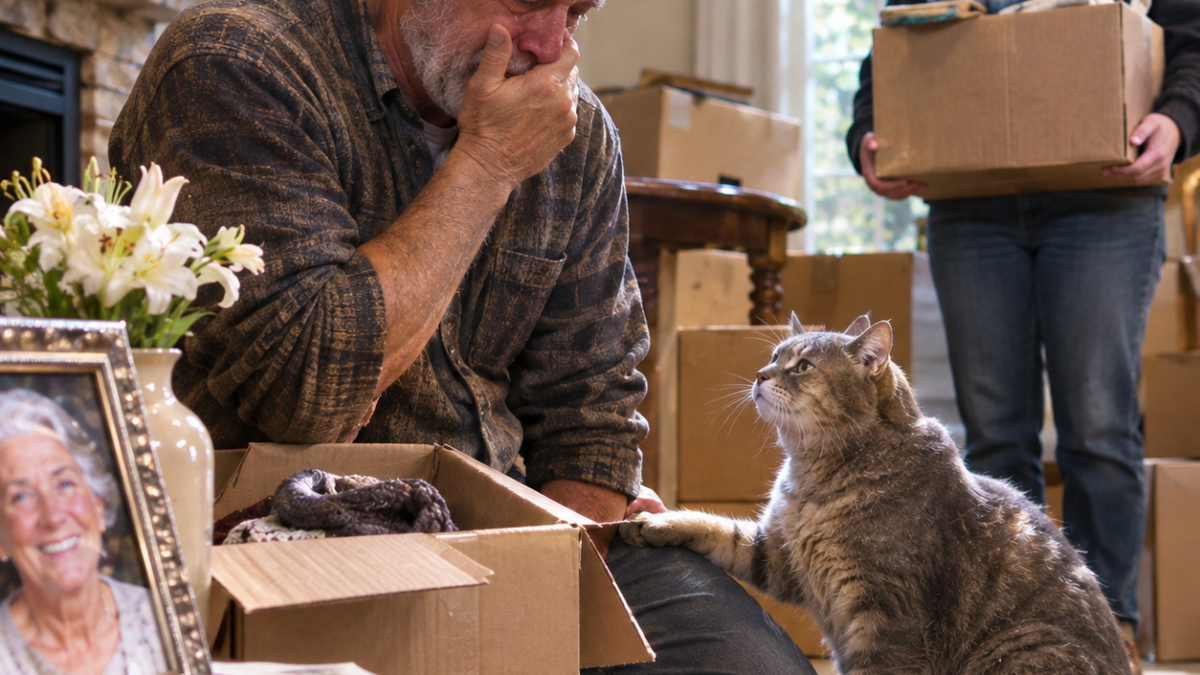
Three Months After My Wife Died, My Daughter Boxed Up Her Things While I Was Gone—Then an Old Shelter Cat Changed What Happened Next
Three months after Linda died, I was still setting out two coffee mugs every morning and lying to my daughter that I was fine.
Then Emily used her spare key while I was away and boxed up the last pieces of her mother I wasn’t ready to touch, turning my grief into the ugliest fight we’d ever had.
What neither of us understood was that a battered senior cat nobody wanted would become the witness to everything we were too proud to say—and the reason neither of us lost the other.
Three months after my wife died, I was still setting out two coffee mugs every morning.
I didn’t do it on purpose.
At least that’s what I told myself.
I’d wake around six, before the winter sun had managed to climb over the bare maple trees behind our house, shuffle into the kitchen, fill the old Mr. Coffee machine, and reach automatically into the cabinet.
One blue mug for me.
One white mug with faded yellow daisies for Linda.
I’d set them beside each other on the counter.
Pour mine.
Then stand there looking at hers.
Empty.
Every morning, the same tiny mistake.
Every morning, the same correction.
I’d put Linda’s mug back in the cabinet before anyone could see what I’d done.
That was the part I never told my daughter.
When Emily called, I always gave her the same answer.
“I’m fine.”
I said it so often that the words stopped sounding like a lie.
They became more like a door I could close.
“How’d you sleep, Dad?”
“Fine.”
“You eating?”
“I’m fine.”
“Did you get out today?”
“I’m fine.”
“Are you sure?”
“Emily.”
A pause.
Then I’d soften my voice.
“I’m fine, sweetheart.”
That usually bought me another day.
Linda and I had been married forty-nine years.
Forty-nine.
People say numbers like that proudly when you’re both alive.
Forty-nine years.
High school sweethearts?
Almost fifty!
What a blessing.
Nobody tells you what forty-nine years feels like after one person disappears.
It means there isn’t a part of your life that doesn’t contain them.
The kitchen was ours.
The bedroom was ours.
PART2:
The patch of faded carpet beside the couch was from the Christmas tree Linda insisted was perfectly straight when it was leaning like a drunk.
The dent in the hallway wall came from the time Emily, at thirteen, tried to roller-skate indoors and took out a side table.
The blue paint in the downstairs bathroom was Linda’s choice.
I had wanted beige.
She said beige was the color of surrender.
We laughed about that for thirty years.
There were a thousand things like that.
Our diner booth every Sunday after church.
Our grocery store arguments about whether we needed another bag of coffee.
Our ridiculous disagreement over how towels were supposed to be folded.
The way she slept with one foot outside the blankets no matter how cold the room was.
The way she’d say my full name—”Thomas Avery Lawson”—whenever I’d done something particularly stupid.
After forty-nine years, you stop thinking in terms of mine and hers.
It’s ours.
Then one December morning, it all became mine.
Just mine.
That was the cruelest part.
Not the hospital.
Not the funeral.
Not the casseroles neighbors kept bringing over in dishes I’d have to remember to return.
Not the cards with watercolor flowers and Bible verses written in shaky handwriting.
Not even the moment the funeral director asked me whether I wanted Linda’s wedding ring left on her hand.
The worst part came afterward.
The quiet.
The house became so still I could hear the refrigerator compressor kick on from the bedroom.
At night the heat ducts popped.
Floorboards creaked.
PART3:
The ice maker dropped cubes.
Every ordinary sound became footsteps for half a second.
And every time, some stupid animal part of me thought:
Linda.
Then my brain would catch up.
No.
Not Linda.
Never Linda again.
I kept the television on even when I wasn’t watching.
Sports.
Weather.
Old westerns.
Cooking shows.
Anything with voices.
I ate soup straight from the saucepan because putting food on a plate seemed like theater nobody was watching.
Sometimes I stood at the kitchen counter with a spoon and realized I’d been staring at the wall for five minutes.
Linda’s cardigan remained hanging on the hook beside the back door.
Faded blue.
One pocket stretched because she always shoved her phone into it.
There was still a peppermint wrapper in the other pocket.
I knew because once, maybe two weeks after the funeral, I put my hand inside and found it.
I nearly threw the sweater away after that.
The pain was so sudden and ridiculous.
A candy wrapper.
A stupid red-and-white piece of plastic.
I stood in the laundry room holding it like somebody had handed me her last letter.
Then I put it back.
The cardigan stayed.
Emily hated that cardigan.
She never said so.
Not at first.
But whenever she visited, I saw her look at it.
My daughter was forty-four then.
Married to a decent man named Dan.
Two kids.
A mortgage.
A job that required too many meetings and too much email.
She had inherited Linda’s dark hair and my habit of worrying silently until suddenly it came out as instructions.
She called every other day.
Sometimes every day if it snowed.
“You sure you’re okay, Dad?”
“Fine.”
“Did you shovel the steps?”
“Yes.”
“Did you actually shovel them or did you just kick a path through the snow?”
“That sounds like a judgmental question.”
“Dad.”
“They’re clear.”
“Do you have groceries?”
“Plenty.”
“Not pickles and crackers. Food.”
“I survived the United States Army, forty-two years at the paper mill, your teenage years, and three presidential administrations I didn’t enjoy. I can buy groceries.”
“You were in the Army for two years.”
“Two dangerous years.”
“You were stationed in Germany.”
“There were Germans everywhere.”
That would usually make her laugh.
Humor became my favorite weapon.
If she laughed, she might not ask the next question.
The questions I couldn’t answer.
Are you lonely?
Are you scared?
Do you know what you’re going to do with the rest of your life?
Do you still want a rest of your life?
She asked me to stay with her.
Not permanently, she said.
Just for a while.
“We’ve got the guest room.”
“No.”
“The kids would love it.”
“No.”
“You wouldn’t be in the way.”
“I know.”
“You’d have people around.”
That was exactly what I didn’t want.
I didn’t want to become the sad old man in the spare bedroom.
I didn’t want to hear a family living normally around me while every normal sound reminded me that mine had been torn in half.
I didn’t want Emily watching how much I ate.
I didn’t want Dan asking if I wanted to go for a walk.
I didn’t want my grandson turning down the television because Grandpa was resting.
I wanted my house.
Even if I hated how quiet it was.
Even if I wandered through it like a ghost who hadn’t received the news.
I wanted the chair Linda had picked.
The kitchen table we’d bought when Emily was six.
The mark on the laundry-room door where Linda had measured the grandchildren’s height.
I wanted the place where my life had happened.
What I wanted, though I never said it out loud, was for that place to stop feeling like a church after everyone had gone home.
That happened on a Sunday in March.
Not all at once.
It started because I couldn’t stand another afternoon in the house.
The sky was gray.
The snow had mostly melted, leaving dirty ridges along parking lots and driveways.
I got into my truck with no destination in mind.
I drove through town.
Past Linda’s pharmacy.
Past the diner.
I almost stopped there.
Didn’t.
Past the hardware store.
Then I saw the county animal shelter.
I’d driven by it hundreds of times.
Linda had talked about volunteering there after retirement.
She never got around to it.
There was always something.
Her mother got sick.
Then my knee surgery.
Then the grandkids.
Then cancer.
Life has a way of making later disappear.
I turned into the shelter driveway.
Immediately felt stupid.
I didn’t want a dog.
I didn’t want a cat.
I didn’t need anything that ate, shed, vomited, scratched furniture, woke me up, or required medical care.
I already had enough trouble keeping myself functioning.
But I parked anyway.
Inside, the dog side was loud enough to shake the walls.
Barking.
Howling.
Metal kennel doors rattling.
Hopeful chaos.
The cat side was quieter.
A woman in purple scrubs looked up from the front desk.
“Can I help you?”
“Just looking.”
She smiled.
“That’s how it starts.”
“I am absolutely not adopting anything.”
“Of course.”
She went back to her paperwork.
Smart woman.
Most of the cats were young.
Bright eyes.
Quick paws.
Kittens bounced against glass.
A black-and-white youngster reached through the bars and tried to steal my coat zipper.
There was an orange kitten asleep upside down with all four feet in the air.
Those were the ones people stopped at.
The ones with little signs saying things like PLAYFUL! or LOVES KIDS!
Then I reached the back row.
And saw him.
Gray tomcat.
Big once, probably.
Now a little bony around the hips.
Fur thin in places.
One ear nicked.
Cloudiness beginning in one eye.
He had a broad, tired face and the expression of somebody who had been disappointed often enough to stop taking it personally.
He wasn’t crying.
Wasn’t pawing the bars.
Wasn’t trying to impress anybody.
He sat on a folded towel and watched people pass.
There was a card on his cage.
OTIS.
AGE: APPROX. 14.
SENIOR.
OWNER DECEASED.
I stared at those last two words.
Owner deceased.
Such a cold phrase.
Two words to summarize the end of somebody’s whole world.
I crouched.
“Well,” I said, “I know a little something about that.”
Otis stared at me.
His left eye narrowed.
He looked deeply unimpressed.
“Yeah. You and me both.”
The woman from the desk had come up behind me.
“That’s Otis.”
“So the card says.”
“He’s been here seven weeks.”
“Why?”
She hesitated.
“You want the polite answer?”
“No.”
“He’s old.”
I looked through the bars.
“That’s it?”
“Mostly.”
“He sick?”
“Kidneys are a little borderline, but nothing unusual for his age. Some arthritis. Dental work was done before he came onto the floor. He needs monitoring.”
“Temperament?”
She smiled.
“Opinionated.”
“I respect that.”
“He doesn’t love other cats. Doesn’t love dogs. Doesn’t particularly love being picked up.”
“People?”
“He chooses.”
“Meaning?”
“You’ll know.”
She opened the cage.
“Hold out your hand.”
“I told you, I’m not—”
“Just your hand.”
I sighed and reached in.
Otis smelled my fingers.
For three or four seconds, nothing happened.
Then he stood.
Slowly.
Walked toward me.
Pressed his forehead against my wrist.
Then leaned his entire old body against my forearm.
Hard.
Like a man at a bus stop deciding I was a wall.
I swallowed.
“What’s he doing?”
The woman folded her arms.
“Choosing.”
“Don’t say that.”
“Why?”
“Because it’s manipulative.”
She laughed.
“I’m not making him do it.”
Otis leaned harder.
“Traitor.”
He began purring.
It wasn’t much of a purr.
More like a lawn mower trying to start in January.
But I felt it through my sleeve.
I almost left.
That’s the truth.
Something about that old cat leaning on me terrified me.
Not the responsibility.
The attachment.
When you’ve just lost the person you loved most in the world, love stops looking entirely beautiful.
It starts looking dangerous.
Everything you love becomes something that can be taken.
Part of you gets superstitious.
Don’t need too much.
Don’t care too much.
Don’t let anything get close enough to hurt you again.
I stood up.
“I’m going home.”
The shelter worker nodded.
“Okay.”
That easy acceptance bothered me.
“Aren’t you supposed to convince me?”
“Nope.”
“What kind of sales operation is this?”
“The kind where he’ll still be here tomorrow if you change your mind.”
I looked at Otis.
He had returned to his towel.
He wasn’t watching me anymore.
That somehow made it worse.
He looked like he’d already learned the lesson I was trying to learn.
People leave.
I walked to my truck.
Sat behind the wheel.
Started the engine.
Didn’t move.
Ten minutes later, I went back inside.
The woman looked up.
“Forget something?”
“Paperwork.”
She smiled.
I pointed at her.
“Don’t.”
“Didn’t say anything.”
“You were about to.”
“I absolutely was.”
I took Otis home.
Emily laughed when I told her.
Then she got quiet.
“You adopted a cat?”
“Apparently.”
“You?”
“There’s no need to sound insulting.”
“Dad, you spent my entire childhood saying cats were smug little freeloaders.”
“I’ve matured.”
“You’re seventy-three.”
“Took time.”
“What kind of cat?”
“Old.”
“How old?”
“Fourteen.”
She was silent.
Then softer, “Dad.”
“What?”
“Nothing.”
“What?”
“I think that’s the first good decision you’ve made in three months.”
I nearly hung up on her.
The first week, Otis hid beneath the guest bed.
He came out to eat.
Use the litter box.
Drink.
Then vanished again.
Fine by me.
We had an agreement.
He wouldn’t ask me to process my emotions.
I wouldn’t ask him to perform affection.
The second week, he started appearing in the kitchen whenever I opened a can.
By week three, he’d claimed Linda’s recliner.
That bothered me.
The first time I saw him there, I stopped in the doorway.
“That’s not yours.”
Otis opened one eye.
“That was Linda’s chair.”
Nothing.
“You could use the couch.”
He closed his eye.
“Unbelievable.”
I considered moving him.
Didn’t.
By April, the chair belonged to him.
He followed me.
Not like a dog.
Not enthusiastically.
He simply appeared wherever I was.
Kitchen.
Hall.
Porch.
Laundry room.
If I spent too long downstairs, he’d show up and sit five feet away.
As though inspecting whether I was still alive.
He changed my routine without asking permission.
Breakfast at seven.
Not seven-fifteen.
Otis considered fifteen minutes an act of aggression.
The curtains had to be opened because he liked sunlight in the front window.
I started making my bed because otherwise he crawled beneath the blankets and I’d spend half an hour wondering where he’d gone.
I started vacuuming because cat hair appeared everywhere.
I started cooking chicken occasionally because apparently an animal who had spent seven weeks in a shelter now considered certain canned foods beneath him.
I also stopped sitting in the dark.
That was the strange one.
Before Otis, some evenings I wouldn’t turn on a lamp until the television became difficult to see.
I told myself I hadn’t noticed.
Really, I think I liked the house disappearing around me.
Otis didn’t.
He’d pause at the edge of the unlit hallway, cloudy eye working, then complain.
So I left a lamp on.
For him.
That’s what I told myself.
One night in May, I was sitting in the living room with one of Linda’s recipe cards.
Her handwriting.
Pot roast.
Nothing important.
She’d written “Tom likes more pepper” in the margin.
That sentence broke me.
Grief is stupid that way.
You survive the funeral.
You survive the grave.
You survive signing death certificates.
Then “Tom likes more pepper” destroys you on a Tuesday.
I cried harder than I had since the hospital.
Not dignified crying.
Bent over.
Hands over my face.
Couldn’t breathe right.
I hated it.
Hated being seventy-three years old and sounding like a frightened child.
Then Otis jumped onto the couch.
He turned once.
Settled against my leg.
That was all.
No miracle.
No magical understanding.
He didn’t fix grief.
He didn’t make me miss Linda less.
He didn’t know who Linda was.
But that night, for the first time since she died, I wasn’t alone inside the missing.
A few weeks later, Emily arrived carrying groceries.
Otis was upside down in the recliner, one paw hanging over the arm.
She stopped.
Looked at him.
Looked around.
“The house feels different.”
I glanced toward Linda’s cardigan.
Still on the hook.
“Yeah.”
“You vacuumed.”
“I own a vacuum.”
“There are dishes drying.”
“That’s usually where clean dishes go.”
She smiled.
“You’re making jokes again.”
“I never stopped.”
“You did.”
That stung because it was true.
She stepped toward me.
“Are you okay?”
My automatic answer rose.
Fine.
I could feel it sitting behind my teeth.
Then Otis opened one eye.
I don’t know why that mattered.
But I told the truth.
“No.”
Emily’s face changed.
“Not all the way.”
I swallowed.
“But I think I’m starting to be.”
She hugged me.
I tolerated it for four seconds.
Then said, “You’re crushing my ribs.”
“You’re impossible.”
“Genetic.”
For a while, that was enough.
Me.
Otis.
Emily checking in.
The garden waking up.
Linda’s absence no longer feeling like an emergency every minute.
Then people started trying to improve me.
Nobody warns widowers about that.
After the funeral, people bring food.
Three months later, they bring solutions.
Practical solutions.
I came to hate the word practical.
Practical meant:
Maybe you should sell the house.
Practical meant:
You don’t need all this space.
Practical meant:
Wouldn’t you like somewhere with people your age?
Practical meant:
We have decided your life contains too much history and not enough handrails.
The first brochures appeared on my kitchen table in June.
Three of them.
Thick paper.
Glossy photographs.
Smiling old people strolling through landscaped gardens wearing suspiciously clean sweaters.
WILLOW CREEK COMMONS.
MEADOW RIDGE SENIOR LIVING.
HARBOR GLEN RESIDENCES.
There wasn’t a harbor within two hundred miles.
Places for old people are always named after trees and water.
Makes institutional carpeting sound scenic.
Otis walked across the brochures and sat on Willow Creek.
Good cat.
I called Emily.
“You left trash on my table.”
A pause.
“You saw them.”
“I am still able to see.”
“Dad.”
“One has a photograph of a man doing yoga beside a fake pond.”
“It’s independent living.”
“Then why does everyone in the picture look supervised?”
“Can you please not do this?”
“Do what?”
“Turn everything into a joke so nobody can talk to you.”
That landed.
I sat.
Otis remained planted on the smiling couple from Willow Creek.
“I am not moving.”
“I didn’t say tomorrow.”
“You left brochures.”
“I wanted you to look.”
“I looked.”
“And?”
“I don’t own pants that color.”
She exhaled.
“You’re doing it again.”
I went quiet.
So did she.
Then Emily said, “I’m scared.”
That took some heat out of me.
But not all.
“I already lost Mom.”
“Emily—”
“I can’t lose you too because you fall off a ladder or have some medical emergency and nobody knows for two days.”
“I’m not dead.”
“I know.”
“Then stop organizing me like I’m halfway there.”
She started crying.
Not much.
Just enough that I heard her breathing change.
“I don’t know how to do this,” she said.
“Do what?”
“Be your daughter when Mom isn’t here.”
I looked down.
Otis was licking one leg.
Completely unconcerned.
“I don’t know how to be your father without her either.”
That was the closest we came to peace that day.
Then I said, “Still not moving.”
Emily laughed once through her tears.
“I know.”
The trouble should have ended there.
Instead, fear started doing what fear does.
It dressed itself up as common sense.
Emily began noticing things.
Burned-out bulb over the porch.
Stack of mail.
Loose step.
Leaves in the gutter.
I’d notice her noticing.
That made me defensive before she’d even said anything.
One afternoon she caught me on a ladder.
Third rung.
Cleaning leaves from the gutter.
“Dad!”
I looked down.
She was in the driveway with both hands in the air.
“What?”
“Get down!”
“I’m cleaning the gutter.”
“I can see what you’re doing.”
“Then why ask?”
“Get. Down.”
“I’m fine.”
She laughed.
Not because it was funny.
Because she was scared.
“That phrase should be illegal for men over sixty.”
“I’m not over sixty.”
She stared.
“All right. Technically.”
“You’re seventy-three.”
“Ageism.”
“Get down.”
I climbed down.
Mostly because arguing from a ladder ruins your authority.
She followed me into the garage.
“You could have fallen.”
“But I didn’t.”
“That isn’t how risk works.”
“Nobody gets points for almost falling.”
“They do get concussions.”
I threw the wet leaves into a trash bin.
“You come over to yell at me?”
“I brought soup.”
“Good.”
“The yelling was a bonus.”
That should have made us laugh.
Instead, I heard something beneath her words.
Assessment.
Can he handle the house?
Can he handle himself?
How close are we to the day when he can’t?
I hated being watched that way.
My whole life I’d been the person people called.
Flat tire?
Call Dad.
Leaking sink?
Call Dad.
Bad boyfriend?
Call Dad.
Need a ride at two in the morning?
Call Dad.
When did I become the person everybody was afraid to leave alone?
A week later, I started volunteering at the shelter.
That made everything worse.
It happened accidentally.
Otis had become picky.
He’d stopped eating pâté and decided only shredded chicken in gravy was acceptable.
Because apparently surviving abandonment gives you culinary standards.
I had three unopened cases of food.
Took them back to the shelter.
The woman behind the desk recognized me.
“Otis’s guy.”
“That’s my identity now?”
“There are worse.”
I stayed talking.
She mentioned they needed volunteers on Saturdays.
“Doing what?”
“Senior cats mostly. Socializing them. Talking to adopters.”
“You want me to sell old cats?”
“I want you to tell people why old doesn’t mean worthless.”
That sentence got under my skin.
Maybe because I knew something about being looked at and quietly assessed for remaining usefulness.
I volunteered.
At the shelter, I met Mabel.
Three-legged tabby.
Mean as unpaid taxes.
A blind beagle named Chester who slept sitting up.
A massive orange cat named Winston who drooled whenever he purred.
A black senior cat named Salem with cloudy eyes and the grave expression of a school principal.
People walked past them.
Kittens went first.
Puppies.
Young animals with long futures.
I understood.
Everybody likes hope with a warranty.
But the old ones didn’t perform.
They didn’t bounce.
Didn’t beg.
Didn’t sell themselves.
They waited.
One Saturday a little girl stopped at Mabel’s cage.
“Why doesn’t she have a leg?”
Her mother read the card.
“She had an accident.”
“Why doesn’t anybody take her?”
“She’s older.”
The girl frowned.
“So?”
That word stayed with me.
So.
Exactly.
So what?
When did old become another word for less worth choosing?
I started talking too much.
Families heading toward the kitten room would hear:
“You want chaos for the next three years, go that way.”
Or:
“This one’s twelve and already knows curtains are not climbing equipment.”
Or:
“You know what an old animal gives you? Gratitude without drama.”
The shelter manager corrected me.
“Cats experience attachment, Tom. We don’t actually know they experience gratitude like humans.”
“You’re ruining my sales pitch.”
It worked anyway.
A retired postal worker adopted Winston.
A widow adopted Chester.
A divorced man named Ray adopted Mabel after she swatted him.
“She seems mean in a way I respect,” he said.
I shook his hand.
Emily wasn’t thrilled.
“You’re volunteering?”
“Yes.”
“Every Saturday?”
“Couple hours.”
“You should be taking it easier.”
“According to?”
“Common sense.”
I laughed.
“Common sense is what people call it when they want your life smaller than you do.”
She went quiet.
“That’s not what I want.”
I knew.
That was the problem.
Emily wasn’t cruel.
She wasn’t greedy.
She wasn’t trying to steal my house.
She was scared.
Scared people can still hurt you.
Spring turned into summer.
I planted Linda’s tomatoes.
I’d left the beds untouched since she died.
Dead vines.
Old stakes.
Weeds.
One morning I looked at them and realized I was tired of calling neglect mourning.
So I dug.
Otis watched from the porch like management.
Emily arrived halfway through.
She stepped out of her car and saw me on my knees in the dirt.
Her expression changed.
That combination again.
Pride.
Fear.
“You’re planting?”
“Apparently.”
“Mom’s tomatoes?”
“Somebody should.”
She removed her jacket.
“You’re spacing those too close.”
“You know nothing about tomatoes.”
“No. Mom just complained about how you planted them for thirty years.”
That got me.
We worked two hours.
For a while, everything was normal.
Father.
Daughter.
Dirt.
Old jokes.
No assisted-living brochures.
No grief negotiations.
Then, in the kitchen afterward, Emily said, “You know, if you ever did move somewhere smaller, you could still garden. Some places have raised beds.”
I shut off the faucet.
She saw my face.
“Dad.”
“I told you.”
“I’m just saying.”
“Stop just saying.”
“Why does this have to become a fight?”
“Because every conversation feels like you’re trying to make my life easier by making it smaller.”
“That’s unfair.”
“There.”
“What?”
“Every time I tell you how this feels, you tell me I’m unfair.”
She threw the dish towel down.
“Do you know what’s unfair? Watching you treat staying in this house exactly the way it was as the only acceptable proof that you loved Mom.”
That hit where she intended.
“Linda has nothing to do with it.”
“Then why are you staying?”
I opened my mouth.
Nothing came.
Why?
The house was too large.
My knees hurt on stairs.
The roof needed work.
The yard was becoming harder.
I had more rooms than I used.
Why?
Because leaving felt like erasure.
Because every wall remembered.
Because I knew exactly where Linda had stood when she told me she was pregnant.
Where Emily had taken her first steps.
Where Linda had called me from the doctor’s office and said, “They found something.”
Because if I left, somebody would repaint.
Replace the counters.
Rip out the tomato beds.
Maybe remove the maple tree Linda had planted the year Emily was born.
And all those things would still have happened.
But not there.
Not visibly.
Emily saw I couldn’t answer.
Her face softened.
I hated that.
“You don’t have to solve me.”
“I’m not trying to solve you.”
“You are.”
“I’m trying to keep you.”
Her voice broke.
“That’s all.”
I wanted to tell her there was no cliff.
No danger.
No deadline.
But there was.
Aging is a cliff.
Grief too.
Some days you stand far from the edge.
Some days you don’t realize how close your heel is.
Three days later, Emily used her spare key.
I was at the shelter.
When I returned, the house smelled wrong.
Clean.
That sounds ridiculous.
But there’s normal clean.
And there’s somebody has been making decisions in your home clean.
The cardigan was gone.
Linda’s blue cardigan.
I stood at the back door staring at the empty hook.
Otis wound around my ankles, asking for dinner.
Then I noticed boxes in the hallway.
Two.
Neatly taped.
Emily’s handwriting.
KEEP.
SORT LATER.
I opened one.
Linda’s scarf.
Her gardening gloves.
A stack of magazines.
Recipe cards.
The paperback she’d been halfway through when she went into the hospital.
My hands started shaking.
I called Emily.
“Hi, Dad.”
“You were in my house.”
Silence.
Then, “I used the spare key.”
“I know how doors work.”
“I was trying to help.”
“You boxed up your mother.”
“No.”
Her voice sharpened.
“I packed a few things that have been sitting out for months.”
“You don’t decide when they stop sitting out.”
“Dad—”
“You don’t decide when I’ve looked at something long enough.”
“Every time I come into that house, you look at her things like they’re cutting you.”
“Then let them cut me.”
“Why?”
“Because they’re mine to hurt over!”
Silence.
Then she said, “Grief has turned that house into a museum.”
There it was.
The sentence.
The one that cracked us open.
People get impatient with grief.
Not cruelly.
Usually.
They want you sad enough to prove the dead person mattered.
But not sad enough to become uncomfortable.
Cry at the funeral.
Keep photographs.
Mention anniversaries.
But eventually—
Move things.
Smile.
Travel.
Date, maybe.
Be grateful.
Live.
Everyone wants to see recovery because grief reminds them there are losses they cannot control.
I said, “Maybe the museum bothers you because you don’t like seeing evidence that your mother was here.”
Emily inhaled sharply.
“That is cruel.”
“You came into my house while I was gone.”
“I was trying to make room for you to breathe!”
“It is not your job to make room in my house.”
“Then whose is it?”
“Mine!”
“Then do something!”
The words rang through the phone.
Otis jumped onto the kitchen chair.
Emily’s voice broke.
“I miss her too.”
I stopped.
“You think I don’t?”
She was crying.
“Do you think I walk into that house and see her sweater and her coffee mug and the chair she sat in and feel nothing? She was my mother.”
I sat.
“You act like you’re the only one who lost her.”
“I never said that.”
“You don’t have to.”
She cried harder.
“You got forty-nine years. I got a mother. My children lost their grandmother. Dan lost the woman who treated him like a son when his own mother barely called. Everybody lost her.”
That shut me up.
Grief makes you selfish.
Not evil.
Narrow.
Pain sits so close to your face you forget other people are carrying their own version of it.
Otis jumped into my lap.
He almost never did that.
Heavy.
Warm.
I put one hand on him.
Emily sniffed.
“I shouldn’t have used the key.”
I stared at the empty hook.
“No.”
“I was wrong.”
That made my anger harder to hold.
“You had no right.”
“I know.”
I wanted her to defend herself.
Then I could keep fighting.
Instead, she said, “I know.”
We did not fix things that night.
I put Linda’s cardigan back.
Put the gardening gloves where they’d been.
Put the book on her bedside table.
Some things stayed in the boxes.
Not because Emily was right.
Because while unpacking them, I realized I didn’t need every object exactly where Linda had left it to prove she’d existed.
I hated realizing that.
A week passed.
Emily texted.
Need groceries?
No.
A photo of my granddaughter at a school concert.
I sent a thumbs-up.
A masterpiece of emotional communication.
Then Otis stopped eating.
Everything changed.
Morning breakfast sat untouched.
“Come on.”
He sniffed.
Walked away.
At dinner, same thing.
He slept deeper.
Moved slower.
The next day he didn’t complain when I picked him up.
That scared me.
Complaining was Otis’s religion.
I called the veterinarian.
The waiting room was full of puppies, carriers, worried people.
I sat holding a fourteen-year-old gray cat and trying not to look like a man who knew exactly what it was to be told something he loved might have limited time.
The veterinarian was young.
Dr. Melissa Grant.
Gentle.
She examined him.
Blood tests.
Urine.
Weight.
Kidneys declining.
Dehydrated.
Arthritis worse.
Nothing dramatic.
No tumor.
No immediate catastrophe.
Just age.
“We can manage this,” she said.
“Manage meaning cure?”
“No.”
I nodded.
“How long?”
She didn’t give me a number.
I respected her for that.
“He may have good time left.”
Good time.
That’s different from time.
I understood that language.
Cancer had taught us the same vocabulary with Linda.
Treatment.
Response.
Quality.
Good months.
Comfort.
Not promises.
I carried Otis home.
At a red light he complained from the carrier.
A rough old howl.
I laughed.
“Good.”
He yelled again.
“That’s right. Insult me.”
At home, he drank water.
Then stared at me like I’d caused the entire medical profession.
I sat at the kitchen table.
And called Emily.
She answered immediately.
“Dad?”
“Otis is sick.”
That was all.
Twenty minutes later she was there.
Hair still damp.
No makeup.
Sweatpants.
“How bad?”
I told her everything.
She listened.
No brochure.
No “this proves you need help.”
No smugness.
She pulled a notepad from the junk drawer.
“Okay.”
She wrote:
Renal food.
Fluids.
Medication.
Follow-up.
Water intake.
Appetite.
Vomiting.
Weight.
I watched her.
One day your child is two years old throwing peas at the wall.
Then she’s forty-four in your kitchen organizing veterinary care because something you love is fragile.
“I’m sorry,” I said.
She looked up.
“For what?”
“For the phone call.”
She knew which one.
“I’m sorry too.”
I nodded.
Then said something I had not understood before.
“I wasn’t holding onto your mother’s stuff only because of your mother.”
Emily waited.
“I think I was holding onto proof that it was still my life.”
Her eyes filled.
There it was.
The ugly truth under the whole fight.
Emily was afraid I’d die alone.
I was afraid of remaining alive inside a life somebody else had already decided I was too old to own.
Those fears looked opposite.
They weren’t.
They came from the same place.
Loss.
Emily crossed the kitchen and hugged me.
This time I didn’t complain about my ribs.
She stayed to help with Otis’s fluids.
He objected violently.
Made a noise like an antique bicycle horn.
Glared at us.
Then marched to Linda’s recliner and sat with his back turned.
Emily laughed.
“I love him.”
“That’s the problem.”
She looked at me.
“What?”
I nodded toward Otis.
“Love.”
She smiled sadly.
“That’s not the problem.”
“No?”
“That’s the risk.”
Maybe she was right.
The next few months taught me that loving something old is a particular kind of courage.
You know the ending is closer.
You love anyway.
Otis stabilized.
Not miraculously.
Some days he ate well.
Some days barely.
We did fluids twice a week.
Special food.
Medication.
Regular bloodwork.
He hated every appointment.
At home, he returned to supervising my mornings.
Emily and I built a compromise.
Not some dramatic reconciliation.
Practical things.
The good kind of practical.
A contractor installed a stronger rail at the back steps.
I agreed never to clean gutters again.
A teenager down the street mowed the lawn twice a month.
Emily kept the spare key.
But she promised not to use it without telling me unless I didn’t answer for an agreed number of hours.
I promised to answer my phone.
Mostly.
The brochures disappeared.
My house stayed mine.
Something else changed.
Emily started coming to the shelter.
The first time, she stopped in front of a thirteen-year-old cat named Napoleon with half a tail and a crooked jaw.
She read his card.
“This is your fault.”
“What?”
“I want him.”
“No.”
“You spend Saturdays convincing strangers to adopt senior animals.”
“Yes.”
“Now you’re telling me no?”
“You have a husband, two children, a Labrador, and two guinea pigs.”
“Your point?”
“My point is, Dan may kill me.”
Napoleon ignored both of us.
Emily crouched.
“I thought the shelter thing was you avoiding the house.”
“Maybe it was at first.”
“And now?”
I looked around.
At animals waiting.
At volunteers cleaning.
At people trying.
“Now it feels useful.”
Emily touched the cage.
Napoleon finally sniffed her finger.
“I used to think empty was what you were afraid of.”
I waited.
She said, “Maybe being unseen is worse.”
That sentence stayed.
Being unseen.
Managed instead of known.
Reduced to whatever version of you makes other people comfortable.
An old cat in a back cage.
An old man in a big house.
Too much history.
Too much maintenance.
Too much future uncertainty.
Easy to admire from a distance.
Harder to choose.
That summer, the shelter held an adoption event in the town square.
Emily helped.
Somebody painted a sign for the senior-animal section.
OLD IS NOT BROKEN.
Simple.
People stopped.
Some smiled.
Some walked on.
Three senior cats and one elderly dog were adopted that day.
When I got home, Otis was waiting at the door.
He complained as I lifted him.
“You have no idea what I accomplished today.”
He purred against my chest.
“People think you’re inspirational.”
He sneezed.
“That’s what I said.”
The house had changed.
Not abandoned its past.
Changed.
The new handrail.
A cat bowl by the kitchen.
Linda’s cardigan still by the door.
Emily’s groceries sometimes on the counter.
Grandchildren’s shoes in the hall during Sunday dinner.
Tomatoes growing outside.
Life was no longer the same.
For months I’d believed that was the tragedy.
Eventually, I understood sameness was never the goal.
Continuity was.
A year after Linda died, I took her cardigan off the hook.
My decision.
Nobody suggested it.
Nobody watched.
It was morning.
Sun coming through the back window.
I looked at the cardigan and realized something.
I could picture Linda wearing it.
Not vaguely.
Clearly.
Standing at the stove.
Sleeves pushed up.
Complaining about the coffee.
Laughing.
I didn’t need the sweater hanging there to summon her.
That scared me.
Then comforted me.
I folded it.
Put it into the cedar chest at the foot of our bed.
I kept the peppermint wrapper.
Obviously.
I’m not a monster.
Then I sat on the bed and cried.
Afterward, I made coffee.
One mug.
Otis screamed because breakfast was six minutes late.
Life continued.
That may be the closest thing to a miracle grief gives you.
Not forgetting.
Not moving on.
I hate that phrase.
You don’t move on from forty-nine years.
You move with.
Your life grows around the missing.
At first, the missing fills everything.
Then life begins pushing outward.
A grandchild’s school play.
Tomatoes.
An old cat.
A ridiculous argument.
A Saturday at the shelter.
A daughter asking the right question instead of giving the wrong instruction.
More room appears.
Not because grief shrinks.
Because you expand.
Otis gave us another year.
Then another.
His kidneys worsened slowly.
He became thinner.
His back legs stiff.
He slept more.
His purr got rougher.
He still claimed Linda’s chair.
Emily bought him a small heated pad.
I said it was excessive.
Then I checked every night to make sure it was working.
At sixteen, Otis stopped jumping.
I built a small step for the recliner.
At seventeen, he stopped using the front window.
I moved a chair lower so he could still sit in sunlight.
At eighteen, Dr. Grant stopped talking about numbers.
We talked about comfort.
Appetite.
Pain.
Interest.
Good days.
Bad days.
One evening, Emily asked, “How will you know?”
I knew what she meant.
“When it’s time?”
I looked at Otis asleep.
“I don’t.”
“Dr. Grant said—”
“I know what she said.”
“I don’t want you to wait too long because you’re afraid.”
I almost became defensive.
Then stopped.
“Neither do I.”
That was progress.
The end came in October.
Cold morning.
Otis didn’t get up for breakfast.
I carried his food to him.
He smelled it.
Turned away.
He looked tired.
Not sick-tired.
Finished-tired.
I sat beside him.
He put one paw on my wrist.
He’d done that thousands of times.
But I knew.
I called Emily.
Then Dr. Grant.
Emily arrived first.
She sat on the floor.
Otis allowed her to touch his head.
“He hates me less now,” she whispered.
“He hates everybody less. Low energy.”
She laughed and cried.
Dr. Grant came to the house.
I couldn’t take him into the clinic.
Not that day.
Not if I could help it.
She examined him.
Then looked at me.
“You don’t have to decide this minute.”
I hated her kindness.
Because it meant the decision was mine.
I stroked Otis.
He didn’t purr.
That told me more than anything.
“He got me through losing Linda.”
Emily put her hand on my shoulder.
“I know.”
“Feels wrong.”
“What?”
“Choosing to lose him.”
Dr. Grant said softly, “You’re not choosing the loss. You’re choosing what part of it he has to experience.”
That sentence saved me.
I nodded.
We put Otis in Linda’s recliner.
His chair.
I sat beside him.
Emily on the floor.
Dr. Grant gave the first injection.
Otis relaxed.
His breathing slowed.
I put my hand against his side.
“Remember that shelter?”
His ear moved.
“You leaned on me.”
Emily was crying silently.
“I thought you needed me.”
I swallowed.
“Turns out you were smarter.”
Otis’s paw rested against my fingers.
“You kept me here.”
His breathing softened.
“Good cat.”
The second injection.
No pain.
No struggle.
One breath.
Another.
Then stillness.
I had thought Linda’s death had prepared me for loss.
It hadn’t.
Loss doesn’t vaccinate you against loss.
It makes you recognize the symptoms faster.
I buried Otis beneath the maple tree.
Emily helped.
The shelter offered cremation.
I wanted him home.
The maple had been Linda’s tree.
The cat had been Linda’s chair thief.
It seemed appropriate.
For days, the house was unbearable.
I still woke expecting his scream.
Still watched my feet so I wouldn’t trip over him.
Still opened curtains automatically.
Still looked toward the recliner.
Empty.
That was when I finally understood something I’d been fighting for two years.
I had spent months believing that if I changed the house, I would lose Linda.
Then I believed if I let Emily help, I would lose myself.
Then Otis died.
And everything changed anyway.
Nothing I loved had stayed because I preserved the room around it.
Linda had stayed through memory.
Through Emily.
Through recipes.
Tomatoes.
The way I folded towels wrong.
The way my granddaughter had Linda’s laugh.
Otis stayed in routines.
Sunlight.
The scratch on the recliner.
The old man I had become because a shelter cat needed breakfast every morning.
Being alive meant being changed by what you lost.
The trick wasn’t preventing change.
It was deciding which changes still allowed you to recognize yourself.
A month after Otis died, I went back to the shelter.
I wasn’t ready for another cat.
I told everyone that.
The manager handed me a volunteer badge.
“Nobody asked.”
“Good.”
I sat with the senior cats.
One cage was occupied by an eleven-year-old calico named Betty.
Owner entered assisted living.
Family could not take.
Betty glared.
I sat.
She ignored me.
Perfect.
After an hour, she approached.
Sniffed my sleeve.
Walked away.
I smiled.
“No pressure.”
Emily appeared behind me.
“What are you doing here?”
“Volunteering.”
“On a Wednesday?”
“I had time.”
She sat beside me.
Betty glared at both of us.
Emily said, “We’re not taking her.”
“I didn’t say anything.”
“Your face did.”
“I have one cat face.”
“You absolutely do.”
We sat quietly.
Then Emily said, “I owe you something.”
“What?”
“An apology.”
“We did that already.”
“No. Different one.”
I looked at her.
She stared at Betty.
“When Mom died, I thought if I didn’t keep moving, I’d fall apart.”
I waited.
“So I moved.”
“Okay.”
“I cleaned. Organized. Made plans. Researched places. Called contractors. Brought you food you didn’t ask for.”
“Terrible soup.”
“It was good soup.”
“Questionable.”
She smiled.
Then her expression changed.
“I thought movement was healing.”
I said nothing.
“I didn’t understand that you were healing too.”
“I wasn’t always.”
“I know.”
She nodded.
“But I made the mistake of thinking if you weren’t healing like me, you weren’t healing at all.”
That was a good sentence.
Painful.
True.
“I made mistakes too.”
“Like?”
“I was a delight.”
“Dad.”
“Fine.”
I watched Betty wash one paw.
“I used grief as a fence.”
Emily listened.
“Anytime you came near it, I treated you like you were trespassing.”
Her eyes filled.
“I didn’t know how to share your mother.”
Emily laughed once.
“That’s a strange sentence.”
“True one.”
She leaned her head against my shoulder.
We sat there.
Father and daughter.
Old cat watching us.
No villains.
That’s another thing life taught me.
People online like villains.
The selfish daughter.
The stubborn father.
The greedy nursing home.
The helpless widower.
Clean categories.
Easy outrage.
Real families aren’t clean.
Emily loved me when she used that key.
She was wrong.
Both things are true.
I loved Emily when I said cruel things on the phone.
I was wrong.
Both things are true.
Love does not prevent people from hurting each other.
Sometimes it gives them the exact map.
The important question is what you do after.
Do you defend every wound you caused because your intention was good?
Do you turn pain into a permanent courtroom?
Or do you say:
I was afraid.
I was wrong.
This hurt me.
I still love you.
Can we try differently?
A year later, Emily asked if I’d reconsider moving.
I laughed.
She held up both hands.
“Not because I think you can’t live here.”
“Continue.”
“Because there’s a smaller ranch house for sale four blocks from us.”
“No.”
“It has a fenced yard.”
“I don’t have a dog.”
“Garden.”
I paused.
“How big?”
She smiled.
I pointed.
“Don’t smile.”
“I didn’t.”
“You did.”
The house was one story.
Two bedrooms.
Back porch.
Small workshop.
Enough yard for tomatoes.
Close enough that the grandchildren could walk over.
I hated it.
Then liked it.
Then hated myself for liking it.
I went home.
Walked room to room.
Our bedroom.
Emily’s old room.
Linda’s kitchen.
The back door.
The cedar chest.
The maple.
Otis beneath it.
I thought leaving would feel like betrayal.
Instead, for the first time, it felt like a choice.
That difference mattered.
I sold the house six months later.
Not because Emily won.
Not because I lost.
Because I was ready.
At closing, the young couple buying it asked about the tomato beds.
“My wife planted tomatoes there for thirty years.”
“We love tomatoes,” the woman said.
“You’ll plant?”
“Absolutely.”
“Don’t crowd them.”
She smiled.
“We won’t.”
“And don’t step on the basil.”
Her husband laughed.
I didn’t explain.
Before leaving, I stood beneath the maple tree.
Otis stayed.
I couldn’t dig him up.
Didn’t want to.
I put a small flat stone near the trunk.
No name.
Just a mark.
The new owners promised not to disturb it.
Then I drove to my new house.
Emily was waiting.
So were Dan and the kids.
There were boxes everywhere.
Chaos.
I stepped inside.
My granddaughter shouted from the kitchen.
“Grandpa, where do you want Grandma’s blue chair?”
Linda’s recliner.
I looked at Emily.
She had kept it.
Of course.
“Front window.”
We put it there.
That evening, everyone left.
The new house became quiet.
For one terrible second, I panicked.
Different quiet.
Different refrigerator.
Different floorboards.
No Linda ghosts here.
No Otis.
I wondered if I had made a mistake.
Then I opened the cedar chest.
Took out Linda’s cardigan.
Held it.
Not because I needed to hang it.
Because I wanted to remember.
I placed it back.
Made coffee.
One mug.
Sat in the old recliner.
The next morning Emily called.
“How are you really?”
It had become our question.
I looked at the unpacked boxes.
At sunlight.
At the small backyard where tomatoes would go.
“Scared.”
“Okay.”
“Little lonely.”
“Okay.”
“Excited about the workshop.”
“Okay.”
“Annoyed you convinced me to move.”
“I didn’t convince you.”
“History will decide.”
She laughed.
I said, “I’m good.”
Then corrected myself.
“No.”
She waited.
“Today I’m… pretty good.”
“That sounds honest.”
“I’m trying.”
Years have passed since then.
I am older now.
Obviously.
I still volunteer at the shelter.
Fewer hours.
My knees insist.
Emily comes with me sometimes.
My granddaughter, who was a child when Linda died, now helps photograph senior animals for adoption posts.
Apparently good lighting matters.
I have learned more about cat photography than a man my age should.
Betty, the calico who watched Emily and me apologize to each other, eventually went home with a seventy-nine-year-old woman named Frances.
The shelter initially worried about placing an old cat with an old adopter.
I argued.
“Why?”
“What if something happens to Frances?”
“What if something happens to me tomorrow?”
They had no answer.
Frances and Betty became inseparable.
When Frances died three years later, her daughter took Betty.
Lives connect.
Then connect again.
Nothing is forever.
That’s not a reason not to love.
It’s the reason love matters while it’s here.
I still think about Otis.
Especially when I meet an older man at the shelter who says:
“I’m just looking.”
I know that voice.
Sometimes I let him look.
Sometimes I point toward the senior room.
I never tell anyone an animal will heal them.
That’s too much responsibility to put on a creature.
Animals aren’t medicine.
They don’t fix grief.
But sometimes they create routine.
Routine creates movement.
Movement creates days.
Enough days can create a life.
That’s what Otis gave me.
Breakfast.
Curtains.
A reason to turn on a lamp.
A body beside mine during the worst nights.
He didn’t save me in some dramatic movie sense.
He simply needed me long enough for me to remember I could still be needed.
That’s different.
Maybe better.
If you have an older parent, I hope you help them.
I also hope you understand help can become control faster than you think.
Ask before you move things.
Ask before you make plans.
Ask what they are afraid of losing.
Sometimes the answer isn’t the house.
Sometimes it’s authority.
Identity.
History.
The right to decide when a sweater becomes a memory instead of an object.
And if you’re the older parent?
Stop saying you’re fine when you’re not.
I know.
I hated that advice too.
But “I’m fine” is a lonely sentence.
Sometimes what you mean is:
I’m frightened.
I don’t know who I am now.
I miss her.
I hate needing you.
I’m afraid if I accept help you’ll start taking over.
I’m afraid if I refuse help you’ll stop offering.
I’m afraid of dying.
I’m more afraid of becoming invisible before I die.
Those are hard things to say.
Say them anyway.
The truth may not solve anything.
But it gives the people who love you somewhere real to meet you.
As for old animals?
Choose them sometimes.
Not out of pity.
Because people are wrong about beginnings.
We think hope has to be young.
Bright.
Unscarred.
Full of future.
It doesn’t.
Hope can be fourteen.
Hope can have cloudy eyes.
Hope can limp.
Hope can have bad kidneys and thin fur and an attitude problem.
Hope can sit in the back cage without asking anyone to notice.
Hope can lean into the hand of a grieving old man like a decision already made.
And sometimes hope does not promise you forever.
Sometimes it offers you good time.
That can be enough.
Linda and I got forty-nine years.
Otis and I got a little more than four.
For years, I would have said those amounts couldn’t possibly belong in the same sentence.
Now I understand love is not measured only in duration.
Some people walk with you for nearly half a century.
Some creatures meet you at the exact moment you’re disappearing and walk beside you just long enough to lead you back.
Both leave marks.
Emily called me tonight.
She does most evenings now.
Not because she’s checking whether I’ve fallen.
At least that’s what she claims.
She told me my grandson is getting married.
My granddaughter has adopted another senior cat.
Dan needs knee surgery and is apparently being “impossible about it,” which I consider justice.
Then Emily asked:
“How are you really?”
I looked around.
Linda’s recliner is still beside my window.
The cardigan is in the cedar chest.
A photograph of Otis sits on the table.
Outside, the tomato beds are brown for winter.
My house is smaller.
My life is different.
I miss things.
People.
Versions of myself.
But I do not feel erased.
“Today?” I said. “Pretty good. Knee hurts. Missing your mom. Thinking about Otis.”
Emily laughed softly.
“Hungry?”
“Always.”
“That sounds honest.”
“Yeah.”
I smiled.
“I’m trying.”
That may be the best answer I’ve found.
I’m not healed.
I don’t think grief works that way.
I’m not broken either.
I’m still here.
And at my age, I’ve stopped saying “still here” like it’s something small.
Still here means I survived the morning after the funeral.
Still here means I learned to make one cup of coffee.
Still here means I fought with my daughter and loved her after.
Still here means I accepted a handrail without surrendering my dignity.
Still here means I packed a cardigan when I was ready.
Still here means I allowed an old cat to matter even though I knew one day he would break my heart too.
People told me moving forward meant letting go.
They were wrong.
I carry Linda.
I carry Otis.
I carry the house.
The maple tree.
The empty cage where I first met him.
Emily’s tears over the phone.
The box marked SORT LATER.
The first tomato plant after winter.
All of it.
That’s what living is.
Not setting down everything heavy.
Becoming strong enough to carry it without letting it stop you.
And if anybody tells you old things are easier to lose because you’ve had longer to prepare, don’t believe them.
They’ve never stood in a quiet kitchen holding a sweater that still seemed shaped like the woman who wore it.
They’ve never sat on a shelter floor while an unwanted animal leaned into them as though saying, without words:
You.
You’ll do.
They’ve never discovered that the opposite of loneliness isn’t noise.
It isn’t a crowded house.
It isn’t assisted living.
It isn’t television.
It isn’t keeping busy.
The opposite of loneliness is being known.
Being allowed to grieve badly.
Being allowed to need help without becoming helpless.
Being allowed to grow old without becoming invisible.
Being chosen when you’re no longer new.
Being loved when loving you comes with history, inconvenience, medicine, fear, and an ending nobody can avoid.
Otis taught me that.
Emily did too.
Linda spent forty-nine years trying.
And if I have learned anything worth leaving behind, it is this:
The people and animals who save us rarely arrive looking like heroes.
Sometimes they’re a worried daughter who gets love wrong before learning to get it better.
Sometimes they’re a tired widower finally admitting he isn’t fine.
And sometimes they’re an old gray cat in the last cage at the shelter, with a nicked ear, cloudy eyes, bad kidneys, and absolutely no idea that the simple act of leaning into one lonely man’s hand is about to give two abandoned lives another reason to keep going.








