Three Months After My Wife Died, I Walked Into a Shelter “Just to Look”—Then an Old Cat Whose Owner Had Died Pressed Against My Hand and Refused to Let Go
PART3:
She didn’t laugh.
Neither did I.
The truth was I didn’t want help because help felt too close to surrender.
First Linda died.
Then people started asking what I planned to do with the house.
What I planned to do with her clothes.
What I planned to do about meals.
What I planned to do if I fell.
Everybody suddenly had plans for me.
I barely had enough energy to decide what soup to heat up.
So one cold Sunday afternoon in March, after spending half the morning listening to the refrigerator hum, I put on my coat and drove.
No destination.
I passed the hardware store.
The church.
The diner where Linda and I used to eat Sunday breakfast.
I almost turned in.
Couldn’t.
Our booth was visible through the front window.
I kept driving.
Ten minutes later, I saw the county animal shelter.
I had passed it hundreds of times.
Linda had occasionally suggested we adopt a cat after our old Labrador died.
I always said no.
“No more animals.”
That had been my rule.
Animals made travel harder.
They cost money.
They scratched furniture.
They died.
That last reason had always seemed practical to me.
That afternoon, it felt cowardly.
I pulled into the shelter parking lot.
I told myself I was only going inside because I had nothing better to do.
The dog wing was loud.
Barking echoed through concrete hallways.
The cat room was quieter.
There were kittens reaching tiny paws through cage doors.
Young cats twisting around ankles.
Bright eyes everywhere.
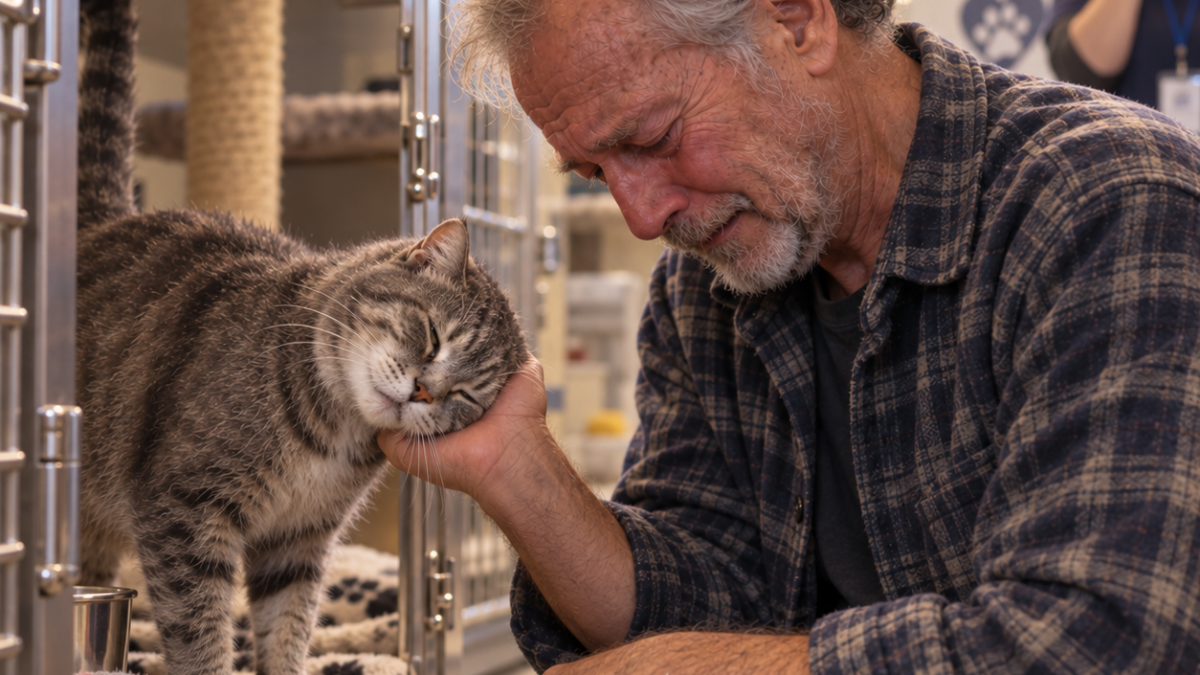
Then I saw him.
Back row.
Bottom cage.
Big gray tomcat.
Old.
His fur was thin around his shoulders.
One ear had a notch missing.
There was a pale scar near his nose.
He had the expression of a man who had been disappointed by several contractors.
He wasn’t meowing.
Wasn’t pawing at the bars.
Wasn’t performing.
He was sitting in the back corner like he had already learned that wanting something didn’t mean it was coming.
The card on his cage said:
OTIS.
MALE.
APPROX. 15 YEARS.
OWNER DECEASED.
That last line hit me like a punch.
Owner deceased.
Three words.
That was all.
Somebody’s entire world reduced to a shelter note.
I crouched.
“Well,” I said quietly, “I know something about that.”
Otis looked at me.
His eyes were green but cloudy around the edges.
He stood slowly.
A shelter worker named Marissa came over.
“He doesn’t do that for everybody,” she said.
“Do what?”
“Get up.”
“That’s a low standard.”
She smiled.
“He’s had a rough few weeks.”
“What happened to his owner?”
“Older gentleman. Heart attack. No family who could take Otis.”
I looked back through the bars.
Otis had moved closer.
“Anybody interested?”
Marissa hesitated.
That told me enough.
“A few people looked.”
“But?”
“He’s old.”
“So am I.”
“He needs kidney monitoring.”
“So do half the men I know.”
“He can be grumpy.”
“Now you’re selling him.”
She laughed.
Then she opened the cage.
I reached in slowly.
I expected Otis to sniff me.
Maybe retreat.
Instead, the old cat walked straight forward, pressed the side of his head against my wrist, and leaned his entire body onto my arm.
That was it.
No miracle.
No dramatic music.
Just weight.
Warm, stubborn weight.
Something inside me cracked.
I had spent three months trying not to need anyone.
Here was a creature who looked like he had spent weeks trying not to need anyone either.
And somehow we both knew the truth.
I took him home.
Emily laughed when I called her.
“You adopted a cat?”
“Apparently.”
“You?”
“I was there.”
“The man who told Mom for twenty years that cats were freeloaders?”
“I’ve reconsidered certain economic theories.”
Then she got quiet.
I could hear the emotion in her breathing.
“Dad?”
“What?”
“I’m glad.”
I looked at the carrier on the passenger seat.
Otis was glaring through the door.
“He doesn’t seem glad.”
“He will be.”
That first week, Otis hid under the guest bed.
I put food near the door.
It disappeared at night.
The second week, he started appearing in the kitchen at exactly 6:12 every morning.
Not 6:10.
Not 6:15.
6:12.
If breakfast wasn’t down, he produced a rough sound somewhere between a cough and an accusation.
By the third week, he had claimed Linda’s recliner.
I almost moved him the first time.
I stood in the doorway staring at him curled in the dent where she used to sit.
For a second, I felt angry.
Then Otis opened one eye.
Linda would have laughed at me.
I could hear her.
Oh, Robert, let the cat sit down.
So I let him.
Soon there were new routines.
I got out of bed because Otis needed breakfast.
I opened the curtains because he liked sun.
I stopped leaving dirty dishes overnight because he would climb into the sink and inspect them.
I started grocery shopping regularly because his food came from the same store.
I even started cooking again.
Nothing impressive.
Eggs.
Chicken.
Chili.
One evening I dropped a piece of chicken on the kitchen floor.
Otis appeared from nowhere.
“You’re fifteen years old,” I told him. “Move that fast more often and I’ll stop believing your act.”
He ate the chicken.
No remorse.
The strangest change happened at night.
The house was still quiet.
But it wasn’t empty.
There is a difference.
Around two in the morning, I would hear Otis jump down from the recliner.
A few minutes later, he would appear in the bedroom doorway.
He never slept on Linda’s side.
That mattered to me for reasons I couldn’t explain.
Instead, he curled near my feet.
Close.
Not close enough to admit affection.
Just close enough that when I woke in the dark and forgot for one terrible second that Linda was dead, I could hear another living thing breathing.
Four months after Linda died, I finally broke.
It was a recipe card.
Meatloaf.
Of all things.
Linda’s handwriting.
Two pounds ground beef.
Bread crumbs.
One egg.
Too much Worcestershire sauce because Robert likes it that way.
I read that last line.
Then read it again.
And suddenly I was crying so hard I couldn’t stand.
I sat on the kitchen floor.
Not the chair.
The floor.
My back against the cabinet.
Hands over my face.
There are kinds of crying you do politely.
This wasn’t one.
I sounded injured.
Maybe I was.
Otis came into the kitchen.
He stopped a few feet away.
For a long moment, he watched me.
Then he walked over.
Slowly.
He pressed against my thigh.
Sat down.
That old rough purr started.
He didn’t fix anything.
He didn’t make Linda less dead.
He didn’t tell me everything would be okay.
He did something better.
He stayed.
After a while, I put my hand on his back.
“I hate this,” I whispered.
Otis kept purring.
“I miss her.”
Purr.
“I don’t know how to do this without her.”
He leaned harder against me.
That was the first night I understood why lonely people talk to animals.
Animals don’t interrupt grief with advice.
They don’t tell you to move forward.
They don’t look uncomfortable when you say the same person’s name too many times.
They just stay.
Emily noticed the difference.
A few weeks later, she came over carrying groceries I hadn’t asked for.
She stepped into the kitchen and looked around.
“You cleaned.”
“I occasionally do.”
“The curtains are open.”
“I’ve recently discovered daylight.”
“You shaved.”
“I was attacked by a razor.”
She smiled.
Then she looked toward the living room.
Otis was upside down in Linda’s recliner with one paw hanging off the side.
“The house feels different,” she said.
I knew what she meant.
It still hurt.
But the pain had movement now.
It breathed.
“I guess.”
She touched my arm.
“How are you?”
I almost said it.
I’m fine.
The words were already there.
Then Otis looked at me.
That sounds ridiculous.
He was a cat.
He wasn’t holding me accountable.
But somehow I changed my answer.
“Not good,” I said.
Emily’s face softened.
I swallowed.
“Not all the time, anyway.”
She waited.
“I miss your mother every minute.”
Her eyes filled.
“But?”
I looked at Otis.
“But I think I’m learning how to be here.”
Emily hugged me.
That should have been the beginning of everything getting better.
It wasn’t.
Because love can become control without anybody noticing the exact moment it crosses the line.
The first real trouble started with a ladder.
The gutters were full of maple leaves.
I had cleaned them every spring since Jimmy Carter was president.
I wasn’t about to stop because I was seventy-four.
I had one foot on the fourth rung when Emily pulled into the driveway.
She got out of her SUV so fast she left the door open.
“Dad!”
I looked down.
“What?”
“Get off that ladder.”
“I’m cleaning the gutters.”
“I can see that.”
“Then why’d you ask?”
“Get down.”
“I’m perfectly—”
“Do not say fine.”
I almost laughed.
Then I saw her face.
She was scared.
Not irritated.
Scared.
I climbed down.
The second my feet hit the driveway, she grabbed my arm.
“What if you fell?”
“I didn’t.”
“What if you did?”
“Then I’d have dirty gutters and a concussion.”
“This isn’t funny.”
“No. It’s leaves.”
Her eyes filled.
That stopped me.
“I already lost Mom.”
The anger went out of my chest.
“Emily.”
“I can’t lose you because you refuse to admit you’re not thirty-five anymore.”
“I know how old I am.”
“Then act like it.”
That sentence landed badly.
She knew it immediately.
I stepped back.
“What exactly does seventy-four act like?”
“That’s not what I meant.”
“Sounds like it.”
“Dad—”
“I climbed four feet up a ladder. I did not attempt Everest.”
She pressed her fingers to her forehead.
“I worry about you.”
“I know.”
“You live alone.”
“I have Otis.”
She stared at me.
“I’m serious.”
“So am I.”
“That cat cannot call 911.”
“Neither could your mother. Never stopped me from living here with her.”
“That is completely different.”
“How?”
“Because Mom was—”
She stopped.
But I heard the word she almost said.
Healthy.
Alive.
Capable.
I felt something cold move through me.
Emily whispered, “That came out wrong.”
“It didn’t come out at all.”
“Dad.”
“I’m done talking about gutters.”
Two days later, I found three brochures on my kitchen table.
Willow Creek Commons.
Golden Harbor Living.
Meadow Ridge Senior Community.
All full of smiling gray-haired people holding tennis rackets they had probably never touched.
I called Emily.
“You leave something here?”
A pause.
“You found the brochures.”
“They were difficult to miss.”
“I just want you to look.”
“No.”
“Dad.”
“No.”
“Please.”
“Emily, I am not moving.”
“Nobody said tomorrow.”
“The brochures did.”
“They’re brochures.”
“They’re propaganda with hydrangeas.”
She exhaled.
“Can you be serious for one minute?”
“I am serious.”
“There are places where you’d have help.”
“I don’t need help.”
“You almost fell off a ladder.”
“I did not almost fall.”
“You live in a two-story house by yourself.”
“With a first-floor bedroom.”
“You forget meals.”
“Sometimes.”
“You don’t answer your phone.”
“Sometimes.”
“You still have Mom’s clothes everywhere.”
That one hit deep.
I went quiet.
Emily heard it.
Her voice softened.
“I’m not saying you have to throw anything away.”
“Good.”
“I’m saying maybe this house is keeping you stuck.”
“And maybe this house is where I live.”
“I’m scared.”
That stopped me.
Not because it changed my mind.
Because I believed her.
“I know.”
“No, Dad. I don’t think you do.”
Her voice cracked.
“I wake up at night wondering if you fell. I drive past your house sometimes just to see if the kitchen light is on. I call and when you don’t answer, I imagine you lying on the floor.”
I sat down.
Otis jumped onto the table and planted himself directly on the Willow Creek brochure.
For once, his timing was excellent.
“I’m not trying to control you,” Emily said.
“You’re leaving housing brochures in my kitchen without asking.”
“That’s fair.”
“You’re treating my life like a problem to solve.”
“I’m trying to keep you safe.”
“I know.”
“Then why are you fighting me?”
“Because safe is not the same as alive.”
Silence.
I looked at Linda’s mug on the shelf.
Then at Otis.
“Your mother and I spent thirty-eight years making this place ours. I’m not ready for strangers to tell me when dinner is served and what chair yoga class is available.”
“You haven’t even visited.”
“I don’t need to visit prison to know I don’t want a cell.”
“Oh, come on.”
“I’m exaggerating.”
“You think?”
“Probably.”
Despite herself, she laughed.
The tension loosened.
A little.
Then she said, “Just promise me you’ll think about it.”
“I’ll think about why you keep bringing it up.”
“Dad.”
“That’s the best offer available.”
What I didn’t know was that Emily wasn’t the only person thinking about my house.
My son-in-law, Dan, had started thinking about it too.
Dan had been married to Emily for eighteen years.
For most of those years, we got along.
He was a real estate broker.
Good-looking in the polished way some men become after forty.
Expensive watch.
Expensive truck.
Teeth unnaturally white.
He could walk into a room and make everybody feel like they were already halfway through a successful transaction.
Linda liked him.
Mostly.
“He’s charming,” she once told me.
“That sounded like an accusation.”
“It might be.”
“What don’t you trust?”
“People who make eye contact while asking what your house is worth.”
I laughed at the time.
After she died, Dan started stopping by more.
At first I appreciated it.
He replaced a porch light.
Brought over a new smoke detector.
Fixed a loose cabinet hinge.
Then his questions changed.
“You know what this neighborhood’s done in value?”
“No.”
“You’d be shocked.”
“I’m easily shocked these days.”
“You’re sitting on a lot of equity.”
“I’m also sitting on a kitchen chair. Doesn’t mean I plan to sell it.”
He laughed.
But his eyes kept moving.
Windows.
Floors.
Kitchen cabinets.
Land.
I knew that look.
He was pricing the place.
One Saturday afternoon, he arrived while I was working in Linda’s tomato beds.
Otis sat on the porch watching me.
Dan stood beside the garden.
“Emily says you’re still against Willow Creek.”
“I’m also against dental surgery without anesthetic.”
“It’s actually a beautiful place.”
“You moving?”
He smiled.
“Not yet.”
“Then we both agree.”
He crouched near the tomato plants.
“Can I say something without you getting mad?”
“Historically, no.”
He ignored that.
“Emily’s exhausted.”
That got my attention.
“She worries constantly.”
“I know.”
“She checks her phone every ten minutes.”
“I answer.”
“Sometimes.”
I stabbed the shovel into the dirt.
“What do you want me to do, Dan?”
“Just consider options.”
“I am considering an option.”
“What?”
“Staying in my house.”
He nodded slowly.
“That’s one.”
“It’s the one.”
He stood.
“You know what Linda would want.”
My grip tightened on the shovel.
I looked at him.
“What did you say?”
He realized too late.
“I just mean she’d want you safe.”
“Don’t use my wife to win an argument.”
“I wasn’t—”
“You knew Linda eighteen years. I knew her forty-nine.”
“I understand.”
“No, you understand real estate. Stay in your lane.”
Dan’s face changed.
Just for a second.
The smile disappeared.
Something harder appeared beneath it.
Then the smile came back.
“Fair enough.”
He left.
I should have paid more attention to that moment.
Instead, I told myself I had embarrassed him.
I even felt guilty.
A week later, I started volunteering at the shelter.
Marissa asked if I could spend Saturday mornings with senior cats.
“People walk past them,” she said.
“People walk past old things in general.”
She gave me a look.
“You okay?”
“Perfectly bitter.”
“Good. You’ll fit right in.”
I loved it.
More than I expected.
There was Mabel, a three-legged tabby who hated everyone equally.
Walter, a nearly blind beagle who slept with his head against the kennel wall.
Pumpkin, an eighteen-pound orange cat with a damaged ear and no understanding of personal space.
I started talking to adopters.
Probably too much.
A young couple came in looking for a kitten.
I convinced them to meet Pumpkin.
“He’s nine,” the husband said.
“So?”
“We wanted younger.”
“You planning to start a baseball team with him?”
The wife laughed.
I opened Pumpkin’s enclosure.
He climbed directly into the husband’s lap and drooled on his shirt.
They took him home an hour later.
That did something to me.
Being useful.
Not needed because I was somebody’s father.
Not pitied because I was somebody’s widower.
Useful because I could help something living find a place to belong.
Emily didn’t understand at first.
“You’re volunteering now?”
“Two mornings a week.”
“With animals?”
“That’s the current shelter model.”
“Dad.”
“What?”
“You’re supposed to be slowing down.”
There it was again.
Supposed to.
According to whom?
“Emily, I sit in a chair and talk about cats.”
“You lift carriers.”
“Small ones.”
“You clean cages.”
“Occasionally.”
“You get tired.”
“I was tired before.”
She sighed.
“I just don’t understand why you need to add things.”
That sentence hurt more than she intended.
“Because taking everything away isn’t the same as healing.”
Silence.
Then she said quietly, “I’m not trying to take everything away.”
“I know.”
But I wasn’t sure anymore.
Things got worse in small steps.
A lawn service showed up one Friday.
“I didn’t call anybody,” I told the young man.
“Your daughter arranged it.”
I sent him away.
A handyman arrived Monday to measure the back steps for a rail.
I sent him away too.
Emily called furious.
“You need that railing.”
“I probably do.”
“Then why did you send him away?”
“Because you didn’t ask.”
“Would you have said yes?”
“Maybe.”
“You would’ve said no.”
“Then at least it would’ve been my no.”
She got quiet.
That was the whole fight.
Not the railing.
Not the lawn.
My no.
My life.
My right to make a bad decision in my own house.
People don’t understand how important that becomes when you get older.
When you’re twenty, everybody assumes the future belongs to you.
When you’re seventy-four, people start treating your future like public property.
Then came the cardigan.
Linda’s blue cardigan had hung beside the back door since before she died.
One Saturday, I came home from the shelter and knew immediately somebody had been in the house.
Nothing dramatic.
The air smelled like lemon cleaner.
Linda hated lemon cleaner.
Too sharp, she used to say.
Otis met me in the hallway, complaining.
Then I looked toward the back door.
Empty hook.
My chest tightened.
“Where is it?”
I don’t know why I asked the cat.
Then I saw two boxes near the stairs.
KEEP.
DONATE.
Written in Emily’s handwriting.
I opened the first.
Linda’s cardigan.
Her scarf.
Two gardening hats.
A pair of old slippers.
The second box had clothes from her closet.
I called Emily so fast I almost dropped the phone.
“You were in my house.”
“I used the spare key.”
“Why?”
“Dad—”
“Why?”
“I was trying to help.”
“You boxed up your mother.”
“No.”
“That is exactly what you did.”
“I packed some clothes.”
“Without asking me.”
“I thought—”
“That’s your problem.”
“What?”
“You keep thinking instead of asking.”
She drew in a breath.
“I come into that house and it feels frozen.”
“It’s my house.”
“It was Mom’s too!”
“And she’s dead!”
The second I said it, I regretted it.
Emily went silent.
Then I heard her crying.
I sat down.
Otis rubbed against my leg.
I whispered, “Emily.”
Her voice came back broken.
“You think I don’t know she’s dead?”
“I didn’t mean—”
“You think I don’t miss her?”
“No.”
“Every time I walk into that kitchen, I expect her to be standing there. Every time I see that sweater, I remember how she wore it when she was sick. Every time I smell that house, I miss her.”
I closed my eyes.
“You’re not the only one who lost her.”
That sentence went through me.
Clean.
Deep.
I had been so wrapped in my grief I had turned Linda into something that belonged only to me.
My wife.
My bed.
My empty chair.
My loss.
I had forgotten she had been Emily’s mother.
“I’m sorry,” I said.
Emily cried quietly.
Then she said, “I’m sorry too.”
“You had no right.”
“I know.”
“I need you to say that.”
“I had no right to come in and move her things without asking.”
I breathed.
“Thank you.”
“But, Dad?”
“Yes?”
“You’re scaring me.”
I looked around the kitchen.
“I’m scared too.”
It was the first honest thing either of us had said all day.
We did not fix everything.
Real families rarely do.
I put the cardigan back.
Some clothes stayed in boxes.
I agreed to the handrail.
Emily agreed not to use the spare key without calling unless she truly believed there was an emergency.
For two weeks, we found something that looked like peace.
Then a stranger ruined it.
His name was Mark Leland.
I met him at the shelter fundraiser.
Willow Creek Commons sponsored the event.
I almost laughed when I saw the banner.
Marissa noticed.
“You know them?”
“My daughter wants to ship me there.”
“It’s supposed to be nice.”
“So is Vermont. I’m not moving there either.”
Mark approached us carrying a coffee.
Mid-fifties.
Silver hair.
Navy blazer.
The kind of smile that made you check whether your wallet was still in your pocket.
“Robert Hayes?”
I looked at him.
“Yes?”
His face brightened.
“Mark Leland. Willow Creek.”
He shook my hand.
“Dan speaks very highly of you.”
My stomach tightened.
“Dan?”
“Your son-in-law.”
“I know who Dan is.”
Mark laughed as though I had made a joke.
“We’re excited to have you.”
I stared at him.
“What?”
“At Willow Creek.”
Marissa looked at me.
Mark’s smile faltered.
“I’m sorry. I may have gotten ahead of myself.”
“You definitely got somewhere without me.”
He lowered his voice.
“Your family has been discussing a transition.”
“My family has been discussing it.”
“Yes.”
“I have not.”
“Well, the reservation paperwork—”
“What paperwork?”
That was the moment.
The room didn’t change.
People were still talking.
Dogs barking.
Coffee pouring.
Somebody laughing near the entrance.
But inside me, something became completely still.
Mark glanced toward the senior adoption table.
“I think perhaps you should speak with Emily and Dan.”
“No.”
I stepped closer.
“I think you should speak with me.”
He looked uncomfortable.
Good.
“Whose name is on the reservation?”
“Mr. Hayes—”
“Whose?”
“Yours.”
Marissa stopped pretending not to listen.
I felt heat climb my neck.
“I signed nothing.”
Mark’s expression changed.
Not guilt.
Fear.
Professional fear.
The fear of a man realizing his paperwork might suddenly matter.
“I’m sure this is a misunderstanding.”
“Show me.”
“Sir—”
“Show me what I signed.”
He hesitated.
Then he reached into his leather folder.
He pulled out a copy.
At the bottom was my name.
Robert A. Hayes.
And underneath it was a signature.
Mine.
Except it wasn’t.
It looked like mine.
Close.
Whoever had done it had copied the shape.
The large R.
The sloping H.
But Linda used to tease me because I never closed the loop on the “b” in Robert.
This signature did.
Forty-nine years married to the same woman teaches you ridiculous things about yourself.
Including your own handwriting.
“That’s not mine.”
Mark went pale.
“Mr. Hayes—”
“I did not sign that.”
He looked toward the door as if Dan might appear and save him.
“Who gave you this?”
“I believe your son-in-law handled the preliminary forms.”
My heart started pounding.
“Preliminary?”
“There’s also documentation regarding the planned sale of your property.”
I heard Marissa whisper, “Oh my God.”
I looked at Mark.
“What sale?”
He stopped talking.
Smartest thing he had done.
I called Emily.
No answer.
I called again.
Then Dan.
He answered.
“Hey, Robert.”
“Where are you?”
A pause.
“Office. Why?”
“I’m at the shelter.”
Another pause.
Longer.
I knew.
“You know Mark Leland?”
Silence.
“Dan?”
“Robert, I can explain.”
Four words.
The anthem of guilty people everywhere.
“I’m listening.”
“This was all preliminary.”
“You forged my signature.”
“No. Absolutely not.”
“I’m looking at it.”
“Emily authorized me to start gathering information.”
“Emily cannot authorize my signature.”
“Robert, nobody is selling anything behind your back.”
“Then why does Willow Creek think I’m moving?”
“We were trying to make the process easier.”
“For who?”
He sighed.
“You’re making this sound sinister.”
“I’m looking at a document with my name on it that I did not sign.”
“It’s an expression of interest.”
“With my signature.”
“It was not binding.”
“Then you should have signed your own name.”
People had started looking at me.
I lowered my voice.
“Did Emily know?”
Dan didn’t answer fast enough.
My chest went cold.
“Did she know about the signature?”
“No.”
That hurt differently.
“Does she know about the house?”
“We discussed options.”
“What house paperwork?”
“Nothing final.”
“Dan.”
“It’s a market-preparation file.”
“English.”
“I had one of my agents prepare a potential listing.”
My knees felt weak.
“You listed my house?”
“No.”
“Did you put it online?”
“Not publicly.”
“That was not the question.”
Another silence.
“Internal network.”
I sat down.
Marissa put a hand on my shoulder.
I barely felt it.
“How much?”
“What?”
“What price did you put on my home?”
“Robert—”
“How much?”
“One point two.”
I laughed.
Not because it was funny.
Because sometimes anger gets so large it comes out wrong.
“One point two million dollars.”
“The neighborhood has appreciated.”
“My wife planted those tomatoes.”
“What?”
“She chose the tile in the kitchen. She painted the guest room three times because she never liked the first two blues. She marked our grandchildren’s heights inside the pantry door. She sat on the bathroom floor with Emily when her first marriage ended. She died in the downstairs bedroom.”
My voice cracked.
“And you reduced it to one point two million dollars without asking me.”
“I was trying to help the family.”
“No.”
I stood.
“You were trying to sell a house.”
I hung up.
Emily called five minutes later.
I let it ring.
Then again.
Then again.
Finally I answered.
“Dad.”
Her voice was panicked.
“Did you know?”
“About what?”
“The paperwork.”
“What paperwork?”
I believed her immediately.
That was somehow worse.
“Ask your husband.”
“What happened?”
“Ask Dan why Willow Creek has my signature.”
Silence.
Then: “What?”
“Ask him why a real estate network has pictures of my house.”
“Dad, I swear to you—”
“I believe you.”
That broke her.
I heard her inhale sharply.
“Oh God.”
“Emily.”
“I didn’t know.”
“I know.”
“Dad, I didn’t know.”
“I know.”
“I told him I wanted you safe. I told him I wanted options. I never told him to—”
Her voice disappeared into a sob.
For the first time since Linda died, I heard my daughter sound like a little girl.
The one who used to run to me when thunderstorms came.
The one I carried asleep from the car.
The one Linda and I spent our lives trying to protect.
Now I couldn’t protect her from the man she had trusted.
“I’m coming over,” she said.
“No.”
“Dad—”
“I need a little time.”
“Please.”
“Emily.”
She stopped.
“I love you.”
She cried harder.
“I love you too.”
Then I went home.
Otis was waiting by the door.
I bent down to pet him.
My hand was shaking.
He sniffed it.
Then walked away.
Cats have a way of respecting emotional privacy while also expecting dinner.
I fed him.
Then I sat at the kitchen table.
For almost an hour, I stared at Linda’s blue-flowered mug.
Finally I said out loud, “You were right about him.”
Otis jumped onto the chair beside me.
“I know. I know. She’d be unbearable about it.”
That night I barely slept.
The next morning, I called an old friend named Samuel Ortega.
Sam and I had known each other since 1981.
He was a retired attorney.
He also owed me because I had once helped him rebuild a deck he had no business designing.
I told him everything.
He stopped me twice.
“Do you have copies?”
“Yes.”
“Don’t sign anything.”
“I’m not an idiot.”
“Grief doesn’t make people idiots, Robert. It makes them vulnerable. Other people sometimes mistake those things.”
That sentence stayed with me.
Sam came over.
We spent four hours going through emails Dan had sent Emily, documents from Willow Creek, and screenshots from the brokerage network.
Emily came too.
She looked terrible.
Dan did not.
By evening, the picture was clear.
Dan’s real estate business had been struggling.
Two large deals collapsed.
He had borrowed against their home.
Emily knew about some debt.
Not all of it.
Dan had convinced her that my house was becoming unsafe and that selling it while the market was high would “protect my estate.”
She had agreed to research options.
That was all.
Dan had gone further.
Much further.
He had submitted a reservation request to Willow Creek.
He had prepared an internal listing.
He had copied my signature from an old contractor authorization I had signed years earlier.
He had told one colleague the family expected the property to become available soon.
Why?
Commission was part of it.
Desperation was another.
But there was something uglier.
In an email to a business partner, Dan had written:
Once Robert is settled, Emily will stop being emotional about the house. That equity eventually comes to her anyway.
Eventually comes to her anyway.
I read that sentence three times.
Emily read it once.
Then she ran to the bathroom and got sick.
Dan had not technically been able to take my money simply by selling the house.
Sam made that clear.
But he had started treating my property—and my death—as a future financial solution.
That was the betrayal.
Not just paperwork.
He had looked at the remaining years of my life and seen an obstacle between himself and money.
Emily sat at my kitchen table with both hands wrapped around a cold cup of coffee.
“I brought him into this family.”
I sat across from her.
“This is not your fault.”
“Yes, it is.”
“No.”
“I pushed you about moving.”
“You were afraid.”
“I gave him information.”
“You trusted your husband.”
“I helped him make you feel like you were losing your mind.”
That hurt because it was partly true.
I reached across the table.
“Look at me.”
She did.
“You did things I didn’t like.”
Tears filled her eyes.
“You crossed lines.”
She nodded.
“But you did not forge my name.”
A tear fell.
“You did not try to sell my house.”
Another.
“And you did not decide my remaining life was money waiting to be released.”
She covered her face.
I moved around the table.
My daughter was forty-four.
A mother.
A professional woman.
Strong.
Capable.
And when I put my arm around her, she folded against me exactly the way she had when she was eight.
“I’m so sorry, Dad.”
“I know.”
“Mom would hate me.”
“No.”
She looked up.
“Your mother would yell at both of us.”
A wet laugh escaped her.
“Then she’d make food.”
Emily laughed harder.
Then cried again.
Sam cleared his throat from across the room.
“I’m going to pretend I’m invisible.”
“You’ve always been good at that,” I said.
“Glad grief hasn’t improved your personality.”
Over the next few days, things moved quickly.
Sam contacted Dan’s brokerage.
The brokerage opened an internal investigation.
The unauthorized listing disappeared.
Willow Creek returned every document and sent me a formal apology.
Mark Leland called personally.
I told him accepting paperwork about somebody’s life without speaking to that person was a good way to become part of the problem.
He didn’t argue.
Dan admitted forging the signature.
He tried to call it “administrative shorthand.”
Sam laughed for almost a full minute when I told him.
“Forgery has had excellent branding lately,” he said.
Dan lost his position with the brokerage.
The company reported the matter to the licensing board.
Emily filed for separation.
I didn’t tell her to.
I didn’t tell her not to.
That was important.
After everything we had been through, I was not going to respond to someone controlling my daughter’s choices by controlling them myself.
Dan came to my house once.
I met him on the porch.
I did not invite him inside.
He looked older.
Not because much time had passed.
Because consequences age people fast.
“I’m sorry,” he said.
I waited.
“I panicked.”
“About money.”
“Yes.”
“You used my grief.”
He looked down.
“Yes.”
“You used Emily’s fear.”
“Yes.”
“You forged my name.”
His jaw tightened.
“Yes.”
“And you were waiting for me to die.”
His head snapped up.
“That’s not fair.”
“Then explain the email.”
“I didn’t mean it like that.”
“Eventually comes to her anyway.”
He closed his eyes.
“I was desperate.”
I nodded.
“I believe you.”
He looked surprised.
I continued.
“Desperate explains behavior. It does not excuse character.”
He swallowed.
“I love Emily.”
“Maybe.”
“I do.”
“Then learn something from this.”
“What?”
“Love that needs somebody else to become smaller is not love worth defending.”
He stared at me.
I opened the door.
Before I stepped inside, he said, “Will you ever forgive me?”
I looked at him.
“I don’t know.”
That was the truth.
Forgiveness is another thing people like to rush.
As if refusing to carry hatred means you’re required to hand trust back to the person who broke it.
I wasn’t there yet.
Maybe I never would be.
I closed the door.
Otis was sitting in the hallway.
“Don’t judge me.”
He meowed.
“I said don’t.”
For a while, life calmed down.
Emily started coming over without an agenda.
That sounds simple.
It wasn’t.
The first time she arrived empty-handed, I asked, “Where are the groceries?”
She blinked.
“I didn’t bring any.”
“No brochures?”
“No.”
“Contractors?”
“No.”
“Medical alert necklace?”
“Dad.”
“I’m checking.”
She smiled.
“I came to have coffee.”
So we did.
We talked about her kids.
About work.
About Dan.
About Linda.
For months, Emily had been afraid to mention her mother because she thought it would break me.
I had been afraid to mention Linda because I thought Emily needed me to be strong.
So both of us had been protecting each other from the exact person we both wanted to talk about.
That is the stupidity of love sometimes.
We finally stopped.
Emily told me stories about Linda I had never heard.
The time Linda drove four hours in college because Emily had failed an exam and was convinced her life was over.
The time they got caught in a rainstorm at a farmer’s market and Linda laughed so hard she dropped an entire bag of peaches into a puddle.
The secret Christmas gifts.
The fights.
The apologies.
“My whole life,” Emily said one afternoon, “I thought Mom was brave.”
“She was.”
“I thought that meant she wasn’t scared.”
I looked at her.
“No. Your mother was scared of plenty.”
“Like what?”
“Flying.”
Emily laughed.
“She flew constantly.”
“Terrified every time.”
“No way.”
“She squeezed my hand hard enough to stop circulation.”
Emily smiled.
“What else?”
“Losing you.”
Her smile faded.
“She worried about me?”
“Constantly.”
“Why?”
“Because parents are ridiculous.”
She looked toward the living room.
Otis was asleep.
“I guess I inherited that.”
“You inherited plenty from her.”
Emily became quiet.
Then she said, “I wish she’d left instructions.”
I laughed softly.
“For what?”
“All of this.”
“Life after her.”
That sentence broke my heart.
A few weeks later, we found something close.
It happened because Otis knocked over a box.
He had been doing better.
His kidney values stabilized.
He was eating.
Bossing me around.
Sleeping eighteen hours a day with great commitment.
One morning I was sorting Linda’s old recipe books on the dining table.
Otis jumped onto a chair, then the table.
“Absolutely not.”
He ignored me.
He stepped on one recipe book.
It slid.
A small envelope fell out.
Emily’s name was written on it.
We both froze.
She happened to be standing at the counter.
I picked it up.
“When did she write this?”
Emily shook her head.
“I don’t know.”
The handwriting was shaky.
Late illness shaky.
My chest tightened.
“Open it.”
Emily hesitated.
“It’s yours.”
She sat down.
Her hands trembled.
The letter was only two pages.
Linda had written it during one of her final hospital stays.
My dear Emily,
If you are reading this, then either your father finally cleaned something without being asked or a cat knocked it over, because I know both of you too well to believe anybody willingly sorted my recipe books.
Emily started crying at the first line.
So did I.
Linda continued:
You are going to worry about your father.
You should.
He is stubborn, proud, emotionally constipated, and has believed since 1978 that falling off a ladder is a personality trait.
I laughed so hard I had to wipe my eyes.
But then the letter changed.
Please take care of him.
But promise me something.
Do not confuse taking care of him with taking his life away from him.
He will need help before he admits it.
Ask anyway.
He will say “I’m fine” when he is not.
Ask twice.
He will hold onto things too long.
Let him.
Then ask what they mean to him before you move them.
The house may become too much someday.
If that day comes, let it be a conversation, not a verdict.
He spent his life making sure I had choices.
Make sure he keeps his.
Emily stopped reading.
Her shoulders shook.
I put my arm around her.
She whispered, “She knew.”
“Of course she did.”
The final lines were worse.
And Dad, because I know you will somehow read over her shoulder even though this letter is addressed to Emily:
I looked at Emily.
She laughed through tears.
“That woman.”
Emily kept reading.
You cannot turn our house into a shrine and call it loyalty.
I am not in the cardigan.
I am not in the coffee mug.
I am not in the garden gloves.
I am in every ridiculous joke you remember, every tomato you plant too close together, every time you choose kindness when bitterness would be easier, and every person you love after me even though loving them means you may lose them too.
Especially then.
Please keep living.
Both of you.
Not because I am gone.
Because I was here.
Love,
Mom
Linda
We sat at that table crying until Otis got annoyed and demanded lunch.
That letter changed everything.
Not instantly.
Nothing real changes instantly.
But it gave us language.
Ask twice.
That became Emily’s phrase.
“You okay?”
“I’m fine.”
She would raise an eyebrow.
“Ask twice.”
Then I had to tell the truth.
Sometimes the truth was:
“I’m lonely.”
Sometimes:
“My knees hurt.”
Sometimes:
“I miss her so much today I can’t stand it.”
Sometimes:
“I’m actually fine. Stop hovering.”
And sometimes Emily had to tell the truth too.
“I’m scared.”
“I’m angry.”
“I miss Mom.”
“I don’t know whether leaving Dan was the right thing.”
“I feel guilty.”
We stopped protecting each other with lies.
Summer came.
The tomatoes grew.
I put in the handrail.
Not because Emily ordered it.
Because I decided falling down the back steps would be embarrassing after all the speeches I had made about independence.
I hired a kid to clean the gutters.
That hurt my pride for approximately twenty minutes.
Then I watched him pull out a dead squirrel nest and decided my bloodline could survive the insult.
I kept volunteering at the shelter.
Emily started coming with me.
So did my granddaughter Sophie.
One Saturday, a handmade sign appeared over the senior animal section.
OLD IS NOT BROKEN.
Sophie had painted it.
People stopped.
Some laughed.
Some got quiet.
An older widow adopted Walter the blind beagle.
A divorced schoolteacher took Mabel.
A veteran named Henry adopted a seventeen-year-old black cat named Eugene because, as he put it, “We’re both mean, deaf, and suspicious of strangers.”
I liked Henry immediately.
The shelter became part of my life.
Not a distraction.
A purpose.
That mattered.
There is a difference between being busy enough not to feel grief and being useful enough to carry it.
For almost another year, Otis stayed with me.
He got older.
I did too.
We became slower together.
He stopped jumping onto the windowsill.
So I built him a little step.
Then another.
Emily saw them.
“You built stairs for the cat.”
“He has mobility challenges.”
“You refused a handrail.”
“That was different.”
“How?”
“He didn’t nag me.”
She laughed.
Otis started sleeping beside me more often.
Not at my feet.
Closer.
Near my hip.
Sometimes with one paw touching my leg.
Old creatures do that.
They pretend they don’t need contact.
Then they make sure you’re still there.
The second winter after Linda died was harder on him.
He lost weight.
Stopped grooming properly.
His coat looked dull.
The vet changed his diet.
Added medication.
Fluids became regular.
I learned how to slide the needle beneath his skin while distracting him with tuna.
He hated the process.
He forgave the tuna.
One February morning, he didn’t come for breakfast.
I knew.
Before I found him.
Before the vet told me.
I knew.
He was in Linda’s recliner.
Curled tightly.
Breathing shallow.
I knelt beside him.
“Hey, old man.”
His eyes opened.
Barely.
I touched his head.
He pushed into my hand.
Just a little.
The same way he had at the shelter.
My throat closed.
“No.”
It came out before I could stop it.
“No, no, no.”
I called Emily.
I didn’t say I was fine.
I said, “I need you.”
She came immediately.
At the veterinary clinic, the doctor examined him.
The kidney failure had progressed.
His temperature was low.
His body was tired.
There are moments when love becomes a terrible choice.
You can ask somebody to stay for you.
Or you can stop asking them to hurt.
I knew which one Linda would tell me to choose.
Emily sat beside me on the floor.
Otis was wrapped in a blue blanket.
His head rested in my lap.
I cried openly.
Didn’t care who saw.
“I can’t do another goodbye,” I said.
Emily held my hand.
“I know.”
“I just learned how to love something again.”
“I know.”
“It feels cruel.”
She leaned against me.
“Maybe that’s why it matters.”
I looked at her.
She was crying.
She whispered, “Mom said it.”
I knew what she meant.
Every person you love after me even though loving them means you may lose them too.
Especially then.
I bent over Otis.
His rough purr started.
Faint.
Barely there.
“You saved me,” I whispered.
Emily squeezed my hand.
The veterinarian gave us time.
A lot of time.
More than I thought clinics gave.
Maybe she understood that this was not just a cat.
Maybe she understood that sometimes an animal enters your life at the exact point when you’re deciding whether your own life is still worth participating in.
When it was time, I kept one hand under Otis’s head.
Emily kept her hand on my shoulder.
His breathing slowed.
Then stopped.
No drama.
No struggle.
Just quiet.
I pressed my forehead against his.
“Thank you,” I whispered.
That was all I could say.
Thank you.
For breakfast complaints.
For stolen chicken.
For sitting beside me on a kitchen floor.
For sleeping in Linda’s chair.
For giving me somebody to care for when I no longer knew how to care for myself.
For choosing me.
The drive home was brutal.
I walked into the house carrying an empty carrier.
That sound—
the plastic door rattling with nothing behind it—
nearly broke me.
I set it down.
The house was silent.
For the first time since Otis arrived, truly silent.
I went into the living room.
Linda’s recliner was empty.
I sat beside it.
Emily sat next to me.
Neither of us spoke.
After a while, she said, “Do you want to stay at my place tonight?”
I almost said no.
Habit.
Pride.
Then I remembered the letter.
Ask twice.
I looked at her.
“Yes.”
She took my hand.
“Okay.”
No victory.
No I told you so.
Just okay.
That night I slept in her guest room.
The next morning, my grandson Caleb burned pancakes.
My granddaughter Sophie complained that he used too much batter.
Emily drank coffee at the counter.
The house was loud.
Messy.
Alive.
I missed my own house.
I missed Otis.
I missed Linda.
And somehow I was okay being there.
That afternoon, Emily drove me home.
Before she left, she stood at the door.
“How are you really?”
I looked toward the empty recliner.
“Bad.”
She nodded.
“Anything else?”
I thought.
“Grateful.”
Her eyes filled.
“Me too.”
Three months later, the shelter asked if they could name the senior-cat room after Otis.
I said no.
Marissa looked surprised.
“Why?”
“Because he would’ve hated attention.”
She laughed.
“So what do you want?”
I looked around at the old cats.
The cloudy eyes.
Scarred ears.
Missing teeth.
Bodies that had already used up the easy years.
Then I saw the sign Sophie had painted.
OLD IS NOT BROKEN.
“Put his picture under that.”
So they did.
A photo of Otis sitting in Linda’s recliner looking deeply disappointed in civilization.
Underneath, we added one line.
CHOOSING SOMEONE LATE STILL COUNTS.
A year after Otis died, I was volunteering on a rainy Saturday when a man came in.
About my age.
Maybe older.
He had the stunned look grief gives people before they learn how to hide it.
He wandered the cat room.
Stopped near an old calico.
Her card said:
DAISY.
AGE 14.
OWNER DECEASED.
The man stared at those words.
I recognized the way his shoulders changed.
I walked over.
“Lost somebody?”
He looked at me.
“My wife.”
“How long?”
“Two months.”
“I’m sorry.”
He nodded.
We stood quietly.
Then Daisy got up.
Walked toward the bars.
The man put his fingers through.
She pressed her head against them.
His face crumpled.
“I’m not ready,” he whispered.
I looked at him.
“No.”
He wiped his eyes.
“I can’t go through losing something again.”
I understood.
God, I understood.
I could have told him grief would get better.
That would have been too simple.
I could have told him adopting Daisy would heal him.
That would have been a lie.
So I told him the truth.
“Love doesn’t protect you from losing things.”
He looked at me.
“It just makes sure the time before the losing meant something.”
He stared at Daisy.
“Did you have one?”
“Otis.”
“What happened?”
“Old age.”
“Did it hurt?”
“Like hell.”
He almost smiled.
“Would you do it again?”
I looked across the room at Otis’s picture.
Then at Daisy.
“Yes.”
No hesitation.
“Yes, I would.”
The man adopted her that afternoon.
I watched him carry her outside beneath an umbrella.
Daisy’s face appeared through the carrier door.
For one second, I felt something inside me settle.
Not close.
Never close.
Grief is not a door.
But settle.
A month later, Emily and I finally went through the cedar chest.
Linda’s cardigan was inside.
Folded neatly.
I held it for a long time.
Then Emily said, “I want to ask you something.”
“Ask twice?”
She smiled.
“Not yet.”
“What?”
“When you’re gone someday—hopefully in about fifty annoying years—can I have this?”
I looked at the cardigan.
Then at my daughter.
“Your mother’s?”
Emily nodded.
“I always liked it.”
I felt embarrassed.
All that time I had treated the cardigan like it was mine because Linda had been my wife.
I had forgotten again.
She had been somebody’s mother too.
I handed it to Emily.
“Take it now.”
Her eyes widened.
“You sure?”
“Yes.”
She held it to her chest.
Then she put it on.
The sleeves were a little short.
Linda had been smaller.
Emily laughed.
“Oh God.”
“What?”
“It smells like cedar.”
“Better than lemon cleaner.”
She smiled.
Then cried.
I did too.
She came over and hugged me.
For one impossible second, with that blue fabric between us, I felt like Linda was somehow part of the embrace.
Not literally.
I’m not a mystical man.
But memory has weight.
Anybody who has loved long enough knows that.
Two years after Linda died, the house still stands.
I still live in it.
There is a handrail by the steps.
Somebody else cleans my gutters.
The lawn gets cut every other Friday by a teenager who charges too much and spends half the time looking at his phone.
The tomato beds are still there.
I still plant them too close together.
Emily still complains.
I still ignore her.
Some things should survive grief.
Dan and Emily eventually divorced.
He apologized again before the paperwork was final.
I told him I hoped he became better than the worst thing he had done.
I meant it.
Justice, I learned, does not always require hatred.
Sometimes consequences are enough.
He lost his job.
Damaged his reputation.
Lost his marriage.
Had to rebuild.
Emily had to rebuild too.
So did I.
We all did.
That is the part people skip when they tell stories about betrayal.
They want the villain exposed.
The liar caught.
The crowd cheering.
The door slammed.
But afterward, everybody still has to wake up Tuesday morning.
They still have to make coffee.
They still have children.
Bills.
Memories.
Shame.
Healing is quieter than revenge.
And harder.
One spring morning, I stood in the kitchen holding my ugly brown mug.
There was only one cup on the counter.
I realized I hadn’t set out Linda’s mug in more than a year.
That used to feel impossible.
I opened the cabinet.
Her blue-flowered mug was inside.
I took it down.
Held it.
Smiled.
Then put it back.
No guilt.
No panic.
Just love.
That surprised me.
For a long time, I thought healing meant losing her again.
I thought if I laughed, she became smaller.
If I changed the house, she disappeared.
If I gave away clothes, I erased her.
If I loved Otis, I was replacing something.
If I admitted I needed help, I was becoming less of the man she married.
I was wrong about all of it.
Love doesn’t work like a room with limited chairs.
Nobody has to leave for somebody else to sit down.
That afternoon, Emily came over.
No groceries.
No brochures.
No agenda.
She walked in wearing Linda’s cardigan.
I stared.
“What?”
“You’re wearing it.”
“She would want me to.”
“She absolutely would.”
Emily smiled.
Then she put something on the kitchen table.
A photograph.
Linda and me.
Young.
Maybe twenty-seven.
I was wearing terrible sideburns.
Linda had a yellow dress.
We were standing in front of our first apartment.
“Where did you find this?”
“One of Mom’s old boxes.”
I picked it up.
On the back, in Linda’s handwriting, were six words.
Robert thinks he is in charge.
I laughed so hard I had to sit down.
Emily leaned against the counter.
“I miss her.”
“Me too.”
“How are you?”
I opened my mouth.
She raised a finger.
“Really.”
I looked around.
At the sunlight.
At the tomato plants outside.
At the empty recliner.
At Otis’s old food dish still sitting on a shelf because some things I still wasn’t ready to move.
At my daughter wearing her mother’s cardigan.
“I’m sad today.”
Emily nodded.
“But it’s a good sad.”
“What does that mean?”
“I don’t know.”
I thought for a moment.
“It means missing them doesn’t feel like drowning anymore.”
Her eyes filled.
“What does it feel like?”
I looked at Linda’s photograph.
“Carrying.”
Emily reached across the table.
Took my hand.
We stayed like that.
No speeches.
No fixing.
Just carrying.
A few weeks later, the shelter called.
They had received an old gray cat.
Not like Otis.
Nothing could be Otis.
This one was smaller.
Female.
Twelve years old.
Her owner had gone into hospice.
She hid beneath a blanket and refused food whenever anyone approached.
Marissa said, “I’m not asking you to adopt her.”
“Good.”
“I’m just asking you to sit with her.”
“I can do that.”
I sat beside her cage for forty minutes.
Didn’t touch her.
Didn’t talk much.
Eventually, one gray paw came out from beneath the blanket.
Then a nose.
Then two yellow eyes.
She looked at me.
I looked at her.
“Oh, absolutely not,” I said.
Her paw reached toward me.
“No.”
She meowed.
“I know this trick.”
The paw stretched farther.
“I’ve seen this movie.”
Marissa laughed from the hallway.
“Everything okay?”
“No.”
The cat came out.
Walked toward the bars.
Pressed her face against my fingers.
I closed my eyes.
The ache came.
So did something else.
Not replacement.
Never replacement.
Permission.
Linda’s words returned.
Every person you love after me even though loving them means you may lose them too.
Especially then.
I took the cat home.
Her name was June.
I did not change it.
Old creatures deserve to keep their names.
Emily came over that evening.
She saw June sitting in Linda’s recliner.
Then she looked at me.
“No.”
I held up a hand.
“Before you say anything, I was manipulated.”
“By a twelve-pound cat?”
“She has sophisticated tactics.”
Emily started laughing.
Then she walked over.
June sniffed her fingers.
Emily sat on the floor.
For a while, neither of us said anything.
Finally, Emily whispered, “Mom would love this.”
I looked toward the kitchen.
Toward the cabinet where the blue-flowered mug sat.
Toward the window where Otis used to sleep in the sun.
Toward my daughter wearing Linda’s cardigan.
“Yeah,” I said.
“She would.”
That night, after Emily left, June followed me upstairs.
She hesitated in the bedroom doorway.
I got into bed.
She jumped up.
Walked in a circle.
Then curled near my feet.
Exactly where Otis used to sleep.
For one second, grief rose so fast I couldn’t breathe.
“Not there,” I whispered.
June looked at me.
I almost moved her.
Then I stopped.
The old instinct.
Preserve everything.
Protect every sacred spot.
Turn memory into a museum.
I heard Linda’s voice in my head.
Oh, Robert.
I laughed.
“Fine.”
June settled.
I turned off the lamp.
The room went dark.
For a while, I listened to her breathing.
Then I thought about Linda.
About Otis.
About Emily.
About the house.
About all the things I had tried desperately to keep from changing.
The truth was, everything changed.
Linda died.
Otis died.
Emily’s marriage ended.
I got older.
The house needed repairs.
My hands shook sometimes when I buttoned a shirt.
I accepted help.
I hated accepting help.
Then I accepted more.
None of it meant my life had been taken away.
Because choice was still there.
That was what mattered.
The choice to stay.
The choice to ask.
The choice to say no.
The choice to say yes.
The choice to need somebody.
The choice to love something old even when time was short.
People talk about independence like it means never leaning on anyone.
I don’t believe that anymore.
A tree that never bends breaks.
A person who never needs anyone eventually becomes very good at being alone.
There is nothing brave about that.
The brave thing is letting people close enough to disappoint you.
Close enough to misunderstand you.
Close enough to help badly and apologize.
Close enough to hurt you.
Close enough to sit beside you when the hurting comes.
Emily once tried to protect me by making my world smaller.
I tried to protect myself by shutting everyone out.
Dan tried to protect himself by turning people into numbers on a balance sheet.
All of us were afraid.
Only some of us learned what to do with that fear.
These days, when Emily calls, she still asks the question.
“How are you really?”
I still sometimes want to say fine.
It’s an old reflex.
But I try.
Last Sunday she called while I was standing in the garden.
June was stretched on the porch.
Tomatoes were growing badly because I had planted them too close.
Linda would have complained.
The sky was clear.
My knees hurt.
I had a shelter shift the next morning.
Emily asked, “How are you?”
I looked at the house.
At the porch.
At the old cat.
At my dirty hands.
I thought about the man I had been the day I first walked into the shelter.
Three months widowed.
Two coffee mugs every morning.
Afraid to love anything because loving it meant someday standing in another quiet room after it was gone.
“Dad?”
“I’m here.”
“I asked how you’re doing.”
I smiled.
“Today?”
“Today.”
“I miss your mother.”
“I know.”
“My knees are killing me.”
“Call the doctor.”
“I will.”
“You’re lying.”
“I’ll consider it.”
She laughed.
“What else?”
I looked at June.
“I’m happy.”
Silence.
Not shocked silence.
Emotional silence.
Then Emily said, very softly, “Good.”
I swallowed.
“I didn’t say I’m not sad.”
“I know.”
“I didn’t say everything is fixed.”
“I know.”
“I just said I’m happy.”
“I heard you.”
We stayed quiet.
Then she said, “Mom would be proud of you.”
I looked down at the dirt.
“That woman spent forty-nine years trying to improve me.”
Emily laughed.
“She barely made progress.”
“Exactly.”
After we hung up, I stayed in the garden until the light started fading.
June eventually came down the steps.
Slow.
Careful.
She walked through the grass toward me.
I sat on the edge of the raised bed.
She pushed her head against my knee.
I rested my hand on her back.
And I thought about something I wish somebody had told me when Linda died.
The opposite of grief is not happiness.
The opposite of grief is not forgetting.
It isn’t moving on.
It isn’t throwing away the sweater.
Selling the house.
Finding a new routine.
Adopting another animal.
The opposite of grief is nothing.
Because grief does not need an opposite.
It needs somewhere to live.
For a while, mine lived everywhere.
In coffee mugs.
In empty chairs.
In Linda’s side of the bed.
In the silence after the refrigerator stopped humming.
Then my life got bigger around it.
Otis made part of that room.
Emily made more.
Forgiveness made some.
Truth made a lot.
June was making a little more.
The missing never left.
It simply stopped being the only thing in the house.
That evening, Emily and the kids came over unexpectedly.
Caleb brought hamburgers.
Sophie brought a school project.
Emily brought nothing.
Exactly the way I liked it.
We ate at the kitchen table.
Caleb spilled soda.
Sophie complained about college applications.
Emily stole one of my fries.
June sat beneath the table pretending not to beg.
At one point, everybody started talking at once.
The room got loud.
Really loud.
For years, I had thought silence was what hurt.
That night I realized noise could hurt too.
Because for one second, I remembered Linda sitting at that same table while everybody talked over everybody else.
I could see her face so clearly.
Her hand around the blue-flowered mug.
Her eyes rolling at me.
Her smile.
I stopped eating.
Emily noticed.
“Dad?”
I looked at her.
She knew.
That’s another thing grief eventually gives you.
People who learn your silences.
She reached over.
Touched my wrist.
No question.
No advice.
Just contact.
Like Otis used to do.
I breathed.
Then Caleb said something ridiculous about a girl at school.
Sophie laughed.
Emily told him not to be stupid.
He told her she didn’t understand modern relationships.
I said nobody understood relationships.
June stole a piece of hamburger from my plate.
Everybody shouted.
And somehow, in the middle of that ridiculous noise, I started laughing.
Not politely.
Not carefully.
I laughed until tears came.
Emily started laughing too.
Then Sophie.
Then Caleb.
None of them even knew exactly why.
Maybe neither did I.
June ran away with the hamburger.
The house was alive.
That is the final thing I learned.
A house does not stay yours because nothing changes inside it.
It stays yours because life keeps happening there.
Linda’s life happened there.
So did her death.
Otis came there when I was broken.
Emily and I nearly lost each other there.
We told the truth there.
We forgave there.
We cried there.
We laughed there.
Another old cat came home there.
Someday I will leave that house.
Maybe I’ll choose to.
Maybe my body will choose for me.
Maybe Emily will stand beside me and we’ll make the decision together.
I don’t know.
For once, I’m comfortable not knowing.
Because Linda was right.
She was never in the cardigan.
Otis was never only in the recliner.
Love does not live in objects.
Objects just give our hands somewhere to go when our hearts are full.
Linda is in the tomatoes I plant wrong.
She is in Emily asking twice.
She is in the way Sophie laughs with her whole body.
She is in the fact that I finally hired someone to clean the gutters.
Otis is in every senior animal I stop people from walking past.
He is in the old man who took Daisy home.
He is in June sleeping at my feet.
He is in the lesson I fought hardest to learn.
Something does not have to last forever to save your life.
Sometimes it only has to find you at the right time.
Sometimes it only has to lean into your hand.
Sometimes it only has to stay beside you on the kitchen floor while you cry.
And sometimes, when it finally leaves, the love it gave you stays behind and teaches you how to choose again.
Before Emily left that night, she stood at the back door.
Linda’s cardigan was folded over her arm.
June sat beside me.
“Dad?”
“Yeah?”
“You okay?”
I looked around the kitchen.
There was only one coffee mug beside the sink.
A family photograph lay on the counter.
The house was messy.
My heart hurt.
My life was not the life I had planned.
But it was mine.
Completely, imperfectly mine.
I looked at my daughter.
“No,” I said.
She waited.
Then I smiled.
“But I’m here.”
Emily’s eyes filled.
She stepped forward and hugged me.
For a long time, neither of us let go.
And somewhere between the daughter I had once carried and the old man she had almost tried too hard to carry, we finally understood each other.
Not perfectly.
Love rarely gives us perfect.
It gives us another chance.
Then another.
Then another.
Emily pulled back.
“See you tomorrow?”
I nodded.
“Tomorrow.”
She walked toward her car.
I stood in the doorway until her taillights disappeared.
June brushed against my ankle.
Inside, the house was quiet again.
But it was no longer the quiet of a church after everybody had gone home.
It was the quiet of a place resting between visits.
A place waiting for morning.
A place where somebody had been loved.
A place where somebody still was.
I bent down and picked up June.
She protested immediately.
“Yeah, yeah.”
I carried her toward the kitchen.
Tomorrow there would be coffee.
One mug.
There would be breakfast.
There would be medicine.
There would be tomatoes to water.
There would be animals at the shelter waiting for somebody to notice them.
There would be phone calls.
Arguments.
Laughter.
Bad knees.
Good days.
Terrible days.
There would be grief.
There would be love.
And now I knew they were not enemies.
They were proof of each other.
I used to think the cruelest thing about losing Linda was waking up every morning and discovering that the world had continued without her.
Now I understand something I couldn’t understand then.
The world did not continue without her.
It continued because she had been here.
Because she loved us.
Because we loved her.
Because some part of every person we truly love becomes part of the way we carry the next person.
Linda taught me how to build a life with someone.
Otis taught me how to keep living after that life broke.
Emily taught me that accepting help does not mean surrendering myself.
And maybe I taught her that protecting someone does not mean taking away their right to choose.
June?
June mostly taught me that apparently I am now a cat person.
Linda would have found that hilarious.
Sometimes, late at night, I imagine telling her everything.
About Otis.
About Dan.
About the forged signature.
About the shelter.
About Emily wearing her cardigan.
About June.
I imagine Linda sitting in her recliner, shaking her head.
“You adopted another one?”
“It was complicated.”
“You always say that when you know I’m right.”
“I miss you.”
In my imagination, she always smiles.
“I know.”
Then I ask the question grief has made me ask a thousand times.
“Did I do okay?”
And because I knew that woman forty-nine years, I know exactly what she would say.
“No.”
Then she’d laugh.
And add:
“But you’re learning.”
That is enough for me now.
Not healed.
Not finished.
Not fearless.
Learning.
Still here.
Still choosing.
Still being chosen.
And if there is one thing I hope my daughter remembers when my own chair is empty someday, it is this:
Do not measure love by how tightly you can hold onto what is leaving.
Measure it by whether that love gave you enough courage to open your hands again.
Because the people and animals who save us do not always stay.
Sometimes they are only given to us for a season.
But if we are lucky, they leave behind something stronger than absence.
They leave behind the person we became because they were here.
And on the mornings when the house is quiet and the sunlight reaches the old recliner, I still miss Linda.
I still miss Otis.
Sometimes enough that it hurts to breathe.
Then June jumps onto the windowsill.
Emily calls.
A shelter cat needs a ride to the vet.
A tomato needs watering.
Life reaches for me.
And now, instead of pulling away, I reach back.
Because I finally know what Otis knew the first day we met.
Being left behind is not the end of your story.
Not if you are brave enough to let yourself be chosen again.








