Three Military K9s Had Been Uncontrollable for 14 Days—Then an ER Nurse Whispered One Forgotten Command and All Three Went Still.
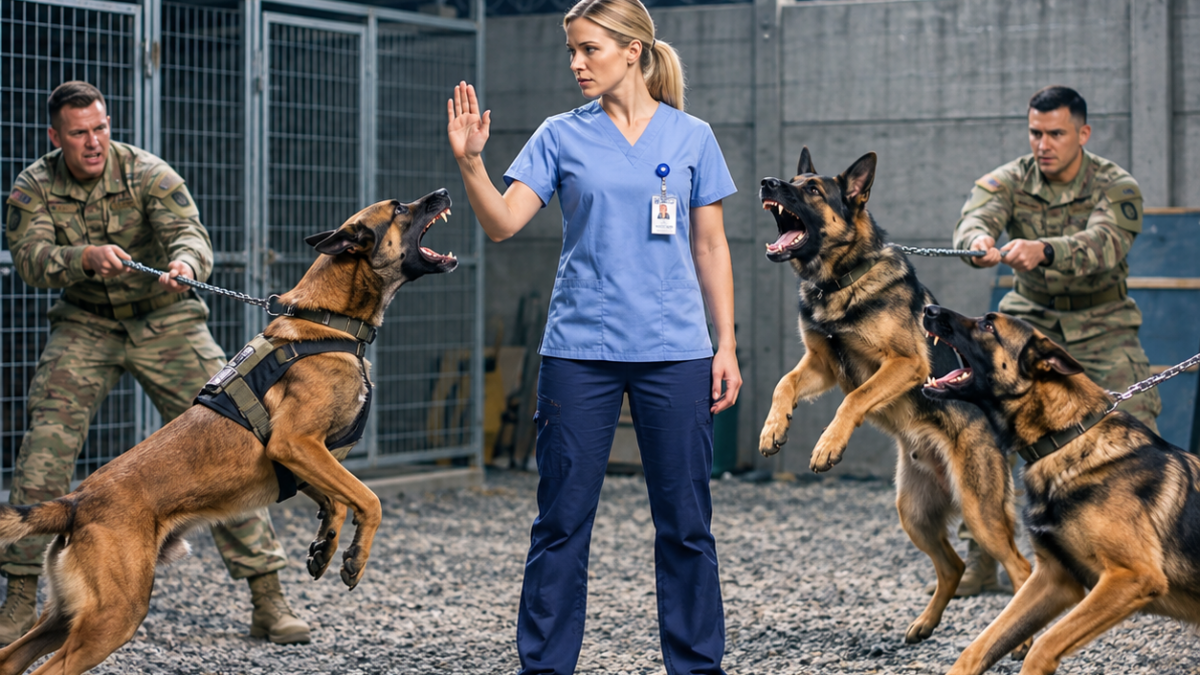
Three Military K9s Had Been Uncontrollable for 14 Days—Then an ER Nurse Whispered One Forgotten Command and All Three Went Still.
For fourteen days, three military K9s had refused commands, lunged at handlers, and deteriorated so badly that Iron Ridge was only days away from making a decision no one wanted to name.
Then a thirty-one-year-old civilian ER nurse stepped inside the wire, whispered a cadence nobody in the current unit recognized, and watched the first Malinois lower his head and press his muzzle against her shoulder.
But when Emily Carter began asking why all three highly trained dogs had broken down at the same time, she uncovered something far more dangerous than a forgotten command—three weeks of missing records, an officer protecting a promotion, and a mistake someone had deliberately tried to erase.
Emily Carter had been awake since 4:30 that morning.
Not because her shift started early.
It didn’t.
Her Wednesday schedule at Callaway Regional began at six, and even after three years of civilian emergency medicine, she could prepare for work in twenty-three minutes if she needed to.
She was awake because sleep still occasionally behaved like an enemy position.
Her apartment was quiet.
Refrigerator humming.
A truck somewhere on the street below.
Pipes clicking behind the wall.
Nothing dangerous.
Her nervous system did not care.
Three years out of the Army and part of her body still conducted threat assessments before the rest of her had a vote.
Door.
Window.
Hallway.
Stairwell.
Unknown sound.
Exit route.
Emily stopped fighting the ritual a long time ago.
She made coffee.
The phone rang while she was pouring her second cup.
Unknown military number.
She considered letting it go.
Then answered.
“Carter.”
“Ms. Emily Carter?”
“Yes.”
“This is Administrative Coordinator Paulson at Iron Ridge Military Medical Center.”
Emily looked at the clock.
5:07.
“What happened?”
A pause.
Interesting.
People who called nurses before sunrise rarely started with small talk, and people who paused after being asked what happened were usually trying to decide how much to say.
“We’ve been given your name for a consultation.”
“What kind?”
“Military working dogs.”
Emily did not move.
“How many?”
“Three.”
“Medical?”
“Behavioral.”
Another pause.
PART2:
“They’ve been in restricted kennel status for almost fourteen days.”
“And you’re calling an ER nurse.”
The man on the other end cleared his throat.
“You were specifically recommended.”
“By whom?”
“I wasn’t given authorization to discuss the referral chain.”
Of course.
Emily looked at the untouched coffee.
“What happened to the dogs?”
“They stopped responding normally to handlers after a training incident.”
“All three?”
“Yes.”
“At once?”
“Within the same operational period.”
That mattered.
“What have you tried?”
“Unit handlers. Veterinary Corps consultation. Behavioral specialist from Fort Bragg.”
“And?”
“Unsuccessful.”
Emily stared through her kitchen window.
Morning hadn’t arrived yet.
“Any injuries?”
“One handler.”
“How serious?”
“Arm bite. Required medical treatment.”
“How close are the dogs to disposition review?”
Paulson did not answer immediately.
That answered it.
Emily closed her eyes.
“How long?”
PART3:
“Command review is in four days.”
“I’ll be there at eight.”
Iron Ridge sat against a low ridge northeast of Redstone City, the sort of military installation that didn’t try to impress anyone because it didn’t need to.
Concrete.
Fences.
Low buildings.
Defined lanes.
Signs whose wording made clear that the person reading them was expected to obey the first time.
Emily parked her ten-year-old Honda Civic in the visitor lot and remained behind the wheel for a moment.
Her Callaway Regional hospital badge hung from her neck.
White letters.
Emergency Department.
Registered Nurse.
Nothing about the badge suggested six Army years.
Nothing suggested combat medicine.
Nothing suggested two overseas deployments.
Nothing suggested three years attached to military working-dog teams.
That was intentional.
Emily got out.
The MP at the checkpoint looked first at her hospital badge.
Then at her.
“Emily Carter.”
“Yes.”
“Consultation?”
“Yes.”
His expression suggested he had been expecting someone else.
Emily had seen that expression many times.
“Wait here.”
A corporal named Hewitt eventually escorted her across the base.
He was young enough that Emily suspected he’d still been in high school during her final deployment.
He led her to a concrete kennel facility near the eastern perimeter.
A woman waited outside.
Captain Olivia Mercer.
Early forties.
Close-cropped hair.
Security command posture.
Arms crossed.
She looked at Emily’s civilian clothes.
Then the ER badge.
Then her face.
“You’re Carter.”
“Yes.”
“You’re an emergency-room nurse at Callaway Regional.”
“I am.”
Mercer nodded slowly.
“I want to be straightforward.”
“Please.”
“We have certified military handlers here.”
Emily waited.
“We’ve had Veterinary Corps specialists.”
Still waiting.
“We flew in a cleared behavioral consultant three days ago.”
Mercer’s eyes held hers.
“None of them could stabilize these animals.”
Emily already knew the rest.
“I’m not sure what a civilian ER nurse is supposed to offer that they couldn’t.”
There it was.
Not cruel.
Not insulting.
Worse, in some ways.
Sincere.
Emily looked at the captain for a moment.
Then said:
“Let me do what nurses usually do.”
Mercer’s eyebrow moved.
“Which is?”
“Look at the patient before deciding what the problem is.”
Something changed in Mercer’s face.
Tiny recalibration.
Not respect.
Not yet.
“Five minutes.”
“Okay.”
“You stay outside the perimeter.”
“Fine.”
“You don’t enter a run.”
“Fine.”
“You don’t interact with the animals.”
Emily looked toward the kennel building.
“Then five minutes may not tell us much.”
“It tells you what I’m authorizing.”
“Understood.”
The smell reached Emily before the dogs came into view.
Not dirty kennels.
The facility was maintained.
Something else.
Stress has a smell when enough animals carry it in one enclosed space.
Ammonia.
Adrenaline.
Old bedding.
Cleaning solution.
Hot breath.
Muscle tension made chemical.
Three dogs occupied isolation runs.
Rex.
Belgian Malinois.
Large.
Dark mask.
Pacing.
Kilo.
German Shepherd.
Withdrawn on the concrete, muzzle between his paws.
Dax.
Younger Malinois.
Back corner.
Watching everything.
Two handlers stood outside.
A third was reading a clipboard.
Nobody approached the kennels.
Emily stopped at the outer fence.
She did not speak.
Mercer stood several feet behind her.
Hewitt beside the gate.
Emily watched Rex.
Twelve feet.
Pivot.
Twelve feet.
Pivot.
Again.
Exactly.
Not random pacing.
Not generalized panic.
A loop.
At the north end of the run, Rex’s head dipped every time.
Fraction of a second.
Then pivot.
Emily counted.
One.
Two.
Three circuits.
Same place.
Same head movement.
Same restart.
“What is behind that wall?”
Hewitt looked over.
“What?”
“The north wall.”
“Old supply corridor.”
“In use?”
“I don’t think so.”
“Ventilation?”
He frowned.
“Probably.”
“Shared airflow with the kennel?”
“No idea.”
Emily watched another circuit.
Head down.
Turn.
Return.
“There is something coming through that wall.”
Mercer spoke behind her.
“A smell?”
“Possibly.”
“Sound?”
“Possibly.”
“You’ve been here four minutes.”
“Yes.”
“Our handlers have watched these dogs for two weeks.”
“Yes.”
Mercer’s tone hardened.
“And nobody has suggested anything behind that wall.”
Emily looked toward Rex.
“They’ve been watching for aggression.”
She turned slightly.
“I’m watching for pattern.”
“Time’s up.”
Emily nodded.
Fair enough.
She looked one final time toward the kennels.
Then Rex stopped.
Instantly.
Not gradual.
Not fatigue.
The Malinois froze halfway through his route.
His head turned toward Emily.
Kilo lifted his muzzle from his paws.
Dax came out of the back corner.
All three were looking at her.
No barking.
No lunging.
Just watching.
Mercer stared.
Emily did not move.
Rex’s ears shifted forward.
His breathing changed.
Mercer said:
“Coincidence.”
“Could be.”
Emily meant it.
A single event proved very little.
“Can I come back tomorrow?”
“No.”
Emily looked at her.
“Captain—”
“You don’t have clearance.”
“I can work from outside.”
“You were authorized for observation.”
“I understand.”
“I’ll relay your notes.”
Emily nodded.
“Make sure whoever checks the north wall does it while Rex is elsewhere. Don’t change the environment while he’s inside the run.”
Mercer said nothing.
Emily walked toward the exit.
Almost to the first checkpoint, footsteps came behind her.
“Ms. Carter!”
Hewitt.
Slightly out of breath.
“Captain Mercer wants you to wait.”
Emily turned.
“For what?”
“I don’t know.”
Eleven minutes later she sat in a plastic chair staring at a crooked teamwork poster while someone higher in the command chain apparently discovered who she used to be.
Mercer returned carrying a manila folder.
Her expression had changed.
Not warmer.
Reorganized.
She placed the folder on the table.
Emily’s name sat at the top.
Service identification numbers below it.
Then a classification header Emily had not seen in three years.
Mercer tapped the page.
“Why wasn’t this in your referral packet?”
“You’d have to ask whoever referred me.”
“Six years Army.”
“Yes.”
“Combat medic.”
“Yes.”
“Three years attached to military working-dog operations.”
“Yes.”
“Two overseas deployments.”
“Yes.”
“Handler trauma support.”
“Yes.”
“Canine behavioral intervention rating.”
“Yes.”
Mercer looked up.
“This qualification exceeds what some of the specialists we’ve brought in have.”
Emily shrugged slightly.
“I also work four ER shifts a week.”
“Why didn’t you tell me?”
“You didn’t ask.”
Mercer stared.
“You let me give you five minutes.”
“You were the person controlling access.”
“You could have corrected my assumption.”
Emily looked at the folder.
“Which assumption?”
Mercer did not answer.
Emily did it for her.
“That the badge told you everything relevant?”
Silence.
Mercer closed the folder.
“The dogs have four days before command makes a disposition decision.”
Emily knew exactly what disposition could mean.
Not automatically euthanasia.
But permanent removal.
Unsuitable status.
Transfer.
In severe cases, worse.
“What do you need?” Mercer asked.
“Raw handler reports.”
“We have summaries.”
“I said raw reports.”
Mercer watched her.
“Training logs.”
“Okay.”
“Command framework used by whoever ran the last high-stress scenarios.”
“Lieutenant Garst.”
“His specific verbal command sequences.”
Mercer’s expression changed.
“Why?”
“Because three trained dogs deteriorating in the same period is a system problem until proven otherwise.”
“And?”
“I need the handlers out when I go inside.”
“No.”
Emily waited.
“These dogs have injured someone.”
“I know.”
“You’ve been outside the kennel five minutes.”
“I know.”
“You’re asking me to remove the people who know them best.”
“For the first assessment.”
“Why?”
“Because I need to see what the dogs do without handler expectations in the space.”
Mercer crossed her arms.
“They’ll read you as unfamiliar.”
“That’s useful.”
Another silence.
Mercer picked up the folder.
“I need authorization.”
“Get it.”
Forty minutes later, Emily received a twenty-four-hour access pass.
Conditions.
Armed handler outside perimeter.
Full documentation.
Immediate withdrawal if any animal escalated.
Emily took the pass.
Mercer said:
“Anything else hidden in this file I should know?”
Emily looked down at the laminated card.
“I was good at my job.”
“That isn’t what I asked.”
“It is what matters today.”
They gave her an olive utility uniform and boots half a size too large.
Emily changed in a small locker room.
When she looked into the mirror, something about the image unsettled her.
Not because she looked unfamiliar.
Because she didn’t.
Gray-green fabric.
Hair tied back.
No civilian hospital logo.
No rank.
She looked more like herself than she had in years.
Staff Sergeant Birkett met her at the kennels.
Late thirties.
Heavy build.
Careful eyes.
“You’re the civilian nurse.”
“Yes.”
“And apparently something else.”
“Apparently.”
Birkett looked toward Rex.
“He bit Hendricks four days ago.”
“How?”
“Forearm.”
“No. Situation.”
Birkett considered.
“Handler entered after a command cycle. Rex hit the fence. Hendricks stepped in. Dog redirected.”
“Which command?”
Birkett gave the phrase.
Emily looked at him.
“Again.”
He repeated it.
Something inside her clicked.
“What command does Garst think that means?”
“Hold.”
“No.”
Birkett frowned.
“That isn’t a hold command under the framework these dogs were originally conditioned with.”
“It is under Garst’s framework.”
“That is the problem.”
Birkett stared.
Emily continued.
“The phoneme sequence is too close to their release transition.”
“You’re saying he’s been giving the wrong command?”
“Not exactly.”
“Then what?”
“He’s been giving a valid command from the wrong system.”
Birkett looked toward the kennels.
Emily pointed.
“These dogs were conditioned under one verbal map.”
“Garst trained under another.”
“Yes.”
“And nobody standardized it?”
“Apparently not.”
Birkett’s face drained slightly.
“How long?”
“How long has Garst been primary?”
“Seven months.”
Emily exhaled.
“There it is.”
“You think seven months did this?”
“Seven months of mixed signals during peak arousal.”
She looked at Rex.
“Every breach.”
“Every hold.”
“Every release.”
“Every time the dog reached maximum drive and received a sound pattern that could mean two different things.”
Birkett looked sick.
“They aren’t aggressive.”
“They are confused.”
Emily paused.
“Confusion becomes dangerous when you punish an animal for not understanding something you’re saying incorrectly.”
She entered the outer corridor.
Okafor stood outside with a sidearm and the expression of a man mentally calculating how fast he could reach it.
Emily stood at the inner gate.
Three minutes.
No speech.
No movement.
Letting the dogs notice.
Rex watched.
Kilo watched.
Dax stayed back.
Emily opened the gate.
One step.
Rex stopped pacing.
She did not approach him directly.
Instead, she used something older.
Not exactly a command.
A cadence.
Low.
Rhythmic.
Three beats.
Pause.
Two.
Then a word from an old working-dog conditioning framework.
A word no one currently standing outside the fence recognized.
Rex did.
His head lowered.
His ears changed.
His breathing slowed.
Emily repeated it.
Once.
The Malinois walked toward her.
Three steps.
Stopped.
She crouched.
No reaching.
No pressure.
Rex came the remaining distance on his own.
Then pressed his muzzle against her shoulder.
Outside the fence, nobody spoke.
Emily closed her eyes for half a second.
Fourteen days of isolation.
Fourteen days of being interpreted as dangerous.
Fourteen days of handlers trying to force clarity back into a nervous system that had been receiving contradictions for months.
Rex exhaled.
Long.
Slow.
Emily placed a hand gently on his neck.
Behind her, Mercer whispered:
“What did she say?”
Birkett answered:
“I don’t know.”
Emily did.
The exact word mattered less than what lived beneath it.
A familiar framework.
A pattern buried under months of noise.
A signal that meant:
Nothing is being demanded from you right now.
You can stop choosing.
You can wait.
Kilo lay down.
Dax stopped pacing.
For the first time in fourteen days, all three dogs were quiet.
Emily stayed with Rex.
Not celebrating.
This was not solved.
A frightened system can go silent without becoming safe.
She could feel tension still running through his neck.
But something had opened.
Ten minutes later she moved to Kilo.
He approached the fence eventually.
Did not touch her.
Enough.
Dax took longer.
Four minutes before one step.
Another.
Then stopped three feet away.
White showing at the edge of his eyes.
Emily remained still.
Dax did not retreat.
Also enough.
When Emily finally left the perimeter, Okafor exhaled.
“You okay?”
“Yes.”
He looked toward the dogs.
“What did you do?”
“Gave them something they recognized.”
“What command?”
“Not exactly a command.”
“You said a word.”
“Yes.”
“What did it mean?”
Emily looked at Rex.
“In context?”
“Yes.”
“Stand down from the decision.”
Okafor frowned.
“I’ve never heard that.”
“You shouldn’t have.”
Mercer was already approaching.
“We need to talk.”
“I need ten minutes.”
Mercer looked like she wanted to object.
Then looked at Rex.
Did not.
The conference room smelled like marker ink and old coffee.
Mercer sat opposite Emily.
“The call I got earlier was from Colonel Haskell.”
Emily waited.
“He authorized your referral.”
“Why?”
“He knows your former unit commander.”
That explained the referral chain.
“Apparently there was a discussion about the dogs three days ago.”
“Without you.”
“Yes.”
“And you weren’t given my service background.”
“No.”
Mercer paused.
“I should have asked.”
Emily said nothing.
“The file is sealed.”
“Yes.”
“Why?”
Emily looked toward the window.
“When I left, I needed to stop being that person for a while.”
Mercer waited.
Emily continued:
“People see commendations and operations and build a story.”
“There are two commendations in the file.”
“I know.”
“People usually don’t hide commendations.”
“I wasn’t hiding them.”
“What were you doing?”
“Living somewhere they weren’t relevant.”
Mercer nodded slowly.
“The file also references a formal complaint against a superior officer.”
Emily’s jaw tightened.
“Yes.”
“Partially upheld.”
“Yes.”
“Officer reassigned.”
“Partially.”
“He kept rank.”
“Yes.”
Mercer chose not to pursue it.
That earned something from Emily.
Not trust.
But room.
“What did you find with the dogs?”
Emily leaned forward.
“The dogs are not the primary failure.”
“What is?”
“Command standardization.”
She explained.
Garst’s phrasing.
The conflicting training frameworks.
Seven months of command drift.
High-arousal sessions.
Each contradiction small enough to be absorbed alone.
Together, destructive.
Then the final six-hour simulated breach.
Maximum command frequency.
Maximum arousal.
The dogs’ response maps finally collapsed.
“They couldn’t tell what would stop the pressure,” Emily said.
Mercer wrote.
“So they became aggressive.”
“No.”
Emily shook her head.
“That’s the mistake.”
She pointed toward the kennels.
“An aggressive dog is moving toward a target.”
“These dogs were trying to escape contradiction.”
Mercer looked at her notes.
“Hendricks was bitten.”
“Rex was already over threshold.”
“That doesn’t make the bite less real.”
“No.”
“Then?”
“It changes what you fix.”
Mercer stopped writing.
That landed.
Emily continued.
“If you call this aggression, you treat the dog as the problem.”
“If you call it signal failure, you fix the system.”
“What about Garst?”
“He probably doesn’t know.”
Mercer looked surprised.
“You don’t blame him?”
“He used what he was taught.”
“His commands put a handler in medical.”
“Accuracy isn’t the same thing as generosity.”
Emily looked directly at her.
“If you tell Garst he’s a dangerous handler without explaining the framework mismatch, he’ll learn the wrong lesson and carry it into the next unit.”
Mercer stared.
Emily added:
“Fix all of it.”
Raw training logs arrived.
Emily found the transition point.
Mid-February.
Three consecutive high-intensity training days.
Garst primary on all three.
Avoidance behavior after the third.
Rest period ordered.
No improvement.
Of course not.
Rest does not repair contradictory information.
“How long?” Birkett asked.
“Rex, maybe three or four days for meaningful stabilization.”
“Kilo?”
“Week.”
“Dax?”
Emily looked toward the kennel.
“Longer.”
“We have four days.”
“Four days is enough.”
“For what?”
“To prove they’re recoverable.”
That became the objective.
Not cure.
Evidence.
Emily returned at six the next morning.
Rex responded to three corrected command sequences.
Then five.
Kilo began holding eye contact.
Dax stopped retreating when she approached.
Progress measured in inches.
Birkett documented every one.
Timestamp.
Stimulus.
Response.
Recovery time.
Emily insisted on detail.
Because memory is persuasive until someone with authority disagrees.
Paper lasts longer.
At 10:30, Mercer arrived.
“Haskell extended you to ten days.”
Emily looked up.
“That’s generous.”
“He read your full file.”
“Less generous.”
“He said you should have been brought in on day one.”
Emily returned her attention to Rex.
“He’s right.”
Mercer almost smiled.
Then:
“There’s another problem.”
Emily stopped.
“The March training records.”
“What about them?”
“They weren’t misplaced.”
Mercer handed her an IT summary.
“Removed.”
Emily read.
“Digital too?”
“Overwritten.”
“When?”
“Still tracing.”
“Garst?”
“No.”
“How certain?”
“Very.”
Emily looked toward the kennels.
Three weeks of missing records.
Exactly where command drift should have been most visible.
“Someone knew.”
Mercer nodded.
“Maybe.”
“No.”
Emily looked up.
“Someone knew enough to remove what would have shown it.”
Mercer’s jaw tightened.
“Garst was under consideration for training-division promotion.”
Emily understood immediately.
“Documented command failure would hurt the recommendation.”
“Yes.”
“Who recommended him?”
Mercer hesitated.
Then:
“Lieutenant Colonel Adrian Voss.”
Not Harlon Voss from Ridgeline.
Different man.
Different institution.
Same instinctive relationship to authority.
Emily looked again at the missing record period.
“Does he run the K9 training program?”
“Yes.”
“Then this just stopped being a dog problem.”
Mercer said quietly:
“I know.”
Emily kept working.
That was a skill she had learned before civilian nursing.
Political gravity makes people stare at the institution while the patient is still bleeding.
Rex needed rehabilitation.
Kilo needed consistency.
Dax needed more time.
Whatever Voss had done could be investigated by people whose job was investigation.
Emily’s job remained the dogs.
Dax came within two feet of the fence that afternoon.
That was enough.
Okafor brought coffee.
Black.
They stood on opposite sides of the perimeter.
“You were Army?”
“Six years.”
“I did four.”
“Dogs?”
“Eight months.”
“Like it?”
Okafor thought.
“I liked the trust.”
Emily nodded.
“I didn’t like what happened when command systems got screwed up.”
“No.”
He looked toward the administrative building.
“Voss is here.”
Emily did not react.
“Meeting with Mercer.”
“Okay.”
“Everybody knows she’s looking at the records.”
“Okay.”
“This place is small.”
“I noticed.”
“He’s been running the program three years.”
Emily drank the coffee.
“You’re telling me to be careful.”
“Yes.”
“Thank you.”
That answer surprised him.
Emily did not need to perform defiance.
Warning received.
Useful.
Mercer appeared near the end of the day.
“Voss wants a briefing.”
“When?”
“Six.”
“Why?”
“Routine oversight.”
Emily looked at her.
“And actually?”
“He wants control of the narrative before Haskell gets the investigation.”
“That’s speculation.”
“Yes.”
“Probably accurate.”
Mercer handed her Hendricks’s original incident report.
Emily read.
Supervisor:
Lieutenant Colonel Voss.
Present.
Signed.
The field requiring notation of command irregularities was blank.
Not “none observed.”
Blank.
Emily looked at Mercer.
“He was there.”
“Yes.”
“He saw Garst’s sequence.”
“We don’t know what he saw.”
“He signed the report.”
“Yes.”
Emily closed the folder.
“Bring this tonight.”
“You already know what you’re going to say.”
“I know what the records say.”
Conference Room B.
Voss took the head seat.
Of course.
Polished uniform.
Controlled expression.
The smile of a man confident enough to be gracious.
“Ms. Carter.”
“Colonel.”
“I’ve heard excellent reports.”
“Thank you.”
Mercer entered.
Birkett followed with the folder.
Voss’s smile tightened one millimeter.
He asked for a status briefing.
Emily gave him one.
Not opinions.
Numbers.
Rex.
Command latency.
Recovery time.
Kilo.
Threshold changes.
Dax.
Fence-distance improvement.
Voss nodded.
“Encouraging.”
“Yes.”
“Though obviously preliminary.”
“Ten-to-fourteen-day rehabilitation estimate remains.”
Voss paused.
“You’ve communicated that externally?”
“To Captain Mercer and Colonel Haskell’s office.”
Another pause.
“Of course.”
Then the missing logs.
Voss had an explanation ready.
“Compliance audit.”
Emily watched.
“Physical files were rotated out for review.”
“Digital files?”
“System migration.”
“Same period?”
“Yes.”
Interesting.
Voss used the word “confusion” twice while describing the missing records.
Emily recognized the technique.
Frame the accurate question as misunderstanding before anyone else gets to define it.
She looked down and wrote something on her notes.
A date.
Dash.
Nothing else.
Voss noticed.
Good.
“The problem,” Emily said, “is that the missing period corresponds precisely with the point where Garst’s command drift became clinically observable.”
“That’s your interpretation.”
“No.”
She opened Birkett’s folder.
“January baseline.”
Next page.
“February progression.”
Next.
“March gap.”
Next.
“April behavioral breakdown.”
Voss remained still.
Emily continued.
“If those missing weeks existed in sequence, the outside consultant could have identified the pattern.”
“Could have.”
“Yes.”
“Not would have.”
“Fair.”
Voss seemed relieved.
Emily continued:
“But their disappearance prevented the possibility.”
Silence.
Voss said:
“I think we need to avoid prematurely characterizing ordinary administrative record movement as suspicious.”
Mercer spoke:
“The digital copies were overwritten.”
“Migration.”
“IT is checking.”
“I welcome it.”
Emily looked at him.
“Good.”
Voss looked back.
For half a second, the smile disappeared.
Then returned.
He ended the meeting quickly.
Outside, Mercer said:
“He’ll make calls.”
“Yes.”
“He’ll create paperwork for the audit.”
“Probably.”
“You don’t seem concerned.”
“I asked Haskell’s staff to inspect metadata before we came in.”
Mercer stared.
“You already—”
“I suggested it might be useful.”
A beat.
“You’ve done this before.”
Emily picked up her notes.
“I need to be back at six.”
Day three began with good news.
Rex responded cleanly to seven commands.
Kilo improved.
Then Dax broke.
A cleaning crew entered his zone during morning sanitation.
Nobody had amended the normal schedule for active behavioral rehabilitation.
At the same time, maintenance had cleared the old supply corridor behind Dax’s wall.
Solvent.
Moved equipment.
New smells through the ventilation gap.
Two uncontrolled environmental changes.
Dax hit the fence.
Bit through part of the lower chain link.
Sedation team alerted.
Emily arrived.
Saw the fence.
Saw the circuit.
Saw his head dip at the same north-wall pivot she had noticed on day one.
“Stop the sedation team from approaching.”
Birkett looked at her.
“The fence is compromised.”
“I know.”
“He could break through.”
“He isn’t trying to escape.”
“He bit through steel.”
“He’s trying to stop something.”
Emily entered the outer corridor.
Dax was redlined.
This was different from Rex.
Not confusion alone.
Acute arousal.
She stood at the inner gate.
Opened it.
Dax froze.
Eight feet.
Emily crouched.
Used the old cadence.
His ears moved.
Again.
One step.
Pause.
Again.
Another.
Then Dax lunged.
Okafor’s hand went toward his weapon.
But Dax wasn’t moving at Emily.
He went past her toward the damaged fence.
Emily moved without thinking.
Between dog and chain link.
And a word came out of her mouth that she had not spoken in three years.
Not the therapeutic cadence.
Not reassurance.
A command.
Hard.
Clean.
Forgotten by everyone around her.
Not forgotten by the dog.
“Higher!”
Dax stopped.
Two feet from Emily.
Chest heaving.
Eyes wide.
For one terrible second, neither moved.
Emily’s heartbeat hit hard against her ribs.
This was the part people misunderstood when telling stories later.
Training did not erase fear.
It made fear less important than the next correct action.
Emily remained still.
Dax stared.
Then somewhere across the compound a door slammed.
Mercer’s voice carried from the administrative building.
Dax flinched.
Emily placed one hand against his neck.
“Easy.”
Different voice now.
Low.
Dax folded.
Down to the concrete.
Muzzle to ground.
Breathing fast.
But down.
Emily stayed with him.
Four minutes.
Five.
Outside the perimeter, nobody moved.
When she finally exited, Mercer was crossing the compound holding a JAG document.
“Voss filed against you.”
Emily removed her gloves.
“What?”
“Formal objection to your continued access.”
“Basis?”
“Conflict of interest.”
Emily almost laughed.
“Which conflict?”
“Your direct reporting to Haskell.”
“Anything else?”
“He filed against me too.”
Emily’s face changed.
“Why?”
“Chain-of-command violation.”
Mercer handed over the document.
Technically competent.
Regulations cited correctly.
Carefully built.
A weapon made of procedure.
“What does Haskell say?”
“Formal briefing.”
“When?”
“Fourteen hundred.”
Emily checked her watch.
10:53.
“Good.”
Mercer stared.
“Good?”
“I’ve been preparing it since yesterday.”
Then Mercer handed her something more important.
IT metadata.
March override.
03:17 a.m.
Administrative-office terminal.
Manual deletion.
“Who had key access?”
“Four people.”
“Where were the others?”
“Off base.”
Emily looked up.
“Voss.”
Mercer nodded.
“Gate logs support it.”
That changed the room they were about to enter.
For two hours, Emily built the timeline.
January.
February.
March.
Deletion.
Incident.
Hendricks.
Blank supervisor field.
Dogs deteriorating.
Voss’s promotion recommendation for Garst.
Objection against Emily.
Every piece alone arguable.
Together, a structure.
Colonel Haskell sat at the head of the formal briefing.
JAG officer beside him.
Mercer.
Birkett.
Emily.
Voss entered later.
Full uniform.
Perfect posture.
Looked at the IT analysis.
Read the timestamp.
Read the terminal.
Read the access data.
“The compliance audit explanation was provided last night,” he said.
Haskell responded:
“The audit schedule you referenced was created this morning.”
Voss went still.
“The migration?”
“No prior record of that either.”
Silence.
Emily watched calculation happen behind his eyes.
People reach moments where they have to choose between confession and another lie.
Voss chose neither.
“I’d like counsel.”
Haskell nodded.
“You are entitled to counsel.”
Then:
“Effective immediately, your authorization over the K9 program is suspended.”
Voss looked up.
“Access to facilities, records, and personnel revoked.”
No reaction.
“You will leave Iron Ridge by the end of business.”
Still controlled.
“The records deletion, incident-report omissions, and your objection filed this morning will be investigated.”
Haskell paused.
“The objection may constitute obstruction.”
Voss’s knuckles whitened.
Then he said:
“The dogs were always my priority.”
Nobody answered.
Emily thought about Rex.
Kilo.
Dax biting through steel.
Hendricks’s arm.
Fourteen days.
She looked at Voss.
“They are now.”
He was escorted out at 15:40.
Emily saw him through a corridor window.
Two MPs.
Not detained.
Not free in the usual sense either.
He did not look toward the kennels.
Emily did.
Rex worked ninety minutes that afternoon.
Best session yet.
Kilo consolidated.
Emily left Dax alone.
Sometimes care is intervention.
Sometimes it is the discipline not to intervene.
She stood outside his enclosure.
Ten minutes.
No demands.
Dax watched from the middle of the run instead of the back corner.
New.
Mercer found her later.
“Haskell wants your full methodology documented.”
“Already is.”
“I assumed.”
There was something settled in Mercer now.
A person who had chosen a side and discovered that making the correct choice did not kill her.
Then Emily’s phone rang.
Callaway Regional.
Charge nurse Pritchard.
There was a patient asking specifically for Emily.
Name:
Hendricks.
The handler Rex had bitten.
Emily’s body tightened.
Okafor saw.
“What?”
“I have to go.”
“Who?”
“Hendricks.”
Okafor’s expression changed.
“I heard Voss make a call before he left.”
Emily stopped.
“He used Hendricks’s name.”
That was enough.
Callaway Regional was normally twenty-two minutes away.
Emily made it in sixteen without driving stupidly.
Pritchard handed her a tablet.
“Room seven.”
Hendricks was physically stable.
Psychologically, no.
Blood pressure elevated.
Stress markers.
Agitation.
Bandaged forearm.
He looked twenty-six going on forty.
When Emily entered, his shoulders lowered.
“You’re Carter.”
“Yes.”
He looked at the door.
Emily closed it.
“What happened?”
The story came out badly.
Out of order.
Truth often does when held too long.
Voss had called him two days earlier.
Personally.
Said he wanted to “align the record.”
Rex’s bite was to be described as unpredictable animal behavior.
No handler command issues.
No training error.
Unit interest.
Then Voss called again after being removed from Iron Ridge.
Different voice.
Less friendly.
Told Hendricks the investigation was political.
Told him if he had already repeated the official account, he needed to keep repeating it.
Emily sat very still.
“Did you?”
“No.”
“Who did you speak to?”
“JAG.”
“What did you tell them?”
“The truth.”
“What truth?”
Hendricks swallowed.
“Garst gave a command sequence about three minutes before I went near Rex.”
Emily waited.
“Rex was already distressed.”
“Yes.”
“I saw it.”
“Did you document it?”
Hendricks nodded.
“Personal phone.”
“Why wasn’t it in the official report?”
“Voss had already signed the report.”
There it was.
Hendricks looked ashamed.
“I was new.”
Emily understood.
“I didn’t know what I was supposed to do.”
“Do you still have the log?”
“Yes.”
“Don’t alter it.”
“I won’t.”
“Don’t screenshot and send it around.”
“Okay.”
“Preserve the original.”
He nodded.
“I thought I was going crazy.”
Emily looked at him.
“No.”
“He told me the report was what happened.”
“No.”
“I started thinking maybe I remembered it wrong.”
Emily’s voice softened.
“You didn’t.”
Hendricks looked down at his wrapped arm.
“You were the only person I heard was trying to fix it.”
“Mercer is fixing it.”
“Now.”
“Yes.”
He looked at her.
“I didn’t know where else to go.”
Emily understood that too well.
She called Mercer.
Told her everything.
Mercer’s response was immediate.
“He contacted a witness after formal suspension.”
“Yes.”
“That’s obstruction.”
“Yes.”
“JAG gets the phone tonight.”
“Hendricks is ready.”
“Tell him he is protected.”
“I already did.”
“Tell him it came from me.”
Emily returned to room seven.
“Captain Mercer says you will not be buried for telling the truth.”
Hendricks closed his eyes.
Then nodded.
That night Emily returned to Iron Ridge at 9:30.
Not because she had to.
She went to the kennels.
Dark.
Quiet.
Three separate breathing patterns.
Rex.
Deep.
Kilo.
Slow.
Dax.
Lighter.
Present.
Emily stood outside listening.
Human institutions lie in paragraphs.
Dogs usually tell the truth with their bodies.
Nine days after the investigation opened, Voss entered a negotiated plea.
Three counts of falsifying official records.
Dereliction of duty.
Two obstruction counts.
The second Hendricks call had ended most of his available defenses.
Metadata.
Gate logs.
Phone records.
Deleted training documents.
False audit paperwork.
Blank incident fields.
All pointing the same direction.
Voss was stripped of rank.
Removed permanently from military animal programs.
Barred from supervisory roles involving them.
Investigators reopened two prior irregularities in his record.
He had done versions of it before.
Emily heard the outcome while sitting inside Dax’s enclosure.
He was lying three feet away.
Calm.
Birkett read the findings from his phone.
Then looked at Dax.
“Ten days ago he tried to go through a fence.”
“Yes.”
“I’ve never seen anything move this fast.”
Emily scratched the floor lightly with one finger.
“He wasn’t broken.”
Birkett watched her.
“He was waiting for something to make sense.”
Garst returned on the seventh day.
Not to full command.
Supervised retraining only.
He looked terrible.
He had spent weeks believing he had destroyed three dogs.
Emily sat with him before the session.
“You used the wrong framework.”
“I used what I was trained on.”
“Yes.”
“That doesn’t make me feel better.”
“It shouldn’t.”
Garst looked at her.
“You think this was my fault.”
“Partly.”
The honesty startled him.
Emily continued.
“You should have standardized your commands against the unit’s conditioning record.”
“I didn’t.”
“No.”
“I missed Rex’s avoidance.”
“Yes.”
“I kept pushing.”
“Yes.”
His eyes reddened.
Emily did not rescue him from that.
People learn nothing if consequences are removed emotionally.
Then she added:
“But someone saw the problem clearly enough to delete the records that would have helped you correct it.”
Garst stared.
“That matters too.”
He swallowed.
“What do I do?”
“Learn both systems.”
“All of it?”
“Yes.”
“Recertify?”
“Yes.”
“Start over?”
“If necessary.”
Garst nodded.
Then entered the supervised session with Rex.
Correct command.
Rex responded.
Second.
Clean.
Third.
No hesitation.
Halfway through, Garst started crying.
He kept working.
Voice steady.
Face wet.
Rex tracked him with absolute attention.
At the end, Garst held position.
Rex approached.
Pressed his muzzle into Garst’s hand.
Garst bent his head.
Emily looked away.
Again.
Some moments do not improve with witnesses.
Kilo responded similarly.
Dax remained cautious.
That was okay.
“You saved them,” Garst told Emily afterward.
“No.”
“You did.”
“No.”
He frowned.
“What do you call this?”
“I reminded everyone what language they were speaking.”
Garst looked toward Rex.
“That sounds like saving.”
Emily shook her head.
“The dogs were telling us the entire time.”
Nobody had listened correctly.
Formal regional review followed.
Three years of program evaluations reopened.
Mercer was appointed to help lead it.
That made sense.
She had been wrong about Emily at the beginning.
She had also been willing to change her position when evidence demanded it.
That mattered more than never being wrong.
On day nine, Mercer came to the kennels carrying two official letters.
First:
Commendation.
Emily Carter.
Contribution to K9 stabilization.
Identification of command-system mismatch.
Assistance in preservation of records.
Methodology.
Signed by Colonel Haskell.
Emily read it.
Folded it.
“Thank you.”
Mercer handed over the second.
“Haskell wants your rehabilitation framework submitted for formal training review.”
Emily looked at her.
“If adopted, it goes into handler certification.”
“My name?”
“Yes.”
Emily was quiet.
Three years earlier she had left the Army specifically because she was exhausted from being interpreted through military service.
Hero.
Medic.
Commendations.
Complaint.
Survivor.
Symbol.
She wanted to become something simpler.
ER nurse.
Coworker.
Woman buying groceries after night shift.
Somebody whose worst day was not the first thing strangers knew.
Now the old work had found its way back.
But differently.
Not as identity.
As useful knowledge.
“I’ll submit it.”
Mercer nodded.
Then remained standing.
Emily waited.
Mercer said:
“I owe you something.”
“You don’t have to.”
“Yes.”
Emily looked up.
“At the gate.”
“I remember.”
“I saw your ER badge.”
“Yes.”
“I saw civilian.”
“Yes.”
“I saw thirty-one.”
“Yes.”
“I had already decided what you could contribute before you spoke.”
Emily waited.
Mercer continued:
“I was wrong.”
“Yes.”
No softening.
Mercer accepted it.
“I don’t expect you to tell me I had reasons.”
“You did.”
“I still stopped looking.”
“Yes.”
“That’s on me.”
“Yes.”
Mercer almost smiled.
“You make apologies difficult.”
“I think you did fine.”
That was enough.
On the tenth and final day of Emily’s authorized access, Rex was cleared at operational specification pending formal Veterinary Corps reevaluation.
Kilo needed another week of consolidation.
Dax had further to go.
His final session with Emily lasted forty minutes.
No drama.
No lunge.
No forgotten command.
No fence.
He walked beside her in the corridor.
Stopped.
Sat.
Then leaned his flank against her leg.
Emily remained there.
His breathing steady.
Ten days earlier he would not allow a person within five feet of his fence.
Now he chose contact.
She wrote a continuation plan.
Detailed.
Triggers.
Correct cue framework.
Environmental controls.
Reintroduction schedule.
Handler rotation.
Scent-management warning.
No abrupt procedural changes during rehabilitation.
Whoever came after her would not have to guess.
At two in the afternoon, Emily completed the final paperwork.
Birkett walked her to the gate.
Not an escort.
Just walking.
Near the checkpoint he stopped.
“I have something.”
Folded paper.
From the interim unit lead.
The note thanked her.
Said he had spent nine years around working dogs and had never seen anyone change three cases so quickly.
Said the unit should have listened when she arrived.
Emily folded it.
“Tell him thank you.”
“I will.”
“And tell him something else.”
“What?”
“They didn’t need someone magical.”
Birkett waited.
“They needed everybody to stop talking long enough to notice what the dogs were already saying.”
He nodded.
“Come back sometime.”
“I work twenty minutes away.”
“I know.”
They shook hands.
Emily stepped through the gate.
Three days later she was back in navy-blue scrubs at Callaway Regional.
Wrist laceration in Bay Four.
Pediatric fever in Eight.
A seven-year-old needed forehead sutures, so Emily held his hand and talked about dinosaurs while the physician worked.
Ordinary nursing.
Real nursing.
No less important than Iron Ridge.
At two, Pritchard approached.
“You okay?”
“Yes.”
Pritchard waited.
Emily smiled slightly.
“Complicated week.”
“I heard.”
“From who?”
“Hendricks called.”
Emily stopped.
“He’s discharged.”
Good.
“Going back to the unit.”
Better.
“He said thanks.”
Emily looked down at her paperwork.
“He also said the dogs are doing well.”
Emily thought of Rex pressing his muzzle to her shoulder.
Kilo finally sleeping.
Dax beside her leg.
Garst crying while still giving clear commands.
Mercer standing at the gate and admitting she had stopped looking.
Then she thought about the first five minutes.
A civilian ER badge.
Crossed arms.
Polite dismissal.
People had decided who Emily was before she reached the kennels.
The strangest part was that they had not been entirely wrong.
She was an ER nurse.
Proudly.
The mistake was believing that was all a person could be.
Her military experience had not made nursing beneath her.
Civilian nursing had not erased the soldier.
Both were real.
Both taught her to see things other people missed.
In emergency medicine, patients rarely arrive in neat categories.
Pain looks like anger.
Fear looks like resistance.
Confusion looks like aggression.
The body often tells a different story than the first report.
The same had been true at Iron Ridge.
Three dogs were labeled dangerous.
One handler was blamed.
One command system was assumed universal.
One officer protected a promotion recommendation.
Three weeks of records disappeared.
A handler’s report was simplified.
Another handler was quietly pressured.
And because everyone kept responding to the label instead of the pattern, the animals got worse.
Emily’s forgotten command had not been magic.
That was the part people would misunderstand if the story ever traveled.
The word itself had not saved Rex.
Or Kilo.
Or Dax.
It had worked because it belonged to a training language buried beneath seven months of contradictory cues.
It told them something recognizable.
Something stable.
Something their nervous systems understood.
The breakthrough was not the command.
It was realizing that the dogs had never stopped communicating.
Everyone else had stopped listening.
Months later, Iron Ridge formally integrated Emily’s rehabilitation methodology into its handler retraining program.
Regional command followed.
Then another installation requested it.
Emily received an email asking whether she would participate in a review panel.
She stared at the invitation.
Closed it.
Opened it again that night.
Eventually accepted.
Part-time.
She refused to leave Callaway Regional.
Mercer called once to ask why.
“You could consult full time.”
“I know.”
“Better money.”
“Probably.”
“More specialized.”
“Yes.”
“Then why stay in the ER?”
Emily thought about that.
“Because people come through our doors scared and hurting and sometimes everyone has already decided what their behavior means.”
Mercer was quiet.
Emily continued:
“I seem to be useful there.”
Mercer laughed.
“You’re useful everywhere.”
“Don’t make it dramatic.”
“I wouldn’t dare.”
The disciplinary review of Voss expanded.
Two prior incidents.
One equipment case.
Another altered report.
His career ended under a pile of documentation he once believed nobody would connect.
The irony was not lost on Emily.
But she did not celebrate it.
She had learned years earlier that professional consequences rarely repair the thing damaged underneath.
Hendricks still had a scar.
Garst still carried guilt.
Dax still required additional rehabilitation.
Three dogs had spent two weeks believing the humans around them had become impossible to understand.
Removing Voss did not erase any of that.
It simply stopped the system from protecting the wrong thing.
That mattered.
One Saturday, several months later, Mercer invited Emily back.
No emergency.
No consultation.
“Just come.”
Emily arrived in jeans and a dark jacket.
The MP at the gate checked the list.
Then looked at her.
Recognition.
“Ms. Carter.”
“Yes.”
“Captain Mercer is expecting you.”
No skepticism this time.
Emily almost preferred the old version.
At the kennels, Rex was working with Garst.
Clean.
Fast.
Confident.
Kilo had returned to full operational training.
Dax was not back to tactical work yet.
But he was outside.
No fence between him and his handler.
Long lead.
Loose body.
Emily stopped.
Dax saw her.
His ears rose.
For several seconds he did nothing.
Then walked across the yard.
Not running.
Not dramatic.
Just walking.
He stopped in front of Emily.
She looked down.
“Hi.”
Dax leaned against her leg.
Mercer stood nearby.
“You’re not going to say it?”
“Say what?”
“That you knew he’d recover.”
“I didn’t.”
“You thought he would.”
“I thought he could.”
Mercer smiled.
“Difference?”
“Important one.”
Rex finished the sequence and Garst approached.
More confident now.
Still carrying humility he had not possessed before.
Good.
“We changed the certification course,” he told Emily.
“I heard.”
“Both command frameworks now.”
“Good.”
“And mandatory verification against the dog’s original conditioning profile before handler reassignment.”
“Better.”
Garst nodded toward Dax.
“He still responds to your word.”
Emily looked down.
“The old command?”
“Yes.”
“Don’t overuse it.”
“I know.”
“It shouldn’t become another dependency.”
“I know.”
Emily smiled slightly.
He had learned.
Later, standing outside the kennel building, Mercer asked:
“Do you ever miss it?”
“The Army?”
“Yes.”
Emily looked toward the ridge.
“Pieces.”
“Dogs?”
“Some.”
“The work?”
“Sometimes.”
“What don’t you miss?”
Emily glanced toward the administrative building.
“People mistaking rank for accuracy.”
Mercer laughed.
“Fair.”
“And being told that disagreeing with authority meant I had failed to understand it.”
The laugh disappeared.
That was the sealed part of Emily’s record.
During her last deployment, she had formally challenged a superior officer over a handler-and-dog readiness decision.
She had been right enough for the complaint to be partially sustained.
Not right enough to avoid consequences.
The officer kept rank.
Emily eventually left.
The facts were more complicated than a heroic whistleblower story.
They always were.
She had made mistakes too.
She had been angry.
Exhausted.
Too direct in rooms that punished directness.
Sometimes wrong in delivery while right in substance.
She carried that with her.
It was one reason she had not arrived at Iron Ridge announcing old credentials.
She did not want the past deciding the current room before she saw what was actually there.
Mercer asked:
“Is that why you sealed the file?”
“Partly.”
“What was the rest?”
Emily considered.
“I got tired of people deciding I was either brave or damaged before they knew me.”
Mercer absorbed that.
“And nursing gave you somewhere no one cared?”
“Nursing gave me work.”
“That simple?”
“Mostly.”
A long silence.
Then Mercer said:
“The dogs recognized you before we did.”
Emily shook her head.
“People keep saying that.”
“Because it’s true.”
“No.”
“What do you think happened?”
Emily looked toward Dax.
“They recognized a familiar way of moving.”
“Military?”
“Maybe.”
“Confidence?”
“Maybe.”
“Then what?”
She thought.
“Someone not asking them to perform.”
Mercer waited.
Emily continued:
“For two weeks, everyone approaching those kennels needed something.”
“Obedience.”
“Assessment.”
“Behavior.”
“Proof they were safe.”
“Proof they were dangerous.”
“Proof somebody’s treatment plan was working.”
She looked at Mercer.
“I didn’t need anything from them in the first five minutes.”
Mercer became quiet.
“That probably felt different.”
“Yes.”
Iron Ridge eventually mounted a small plaque near the K9 training room.
Emily hated plaques.
Mercer did not ask permission.
It did not call Emily a hero.
She would have removed it herself if it had.
Instead it carried one sentence from the revised handler curriculum:
Observe the animal in front of you before responding to the behavior you expected to see.
No name.
Emily approved of that.
Years later, people at Callaway Regional still occasionally learned about her Army service by accident.
A military patient recognized a unit designation.
An old colleague visited.
A photograph surfaced.
The newer nurses were always surprised.
“You worked with military dogs?”
“Yes.”
“In combat?”
“Yes.”
“Why didn’t you tell us?”
“Never came up.”
One young nurse once asked:
“Is that why you’re so calm in bad cases?”
Emily thought about Dax hitting the fence.
Her heartbeat.
Her fear.
Her hand moving before thought.
“No.”
The young nurse looked confused.
“I get scared.”
Emily said.
“You just don’t look scared.”
“That’s different.”
“How?”
Emily leaned against the nursing station.
“Calm isn’t not having the reaction.”
“It is knowing which part of the reaction is useful.”
That nurse remembered it.
Emily knew because months later she heard her say almost the same thing to someone else.
Knowledge travels strangely.
Sometimes through manuals.
Sometimes through military files.
Sometimes through one nurse repeating something at two in the morning.
Rex retired several years later.
Garst sent Emily a photograph.
Gray around the muzzle.
Lying on a couch.
Caption:
He finally learned civilian rules. Mostly.
Kilo served another three years before retirement.
Dax never returned to the same type of high-intensity tactical assignment.
That was not failure.
The revised evaluation placed him in a lower-pressure detection role where he excelled.
Emily liked that outcome best.
Recovery did not have to mean returning someone to the exact environment that hurt them.
Sometimes success meant finding the work that fit the nervous system you actually had.
Mercer eventually took permanent leadership of the K9 program.
When she received the appointment, she called Emily.
“I suppose now I get to become the authority you complain about.”
“Probably.”
“You’ll tell me?”
“If necessary.”
“I know.”
That was trust.
Not agreement.
The confidence that disagreement would be allowed to survive.
The forgotten command became part of unit lore.
Emily disliked that too.
Recruits exaggerated it.
One whispered word.
Three dogs instantly calm.
Mysterious combat nurse.
Secret K9 language.
By the fifth retelling it sounded ridiculous.
Emily corrected it whenever she heard the story.
“It took ten days.”
The storyteller would pause.
“But the first dog—”
“Took fourteen days of damage before I arrived.”
“But the command worked.”
“Because it was familiar.”
“They recognized you.”
“They recognized structure.”
“Still sounds pretty incredible.”
Emily would shake her head.
“No.”
Then she would tell them the less exciting truth.
The command mattered.
The investigation mattered.
The missing records mattered.
But Rex recovered because somebody worked forty minutes.
Then another forty.
Then again.
Kilo recovered because his signals became consistent.
Dax recovered because people stopped forcing progress on a schedule designed for administrative convenience.
Garst recovered professionally because he returned, admitted what he did not know, and retrained.
Mercer became better at command because she admitted she had judged a person by a badge and corrected herself publicly.
Hendricks helped expose obstruction because someone finally told him his memory was not less real than an officer’s report.
None of that fit inside one whispered word.
Real repair rarely does.
The command simply created the first silence in which everyone could finally hear the larger problem.
Years later, Emily still woke too early sometimes.
4:30.
Dark apartment.
Refrigerator humming.
Old threat calculations occasionally running.
But things had changed.
She no longer treated those mornings as proof the war had followed her home.
Sometimes the body learns slowly.
She understood that better now.
Rex had taught her again.
Kilo.
Dax.
People too.
One morning before a Callaway shift, Emily found an envelope beneath her apartment door.
No stamp.
Mercer had apparently been in town.
Inside was a photograph.
Three dogs in an open training field.
Rex.
Kilo.
Dax.
Different positions.
Different futures.
All standing.
On the back Mercer had written:
Fourteen days everyone asked what was wrong with them. You were the first person who asked what we were doing wrong.
Emily read it twice.
Then placed it beside the coffee maker.
She did not frame it.
That would have been too sentimental.
But she never threw it away.
At six, she clocked into the ER.
Pritchard handed her a chart.
“Bay Six.”
“What?”
“Veteran. Agitated. Won’t let anybody near him.”
Emily looked down.
“Pain?”
“Claims no.”
“Claims?”
Pritchard smiled.
“I’ve learned from you.”
Emily walked toward Bay Six.
No military uniform.
No commendation.
No special pass.
No K9 behind a fence.
Just navy scrubs.
Hospital badge.
A patient whose behavior had already become the headline before anyone understood the cause.
Emily stopped outside the curtain.
Breathed.
Observed.
Then stepped inside.
That was the part nobody ever put in the dramatic version.
The forgotten command did not make Emily Carter extraordinary.
It simply exposed what had been true long before she entered Iron Ridge.
She knew how to listen before she decided what something meant.
Three military K9s had spent fourteen days screaming in the only language they had.
Everyone around them had heard aggression.
Emily heard confusion.
And once someone finally understood the difference, the dogs went quiet long enough for a much uglier truth to make itself heard.








