Thousands of Maggots Covered the Puppy’s Wounds—But Elijah Still Leaned Into the First Hand That Tried to Save Him
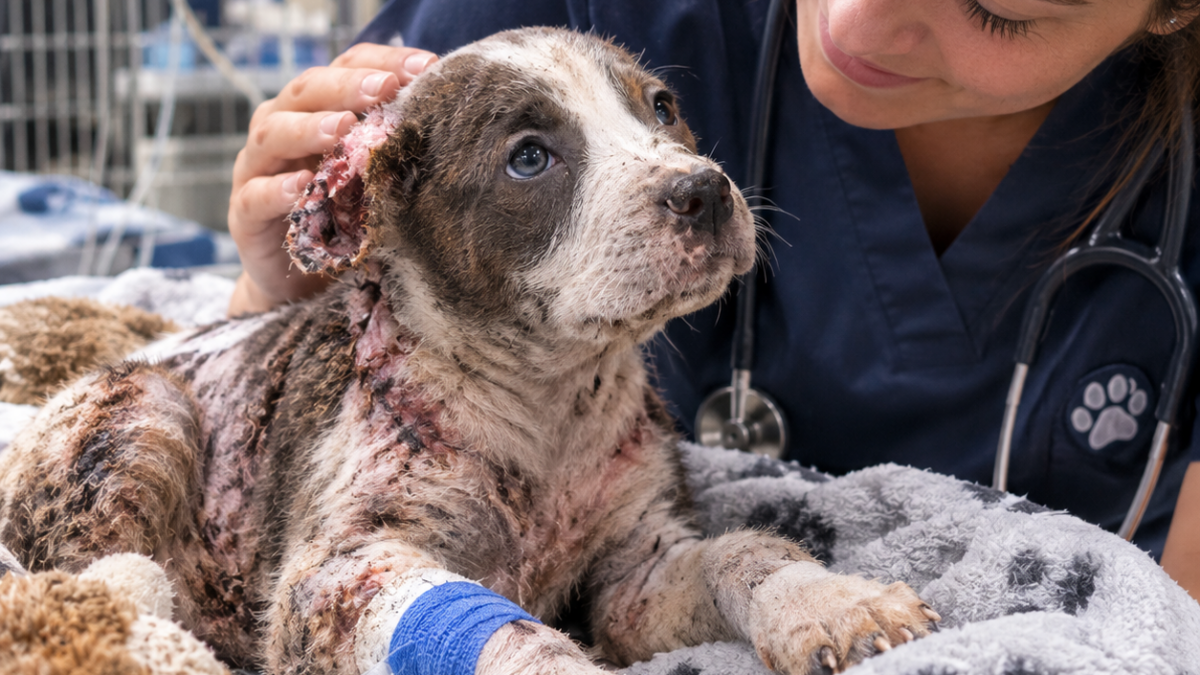
PART3:
Her hands shook as she called the rescue.
Tessa answered on the second ring.
“Maya?”
“I found one.”
Tessa heard her voice and immediately changed tone.
“How bad?”
Maya looked at the puppy.
“Call Everglades Veterinary Emergency. Tell Lena I’m coming.”
“Maya, how bad?”
“Tell her I’m coming now.”
There was a pause.
“Okay.”
“And tell her…”
Maya stopped.
She had just noticed something around the puppy’s neck.
A collar.
Not a pet collar.
A narrow strip of cracked black nylon without a buckle, held together by a metal fastener.
There was dried blood beneath it.
“Maya?”
“Just tell Lena to be ready.”
She hung up.
The puppy’s eye opened.
Only one.
The other was swollen nearly shut.
Maya slowly extended her hand.
“I’m not going to hurt you.”
She hated saying those words.
Not because they were false.
Because somebody had made them necessary.
The puppy watched her fingers.
He tried to lift his head.
His muscles trembled.
Then his head fell back into the grass.
Maya’s throat tightened.
“Don’t.”
She moved closer.
“You don’t have to do anything anymore.”
She slid one hand beneath his chest.
Even through her gloves, she could feel how hot his skin was.
Fever.
She positioned a blanket beneath him without rolling him more than necessary.
The smell hit her then.
Infection.
Dead tissue.
Blood.
Maya had smelled it before.
She still had to turn her face for half a second.
When she looked back, the puppy was watching her.
“I’m sorry.”
She wrapped the blanket around him.
His body weighed almost nothing.
As she lifted him, his head rolled toward her chest.
For one terrible moment Maya thought he had stopped breathing.
“No, no, no.”
She pressed her ear near his nose.
A faint breath touched her cheek.
“Stay with me.”
She carried him toward the SUV.
The puppy made a sound.
Not a bark.
Not even a whimper.
It was something smaller.
An exhausted breath that seemed to carry pain through his entire body.
Maya climbed into the back seat with him and called Tessa again.
“You need somebody to drive me.”
A county utility truck was approaching.
Maya stepped into the road and waved both arms.
The driver slammed his brakes.
Ten minutes later, a stranger named Calvin Brooks was driving Maya’s SUV seventy miles per hour toward the veterinary hospital while Maya sat in the back with the puppy across her lap.
She kept talking.
She told him about Moses, the old pit bull she had been supposed to deliver.
She told him about the rainstorm predicted for later that afternoon.
She told him she had once had a dog named Sammy who ate an entire couch cushion and then acted offended when anybody questioned him.
She told him anything she could think of.
Anything except what she was afraid of.
At the hospital, Dr. Lena Brooks was waiting outside with two technicians and a gurney.
Lena had known Maya for six years.
She had never seen her look that pale.
“What do we know?”
“Nothing.”
“Age?”
“Four months, maybe five.”
“Conscious?”
“In and out.”
“Possible trauma?”
Maya looked at her.
“Punctures everywhere.”
Lena’s jaw tightened.
They moved fast.
The doors opened.
The puppy disappeared beneath fluorescent lights.
Maya followed until a technician blocked her at the treatment room.
“I need you out here.”
“I found him.”
“I know.”
“He—”
“Maya.”
She stopped.
The technician’s voice softened.
“Let us work.”
The doors closed.
Maya stood in the hallway.
Blood marked the front of her shirt.
A maggot crawled across one glove.
She stared at it until Tessa arrived and pulled the glove from her hand.
Tessa was sixty-one, gray-haired, five-foot-three, and capable of intimidating men twice her size with one look.
She put both hands around Maya’s face.
“You got him here.”
“I almost didn’t see him.”
“But you did.”
“I almost—”
“Maya.”
Tessa lowered her voice.
“You saw him.”
Maya looked toward the treatment room.
“What if it’s too late?”
Tessa glanced through the glass.
“Then he won’t die beside a road.”
The veterinary team worked for more than four hours.
They started fluids.
Antibiotics.
Pain medication.
They removed maggots from wounds so deep that one technician had to leave the room to cry.
They shaved damaged fur.
Flushed punctures.
Cut away necrotic tissue.
The worst area was near the puppy’s left ear.
Blood supply had been destroyed.
The tissue had begun dying.
Lena tried to save it.
She could not save all of it.
Shortly before two in the afternoon, she walked into the consultation room.
Maya stood immediately.
Lena removed her surgical cap.
“He’s alive.”
Maya closed her eyes.
Tessa whispered, “Thank God.”
“But he’s critical.”
Maya opened her eyes.
“How critical?”
“He has systemic infection. Severe dehydration. Significant tissue damage. I had to remove part of the left ear. There are several deep wounds around the neck and shoulder. Some older, some newer.”
“Can you tell what caused them?”
Lena hesitated.
“Some are consistent with bites.”
Maya already knew what she meant.
“Dog bites?”
“Yes.”
“How many?”
“Too many.”
Tessa folded her arms.
“Could he have been attacked as a stray?”
Lena looked at her.
“Possibly.”
Maya heard the uncertainty.
“What aren’t you saying?”
Lena sat down.
“The pattern concerns me.”
“How?”
“Different stages of healing. Repeated injuries. Minimal defensive wounds on the front legs compared with the neck and flank.”
Maya felt cold despite the air-conditioning.
Tessa said it quietly.
“Bait dog.”
Lena did not answer immediately.
“We can’t prove that from injuries alone.”
“But you think it.”
“I think somebody needs to document everything.”
Maya walked to the window.
Outside, families carried healthy dogs through the parking lot.
A golden retriever pulled a teenage boy toward the entrance.
A woman held a tiny terrier against her shoulder.
Ordinary animals living ordinary lives.
“What do we call him?” a technician asked from the doorway.
Maya turned.
“What?”
“We need something for his chart.”
The puppy had arrived as STRAY MALE 817.
Maya hated it.
Tessa looked at her.
“You found him.”
Maya looked through the treatment-room window.
The puppy lay beneath warming blankets.
A tube ran into one foreleg.
Bandages covered much of his body.
The damaged ear had been wrapped.
His eyes were closed.
“Elijah.”
Tessa raised an eyebrow.
“Why Elijah?”
Maya thought of something her mother used to say when Maya was a child and afraid during thunderstorms.
Sometimes survival begins with somebody answering when you call.
“I don’t know.”
She looked at him.
“It just feels like his name.”
That evening, Maya went home and stood beneath the shower until the water turned cold.
She scrubbed blood from her arms.
She scrubbed beneath her fingernails.
She changed clothes.
Then she drove back to the hospital.
Lena found her sitting beside Elijah’s kennel at eleven thirty that night.
“You should sleep.”
“So should you.”
“I’m working.”
“So am I.”
Lena leaned against the wall.
“You’re not scheduled.”
“Then I’m volunteering.”
“Maya.”
“He doesn’t know anyone.”
“He’s sedated.”
“Doesn’t mean he can’t smell.”
Lena watched her.
“You can’t save every one.”
Maya looked at Elijah.
“I know.”
“That sentence is supposed to mean something to you.”
“It does.”
“What?”
“That I don’t have to save every one.”
Maya reached through the kennel bars without touching him.
“Just this one tonight.”
Lena sighed.
“You’re impossible.”
“So I’ve heard.”
After midnight, Elijah woke.
His eyes moved slowly.
His breathing changed.
Maya noticed immediately.
“Hey.”
He tried to move.
Pain stopped him.
“Don’t.”
His eye found her.
Maya moved her hand closer.
“It’s me.”
She rested two fingers against the blanket.
Elijah stared at them.
For a few seconds, nothing happened.
Then his nose moved.
He smelled her.
Maya waited.
She expected fear.
Maybe a flinch.
Maybe the rigid stillness abused animals sometimes showed when they were too frightened to fight.
Instead, Elijah shifted his head.
Barely an inch.
Then another.
He pressed his muzzle against her fingers.
Maya stopped breathing.
“Oh, baby.”
Elijah leaned harder.
As much as his weakened body could.
He had been found with evidence of repeated violence across his skin.
He had been cut open by surgeons.
He had lost part of his ear.
Humans had apparently taught him that hands could bring pain.
And still, when Maya touched him gently, he moved closer.
Maya lowered her forehead against the kennel door.
“I don’t understand you.”
Elijah’s eye closed.
“How are you still this good?”
Behind her, Lena stood silently in the hallway.
She did not interrupt.
The next morning brought the first surprise.
It was not good news.
Lena called Maya before sunrise.
“Some of the tissue around the shoulder isn’t viable.”
Maya sat upright in bed.
“What does that mean?”
“More surgery.”
“When?”
“Today.”
Maya closed her eyes.
“He just had surgery.”
“I know.”
“Can he handle another?”
“I don’t know.”
That was the first time Lena said those words.
Maya would remember them.
Because doctors usually found a more careful way to express uncertainty.
We’ll monitor.
We’ll reassess.
There are risks.
Lena saying I don’t know meant she was scared too.
Maya dressed and drove back.
Elijah survived the second operation.
Then came the waiting.
A feeding tube supplied calories because his body could not heal without nutrition and he was too weak to eat enough.
A wound-vacuum system helped manage some of his deepest injuries.
Bandages were changed.
Antibiotics adjusted.
Cultures examined.
Temperature checked.
Every morning seemed to bring another number.
White blood cell count.
Weight.
Hydration.
Drainage.
Oxygen.
Maya learned what each number meant.
She learned which changes made Lena smile and which made her stare at the computer screen too long.
On the fifth day, Elijah developed another fever.
On the sixth, it dropped.
On the seventh, he lifted his head when Maya entered.
On the eighth, he wagged his tail once.
Maya cried harder over that single tail movement than she had when Lena first told her he had survived surgery.
“You’re ridiculous,” Tessa said.
“He wagged.”
“I saw.”
“One wag.”
“Historic.”
“You’re making fun of me.”
“Yes.”
Elijah wagged again.
Tessa turned away.
Maya smiled through tears.
“Are you crying?”
“No.”
“You are.”
“I have allergies.”
“In an animal hospital?”
“Very aggressive allergies.”
As Elijah stabilized, another question grew more urgent.
Who had done this?
Animal control opened an investigation.
At first, Maya expected the usual obstacles.
No witnesses.
No microchip.
No owner.
No camera footage from the road.
But Elijah had arrived wearing that strange black collar.
A county investigator named Daniel Reed came to photograph it.
Daniel was a former Miami-Dade detective who had moved into animal cruelty investigations after twenty-one years working violent crimes.
He was broad-shouldered, patient, and quiet.
He examined the collar beneath a bright evidence lamp.
“No tag,” he said.
“No buckle,” Maya replied.
“Looks homemade.”
“That’s what I thought.”
Daniel rotated the collar.
“What’s this?”
There was a small brass plate near the fastener.
Maya had noticed it before but assumed the scratches were random.
Daniel cleaned it carefully.
Under dried blood, shallow markings appeared.
C-17.
Maya frowned.
“What does that mean?”
“I don’t know.”
“Could it identify whoever owned him?”
“Maybe.”
Daniel placed the collar into an evidence bag.
“Or it could mean nothing.”
Two days later, he called her.
“It means something.”
Maya was sitting beside Elijah, trying to convince him to lick soft food from a spoon.
She stood.
“What?”
“I found another case.”
Her stomach tightened.
“What kind?”
“Dog picked up eight months ago near Florida City. Adult male. Severe bite injuries. Different rescue handled him.”
“Did he survive?”
“No.”
Maya looked down at Elijah.
“What does that have to do with the collar?”
“The dog had one too.”
She went still.
“Black nylon?”
“Same construction.”
“And the plate?”
“B-11.”
Maya sat down.
“What are we looking at?”
Daniel was quiet.
“Possibly an identification system.”
“For what?”
“I don’t know yet.”
But they both knew what he was thinking.
The first public mention of Elijah appeared online that afternoon.
The rescue posted three photographs.
None showed the worst wounds.
One showed his bandaged body.
One showed Maya’s hand resting beside his paw.
The last showed his face.
Half his ear was gone.
His eyes looked exhausted.
The caption simply asked for help with his medical bills.
By midnight, thousands of people had shared it.
By morning, donations had covered the first surgery.
Then came messages.
Most were kind.
Some were furious.
A few contained information.
One was anonymous.
CHECK THE OLD TOMLINSON PROPERTY OFF 217TH.
Maya forwarded it to Daniel.
He replied immediately.
Do not go there.
She stared at the message.
Then typed:
I wasn’t planning to.
Daniel answered:
That was too fast. You are absolutely planning to.
Maya smiled despite herself.
I’m not stupid.
His reply came ten seconds later.
Smart people do stupid things when they care too much.
She did not go.
Not that day.
Daniel did.
The Tomlinson property consisted of fourteen acres hidden behind palms, rusted fencing, and a collapsing concrete wall.
The county records listed the owner as Palmetto Agricultural Holdings LLC.
The mailing address led to a commercial office rented by an accountant.
The accountant led investigators to a man named Wade Mercer.
Maya knew the name.
Everybody involved in local animal rescue knew it.
Wade Mercer owned three auto repair shops, sponsored youth baseball, donated to sheriff’s reelection campaigns, and appeared every December at a Christmas toy drive.
He had also been accused twice of animal neglect.
Both cases disappeared.
No charges.
No public explanation.
When Maya heard his name, she called Daniel.
“You’re kidding.”
“No.”
“He’s been reported before.”
“I know.”
“He keeps dogs behind Mercer’s Auto on Flagler.”
“I know.”
“We sent photos three years ago.”
“Maya.”
“Nothing happened.”
“I wasn’t assigned then.”
“Somebody was.”
Daniel went quiet.
“That matters.”
“You think?”
“I think anger is useful right up until it makes you careless.”
“Don’t lecture me.”
“Then don’t make me.”
Maya stood in the hospital parking lot gripping her phone.
“You know what I saw on that road.”
“Yes.”
“He couldn’t lift his head.”
“I know.”
“Somebody knew what was happening to him.”
“Yes.”
“And somebody made earlier complaints disappear.”
Daniel paused.
“That’s what I’m trying to find out.”
Maya lowered her voice.
“Then find out.”
The investigation widened.
Daniel discovered seven animal-control complaints linked directly or indirectly to Mercer properties.
Three dogs with untreated injuries.
One report of prolonged barking and fighting noises.
Two reports of trucks arriving late at night.
One anonymous photograph showing stacked transport crates.
Six complaints had been closed as “unsubstantiated.”
One had vanished from the digital system entirely.
The officer attached to four of those complaints was Deputy Russell Vale.
Russell Vale was Wade Mercer’s cousin.
When Daniel showed Maya the connection, she stared at the screen.
“You have got to be kidding me.”
“I wish I were.”
“You think a deputy protected him?”
“I think we’re going to prove what happened before we accuse anybody.”
Maya leaned back.
“That’s a yes.”
“That’s an investigator saying evidence first.”
At the hospital, Elijah continued doing small impossible things.
He ate on his own for the first time twelve days after his rescue.
Maya had been holding a bowl beneath his nose.
“Come on.”
Elijah sniffed.
Then turned away.
She sighed.
“I know hospital food isn’t great, but I’ve seen you try to eat a gauze wrapper, so your standards aren’t exactly high.”
Lena walked past.
“You negotiate with dogs now?”
“It’s called motivational interviewing.”
“That’s not what motivational interviewing is.”
“You went to medical school. I watched YouTube.”
Lena shook her head.
Maya lifted the bowl again.
Elijah licked once.
She froze.
“Lena.”
“What?”
“He ate.”
“He licked.”
“That counts.”
Elijah licked again.
Then took a small mouthful.
Maya gasped.
Lena smiled.
“Okay.”
“You saw that?”
“Yes.”
“He’s eating.”
“I can see.”
“He’s eating.”
Maya started crying.
Lena laughed.
“You have become emotionally unstable.”
“I found him with insects living in his wounds. Let me have this.”
Elijah ate three more bites.
By evening, every staff member on shift knew.
A technician brought him a tiny stuffed alligator.
Another wrote GOOD JOB, ELIJAH on the whiteboard outside his treatment room.
Maya removed the writing before taking photographs because she did not want strangers turning his recovery into a slogan.
He was not inspiration.
He was a puppy.
He deserved ordinary things.
Food.
Sleep.
Sunlight.
A safe hand.
That became Maya’s private definition of justice.
Not revenge.
Ordinary things returned to someone who should never have lost them.
Three weeks after his rescue, Elijah went outside.
Lena insisted he use a support harness.
Maya knelt beside him on a patch of grass behind the hospital.
“You ready?”
Elijah looked at her.
“I have no idea if that means yes.”
His front legs straightened.
His back legs trembled.
He stood.
For two seconds.
Then four.
Then seven.
Maya kept one hand beneath his chest without lifting.
“That’s it.”
Elijah took a step.
His legs wobbled.
Another step.
Then he stopped and smelled the grass.
That was what broke Maya.
Not the walking.
The smelling.
He stood beneath the Florida sun, scarred and bandaged, and became interested in grass.
For the first time since she had found him, pain was not the most important thing happening in his body.
Curiosity was.
“What is it?” Lena asked behind her.
Maya wiped her eyes.
“He’s being a dog.”
Elijah sneezed.
Maya laughed.
“Yes, sir.”
He took another step.
“That too.”
The next morning Daniel called.
“We found a witness.”
A mechanic named Luis Mendoza had worked at one of Mercer’s repair shops for eleven months.
Three years earlier, he had quit without collecting his final paycheck.
He had never explained why.
Now, after seeing Elijah’s picture online, he contacted investigators.
Daniel interviewed him in a windowless county office.
Maya was not allowed inside.
Later, Daniel told her only part of what Luis had said.
Enough.
“There were fights,” he said.
Maya felt sick.
“Where?”
“Different properties.”
“Mercer?”
“Luis says Wade organized some of them.”
“And Elijah?”
“He doesn’t know Elijah.”
“What about bait dogs?”
Daniel’s expression changed.
Maya wished she had not asked.
“Luis says smaller or inexperienced dogs were sometimes used to test fighting dogs.”
Maya stared at the floor.
“Test.”
“I know.”
“What kind of person calls that a test?”
Daniel did not answer.
“Did Luis report it?”
“He says he tried.”
“To who?”
“Russell Vale.”
Maya looked up.
Daniel nodded.
“He says Vale told him he was confused about what he’d seen and suggested that immigration authorities might become interested in his brother if he continued making accusations.”
Maya’s jaw tightened.
“His brother was undocumented?”
“At the time.”
“So he threatened his family.”
“Allegedly.”
“No. Don’t give me allegedly like that makes it smaller.”
“Maya.”
“He threatened his family so dogs could keep dying.”
Daniel leaned forward.
“I need you to understand something.”
“What?”
“If we do this correctly, Wade Mercer doesn’t get to talk his way out.”
Maya said nothing.
“And if Vale abused his badge, he doesn’t get to hide behind it.”
“You can promise that?”
“No.”
Daniel shook his head.
“I can promise I’ll build the case as if the people we lost matter.”
Maya looked toward the hospital wing.
“Include Elijah.”
“He’s not lost.”
“Then build it like I almost lost him.”
The warrant took another two weeks.
Those weeks nearly destroyed Maya’s patience.
She watched Elijah improve while knowing other animals might still be somewhere behind walls investigators had not yet entered.
He began playing.
At first, he did not understand toys.
A yellow rubber ball was placed near his bed.
He stared at it.
Maya rolled it gently.
Elijah watched.
She rolled it back.
Nothing.
“You’re terrible at fetch.”
Elijah blinked.
“I’m just being truthful.”
The next day, he touched it with his nose.
The day after that, he put it in his mouth.
Three days later, he stole Lena’s pen.
“He understands theft,” Maya said proudly.
Lena reached for it.
Elijah turned his head.
“Give me my pen.”
He wagged.
Maya laughed.
“This is huge.”
“This is a twelve-dollar pen.”
“This is neurological enrichment.”
“This is property crime.”
“Look at his face.”
Elijah held the pen sideways.
For the first time, he looked young.
Not wounded.
Not rescued.
Young.
The search warrant was executed at 5:12 on a Tuesday morning.
Daniel did not tell Maya until officers were already on the property.
He knew she would try to come.
She found out because Tessa called.
“They’re at Mercer’s place.”
Maya was out the door in thirty seconds.
By the time she reached the road near the property, deputies had blocked access.
Television vans had already begun arriving.
Maya parked nearly half a mile away.
She could hear dogs barking.
A lot of dogs.
She got out.
An officer approached.
“You can’t go through.”
“I’m with 100+ Abandoned Dogs.”
“You still can’t go through.”
“We can help transport.”
“Animal control is already inside.”
“How many?”
“I don’t know.”
“How many dogs?”
“Ma’am—”
“How many?”
He looked toward the property.
His expression answered before he did.
“A lot.”
Maya called Daniel.
He did not answer.
She called again.
Nothing.
Then vehicles began coming out.
Animal-control trucks.
A sheriff’s trailer.
A rescue van.
Maya saw crates.
Dogs inside them.
Some barking.
Some silent.
One pressed itself against the back of a crate when sunlight reached its face.
Maya covered her mouth.
Tessa appeared beside her.
“Don’t.”
Maya looked at her.
“Don’t what?”
“Go to pieces yet.”
Maya’s eyes burned.
“I hate people.”
“No, you don’t.”
“Today I do.”
“No.”
Tessa watched another truck pass.
“You hate what people choose to become.”
They recovered thirty-two dogs from the property.
Nine required immediate medical treatment.
Four had old injuries consistent with organized fighting.
Two were pregnant.
Investigators found treadmills modified for canine conditioning, veterinary medications without prescriptions, break sticks, blood-stained equipment, handwritten betting records, and cages hidden behind a false wall in an outbuilding.
They also found collars.
Black nylon.
Metal plates.
A-3.
B-7.
D-4.
C-17 was missing.
Elijah had been wearing it.
Daniel called Maya that evening.
“We can connect him.”
She sat beside Elijah’s foster kennel.
“To Mercer?”
“To the property.”
“How?”
“Records.”
“What records?”
“A ledger.”
Maya closed her eyes.
Daniel continued.
“C-17. Male. Brown-white. Approximate weight matches.”
She did not want to ask.
“What does it say?”
“Maya.”
“Read it.”
“I don’t think—”
“Read it.”
Silence.
Then Daniel spoke carefully.
“C-17. Soft. Won’t engage. Use twice. Dispose.”
Maya stopped breathing.
Soft.
Won’t engage.
Use twice.
Dispose.
Elijah rested his head against her knee.
Maya looked down at him.
He had started growing fur over the shaved areas.
The wound-vac was gone.
The feeding tube had been removed.
His scars were still visible.
So was the missing part of his ear.
Soft.
The word made Maya angrier than all the others.
Someone had recognized gentleness in him.
And punished him for it.
“He wouldn’t fight,” she whispered.
“What?”
Maya stroked Elijah’s neck.
“They knew he wouldn’t fight.”
Daniel was silent.
“So they used that against him.”
Elijah leaned into her hand.
Maya’s voice cracked.
“They wrote down that he was soft like it was something wrong with him.”
Daniel said, “We’re going to need copies of his veterinary records.”
“You’ll get everything.”
“And photographs.”
“Everything.”
“Maya?”
“Yes?”
“The arrest warrant for Mercer was signed twenty minutes ago.”
She looked up.
“What charges?”
Daniel named them.
Animal cruelty.
Organized animal fighting.
Illegal gambling.
Conspiracy.
Evidence tampering.
More could come.
“And Vale?”
“Internal Affairs picked him up this afternoon.”
Maya pressed her lips together.
“What happens now?”
“Now they get lawyers.”
That part proved harder than the raid.
Because arrest was not justice.
It was only the beginning of another fight.
Wade Mercer walked into court three days later wearing a navy suit and the expression of a man inconvenienced by a misunderstanding.
His attorney called him a businessman.
A community leader.
A family man.
The attorney argued that Mercer leased parts of the property to other individuals and had no direct knowledge of illegal activity occurring there.
Outside the courthouse, Mercer stood behind microphones.
“I have spent my life helping this community,” he said.
Maya watched the broadcast from Elijah’s foster room.
Mercer looked straight into the cameras.
“The accusations being spread about me are lies promoted by activists who care more about publicity than facts.”
Maya laughed once.
No humor in it.
Mercer continued.
“I love animals.”
Elijah lifted his head at the sound of Maya’s voice.
She switched off the television.
“No.”
She sat beside him.
“You don’t have to hear that.”
The public fight became ugly.
Mercer’s supporters attacked the rescue online.
They called the photographs manipulated.
They accused Maya of staging Elijah’s injuries.
Someone posted her home address.
Another person sent a photograph of a dead dog with the message:
YOU WANT TO BE A HERO TOO?
Tessa wanted her to stay somewhere else.
Maya refused.
Then someone threw a brick through the rescue office window.
Written on it in black marker were two words.
LET IT GO.
Maya stared at the glass scattered across the floor.
Tessa stood behind her.
“This changes things.”
“No.”
“Yes.”
“No.”
Tessa stepped in front of her.
“You think courage means pretending you’re not scared.”
“I didn’t say I’m not scared.”
“Then act like it.”
“What does that mean?”
“It means you stop making yourself easy to reach.”
Maya looked away.
Tessa lowered her voice.
“You are useful alive.”
That night, Maya stayed at Lena’s house.
She hated it.
Not because Lena’s guest room was uncomfortable.
Because fear had taken something ordinary from her.
Her own bed.
Her own front door.
Her ability to park outside without checking the street twice.
It reminded her of what abuse did.
It changed the shape of normal life.
She thought of Elijah on the roadside.
He had been denied normal before he even knew what normal was.
The next morning, Lena found Maya sitting at the kitchen table at five.
“You sleep?”
“No.”
“Coffee?”
“Yes.”
Lena poured two cups.
Maya said, “What if he walks?”
“Mercer?”
“Yeah.”
“He might.”
Maya looked at her.
“You really know how to comfort people.”
“You don’t need comfort. You need truth.”
“Fine.”
Lena sat opposite her.
“The truth is prosecutors lose cases.”
Maya stared into her coffee.
“The truth is money buys very good attorneys.”
Silence.
“The truth is witnesses get scared.”
Maya nodded.
“And?”
Lena leaned forward.
“The truth is also that Elijah is alive.”
Maya looked up.
“You found him.”
“That doesn’t fix anything.”
“No.”
“You cut away half his ear.”
“That didn’t fix everything either.”
“You saved him.”
“We treated him.”
“Same difference.”
“No.”
Lena shook her head.
“We did our part. Elijah did his.”
She paused.
“That’s the only way any of this works.”
Maya frowned.
“What?”
“You keep thinking justice is something Daniel or a prosecutor is going to deliver in one dramatic moment.”
“Isn’t that literally their job?”
“Partly.”
Lena pointed toward the guest room where Elijah had slept overnight in a travel crate because Maya refused to leave him at the rescue after the threat.
“But every time that dog eats without fear, somebody loses.”
Maya’s eyes filled.
“Every time he sleeps through the night, somebody loses.”
Lena continued.
“Every time he leans into your hand instead of away from it, whoever did this to him loses something they thought they’d taken permanently.”
Maya looked toward the hallway.
“That doesn’t mean they shouldn’t go to prison.”
“Oh, they should absolutely go to prison.”
Maya laughed.
Lena smiled.
“But don’t make a courtroom responsible for proving Elijah won.”
Two months after his rescue, Elijah entered foster care.
Maya took him herself.
The foster parents were Noah and Grace Bennett.
Noah was a high-school history teacher.
Grace worked from home as a medical transcriptionist.
They had recently lost their thirteen-year-old Labrador and had told Tessa they were not ready to adopt again.
“Temporary,” Grace said when Elijah arrived.
Maya smiled.
“I’ve heard that before.”
“I mean it.”
“Absolutely.”
“Noah?”
He raised both hands.
“I’m staying out of this.”
Their house stood on a quiet street in Kendall with a fenced backyard and a screened porch.
Elijah stepped inside carefully.
He sniffed the entry rug.
Then a chair.
Then Noah’s shoe.
Noah remained still.
“Hey, buddy.”
Elijah backed away.
Noah immediately lowered his eyes.
“No pressure.”
Maya noticed.
Most people reached.
Good people sometimes reached too quickly because affection felt harmless to them.
Noah understood that trust belonged to Elijah.
Not to whoever wanted it.
That mattered.
Grace crouched near the kitchen.
“I put his bed there.”
Elijah looked toward it.
“And water.”
He sniffed the bowl.
“And we bought six toys even though Tessa specifically told us not to overwhelm him.”
Maya glanced at the pile.
“You bought eleven.”
Grace looked embarrassed.
“Some came in multipacks.”
“Sure.”
By the time Maya left, Elijah had climbed onto the bed.
She stood at the front door longer than necessary.
Grace noticed.
“You can call.”
“I know.”
“Anytime.”
“I know.”
“You can also come back tomorrow.”
Maya looked down.
Elijah was watching her from the hallway.
For a second, guilt hit her.
Sharp and irrational.
She had promised to stay.
Now she was leaving.
Maya walked back and knelt.
“This isn’t me leaving you.”
Elijah stepped closer.
“This is you getting more people.”
He leaned against her chest.
Maya closed her eyes.
“That’s different.”
The first night, Grace slept on the floor beside him.
The second night, Elijah slept three feet from the couch.
By the fourth, he put his head on Noah’s foot.
Grace texted Maya a picture.
Maya immediately called.
“He touched him.”
Grace laughed.
“Yes.”
“He chose to?”
“Yes.”
“Did Noah move?”
“Not for forty-five minutes.”
In the background Maya heard Noah say, “My leg went numb.”
“You don’t deserve the honor,” Maya shouted through the phone.
“I know!”
Three weeks later Elijah discovered the backyard sprinkler.
The dog who had once been barely able to stand chased water through the grass until Grace cried so hard she had to sit down.
Noah filmed twenty seconds.
Maya watched it seventeen times.
Elijah lunged toward the spray.
Missed.
Shook his head.
Ran back.
His scarred ear bounced.
His tail whipped behind him.
No bandages.
No tubes.
No hospital walls.
Just sunlight.
Water.
Grass.
Life moving through a body that someone had marked for disposal.
The trial began seven months after Elijah was found.
By then, Wade Mercer had stopped giving interviews.
Russell Vale had been fired after an internal investigation found that he had improperly accessed complaint records and communicated repeatedly with Mercer near the dates of animal-control inspections.
Prosecutors charged him with official misconduct, evidence tampering, witness intimidation, and conspiracy.
Luis Mendoza agreed to testify.
So did two other former workers.
One had photographs.
Another had financial records.
The prosecution wanted Maya as a witness to Elijah’s condition when found.
She hated the idea.
“You’ll be fine,” Daniel told her outside the courtroom.
“I don’t care about being fine.”
“What do you care about?”
“Losing my temper.”
“Don’t.”
“Excellent advice.”
“I’m serious.”
“So am I.”
He looked through the courtroom doors.
“Mercer’s attorney wants you angry.”
“Why?”
“Because angry rescuers look emotional.”
“I am emotional.”
“You’re also accurate.”
Daniel looked at her.
“Give them accurate.”
The courtroom was full.
Reporters occupied two rows.
Mercer’s family sat behind the defense.
Rescue volunteers sat on the opposite side.
Grace and Noah stayed home with Elijah.
Maya did not want him anywhere near the building.
When she took the stand, Mercer did not look at her.
The prosecutor began simply.
“Ms. Torres, where were you on the morning of August eighteenth?”
Maya told them.
The road.
The plastic bag.
The movement in the grass.
The puppy.
She described his condition in clinical terms because she knew adjectives would be used against her.
She said puncture wounds.
Necrotic tissue.
Visible larvae.
Severe weakness.
She did not say horrifying.
She did not need to.
Photographs appeared on the screen.
Someone in the jury box inhaled sharply.
Mercer looked down.
The prosecutor asked, “What did the puppy do when you approached?”
“Almost nothing.”
“Did he attempt to run?”
“No.”
“Growl?”
“No.”
“Bite?”
“No.”
“What happened when you touched him?”
Maya looked toward the jury.
“He leaned into my hand.”
The prosecutor paused.
“Despite his injuries?”
“Yes.”
“Despite injuries the veterinary evidence indicates were caused in part by other dogs?”
“Yes.”
Mercer’s attorney stood.
“Objection. Characterization.”
“Sustained.”
The prosecutor nodded.
“No further questions.”
The defense attorney approached.
His name was Carlton Webb.
He was polished, calm, and expensive.
“Ms. Torres, you care deeply about animals.”
“Yes.”
“You’ve described yourself publicly as an advocate.”
“I work in rescue.”
“You’ve raised money using photographs of injured animals.”
“We raise money to treat them.”
“So photographs of animals like Elijah produce donations.”
Maya understood immediately.
“Yes.”
“Thousands of dollars?”
“Yes.”
“Sometimes tens of thousands?”
“For emergency treatment, yes.”
“So your organization benefits financially when an especially disturbing case receives public attention.”
The courtroom shifted.
Maya heard Tessa whisper something angry behind her.
Carlton continued.
“Isn’t that true?”
“We pay veterinary bills with those donations.”
“That wasn’t my question.”
Maya looked at him.
“Then ask one that isn’t trying to make medical care sound like profit.”
“Your Honor.”
The judge looked at Maya.
“Ms. Torres, answer only the question.”
“Yes, Your Honor.”
Carlton smiled faintly.
“Your organization receives money.”
“Yes.”
“And Elijah became one of your most widely shared cases.”
“Yes.”
“Did increased attention help your fundraising?”
“Yes.”
“Did you personally post photographs suggesting he had been used as a bait dog before police had completed an investigation?”
Maya paused.
The prosecutor shifted.
Carlton saw it.
“Ms. Torres?”
“The rescue stated that his injuries were consistent with suspected bait use.”
“Suspected.”
“Yes.”
“So you didn’t know.”
“We knew what the injuries looked like.”
“You are not a veterinarian.”
“No.”
“Not a forensic pathologist.”
“No.”
“Not a police detective.”
“No.”
“But you allowed thousands of people online to conclude my client had tortured this animal.”
“I never named your client before he was arrested.”
“But you wanted someone blamed.”
Maya felt heat rise through her chest.
Daniel’s voice returned to her.
Accurate.
She looked directly at Carlton.
“I wanted to know who hurt him.”
“Because you were angry.”
“Because he couldn’t lift his head.”
“That made you angry.”
“Yes.”
Carlton smiled.
“Thank you.”
Maya did not look away.
“You’re welcome.”
Then he made the mistake that changed the room.
“You’ve called Elijah gentle, haven’t you?”
“Yes.”
“You’ve called him trusting.”
“Yes.”
“You’ve told reporters his temperament made his injuries especially tragic.”
“I said his trust surprised me.”
“So you have built a public narrative around the idea that this dog was unusually innocent.”
Maya frowned.
“All dogs are innocent of whatever humans make them do.”
Carlton stepped closer.
“But isn’t it possible that Elijah participated willingly in fights and was injured?”
The courtroom went silent.
Maya stared at him.
“What?”
“Dogs fight.”
“Not like that.”
“Dogs can be aggressive.”
“He was a puppy.”
“Puppies can display aggression.”
Maya gripped the edge of the witness box.
Carlton continued.
“You cannot personally testify to how those injuries occurred.”
“No.”
“So it’s possible Elijah’s injuries resulted from his own aggressive behavior.”
Maya looked at Mercer.
For the first time, he was watching her.
There was something in his face.
Not remorse.
Annoyance.
As if Elijah had caused him trouble even now.
Maya turned back to Carlton.
“You’re asking whether I blame Elijah.”
“I’m asking whether alternative explanations exist.”
Maya spoke slowly.
“When I found him, he was lying beside a road with thousands of maggots living inside infected wounds.”
Carlton opened his mouth.
She continued.
“He had injuries in different stages of healing.”
“Ms. Torres—”
“He was too weak to stand.”
“Your Honor.”
“And when I touched him, he leaned toward me.”
The judge said, “Ms. Torres.”
Maya stopped.
The judge’s voice softened by half a degree.
“Please answer the questions asked.”
Maya nodded.
Carlton adjusted his jacket.
“No further questions.”
As Maya stepped down, she passed Mercer.
He finally spoke.
Quietly enough that the jury could not hear.
“You people made a circus out of a dog.”
Maya stopped.
Daniel moved immediately.
“Maya.”
She turned.
Mercer looked at her with flat contempt.
Maya could have shouted.
She could have given him exactly the scene his attorneys wanted.
Instead she said one sentence.
“No, Mr. Mercer.”
She held his gaze.
“You did.”
Then she walked away.
Luis testified the next day.
He cried on the stand.
He described cages.
Money changing hands.
Men laughing.
Dogs being weighed.
He described Mercer walking through the property with a clipboard.
He described animals identified by letter-and-number codes.
Then the prosecutor displayed the ledger.
C-17.
Brown-white male.
Soft.
Won’t engage.
Use twice.
Dispose.
Maya sat perfectly still.
The prosecutor asked Luis what the entry meant.
Luis looked toward the jury.
His face collapsed.
“It meant the dog wouldn’t fight.”
“What happened to dogs that wouldn’t fight?”
Luis stared at his hands.
“They used them for the others.”
“To train?”
“Yes.”
“And ‘dispose’?”
Luis began crying.
The judge gave him time.
Finally he whispered, “Get rid of them.”
The prosecutor looked toward Mercer’s table.
“Was Wade Mercer aware of this system?”
“Yes.”
“How do you know?”
“He made the system.”
Mercer’s attorney objected.
The judge overruled.
Luis continued.
“He said names made people sentimental.”
Maya felt her stomach twist.
“He wanted numbers.”
The prosecutor pointed to C-17.
“Do you recognize this description?”
Luis nodded.
“I remember that dog.”
Maya’s breath caught.
Mercer looked sharply at him.
The prosecutor said, “Tell us.”
Luis wiped his face.
“He was young.”
“Brown and white?”
“Yes.”
“Did he fight?”
“No.”
“What happened?”
“They put him in twice.”
Maya covered her mouth.
Tessa took her hand.
Luis stared toward the floor.
“He tried to hide against the fence.”
His voice broke.
“He wouldn’t fight back.”
Mercer leaned toward his attorney.
The prosecutor waited.
Luis continued.
“After the second time, Wade said the dog was useless.”
“Did you see what happened next?”
“Russell came that night.”
Deputy Vale’s attorney stood.
“Objection.”
The judge instructed the jury on how the testimony could be considered.
The prosecutor continued.
“What did you see?”
“They put the dog in a truck.”
“Who?”
“Wade and Russell.”
Maya’s eyes burned.
“Was the dog alive?”
“Yes.”
“Did you see where they took him?”
“No.”
“Did you ever see him again?”
Luis looked toward a photograph of Elijah on the monitor.
He cried openly.
“Not until the internet.”
No one moved.
The photograph showed Elijah in foster care.
Scarred.
One damaged ear.
Standing on green grass.
Luis whispered, “I thought he died.”
Maya looked at Mercer.
For the first time since the trial began, his confidence was gone.
Not completely.
Men like Wade Mercer did not lose arrogance all at once.
It cracked.
A little.
Enough for everyone to see something underneath.
Fear.
The defense attacked Luis brutally.
They brought up unpaid debts.
A misdemeanor arrest from twelve years earlier.
His brother’s former immigration status.
His resentment over unpaid wages.
They called him dishonest.
Vindictive.
Confused.
Then Daniel testified.
Phone records placed Mercer and Vale together on the night Elijah was abandoned.
Cell-tower data showed Vale’s county-issued phone traveling along the same road where Maya found Elijah.
A traffic camera captured Mercer’s truck entering the area.
Another camera showed it leaving twenty-four minutes later.
Most damaging was a text recovered from Vale’s deleted messages.
Wade:
C17 is still breathing.
Vale:
Then don’t leave him near the shop.
Wade:
You handle it.
Vale:
Same spot as before.
The courtroom became absolutely still.
The prosecutor asked Daniel, “What did investigators determine ‘same spot as before’ likely referred to?”
“The roadside area where two injured dogs had previously been recovered.”
Maya closed her eyes.
Elijah had not been the first.
That hurt almost more than learning what happened to him.
Because she had imagined cruelty as one terrible act.
Now she understood it had been routine.
Convenient.
Repeated.
Like taking out trash.
The defense still fought.
That was their job.
They questioned chain of custody.
Witness credibility.
Intent.
Ownership.
They argued that the ledger did not prove Mercer personally ordered injuries.
They suggested Vale acted independently.
They suggested Luis fabricated details after seeing media coverage.
Then Mercer took the stand.
Daniel was surprised.
So was the prosecutor.
Maya was not.
She had watched Mercer long enough to understand his weakness.
He needed to be the smartest man in the room.
He believed he could explain anything.
At first, he did well.
He spoke calmly.
He admitted visiting the property but denied organizing fights.
He claimed some equipment belonged to tenants.
He said the ledger recorded breeding stock.
He claimed “use” referred to breeding.
The prosecutor asked, “And ‘dispose’?”
Mercer shrugged.
“Could mean sell.”
“Could?”
“I didn’t write every entry.”
“Mr. Mendoza testified you created the identification system.”
“He lied.”
“The text message says, ‘C17 is still breathing.’”
“I don’t remember that conversation.”
“Your phone sent it.”
“I didn’t say the phone wasn’t mine.”
“Why would you tell Deputy Vale that C17 was still breathing?”
Mercer shifted.
“I don’t remember.”
“Was C17 Elijah?”
“I don’t know.”
The prosecutor held up a photograph.
Elijah on the roadside.
“Do you recognize this dog?”
Mercer looked.
“No.”
Another photograph.
Elijah’s collar.
C-17.
“No?”
“No.”
“Mr. Mendoza says you called him useless.”
“Mr. Mendoza is a liar.”
The prosecutor stepped closer.
“Did you own dogs used in organized fights?”
“No.”
“Did you attend dogfights?”
“No.”
“Did you accept bets?”
“No.”
“Did you know injured dogs were being kept on your property?”
“No.”
“Did you help move Elijah?”
“No.”
“Did you send the text saying C17 was still breathing?”
“I already told you I don’t remember.”
The prosecutor paused.
“Did you love animals?”
Mercer’s attorney objected.
The judge allowed a narrow answer because Mercer had publicly described himself that way.
Mercer leaned back.
“Yes.”
The prosecutor looked toward the jury.
“Then why didn’t you call for help when you learned an injured puppy was still breathing?”
Mercer stared at her.
“I didn’t know what C17 meant.”
“But you knew something was breathing.”
Silence.
“You contacted a sheriff’s deputy.”
Silence.
“You didn’t contact a veterinarian.”
Mercer’s jaw tightened.
“No.”
“Animal control?”
“No.”
“A rescue?”
“No.”
“Emergency services?”
“No.”
The prosecutor placed the photograph of Elijah on the monitor again.
“What kind of person hears that something helpless is still breathing and worries only about where to leave it?”
“Objection.”
“Sustained.”
But the question had already landed.
The jury deliberated for eleven hours.
Maya spent most of that time at Grace and Noah’s house.
She did not want to wait in the courthouse.
Elijah was almost a year old now.
He had gained weight.
His coat shone.
The scars were visible if you knew where to look.
The missing portion of his ear was impossible to miss.
Children sometimes asked about it.
Grace always answered simply.
“He got hurt before he came home.”
Home.
The word had changed.
Temporary foster care had ended three months earlier.
Grace and Noah had formally adopted Elijah on a rainy Friday afternoon.
Maya had signed the transfer paperwork with tears dripping onto the page.
“I knew it,” she told Grace.
Grace cried.
“You’re annoying.”
“I warned you.”
Noah crouched beside Elijah.
“Temporary.”
Maya laughed.
“Sure.”
Now, while the jury deliberated, Elijah slept across Maya’s feet.
Noah watched television with the sound off.
Grace made coffee nobody drank.
At 4:37 p.m., Daniel called.
“Verdict.”
Maya stood.
“When?”
“Forty minutes.”
She looked down at Elijah.
He opened his eyes.
Grace asked, “You going?”
Maya hesitated.
“Yes.”
Noah picked up Elijah’s leash.
“Then we’re going too.”
Maya shook her head.
“No. Keep him here.”
Grace understood.
“You don’t want his story to end in a courtroom.”
Maya looked at Elijah.
“No.”
She knelt.
He immediately pressed his forehead against her shoulder.
“You already won your part.”
She kissed the top of his head.
“This part is ours.”
The courtroom filled before the jury returned.
Wade Mercer entered wearing the same expression he had worn for most of the trial.
Controlled.
Vale sat several feet away because their cases had partially diverged.
Luis sat near the back.
Maya saw him and moved beside him.
“You okay?”
He shook his head.
“No.”
“Me neither.”
“I should have stopped them earlier.”
Maya looked at him.
“You tried.”
“Not enough.”
“That guilt will eat everything if you feed it.”
He laughed bitterly.
“You sound like somebody told you that.”
“I’m telling myself too.”
The jury entered.
Everyone stood.
Mercer looked straight ahead.
The first guilty verdict came on organized animal fighting.
Then conspiracy.
Then multiple counts of aggravated animal cruelty.
Illegal gambling.
Evidence tampering.
Not every count.
But enough.
More than enough.
Vale was convicted on official misconduct, conspiracy, evidence tampering, and witness intimidation.
When the clerk read the final verdict, Maya expected to feel something enormous.
Triumph.
Relief.
Vindication.
Instead, she thought of the roadside.
The plastic bag.
Elijah’s eye opening.
The faint pressure of his muzzle against her fingers.
She sat down and cried quietly.
Luis cried beside her.
Tessa wrapped both arms around them.
Mercer finally turned.
His eyes met Maya’s.
She saw anger there.
Humiliation.
Disbelief.
But not remorse.
That was the last thing he refused to give.
And Maya suddenly understood she did not need it.
Justice did not require cruel people to become good.
Sometimes justice simply required that they lose the power to keep hurting others.
At sentencing two months later, survivors were allowed to address the court.
Maya almost declined.
Then she thought about the animals who had not survived long enough to be known.
She stood at the podium.
Mercer sat behind his attorney.
The judge waited.
Maya had written six pages.
She used none of them.
“My name is Maya Torres.”
Her voice shook once.
Then steadied.
“Last August, I found a puppy beside a road.”
She looked at the judge.
“He had wounds covering his body. Infection. Dead tissue. Thousands of maggots. He was so weak I was afraid lifting him might kill him.”
Mercer stared down.
“His name is Elijah.”
Maya paused.
“I didn’t give him that name because I thought he was a symbol. I gave him a name because somebody else had turned him into a number.”
She looked at Mercer.
“C-17.”
His jaw moved.
“They wrote that he was soft.”
Maya swallowed.
“They meant it as a flaw.”
The courtroom remained silent.
“They wrote that he wouldn’t engage. That meant he wouldn’t fight.”
Her voice grew stronger.
“And because he wouldn’t become what they wanted, they used his gentleness against him.”
Luis lowered his head.
“But there is something Mr. Mercer should understand.”
Maya faced him fully now.
“Elijah is still soft.”
Mercer looked up.
“He still leans into people.”
Maya’s eyes filled.
“He sleeps beside a teacher who lets him steal half the bed.”
A few people smiled.
“He waits in the kitchen every morning because his mother gives him blueberries.”
Grace began crying.
“He chases sprinklers.”
Noah covered his mouth.
“He carries a yellow ball everywhere.”
Maya smiled through tears.
“And when he’s tired, he puts his head in someone’s lap because he finally knows what happens when he asks for comfort.”
She looked at Mercer.
“You tried to teach him that softness would get him hurt.”
Her voice dropped.
“You failed.”
Mercer’s face hardened.
“You tried to make him afraid of hands.”
Pause.
“You failed.”
“You decided he was disposable.”
Maya took one breath.
“You failed.”
The judge looked down briefly.
Maya continued.
“I hope the sentence imposed today protects animals and protects people who were threatened for trying to speak.”
She looked toward Luis.
“But I also want the court to know something that punishment cannot show.”
“Elijah did not survive because he became harder than the people who hurt him.”
Her voice cracked.
“He survived and remained gentle.”
She stepped back.
“That is the part they never understood.”
Mercer received a lengthy prison sentence.
Vale received a separate sentence and permanently lost his law-enforcement career.
Properties connected to the fighting operation were seized.
Money recovered through forfeiture helped fund veterinary treatment and cruelty investigations.
Several men connected to the gambling network later accepted plea agreements.
One case reopened an older investigation into another injured dog found years earlier.
Not every mystery was solved.
Not every animal got a name.
That stayed with Maya.
Justice, she discovered, never arrived cleanly.
It did not return the dead.
It did not erase scars.
It did not make Elijah’s ear grow back.
It did not give him the months of puppyhood stolen from him.
But it changed what came next.
Sometimes that was the only thing justice could do.
A year after Maya found Elijah, Grace invited the entire veterinary team to a backyard cookout.
Maya arrived late.
She walked through the gate carrying a wrapped box.
Elijah saw her from the opposite side of the yard.
For one second he froze.
Then he ran.
Not limped.
Not staggered.
Ran.
“Whoa!”
Maya barely had time to kneel before sixty pounds of enthusiastic dog slammed into her.
She fell backward laughing.
“Elijah!”
He covered her face with kisses.
“Your dignity,” Noah said from the grill, “has been completely destroyed.”
Maya wrapped both arms around Elijah.
“It wasn’t doing much for me anyway.”
Lena crouched nearby.
“He looks terrible.”
Grace gasped.
“Excuse me?”
“Clearly neglected.”
Elijah rolled onto his back.
His stomach was round from stolen hamburger.
Grace pointed.
“Exactly.”
Maya scratched his chest.
“You’ve changed.”
Elijah sneezed.
She laughed.
“I know. Me too.”
Later, everyone gathered while Grace opened the box Maya had brought.
Inside was Elijah’s original collar.
Not the actual evidence.
That remained preserved by the county.
This was a replica Daniel had helped Maya create after the case ended.
Black nylon.
Metal plate.
C-17.
Grace stared at it.
“I don’t understand.”
Maya turned the collar over.
On the inside, engraved into a new silver plate, were three words.
ELIJAH BENNETT.
HOME.
Noah looked away immediately.
Grace began crying.
“You’re awful.”
Maya smiled.
“Why?”
“You knew this would make me cry.”
“Absolutely.”
Grace hugged her.
Elijah tried to steal the collar.
“No,” Maya said.
He grabbed the box instead.
Everyone laughed.
Maya sat in the grass after sunset.
The others moved around the porch behind her.
Music played quietly.
Someone dropped a fork.
Noah complained about Elijah stealing meat.
Ordinary sounds.
Elijah lay beside Maya.
His head rested on her thigh.
Fireflies appeared near the fence.
Maya traced the edge of his scarred ear.
“Do you remember?”
He slept.
“I hope you don’t.”
She watched his chest rise and fall.
A year earlier, she had measured those breaths because each one might have been his last.
Now they came slowly.
Deeply.
Without struggle.
She thought about how desperately human beings wanted healing to look dramatic.
A first step.
A verdict.
A courtroom speech.
A photograph showing before and after.
But healing, she had learned, was usually quieter.
It was sleeping without waking in terror.
Eating without guarding the bowl.
Letting someone touch your neck.
Learning the sound of a particular car in the driveway.
Knowing which door led outside.
Knowing it would open again.
Knowing the people you loved would come back.
Weeks passed.
Then months.
Elijah developed routines.
He woke Noah at 5:45 every morning by placing one paw on his chest.
He refused to go outside during heavy rain.
He loved children.
He disliked vacuum cleaners.
He could find a tennis ball beneath almost any piece of furniture but somehow failed to notice food directly in front of him if Grace told him to wait.
He became afraid of metal crates.
That fear never disappeared completely.
Grace stopped using them.
He sometimes froze when unfamiliar dogs barked aggressively.
Noah learned to turn away before panic built.
Nobody forced him to “get over it.”
That phrase irritated Maya now.
Get over it.
As if trauma were a fence.
As if healing meant climbing once.
Elijah did not get over what happened.
He built a life larger than it.
There was a difference.
Two years after the rescue, Maya received an email from a woman named Claire.
Her twelve-year-old son, Ethan, had been following Elijah’s story.
Ethan had undergone multiple surgeries after a serious car accident.
He was struggling with physical therapy.
He hated his scars.
He did not want classmates visiting.
Claire asked one question.
Would Elijah ever be comfortable meeting him?
Maya forwarded the email to Grace.
Grace replied:
Only if Elijah chooses.
That Saturday they drove to Ethan’s house.
Elijah stood outside the front door wearing a blue harness.
No vest declaring him a therapy dog.
No costume.
No expectations.
Ethan sat on the couch with one leg braced.
He looked embarrassed when Maya entered.
“Hi.”
“Hi.”
Elijah remained near the door.
Ethan looked at his ear.
“What happened?”
Maya sat down.
“Some people hurt him.”
Ethan nodded.
“My mom told me.”
“He doesn’t like people making a big deal about it.”
Ethan looked skeptical.
“He told you that?”
“Very clearly.”
A tiny smile appeared.
Elijah sniffed the room.
Then Ethan.
The boy did not reach.
Five minutes passed.
Ten.
Elijah approached.
Ethan whispered, “Can I?”
“Let him decide.”
The boy held his hand low.
Elijah sniffed.
Then leaned.
Maya felt the old ache in her chest.
That movement.
The same movement.
The first day.
The hospital.
A tiny muzzle pressing toward kindness.
Ethan touched Elijah’s shoulder.
“He has scars.”
“Yeah.”
“Do they hurt?”
“Some used to.”
Ethan looked down at his own leg.
“My scars are ugly.”
Maya waited.
Elijah placed his head across Ethan’s knee.
The boy froze.
Then he smiled.
Maya said, “I don’t think he cares.”
Ethan’s eyes filled.
“He’s missing part of his ear.”
“Yep.”
“He still looks cool.”
Maya smiled.
“He thinks so too.”
Ethan laughed.
For the next hour, he threw Elijah’s yellow ball across the living room.
His physical therapist later told Claire it was the most movement Ethan had willingly done in weeks.
Maya refused every interview request that tried to turn Elijah into a miracle.
“He isn’t magic,” she told one reporter.
“But look at the impact he’s having.”
“He’s a dog.”
“An extraordinary dog.”
Maya shook her head.
“No.”
The reporter seemed surprised.
Maya explained.
“The extraordinary thing is that we expect damaged beings to prove they deserve saving by becoming inspirational afterward.”
The reporter lowered her microphone slightly.
“Elijah didn’t owe anybody that.”
Maya looked across the yard where he was chewing a stick.
“He deserved rescue if all he ever did afterward was sleep safely on a couch.”
That quote spread farther than anything Maya had ever said.
She found that ironic.
Elijah did eventually become part of a community program.
Not officially.
Grace sometimes brought him to a reading group for children who struggled with confidence.
Elijah slept while they read aloud.
He did not care when they mispronounced words.
He did not correct anybody.
He occasionally snored.
The children loved him.
One afternoon, a little girl asked Grace why his ear looked different.
Grace gave the usual answer.
“He was hurt.”
The girl considered this.
Then she touched her own hearing aid.
“Me too.”
Grace smiled.
The girl sat beside Elijah.
“You’re still handsome.”
Elijah rolled onto his side.
The girl giggled.
Years later, Maya would remember that moment almost as vividly as the roadside.
Because cruelty had once tried to turn Elijah’s body into evidence that he had no value.
Children saw the same body and found reasons to move closer.
That mattered.
Daniel retired three years after the case.
At his retirement dinner, he handed Maya a small envelope.
“What is this?”
“Something I probably shouldn’t have kept this long.”
Inside was a copy of the photograph taken the day Elijah’s collar entered evidence.
C-17.
Maya stared.
“I hate this thing.”
“I know.”
“Then why give me the picture?”
Daniel sat beside her.
“Because I wanted you to notice the evidence tag.”
She looked closer.
The official description read:
ITEM 14B: BLACK NYLON COLLAR RECOVERED FROM LIVE CANINE ELIJAH.
Not C-17.
Elijah.
Maya looked at Daniel.
He smiled.
“First thing I did.”
“You changed his identification?”
“No.”
Daniel shook his head.
“I corrected it.”
Maya cried.
Daniel pretended not to notice.
“You’re getting sentimental in retirement.”
“Don’t ruin my reputation.”
Years passed.
Elijah’s muzzle slowly turned gray.
His running became less explosive.
He still chased sprinklers, but he took longer breaks.
Noah built him a small ramp beside the porch steps.
Grace bought an orthopedic bed so expensive Maya accused her of providing better accommodations to the dog than to houseguests.
“You’re correct,” Grace said.
At nine years old, Elijah developed arthritis in one hip.
Lena treated him.
At ten, he needed a dental procedure.
At eleven, his hearing began fading.
His missing ear had never slowed him much.
Age finally did.
Maya visited often.
One autumn afternoon she found him sleeping beneath the same oak tree where he had once chased the sprinkler.
She sat beside him.
Elijah opened his eyes.
His tail moved twice.
“That’s all I get?”
Another wag.
“Rude.”
He lifted his head.
Maya scratched beneath his chin.
“You know something?”
His eyes closed again.
“You were supposed to be one rescue.”
She smiled.
“You caused an unreasonable amount of trouble.”
Noah came outside carrying lemonade.
“He gets that from you.”
“False.”
“He broke into the pantry yesterday.”
“Survivor mentality.”
“He ate an entire loaf of bread.”
“Resource acquisition.”
Noah sat beside her.
For a while neither spoke.
Then he said, “Grace is worried.”
Maya looked at him.
“About?”
“He’s slowing down fast.”
Maya’s hand stopped.
“How fast?”
“Lena’s coming tomorrow.”
The old fear returned instantly.
It surprised Maya with its force.
After all these years, some part of her was still sitting beside a veterinary kennel counting breaths.
“He’s eleven,” Noah said.
“I know.”
“That’s a good life.”
“I know.”
“But?”
Maya looked at Elijah.
“But I wanted forever.”
Noah nodded.
“Yeah.”
Elijah lived another fourteen months.
His final year was quiet.
He slept more.
He walked slowly.
Children from the reading program sent cards.
Ethan, now in college studying physical therapy, visited during winter break.
He knelt beside Elijah and showed him the faint scars along his leg.
“Look.”
Elijah sniffed.
“We both got old.”
Maya laughed.
“You’re nineteen.”
“Ancient.”
Elijah placed his paw on Ethan’s shoe.
Some things did not change.
The last morning came in January.
Grace called Maya at 6:12.
“You need to come.”
Maya knew immediately.
She drove through light rain.
The same kind of rain that had been predicted the day she found him.
Lena was already there.
Elijah lay on his bed near the living-room window.
Noah sat on the floor.
Grace held his head.
Maya entered.
Elijah’s eyes opened.
His tail moved.
Once.
Maya dropped to her knees.
“Hey, baby.”
She had called him that the first day.
The words almost broke her.
His breathing was shallow.
Lena explained quietly.
Cancer.
Internal bleeding.
Nothing more to fix.
Maya listened.
She understood every word.
She hated all of them.
Grace whispered, “We don’t want him scared.”
Maya touched Elijah’s face.
“He isn’t.”
Elijah leaned into her hand.
Eleven years disappeared.
The road.
The grass.
The hospital.
Bandages.
Fluorescent lights.
A frightened young woman holding out two fingers.
A dying puppy choosing to move closer.
Maya pressed her forehead to his.
“You did it.”
Noah cried openly.
Grace kissed Elijah’s head.
Maya whispered, “You don’t have to fight.”
The sentence felt different now.
Once, she had said it because somebody had forced fighting onto him.
Now she said it because love sometimes meant releasing someone from the demand to stay.
“You don’t have to do anything.”
Elijah breathed.
Maya kept her hand beneath his chin.
“We’re all here.”
His eyes rested on her.
“Nobody’s leaving.”
Lena gave the medication.
Elijah relaxed.
Grace whispered his name.
Noah held his paw.
Maya kept touching his face.
His final breath came quietly.
No fear.
No roadside.
No cages.
No strangers deciding he was disposable.
Home.
Surrounded by people whose lives had reorganized themselves around the simple fact that he existed.
For several minutes, nobody moved.
Rain touched the windows.
Maya cried with her face against Elijah’s neck.
She had spent years telling people survival was not the only measure of a rescue.
Now she understood something else.
Death did not erase the rescue either.
The ending did not change because life eventually ended.
Every safe day remained.
Every meal.
Every nap.
Every stolen piece of bread.
Every sprinkler.
Every child.
Every hand he leaned into.
Still his.
At the memorial, they did not show photographs of Elijah’s injuries.
Maya insisted.
“No roadside pictures.”
Somebody asked why.
“Because that wasn’t his life.”
They displayed photographs of Elijah in the backyard.
Elijah asleep beside Noah.
Elijah wearing a ridiculous birthday hat.
Elijah with Ethan.
Elijah surrounded by children holding books.
Elijah standing in the ocean for the first time and looking personally betrayed by the waves.
Elijah with blueberries balanced on his nose.
Elijah asleep on Maya’s feet.
Near the final photograph sat the replica collar.
C-17 was hidden underneath.
The visible side read:
ELIJAH BENNETT.
HOME.
Maya spoke last.
She stood before a room filled with people who had known pieces of Elijah’s story.
Veterinarians.
Rescuers.
Investigators.
Teachers.
Children.
Families.
Luis Mendoza sat near the back.
Daniel sat beside him.
Maya looked at all of them.
“I spent years thinking Elijah’s story was about cruelty.”
She paused.
“I was wrong.”
People listened silently.
“Cruelty started it.”
Maya looked toward the photographs.
“But cruelty didn’t get enough pages to own the story.”
She smiled through tears.
“His story was about what happened next.”
Someone found him.
Someone stopped.
Someone carried him.
Someone cleaned wounds that another person had ignored.
Someone stayed beside him at night.
Someone fed him when he couldn’t eat.
Someone helped him stand.
Someone opened a house.
Someone threw a ball.
Someone built a ramp.
Someone sat beside him when he was old.
Someone stayed until his last breath.
Maya looked at Grace and Noah.
“People sometimes ask me how Elijah trusted humans after what humans did to him.”
She shook her head.
“I don’t know.”
Her voice softened.
“Maybe trust wasn’t something we gave him.”
She thought of the first night.
The kennel.
Two fingers resting against a blanket.
A tiny movement.
“Maybe he gave us the chance to deserve it.”
The room became very still.
Maya looked at the final photograph.
Elijah stood in sunlight.
Head lifted.
Scarred ear crooked.
Yellow ball in his mouth.
Alive.
“For a long time, I hated the word they used in that ledger.”
She swallowed.
“Soft.”
“They meant weak.”
Maya shook her head.
“They were wrong.”
Her eyes filled.
“Elijah stayed soft in a world that gave him every reason to become afraid.”
Pause.
“He stayed willing to love.”
Another pause.
“And I think that may have been the strongest thing any of us ever saw.”
After everyone left, Maya stayed behind.
She picked up the replica collar.
Her thumb rested against the silver plate.
HOME.
She thought about the roadside again.
The thing she had feared remembering for years.
Only now the memory had changed.
She no longer saw only the wounds.
She saw what happened after she crouched.
She saw Elijah opening one eye.
She saw herself extending her hand.
And she saw the smallest movement.
His head shifting toward her.
That was where his real story began.
Not when people hurt him.
Not when they gave him a number.
Not when they decided he was useless.
Not even when they left him beside the road expecting him to die.
His story began when someone finally came close without intending harm.
And a puppy who had every reason in the world to turn away made one impossible choice.
He leaned closer.
Maya carried the collar outside.
The evening air was warm.
Somewhere down the street, a dog barked.
Another answered.
She smiled.
There was no way to return Elijah to the puppyhood he should have had.
No way to erase his scars.
No way to undo every frightened night before she found him.
There were things rescue could repair.
There were things it could only carry.
But the people who hurt Elijah had been wrong about the most important thing.
They had believed they controlled his ending because they controlled his suffering.
They had believed pain was the final authority.
They had believed a wounded body was the same thing as a ruined life.
They had believed gentleness could be beaten out of something.
They had believed being discarded meant being forgotten.
They had believed a number was enough to erase a name.
C-17.
Soft.
Won’t engage.
Use twice.
Dispose.
Every word had been wrong.
His name was Elijah.
He survived.
He remained gentle.
He learned to play.
He found a family.
He helped children who were frightened of their own scars.
He grew old.
He was loved.
And when his life finally ended, it ended exactly where cruelty had once tried to convince him he would never belong.
In a home.
With a hand resting gently against him.
And someone still there.








