This Shelter Cat Was Passed Over 63 Times in 847 Days—Then the 64th Person Sat Down and Saw What Everyone Else Had Missed.
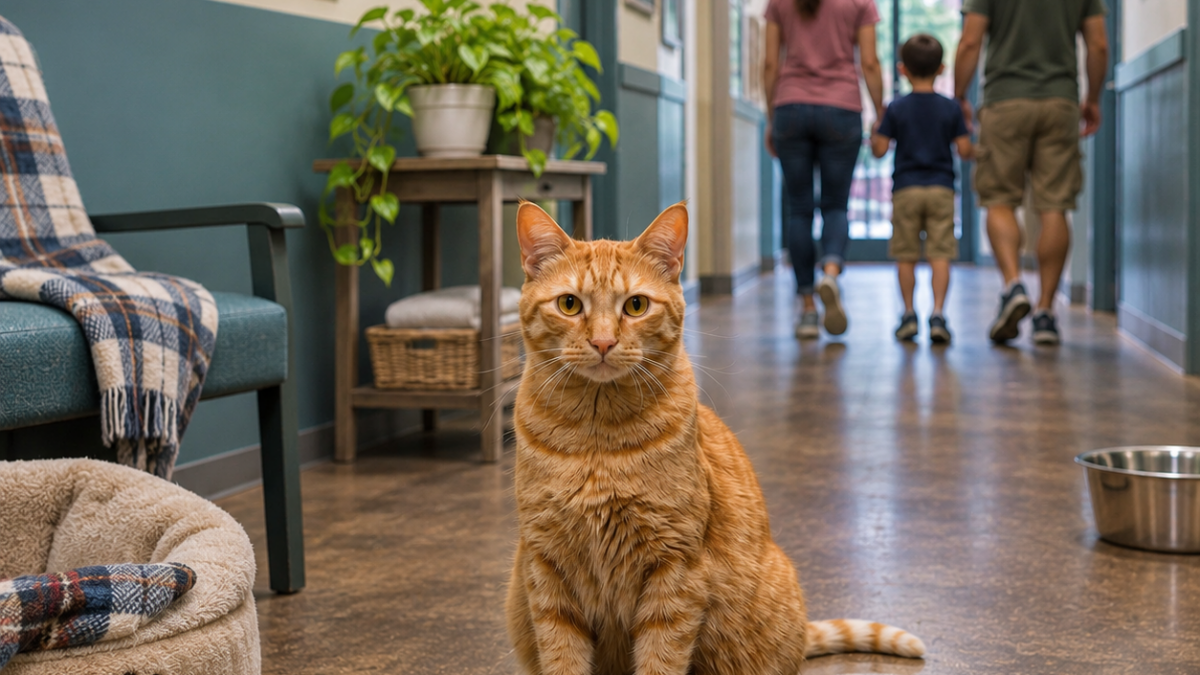
PART3:
Two amber eyes looked back.
The cat did not retreat.
“Hi.”
He blinked.
No hiss.
No growl.
No attempt to push forward.
Just a calm stare.
“Okay,” Evelyn murmured. “Let’s see who you belong to.”
He did not have a microchip.
No collar.
No identification.
No obvious injuries.
The veterinary technician, Callie Mason, examined him.
“Male. Neutered.”
“Age?”
“Maybe two.”
“Teeth look good?”
“Very.”
“Fleas?”
“A few. Nothing dramatic.”
“Temperament?”
Callie ran a hand down the cat’s back.
He allowed it.
She lifted one paw.
No resistance.
She checked his ears.
Still nothing.
“Easy.”
Evelyn looked at him.
“That’s good.”
It should have been.
They photographed him.
Posted him to the county lost-and-found page.
Called the two veterinary clinics in the area.
Checked neighborhood groups.
For seventy-two hours, they waited for someone to call.
Nobody did.
At the end of the stray hold, Evelyn entered him into the adoption system.
The computer required a name.
She typed:
ORANGE MALE 0415.
His printed kennel card was simpler.
Name: Unlisted.
Breed: Domestic Shorthair, Orange Tabby.
Age: Approximately 2 years.
Status: Available.
He went into kennel C-14.
And waited.
The shelter’s average cat stayed forty-one days.
Kittens often stayed less than a week.
A friendly young cat might be adopted on the first Saturday after becoming available.
Senior cats took longer.
Black cats sometimes waited longer than Evelyn thought they should.
Shy cats could be difficult because visitors often interpreted fear as rejection.
But an attractive, healthy, young orange tabby?
Evelyn expected him to leave quickly.
Orange cats were popular.
Families liked them.
People made jokes about them being mischievous and ridiculous.
They photographed well.
They stood out in a room.
The first prospective adopter met him on day nine.
A young couple named Casey and Andrew had recently moved into an apartment.
They wanted their first pet together.
Callie brought the orange cat into the meet-and-greet room.
It was a small space with two plastic chairs, a cat tree, a basket of toys, and a rug printed with cartoon paw prints.
The cat walked to the middle of the rug.
Sat down.
And looked at them.
Casey smiled.
“Oh, he’s gorgeous.”
Andrew picked up a feather wand.
“Hey, buddy.”
He waved it.
The cat watched the feather.
He did not chase it.
Andrew flicked it closer.
Nothing.
Casey crouched.
“Come here, sweetheart.”
The cat looked at her.
But did not approach.
For nearly fifteen minutes, they tried.
Feather toy.
String.
Treat.
Baby talk.
Finger wiggling.
The cat remained in the middle of the rug.
Watching.
Eventually Casey stood.
“He’s really sweet.”
Callie knew that tone.
“But?”
Casey looked embarrassed.
“We were hoping for something a little more affectionate.”
Andrew nodded.
“Maybe one that chooses us.”
Callie smiled politely.
“Of course.”
They adopted a six-month-old tuxedo cat named Jasper that afternoon.
The orange tabby returned to C-14.
The second meeting happened five days later.
A retired woman wanted a calm companion.
That sounded perfect.
She sat with him for twenty minutes.
He sat five feet away.
“He doesn’t seem to like me,” she said.
“He does this with everyone,” volunteer coordinator Mandy Ellis explained.
“Does he ever sit in laps?”
“We haven’t really seen it.”
“Oh.”
The woman adopted a nine-year-old gray female who climbed directly into her purse.
The orange cat returned to C-14.
Weeks passed.
His forty-first day came and went.
Then his fiftieth.
His seventy-fifth.
He remained healthy.
He ate normally.
Used the litter box.
Allowed staff to clip his nails.
Accepted veterinary examinations.
Never bit.
Never scratched.
Never hissed without reason.
He was not depressed in the way some long-term shelter cats became depressed.
He watched.
He slept.
He ate.
He sat near the kennel door when staff entered the room.
If Evelyn opened his cage and simply stood there, he remained inside.
If she sat on the floor for a while, he eventually stepped out.
It was subtle.
Nobody connected it to anything.
By June, they gave him a name.
The unofficial names usually came from volunteers.
One morning, Mandy walked into the cat room and found him sitting in exactly the same place as the previous afternoon.
She laughed.
“You’re like part of the building.”
Callie glanced over.
“What?”
“He’s basically a brick.”
The name stayed.
Brick.
At first it was a joke.
Then it became affectionate.
“Brick needs his medication.”
“Brick stole somebody’s towel.”
“Brick’s in the window kennel today.”
“Brick finally played with the blue mouse.”
The staff adored him.
Brick adored them in his own quiet way.
He did not rush to the front of the cage when someone entered.
He did not yell for breakfast.
He never reached a paw through the bars like some of the other cats.
But he watched people.
He learned footsteps.
He knew Callie’s.
He knew Mandy’s.
He knew Evelyn’s.
When Evelyn worked late, sometimes she opened C-14 and sat at the desk in the cat room doing paperwork.
Brick would eventually come out.
He never climbed into her lap.
He simply sat six feet away.
Evelyn liked that.
“You’re good company.”
Brick blinked.
“Better than county commissioners.”
Blink.
“Definitely better than county commissioners.”
By day 114, Evelyn became concerned.
Not alarmed.
Just concerned.
He had already been through eight meet-and-greets.
Nobody had chosen him.
She rewrote his profile.
BRICK IS A QUIET, GENTLE ORANGE TABBY WHO ENJOYS PEACEFUL COMPANY AND WOULD DO WELL IN A CALM HOME.
It helped.
More people asked about him.
More people met him.
More people left.
One family stayed almost forty minutes.
The father loved Brick’s color.
The mother liked how calm he was.
Their teenage daughter tried every toy in the room.
Brick sat.
Watched.
Waited.
Finally the girl shrugged.
“He’s kind of boring.”
Her mother whispered, “Don’t say that.”
“But he is.”
Brick looked at them.
Evelyn was standing outside the room.
She heard every word.
They adopted a playful tabby kitten two kennels away.
That evening, Evelyn opened Brick’s cage.
He stepped to the edge.
“You know you’re not boring, right?”
Brick sat.
“Not that you care.”
He stared at her.
She sat on the floor.
Only then did Brick come out.
He walked past her.
Sat three feet away.
Evelyn looked at him.
“You could make this easier.”
His ear twitched.
“Just rub against somebody’s leg once.”
Nothing.
“One dramatic purr.”
Nothing.
“Fake it.”
Brick began cleaning his paw.
Evelyn laughed.
“Fine.”
Day 200 arrived.
Then 300.
The shelter posted a photograph.
MEET BRICK! OUR HANDSOME ORANGE GENTLEMAN IS STILL SEARCHING FOR HIS FOREVER HOME.
The post received 417 reactions.
Twenty-three comments said some version of “I wish I could take him.”
Six people asked whether he was good with dogs.
Two scheduled meetings.
Neither adopted him.
One said Brick had “no spark.”
The other chose a kitten.
On day 365, the staff put a little cardboard sign beside his kennel.
ONE YEAR WAITING FOR HOME.
Mandy baked cookies for the humans.
Callie gave Brick a spoonful of wet food shaped like a birthday cake.
Evelyn took the sign down before visitors arrived.
She could not explain why.
Maybe she did not want people adopting him out of pity.
Maybe she did not want to admit he had been there that long.
That afternoon, Evelyn began the notebook.
It was nothing official.
Just a black composition book she kept in the bottom drawer of her desk.
On the first page, she wrote:
BRICK — LONG-STAY NOTES.
Then she started reconstructing every meet-and-greet she could remember.
- Young couple. Wanted more affectionate cat.
- Older woman. Felt Brick did not like her.
- Family. Daughter thought he was boring.
- Man, 31. Said Brick “seemed checked out.”
- Couple with child. Chose kitten.
- Woman, 67. Wanted lap cat.
- College student. No reason given.
- Family of four. “He didn’t really do anything.”
That last sentence bothered Evelyn.
He didn’t really do anything.
It appeared again at meeting eleven.
And fourteen.
At nineteen, someone wrote on the visitor card:
Sweet but no connection.
At twenty-two:
He seems indifferent.
At twenty-seven:
Looking for more personality.
At thirty-one:
He didn’t choose us.
Evelyn underlined that one.
He didn’t choose us.
She walked into the cat room.
Brick was lying on his heated bed.
She opened the kennel.
He lifted his head.
“Why don’t you choose anybody?”
Brick yawned.
“I’m serious.”
No response.
She sat.
Thirty seconds later, Brick climbed down.
He walked from his kennel.
Sat beside Evelyn’s shoe.
She froze.
Then she looked down at him.
“There.”
Brick stared toward the window.
“That.”
She did not touch him.
“You only come when people stop trying.”
His tail wrapped around his paws.
Evelyn frowned.
It was a pattern.
But patterns were not always explanations.
She started telling prospective adopters to sit quietly.
Some tried.
Most managed perhaps thirty seconds before speaking, reaching, offering a toy, or making another attempt to win him over.
People came to shelters to be chosen.
They wanted the movie moment.
A cat reaching through bars.
A dog putting its paw in a hand.
A frightened animal suddenly crawling into their lap.
Brick gave them nothing like that.
He required stillness.
And stillness was difficult to sell.
His second year began.
The county budget became tighter.
Then worse.
The shelter’s animal-control contract expanded without corresponding funding.
They took in twenty-one cats from a hoarding case.
A barn colony produced thirty-two kittens.
Three litters arrived in one week.
The cat room filled.
Temporary cages appeared in the hallway.
Evelyn attended a county budget meeting in October.
Commissioner Curtis Bell sat behind a long table beneath fluorescent lights.
Curtis was not a cruel man in the cinematic sense.
He did not hate animals.
That almost made conversations with him harder.
He reduced living creatures to columns.
Capacity.
Turnover.
Cost.
Outcome.
“We cannot maintain animals indefinitely,” he said.
Evelyn folded her hands.
“What does indefinitely mean?”
“Use common sense.”
“We have a cat at five hundred and thirty-two days.”
Curtis looked at a spreadsheet.
“Brick?”
The fact that he knew the name surprised her.
“Yes.”
“That’s exactly what I mean.”
“He’s healthy.”
“Then why hasn’t he been adopted?”
“No idea.”
“Five hundred days suggests the public has made a decision.”
Evelyn felt her jaw tighten.
“The public makes terrible decisions every day.”
One commissioner coughed to hide a laugh.
Curtis did not.
“We have finite space.”
“I know.”
“Finite money.”
“I know.”
“Then long-stay animals need review.”
“What does review mean?”
“You know what it means.”
Evelyn leaned forward.
“If you want to tell me to euthanize a healthy two-year-old cat because he doesn’t entertain people enough, say the sentence out loud.”
Curtis looked uncomfortable.
“That is not what I said.”
“Then don’t hide it inside the word review.”
The room went silent.
Afterward, another commissioner caught Evelyn near the elevator.
“You’re going to get yourself fired.”
“Probably.”
“Bell wasn’t ordering euthanasia.”
“Not directly.”
“He’s asking about capacity.”
“Brick isn’t a box in a warehouse.”
“I know.”
“Does he?”
The commissioner sighed.
“You have sixty days before the next review.”
Evelyn understood.
She went back to the shelter and opened the black notebook.
Meeting thirty-eight had happened that morning.
A man had spent eleven minutes with Brick.
His note:
Nice cat. No chemistry.
Evelyn closed the book.
“Come on, Brick.”
The cat looked at her.
“Help me here.”
He did not.
A local television station ran a segment on long-stay shelter animals.
Brick appeared for twelve seconds.
The reporter stood beside his kennel.
“This handsome orange tabby has been waiting more than eighteen months.”
Brick sat behind her.
The camera operator made clicking sounds.
Nothing.
The reporter waved a toy.
Nothing.
After filming, she said quietly, “Wow. He really is low-energy.”
Mandy heard.
“He’s not.”
The reporter looked embarrassed.
“I didn’t mean—”
“He plays when he wants to.”
“Of course.”
“He follows us.”
“I believe you.”
“He’s just not a circus act.”
The segment aired that night.
A dog named Lucy received sixteen applications.
A black kitten named Pepper received nine.
Brick received one.
The applicant never showed up.
Day 600.
Meeting forty-four.
Day 650.
Meeting forty-eight.
Day 700.
Fifty-two.
Brick became older.
Four years old now.
Still young.
Still healthy.
But people no longer saw the two-year-old orange cat near the front of the adoption wing.
They saw the cat who had been there forever.
His longevity became part of his identity.
Visitors asked:
“What’s wrong with him?”
Nothing.
“Why has he been here so long?”
We don’t know.
“Does he bite?”
No.
“Spray?”
No.
“Hate children?”
No.
“Medical problem?”
No.
“Then why?”
Evelyn stopped having answers.
At meeting fifty-eight, a woman named Trisha sat with Brick for twenty-six minutes.
Brick remained in the middle of the room.
Trisha cried when she came out.
Evelyn thought this might finally be it.
“He’s beautiful,” Trisha said.
Evelyn smiled.
“He is.”
“But I don’t think he wants me.”
Evelyn’s smile faded.
“Why?”
“He didn’t come over.”
“He often doesn’t.”
“I want that connection.”
“It might take time.”
Trisha looked through the glass.
“I’ve had cats before. You know when they choose you.”
Evelyn glanced at Brick.
He was still sitting exactly where Trisha had left him.
“Sometimes,” Evelyn said quietly, “maybe choosing looks different.”
Trisha adopted another cat.
Meeting sixty-three happened on day 841.
A teacher named Meredith wanted a quiet adult cat.
Perfect.
She had no children.
No other animals.
Worked from home three days a week.
She sat with Brick.
Talked softly.
Did not overwhelm him.
For a few seconds, Brick seemed interested.
He looked at her.
She smiled.
Then he remained seated.
After fifteen minutes, Meredith sighed.
“He’s sweet.”
Evelyn’s stomach dropped.
She knew the sentence.
“But?”
“I think I need a cat that gives a little more back.”
Evelyn looked through the glass.
Brick was watching them.
“Of course.”
Meredith left without adopting anyone.
Evelyn returned to her office.
Opened the notebook.
- Meredith. Sweet. “Need cat that gives more back.”
She put down the pen.
Then, beneath it, she wrote:
847 days is coming.
She did not know why that number mattered.
Maybe because she had calculated it so many times that every day felt like a tally against him.
Two years.
Three months.
Twenty-two days.
More than four hundred cats adopted around him.
Sixty-three people given time alone with him.
Sixty-three people leaving.
That week Curtis Bell sent an email.
LONG-STAY OUTCOME REVIEW — FRIDAY.
Brick’s identification number was on the list.
Evelyn printed the email.
Folded it.
Put it in the bottom drawer beneath the black notebook.
She did not tell the volunteers.
There was nothing they could do except worry.
Day 847 ended at 6 p.m.
Evelyn stood in front of C-14.
Brick was sitting near the kennel door.
She opened it.
“You know, tomorrow would be a really good day to impress somebody.”
He looked at her.
“I’m not joking.”
He blinked.
She sat on the floor.
Brick stepped out.
He sat near her knee.
Evelyn touched the top of his head.
He allowed it.
“Why can’t you do this in there?”
Brick’s eyes narrowed contentedly.
“Just once.”
She scratched behind his ear.
“Pretend.”
Brick purred.
Very quietly.
Evelyn stopped.
She felt absurdly betrayed.
“Oh, you can purr.”
Brick closed his eyes.
“You little jerk.”
She laughed.
Then she cried.
Only for a minute.
She wiped her face before anyone entered.
The next morning, day 848, Mara Bennett parked outside the shelter at 10:12.
She sat in her car for six minutes before going inside.
Mara was forty-two years old.
She wore jeans, a cream sweater, and no makeup except mascara.
Five years earlier, she would have apologized for all three choices.
Her ex-husband, Grant, had opinions about everything.
Her hair.
Her weight.
Her clothes.
Her laugh.
The people she spent time with.
The books she read.
The way she stood in photographs.
Twelve years of marriage had trained Mara to enter every room asking the same question.
Who do I need to become in here?
Grant never shouted much.
That made explaining the marriage difficult.
People understood shouting.
Bruises.
Broken plates.
They understood obvious cruelty.
Grant preferred erosion.
“You used to be more fun.”
“Why don’t you wear your hair like that woman?”
“You’re really going out dressed like that?”
“My wife should make an effort.”
“You always have to make everything serious.”
“Can you just be normal tonight?”
“You know what your problem is? You’re too sensitive.”
When Mara tried harder, he moved the target.
When she lost twelve pounds, he told her she looked tired.
When she gained five back, he said she was “letting herself go.”
When she became more social, he said she talked too much.
When she became quieter, he asked why she was always miserable.
She spent twelve years tap-dancing for a man who kept looking over her shoulder at the next woman.
The marriage finally ended because of a restaurant receipt.
Grant had told her he was in Columbus for a three-day training conference.
Mara found a dinner receipt from Cincinnati.
Two entrées.
Two glasses of wine.
One dessert.
A hotel charge followed.
Then messages.
Then the name of the woman from his office he had repeatedly told Mara she was “crazy” to worry about.
The affair had been going on for fourteen months.
Grant cried when confronted.
He blamed loneliness.
Then stress.
Then Mara.
“You haven’t been happy in years.”
“I was trying to make you happy.”
“That’s the problem.”
She remembered staring at him.
“What?”
“You became so desperate.”
That sentence did what the affair had not.
Something inside Mara stopped negotiating.
She filed for divorce.
Grant married the other woman seventeen months later.
Mara moved from Columbus back to southern Ohio, near the town where she had grown up.
She bought a small white house with green shutters and a narrow garden behind it.
For the first year, she lived almost silently.
Not miserably.
Silently.
She discovered silence could be peaceful when nobody was using it as punishment.
She chose furniture Grant would have hated.
She painted the kitchen sage green.
She stopped straightening her naturally wavy hair.
She learned she did not have to explain why she wanted soup for dinner.
She planted tomatoes badly.
Most died.
She planted lavender.
That survived.
Eventually, the house began feeling less like the place she had escaped to and more like hers.
Then came the cat idea.
Mara had grown up with cats.
She wanted company.
But every time she looked at adoption pages, she felt overwhelmed by photographs and descriptions.
Playful.
Affectionate.
Outgoing.
Loves cuddles.
High energy.
Perfect family pet.
Every animal seemed to be advertising.
One Thursday morning, Mara closed her laptop.
She got into the car.
Drove to Pine Ridge County Animal Shelter.
Walked to the front desk.
Mandy smiled.
“Hi. Looking to adopt?”
“Yes.”
“Cat or dog?”
“Cat.”
“Any age preference?”
“No.”
“Male or female?”
“No.”
Mandy laughed.
“That gives us a lot to work with.”
Mara looked toward the adoption wing.
“I want to meet the cat who’s been here the longest.”
Mandy stopped smiling.
Not because the request was bad.
Because she knew immediately.
“Brick.”
“Is that his name?”
“It is now.”
“How long?”
Mandy hesitated.
“Eight hundred forty-eight days.”
Mara stared.
“I’m sorry?”
“Today is day eight forty-eight.”
Something in Mara’s face changed.
“Why?”
Mandy gave the answer she had given a hundred times.
“We honestly don’t know.”
“Medical?”
“No.”
“Behavior?”
“No aggression. No litter-box issues. Nothing disqualifying.”
“Old?”
“About four now.”
“Then why?”
Mandy looked through the door toward C-14.
“He’s quiet.”
Mara waited.
“That’s it?”
“People meet him and don’t feel a connection.”
“Does he hide?”
“No.”
“What does he do?”
Mandy almost smiled.
“He sits.”
Mara stared at her.
“He sits.”
“Yes.”
“And people don’t adopt him because he sits?”
“When you say it like that, it sounds ridiculous.”
“It sounds ridiculous any way you say it.”
Mandy laughed despite herself.
“Would you like to meet him?”
“Yes.”
Evelyn was in her office when Mandy appeared in the doorway.
“Longest-stay request.”
Evelyn looked up.
“What?”
“Woman at the desk asked for whoever’s been here longest.”
Evelyn stood.
“She asked by name?”
“No.”
“Did she see the post?”
“No idea.”
“Is she normal?”
Mandy raised an eyebrow.
“As far as I can tell.”
“Okay.”
Evelyn followed her.
Mara was waiting outside the meet-and-greet room.
Evelyn introduced herself.
“Mara Bennett.”
“Evelyn Hart.”
“Is Brick really at eight hundred forty-eight days?”
“Yes.”
“Sixty-three meetings?”
Evelyn blinked.
“Mandy told me.”
“Yes.”
“What happens in the meetings?”
Evelyn considered the question.
“Almost exactly the same thing every time.”
She opened C-14.
Brick looked up.
Mara saw him for the first time.
He was larger than she expected.
Deep orange stripes.
A broad face.
A small notch in the edge of his left ear.
Amber eyes.
He did not come forward.
Mara smiled.
“Hi, Brick.”
His ears moved.
That was all.
Evelyn placed him into a carrier and brought him to the meeting room.
Mara entered.
The door closed.
Brick stepped from the carrier.
He walked to the middle of the rug.
Sat.
Looked at Mara.
Evelyn and Mandy watched through the small observation window.
Mara did not pick up a toy.
She did not call him.
She did not crouch.
She lowered herself onto the floor.
Crossed her legs.
And looked at him.
Brick looked back.
Thirty seconds.
One minute.
Two.
Mandy whispered, “She’s not doing anything.”
Evelyn glanced at her.
“That may be good.”
Inside the room, Mara finally spoke.
“You’re not going to audition for me, are you?”
Brick blinked.
Mara smiled.
“Good.”
Another minute passed.
“You don’t know me.”
Brick’s tail moved once.
“So why would you crawl into my lap?”
He remained still.
“I wouldn’t either.”
Brick watched her.
Mara rested her hands in her lap.
“I spent twelve years trying to impress somebody who already decided I wasn’t enough.”
His ears angled toward her voice.
“I’m not going to make you do that.”
She exhaled.
“You can sit there.”
Brick did.
Five minutes later, Mara stood.
Evelyn’s heart sank.
Too short.
Again.
Mara opened the door.
“I’ll take him.”
Mandy stared.
Evelyn said, “You want more time?”
“No.”
“You can spend another twenty minutes if—”
“I don’t need twenty minutes.”
Evelyn looked through the glass.
Brick remained in the middle of the room.
“You understand he may take time to warm up.”
“So can I.”
“He may never be a lap cat.”
“Okay.”
“He doesn’t really perform for visitors.”
“I noticed.”
Evelyn hesitated.
“Can I ask why him?”
Mara looked back through the window.
For a long moment, she said nothing.
Then:
“Because everybody keeps telling me what he doesn’t do.”
Evelyn waited.
Mara continued.
“He doesn’t climb into strangers’ laps. He doesn’t play on command. He doesn’t beg. He doesn’t make people feel special five minutes after meeting them.”
She looked at Evelyn.
“And somehow everybody decided that means there’s nothing there.”
Evelyn felt something tighten in her chest.
Mara smiled faintly.
“I know what that feels like.”
The adoption paperwork took forty-seven minutes.
Evelyn checked every line twice.
Address.
Veterinarian plan.
Landlord status.
Emergency contact.
Indoor-only agreement.
Mara paid the fee.
When it was time to leave, Evelyn returned to C-14.
Brick sat inside.
“You did it.”
He looked at her.
“Eight hundred forty-eight days.”
Her voice broke.
She cleared her throat.
“Don’t make me emotional.”
Brick stepped into the carrier.
Evelyn latched the door.
Mara took the handle.
Before she left, Evelyn handed her a folder containing medical records.
Then, without planning to, she opened her desk drawer.
She looked at the black notebook.
Sixty-three names.
Sixty-three reasons.
She almost gave it to Mara.
Then stopped.
It belonged to the shelter.
Maybe to Brick.
Maybe to no one.
She closed the drawer.
Mara drove home.
Brick did not make a sound.
At every red light, she looked toward the carrier.
“You okay?”
He stared through the grate.
“You know, I’m also terrible in cars.”
Nothing.
“I get motion sick.”
Nothing.
“This is going well.”
When they reached the house, Mara carried him into the spare bedroom she had prepared.
Food.
Water.
Litter box.
Scratch pad.
Soft bed.
Cardboard box.
She opened the carrier.
Brick stayed inside.
Mara sat on the floor.
“I’m going downstairs.”
His eyes followed her.
“You can come out whenever you want.”
She left the door open.
An hour passed.
No Brick.
Two.
Mara went upstairs.
The carrier was empty.
Brick sat beneath the desk.
“Progress.”
He watched her.
She did not approach.
That night, she left the bedroom door open.
At 2:13 a.m., Mara woke because she felt she was being watched.
She sat up.
Brick was in her bedroom doorway.
Not beside the bed.
Not inside.
Just at the threshold.
“Hi.”
He remained there.
Mara lay back down.
“You can stay.”
At some point, she fell asleep.
In the morning, he was gone.
For the first week, Brick behaved as though the house contained invisible rules nobody had explained to Mara.
He followed her.
But never closely.
If she walked from the kitchen into the living room, he appeared two minutes later.
If she sat at the table, he sat near the doorway.
If she worked on her laptop, he took a position six feet away.
He watched constantly.
He rarely meowed.
He did not climb onto furniture while she was standing.
He did not brush against her legs while she walked.
He did not race through doorways ahead of her.
He was, Mara thought, the most polite cat she had ever met.
On the fourth evening, she dropped a piece of chicken.
Brick looked at it.
“Go ahead.”
Nothing.
“It’s chicken.”
He stared.
“Cats like chicken.”
No movement.
Mara sat at the kitchen table.
Brick immediately walked over.
Ate the chicken.
Then sat near her chair.
Mara frowned.
The next day she tested it.
She placed a treat on the floor.
Brick watched.
She remained standing.
Nothing.
She sat.
Brick walked over.
Ate it.
“Huh.”
The pattern repeated.
He approached when she stopped moving.
He relaxed when she sat.
If she stood suddenly, he moved aside.
Not fearfully.
Automatically.
As though his body knew where not to be.
At the shelter, nobody had noticed because the staff were always moving.
Cleaning.
Feeding.
Opening cages.
Closing doors.
Visitors were always performing too.
Waving toys.
Calling.
Reaching.
Brick had simply waited for the room to settle.
Mara began calling Evelyn.
Not because anything was wrong.
Because she had questions.
“Did he always wait for people to sit?”
Evelyn paused.
“What do you mean?”
“If I’m standing, he stays out of my way.”
“That sounds familiar.”
“The second I sit, he gets closer.”
“How close?”
“Depends.”
“Does he let you touch him?”
“Yes.”
“When?”
“When I’m sitting.”
Evelyn became quiet.
“You noticed something?”
“I don’t know.”
“Evelyn.”
“I wrote once that he only comes out of the kennel when I sit on the floor.”
“And?”
“I thought he was cautious.”
“He’s not cautious.”
“What do you think?”
Mara looked across the living room.
Brick sat near the bookcase.
“I think he’s following a rule.”
“What rule?”
“I don’t know.”
The first real breakthrough happened seventeen days after the adoption.
It was raining.
Mara came home exhausted from work.
Her ex-husband had emailed her that afternoon about the final distribution of a retirement account that had somehow taken two years to resolve.
The message was classic Grant.
Polite enough to show anyone.
Cruel enough that Mara understood every hidden blade.
I hope you can respond without turning this into another emotional issue.
She had stared at that line for ten minutes.
Two years divorced.
And six words could still turn her into the woman who wondered whether she was unreasonable for having feelings.
She came home.
Dropped her keys.
Brick watched from the hallway.
“Bad day.”
He blinked.
“I know. You don’t care.”
She changed clothes.
Made tea.
Sat in the armchair.
Brick remained near the hall.
Mara looked at him.
“You know what I like about you?”
His ear moved.
“You don’t expect anything.”
She rested her head back.
“Everybody says relationships need communication.”
Brick cleaned his chest.
“Maybe what I needed was a relationship where nobody talks.”
She laughed.
Then, without thinking, she tapped the arm of the chair twice.
Tap.
Tap.
Brick froze.
Mara stopped.
His head snapped toward her.
“What?”
Brick stood.
He stared at the chair.
Mara frowned.
“Brick?”
His body changed completely.
Tail lifted.
Shoulders loosened.
He crossed the room quickly.
Not cautiously.
Not after waiting.
Quickly.
He jumped onto the armchair.
Climbed directly into Mara’s lap.
And began purring so loudly she could feel it through her sweater.
Mara did not move.
She barely breathed.
“Brick?”
He pushed his head under her hand.
She stared at him.
For 847 days, this cat had been described as distant.
Unresponsive.
Low-energy.
Indifferent.
He had endured sixty-three meetings without approaching a stranger.
Now he was kneading her leg, purring like a motor.
Mara touched his head.
“What did I do?”
Brick shoved harder beneath her palm.
She scratched his ears.
Tears filled her eyes.
“Okay.”
His purr grew louder.
“Okay, I clearly did something.”
She picked up her phone.
Called Evelyn.
The shelter director answered on the fourth ring.
“Everything okay?”
“I think I broke your cat.”
“What?”
“He’s in my lap.”
Silence.
“Mara.”
“He climbed into my lap.”
“How?”
“I tapped the chair.”
“What?”
“Twice.”
Evelyn said nothing.
“I tapped twice.”
“Do it again.”
“He’s already here.”
“Get up.”
“What?”
“Just humor me.”
Mara gently lifted Brick.
He jumped to the floor.
She stood.
Brick moved several feet away.
Mara waited.
Then sat again.
Tap.
Tap.
Brick immediately returned.
Evelyn inhaled sharply.
“Oh my God.”
“What?”
“I don’t know.”
“That sounded like you know.”
“I don’t.”
Brick climbed onto Mara’s lap.
Evelyn whispered, “There’s a reason.”
Mara looked down at him.
“Yes.”
“How do we find it?”
That question became an obsession.
Evelyn searched Brick’s intake records.
Nothing.
No chip.
No collar.
No prior shelter record.
Found near Route 62.
Approximate age two.
She contacted Jeff Warren.
He remembered the cat immediately.
“Sure. Orange guy.”
“Where exactly?”
Jeff described the culvert.
“Did you see houses?”
“A few.”
“Any farms?”
“Whitaker place was maybe half a mile east.”
Evelyn wrote the name down.
“Whitaker?”
“Old farmhouse with white barn.”
“Anyone live there?”
“Not anymore.”
“Why?”
Jeff hesitated.
“Old man died around then.”
Evelyn stopped writing.
“When?”
“Spring twenty-one, I think.”
“What was his name?”
“Samuel.”
She felt something cold move down her arms.
“Did he have a cat?”
Jeff was quiet.
“You know, I think he did.”
Evelyn stood.
“What kind?”
“I don’t know.”
“Think.”
“Evelyn, it was years ago.”
“Orange?”
Another pause.
“Maybe.”
She called Mara immediately.
“I found something.”
“What?”
“Maybe nothing.”
“Evelyn.”
“There was a man named Samuel Whitaker living about half a mile from where Brick was found.”
“And?”
“He died around the same time.”
Mara sat down.
Brick was beside the window.
“Did he own a cat?”
“We’re finding out.”
The investigation was not official.
No police.
No detectives.
Just two women who suddenly could not tolerate not knowing.
Evelyn searched obituaries.
Samuel Thomas Whitaker, age seventy-eight, had died April 11, 2021.
Four days before Brick entered the shelter.
He had been a widower.
Retired electrician.
Member of First Methodist Church.
Survived by one daughter, two granddaughters, and a sister.
No mention of a cat.
Evelyn found the daughter through a public business listing.
Her name was Rachel Whitaker Cole.
She lived in Indiana.
Evelyn stared at the phone number for several minutes before calling.
A woman answered.
“Hello?”
“Ms. Cole?”
“Yes.”
“My name is Evelyn Hart. I direct Pine Ridge County Animal Shelter in Ohio.”
Silence.
“Is something wrong?”
“No. I’m sorry to call unexpectedly. I have a strange question about your father.”
Another pause.
“My father?”
“Samuel Whitaker.”
“He died.”
“I know. I’m sorry.”
“What is this about?”
“Did he own an orange cat?”
Rachel did not answer.
Then:
“Red.”
Evelyn closed her eyes.
“Red?”
“My father called him Red.”
“Orange tabby?”
“Yes.”
“How old?”
Rachel’s voice changed.
“Why?”
Evelyn sat down.
“We may have found him.”
The silence on the line lasted so long Evelyn checked whether the call had dropped.
Then Rachel whispered, “No.”
“What?”
“No. Red died.”
“How?”
“We assumed—”
She stopped.
Evelyn waited.
Rachel’s breathing became uneven.
“My father was taken to the hospital by ambulance.”
“When?”
“April eighth. Maybe the ninth. I’d have to check.”
“He died on the eleventh.”
“Yes.”
“What happened to the cat?”
Rachel began crying.
“My father wouldn’t leave because of him.”
Evelyn gripped the phone.
“What do you mean?”
“He was having chest pain. My cousin called 911. Dad kept saying somebody had to find Red first.”
“Was the cat missing?”
“He hid when the paramedics came.”
Rachel’s voice broke.
“They couldn’t wait.”
“What happened after?”
“My cousin went back. Red was gone.”
“Outside?”
“The front door had been open. Paramedics going in and out. We think he slipped out.”
“Did you look?”
“Yes.”
“How long?”
“Days.”
“Did you call shelters?”
“My cousin called somewhere. I was in Indiana. My father was dying. Everything was…”
She stopped.
“I thought someone had found him.”
Evelyn closed her eyes.
“We did.”
Rachel began sobbing.
Evelyn waited.
After a while, Rachel asked, “Is he alive?”
“Yes.”
“Where?”
“He was adopted a few weeks ago.”
Another silence.
“Is he okay?”
“He’s wonderful.”
Rachel cried harder.
“I need to see a picture.”
Evelyn sent one.
Thirty seconds later, Rachel called back.
“That’s Red.”
“You’re sure?”
“Left ear.”
Evelyn enlarged the photograph.
The small notch.
“My father said he tore it climbing through an old screen door when he was a kitten.”
Evelyn’s eyes filled.
“There’s something else.”
“What?”
“Did your father train him?”
Rachel laughed through tears.
“Train a cat?”
“To wait.”
Silence.
“What do you mean?”
“He won’t approach people when they’re standing. But if they sit and tap a chair twice—”
Rachel made a sound.
Evelyn stopped.
“What?”
“My God.”
“What is it?”
Rachel was crying again.
“My father.”
“Tell me.”
Rachel took several breaths.
“Dad had neuropathy. Bad balance. He used a walker the last three years.”
Evelyn listened.
“Red almost tripped him once.”
She could already see where this was going.
“Dad fell.”
“When?”
“Maybe a year before he died.”
“Was he badly hurt?”
“Bruised his hip. Nothing broken. But after that, he got scared Red would get under his feet.”
“So what did he do?”
“He taught him to stay back when Dad was walking.”
Evelyn covered her mouth.
“How?”
“I don’t know exactly. Treats, probably. Dad was patient.”
“And the chair?”
Rachel’s voice softened.
“He had this blue recliner.”
Evelyn closed her eyes.
“When Dad got settled, he would tap the arm twice.”
Tap.
Tap.
“And say, ‘All right, Red.’”
Evelyn began crying.
Rachel continued.
“Then Red would jump up.”
For more than two years, sixty-three people had entered a small shelter room.
They had stood.
Moved.
Waved toys.
Called.
Reached.
Tried to make Brick come.
And Brick had done exactly what Samuel Whitaker taught him to do.
He stayed out of the way.
He waited until the person was safely settled.
He waited for the invitation.
Nobody gave it.
Not because they were cruel.
Because nobody knew.
Every person had interpreted discipline as indifference.
Loyalty as emptiness.
Training as lack of personality.
Brick had not been refusing to connect.
He had been obeying a dead man.
Evelyn called Mara.
She could barely speak.
“Mara.”
“What happened?”
“We know.”
Mara stood in the kitchen.
Brick was eating.
“Know what?”
“His name was Red.”
Brick’s head lifted.
Mara froze.
“What did you say?”
“His original name.”
Mara stared at the cat.
“Red?”
Brick turned toward her.
Not dramatically.
But immediately.
“Oh my God.”
“Mara, listen to me.”
Evelyn told her everything.
Samuel.
The ambulance.
The open door.
The search.
The fall.
The walker.
The training.
The blue recliner.
The two taps.
Mara slowly sat at the kitchen table.
Brick walked closer.
“He wasn’t ignoring them.”
“No.”
“He was waiting.”
“Yes.”
“All sixty-three?”
Evelyn began crying.
“Probably.”
Mara looked at Brick.
“You sat there because nobody told you it was safe.”
Brick blinked.
Mara pressed one hand to her mouth.
The meaning hit her harder than she expected.
For 847 days, people had looked at Brick and asked why he was not doing more.
Why he was not warmer.
Why he was not more playful.
Why he was not easier to love.
And the answer was not that Brick lacked affection.
It was that affection had once come with a ritual.
Wait while the person moves.
Stay out of the way.
Let him sit.
Then, and only then, come close.
It was a rule built from love.
A rule designed to protect an old man from falling.
Brick had kept it after the man was gone.
Kept it through the ambulance.
The road.
The shelter.
C-14.
One year.
Two years.
Sixty-three strangers.
He had continued protecting someone who was no longer there.
Mara lowered her hand.
“Evelyn?”
“Yes?”
“I want to meet his family.”
Rachel came to Ohio the following Saturday.
She brought her daughter Leah.
And something wrapped in a moving blanket in the back of an SUV.
Mara stood on the porch as they pulled in.
Brick watched from the window.
Rachel was fifty-three.
She looked nervous.
“I don’t want to confuse him.”
“You won’t.”
“I don’t want him back.”
Mara paused.
Rachel shook her head quickly.
“I mean that the right way.”
“I understand.”
“He’s yours.”
Mara smiled.
“He’s his own.”
Rachel laughed softly.
“Yes.”
They entered.
Brick remained near the hallway.
Rachel saw him.
Her face collapsed.
“Red.”
Brick’s ears lifted.
Rachel knelt.
“It’s me.”
He stared.
She cried.
“I’m sorry.”
Mara stayed back.
Rachel did not reach.
Maybe she had learned from the story.
She sat on the floor.
Brick watched.
Then moved closer.
Slowly.
He sniffed her hand.
Rachel sobbed.
“He remembers.”
Nobody could know exactly what Brick remembered.
Smell.
Voice.
A name.
Something older and deeper.
But he stayed.
Rachel touched his cheek.
“My dad loved you so much.”
Brick leaned into her hand.
Leah cried behind them.
Mara looked away.
After a while, Rachel stood.
“There’s something outside.”
They went to the SUV.
Together, Rachel and Leah pulled out an old blue recliner.
The fabric was faded.
One arm had a worn patch.
Mara stared.
“No.”
“I was going to donate it after Dad died.”
Rachel swallowed.
“I couldn’t.”
They carried it into Mara’s living room.
Brick appeared in the doorway.
He stopped.
Every person in the room became silent.
The cat stared at the chair.
Mara felt goosebumps rise along her arms.
Brick walked forward.
Not running.
Not frightened.
He approached the recliner.
Sniffed the base.
One corner.
The worn arm.
Then he climbed onto the seat.
Turned once.
And sat.
Rachel covered her face.
“That’s his chair.”
Mara began crying.
Leah sat beside her mother.
Brick remained on the cushion.
Rachel approached.
She sat carefully.
Brick stepped onto the arm.
For one strange moment, Rachel looked like she was afraid to perform the ritual.
Mara whispered, “Do it.”
Rachel touched the worn fabric.
Tap.
Tap.
“All right, Red.”
Brick climbed into her lap.
Rachel broke.
She wrapped both arms loosely around him and sobbed into his fur.
“I’m sorry.”
Brick purred.
“You waited for him.”
Mara cried silently.
Rachel whispered, “He wasn’t coming back, baby.”
Brick closed his eyes.
“I’m so sorry nobody told you.”
There are moments human beings cannot explain without turning them into something sentimental.
Maybe Brick recognized the chair.
Maybe he remembered Rachel.
Maybe the tap was simply learned conditioning.
Maybe the purr meant nothing more than comfort.
But nobody in that room needed magic.
The truth was already enough.
An old man with failing balance had taught a young cat not to come underfoot.
The cat learned.
The old man died.
And the lesson survived him.
What the shelter called Brick’s lack of personality had once been an act of care.
That afternoon, Rachel told them about Samuel.
He had lost his wife, Joan, eight years before he died.
For months afterward, he barely left the house.
Rachel worried.
Then a scrawny orange kitten appeared under his porch.
Samuel fed him.
The kitten returned.
Samuel pretended not to care.
Three weeks later, there was a litter box in the laundry room.
“Dad named him Red because Dad had absolutely no imagination,” Rachel said.
Mara laughed.
“He slept with him?”
“Every night.”
Rachel looked at Brick.
“When Dad’s legs got worse, Red changed.”
“How?”
“He stopped racing around him.”
“He figured it out?”
“Partly.”
“And partly Samuel taught him.”
“Yes.”
Rachel smiled.
“Dad used to brag about it.”
“What would he say?”
“That Red was smarter than every dog in the county.”
Brick yawned.
Mara laughed.
Rachel looked at her.
“You know the funniest part?”
“What?”
“Red was wild when Dad was sitting.”
Mara stared.
“What do you mean?”
“Toys. Zoomies. Attacking shoelaces.”
“He played?”
“Constantly.”
Mara looked at Brick.
“You fraud.”
Rachel laughed through tears.
“He just had rules.”
That evening, after Rachel left, Mara sat in Samuel’s recliner.
Brick watched from the hallway.
She tapped twice.
“All right, Red.”
Brick sprinted.
Actually sprinted.
Across the living room.
Onto the chair.
Into her lap.
Mara laughed so hard she cried.
“Oh, you have got to be kidding me.”
Brick rubbed his face against her chin.
“You let sixty-three people call you boring?”
Purr.
“You could’ve done this?”
Purr.
“You stubborn little man.”
He kneaded her sweater.
Mara held him carefully.
For the first time since adopting him, she understood that Brick had never refused affection.
He had simply needed permission.
The shelter story spread after Rachel allowed Evelyn to post the truth.
The headline on the shelter page read:
BRICK WASN’T BORING. WE JUST DIDN’T KNOW HIS CUE.
Evelyn told the story carefully.
She did not turn Samuel’s death into entertainment.
She did not mock the sixty-three adopters.
Most had done nothing wrong.
They simply interpreted what they saw through the expectations they carried.
But Evelyn included the lesson.
Quiet behavior is behavior.
Waiting is communication.
An animal’s history may be invisible.
Sometimes what looks like indifference is training.
Sometimes what looks like distance is trust expressed differently.
The post reached thousands of people.
Then tens of thousands.
Former visitors recognized Brick.
One woman commented:
I MET HIM. I was one of the people who said he didn’t connect with me. This is breaking my heart.
Evelyn replied privately.
You didn’t know. Neither did we.
Another person wrote:
I chose another cat because Brick just sat there. I feel terrible.
Evelyn wrote:
Please love the cat you chose. Brick is okay.
Curtis Bell saw the post too.
At the next county meeting, Evelyn walked into the same room where he had once called long-stay animals a capacity issue.
Curtis cleared his throat.
“I read about Brick.”
“So did half of Ohio.”
“He was on the outcome review list.”
“I remember.”
Curtis looked uncomfortable.
“You were right.”
Evelyn sat back.
“Can you say that louder? I’d like it entered into the minutes.”
A few people laughed.
Curtis almost did.
“I was wrong to assume length of stay meant an animal had been adequately evaluated by the public.”
Evelyn’s expression changed.
That was more honest than she expected.
Curtis continued.
“I also approved the behavior-room funding request.”
She stared.
“What?”
“New meet-and-greet protocols. Staff training. Foster observation for long-stay animals.”
“You denied that request last year.”
“I know.”
“Twice.”
“I know.”
“You called it nonessential.”
Curtis sighed.
“Enjoy this moment, Evelyn.”
“I am.”
The shelter changed.
Not overnight.
Budgets did not become magical because one cat went viral.
But the staff started paying closer attention to what animals did when no one was asking anything from them.
For long-stay cats, meet-and-greets became slower.
Visitors were asked to sit.
Put away toys.
Stop calling.
Give the animal five minutes of quiet.
Sometimes ten.
The results surprised everyone.
A cat named Tilly, previously labeled aloof, climbed into laps once people stopped reaching for her.
A nervous black cat named Odin played only when the room lights were dimmed.
A senior tortoiseshell who had failed eight meetings approached people only after they turned sideways rather than facing her directly.
They had always been communicating.
Humans had been too loud to notice.
Brick’s black notebook stayed in Evelyn’s desk.
She never threw it away.
Sixty-three meetings.
Sixty-three misunderstandings.
She added one final entry.
- Mara Bennett.
Asked nothing from him.
Adopted.
Months passed.
Brick changed at home.
Or maybe Mara simply learned the cat who had always been there.
He loved bottle caps.
Ignored expensive toys.
Hated the vacuum cleaner.
Loved warm laundry.
At exactly 6:40 every morning, he sat outside Mara’s bedroom.
He never screamed for breakfast.
He stared.
Somehow that was worse.
He discovered the garden.
Under supervision, he sat on the screened porch watching birds with the concentration of a sniper.
Mara planted another patch of lavender.
Brick slept beside it.
Visitors still misunderstood him.
Mara’s neighbor Denise came over one afternoon.
Brick sat near the bookshelf.
“He’s really quiet.”
“He is.”
“Does he ever do anything?”
Mara smiled.
“Constantly.”
Denise looked at the motionless cat.
“Like what?”
“He knows where I am every second.”
Brick’s ear moved.
“He sits outside the bathroom.”
Denise laughed.
“That’s a cat thing.”
“He waits by the door at five thirty.”
“For dinner?”
“For me.”
Mara looked at him.
“He knows when I’m upset.”
“How?”
“He sits closer.”
Denise watched Brick.
“That’s it?”
“That’s everything.”
One day Grant saw Brick.
It happened by accident.
Mara had agreed to meet her ex-husband outside her house so he could return a box of documents discovered during his move.
Grant arrived in a new SUV.
Same expensive haircut.
Same polished confidence.
He handed her the box.
“Still living here?”
Mara almost laughed.
“You have the address.”
“I mean in this town.”
“Yes.”
He looked past her.
Brick was sitting inside the screen door.
“You got a cat.”
“Yes.”
Grant crouched.
“Hey, buddy.”
Brick remained where he was.
Grant made a clicking sound.
Nothing.
He stood.
“He doesn’t seem very friendly.”
Mara felt something old try to wake inside her.
That familiar reflex.
Explain.
Apologize.
Make it better.
She looked at Grant.
“No. He just doesn’t perform for strangers.”
Grant’s expression changed slightly.
“Okay.”
“He’s actually extremely affectionate.”
“Could’ve fooled me.”
Mara smiled.
“It fooled sixty-three people.”
Grant glanced at her.
“What’s that supposed to mean?”
“Nothing.”
He shrugged.
“Well, he fits you.”
There it was.
The tiny blade.
Mara almost heard the old internal voice begin.
What does that mean?
Am I boring?
Is he insulting me?
Should I defend myself?
Instead she looked through the screen.
Brick was watching.
Mara turned back.
“You know, Grant, I think that’s the nicest thing you’ve said to me in fifteen years.”
His smile disappeared.
“I wasn’t complimenting you.”
“I know.”
Mara picked up the box.
“That’s why it’s funny.”
She went inside.
Closed the door.
Grant stood outside for several seconds.
Then left.
Mara placed the box on the floor.
Brick remained ten feet away.
She sat in Samuel’s chair.
Tap.
Tap.
“All right, Red.”
Brick came running.
Mara buried her face in his fur.
“You know what?”
Purr.
“I think we’re both done auditioning.”
A year after Brick’s adoption, Rachel visited again.
She brought a small wooden box.
“I found this cleaning Dad’s garage.”
Inside was an old photograph.
Samuel sat in the blue recliner.
Younger.
Thinner.
Brick—Red—was sprawled across his chest.
On the back, Samuel had written:
RED THINKS THIS IS HIS CHAIR.
Mara laughed.
“It is now.”
Rachel looked around the living room.
Brick slept on the recliner.
“Dad would like this.”
“You think?”
“I know.”
Rachel sat.
“My father was terrified of going into assisted living.”
Mara looked at her.
“He never went?”
“No. We were talking about it.”
“Because of his health?”
“Yes.”
Rachel stared at Brick.
“But mostly he kept asking what would happen to Red.”
Mara swallowed.
“What did you tell him?”
“That I’d take him.”
A tear rolled down Rachel’s face.
“I didn’t.”
“You tried.”
“Not hard enough.”
“Rachel.”
“I was managing the hospital. Funeral. Estate. Dad’s sister was sick. I kept thinking someone else had checked.”
Mara understood that kind of guilt.
The kind that rewrote history so one person carried every failure.
“You searched.”
“For three days.”
“You thought he was gone.”
“I should have called every shelter.”
“Maybe.”
Rachel looked at her.
Mara continued gently.
“But then what?”
Rachel frowned.
“You spend the rest of your life punishing yourself?”
“I don’t know.”
“Brick doesn’t.”
Rachel looked toward him.
“No.”
“He isn’t sitting here angry because you didn’t find him.”
“How do you know?”
“I don’t.”
Mara smiled faintly.
“But I think he’s busy.”
Brick was sleeping upside down, one paw dangling from the chair.
Rachel laughed.
“Very busy.”
They sat quietly.
Eventually Brick woke.
He stretched.
Jumped down.
Walked to Rachel.
Sat beside her foot.
She touched his head.
“Hi, Red.”
He closed his eyes.
She smiled.
“Hi, Brick.”
His tail curled around her shoe.
For the first time, Rachel did not cry.
The shelter invited Mara to speak at an adoption event marking Brick’s second year in his new home.
She almost refused.
Public speaking felt too much like performing.
Evelyn understood.
“You don’t have to.”
Mara looked across the shelter lobby.
There were photographs of long-stay animals on the wall.
“You know what?”
“What?”
“I think I want to.”
The room was small.
Maybe forty people.
Volunteers.
Adopters.
County staff.
Rachel came.
Curtis Bell sat in the back.
Mara stood beside a large photograph of Brick sitting in the middle of the meet-and-greet room.
She had written a speech.
Then ignored it.
“People like Brick’s story because it sounds like it’s about waiting for the right person.”
She looked around.
“And it is.”
“But I think there’s another part.”
The room quieted.
“For 847 days, everybody asked the same question.”
“What is wrong with this cat?”
Mara paused.
“The answer was nothing.”
She looked at Evelyn.
“We were asking the wrong question.”
Someone shifted in a chair.
“The right question was: what happened to him before he got here?”
Mara told them about Samuel.
The fall.
The walker.
The two taps.
The sixty-three rooms.
Then she said, “Brick never failed those meetings.”
Evelyn’s eyes filled.
“We failed to understand what he was saying.”
Mara looked at the photograph.
“He sat because someone he loved had taught him that staying still kept that person safe.”
Her voice wavered.
“We called that emptiness.”
Rachel lowered her head.
Mara continued.
“I spent a lot of my own life believing love was something you earned by presenting the correct version of yourself.”
She had not planned to say this part.
But she did.
“If somebody pulled away, I changed.”
“If somebody criticized me, I changed.”
“If somebody looked somewhere else, I changed faster.”
Her hands trembled.
“I thought that was what relationships required.”
She looked at Brick’s photograph.
“Then I met a cat who had been rejected sixty-three times and was still sitting exactly where he had been taught to sit.”
A few people laughed softly through tears.
“He didn’t know he was making a statement.”
“He wasn’t trying to teach anybody courage.”
“He was just being Brick.”
Mara smiled.
“But maybe that’s enough.”
Afterward, Curtis approached Evelyn.
“I assume you enjoyed the part where the county looked stupid.”
Evelyn smiled.
“Immensely.”
He nodded.
“I deserved that.”
She studied him.
“You’ve changed.”
“Don’t tell anybody.”
“I’m serious.”
Curtis looked toward the adoption rooms.
“My wife adopted Tilly.”
Evelyn stared.
“The aloof one?”
“She sleeps on my pillow.”
Evelyn burst out laughing.
“You’ve got to be kidding me.”
“Apparently I was also asking the wrong question.”
Three years after adoption, Brick still did not greet strangers.
He no longer sat in the exact center of rooms.
But he observed.
Waited.
Decided.
Mara never forced him.
Sometimes visitors spent an entire evening at her house and Brick remained six feet away.
Other people sat quietly and found him beside them within minutes.
Mara noticed he liked people who did not need immediate proof.
There was something almost poetic about that.
Not magical.
Just true.
He was affectionate with people who left room for affection to arrive.
Every morning, Brick sat in the sunny window.
Every afternoon, he followed Mara into the kitchen.
Every night, when she settled into Samuel’s old recliner, there was still a ritual.
Tap.
Tap.
Sometimes she said, “All right, Red.”
Sometimes, “Come on, Brick.”
Eventually she stopped saying anything.
The taps were enough.
He would appear.
Jump up.
Turn twice.
Settle against her.
Purr.
Mara never tired of it.
Sometimes she thought about the sixty-three people.
She did not resent them.
Many had given other cats wonderful homes.
They had simply wanted something Brick did not know how to give immediately.
Maybe they needed to feel chosen.
Mara understood that too.
Being chosen feels good.
But she had learned something living with Brick.
Love did not always announce itself by running across a room.
Sometimes love was a cat sitting in a doorway every night to make sure you were still there.
Sometimes it was quiet footsteps following you from room to room.
Sometimes it was someone staying nearby without demanding to be entertained.
Sometimes it was trust so disciplined that it waited for permission.
And sometimes the most loving thing an animal could do looked, to somebody in a hurry, exactly like nothing.
On the fourth anniversary of Samuel’s death, Rachel came to the house with flowers.
Not for a grave.
For the garden.
They planted them near the lavender.
Brick watched from the screened porch.
Rachel wiped dirt from her hands.
“Dad hated gardening.”
Mara laughed.
“Why are we doing this?”
“Because he loved complaining about things.”
“Fair.”
Rachel looked at Brick.
“Do you ever wonder what would have happened if you hadn’t gone to the shelter that day?”
Mara sat back on her heels.
“Yes.”
“What do you think?”
She considered it.
“Somebody eventually would have seen him.”
“You believe that?”
“I need to.”
Rachel smiled.
Mara looked toward the porch.
“But I’m glad it was me.”
They went inside.
Rachel sat in Samuel’s chair.
Brick remained near the window.
She grinned.
“Can I?”
“It was your father’s cue.”
Rachel’s eyes softened.
She tapped twice.
Brick came.
Not racing anymore.
He was seven now.
A little heavier.
A little slower.
But he crossed the room without hesitation.
He climbed beside Rachel.
She stroked his back.
“Dad would have laughed at all this.”
“At Brick being famous?”
“At Dad accidentally training a cat so well that sixty-three people thought he had no personality.”
Mara laughed.
Brick purred.
There was no tragedy in the room anymore.
The past remained.
Samuel was still gone.
Brick had still spent 847 days in C-14.
Sixty-three people had still walked away.
The shelter had still nearly put his name through an outcome review.
Mara had still spent twelve years believing she had to compete for love.
None of that disappeared.
But pain did not have to disappear for something new to become larger than it.
Brick had taught Mara that without knowing it.
Samuel had taught Brick a rule.
Stay still until it is safe.
Mara had spent years learning the same thing in a different way.
In her marriage, stillness had been dangerous.
Silence meant Grant was angry.
A pause meant she had said something wrong.
She constantly rushed to fill empty space.
Explain.
Apologize.
Entertain.
Reassure.
Fix.
Brick had changed the meaning of silence in her house.
Silence became trust.
Stillness became safety.
Nobody had to dance.
Nobody had to prove anything.
One winter evening, snow covered the yard.
Mara sat in the blue chair reading.
Brick slept on her lap.
The house was quiet except for the furnace.
Her phone buzzed.
A message from Grant.
They had not spoken in almost a year.
Hope you’re doing well. Been thinking about you lately. Would be nice to catch up sometime.
Years earlier, those words would have destabilized her entire week.
She would have examined them.
What does he mean?
Does he regret leaving?
Is he unhappy?
Does he finally understand?
What should I say?
Should I look better if we meet?
Should I show him I’m doing well?
Should I make him miss me?
Mara read the message once.
Then looked at Brick.
He had no idea her past was trying to knock on the door.
He stretched one paw.
Placed it across her wrist.
Mara smiled.
She deleted the message.
Not angrily.
Not dramatically.
She simply did not need it.
Brick opened one eye.
“You know why I like you?”
The eye closed.
“You never ask me to prove I’m worth staying for.”
Purr.
Mara looked toward the dark window.
“Neither do I.”
Years passed.
Brick’s story remained on the shelter wall.
Not because he became a mascot.
Evelyn disliked turning animals into symbols.
But one photograph stayed beside the meet-and-greet rooms.
Brick.
Sitting in the center of the rug.
Beneath it, a small sign read:
BEFORE YOU DECIDE AN ANIMAL ISN’T CONNECTING WITH YOU, SIT DOWN.
WAIT.
LISTEN TO WHAT THEY’RE ACTUALLY SAYING.
The average length of stay at Pine Ridge did not magically become shorter.
Some animals still waited.
Some were difficult to place.
Some had medical needs.
Some needed homes without children.
Some hated dogs.
Some feared men.
Some could not tolerate being handled.
There were no perfect lessons.
But staff asked better questions.
And sometimes a better question changed everything.
On day 848 of Brick’s time with the shelter, Mara had walked into a room with a cat sixty-three people had rejected and noticed something no one else valued.
He was not asking her to choose him.
That felt like freedom.
Weeks later, she discovered there had been something deeper underneath the silence.
Brick had once loved an old man.
The old man had become unsteady.
So Brick learned to wait.
He learned not to dart beneath moving feet.
Not to demand.
Not to approach until the person he loved was settled safely in a chair.
Then Samuel died without coming home.
Brick wandered.
Was found.
Went to a shelter.
And nobody knew the rule.
For 847 days, he kept following it anyway.
Maybe animals do not understand promises the way humans do.
Maybe calling it loyalty gives human language to something simpler.
Habit.
Training.
Memory.
But Mara never cared what word was scientifically perfect.
She knew what she saw.
Brick had carried something from one home into another.
A pattern created by love.
And because nobody understood it, people mistook that love for emptiness.
That was the part Mara never forgot.
How easily the world can misread quiet people.
Quiet animals.
Anyone who does not rush forward and advertise what they have to offer.
The loudest thing in the room is not always the deepest.
The quickest affection is not always the strongest.
Some hearts need a chair.
A little space.
Two soft taps.
Permission.
And time.
Brick had been called unwanted for 847 days.
But “unwanted” had never been the right word.
He had been wanted once.
Deeply.
By an old man in a blue recliner who loved him enough to teach him how not to knock him down.
Then Brick lost the person whose rules made sense.
After that, he entered room after room where strangers unknowingly asked him to break those rules in order to earn another home.
He would not.
Or perhaps he simply did not know how.
Either way, he stayed himself.
Meeting one.
Meeting twelve.
Meeting thirty-one.
Meeting fifty.
Meeting sixty-three.
Then Mara walked into meeting sixty-four.
She sat down.
She did not wave a toy.
She did not beg.
She did not ask why he was not more affectionate.
She did not ask him to entertain her.
She looked at him and said:
“You’re not going to audition for me, are you?”
And Brick sat there.
Exactly as he always had.
Exactly as Samuel had taught him.
Mara smiled.
“Good.”
That was all.
No grand gesture.
No instant cuddle.
No magical recognition.
Just one living thing looking at another and deciding there was no performance required.
The rest took time.
And time, it turned out, was the one thing Brick understood better than anyone.
He had waited beside a road.
Waited in C-14.
Waited through sixty-three meetings.
Waited while hundreds of other cats went home.
Waited through birthdays nobody knew.
Winters.
Summers.
Adoption events.
Closed doors.
Visitors.
Rejections.
He had waited 847 days.
Then the right person sat down.
And for the first time, nobody asked him to become anything else.
Years later, when Brick was older and orange fur around his face had begun turning pale, Mara still used Samuel’s chair.
The fabric had been repaired twice.
The left arm remained worn.
She refused to replace it.
One evening, rain tapped softly against the windows.
Brick stood in the hallway.
Mara sat down.
He watched her.
She looked at him.
Neither moved.
Then she smiled.
Tap.
Tap.
Brick crossed the room.
Slowly now.
No sprint.
No dramatic leap.
He climbed onto the footrest, then into her lap.
Mara adjusted the blanket around him.
“There you are.”
Brick curled against her.
Purring.
No audience.
No meet-and-greet.
No adoption card.
No one asking him to prove he had personality.
No one measuring whether he gave enough back.
No one wondering why he did not perform.
Only home.
And maybe, after 847 days of being misunderstood, that was the thing Brick had actually been waiting for.
Not someone willing to rescue him from being unwanted.
Not someone willing to fix his quietness.
Not someone patient enough to teach him a better personality.
He had been waiting for someone who could look at everything he did not do and understand that absence was not emptiness.
Someone who knew that a creature could be quiet and still be full of love.
Someone who understood that worth was not determined by how quickly you could make a stranger feel important.
Someone who would sit down instead of demanding that he come running.
Someone who did not need an audition.
Brick waited 847 days for that person.
And when Mara finally arrived, the most extraordinary thing was not that she chose him.
It was that for the first time in years, Brick did not have to change a single thing to be chosen.








