This Military K9 Attacked Six Handlers—Then a Trauma Nurse Said One Word, “Guardian,” and He Lay Down
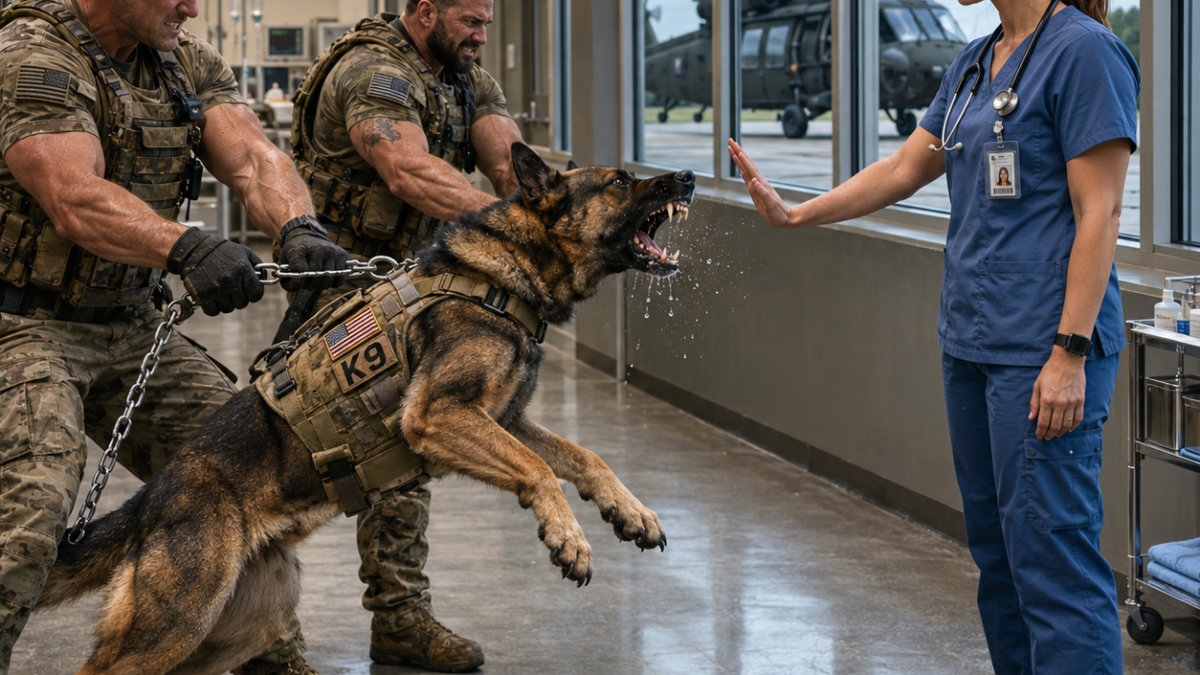
PART2:
Before everything went wrong, handlers at Fort Sentinel used to talk about him with admiration.
There were photographs of Rex beside Senior Chief Mason Reed.
Commendation ceremonies.
Training evaluations.
Deployment summaries.
Stories told over coffee during overnight shifts.
Rex had located explosive material other dogs missed.
He had worked under gunfire.
He had remained focused in environments that made younger dogs shut down completely.
One story claimed he once caught the straps of a wounded operator’s vest and dragged him several feet toward cover while the team repositioned.
Depending on who told it, the distance became longer every year.
That was how legends worked.
But every version agreed on one thing.
Rex and Mason Reed had been exceptional together.
Then Mason went on a deployment.
Rex came home.
Mason did not.
After that, the photographs stopped.
The commendations stopped.
And eventually, the stories changed.
Rex refused new handlers.
PART3:
Then resisted them.
Then attacked.
The first serious injury required thirty-seven stitches.
Another handler suffered a broken wrist during a collar transition.
A third completed transfer paperwork within a day of an incident and refused to enter the kennel building afterward.
People began using different words.
Unstable.
Dominant.
Unpredictable.
Dangerous.
Liability.
The latest behavioral review used the phrase:
“Unable to be safely integrated into normal working-dog operations.”
Everyone understood what came after language like that.
Rex was not a pet living in a private home.
He was a military working dog assigned to an operational program.
If he could not be safely handled, housed or transferred, options narrowed quickly.
Commander Douglas Mercer had spent twenty-six years in uniform.
He did not enjoy signing papers that ended an animal’s life.
But he disliked sending human beings to emergency surgery even more.
So when the latest file reached his desk, he read every page.
Then scheduled the review.
That same morning, Lieutenant Abigail Cross drove onto Fort Sentinel with a travel mug of coffee between her knees and absolutely no intention of becoming involved with a military dog.
Abigail was thirty-four.
Trauma nurse.
Assigned to the military medical unit supporting Fort Sentinel.
Her official work involved emergency medicine, recovery coordination and acute trauma response.
Her unofficial job was more difficult to describe.
She was the person people tended to call when a room became chaotic.
Not because Abigail had some mystical ability to calm everyone.
She simply became quieter as other people became louder.
That morning was ordinary.
Cold autumn air.
Gray sky.
Training fields wet from overnight rain.
Handlers working dogs through obedience drills.
Vehicles moving between buildings.
Commands carrying across open ground.
Abigail stepped out of her truck.
Closed the door.
Took one sip of coffee.
Then heard a bark.
She stopped.
Another.
Deep.
Violent.
Not ordinary kennel noise.
A senior sergeant walking nearby noticed her looking.
“Rex.”
Abigail glanced at him.
“The famous one?”
The sergeant laughed without humor.
“Depends who you ask.”
“What does that mean?”
“Half the base remembers what he used to be.”
“And the other half?”
He looked toward the isolated kennel building.
“Would prefer never being assigned near him.”
Abigail continued toward the clinic.
The bark followed her.
Not literally.
Rex eventually stopped.
But the sound remained in her mind.
She spent the morning treating things that happened when young service members believed joints were optional.
Sprained ankle.
Shoulder strain.
A recruit who had replaced water with energy drinks and seemed offended by the consequences.
Normal.
At noon, Abigail caught herself staring out a clinic window.
Kennel compound in the distance.
She told herself it was none of her business.
By two, she had lost that argument.
The military working-dog area sat behind two controlled gates.
Rows of runs.
Training yards.
Storage areas.
Veterinary spaces.
Most dogs announced visitors immediately.
Barking.
Pacing.
Spinning.
Rex did not.
He sat at the far end of his run.
Watching.
That surprised her.
The dog she had expected from the incident descriptions was supposed to be uncontrollable.
Instead:
stillness.
Amber eyes.
Head high.
Every muscle prepared.
Abigail stopped well outside the barrier.
Rex stood.
His posture changed.
Weight forward.
But no bark.
No growl.
No charge.
Just attention.
A young handler appeared behind Abigail.
“Ma’am?”
She looked back.
“You shouldn’t be this close.”
“I’m outside the exclusion line.”
“Yes, ma’am.”
“So?”
He shifted.
“That dog attacks.”
Abigail looked back at Rex.
“Does he?”
The handler frowned.
“Respectfully, that part isn’t really disputed.”
Rex watched both of them.
Abigail asked:
“What happened to his original handler?”
The young man immediately looked uncomfortable.
“Senior Chief Reed.”
“Mason Reed?”
“You know the name?”
“Everybody knows the name.”
“Then you know more than I do.”
“I know he died.”
“Mission.”
“Classified.”
“Rex was there?”
The handler hesitated.
“Yes.”
Abigail studied the dog.
She had seen the same quality in human trauma patients.
Not aggression.
Not exactly.
Constant preparation.
People who sat facing doors.
People who woke at hallway noises.
People who became angry because fear felt unacceptable.
Rex’s posture reminded her of someone who believed the next disaster might occur if he stopped watching.
She lowered herself into a crouch.
The young handler stiffened.
“Ma’am.”
“I’m not approaching.”
Rex’s eyes stayed on her.
Seconds.
Abigail did nothing.
No kissing sounds.
No command.
No attempt to lure.
Rex eventually lowered his head a fraction.
Then a truck backfired across the compound.
Crack.
Rex exploded.
He hit the front of the run so hard the fencing shook.
Barking.
Teeth.
Body slamming forward.
The handler jumped backward.
“There.”
Abigail remained where she was.
Not because she was fearless.
Because Rex was behind a secured barrier and she was more interested in what happened immediately before the behavior than the behavior itself.
Truck.
Sudden sharp sound.
Immediate escalation.
No warning sequence long enough for thought.
Abigail stood.
“Has anyone documented his triggers chronologically?”
The young man stared.
“We have incident reports.”
“That isn’t what I asked.”
That evening, she requested Rex’s file.
The records clerk looked at the request.
Then at her.
“You enjoy suffering?”
“I enjoy patterns.”
He handed her a thick stack.
Incident report.
Behavior evaluation.
Veterinary exam.
Training assessment.
Handler statement.
Another incident.
Another.
Abigail carried everything home.
At 11:40 p.m., she was sitting at her kitchen table with cold coffee and enough paperwork to ruin anyone’s evening.
One evaluator wrote:
dominance-related aggression.
Another:
territorial aggression.
A veterinary note mentioned possible neurological trauma.
Another report suggested handler conflict.
Another described generalized aggression.
No consensus.
Same dog.
Same attacks.
Different explanations.
Abigail began making her own timeline.
Date.
Handler.
Location.
Trigger.
Body posture.
What happened immediately before physical contact?
What verbal cue was used?
What equipment?
What environmental noise?
One incident:
New handler reached suddenly for collar.
Rex attacked.
Another:
High-intensity verbal correction.
Attack.
Another:
Restraint near transport vehicle.
Attack.
Another:
Handler transition exercise.
Attack.
Another:
specific verbal cue.
Attack.
Abigail circled it.
Then saw it again.
Different report.
Same category of exercise.
A replacement handler attempting to establish control after Mason’s death.
Next morning, Abigail requested training footage.
Hours.
Rex with Mason.
Rex after Mason.
Rex with replacement handlers.
The contrast was painful.
With Mason, Rex’s movements were sharp but not frantic.
Focused.
Responsive.
After Mason:
watching hands.
Watching equipment.
Escalation when physically controlled.
Particularly during transitions from one handler to another.
Abigail replayed one clip.
A replacement handler approached.
Command.
Rex stiffened.
Handler repeated.
Rex backed away.
Correction.
Rex attacked.
She stopped the video.
Rewound.
Again.
There.
Before every attack came something.
Not always identical.
But enough.
Surprise.
Loss of control.
Specific handling situations.
Loud transient sounds.
And certain verbal cues associated with replacement training.
Abigail wrote:
He is not attacking “without warning.”
He is escalating after recognizable precursors that staff may be misreading or moving through too quickly.
That was different from saying he was safe.
He was not.
A dog capable of causing thirty-seven stitches was dangerous whether or not the reason made emotional sense.
Understanding behavior did not erase risk.
It changed what you did with it.
Abigail wanted the deployment file.
Denied.
She submitted another request.
Denied.
She tried through medical liaison channels.
No.
Then, several days later, a retired administrative officer named Thomas Hale agreed to speak unofficially.
They met in an empty office.
Hale closed the door.
“You didn’t hear this from me.”
“Fine.”
“Mason Reed.”
“Yes.”
“Rex’s handler.”
“What happened?”
Hale stared at the desk.
“Extraction mission.”
“Where?”
“You know I can’t answer.”
“Rex was present when Mason died?”
Silence.
Then:
“Yes.”
Abigail stopped writing.
“Did Rex see it?”
Hale looked toward her.
“I don’t know what the dog perceived.”
“Was he there?”
“Yes.”
“Did somebody remove Rex afterward?”
“Yes.”
“Immediately?”
“As soon as circumstances allowed.”
“To whom?”
“Another handler.”
That sentence mattered.
“Another handler.”
“Yes.”
“And when they returned?”
“Medical evaluation.”
“Then?”
“Temporary handling assignment.”
“Then?”
“Transfer.”
“How many?”
Hale shook his head.
“Several changes.”
Abigail sat back.
A dog loses the only handler he has trusted through multiple deployments.
Then strangers begin taking control of his collar.
Equipment.
Movement.
Commands.
Transport.
Each person trying to establish a new working relationship.
Reasonable.
Necessary.
Potentially unbearable to the animal.
Hale stood.
Conversation over.
At the door, he stopped.
“One thing.”
“What?”
“Mason and that dog.”
He exhaled.
“I’ve worked around K9 teams almost twenty years.”
Pause.
“I never saw another pair like them.”
Then he left.
Abigail returned to the old footage.
This time, she watched Mason.
Not Rex.
How did Mason stand?
Touch?
Call?
Reward?
Talk?
Military working dogs respond to standardized commands.
Precision matters.
Search.
Down.
Stay.
Release.
But Mason did something else when operations ended.
He talked to Rex like a person sitting beside him.
Helmet-camera footage after one stressful training event:
Mason crouched.
Rex breathing hard.
Mason removed one glove.
“Easy, Guardian.”
Rex’s breathing changed.
Abigail stopped the video.
Rewound.
Later clip.
Helicopter.
Noise.
Rex restless.
Mason leaned close.
“Guardian.”
Dog settled.
Another clip.
Post-mission staging area.
Rex scanning.
Mason touched shoulder.
“Good, Guardian.”
Relaxation.
Abigail wrote the word.
GUARDIAN.
Not formal command.
No training manual used it that way.
Personal cue?
Nickname?
Reassurance phrase?
She searched more footage.
Again.
Again.
Again.
Whenever Mason said it outside active command sequences, Rex’s posture changed.
Abigail did not conclude she had discovered a magic word.
That would have been dangerous.
Associations are not spells.
But if one sound had been repeatedly paired with Mason’s calm presence, decompression and safety, it might still mean something to Rex.
She requested Commander Mercer.
He listened with the expression of a man calculating how much paperwork one nurse could generate.
When she finished, Mercer said:
“You want direct contact with Rex.”
“Controlled contact.”
“Based on a word.”
“Based on weeks of behavior patterns.”
“And the word.”
“And the word.”
Mercer rubbed his forehead.
“This dog broke a man’s wrist.”
“I read the report.”
“Thirty-seven stitches on another.”
“I know.”
“If he charges you—”
“Handlers maintain physical control.”
“Yes.”
“Distance stays outside bite range.”
“Yes.”
“Safety barriers remain staffed.”
“Yes.”
“One attempt.”
“Fine.”
“If he escalates, it ends.”
“Agreed.”
Mercer leaned back.
“You are unusually calm about this.”
“I’m not planning to wrestle him.”
“That helps.”
The trial occurred the following afternoon.
News traveled.
Handlers stood behind safety barriers.
Veterinary staff observed.
Commander Mercer stayed near the fence.
Rex entered under controlled restraint.
Immediately:
stiff.
Ears forward.
Scanning.
Abigail walked into position.
Slow.
No direct approach.
No reaching.
Thirty yards.
Twenty.
Fifteen.
Rex began pacing.
Low vocalization.
Handlers tightened.
Abigail stopped.
Rex stared.
A helicopter passed overhead.
Wind moved across the yard.
Then Rex surged.
The restraint snapped taut.
He barked.
Again.
Again.
A handler shifted forward.
Commander Mercer moved one step.
Abigail did not shout.
She said:
“Guardian.”
Rex stopped.
Not gradually.
The next bark never came.
His ears moved.
Head tilted.
He stared at Abigail.
Confusion.
Recognition.
No one around the yard moved.
Abigail remained still.
“Guardian.”
Softer.
Rex’s body lowered.
Front legs folded.
Then hindquarters.
He lay down.
Not a formal obedience response.
No one had issued “down.”
No handler had corrected him.
The dog simply stopped fighting the moment.
One older trainer turned his face away.
Another removed sunglasses although the sky was gray.
Abigail crouched.
Still outside physical contact range.
No celebration.
No one rushed him.
That mattered.
She waited.
Rex stayed down.
For the first time in months, an interaction with an unfamiliar person ended without anyone forcing him.
The following week, Abigail made a rule.
She would not become Rex’s handler.
That was not her training.
Not her role.
Not safe.
Instead, she worked with the K9 behavioral and veterinary staff as a consistent neutral presence.
No obedience drills from her.
No collar grabs.
No “proving” authority.
She sat near his enclosure.
Read medical journals.
Drank coffee.
Sometimes talked.
“Recruit today tried explaining that four energy drinks are basically hydration.”
Rex watched.
“I disagreed.”
Nothing.
“Professionally.”
One morning his tail moved once when she arrived.
Every handler saw it.
Nobody commented until she left.
Then they talked about nothing else.
Three weeks:
Rex accepted food from Abigail under staff guidance.
Later:
brief contact.
Then longer.
The first time she touched his shoulder, her hand stayed visible.
Rex sniffed.
Allowed it.
She stopped before he became uncomfortable.
Progress remained slow.
There were setbacks.
A dropped metal tray triggered a hard startle.
A vehicle backfire brought the old reaction almost completely back.
But staff stopped treating every escalation as proof that all previous improvement had been fake.
They documented.
Adjusted.
Worked below threshold when possible.
Changed transition procedures.
One handler said:
“We were asking him to get over it every day.”
Abigail answered:
“And he was telling you he hadn’t.”
That did not absolve Rex of risk.
It gave the risk a shape.
Still, one question bothered her.
What happened after Mason’s death that connected so strongly to the word?
The answer arrived by accident.
Rainy Tuesday.
Abigail was accompanying Rex and an authorized K9 handler through a storage building during a low-stimulation exposure exercise.
Old equipment.
Archived training material.
Personal property awaiting disposition.
Rex stopped.
Turned toward an aisle.
Handler allowed him to investigate on line.
Rex moved.
Stopped at a metal shelving unit.
Sat.
Looked upward.
A small weathered container carried a label.
MASON REED.
No one claimed Rex had performed some supernatural act.
Maybe he smelled old fabric.
Maybe a familiar material.
Maybe nothing more than chance made him investigate that aisle.
Nobody could prove why.
The box itself was real.
Commander Mercer authorized it opened through proper channels.
Inside:
watch.
Notebook.
Photographs.
Mission patches.
Personal effects.
Then a digital voice recorder.
One file.
Timestamp:
the week before Mason’s final deployment.
The room became quiet.
Mercer pressed play.
Static.
Then a voice.
Mason Reed.
Rex’s ears rose immediately.
“Hey, buddy.”
Mason laughed softly on the recording.
“If somebody’s playing this, things probably didn’t go according to plan.”
No one moved.
“First things first.”
Pause.
“You’re a good dog.”
An older handler looked down.
Mason continued.
“You did your job.”
Another pause.
“No matter what happened, none of it was your fault.”
Abigail felt something tighten in her throat.
Not because Rex understood every English word the way a person would.
He did not need to.
The voice itself mattered.
Tone.
Cadence.
Familiarity.
Then:
“If I’m not there anymore, I need you to keep protecting people.”
Rex became completely still.
Mason’s voice:
“You hear me, Guardian?”
Rex lifted his head.
Tail moved.
Slow.
Once.
The room went silent except for the recording.
The final file ended.
Nobody spoke for a long time.
Commander Mercer finally said:
“How long has that been sitting there?”
No one had an answer that made anyone feel better.
Abigail looked at Rex.
For years, people had used the word aggression because aggression was visible.
Teeth.
Injuries.
Lunges.
Behavior could be photographed.
Grief could not.
But that did not mean grief excused dangerous behavior.
It meant the K9 unit had been trying to change what Rex did without fully understanding what repeatedly pushed him there.
Mason was gone.
Then handler after handler entered Rex’s life, trying to replace a relationship Rex had never learned how to lose.
The recording did not “cure” him.
The next morning he remained cautious.
He still startled.
Still watched unfamiliar hands.
But something changed in how the humans around him treated the work.
No one talked about “winning.”
No one tried to force fast bonding.
Abigail became part of a larger rehabilitation plan rather than the center of it.
Veterinary staff monitored him.
Experienced handlers used predictable transitions.
Trigger exposure was controlled.
Safety equipment stayed in place.
Weeks passed.
No attack.
Then another.
Still none.
Eventually, the euthanasia recommendation was withdrawn pending continuing assessment.
Not because Rex had become harmless.
Because his behavior had become manageable enough to justify continued rehabilitation.
That distinction mattered.
Months later, Commander Mercer called Abigail.
“Come here.”
She entered his office.
He slid a folder across the desk.
“What?”
“Hospital rehabilitation program.”
She looked.
Military patients recovering from severe injuries and post-deployment difficulties.
“What does this have to do with Rex?”
Mercer smiled without humor.
“I was hoping you’d tell me that.”
One patient had caught Abigail’s attention.
Ethan Walker.
Nineteen.
Army specialist.
Survived a roadside explosion.
Physical wounds healing.
Emotional withdrawal severe.
For months, Ethan barely engaged.
Counseling.
Occupational therapy.
Group programs.
Visitors.
He attended some.
Ignored others.
Abigail had met him once.
He sat by a hospital window.
Gray parking lot outside.
“Ethan.”
Nothing.
“I’m Abigail.”
Nothing.
“How are you doing?”
Eyes outside.
After fifteen minutes, Abigail left.
That evening she sat outside Rex’s enclosure.
He rested nearby.
The idea arrived.
Then she rejected it.
Then it returned.
Next morning:
Mercer.
“No.”
“I haven’t asked yet.”
“I know your face.”
“Controlled visit.”
“No.”
“Rex has been stable.”
“No.”
“He is already participating in structured environments.”
Mercer stared.
“You want to bring the former most dangerous dog on this installation into a hospital.”
“Not loose.”
“Abigail.”
“Full control.”
“Medical oversight.”
“Behavioral staff.”
“One patient.”
“No public hallway.”
Mercer closed his eyes.
“You make terrible ideas sound reasonable.”
“Useful skill.”
Three days later, after risk review and approvals, one controlled visit was authorized.
Not therapy certification.
Not free access.
Trial.
Rex entered Ethan’s room beside his trained handler.
Abigail followed.
Ethan did not look up.
Then Rex moved into view.
Ethan’s eyes shifted.
Tiny response.
But response.
Rex stopped near the chair.
Handler remained in control.
No one forced contact.
Ethan slowly lowered one hand.
Rex sniffed.
Then rested his chin beneath it.
Ethan closed his eyes.
A faint smile appeared.
No one declared a miracle.
No therapist canceled treatment.
No one said the dog had healed him.
The next visit, Ethan asked:
“What’s his name?”
First spontaneous question Abigail had heard from him.
“Rex.”
“He military?”
“Yes.”
“What happened to him?”
Abigail paused.
“He lost somebody.”
Ethan looked at the dog.
“How long ago?”
“Long enough.”
Ethan scratched behind Rex’s ear.
“Still bothers him?”
“Yes.”
That answer seemed to matter.
Visits continued.
Controlled.
Short.
Rex became one bridge among several.
Ethan began talking more during clinical sessions.
Not because a dog replaced therapy.
Because talking to Rex made talking to people feel slightly less impossible.
Some days:
one sentence.
Others:
nothing.
Then memories.
Fear.
Guilt.
Anger.
One afternoon Ethan said:
“Everybody keeps saying I survived.”
Abigail waited.
“They say it like I won.”
Rex lay beside his chair.
Abigail answered:
“You don’t have to feel lucky on schedule.”
Ethan looked at Rex.
“Does he?”
“Does he what?”
“Feel lucky?”
Abigail smiled sadly.
“I don’t think Rex uses that word.”
The young soldier nodded.
“Good.”
Word spread through Fort Sentinel.
People began speaking about Rex differently.
The dog once associated only with incident reports became known for sitting quietly beside wounded service members.
That reputation created its own danger.
People started wanting access.
Photos.
Demonstrations.
Visits.
Abigail pushed back.
“He is not a mascot.”
Rex still had limits.
Crowds.
Sudden grabs.
Certain sharp noises.
He was improving because his environment respected those limits.
Not because they disappeared.
Winter arrived.
Then came the hospital power failure.
A maintenance fault disrupted part of one wing.
Backup systems activated.
Staff began controlled relocations.
Security moved people through corridors.
Most of the disruption resolved quickly.
Then one family realized their seven-year-old son was missing.
He had been visiting his recovering father.
Somewhere in the movement between waiting area and temporary relocation, the child had become separated.
Security searched.
Rooms.
Hallways.
Stairwells.
No child.
Rex was in the hospital for a scheduled visit with Ethan when the alert came.
His head lifted.
Working posture.
Different from fear.
Focused.
Abigail saw it.
So did his handler.
Rex had spent years in detection and search-related environments.
Security made a decision.
Could he assist?
Under control.
Yes.
A scent reference was obtained from the family.
Search began.
Rex moved down one corridor.
Checked.
Changed direction.
Stairwell.
Another wing.
Then toward a maintenance section.
He stopped at a closed utility-room door.
Focused.
Handler indicated.
Security unlocked it.
Inside:
a boy.
Crying.
Frightened.
Physically safe.
The father arrived moments later.
Nobody cared about applause.
Not at first.
They cared that the child was alive and unharmed.
The boy saw Rex.
“Dog.”
His father laughed through tears.
“Yes.”
Security initially prevented an impulsive hug until the handler confirmed safe contact.
Then the child touched Rex carefully.
Rex stood.
Calm.
Abigail watched from several feet away.
A year earlier, people had discussed whether Rex could safely remain alive.
Now he had contributed to finding a missing child in the same hospital where his presence was helping a young soldier reconnect with treatment.
The story spread.
Base first.
Then military community.
Then outside.
Abigail disliked the headlines.
“KILLER K9 BECOMES HERO.”
Wrong.
Rex had already been a working dog before his behavioral collapse.
He did not become valuable because he became easier for humans to understand.
Another headline:
“NURSE SAVES VICIOUS DOG WITH ONE WORD.”
Also wrong.
One word had opened a door.
Everything after required months of controlled work.
She corrected reporters whenever they asked.
“I did not fix Rex.”
“What did you do?”
“I noticed a pattern.”
“And the word?”
“It mattered.”
“Why?”
“Because it belonged to somebody he trusted.”
Later that spring, the base held a formal recognition ceremony.
Handlers.
Medical staff.
Veterans.
Families.
People Rex had worked around.
No exaggerated spectacle.
Commander Mercer spoke about rehabilitation.
About operational responsibility.
About the danger of reducing behavior to labels.
Then Abigail was asked to say a few words.
She stood at the podium.
Rex sat beside his handler several yards away.
Calm.
Older somehow.
Not in years.
In expression.
Abigail looked at the crowd.
“They keep asking how I saved Rex.”
Pause.
“I didn’t.”
Quiet.
“I listened to what happened before the attack.”
She looked toward the dog.
“Then other people did the hard part.”
Handlers.
Veterinary staff.
Behavior specialists.
Commanders willing to change a decision.
Medical teams who accepted risk controls rather than demanding a dramatic success story.
“And Rex.”
She smiled.
“He had to choose to participate too.”
After the ceremony, an elderly couple waited near the edge of the parade ground.
Abigail recognized them from photographs.
Mason Reed’s parents.
Mrs. Reed looked at Rex.
Did not approach.
The handler asked if she wanted to meet him.
She nodded.
Rex saw them.
Paused.
Walked forward slowly.
Mrs. Reed crouched as far as her knees allowed.
Rex sniffed.
Her hands trembled.
“You knew my boy.”
The dog could not answer.
She touched his shoulder.
Rex remained.
Then lowered his head against her lap.
Mrs. Reed broke.
Not theatrically.
Quietly.
Her husband rested one hand on Rex’s back.
Nobody nearby spoke.
Abigail looked away.
Some grief deserved privacy even in public.
Later, when nearly everyone had left, Abigail stood near the edge of the field.
Rex rested on the grass.
Commander Mercer approached.
“You know what bothers me?”
Abigail smiled.
“Long list?”
“We almost put him down.”
“Yes.”
“We had reports.”
“Yes.”
“Injuries.”
“Yes.”
“We weren’t inventing the danger.”
“No.”
Mercer looked toward Rex.
“So were we wrong?”
Abigail thought before answering.
“Not about the danger.”
“About what?”
“Thinking danger was the whole dog.”
Mercer nodded slowly.
“That sounds annoyingly reasonable.”
“I work very hard at it.”
He walked away.
Abigail stayed.
Rex looked toward her.
She crouched.
Years earlier, Mason had used one private word after helicopters.
Gunfire.
Difficult missions.
Times when the job was over and Rex needed to understand that the man beside him was still there.
Guardian.
Maybe Mason meant:
You protected me.
Maybe:
I’ve got you.
Maybe it was just a nickname.
It no longer mattered exactly.
The word survived him.
Abigail said it softly.
“Guardian.”
Rex’s ears moved.
His front legs folded.
He lowered himself onto the grass.
Exactly as he had the first day.
But the meaning looked different now.
That first time, he seemed shocked by memory.
This time:
rest.
Abigail sat beside him.
No command.
No expectation.
For years, Rex had lived as though Mason might return if he stayed alert long enough.
Every new handler became proof that someone else was taking Mason’s place.
Every forced transition reopened the same absence.
Then the people around him finally stopped asking:
How do we make this dog obey us?
And started asking:
What is he reacting to?
That question did not erase what Rex had done.
Six injured handlers still mattered.
Safety still mattered.
Behavior still had consequences.
But understanding the cause gave everyone a chance to build something different.
Rex never became the dog he had been before Mason’s death.
That was never the goal.
He became a dog who could live safely again.
Work in limited ways.
Accept people.
Rest.
Help when appropriate.
Walk away when something became too much.
And perhaps most importantly, stop waiting for one man to return through a door that would never open.
The sun dropped lower over Fort Sentinel.
Rex rested beside Abigail.
His eyes half closed.
For once, nobody was holding a restraint line.
Nobody was testing him.
Nobody was asking him to prove he was safe.
He was simply lying in the grass.
And for a dog who had spent years preparing for the next loss, that may have been the clearest sign of recovery anyone ever saw.








