Thirty People Walked Past the 17-Year-Old Cat Marked “FREE”—I Was Number Thirty-One
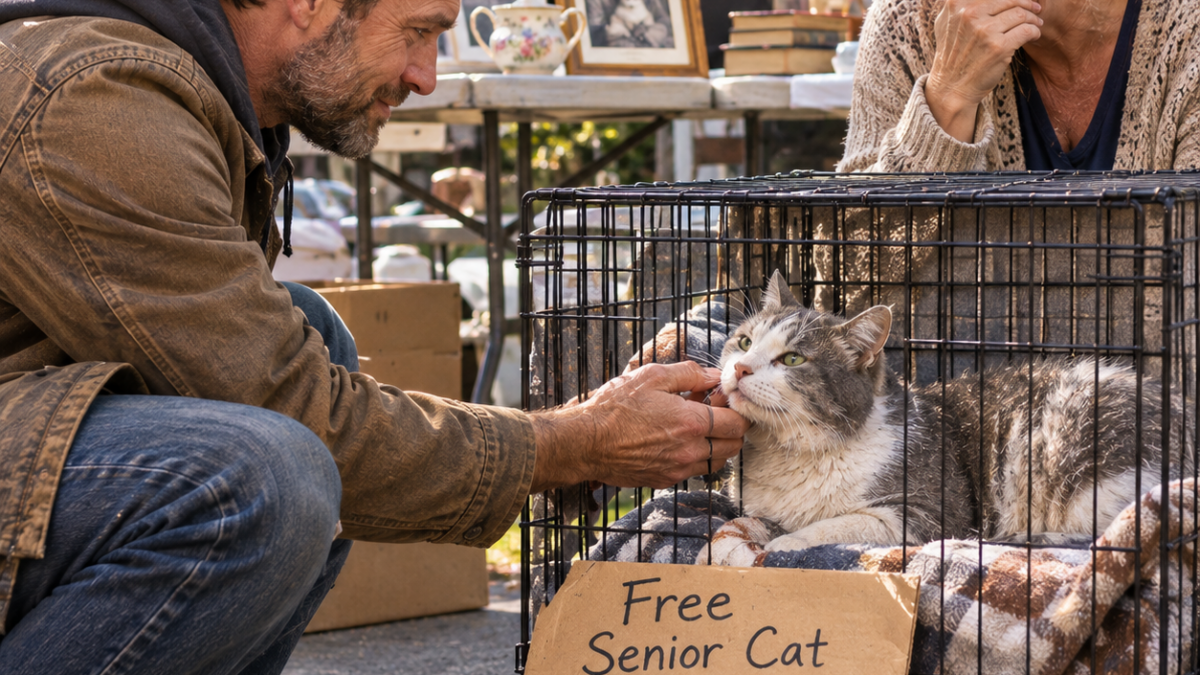
Thirty People Walked Past the 17-Year-Old Cat Marked “FREE”—I Was Number Thirty-One.
The handwritten cardboard sign beside the wire carrier said, “FREE. 17-year-old cat. His owner died. He just needs someone.” For four hours, people walked past him while everything else from his dead owner’s life was sold off table by table.
By two in the afternoon, the porcelain was gone, the coats were boxed up, the old photographs had disappeared into strangers’ cars—and the only thing nobody wanted was Arthur, the elderly cat who had slept beside the same woman for seventeen years.
I watched thirty people pass his cage before I finally crouched down, and when I asked the grieving daughter to tell me his story, she reached beneath the folding table for one last thing that had never been marked for sale.
I had absolutely no intention of adopting a cat.
That needs to be established immediately.
I had gone to the neighborhood yard sale looking for tools.
Specifically, sockets.
Maybe a decent ratchet if somebody was getting rid of one cheap.
That was it.
I lived alone in a small house outside Columbus, Ohio, worked maintenance for a commercial property company, and already had enough unfinished projects to keep me busy until retirement.
There was a leaking outdoor faucet.
A garage door that made a sound like an injured dinosaur.
Two kitchen cabinet hinges I had been promising myself I would replace for six months.
I did not need a pet.
I especially did not need a seventeen-year-old cat.
Yet twelve hours after telling myself exactly that, I was sitting on my living-room floor watching one sleep on my couch.
His name was Arthur.
But I am getting ahead of myself.
The yard sale had taken over most of a quiet cul-de-sac on the edge of town.
Five or six houses were participating.
Maybe seven.
Tables had been dragged into driveways.
Clothes hung from temporary racks.
Cardboard signs leaned against mailboxes.
The whole street had that familiar Saturday-morning atmosphere where people carried coffee in disposable cups and negotiated aggressively over objects worth three dollars.
There were bicycles.
Lamps.
Children’s toys.
Stacks of paperback novels.
Christmas decorations.
Old tools.
Kitchen appliances that probably had not been plugged in since the first Bush administration.
Nothing unusual.
I parked near the entrance to the street and walked down carrying twenty dollars in my pocket.
Two houses in, I found a folding table with tools.
Mostly junk.
Rusty wrenches.
A cordless drill without a battery.
A hammer that looked like somebody had used it to repair a submarine.
I kept walking.
That was when I noticed the house at the far end.
Its sale looked different.
I could tell before I reached it.
There were fewer bright plastic things.
No children running around.
PART2:
No one laughing over old Halloween costumes.
The objects were older.
Carefully arranged.
Porcelain dishes.
Framed landscapes.
A walker.
A small wooden jewelry box.
Several heavy winter coats.
Cookbooks with handwritten notes sticking out from the pages.
A stack of embroidered tablecloths.
Two lamps with fabric shades yellowed by time.
A cardboard box filled with framed photographs that had been turned facedown.
If you have ever helped clean out the home of someone who died, you recognize that kind of sale immediately.
It did not look like people were getting rid of things they no longer wanted.
It looked like an entire life had become impossible to keep.
A woman sat behind the folding table.
Mid-fifties, I guessed.
Dark hair with gray at the temples.
Jeans.
Blue sweatshirt.
Tired face.
She smiled when people approached but never called anyone over.
I might have walked past the whole thing if I had not noticed the wire carrier on the ground.
At first I thought it was empty.
PART3:
Then something inside moved.
A cat.
Large.
White and gray.
He was lying on a folded blanket inside a roomy metal crate.
Not pacing.
Not crying.
Not pushing at the door.
Just lying there.
Watching.
There was a piece of cardboard propped against the side.
Black marker.
Big letters.
FREE.
OLDER CAT.
17 YEARS OLD.
OWNER PASSED AWAY.
HE JUST NEEDS A GOOD HOME.
LITTER BOX + FOOD INCLUDED.
I stopped long enough to read it.
Then I kept walking.
That part matters.
I would love to tell you I saw Arthur and immediately knew.
I did not.
I read the sign.
Looked at the old cat.
Thought, That’s sad.
And walked away.
Two houses farther down, I found the socket set I had come for.
Stanley.
Used, but complete.
Fifteen dollars.
I bought it.
Then I walked back toward my truck.
I should have left.
Instead, I stopped beside the tailgate and looked back down the street.
I could still see the carrier.
People moved around it.
A woman picked up a ceramic bowl from the table.
A man examined the walker.
Two teenagers looked through records at the neighboring house.
The cat remained where he was.
I do not know why I stayed.
Maybe curiosity.
Maybe discomfort.
Maybe I simply had nowhere important to be.
I leaned against my truck.
A family came down the sidewalk.
Mother.
Father.
Two kids.
The younger boy pointed.
“Cat!”
The mother looked toward the carrier.
Then toward the sign.
“No, honey.”
They kept walking.
A few minutes later, an older couple stopped.
The woman bent slightly to read the cardboard.
Her husband leaned in.
They talked quietly.
Then shook their heads and walked away.
Another person passed.
Then another.
I started counting without meaning to.
Five.
Six.
Seven.
Some people glanced.
Some did not.
One woman said, “Oh, poor baby,” without slowing down.
Another man read the sign and said to whoever was beside him, “Seventeen? That’s ancient.”
Then he walked toward a table of golf clubs.
Arthur did not react.
That bothered me.
Not that people were walking away.
That the cat seemed accustomed to watching it happen.
I moved closer.
Not all the way back.
Just enough to see.
The woman remained beside the carrier.
She was not begging.
That also bothered me.
She did not call to people.
Did not say, “He’s sweet.”
Did not advertise him.
She just sat there.
Every few minutes she looked down at the cat.
Then back toward the street.
By noon, I had counted fourteen people.
I went back to my truck.
Put the socket set behind the seat.
Started the engine.
Sat there.
Turned it off.
“This is stupid,” I said.
Nobody heard me.
I walked back toward the sale.
Not to adopt the cat.
I want that understood.
I walked back because there was a box of drill bits I had noticed earlier.
That is what I told myself.
The drill bits were gone.
Arthur was not.
Twenty people.
Twenty-two.
Twenty-five.
Around one-thirty, the sale began thinning out.
Tables at the neighboring houses were being packed.
Children dragged unsold toys toward garages.
Someone loaded a folding card table into a minivan.
At the last house, most of the elderly woman’s belongings were gone.
The porcelain had sold.
The walker was gone.
The lamps were gone.
The coats had been boxed.
The framed pictures had mostly disappeared.
I stood across the street with a paper cup of lemonade I did not remember deciding to buy.
Twenty-eight.
A young couple approached.
The woman stopped at Arthur’s carrier.
Finally.
She crouched.
Arthur lifted his head.
She smiled.
Then read the sign.
“Seventeen?”
The man beside her said, “We wanted a kitten.”
She nodded.
They left.
Twenty-nine.
A middle-aged man walked by.
Thirty.
By then it had been almost four hours.
Thirty people had passed close enough to read that sign.
Not one asked to open the cage.
Not one asked his name.
Not one knelt.
At around two, the street became almost empty.
The woman behind the table stood.
She stretched her back.
Looked over what remained.
Almost nothing.
Then she looked at Arthur.
I watched her face change.
I am not going to tell you what I think that expression meant.
It belonged to her.
But I saw it.
That was enough.
I walked across the street.
She noticed me approaching.
“Hi.”
“Hi.”
I crouched in front of the carrier.
Up close, Arthur looked older than he had from across the street.
His face was narrow.
His cheeks slightly hollow.
Gray fur covered the top of his head and parts of his back.
White surrounded his mouth.
The fur along his sides was thinner.
His eyes were green.
Clouded around the edges.
He looked at me.
Not afraid.
Not excited.
Just watching.
I put my hand near the carrier door.
Not through it.
Arthur blinked slowly.
Then he moved his head forward.
His nose stopped near my fingers.
I looked at the woman.
“Tell me about him.”
For the first time all afternoon, she looked startled.
“You’re interested?”
“I’m asking.”
She sat back down.
“His name is Arthur.”
The cat blinked again.
“Arthur.”
“He was my mother’s.”
“How long?”
“His whole life.”
“Seventeen years?”
She nodded.
“My mom adopted him when she retired.”
“What did she retire from?”
“Elementary school librarian.”
That seemed to fit somehow.
“What was her name?”
“Evelyn.”
I looked at Arthur.
“So Arthur belonged to Evelyn.”
“He thought Evelyn belonged to him.”
She smiled.
The first real smile I had seen on her face.
“He followed her everywhere.”
“Everywhere?”
“Bathroom. Kitchen. Laundry room. If she went outside to water flowers, he sat inside the screen door and yelled until she came back.”
I smiled.
“He slept with her?”
“Every night.”
The smile disappeared.
“She got sick last year.”
I stopped moving.
“What happened?”
“Pancreatic cancer.”
“I’m sorry.”
“Thank you.”
Her name, I learned, was Rebecca.
Rebecca had lived forty minutes away.
Her mother had refused to leave her house for most of the illness.
Arthur had remained with her.
“When Mom started spending most of the day in bed, Arthur stopped leaving the bedroom.”
“Even for food?”
“We moved his bowls in.”
I looked into the carrier.
Arthur’s eyes were half closed now.
“He knew?”
Rebecca shrugged.
“I don’t know what cats know.”
Then quietly:
“But he knew something.”
During Evelyn’s final week, hospice nurses came and went.
Arthur did not hide.
He stayed on the bed.
Sometimes at her feet.
Sometimes against her side.
The morning Evelyn died, Arthur was lying near her knees.
Rebecca’s voice changed when she told me that.
Not dramatically.
It simply became thinner.
“We let him stay.”
“How long?”
“A few hours.”
“And afterward?”
She looked down.
“He sat on her bed.”
“For how long?”
“Two days.”
I stared.
“He wouldn’t leave?”
“He ate a little. Used the litter box. Then went back.”
“What happened when you stripped the bed?”
Rebecca rubbed her hands together.
“He searched.”
That one word did something to me.
“He went under it. Around it. Into the closet. Back into the hallway.”
She looked toward the house.
“For about a week, every time the front door opened he came running.”
I looked at Arthur.
He was awake again.
Watching us.
Rebecca continued.
“I took him home with me.”
“You couldn’t keep him?”
“I tried.”
There was no defensiveness in her voice.
“I have two dogs.”
“Bad with cats?”
“One is fine. The other gets too excited.”
“Arthur?”
“Terrified.”
She swallowed.
“He stayed under my guest bed almost the whole week.”
“Did he eat?”
“Barely.”
“So you brought him back here?”
“To Mom’s house.”
“Alone?”
“No. I came every day.”
“But the house was being cleared.”
“Yes.”
She looked ashamed.
I hated that immediately.
It was not my place to judge how somebody dismantled her dead mother’s home.
“What about a shelter?”
Rebecca looked at me.
“I called three.”
“And?”
“All full.”
She paused.
“One said they could put him on a waiting list.”
“That sounds reasonable.”
“Then the woman asked his age.”
I knew before she said it.
“She said what?”
“That I should understand a seventeen-year-old cat probably wouldn’t do well in a kennel.”
Rebecca looked at Arthur.
“She was trying to be honest.”
“And you decided on this.”
“A yard sale.”
“Yes.”
For the first time, she sounded embarrassed.
“I know how it looks.”
I looked around at the nearly empty tables.
“At first I thought maybe somebody who saw him in person would feel something.”
Her voice trembled.
“I put free because I didn’t want money.”
“I figured.”
“I put his food out. His litter box. His medical records. Everything.”
She looked toward the street.
“I thought somebody would stop.”
I had stopped.
Eventually.
After thirty people.
After I had already walked away once myself.
“How’s his health?”
“Surprisingly good.”
“At seventeen?”
“Kidneys are starting to show his age. Arthritis. He’s mostly deaf. But he eats. Uses the litter box. Still jumps onto the couch if you give him a stool.”
“Any medication?”
“Just supplements and pain medication when his arthritis is bad.”
“Does he bite?”
“No.”
“Scratch?”
“Not unless you’re trying to put him in a bath.”
“I don’t bathe cats.”
“Then you’re safe.”
I looked at Arthur.
He had moved closer to the carrier door.
“Does he like men?”
“He liked my father.”
“Your father?”
“Died nine years ago.”
I nodded.
Arthur had already lost one person.
Then another.
“What happens if nobody takes him?”
Rebecca did not answer immediately.
That was answer enough.
“Tonight?”
“He comes back inside with me.”
“And after?”
“I don’t know.”
She rubbed her eyes.
“I can’t keep moving him between houses.”
I looked at the cardboard sign again.
FREE.
17 YEARS OLD.
OWNER PASSED AWAY.
HE JUST NEEDS A GOOD HOME.
It was absurd.
Everything else had been priced.
Five dollars.
Ten dollars.
Twenty.
Porcelain.
Tools.
Furniture.
Coats.
Seventeen years of loyalty had been marked free.
And still nobody wanted it.
I heard myself say:
“I’ll take him.”
Rebecca stared.
“What?”
“I’ll take Arthur.”
She did not move.
“Are you serious?”
“No.”
I paused.
“Yes.”
She laughed once.
Then covered her mouth.
Tears came immediately.
Not neat tears.
She turned away.
“I’m sorry.”
“You don’t have to apologize.”
“My mother would be so relieved.”
That sentence almost changed my mind.
Not because I wanted to leave.
Because suddenly it felt enormous.
“Rebecca.”
She looked at me.
“I don’t know anything about him except what you just told me.”
“I know.”
“I haven’t owned a cat in fifteen years.”
“That’s okay.”
“I work.”
“He sleeps eighteen hours a day.”
“I’m not promising anything fancy.”
“He doesn’t need fancy.”
“What does he need?”
Rebecca looked toward the carrier.
“Somebody.”
That was all.
Somebody.
Not a savior.
Not a perfect house.
Not a dramatic second chance.
Someone to be there.
I nodded.
“All right.”
Then Rebecca cried harder.
She hugged me.
A stranger.
Right there in the driveway between an empty folding table and a cardboard sign.
“Thank you.”
I stood awkwardly.
“You’re welcome.”
“My mom worried about him more than anything.”
“She knew she was dying?”
“Yes.”
“Did she make plans?”
Rebecca wiped her face.
“She thought I’d keep him.”
There was guilt in that sentence.
“I’m sure she also knew you’d do what you could.”
Rebecca looked down.
“I hope so.”
Then she began gathering Arthur’s things.
It turned out he owned more property than I did.
Two bags of senior-cat food.
A stainless-steel bowl.
A ceramic water dish with blue flowers around the edge.
Litter box.
Medication.
A scratching pad he apparently had never used.
Three toys.
One brush.
A thick beige blanket.
Rebecca held the blanket for a moment before giving it to me.
“This was on Mom’s bed.”
I took it carefully.
Arthur lifted his head when he saw it.
“He knows it.”
“He sleeps on it.”
“Then it comes.”
“Yes.”
Rebecca went inside.
She returned carrying a framed photograph.
An elderly woman sat in a floral chair holding a tiny gray-and-white kitten.
The kitten’s ears looked too large for his head.
The woman was laughing.
“Mom and Arthur.”
I stared at it.
“When?”
“First week she had him.”
“I can’t take this.”
“You should.”
“It belongs to you.”
Rebecca shook her head.
“He should have it.”
“He’s a cat.”
“I know.”
“Arthur doesn’t need a photograph.”
“No.”
Her eyes filled again.
“But maybe his new house does.”
I understood.
I took it.
We loaded Arthur’s things into my truck.
Then came Arthur.
Rebecca opened the carrier.
For a moment he did nothing.
She reached in.
“Come on, Artie.”
Arthur stood slowly.
Very slowly.
His back legs stiff.
Rebecca lifted him.
He did not fight.
He rested against her chest.
She buried her face in his fur.
I looked away.
That goodbye did not belong to me.
“Be good,” she whispered.
Arthur blinked.
She carried him to my truck.
I had no cat carrier except the wire cage.
So we secured it on the backseat.
Before closing the door, Rebecca touched the bars.
“Bye, Arthur.”
The cat pushed his nose toward her fingers.
She started crying again.
Then she stepped away.
I drove home.
The entire ride, I kept looking into the rearview mirror.
Arthur sat upright.
He did not cry.
That somehow made it worse.
“You’re allowed to complain,” I told him.
Nothing.
“This vehicle has terrible suspension.”
Arthur blinked.
“My house isn’t fancy.”
Nothing.
“I have no idea what I’m doing.”
He turned toward the window.
“Excellent conversation.”
When we reached my place, I carried the carrier inside.
I set it in the living room.
Opened the door.
Then sat several feet away.
Arthur did not come out.
Five minutes.
Ten.
I went to the kitchen.
Put his food in the bowl.
Water in the flowered dish.
Set up the litter box in the laundry room.
When I returned, Arthur was standing at the carrier door.
“Hey.”
He took one step out.
Then another.
He sniffed the rug.
Walked toward the couch.
Stopped.
Looked at it.
I remembered Rebecca saying he still jumped if he had a stool.
I grabbed a wooden step stool from the kitchen.
Placed it beside the couch.
Arthur stared at me.
Then at the stool.
Then climbed.
Slowly.
One step.
Couch cushion.
He turned around three times.
Then lay down.
I spread Evelyn’s blanket beside him.
Arthur sniffed it.
Immediately, he moved onto it.
No hesitation.
He lowered his head.
Closed his eyes.
That was it.
No dramatic thank-you.
No instant affection.
He slept.
I sat in the chair opposite him.
The framed photograph of Evelyn and kitten-Arthur rested on the coffee table.
I looked from the photograph to the cat.
Seventeen years.
The kitten in that frame had lived an entire lifetime with one person.
Now he was sleeping in a stranger’s house.
I wondered whether he thought this was temporary.
Maybe every new room had become temporary.
Rebecca’s house.
Back to Evelyn’s.
The yard sale.
My truck.
My living room.
“Stay,” I said quietly.
Arthur’s ear twitched.
“You can stay.”
That evening, I offered food.
He ate the entire bowl.
That felt like winning something.
I texted Rebecca.
He ate.
Her response came almost immediately.
THANK GOD.
Then:
Can you send a picture when you get a chance?
I sent one.
Arthur asleep on the couch.
Evelyn’s blanket beneath him.
Rebecca replied with a heart.
Then another message.
Mom would have loved that couch.
I did not know how to answer.
So I said:
He seems to.
That night, I expected Arthur to stay downstairs.
He did not.
At around ten-thirty, I heard a scratch at my bedroom door.
I opened it.
Arthur stood outside.
“You made it up the stairs?”
He looked offended.
“All right.”
I walked into the room.
Arthur followed.
He looked at the bed.
Then me.
“Oh, no.”
He looked at the bed.
“You are seventeen.”
The bed.
“My mattress is too high.”
Arthur sat.
I sighed.
I went downstairs.
Found a small bench.
Carried it up.
Placed it beside the bed.
Arthur climbed onto the bench.
Then onto the mattress.
He walked directly to the left side.
Turned.
Lay down.
I stood there.
Rebecca’s words returned.
Every night, he slept in her bed.
I climbed in on the other side.
“Just so we’re clear, this isn’t your bed.”
Arthur closed his eyes.
“Right.”
At three in the morning, I woke.
Arthur was still there.
One paw stretched toward me.
Not touching.
Close.
I went back to sleep.
The next morning, I found him sitting in the kitchen doorway while I made coffee.
Not begging.
Watching.
“Breakfast?”
His tail moved once.
I fed him.
He ate.
Then went back to the couch.
That became our first day.
Then our second.
By the fourth, Arthur had established a routine.
Breakfast at six.
Morning nap.
Window at eleven.
Couch at noon.
Dinner at five.
Bed whenever he decided I had remained awake too long.
He did not play.
Not really.
He watched a feather wand once with such disappointment that I put it away.
He ignored the scratching pad.
He liked cardboard boxes.
He hated the vacuum cleaner.
He liked the warm air vent beside the kitchen.
He drank water from his flowered bowl but preferred mine if I left a glass unattended.
He was almost deaf.
But somehow always heard a can of food open.
By the end of the first week, he followed me from room to room.
Not closely.
He just preferred being where I was.
If I worked in the garage, he lay inside the doorway.
If I watched television, couch.
If I cooked, kitchen.
If I showered, he sat outside the bathroom.
I called Rebecca.
“Was he always like this?”
“Like what?”
“Supervisory.”
She laughed.
“Yes.”
“He’s judging everything.”
“That too.”
Then her voice softened.
“Is he hiding?”
“No.”
“Eating?”
“Yes.”
“Sleeping with you?”
I hesitated.
“Yes.”
Rebecca became quiet.
“He slept with Mom every night.”
“I know.”
“Thank you.”
That word again.
I was starting to dislike it.
“You don’t have to thank me every time.”
“I know.”
“You gave me half a pet store.”
She laughed.
Then said, “I just didn’t want him to think everybody disappeared.”
That stayed with me.
Everybody disappeared.
A few days later, Arthur did something strange.
I was sitting on the couch when the doorbell rang.
Arthur lifted his head.
I got up.
UPS driver.
Package.
Thirty seconds.
When I came back, Arthur was standing at the end of the hallway.
Staring toward the front door.
“You okay?”
He walked past me.
Sniffed the door.
Then sat.
I realized.
Doors had become important.
His person had disappeared.
Then his home changed.
Then Rebecca’s home.
Then the yard sale.
People leaving mattered.
I sat on the floor.
“Hey.”
Arthur looked at me.
“I came back.”
He blinked.
I touched the floor beside me.
Arthur walked over.
Not all the way.
Close enough.
I stayed there a while.
After that, I started announcing departures.
This is ridiculous, but I did.
“Going to work.”
“Getting groceries.”
“Taking out trash.”
“I’ll be back.”
Arthur never acknowledged any of it.
But when I returned, I said:
“See?”
Eventually, he stopped waiting near the door.
That felt important.
Two weeks after the yard sale, Rebecca visited.
She brought Arthur’s veterinary records and another bag of food.
I opened the door.
Arthur was on the couch.
Rebecca froze.
“Arthur.”
His head lifted.
She crouched.
“Hi, Artie.”
Arthur stood.
Climbed down using the stool.
Walked toward her.
Slowly.
Rebecca began crying before he reached her.
Arthur rubbed his face against her knee.
Then walked back toward the couch.
Rebecca laughed through tears.
“I guess that’s all I get.”
“He’s very busy.”
She sat beside him.
He allowed her to pet him.
For ten minutes.
Then he went to sleep.
Rebecca looked around my living room.
“You kept the picture.”
“Of course.”
It sat on a shelf.
Evelyn holding tiny Arthur.
Rebecca stared.
“Mom hated having her picture taken.”
“She looks happy.”
“She was.”
Silence.
Then:
“After Dad died, Arthur was what kept her moving.”
I looked at her.
“Your dad died nine years ago?”
“Yes.”
“She almost stopped going anywhere.”
Rebecca watched Arthur.
“She’d get up because he needed breakfast.”
A small smile.
“Then she’d say, ‘Well, I’m already up.’”
“That sounds familiar.”
“She started volunteering at the library again.”
“Because of the cat?”
“Not exactly.”
Rebecca shrugged.
“Sometimes one obligation gets you through the doorway.”
I understood.
Arthur had done that for Evelyn.
Maybe he was doing it again.
Not saving me.
I did not need saving.
But giving shape to evenings that had started becoming too repetitive.
A reason to come home.
A living creature noticing whether I did.
By March, Arthur had claimed the couch permanently.
I stopped pretending otherwise.
I bought him a heated bed.
He ignored it.
I placed Evelyn’s blanket inside.
He accepted it immediately.
I took him to the veterinarian.
The doctor was younger than some of my tools.
She examined Arthur.
Kidneys.
Joints.
Teeth.
Heart.
“He looks good for seventeen.”
“That’s not the same as good, is it?”
She smiled.
“It actually is.”
Bloodwork showed mild kidney changes.
Arthritis.
Nothing surprising.
“We keep him comfortable.”
“How long?”
The question escaped before I meant to ask.
The vet looked at Arthur.
Then me.
“No one can tell you.”
“I figured.”
“Could be months.”
I nodded.
“Could be longer.”
I nodded again.
She touched Arthur’s back.
“The goal isn’t predicting.”
“What is it?”
“Good days.”
That sounded simple.
It was not.
When you adopt an old animal, time becomes louder.
Every skipped meal feels important.
Every long nap.
Every awkward step.
Every morning you check whether the chest is still moving.
People asked why I had taken him.
My coworker Jason said it first.
“Seventeen?”
“Yes.”
“Man, that’s like adopting heartbreak.”
I looked at him.
“What?”
“You know he’s not gonna be around long.”
“That applies to everybody.”
“You know what I mean.”
I did.
And I hated it.
People treat short futures like bad investments.
Why start loving something when the ending is visible?
But the more I lived with Arthur, the less I understood that argument.
Arthur did not need seventeen more years.
He needed Tuesday.
Then Wednesday.
A warm place Thursday.
Breakfast Friday.
Someone nearby Saturday.
He did not care about my projected emotional return.
He cared whether his bowl appeared.
Whether the couch was warm.
Whether the person who left came back.
Spring arrived.
Arthur began sitting near the open screen door.
He watched birds.
Did not chase.
Probably could not have caught a bird if it landed on him.
But he watched with intense concentration.
One afternoon, a robin hopped close to the porch.
Arthur’s tail twitched.
“Don’t even think about it.”
He looked at me.
“You are ninety in cat years.”
The robin flew away.
Arthur looked personally offended.
Rebecca sent me a message one evening.
It was the anniversary of Evelyn’s death.
I almost forgot.
She did not.
She asked:
Could I come see him tomorrow?
Of course.
She arrived carrying flowers.
Not for Arthur.
For the photograph.
She placed them beside Evelyn’s frame.
Then sat on the couch.
Arthur climbed slowly into her lap.
It was the first time I had seen him do that.
Rebecca closed her eyes.
She did not cry at first.
Then she did.
Arthur stayed.
I left the room.
Some things are not yours just because they happen in your house.
Twenty minutes later, Rebecca found me in the kitchen.
“Thank you.”
Again.
I handed her coffee.
“He remembers her.”
“You think?”
“I think he remembers being loved.”
Rebecca looked toward the living room.
“That may be the same thing.”
Summer was harder.
Arthur became thinner.
Not drastically.
Enough for me to notice.
He slept more.
The stairs became difficult.
So I moved his nighttime routine downstairs.
Then mine.
I bought a cheap foldout bed for the living room.
Jason heard about it.
“You’re sleeping downstairs because of the cat?”
“Yes.”
“You’ve lost your mind.”
“Probably.”
Arthur slept on the couch.
I slept six feet away.
At night, sometimes I heard him get down for water.
Then slowly climb back using the stool.
One night he did not return to the couch.
I found him asleep on the floor beside my bed.
I lay there staring at him.
“Really?”
No response.
I reached down.
His head leaned into my hand.
That was the first time I understood I had become his person.
Not Evelyn.
Never replacing Evelyn.
Not Rebecca.
Me.
Arthur could have more than one person in one lifetime.
That felt obvious when I said it.
It had taken months to understand.
In August, Rebecca invited me to lunch.
We sat at a diner.
No Arthur.
It was strange seeing her without him being the reason for the room.
She told me she had finally sold Evelyn’s house.
“That must have been hard.”
“Yes.”
“What did you keep?”
“Too much.”
She smiled.
Then reached into her purse.
An envelope.
“What’s this?”
“Something Mom wrote.”
“For me?”
“No.”
She looked embarrassed.
“For whoever took Arthur.”
I stared at her.
“You had this the whole time?”
“I found it after the sale.”
I did not open it immediately.
Rebecca said, “I think you should.”
The handwriting was shaky.
Dear Whoever Loves Arthur Next,
If Rebecca is giving you this, I suppose I am gone.
Arthur has been with me seventeen years.
He has seen me healthy, sick, happy, widowed, stubborn and probably unbearable.
He slept beside me after my husband died.
On nights when the house felt too quiet, he made it less empty simply by breathing in the room.
Please do not feel sorry for him because he is old.
He does not know he is old.
He only knows whether he is comfortable, whether breakfast arrives and whether somebody is nearby.
If he watches the door, he is waiting for you.
Come back when you can.
I stopped reading.
Rebecca was crying.
So was I.
I continued.
If his time is short, please understand that short does not mean unimportant.
A day can still be a whole day.
A warm afternoon is still warm.
One good night still counts.
I would keep every one of his days if I could.
Since I cannot, I hope someone else will.
Thank you for being that someone.
Evelyn
I folded the letter.
Neither of us spoke.
Finally Rebecca said:
“She wrote that after hospice started.”
“Why didn’t you tell me?”
“I didn’t know it existed.”
I looked toward the diner window.
Thirty people had walked past Arthur.
I almost had too.
I had been thirty-one.
But reading that letter, I stopped thinking of the number as if I had won something.
I had simply been the person who finally stopped.
Autumn came.
Arthur declined slowly.
Very slowly.
The same way he did everything.
His hearing worsened.
He sometimes stared into corners.
He lost another pound.
He still ate.
Still used the litter box.
Still wanted the couch.
Still sat in sunlight.
Good days.
That was our measurement.
In October, I woke at three in the morning and realized Arthur was not beside the foldout bed.
He was standing near the front door.
Just standing.
I got up.
“What are you doing?”
He looked at me.
Then the door.
I opened it slightly.
Cold air came in.
Arthur sniffed.
Then sat.
Maybe he remembered Evelyn’s house.
Maybe Rebecca.
Maybe nothing.
I sat beside him.
“You waiting for somebody?”
His eyes remained on the doorway.
I thought of Evelyn’s letter.
If he watches the door, he is waiting for you.
Come back when you can.
I rested my hand on Arthur’s back.
“She can’t come back.”
The words felt foolish.
Necessary.
“But she didn’t leave because she wanted to.”
Arthur slowly leaned against my leg.
I stayed with him until he walked back to the couch.
By December, he needed help climbing.
I replaced the stool with a small carpeted ramp.
He refused it for two days.
On the third, he used it when he thought I was not watching.
Typical.
Christmas morning, Rebecca came over.
She brought the old dog-bone-shaped—actually cat-shaped—ornament Evelyn had once hung for Arthur.
ARTHUR’S FIRST CHRISTMAS.
Seventeen years old.
We hung it on my tree.
Arthur slept beneath the lights.
Rebecca took a photograph.
“Mom would lose her mind.”
“Because he’s under the tree?”
“Because she hated artificial trees.”
“Then don’t tell her.”
Rebecca laughed.
We spent Christmas afternoon with a seventeen-year-old cat sleeping between us.
No dramatic moment.
No miracle.
Just warmth.
In January, Arthur stopped finishing breakfast.
The veterinarian adjusted medication.
Kidney values had worsened.
“Are we close?” I asked.
She did not lie.
“Yes.”
I hated her for two seconds.
Then appreciated her.
“What do I watch?”
“Pain.”
“Confusion.”
“Appetite.”
“Whether he still seeks things he enjoys.”
I looked at Arthur.
“What does he enjoy?”
“You tell me.”
Sunlight.
His blanket.
The couch.
Being near me.
Food, usually.
Rebecca.
Warm air vents.
Sleep.
“Then watch those.”
I did.
For three more weeks, Arthur had good days.
He ate chicken.
Sat in the window.
Slept on Evelyn’s blanket.
One afternoon, he surprised me by climbing onto my lap.
All seventeen pounds of old cat.
He had never done it before.
I froze.
“You comfortable?”
Arthur settled.
I did not move for an hour.
My leg went numb.
Worth it.
Then one Monday morning, he did not get up.
I opened food.
Nothing.
Touched his blanket.
Nothing.
He looked at me.
His eyes were tired.
I knew.
Knowing did not make it easier.
Rebecca came immediately.
The veterinarian agreed to come to the house.
We placed Arthur on the couch.
Evelyn’s blanket beneath him.
The framed photograph nearby.
Rebecca sat on one side.
I sat on the other.
Arthur’s breathing was shallow.
Rebecca stroked his forehead.
“You were such a good boy.”
I said nothing.
My throat would not cooperate.
The veterinarian arrived.
She explained everything.
We had already discussed it.
Still, I made her explain again.
Because delaying by five minutes felt like bargaining with time.
Rebecca looked at me.
“You gave him this.”
“No.”
“Yes.”
“He gave me plenty.”
She smiled through tears.
“Mom would have liked you.”
“That’s a lot of pressure from a dead librarian.”
Rebecca laughed.
Arthur opened his eyes.
We both stopped.
He looked toward her.
Then me.
I touched his paw.
“Everybody’s here.”
The sedative relaxed him.
His body softened against the blanket.
Rebecca whispered Evelyn’s name.
I whispered mine.
Then I told him the only thing I could think to say.
“You don’t have to wait at the door anymore.”
Arthur breathed out.
Long.
Slow.
His eyes closed.
A few minutes later, he was gone.
Seventeen years with Evelyn.
Several weeks caught between homes.
Months with me.
I once thought the important part of Arthur’s story was that thirty people walked past him.
It was not.
The important part was that for seventeen years, one woman had not.
She woke up.
Fed him.
Opened doors.
Returned home.
Let him sleep beside her.
Then when she could no longer do those things, she hoped somebody else would.
For a little while, that somebody was me.
After Arthur died, I kept Evelyn’s photograph.
Rebecca wanted me to.
I also kept the cardboard sign.
She had almost thrown it away.
FREE.
OLDER CAT.
17 YEARS OLD.
OWNER PASSED AWAY.
HE JUST NEEDS A GOOD HOME.
The word FREE bothered me afterward.
Arthur had never been free.
Not really.
He came with seventeen years of history.
Habits.
Love.
Loss.
A blanket that smelled like home.
A dead woman’s hopes.
A daughter’s guilt.
An old cat’s expectation that somebody would always come back through the door.
Taking him cost me something.
Of course it did.
Every real attachment does.
It cost sleep.
Vet bills.
Furniture arrangements.
Worry.
And eventually grief.
But free had never meant worthless.
That was the mistake people made.
Not only about Arthur.
About old things.
Old animals.
Old people.
Old houses.
Objects from lives we did not witness.
We see less future and assume less value.
Arthur had less future than the kittens people wanted.
That was true.
But the future he had still belonged to him.
One warm afternoon mattered.
One full bowl mattered.
One night on a couch mattered.
One person coming back through the door mattered.
Three months later, Rebecca called.
“I’m doing another sale.”
I laughed.
“No cats?”
“No cats.”
“Good.”
“It’s the last stuff from storage.”
“I probably don’t need anything.”
“You said that last time.”
Fair.
I went.
The cul-de-sac looked different in spring.
Trees green.
Children riding bicycles.
The folding tables were back.
Rebecca hugged me.
At one point, a woman approached carrying a small cat carrier.
Inside was a senior tabby.
Maybe twelve.
The woman was asking if anybody knew a rescue.
Her father was moving into assisted living.
Could not take the cat.
I stared.
Rebecca looked at me.
“No.”
“I didn’t say anything.”
“You have a face.”
“I do not.”
“You absolutely do.”
The tabby meowed.
I crouched.
Rebecca folded her arms.
“You came here for tools again?”
“Yes.”
“You’re terrible at buying tools.”
I laughed.
Then put my hand near the carrier.
The cat sniffed my fingers.
I did not know whether I would take her.
Not yet.
That was not the point.
The point was that this time, I did not walk past first.
I stopped.
And sometimes that is where every good thing begins.








