They Were Hours Away From Being Separated After Seven Months Together—Then One Shelter Worker Took a Photo of Tilda Holding Fiete, and the Calls Started Coming In
PART3:
A stranger walking too quickly past Kennel 17 could make him fold himself behind Tilda before anyone even reached the gate.
I used to sit with them in the afternoons when the shelter was quieter.
Not inside the kennel at first. Just outside, back against the wall, one knee up, paper cup of coffee in my hand. I’d talk to them the way old men talk when they don’t expect anyone to answer.
“Well, Tilda,” I’d say, “the washing machine tried to kill itself again today.”
She would blink at me.
“And Fiete, I know you don’t trust the red mop bucket. For the record, neither do I.”
Fiete would stare from behind her shoulder.
Eventually, he stopped retreating when I sat down.
Eventually, he took a treat.
Eventually, he let my fingers touch his chin.
Only once.
But once counts in a shelter.
For seven months, we tried to find them a home together.
That was always the goal.
A bonded pair, we called them in the posts.
Must stay together, we wrote in bold letters.
Tilda and Fiete are looking for a patient home with a fenced yard, gentle routines, and someone willing to give Fiete time to trust.
People liked the post.
They shared it.
They commented with broken-heart emojis.
They said things like, “I wish I could,” and “Someone please take these babies,” and “They deserve the world.”
And then they came to meet them.
Most people liked Tilda.
That was easy. She was beautiful in a quiet, weathered way. She leaned gently against people she trusted. She had that gray muzzle that made people say, “Oh, she’s so sweet.” She looked like the kind of dog who would sleep beside your chair and make a house feel calmer just by being in it.
People liked Fiete too, once they understood him.
They just didn’t want both.
Two dogs meant two mouths to feed.
Two vet bills.
Two leashes.
Two beds.
Two sets of adjustment problems.
People had apartments, leases, old cats, small children, existing dogs, tight budgets, long workdays. I understood. I truly did. Life is expensive. Kindness still has to pay bills.
But every time someone asked, “Could we just adopt Tilda?” something tightened in my chest.
Because I knew what they didn’t.
Tilda wasn’t just Fiete’s kennel mate.
She was his courage.
She was the reason he could walk through a doorway.
She was the reason he could sleep.
She was the wall between him and a world that had taught him fear before it taught him anything else.
The first time a couple asked to adopt Tilda alone, I found Fiete pressed against the back of Kennel 17 after they left.
Tilda stood at the gate, watching the hallway.
Not anxious.
Just alert.
As if she knew someone had considered removing her from the job she had chosen.
I crouched outside the kennel and said, “I won’t let them split you unless there’s no other way.”
I meant it.
The trouble was, shelter promises depend on shelter space.
And space ran out in September.
We had a litter of emergency intakes from a hoarding case. Twelve dogs. Then three owner surrenders in one week. Then a call from animal control about two injured strays needing medical isolation. Every kennel was full. Temporary crates lined the laundry room. Staff were stretched thin. Volunteers were tired. Donations had slowed.
By Friday morning, the decision had been made.
Fiete would transfer to another shelter thirty miles away that had room for harder-to-place dogs and a trainer with experience in fear cases.
Tilda would stay.
Nobody was being cruel.
That is the worst part.
Nobody woke up and said, “Let’s break two dogs’ hearts today.”
The director cried in her office after making the call. Maya, our intake coordinator, stopped speaking for nearly an hour, which for Maya meant she was either furious or trying not to fall apart. Even the driver scheduled for transport said, “Are we sure?” twice, though everyone knew asking didn’t change space.
I told myself dogs adjust.
I said it while filling water bowls.
Dogs adjust.
I said it while folding towels.
Dogs adjust.
I said it while signing the transport note clipped to Kennel 17.
I didn’t believe it once.
Around nine that morning, I carried their breakfast down the row.
The shelter was loud already. Morning feeding always was. Metal bowls. Excited barking. Volunteers calling names. The smell of kibble and disinfectant mixing in the air.
When I reached Kennel 17, I stopped.
Fiete wasn’t at the gate.
Usually, he let Tilda approach first, then crept forward behind her if breakfast smelled good enough to overcome fear. That morning, he was pressed against the back wall, his body folded low, ears flat, trembling.
Tilda stood beside him.
She looked at me.
Not with accusation. Dogs don’t look that way unless we put human guilt in their eyes.
But she looked tired.
I opened the kennel.
“Morning, you two,” I said, trying to keep my voice normal.
Fiete shook harder when he saw the bowls.
Or maybe when he saw the leash hanging from my belt.
Then Tilda did something I had never seen before.
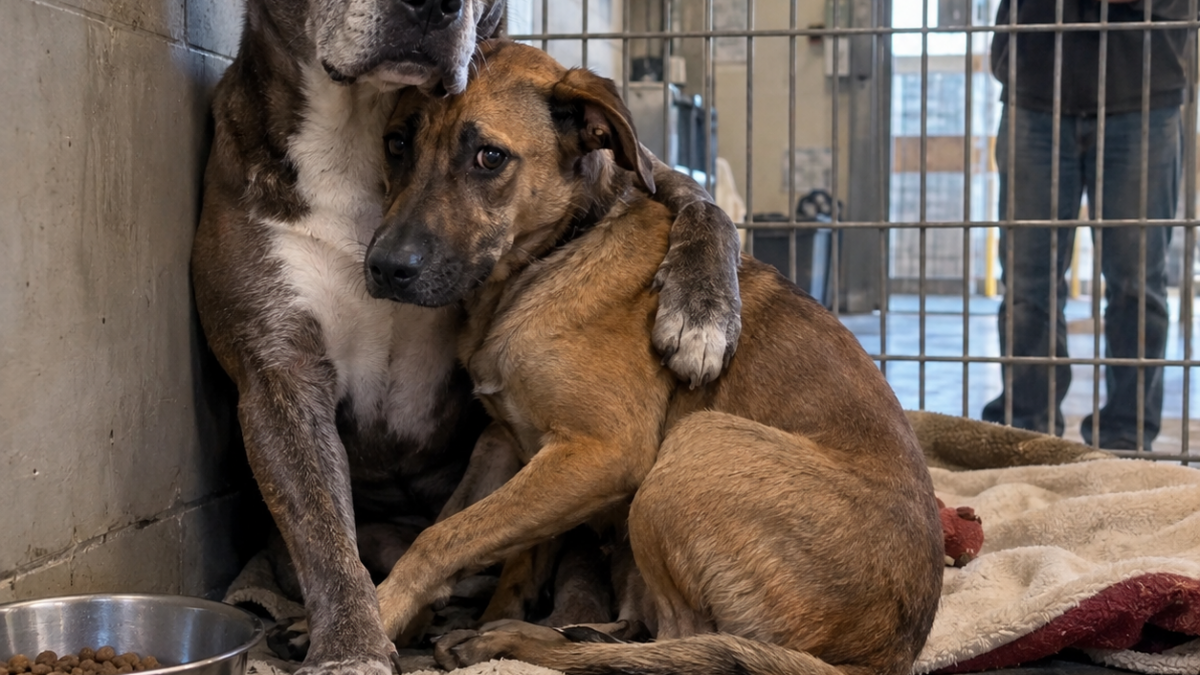
She walked over to him, sat beside him, and lifted her front leg.
Slowly, awkwardly, she placed it across his shoulders.
Fiete leaned into her.
Tilda pulled him closer.
And they stayed like that.
Two frightened dogs on a cold concrete floor.
Holding onto each other.
I stood there with food bowls in both hands and felt something inside me give way.
Because I knew that posture.
Not from dogs.
From hospital rooms.
My wife, Ellen, died after a long illness. People say that phrase because it is softer than describing the truth. Long illness sounds organized, like a road with signs. In reality, it was appointments, treatments, side effects, hope, bad news, new hope, worse news, pill bottles, insurance calls, nausea, pain, sleepless nights, whispered prayers, and the slow humiliation of watching a strong woman need help standing from a chair.
Near the end, there were nights when I had no idea what to say to her.
I wanted to fix it.
That was my worst instinct and my deepest failure. I had been a man who fixed things. Leaky faucet? Fixed. Broken step? Fixed. Car wouldn’t start? I’d try until it did. Loose cabinet hinge? Give me ten minutes.
But I could not fix cancer.
I could not bargain with her body.
I could not make the pain leave.
Some nights, all I could do was sit beside her and hold her hand.
After she died, I tortured myself with all the things I should have done.
Should have found a different doctor.
Should have noticed symptoms earlier.
Should have pushed harder.
Should have prayed better.
Should have said better words.
Should have been less tired.
Should have been braver.
Guilt is a cruel thing because it speaks in your own voice. It knows exactly which memories to use. It will take your best efforts and hold them up like evidence of failure.
For years, I believed sitting beside Ellen had not been enough.
But there in Kennel 17, watching Tilda hold Fiete because there was nothing else she could do, I wondered if I had misunderstood something.
Maybe being there was not nothing.
Maybe staying was not small.
Maybe a body beside yours in terror means more than any solution.
I set the bowls down quietly, took out my phone, and snapped one picture.
It was not a beautiful photograph.
The lighting was terrible. The kennel looked depressing. My thumb blurred one corner. Fiete’s face was partly hidden behind Tilda’s chest. Tilda’s leg looked almost human in the way it rested around him.
But it captured something I could not explain.
Something raw.
Something anyone with a heart would understand before words got involved.
I posted it on the shelter’s community page.
The caption was simple.
Tilda and Fiete have been together for seven months. This afternoon, they may have to be separated because we are out of space. We are still hoping someone has room for both.
Then I put my phone away.
Twenty minutes later, it started buzzing.
At first, I thought something was wrong.
Then I saw the notifications.
People were sharing the post.
Dozens.
Then hundreds.
Comments came fast.
Please, someone help them.
I’m crying at work.
They can’t be separated.
Where are they located?
Can donations help?
For the first time that morning, I thought maybe we had a chance.
By ten-thirty, the shelter phone was ringing nonstop.
Maya took calls at the front desk while trying to process two vaccine appointments. The director answered messages from her office. Volunteers started whispering about the post.
But one call after another ended the same way.
“I can take Tilda.”
“I wish I could take both, but I already have two dogs.”
“My apartment only allows one.”
“Can they be separated temporarily?”
“I can foster Fiete if someone else takes Tilda.”
Every offer came from a good place.
Every offer still split them.
By noon, the post had been shared more than two thousand times.
By one-thirty, nothing had changed.
The transport van was coming at three-thirty.
I walked past Kennel 17 three times without going in.
Tilda watched me each time.
Fiete stayed behind her.
At two o’clock, I carried Fiete’s leash down the hallway.
The moment he saw it, he backed behind Tilda.
Tilda stepped in front of him.
She did not bark.
She did not growl.
She did not bare her teeth.
She simply stood there.
Broad chest forward.
Gray muzzle lifted.
Between him and the world.
I sat down on the concrete outside the kennel and leaned my head back against the bars.
“I’m sorry, buddy,” I whispered.
Fiete pressed so tightly behind her that only one nervous eye showed.
Tilda looked at me for a long moment.
Then she walked to the gate, lowered her head, and rested it against my knee through the bars.
That nearly broke me.
Because there she was, the dog about to lose the one creature she had protected for seven months, comforting me.
“Ellen,” I whispered, though I hadn’t meant to say my wife’s name out loud.
I hadn’t said it much lately.
Not because I had forgotten.
Because saying it alone hurt.
Tilda closed her eyes while her head rested on my knee, and for a few seconds, I was back beside a hospital bed, holding a hand that had grown too thin, wishing love could become medicine if I poured enough of it into my grip.
My phone rang at 2:17.
I almost ignored it.
Then I saw the shelter number forwarding from the front desk.
I answered, wiping my face with my sleeve.
“This is Jim.”
A woman’s voice came through, breathless, nervous, but clear.
“Are Tilda and Fiete still there?”
“Yes.”
“My name is Rachel. I saw the photo. My friend Dana and I live together outside Delaware County. We have a fenced yard. We were planning to adopt one dog.”
I closed my eyes.
One dog.
There it was again.
Then she said the sentence that made me sit up straight.
“Can they stay together?”
I didn’t answer for half a second because I was afraid I had heard wrong.
“Yes,” I said quickly. “They need to stay together.”
“That’s what I thought.”
Her voice shook.
“We saw the picture. Dana said, ‘That dog is holding him like she knows.’ And I said, ‘Then we don’t get to be the people who pull them apart.’”
I stood so fast my knee cracked.
“Are you serious about both?”
“Yes. We need to ask questions. We want to do this right. But yes. We want to try for both.”
I started walking toward the office.
“Don’t hang up.”
“I won’t.”
“Maya!” I called down the hall.
Maya looked up from the desk.
I must have had a strange expression because she stood immediately.
“What?”
I covered the phone and said, “They asked if the dogs can stay together.”
For one second, nobody moved.
Then Maya put both hands over her mouth.
The process still mattered.
A viral photo could open a door, but it could not replace responsibility. Rachel and Dana had to answer questions. Housing. Yard. Work schedules. Vet history. Existing pets. Finances. Fearful-dog experience. Willingness to go slow. Understanding that Fiete might not become “normal” in a week or a month. Understanding that Tilda was not just a bonus dog but a living being with needs of her own.
They answered everything.
Not perfectly.
Honestly.
That mattered more.
They had a small home with a fenced yard. No other dogs. One older indoor cat who had lived with dogs before and had a room of her own if needed. Rachel worked from home. Dana was a school counselor. They had planned for one dog because they thought one was reasonable.
Then they saw the picture.
“We talked for ten minutes,” Rachel said later. “And then we both realized we were trying to talk ourselves out of what we already knew.”
The director approved a meet-and-greet for that afternoon.
The transport was placed on hold.
At 3:05, I walked back to Kennel 17.
The transport note was still clipped to the door.
Fiete saw me and trembled.
Tilda stepped forward.
I reached up and pulled the note down.
Tilda watched the paper in my hand.
“You two are staying together,” I said.
They could not possibly understand the words.
But Tilda’s tail moved.
Just once at first.
Then again.
Slow. Careful. Like she was afraid joy might be another thing that could be taken away.
By 3:40, Rachel and Dana arrived.
Rachel had dark curly hair pulled into a bun and red eyes from crying before she even entered the kennel area. Dana was taller, quieter, the kind of person who seemed to slow a room down simply by standing in it. They carried no baby talk, no excitement too big for frightened dogs, no assumptions.
That told me something good.
We brought Tilda out first.
She greeted them politely, sniffed their hands, leaned briefly into Dana’s leg, then turned toward the kennel.
“She wants him,” Rachel whispered.
“Yes,” I said. “She always does.”
When we brought Fiete out, he panicked at first. New people. New room. Too much attention. His legs folded, and he tried to scramble backward.
Tilda moved beside him.
Rachel immediately sat on the floor and turned sideways.
Dana did the same.
Neither reached for him.
Nobody pushed.
Nobody said, “Come on, buddy,” in that overly bright voice people use when they want fear to move faster than it can.
We waited.
Five minutes.
Ten.
Fiete stopped shaking quite so hard.
Tilda sniffed Rachel’s shoe.
Rachel smiled through tears but did not touch her.
Fiete stretched his neck.
Sniffed the air.
Took one step.
Then another.
By the time he touched Dana’s knee with his nose, everyone in the room was pretending not to cry.
The adoption wasn’t finalized that minute. It couldn’t be. We arranged a foster-to-adopt trial, home checks, slow transition, support from our trainer, and follow-up visits. But the decision had already found its shape.
At 5:12 p.m., Tilda and Fiete left the shelter together.
Not in a transport van.
Not in separate crates.
Together.
Tilda climbed into Rachel’s car first, then turned and waited.
Fiete hesitated at the open door until Tilda leaned down and sniffed his face.
Then he climbed in after her.
I stood in the parking lot long after the car disappeared.
Maya stood beside me.
“You okay?” she asked.
“No.”
She nodded.
“Good no or bad no?”
I watched the taillights vanish around the corner.
“The kind that feels like both.”
That night, I went home to my quiet house.
For the first time in a long time, the quiet did not feel quite so punishing.
I made coffee even though it was too late. Sat at the kitchen table. Looked at the chair across from me where Ellen used to sit with her crossword puzzles and her reading glasses perched halfway down her nose.
“I think I learned something today,” I said to the empty chair.
The house did not answer.
It never did.
But that night, the silence felt different.
Softer, maybe.
A few months later, an envelope arrived at the shelter with my name on it.
Inside was a handwritten note from Rachel and Dana, and two photographs.
The first was the photo I had taken.
Tilda and Fiete on the concrete floor of Kennel 17. Bad lighting. Blurry corner. Tilda’s leg wrapped around Fiete while he leaned into her like the whole world had narrowed down to that one safe place.
The second photo made me sit down.
Tilda was stretched out comfortably on a rug in their new home. The kind of rug people buy when they have decided dogs matter more than clean floors. Her gray muzzle rested on her paws. Her eyes were half closed.
Fiete lay beside her.
But this time, his front leg rested across Tilda’s back.
I stared at that picture for a long time.
At the shelter, Tilda had held him.
Now he was holding her.
Rachel’s note said Fiete still startled at loud noises, but he recovered faster. Tilda loved the yard and had claimed the sunny patch near the back door. Dana had started calling them “the old married couple,” even though Fiete was younger and Tilda still bossed him around. They slept together every night. They explored together. Fiete had learned to wag at the sound of Rachel’s voice. Tilda had learned to let him walk ahead sometimes.
The last line of the note said:
We thought we were adopting two dogs. We didn’t realize we were being trusted with a promise they had already made to each other.
I read that line three times.
Then I printed both photographs and placed them beside each other on my desk.
One showed fear.
One showed safety.
One showed holding on because goodbye was coming.
The other showed holding on because goodbye never came.
And somewhere between those two photographs, I finally understood something about my wife.
Maybe I had not failed Ellen because I couldn’t fix what was happening.
Maybe sitting beside her mattered.
Maybe holding her hand mattered.
Maybe the nights when I had no answers were not empty just because I had no cure.
Maybe staying matters more than we think.
I still miss her.
That did not change.
Grief is not a broken gate you repair once and never think about again. It is more like an old scar under weather. Some days, it is quiet. Some days, it aches before you know the storm is coming.
But after Tilda and Fiete, the guilt loosened.
Not all at once.
Nothing true ever does.
But enough.
Enough for me to say Ellen’s name more often.
Enough to sit at the kitchen table without feeling like I was being judged by the empty chair.
Enough to understand that love does not always look like saving someone from pain.
Sometimes it looks like refusing to let them face it alone.
Thousands of people shared that photograph.
Rachel and Dana gave Tilda and Fiete a home.
Maya fought for the time to make it happen.
The shelter canceled the transport.
Everyone played a part.
But I believe their rescue began long before anyone saw my blurry picture.
It began in Kennel 17, on a cold concrete floor, when one frightened dog looked at another frightened dog and made a choice.
Not with words.
Not with promises.
Not with any certainty that it would be enough.
Just a simple message, spoken in the only language that mattered.
You are not going through this alone.
And maybe, in the end, that is the promise every living heart is waiting to hear.








