They Used Her as Bait for Two Years—Then the Cat Missing Half Her Face Started Purring the Moment I Held Her
They Used Her as Bait for Two Years—Then the Cat Missing Half Her Face Started Purring the Moment I Held Her
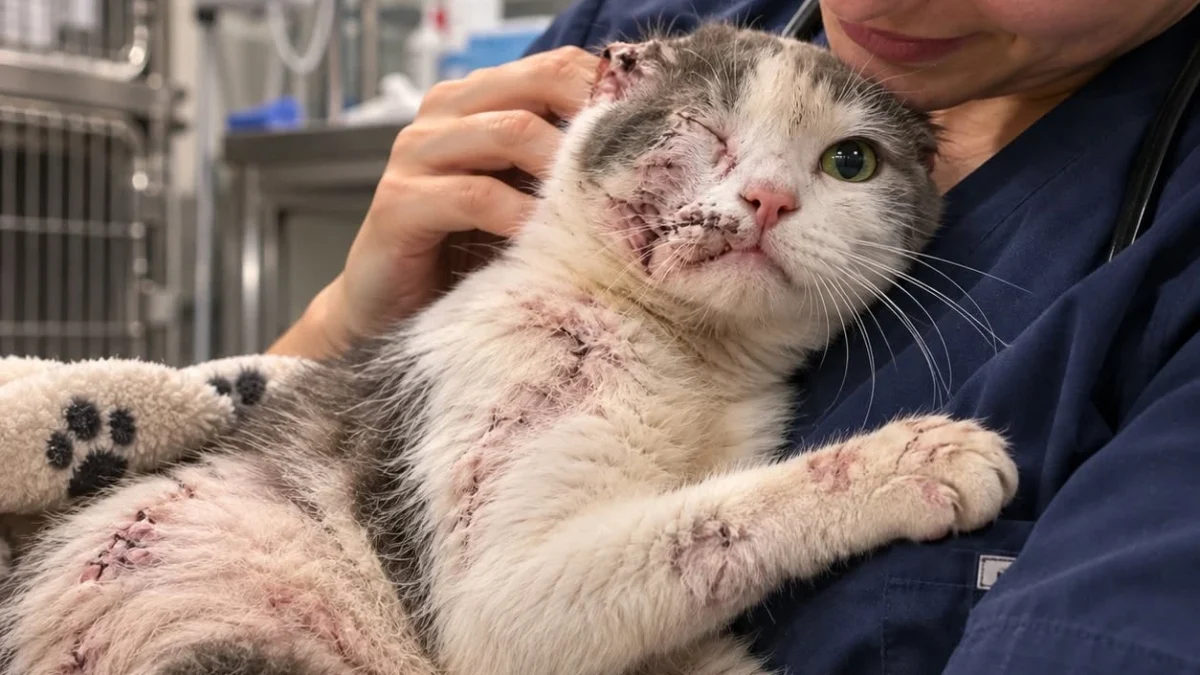
The little white-and-gray cat weighed barely four pounds when police carried her into our clinic, and at first I couldn’t understand how something so badly broken could still be alive.
Then I learned she had spent almost two years trapped in a tiny cage and repeatedly used to provoke fighting dogs, surviving injuries, starvation, and neglect no animal should ever have been forced to endure.
But when I lifted her against my chest, expecting terror, she pressed what remained of her face into my hand—and started purring so loudly I had to turn away before anyone saw me cry.
My name is Emily Carter.
I’ve worked as a veterinary technician for seventeen years.
I’ve seen animals hit by cars.
Dogs pulled from house fires.
Cats rescued from hoarding cases.
Puppies fading from diseases that could have been prevented.
Police K9s rushed through our doors after being injured on duty.
People sometimes ask how you do this kind of work without becoming numb.
You don’t.
At least, I never did.
You simply learn how to keep working while something inside you is hurting.
So you focus on numbers.
Temperature.
Heart rate.
Breathing.
Weight.
Medication.
Blood pressure.
You focus on the patient instead of imagining the story that brought them onto your table.
Because once you start thinking about the story, your hands can begin to shake.
Lace made that impossible.
She arrived on a humid afternoon in June.
We had already handled three emergencies before lunch.
A Labrador with heatstroke.
A kitten that had swallowed sewing thread.
An elderly Chihuahua struggling to breathe.
We were understaffed.
One exam room had no air conditioning.
I had skipped lunch and was halfway through a protein bar when our receptionist opened the treatment-room door.
“Emily?”
Something in her face made me stop chewing.
“What?”
“Law enforcement.”
My stomach tightened.
“How many animals?”
“One.”
Two officers entered carrying a small plastic carrier.
Neither man said much.
They didn’t need to.
I could smell the carrier before it reached the table.
Old bedding.
Medication.
Fear.
One officer set it down gently.
“We found her during a search.”
I crouched.
Inside was a tiny white-and-gray cat.
For several seconds, I couldn’t process what I was seeing.
Both ears were badly damaged.
Her tail was shortened from an old injury.
One eye was gone.
Scarring covered much of one side of her face.
Her body looked impossibly small beneath tangled fur.
And yet she was watching me.
Not growling.
Not hissing.
Watching.
“What’s her name?” I asked.
The officer shook his head.
“Don’t know if she has one.”
Later, paperwork would list her simply as Evidence Animal 6.
I couldn’t stand that.
So I called her Lace.
Because even damaged lace is still delicate.
Still worth protecting.
Dr. Grant entered and went completely silent.
“How long?”
The officer looked down.
“Best estimate? Close to two years.”
Two years.
My chest tightened.
We examined her slowly.
Old injuries.
Healing injuries.
Malnutrition.
PART2:
Evidence that her body had repeatedly been forced to survive things it never should have faced.
But there was one question I couldn’t stop thinking about.
How was she still willing to let a human touch her?
When we finished, I opened a clean towel.
“I’m going to move you now, sweetheart.”
I expected her to panic.
I slid one hand beneath her chest.
The other beneath her hips.
She weighed almost nothing.
I lifted her against me.
And Lace froze.
For one second, I thought I had made a mistake.
Then she slowly turned her head.
Pressed the scarred side of her face into my palm.
And started purring.
Not softly.
Loudly.
Her entire tiny body vibrated against my chest.
The room went silent.
One officer looked at the floor.
Dr. Grant took off her glasses.
I swallowed hard.
After everything humans had done to her, Lace was still trying to trust one.
And that was the moment I realized saving her body might not be the hardest part of what came next.








