They Tried to Take the “Healthy” Puppy Without His Injured Sister—Then He Broke Free and Revealed She’d Been His Ears All Along
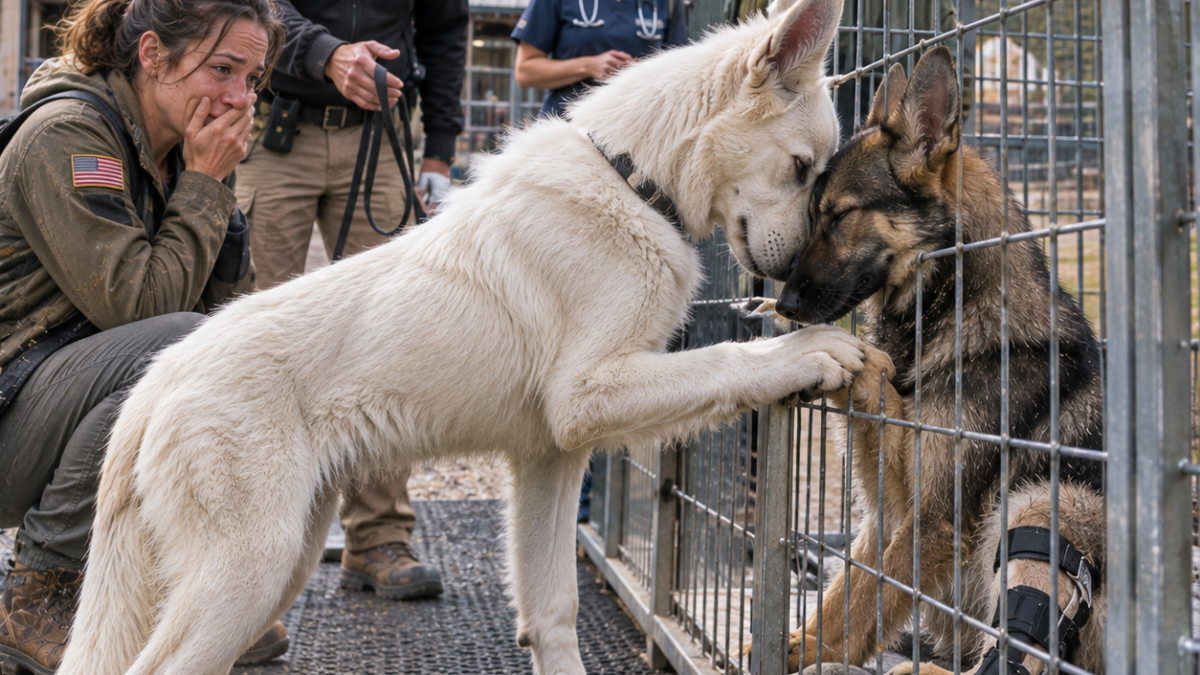
They Tried to Take the “Healthy” Puppy Without His Injured Sister—Then He Broke Free and Revealed She’d Been His Ears All Along.
The state handler clipped a new working collar onto the healthy white shepherd and called him “the one worth training,” while his injured sister watched from ten feet away with a brace supporting her damaged rear leg.
Then Ash slipped the leash and ran straight back to Ember—not because he was simply too attached to leave her, but because everyone at the working-dog center had missed something for six weeks: the puppy they were about to send away was profoundly deaf, and his injured sister had been acting as his ears.
What none of us knew yet was that Ember had already once crawled out of a wrecked transport crate on a shattered pelvis and stayed beside her trapped brother instead of escaping—and the photographs from that crash would expose an unused $10,000 insurance policy, stop them from being separated, and force me to decide whether I was still grieving my old dog or finally ready to let another two into my life.
The county handler clipped a new black collar around the white shepherd’s neck and said:
“This one’s worth training. The other one isn’t.”
Ten feet away, Ember watched.
She was seven months old.
Dark sable coat.
Fine-boned face.
One rear leg braced beneath her after a transport accident that had nearly ended her life before it had properly begun.
Her brother Ash stood beside the handler.
Same litter.
Same age.
Nearly opposite in appearance.
Ash was white.
Long-legged.
Oversized paws.
One ear perfectly upright.
The other tipped slightly outward.
Healthy.
At least that was what everyone believed.
I put down my coffee.
“Take the collar off.”
The training barn went quiet.
Grant Lowell looked at me.
“Hannah.”
“Take it off.”
“This isn’t your evaluation.”
“No.”
“Then why are you interrupting mine?”
PART2:
“Because your dog hasn’t heard one word anybody has said to him for twenty minutes.”
Nobody moved.
My name is Hannah Cross.
I was forty-three years old, formerly an urban search-and-rescue K9 handler and, at that point in my life, an insurance investigator specializing in commercial fire and property-loss claims across western Montana.
I had come to Granite Ridge Working Dog Center outside Missoula for one reason.
Six boxes.
Harnesses.
Long lines.
Training cones.
Scent containers.
Protective boots.
Equipment that had belonged to Juno.
My dog.
My partner.
My problem for eleven years.
And until eighteen months earlier, the loudest living thing in my house.
Juno had been a dark German Shepherd with terrible manners around cheeseburgers and extraordinary discipline everywhere else.
Together we worked collapsed buildings, wildfire evacuations, missing-person searches, industrial incidents, and enough certification exercises to convince both of us that concrete dust was simply part of the atmosphere.
Cancer ended her career.
Then it ended everything else.
PART3:
After she died, I left active search work.
People called the decision understandable.
I called it temporary.
Eighteen months later, temporary had become a very comfortable lie.
Granite Ridge had been training and placing working dogs for nearly twelve years.
Sheriff’s departments.
Conservation programs.
Search teams.
Specialized civilian placements.
Grant Lowell chaired the board.
Former sheriff’s captain.
Sixty-one.
Excellent administrator.
Good fundraiser.
The sort of man who could make donors feel personally responsible for the existence of every empty food bowl in Montana.
He also viewed kennel space the way airlines viewed empty seats.
Useful capacity had to move.
I understood why.
Granite Ridge was not wealthy.
Veterinary costs had exploded.
Two major grant renewals were late.
Four kennels needed repairs.
Thirteen dogs were waiting for intake.
Ash represented something Grant desperately needed.
A clean placement.
Young.
Healthy.
Driven.
Good nose.
Strong environmental confidence.
A state wildlife agency had spent the morning evaluating him for conservation scent work.
Hidden odor boxes?
Ash found them.
Food distraction?
Ignored.
Vehicle exposure?
Fine.
New handler?
Engaged.
Exactly the kind of dog programs wanted.
Ember had not even been evaluated.
Her leg had made that decision for her.
The transport accident occurred two months earlier.
Black ice outside Dillon.
Commercial canine transport van rolled.
Six dogs aboard.
No deaths.
Ember fractured her pelvis and damaged a rear leg badly enough that she still required physical therapy.
Ash appeared physically uninjured.
Everyone assumed that made the choice simple.
Healthy dog goes to work.
Injured dog goes into rehabilitation placement.
Grant had said some version of that twice before realizing I was listening.
The state handler, Ben Price, crouched beside Ash.
“Come.”
Ash kept watching Ember.
“Ash. Come.”
Nothing.
Ben gave the leash a gentle cue.
Ash followed.
Grant nodded.
“There.”
I did not.
The movement looked like obedience.
It wasn’t.
I had been watching Ash’s ears.
Someone dropped a steel bowl behind him.
Nothing.
A kennel gate slammed.
Nothing.
Ben called his name from behind.
Nothing.
But Ember shifted position.
Ash looked immediately.
Ember sat.
Ash glanced at her and sat.
Ember turned toward Ben.
Ash followed her gaze.
The handler began walking toward the transport vehicle.
Ember pushed herself upright.
Ash looked back.
Her weak rear leg trembled.
He stopped.
Ben gave another gentle cue.
“Come on.”
Ash took one step.
Ember’s brace snagged against the rubber mat.
She stumbled.
Ash spun so sharply the leash slipped through Ben’s glove.
He ran.
Not toward the parking lot.
Not through the open barn door.
Not toward freedom.
Straight back to Ember.
He stopped outside her enclosure.
She pushed her nose through the wire.
Ash pressed his forehead against hers.
Grant rubbed his face.
“This is exactly why we should’ve separated them earlier.”
I walked closer.
“Or exactly why you shouldn’t separate them before you understand what they’re doing.”
“They’re littermates.”
“That describes their genetics.”
“We’ve seen bonded pairs.”
“So have I.”
“And?”
“This doesn’t look like ordinary attachment.”
Ben looked at me.
“What are you seeing?”
I moved behind Ash.
Clapped once.
Nothing.
Grant frowned.
“What are you doing?”
I moved eight feet to Ash’s right.
“Ash.”
Nothing.
Ember’s ear rotated toward me.
She looked in my direction.
Ash immediately followed her gaze.
Ben’s expression changed.
I tried again.
“Ash.”
Nothing.
Ember turned.
Ash turned.
I looked at Grant.
“He can’t hear you.”
“No.”
“Possibly profoundly deaf.”
“He responds to commands.”
“He responds to Ember.”
Grant shook his head.
“He’s been here six weeks.”
“And how often do they train together?”
“Often.”
“There’s your answer.”
Ben crouched behind Ash.
Jingled keys.
Nothing.
Moved the keys into Ash’s vision.
Immediate focus.
Dr. Marcus Lee came from the medical building.
He repeated the test carefully.
Different angles.
Different sounds.
No reliable response outside Ash’s visual field.
Marcus looked toward me.
“You may be right.”
The state placement changed in less than five minutes.
That field program required dogs working at significant off-leash distance in rough terrain.
Reliable recall.
Environmental awareness.
A deaf dog might succeed in many kinds of work with adapted communication.
But pretending hearing did not matter in that particular assignment would have been dangerous.
Ben removed the new collar.
“I’m sorry.”
Grant’s jaw tightened.
“Let’s not make a decision from somebody clapping behind him.”
Marcus nodded.
“Agreed. BAER test Monday.”
Ben scratched Ash’s neck.
“If he’s profoundly deaf, our program can’t take him.”
Grant said he understood.
His voice told me he understood too well.
One placement gone.
One kennel still occupied.
One line of expected revenue erased.
Ash walked back to Ember.
Lay down against the fence.
She lowered herself on the opposite side.
Grant looked at me.
“You just cost us a state placement.”
“No.”
“They were prepared to leave with him today.”
“They were prepared to leave with a dog they didn’t understand.”
“You always do this.”
“What?”
“Walk in, tell everybody they missed something and walk back out.”
That was fair enough to sting.
Grant had tried to recruit me after Juno died.
I declined.
Then continued showing up occasionally and offering opinions for free.
Probably obnoxious.
He lowered his voice.
“We have dogs in temporary runs.”
“I know.”
“Ember may need another surgery.”
“I know.”
“Ash just lost his best opportunity.”
“Because he may be deaf.”
“We don’t know that yet.”
“Would you prefer not knowing?”
His expression changed.
“That’s unfair.”
Maybe.
I picked up my coffee.
“Get the test.”
I started toward my truck.
Behind me, Ash barked.
Loud.
Unusually loud.
Poorly modulated.
Another clue.
Grant called:
“Hannah.”
I turned.
“The evaluator leaves tomorrow.”
“So?”
“If we wait until Monday, we lose the slot regardless.”
“What are you asking?”
“One controlled off-site assessment.”
“No.”
“You don’t know what I’m going to say.”
“I know your proposal face.”
“Take Ash home overnight.”
“No.”
“One night.”
“No.”
“Separate environment. No Ember. Test visual cues, vibration response, auditory response.”
“You have staff.”
“They all work with him here.”
“Use another facility.”
“Storm tonight.”
I stared.
“You live fifteen minutes away.”
“That is geography, not qualification.”
“You handled a search dog for eleven years.”
“Had.”
“Exactly.”
There it was.
The word everybody avoided.
Had.
Juno had been gone eighteen months.
My mudroom still contained her gear.
Her collar.
Her old water bowl.
A wooden scent box I had not opened since she died.
I looked through the fence.
Ash had stretched one white paw beneath the divider.
Ember’s darker paw rested against it.
“One night,” Grant said.
“I bring him back in the morning.”
“Fine.”
Grant smiled.
“Don’t.”
“What?”
“Look pleased.”
“I wouldn’t dream of it.”
Two hours later, a seven-month-old shepherd who was probably deaf stood in my kitchen staring at Juno’s old water bowl.
I had not intentionally kept it there.
I simply had not moved it.
Those were different things.
At least that was what I told myself.
Ash sniffed the rim.
Then looked down the hallway.
Searching for Ember.
“She’s not here.”
He walked to the front door.
Sat.
Waited.
At 9:17, the storm reached us.
Wind.
Branches scraping roof shingles.
Rain against windows.
Ash slept through all of it.
Then lightning flashed.
His head snapped up.
Not thunder.
Light.
I dropped a spoon onto the tile behind him.
Nothing.
“Buddy.”
No response.
I tapped the floor twice.
Tap.
Tap.
The vibration traveled beneath his paws.
His head turned instantly.
There it was.
Communication.
Different.
Not lesser.
Different.
Ash could learn.
Then he left the door.
Walked into my living room.
Stopped beside the bookcase.
And stared at something I had avoided for eighteen months.
A wooden box.
Juno’s collar inside.
Her old scent article.
A piece of blanket sealed inside a training bag.
Ash lowered his nose.
Sniffed.
Then sat.
Perfect final response.
My throat tightened.
“Don’t.”
He looked at me.
He did not understand Juno.
He was not carrying some mystical message from a dead dog.
He smelled another working animal.
That was all.
The meaning belonged entirely to me.
I sat on the floor.
Reached for the box.
Stopped.
Reached again.
Opened it.
Juno’s collar lay exactly where I had left it.
I ran one finger over the buckle.
Ash watched.
Then walked away.
Which somehow made it easier.
The BAER test Monday confirmed everything.
Profoundly deaf.
Both ears.
Not selective.
Not partial.
Deaf.
Grant read the report twice.
Marcus leaned against the exam counter.
Ash watched Ember through the glass.
Grant finally said:
“How did nobody catch this?”
Marcus answered:
“Because he compensates extraordinarily well.”
“Six weeks.”
“He’s visual.”
I added:
“And he has Ember.”
Grant looked at me.
“You enjoyed saying that.”
“No.”
“Little?”
“Little.”
The state wildlife placement was formally withdrawn.
Then Grant said:
“We separate them today.”
I looked at him.
“Why?”
“Because now we need to know whether he can function independently.”
“He needs deaf-dog communication.”
“Yes.”
“Not isolation.”
“Independent assessment.”
Marcus intervened.
“Controlled separation could be useful.”
“Different wings?”
Grant nodded.
“No shared exercise.”
“That’s excessive.”
“I need data.”
“You need a fast answer.”
“We need both.”
Ember was moved to medical.
Ash remained in training.
First two hours:
Fine.
Then the staff notes changed.
Would not settle.
Checked doors.
Ignored food.
Barked toward empty hallways.
I returned after work.
Ash saw me.
Immediately looked behind me.
Searching for Ember.
“Sorry.”
His posture dropped.
That bothered me more than frantic behavior.
I brought him into the training room.
Hand signal.
Sit.
Excellent.
Down.
Excellent.
Short-distance visual recall.
Excellent.
Floor vibration for attention.
Improving.
Three scent boxes.
One birch odor.
Ash found it.
Sat.
Looked at me.
Again.
Same result.
Grant watched through the observation window.
“He could still work.”
“Possibly.”
“Facility detection.”
“Possibly.”
“Controlled industrial environments.”
“Possibly.”
“You sound disappointed.”
“I don’t know him well enough to be excited.”
That evening Ember’s therapist worked in the room next door.
Ash stopped twice.
Looked toward the wall.
Then resumed.
Could he feel vibration?
Smell her?
Recognize the schedule?
I did not know.
Anyone pretending certainty would have been guessing.
Marcus eventually brought Ember into the room.
Ash ran to her.
Ember did not run back.
She waited.
He approached.
She touched her nose to his cheek.
His entire body changed.
Shoulders lowered.
Breathing slowed.
He sat.
Grant said:
“She regulates him.”
“Yes.”
“Dependency.”
“No.”
“What would you call dependency?”
“If it only worked one direction.”
Ember approached a rehabilitation platform.
Low.
Padded.
Designed for controlled balance work.
She hesitated.
Her injured rear leg tightened.
Ash stepped onto the platform first.
Stopped.
Looked back.
Ember followed.
Halfway across, her foot slipped.
Ash stopped.
Did not finish ahead of her.
Did not circle frantically.
Simply waited beside her.
Ember regained balance.
They continued.
“He gives her confidence,” I said.
Marcus nodded.
“And she gives him environmental information.”
Grant folded his arms.
“They compensate for each other.”
“Exactly.”
“That makes separate placement harder.”
“Or gives you a reason not to rush.”
Grant sighed.
“Everything gives you a reason not to rush.”
“That is because rushing is frequently stupid.”
Marcus waited until Grant left.
Then:
“You’re excellent with people.”
“I investigate insurance fraud.”
“That explains a great deal.”
The next problem came from Ember’s leg.
Her original fracture had healed badly enough to place abnormal stress on the joint.
New imaging showed one fixation screw migrating.
Revision surgery.
Estimated:
$5,000 to $7,000.
Granite Ridge’s available medical fund:
$3,100.
Grant closed his office door.
“We cannot keep doing this.”
“She’s already here.”
“I know.”
“Then what?”
“A Boise special-needs rescue will take her.”
I looked at the paperwork.
Good organization.
Experienced medical fosters.
Real veterinary partners.
Nothing wrong with them.
Except Ash was staying in Montana.
“When?”
“Friday.”
“That is three days.”
“They have transport coming through.”
“And Ash?”
“Public adoption event Saturday.”
I stared.
“You’re putting a profoundly deaf adolescent shepherd into an adoption event the day after removing the dog he has used as environmental information his entire life.”
“We disclose deafness.”
“Good.”
“Experienced adopter required.”
“Good.”
“Then stop making this sound like we’re dumping him.”
That landed.
Grant was not wrong about everything.
Separation itself was not automatically cruelty.
Ash and Ember might eventually thrive apart.
Maybe even better.
I did not know.
That was the problem.
Nobody knew.
“Give me thirty days.”
Grant laughed.
“For what?”
“Paired assessment.”
“Who pays for Ember’s surgery?”
I had no answer.
“Who takes the waiting-list dogs?”
No answer.
“Who replaces the placement income we just lost?”
Still none.
His voice softened.
“Hannah.”
“What?”
“I know what you’re doing.”
“Tell me.”
“You’re saving Juno again.”
I stood.
“Careful.”
“I’m not insulting her.”
“Then don’t use her.”
“You lost one dog and spent eighteen months avoiding anything that might feel like losing another.”
“That doesn’t invalidate the evaluation.”
“No.”
He held my gaze.
“But you should ask whether you’re evaluating them or yourself.”
I hated him for saying it.
That usually meant I needed to hear it.
I left.
Sat in my truck twenty minutes.
Juno’s old collar was on the passenger seat.
I had brought it with me for reasons I had not examined.
Saving Juno again.
Maybe.
The following morning, I stopped arguing emotion.
I went looking for records.
Granite Ridge’s intake file said:
Commercial transport accident near Dillon.
Carrier:
Mountain West Canine Logistics.
I knew the company.
Not from rescue work.
Insurance.
Eight months earlier, I had handled a commercial fire claim involving the same operator.
I still had the insurer’s contact information.
My professional reason for reviewing the transport accident was legitimate.
I called.
Claims representative pulled the file.
“Animal injury coverage included.”
“Did the carrier submit a claim for the shepherd with the fractured pelvis?”
Pause.
“No.”
“Nothing?”
“They reported cargo transferred without loss.”
I looked through the medical window at Ember.
“She required orthopedic surgery.”
“That was never reported.”
“Coverage?”
“Up to ten thousand dollars per animal for veterinary treatment resulting from the transport accident.”
I closed my eyes.
There it was.
Not charity.
Not a donor miracle.
Insurance that should have been used from the beginning.
Enough to cover Ember’s revision surgery.
I requested claim instructions.
Then received the county crash report.
Twelve photographs.
I opened them one at a time.
Damaged van.
Broken cargo partitions.
Crates shifted.
Bent frame.
Then photograph seven.
Two carriers had collapsed against each other.
Ash’s door warped inward.
Ember’s crate door broken open.
Next photograph.
Ember outside her crate.
Blood on her rear leg.
Pressed against Ash’s damaged carrier.
Claw marks near his latch.
The rear of the van was open.
She could have escaped.
She did not.
She stayed with him.
I stared at the photograph.
Everyone had built a story around Ash.
Healthy brother protecting injured sister.
Ash refusing to leave Ember.
Ash following her everywhere.
Ash needing her.
But this image changed the story.
Ember had been badly injured.
Gotten free.
And instead of running away from the wreck, she stayed beside her trapped deaf brother until responders arrived.
Neither dog had spent its life carrying the other.
They had been taking turns.
Grant read the insurance letter twice.
“Ten thousand?”
“Maximum.”
“For accident-related care?”
“Yes.”
“Why didn’t Mountain West file?”
“They reported no cargo loss.”
“She had a fractured pelvis.”
“Apparently loss meant dead or missing.”
“That’s ridiculous.”
“Insurance language has achieved worse.”
Marcus studied the crash photographs.
Ember beside the warped carrier.
Blood beneath her.
Ash behind bent metal.
“This pays for surgery.”
“Yes.”
Grant tapped the photograph.
“Doesn’t automatically determine placement.”
“No.”
He looked surprised.
“I’m not asking you to promise they remain together forever.”
“Good.”
“I’m asking you to stop making permanent placement decisions because the budget assumes surgery is unfunded.”
Grant rubbed his jaw.
“The Boise rescue is still good.”
“I agree.”
“You agree?”
“Yes.”
“I called them.”
He narrowed his eyes.
“You called them?”
“They’ll hold Ember’s medical slot until after surgery and assessment.”
“You are operating around me.”
“I’m gathering options.”
“You’re not staff.”
“You’ve mentioned.”
Long silence.
Then:
“Thirty days.”
I stared.
“What?”
“Paired assessment.”
“You’re serious?”
“Do not make me regret this.”
“Impossible.”
“Document everything.”
“I will.”
“Independent behavior evaluation.”
“Yes.”
“No emotional language in your final recommendation.”
“Agreed.”
“And if the recommendation says they can be placed separately?”
That hurt.
More than it should have.
“I accept it.”
Ember’s revision surgery happened nine days later.
Successful.
Migrating hardware removed.
New fixation placed.
Strict recovery.
Ash became intolerable.
He wanted to follow every movement she made.
So we taught him another system.
Visual place command.
Hand to chest.
Palm down.
Point.
At first:
four seconds.
Then twelve.
Then thirty.
Ember crossed the room.
Ash trembled with effort.
Stayed.
Release signal.
He immediately went to her.
Progress.
Not forced independence.
Tolerance.
The distinction mattered.
We trained them separately.
Ate in separate rooms.
Short periods in different crates.
Individual walks.
Individual scent work.
Then reunions.
Ash learned:
Losing visual contact with Ember did not mean she had vanished.
Ember learned:
Ash could disappear through a doorway and come back.
Over time, both settled faster.
The independent behavior evaluator eventually wrote:
Bond strong but not pathologically inseparable.
Structured independence beneficial.
Pair placement preferred if appropriate qualified home is available.
Separate placement possible if performed gradually and with appropriate support.
That was exactly the kind of answer I trusted.
Complicated.
Not sentimental.
Then Grant crossed a line.
He had been negotiating with a private disaster-response contractor in Nevada.
They wanted Ash.
Confined-area scent work.
Warehouses.
Industrial campuses.
Fenced training environments.
Deafness was not automatically disqualifying.
On paper, I liked the concept.
Then I read their evaluation agreement.
Thirty days.
On-site housing.
No companion dog.
No gradual transition.
If unsuccessful:
Ash returned to Granite Ridge.
“When were you going to tell me?”
Grant leaned back.
“When terms were final.”
“Thirty days alone?”
“They need to evaluate independence.”
“We already have independent data.”
“For hours.”
“Sometimes overnight.”
“This is professional work.”
“So?”
“So he could have a real future.”
I stared at him.
“A real future compared to what?”
“You know what I mean.”
“No.”
I leaned forward.
“Say it.”
He looked toward the kennels.
“Ash is high-drive. He needs purpose.”
“And Ember?”
“Her orthopedic history limits options.”
“There it is.”
“Don’t twist my words.”
“You divided them into valuable and difficult.”
“I divided them by capability.”
“That is how the same thing sounds when you use administrative language.”
“They cannot build their lives around each other’s limitations.”
“Neither can people.”
Grant’s expression hardened.
“This is why I should never have let you conduct this.”
I slid the behavioral report across his desk.
“This is why you should read it.”
He did not touch it.
Then:
“The Nevada contractor is offering Granite Ridge a fifteen-thousand-dollar program donation.”
There.
Money.
Finally spoken aloud.
“Does Ash know he’s worth fifteen thousand?”
“Don’t do that.”
“What problem is this placement solving?”
“Both.”
Grant stood.
“We need money.”
“I know.”
“You found Ember’s insurance. Great. That pays a veterinarian. It does not pay employees.”
“I know.”
“People love to imagine rescues run on kindness.”
“I said I know.”
“They run on money.”
He looked exhausted.
“We need heating bills paid. Staff paid. Food. Liability insurance. Kennel repairs. Fifteen thousand keeps dogs alive.”
That stopped me.
Because Grant was not corrupt.
That would have been simpler.
He had fostered twelve dogs.
Driven transports through snowstorms.
Paid vet bills personally.
Spent years keeping Granite Ridge alive.
He was trying to make one placement help fund ten others.
That was exactly how dangerous compromises arrived.
Not looking evil.
Looking efficient.
“Send them the full behavioral report.”
Grant hesitated.
“Of course.”
“Including paired-placement preference.”
“They know the dogs are bonded.”
“That is not what I asked.”
Silence.
“Grant.”
“They do not need every internal recommendation before they evaluate him.”
“Yes, they do.”
“They’re professionals.”
“Then they can read.”
“If we overstate dependence—”
“It does not overstate it.”
“They may withdraw.”
“So?”
“Fifteen thousand dollars disappears.”
I stared at him.
Then he said:
“Send hearing records. Medical. Training scores. Let their evaluators form their own conclusion.”
“No.”
“Hannah.”
“No.”
“You are not authorized to contact them.”
“Correct.”
“So stay out.”
I picked up my phone.
“What are you doing?”
“Emailing Marcus and the independent evaluator that their written conclusion is being withheld from a prospective placement.”
His face changed.
“Do not make this bigger.”
“Send the report.”
“This is my organization.”
I looked around his office.
“No.”
He stared.
“It’s the dogs’ organization.”
Pause.
“You’re just the guy who currently holds the keys.”
That ended my advisory role.
Next morning:
Badge disabled.
Formal email.
Thank you for your volunteer service.
To preserve evaluation integrity and avoid conflicts, Granite Ridge was ending my advisory position.
Fair.
Grant had the authority.
I had pushed boundaries.
The independent evaluator, however, filed her report directly with the board.
Marcus documented Ash’s deafness.
Another board member insisted that the Nevada contractor receive everything.
They read it.
They withdrew.
Grant called me.
“Happy?”
“You sound like you think I wanted this.”
“Didn’t you?”
“No.”
“We lost fifteen thousand.”
“You avoided putting him into an assessment based on incomplete disclosure.”
“He is still occupying a kennel tomorrow.”
“Yes.”
“You blocked something.”
“Yes.”
“You didn’t solve anything.”
That one landed.
Because he was right.
Then:
“The thirty days end Monday.”
“I know.”
“Board voted tonight.”
My stomach tightened.
“If no qualified paired placement exists by Monday, we separate.”
“Ash?”
“Special-needs shepherd rescue in Colorado.”
“Ember?”
“Boise rehabilitation foster after surgical clearance.”
Both legitimate.
Both safe.
Three states apart.
Grant’s voice softened.
“I’m not punishing you.”
“It feels similar.”
“The clock is real.”
He hung up.
I went into the mudroom.
Juno’s room.
That was not its official name.
Just what I called it silently.
Harness.
Leads.
Old waterproof scent containers.
Training vest.
Empty hook where her working collar had hung.
I opened my laptop.
Qualified paired placement.
For thirty days I had demanded somebody find one.
I had apparently never considered that “somebody” could be me.
My house:
Two fenced acres.
Separate indoor spaces.
Quiet recovery area.
Eleven years of working-dog experience.
Flexible investigation schedule.
Financially stable.
No other animals.
Veterinary relationship.
Every qualification except willingness.
I opened the Granite Ridge adoption application.
Closed it.
Opened it.
First question:
WHY ARE YOU INTERESTED IN ADOPTING THESE DOGS?
I typed:
Because nobody else will.
Deleted.
That was not a reason to adopt.
It was panic.
Then:
Because they should stay together.
Deleted.
Also not enough.
Dogs do not exist to complete our preferred story.
I thought about Ash sitting at my front door the night of the storm.
Ember bleeding beside his crushed transport crate.
Juno’s collar.
Grant accusing me of trying to save her again.
Maybe adopting Ash and Ember because of grief would be unfair.
But refusing them because of grief meant grief was still making the decision.
I typed:
I am interested because after thirty days evaluating Ash and Ember, I understand their medical, behavioral and communication needs. I have the training background, property, schedule and financial ability to meet those needs, and I want them in my life even if neither dog ever performs a single day of professional work.
I stopped.
Read it.
Then added:
I am not applying to replace Juno.
I am applying because Ash is Ash, Ember is Ember, and I am finally willing to let that be enough.
Submit.
I did not sleep much.
Monday morning Grant found the application on his desk.
He called at 6:41.
“You have got to be kidding me.”
“No.”
“You waited until now?”
“I spent thirty days telling everybody not to rush.”
“That answer is deeply irritating.”
“I know.”
“You understand you don’t get special treatment.”
“I would be disappointed if I did.”
“Home inspection.”
“Fine.”
“Financial review.”
“Fine.”
“Medical-care plan.”
“Already attached.”
“Deaf-dog training plan.”
“Attached.”
“Ember rehabilitation schedule.”
“Attached.”
“Behavior follow-up.”
“Attached.”
Silence.
“You prepared all of this over the weekend?”
“Yes.”
“You are terrifying.”
“I investigate claims for a living.”
“Board meets at ten.”
“I’ll be there.”
“No.”
“What?”
“You don’t attend.”
“Why?”
“Conflict.”
“You’re serious?”
“Extremely.”
“So what do I do?”
“Wait like every other applicant.”
I hated that.
Which meant he was right.
At 10:17, I was sitting in my truck outside a grocery store pretending to buy coffee when my phone rang.
Marcus.
I answered.
“Well?”
“You are not supposed to be calling me.”
“Marcus.”
He laughed.
“Approved pending final home check.”
I closed my eyes.
“Both?”
“Both.”
I did not realize I had been holding my breath until it left.
“Grant?”
“Voted yes.”
That surprised me.
“Really?”
“Unanimous.”
“Why didn’t he call?”
“Probably because he wants you to suffer.”
“Reasonable.”
Granite Ridge performed the home inspection that afternoon.
Not Grant.
Independent board member and behavior consultant.
Fencing checked.
Gate latches.
Flooring.
Separate rest spaces.
Medication storage.
Emergency transport plan.
Visual doorbell system.
Smoke alarm with strobe.
Exterior lighting.
The consultant pointed toward the backyard.
“How will you recall Ash at distance?”
“Long line until vibration cue is conditioned.”
“Vibration collar as punishment?”
“No.”
“As attention cue?”
“Yes.”
“Backup?”
“Visual check-ins reinforced heavily.”
“Night?”
“Light signal.”
“What if Ember is not present?”
“Same system.”
She nodded.
“And Ember?”
“Rehab area here.”
I showed her.
Rugs.
No slippery flooring.
Ramp.
Restricted access to stairs.
She looked toward Juno’s old gear.
“You keeping that?”
“Yes.”
“For these dogs?”
“No.”
I thought about it.
“Maybe some equipment eventually. But Juno’s things are Juno’s.”
That answer seemed to matter.
Approval final.
Grant made me wait another day before pickup.
Probably because he enjoyed structure.
Tuesday morning, I arrived at Granite Ridge at 8:00.
Ash saw me first.
His eyes went behind me automatically.
Looking for Ember.
Then Ember appeared from medical on leash.
Ash’s entire body changed.
I crouched.
No dramatic speech.
No:
You’re coming home.
Ash could not hear it anyway.
I gave him the attention cue.
Two fingers toward my eyes.
Then open hand toward myself.
He focused.
I pointed toward the truck.
Ember followed.
Ash followed Ember.
Halfway there, Ember slowed because of her leg.
Ash stopped.
Waited.
I looked at Grant.
He was standing near the barn.
“You know,” he said, “there is an easier way to adopt a dog.”
“I wouldn’t know.”
“You could walk into a shelter and say, ‘That one.’”
“Sounds reckless.”
He looked toward Ash.
“Still think I’m the villain?”
“No.”
“Good.”
“I think you were wrong.”
“There she is.”
I smiled.
Then:
“You were right about one thing.”
He looked suspicious.
“What?”
“I was using Juno.”
Grant said nothing.
“For a while.”
He waited.
“I kept thinking accepting another dog meant admitting she was gone.”
Grant looked at the truck.
“And?”
“She was gone whether I adopted them or not.”
His expression softened.
“That’s usually how death works.”
“That was almost kind.”
“Don’t spread it around.”
I opened the rear door.
Ember climbed carefully onto the ramp.
Ash followed.
Then turned.
Looked toward Grant.
Grant raised one hand.
Ash did not know what it meant.
So Grant copied my visual goodbye signal.
Flat hand.
Small outward motion.
Ash watched.
Then turned toward me.
I shut the door.
The first week was chaos.
Not sentimental chaos.
Actual chaos.
Ash learned the vibration collar meant:
Look at Hannah.
Not punishment.
Not recall by itself.
Attention.
Buzz.
Look.
Signal.
Reward.
Again.
Ember hated physical-therapy exercises on Tuesdays and tolerated the same exercises on Thursdays for reasons none of us could identify.
Ash learned that the visual signal for “leave it” apparently did not apply to dish towels.
Ember learned to open the mudroom door with her nose.
I learned to install a better latch.
They slept separately at first.
That was intentional.
Not because I wanted them apart.
Because I wanted both dogs capable of resting without monitoring the other every second.
The first night Ash checked Ember’s room fourteen times.
Second night:
nine.
Fourth:
five.
Week two:
once.
Then one night he went to his own bed without checking.
I nearly celebrated.
Did not.
Progress did not need applause every time.
Ember’s rehabilitation continued.
Slowly.
Muscle returned.
Her gait improved.
She would never move exactly like an uninjured shepherd.
That did not matter.
Ash’s scent ability remained extraordinary.
I began recreational scent work.
Boxes.
Indoor searches.
Short controlled problems.
No pressure.
No career plan.
One afternoon he located birch odor beneath a shelving unit.
Sat.
Looked at me.
I rewarded.
Then he ran toward Ember and bounced like an idiot.
She ignored him.
I laughed.
That became enough.
Months later, Granite Ridge changed several intake procedures.
Basic sensory screening earlier.
Clear hearing checks before working placement.
Paired-dog evaluations documented as functional relationships rather than automatically labeled “bonded” or “dependent.”
Commercial transport claims reviewed for available medical coverage whenever injury occurred during contracted transport.
Grant called it:
“Things we should have been doing anyway.”
I said:
“That is the least flattering description possible.”
“Accuracy matters.”
The $10,000 transport insurance coverage paid the eligible accident-related veterinary costs associated with Ember’s injury, giving Granite Ridge the financial room to stop treating immediate separation as the only practical answer.
Grant also changed one other thing.
Donation-linked placements required complete disclosure of behavioral and medical evaluations.
He never said my argument caused the policy.
I never asked.
Mostly because I enjoyed being invited back onto the property eventually.
Six months after adoption, I went to Granite Ridge for a training seminar.
Not as staff.
Guest.
Ash came.
Ember stayed home because her leg was sore.
That mattered.
Six months earlier, Ash without Ember could barely settle.
Now he entered the barn.
Looked around.
Checked me.
Buzz.
Look.
Hand signal.
He followed.
Worked twenty minutes.
Rested.
A kennel gate slammed behind him.
He did not hear it.
Someone approached from outside his field of vision.
I gave the vibration cue.
He looked.
Adjusted.
Fine.
Grant watched.
“So he can function alone.”
“Yes.”
“You admit it.”
“Yes.”
He looked pleased.
“Don’t.”
“What?”
“Look pleased.”
He laughed.
When we returned home, Ember waited by the fence.
Ash saw her.
Ran.
She moved toward him.
He slowed before reaching her.
That was new.
No collision.
No panic.
No desperate pressing against her.
Just greeting.
Nose.
Shoulder.
Tail.
Then both wandered toward the house.
I stood by the gate watching them.
Keeping them together had never required keeping them helpless.
That was the part I had finally understood.
Their bond was not valuable because Ash could not survive without Ember.
It was valuable because they chose each other even after learning they could function apart.
The transport photograph stayed in my desk.
Ember injured.
Ash trapped.
She had every opportunity to run.
She stayed.
Months later, Ash had the opportunity to become independent.
He still came home to her.
Those were different things.
Both mattered.
One year after the day I interrupted the state evaluation, Grant called.
“You coming Saturday?”
“What’s Saturday?”
“Open house.”
“No.”
“Hannah.”
“I hate fundraisers.”
“You hate people.”
“I like specific people.”
“We’re doing a working-dog demonstration.”
“Still no.”
“Deaf-dog communication.”
I paused.
“Who?”
“Ash.”
“No.”
“You said he enjoys scent work.”
“At home.”
“We have a controlled search setup.”
“No professional expectation.”
“No.”
“Educational only.”
“No.”
“Ember can come.”
I sighed.
Grant knew exactly what he was doing.
Saturday arrived.
I went.
Ash demonstrated visual cues.
Vibration attention.
Short scent search.
Nothing impressive by working-dog standards.
That was the point.
A family in the audience had a deaf six-month-old shepherd mix.
The mother asked:
“Can a dog like that still have a normal life?”
I looked at Ash.
Then Ember.
“A normal life?”
I thought about my house.
Mudroom.
Destroyed towel.
Physical therapy.
Visual doorbell.
Scent boxes.
Two dogs fighting over one old blanket even though there were four beds.
“Unfortunately.”
She looked confused.
I smiled.
“Yes.”
Her daughter laughed.
After the demonstration, Ash went immediately to Ember.
Not because he had been terrified.
Not because he could not function without her.
Because she was there.
She sniffed his shoulder.
He dropped onto the grass.
Ember lay beside him.
Grant came over.
“Worth training?”
I looked at him.
“That sounds familiar.”
He grimaced.
“I deserved that.”
“Yes.”
He watched Ash.
“You know what I meant that day.”
“I do.”
“He looked like the easy placement.”
“I know.”
“Ember looked like a medical bill.”
“I know.”
Grant exhaled.
“That’s not a good way to see them.”
“No.”
“It’s sometimes how organizations survive.”
“I know.”
He glanced at me.
“That sounds almost forgiving.”
“Don’t get excited.”
He walked away.
I sat on the grass.
Ash rested beside Ember.
One white paw across her darker one.
Almost exactly like the morning at Granite Ridge.
Except everything that had looked like weakness then looked different now.
Ash had not run back to Ember because she made him broken.
He ran back because she was information.
Safety.
History.
Family.
And she had stayed beside him after the crash for exactly the same reason.
Everyone had looked at the healthy white dog and assumed he was carrying the injured one.
The truth was more complicated.
Ash used Ember’s ears.
Ember used Ash’s confidence.
He helped her cross unstable surfaces.
She helped him understand a world that could move without warning.
They could work separately.
Eat separately.
Sleep separately.
Travel separately for controlled periods.
They had learned all of it.
And at the end of the day, when given the choice, they still moved toward each other.
I understood that better than I wanted to.
For eighteen months after Juno died, I had called isolation peace.
It was not.
It was risk management.
If nobody came close enough to matter, nobody could leave.
Ash and Ember did not cure that.
Dogs are not prescriptions.
They did something less convenient.
They forced me to notice it.
One evening, almost two years after Juno died, I opened the wooden box again.
Her collar.
Her scent article.
Old photograph.
Ash walked in.
Sniffed the box.
Recognized the old dog smell.
Sat.
Same final response he had offered that first night.
This time I laughed.
“No.”
He stared.
“You don’t get paid for that anymore.”
He tilted his head.
I closed the box.
Placed it on a higher shelf.
Not hidden.
Not shrine.
Just part of the house.
Ember stood in the doorway.
Ash saw her.
Got up.
Went to her.
They disappeared down the hallway.
I followed.
That was the difference.
I followed.
I did not stay behind with the box.
The original state handler had called Ash “the one worth training.”
He had not meant anything cruel.
He saw a physically healthy young shepherd with working potential.
Ember looked injured.
Expensive.
Limited.
Then Ash slipped the leash and ran back to her.
Everyone thought that proved he was too dependent.
Instead it revealed the first clue.
Ash had not heard the command.
He had not heard his name.
He had not heard the bowl crash.
He had spent six weeks watching Ember’s ears, eyes and body to understand what everybody else could hear.
She had been translating the world for him without anyone realizing it.
Then the crash photographs showed she had done something even earlier.
Bleeding.
Pelvis fractured.
Transport door open.
She stayed beside Ash’s trapped crate.
He had spent months refusing to leave his injured sister.
But before any of us met them, his injured sister had already refused to leave him.
That was why I eventually stopped calling one the healthy dog and one the damaged dog.
Those words had been useful for paperwork.
They were useless for understanding them.
Ash was deaf.
Ember had an orthopedic injury.
Neither fact told me what either dog was worth.
Neither told me whether they could work.
Neither told me whether they should stay together.
Neither told me what kind of life they could build.
We had to learn that slowly.
Grant wanted efficiency.
I wanted certainty.
Both of us had to surrender something.
He learned not every expensive dog was a bad operational decision.
I learned not every separation was betrayal.
Ash learned Ember could disappear through a doorway and return.
Ember learned she could cross unstable ground without Ash standing beside her.
And I learned loving another dog after Juno did not replace the one I lost.
There was never a vacancy.
That had been the mistake in my thinking.
Juno did not leave a job opening.
She left a history.
Ash and Ember were not applicants for it.
One snowy morning, I opened the back door.
Ember went first.
Her leg stiff for three steps.
Then better.
Ash followed.
A snowplow passed beyond the fence.
Ember’s ears turned.
Ash saw her.
Looked toward the road.
Then back at me.
I gave the hand signal.
All good.
Ash relaxed.
Ember started down the path.
He followed for several yards.
Then stopped to investigate something beneath the snow.
She continued without him.
Neither panicked.
A minute later Ash ran to catch up.
Not because he needed his ears.
Not because she needed his courage.
Just because he wanted to.
I stood at the door watching.
The day I first saw them, everyone had been trying to decide which dog was worth saving.
The healthy one.
The trainable one.
The injured one.
The expensive one.
The deaf one.
The working prospect.
The rehabilitation case.
We had been asking the wrong question.
The better question was whether we were willing to understand the dogs actually standing in front of us before deciding what their futures should look like.
Ash slipped a leash and ran back to Ember.
That tiny act cost Granite Ridge one easy placement.
It uncovered his deafness.
It exposed unused insurance coverage.
It gave Ember the surgery she needed.
It forced a full behavioral assessment.
And eventually it forced me to open an adoption application I had spent eighteen months pretending I was not ready to fill out.
People later told the story as though Ash saved Ember.
Some told it the other way around.
Both versions were too simple.
They kept saving each other.
Sometimes by staying.
Sometimes by waiting.
Sometimes by stepping onto the difficult platform first.
Sometimes by looking toward the sound the other could not hear.
And eventually, by learning that love did not require either one to remain helpless.
That was the part nobody expected.
Not that the healthy puppy ran back to his injured sister.
But that after everything we taught them about independence, after both dogs proved they could stand on their own, they still chose to walk home together.








