They Tried to Evict Me on Christmas Eve for Defying the HOA—Then My Attorney Opened One Folder and Karen Went Silent.
PART2:
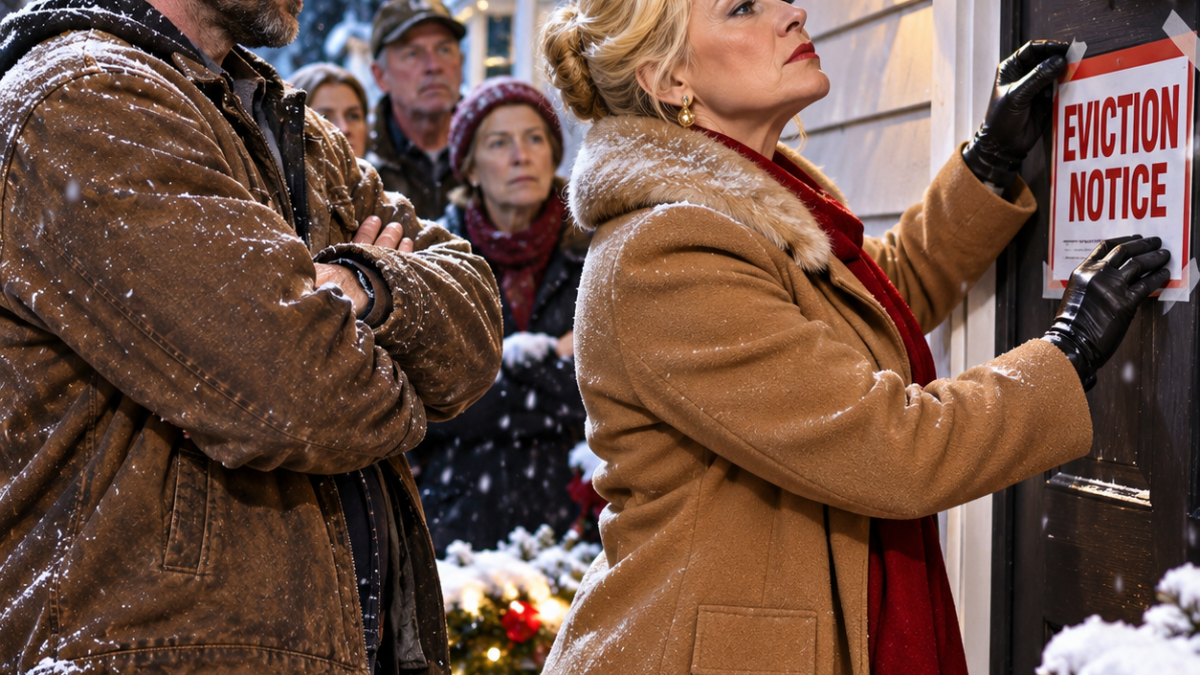
Blonde hair pinned neatly enough that even the wind seemed reluctant to disturb it.
Beverly did not merely occupy space.
She administered it.
She stopped at the edge of the porch light.
“Good evening, Mr. Mercer.”
“Beverly.”
“I wanted to make sure you received that personally.”
I looked down at the envelope.
“You succeeded.”
Her smile appeared.
Small.
Polished.
No warmth.
I opened it.
One page.
Ongoing noncompliance.
Outstanding balance.
Potential enforcement.
The number sat in bold type.
$2,400.
Below it:
CHRISTMAS COMMUNITY RESTORATION ASSESSMENT.
I read the page twice.
Then looked at her.
“This is the fee I already asked you to document.”
“It has been documented.”
“No. You sent me a flyer.”
PART3:
“The board approved it.”
“Then send me the minutes.”
Her smile tightened.
“The authority is the association, Gideon.”
I folded the paper.
“No.”
For the first time, she looked genuinely confused.
“No?”
“The HOA gets authority from its governing documents and state law. It doesn’t create authority by saying it has some.”
A curtain moved across the street.
Beverly noticed too.
That was why she was here instead of sending another letter.
She wanted witnesses.
“You have forty-eight hours,” she said.
“To do what?”
“Pay.”
“And if I don’t?”
Her voice remained pleasantly conversational.
“Collections.”
I waited.
“Additional fines.”
I kept waiting.
“A lien.”
There it was.
“And if necessary,” she continued, “foreclosure.”
A couple two houses down had stopped carrying groceries.
They were listening.
Beverly knew it.
“I have done it before,” she said.
Then she gave me the part she wanted everyone to remember.
“And I don’t care that it’s Christmas.”
I studied her.
No raised voice.
No threat in mine either.
“Have you checked the entire file, Beverly?”
She laughed.
Bright.
Sharp.
“Is that supposed to frighten me?”
“It’s a question.”
“I’ve checked everything I need to check.”
“All right.”
She waited.
Maybe she expected something more.
An argument.
Anger.
A payment offer.
Instead, I slid the notice into my jacket.
“Good night.”
She stared at me for a second.
Then turned.
Her heels clicked down the salted driveway.
I watched her walk away until she reached the sidewalk.
That evening Beverly Crane believed she had just humiliated an ordinary homeowner in front of his neighbors.
She believed I was a quiet forty-one-year-old man with an aging truck and one modest house.
She was correct about the truck.
She was wrong about almost everything else.
The house on Larkspur Lane was one of fifteen properties I owned inside Willow Creek.
And the fifteenth was a property Beverly knew more intimately than she could possibly imagine.
But I had no intention of telling her yet.
Three weeks earlier, I had not been on Beverly’s radar.
That was what made the whole thing interesting.
For years, I was the kind of resident HOA presidents liked.
Dues paid automatically.
Lawn maintained.
No loud parties.
No boat in the driveway.
No political signs.
No complaints.
I had attended exactly one annual meeting in eight years.
Beverly probably would have continued ignoring me if she had not decided December required a campaign of compliance.
The first notice said my garbage cans were eleven inches too visible from the street.
I moved them.
The second said my porch light was not on the approved fixture list.
The fixture had been approved six years earlier.
I still replaced it.
The third said my truck had remained stationary in the driveway longer than seventy-two hours.
It was a week when snow had fallen every day and I worked from home.
I moved the truck around the block.
The fourth violation involved a small illuminated wooden sign beside my walkway.
PEACE.
My mother had given it to me years earlier.
Beverly’s notice said the decoration exceeded the maximum holiday display dimension by four inches.
I measured it.
She was technically correct if you interpreted the most restrictive version of the decorative guideline.
So I took a saw to it.
Four inches.
Done.
Every time I corrected something, I sent one email.
Issue corrected.
Thank you.
No argument.
That was my mistake.
Or Beverly’s.
She interpreted cooperation as fear.
People like Beverly often do.
Then the glossy flyer arrived.
CHRISTMAS COMMUNITY RESTORATION ASSESSMENT.
It promised upgraded winter landscaping, repairs to decorative lighting, restoration of common-area fencing, and “preservation of the premium holiday character expected within Willow Creek Estates.”
The amount was not clearly printed.
Residents received individual invoices.
Mine was $2,400.
Payment due in nine days.
I sat at my kitchen table that night with black coffee and opened the association documents.
Most homeowners never read HOA declarations.
I understand why.
They are an effective treatment for insomnia.
But I had bought enough property to develop a certain respect for boring documents.
The Willow Creek declaration said special assessments above $500 required specific advance notice, a quorum, and a membership vote.
I checked the board minutes.
No vote.
Checked the notices.
Nothing.
I emailed Beverly.
Please provide the governing authority approving the Christmas Community Restoration Assessment, including the meeting minutes and owner vote required under the declaration.
That was all.
She did not answer.
Instead, she began talking about me.
At the mailbox cluster.
At a cookie exchange.
In the clubhouse.
“The man on Larkspur Lane refuses to contribute.”
“He thinks the rules don’t apply to him.”
“He wants everyone else to pay while he benefits.”
That kind of thing.
Within a week, people who had waved at me for years stopped waving.
A woman who lived near the corner actually crossed the street when she saw me approaching.
I noticed.
Said nothing.
Walter Hollis noticed too.
Walter was seventy-eight.
Retired machinist.
My next-door neighbor.
Widower.
The kind of man who owned six hammers because each one was obviously for a different purpose.
I was salting my steps one evening when he leaned against the fence.
“Son.”
“Walter.”
“I’m going to tell you something you didn’t ask for.”
“That usually means it’ll be interesting.”
He smiled.
“Beverly Crane doesn’t like no.”
“I gathered.”
“I’ve watched her make life miserable for three families.”
“I’m not trying to make her like me.”
“That isn’t what I said.”
I scattered more salt.
Walter watched.
“She’ll keep pushing.”
“I know.”
“You worried?”
“No.”
He looked at me longer.
Then laughed softly.
“Interesting.”
“What?”
“Nothing.”
He went inside.
That night I sat at the desk in my upstairs spare bedroom.
Opened my laptop.
A spreadsheet came up.
PROPERTY PORTFOLIO.
Fifteen active properties inside Willow Creek.
Larkspur Lane.
Cedar Hollow Drive.
Juniper Way.
Aspen Ridge.
Brier Court.
A pair of duplexes close to the clubhouse.
A brick ranch near the retention pond.
A corner house with an old oak tree I had spent four thousand dollars saving after a storm split one branch.
Most were owned through Northgate Residential Holdings.
I had bought them one by one over nine years.
Not as trophies.
Not even originally as a strategy.
I started life as an electrician.
Then became a contractor.
Then built a renovation company.
Eventually I discovered I was better at buying houses with problems than houses without them.
Sometimes the problem was structural.
Sometimes financial.
Sometimes human.
A machinist lost his job at fifty-eight and was six weeks from foreclosure.
I bought the house and leased it back below market until he retired.
A nurse’s husband was badly injured and medical bills buried them.
I bought their home, cleared enough debt for them to breathe, and let them stay.
A widow could not afford a major foundation repair.
I bought the property and gave her a lifetime lease.
None of those stories belonged in HOA newsletters.
So nobody knew.
There was another reason I kept my finances private.
When I was fifteen, a bank took my parents’ home.
December twenty-third.
Two days before Christmas.
I still remembered my father standing in our kitchen folding a foreclosure letter into smaller and smaller squares.
My mother cried quietly at the counter because she did not want my younger sister to hear.
I remembered a deputy at the door.
Cardboard boxes.
The Christmas tree coming down before Christmas.
I had promised myself something that night.
I would never become powerful by making another person feel that small.
And I would never again allow someone to take a home from me merely because they assumed I had no way to fight.
So I closed the spreadsheet.
I did not tell Beverly anything.
The HOA special meeting happened Thursday.
The clubhouse was decorated with poinsettias and sugar cookies.
About forty residents attended.
Beverly sat behind the board table like a judge.
Marjorie Voss, secretary, sat beside her with reading glasses hanging from a chain and a laptop open.
Glenn Whitaker was next.
Glenn agreed with whichever confident person had most recently spoken.
Denise Albright sat farther down, mostly looking at her phone.
At the end sat Raymond Pike.
Retired accountant.
Gray mustache.
Quiet.
Raymond said almost nothing during most meetings.
But I noticed something.
He listened.
Beverly opened a slideshow.
First slide:
GIDEON MERCER — LARKSPUR LANE.
Next:
Photograph of trash cans.
Next:
Porch light.
Truck.
Holiday sign.
One violation after another.
“This homeowner,” Beverly said, “has demonstrated a consistent pattern of resistance to community standards.”
I sat in the back row.
Did not move.
“He is uncooperative.”
Click.
“He disregards our rules.”
Click.
“And now he refuses his financial obligation to the community.”
She spoke for nearly twenty minutes.
Never mentioned that I had corrected every violation within twenty-four hours.
Never showed my emails.
Never mentioned my request for the assessment vote.
When she finished, she looked toward me.
“Mr. Mercer. I see you finally decided to attend.”
Forty faces turned.
“Would you like to explain yourself?”
I stood.
Stayed where I was.
“One question.”
Beverly folded her hands.
“Who approved the assessment?”
“The board.”
“Where are the minutes?”
Her expression did not change.
“And where was the membership vote required under the declaration?”
A few heads turned toward the board.
Raymond looked up.
Beverly’s voice cooled.
“There is no reason to turn this into a legal dispute.”
“You threatened enforcement.”
A coffee cup clicked onto a saucer.
I continued.
“I’m asking for the record that authorized the charge.”
“The board has broad discretion.”
“Not for an assessment above five hundred dollars.”
Someone whispered.
Beverly leaned toward the microphone.
“If you dislike the way this community operates, Mr. Mercer, you are free to sell your house and leave.”
A few people nodded.
I let the silence sit.
“I’m not selling.”
“Then you’ll face the consequences.”
For the first time, I smiled.
Barely.
“I think you will too.”
She adjourned the meeting.
Immediately.
That told me more than another hour of debate would have.
Outside, Walter gave me a slow nod.
Raymond Pike left last.
He looked thoughtful.
At home, I made coffee.
Checked my phone.
One email.
No subject.
One sentence.
They have now crossed the line. We can proceed.
The sender was Dorian Vale.
My attorney.
The official violation notice came three days later.
It listed old violations I had already corrected.
Added penalties.
Added late charges.
Balance:
$3,100.
Then came a collection letter.
Then notice of intent to record a lien.
Beverly was escalating exactly as expected.
She also escalated socially.
Homeowners on Cedar Hollow received calls.
People on Juniper.
She suggested I might be in financial trouble.
Said I was becoming dangerous to the stability of the neighborhood.
By mid-December, I was apparently one missed payment away from financial collapse, while somehow also plotting to destroy the HOA.
Rumors rarely require internal consistency.
I collected them.
Dates.
Witnesses.
Emails.
Notices.
Postmarks.
Meeting records.
By the time I carried the binder into Dorian’s office, it weighed almost six pounds.
His firm occupied the ninth floor of a downtown building overlooking the frozen river.
Dorian was fifty-eight.
Silver hair.
Dark suits.
Thirty years in real estate law.
He had represented me since my contracting company was small enough that I answered my own emergency calls.
He read the binder for ten minutes.
No comment.
Then removed his glasses.
“They have no idea who they’re dealing with.”
“I don’t want revenge.”
“Good.”
“I want them to follow the rules.”
Dorian smiled.
“That’s considerably worse for them.”
I leaned back.
He tapped the binder.
“The assessment appears unauthorized.”
Tap.
“Notice requirements weren’t met.”
Tap.
“The penalties are built on a charge that may not exist.”
Tap.
“She is potentially making defamatory statements about your finances.”
“I don’t care about that.”
“You may care later.”
“I care about the assessment.”
“So do I.”
He pulled out an email forwarded to him by another homeowner.
Beverly had written to board members:
We need all enforcement against Mercer completed before the holiday so this matter is closed before the new year.
Dorian said, “She’s rushing.”
“So?”
“Confident people with good documents usually don’t rush.”
That evening, Beverly held a private meeting at her house on Brier Court.
I learned the details later.
Marjorie and Glenn attended.
No membership notice.
No agenda.
Denise excluded.
Raymond excluded.
Beverly’s plan was simple.
Lien before December twentieth.
Final notice on the twenty-second.
Foreclosure authorization Christmas Eve.
Glenn apparently asked the obvious question.
“Christmas Eve?”
Beverly replied:
“That’s when people remember who is in charge.”
That sentence eventually mattered.
At the time, Beverly still believed I was a man with one house.
Two days later, Dorian rolled a large Willow Creek plat map across his conference table.
Every one of the 112 lots appeared.
He uncapped a red marker.
Circle.
My house.
Circle.
Cedar Hollow.
Juniper.
Aspen.
Brier.
One by one.
Fifteen marks.
He capped the marker.
“You hold more than ten percent of the voting interests.”
“Through Northgate.”
“Fourteen are clearly under Northgate.”
“And the other?”
Dorian looked toward the final circle.
Brier Court.
“We both know why that one’s separate.”
I said nothing.
Six years earlier, Beverly Crane had gone through a vicious divorce.
I did not know her then.
Not personally.
Her ex-husband forced sale issues into court.
Debt piled up.
The bank began foreclosure proceedings on the house.
A broker contacted one of my acquisition managers about a confidential sale-leaseback.
The seller was desperate to remain in the home and did not want the neighborhood to know she had lost ownership.
We structured the purchase through Brier Court Trust.
Paid enough to satisfy the bank.
Allowed her to stay as a tenant.
Long lease.
Reasonable rent.
Confidential management.
I had never met the seller.
Not during the transaction.
Not until years later.
By the time I realized it had been Beverly, the arrangement had been running smoothly.
I kept it private.
It was none of anybody’s business.
Recently, however, rent had stopped.
Four months.
My property manager had asked whether to issue default notices.
I said no.
It was November.
Then December.
I knew what foreclosure threats felt like near Christmas.
So Beverly had spent four months not paying rent on a house I owned while threatening to take my home over an unauthorized HOA fee.
I found the irony unpleasant rather than satisfying.
Dorian slid a copy of Article Seven toward me.
One vote per lot.
Owners controlling ten percent or more of voting interests could demand a special meeting and full financial inspection.
We exceeded the threshold.
“Do I use it?”
I asked.
Dorian folded his hands.
“How many choices is Beverly leaving you?”
Before I answered, Beverly discovered fourteen houses on her own.
Kelsey Dunar caused it accidentally.
Kelsey rented my brick ranch on Cedar Hollow.
At the holiday cookie exchange, she mentioned to Marjorie that she did not understand why anyone thought I was cheap or irresponsible.
“He’s my landlord,” she said. “My furnace died last winter and he drove through a storm at midnight to replace the ignition himself.”
Marjorie reported that to Beverly.
Beverly laughed.
Apparently she said:
“That man? He drives an eleven-year-old truck.”
Because obviously vehicle age determines title ownership.
But she told Marjorie to check county records.
Marjorie did.
Northgate Residential Holdings.
Fourteen Willow Creek addresses.
Registered manager:
Gideon Mercer.
Beverly called an emergency meeting.
Subject:
PROTECTING WILLOW CREEK FROM OUTSIDE CONTROL.
The clubhouse was packed.
Beverly took the microphone.
“I have learned that Mr. Mercer has been secretly purchasing homes throughout our community.”
Secretly.
As if deeds were covert operations.
“He intends to use his financial influence to control Willow Creek.”
People murmured.
I stood near the back.
Then walked forward.
Placed a single sheet in front of Beverly.
Fourteen addresses.
Raymond counted.
“Fourteen?”
“Yes.”
Beverly looked at me.
I said, “There’s a fifteenth.”
Her eyes narrowed.
“It isn’t on that page.”
“Why not?”
“Because it doesn’t need to be tonight.”
Then I faced the room.
“I don’t use money to control anyone.”
The room quieted.
“I’ve owned these properties for years. Most of you never knew because it didn’t matter.”
I looked toward Beverly.
“It still shouldn’t matter.”
Then back at the residents.
“I’m asking this board to follow the same rules it expects each of you to follow.”
Denise put her phone down.
“Beverly, was there actually a membership vote?”
A woman near the front raised her hand.
“I paid $2,400.”
Another woman stood.
“My sister paid eight hundred.”
That got attention.
“Why are the amounts different?”
Beverly tried to redirect.
People kept asking.
Then Raymond opened a binder.
He had kept printed minutes from every board meeting because retired accountants apparently consider document retention a recreational activity.
“Beverly.”
His voice was quiet.
Everyone heard it.
“The October minutes say six owners attended and unanimously approved the assessment.”
Beverly went still.
Raymond turned the binder.
“I attended that meeting.”
He looked around.
“There were three people.”
Then at the head table.
“Beverly. Marjorie. Me.”
Marjorie stopped typing.
Raymond continued.
“Nobody voted.”
Silence.
“You said the proposal would go to the membership in November.”
Beverly recovered quickly.
“The minutes were a draft.”
“They were distributed as approved minutes.”
“This is not the time—”
She adjourned the meeting.
Again.
Walked out without her gloves.
The next morning Dorian filed the Article Seven demand.
Bank statements.
Invoices.
Ballots.
Meeting records.
Assessment calculations.
Vendor payments.
Everything.
The management company eventually complied.
Dorian spent the night reviewing it.
The next morning I sat across from him.
He placed documents in front of me.
“No proper notice.”
Next.
“No owner vote.”
Next.
“False meeting attendance.”
Next.
“Different owners were billed different amounts.”
He showed me a spreadsheet.
Residents Beverly considered cooperative had often been charged $800.
Residents labeled difficult:
$2,400.
Rental properties:
Usually the highest tier.
Then the account.
WILLOW CREEK HOLIDAY RESTORATION FUND.
Not a normal HOA reserve account.
One signer.
Beverly Crane.
I stared.
“How much?”
He gave me the figure.
“Spent?”
“About nine thousand.”
“Where?”
He placed an invoice in front of me.
Landscaping.
Company name unfamiliar.
“Who owns it?”
“Her brother-in-law.”
“Did they do the work?”
“Not according to the maintenance records.”
I leaned back.
For the first time, I was angry enough that silence required effort.
Dorian watched me.
“What do you want to do?”
“Ask her.”
He looked genuinely disappointed.
“She has been asked.”
“Not about this.”
“Gideon.”
“One opportunity.”
“You’re kinder than I am.”
“No.”
I looked at the bank statement.
“I remember people assuming my father was a thief because he couldn’t pay his mortgage.”
Dorian stopped.
“I don’t know what happened here yet.”
He nodded slowly.
“All right.”
I wrote Beverly directly.
Asked for an accounting.
Asked about the false minutes.
Asked about the separate fund.
Asked about inconsistent assessments.
Offered a private meeting before Christmas.
She responded within an hour.
The association does not answer to individual homeowners.
The records demand constitutes harassment.
Enforcement against your property will continue as scheduled.
Signed:
Beverly Crane
President
I forwarded it to Dorian.
His reply:
Now?
I wrote:
Now.
His office delivered formal notice to every board member.
Not just Beverly.
Every one.
Numbered paragraphs.
Missing vote.
False minutes.
Improper notice.
Unequal billing.
Undisclosed account.
Related-party payments.
Each supported by documents.
Final line:
Resolve these matters within the prescribed period or my client will pursue all available lawful remedies.
No insults.
No threats beyond the law.
That letter changed the board.
Raymond called Denise.
Glenn stopped answering Beverly.
Marjorie searched her laptop for her original October notes.
She found them.
Three people present.
No vote.
Beverly still pushed forward.
Some people retreat when evidence stacks against them.
Beverly interpreted retreat as humiliation.
She would rather lose harder than stop.
Christmas Eve.
Six p.m.
My front door.
I learned about the plan because Denise was accidentally copied on an email.
I called Dorian.
“She’s coming tomorrow.”
“Good.”
“Good?”
“She is choosing the stage.”
“So?”
“So we’ll use it.”
Christmas Eve arrived under heavy snow.
Larkspur Lane looked almost unreal.
Luminaries along sidewalks.
Warm windows.
Children shouting somewhere behind a house.
Church bells in the distance.
At six precisely, headlights crossed my living room wall.
I set down my coffee.
Opened the front door.
Beverly came up the walkway.
Marjorie behind her.
Glenn.
A process server carrying a clipboard.
Neighbors appeared almost immediately.
Walter stood near our fence wearing boots under his bathrobe.
Kelsey had driven over.
Raymond waited at the end of my driveway.
Denise stood near him.
Beverly reached the porch.
The process server handed her the paper.
She personally taped it to my door.
NOTICE OF DEFAULT AND INTENT TO FORECLOSE.
She smoothed each corner.
Turned.
“This is your final notice, Gideon.”
I looked at the document.
For a moment I was fifteen.
Different house.
Different snow.
My father folding paper.
My mother staring at an empty kitchen.
I could smell the cardboard boxes again.
Then the memory passed.
Beverly smiled.
“You’re done here.”
“No.”
Her smile remained.
“No?”
“No.”
“This is a lawful enforcement notice.”
“Are you sure?”
She laughed.
There it was.
That same brittle laugh from the first night.
“You think your attorney is going to save your house?”
I shook my head.
“No.”
Then looked past her.
A black sedan turned onto Larkspur Lane.
It stopped at the curb.
Dorian stepped out wearing a charcoal overcoat.
A notary came out behind him.
Then a title examiner carrying accordion files.
The neighbors moved aside.
Dorian climbed my steps.
“Mrs. Crane.”
“Mr. Vale.”
He handed her a bound response.
“This is our formal reply on behalf of Gideon Mercer and Northgate Residential Holdings.”
She opened it.
Read.
First page.
Second.
Her face changed.
False minutes.
Improper assessment.
Separate account.
Related-party payments.
Dorian waited.
Then handed her another set.
“And this is a property ownership disclosure.”
Beverly barely glanced at it.
“I already know about his houses.”
“No.”
Dorian’s voice stayed almost gentle.
“You know about fourteen.”
He gave her one final page.
FIFTEEN PROPERTY OWNERSHIP DISCLOSURES.
She looked down.
The first fourteen meant nothing new.
Then the fifteenth.
Brier Court.
Her address.
Her face emptied.
I heard someone behind us whisper:
“What?”
Beverly read the line again.
Then looked at me.
“No.”
Dorian said nothing.
“That property belongs to Brier Court Trust.”
“Yes.”
“This has nothing to do with him.”
Dorian opened the title file.
“Brier Court Trust is controlled through a holding structure beneficially owned by Mr. Mercer.”
Beverly’s face went white.
Snow landed in her hair.
She didn’t seem to notice.
Six years earlier, during her divorce, she had sold the house.
She knew that.
What she did not know was who ultimately bought it.
Her broker had protected confidentiality.
So had I.
Every month she mailed rent to a management office downtown.
And for four months, she had mailed nothing.
Dorian did not humiliate her with unnecessary details.
He said only:
“My client acquired the property when the previous owner faced foreclosure. He paid above-market value and agreed to a confidential leaseback so the resident could remain in the home.”
Beverly looked at me.
“You knew?”
“For years.”
“And you never said anything?”
“No.”
“Why?”
“You wanted privacy.”
For the first time that night, she looked genuinely shaken instead of angry.
Dorian continued.
“My client has also declined to begin collection proceedings for the last four months of unpaid rent.”
Her eyes widened.
Walter slowly removed his cap.
The entire street seemed silent.
It was not the fact that I owned fifteen houses that destroyed Beverly’s authority.
It was the contradiction.
She had spent December portraying me as a financially unstable homeowner refusing to pay his obligations.
Meanwhile, she was four months behind on rent owed—indirectly—to me.
And I had done nothing about it.
Beverly’s confusion turned to anger.
“You hid this.”
“Yes.”
“To trap me.”
“No.”
“You knew I was president.”
“Yes.”
“And you let me—”
“I let you live in your home.”
She stopped.
I did not raise my voice.
“I kept the arrangement confidential because that was the agreement.”
She stared.
Dorian opened the accordion folder.
“None of this would have been disclosed publicly tonight except that the association is attempting to foreclose on Mr. Mercer while falsely characterizing his ownership and financial standing.”
Then the rest came out.
Raymond’s notes.
Marjorie’s original meeting file.
The bank statement.
Assessment spreadsheet.
Invoices.
The brother-in-law’s landscaping company.
Every email I had sent.
Every question ignored.
Every notice escalated.
Dorian did not make a speech.
He did not need one.
Paper is devastating when the other side has built its power on people not reading.
Beverly looked at me.
Her voice was hoarse.
“What do you want?”
“Nothing special.”
Her face twisted.
“Then why are you doing this?”
“I’m not.”
I pointed toward the foreclosure notice on my door.
“You did.”
She looked away.
I continued.
“I don’t want control of Willow Creek.”
“You own fifteen votes.”
“I know.”
“You could remove half the board.”
“Probably.”
“Then what do you want?”
“The rules.”
She stared.
“The same ones for me.”
I looked toward the neighbors.
“The same ones for them.”
Back to Beverly.
“And the same ones for you.”
Behind her, Marjorie closed her laptop.
The sound seemed loud.
“Beverly.”
Beverly turned.
Marjorie’s eyes were wet.
“I can’t defend the October minutes.”
“Marjorie—”
“I typed them because you told me to.”
Beverly’s face hardened.
“This isn’t the place.”
“It became the place when we brought a foreclosure notice to his door.”
Raymond stepped forward.
“As a member of the board, I move that all enforcement actions arising from the Christmas assessment be suspended immediately pending an independent audit.”
Denise spoke from the sidewalk.
“Second.”
Glenn looked at Beverly.
Then raised his hand.
“Agreed.”
Marjorie raised hers.
Four.
The board voted around its own president.
On my porch.
Christmas Eve.
Beverly stood still holding the ownership disclosure.
I turned toward Raymond.
“I’m willing not to sue the association.”
Every face turned toward me.
Dorian raised one eyebrow.
We had discussed it.
He knew.
I continued.
“Under conditions.”
Raymond nodded.
“What conditions?”
“Void the assessment.”
“Yes.”
“Refund every homeowner.”
“Yes.”
“Independent audit.”
“Yes.”
“Publish the governing documents and all future minutes.”
“Yes.”
“Any future special assessment follows the actual procedure.”
“Yes.”
“Two authorized signatures on reserve withdrawals.”
Raymond looked toward Denise.
She nodded.
“Done.”
“And any related-party contract gets disclosed.”
“Agreed.”
I looked at Beverly.
She had gone completely quiet.
Finally she asked:
“And me?”
That was the question everyone expected me to enjoy.
I didn’t.
“You have decisions to make.”
“About the board?”
“About everything.”
Her jaw trembled.
Just once.
I lowered my voice.
“I’m not serving you an eviction notice tonight.”
She looked at me.
“You could.”
“I could start a rent action.”
“Why haven’t you?”
I thought about my mother.
Christmas.
Boxes.
“No one needs that on Christmas Eve if there’s another option.”
Beverly stared at me.
There was no gratitude in her face yet.
Maybe there never would be.
That was fine.
Kindness given only in exchange for gratitude is commerce.
The process server removed the foreclosure notice from my door.
Beverly walked away.
No dramatic collapse.
No shouting.
She simply walked down my driveway while neighbors parted.
Christmas lights reflected across the snow.
The audit began January third.
The Christmas Community Restoration Assessment was declared void.
Ninety-four homeowners attended the membership meeting.
Largest turnout in Willow Creek history.
Residents learned the numbers.
Unequal invoices.
Improper account.
Missing vote.
False minutes.
About nine thousand dollars paid to the landscaping company connected to Beverly’s brother-in-law.
The money was returned.
The matter was referred for review by county authorities.
The association also adopted new controls.
Thirty-day notice for large special assessments.
Full membership vote.
Audited reserve account.
Two signatures for withdrawals.
Public minutes within seven days.
Conflict-of-interest disclosures.
Beverly resigned before removal proceedings began.
She also had to decide what to do about Brier Court.
Dorian sent her two options.
Option one:
Stay.
New lease.
Reasonable repayment plan.
No public disclosure beyond what was already necessary.
Option two:
Move by the end of winter.
Past-due rent forgiven.
No collection action.
She chose to leave.
In February, a moving truck backed into the curved driveway.
I watched none of it.
Kelsey told me later.
Beverly packed quietly.
No speech.
No neighborhood farewell.
By sunset, the house was empty.
I renovated it that spring.
New flooring.
Paint.
Roof repair.
Then rented it to a teacher and her teenage son.
The rent was less than market.
Dorian complained.
As usual.
Raymond Pike became HOA president.
Nearly unanimous vote.
He hated the job.
That made him excellent at it.
Marjorie remained secretary.
Every set of minutes went online within a week.
Denise took charge of budget oversight.
Glenn stopped voting based on whoever spoke last, mostly because Raymond began sending materials three days before meetings and forcing everyone to read them.
The neighborhood changed.
Slowly.
People who had believed Beverly’s rumors apologized.
Some badly.
One woman brought brownies and spent five minutes explaining why she had crossed the street to avoid me.
“You don’t have to explain.”
“I believed her.”
“Most people did.”
“I shouldn’t have.”
“Then next time ask.”
She nodded.
That was enough.
Kelsey organized a spring potluck.
Walter refused to bring anything except store-bought potato salad because, according to him, his late wife had prohibited him from cooking for other human beings.
The little PEACE sign returned to my walkway.
Original size.
Nobody measured it.
No violation notice came.
The night everything happened, after the neighbors went home and the snow grew heavier, I made another pot of coffee.
No party.
No champagne.
No victory phone calls.
The red foreclosure notice was gone.
My evergreen wreath remained.
A little after nine, someone knocked.
Walter.
Bathrobe again.
Boots.
Tin of fudge.
“Come in.”
He sat at the kitchen table.
Took off his cap.
Turned it between his hands.
“I owe you an apology.”
“No, you don’t.”
“I thought you were stubborn.”
“I am.”
“Then I thought you were out of your depth.”
“I might still be.”
He snorted.
We drank coffee.
After a while, he looked around my kitchen.
Nothing fancy.
Old cabinets.
Scuffed table.
A refrigerator with one magnet on it.
“Fifteen houses.”
“Apparently.”
“You say that like you found out tonight too.”
I smiled.
Walter shook his head.
“Why didn’t you ever tell anybody?”
“About the houses?”
“Yes.”
“Would it have mattered?”
“People would have treated you differently.”
“That’s exactly why.”
He looked at me.
“You could’ve ended Beverly’s whole campaign the first week.”
“Maybe.”
“Just tell everyone you own fourteen rental properties and half the neighborhood suddenly decides you’re important.”
“I didn’t want that.”
“Why?”
I looked out the kitchen window.
Snow covered Larkspur Lane.
Across the street, Christmas lights glowed behind curtains.
At the corner stood one of my houses.
A widow had sold it to me years earlier.
She still lived there.
Nobody knew.
“I don’t think anyone should need to know how much money I have before they decide I deserve respect.”
Walter went quiet.
I continued.
“If Beverly’s assessment was illegal for me, it was illegal for the guy with ten dollars in his checking account.”
He nodded.
“If she lied about minutes when I challenged her, she would’ve lied about them if some twenty-four-year-old first-time homeowner challenged her too.”
Another nod.
“That’s the point.”
Walter took a sip.
“Your father would’ve been proud.”
I looked at him.
I had told Walter about my parents years earlier.
Forgotten I had.
“Maybe.”
“He would.”
We sat there until ten.
Before leaving, Walter stopped at the door.
“You know what the funniest part is?”
“What?”
“Beverly threatened to take your house while living in yours.”
I laughed.
Couldn’t help it.
“That part is admittedly difficult to improve.”
He walked home through the snow.
I stayed outside after he left.
Cold air.
Quiet street.
My phone buzzed.
Dorian.
Three words.
Everything is settled.
I looked at the message.
Then put the phone away.
Owning fifteen houses was never the reason I won.
It gave me voting power.
It gave Dorian tools.
It certainly gave Beverly an unpleasant surprise.
But if I had owned only the house under my feet, the assessment would still have been improper.
The fake minutes would still have been fake.
The money would still have gone into the wrong account.
The rules would still have applied.
That mattered.
Too many people believe rights become stronger when the person claiming them is wealthy.
They do not.
They simply become easier to enforce.
That difference bothered me.
It still does.
For years after, I continued buying properties occasionally.
Not many.
I had enough.
Some I sold.
Some I kept.
Northgate grew.
My truck eventually died at 247,000 miles.
I replaced it with another used one.
Kelsey laughed.
“You could afford any truck you want.”
“I wanted this one.”
“You bought another gray truck.”
“Easy to find parts.”
“You are hopeless.”
Probably.
Every December, Willow Creek held a holiday party.
The new board called the old “Christmas Community Restoration Assessment” by a different name.
A mistake.
Nobody was charged for it.
Residents voted on actual spending through the regular budget.
One year they upgraded the clubhouse lights.
Another they repaired fencing.
One year they did nothing because there was no need.
That was my favorite.
Beverly never returned.
I heard she moved two counties away.
Someone once asked whether I hated her.
No.
Hate requires maintenance.
I have enough properties to maintain.
I did think about her occasionally.
Mostly because the entire conflict taught me something useful.
Power does not always look powerful.
Sometimes power wears a camel coat and carries an embossed letter.
Sometimes it drives an expensive car and speaks into a microphone.
Sometimes it announces consequences in front of forty people.
But sometimes power looks like an old pickup.
A canvas jacket.
A quiet man sitting in the back row.
A binder.
A county record.
A provision on page forty-three nobody bothered to read.
The person shouting “I’m in charge” is not automatically the person holding authority.
And silence is not always surrender.
Sometimes silence is somebody giving you one final opportunity to stop before the documents come out.
The following Christmas Eve, snow fell again.
Almost the same hour.
I was outside adjusting the wooden PEACE sign when Raymond walked up.
He carried an envelope.
I looked at it.
“Should I worry?”
“Probably not.”
He handed it over.
Inside was the annual budget summary.
Clear categories.
Reserve balance.
Proposed expenditures.
Voting date.
Exactly what an association document should have been.
“Looks boring.”
Raymond smiled.
“Highest compliment you could give me.”
At the bottom was a handwritten note.
No special assessment proposed.
I laughed.
Raymond glanced at the PEACE sign.
“Four inches too tall.”
I looked at him.
He kept a straight face for maybe two seconds.
Then laughed.
“You’re getting removed as president.”
“Worth it.”
He walked away.
I stood beneath the porch light.
Same house Beverly had tried to take.
Same street.
Same old sign.
No one gathered to watch.
No legal notices.
No humiliation.
No need for one.
And that was the part I valued most.
Not that Beverly lost.
Not that the neighborhood discovered what I owned.
Not even the moment she saw her own address on page fifteen.
The real victory was that Willow Creek became boring again.
Rules got followed.
Accounts got audited.
Meetings happened.
People argued.
Votes were counted.
No one person decided that a title gave them the right to invent authority.
That is what I had wanted from the beginning.
Christmas lights reflected on the snow.
Walter’s house was glowing next door.
Somewhere farther down the block, children laughed.
I adjusted the wooden sign until it sat straight.
PEACE.
Original dimensions.
Then I went inside.
Because after all those notices, meetings, rumors, lawyers, houses, bank statements, and one unforgettable Christmas Eve, I had finally gotten exactly what I had been asking Beverly Crane for the entire time.
Nothing special.
Just the same rules for everyone.








