They Threw the ER Nurse Out of the Military Kennel—Then Six Traumatized K9s Did Something No Handler Could Explain.
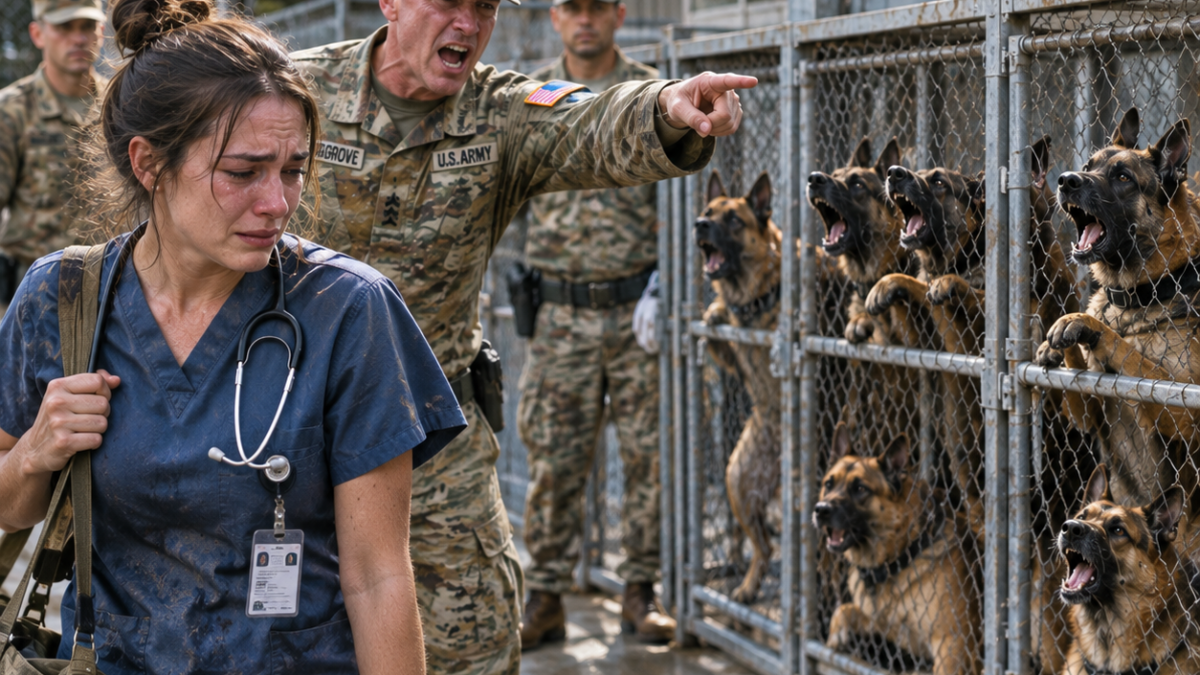
They Threw the ER Nurse Out of the Military Kennel—Then Six Traumatized K9s Did Something No Handler Could Explain.
By seven that morning, six retired military K9s had turned one kennel block into a crisis zone, three handlers had been injured, and administrators were already discussing whether some of the dogs had become too dangerous to keep alive.
Then a quiet temporary ER nurse named Evelyn Carter walked through the gate, set down a paper coffee cup, and within hours dogs that had been pacing, biting, slamming themselves against concrete, and refusing human contact began going silent one by one.
But when the base director ordered her thrown out because she was “just a nurse,” all six dogs reacted—and the classified record eventually uncovered behind Evelyn’s name revealed why they seemed to recognize something in her that none of their own handlers had understood.
The first dog drew blood at 6:12 in the morning.
Private Danny Roark would remember the time for the rest of his career because he looked at the clock immediately afterward.
06:12.
He had been working canine support at Redstone Air Base outside Ashford, Colorado, for four months.
Nineteen years old.
Good evaluations.
Good instincts.
Not enough experience to know when experience itself had become the problem.
Everyone had told him Block Seven was easy duty.
The dogs housed there were retirees.
Old soldiers.
Worn hips.
Damaged hearing.
Bad backs.
Scars beneath their coats.
They had spent years doing work most civilians would never hear about and most military paperwork described only in sanitized language.
Patrol.
Detection.
Tracking.
Force protection.
Four combat theaters across eleven combined years of service.
Kodiak.
Reaper.
Dust.
Vega.
Six-Pack.
May.
Six animals that had located explosives, tracked armed men through mountain terrain, protected handlers under fire, and returned from places that had changed them in ways nobody could chart with ordinary veterinary measurements.
They had been decorated.
Photographed.
Praised.
Then retired.
And everyone had made the same mistake.
They thought retired meant finished.
Roark entered Kodiak’s enclosure that morning carrying breakfast and medication.
Kodiak was ten.
Belgian Malinois.
Lean despite age.
Dark face graying around the muzzle.
Both hips arthritic.
One canine tooth worn almost flat.
A dog who had once located an explosive device concealed beneath a culvert before a convoy rolled across it.
Now his world had narrowed to a concrete run, a raised bed, two meals, medication, and whichever young handler happened to be assigned that week.
“Morning, old man.”
Kodiak stood in the back corner.
Roark stopped.
Something was wrong.
The dog’s body was rigid.
Head low.
Eyes wide enough that white showed around the edges.
“Kodiak?”
PART2:
The Malinois did not look toward the food.
That alone should have been warning enough.
Roark set the bowl down.
“Easy.”
Kodiak lunged.
Roark barely saw him move.
One moment the dog was against the wall.
The next his jaws were around Roark’s forearm.
Not tearing.
Not shaking.
Just locked.
Roark went down on one knee.
He did not scream.
Years later, people would remember that part.
Some called it bravery.
Roark knew the truth.
He was too frightened to make noise.
Kodiak’s teeth compressed through the heavy uniform sleeve.
Pain shot up Roark’s arm.
“Don’t pull!”
Master Sergeant Logan Pierce was already moving down the corridor.
“Stay still!”
Roark obeyed.
Kodiak trembled while holding him.
That was what Pierce noticed first.
Not rage.
Terror.
The dog’s entire body shook.
“Kodiak.”
No response.
PART3:
Pierce tried the release cue.
Nothing.
Another handler tried.
Nothing.
Roark whispered, “Sergeant?”
“I’ve got you.”
Kodiak’s pupils were enormous.
Pierce realized the dog was no longer processing the kennel corridor around him.
Whatever Kodiak believed was happening, he was somewhere else.
Pierce made a decision he hated.
“Blank.”
Sergeant Holloway fired a starter blank six feet away.
The crack slammed through the corridor.
Kodiak released.
He backed into the corner instantly.
Hackles raised.
Panting.
Shaking.
Roark remained on the floor holding his arm.
Pierce looked at Kodiak.
The dog stared back.
The expression did not look victorious.
It looked ashamed.
By 6:40, Reaper had begun pacing.
By 6:48, Vega threw herself into the side wall hard enough to bloody one shoulder.
At 6:55, May refused food for the second day.
Six-Pack began growling at anyone who passed his enclosure.
Dust remained in the rear corner where he had spent most of the previous seven months, barely engaging with anything at all.
By seven, every dog in Block Seven was in some form of active distress.
The sounds were what people remembered.
Not barking.
Barking would have been easier.
These were lower sounds.
Whines without rhythm.
Growls directed at nothing visible.
Panting.
Claws scraping concrete.
The occasional impact of a body against a wall.
Pierce stood in the corridor listening.
He had spent twenty-two years in the Army.
He had heard wounded men.
Frightened recruits.
Aircraft alarms.
Incoming fire.
He had learned that some sounds entered through the ears and others entered through the chest.
Block Seven entered through the chest.
Dr. Rosario Finch arrived before eight.
She was the base veterinarian.
Forty-two.
Eleven years treating military working dogs.
Smart enough to know the difference between a difficult dog and a dog whose nervous system had stopped believing the environment was safe.
She examined Roark first.
Bruising.
Possible bone contusion.
No puncture through the protective sleeve.
He was lucky.
“Kodiak wasn’t trying to maul you.”
Roark looked offended.
“He had my arm in his mouth.”
“I know.”
“What would you call that?”
“Panic.”
Pierce stood nearby.
Finch looked toward the kennels.
“This has been building.”
Pierce said, “I know.”
“No.”
She faced him.
“This has been building for weeks.”
That part he could not argue with.
Six-Pack had broken containment three days earlier.
Vega had stopped tolerating routine handling.
May had begun refusing meals.
Reaper paced for hours at night.
Kodiak had started guarding the rear wall of his enclosure as though something behind it frightened him.
Dust had stopped doing almost everything.
Reports existed.
Pierce had submitted them.
Finch had written recommendations.
The behavioral-health contractor who once visited twice a week had been cut six months earlier.
Eleven thousand dollars.
That was the number.
The entire behavioral support contract had been eliminated to save eleven thousand dollars from a budget line Director Elliot Hargrove believed was nonessential.
Hargrove had never worked with military dogs.
He worked with spreadsheets.
Procurement.
Compliance.
Facilities.
Resource allocation.
He had the posture of a man who believed every difficult thing could eventually be reduced to a column if everyone around him would stop being emotional long enough to find the correct spreadsheet.
At 8:17, Finch walked into his office.
“I need behavioral support reinstated.”
Hargrove continued reading.
“I need a specialist today.”
He looked up.
“We have an external team scheduled.”
“Thursday.”
“Yes.”
“That’s four days.”
“I know how many days Thursday is, Doctor.”
Finch held his gaze.
“Kodiak injured a handler.”
“I saw the report.”
“Six-Pack has breached containment three times.”
“Reported.”
“Vega is injuring herself.”
“Noted.”
“Dust is barely eating.”
Hargrove closed the folder.
“What exactly are you asking me to do?”
“Restore the contract you cut.”
“We’ve discussed this.”
“No. You made a decision and I documented why I disagreed.”
“Budget decisions require compromises.”
“These are combat veterans.”
“They are retired animals.”
Finch’s expression changed.
Not much.
Enough.
“Retirement doesn’t erase the nervous system.”
Hargrove leaned back.
“I have a specialist team arriving Thursday.”
“Thursday may be too late for Dust.”
“What does that mean?”
Finch hesitated.
She hated saying it.
“I’ve been considering humane euthanasia.”
Hargrove looked at her.
“For aggression?”
“No.”
“Then why?”
“Because he has been functionally shut down for months.”
“That sounds contradictory.”
“It isn’t.”
Finch stepped closer.
“Watching an animal exist in constant fear until his body gives out is not automatically more humane than euthanasia.”
Hargrove’s eyes shifted toward the incident report.
“And the others?”
“I am not recommending euthanasia for the others.”
“Yet.”
Finch went still.
“I didn’t say that.”
“You have six unstable military animals and injured personnel.”
“They became unstable because support was removed.”
Hargrove’s voice cooled.
“Be careful.”
“No.”
That surprised him.
Finch had spent six months being careful.
Careful emails.
Careful reports.
Careful recommendations.
Careful phrases such as elevated distress indicators and behavioral deterioration.
Three injured handlers later, she had run out.
“You cut the one program specifically designed to keep retired working dogs from reaching this point.”
“That is your opinion.”
“That is my medical assessment.”
Hargrove stared.
Finch turned.
“I contacted Fort Ralston.”
“Without authorization?”
“I contacted a veterinarian.”
“Doctor—”
“They can send someone Thursday.”
She looked back.
“If these dogs make it to Thursday.”
Then she left.
The cold morning air outside did nothing for her temper.
She was fifty yards from Block Seven when the duty officer called.
“Dr. Finch?”
“What?”
“There’s someone at the east gate.”
“If this is media, tell them no.”
“Not media.”
“What then?”
“Hospital staff.”
Finch stopped.
“Hospital?”
“Temporary ER nurse.”
“Why?”
“She says she wants to help with the dogs.”
Finch actually closed her eyes.
“Of course she does.”
Everyone wanted to help with working dogs.
People watched one documentary and believed military K9s were large versions of family shepherds who needed patience and treats.
“Tell her this is an active veterinary incident.”
“She says she has experience.”
“What experience?”
“She wouldn’t say.”
Finch turned toward the gate.
“Fine.”
Five minutes later she saw Evelyn Carter for the first time.
Thirty-one.
Five foot six.
Dark green scrubs beneath a fleece jacket.
Hair tied low behind her neck.
Canvas medical bag hanging from one shoulder.
Paper coffee cup in one hand.
Nothing about her suggested authority.
Nothing about her demanded attention.
If anything, she looked tired.
Three weeks into a temporary ER assignment covering maternity leave at the base hospital.
Finch crossed her arms.
“You asked to come into my kennel.”
“Yes.”
“You’re an ER nurse.”
“Yes.”
“Why?”
“I heard what happened.”
“That isn’t an answer.”
Evelyn looked toward Block Seven.
The low vocalization carried through the cold air.
Her expression changed.
Only slightly.
“I’ve worked with traumatized K9s.”
“Where?”
“Field environments.”
“What kind?”
Evelyn looked at Finch.
“The kind where dogs learn that unpredictable movement can get people killed.”
That answer was specific enough to irritate Finch.
“And your credentials?”
“Nursing.”
“For canine behavioral intervention?”
“No.”
“Then you’re asking me to violate protocol.”
“Yes.”
Finch stared.
Evelyn drank her coffee.
“You’re very calm about that.”
“Being nervous wouldn’t improve the protocol violation.”
Against her will, Finch almost smiled.
Almost.
“What exactly do you think you can do?”
Evelyn looked again toward the kennel block.
“I don’t know until I see them.”
“That is not reassuring.”
“No.”
“Anything else?”
“Yes.”
“What?”
“If you bring me in, don’t introduce me.”
Finch frowned.
“To the dogs?”
“To anybody unless necessary.”
“Why?”
“Because people change posture when they hear titles.”
“What title?”
Evelyn’s gaze held hers.
“Exactly.”
Finch should have sent her away.
Years later, she admitted that.
Every rule said no.
Active emergency.
Uncredentialed civilian.
Retired working dogs with bite histories.
Liability.
Chain of command.
Procedure existed precisely because desperate people made bad decisions.
But procedure had not stopped Block Seven from collapsing.
And Thursday remained four days away.
Finch opened the gate.
“Stay behind me.”
Evelyn said nothing.
Master Sergeant Pierce met them inside.
He looked at Evelyn.
Then Finch.
Then back at Evelyn.
“Who is this?”
“Temporary hospital staff.”
His expression hardened.
“You brought a nurse?”
“She says she has canine experience.”
Pierce looked Evelyn up and down.
“What kind?”
“Field.”
“Field what?”
“Experience.”
“That’s not an answer.”
“No.”
Pierce’s jaw tightened.
He had been awake since before five.
One handler injured.
Six unstable dogs.
An administrator minimizing everything.
He had no patience left for mysterious civilians carrying coffee.
“I don’t need a volunteer.”
Evelyn looked past him.
Vega slammed into the wall.
The impact shook the kennel door.
Everyone startled.
Everyone except Evelyn.
Her head turned.
No flinch.
No widening eyes.
No backward movement.
Just assessment.
She set the coffee down.
Slowly unzipped the canvas medical bag.
Pierce noticed.
“What are you doing?”
“Nothing.”
She didn’t remove an instrument.
She simply opened the bag.
A mixture of familiar odors escaped.
Canvas.
Leather.
Antiseptic.
Metal.
Something medicinal.
Vega stopped.
Not completely.
But her head lifted.
The German Shepherd scented the air.
Evelyn walked toward the enclosure.
Pierce reached for her arm.
She stopped before he touched her.
“Don’t.”
He withdrew his hand.
Not because she sounded threatening.
Because she sounded certain.
Vega had lost most of her hearing in an explosion.
Her handler had not survived it.
Since retirement, loud environments confused her.
People compensated by using bigger gestures.
More exaggerated signals.
More physical attempts to guide.
None of it had helped.
Evelyn stopped three feet from the door.
She placed both hands loosely beside her legs.
No eye contact.
No reaching.
No crouching.
Nothing.
Vega paced.
Evelyn remained still.
Thirty seconds.
Forty.
One minute.
Pierce grew impatient.
Then Vega stopped hitting the wall.
She circled.
Sniffed.
Looked.
Evelyn shifted one shoulder slightly away from the enclosure.
Vega lowered herself.
Not relaxed.
But down.
Head on paws.
Watching.
Pierce stared.
“How?”
Evelyn kept her eyes on Vega.
“She can’t hear enough to interpret what’s happening.”
“We know she’s hearing impaired.”
“You’re still treating her like a hearing dog.”
Finch looked at Pierce.
Evelyn continued.
“Everyone walks in fast because they’re worried. Everyone leans toward her because they’re trying to help. Everyone uses hands because voice cues don’t work.”
Vega’s breathing slowed.
“She doesn’t know why all these bodies keep approaching her with urgency.”
Pierce asked, “So?”
“She needs stillness.”
Reaper stopped pacing.
Nobody noticed at first.
The Malinois had been circling his kennel for almost two hours.
Same twelve steps.
Turn.
Twelve steps.
Turn.
Now he stood with his nose in the air.
Scenting.
Watching Evelyn.
Then he sat.
Pierce saw it.
His expression changed.
“What did you put in the bag?”
“Old field gear.”
“What kind?”
“Medical.”
“Why does he recognize it?”
Evelyn glanced at him.
“Because scent memory survives retirement.”
She moved down the corridor.
May refused to look at her.
Evelyn did not approach.
“Keeps skipping meals?”
Finch nodded.
“Second day.”
“Where do you feed her?”
Finch pointed.
Evelyn looked at the bowl placement.
Directly beside the front of the enclosure.
Every person who walked past it.
Every cart.
Every boot.
Every metal clang.
“Move it.”
“Where?”
“Back left.”
One handler relocated the bowl.
May waited.
Evelyn walked away.
Five minutes later the dog ate two bites.
Finch wrote nothing.
She was too busy watching.
Kodiak was different.
The old Malinois remained against the rear wall.
Eyes fixed toward the same point.
Evelyn watched him from outside.
“What is behind that?”
“Service corridor.”
“Used?”
“Maintenance.”
“How often?”
“Depends.”
“Anything change recently?”
Pierce thought.
Then frowned.
“Ventilation motor.”
“When?”
“Three weeks ago.”
Evelyn looked at him.
“Three weeks?”
“Replaced.”
“Different frequency.”
Finch understood.
“You think he hears it?”
“Or feels it.”
“It’s a motor.”
“To us.”
Evelyn sat on the floor outside Kodiak’s kennel.
The dog remained rigid.
She did not call him.
Did not offer food.
Just sat.
Pierce looked at Finch.
Finch mouthed:
Let her.
At 9:26, Director Hargrove entered Block Seven.
He expected panic.
He had been told the situation was stabilizing.
He interpreted that to mean the crisis had been brought under conventional control.
What he saw instead was a civilian woman in scrubs sitting cross-legged on concrete.
Kodiak lay on the opposite side of the chain link.
His nose rested near the fence.
His breathing was slower than it had been all morning.
Hargrove stopped.
“Who is that?”
Pierce answered.
“Temporary ER staff.”
“Doing what?”
“Helping.”
“With what authority?”
Finch stepped forward.
“Mine.”
Hargrove looked at her.
“You brought hospital staff into an active kennel emergency?”
“Yes.”
“Why?”
“Because she was useful.”
Evelyn looked up.
Hargrove turned toward her.
“Ms.—?”
“Carter.”
“Ms. Carter, this is a military working-dog facility.”
“I noticed.”
Pierce almost coughed.
Hargrove’s eyes narrowed.
“These animals are under veterinary and handler control.”
Evelyn looked at Kodiak.
“Not very effectively this morning.”
Silence.
Finch closed her eyes briefly.
Hargrove stepped closer.
“I appreciate whatever assistance you believe you’re providing.”
“I don’t believe it.”
“Excuse me?”
“I can see it.”
She nodded toward Vega.
“She’s stopped self-injuring.”
Toward Reaper.
“He’s no longer pacing.”
Toward May.
“She ate.”
Then Kodiak.
“His respiration is almost back to baseline.”
Evelyn looked at him.
“That’s not belief.”
Hargrove’s face tightened.
Pierce knew the expression.
Administrative offense.
The most dangerous kind because it never looked emotional.
“What are your credentials?”
“I have credentials.”
“For this?”
“Yes.”
“Show me.”
Evelyn paused.
“No.”
The corridor went completely still.
Hargrove stared.
“No?”
“They aren’t relevant to the immediate work.”
“They are relevant to whether you should be in this building.”
Evelyn stood.
No drama.
No challenge.
She was shorter than Hargrove.
Somehow it didn’t feel that way.
“You can ask me to leave.”
“I am.”
Finch stepped forward.
“Director—”
“No.”
Pierce said, “Sir, she’s helping.”
“I didn’t ask for your opinion.”
Pierce’s voice became colder.
“No, sir. I’m giving it anyway.”
Hargrove looked at him.
Then Evelyn.
“Gather your things.”
Evelyn looked once at Kodiak.
His eyes followed her.
She picked up the canvas bag.
Then the coffee.
Cold now.
Pierce moved beside her.
“You heard him.”
“Yes.”
“I have to escort you.”
“I know.”
Something about how easily she accepted it made him angrier.
Not at her.
At himself.
They walked to the door.
Dust remained in the far corner.
Evelyn stopped.
Only for a second.
The nine-year-old Malinois had lost his last handler eighteen months earlier.
Since then, he had allowed almost no voluntary contact.
He ate barely enough.
Avoided the front fence.
Did not play.
Did not threaten.
He simply withdrew farther and farther until even Finch had begun wondering whether keeping him alive was kindness.
Evelyn looked at him.
Dust looked back.
Pierce said quietly:
“We need to go.”
She nodded.
Then left.
At 10:31, Evelyn passed through the outer kennel gate.
At 10:32, Six-Pack escaped.
The latch failure happened when a handler entered with medication.
Six-Pack hit the partially secured door with his shoulder.
The gate opened.
The black German Shepherd entered the main corridor.
Three handlers immediately backed against the wall.
Nobody screamed.
Nobody ran.
But fear has a shape.
Dogs see it.
Six-Pack did.
His head lowered.
Hackles rose.
A growl built inside his chest.
Pierce ran in.
“Don’t move.”
The handlers stayed frozen.
Six-Pack stared.
Pierce knew the dog.
Eight years old.
Six years patrol work.
His last assessment used the phrase elevated threat response in non-operational environments.
Translation:
When startled, Six-Pack moved toward whatever scared him.
Pierce reached for his radio.
Then the outer door opened.
He knew the footsteps before turning.
Measured.
Not fast.
Not slow.
Evelyn walked back in.
Pierce stared.
“I escorted you out.”
“Yes.”
“What are you doing?”
“Fixing the part that changed.”
She stepped past him.
Six-Pack saw her.
The growl continued.
Evelyn stopped directly between the dog and the handlers.
Empty hands.
No leash.
No weapon.
No raised voice.
Eight seconds passed.
Pierce counted because he did not know what else to do.
Evelyn said one word.
“Easy.”
Not a command.
Not sharp enough.
No trained hand signal.
Just the word.
Six-Pack’s hackles lowered halfway.
Evelyn shifted one foot.
The rest lowered.
His breathing changed.
The growl disappeared.
He sat.
Nobody moved.
Then Six-Pack walked forward.
Pierce’s hand went toward his sidearm out of reflex.
Evelyn said:
“Don’t.”
Six-Pack stopped in front of her.
Sniffed the canvas bag.
Sniffed her pants.
Then pushed his head against her knee.
Pierce stared.
He had handled military dogs most of his adult life.
He knew obedience.
This was not obedience.
This was recognition.
Or something close enough that the distinction no longer mattered.
Evelyn placed one hand lightly behind Six-Pack’s ear.
“Good.”
The dog closed his eyes.
That was the first moment Pierce understood she had not told them the truth.
Not exactly.
Everything she had said may have been technically accurate.
But “field experience” did not explain this.
Twenty minutes later, Six-Pack was secured.
No injuries.
No bite.
No tranquilizer.
Pierce found Evelyn outside again.
She sat on the concrete step holding the same coffee.
“You know that’s cold.”
“Yes.”
“You still drinking it?”
“No.”
“Then why are you holding it?”
She looked at the cup.
“Something to do with my hands.”
That answer felt more honest than most of what she had given him.
Pierce sat.
“What you did in there doesn’t come from nursing school.”
“No.”
“Doesn’t come from volunteering at a shelter.”
“No.”
“You were military.”
Evelyn looked toward the mountains.
“I worked around military.”
He almost laughed.
“That’s the sentence you’re going with?”
“For now.”
“How long?”
“Enough.”
“What unit?”
“No.”
“What branch?”
“No.”
“What did you do with dogs?”
Evelyn was quiet.
“Medical support.”
“That isn’t all.”
“No.”
He respected the honesty of that.
His radio crackled.
Hargrove’s aide.
“Master Sergeant Pierce, confirm Ms. Carter has exited the facility.”
Pierce looked at Evelyn.
She looked at him.
He keyed the radio.
“Copy.”
A pause.
“Confirm.”
Pierce waited two seconds.
“In progress.”
He clipped the radio back.
Evelyn raised one eyebrow.
“That wasn’t exactly accurate.”
“It’s becoming true.”
He stood.
“You need to leave.”
She nodded.
Then Corporal Dana Wills came through the door.
Twenty-three.
Youngest handler in the block.
Usually composed.
Not now.
Her face had gone pale.
“Master Sergeant.”
“What?”
“Dust.”
Pierce was already moving.
Evelyn turned too.
Pierce almost told her not to follow.
He didn’t.
Dust was out of the corner.
That alone stopped Pierce in the doorway.
For seven months, the Malinois had pressed himself against the far rear wall whenever people entered.
Now he stood in the center of the enclosure.
Evelyn was already kneeling outside the chain link.
One hand flat against it.
Dust approached.
Not quickly.
One step.
Pause.
Another.
Wills held her breath.
Dust reached the fence.
He pressed his nose against Evelyn’s palm.
Wills began crying.
She turned away, embarrassed.
Pierce did not correct her.
He had not seen Dust voluntarily touch a person in seven months.
Evelyn said nothing.
No praise.
No dramatic reaction.
She simply left her hand where it was.
Dust breathed against it.
Pierce felt something inside him shift.
Not hope.
Hope was too large.
Permission to hope.
That was different.
His radio crackled again.
“Ms. Carter’s access credentials have been revoked effective eleven hundred hours.”
Pierce looked at his watch.
10:43.
Seventeen minutes.
He turned the radio volume down.
Evelyn glanced at him.
“You heard that.”
“Yes.”
“Seventeen minutes.”
“I can count.”
“What are you doing?”
Pierce looked at Dust.
“Using them.”
He called Lieutenant Ethan Brooks.
“I need you to run a name.”
“What name?”
“Evelyn Carter.”
“Civilian employee?”
“Temporary ER.”
“Why?”
“Because she’s not temporary anything.”
Brooks hesitated.
“What am I looking for?”
“Military service.”
“Master Sergeant, you know I can’t just—”
“Open-source and standard-access records only.”
“That I can do.”
“Do it now.”
Evelyn remained at the fence.
Dust remained with her.
Pierce crouched nearby.
“Tell me something real.”
She looked at him.
“What?”
“Anything you are allowed to say.”
Evelyn looked at Dust.
“I was a combat nurse.”
“That I believe.”
“I served with teams whose locations weren’t always reflected in ordinary deployment records.”
Pierce’s expression changed.
He knew that language.
“In what capacity?”
“Medical.”
“With K9 teams?”
“Yes.”
“Just treatment?”
A pause.
“No.”
“What else?”
Evelyn looked through the fence.
“When handlers went down, somebody still had to manage the dog.”
Pierce listened.
“When dogs were injured, somebody had to keep them working until extraction.”
She swallowed.
“And sometimes teams needed someone whose presence wouldn’t change the dog’s threat read.”
“What does that mean?”
“Dogs watch us before we know we’re being watched.”
She looked at him.
“They know who’s frightened. Who’s lying. Who’s uncertain. Who’s about to move.”
“That’s training.”
“Partly.”
“What unit?”
Evelyn almost smiled.
“No.”
The radio cracked again.
Pierce ignored it.
Dust lowered himself near the fence.
Not in the corner.
Near Evelyn.
Pierce stared.
He had seen medals awarded for less impossible things.
“Finish with him.”
Evelyn looked up.
“Hargrove ordered—”
“I know.”
“I don’t want you losing your position over me.”
“I’m not doing this for you.”
“That right?”
“The dog.”
Evelyn’s almost smile appeared again.
“Of course.”
Pierce stood.
“I’ll manage Hargrove.”
At 10:59, Evelyn lifted her hand from the fence.
Dust did not retreat.
She looked at Wills.
“You take over.”
Wills swallowed.
“How?”
“Sit.”
“What?”
“Six feet away.”
Wills sat.
“Don’t look directly at him.”
She obeyed.
“Slow breathing.”
Wills exhaled.
“Hands visible.”
“Yes, ma’am.”
“Don’t call him.”
“What if he doesn’t come?”
“Then he doesn’t come.”
Wills looked confused.
Evelyn continued.
“Your job isn’t to make him do something.”
“What is my job?”
“To make nothing bad happen.”
That silenced the room.
Evelyn stood.
“If he goes back to the corner, you let him.”
“That feels like failure.”
“No.”
Evelyn looked at Dust.
“It’s information.”
She picked up the bag.
Walked out.
Pierce escorted her through the gate.
Hargrove stood inside the entrance waiting.
He said nothing to Evelyn.
She said nothing to him.
Sometimes silence is more aggressive than argument.
At the road, Evelyn stopped.
“Thank you.”
Pierce frowned.
“For what?”
“The seventeen minutes.”
“I was helping the dog.”
“Sure.”
She walked toward the hospital.
Pierce watched until she disappeared around the corner.
Brooks called thirty minutes later.
“I found almost nothing.”
Pierce sat in his office.
“That means you found something.”
“Service number.”
“Branch?”
“Army.”
“Years?”
“About nine officially.”
“Officially?”
“Separation date seven years ago.”
“Deployments?”
“Redacted.”
“All?”
“Not missing. Redacted.”
Pierce leaned back.
“What classification?”
Brooks read the code.
Pierce stopped moving.
He had seen that code twice.
Both times attached to operations people did not discuss even after leaving service.
“Anything else?”
“One award citation.”
“What?”
“Joint meritorious unit commendation.”
“Unit?”
Brooks hesitated.
“That’s the weird part.”
“What?”
“The designation doesn’t resolve.”
“What does it say?”
“A numeric code.”
Pierce wrote it down.
“Don’t save the search.”
“Wasn’t planning to.”
“Brooks.”
“Yeah?”
“You didn’t see this.”
“I know.”
Pierce ended the call.
He sat alone.
Six dogs who had rejected handlers for weeks had responded to Evelyn within hours.
Vega.
Reaper.
May.
Kodiak.
Six-Pack.
Dust.
The woman had not controlled them.
That was what bothered him.
Control had not happened.
Something else had.
They had changed around her.
Pierce spent twenty-two years learning the difference between command presence and trust.
Evelyn carried the second one in a way he had rarely seen.
Finch found him.
“You look like you read something classified.”
“I didn’t.”
“That convincing?”
“No.”
She closed the door.
“What?”
“Her records are sealed.”
Finch sat.
“How sealed?”
“Enough.”
“Military?”
“Army record.”
“I knew it.”
“You knew nothing.”
“I knew temporary ER nurse was nonsense.”
“She is an ER nurse.”
“She’s also carrying a field bag that smells like old deployment gear, reading combat dogs like books, and knew Vega’s problem in ninety seconds.”
Finch looked toward the kennel block.
“Dust touched her.”
“I know.”
“I’ve been considering euthanasia for three weeks.”
Pierce looked at her.
“That bad?”
Finch rubbed her face.
“He’s not living.”
“He eats.”
“Barely.”
“Moves.”
“From one corner to the litter area and back.”
“He’s not aggressive.”
“That doesn’t mean he’s okay.”
Her voice cracked slightly.
“I’ve watched that dog disappear by inches.”
Pierce said nothing.
Finch looked at the desk.
“Evelyn asked me whether the recommendation was final.”
“What did you say?”
“No.”
“And?”
“She said, ‘He’s not ready to give up. He’s waiting for someone to stay.’”
Pierce looked toward the door.
Hargrove was going to make sure Evelyn did not come back.
Pierce suddenly understood that Hargrove believed the problem had been the protocol violation.
The problem was that he still did not understand what the dogs had been telling them.
At 12:52, Kodiak collapsed.
Corporal Wills found him on his side.
Breathing hard.
Gums pale.
Heart rhythm erratic.
Finch ran.
Pierce arrived seconds later.
“What happened?”
“Cardiac.”
“Can you stabilize?”
“Maybe.”
“Maybe?”
“My equipment here is basic.”
“What do you need?”
“Imaging. Cardiac medications. Monitoring.”
Pierce thought of Evelyn’s bag.
Then remembered she had carried only the canvas kit.
He pulled out his phone.
Finch looked at him.
“Who are you calling?”
“Someone Hargrove doesn’t want here.”
Evelyn answered on the second ring.
“Kodiak.”
That was all Pierce said.
Her voice changed instantly.
“What?”
“Cardiac event.”
“Conscious?”
“Barely.”
“Gum color?”
He asked Finch.
“Pale.”
“Breathing?”
“Rapid.”
“Keep him down. Keep the space quiet. No standing. I’m seven minutes away.”
“Your credentials are revoked.”
“I know.”
“Hargrove will have you detained at the gate.”
“Then meet me there.”
The call ended.
She arrived in six minutes.
This time no paper coffee cup.
No soft uncertainty.
Hard-sided medical case in one hand.
She moved through the gate like somebody who had stopped pretending to be ordinary.
Pierce met her.
“What’s in that?”
“Things Finch doesn’t have.”
“Authorized?”
Evelyn gave him a look.
“No.”
“Of course.”
They entered.
Kodiak opened his eyes when she touched him.
His tail moved once.
“Hey.”
Evelyn knelt.
“I’ve got you.”
Finch stared at the hard case.
“You carry veterinary cardiac medication?”
Evelyn opened it.
“Field dosing.”
“For what field?”
“Not now.”
Her hands moved with muscle memory.
Pulse.
Gums.
Respiration.
Monitor.
Questions.
Short answers.
No performance.
No dramatic urgency.
The speed came from precision, not panic.
Pierce stood too close.
Evelyn looked up.
“Out.”
He frowned.
“What?”
“You’re anxious.”
“I am not.”
“You are.”
Finch almost smiled despite the emergency.
Evelyn pointed.
“He reads you.”
Pierce left.
Outside the enclosure, Wills stood beside him.
“She knows what she’s doing.”
“Yes.”
“How?”
Pierce looked through the chain link.
“I don’t know.”
That answer was becoming increasingly uncomfortable.
By two o’clock, Kodiak’s heart rhythm steadied.
Not normal.
Steadier.
Finch sat back against the wall.
“You bought him time.”
Evelyn shook her head.
“We bought him transport.”
“Same thing today.”
“No.”
Evelyn looked at the old dog.
“Time only matters if somebody uses it.”
Pierce’s phone rang.
Brooks.
“Hargrove is moving.”
“What does that mean?”
“Formal complaint.”
“Against?”
“You. Finch. Carter if he can reach her.”
“Basis?”
“Unauthorized access. Security breach. Unapproved pharmaceuticals.”
Pierce laughed once.
No humor.
“The pharmaceuticals keeping a decorated dog alive.”
“I didn’t say it was smart.”
“When?”
“He wants preliminary documentation by seventeen hundred.”
Pierce looked through the kennel.
Evelyn had one hand resting on Kodiak’s side.
Finch checked the monitor.
“Good.”
Pierce said.
“What?”
“Let him file.”
Brooks hesitated.
“Master Sergeant?”
“Let him put everything in writing.”
Pierce ended the call.
For six months, Pierce had tried to fight Hargrove through conversation.
Meeting.
Email.
Recommendation.
Professional disagreement.
Now Hargrove had decided to create a record.
Pierce realized a record could cut both directions.
He returned to his office.
Opened a blank document.
Started with 06:12.
Kodiak bite incident.
Then went backward.
Behavioral support contract terminated.
Veterinary consultation not obtained.
Finch recommendation one.
Received.
No action.
Recommendation two.
Received.
No action.
First handler injury.
Not escalated.
Second.
Not escalated.
Third.
Not escalated.
Six-Pack breach.
Logged.
No support restored.
Dust deterioration.
Documented.
No intervention.
Pierce attached everything.
He was not choosing a fight.
He was choosing a record.
At 3:18, he called Colonel Diana Voss at Fort Ralston.
She oversaw regional military working-dog welfare.
“Pierce.”
“Ma’am.”
“You sound like paperwork.”
“I have some.”
“How bad?”
“Six retired dogs in behavioral crisis. Four handler injuries in six weeks. Behavioral contract terminated six months ago without veterinary consultation.”
Silence.
“Who authorized termination?”
“Director Hargrove.”
“Background in canine welfare?”
“None.”
“Veterinary recommendations?”
“Four written.”
“Actioned?”
“No.”
Another silence.
“Send me everything.”
“There’s a complication.”
“Of course.”
“A civilian nurse entered the kennel.”
“What?”
“Temporary ER staff.”
“Pierce.”
“She stabilized all six behaviorally and one medically.”
Now Voss was quiet longer.
“Explain.”
“I can’t.”
“Try.”
“Her service record is classification-coded above my access.”
“You looked?”
“Standard-level records.”
“Name?”
“Evelyn Carter.”
The silence on the other end changed.
Pierce heard it.
“Colonel?”
“Send me the documents.”
“You know her.”
“I didn’t say that.”
“You didn’t need to.”
“Master Sergeant.”
“Yes, ma’am.”
“Send the documents.”
The call ended.
At 4:17, a military vehicle appeared at the east gate.
Major Sylvia Crane stepped out in uniform.
The second passenger wore civilian clothes.
Silver hair.
Gray jacket.
Security scanned his badge.
The system returned a code instead of a name.
Brooks called Pierce.
“I’ve never seen this.”
Pierce looked at the screen.
Then looked toward Block Seven.
“Clear them.”
He went to find Evelyn.
She sat beside Kodiak.
Wills sat outside Dust’s enclosure.
Dust was no longer in the corner.
That fact alone had become almost normal in less than a day.
“There are two people at the gate.”
Evelyn looked up.
“One from Voss.”
Her face remained neutral.
“The other has a badge the system can’t resolve.”
Now she changed.
Barely.
But Pierce saw it.
“What code?”
He told her.
Evelyn went still.
“Same as yours?”
“Yes.”
“Who?”
“I don’t know.”
She looked at Kodiak.
The dog slept.
Pierce waited.
“Could be Director Marsh.”
“Who is Director Marsh?”
Evelyn’s mouth tightened.
“Someone from before.”
“Good before?”
She thought.
“Complicated.”
“Danger?”
“I don’t think so.”
“That isn’t reassuring.”
“No.”
Pierce held the door.
“Come with me.”
She looked at him.
“You don’t have to involve yourself.”
“Too late.”
“I mean it.”
“So do I.”
“Pierce.”
“You’ve been managing the unknown alone all day.”
He nodded toward the administration building.
“That ends now.”
Something changed in her expression.
Not gratitude.
Recognition.
She stood.
Director Marsh was already in the conference room when they arrived.
He turned.
Saw Evelyn.
For the first time all day, Pierce watched Evelyn Carter lose complete control of her face.
Only for a fraction of a second.
Shock.
History.
Pain.
Then nothing.
“Evelyn.”
She stopped.
“Director Marsh.”
Major Crane looked between them.
Pierce remained standing.
Marsh gestured toward a chair.
“It’s been a while.”
“Six and a half years.”
“I wasn’t counting.”
“I was.”
Marsh absorbed that.
Pierce said nothing.
Marsh looked toward him.
“Master Sergeant, I appreciate the contact with Colonel Voss.”
“I contacted her about the dogs.”
“I know.”
His eyes returned to Evelyn.
“Your name appeared in the report.”
“So?”
“So your name attached to a military welfare inquiry activated a flag.”
Evelyn leaned back.
“I’ve been civilian for six years.”
“You’ve had civilian employment for six years.”
Her jaw tightened.
“There’s a difference.”
Pierce looked at her.
She looked at Marsh.
“So you came because you think I’m a classification problem.”
“I came because your sealed record is now sitting beside a formal incident involving military animals.”
“Animals that would still be in crisis if I hadn’t walked in.”
“I know.”
“Do you?”
Marsh did not answer immediately.
That told Pierce more than any classified record.
This was personal.
Marsh opened a folder.
“I’m not here to pull you back.”
Evelyn’s expression stayed flat.
“Good.”
“I need a scope statement.”
“What?”
“Enough to explain why you possessed the skills you used today without exposing operational details.”
“And if I refuse?”
“Then the review widens.”
“How wide?”
“Beyond me.”
That was enough.
Pierce looked at Evelyn.
She studied her hands.
Then:
“Fine.”
Marsh nodded.
“There is something else.”
He slid a photograph across the table.
Evelyn stared.
Pierce could see it from the side.
A younger Evelyn kneeling in rocky terrain.
Field clothing.
No visible unit insignia.
Her hands pressed against the ribs of a large black Belgian Malinois.
The dog looked toward her.
On the bottom of the photograph, most of a handwritten message had been blacked out.
Four words remained.
NEVER ABANDON YOUR PARTNER.
Evelyn touched the photograph.
“Where did you get this?”
“Hargrove’s administrative archive.”
Her eyes lifted.
“What?”
“Scanned eight months ago during veterinary file consolidation.”
“That photograph was classified.”
“I know.”
“Who is the dog?”
Pierce asked quietly.
Evelyn took a long time to answer.
“Ranger.”
Her voice changed around the name.
“He worked with my unit.”
“Your dog?”
“No.”
A pause.
“His handler was a man named Sergeant Thomas Vale.”
“What happened?”
Evelyn looked at the photograph.
“They died.”
Both?
Pierce did not ask aloud.
He didn’t need to.
Evelyn continued.
“Ranger was wounded during an operation.”
Her finger stayed on the picture.
“His handler was hit first.”
Marsh looked down.
“I reached them.”
She stopped.
Pierce waited.
“Thomas made me promise not to leave Ranger.”
She inhaled once.
“So I didn’t.”
“What happened?”
“I stayed with the dog until extraction.”
“And the handler?”
Evelyn closed her eyes.
“Didn’t make it.”
The room remained silent.
Pierce finally understood the canvas bag.
The smell.
The measured movements.
The way the dogs seemed to read her.
Years of working around animals under gunfire.
Years of learning to make her body say safe when everything around them said danger.
The six dogs had not recognized Evelyn herself.
They had recognized the language she carried.
A language built in places where calm was not a personality trait.
It was survival.
Marsh spoke carefully.
“Your unit is being declassified in part.”
Evelyn looked up sharply.
“What?”
“Administrative closure began last year.”
“Why wasn’t I told?”
“We tried.”
“No.”
“Evelyn.”
“No.”
The word carried years.
“You sealed the file.”
“Necessary at the time.”
“You erased the people.”
“We protected them.”
“You protected the program.”
Marsh absorbed that.
“Both can be true.”
“No.”
She looked toward the photograph.
“Not to the people inside it.”
Pierce felt as if he had entered a conversation that started seven years before he arrived.
He stayed anyway.
Marsh noticed.
“This is her business.”
Pierce answered:
“She’s on my base.”
Evelyn glanced at him.
Marsh studied Pierce.
Then nodded once.
“Fair.”
The door opened.
Major Crane returned carrying a stack of files.
Her expression was colder than before.
“We have a problem.”
“What?”
“Hargrove filed his complaint at 16:48.”
Pierce looked at his watch.
“Against?”
“You and Finch.”
“Carter?”
“No.”
Crane sat.
“He doesn’t know enough about her to use her effectively.”
Evelyn almost smiled.
“Smart.”
Crane continued.
“He alleges unauthorized civilian access, misuse of military resources, security violations, and failure to follow direct administrative instruction.”
Pierce nodded.
“Expected.”
“There is another submission.”
“Voss.”
“Yes.”
Crane placed another folder down.
“Colonel Voss filed a welfare inquiry at 17:02.”
Marsh leaned back.
“Two competing reports.”
“Correct.”
“What happens?”
“Regional board escalated.”
Pierce asked:
“When?”
“Site inspection within forty-eight hours.”
Silence.
Hargrove had tried to turn the day into a case about disobedience.
Instead, he had accidentally invited outsiders to read six months of decisions.
Evelyn looked at Pierce.
“You planned that.”
“No.”
“You hoped.”
“Maybe.”
The conference-room door opened at 6:30.
Hargrove walked in.
Stopped.
Major Crane.
Director Marsh.
Pierce.
Evelyn.
Documents covering the table.
For the first time that day, Elliot Hargrove looked like a man who had entered the wrong room.
“What is this?”
Crane answered.
“Regional preliminary assessment.”
“I was not notified.”
“It began after your submission collided with Colonel Voss’s.”
His face changed.
“My complaint concerns protocol.”
“Yes.”
Crane opened a file.
“And the welfare inquiry concerns why protocol failed before anyone violated it.”
Hargrove looked at Pierce.
“You went over my head.”
Pierce kept his voice level.
“I sent documented welfare concerns to the responsible regional authority.”
“You deliberately undermined—”
Crane interrupted.
“Director.”
He stopped.
She slid four pages forward.
“Dr. Finch submitted four written behavioral-health recommendations over forty-three days.”
Hargrove looked down.
“Received by your office.”
“Yes.”
“No recorded action.”
“Budget constraints—”
“Behavioral contract terminated without veterinary consultation.”
“It was an administrative decision.”
“Three handler injuries preceding today not escalated.”
“Minor.”
“A fourth today.”
“Which is why I—”
Crane raised one hand.
“And a cardiac consult for Kodiak was recommended four months ago.”
Hargrove’s face changed again.
Pierce hadn’t known that.
Finch had.
Evelyn closed her eyes briefly.
Hargrove looked toward her.
“This woman reentered after credentials were revoked.”
Evelyn answered calmly.
“Yes.”
“You carried unauthorized pharmaceuticals onto a secure installation.”
“Yes.”
“You intervened in an animal medical event without credentialed authority.”
“Yes.”
Hargrove stared.
He had expected defense.
Evelyn gave him facts.
Nothing to push against.
Director Marsh spoke.
“The dog’s current status?”
“Alive,” Evelyn said.
Hargrove looked at him.
Marsh continued.
“The review will include Ms. Carter’s conduct.”
Evelyn nodded.
“And yours.”
Hargrove’s jaw tightened.
“Under what authority?”
Marsh showed the badge.
Hargrove looked at the code.
He did not understand it.
That bothered him visibly.
“Who exactly are you?”
Marsh smiled without warmth.
“Someone whose office prefers that question remain unanswered in open rooms.”
The silence afterward was almost satisfying.
Then Pierce’s radio crackled.
Finch.
“Kodiak ate.”
Everybody turned.
Pierce lifted the radio.
“Say again?”
“He ate.”
Finch sounded close to laughing.
“Whole bowl.”
Evelyn looked down.
Her face softened.
“Good dog.”
Hargrove left shortly afterward.
He did not slam the door.
Men like Hargrove rarely did.
They believed quiet exits preserved power.
Forty-eight hours later, the regional inspection began.
The auditors went backward.
Not six months.
Eight.
That mattered.
The behavioral contract was only the most visible decision.
Before that, staffing rotations had been reduced.
Veterinary recommendations delayed.
Maintenance complaints around the kennel ventilation marked nonurgent.
Night coverage thinned.
Every individual decision looked survivable.
Together, they created Block Seven.
The dogs had not “lost their minds” in one morning.
The system around them had become less predictable, less supported, noisier, more inconsistent, and more frightening month after month until their behavior became the emergency everyone could finally see.
Vega’s hearing loss made her especially vulnerable.
Reaper’s repetitive pacing had been worsening.
May’s refusal to eat tracked with increased hallway traffic.
Kodiak’s distress began after the new ventilation motor changed the vibration pattern behind his kennel.
Six-Pack’s escalating startle response coincided with rotating inexperienced handlers.
Dust had been deteriorating long before all of them.
Finch had documented everything.
No one had joined the dots because Hargrove viewed each problem as separate.
Evelyn did not.
“Animals don’t experience budget lines.”
She told the inspectors.
“They experience what the budget line changes.”
The auditor looked up.
“What does that mean?”
“It means you cut behavioral support.”
Evelyn pointed toward Block Seven.
“They experience new people.”
“You cut staffing.”
“Different schedules.”
“You delay maintenance.”
“New noise.”
“You reduce veterinary follow-up.”
“Pain.”
She looked around the table.
“The paperwork says six separate decisions.”
“The dogs experienced one environment becoming unsafe.”
Nobody answered.
That sentence appeared almost verbatim in the preliminary findings.
The accounting review found something worse.
The eleven thousand dollars supposedly redirected from behavioral support to urgent facility maintenance had not actually been needed for that project.
The maintenance work had already been funded through another line.
The reallocation was unnecessary.
The auditor used four words:
NO LEGITIMATE BASIS IDENTIFIED.
Hargrove was placed on administrative leave that morning.
No dramatic arrest.
No handcuffs.
No shouting.
Real institutional consequences are often quieter.
Badge access changed.
Office reassigned.
Files secured.
Formal review initiated.
His decisions would now be evaluated by people who did not report to him.
For Finch, that was enough to breathe again.
For Pierce, it was only the beginning.
Because Block Seven still held six damaged dogs.
Removing the man who ignored the problem did not repair the problem.
Evelyn spent the next two days writing.
Not reports about Hargrove.
Dogs.
Kodiak:
Lower-stimulation kennel.
Cardiac evaluation.
Stable handler assignment.
Avoid abrupt rear-corridor activity.
Vega:
Visual predictability.
Minimize exaggerated gestures.
Approach from visible angle.
No sudden hands entering peripheral field.
Reaper:
Interrupt pacing through environmental routine, not restraint.
Structured low-intensity activity.
Consistent sleep schedule.
May:
Move feeding area away from traffic.
No observation pressure during meals.
Six-Pack:
No rotating inexperienced handlers.
Reduce surprise entry.
Allow visual orientation before contact.
Dust:
Do not reach.
Do not force proximity.
Same handler.
Same time.
Same seated position.
Allow retreat.
Wait.
Wills read Dust’s sheet three times.
“That’s it?”
Evelyn looked up.
“What?”
“I sit.”
“Yes.”
“And if he hides?”
“You sit.”
“If he doesn’t come?”
“You sit.”
“For how long?”
“Twenty minutes.”
“And then?”
“Leave.”
Wills frowned.
“That feels like nothing.”
Evelyn looked through the fence.
Dust watched them from halfway between his old corner and the gate.
“Nothing is exactly what he needs from you.”
Wills followed the dog’s gaze.
“He expects every person to want something.”
“So don’t.”
The first morning, Wills sat twenty minutes.
Dust stayed in the corner.
Second morning.
Same.
Third.
At minute eighteen, Dust stood.
Walked two steps.
Stopped.
Wills almost looked directly at him.
Evelyn, standing behind the corridor window, raised one finger.
Don’t.
Wills kept her gaze down.
Dust came closer.
Five feet.
Four.
Then stopped.
Wills breathed.
Nothing happened.
That was the success.
Nothing bad happened.
He returned to his bed.
Wills cried afterward.
“I didn’t even touch him.”
Evelyn handed her a tissue.
“Exactly.”
“You’re impossible.”
“Yes.”
Private Roark returned to duty six days after Kodiak bit him.
His arm was bruised almost black.
Pierce offered another assignment.
“No.”
“You sure?”
“No.”
Pierce waited.
Roark looked at the kennel corridor.
“I’m scared.”
“That would be a normal response.”
“I don’t want to be.”
“That’s not how fear works.”
Roark swallowed.
“I want to go back.”
Pierce said:
“Then you go back differently.”
Roark became the first handler besides Wills to use Evelyn’s protocol with Dust.
He sat outside the enclosure.
Hands on knees.
No eye contact.
No reaching.
Dust watched him for eighteen minutes.
Then walked to the fence.
Roark did not move.
After the session, he sent Pierce a photograph.
Dust at the front fence.
Pierce forwarded it to Evelyn.
Three words came back.
Good. Keep going.
Kodiak went to Fort Ralston for a full cardiac evaluation.
Arrhythmia.
Manageable.
Medication.
Lower-stress housing.
Adjusted exercise.
He returned nine days later.
Pierce moved him to the kennel nearest the exterior wall.
Trees outside.
Less mechanical vibration.
The first morning, Kodiak ate breakfast in four minutes.
Finch documented it clinically.
KODIAK CONSUMED 100% MEAL.
Then she closed the chart and smiled at nobody.
May gained half a pound.
Reaper’s pacing fell from hours to minutes.
Vega stopped striking the wall.
Six-Pack still startled.
But now his assigned handler waited at the entrance until Six-Pack oriented toward him before entering.
Predictability.
That word became the center of everything.
Evelyn said it constantly.
“What do they need?”
Predictability.
“What do traumatized dogs lose?”
Predictability.
“What are we giving back?”
Predictability.
Pierce eventually asked:
“Why that word?”
Evelyn was sitting beside Dust’s enclosure late one evening.
The Malinois lay inside.
Not touching her.
Near.
That itself had become extraordinary.
“Because operational dogs spend years living where threats don’t follow ordinary rules.”
She looked at Dust.
“Different street.”
“Different smell.”
“Different people.”
“Different explosion.”
“Different time.”
“No stable pattern.”
Pierce sat on the floor nearby.
“They’re trained for uncertainty.”
“They perform through uncertainty.”
“Different?”
“Very.”
She looked at him.
“Performance isn’t healing.”
Pierce thought about that.
Not just for the dogs.
Evelyn noticed.
“You’re doing the thing.”
“What thing?”
“Pretending you didn’t hear something because it applied to you.”
He almost smiled.
“Occupational habit.”
“Bad one.”
“Speaking from experience?”
“Yes.”
That was new.
She had begun answering honestly.
Not completely.
But more.
The review of her own record produced a surprise Evelyn had not expected.
Director Marsh returned on Wednesday carrying another folder.
She saw him and sighed.
“I was having a decent day.”
“I get that reaction frequently.”
Pierce was there.
So was Major Crane.
Marsh placed the document down.
“The closure process for your former program is complete.”
Evelyn stared.
“And?”
“Some service records are being restored.”
Her expression emptied.
“Restored how?”
“Official acknowledgement.”
“No.”
“Evelyn.”
“No.”
Marsh opened the folder.
“Your commendations.”
“I don’t care.”
“VA eligibility for service periods that were never properly recorded.”
She stopped.
That mattered.
Marsh continued.
“Back pay adjustment.”
“Don’t care.”
“Service acknowledgment.”
“Still don’t care.”
“Names.”
Evelyn looked at him.
“What?”
“The personnel roster.”
He slid a page over.
“Names restored.”
She stared.
Ranger’s handler.
Thomas Vale.
There.
Not a code.
Not a redaction.
A name.
She touched it.
Marsh said quietly:
“His family was notified last year.”
Evelyn looked up.
“What did they know?”
“Enough.”
“About him?”
“Yes.”
“About Ranger?”
“Yes.”
Her face tightened.
“They knew he stayed with the dog?”
“They know what the final report now says.”
Evelyn looked down.
“What does it say?”
Marsh answered:
“That Sergeant Vale continued mission support after sustaining fatal injury and that K9 Ranger remained with him until medical recovery personnel arrived.”
Evelyn’s eyes filled.
She looked away.
Pierce did too.
Some moments deserve privacy even in public rooms.
Marsh continued softly.
“And that Nurse Evelyn Carter maintained life support and refused extraction until both were recovered.”
She closed her eyes.
“I didn’t save them.”
“No.”
“I couldn’t.”
“No.”
Marsh waited.
“But you brought them home.”
Evelyn wiped one tear angrily.
“I hate when people say things like that.”
“I know.”
“Sounds clean.”
“It wasn’t.”
“No.”
“But it’s true.”
She looked at Thomas Vale’s name.
Then signed the acknowledgment document.
Her own name became visible in the official record for the first time in years.
Evelyn Carter.
Not a unit code.
Not redacted.
Not classified into absence.
Her.
Six days after the initial crisis, the regional findings became official.
Hargrove was removed from his administrative role pending disciplinary proceedings.
The behavioral health contract returned.
Full value.
Then expanded.
A second handler billet was approved.
Veterinary oversight increased.
Incident escalation rules changed.
The kennel staffing plan changed.
And Evelyn’s handwritten assessment system began turning into something larger.
Dr. Ida Roark, the behavioral specialist whose contract had been cut months earlier, returned.
She read Evelyn’s notebook.
Then read it again.
“Who wrote this?”
Pierce nodded down the corridor.
Evelyn sat outside Dust’s enclosure.
“The nurse?”
“Among other things.”
Roark adjusted her glasses.
“This isn’t standard military retirement protocol.”
“No.”
“It should be.”
Pierce smiled.
“That is exactly what I’ve been saying.”
The two spent the next week formalizing the approach.
Individual baseline.
Sensory impairment assessment.
Handler consistency.
Environmental triggers.
Predictable routines.
Low-pressure contact.
Medical-behavioral overlap.
No one-size-fits-all “retired dog” model.
Because Kodiak was not Vega.
Vega was not Six-Pack.
Six-Pack was not Dust.
Combat had not broken them identically.
Retirement would not heal them identically either.
The program was renamed around the unit the six dogs had served under.
Evelyn objected to her own name appearing anywhere.
Pierce ignored that.
The framed citation at the kennel entrance eventually read:
DEVELOPED IN PARTNERSHIP WITH EVELYN CARTER, CONSULTING SPECIALIST.
When she saw it three weeks later, she stood silently.
“You could have asked.”
Pierce stood beside her.
“I could have.”
“I would’ve said no.”
“I know.”
“So you intentionally didn’t ask.”
“Correct.”
She turned.
“That is terrible leadership.”
“Regional oversight disagrees.”
“I’m filing a complaint.”
“I’ll put Hargrove’s old desk aside for the paperwork.”
That got the smile.
A real one.
Brief.
But visible.
Pierce handed her another folder.
“What now?”
“Job.”
“I have one.”
“Temporary ER contract ends this week.”
“I can find another.”
“Sure.”
She opened the folder.
PROGRAM DEVELOPMENT CONSULTANT — MILITARY WORKING DOG RETIREMENT BEHAVIORAL REHABILITATION.
Evelyn read.
Then looked at him.
“You wrote this around me.”
“I wrote it accurately.”
“Field travel.”
“Yes.”
“Handler training.”
“Yes.”
“Medical-behavioral protocol.”
“Yes.”
“Regional access.”
“Yes.”
“Curriculum authority?”
“Shared.”
“With who?”
“Dr. Roark and Voss’s office.”
Evelyn looked farther down.
“Full credentials.”
“Yes.”
“Not classified.”
“No.”
“Reports public inside the system.”
“Yes.”
“Name attached.”
“Yes.”
She stopped reading.
Pierce’s voice softened.
“No sealed files.”
Evelyn looked at him.
“No operations that don’t officially exist.”
Her face changed.
He continued.
“No disappearing from records because someone decided the work was easier to manage if the people doing it weren’t visible.”
Evelyn looked toward Block Seven.
Kodiak slept in sunlight.
Vega watched Wills approach and remained calm.
Reaper sat waiting for his evening walk.
May had finished dinner.
Six-Pack worked with one handler in the outdoor run.
Dust stood at his gate.
Not the corner.
The gate.
Watching her.
Pierce said:
“You’ve spent your entire career being the most qualified person in rooms where you had to pretend you weren’t.”
She did not answer.
“You don’t have to do that here.”
Still nothing.
“The work is good.”
He looked toward the dogs.
“Let it be visible.”
Evelyn closed the folder.
“I want an office.”
Pierce blinked.
“What?”
“Real office.”
“You’re saying yes?”
“I’m saying I want an office if I say yes.”
“Done.”
“Not a storage closet.”
“Done.”
“Window.”
“Now you’re abusing authority.”
“Window.”
“Fine.”
“Weekly access to Block Seven separate from handler rotation.”
“Done.”
“Handler feedback included in every curriculum revision.”
“Yes.”
“Not officer summary.”
“Direct handler input.”
“Good.”
Pierce smiled.
“So?”
Evelyn looked at Dust.
The dog pressed his nose through the chain link.
She walked over.
Put her knuckles against his nose.
Then said:
“Okay.”
Pierce nodded.
“Okay?”
“Yes.”
“That sounded suspiciously like accepting.”
“Don’t ruin it.”
He did not.
Her last morning before a three-week trip arrived cold and clear.
6:30.
Evelyn entered Block Seven before most handlers.
She went kennel to kennel.
Vega first.
Reaper.
Six-Pack.
May.
Kodiak’s temporary space had been empty because he was at Fort Ralston for a follow-up.
She stopped there anyway.
Then Dust.
Wills arrived carrying coffee.
“You’re early.”
“So are you.”
“Learned from somebody annoying.”
Evelyn nodded.
“Good.”
Wills looked at Dust.
“He came to the gate before I sat yesterday.”
“Don’t reward yourself by changing the routine.”
Wills laughed.
“You really can’t let anybody feel good for more than ten seconds.”
“Feel good.”
“Then?”
“Do the work the same way.”
Wills nodded.
Evelyn’s tone softened.
“You’re good at this.”
Wills looked surprised.
“You don’t give compliments.”
“That wasn’t one.”
“What was it?”
“Assessment.”
That meant more.
Wills looked away before Evelyn saw her eyes fill.
Evelyn put her hand against Dust’s fence.
He came.
Nose to knuckles.
No hesitation.
She stood there.
A dog that had once spent seven months hiding in a rear corner now chose the front.
Not because she fixed him.
She hated that word.
Because enough people had finally stopped demanding that he recover on their schedule.
At the kennel entrance, Pierce waited.
“Thursday.”
“Approximately three weeks.”
“Approximately?”
“You’ll survive.”
“Debatable.”
She adjusted the canvas bag on her shoulder.
The hard-sided medical case sat beside her.
Pierce nodded toward it.
“You know, technically, that thing caused half my paperwork.”
“It also kept Kodiak alive.”
“I know.”
She looked at him.
“Pierce.”
“Yeah?”
“What you did.”
He waited.
“Calling Voss.”
“Dogs.”
“Building the record.”
“Dogs.”
“Standing in the room with Marsh.”
“Dogs.”
She almost smiled.
“Stop.”
He did.
Evelyn looked toward the kennels.
“You stayed in the room when it would’ve been easier not to.”
Pierce held her gaze.
“So did you.”
That was enough.
She walked out.
Three weeks later, she came back.
Not as temporary ER staff.
Not as an unauthorized civilian.
Not as a classification code.
Evelyn Carter signed the visitor register beneath a new line.
PROGRAM DEVELOPMENT CONSULTANT.
Her real name.
Real title.
Real place.
She held the pen for a second.
Pierce watched.
He understood.
Years of work in locations erased from ordinary records.
A commendation sealed.
People lost under unit numbers.
A dog named Ranger whose mission officially had not happened.
A handler whose family waited years to receive the whole truth.
Now:
Evelyn Carter.
Ink.
Paper.
Visible.
She returned the pen.
“Same time tomorrow?”
“Same time.”
Then something happened that nobody planned.
No command had been issued.
No handler signaled.
No training exercise was underway.
Evelyn entered Block Seven.
Vega stood.
Reaper stood.
May rose from her bed.
Six-Pack stopped beside his handler and turned.
Kodiak, back from Fort Ralston, lifted himself carefully despite his hips.
Dust was already at the gate.
Six dogs.
Different breeds.
Different histories.
Different injuries.
Different triggers.
All facing the corridor.
Facing Evelyn.
Pierce stopped walking.
Wills whispered:
“Did you cue them?”
“No.”
“Anybody?”
Nobody answered.
Evelyn stopped.
Six dogs watched her.
Not barking.
Not lunging.
Not pacing.
No panic.
Just stillness.
Then Kodiak sat.
Vega sat.
Reaper followed.
May.
Six-Pack.
Dust last.
The entire kennel block became silent.
No one had trained that behavior.
No shared cue existed.
They were not performing a formal military salute.
Dogs don’t understand ceremonies the way humans do.
Evelyn would correct anyone who claimed otherwise.
But they knew her.
Or they knew what happened when she entered.
Predictability.
Safety.
No pressure.
Someone who watched before touching.
Someone who listened before commanding.
Someone who had once learned in invisible places how to make frightened working dogs believe the next second might not hurt.
Six animals who had spent months bracing for the unexpected now saw her and expected something else.
Nothing bad.
Evelyn looked at them.
Her face tightened.
Pierce said quietly:
“Don’t.”
She glanced at him.
“What?”
“Manage it.”
She looked away.
“I don’t know what you’re talking about.”
“Yes, you do.”
Her eyes filled.
Only slightly.
She let them.
“Hi,” she said.
Six tails moved.
Not dramatically.
Not all at once.
Kodiak first.
Then May.
Vega.
Reaper.
Six-Pack.
Dust.
Wills covered her mouth.
Pierce looked down.
Nobody said the word miracle.
Evelyn would have hated that.
There were explanations.
Scent.
Routine.
Conditioned safety.
Body language.
Memory.
Dogs notice things humans miss.
There was science in all of it.
But explanations do not make a moment smaller.
Sometimes understanding why something happens makes it more beautiful.
The dogs had not recognized a secret rank.
They did not understand classified operations.
They did not know the commendation being restored to Evelyn’s record.
They did not care who Hargrove was.
Or what the regional board decided.
They knew only what mattered in their world.
This person enters.
She does not force.
This person sits.
She does not demand.
This person touches only when invited.
This person notices pain.
This person stays.
That was enough.
Months later, Block Seven looked different.
Not perfect.
Trauma does not disappear because administration improves.
Kodiak still had bad cardiac days.
Vega still startled when machinery vibrated unexpectedly.
Reaper sometimes paced at night.
May skipped meals when strangers visited.
Six-Pack still required careful introductions.
Dust still retreated occasionally.
But recovery had never meant becoming dogs who had not been through anything.
Recovery meant their past stopped controlling every second of the present.
Dust became the clearest example.
One afternoon, Pierce found Evelyn inside his enclosure.
That alone remained difficult to believe.
Dust lay beside her.
Not touching.
Close.
Pierce sat outside.
“He let you in.”
“Yesterday.”
“You didn’t tell me.”
“You didn’t ask.”
“Is this the part where you pretend it’s not significant?”
“Yes.”
Pierce leaned against the fence.
Dust glanced at him.
Then relaxed again.
Evelyn scratched lightly beneath the dog’s chin.
“The greatest mistake people make with animals like him is thinking trust should look dramatic.”
Pierce listened.
“They want the dog to run over.”
“Tail wag.”
“Climb into somebody’s lap.”
“Then everyone cries and the story ends.”
Pierce smiled.
“You dislike good endings.”
“I dislike dishonest ones.”
Dust exhaled.
Evelyn continued.
“Sometimes trust is this.”
“What?”
“He’s asleep while I’m in the room.”
Pierce looked.
Dust’s eyes were closed.
For a dog who once slept only pressed against the far wall, that was enormous.
“He isn’t watching you.”
“No.”
“That’s good?”
“Best thing he’s done all week.”
Pierce was quiet.
Then:
“What about people?”
Evelyn looked over.
“What?”
“Same rule?”
She understood immediately.
“Probably.”
“Trust doesn’t have to look dramatic.”
“No.”
“What does it look like?”
Evelyn thought.
Then:
“Not preparing for someone to leave.”
Pierce said nothing.
She looked down at Dust.
“I spent years doing that.”
“Preparing?”
“Leaving first.”
“Why?”
“Efficient.”
“That sounds miserable.”
“It was.”
Pierce smiled slightly.
“You staying?”
Evelyn looked around Block Seven.
At the dogs.
The handlers.
Her notebook on the floor.
Her name on the official access badge clipped to her jacket.
“Yes.”
That was all.
No speech.
No dramatic decision.
Just yes.
The work expanded the following year.
Evelyn and Dr. Roark built the first regional curriculum focused specifically on behavioral transition for retired military working dogs with combat-associated stress.
Handlers were trained to read sensory changes.
Hearing loss.
Vision decline.
Pain.
Environmental triggers.
The difference between disobedience and fear.
The difference between aggression and panic.
The difference between shutting down and being “easy.”
Every new handler learned Dust’s story.
Not his classified operations.
His retirement.
A dog who spent seven months in a corner because everyone kept trying to pull him out of it.
Then someone sat outside.
And waited.
Private Roark became Sergeant Roark eventually.
He stayed in the program.
The bite scar on his forearm faded.
He never blamed Kodiak.
Years later, when a young handler asked whether he was scared after the attack, Roark answered:
“Terrified.”
The trainee looked surprised.
“You went back.”
“Being scared isn’t the same as being unsafe.”
That sentence came from Evelyn.
He never told her he used it.
Vega lived another four years.
She spent retirement with a former handler on acreage outside Pueblo.
May was adopted into a quiet home where she became fat enough that Finch sent angry emails.
Reaper remained at Redstone and discovered an inexplicable obsession with tennis balls.
Six-Pack never became easy with strangers.
He didn’t need to.
His world became smaller and predictable enough that he no longer believed every unfamiliar movement was a threat.
Kodiak died at thirteen.
Heart failure.
Not alone.
Pierce and Finch were there.
Evelyn sat on the floor beside him.
The old Malinois rested his head across her leg.
Before the final injection, Pierce whispered:
“First one.”
Evelyn nodded.
The dog who began the entire crisis.
The dog whose bite forced everyone to look at what had been ignored.
She touched his gray muzzle.
“Good boy.”
Kodiak died quietly.
Dust outlived him.
Against every prediction.
He never became social.
Never became the dog people wanted in photographs.
He liked three humans.
Wills.
Pierce.
Evelyn.
That was enough.
When his hips eventually failed, Wills asked whether Evelyn wanted to be there.
Evelyn said yes.
Dust spent his last morning outside.
Snow in the mountains.
Sunlight across the yard.
He lay between Evelyn and Wills.
Pierce stood behind them.
Wills cried.
Evelyn did too.
No one pretended otherwise.
Before the veterinarian arrived, Dust pushed his head against Evelyn’s hand.
The same gesture he had first made through chain link years earlier.
Evelyn whispered:
“You can stop watching now.”
Dust closed his eyes.
That became the line Pierce remembered.
Not because it was poetic.
Because it described nearly every creature that had passed through Block Seven.
Dogs who had spent years watching.
Doors.
Roads.
Walls.
Strangers.
Hands.
Every movement.
Every sound.
Every possible threat.
Retirement had given them beds.
Food.
Medical care.
But safety was not the same thing as believing you were safe.
That required time.
Consistency.
People who stayed.
Evelyn learned that from them.
Maybe they learned it from her too.
Director Hargrove disappeared from daily conversation long before Dust died.
His disciplinary review concluded with removal from the welfare and facility-management chain, loss of his director position, and formal findings attached permanently to the regional compliance record.
People expected Evelyn to feel vindicated.
She didn’t.
Once, a new officer asked her:
“Didn’t it feel good watching him get removed?”
Evelyn looked confused.
“No.”
“He tried to destroy your career.”
“No.”
“He had you thrown out.”
“Yes.”
“And?”
She looked through the window toward Block Seven.
“The dogs spent forty-three days getting worse while people argued about paperwork.”
She turned back.
“There is nothing satisfying about being right after that.”
The officer never asked again.
Her old classified service record was eventually partially restored.
Not everything.
Some things would remain sealed.
Names.
Locations.
Operations.
But enough.
Her commendations existed publicly within military personnel systems.
Her years counted.
Veterans benefits corrected.
And Sergeant Thomas Vale’s family finally received a complete enough record to know he had not died alone.
Neither had Ranger.
Evelyn visited them once.
She did not tell Pierce much afterward.
“How’d it go?”
She thought.
“Hard.”
“Good?”
“Also.”
That was all.
On the wall of her office she hung one photograph.
The rocky terrain.
Young Evelyn.
Black Malinois.
Most of the old writing remained obscured.
But the final four words were visible.
NEVER ABANDON YOUR PARTNER.
Under it sat a newer photograph.
Block Seven.
Six dogs.
No formation.
No dramatic pose.
Kodiak lying down.
Reaper looking somewhere else.
Vega half turned.
May blinking.
Six-Pack standing.
Dust near the rear.
Evelyn wasn’t in the picture.
Pierce noticed.
“You’re missing.”
“I took it.”
“Of course.”
He shook his head.
She looked up.
“What?”
“Still managing visibility.”
“I’m literally employed in a glass office.”
“You know what I mean.”
She did.
Later that week another photograph appeared.
Someone had taken it from the kennel entrance.
Evelyn sitting on the floor.
Dust beside her.
Wills leaning against the opposite wall.
Pierce standing in the doorway.
Six-Pack visible farther down the corridor.
No one posed.
No one looked at the camera.
Evelyn stared at it.
Then pinned it beside Ranger.
Progress.
Years later, people at Redstone still told the story incorrectly.
Stories do that.
They said six military dogs went berserk.
A mysterious nurse walked in.
The dogs instantly obeyed.
The director threw her out.
The dogs revolted.
Her secret identity was revealed.
Justice happened.
Nice.
Clean.
Almost none of it was true in that form.
The dogs did not go berserk.
They were terrified.
Evelyn did not control them.
She reduced the reasons they thought they needed control.
They did not magically recognize her.
They recognized consistency in her body, scent, timing, and behavior.
Her secret past did not make her superhuman.
It explained the years of practice behind what everyone else mistook for instinct.
Hargrove was not defeated in one dramatic confrontation.
Documentation caught him.
Records.
Ignored warnings.
Accounting.
Patterns.
And the dogs did not heal because one extraordinary person arrived.
They healed because after she arrived, ordinary people finally started doing the right things every day.
Same handler.
Same time.
Same approach.
Food.
Medicine.
Quiet.
Patience.
Tomorrow.
Then tomorrow again.
That was the real story.
The day Evelyn first walked into Block Seven, everyone wanted a dramatic solution.
Sedation.
Control.
Orders.
Containment.
Euthanasia if nothing else worked.
Evelyn offered something almost insulting in its simplicity.
Pay attention.
Slow down.
Stop demanding.
Stay.
The six dogs responded because for the first time in months, someone entered their world without asking them to immediately change for hers.
And when Hargrove ordered that woman removed, everyone assumed her value would leave with her.
It didn’t.
Her methods remained.
Wills sat.
Roark returned.
Finch documented.
Pierce fought for the program.
Voss expanded it.
Dr. Roark formalized it.
Handlers learned.
The dogs taught them where they were wrong.
That was why Evelyn always corrected anyone who said she saved Block Seven.
“I didn’t save them.”
Then what did you do?
“I listened.”
And the six dogs?
What did they do that morning no handler could explain?
They became quiet.
Not because they had surrendered.
Not because they had been dominated.
Not because someone more powerful had walked into the room.
They became quiet because, in a woman carrying a battered canvas medical bag and a history she had spent years hiding, they recognized something before the humans did.
Someone who knew what fear looked like when it stopped making noise.
Someone who understood that a body could survive long after it stopped believing it was safe.
Someone who would sit beside a fence without demanding proof of trust.
Someone who knew the difference between fixing and staying.
And perhaps that was why Dust—the dog everybody believed had given up—was the one who finally explained Evelyn better than any classified file could.
He did not run to her.
He did not obey.
He did not perform.
He simply came out of the corner.
One step.
Then another.
And stayed.
Years later, when Evelyn Carter signed her name into Block Seven’s daily access log as the program’s official behavioral consultant, Pierce watched her pause over the ink.
No code.
No redaction.
No missing unit.
No invisible service.
Just her name.
Behind her, six dogs were alive because a room full of people had finally learned how to see what had been in front of them all along.
Evelyn returned the pen.
Dust was waiting at the gate.
She walked toward him.
He came forward before she reached it.
And that time, nobody asked how she did it.
They finally understood.
She stayed long enough for him to believe she would come back.








