They Thought the Frozen Cat Was Already Gone—Until a Road Worker Found What She Had Been Protecting Beneath Her, and the Truth Revealed a Mother’s Love Beyond Words
PART3:
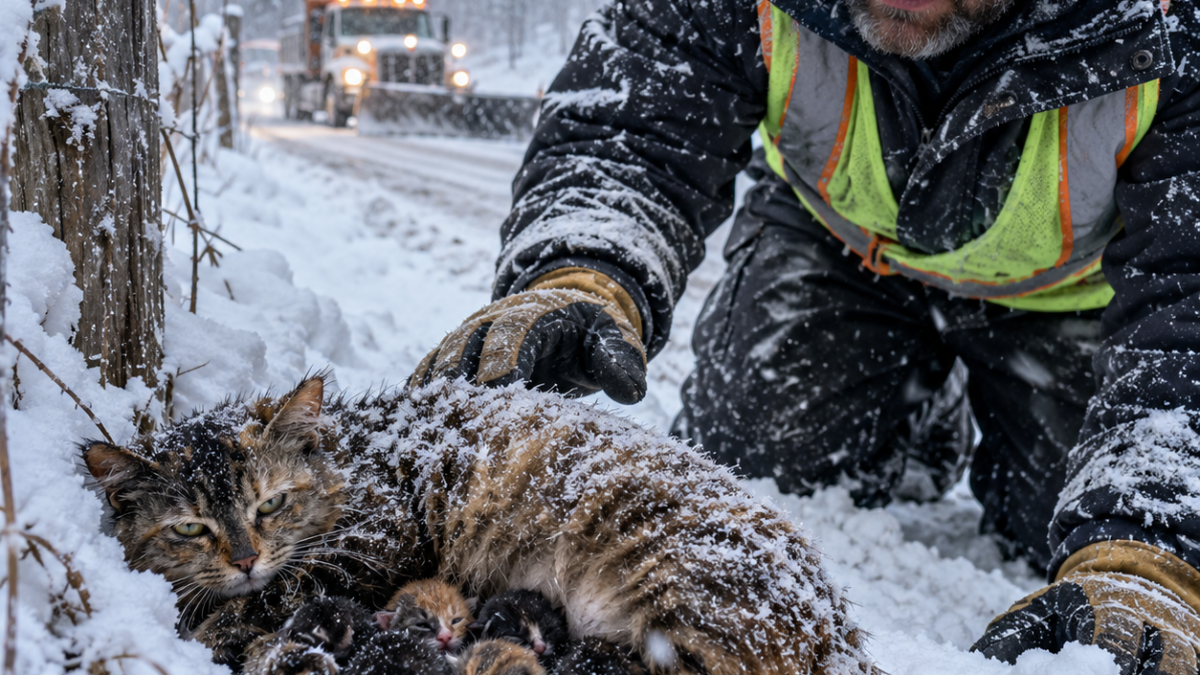
He reached down and touched the tortoiseshell’s back.
She felt stiff.
Frozen stiff.
Ryan looked away.
“She gone?”
Caleb swallowed.
“I think so.”
He slipped one gloved hand beneath her shoulder, intending to move her off the road edge so the plow would not strike her on the next pass. He had done that before for animals. It felt like the smallest respect a body could be given in winter.
But when he tried to lift her, she did not come free.
At first, he thought she was frozen to the ground.
Then he felt movement.
Not from her.
Beneath her.
A tiny squirm.
Caleb froze.
“What the—”
He leaned closer, brushing snow away with his glove.
There, beneath the curve of the cat’s body, hidden between her chest and belly in a shallow hollow she had made in the snow, something small moved again.
Ryan dropped to his knees beside him.
“Caleb?”
Caleb lifted the cat’s body as carefully as he could.
The sight beneath her made the world go silent.
Five newborn kittens.
Tiny.
Eyes sealed shut.
Bodies no bigger than Caleb’s thumb and palm together.
They were pressed into a trembling knot beneath their mother, protected by the cage of her frozen body. Their fur was damp but not frozen. Their little mouths opened silently. One nosed blindly against another. Another kicked a back leg the width of a matchstick.
Alive.
Every single one alive.
Ryan made a sound like he had been punched.
“Holy God.”
Caleb’s throat closed.
The mother cat did not move.
Her body was icy along the top, rigid in places, her fur frozen where the wind had hammered snow into it. But beneath her, where she had sealed herself around her babies, there was warmth. Not enough. Not safe. But enough to keep five little hearts beating through the worst night of the storm.
“She kept them alive,” Ryan whispered.
Caleb took off his coat.
The cold hit him instantly, sharp as broken glass through his sweatshirt, but he barely felt it. He spread the coat on the snow and lifted the mother cat and kittens together, careful not to separate them more than necessary. The mother’s body resisted at first, frozen fur stuck to the ground. Caleb worked his glove beneath her slowly, whispering without realizing it.
“Easy. Easy, mama. I got you. I got you.”
When she came free, one of the kittens gave a thin cry.
Not loud.
Almost nothing.
But alive.
Ryan was already running back to the truck.
“Earl!” he shouted. “Call somebody! Call a vet!”
Caleb wrapped the mother and kittens inside his coat, folding the heavy canvas around them like a nest. The mother’s head lolled slightly. Ice clung to her whiskers. Her eyes were half-open but unfocused. For one terrible second, Caleb thought she truly was gone and only her last warmth had remained.
Then her mouth opened.
A shallow breath.
Barely there.
Caleb bent so close his own breath warmed the ice on her face.
“She’s alive,” he said.
Ryan stopped moving.
“What?”
“She’s alive.”
The next ten minutes were chaos.
Ryan called dispatch. Dispatch tried the nearest veterinary clinic, which had no emergency staff in because of the storm. Earl called his niece, who worked at Green Valley Animal Hospital twenty-two miles away. Caleb climbed into the truck with the bundle pressed against his chest while Ryan cranked the heat so high the vents roared.
The road ahead had not been fully cleared.
The snow was still falling.
The truck’s tires slipped twice before Caleb steadied them.
“Let me drive,” Ryan said.
“No.”
“You’re freezing.”
“I said no.”
Ryan looked at him and then shut his mouth.
Caleb kept one hand on the wheel and one hand over the coat bundle on the seat beside him. Every few seconds, he glanced down. The kittens squirmed faintly under the fold of canvas. The mother cat’s breathing remained uneven, shallow, too slow.
“Stay with me,” Caleb whispered. “Come on. Stay with me.”
He had not prayed in years.
Not properly.
Not since his brother died in a logging accident when Caleb was twenty-eight and every casserole-bearing church lady in town said things that made grief feel worse. But as the truck pushed through the white road, hazard lights flashing, heater blasting, Ryan calling out directions to Green Valley Animal Hospital, Caleb found himself saying the only prayer he could manage.
“Please.”
Just that.
Please.
At Green Valley, veterinary technician Mara Ellis was already waiting by the side entrance when the truck slid into the lot.
She had been there for nearly thirty hours.
The storm had trapped half the staff at home and trapped the other half inside the clinic. Mara had slept for ninety minutes on an exam-room floor beneath a dog blanket. Her hair was twisted into a messy knot, her scrubs were wrinkled, and her hands smelled permanently of disinfectant and wet fur.
She had handled two hypothermic dogs, one blocked cat, a chicken with frostbitten feet, and a panicked elderly man who had driven off the road with his diabetic beagle in the back seat.
Then dispatch called about the frozen mother cat.
Mara heard the words “newborn kittens underneath her” and felt every bit of exhaustion in her body turn into focus.
Dr. Asha Patel, the veterinarian on duty, stood beside her with warmed towels, a thermometer, IV supplies, oxygen, and the grim look of someone preparing for a miracle and a loss at the same time.
Caleb burst through the side door carrying his coat bundle.
“She’s breathing,” he said, breathless. “Barely. Babies are alive.”
Mara took the bundle with both arms.
The coat was wet with melted ice.
Inside, the mother cat was shockingly cold.
Mara felt it through her gloves.
“Oh, mama,” she whispered.
They moved fast.
Exam Room 1 became an emergency warming station. Heated blankets. Warm fluids. Oxygen. Kittens transferred to a small box with a heating pad set low and wrapped in towels. Dr. Patel checked the mother’s heart, gums, pupils, paws, ears, tail, breathing, temperature.
“Body temp?” Mara asked.
Dr. Patel inserted the thermometer gently.
They waited.
The number flashed.
87.1°F.
Mara closed her eyes for one second.
Normal for a cat was around 100 to 102.5°F.
Eighty-seven was not just bad.
It was the edge.
“Severe hypothermia,” Dr. Patel said. “Frostbite to both pinnae. Paw pads. Tail tip. Likely dehydration. Shock. Possible postpartum exhaustion. We need warm IV fluids now. Slowly. Do not warm too fast.”
Mara nodded.
The kittens cried from the box.
Tiny, ragged little sounds.
Caleb stood near the door, his arms wrapped around himself now that he had no coat. Ryan had given him his own jacket, but Caleb still shivered violently.
Mara looked at him.
“Sir, are you okay?”
He stared at the mother cat.
“Are they going to live?”
Mara did not answer too quickly.
That was something she had learned early in veterinary medicine. Hope was sacred. You did not hand it out carelessly just because people were scared.
“The kittens are cold and dehydrated, but they’re moving,” she said. “That’s good.”
“And her?”
Dr. Patel looked up.
“She is critical.”
Caleb swallowed.
“But alive.”
“Yes,” Dr. Patel said. “Alive.”
The mother cat lay on her side beneath warm towels, too weak to lift her head. Her fur, as it thawed, revealed the rich mottled colors of a tortoiseshell: black, orange, brown, cream, all tangled with ice and dirt. She was painfully thin beneath the swelling of nursing. Her ears were damaged at the tips, pale and hard in places. Her paw pads looked terrible. The end of her tail was stiff and discolored.
But when one of the kittens cried again from the heated box, her body responded.
Not much.
A twitch.
A faint movement of one paw.
Mara saw it.
“She hears them,” she whispered.
Dr. Patel glanced at the kittens.
“Not yet. She’s too unstable.”
Mara knew that.
Still, she moved the kitten box closer, just close enough that the mother might smell them, hear them, know they were near.
The mother cat’s breathing hitched.
Mara placed one gloved hand lightly near her shoulder.
“They’re here,” she whispered. “They’re all here. You did it.”
No one in the room spoke for several seconds.
Even Ryan, who had been nervously shifting from one foot to the other, went still.
Caleb looked down at the floor.
His face crumpled.
Mara pretended not to see.
Some emotions deserved privacy even when they happened in crowded rooms.
They worked for hours.
The kittens were weighed, warmed, stimulated, checked for dehydration, and placed together in a towel nest. They were less than a week old, eyes sealed, ears folded, their bodies impossibly small. Two were dark tortoiseshell like their mother. One was orange. One was gray. One was black with a white chin.
“Five,” Mara said softly as she counted them again.
She kept counting them.
It became a ritual almost immediately.
One, two, three, four, five.
Still alive.
The mother cat remained critical. Warm fluids. Pain control. Oxygen. Careful warming. Blood glucose support. Frostbite assessment. Slow, steady intervention.
At some point, Earl arrived with a spare county coat for Caleb and a paper bag full of gas-station breakfast sandwiches nobody ate. He stood at the exam-room window, watching the tiny family through the glass.
“I thought he was stopping for trash,” Earl said quietly to Mara.
“Caleb?”
Earl nodded.
“He sees things on the road. Always has. Drives me nuts sometimes. Stops for turtles. Moves branches. Pulls folks out of ditches after shift when he should go home.”
Mara looked at Caleb, who was sitting in the lobby with his elbows on his knees and his hands clasped so tightly his knuckles were white.
“Good,” she said. “Today that mattered.”
At noon, Dr. Patel stepped into the lobby.
Caleb stood immediately.
“Well?”
“The kittens are stable for now.”
His eyes closed briefly.
“And the mother?”
Dr. Patel removed her glasses and rubbed the bridge of her nose.
“She has a very hard fight ahead. I would give her about a twenty percent chance of surviving the first night.”
Ryan whispered, “Jesus.”
Caleb’s face went pale.
“She kept them alive.”
“I know.”
“So she deserves—”
“She deserves everything we can do,” Dr. Patel said gently. “And we’re doing it.”
Caleb nodded.
“What’s her name?”
Mara, standing behind Dr. Patel, realized no one had asked that yet.
“She doesn’t have one,” Dr. Patel said.
Caleb looked toward the exam-room door.
Outside, wind threw snow against the clinic windows.
“Call her Ruth,” he said suddenly.
Mara tilted her head.
“Ruth?”
“My grandmother’s name. She raised six kids by herself after my grandfather died. Toughest person I ever knew.” His voice broke slightly. “Seems right.”
Dr. Patel nodded.
“Ruth it is.”
And that was how the frozen mother cat became Ruth before anyone knew whether she would live long enough to answer to it.
The first night nearly took her.
Mara stayed.
Her shift had technically ended at six in the evening, but the roads were still dangerous, half the overnight staff could not make it in, and Ruth’s temperature dipped again just after seven.
Mara called her sister and said she would not be home.
Her sister said, “You sound awful.”
“I look worse.”
“Is this about the frozen cat?”
“Yes.”
“Is she going to make it?”
Mara looked through the glass at Ruth’s small body beneath the warming blankets.
“I don’t know.”
“Do you need anything?”
“Coffee. A miracle.”
“I can bring coffee when the roads clear.”
“Then I’ll work on the miracle.”
Mara sat beside Ruth’s kennel for most of the night.
Not constantly touching her. Too much stimulation could stress a critical animal. But near enough that Ruth was not alone.
The kittens were nearby in their heated box. Every two hours, Mara checked them, weighed them, helped them latch when Ruth was stable enough to nurse, supplemented only when absolutely necessary, cleaned them, warmed them, counted them.
One, two, three, four, five.
Ruth drifted in and out.
Sometimes her breathing became so shallow Mara leaned close in panic.
Sometimes a kitten cried and Ruth’s paw moved faintly, searching.
At 2:18 a.m., Ruth’s heart rate dipped.
Dr. Patel, who had been asleep for twenty minutes in the office chair, woke instantly when Mara called her. They adjusted fluids, checked glucose, warmed her more carefully, whispered instructions back and forth while snow battered the windows.
At 3:04, Ruth stabilized.
Mara sat on the floor outside the kennel afterward, shaking from exhaustion.
“You can sleep,” Dr. Patel said.
“So can you.”
“I’m old.”
“You’re forty-six.”
“Ancient.”
Mara leaned her head against the cabinet and looked at Ruth.
“She can’t die after that,” she whispered.
Dr. Patel sat beside her.
“Yes, she can.”
“I know.”
“That’s the hardest part.”
Mara swallowed.
“She chose to stay over them. Caleb said she was frozen solid on top, but they were warm underneath.”
Dr. Patel’s eyes were tired and sad.
“Maternal instinct can be powerful.”
“No,” Mara said. “Don’t make it sound clinical.”
Dr. Patel looked at her.
Mara wiped her face.
“I know instinct is real. I know biology is real. But she was starving. Frostbitten. Freezing to death. She could have moved. She could have tried to save herself.”
“Maybe she couldn’t.”
“Maybe. But those kittens were alive because she stayed.”
Dr. Patel did not argue.
After a while, she said, “Then we stay too.”
So they did.
Ruth survived the first night.
Then the second.
On the third day, just after dawn, Mara was changing the kittens’ bedding when Ruth lifted her head.
Not much.
Barely two inches.
But after nearly seventy hours of critical care, it felt like watching a mountain move.
Mara froze.
“Dr. Patel,” she whispered.
Dr. Patel turned from the counter.
Ruth’s eyes were open.
Cloudy with exhaustion, pain, and medication, but open.
She did not look at the people.
She did not look at the food bowl.
She did not look toward the warm light or the IV line or the door.
Her eyes went straight to the kitten box.
Mara’s throat closed.
“She wants them.”
Dr. Patel came closer.
“Carefully.”
Mara lifted the first kitten, the tiny gray one, and placed it near Ruth’s chest. Ruth’s nose twitched. Slowly, with effort that seemed enormous, she lowered her face and touched the kitten.
Once.
Then again.
Mara placed the second beside her.
Then the third.
Fourth.
Fifth.
Ruth smelled each one.
One, two, three, four, five.
Only after the last kitten wriggled against her did Ruth lower her head to the towel.
Her body was ruined by cold.
Her ears blackened at the edges.
Her paws bandaged.
Her tail damaged.
Her ribs visible beneath nursing fur.
But the moment the kittens pressed into her, Ruth began to purr.
It was weak.
Almost soundless.
But it was there.
Mara turned away and cried into her sleeve.
Even Dr. Patel took off her glasses again, though this time she did not pretend it was because of fatigue.
“She’s still their mother,” Mara whispered.
Dr. Patel nodded.
“Yes,” she said. “She is.”
News of Ruth spread faster than anyone expected.
At first, it was just the county crew.
Then dispatch.
Then Caleb’s daughter, Grace, who heard the story from her father and told her middle-school art teacher, who happened to volunteer with Green Valley’s rescue partner, who posted a careful update asking for donations toward emergency care for “a frostbite survivor mama and her five newborn kittens.”
No graphic photos.
No sensational details.
Just Ruth wrapped in blankets, eyes half-open, five tiny bodies tucked safely beside her.
By evening, the post had been shared hundreds of times across northern Vermont.
By morning, thousands.
People left comments from Maine, Montana, Texas, Ontario, Scotland. Strangers sent money. Heated pads arrived. Kitten milk replacer. Fleece blankets. Gift cards. One elderly woman mailed a handwritten letter with twenty dollars in cash and the note: “For the brave little mother.”
The clinic staff pinned the note above Ruth’s treatment station.
Caleb came every day after his shift.
At first, he stood awkwardly in the lobby, unsure whether he was allowed to ask about a cat that was not his. Mara noticed him from the treatment room and waved him back.
“She knows you,” she told him.
“No, she doesn’t.”
“You found her.”
“She was mostly gone.”
“And now she isn’t.”
Caleb washed his hands and stood outside Ruth’s kennel.
“Hey, Ruth,” he said quietly.
Ruth opened her eyes halfway.
Her kittens nursed against her belly, tiny paws kneading.
Caleb stared at them for a long time.
“I keep thinking,” he said, “if I’d been ten minutes later…”
Mara interrupted him.
“You weren’t.”
“But if I had been.”
“You weren’t.”
He looked at her.
Mara held his gaze.
“You do not get to punish yourself with the version where you didn’t stop. She has enough pain. Don’t add yours to the room.”
Caleb looked down.
After a moment, he nodded.
“Grace wants to draw her.”
“Your daughter?”
“She’s twelve. She saw the photo. Said Ruth looks like a warrior.”
“She does.”
“She asked if all mothers do that.”
Mara did not answer right away.
In the kennel, Ruth shifted painfully but did not disturb the kittens.
“Some try,” Mara said. “Some never get the chance. Some are failed before they can.”
Caleb looked at her.
“What do you mean?”
Mara’s eyes moved to Ruth’s thin body.
“I mean cats don’t appear beside remote roads with newborn kittens in a blizzard by magic.”
That was the thought no one wanted to say too loudly at first.
Where had Ruth come from?
The area where Caleb found her was remote, but not empty. There were farms, seasonal cabins, a closed roadside produce stand, a maple sugar property, and an old rental house set back behind the pines. Ruth had been nursing newborn kittens in a storm that would have sent any sensible animal searching for shelter.
Had she been feral?
A barn cat?
Dumped?
Lost?
Abandoned while pregnant?
No microchip.
No collar.
No missing cat reports matching her.
Her condition told a story of neglect before frostbite. She was underweight. Her coat had been poor even before the ice. She had fleas beneath the frozen mats. Her claws were worn unevenly. A healed scar crossed one shoulder. She had clearly survived hardship before the storm ever arrived.
But hardship was not proof.
Mara knew that.
She had worked in rescue long enough to understand the danger of easy villains. Sometimes people were cruel. Sometimes they were overwhelmed. Sometimes poverty, addiction, illness, shame, and rural isolation made animals suffer in ways outsiders judged quickly and understood poorly.
But Ruth had been found near a fence line less than half a mile from the old Leary place.
That detail mattered.
The Leary place had been a farm once, then a rental, then something in between. People in town called it “the blue-roof house,” though half the roof was no longer blue. The last tenant, Warren Pike, had lived there with too many animals and not enough money for years. Complaints had been made. Dogs barking. Cats breeding. Trash piling near the shed. Smoke from a woodstove chimney even during burn bans.
The property owner lived in Florida.
The town had cited the place twice.
Nothing much had changed.
After Ruth’s story went public, someone commented under the rescue post:
“That looks like one of the cats from the Pike place.”
The comment disappeared within an hour.
But Mara saw it.
So did Caleb.
He called her that night.
“You see that comment?”
“Yes.”
“Pike place is near where I found her.”
“I know.”
“He had cats?”
“People say he did.”
“People say lots of things.”
“Yes.”
“But?”
Mara sat in the clinic break room, holding cold coffee she had forgotten to drink.
“But Ruth came from somewhere.”
Caleb was quiet.
Then he said, “I can drive by tomorrow.”
“No.”
“You don’t get to tell me no.”
“Actually, I do. Don’t go poking around alone on someone’s property.”
“I plow that road.”
“Plowing is not investigating.”
“I can notice things.”
Mara closed her eyes.
“Caleb.”
“She nearly died.”
“I know.”
“Her babies nearly died.”
“I know.”
“If someone left her—”
“We need facts,” Mara said. “Not rage.”
He exhaled sharply.
“I’ve got plenty of rage.”
“So do I. Facts first.”
The facts came slowly.
A woman named Tessa from the rescue group remembered trapping cats near the Leary property two summers earlier. She had offered Warren Pike help with spay and neuter. He refused, saying the cats handled themselves. Another neighbor, Mrs. Bell, said she had seen a small tortoiseshell cat heavily pregnant near Pike’s woodshed in January. A delivery driver remembered several cats around the porch during a cold snap, one of them mottled orange and black.
Then, five days after Ruth was found, a teenage boy named Dylan Pike came to the clinic.
He was seventeen, thin, pale, wearing a too-large coat and boots with duct tape around one sole. Mara saw him standing uncertainly near the front desk, staring at the pinned photo of Ruth.
Kelsey, the receptionist, asked, “Can I help you?”
Dylan swallowed.
“That cat.”
Mara had been walking past and stopped.
Dylan pointed at Ruth’s photo.
“That’s Sable.”
The clinic went quiet in the strange way small rooms do when truth enters unexpectedly.
Mara stepped closer.
“You know her?”
Dylan nodded, eyes fixed on the photo.
“She lived at my dad’s place.”
Mara kept her voice gentle.
“Are you Warren Pike’s son?”
“Yeah.”
“Do you know what happened to her?”
Dylan’s face twisted.
“I told him she was pregnant.”
No one spoke.
“I told him we had to bring her inside before the storm. I told him.”
His voice cracked.
Mara guided him into the consultation room before everyone in the lobby could watch him fall apart.
Dr. Patel joined them.
Dylan sat on the edge of the chair, hands jammed between his knees, eyes red but dry in the stubborn way teenage boys try to keep them.
“Sable was my mom’s cat,” he said.
Mara and Dr. Patel exchanged a glance.
“Where is your mom?” Dr. Patel asked.
“Gone.”
The word was flat.
“Gone how?”
“Moved out two years ago. Then died last summer.”
“I’m sorry,” Mara said.
Dylan shrugged, but his mouth trembled.
“She found Sable as a kitten. Dad never liked cats, but Mom did. After she left, everything got…” He looked toward the wall. “Bad.”
“Were there other cats?”
“Yeah.”
“How many?”
“I don’t know. Some inside, some outside. They kept having kittens. I tried feeding them.”
His voice grew defensive suddenly, as if he expected blame to strike him.
“I’m in school. I work at the gas station. I’m not always there.”
“No one is blaming you,” Dr. Patel said.
Dylan’s eyes flashed.
“You should. I knew she was pregnant.”
“You were a child trying to manage an adult’s neglect,” Mara said.
He looked at her.
That sentence seemed to land somewhere painful.
“The night before the storm,” he continued, “I put Sable in the mudroom with towels. I swear I did. Dad was drinking. He got mad because she scratched at the door. Said he wasn’t running a damn cat hotel. I went to work the next morning. When I came back, she was gone.”
“Gone?”
“He said he let her out.”
Mara felt cold move through her body.
“How far was your house from where she was found?”
Dylan wiped his nose with his sleeve.
“Maybe half a mile. Through the field.”
Dr. Patel’s face hardened, though her voice remained calm.
“Did he put her outside during the storm?”
Dylan stared at the floor.
“I think he drove her down the road.”
Mara closed her eyes.
The room was silent except for the hum of the heater.
Then Dylan whispered, “I should have stopped him.”
Mara knelt in front of him.
“Dylan, listen to me. Your father was the adult.”
“He said they’d find a barn. That cats know what to do.”
“Sable gave birth in a blizzard.”
“I know.”
“She nearly died.”
“I know.”
He finally began to cry.
Not loudly.
Not like a child.
Like someone who had been trying to hold back a flood with his hands and had finally run out of strength.
“I asked if I could see her,” he whispered.
Mara looked at Dr. Patel.
Dr. Patel nodded.
“She’s fragile,” Mara said. “You have to be quiet. No sudden movement.”
Dylan nodded quickly.
Mara led him to Ruth’s recovery kennel.
When Dylan saw her, he stopped.
Ruth was lying on her side, kittens nursing, ears bandaged, tail wrapped, paws protected. She looked stronger than she had on the first day but still terribly injured.
Dylan pressed one hand to his mouth.
“Sable,” he whispered.
Ruth’s eyes opened.
She looked at him.
For a moment, no one moved.
Then Ruth lifted her head a fraction.
Not much.
But enough.
Dylan made a broken sound and sank to his knees outside the kennel.
“I’m sorry,” he whispered. “I’m so sorry. I tried to keep you in. I swear I tried.”
Ruth watched him.
One kitten slipped off and cried.
Despite her weakness, Ruth turned toward the sound, nose searching.
Dylan saw it and cried harder.
“She was always a good mom,” he said.
Mara stood behind him with tears burning her own eyes.
“How many litters?” Dr. Patel asked softly.
Dylan wiped his face.
“This is her third. First two… not all made it.”
Ruth tucked the kitten back against her with her chin.
Mara looked at this little cat who had lost babies before, been failed before, been put out into weather before, and still chose to wrap her entire broken body around this litter until help came.
A mother’s love was not gentle in that moment.
It was furious.
It was defiant.
It was a small frozen body saying no to death with everything it had left.
The rescue group and animal control went to the Pike property that afternoon.
This time, there were facts.
Dylan’s statement.
Neighbor reports.
Photos.
Ruth’s medical condition.
The property was worse than Mara expected.
Cats scattered from the porch when the vehicles pulled in. Thin shapes beneath the shed. Paw prints around empty bowls. A broken plastic tote filled with frozen water. The mudroom smelled of urine and old straw. Inside, the house was cold except for one room where a woodstove burned too hot. Warren Pike answered the door angry, unshaven, and defensive.
He denied everything.
Then he blamed Dylan.
Then he said cats belonged outside.
Then he said Sable was “just a barn cat,” though there was no working barn.
Then he admitted he had “moved her away from the house” because she was “making noise.”
Animal control documented the property. Cats were trapped over the next week. Some were feral. Some were friendly. Some were pregnant. Two had frostbite. One old male had a wound so infected Dr. Patel stayed three hours late to treat him.
Dylan helped.
Every day after school, he showed up at the clinic or the trapping site, silent and pale, carrying food, washing carriers, labeling towels, doing whatever anyone asked. Some adults looked at him with pity. Some with suspicion. Mara watched him absorb both like blows.
One evening, she found him in the storage room stacking clean blankets.
“You don’t have to prove you’re not him,” she said.
Dylan froze.
“I’m not trying to.”
“Yes, you are.”
His hands clenched around a towel.
“He’s my dad.”
“I know.”
“What if I am?”
Mara understood then that his fear was not only about Ruth.
It was about inheritance.
Not money.
Damage.
The terror that cruelty was something in the blood, something waiting to wake up.
“You came here,” she said. “You told the truth. You’re helping the cats he neglected. That is not nothing.”
Dylan looked at her.
His eyes were young and exhausted.
“Is Sable going to live?”
Mara exhaled slowly.
“I think she wants to.”
“That’s not an answer.”
“It’s the truest one I have.”
Ruth did want to live.
But wanting was not enough to spare her pain.
The frostbite damage declared itself over the following weeks. Both ear tips blackened and had to be surgically removed. The tip of her tail died back and later required partial amputation. Two front paw pads lost sensation permanently. She developed complications from infection. Her weight dropped to 4.8 pounds despite eating ravenously whenever she could. Some days, she seemed to make progress. Other days, she lay so still Mara’s heart lurched every time she entered the room.
Yet Ruth never stopped nursing.
That became the astonishing fact repeated in every medical note.
Patient weak but alert when kittens vocalize.
Patient allows treatment, returns attention to kittens.
Patient nursing all five.
Supplemental formula not required.
Milk production adequate despite severe body condition.
Maternal care extraordinary.
Every two hours, those kittens fed.
Every two hours, Ruth gave what she had.
Dr. Patel monitored closely, ready to supplement, ready to intervene, ready to stop nursing if it endangered Ruth’s life beyond reason. But Ruth’s body, damaged and starved and frostbitten, kept producing enough.
“Her body should not be able to do this,” Kelsey said one night, watching the kittens nurse.
Dr. Patel replied, “Her body apparently did not ask our opinion.”
The kittens grew.
Slowly at first.
Then with the sudden determination of newborn animals who decide life is worth pursuing. Their bellies rounded. Their squeaks strengthened. Their sealed eyes opened one by one into cloudy blue surprise. They crawled over Ruth’s paws, tumbled against her chest, kneaded her bandages, and slept in a pile beneath her chin.
They received names from Grace, Caleb’s daughter.
She drew each kitten on a sheet of notebook paper and labeled them: Flint, Clover, Bean, Maple, and Star.
Mara thought Bean was a ridiculous name.
Bean became the biggest.
Grace visited Ruth after school on the day roads were fully clear. She was twelve, freckled, solemn, with Caleb’s eyes and her own fierce sense of justice. She stood beside Ruth’s kennel holding the drawing in both hands.
“She looks smaller than in the picture,” Grace whispered.
“She’s been through a lot,” Mara said.
“Dad said she kept them alive by being a blanket.”
“That’s one way to say it.”
Grace watched Ruth sleeping with five kittens pressed against her.
“My mom says animals don’t think like people.”
“That’s true.”
“Does that mean she didn’t love them?”
Mara crouched beside her.
“No. It means her love may not work exactly like ours. But she protected them. She fed them. She looked for them before she looked for food. Whatever word humans use for that, it matters.”
Grace nodded.
Then she slipped her drawing through the gap beside the kennel card.
Ruth opened one eye, unimpressed.
Grace smiled.
“She looks like she’d bite a wolf.”
“She might.”
“Good.”
The criminal case against Warren Pike did not become the dramatic courtroom victory people online wanted.
Reality rarely provides the clean justice people crave.
He was charged with animal neglect and cruelty related to Ruth and the other cats. There were fines, probation conditions, mandatory surrender of animals, a ban on owning cats for a period of time, and required inspections. Some people said it was too harsh because he was poor and struggling. Others said it was far too little because Ruth had almost died.
Mara thought both things could be complicated and still not change the center of the truth.
Ruth had been put out into a killing storm while pregnant or newly birthing.
Five kittens had nearly died under her.
Other cats on the property had suffered.
Whatever Warren’s pain, poverty, addiction, grief, or failures, he had made helpless animals pay for it.
Dylan attended one hearing.
Mara went with him.
So did Caleb.
Warren did not look at his son until the end. When he did, his face held anger first. Then something else. Shame, maybe. Or only embarrassment at being seen.
Dylan stood very still.
Afterward, outside the courthouse, Warren called his name.
“Dyl.”
Dylan stopped.
Mara felt Caleb tense beside her.
Warren shifted awkwardly.
“You didn’t have to tell them everything.”
Dylan’s face went pale.
For a second, Mara feared he would shrink back into the boy who had carried too much for too long.
Instead, Dylan said, “Yes, I did.”
Warren’s jaw tightened.
“She was a cat.”
Dylan’s eyes filled with tears.
“She was Mom’s cat.”
Warren looked away.
That was all.
No apology.
No reconciliation.
No movie moment where a broken father became whole because truth had cornered him.
But Dylan walked away.
Sometimes justice begins there.
Not with the cruel person understanding.
With the hurt person no longer waiting for them to.
Spring came slowly to northern Vermont.
Snowbanks shrank into dirty ridges. Roads turned to mud. Maple sap lines appeared in the woods. The air softened by degrees, as if the world did not trust warmth enough to offer it all at once.
Ruth healed the same way.
By inches.
Her ear surgeries left her with a rounded, permanently kitten-like look that made strangers coo until they saw her eyes. Ruth’s eyes were not cute. They were old. Watchful. Tired in a way that demanded respect.
Her tail became a short, crooked plume after the amputation. Her front paws remained sensitive. She walked carefully, sometimes lifting one paw when cold tile bothered the damaged pads. She hated having her bandages changed. She tolerated Mara. She adored her kittens. She distrusted men except Caleb and, eventually, Dylan.
The first time Ruth stood fully and took three steps to reach her water bowl, the clinic staff applauded.
Ruth looked offended.
The first time she climbed into the low bed with her kittens without help, Mara cried.
Ruth ignored that too.
The first time she groomed herself properly, licking the fur along her chest with slow dignity, Dr. Patel whispered, “There you are.”
Ruth paused, looked at her, and continued as if she had never been missing.
As the kittens grew, they became a ridiculous little storm of paws and hunger. Flint was bold. Clover was sweet. Bean was enormous and dramatic. Maple had opinions. Star was the smallest, a black kitten with a white chin who liked to sleep on Ruth’s surviving tail.
Ruth let them climb over her, bite her ears, tumble into her food dish, and nurse long after they had teeth sharp enough to make anyone else reconsider motherhood.
But she also began to leave them.
Only for moments at first.
She would step out of the kitten pen, take a drink, look back immediately, and return.
Then she began resting on a blanket outside the pen while they played.
Then, one afternoon, Mara found her sitting on the windowsill in the recovery room, watching snow melt from the roof.
Away from the kittens.
Not far.
But away.
Mara stopped in the doorway.
Ruth glanced at her.
Sunlight fell over her damaged ears, her shortened tail, her thin but recovering body. She looked scarred, yes. Changed forever. But also present in herself, not only as a mother, not only as a survivor, but as Ruth.
Mara smiled.
“There you are,” she whispered.
Ruth blinked slowly.
It was the first slow blink she had ever given Mara.
Mara turned around, walked into the supply closet, and cried into a stack of pee pads.
By late spring, the kittens were old enough for adoption.
That was harder than anyone expected.
People had followed their story online. Applications poured in. Some were wonderful. Some were not. Some wanted “one of the miracle kittens” for the wrong reasons. Some asked if Ruth was available because “her story would be inspiring content.” Mara deleted those emails with unnecessary force.
The rescue decided the kittens would not be adopted until Ruth was fully weaned from them and Dr. Patel cleared her emotionally and physically. They also decided, because they had learned something from Ruth, that no one would be placed for publicity.
Three kittens — Flint, Clover, and Bean — were adopted together by a family from the same county. The parents had two gentle children, a warm farmhouse, and a grandmother who had once bottle-fed orphaned kittens. During the meet-and-greet, Bean climbed into the father’s jacket and refused to leave. Ruth watched from her bed, eyes narrowed.
The father looked genuinely nervous.
“I think she’s judging me,” he whispered.
“She is,” Mara said.
“Did I pass?”
Ruth yawned.
“That’s her highest approval.”
The other two kittens, Maple and Star, went to a retired teacher named Mrs. June Callahan, who had lost her seventeen-year-old cat the year before and still kept the cat’s bed in the sunroom because she could not bring herself to move it. Maple marched into June’s carrier immediately. Star followed because Maple did everything first.
June cried during the adoption paperwork.
“I thought I wanted one quiet adult cat,” she said.
Mara smiled.
“That’s how it starts.”
Ruth watched both adoption days with calm attention.
People worried she would grieve.
Maybe she did, in her own way. She searched the room more than usual after the last kittens left. She sniffed the blankets. She slept deeply for most of the next day.
But she did not break.
She had given them life.
Now they had homes.
And Ruth, at last, had the chance to become more than the body that protected them.
Mara told herself she was fostering Ruth through recovery.
Everyone at Green Valley pretended to believe her.
Dr. Patel did not.
Kelsey did not.
Caleb did not.
Even Ruth did not seem convinced.
It happened gradually.
Ruth stayed at the clinic for months because her care was intensive and Mara had the experience to manage her wounds, medications, and mobility. At first, Mara visited her as a patient. Then she began spending lunch breaks beside her kennel. Then Ruth moved into Mara’s office during the day because she was calmer there. Then Mara took her home for “a weekend trial” during a clinic renovation.
Ruth entered Mara’s apartment like a queen inspecting a disappointing temporary palace.
She limped through the living room, sniffed the couch, paused before the electric fireplace, inspected the kitchen, and then found Mara’s bed.
She climbed onto it with effort, turned once, and lay down in the exact center.
Mara stood in the doorway.
“That’s my side.”
Ruth closed her eyes.
“All right,” Mara said. “Your side.”
By Sunday night, Ruth had claimed the bed, the heated blanket, the windowsill, and a small rug near the radiator. She allowed Mara to administer medication without protest if bribed with chicken. She hated the dishwasher. She liked classical piano. She woke Mara at 5:20 a.m. by placing one frostbite-damaged paw on her face.
On Monday morning, Mara brought Ruth back to the clinic for a checkup.
Dr. Patel watched Ruth climb out of the carrier and onto Mara’s lap in the exam room.
“So,” Dr. Patel said.
Mara looked up.
“What?”
“Are we still calling this a weekend trial?”
Ruth tucked her shortened tail around herself and settled against Mara’s stomach.
Mara looked down at her.
Ruth looked up.
There are moments in life when the truth becomes so obvious that resisting it feels embarrassing.
“No,” Mara said softly. “We’re not.”
Dr. Patel smiled.
“I’ll prepare the adoption paperwork.”
Mara cried while signing it.
Ruth bit the pen.
Very on brand.
When Caleb heard, he came by with Grace and a small wooden sign he had made from scrap maple.
It read:
RUTH’S HOUSE
SURVIVORS WELCOME
Mara laughed and cried at the same time.
Grace knelt on the floor. Ruth approached her slowly, sniffed her sleeve, and allowed exactly one gentle stroke along her back.
Grace looked as if she had been knighted.
“Dad,” she whispered. “She picked me.”
Caleb’s eyes softened.
“She’s got good judgment.”
He crouched near Ruth, careful as always.
“Hey, girl.”
Ruth sniffed his work glove.
Then, with great dignity, she pressed her head against his knuckles.
Caleb froze.
Mara saw his face change.
This was the man who had found her frozen, who had carried her in his coat, who had driven through a storm whispering please like a prayer. He had held himself together through the rescue, the clinic visits, the hearings, the updates, the adoptions.
But Ruth’s head against his hand undid him.
He covered his face and turned away.
Grace put one arm around him.
Ruth blinked, unimpressed by human fragility, and limped back to Mara’s lap.
Months passed.
Ruth grew stronger.
Never fully whole in the way she had been before the storm. The cold had taken parts of her and left others altered. Her ear tips were gone. Her tail was shorter. Her paws were sensitive. She tired easily. In winter, even indoors, her old frostbite injuries ached. Mara learned to warm her blankets before bed, to place soft rugs over cold floors, to check her paws after every vet visit, to carry her when ice made the sidewalk dangerous.
But Ruth lived.
Not as a symbol.
Not as tragedy.
As a cat.
She stole chicken from Mara’s plate.
She scratched the expensive cat bed and slept in the cardboard shipping box.
She yelled at the bathroom door.
She developed a feud with the neighbor’s golden retriever through the window.
She groomed Mara’s hair at night with the seriousness of a nurse tending a patient.
She purred rarely, but when she did, it felt earned.
Her kittens thrived.
Flint, Clover, and Bean became chaotic farmhouse royalty. Bean grew into a massive orange-and-white cat whose favorite activity was lying across heating vents. Clover slept with the youngest child every night. Flint learned to open kitchen cabinets.
Maple and Star turned June Callahan’s quiet house into a two-cat theater production. Maple supervised knitting. Star slept in the old cat bed June had finally moved into the sun.
The families sent photos every month.
Mara printed them and placed them in a small album titled Ruth’s Babies.
Did Ruth understand the pictures?
Probably not.
But sometimes when Mara opened the album on the floor, Ruth sat beside her and looked with solemn interest.
Mara liked to think some part of her knew.
The road where Caleb found Ruth changed too.
Not physically. The fence post still stood. The fields still opened to the wind. Snow still drifted there in winter.
But people remembered.
The county crew placed a small marker near the fence with permission from the landowner. Nothing dramatic. Just a weatherproof wooden stake carved by Caleb, with five tiny paw prints and one larger one.
Underneath, the words:
WHERE LOVE HELD ON
Some people thought it was sentimental.
They were not wrong.
Sentiment is not weakness when the world has been cruel.
On the first anniversary of the storm, Caleb, Grace, Mara, Dylan, Dr. Patel, and a few clinic staff drove out to the spot.
The air was cold but not dangerous. Snow lay lightly over the field. The sky was pale blue, washed clean by winter sun.
Mara brought Ruth in a warmed carrier lined with fleece. She did not set Ruth down in the snow. She would never ask that of her. Instead, she held the carrier close inside her coat, letting Ruth look through the mesh at the place where everything had almost ended and everything after had begun.
Dylan stood apart from the group at first.
He had grown taller in a year, or maybe simply less folded in on himself. He was living with his aunt by then, finishing school, working weekends at the gas station, and volunteering with the rescue during cat-trapping days. He still carried guilt. Mara saw it. But he carried other things now too.
Purpose.
Gentleness.
A future not entirely shaped by Warren Pike.
Grace walked over and handed him a small drawing.
It showed Ruth with five kittens under her, but not in the snow. In the drawing, they were under a huge golden sun.
Dylan swallowed.
“Thanks.”
“She doesn’t hate you,” Grace said.
Dylan looked startled.
“What?”
“Ruth. She doesn’t.”
He looked toward the carrier in Mara’s arms.
“You don’t know that.”
Grace shrugged.
“She head-butted your hand last week.”
“She head-butts the food bag too.”
“She loves the food bag.”
Despite himself, Dylan smiled.
It was small.
It mattered.
Caleb stood by the marker, hands in his coat pockets.
“I keep thinking about what I thought she was,” he said to Mara.
“Trash?”
He nodded, ashamed.
“For half a second. I thought she was trash.”
“But you looked closer.”
“Yeah.”
“That’s the whole story sometimes.”
He looked at her.
“What?”
“Looking closer.”
The wind moved across the field, softer than it had been that terrible morning.
Mara looked down at Ruth.
Ruth was awake, eyes calm, body warm inside the carrier.
“You know,” Mara said quietly, “people call her a miracle.”
“She is.”
“Yes. But not because she survived in some magical way. She survived because you stopped. Because dispatch answered. Because the clinic opened. Because Dylan told the truth. Because people donated. Because laws changed. Because everyone after that first moment kept choosing to help.”
Caleb nodded slowly.
“Still sounds like a miracle.”
Mara smiled.
“Maybe miracles are just a lot of people refusing to fail the same small life.”
That spring, Green Valley Animal Hospital and the rescue group started Ruth’s Fund, an emergency program for abandoned, frostbitten, nursing, or critically injured cats. Caleb donated his overtime from the storm weekend. Mrs. Bell organized a bake sale. Grace’s school held a supply drive. Dylan spoke at one event, voice shaking, and told a room full of adults that ignoring suffering because you are ashamed does not make it disappear.
“Someone always pays for silence,” he said. “Usually the smallest one.”
The room stayed quiet for a long time after that.
Then people stood.
Not cheering wildly.
Just standing.
Respect.
Warren Pike never attended any of it. His animals were gone. The property was eventually cleaned, sold, and repaired by a family who promised the rescue group they would maintain feeding stations for local barn cats and call if any strays appeared.
Life moved, as life does.
The internet eventually found other stories. Other outrages. Other miracles. Ruth’s post stopped being shared. The comments slowed. Donations became steadier and quieter. People who had cried over her photo went back to their own pets, their own jobs, their own storms.
But Ruth remained.
Each morning, Mara woke to one scarred paw on her collarbone and a hoarse little chirp demanding breakfast. Each winter, when the first hard freeze came, Mara turned up the heat and placed extra blankets near every window. Each February, Caleb sent a text: Thinking of Ruth today. Each time, Mara sent back a photo of Ruth looking annoyed, comfortable, alive.
One night, nearly two years after the storm, Mara woke to find Ruth sitting on the windowsill.
Snow was falling.
Softly this time.
No wind.
No emergency.
No frozen road.
Just quiet flakes drifting through the yellow glow of streetlights outside Mara’s apartment.
Ruth sat very still, her shortened tail curled around her paws, her damaged ears silhouetted against the glass.
Mara got out of bed and walked slowly to her.
“You okay?” she whispered.
Ruth did not look away from the snow.
Mara sat on the floor beside the window.
For a while, they watched together.
Mara thought of the fence post. The coat. The five kittens. The temperature reading 87.1. The first purr. The first head lift. The surgeries. The adoption papers. The marker in the snow. The countless hands that had refused to let Ruth’s story end where the storm tried to end it.
Then Ruth stepped down from the windowsill.
She walked carefully to Mara, lifted one front paw, and placed it on Mara’s knee.
A paw that had lost feeling in places.
A paw the cold had tried to take.
A paw that had once held five babies beneath her frozen body.
Mara placed her hand beside it, not over it.
Ruth leaned forward and pressed her forehead against Mara’s wrist.
And purred.
Low.
Rough.
Unmistakable.
Mara bowed her head and cried quietly.
Not because Ruth was sad.
Because Ruth was here.
Because sometimes survival itself is so beautiful it hurts to witness.
Years later, when people asked Mara why she adopted Ruth, she always gave the simple answer first.
“Because she needed a home.”
That was true.
But not complete.
The fuller answer was harder.
Mara adopted Ruth because she had watched that small tortoiseshell mother come back from the edge of death and look for her kittens before she looked for herself. Because she had seen Ruth endure pain no creature should endure and still offer warmth. Because she had watched five tiny lives grow strong from a body that had every reason to give up. Because she could not bear the thought of Ruth going somewhere that admired her story but did not understand her scars.
Because Ruth did not need to be called brave by strangers.
She needed warm floors.
Soft blankets.
Medication when old injuries ached.
A person who knew why winter frightened her body even when she was safe.
A home where nobody asked her to be inspirational before breakfast.
That was the truth of rescue people often missed.
The dramatic moment matters.
The discovery in the snow. The race to the clinic. The first night survived. The viral photo. The headline. The tears.
But love is what happens afterward.
Love is trimming claws carefully because frostbite made the paws sensitive.
Love is warming blankets.
Love is remembering the anniversary of the day a life almost ended without making the survivor relive it.
Love is letting a mother rest after she has given everything.
Love is seeing the scars and not asking them to disappear so the story feels prettier.
Ruth lived many years after the storm.
Good years.
Not perfect years.
Good ones.
She became rounder, though never fat. Her fur grew glossy. Her face, with its rounded ears, made her look both fierce and strangely young. She never loved strangers, but she tolerated clinic staff and adored Mara with quiet possessiveness. She napped near the radiator. She supervised dinner. She once stole an entire piece of baked salmon from Caleb’s plate during a visit and showed no remorse.
Her kittens grew into cats who carried pieces of her.
Flint’s stubbornness.
Clover’s gentleness.
Bean’s appetite.
Maple’s opinions.
Star’s watchful eyes.
Every Christmas, the families sent photos to Mara, and every February, Mara placed them near Ruth’s bed.
One year, Grace — older now, almost finished with high school — visited with Caleb and brought a framed drawing. It showed Ruth not in snow, not suffering, not frozen, but standing tall on a green hill with five grown cats behind her and sunlight breaking through clouds.
At the bottom, Grace had written:
She was not the storm. She was what the storm could not take.
Mara hung it in the hallway.
When Ruth died years later, she died in warmth.
That mattered to Mara more than anything.
She was old by then. Her body had carried the storm for a long time, and eventually, it grew tired. Dr. Patel came to Mara’s apartment because Ruth had always hated exam rooms after too many necessary procedures. Caleb and Grace visited that morning. Dylan sent flowers. The kitten families sent messages. Mara placed Ruth on her favorite fleece blanket near the window, with the radiator humming and soft snow falling outside.
Not a storm.
Just snow.
Mara held her.
Ruth’s paw rested against her wrist, just as it had that night by the window.
“You did enough,” Mara whispered. “You did so much.”
Ruth’s breathing slowed.
Mara pressed her face into Ruth’s fur and said the words she had been saying since the first night at the clinic.
“They’re safe. You’re safe. Everybody’s safe.”
And then Ruth let go.
There are losses that feel like endings, and losses that feel like the closing of a circle.
Ruth’s was both.
Mara buried her ashes beneath a young maple tree behind the clinic, near the garden where staff sometimes sat during lunch. Caleb made a small wooden marker. Grace painted five tiny kittens curled beneath a tortoiseshell body, but this time there was no snow around them. Only flowers.
Dylan came to the memorial and stood quietly at the back.
Afterward, he approached Mara.
“I still think about her all the time,” he said.
“Me too.”
“She changed my life.”
Mara smiled sadly.
“She did that to a lot of people.”
Dylan looked at the marker.
“I used to think I was the kind of person things happened to. Bad house. Bad dad. Bad luck. Ruth made me realize I could choose what kind of person I became after.”
Mara’s eyes filled.
“What kind did you choose?”
He looked embarrassed.
“I start vet tech school in September.”
Mara covered her mouth.
Dr. Patel, standing nearby, said, “Good. We need people who know why it matters.”
Years after that frozen morning, County Road 17 still drifted badly in storms.
Caleb still plowed it, though with more gray in his beard and less patience for people who ignored road closures. Every time he passed the fence post, he slowed just slightly.
Not enough for anyone else to notice.
Enough for him.
The marker weathered.
The words faded once and Grace repainted them.
WHERE LOVE HELD ON
Drivers passed without knowing. Some saw it and wondered. Some looked it up and found Ruth’s story archived on the rescue website. Some left flowers. Once, someone left a tiny knitted blanket.
The world moved on.
But not completely.
Because somewhere in Vermont, five cats lived because their mother did not move.
Because one road worker looked closer.
Because one veterinary team refused to give up.
Because one frightened teenager told the truth.
Because one small tortoiseshell cat, freezing beneath a fence post in a storm that should have killed her, used the last warmth in her body to create a pocket of life beneath her.
People often say a mother’s love is strong.
But Ruth taught everyone who knew her that strong is too small a word.
Her love was not a slogan.
It was not sweet in the way greeting cards make motherhood sweet.
It was raw, physical, costly, and absolute.
It was frostbitten ears.
Damaged paws.
A tail lost to cold.
A body temperature of 87°F.
Nearly eighteen hours in snow and wind.
Five newborn kittens who could not open their eyes.
One mother who had been failed by humans, failed by a home, failed by the world, and still refused to fail her babies.
She did not survive the storm because she was strong enough to save herself.
She survived long enough to make sure they had a chance.
And in the end, that chance became everything.
Five kittens opened their eyes.
Five kittens grew.
Five kittens found homes.
A road worker carried her memory for the rest of his life.
A girl learned that courage can be small and frozen and still change the world.
A teenage boy broke a family pattern of silence.
A clinic built a fund that saved animals Ruth would never meet.
A woman named Mara found the cat who would become the scarred, stubborn, beloved center of her home.
And Ruth, who once lay frozen to the ground while life trembled beneath her, spent the rest of her days warm.
That is the ending people cried hardest over.
Not the rescue.
Not the headlines.
Not the courtroom.
The warmth.
Ruth earned warmth.
Every frightened animal does.
Every creature left in a storm deserves someone to look closer.
And every now and then, when the world is at its coldest, love does something impossible.
It curls itself around the smallest lives.
It takes the wind on its own back.
It gives away its last heat.
It says, without words and without witness, if anything survives this night, let it be them.
Ruth never knew her story traveled beyond that road, beyond that clinic, beyond the people who touched her gently and whispered encouragement as she fought her way back.
She never knew strangers cried over her.
She never knew laws changed because of her.
She never knew a sign stood by a fence post marking the place where she held on.
She only knew what mattered.
Her babies were warm.
Her babies were alive.
And when she finally lifted her head in that clinic kennel, broken and frostbitten and barely strong enough to breathe, they were still there.
One.
Two.
Three.
Four.
Five.
All safe.
All because their mother loved them more than the storm could take.








