They Sealed an Elderly Dog Inside Two Bags and Left Her to Die—But the Bag Moved, and So Did the Truth
PART3:
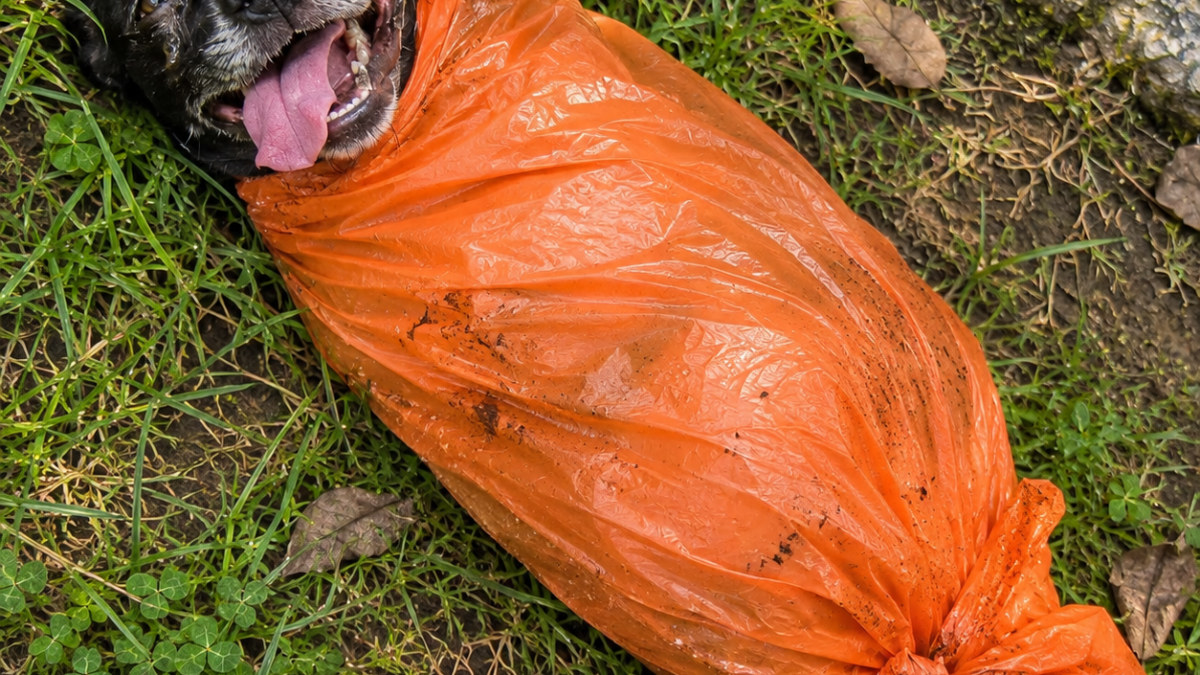
Air rushed inward.
The plastic loosened.
And an old dog’s face appeared.
Gray around the muzzle.
Cloudy brown eyes.
Ears pressed flat.
Mouth open but barely panting.
She did not bark.
She did not snap.
She did not scramble desperately toward freedom.
She simply stared at them.
Mateo tore the plastic farther apart.
“Easy, girl.”
The dog tried to stand.
Her legs trembled.
She sank back down.
Lucía knelt opposite him.
“Water.”
Mateo looked toward the house.
“I’ll get—”
“No. Don’t leave her.”
Something in Lucía’s voice stopped him.
She removed her own water bottle, poured some into her palm, and held it near the dog’s mouth.
The dog stared at the water.
Then at Lucía.
Then back at the water.
As if she suspected a trick.
“It’s okay,” Lucía whispered. “Nobody’s going to hurt you.”
The old dog lowered her nose.
One lick.
Then another.
Then she stopped and looked toward the road.
Mateo followed her gaze.
The sedan was gone.
The dog kept staring anyway.
Lucía’s eyes filled.
“She’s waiting.”
“For what?”
“For the car.”
The words settled between them.
Mateo looked down at the torn bags.
He imagined hands tying those knots.
A person placing the dog inside one layer of darkness.
Then another.
He imagined the old animal feeling the air disappear.
Hearing a familiar engine.
Smelling the person she knew.
Being lifted.
Dropped.
Left.
His hands began to shake.
“We’re calling the police.”
Lucía looked at him.
“First we’re getting her somewhere safe.”
The dog finally managed to stand.
She was thinner than she had appeared inside the bag, her belly tucked high, her coat dull in patches. There were no obvious catastrophic wounds. No blood. No broken limbs.
That almost made it worse.
She had not been discarded because she was dying in some visibly horrific way.
She had simply been discarded.
Lucía extended her hand.
The dog flinched.
Lucía froze.
Then slowly lowered her hand to the grass instead.
“Okay,” she whispered. “You don’t have to trust me.”
The old dog’s eyes stayed fixed on her.
Mateo swallowed.
“What do we do?”
“We walk beside her.”
So they did.
They did not drag her.
They did not carry her.
They opened a path through the grass and moved slowly toward the house.
The dog followed several feet behind.
Every few steps she stopped and looked back.
At the road.
At the place where the car had disappeared.
By the time they reached the yard, Mateo had called the local police station and given the sedan’s description.
Lucía had placed a shallow bowl of water beneath the shade of a mango tree.
The dog drank.
Then she walked to the farthest corner of the yard and curled herself against the wall.
Lucía brought an old blanket.
The dog moved away from it.
Lucía stopped.
“Fine,” she said softly. “You choose.”
She laid the blanket several feet away.
Mateo leaned against the porch post.
“We need a veterinarian.”
“I know.”
“And someone who knows rescue.”
“I know.”
“She may have a chip.”
Lucía nodded.
Her eyes never left the dog.
“What?”
Mateo followed her stare.
“She’s still watching the gate.”
Before Lucía could answer, an engine sounded on the road.
The old dog stood so abruptly that her legs nearly slipped.
Her ears lifted.
Mateo stepped forward.
The silver sedan turned into the drive.
“No,” Lucía whispered.
The old dog’s tail moved once.
One fragile sweep.
Then the car stopped.
The same woman climbed out.
Without sunglasses this time.
She looked to be in her late fifties, perhaps early sixties, with carefully styled dark hair streaked with gray and the expression of someone inconvenienced by other people’s existence.
Her gaze landed on the dog.
“There she is.”
Lucía stepped between them.
The woman frowned.
“Move.”
Mateo stared at her.
“Excuse me?”
“That’s my dog.”
Lucía’s voice changed.
It became very calm.
“You put her inside two bags.”
The woman exhaled sharply.
“You don’t understand.”
“I understand exactly what I opened.”
“You had no right to take her.”
Mateo almost laughed.
“Take her?”
“She belongs to me.”
The dog had stopped wagging.
She stood behind Lucía now.
Head low.
The woman pointed toward the sedan.
“Come, Mila.”
The old dog did not move.
Again.
“Mila, come.”
Lucía glanced down.
“Mila?”
The woman’s face hardened.
“That is her name.”
Mateo looked at the dog.
Then at the torn plastic bags still lying near the fence.
“You knew her name when you tied those bags?”
The woman’s cheeks flushed.
“I was not trying to kill her.”
Lucía stared.
“You sealed her in plastic.”
“She keeps getting out.”
Mateo actually laughed then, a short disbelieving sound.
“So your solution was to suffocate her?”
“I was taking her somewhere.”
“You left.”
“I panicked.”
“You drove away.”
“I came back.”
“Because you saw us?”
The woman’s eyes flicked toward him.
That was enough.
Mateo stepped closer.
“You saw us running toward the bag, didn’t you?”
“No.”
“You looked toward the houses before you dropped her.”
“I said no.”
Lucía raised one hand.
“Mateo.”
He stopped.
The old dog pressed closer to Lucía’s legs.
The woman saw it.
Something ugly flashed across her face.
Not grief.
Not relief.
Possession.
“Give me my dog.”
Lucía shook her head.
“No.”
“You can’t keep her.”
“I’m not giving an animal back to someone I watched dump her alive.”
“You don’t know what I’ve been through with that dog.”
Lucía’s expression sharpened.
“No. I know what she’s been through with you.”
The woman took a step forward.
The dog backed away.
Lucía stepped with her.
The woman noticed.
So did Mateo.
For the first time, a little of her confidence slipped.
“She’s old,” the woman said. “She soils the house. She cries at night. She scratches the doors. She doesn’t listen anymore.”
Mateo stared at her.
“You came back here to explain why an old dog deserved a plastic bag?”
“That is not what I said.”
“It’s exactly what you said.”
“She’s my responsibility.”
“You abandoned that responsibility in a field.”
The woman looked toward the road as though suddenly aware that other people might be watching.
“You’re making this dramatic.”
Lucía’s face went pale with anger.
“Dramatic?”
“I was overwhelmed.”
“So you could have taken her to a shelter.”
“They wouldn’t take her.”
“A veterinarian.”
“I don’t have endless money.”
“You’re driving a car worth more than my house.”
“That is none of your business.”
“You made it my business when your garbage moved.”
The woman flinched.
Just slightly.
Then her expression went cold.
“You have no idea who I am.”
Mateo folded his arms.
“That supposed to scare us?”
“It should make you think before accusing me publicly of something you don’t understand.”
Lucía looked down at the dog.
The old animal was trembling now.
Lucía bent slowly, not touching her.
“Look at her.”
The woman said nothing.
“Look at what happens when you walk toward her.”
“Mila has always been nervous.”
“Then why was she watching the road for you?”
The woman’s jaw tightened.
“Because she knows me.”
“That’s what makes this worse.”
A police vehicle appeared at the end of the dirt road.
The woman turned.
Her face changed instantly.
The anger vanished.
Her shoulders dropped.
Her voice softened.
“Oh, thank God.”
Mateo stared at her.
Lucía did too.
The transformation was so complete it was almost impressive.
By the time the officer stepped out, the woman was crying.
Not sobbing.
Carefully crying.
“My dog got away from me,” she said before the officer could ask a question. “These people found her, and now they won’t return her.”
Mateo felt his temper flare.
Lucía touched his arm.
“Let her finish.”
The officer, a compact man named Inspector Benítez, looked from the woman to Mateo, then Lucía, then the dog.
“What happened?”
The woman spoke quickly.
“She’s elderly. She’s confused sometimes. I was trying to transport her because she had an accident in the car, and she got out—”
Mateo pointed toward the black plastic on the ground.
“She got out of those?”
The officer looked.
The woman stopped.
Lucía said, “We watched her remove the dog from her car inside those bags, carry her into the field, drop her, and drive away.”
“That’s a lie.”
Mateo stepped forward.
“You want to try that again?”
Inspector Benítez lifted a hand.
“Sir.”
Mateo stopped.
The officer crouched near the torn plastic without touching it.
“You opened these?”
“Yes,” Lucía said.
“How many bags?”
“Two.”
“Both closed?”
“Tied.”
The woman shook her head.
“They’re exaggerating.”
Lucía pulled out her phone.
“I took a picture before Mateo cut the second one.”
The woman went still.
Mateo turned to his wife.
“You did?”
Lucía looked almost apologetic.
“You were cutting the first bag. I thought if somebody had done this, we would need proof.”
Inspector Benítez stood.
“Show me.”
Lucía opened the image.
The officer studied it.
The outer black bag had been cut open.
Inside, the second translucent plastic layer remained twisted tightly enough to show the shape of the dog’s body beneath it.
The woman’s face was partly visible in the background.
She had already returned.
There would be arguments later about exactly what the photograph proved.
There would be statements.
Veterinary reports.
Questions about intent.
Questions about animal-protection statutes.
Questions about whether the dog could have died.
But in that yard, something simpler happened.
The woman reached for Milagros.
The dog recoiled so violently she stumbled.
Then she moved behind Lucía.
And stayed there.
Inspector Benítez looked at the woman.
“You’re not taking the dog today.”
“You can’t do that.”
“I can while this is investigated.”
“This is theft.”
“No. This is evidence.”
The word hit differently.
The woman looked at the old dog as though she had suddenly become dangerous.
Not because Milagros could bite.
Because she could prove something.
The woman turned to Lucía.
“You think you’re saving her?”
Lucía said nothing.
“You have no idea what she’s like.”
Lucía glanced behind her.
Milagros was pressed against the back of her calf.
“I know she’s alive.”
The woman left without the dog.
This time, Milagros did not watch the car until it disappeared.
She watched Lucía.
That evening, the storm broke just after sunset.
Rain hammered the tin awning over the back porch while Mateo sat at the kitchen table filling out a statement for the police.
Lucía had made a temporary bed in the laundry room.
Milagros refused it.
She chose a patch of covered concrete outside instead.
“Should we bring her in?” Mateo asked.
“No.”
“She’s going to get cold.”
“She’s dry there.”
“There’s thunder.”
“I know.”
Mateo watched his wife.
Lucía sat on the floor six feet from the dog with a cup of coffee cooling beside her.
“You’ve been there two hours.”
“She’s been through worse than two hours of me sitting quietly.”
“What if she never comes inside?”
“Then tomorrow we try again.”
“And if she never trusts us?”
Lucía looked toward Milagros.
“Then she can spend the rest of her life not trusting us in a place where nobody hurts her.”
Mateo sat beside her.
For a while, neither spoke.
Lightning brightened the yard.
Milagros flinched.
Lucía did not reach for her.
A few minutes later, the dog shifted.
One paw forward.
Then another.
She moved perhaps eight inches closer.
Lucía did not react.
Mateo smiled.
“Did you see that?”
“Yes.”
“You’re pretending you didn’t.”
“Yes.”
“Why?”
“Because maybe she needs to know she can come closer without somebody grabbing her.”
So they sat.
At midnight, Milagros was still outside.
At one in the morning, Lucía woke on the laundry-room floor with Mateo’s jacket over her shoulders.
Milagros was gone.
Panic struck immediately.
She sat up.
Then saw the gray muzzle resting on the threshold.
The dog had moved halfway inside.
Not onto the bed.
Not beside Lucía.
Just across the line between outside and in.
Lucía covered her mouth.
She did not touch her.
In the morning, Milagros was back against the wall.
But something had changed.
The next day, veterinarian Dr. Emilia Ferreira examined her.
The clinic smelled like disinfectant, wet fur, and nervous animals.
Milagros trembled on the floor.
Lucía refused to lift her onto the metal table until the veterinarian suggested examining her where she stood.
“Good,” Dr. Ferreira said. “Let her choose as much as possible.”
She checked Milagros’s heart.
Eyes.
Ears.
Teeth.
Joints.
Skin.
Weight.
Blood.
The examination took nearly an hour because every movement had to be slow.
Finally, Dr. Ferreira sat on the floor with them.
“Well?”
Lucía braced herself.
The veterinarian looked at Milagros.
“She is old.”
“That’s all?”
“She has arthritis. Her teeth need attention. She’s underweight. Her hearing is reduced. I want lab results before I say more. But I am not finding some catastrophic illness that would explain abandoning her.”
Mateo frowned.
“So she’s not dying?”
Dr. Ferreira gave him a sad smile.
“Every old animal is closer to the end than a puppy, Mateo. That does not mean they are actively dying.”
Lucía looked down.
Milagros had settled beside her shoe.
“Could she have suffocated in the bags?”
“Yes.”
“How fast?”
“That depends on several factors. Temperature. Air volume. Whether the plastic obstructed her nose. Stress. But an elderly dog enclosed in plastic on a hot afternoon?”
Dr. Ferreira’s expression hardened.
“Absolutely.”
Mateo looked away.
Lucía asked the question she had been avoiding.
“Do you think she knew she was being abandoned?”
The veterinarian was quiet for a moment.
“We can’t tell you what story an animal tells herself.”
Lucía nodded.
“But?”
“But dogs recognize routines. Smells. People. Cars. Fear. They understand when something familiar becomes frightening.”
Dr. Ferreira glanced at Milagros.
“She may not understand abandonment the way we define it, but she knows something happened with the person she depended on.”
The lab results arrived the next morning.
No cancer.
No kidney failure.
No terminal disease.
No hidden medical catastrophe.
Milagros was simply old.
The conclusion spread through the rescue community with a kind of quiet outrage.
Not because old age made abandonment less understandable.
Because it made the reason look brutally simple.
Someone may have decided that caring for her had become inconvenient.
Lucía contacted a rescue organization known locally for taking difficult cases.
A woman named Ana Belén Ruiz arrived that afternoon.
Ana was forty-three, sun-browned, quick-moving, and carried dog treats in every pocket of her clothes.
She did not offer Milagros one.
Lucía noticed.
“You’re not trying to bribe her?”
Ana smiled.
“Not yet.”
She sat on the ground.
Milagros stayed near the wall.
Ana looked at her for several minutes.
Then she looked at Lucía.
“She’s shut down.”
“What does that mean?”
“It means people expect rescued dogs to understand rescue.”
Ana picked a blade of grass and rolled it between her fingers.
“We think we open the cage, remove the chain, cut the bag, and the animal should know the bad part is over.”
Milagros lowered her head.
“They don’t know that.”
Mateo leaned against the fence.
“So what do we do?”
“Stop trying to prove you’re good.”
He frowned.
Ana smiled.
“Just be predictable.”
She pointed toward the water bowl.
“Same place.”
Toward the shaded area.
“Same bed.”
Toward Lucía.
“Same people.”
Then she looked at Milagros.
“Trust is boring.”
Lucía blinked.
“What?”
“Real trust. It’s boring. Food arrives. Nobody yells. Night comes. Nobody disappears. Morning comes. Same person. Door opens. Door closes. Nobody puts you in a bag.”
Mateo’s expression tightened.
Ana continued more softly.
“You repeat ordinary safety until her body stops expecting disaster.”
Lucía looked at the dog.
“How long?”
Ana shrugged.
“However long she needs.”
It became the rule of the house.
No forcing.
No dramatic rescue performance.
No crowd of visitors.
No constant touching.
No expectation that Milagros should be grateful.
Ana took legal temporary custody through the rescue organization while the investigation proceeded, but because Lucía and Mateo had become the dog’s first safe human contact after the abandonment, she suggested Milagros remain with them for several days before any move.
“Too many changes at once could make it worse.”
So Milagros stayed.
Breakfast appeared every morning at seven.
At first, Lucía placed it near the wall and walked away.
Milagros waited until she was alone before eating.
On the fourth morning, Lucía remained ten feet away.
Milagros ate.
On the sixth, eight feet.
On the ninth, six.
Then came the first unexpected victory.
Lucía was sitting on the porch reading messages when she felt something touch her sandal.
She froze.
Milagros had approached from behind.
Her nose rested against Lucía’s ankle.
Lucía looked straight ahead.
Tears flooded her eyes.
Mateo came through the kitchen door carrying coffee.
Lucía lifted one finger to her lips.
He stopped.
His face softened.
Milagros stood there for perhaps five seconds.
Then walked away.
Lucía began crying.
Mateo whispered, “That’s it?”
She laughed through tears.
“That’s everything.”
Meanwhile, the investigation widened.
Inspector Benítez returned twice.
He interviewed neighbors.
He obtained footage from a small grocery store camera at the junction leading toward the field.
The silver sedan was visible entering the road at 2:16 p.m.
Leaving at 2:24.
Returning at 2:31.
Seven minutes.
The woman’s name was Verónica Salcedo.
She owned a small property-management company and was well known in her neighborhood.
When police first contacted her formally, she repeated her explanation that she had been “overwhelmed” and had never intended for the dog to die.
Then she began changing details.
First, she claimed she had intended to leave Milagros somewhere a rescuer would find her.
When asked why she used two tied bags, she said the dog had been dirty after soiling the vehicle.
When asked why the bags were closed, she said she had not tied them tightly.
The photograph contradicted that.
Then she claimed Milagros was seriously ill.
The veterinary report contradicted that.
Then she claimed the dog was aggressive.
Dr. Ferreira’s examination found no sign of aggression.
Lucía and Mateo had seen none.
Ana saw fear, avoidance, shutdown, and occasional trembling.
Never aggression.
Then something else happened.
A woman named Rosa Méndez called the rescue organization.
“I used to clean Verónica’s house,” she said.
Ana listened.
“For how long?”
“Six years.”
“And you know the dog?”
A pause.
“I knew her when she was young.”
Ana sat straighter.
“What can you tell me?”
Rosa’s voice broke.
“She used to sleep beside Verónica’s bed.”
That one sentence changed the emotional shape of the entire case.
Milagros had not been a stray briefly acquired and carelessly discarded.
She had lived with Verónica for years.
Rosa described a younger dog racing through hallways.
Waiting by the door when Verónica returned from work.
Following her into the kitchen.
Sleeping under her desk.
Riding in the same silver sedan.
“She loved that woman,” Rosa said.
Ana closed her eyes.
“What changed?”
“Milagros got old.”
Rosa described accidents in the house.
Stiffness in the mornings.
Whining during storms.
Occasional confusion at night.
Verónica began complaining.
At first, ordinary complaints.
Then crueler ones.
“She called her disgusting.”
Ana wrote every word down.
“She said that?”
“Yes.”
“Anyone else hear it?”
“Her sister sometimes.”
“Anything more serious?”
Rosa hesitated.
“One day I found Milagros outside in heavy rain.”
“For how long?”
“I don’t know. Verónica told me not to bring her inside because she had urinated on a rug.”
Ana gripped her pen.
“Did you bring her in?”
“Yes.”
“What happened?”
“She fired me two weeks later.”
Rosa’s testimony did not prove what happened in the field.
But it established a pattern.
More importantly, it gave Milagros a past.
Ana told Lucía about it that evening.
Milagros was sleeping several feet from the porch now.
“Years?” Lucía whispered.
“Yes.”
“She had her for years?”
“Yes.”
Lucía stared at the old dog.
“She wasn’t just abandoned.”
Ana understood.
“She was betrayed.”
The word felt heavier.
Abandonment could be sudden.
Impersonal.
Betrayal required trust first.
Milagros had given that trust.
For years.
Then the person at the center of her world had tied her inside plastic.
The story leaked to local social media after someone posted a photograph of the torn bags.
At first, Ana was furious.
“I didn’t want her turned into content.”
But the image spread.
Then another appeared.
Milagros curled alone beside a wall after rescue.
Then a short video of her walking slowly across Lucía’s yard.
People began asking questions.
Who did this?
Was she safe?
Could they help?
Verónica’s name circulated before authorities released anything publicly.
She responded with a statement through her attorney.
The dog had behavioral problems.
The incident had been misunderstood.
She had experienced an emotional crisis.
She had returned voluntarily.
Online arguments exploded.
Some people defended her.
Others condemned her.
Ana stopped reading comments.
“None of this helps Milagros.”
But the attention had one consequence no one expected.
More witnesses emerged.
A neighbor remembered hearing Verónica say she was “done dealing with that old dog.”
A former friend recalled Verónica asking whether anyone knew “a place where old dogs can be left.”
A veterinary receptionist produced a record showing Verónica had called months earlier asking about euthanasia.
That fact alone was not sinister.
Many loving owners ask painful questions when aging pets decline.
What mattered was the reason documented by the receptionist.
“She asked whether age by itself was enough.”
Dr. Ferreira read the note twice.
“What did the clinic say?”
“They said no ethical veterinarian would euthanize a physically stable animal simply because the owner was tired of caring for her.”
Ana leaned back.
“And after that?”
“No appointment.”
The case was becoming difficult for Verónica to explain away.
She responded the only way people like her often do when evidence starts replacing control.
She attacked the witnesses.
Rosa was a disgruntled former employee.
Mateo and Lucía wanted publicity.
The rescue organization wanted donations.
The veterinarian was biased.
The police were overreacting.
Everyone, according to Verónica, had misunderstood her.
Everyone except Verónica.
Then she made her biggest mistake.
She went to Lucía’s house.
Alone.
At dusk.
Mateo was at work.
Lucía was watering plants.
Milagros was lying near the porch.
The silver sedan stopped outside the gate.
Milagros stood.
Her body changed before Lucía even turned.
Head low.
Tail tucked.
Legs rigid.
Lucía followed her gaze.
Verónica.
“No.”
She stepped toward the gate.
Verónica raised both hands.
“I’m not here to fight.”
“You shouldn’t be here.”
“I want to talk.”
“Talk to the police.”
“They won’t listen.”
“That sounds like your problem.”
Verónica looked past her.
“Mila.”
Milagros backed toward the house.
Lucía’s anger rose.
“Don’t call her.”
“I raised her.”
“You abandoned her.”
“I made one mistake.”
“One?”
Verónica’s face tightened.
“You think you know everything because you’ve had her for a few days.”
“I know she trembles when she hears your car.”
“That is not because of me.”
“She was staring at the road when we opened those bags.”
Verónica looked away.
Lucía saw it.
For the first time, she wondered whether guilt was hiding somewhere beneath all that defensiveness.
Not enough guilt to tell the truth.
But enough to hurt.
“I loved that dog,” Verónica said.
Lucía’s anger faltered for half a second.
Because the sentence sounded real.
Perhaps that was the ugliest truth of all.
Verónica may have loved Milagros once.
Maybe she still believed she did.
People liked to imagine cruelty came only from monsters who had never felt affection.
But sometimes it came from ordinary people who decided their comfort mattered more than the living thing that trusted them.
“What happened to you?” Lucía asked.
Verónica stared.
“You loved her. So what happened?”
The other woman’s face hardened again.
“You have no right to judge me.”
“I watched you throw her away.”
“You have no idea what the last year was like.”
“Then tell me.”
Verónica’s eyes filled.
“My husband left.”
Lucía said nothing.
“My daughter moved to Spain. My mother died. The company nearly collapsed. I had debts. Milagros started ruining the floors. Every night she paced. Every morning there was another mess.”
Her voice shook.
“I couldn’t sleep.”
Lucía listened.
For a moment, the woman in front of her did not look arrogant.
She looked exhausted.
Human.
Broken.
Then Verónica said, “I needed one thing in my life to stop being a problem.”
Lucía’s face changed.
Milagros stood behind her.
“So you chose the one thing that couldn’t defend herself.”
Verónica flinched.
“You don’t understand.”
“I understand being tired.”
“No.”
“I understand grief.”
“No, you don’t.”
“My father died in my house after I cared for him for fourteen months.”
Verónica went silent.
Lucía stepped closer to the gate.
“I cleaned him. Fed him. Lifted him. Changed sheets at three in the morning. He shouted at me when dementia made him scared. Sometimes I sat in the bathroom and wished somebody else would take over.”
Tears filled Lucía’s eyes.
“I understand being tired.”
Verónica looked down.
“But I never put him in a bag.”
The words landed with devastating quiet.
Verónica’s face crumpled.
Then, just as quickly, shame turned back into anger.
“She is not a person.”
Lucía stared at her.
There it was.
The sentence that ended any sympathy still standing between them.
“No,” Lucía said. “She’s a dog.”
She looked back at Milagros.
“And somehow she still managed to be more loyal to you than you were to her.”
Verónica stepped toward the gate.
“I want her back.”
Milagros retreated.
Lucía laughed once in disbelief.
“After everything you just said?”
“If I get her back, this ends.”
“No.”
“I can take care of her.”
“No.”
“I can prove it.”
“This isn’t about her anymore, is it?”
Verónica’s expression sharpened.
“It’s about you getting your reputation back.”
“That matters.”
“More than she does.”
Verónica said nothing.
Lucía reached into her pocket and removed her phone.
“I recorded this conversation.”
Verónica went pale.
“You what?”
“I was advised to record any contact.”
“You had no right.”
“Leave.”
“You manipulative—”
“Leave.”
Verónica gripped the gate.
Milagros barked.
It was the first bark Lucía had heard from her.
One sharp sound.
Everyone froze.
Milagros stood ten feet away.
Her body trembled.
But she did not retreat farther.
Lucía looked at her.
Verónica did too.
For one long second, the old dog and the woman who had once owned her stared at each other.
“Mila,” Verónica whispered.
Milagros turned away.
She walked to Lucía.
And sat behind her.
Verónica left without another word.
The recording became part of the case.
Not because it contained a confession to intending death.
It did not.
But because it contradicted the softer public story.
Verónica had not lost Milagros.
She had not experienced a momentary transportation mishap.
She had viewed the aging dog as a problem she wanted removed.
The legal process moved slowly.
Milagros healed slowly too.
Weeks passed.
Then months.
Ana eventually transferred her from Lucía’s temporary care into her own rescue home because the organization had better facilities for senior animals and because Lucía and Mateo already cared for two dogs.
Lucía cried the day Milagros left.
“I feel like I’m abandoning her.”
Ana shook her head.
“You’re not.”
“She doesn’t know that.”
“Then come with us.”
So Lucía rode in the back seat beside Milagros.
No bags.
No closed trunk.
No dark confinement.
The windows cracked enough to carry in fresh air.
Ana drove.
Milagros stood once, looked at Lucía, then lay down again.
At the rescue home, four dogs greeted them from behind a fence.
Milagros froze.
Ana waited.
A black mutt named Coco approached slowly.
He sniffed.
Milagros sniffed back.
Then Coco wandered away.
“That’s good?” Lucía asked.
Ana smiled.
“That’s perfect.”
No drama.
No pressure.
Just another dog saying, in the only language that mattered, You can stand here if you want.
Milagros chose a sleeping place outside the first night.
Ana let her.
The second night, too.
By the fourth, she slept beneath the covered patio.
By the ninth, just inside the kitchen door.
On the twelfth morning, Ana woke and found Milagros sleeping beside Coco.
She took a picture.
Not for social media.
For Lucía.
Lucía called immediately.
“I’m crying.”
“I knew you would.”
“Did she choose that?”
“Yes.”
“She went there herself?”
“Yes.”
Lucía laughed through tears.
“Don’t move them.”
“I wasn’t planning to.”
Milagros’s recovery became a collection of moments too small to sound important unless you understood what had come before.
The first time she finished a meal while Ana remained in the room.
The first time she fell asleep deeply enough to dream.
Her paws moved.
Her whiskers twitched.
She made a tiny sound.
Ana sat across the room and cried silently because frightened animals do not sleep deeply until some part of them believes it can afford to.
The first time Milagros allowed her collar to be touched without shrinking.
The first time she walked into the house during a storm instead of choosing the far corner outside.
The first time she followed Ana from the kitchen into the bedroom.
The first time Ana stopped and Milagros bumped into the back of her leg because she had been following too closely.
Ana turned.
Milagros froze.
Then her tail moved.
Once.
Ana covered her mouth.
“Oh, sweetheart.”
The tail moved again.
Not much.
Two hesitant motions.
As if the dog were testing an old muscle.
Ana crouched.
Milagros stayed.
“You remember,” Ana whispered.
Coco trotted by.
Milagros followed him.
Ana sat on the floor and cried.
People who had never rehabilitated a frightened animal would have seen only a tail wag.
Ana saw a declaration.
I am still here.
During those months, Verónica’s life unraveled.
Not because strangers online destroyed her.
Ana refused to celebrate that.
“Public cruelty does not cure private cruelty,” she told anyone who asked.
The real consequences were quieter.
Clients left Verónica’s property-management company after learning police had opened an animal-cruelty case.
Her sister stopped defending her when she heard the recording from Lucía’s gate.
Her daughter called from Spain.
That conversation lasted forty-eight minutes.
No one knew exactly what was said.
But afterward, Verónica sat alone in her kitchen beside an empty water bowl she had never thrown away.
For months she had insisted everyone else was exaggerating.
Then one evening she opened a folder of old photographs.
There was Milagros at two years old.
Standing beside a Christmas tree.
Milagros at four.
Riding in the silver sedan.
Milagros asleep beneath Verónica’s office chair.
Milagros wearing a ridiculous red scarf.
Milagros with Verónica’s husband before he left.
Milagros beside Verónica’s daughter when she graduated.
Milagros in every version of the family Verónica said she had lost.
The dog had been there through all of it.
When the marriage cracked.
When her daughter left.
When her mother became sick.
When the company struggled.
Milagros had become slower.
Needier.
Messier.
But she had stayed.
Verónica stared at one photograph for a long time.
In it, she was younger, kneeling in the grass with both arms around Milagros.
On the back, in her daughter’s handwriting, were five words.
Mom and her favorite girl.
Verónica put the photograph facedown.
Then she cried until morning.
It did not absolve her.
Regret is not innocence.
Pain is not accountability.
And understanding why someone becomes cruel does not make the cruelty smaller.
The hearing was scheduled for late August.
By then, Milagros had been away from Verónica for nearly four months.
Ana was asked to bring her only if necessary.
She refused initially.
“I’m not putting that dog through a courtroom for theater.”
The prosecutor agreed.
Veterinary records, photographs, witness statements, the video-surveillance timeline, Lucía’s recording, and testimony from Rosa were enough.
But Verónica’s lawyer made an issue of Milagros’s current condition.
He suggested the dog’s fear might have been exaggerated.
He suggested she had always been nervous.
He implied rescuers had interpreted ordinary senior-dog behavior as trauma because it supported their public story.
Dr. Ferreira answered first.
“Fear is not a legal conclusion,” she said from the witness chair. “It is an observable behavioral state.”
“Can you prove the dog’s fear came from my client?”
“I can prove that she showed acute avoidance when your client approached her.”
“That could have many explanations.”
“Yes.”
“So you cannot say why.”
“I can say the behavior was significantly stronger around your client than around strangers.”
The attorney tried another approach.
“Doctor, would you agree that older dogs can be confused?”
“Yes.”
“Anxious?”
“Yes.”
“Disoriented?”
“Yes.”
“So the behavior these witnesses describe could simply be age.”
Dr. Ferreira looked directly at him.
“Age can explain gray hair.”
She paused.
“It does not explain being inside two tied plastic bags.”
The courtroom went silent.
Mateo lowered his head to hide a smile.
Lucía did not.
Rosa testified next.
Verónica would not look at her.
Rosa described the younger Milagros.
The devotion.
The years.
The slow change.
The complaints.
The rain incident.
Then the attorney asked, “Ms. Méndez, were you terminated by my client?”
“Yes.”
“So you may have resentment.”
“I was angry.”
“Exactly.”
Rosa nodded.
“I was angry because she left an old dog in the rain.”
The attorney sighed.
“You see what I mean.”
“No,” Rosa said. “You see what I mean.”
Mateo nearly laughed aloud.
The judge looked at him.
He stopped.
Lucía testified about the field.
She described the car.
The bundle.
The movement.
The bags.
She described the way Milagros stood after they opened them.
“You said she did not run away?”
“No.”
“Why do you consider that significant?”
“I don’t know if it is legally significant.”
The prosecutor nodded.
“Then just tell us what you saw.”
Lucía’s voice softened.
“She looked like she didn’t understand why she was free.”
Verónica stared at the table.
Lucía continued.
“She kept looking toward the road.”
“Toward the direction the car had gone?”
“Yes.”
“How long?”
“I don’t know. Minutes. Maybe longer.”
“What did you think she was doing?”
The defense attorney stood.
“Objection. Calls for speculation.”
“Sustained.”
The prosecutor nodded.
“Then what happened when Ms. Salcedo returned?”
Lucía looked at Verónica.
“Milagros stood.”
“And?”
“For a second, her tail moved.”
Verónica closed her eyes.
“Then Ms. Salcedo came toward her.”
“What did the dog do?”
“She moved behind me.”
The prosecutor was quiet.
“And after that?”
“She kept doing that.”
“When?”
“Whenever Verónica approached.”
The recording from the gate was played.
Verónica’s own voice filled the courtroom.
My husband left.
My daughter moved to Spain.
My mother died.
The company nearly collapsed.
Milagros started ruining the floors.
Every night she paced.
Every morning there was another mess.
Then the sentence that changed the room.
I needed one thing in my life to stop being a problem.
Verónica covered her mouth.
Lucía’s recorded voice followed.
So you chose the one thing that couldn’t defend herself.
Nobody moved.
The defense attorney stood when the recording ended.
“Mrs. Alvarez, did my client also tell you she had loved Milagros?”
“Yes.”
“Did she describe severe emotional stress?”
“Yes.”
“Did you believe she was upset?”
“Yes.”
“So there was human suffering here too.”
Lucía studied him.
“Yes.”
The attorney seemed surprised.
“You agree?”
“Of course.”
“Then perhaps you can understand why a person under extreme stress might make a terrible decision she normally would not make.”
Lucía looked at Verónica.
For one strange second, the courtroom seemed to disappear.
There was only an old dog who was not present and two women who had both known exhaustion.
“I understand how somebody can become overwhelmed,” Lucía said.
The attorney nodded.
“I understand wanting help.”
Another nod.
“I understand crying in private because responsibility feels too heavy.”
The attorney smiled slightly.
Then Lucía added, “I do not understand tying a living animal inside two plastic bags.”
His smile disappeared.
“No further questions.”
Inspector Benítez testified last.
He gave the timeline.
The grocery-store footage.
The statements.
The inconsistencies.
The photograph.
Then the prosecutor asked a simple question.
“When Ms. Salcedo returned to the property, what did she first say?”
Benítez consulted his notes.
“She said the dog had gotten away.”
“And based on the physical evidence?”
“That was not consistent with what we found.”
The defense objected.
The judge allowed him to clarify.
“The dog did not escape from two sealed bags and then re-enter them before witnesses found her.”
A ripple went through the room.
Verónica’s lawyer rubbed his forehead.
The hearing did not end with a dramatic prison sentence or a judge pounding a gavel while the crowd cheered.
Real justice rarely looked that clean.
There were legal limits.
Questions of intent.
Procedural requirements.
But the court found sufficient evidence that Verónica had deliberately abandoned Milagros under conditions that endangered her life.
She was barred from reclaiming the dog.
Fined.
Ordered to cover veterinary and care expenses.
Required to complete community service under supervision away from direct animal handling.
And prohibited for a period of time from owning or taking custody of another animal.
A separate civil process affected her business after the publicity and findings.
But the most important ruling, to everyone involved with Milagros, fit into a single sentence.
Permanent custody would remain with the rescue.
Verónica did not react when the judge read the financial penalties.
She did not react to the community service.
She did not react when her attorney whispered something beside her.
But when the judge said she would never regain Milagros, her face broke.
Lucía saw it.
So did Rosa.
Verónica pressed her lips together and looked down.
Outside the courthouse, reporters waited.
Ana walked past them.
One called her name.
“Do you feel justice was served?”
Ana stopped.
She could have given them the line they wanted.
She could have talked about punishment.
Cruelty.
Victory.
Instead she said, “Justice for Milagros started before today.”
The reporter frowned.
“What do you mean?”
“It started when two people saw a bag move and decided it mattered.”
Then Ana left.
That afternoon, she went home.
Milagros was asleep beneath the kitchen table.
Coco lay beside her.
Ana placed her bag down.
Milagros opened one eye.
Her tail thumped once.
“Hi, old lady.”
Another thump.
Ana sat on the floor.
Milagros lifted her head.
For months, Ana had avoided pulling her close.
She had let Milagros make the choices.
That afternoon, the old dog stood.
Walked toward her.
And placed her head in Ana’s lap.
Ana stopped breathing.
One hand hovered above Milagros’s neck.
“Can I?”
The dog closed her eyes.
Ana touched her.
Slowly.
Her fingers moved through the gray fur behind Milagros’s ears.
Milagros exhaled.
A long, deep breath.
Ana cried.
Not because the court had ruled.
Not because the case was over.
Because Milagros had chosen contact.
Months earlier, strangers had torn open two bags and given her air.
Now she was giving someone trust.
That was harder.
Over the next year, Milagros became almost unrecognizable from the frightened dog who had curled against the wall.
Not younger.
Never younger.
Her face remained gray.
Her joints worsened.
She needed anti-inflammatory medication.
Some mornings she required help standing.
Her hearing faded more.
She developed a slight cloudiness in both eyes.
But the personality buried beneath fear finally surfaced.
She was stubborn.
Spectacularly stubborn.
She refused dry food unless broth was added.
She stole Coco’s bed even though she had three beds of her own.
She discovered that Ana kept treats in the second kitchen drawer and would stand beneath it staring until somebody surrendered.
During thunderstorms, she no longer hid outside.
She demanded a blanket.
Ana would spread it beside the sofa.
Milagros would circle twice and collapse dramatically as though she had personally survived a military campaign.
Lucía visited every Sunday.
At first, Milagros greeted her with a cautious approach.
Then one Sunday, something extraordinary happened.
Lucía opened the gate.
Milagros saw her.
And ran.
Not fast.
Not gracefully.
It was an elderly dog’s version of running—uneven, stiff, almost ridiculous.
But she ran.
Lucía dropped to her knees.
Milagros reached her and pressed against her chest.
“Oh, no,” Lucía sobbed. “You don’t get to do this to me.”
Mateo laughed behind her.
“You’ve been waiting months for this.”
“I wasn’t ready.”
Milagros licked her chin.
Lucía cried harder.
Ana stood on the porch smiling.
Trust, she thought.
Boring until suddenly it isn’t.
The story faded from public attention.
Other stories replaced it.
Other outrages.
Other rescues.
That was fine.
Milagros did not need strangers to remember her every day.
She needed Ana to remember her medication.
She needed Coco to leave enough room on the bed.
She needed Lucía to visit.
She needed water in the same place.
Breakfast at the same time.
A door that opened.
A person who came back.
And that was what she received.
Verónica disappeared from the story for almost two years.
Then one morning Ana received a letter.
No return address.
Inside was a single sheet of paper.
Ana almost threw it away when she saw the signature.
Verónica Salcedo.
She sat at the kitchen table.
Milagros slept nearby.
The letter began without excuses.
I do not expect forgiveness.
Ana kept reading.
For nearly two pages, Verónica described therapy.
Her daughter’s refusal to speak to her for months.
The collapse of her business.
The humiliating reality of people recognizing her in public.
But unlike before, she did not frame those things as proof she had been victimized.
She wrote that she had spent most of her life measuring love by convenience.
She loved people when she felt needed.
Animals when they made her feel loved.
Work when it made her feel important.
Then aging, illness, grief, and responsibility asked something different from her.
Patience without reward.
Care without gratitude.
Loyalty when nothing felt easy.
And she failed.
Near the end was a line that made Ana stop.
I kept saying Milagros became a burden when she got old, but the truth is that she became a mirror, and I hated what I saw in myself.
Ana looked toward the dog.
Milagros snored softly.
The letter continued.
I do not want her back.
I understand now that asking for that would only be another selfish act.
I only want to know whether she is safe.
Ana read the letter twice.
Then called Lucía.
“What do you think?”
Lucía was silent.
“You’re asking me?”
“You were there from the beginning.”
Another pause.
“Do you believe her?”
“I believe she regrets it.”
“That’s not the same thing.”
“I know.”
“Do you think people can change?”
Ana looked at Milagros.
“I have living proof.”
Lucía exhaled.
“That dog changed because people gave her safety.”
“Yes.”
“Verónica has to change because nobody protects her from consequences.”
“Yes.”
Another long silence.
“Tell her Milagros is safe.”
“That’s all?”
“That’s all.”
Ana wrote four sentences.
Milagros is safe.
She lives indoors by choice now.
She has dog friends, people she trusts, good veterinary care, and more beds than any animal reasonably needs.
She will remain here for the rest of her life.
Ana mailed it.
No photographs.
No invitation.
No forgiveness offered on Milagros’s behalf.
Some boundaries were part of justice too.
Months later, a donation arrived anonymously at a senior-dog medical fund.
Ana never proved who sent it.
She did not try.
Milagros turned fourteen.
Then fifteen.
Her birthdays were guesses because records were incomplete.
Ana celebrated anyway.
Not with hats.
Milagros hated anything placed on her head.
Instead, she got chicken, rice, a ridiculous orthopedic bed, and a new blanket.
Lucía brought a small cake for the humans.
Mateo brought steak for the dogs and pretended he had not.
“Why does Coco have beef?”
“No idea.”
“Mateo.”
“He found it.”
“In a sealed container?”
“He’s very talented.”
Milagros stood in the middle of the kitchen while everyone laughed.
There had been a time when human voices rising together made her retreat.
Now she stayed.
That detail mattered to Ana more than anyone knew.
Later that night, after everyone left, Ana found Milagros in the yard.
The old dog stood beneath the same kind of dark summer sky that had once covered the field where she had been abandoned.
Ana walked beside her.
Milagros looked toward the gate.
For a moment, Ana felt something old and sad move through her.
Then Milagros turned.
Walked back toward the house.
Ana followed.
The old dog paused at the doorway.
Years earlier, she had slept across thresholds.
Half in.
Half out.
As though she needed an escape route.
Now she walked inside without hesitation.
Her bed waited beside Ana’s bedroom.
She lowered herself onto it with a groan.
Ana covered her with the blanket.
Milagros closed her eyes.
“You know,” Ana whispered, “you scared a lot of people.”
One eye opened.
Ana smiled.
“You made them think about things they didn’t want to think about.”
Milagros sighed.
“What happens when love gets inconvenient.”
The dog’s eye closed again.
“Whether loyalty has an expiration date.”
Ana touched her gently.
“And whether old things are allowed to take up space.”
Milagros slept.
The final year came quietly.
Her arthritis worsened.
There were more veterinary visits.
More medications.
A ramp appeared beside the porch.
Then another beside the sofa because Milagros still insisted on climbing up when nobody was looking.
Some mornings she ate everything.
Others, half.
Ana began watching details more closely.
Breathing.
Appetite.
Comfort.
Joy.
She had rescued enough senior animals to know that loving them meant being willing to ask the hardest question before your own heart wanted to.
Is she still having more good days than bad?
For months, the answer remained yes.
Then one winter morning, Milagros could not stand.
Ana found her awake but calm.
She tried once.
Her hind legs failed.
She looked at Ana.
Not panicked.
Just tired.
Ana sat beside her.
“No.”
The word escaped before she could stop it.
Milagros rested her chin on the blanket.
Ana called Dr. Ferreira.
Then Lucía.
The veterinarian came to the house.
She examined Milagros gently.
Her heart was weaker.
Her body was failing in ways medicine could ease but no longer reverse.
“There are options,” Dr. Ferreira said carefully.
Ana looked at her.
“Would they be for her?”
The veterinarian understood the question.
“Some would be for us.”
Ana began crying.
Lucía arrived twenty minutes later.
Mateo came behind her.
Coco lay beside Milagros.
No one said much.
They did not need to.
The dog who once had nobody protecting her from a terrible decision was now surrounded by people afraid to make one selfishly.
Ana lay beside Milagros.
“You don’t have to stay because I’m scared to lose you.”
Lucía covered her mouth.
Mateo looked away.
Milagros’s eyes opened.
Ana stroked the gray face.
“You stayed long enough.”
The old dog breathed slowly.
“You stayed so much longer than anybody had the right to ask.”
Her voice broke.
“Thank you.”
Dr. Ferreira gave them time.
When the moment came, Milagros’s head rested in Ana’s lap.
Lucía’s hand lay gently over one paw.
Coco pressed against her side.
No plastic.
No darkness.
No field.
No stranger deciding that her age made her disposable.
Only familiar voices.
A familiar blanket.
Hands she had learned meant safety.
Ana whispered to her until the end.
“You can stay.”
She cried.
“You can go.”
Then softer.
“You belong either way.”
Milagros took one final breath.
And did not have to be afraid of what happened next.
For a long time, nobody moved.
Lucía eventually looked toward the window.
Morning sunlight had reached the porch.
“She got old,” she whispered.
Ana nodded.
“That’s all.”
The same truth Dr. Ferreira had given them years earlier.
She was old.
That had once been treated as a reason to throw her away.
In the end, it became a privilege.
Milagros had been allowed to become older.
Slower.
Needier.
More fragile.
She had been allowed to require things.
Medicine.
Patience.
Help standing.
Soft food.
Warmth.
Time.
She had been allowed to be inconvenient.
And still loved.
Weeks later, Ana buried Milagros’s ashes beneath a flowering lapacho tree at the rescue.
Lucía placed a smooth stone beside it.
No long inscription.
Only one word.
Milagros.
Miracles.
People later asked Ana what the miracle had been.
That the couple saw the bag move?
Yes.
That Mateo cut it open in time?
Yes.
That the police believed them?
Perhaps.
That the legal system imposed consequences?
Important.
That Verónica eventually confronted what she had done?
Maybe.
But Ana always thought the real miracle was quieter.
It happened in kitchens.
On porches.
Beside ordinary bowls of water.
It happened each morning Milagros woke and discovered nobody had disappeared.
Each night she slept deeply enough to dream.
Each time she moved a little closer instead of farther away.
Each time her tail remembered how to move.
Each time she walked through a doorway without fearing it would close behind her.
The world had not erased what happened in that field.
Nothing could.
Healing was not an eraser.
It was evidence.
Evidence that one terrible day did not have to own every day that followed.
Verónica had taught Milagros that someone she trusted could decide she was disposable.
Mateo and Lucía taught her strangers could stop.
Ana taught her someone could stay.
Coco taught her there was always room on a bed, even if technically there was not.
Dr. Ferreira taught everyone around her that aging was not a disease requiring apology.
And Milagros taught them something harder.
Love was easiest when the thing you loved was young, useful, healthy, beautiful, grateful, uncomplicated.
But that was not where love proved itself.
Love proved itself at three in the morning.
In accidents on the floor.
In medication hidden inside food.
In slow walks.
In veterinary bills.
In patience.
In repetition.
In staying when staying no longer earned applause.
Milagros had spent years beside a human being.
Then, when she became old enough to need loyalty returned, she was sealed into darkness.
But darkness was not the final thing she learned about people.
That mattered.
The last thing she learned was not abandonment.
It was belonging.
The last hands she knew did not push her away.
They held her gently.
The last room she knew was not a field.
It was home.
The last voice she heard did not tell her she was a problem.
It told her she had stayed long enough.
And maybe that was why the name Milagros had fit from the beginning.
The miracle was never that an elderly dog survived being thrown away.
The miracle was that after everything people had taught her about betrayal, she found enough courage to trust them again.
For the rest of her life, nobody asked Milagros to become young again.
Nobody asked her to stop being afraid on command.
Nobody demanded gratitude for saving her.
They simply kept showing up.
Breakfast after breakfast.
Night after night.
Storm after storm.
Until one day, without anyone noticing exactly when it happened, the dog who once curled herself into the smallest corner she could find began sleeping in the center of the room.
Taking up space.
Snoring.
Stealing beds.
Following footsteps.
Expecting dinner.
Waiting by the door not because she feared being left, but because she knew someone she loved would come through it.
And every ordinary day she lived that way became an answer to the person who had once decided her life was worth less because she had grown old.
She was worth the trouble.
She was worth the time.
She was worth the medicine.
She was worth the mess.
She was worth opening the bag.
She was worth staying for.
And in the end, that was the justice Milagros understood best.








