They Saw a Cat With a Scarred Face and a Cloudy Eye—But the Heartbreaking Truth Behind Her Injuries Revealed a Love More Powerful Than the Fire That Changed Her Forever
PART3:
The bathroom doorway was black with burn patterns. The heat had clearly come from the hall, rolling toward the room like a beast. The towels hanging near the sink had burned down to charred strips. The plastic soap dish had warped. The shower curtain was gone.
But the kittens beneath the mother cat were untouched.
No burns.
No blisters.
No singed fur.
Just ash in their tiny coats and desperate little mouths searching for milk their mother was too weak to give.
The cat lifted her head one inch.
Only one.
But it was enough.
Her good eye fixed on Aaron.
Not wild.
Not attacking.
Not even pleading in a way he could easily describe.
It was a look of pure exhaustion.
A look that said she had held her post as long as she could, and now she needed someone else to understand.
Aaron took one step closer.
“It’s okay,” he said, voice rough. “We’ve got them.”
The cat’s burned ear twitched.
The kittens cried again.
Captain Willis radioed for animal rescue support and a veterinary emergency transport. The nearest full veterinary hospital was forty minutes away in Millbrook, but a local clinic had an emergency line, and one of the technicians lived only ten minutes from the fire scene.
While they waited, Aaron and the captain stood beside the tub as if guarding something sacred.
No one joked.
No one rushed.
Even the old house seemed quieter around them.
The mother cat did not move away from the kittens.
Not when gloved hands reached carefully into the tub.
Not when Aaron spoke softly.
Not when the technician, a woman named Sarah Boone, arrived wearing rubber boots and a winter coat thrown hastily over scrubs.
Sarah took one look into the bathtub and whispered, “Oh my God.”
She had brought a small crate, warmed towels, emergency fluids, and heat packs. She worked quickly but gently, explaining each step in a low voice though no one asked her to.
“We need to keep the kittens warm. We need to move all three. Mom is critical.”
When Sarah lifted the first kitten, the mother cat’s head jerked up.
Her body tried to follow.
A strangled sound came from her throat.
Aaron’s hand hovered.
“She thinks we’re taking them.”
Sarah froze.
Then she lowered the kitten close to the mother’s face.
“See?” she whispered. “Still here. We’re helping.”
The mother cat sniffed the kitten weakly.
Only then did her head lower again.
They moved the kittens first into a warmed carrier.
Then the mother.
It took both Aaron and Sarah to lift her safely because parts of her skin could not be touched. She was shockingly light beneath the wet towels. Too thin. Too cold. Trembling so deeply it seemed to come from the bones.
As Sarah settled her into the crate beside—but not on top of—the kittens, the mother cat dragged herself half an inch toward them.
Half an inch.
That was all the strength she had left.
Enough to try.
Aaron turned away for a moment because he did not want the others to see his face.
Behind him, Captain Willis cleared his throat.
“Bell.”
Aaron looked back.
The captain’s eyes were still on the crate.
“You ride with them.”
Aaron blinked.
“Captain?”
“You found them too. Go.”
Technically, Aaron had not found them first.
But Captain Willis was not in the mood for technical truth.
Neither was Aaron.
He climbed into the passenger seat of Sarah’s SUV while she secured the crate in the back. The fire engine stayed behind. The burned house shrank in the side mirror as they pulled onto the road.
For the first ten minutes, neither Aaron nor Sarah spoke.
The kittens made tiny sounds from the crate.
The mother cat answered once.
A faint, cracked noise.
Aaron looked over his shoulder.
She lay curled with her burned side upward, her good side pressed close to the kittens. Even now, unconsciousness tugging at her, pain consuming half her body, she had arranged herself between them and the world.
Sarah kept glancing back through the rearview mirror.
“Her temperature is too low,” she said.
“How low?”
“I don’t know yet. But bad.”
“She stayed in the tub all night.”
Sarah’s mouth tightened.
“She stayed between them and the heat.”
Aaron looked at her.
“You can tell?”
“I can guess.” Her voice shook despite her steady hands. “The burn pattern… one side of her body took it. The kittens didn’t. She must have shielded them.”
Aaron stared out at the rural road ahead.
Fields rolled by, brown and gold under the morning sky. Fence posts. Farmhouses. A church sign with missing letters. A school bus turning in the distance. Ordinary life continuing with the unbearable confidence of things that had not burned.
“Why didn’t she run?” he asked.
Sarah did not answer right away.
When she did, her voice was soft.
“Because they couldn’t.”
At Millbrook Animal Hospital, the staff was waiting.
Dr. Thomas Reed met them at the side entrance in surgical scrubs and a navy sweatshirt, his hair still wet from what looked like a rushed shower. He had kind eyes, though they sharpened the moment he saw the crate.
“What do we have?”
Sarah answered fast.
“Adult female cat. Severe thermal burns to right face, ear, neck, and shoulder. Smoke exposure likely. Shock. Hypothermia. Two neonate kittens approximately ten days old. Kittens appear unburned but need evaluation.”
Dr. Reed opened the crate.
The mother cat tried to lift her head.
Could not.
Her one good eye moved toward the kittens.
“Keep them in her sight if possible,” Dr. Reed said immediately.
That was the first moment Aaron trusted him.
Not because he knew the medical plan.
Because he understood what mattered to her.
The treatment room became a storm of controlled urgency.
A technician took temperatures.
Another prepared warmed fluids.
A third checked the kittens.
Dr. Reed examined the mother cat with careful, practiced hands.
Aaron stood near the door, suddenly aware that he was covered in soot and smelled like smoke. He should have left. He had no reason to stay. But no one told him to go.
Maybe they saw something in his face.
Maybe they knew he could not leave before knowing whether she would live.
A technician called out, “Mom’s temp is 34.1 Celsius.”
Dr. Reed’s jaw tightened.
Aaron did not know cat temperatures, but he understood the reaction.
“That bad?”
“Very,” Sarah said beside him. “Normal is around thirty-eight to thirty-nine.”
Another technician checked the kittens.
“Gray kitten is 37.7. Orange kitten is 37.6.”
Dr. Reed stopped for half a second.
Only half.
But Aaron saw it.
The mother was dangerously cold.
The kittens were warm.
They had survived by taking heat from the body that was freezing around them.
“Start active warming,” Dr. Reed said. “Carefully. Fluids. Pain control. Oxygen support. Burn protocol. And get photos for medical documentation.”
He examined the right eye last.
The room seemed to hold its breath.
After a long moment, he said, “The eye is severely damaged. Prognosis for vision is poor to none.”
Aaron looked at the cat.
Her left eye remained open, unfocused but aware.
As if she had heard.
As if she had already paid the price and did not need anyone to name it.
“What happens now?” Aaron asked.
Dr. Reed looked up.
“Now we fight for her.”
The clinic named her Maya before noon.
No one remembered who suggested it first.
Sarah thought it was one of the technicians.
Dr. Reed thought Sarah said it.
Aaron, years later, would insist he heard the name from the gray kitten’s chart because someone had written “Mama cat” and the letters blurred in his tired mind until Mama became Maya.
However it happened, the name stayed.
Maya.
A soft name.
A name that did not sound like a tragedy.
The kittens were named Ash and Ember by the afternoon, because rescue workers have a terrible sense of humor when they are trying not to cry.
Ash was the gray-and-white one, a girl with a stubborn little cry.
Ember was the orange one, a boy, smaller but fierce when hungry.
Both kittens were bottle-supported at first because Maya was too weak to nurse safely. But whenever they were moved away from her, she became restless, even through pain medication. Her breathing changed. Her paw twitched. Her good eye searched.
So Dr. Reed made a decision.
They would keep the kittens near her in a warmed enclosure where she could see and smell them. When safe, they would allow supervised contact.
“It may help her fight,” he told the staff.
Aaron heard that and stayed another hour.
Then two.
Then three.
By evening, he had called the station, taken a lecture from Captain Willis about resting, ignored it, and fallen asleep for twenty minutes in a plastic chair near the waiting room vending machine.
When he woke, Sarah was standing over him holding a paper cup of coffee.
“She’s stable for now,” she said.
Aaron sat up.
“For now?”
“For now is good.”
He took the coffee.
“What about the kittens?”
“Hungry. Loud. Shockingly opinionated for animals that look like damp socks.”
Aaron laughed.
It came out rough and strange.
Sarah smiled, then sat beside him.
“You should go home.”
“I know.”
“You won’t?”
“Not yet.”
She nodded like she understood.
After a moment, Aaron said, “I keep seeing her in that tub.”
Sarah looked down at her coffee.
“Yeah.”
“She could’ve left.”
“Yes.”
“The doorway was open.”
“Yes.”
He rubbed both hands over his face.
“She stayed.”
Sarah’s voice softened.
“Some mothers do.”
There was a story behind the way she said it.
Aaron did not ask.
The first three days were brutal.
Maya survived the first night.
Then the second.
Her body fought infection, shock, dehydration, smoke exposure, and pain. She needed fluids, antibiotics, wound care, eye medication, oxygen support, careful warming, and constant monitoring. The burns on her face and shoulder had to be cleaned and treated with a gentleness that still made her flinch.
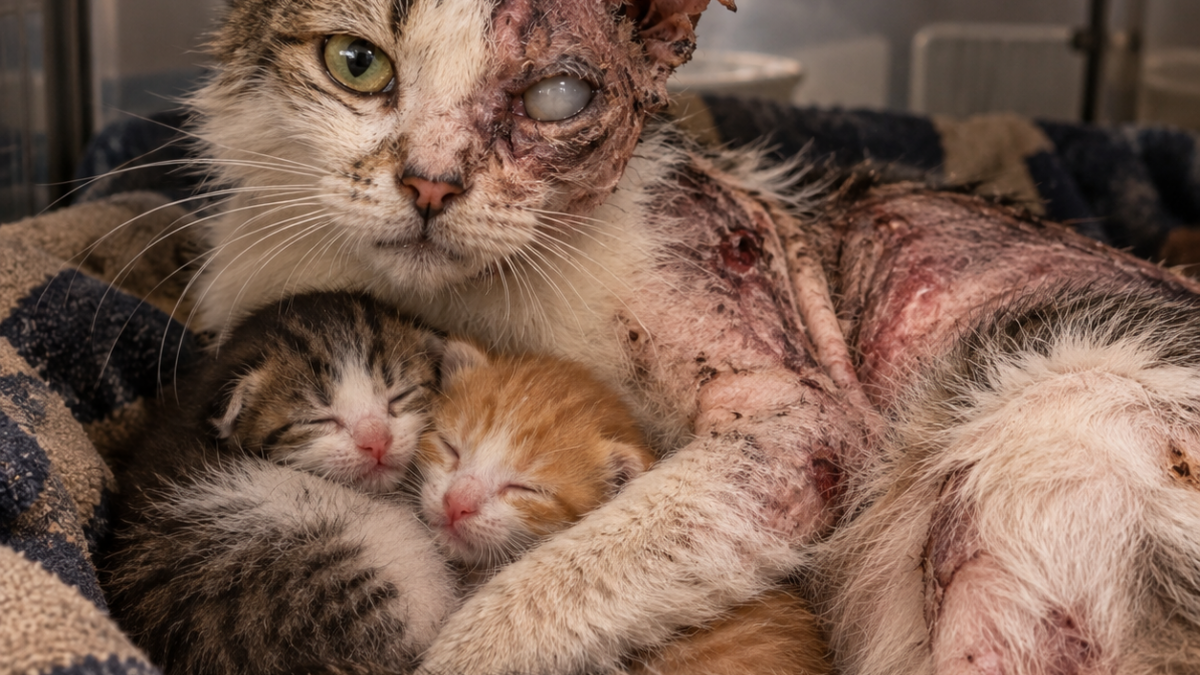
The right side of her face changed as swelling shifted.
At first, she looked almost unrecognizable. A creature shaped by injury more than identity.
But the left side remained herself.
Soft fur.
Clear eye.
Long white whiskers.
A cheek that still leaned faintly toward the kittens when they were placed near her.
On the fourth day, Maya tried to groom Ash.
Her burned mouth and damaged skin made the movement awkward. She could not do much. Just one weak swipe of her tongue across the kitten’s back.
But the entire clinic celebrated as if she had won a championship.
Sarah cried in the supply closet.
Aaron knew because he found her there when he came by after his shift.
“You okay?” he asked.
She wiped her face fast.
“Fine.”
“You’re crying next to gauze.”
“It’s emotional gauze.”
He smiled.
“You people are strange.”
“You’re here every day visiting a cat you met in a bathtub fire.”
“Fair.”
By the end of the first week, Maya was stable enough to be moved from emergency care into a long-term recovery ward at the clinic.
That did not mean she was healed.
Healing, Dr. Reed explained, would take months.
Some wounds would close.
Some would scar.
Some damage would remain forever.
Her right eye would not recover vision. Eventually, once she was stronger, the veterinary team would determine whether it could remain safely or needed removal. The burned ear would heal into a folded, partial shape. Fur on much of the right side might never grow back. The skin there would be fragile, shiny, and exposed.
But Maya lived.
Ash and Ember lived.
That was the miracle everyone kept returning to when the treatments were painful and the bills grew and the progress was slow.
The kittens began nursing again under supervision after the first week.
Maya could not curl around them the way she wanted because her burns had to be protected, but she tried.
Always, she tried.
If Ash squeaked, Maya lifted her head.
If Ember rolled away from the warmed towel, Maya shifted, even when shifting hurt.
If a technician picked one kitten up for feeding, Maya’s good eye followed the movement until the kitten was returned.
She did not trust easily.
Not at first.
Who could blame her?
Every hand that approached her came with medicine, bandages, thermometers, syringes, ointment, or pain. Even kind hands can frighten when the body has learned that touch hurts.
But she trusted Sarah before anyone else.
Sarah moved slowly. She spoke before touching. She never approached from Maya’s blind side without warning. She warmed towels in the dryer and placed them under Maya’s good side. She learned the difference between Maya’s warning growl and Maya’s pain sound.
Most people would not have noticed.
Sarah did.
“You like her,” Aaron said one evening.
Sarah was sitting beside Maya’s enclosure, entering notes into a tablet while Ember slept like a tiny orange comma near his mother’s belly.
“I like all my patients.”
“No. You like her.”
Sarah did not look up.
“I respect her.”
That was better than like.
Aaron understood.
The story reached the town before the first week was over.
It began with the fire department’s short post:
No human injuries in last night’s structure fire on County Road 17. Fire remains under investigation. During follow-up search, crews located an injured mother cat and two surviving kittens. They are receiving veterinary care. Please consider supporting local animal emergency funds.
The post included no graphic images.
Just a photo of Ash and Ember tucked safely in a towel.
People responded immediately.
Prayers.
Donations.
Offers to adopt the kittens.
Questions about the mother.
Then someone from the clinic, with permission, posted an update about Maya.
Not the worst photos.
Not the rawest wounds.
Just one carefully framed image showing the left side of her face, her good eye open, Ash pressed beneath her chin.
The caption explained that Maya had shielded her kittens from the fire.
By morning, the post had been shared thousands of times.
Local news called.
Then regional news.
Then strangers from states away began mailing blankets, supplies, checks, toys, and handwritten cards.
For Maya, people wrote on envelopes.
For the brave mama.
For the bathtub cat.
For the fire cat.
Aaron hated the last one.
“She’s not the fire cat,” he told Sarah while they sorted donated towels. “She’s Maya.”
Sarah smiled.
“Protective already?”
“She earned her name.”
“Yes,” Sarah said. “She did.”
But public attention is a strange thing.
It brings help.
It also brings opinions.
Some people called Maya a hero.
Some argued animals did not make choices, only followed instinct.
Some demanded to know why no one had saved her sooner.
Some blamed the homeowner.
Some said the kittens should stay with their mother forever.
Some said the mother should be euthanized because her injuries were too severe and people were “projecting.”
Dr. Reed stopped reading comments after one morning.
Sarah lasted a day longer.
Aaron lasted nine minutes.
He nearly threw his phone across the station kitchen after seeing one comment that said: It’s sad but it’s just a cat. People are too emotional.
Captain Willis looked up from his coffee.
“You all right?”
“No.”
“Internet?”
“Yes.”
“Rookie mistake.”
Aaron set the phone down.
“They didn’t see her.”
Captain Willis stirred sugar into his coffee.
“No.”
“They didn’t see the tub.”
“No.”
“They don’t know what she did.”
The captain looked at him then.
His face, usually set in hard lines, softened.
“We know.”
Aaron swallowed.
It did not feel like enough.
But maybe witnessing never does.
Maya’s recovery became measured in tiny victories.
The first time she ate on her own.
The first time she stood without trembling.
The first time she allowed Dr. Reed to clean the edge of her burn without sedation.
The first time Ash crawled over her front legs and Maya did not flinch from pain.
The first time Ember hissed at Aaron, a sound so small and ridiculous that Aaron laughed for the first time in days.
“Fearsome,” he told the kitten.
Ember’s eyes were barely open.
He hissed again.
“Terrifying.”
Maya watched him from her bed.
Her good eye was clearer now.
More present.
Still tired.
Still guarded.
But present.
The left side of her face was beautiful.
The right side was becoming something else.
At first, people used words like damaged.
Disfigured.
Poor thing.
Aaron hated those too, though he understood why people said them. The scars were shocking. They pulled the eye. They told the brain something terrible had happened before the heart could prepare.
But the longer he looked at Maya, the less her injured side seemed like a loss of beauty.
It became the story.
The right side of her face was the side that faced the fire.
The side that did not turn away.
The side that took heat meant for two helpless bodies pressed behind her.
There was beauty in that so fierce it made ordinary prettiness feel thin.
One afternoon, about three weeks into her recovery, an older woman came to the clinic carrying a quilt.
She introduced herself as Clara Whitman.
She was sixty-six, with silver hair pinned loosely at the back of her neck and hands that looked like they had spent a lifetime gardening, cooking, repairing, and holding other people steady. She wore no makeup, a denim jacket, and a wedding ring on a chain around her neck.
“I’m not here to bother anyone,” she said to Sarah at the front desk. “I made this for Maya.”
The quilt was small, soft, and handmade from squares of faded cotton. Blue, cream, pale yellow, and one square with tiny printed sunflowers.
Sarah accepted it gently.
“That’s beautiful.”
“My husband used to say every survivor deserves something soft,” Clara said.
Sarah looked at her.
“Used to?”
Clara touched the ring on her chain.
“He passed four years ago.”
“I’m sorry.”
Clara nodded once.
“Me too.”
Her eyes moved toward the treatment hallway.
“I’ve been following Maya’s updates.”
Sarah had heard that sentence often by then.
But Clara said it differently.
Not excited.
Not curious.
Almost reverent.
“She reminds me of someone?” Sarah asked.
Clara smiled faintly.
“Maybe all of us, if we’re honest.”
Sarah should not have let her back that day.
The clinic was busy. Maya was still recovering. Visitors were limited. Rules existed for good reasons.
But Sarah looked at Clara, at the quilt, at the ring on the chain, and made one of those small decisions that changes everything.
“Do you want to sit with her for a few minutes?”
Clara’s face changed.
“Oh. I wouldn’t want to upset her.”
“You won’t touch her. Just sit. Let her decide what she thinks.”
Maya was lying on a padded blanket in her recovery enclosure when Clara entered.
Ash and Ember were sleeping in a warmed basket nearby, fat-bellied and twitching with kitten dreams.
Clara stopped several feet away.
She did not gasp.
She did not flinch.
That mattered.
Most people tried not to react when they saw Maya’s face, which somehow made their reaction louder. Their eyes flickered to the burned side and away. Their mouths tightened. Their voices became too soft.
Clara simply looked at her.
All of her.
The clear left eye.
The scarred right side.
The folded ear.
The raw places slowly becoming new skin.
The body that had refused to leave the bathtub.
“Hello, Maya,” Clara said.
Maya’s good eye opened.
Sarah watched carefully.
Clara lowered herself into the chair beside the enclosure with a small sound of effort.
“I brought you something,” she continued. “It’s not perfect. I haven’t quilted much since Robert died. My corners are terrible now.”
Maya blinked.
Clara smiled.
“He would have told me that, too. Kindly, but he would’ve told me.”
Maya did not move closer.
But she did not turn away.
Clara sat with her for twelve minutes.
She did not reach into the enclosure.
She did not make kissing sounds.
She did not say poor baby.
She talked quietly about the weather, her garden, and how stubborn grief could be about staying in rooms where it had not been invited.
When Clara left, Maya was awake.
Listening.
The next week, Clara came again.
And the next.
Twice a week, she drove forty minutes each way to sit beside a cat who could barely tolerate touch.
She brought no audience.
Took no selfies.
Posted nothing online.
She just sat.
Sometimes she read aloud from gardening magazines. Sometimes from old mystery novels. Sometimes she said nothing at all.
By the sixth visit, Maya turned her head when Clara entered.
By the ninth, Maya inched closer to the side of the enclosure.
By the twelfth, Clara placed her hand near the opening, palm down, not reaching.
Maya stared at it for almost five full minutes.
Then she leaned forward and sniffed Clara’s knuckles.
Clara held perfectly still.
Maya pulled back.
Then, slowly, she touched the left side of her face—the unburned side—against Clara’s hand.
Sarah, watching from the doorway, had to turn around.
That same week, Ash and Ember turned eight weeks old.
They were thriving.
No scars.
No respiratory damage.
No burns.
Ash became bold and bossy, climbing everything and yelling when removed from places she had no business being. Ember was softer, a little clumsy, and deeply attached to his sister’s tail.
Applications for them had arrived by the dozens.
Everyone wanted the miracle kittens.
Almost everyone asked the same first question.
“Are they okay?”
Yes.
They were okay.
The world loved a survivor best when survival left no visible mark.
Finding them a home was easy.
Choosing the right one was harder.
Dr. Reed insisted they be adopted together.
“They survived together,” he said. “They leave together.”
No one argued.
A young couple named Hannah and Miles adopted them. They lived in a quiet farmhouse ten miles outside town and had no other pets, a screened porch, and the kind of gentle nervousness that made Sarah trust them. They listened seriously to every instruction, brought a list of questions, and cried when they met Maya.
“Do they need to say goodbye?” Hannah asked.
No one had a protocol for that.
So they made one.
The kittens were placed near Maya one last time before leaving.
Ash immediately tried to climb onto her mother’s head.
Ember tucked himself beneath Maya’s chin.
Maya groomed them both.
Carefully.
Her burned side remained still. Her good side bent around them.
She cleaned Ash’s ear.
Then Ember’s face.
Then she rested her chin near them and closed her good eye.
For a moment, the room became the bathtub again.
Not in terror.
In protection.
Her body curved around them.
The staff stood back and let the goodbye take as long as it needed.
When Hannah finally lifted the kittens into their carrier, Ash complained loudly. Ember squeaked. Maya opened her eye and watched them go.
She did not panic.
She did not cry.
Some people later said she must not have understood.
Clara, who was there that day, disagreed.
“She understands they’re safe,” she said softly.
Maya lowered her head to the blanket.
Her kittens left the clinic without a single scar.
Their mother remained covered in them.
For the first time, Clara understood the full weight of that.
She went home that evening and took out Robert’s flannel shirts from the cedar chest.
She had not touched them in almost four years.
Robert had died of lung disease after forty-one years of marriage. He had been a quiet man, a cabinetmaker, a fixer of broken hinges and squeaking stairs. He could make a table from ruined wood and a birdhouse from scraps. He loved calmly, without grand speeches, in the language of repaired things.
After he died, Clara’s house became orderly in the way lonely houses often do.
Too orderly.
No shoes by the door.
No mug in the sink.
No sawdust on the porch.
No low humming from the garage.
She had tried to keep busy.
Church.
Garden club.
Volunteering at the library.
Casseroles for neighbors.
But some evenings, the quiet sat across from her like another person.
When she began visiting Maya, she told herself it was because the cat needed calm company.
That was true.
It was not the whole truth.
Clara needed somewhere to put the softness that had nowhere to go.
She made a new blanket that night from pieces of Robert’s flannel.
Not the best shirts.
She was not ready for that.
Just scraps from the worn cuffs and torn sleeves he had kept in a basket for rags.
Blue plaid.
Green.
Gray.
Soft cotton worn thin by years of work.
She stitched them into a small square blanket and brought it to the clinic.
Maya sniffed it for a long time.
Then, with great care, she placed one paw on it.
Clara whispered, “He was gentle too.”
Maya closed her good eye.
The fourteen weeks of treatment changed everyone around Maya.
Dr. Reed became quieter.
Sarah became fiercely protective of the clinic’s burned and injured patients.
Aaron, who kept visiting even after the kittens left, joined a training committee to improve how the volunteer fire department handled animal recovery after structure fires. He raised money for pet oxygen masks and thermal blankets.
Captain Willis pretended not to be emotional when the equipment arrived.
“This is practical,” he said gruffly.
Aaron smiled.
“Very practical.”
“No need to make a thing of it.”
“Of course not.”
The department later hung a small framed photo of Maya in the station hallway.
Not the raw injury photos.
A later one.
Maya lying on Clara’s flannel blanket, good eye open, scarred side visible, head lifted with quiet dignity.
Underneath, someone wrote:
Courage is not always loud.
When Maya was finally healthy enough for adoption consideration, there was a meeting.
Dr. Reed, Sarah, Meredith from the rescue, and Clara sat in the clinic office.
Maya’s file lay on the desk.
It was thick now.
Burn records.
Treatment notes.
Eye evaluations.
Pain management logs.
Weight charts.
Photos.
Donation receipts.
Behavior notes.
Clara sat with her hands folded in her lap, trying to pretend she was calm.
Meredith cleared her throat.
“We have had several inquiries about Maya.”
Clara looked down.
Of course they had.
Maya’s story had traveled far. People loved brave animals, especially from a distance. Some wanted to meet her. Some wanted to adopt her because her story had moved them. Some, Clara suspected, wanted the idea of her more than the reality.
Maya was not an easy cat.
Not because she was mean.
She was not.
But she startled if approached from the right. She disliked sudden hands. Her skin required monitoring. Her damaged eye needed care. She did not like being crowded. She became anxious when she could not see exits. Loud smoke alarms on television sent her hiding beneath furniture.
And she was no longer a young cat untouched by trauma.
“She’ll need someone patient,” Sarah said.
Dr. Reed nodded.
“Someone who understands her blind side. Someone willing to continue medical checks. Someone who won’t treat her scars like a novelty.”
Meredith looked at Clara.
“Someone who already drives forty minutes twice a week to sit beside her?”
Clara’s heart stumbled.
“I didn’t want to presume.”
Sarah laughed once, softly.
“Clara, Maya looks for you on Tuesdays.”
Clara pressed her fingers to her mouth.
“She does?”
Dr. Reed smiled.
“She does.”
Meredith opened a folder.
“If you’re willing, we would like to approve you as her adopter.”
Clara looked at the papers.
Then at the window.
Outside, late winter sunlight lay across the parking lot. A car passed. Somewhere in the clinic, a dog barked. Life continued in all its ordinary, impossible ways.
“I need to tell you something,” Clara said.
Everyone waited.
“My husband died in our bedroom.”
The room became still.
Clara looked down at her hands.
“I found him in the morning. He’d been sick for a long time, but still. You think you’re prepared because doctors have used words like terminal and hospice and decline. But you’re not prepared for the silence after.”
Sarah’s eyes softened.
“For a long time, I thought bringing anything living into that house would be unfair. To me. To the animal. To Robert’s memory. I thought grief had already taken up all the room.”
Her voice trembled.
“Then I met Maya.”
No one interrupted.
“She is scarred because she loved something more than she feared pain. I don’t know if I have that kind of courage. But I would like to learn from her.”
Meredith quietly slid the adoption papers across the desk.
Clara signed them with tears falling onto the first page.
Maya came home on a clear March morning.
Aaron offered to drive her.
Sarah offered too.
Dr. Reed pretended he had too much work, then appeared in the parking lot anyway.
Maya traveled in a large soft-sided carrier lined with Robert’s flannel blanket. Clara sat in the back seat beside her while Aaron drove slowly, as if carrying glass.
“You know,” Aaron said, “Captain Willis wanted to come.”
Clara smiled.
“Why didn’t he?”
“He said someone had to remain dignified.”
“Ah.”
“He sent canned food.”
“That is very dignified.”
Maya remained quiet most of the ride.
At first, she faced the carrier door, good eye watching Clara.
Then she turned so her injured side faced upward slightly, the way she often rested now. Sarah said it might feel more comfortable to keep pressure off the scar tissue. Clara sometimes wondered if Maya positioned herself that way so she could see the room with her good eye while protecting what was vulnerable.
Clara’s house was small and white with green shutters, set back from a quiet road lined with maple trees. Robert had built the porch railing himself. He had repaired the kitchen cabinets, laid the living room floor, and carved the little wooden bird sitting on the mantel.
Clara had prepared the spare room for Maya.
Food.
Water.
Litter box.
Soft beds.
Low lighting.
A window perch.
No candles.
No fireplace.
No sudden noises.
When she opened the carrier, Maya did not come out.
Clara sat on the floor.
“It’s all right,” she said. “Take your time.”
Maya looked at her.
Then past her.
The house creaked in the mild spring wind.
A clock ticked in the hallway.
Somewhere outside, a crow called.
Maya stepped out after twenty-three minutes.
Clara knew because she watched the clock and tried not to hold her breath.
The cat’s paws touched the hardwood floor carefully.
She sniffed the bed.
The water bowl.
The corner.
The doorframe.
Then she walked to Clara’s knee and leaned her left side—the soft side, the unburned side—against her leg.
Clara began to cry.
Maya stayed there.
Not long.
Just long enough to make the house feel less empty.
The first weeks were slow.
Maya spent most of her time in the spare room. She ate at night, slept under the desk, and came out when Clara read aloud. She allowed petting only on the left side. If Clara’s hand drifted too near her scarred cheek, Maya flinched, then looked ashamed though she had done nothing wrong.
Clara learned.
Always approach from the left.
Speak before entering.
No sudden reaching.
No pity in the voice.
Maya disliked pity.
Clara could tell.
The first time a neighbor came by with a casserole and saw Maya in the hallway, she gasped.
“Oh, that poor thing.”
Maya vanished under the sofa.
Clara took the casserole, thanked the neighbor, and did not invite her in again for three weeks.
The next time, she said gently at the door, “If you see Maya, please just say hello. Don’t react to her face.”
The neighbor looked embarrassed.
“I didn’t mean—”
“I know,” Clara said. “But she has already survived the fire. She shouldn’t have to survive everyone’s shock too.”
That became Clara’s rule.
No shock.
No pity.
No reaching.
No calling her disfigured.
No treating her like a tragedy in her own home.
Maya deserved better than to become a wound people visited.
By summer, she had claimed the left side of Clara’s bed.
Not the right.
The left.
Every night, she climbed up using the little carpeted steps Clara bought for her and settled near the pillow with her injured side facing upward, good eye watching the room.
Still alert.
Still protective.
Sometimes Clara woke at two in the morning and found Maya awake, staring toward the bedroom door.
“It’s all right,” Clara would whisper. “Nothing’s coming.”
Maya’s ear would twitch.
Clara understood.
The body remembers danger long after the danger has passed.
Hers did too.
After Robert died, Clara had woken many nights reaching toward his side of the bed, heart already breaking before she fully opened her eyes. For months, every creak in the house sounded like loss returning for something it had forgotten.
Maya and Clara learned sleep together.
Not quickly.
But slowly.
One safe night at a time.
Ash and Ember’s adopters sent updates every month.
The kittens were renamed Lily and Finn by their new family, though Clara always thought of them by their first names too. They grew into glossy, playful cats with no visible memory of the fire. Lily climbed curtains. Finn carried socks into the kitchen. They slept in a pile on the farmhouse sofa and chased each other across the screened porch.
Their photos made Clara happy and sad in equal measure.
Maya would sometimes sniff Clara’s phone when the videos played.
Did she recognize their sounds?
Clara never knew.
But once, when a video played of Finn squeaking as he chased a toy, Maya lifted her head and answered with a soft trill.
Clara saved that video forever.
In the fall, one year after the fire, Millbrook held a fundraiser for the volunteer fire department’s new animal rescue equipment.
Maya was not supposed to attend.
Clara had said no immediately when Aaron asked.
“She doesn’t need crowds.”
“I know,” Aaron said. “I just wanted to invite you.”
“I can come. Maya stays home.”
“That’s fair.”
But the morning of the fundraiser, Maya did something unusual.
She followed Clara to the front door.
Not halfway down the hall.
All the way.
Clara looked down.
“You are not a social butterfly.”
Maya stared at her.
“You hate car rides.”
Maya continued staring.
“You once hid from the mailman for three hours.”
Maya blinked.
Clara sighed.
“Don’t make me assign meaning to this.”
Maya sat beside the door.
So Clara brought her.
Not into the center of the crowd.
Not into noise.
She carried Maya in a covered stroller borrowed from Sarah, lined with Robert’s flannel blanket. They stayed near the edge of the fire station bay, away from children and loudspeakers. Clara watched Maya closely for stress.
At first, Maya crouched low.
Then Aaron approached.
He stopped several feet away.
“Hi, Maya,” he said.
Her good eye fixed on him.
He crouched.
“You probably don’t remember me.”
Clara was not so sure.
Maya leaned forward and sniffed the air.
Aaron’s face tightened with emotion.
“I remember you,” he whispered.
Captain Willis came next.
He held a paper plate with a hot dog he seemed to have forgotten.
He looked at Maya for a long time.
Then he removed his cap.
A small gesture.
Old-fashioned.
Respectful.
Maya blinked at him.
The fundraiser raised enough money for more equipment than the department had hoped.
But the moment people remembered most happened near the end.
A little boy approached Clara carefully, holding his mother’s hand. He was maybe six. His face was serious.
“Is that the fire cat?” he asked.
Clara smiled.
“Her name is Maya.”
“Does her face hurt?”
“Not much now.”
He looked at Maya’s scarred side.
“Is she ugly?”
His mother gasped.
“Caleb!”
But Clara held up one hand.
Children ask directly what adults often hide behind softer cruelty.
She looked at the boy.
“No,” Clara said. “She is not ugly.”
He frowned thoughtfully.
“But it looks different.”
“Yes. It looks different because that side faced the fire.”
The boy’s eyes widened.
“She looked at the fire?”
“She stood between the fire and her babies.”
He looked at Maya again.
This time, his expression changed.
Not disgust.
Awe.
“Oh,” he said. “So that’s her brave side.”
The adults nearby went silent.
Clara felt tears rise.
“Yes,” she whispered. “That is exactly what it is.”
From then on, Clara called it that.
Not the burned side.
Not the injured side.
Not the scarred side.
Maya’s brave side.
The phrase changed something.
Not in Maya, perhaps.
In everyone else.
When Clara’s grandchildren visited, she explained it that way.
“This is Maya’s soft side,” she said, touching the left cheek only when Maya allowed. “And this is her brave side.”
The children accepted that immediately.
Children often understand truth better when adults stop dressing it in fear.
Her oldest granddaughter, Sophie, drew Maya for a school project about heroes. In the picture, Maya stood in a bathtub with flames on one side and two kittens behind her. Above her head, Sophie wrote:
A hero is someone who protects even when it hurts.
Clara framed that too.
Her house slowly filled with proof that love had lived there.
Robert’s bird on the mantel.
Maya’s quilt near the window.
Photos of Lily and Finn.
Sophie’s drawing.
A framed copy of a letter from Aaron thanking Maya for teaching the fire department that animal lives were part of rescue too.
And, eventually, a photograph Clara never expected to love.
It showed Maya sitting in a patch of sunlight on the bed, her face turned slightly toward the camera so both sides were visible.
The soft side.
The brave side.
Clear eye.
Clouded eye.
Full ear.
Folded ear.
Beauty.
Sacrifice.
One face.
For a long time, Clara had avoided mirrors after Robert died.
Not because she hated her reflection.
Because grief had changed her face too.
The lines around her mouth deepened. Her eyes looked tired. Her hair went fully silver in less than two years. Sometimes she caught sight of herself and saw not age exactly, but evidence.
Of sleepless nights.
Hospital chairs.
Holding Robert’s hand.
Signing papers.
Coming home alone.
She had thought evidence meant damage.
Maya taught her otherwise.
Some faces carry what they survived.
That does not make them less beautiful.
It makes them honest.
Two years after the fire, Dr. Reed invited Clara to speak at a small veterinary conference about burn recovery and long-term adoption support for injured animals.
Clara said absolutely not.
Then Sarah called.
Then Aaron.
Then Clara’s daughter Beth said, “Mom, you talk to your garden club about compost for forty minutes. You can talk about Maya for ten.”
“That is different.”
“Yes. Compost is less inspiring.”
Clara agreed only because Maya would not have to attend.
She stood in front of a room full of veterinarians, technicians, shelter coordinators, and rescue workers with her hands shaking around her notes.
“I am not a medical professional,” she began. “I am just the woman who adopted the cat you all worked so hard to save.”
Faces softened.
Clara looked at the first row, where Dr. Reed and Sarah sat.
“I want to talk about what happens after survival.”
The room went very still.
“Because survival is not the end of the story for animals like Maya. It is the beginning of a long negotiation with fear, pain, memory, and the way people look at them.”
She told them about approaching from the left.
About not gasping.
About teaching visitors to call it her brave side.
About how Maya slept with her injured side upward and her good eye watching the door.
About the first time Maya purred in her sleep.
About the first thunderstorm and the way she hid in the bathtub until Clara sat on the bathroom floor beside her for two hours, whispering, “Not this time. Not this house.”
Several people cried.
Clara did too.
Then she said the thing she had come to say.
“Please do not save animals like Maya only so they can spend the rest of their lives being treated like sad stories. They are not only what happened to them. They are who they became after.”
Afterward, a young veterinarian approached her.
“I have a burned dog at my clinic,” she said. “I’ve been so focused on wound care that I don’t think I’ve thought enough about how people react when they see him.”
Clara touched her arm.
“Teach them before they meet him.”
The woman nodded, wiping tears.
“I will.”
That night, Clara came home to Maya waiting by the bedroom door.
She knelt slowly.
“I talked about you today,” she said.
Maya blinked.
“Good things.”
Maya stepped forward and pressed her soft side against Clara’s hand.
Clara smiled.
“Yes,” she whispered. “Only the truth.”
Years passed gently after that.
Not perfectly.
Gently.
Maya had flare-ups with her skin.
Her blind eye sometimes needed medication.
She hated the carrier forever.
She tolerated Dr. Reed because he respected her and because Sarah bribed her shamelessly with chicken.
She never became a lap cat, but she became a beside cat.
Beside Clara in bed.
Beside Clara in the garden chair.
Beside Clara on the sofa during storms.
Beside, always, like a quiet promise.
Lily and Finn grew into enormous, spoiled cats.
Their family sent photos every Christmas. In one, the two of them slept under a tree, tangled together, bright and whole. Clara showed Maya the card each year.
“Your babies,” she would say.
Maya would sniff the card, then look away.
Maybe she remembered.
Maybe she did not.
Clara remembered for her.
On the fifth anniversary of the fire, the volunteer department planted two maple trees near the station.
One for resilience.
One for protection.
The plaque between them read:
In honor of Maya, who reminded us that courage can be small, scarred, and silent.
Maya did not attend that ceremony. She was older by then, less tolerant of outings, more devoted to warm blankets and strict mealtimes.
Clara attended for her.
Aaron, now a captain himself, gave a short speech.
He still looked emotional whenever he talked about the bathtub.
“I have been asked many times why this one cat changed our department,” he said. “The answer is simple. She reminded us that rescue does not end with people. Where there is life, there is duty. Where there is fear, there must be care. And where there is sacrifice, there must be witness.”
Clara stood beneath the young maple trees and cried quietly.
Captain Willis, retired now, stood beside her.
“She doing all right?” he asked.
“Maya?”
“Yes.”
“She’s old. Stubborn. Demanding.”
He smiled.
“Good.”
“She still sleeps facing the door.”
“Once a guard, always a guard.”
Clara looked at the plaque.
“She saved me too, you know.”
Captain Willis did not pretend surprise.
“I figured.”
“My house was so quiet before her.”
He nodded.
“After my wife died, I kept the television on for two years.”
Clara looked at him.
He shrugged.
“Noise helps.”
“Yes,” she said softly. “It does.”
That evening, Clara returned home and found Maya asleep on the left side of the bed.
The sun was setting, filling the room with gold.
Maya’s brave side faced upward.
The scarred skin shone faintly in the light. Her folded ear cast a tiny shadow. Her cloudy eye, blind but still present, looked almost silver.
Clara sat beside her.
Maya woke and stretched one paw toward her.
“You have no idea how many people love you,” Clara said.
Maya yawned.
Clara laughed.
“No interest in fame. I respect that.”
Maya placed her paw on Clara’s wrist.
For a moment, Clara could feel the rhythm of her breathing.
Slow.
Steady.
Alive.
Maya lived nearly seven years after the fire.
Longer than anyone expected.
Not long enough.
Never long enough.
In her final winter, she moved more slowly. Her appetite came and went. The brave side of her face remained delicate, but it no longer looked raw or painful. It looked like old silk pulled tight over memory.
She still watched doors.
She still disliked smoke smells.
She still slept beside Clara, good eye toward the room.
The end came quietly, on a February morning with snow falling outside.
Maya did not get up for breakfast.
That was how Clara knew.
Not because Maya had never skipped breakfast before.
But because of the way she looked at her.
Tired.
Ready.
Trusting Clara to understand.
Dr. Reed came to the house.
Sarah came too, no longer at the clinic full-time but unwilling to miss goodbye.
Aaron came and waited on the porch until Clara asked him in.
The room filled with the people who had known the cost of Maya’s life from the beginning.
Maya lay on Robert’s flannel blanket.
Clara sat beside her, one hand resting on the soft left side of her face.
No one touched the brave side unless Maya moved into it.
She did not need pain at the end.
Clara told her about Lily and Finn.
About the maple trees.
About the little boy who had named her brave side.
About the kittens she saved, the firefighters she changed, the veterinarians she taught, the lonely widow whose bed no longer felt like a grave because Maya had chosen the left side and stayed.
“You did enough,” Clara whispered.
Maya opened her good eye.
“You protected them. You protected me. You can rest now.”
Maya breathed out.
Slowly.
Her paw flexed once against the blanket.
Then she was gone.
The silence afterward was not the silence Clara had known after Robert.
It hurt.
Oh, it hurt terribly.
But it was not empty.
Maya left too much behind for emptiness.
She left quilts and drawings and photographs.
She left protocols at the fire department.
She left training materials at the clinic.
She left two grown cats living bright, scar-free lives in a farmhouse full of sun.
She left a plaque beneath maple trees.
She left a woman who had learned that love could enter a burned place and not erase what happened, but make something living grow there.
After Maya died, Clara kept her ashes beside Robert’s bird on the mantel.
For a while, she could not move Maya’s bed.
Then one spring afternoon, she washed the blankets, folded them carefully, and drove to the clinic.
Sarah met her outside.
“I’m not ready to adopt again,” Clara said immediately.
Sarah smiled through tears.
“I didn’t ask.”
“I know you.”
“Fair.”
Clara handed her the blankets.
“For the next one who needs something soft.”
Sarah took them like they were sacred.
Because they were.
A few months later, Clara received a photo from the clinic.
A burned stray dog recovering on Maya’s quilt.
Then another.
A senior cat after surgery tucked into the sunflower square.
Then another.
A litter of orphaned kittens sleeping on Robert’s flannel blanket.
Clara printed each picture and placed them in an album titled Maya’s Soft Things.
That became her way of continuing.
Not replacing.
Continuing.
Years later, people in Millbrook still told Maya’s story.
Some told it simply.
A mother cat saved her kittens in a fire.
Some told it with dramatic details, not all of them accurate.
Some swore she carried kittens one by one into the bathtub, which she almost certainly did not.
Some said she stood in actual flames, which no one could prove.
But Clara always told it carefully.
Truth did not need exaggeration.
The truth was enough.
A mother cat trapped in a burning house chose not to run.
The bathroom doorway was open.
The heat came toward her.
Her kittens could not move.
So she placed herself between them and the fire.
The side facing danger was destroyed.
The side sheltering life remained whole.
Her body temperature fell dangerously low.
Her kittens stayed warm against her.
She nearly died.
They lived without scars.
And for the rest of her life, her face carried the map of that choice.
That was enough.
More than enough.
One summer, Clara visited the farmhouse where Lily and Finn lived.
They were seven years old then.
Healthy.
Playful.
Enormous.
Finn, once Ember, had grown into a handsome orange cat with a white stripe down his nose. Lily, once Ash, was sleek gray-and-white with bright eyes and an imperious tail.
They did not know Clara.
Not really.
But Lily allowed one brief touch.
Finn sniffed Clara’s shoes and then flopped dramatically in a sunbeam.
Their family had kept every update about Maya. Hannah showed Clara a framed photo on their mantel: Maya lying on the clinic blanket, good eye open, brave side visible.
“We tell our kids that’s their mother,” Hannah said.
Clara’s throat tightened.
“What do they say?”
Hannah smiled.
“They say she was a warrior queen.”
Clara laughed through tears.
“That sounds right.”
Before leaving, Clara sat on the screened porch and watched Lily and Finn chase moth shadows across the floor.
No scars.
No fear.
No memory, perhaps, of the bathtub, the heat, the body that curved over them.
For a moment, that hurt.
Then Clara understood it differently.
That was the gift.
Maya had carried the memory so they would not have to.
Some sacrifices are successful only when the saved get to live without knowing the full price.
On the drive home, Clara passed County Road 17.
The old burned house had been cleared years earlier. Grass now grew where the foundation had been. Wildflowers moved in the wind. Someone had put up a new fence.
If you did not know, you would never know.
Clara pulled over anyway.
She stood by the roadside for a long time.
“Thank you,” she said.
Not only to Maya.
To the firefighters.
To Dr. Reed.
To Sarah.
To the strange mercy that sometimes walks through devastation carrying life in its hands.
The wind moved through the grass.
No answer came.
None was needed.
Maya’s story became part of Clara’s too.
When people asked about the photo in her living room—the one showing both sides of Maya’s face—Clara told them what the little boy had said.
“This was her soft side,” she would explain, touching the glass over Maya’s unburned cheek.
Then her finger would move to the scarred side.
“And this was her brave side.”
People always grew quiet then.
Because that language changed what they saw.
They stopped looking at what the fire took.
They started seeing what love gave.
That is what Maya still does.
Even gone, she changes the way people look.
At scars.
At beauty.
At motherhood.
At survival.
At the cost of protecting what cannot protect itself.
The left side of Maya’s face was beautiful.
Everyone could see that.
But the right side—the side without fur, the folded ear, the cloudy eye, the skin marked forever by heat—that was the side that told the truth.
That was the side that faced the flames.
That was the side that stayed.
That was the side that said two tiny lives mattered more to her than pain, more than fear, more than escape.
We live in a world obsessed with unmarked beauty.
Smooth skin.
Perfect symmetry.
Before pictures without after pictures.
We praise what looks untouched.
Maya’s face taught everyone who loved her something different.
Some beauty is born from being untouched.
But some beauty is forged in the moment something living chooses love at a cost.
Some scars are not ruins.
They are records.
They are signatures.
They are proof that when the doorway was open and escape was possible, someone stayed.
Maya lost fur.
She lost part of an ear.
She lost sight in one eye.
She lost the face she might have had.
But because of her, Ash and Ember—Lily and Finn—grew up whole.
Because of her, firefighters learned to carry oxygen masks for pets.
Because of her, burned animals in one clinic were greeted with more understanding.
Because of her, a grieving widow let life back into her house.
Because of her, children learned that different does not mean ugly.
Because of her, people who saw scars learned to ask not only what happened, but who was saved.
And that is why Clara kept telling the story long after Maya was gone.
Not to make people sad.
Sadness was only the doorway.
She told it because Maya’s life asked something of everyone who heard it.
Look closer.
Honor sacrifice.
Do not pity what you should respect.
And never assume that scars make something less beautiful when they may be the very place where love showed itself most clearly.
Maya’s face carried fire.
But it also carried proof.
Proof that even in smoke, terror, and heat, love can hold its ground.
Proof that the smallest body can contain courage larger than a burning house.
Proof that some mothers do not run, even when the doorway is open.
Proof that a scar can be the most beautiful part of a face when you finally understand what it means.








