They Said This 2-Month-Old Kitten Wouldn’t Survive—Then He Became the Shelter’s “Nurse” for Sick and Injured Animals
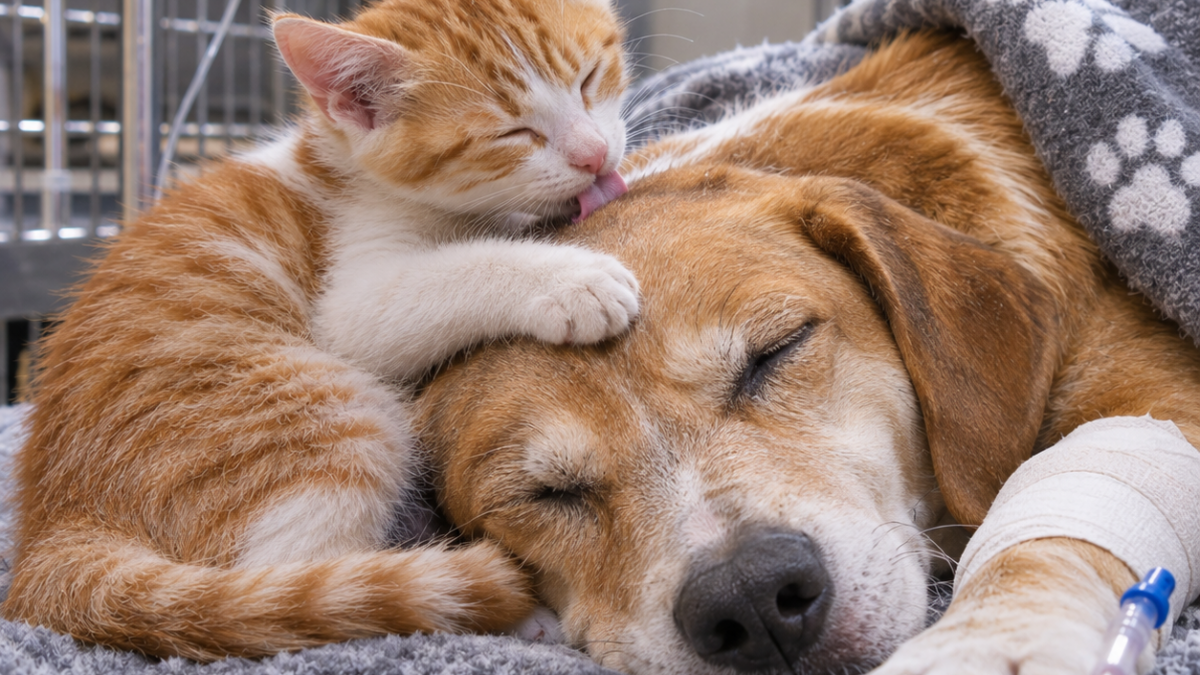
They Said This 2-Month-Old Kitten Wouldn’t Survive—Then He Became the Shelter’s “Nurse” for Sick and Injured Animals.
At barely two months old, Rademenes arrived at a shelter in Bydgoszcz so sick that one administrator called further treatment a waste of money—but the young veterinarian holding him refused to sign the euthanasia order and quietly promised the kitten he would not die alone.
Months later, after Rademenes survived, staff began finding the little black cat curled beside frightened dogs and injured cats in the recovery room, grooming them awake after surgery as though he somehow remembered exactly what terror felt like from the other side of the table.
Then a wealthy donor accused the shelter of exploiting a sick animal for attention, demanded Rademenes be removed, and forced the staff to prove what they had always known in their hearts: the kitten everyone once wanted to give up on had become the one creature who could reach patients no human being could calm.
The cardboard box was wet at the bottom.
That was the first thing Dr. Marta Lewandowska remembered.
Not the kitten.
Not the smell of antiseptic in the treatment room.
Not the argument that came later.
The box.
It had been raining in Bydgoszcz since before dawn, a cold spring rain that turned sidewalks gray and left dirty water gathered in the gutters. The shelter opened at seven, and by seven twelve there were already three dogs barking in intake, a volunteer mopping muddy paw prints from the corridor, and someone pounding on the side door.
Marta was twenty-nine then.
Young enough to still believe that working in animal rescue meant the hardest part would be medicine.
She would learn.
A volunteer named Ania opened the door and found nobody there.
Only the box.
“Another one,” she muttered.
People left animals at shelters in every kind of container imaginable.
Laundry baskets.
Plastic crates.
Shopping bags.
Blanket bundles.
Once, a terrified dachshund had been tied to the front gate with a shoelace.
Ania carried the box inside.
It weighed almost nothing.
That should have worried her.
She placed it on the stainless steel intake table.
Something inside made a sound.
Not a meow.
More like paper being rubbed together.
Marta looked up from a shepherd mix whose bandage she was changing.
“What is that?”
“Kitten, I think.”
“You think?”
Ania opened the box.
There was a black kitten inside.
He was curled so tightly that at first Marta thought he might already be dead.
His coat was dull.
Wet near the paws.
The fur around his nose was crusted.
His eyes were half sealed by discharge.
PART2:
When he tried to breathe, his entire little body moved.
Chest.
Belly.
Shoulders.
Every breath was work.
Marta crossed the room immediately.
“Oh, sweetheart.”
She lifted him.
The kitten was hot.
Too hot.
And much lighter than he looked.
“How old?”
Ania shook her head.
“Eight weeks, maybe.”
“Less?”
“Hard to tell.”
Marta listened to his chest.
The stethoscope picked up congestion almost everywhere.
The kitten opened his mouth, trying to pull in more air.
Marta’s expression changed.
“Get oxygen.”
Ania moved.
PART3:
Marta wrapped him in a towel.
His body trembled.
“Come on.”
She hated saying things like that to animals.
Come on.
Stay with me.
Fight.
As though survival were a moral choice.
As though animals who died had simply not wanted it enough.
But she said it anyway.
“Come on, little one.”
The kitten’s front paw moved.
One claw caught in the towel.
That tiny act felt enormous.
They put him into an oxygen chamber.
Temperature: 40.2 Celsius.
Severely dehydrated.
Underweight.
Respiratory infection advanced enough that Marta suspected pneumonia.
They started fluids carefully.
Antibiotics.
Nebulization.
Supportive care.
Ania stood beside the chamber.
“He looks awful.”
“He is awful.”
“You think he’ll make it?”
Marta watched the little chest rise.
Fall.
Rise.
Fall.
“I don’t know.”
That was the truthful answer.
Ania hated it.
Most people did.
By ten that morning, the kitten had a temporary intake number.
K-214.
No name.
No history.
No owner.
No person calling to ask if he was alive.
At eleven thirty, shelter administrator Tomasz Zielinski entered the treatment room.
He wore polished shoes that always seemed absurd in a building full of mud and animal hair.
Tomasz was not a veterinarian.
He had a background in municipal administration and nonprofit management.
He understood budgets.
Contracts.
Donor relations.
Occupancy ratios.
He used phrases like resource allocation and capacity limits.
Marta did not dislike him because he cared about money.
Someone had to.
A shelter that ignored money eventually stopped helping animals.
She disliked him because sometimes he talked about living things as though they were damaged inventory.
He looked through the oxygen chamber.
“What’s this?”
“Kitten.”
“I can see that.”
Marta did not answer.
“Status?”
“Severe respiratory disease. Probably pneumonia.”
“Prognosis?”
“Guarded.”
“Meaning?”
“You know what guarded means.”
“It means expensive.”
Marta looked at him.
“It means I don’t know if he survives.”
Tomasz opened the chart.
“How much have we used?”
“Some fluids, antibiotics, oxygen.”
“How long?”
“Could be days.”
He sighed.
Marta felt something in her chest tighten.
“Tomasz.”
“We have twenty-three cats over capacity.”
“I know.”
“Four kittens with ringworm.”
“I know.”
“Three dogs scheduled for orthopedic procedures.”
“I know.”
“Then you know the question.”
“No.”
“You know exactly the question.”
Marta folded her arms.
“He has been here four hours.”
“And?”
“And I’m not euthanizing an eight-week-old kitten because he had the bad manners to arrive sick on a crowded day.”
Tomasz looked toward the chamber.
“He may die anyway.”
“Yes.”
“And suffer while doing it.”
“If I believe he’s suffering without reasonable chance of recovery, I’ll make that decision.”
“You?”
“Yes.”
“Not the budget?”
Marta stared at him.
Tomasz’s jaw tightened.
He lowered his voice.
“You think I like this?”
“I don’t know what you like.”
“I like keeping this place open.”
“So do I.”
“Then stop treating me like a villain for asking whether one patient should consume resources that could save five others.”
There it was.
The argument Marta knew had no clean answer.
Shelter medicine was full of arithmetic people outside it never had to see.
Ten thousand złoty spent on one complicated case could vaccinate dozens of animals.
One kennel held for a long-term patient meant another dog waited elsewhere.
Every choice had an invisible animal attached to the other side.
Marta knew that.
She also knew K-214 had lifted one tiny paw and tried to hold on to a towel.
“No euthanasia today.”
Tomasz shut the chart.
“I want reassessment tonight.”
“Fine.”
“And tomorrow morning.”
“Fine.”
“If he deteriorates—”
“I know my job.”
Tomasz looked at her for a long second.
Then left.
Ania waited until the door closed.
“You enjoy making your career difficult.”
Marta looked at the kitten.
“He started it.”
That afternoon, K-214 stopped eating.
They tube-fed small amounts.
His fever stayed high.
At four, he began breathing faster.
At five, Marta adjusted oxygen.
At seven, everyone who was not on overnight duty went home.
Marta stayed.
Technically, she was not supposed to.
She had started at six thirty that morning.
Her shift ended at six.
But she pulled a chair beside the oxygen chamber and opened her laptop.
At eight fifteen, the shelter was almost silent.
Dogs still barked occasionally.
Metal kennel doors clicked.
The refrigerator compressor hummed.
K-214 breathed.
Marta watched.
He looked too small to contain so much struggle.
At nine twenty, his eyes opened.
Really opened.
Greenish-yellow.
Cloudy with illness.
He looked through the plastic chamber.
Marta leaned closer.
“Hi.”
The kitten blinked.
“Terrible place, I know.”
Blink.
“I’m not thrilled either.”
He lifted his head.
It shook.
Then lowered again.
Marta put her fingers against the outside of the chamber.
“You don’t have to do anything tonight except breathe.”
She stopped.
“That’s enough.”
At ten, Tomasz returned.
He lived nearby.
Marta suspected Ania had texted him that she was still there.
“You’re still working.”
“Yes.”
“You’re paid badly enough without volunteering.”
“I’m aware.”
He looked at the kitten.
“No improvement?”
“Not much.”
“Worse?”
“No.”
Tomasz pulled another chair over.
That surprised Marta.
He sat.
For several minutes neither spoke.
Finally he said, “My daughter wants a rabbit.”
Marta looked at him.
“What?”
“She’s seven.”
“That’s an age, not a reason.”
“She has made a PowerPoint.”
Marta smiled despite herself.
“How many slides?”
“Twelve.”
“Strong case.”
“She included projected monthly expenses.”
Marta laughed.
Tomasz looked at K-214.
“You think I don’t care.”
“I think you care differently.”
“That’s diplomatic.”
“It’s the best you’re getting after sixteen hours.”
He nodded.
They sat.
The kitten breathed.
Then Tomasz said quietly, “If he’s worse in the morning, we have to talk again.”
Marta’s smile disappeared.
“I know.”
He stood.
At the door he paused.
“Name him.”
Marta looked over.
“What?”
“If you’re going to sit here all night, he should at least have a name.”
Then he left.
Marta stared at the little black kitten.
“Great.”
He blinked.
“Now I have to name you.”
She searched her exhausted brain.
Every common cat name felt wrong.
Midnight.
Shadow.
Lucky.
No.
Then she remembered a name from an old article about a medieval healer she had once read in veterinary school.
Rademenes.
She had no idea why it surfaced.
Maybe because it sounded too large for the kitten.
A grand name for something barely heavier than a loaf of bread.
“Rademenes.”
The kitten did nothing.
Marta smiled.
“Too late. You had your chance.”
At two thirteen in the morning, Rademenes crashed.
His breathing became shallow.
His oxygen saturation fell.
Marta called the on-call veterinarian, Dr. Jakub Wrona, who arrived half dressed and furious at the universe.
“Why is every emergency at two?”
“Because animals respect your schedule.”
“Clearly.”
They worked.
Medication.
Airway support.
More oxygen.
Marta held the kitten’s head.
His body went limp for a moment.
“Rademenes.”
Jakub glanced at her.
“You named him?”
“Focus.”
“Bad sign.”
“Jakub.”
“I’m focusing.”
Minutes stretched.
Then the oxygen saturation began rising.
Slowly.
Not good.
Better.
Rademenes coughed.
A horrible wet little cough.
Marta almost cheered.
Jakub leaned back.
“Stubborn.”
“Yes.”
“You attract these.”
“I know.”
By sunrise, Rademenes was alive.
Not healthy.
Alive.
That distinction became the shape of the next four days.
Day two, alive.
Day three, alive.
Day four, still alive.
His fever finally started falling.
His eyes cleared.
He ate half a teaspoon of soft food on his own.
Ania filmed it.
Marta objected.
“Don’t turn everything into content.”
“He ate.”
“I can see.”
“He ate.”
Ania showed everyone anyway.
By the end of the week, Rademenes could stand without swaying.
He looked ridiculous.
Head too large.
Legs too thin.
Tail like a black string.
But he stood.
Tomasz came into treatment.
Looked through the cage.
“Well.”
Marta folded her arms.
“Well what?”
“I’m waiting for you to be unbearable.”
“I don’t know what you mean.”
“You saved him.”
“We saved him.”
“See? Unbearable and modest.”
Marta smiled.
Tomasz crouched.
Rademenes walked toward the bars.
Sniffed his fingers.
Tomasz scratched beneath his chin.
The kitten purred.
It was barely audible.
But everyone heard.
Tomasz stood too quickly.
“Fine.”
Marta laughed.
“What?”
“He can stay through recovery.”
“Very generous.”
“He is still not becoming a permanent shelter mascot.”
Marta looked at Rademenes.
“Did you hear that?”
The kitten began licking his paw.
“Zero respect for management.”
Three weeks later, Rademenes was officially healthy enough for adoption.
That should have been the next step.
A photograph.
Short profile.
“Sweet black kitten, recovered from illness, looking for loving home.”
People loved survivor stories.
He would probably be adopted quickly.
Except Rademenes had developed another problem.
He refused to behave like an ordinary shelter cat.
The first time Marta found him in the surgical recovery room, she assumed someone had left a cage open.
A tabby named Miki had undergone surgery after being hit by a car.
He was waking from anesthesia.
Confused.
Disoriented.
Trying to pull at his bandage.
Marta entered and saw a small black shape inside the recovery enclosure.
“Rademenes?”
The kitten was curled against Miki’s shoulder.
Miki, normally reactive around other cats, was still.
Rademenes licked his ear.
Slowly.
Again.
Marta stared.
“How did you get in there?”
Ania appeared behind her.
“He opened the gate.”
“He did not.”
“Then we have a ghost.”
Rademenes continued grooming Miki.
Marta opened the enclosure.
“Come on.”
Rademenes ignored her.
“Rademenes.”
Nothing.
Miki’s breathing had slowed.
He was no longer trying to paw at the bandage.
Ania whispered, “Leave him.”
“This is recovery, not daycare.”
“Look at Miki.”
Marta did.
She hated when volunteers were right.
“Five minutes.”
Rademenes stayed forty.
The next day he climbed beside a recovering spaniel.
The dog was three times his size.
Rademenes curled against the animal’s abdomen.
The spaniel, who had been whining after surgery, stopped within minutes.
“Coincidence,” Marta said.
Ania smiled.
“Of course.”
Third patient.
Older cat after dental surgery.
Rademenes groomed her forehead.
Fourth.
Small terrier after fracture repair.
Rademenes slept beside the cage until morning.
Fifth.
Large mixed-breed dog named Bruno, recovering from removal of a tumor.
Bruno hated cats.
Everyone knew this.
When Rademenes tried to enter the recovery enclosure, Marta stopped him.
“No.”
Rademenes sat outside.
Bruno growled weakly.
Rademenes sat.
Bruno growled again.
Rademenes lay down.
Marta watched.
Ten minutes later, Bruno stopped growling.
Twenty minutes.
Rademenes moved closer.
Thirty.
He pressed against the outside of the bars.
Bruno rested his head on the other side.
Ania took a photograph.
That photograph changed everything.
A black kitten.
A scarred brown dog.
Bars between them.
Foreheads almost touching.
She posted it on the shelter’s social page with one sentence:
The patient who nearly didn’t survive now refuses to let anyone recover alone.
The post spread.
First locally.
Then nationally.
Then farther.
Messages arrived.
Poland.
Germany.
United Kingdom.
United States.
People called him Nurse Rademenes.
The Little Doctor.
The Shelter Nurse.
Someone made an illustration of him wearing a tiny white medical cap.
Marta hated that one.
“He is not wearing a hat.”
Ania laughed.
“You cannot control the internet.”
“I can try.”
Donations rose.
Not enormous.
Enough to matter.
People sent blankets.
Food.
Money for medical cases.
One woman mailed thirty handmade cat beds.
Another donated an oxygen concentrator after reading that Rademenes had once needed oxygen.
Tomasz watched the numbers.
Then watched Rademenes.
Then said something Marta never expected.
“Do not list him for adoption yet.”
She raised an eyebrow.
“Excuse me?”
“Temporary hold.”
“Why?”
“He seems… useful here.”
Marta smiled.
“Careful.”
“Don’t.”
“You’re becoming emotional.”
“I will terminate your contract.”
“Very emotional.”
But Rademenes stayed.
Months passed.
He grew.
Not large.
Just sleek.
Black coat shining now.
Eyes bright.
The kitten who had once struggled for every breath began racing through hallways, stealing pens, climbing shelves, and appearing in places no cat should logically reach.
Yet when an animal came out of surgery, something in him changed.
He slowed.
Approached carefully.
He rarely forced contact.
That was what interested Marta most.
If the patient seemed agitated by him, he sat farther away.
If the patient accepted him, he moved closer.
Some animals he groomed.
Some he slept beside.
Some he simply watched.
“Maybe he reads body language,” Jakub said.
“Obviously.”
“Better than us.”
“Also obviously.”
They never called it medicine.
Never said he healed anyone.
That mattered to Marta.
Rademenes was not miraculous.
Antibiotics were medicine.
Surgery was medicine.
Pain control was medicine.
Fluid therapy was medicine.
Rademenes was company.
And sometimes company mattered more than people realized.
Then came Helena Markovic.
Helena was sixty-three and wealthy in the way that made other people adjust chairs before she sat down.
She owned a chain of pharmaceutical distribution companies and had recently created a foundation supporting animal welfare.
Her foundation offered the shelter a grant large enough to renovate the entire recovery wing.
New oxygen cages.
New surgical monitors.
Heated floors.
Better isolation rooms.
Tomasz called it transformative.
Marta called it badly needed.
Helena arrived for a tour in a cream-colored coat that probably cost more than Marta’s car.
Two assistants followed.
A photographer.
A local journalist.
Tomasz welcomed them.
Marta joined reluctantly.
She disliked donor tours during working hours.
Real shelters smelled.
Animals barked.
Emergencies happened.
Donors often wanted gratitude framed under flattering lighting.
Helena smiled as she entered the recovery ward.
“So this is where the famous cat works.”
Marta’s shoulders tightened.
“He lives here.”
“Of course.”
Helena spotted Rademenes sitting outside a cage containing a recovering shepherd mix.
“There he is.”
The photographer immediately moved closer.
Rademenes stood.
Walked away.
Helena laughed.
“Temperamental star.”
“He doesn’t like flashes.”
“We can manage that.”
Marta stepped between the camera and the dog.
“No flash.”
The photographer lowered it.
Helena smiled at Marta.
“You’re protective.”
“He’s an animal.”
“That’s why we are all here.”
“Good.”
Tomasz gave Marta a warning look.
Helena crouched.
“Rademenes.”
The cat did not come.
She reached into her handbag.
Treat.
Rademenes looked.
Then walked past her to the shepherd’s cage.
Helena’s smile tightened.
“Very loyal to his patients.”
Ania grinned.
“He chooses them.”
Helena stood.
“That is an excellent line.”
“It wasn’t a line.”
Helena looked at her.
“What do you mean?”
Ania shrugged.
“He really does.”
The journalist wrote something.
Marta noticed.
She hated that too.
They continued the tour.
Helena asked intelligent questions.
That surprised Marta.
She understood isolation protocols.
Asked about antibiotic resistance.
Asked how post-operative temperatures were monitored overnight.
Not superficial.
By the end, Marta had softened slightly.
Then they reached the conference room.
Helena’s assistant opened a presentation.
Photos of Rademenes appeared on a screen.
Bruno.
Miki.
Dogs.
Cats.
Rademenes beside them.
The foundation had developed a campaign proposal.
HEALING PAWS.
The concept centered on the shelter’s “miracle nurse cat.”
Marta’s expression hardened.
One mock-up showed Rademenes in digitally added medical clothing.
Another showed him beside a bottle of the foundation’s sponsor company supplements.
“No.”
The room went quiet.
Tomasz looked at her.
Helena remained calm.
“What concerns you?”
“He does not endorse supplements.”
One assistant smiled nervously.
“Obviously.”
“Then don’t make it look like he does.”
“It’s symbolic.”
“He’s a cat.”
Marta pointed at the slide.
“And that copy says his presence speeds recovery.”
Helena said, “We have anecdotal observations.”
“Anecdotes are not clinical evidence.”
“No one is claiming clinical efficacy.”
“The sentence literally says animals recover faster with Rademenes beside them.”
Helena glanced toward the screen.
Her assistant shifted.
“That can be revised.”
Marta crossed her arms.
“Good.”
Tomasz intervened.
“Perhaps we can focus on the broader emotional-support angle.”
Helena nodded.
“Exactly.”
Marta looked at him.
“We are not turning him into a mascot for medical claims.”
Helena’s voice cooled slightly.
“Doctor, nobody is trying to exploit your cat.”
“He isn’t my cat.”
“Then the shelter’s cat.”
“He is still not a brand asset.”
Silence.
Tomasz said, “Marta.”
She knew that tone.
Enough.
Helena closed the presentation.
“I appreciate candor.”
Marta doubted it.
The grant negotiations continued.
But something changed.
Helena wanted control over publicity.
Professional filming.
Scheduled appearances.
Access to Rademenes during donor events.
Tomasz resisted some requests.
Accepted others.
The shelter needed money.
Marta understood.
Then Helena’s foundation announced a gala.
Without asking Marta.
The invitation featured Rademenes.
LIVE APPEARANCE BY THE WORLD-FAMOUS NURSE CAT.
Marta stormed into Tomasz’s office holding a printout.
“What is this?”
Tomasz looked tired before she spoke.
“Fundraiser.”
“He is not going.”
“Marta.”
“No.”
“We need the renovation money.”
“Then raise it honestly.”
“We are.”
“This says ‘meet the miracle cat who heals abandoned animals.’”
“I didn’t write it.”
“Your logo is on it.”
Tomasz leaned back.
“We already requested wording changes.”
“Cancel.”
“We cannot cancel a major foundation event.”
“Then he doesn’t attend.”
“Marta.”
“He is not a prop.”
Tomasz stood.
“I agree.”
“Good.”
“But Helena’s foundation is offering nearly two years of our medical budget.”
“So?”
“So sometimes adults negotiate.”
Marta stared.
“You think I’m being childish?”
“I think you’re making an absolute ethical argument in a place where everything is compromise.”
“He cannot consent.”
“He is a cat.”
“Exactly.”
Tomasz rubbed his forehead.
“He will be transported in a quiet carrier, kept in a private room, brought out briefly, and returned.”
“No.”
“You don’t own him.”
That landed hard.
Marta went still.
Tomasz regretted it immediately.
“Marta—”
“No.”
“You know what I mean.”
“I know exactly what you mean.”
She turned.
“Where are you going?”
“To work.”
“Marta.”
She stopped at the door.
“He almost died here.”
Tomasz softened.
“I know.”
“You wanted to euthanize him before lunch.”
His face changed.
“That is unfair.”
“Is it?”
“Yes.”
“I asked a reasonable medical-budget question.”
“You called treatment wasteful.”
“I was wrong.”
Marta turned toward him.
“Then don’t become wrong again because the number is bigger.”
She left.
The gala happened without Rademenes.
Marta refused transportation.
Tomasz backed her at the last minute.
Helena noticed.
The foundation did not cancel the grant.
It delayed it.
Then reduced the amount.
Officially because of “revised campaign integration.”
Unofficially, everyone knew.
Ania blamed Helena.
Marta blamed Tomasz.
Tomasz blamed Marta.
Then immediately hated himself for it.
The shelter renovation stalled.
A monitor failed two months later.
The isolation room heater broke.
Veterinary staff began using donated space heaters.
Every inconvenience became part of an argument nobody voiced.
Then a dog died.
His name was Olek.
Seven years old.
Large mixed breed.
He arrived after being struck by a delivery van.
Internal injuries.
Marta operated.
They stabilized him.
For twelve hours, things looked hopeful.
Then his blood pressure collapsed.
They lost him at 3:08 a.m.
Rademenes had been sitting outside the recovery enclosure.
After Olek died, the cat remained.
Marta sat on the floor.
Exhausted.
Covered in surgical scrubs.
Rademenes walked to her.
Climbed into her lap.
She did not want comfort.
Not from him.
Not then.
She moved him aside.
“Not now.”
Rademenes returned.
“Stop.”
He returned again.
Marta stood.
“Enough.”
Her voice echoed.
Rademenes froze.
Ania, standing near the doorway, said softly:
“Marta.”
She looked at the cat.
He sat beside Olek’s empty recovery cage.
Tiny.
Confused.
Marta hated herself.
She picked him up.
“I’m sorry.”
Rademenes rested against her chest.
Ania sat nearby.
Marta whispered:
“I keep telling everyone he doesn’t heal anybody.”
Ania said nothing.
“Olek still died.”
“Yes.”
“I know.”
Marta looked down.
“But part of me wanted this stupid story to be true.”
“What story?”
“That if he was there, somehow they’d be less likely to die.”
Ania’s eyes filled.
“He was there for Olek.”
“And Olek died.”
“Those aren’t opposites.”
Marta looked at her.
Ania wiped her face.
“Maybe the point isn’t that nobody dies.”
“Then what?”
“No one dies alone.”
The sentence stayed.
Weeks later, Helena Markovic returned.
No photographer.
No assistants.
Only Helena.
She walked into treatment wearing plain dark trousers and a wool coat.
Marta saw her.
“I’m busy.”
“I know.”
“Then why are you here?”
Helena looked toward the recovery ward.
“My dog.”
Marta’s expression changed.
“What?”
“His name is Leon.”
Twelve-year-old golden retriever.
Splenic mass.
Emergency surgery at a private clinic.
Complications.
Helena wanted transfer to the shelter because Dr. Jakub had experience managing the exact post-operative issue and the private hospital lacked overnight staffing.
Marta stared.
“You want your dog treated here?”
“Yes.”
“With the old monitors?”
Helena heard the accusation.
“Yes.”
“With the heater we fixed using donated parts?”
Helena’s jaw tightened.
“Yes.”
Marta hated the satisfaction she felt.
Then hated herself for that too.
“Bring him in.”
Leon arrived twenty minutes later.
Weak.
Pale gums.
Abdominal incision.
Complicated anemia.
Marta and Jakub worked.
Helena stood in the corridor like every terrified owner who had ever walked into the shelter.
Money did not change that expression.
“Will he survive?”
Marta looked at her.
“I don’t know.”
Helena’s eyes filled.
That answer sounded different when it was your animal.
“Can I stay?”
“Yes.”
Leon stabilized.
Barely.
Rademenes appeared outside the recovery room.
Helena saw him.
Her face changed.
“Is that…”
“Yes.”
“Will he go near Leon?”
“If he chooses.”
Helena almost laughed.
“Of course.”
Rademenes approached the enclosure.
Leon lifted his head weakly.
The cat stopped.
Waited.
Then moved closer.
Leon sniffed.
Rademenes entered.
Curled beside his front legs.
Helena sat outside the cage.
For hours.
Nobody photographed it.
Nobody posted it.
No campaign.
No miracle language.
Just one rich woman sitting on linoleum while a black cat slept beside her old dog.
At two in the morning, Leon began trembling.
Rademenes woke.
Moved closer.
Pressed against his neck.
Helena whispered:
“Does he always do that?”
Marta stood beside her.
“Not always.”
“How does he know?”
“He doesn’t.”
Helena looked up.
Marta continued.
“We don’t know what he knows.”
“He may respond to smell.”
“Body temperature.”
“Movement.”
“Behavior.”
“Maybe he simply likes animals who stay still.”
Helena looked through the bars.
“You always have to ruin the magic?”
“Yes.”
“Why?”
“Because reality is enough.”
Helena stared.
Marta pointed to Rademenes.
“That cat nearly died.”
“He recovered.”
“Now, for whatever reason, he chooses to sit beside sick animals.”
“That is already extraordinary.”
“We don’t need to lie.”
Helena looked down.
After a while, she said:
“You were right about the campaign.”
Marta said nothing.
“I hated you for embarrassing me.”
“I didn’t embarrass you publicly.”
“You embarrassed me privately.”
“That must have been difficult.”
Helena almost smiled.
“My staff told me the slogan was harmless.”
“It wasn’t.”
“I know.”
“What changed?”
Helena touched Leon’s paw through the bars.
“This.”
Her voice broke.
“If someone told me tonight that this cat could save him, I would believe anything.”
Marta softened.
“That’s why we have to be careful.”
Helena nodded.
“Desperate people are easy to sell hope to.”
“Yes.”
Leon survived.
Slowly.
No miracle.
Blood transfusion.
Medication.
Monitoring.
A second procedure.
Good veterinary care.
And a black cat beside him during long hours.
When Helena took Leon home nine days later, she asked Marta one question.
“What would the recovery wing cost if nobody’s face appeared on anything?”
Marta looked at her.
“What?”
“No campaign.”
“No sponsor product.”
“No ‘miracle nurse.’”
“Just the renovation.”
Marta gave her the number.
Helena nodded.
“Send it.”
The full grant arrived two weeks later.
No branding requirement.
Tomasz read the letter three times.
Then walked into treatment.
Marta looked up.
“What?”
“You won.”
“I wasn’t competing.”
“That is exactly what people say when they win.”
He handed her the letter.
She read.
Looked at him.
“You convinced her?”
“No.”
“Then who?”
Tomasz nodded toward Rademenes.
The cat was asleep in a clean laundry basket.
Marta laughed.
“Unbearable.”
The renovation began.
That should have been the happy middle.
Instead, trouble arrived from a different direction.
A national television program wanted to feature Rademenes.
The producer promised respectful coverage.
Educational focus.
No staged interactions.
Tomasz agreed.
Marta reluctantly agreed.
Filming happened.
Rademenes ignored the camera.
Perfect.
The episode aired.
Millions saw him.
Donations exploded.
So did criticism.
A veterinary commentator on another program accused the shelter of anthropomorphism.
Then a popular online account posted:
SHELTER USES SICK ANIMALS TO MARKET “NURSE CAT.”
The clip showed Rademenes beside Leon.
Without context.
Comments became ugly.
“He’s stressing recovering animals.”
“This is dangerous.”
“They’re exploiting suffering for donations.”
“Cats carry bacteria.”
“Why is a non-sterile animal in surgical recovery?”
Some criticism was valid.
Marta knew that.
Infection control mattered.
Patient selection mattered.
Not every recovering animal should have contact.
They had already created rules.
Only stable patients.
No open wounds exposed.
No isolation cases.
No animals showing aggression or distress.
Never during immediate post-anesthetic instability.
Never instead of human monitoring.
But internet arguments did not reward nuance.
Then someone leaked an old internal memo.
The euthanasia discussion from Rademenes’s first day.
A line attributed to Tomasz:
Prolonged treatment may not represent reasonable use of limited resources.
The headline became:
SHELTER BOSS WHO WANTED “NURSE CAT” DEAD NOW PROFITS FROM HIS FAME.
Tomasz was publicly humiliated.
Reporters called.
His daughter saw comments at school.
Someone posted his home address.
Marta found him in the conference room late at night.
Lights off.
Phone face down.
He looked twenty years older.
“You okay?”
“No.”
She sat.
“I’m sorry.”
He laughed bitterly.
“You’re sorry?”
“Yes.”
“You hated me that day.”
“I did.”
“You told people?”
“No.”
“Someone did.”
“Not me.”
Tomasz looked at the wall.
“The memo is accurate.”
“Partly.”
“I asked whether to euthanize him.”
“You asked whether continued treatment was justified.”
“That distinction is not surviving online.”
Marta understood.
“Do you regret asking?”
“No.”
She looked at him.
He continued.
“I regret the way I spoke.”
“I regret how easy it was to reduce him to cost because I didn’t know him yet.”
“But the question?”
“No.”
Tomasz finally looked at her.
“If I stop asking what care costs, this shelter closes.”
“If I stop asking who deserves another day, I become something worse.”
“That tension is the job.”
Marta nodded.
“Yes.”
Tomasz rubbed his face.
“My daughter asked if I tried to kill Rademenes.”
Marta’s chest hurt.
“What did you say?”
“I told her the truth.”
“What?”
“That I thought he might be too sick to save.”
“And?”
“She said I was wrong.”
Marta almost smiled.
“She’s seven.”
“Eight now.”
“Still qualified.”
He laughed.
Then cried.
Quietly.
Marta stayed.
The shelter issued a statement.
Not defensive.
Not polished into meaninglessness.
It acknowledged that euthanasia had been discussed because Rademenes arrived critically ill.
It explained that difficult decisions were part of shelter medicine.
It explained that treatment continued because veterinarians believed recovery remained possible.
It acknowledged that Rademenes’s interactions with patients required oversight and were not medical treatment.
The statement ended:
Rademenes is not a miracle cure. He is a cat who survived severe illness and now voluntarily seeks proximity to some recovering animals. We believe his story is meaningful precisely because it does not need exaggeration.
Some people accepted it.
Some did not.
The internet moved on.
Real work continued.
Animals arrived.
A husky with a broken pelvis.
Three kittens with eye infections.
A senior dachshund surrendered after his owner died.
A shepherd seized from neglect.
Rademenes kept doing what he did.
Then came Bella.
Bella was a pit bull mix.
White chest.
Brown face.
Four years old.
Found tied behind an abandoned warehouse.
She had scars.
Old and new.
She feared men.
Metal bowls.
Raised voices.
Other dogs.
And cats.
Especially cats.
When she saw Rademenes through glass, she lunged.
Everyone agreed.
Keep them apart.
Bella underwent surgery for an old untreated leg injury.
Recovery was difficult.
She woke terrified.
Thrashed against the enclosure.
Growled at staff.
Would not eat.
Marta sat outside.
“Bella.”
The dog pressed into the far corner.
“No one’s touching you.”
Bella trembled.
Rademenes appeared in the hallway.
Marta immediately pointed away.
“No.”
Rademenes stopped.
Sat.
Bella saw him.
Growled.
Rademenes lay down outside the room.
“Go.”
He stayed.
For two hours.
Bella watched him.
Every time staff entered, she tensed.
Rademenes did nothing.
By evening, Bella had stopped growling at him.
Day two.
Rademenes sat closer.
Day three.
He lay outside the recovery enclosure.
Bella ate half a meal.
Day four.
Marta opened the exterior gate while keeping a barrier between them.
Rademenes entered the room but stayed five feet away.
Bella watched.
No lunge.
Day five.
Three feet.
Day six.
Rademenes sat beside Bella’s blanket.
Bella trembled.
Rademenes turned his back.
That was the moment.
Bella lowered her head.
Closed her eyes.
Rademenes stayed.
A volunteer took no photo.
Nobody wanted to turn the moment into content.
But Marta remembered it forever.
Weeks later, Bella was ready for adoption.
One family came.
Then another.
Bella retreated from the first man.
Barked at the second.
A woman named Katarzyna visited alone.
She sat on the floor.
Did not reach.
Bella approached.
Rademenes watched from a shelf.
Katarzyna noticed.
“That him?”
Marta smiled.
“That’s him.”
“The nurse?”
“The unemployed cat who refuses to respect boundaries.”
Katarzyna laughed.
Bella looked at her.
Rademenes jumped down.
Walked to Bella.
Rubbed once along her shoulder.
Then walked to Katarzyna.
Sniffed her shoe.
Left.
Katarzyna whispered:
“Did I pass?”
Marta laughed.
“Apparently.”
Bella went home with her.
Months later, Katarzyna sent a photograph.
Bella asleep on a couch.
A black stuffed cat tucked beneath her chin.
Marta showed Rademenes.
He licked himself.
“Ungrateful.”
More years passed.
Rademenes became famous enough that strangers came asking to see him.
The shelter created rules.
No visits solely for him.
No picking him up.
No forcing interaction.
No staged patient contact.
He was allowed to be a cat.
That was perhaps the most important victory.
The renovation finished.
New recovery room.
Warm floors.
Better monitors.
Glass partitions.
Quiet lighting.
Rademenes hated the automatic door for three days.
Then learned it opened when he stood near it.
This became dangerous knowledge.
He started wandering everywhere.
Tomasz installed a sensor lock.
Rademenes learned to wait behind staff.
Tomasz stared at security footage.
“I’m being defeated by a six-kilogram animal.”
Marta corrected him.
“Five point three.”
“Worse.”
The shelter’s reputation improved.
Not because of the viral cat alone.
Because attention brought scrutiny.
Scrutiny forced better protocols.
Donation records became more transparent.
Medical decision standards were written more clearly.
The shelter published annual outcome data.
Tomasz insisted on it.
“If people are going to accuse us publicly, they can at least accuse us using numbers.”
Marta laughed.
“You’ve become petty.”
“I’ve always been petty.”
Helena joined the advisory board.
Marta objected.
“You hate me.”
Helena smiled.
“I find you medically useful.”
“That is not friendship.”
“Thank God.”
They became friends anyway.
Rademenes aged.
Not dramatically at first.
The little kitten became an adult cat.
Sleek.
Confident.
Then a little heavier.
Then dignified in the way middle-aged cats become dignified after spending years knocking supplies off counters.
He remained drawn to recovery patients.
Not all.
Never all.
Staff began noting patterns.
He often approached animals waking slowly from anesthesia.
Animals that vocalized.
Animals alone.
Sometimes he ignored the sickest patient and slept beside a mildly injured one.
Nobody understood.
That protected them from mythology.
One winter, a young veterinarian named Emilia joined the shelter.
Twenty-six.
Brilliant.
Fast.
Too certain.
Marta recognized herself immediately and disliked her on principle.
Emilia loved Rademenes.
Too much.
She began talking about “therapeutic feline intervention.”
Marta stopped her.
“No.”
“But there is literature on interspecies social buffering.”
“Good.”
“We could study him.”
“Maybe.”
“Cortisol levels.”
“Maybe.”
“Recovery times.”
“No.”
“Why?”
“Because the minute your hypothesis is ‘Rademenes makes them recover faster,’ you will start seeing what you want.”
Emilia bristled.
“That’s insulting.”
“It’s scientific.”
“We can design controls.”
“Then design them.”
Emilia did.
Proper observational study.
Ethics approval.
No forced contact.
No medical claims beyond measurable stress-associated behaviors.
The results were modest.
Animals that voluntarily tolerated Rademenes sometimes displayed lower agitation scores during certain recovery periods.
No proven faster healing.
No reduction in major complications.
No miracle.
Emilia was disappointed.
Marta was delighted.
“This is beautiful.”
“It’s barely significant.”
“Exactly.”
“What?”
“It means reality survived your enthusiasm.”
Emilia rolled her eyes.
The shelter published the findings in a veterinary behavioral journal.
The headline internally was:
CAT MAY HELP SOME ANIMALS FEEL LESS TERRIBLE SOMETIMES.
Tomasz wanted that as the actual title.
Marta refused.
By then, Rademenes was nine.
His own health began changing.
First dental disease.
Then weight loss.
Blood work.
Kidney values slightly abnormal.
Nothing catastrophic.
Manageable.
Marta felt panic anyway.
She had treated thousands of animals.
She knew aging.
She knew kidney disease in cats.
She knew numbers.
Knowing did not help when the patient was the one creature who had been present through almost her entire career.
Rademenes took medication badly.
Of course.
He hid pills.
Spat them.
Learned which food contained crushed medicine.
Tomasz watched one attempt.
“Your famous medical colleague seems anti-science.”
“He has always been difficult.”
Rademenes glared from beneath a chair.
Eventually they found a routine.
Good months.
Bad days.
He still visited recovery.
Less often.
Long naps interrupted his rounds.
Then one afternoon, Marta found him beside an old dog named Stefan.
Stefan was fifteen.
Congestive heart failure.
His family had surrendered him because the elderly owner entered assisted living.
Nobody had done anything wrong.
That somehow made it sadder.
Stefan was not recovering.
He was dying.
Comfort care.
Hours, maybe a day.
Rademenes climbed beside him.
Curled against his chest.
Marta sat outside.
Memory struck.
Olek.
Years earlier.
Ania’s sentence.
Maybe the point isn’t that nobody dies.
No one dies alone.
Stefan died just after sunset.
Rademenes remained until his body was removed.
Then he walked to Marta.
Sat on her foot.
She picked him up.
“You’re not supposed to still be doing this.”
He purred.
“You’re old.”
Purrrrr.
“So am I.”
She was forty now.
Not old.
But older than the woman who once sat beside an oxygen chamber and named a dying kitten because an administrator told her to.
She carried Rademenes to the office.
Tomasz was there.
Gray at his temples now.
He looked up.
“Stefan?”
“Gone.”
He nodded.
“Family?”
“Owner’s niece is coming.”
Rademenes jumped onto Tomasz’s desk.
Lay across budget papers.
Tomasz scratched his head.
“You remember when I wanted to euthanize you?”
Marta looked at him.
Rademenes yawned.
Tomasz continued.
“The internet certainly does.”
Marta smiled.
“You ever regret saving him?”
“Financially?”
“Yes.”
“Constantly.”
She laughed.
Then he became serious.
“No.”
He looked at the cat.
“I regret that the first thing I saw was cost.”
Marta sat.
“You weren’t wrong to see cost.”
“I know.”
“That’s not what you want me to say.”
“No.”
“But it’s true.”
Tomasz looked at her.
“You remember everything in absolutes.”
“I was twenty-nine.”
“You were unbearable.”
“I remain unbearable.”
“Yes.”
He stroked Rademenes.
“You made me better at my job.”
Marta smiled.
“Took a cat?”
“Apparently.”
Rademenes’s kidney disease progressed slowly.
At eleven, he stopped jumping onto high counters.
At twelve, he needed subcutaneous fluids.
At thirteen, he slept more than he patrolled.
New volunteers knew the legend before they knew the cat.
They expected something mystical.
Instead they found an elderly black cat who screamed at closed doors, stole chicken, and occasionally sat beside recovering animals when he felt like it.
Good.
Marta preferred that.
One volunteer asked:
“Does he know when an animal is dying?”
Marta answered:
“No.”
“But people say—”
“People say many things.”
“What do you think he knows?”
Marta looked through the glass.
Rademenes lay beside a cat recovering from an eye procedure.
“I think he knows when he wants to stay.”
That was enough.
Then came the worst week.
Rademenes stopped eating.
Blood work worsened sharply.
Kidneys failing.
Anemia.
Dehydration despite support.
Marta stared at the results.
Emilia, now one of the senior veterinarians, stood beside her.
“We can hospitalize.”
“He hates hospitalization.”
“We can manage nausea.”
“I know.”
“Fluids.”
“I know.”
“Marta.”
“I know.”
The word broke.
Emilia waited.
Marta sat down.
For thirteen years, she had told owners the same things.
Quality of life.
Treatment burden.
Reasonable goals.
Comfort.
Now every phrase sounded like betrayal.
“He still walks to recovery.”
“Sometimes.”
“He purrs.”
“Sometimes.”
“He ate chicken yesterday.”
“Two bites.”
Marta looked at her.
“I fought for him.”
Emilia’s expression softened.
“Yes.”
“I refused to let Tomasz euthanize him.”
“Yes.”
“What if stopping now means I become the person I hated?”
“No.”
Marta looked away.
Emilia pulled a chair closer.
“You did not fight for him so he would never die.”
Silence.
“You fought so he could live.”
Marta cried.
Quietly.
Emilia continued.
“He did.”
That afternoon Rademenes walked out of the veterinary room.
Slow.
Marta let him.
He went to recovery.
Of course.
A young tabby named Lusia had just undergone surgery after a bowel obstruction.
Stable.
Frightened.
Rademenes climbed into the enclosure with effort.
Emilia almost stopped him.
Marta shook her head.
“Let him.”
He curled beside Lusia.
The young cat sniffed him.
Rademenes groomed her once.
Twice.
Then rested his head.
Marta sat on the floor outside.
For three hours.
At one point Tomasz joined her.
Then Helena.
Then Ania, who had long since moved away but drove in after Marta called.
Nobody spoke much.
Rademenes slept beside Lusia.
Evening came.
Lusia woke more fully.
Ate a little.
Rademenes lifted his head.
Watched.
Then stepped out of the enclosure.
Walked toward Marta.
Stopped halfway.
His legs trembled.
She picked him up.
He did not protest.
That frightened her most.
“Okay.”
She held him.
“Okay.”
He rested his face against her neck.
Ania cried.
Tomasz looked away.
Helena whispered:
“You were right.”
Marta looked at her.
“About what?”
“Reality being enough.”
Marta started crying harder.
They took Rademenes to the quiet room.
Not surgical recovery.
A small room with a couch.
Blankets.
Low light.
No cages.
He had spent a lifetime beside animals waking afraid.
They would not let his last hours feel clinical unless necessary.
Marta placed him on a blanket.
He immediately tried to get up.
“Where are you going?”
He moved toward the door.
Of course.
Recovery.
Marta laughed through tears.
“No.”
Rademenes looked at her.
“No patients tonight.”
He meowed.
Weak.
Indignant.
“Absolutely not.”
Tomasz sat near the door.
“You finally have authority over him.”
“Only because he can’t walk fast.”
“Still counts.”
Ania sat on the floor.
Helena stayed in the hallway.
Emilia checked Rademenes.
Comfortable enough.
For now.
They did not rush.
Marta lay beside him.
Her hand on his back.
She thought of the cardboard box.
Wet bottom.
Crusted nose.
Tiny body struggling to breathe.
She thought of Tomasz asking the question nobody wanted to ask.
How much?
How long?
What chance?
She thought of Olek.
Bella.
Leon.
Stefan.
Hundreds of animals whose names blurred with years.
Rademenes had not saved them.
That had never been his job.
He had simply been there.
Marta finally understood why that mattered so much.
Medicine was often action.
Cut.
Inject.
Drain.
Stabilize.
Measure.
Decide.
But suffering contained hours when nothing could be fixed immediately.
Waiting for anesthesia to wear off.
Waiting for pain medication.
Waiting for lab results.
Waiting to know whether the next breath would come.
Humans hated those hours.
Animals did too.
Rademenes filled them.
Warmth.
Fur.
Purring.
Presence.
No promises.
Maybe that was why nobody could turn away from his story.
He never promised recovery.
He offered company.
At midnight, his breathing changed.
Marta knew.
Emilia knew.
Everyone knew.
Tomasz said quietly:
“Do you want us to leave?”
Marta looked around.
“No.”
Rademenes had never believed recovery should happen alone.
His ending would not either.
Ania moved closer.
Tomasz sat on the floor despite his bad knee.
Helena entered.
Emilia prepared the medication but waited.
Marta held Rademenes against her chest.
He was lighter again.
Not like the kitten.
But close enough to hurt.
She whispered:
“You were supposed to get adopted.”
Tomasz laughed softly.
“Management decision.”
“You said he couldn’t stay.”
“I’ve made worse predictions.”
Rademenes’s eyes opened.
Green-yellow.
Cloudy now.
Marta touched his nose.
“You remember me?”
Impossible question.
She did not need an answer.
“You made my life very difficult.”
Purr.
Faint.
Everyone heard.
Ania covered her mouth.
Marta laughed.
“There.”
Another faint vibration.
“You really are stubborn.”
Emilia asked softly:
“Ready?”
Marta looked down.
No.
Never.
Then she remembered something she had said to owners hundreds of times.
Love does not become less real when it changes from holding on to letting go.
She had always believed it.
Now she had to practice it.
“Yes.”
Medication entered the catheter.
Rademenes relaxed.
Marta held him.
No panic.
No struggle.
His breathing slowed.
She whispered:
“You don’t have to stay for anyone else.”
Tomasz lowered his head.
Marta continued.
“No more patients.”
Another breath.
“You did enough.”
Another.
“You can sleep.”
Rademenes exhaled.
His body became still.
For several seconds nobody moved.
Then Ania began crying openly.
Tomasz did too.
Helena sat beside him.
Emilia removed the catheter.
Marta kept holding the cat.
Minutes passed.
She did not care.
Eventually Tomasz said:
“I’m sorry.”
Marta looked at him.
“For what?”
“Everything.”
She shook her head.
“No.”
He frowned.
Marta looked down at Rademenes.
“You asked the question.”
“What question?”
“Whether he had enough chance.”
Tomasz swallowed.
“I almost made the wrong call.”
“And then you didn’t.”
“Because you stopped me.”
“No.”
Marta looked at him.
“Because you listened.”
That mattered.
Nobody in Rademenes’s story was allowed to become a cartoon villain.
Not even Tomasz.
Not Helena.
Not the internet commentators.
People were wrong.
Proud.
Scared.
Greedy sometimes.
Defensive.
But people also changed.
That was justice too.
Not only punishment.
Correction.
Learning.
Doing better after being shown where you had failed.
The next morning, the shelter did not announce Rademenes’s death immediately.
Staff needed time.
They moved through routines.
Animals still required breakfast.
Medications.
Walks.
Bandages.
The living had terrible timing.
At eleven, Marta wrote the statement herself.
She deleted every dramatic version.
No “angel.”
No “miracle nurse.”
No “crossed the rainbow bridge.”
Finally:
Rademenes, the black cat who came to us critically ill as a kitten and spent much of his life choosing to sit beside recovering animals, died peacefully last night surrounded by the people who loved him.
He was never a veterinarian.
He never performed a miracle.
He simply stayed close.
For thirteen years, that was more than enough.
The post traveled around the world.
Hundreds of thousands of messages.
Photographs.
Stories from people who had followed him for years.
Veterinary technicians wrote about overnight shifts.
Nurses wrote about patients who needed someone to sit quietly.
People wrote about parents.
Children.
Dogs.
Cats.
Grief.
A woman from Chicago wrote:
My husband died in hospice last year. Nothing could cure him. I used to think sitting beside him was doing nothing. Your cat taught me maybe it wasn’t nothing.
Marta read that message three times.
Then printed it.
Rademenes was cremated.
The shelter debated a memorial.
Tomasz suggested a plaque.
Helena offered a statue.
Marta rejected the statue immediately.
“No.”
“Why?”
“He would hate it.”
“He was a cat.”
“Exactly.”
They settled on something smaller.
A bench in the new recovery garden.
Beside it, a black metal silhouette of a sitting cat.
No halo.
No medical hat.
The inscription:
RADEMENES
HE COULD NOT CURE THEM.
HE STAYED WITH THEM.
The shelter established a fund in his name.
Not for marketing.
Not for “therapy cats.”
For long-term medical cases that shelters might otherwise struggle to afford.
The first recipient was a three-month-old kitten with severe pneumonia.
Black.
Of course.
Marta saw him in intake and laughed so hard she cried.
Ania, visiting that weekend, stared through the cage.
“You’re naming him Rademenes Two.”
“No.”
“Junior.”
“No.”
“Little Nurse.”
“I will remove you from the building.”
The kitten sneezed.
Marta opened the cage.
Picked him up.
He was warm.
Weak.
Breathing hard.
For one terrible second, time folded.
Twenty-nine again.
Wet cardboard.
Tomasz asking how much.
Tiny paw catching the towel.
Marta held the kitten carefully.
Emilia stood beside her.
“Prognosis?”
Marta listened to his chest.
“Guarded.”
Tomasz appeared at the door.
Older now.
Glasses.
Still polished shoes.
“What do you need?”
Marta looked at him.
Not how much?
Not how long?
What do you need?
She smiled.
“Oxygen cage.”
“Done.”
“Antibiotics.”
“Done.”
“Overnight monitoring.”
“I’ll approve overtime.”
Marta stared.
“What?”
Tomasz shrugged.
“I learned something.”
“Finally.”
He pointed at her.
“Still unbearable.”
The kitten survived.
No miracle.
Medicine.
Work.
Money from the Rademenes Fund.
People willing to stay.
Months later he was adopted by a family with two children.
He never entered a recovery room again.
Perfect.
Not every rescued animal needed to become symbolic.
Some just needed a home.
Years later, visitors still asked about Rademenes.
New staff pointed to the bench.
Older staff told stories.
Some stories became exaggerated.
They always did.
People said Rademenes knew which animals were going to die.
He did not.
People said dogs recovered faster when he slept beside them.
Never proven.
People said he could sense illness before veterinarians.
No evidence.
Marta corrected those stories whenever she heard them.
At first people seemed disappointed.
“You’re ruining it.”
One visitor told her.
Marta smiled.
“No.”
She pointed toward the recovery room.
“The truth is better.”
“What truth?”
“He was dying.”
“People saved him.”
“Then he spent the rest of his life voluntarily staying near animals who were frightened or recovering.”
“That’s all?”
Marta looked at her.
“That’s all?”
The woman thought.
Then smiled.
“No.”
Exactly.
Rademenes did not need supernatural powers.
He did not need to cure cancer.
Predict death.
Diagnose disease.
He did not need a white coat.
A miracle label.
A corporate campaign.
The real story had always been enough.
A tiny kitten arrived in a wet cardboard box.
He was sick enough that euthanasia was discussed.
A young veterinarian refused to give up while hope remained.
An administrator worried about money because money decided how many lives a shelter could help.
A team fought through a terrible night.
The kitten lived.
Then, once healthy, he began seeking out animals who were not.
Some he groomed.
Some he slept beside.
Some he watched from a distance.
A frightened dog learned to rest near him.
A wealthy woman learned that hope did not need exaggeration.
An administrator learned that budgets could measure cost without measuring worth.
A veterinarian learned that medicine could not solve every kind of suffering.
And thousands of strangers learned something much simpler.
There is a difference between fixing pain and refusing to leave someone inside it alone.
The first requires skill.
The second requires presence.
Rademenes had plenty of the second.
Near the end of Marta’s twentieth year at the shelter, she was asked to speak at a veterinary conference in Warsaw.
She hated public speaking.
Tomasz volunteered her anyway.
“Why?”
“Revenge.”
The talk was supposed to be about shelter medicine and ethical communication.
At the end, someone asked:
“What did Rademenes teach you?”
Marta could have answered scientifically.
Stress behavior.
Interspecies social interaction.
The dangers of anthropomorphism.
The ethics of viral animal stories.
Instead she looked at the photograph projected behind her.
A young Rademenes beside Bruno.
The famous picture.
Black cat.
Brown dog.
Bars between them.
Foreheads almost touching.
She said:
“When I was young, I thought saving an animal meant keeping it alive.”
The room went quiet.
“Sometimes it does.”
“Sometimes that is exactly the work.”
She looked at the image.
“But eventually I learned survival is not the only moment an animal needs us.”
“They need us when they wake confused.”
“When treatment hurts.”
“When recovery is slow.”
“When they are frightened.”
“And sometimes when we cannot save them.”
Marta paused.
“Rademenes never understood any of those words.”
“He understood proximity.”
A few people smiled.
“He stayed.”
“That sounds small until you are the one who is scared.”
She ended there.
No applause line.
No grand moral.
The audience stood anyway.
Marta hated that too.
Back at the shelter, Tomasz watched the recording.
“You became sentimental.”
“Delete it.”
“Too late.”
Helena sent flowers.
Ania sent a message:
THE CAT FINALLY MADE YOU NICE.
Marta replied:
Blocked.
That evening, Marta walked through the recovery ward.
New monitors.
Warm flooring.
Quiet lights.
A young dog slept after surgery.
A volunteer sat outside the enclosure reading paperwork.
No cat beside him.
That was okay.
The shelter had never needed another Rademenes.
Trying to replace him would have misunderstood him entirely.
Marta stopped near the garden door.
Outside, the little black metal silhouette sat beside the bench.
Snow covered its ears.
She walked out.
Brushed it away.
For a moment she could almost see him.
Not as a legend.
Not as the famous nurse cat.
As the kitten in the wet box.
Too weak to stand.
Tiny claw catching the towel.
A life no one could yet know the value of because value is easier to see after a story has happened.
That was perhaps the deepest thing Rademenes left behind.
When he arrived, nobody knew he would become famous.
Nobody knew photographs of him would travel around the world.
Nobody knew he would comfort dogs.
Cats.
Veterinarians.
Owners.
Administrators.
Strangers.
He had no story yet.
He was simply sick.
That was enough reason to care.
Marta sat on the bench.
Inside, a recovering dog began whining.
A volunteer entered quietly and sat beside the enclosure.
Did not touch.
Did not speak.
Just stayed.
Marta smiled.
Rademenes was gone.
The lesson remained.
Years earlier, a kitten had arrived needing people to believe his suffering was not inconvenient enough to make his life disposable.
They treated him.
They waited.
They gave him time.
He survived.
And for the rest of his life, whenever another animal woke in a strange room hurting, frightened, or alone, Rademenes often did the simplest thing imaginable.
He went closer.
He lay down.
He stayed.
The kitten who once needed saving never became the one doing all the saving.
That was never true.
Veterinarians saved.
Technicians saved.
Volunteers saved.
Medicine saved.
Owners saved.
Donors saved.
Sometimes nobody could save at all.
Rademenes gave something different.
He made the distance between suffering and companionship a little smaller.
And in a world obsessed with dramatic rescues, miraculous reversals, and perfect endings, perhaps that was the part worth remembering most.
Not every act of love changes the outcome.
Sometimes it changes the experience.
Sometimes the sick recover.
Sometimes they do not.
Sometimes justice means exposing a lie.
Sometimes it means admitting you were wrong.
Sometimes healing means surgery.
Sometimes it means forgiveness.
Sometimes it means nothing more complicated than refusing to let fear become solitude.
Rademenes had once been the frightened one.
Weak.
Breathless.
Unnamed.
A tiny black kitten inside a wet cardboard box while adults debated whether one more day of treatment was justified.
They gave him that day.
Then another.
Then another.
Thirteen years later, when his own body finally failed, the room around him was full.
The veterinarian who had fought for him.
The administrator who had once questioned the cost.
The donor who once wanted to turn him into a brand.
The volunteer who had watched his first uncertain steps.
Every one of them had been changed by the animal they almost lost before they even knew who he was.
And maybe that was the final reversal no viral headline could ever fully capture.
The world remembered Rademenes because he comforted animals after they had been saved.
But the people who knew him best understood something deeper.
His entire life had begun because, on the worst morning of his tiny existence, when he had nothing to offer anyone and no inspiring story yet attached to his name, somebody looked at him and decided he was still worth staying for.








