They Said Bianca Was Too Broken to Save—Then the Cat With a Shattered Jaw Lifted Her Paw Toward the Hand That Stayed
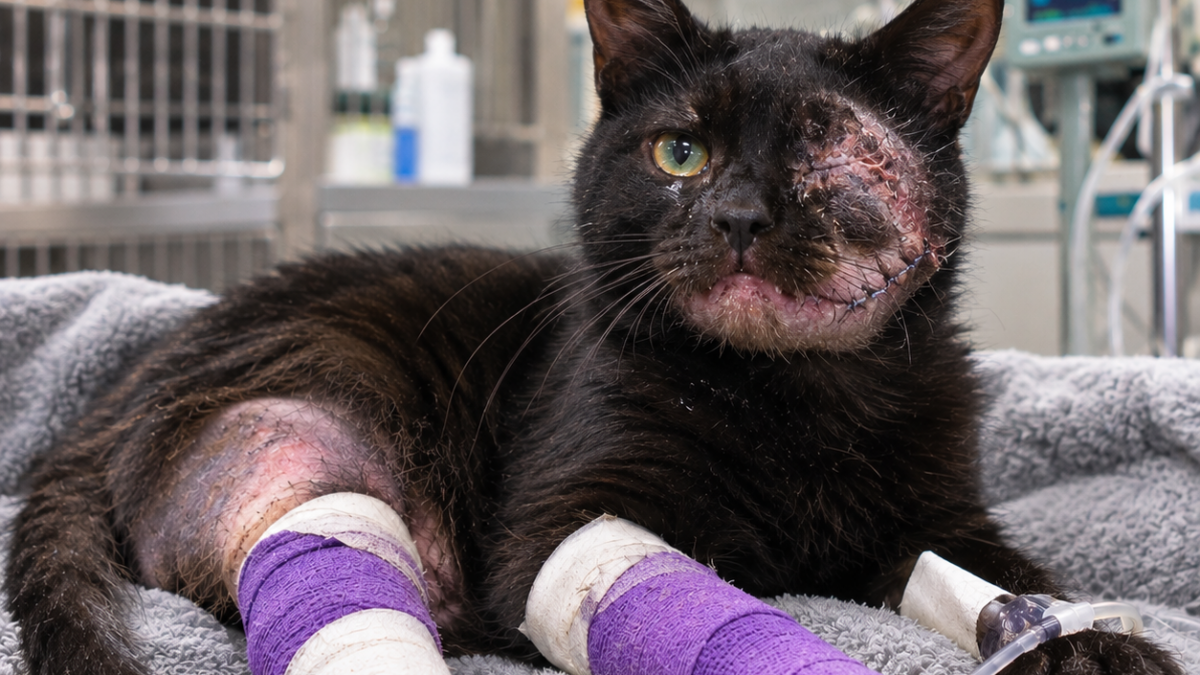
They Said Bianca Was Too Broken to Save—Then the Cat With a Shattered Jaw Lifted Her Paw Toward the Hand That Stayed.
Bianca arrived unable to walk, unable to eat, and with her jaw broken in three places after being struck by a car.
Three of her legs were badly injured, one eye was damaged, and even experienced people quietly wondered whether asking her to keep fighting was fair.
Then, beneath the casts and bandages, one tiny paw began moving against her blanket—and the people around Bianca realized she still had something to say.
Nobody knew exactly how long Bianca had been lying there before someone noticed her.
There was traffic.
Noise.
Cars passing close enough to shake dust from the roadside.
And somewhere near all of it was a small black cat whose body had absorbed an impact far greater than anything her size should have been able to survive.
At first, she barely moved.
That was what frightened the person who found her.
A frightened cat normally tries to run.
Even an injured one may crawl beneath a car, disappear under a fence, drag itself toward somewhere dark.
Bianca did not.
She lay where the collision had thrown her.
Her black fur made her easy to miss against the shadow near the road.
One eye was partly closed.
Her mouth sat strangely.
One side of her face looked swollen.
Three legs seemed unwilling or unable to support her.
Every breath moved through a body that appeared to have been broken in too many places at once.
But she was breathing.
And when someone came closer, Bianca’s remaining alert eye moved toward them.
That was enough.
Help was called.
The rescuer who reached her first crouched several feet away.
“Hey, sweetheart.”
Bianca did not run.
She could not.
She tried to lift her head.
It rose slightly.
Then dropped.
The rescuer looked at the traffic.
Then at the cat.
There was no time to wait.
Moving an animal with multiple possible fractures always carries risk, but leaving Bianca beside the road was not an option.
A towel was brought.
Then a rigid surface.
Everything happened slowly.
One hand near the chest.
Another supporting the pelvis.
No pulling on the legs.
No pressure on the jaw.
PART2:
Bianca made one small sound when they lifted her.
Not a meow.
Not quite a cry.
A broken little breath that made the rescuer stop for half a second.
“I know.”
The cat stared.
“I’m sorry.”
Then they moved again.
Bianca was taken directly to a veterinary clinic.
By the time the door opened, the team was already waiting.
The first minutes were about survival rather than repair.
Breathing.
Heart rate.
Temperature.
Shock.
Pain.
Bleeding.
Neurological response.
The staff worked quickly.
But not chaotically.
A badly injured cat can deteriorate because of what is happening inside the body even when the wounds outside do not look dramatic enough to explain it.
Bianca’s body had taken enormous force.
The clinic needed to know where.
Imaging began once she was stable enough.
The first results were worse than anyone hoped.
Her jaw was broken.
Not once.
Three separate fractures.
That explained the strange position of her mouth.
It explained why she could not close it correctly.
Why eating was impossible.
Why even trying to lap water would be difficult and painful.
Then came the legs.
Three were badly injured.
Multiple fractures.
Different levels of damage.
The team studied the images again.
And again.
One eye had also been injured.
The concern was not only whether Bianca would see normally again.
They had to determine whether the eye itself could remain comfortable and functional.
The list seemed endless.
Jaw.
Legs.
Eye.
Shock.
Pain.
Nutrition.
Mobility.
Infection risk.
One injury would have created a difficult case.
Bianca had several.
Someone asked the question quietly.
Not because they did not care.
Because they did.
“How much are we asking her to endure?”
The room went still.
It is one of the hardest questions in veterinary medicine.
Helping is not always the same as doing everything technically possible.
A treatment can exist and still not be the kindest choice for a particular animal.
Pain matters.
Prognosis matters.
Expected quality of life matters.
The ability to recover matters.
There are situations where letting an animal go is not abandonment.
It is mercy.
Bianca’s injuries forced everyone around her to confront that question honestly.
Could she survive the procedures?
Could the jaw be repaired well enough for her to eat?
Could enough function return to the injured legs?
Could her pain be controlled?
What would happen with the damaged eye?
Were they extending suffering or creating a realistic path through it?
Nobody could guarantee the outcome.
That was the problem.
One of the rescuers stood beside Bianca’s cage after the discussion.
The black cat lay almost completely still.
Her face was swollen.
Her body looked small beneath the hospital towel.
The rescuer watched her breathing.
Then Bianca moved her head.
Only slightly.
Her eye opened.
She looked toward the person standing beside her.
Not for long.
Then her eyelid lowered again.
The rescuer whispered:
“She’s still here.”
Nobody used the phrase as an argument that every injured animal must be pushed through treatment.
It was simply an observation.
Bianca was still there.
And the specialists believed there was a medical path worth attempting.
So the decision was made.
They would try.
That decision did not mean optimism replaced reality.
The team understood exactly how difficult the next weeks could become.
They stabilized Bianca.
Controlled pain.
Supported hydration.
Prepared for surgery.
And because her jaw could not safely manage normal food, nutrition became an immediate concern.
Cats cannot go indefinitely without adequate calories.
Healing fractures consumes energy.
Fighting inflammation consumes energy.
Stress consumes energy.
Bianca’s body needed fuel at precisely the moment eating had become almost impossible.
At first, tiny amounts of carefully prepared nutrition were delivered slowly.
A syringe.
A drop.
Pause.
Another.
Everything had to avoid placing unnecessary stress on the damaged jaw.
Bianca did not understand why someone kept bringing something near her mouth.
She turned her head when she could.
Sometimes she simply closed her eye.
The staff learned to work around her fear.
“Just a little.”
Pause.
“Good.”
Another drop.
“Almost done.”
No one expected gratitude.
Bianca’s job was not to appreciate them.
Her job was simply to stay alive.
The first major surgery was long.
The jaw required precise stabilization.
Three fracture sites meant the veterinarians had to think not only about bone healing but about future function.
A cat can survive many things.
But the mouth matters every day.
Eating.
Drinking.
Grooming.
Comfort.
If the jaw healed badly, Bianca could face permanent problems even after surviving everything else.
The injured legs required their own repairs and stabilization.
Casts and supportive bandaging would become part of her life.
The eye was treated according to what function could be preserved.
Hour after hour, the team worked.
Outside the operating area, rescuers waited.
Waiting creates its own kind of helplessness.
There is nothing to clean.
Nothing to hold.
No medication to give.
You simply wait for someone to open a door and tell you whether the animal you carried inside is still alive.
Eventually the veterinarian emerged.
Bianca had made it through.
Nobody celebrated loudly.
Not yet.
One successful surgery did not erase the risks.
There could be swelling.
Infection.
Failure of fixation.
Pain complications.
Nutrition problems.
Another procedure.
Bianca still had a long road in front of her.
But she had survived the first major step.
When she woke, she looked almost impossible to recognize.
Bandages.
Casts.
Swelling.
Medical lines.
Support everywhere.
Her body seemed surrounded by things designed to hold broken parts together.
She could not stand.
She could not eat normally.
She could barely reposition herself.
The cat who had once been built to jump onto furniture, twist in midair and land on four paws now needed assistance simply to remain comfortable in bed.
The staff changed her position carefully.
Pressure points were checked.
Bedding was kept soft.
Her body was cleaned because grooming herself was impossible.
Each task was done slowly.
Bianca hated some of it.
That was encouraging in an odd way.
When strength returned enough for her to object, she did.
A small turn of the head.
A tense shoulder.
An attempt to withdraw her paw.
“You can be mad,” one technician told her.
Bianca’s eye narrowed.
“Actually, that’s probably a good sign.”
Recovery did not arrive as a dramatic transformation.
For days, almost everything looked the same.
Black cat.
Bandages.
Casts.
Quiet breathing.
Nutrition support.
Medication.
People coming and going.
But veterinary teams learn to notice things other people might miss.
The first change was her eye.
Not the injured structure itself.
The expression.
Bianca began following movement around the room.
A nurse walked past.
Her gaze tracked.
A hand approached.
She watched.
Someone opened food.
One ear moved toward the sound.
Tiny things.
But they meant Bianca was becoming more engaged with the world outside her own pain.
Then came the head lift.
At first only a second.
Bianca raised her head from the blanket.
Held it.
Lowered it.
The staff member beside her smiled.
“Good morning.”
Bianca did not respond.
That afternoon she did it again.
The next day, longer.
Then something happened with her paws.
Bianca lay on a clean blanket after one of her bandage checks.
Her body was still heavily supported.
A technician rested a hand several inches away.
Not touching.
Just there.
Bianca’s front paw moved.
Very slightly.
Forward.
Back.
Forward again.
The technician leaned closer.
The paw pressed against the fabric.
Then released.
Pressed.
Released.
Kneading.
Barely.
The movement was so small that another person might not have noticed.
But the technician did.
“Are you making biscuits?”
Bianca stopped.
The technician laughed softly.
“Okay. I won’t embarrass you.”
Later, the movement returned.
Slow paw against blanket.
Press.
Release.
It did not mean Bianca felt wonderful.
Cats can knead in different emotional states.
But it showed engagement.
Something familiar remained inside the severely injured animal.
Something from ordinary cat life.
It gave the people around her a glimpse of the Bianca they hoped might eventually emerge.
Feeding remained one of the hardest parts.
The jaw needed rest.
Nutrition could not wait.
As treatment continued, a feeding tube became part of her care so that adequate calories could reach her without repeatedly asking her injured mouth to do something it could not safely do.
The tube looked frightening to visitors.
To the veterinary team it was relief.
It meant Bianca could receive food without turning every meal into another painful challenge.
Nutrition entered slowly.
Measured.
Monitored.
Her weight stopped falling.
Then stabilized.
Eventually, little by little, she began rebuilding.
The casts remained.
The jaw continued healing.
The eye was monitored.
And every day, somebody sat beside her.
Not always touching.
Bianca did not need constant hands on her body.
She had already endured enough necessary handling.
Sometimes companionship meant sitting nearby while she slept.
One rescuer began bringing paperwork into the recovery room.
Nothing sentimental.
She simply worked there.
Keyboard clicks.
Pages turning.
Quiet breathing from Bianca’s bed.
At first, Bianca ignored her.
Later, she watched.
One afternoon the rescuer looked up and found Bianca staring.
“What?”
Bianca blinked.
“You need something?”
Nothing.
The woman returned to her work.
Several minutes later, Bianca shifted her head until she faced her.
The rescuer smiled.
“All right.”
That became their arrangement.
Bianca was never left without care.
But she was also not treated as a spectacle.
Her injuries attracted attention.
A cat with a jaw broken in three places and three badly injured legs naturally did.
People wanted updates.
Photographs.
Predictions.
The rescue team resisted turning every medical change into a victory announcement.
Because the truth was more complicated.
Some days were good.
Others were not.
There were mornings when swelling looked better.
Then an afternoon when Bianca seemed more painful.
A bandage needed adjustment.
An area of skin looked irritated.
Food tolerance changed.
Medication needed review.
Healing bones do not read social-media schedules.
Bianca recovered according to her body.
Week by week.
One of the first major milestones came when the medical team began allowing limited attempts at supported standing.
Nobody expected a walk.
Her legs had endured too much.
The goal was simply to see how she responded to carefully controlled weight.
A sling supported part of her body.
Hands stabilized her.
Paws were positioned.
Bianca looked down.
Then at the technician.
“Easy.”
One injured leg trembled.
Another touched the padded surface.
Bianca shifted.
The support tightened slightly.
For a moment, she was upright.
Not independently.
Not confidently.
But upright.
Then her body lowered again.
The technician exhaled.
“That counts.”
The next session lasted a little longer.
Bianca remained angry about the whole arrangement.
Her expression made that very clear.
A veterinarian joked:
“She’s going to sue all of us.”
Nobody minded.
Anger required energy.
Bianca had energy again.
Her jaw also began showing progress.
Imaging suggested healing was occurring where it needed to.
The day everyone had been waiting for approached cautiously.
Could Bianca try food herself?
Not a hard meal.
Nothing requiring forceful chewing.
Soft.
Tiny amount.
The veterinary team prepared it.
Her feeding support remained available.
Nobody would push.
A small dish was placed near her.
Bianca smelled it.
That alone made several people stop what they were doing.
She leaned forward.
Paused.
The jaw still felt unfamiliar.
Probably uncomfortable.
The muscles had not worked normally in weeks.
Bianca smelled again.
Then her tongue moved.
One tiny taste.
The room remained silent.
Another lick.
Then another.
Bianca stopped.
Everyone waited.
She leaned forward again.
The first actual bite was so small that it barely seemed worthy of the word.
But it went into her mouth.
She swallowed.
A nurse covered her own mouth.
Another looked away and blinked hard.
Bianca took another.
Nobody cheered.
They were afraid to frighten her.
But the energy in the room changed.
The cat who had been unable to eat was eating.
Not enough to remove the feeding tube.
Not yet.
But enough to begin.
The veterinarian wrote the amount down.
Measured progress.
No miracles.
Data.
Bianca had taken food herself.
That night, the rescuer who had spent so many hours beside her called another member of the team.
“She ate.”
“How much?”
“Not much.”
“She ate?”
“Yes.”
Silence.
Then laughter.
The next day Bianca ate again.
A little more.
Then less.
Then more.
Recovery was like that.
The feeding tube stayed until the team knew Bianca could maintain adequate intake safely.
They did not remove support just because everybody desperately wanted a milestone.
The body decided.
Meanwhile, her legs continued healing.
Casts were changed as required.
Imaging was repeated.
Fractures that once looked catastrophic began developing the signs of repair the doctors hoped for.
One leg responded better than expected.
Another remained weaker.
Bianca learned to compensate.
Cats are astonishingly good at reorganizing movement around limitations.
Not magically.
Not without pain.
But efficiently.
When she was finally allowed more freedom in a protected recovery area, Bianca did not stand and walk across the room like a movie scene.
She tried.
Stopped.
Adjusted.
One paw placed.
Then another.
Weight shifted.
Her body wobbled.
She lowered herself.
Rested.
Then tried again.
The staff watched from several feet away.
No one wanted to rush over unless she needed help.
Bianca hated feeling cornered.
So they gave her room.
Second attempt.
She moved one body length.
Third.
Farther.
The movement was awkward.
But it belonged to her.
That distinction mattered.
For weeks, nearly everything Bianca experienced had been done to her or for her.
Lifted.
Fed.
Positioned.
Bandaged.
Injected.
Examined.
Now she was making a choice herself.
Move.
Rest.
Move again.
That evening she slept for hours.
The next morning she was more reluctant.
The team did not panic.
Soreness after increased activity was expected.
They adjusted.
Rest.
Pain management.
Then try again later.
Eventually, one cast came off.
The leg beneath looked thin.
Muscles disappear frighteningly quickly when they are not used.
Bianca sniffed it.
Then immediately tried to groom an area she had been unable to reach.
The technician stopped her gently because the skin still needed protection.
Bianca gave her a look of absolute betrayal.
“You haven’t been able to wash that leg in weeks.”
Bianca tried again.
“I understand.”
Again.
“No.”
The cat’s ear flattened.
The technician laughed.
“Good. You’re feeling more like yourself.”
The second cast came off later.
Then another layer of support was reduced.
Every removed piece revealed both progress and vulnerability.
The medical equipment had protected her.
Without it, Bianca had to begin trusting her own body again.
That was not immediate.
A leg that has been held still for weeks does not suddenly feel normal because the cast disappears.
Muscle weakness.
Joint stiffness.
Altered sensation.
Caution.
Bianca sometimes looked at a paw before placing it, as though asking whether it could be trusted.
The therapy team worked with her.
Short sessions.
Controlled movement.
Rest.
No chasing dramatic milestones.
Some days she took several steps.
Others, fewer.
Then something else changed.
The feeding tube came out.
That day felt different.
By then Bianca was eating enough on her own.
She approached her bowl with real interest.
The first few times everyone watched nervously.
Eventually she made it clear she would prefer them to stop staring while she ate.
A technician laughed.
“We spent weeks begging you to eat.”
Bianca kept eating.
“And now we’re annoying?”
Bianca lifted her head.
The technician backed away.
“Understood.”
The jaw had not merely healed enough for survival.
Bianca was beginning to use it as part of ordinary life.
Eating.
Drinking.
Eventually grooming.
She licked one front paw.
Dragged it over her face.
Stopped when she reached the injured side near the eye.
Adjusted.
Tried differently.
The team saw intelligence in those little adaptations.
Bianca did not need to be taught that her body had changed.
She discovered it.
Then learned around it.
Her vision remained reduced on the injured side.
The other eye became even more important.
At first, sudden movement from the impaired side startled her.
The caregivers learned to approach from where Bianca could see them.
They spoke before touching.
A small habit.
Huge difference.
“Bianca.”
Ear turns.
“Coming from your left.”
Hand appears.
No startle.
Over time, Bianca became more confident navigating with limited vision.
Whiskers helped.
Hearing helped.
Memory helped.
Her world did not collapse because one eye no longer offered the same information.
She adapted.
The humans adapted too.
That became a recurring theme in her life.
Healing was not only Bianca changing.
Everyone around her changed with her.
Bowls were positioned where she could approach comfortably.
Furniture in the recovery area stayed predictable.
No objects suddenly appeared in her path.
People approached from the stronger visual side when possible.
Her environment began working with her rather than demanding she behave like a cat who had never been injured.
One afternoon Bianca attempted something nobody expected.
A low cushion had been placed a few inches above the floor.
Nothing dramatic.
Just a padded place where she could rest.
Bianca stared at it.
Then lifted one front paw.
Placed it on the edge.
Her injured legs adjusted.
She paused.
The rescuer nearby nearly moved to help.
Then stopped herself.
Bianca pulled.
Shifted.
One hind leg pushed.
The other followed awkwardly.
Then she was on top.
She turned once.
Slowly.
Lay down.
And looked at everyone as though she had done nothing unusual.
The room erupted only after she closed her eyes.
Quiet laughter.
A few tears.
Someone whispered:
“She climbed.”
Three inches.
That was all.
Three inches can be Everest when your body has been broken.
The emotional changes were happening alongside the physical ones.
Initially, Bianca tolerated touch because treatment required it.
That is not the same as enjoying affection.
The team understood the difference.
They did not mistake stillness for consent.
A cat in pain may freeze because there is no better option.
So when Bianca no longer required constant medical restraint, people gave her more control.
Hand offered.
Wait.
If she leaned away, stop.
If she stayed, maybe one stroke.
Then stop again.
Let her decide whether there would be another.
At first Bianca usually chose distance.
Nobody took it personally.
Then one evening, the woman who often did paperwork beside her sat on the floor.
Bianca had become mobile enough to move around the small recovery room.
She walked with care.
Her gait was not perfect.
But she was walking.
The woman did not call her.
Bianca moved toward the wall.
Sniffed the corner.
Turned.
Passed the woman.
Then stopped.
The woman continued reading.
Bianca looked at her hand.
Nothing.
One step closer.
The woman did not move.
Bianca’s nose touched one finger.
The woman remained still.
Bianca sniffed.
Then rubbed one side of her face against the knuckle.
The woman closed her eyes.
Bianca did it again.
The hand moved slowly over the side of her head.
One stroke.
Stop.
Bianca leaned forward.
Another.
Then another.
A sound began.
Purring.
The woman’s eyes filled.
Bianca pushed her forehead harder into the hand.
The purr grew louder.
For an animal who had endured weeks of necessary handling, this was different.
No medicine.
No bandage.
No syringe.
No examination.
Bianca could leave.
She chose to stay.
That mattered more than any photograph could show.
The veterinary team had seen her body survive.
Now they were watching her discover comfort.
A few days later, Bianca began making biscuits more regularly.
She had been given a thick fleece blanket.
Soft.
Warm.
She stepped onto it carefully.
Her legs were still not completely strong.
Then one front paw pressed.
Release.
The other.
Press.
Release.
Back and forth.
Her body lowered.
Purr.
Knead.
Purr.
Someone recorded a few seconds for the rescue team.
No dramatic caption.
Just:
Look at her.
Everyone knew what it meant to them.
The cat once unable to move was using her paws for something that had nothing to do with survival.
Comfort.
Bianca did not know she was supposed to inspire anybody.
She was making a blanket feel right.
That was all.
And that was everything.
Her veterinary checkups became less frightening.
The same clinicians who once studied her images wondering whether her body could survive now watched her walk into the examination area.
Slowly.
One eye giving her incomplete vision.
A slight difference in gait.
But walking.
Eating.
Grooming.
Interested.
Alive.
One veterinarian looked at her and laughed softly.
“You really made all of us look foolish.”
Bianca sniffed his sleeve.
Months earlier, he had been among those who questioned whether treatment might demand too much from her.
He did not regret asking.
That question had been responsible.
What changed was the answer.
Bianca had shown them what her quality of life could become.
Not through heroism.
Not through some moral decision to fight harder than another animal.
Through the combination of medical repair, time, pain control, nutrition, rehabilitation, and her individual response.
She was doing well.
That was what mattered.
The veterinarian scratched lightly behind her ear.
Bianca leaned in.
He smiled.
“Fair enough.”
By then the rescue team could begin thinking beyond treatment.
Bianca did not need to remain a medical patient forever.
She needed a life.
That raised the next question.
Where?
A forever home sounds simple when said quickly.
For Bianca, the right home needed to understand what she had been through without treating her as fragile forever.
She did not need pity.
She needed accommodation.
Predictability.
Veterinary follow-up.
Someone willing to pay attention if her repaired jaw ever caused discomfort.
Someone aware that old fractures could become relevant later.
Someone who understood her limited vision.
A household where furniture would not be rearranged every week.
Gentle introductions.
Safe spaces.
Soft bedding.
And, most importantly, a family who saw Bianca rather than a tragedy.
The rescue prepared her adoption profile carefully.
They did not hide the history.
Struck by car.
Multiple fractures.
Jaw broken in three places.
Three legs severely injured.
Eye injury with lasting visual impairment.
Several surgeries.
Long recovery.
But the profile also described what Bianca had become.
Affectionate with people she trusted.
Food motivated.
Increasingly playful.
A dedicated blanket kneader.
Curious.
Quiet.
Determined to inspect anything new within reach.
Fond of gentle head scratches.
Capable of getting around well in a properly arranged environment.
The responses came.
Some people wrote because the story made them cry.
That was not enough.
Some wanted a “miracle cat.”
That worried the rescuers.
Bianca was not a symbol to display.
She was a living animal with future needs.
Then one application stood out.
Not because the person wrote the most emotional message.
Because the questions were practical.
What kind of flooring did Bianca prefer?
Did she have difficulty jumping?
How high should litter-box sides be?
Would keeping bowls in a fixed location help with the vision loss?
How often did the veterinary team want follow-ups?
Did she tolerate being picked up?
What signs of discomfort should the adopter watch for around the jaw?
Could the adopter visit multiple times before taking her home?
The rescuer reading the application stopped.
“This one.”
Nobody decided immediately.
Meetings came first.
The potential adopter sat on the floor during the first visit.
No grabbing.
No dramatic tears.
No trying to force Bianca into a photograph.
Bianca remained several feet away.
The person talked with the rescue worker.
Ignored her.
Eventually Bianca approached.
Sniffed a shoe.
Walked away.
Good.
Second visit:
She came closer sooner.
Third:
Bianca rubbed against a hand.
The adopter smiled but did not immediately pick her up.
Even better.
The rescue team began to believe they had found the right home.
The day Bianca left was strangely quiet.
Her medical records were packed.
Medication instructions.
Follow-up schedule.
Notes about her eye.
Notes about the jaw.
Notes about mobility.
Favorite food.
Favorite blanket.
Yes, the blanket went too.
Bianca entered the carrier with mild objection.
A very normal cat response.
One of the clinic workers laughed.
“Look at you complaining about a carrier like a completely ordinary cat.”
Bianca stared through the door.
“Good.”
The woman who had spent nights beside her knelt.
For a moment, neither moved.
Then she put one finger through the carrier bars.
Bianca sniffed.
Rubbed her cheek against it.
The woman swallowed.
“Be difficult.”
Bianca blinked.
“Seriously. Ruin something.”
Someone behind her laughed.
“Make them work for it.”
Bianca rubbed the finger again.
Then the carrier was lifted.
The clinic door opened.
For the first time since she had arrived shattered from the roadside, Bianca left not because someone was rushing her toward another medical procedure.
She was going home.
The transition was treated carefully.
One room first.
Not an entire unfamiliar house.
Food.
Water.
Low-entry litter box.
Soft bed.
The familiar blanket.
Places to hide.
Nothing dangerous to climb.
The carrier stayed open.
Bianca remained inside for nearly an hour.
Her new person sat several feet away.
No reaching.
No coaxing.
Eventually Bianca’s face appeared.
One eye studying the room.
Nose moving.
One paw came out.
Then another.
She walked toward the blanket.
Smelled it.
Stepped onto it.
Kneaded twice.
Then retreated back into the carrier.
Nobody considered that failure.
A new home is enormous to a cat.
Especially one with limited vision.
Especially one who has lived through months of medical care.
That first day was not supposed to prove anything.
It was simply the first day.
The second day, Bianca spent more time outside.
Third day:
She ate while her adopter remained in the room.
Fourth:
She explored behind the chair.
Fifth:
She slept on the blanket without keeping her body pointed toward the hiding place.
Sixth:
She climbed onto a low cushion.
Then came the evening that told everyone she had begun settling.
Her adopter sat on the floor reading.
Bianca approached.
Rubbed one cheek against a knee.
Turned.
Rubbed again.
Then placed both front paws on the person’s leg.
Press.
Release.
Press.
Making biscuits.
The adopter stayed still.
Bianca climbed halfway into her lap.
Purring.
The rescuer received a message with a photograph.
No long explanation.
Just:
I think she knows she’s home.
The rescuer looked at the image for a long time.
Bianca’s eye was closed.
Front paws against the blanket covering the adopter’s legs.
Body relaxed.
Nothing medical visible.
No cast.
No tube.
No bandage.
Just a cat.
The clinic group chat exploded.
Hearts.
Crying faces.
Messages.
One veterinarian wrote:
I stand happily corrected.
Another:
Look at those legs.
Sofia—one of the technicians who had cared for Bianca early—wrote only:
She chose the lap.
That became the detail people remembered.
Not because sitting on somebody is extraordinary for a cat.
Because Bianca had once been unable to reposition herself without help.
Now she could choose where to place her body.
She chose closeness.
Life in the new home developed around ordinary routines.
Morning breakfast.
Bianca learned the sound of the refrigerator.
She learned exactly where the food preparation happened.
Her impaired vision did not prevent her from memorizing the home.
Cats build maps through more than sight.
Smell.
Sound.
Whiskers.
Memory.
Repeated routes.
Within weeks Bianca moved confidently through her environment.
Not recklessly.
She remained careful near unfamiliar objects.
But confidence grew.
Her family avoided constantly moving furniture.
Low steps were placed near favorite resting spots.
The litter box remained easy to enter.
Food and water stayed predictable.
She discovered a sunny patch near a window.
That became hers.
Every morning, when the sun reached the floor, Bianca appeared.
She stretched.
Not perfectly symmetrically.
One repaired leg remained slightly different.
Then lowered herself into the warmth.
Sometimes she slept.
Sometimes watched movement outside.
Birds.
Leaves.
People passing.
The injured eye limited part of her visual world.
The other did the work.
Bianca adapted.
She became interested in toys again.
At first, toys moving too quickly from her reduced-vision side startled her.
The family learned.
Move slowly.
Let Bianca locate it.
Then play.
A soft fabric mouse became a favorite.
She would stalk it from several feet away.
Crouch.
Shift weight.
Launch.
Not a perfect leap.
But hers.
Once she pounced, she bit the toy and kicked it with her back feet.
The first video made the rescue workers laugh.
One wrote:
Three injured legs, apparently still enough for murder.
Bianca did not care about their jokes.
She destroyed the mouse.
Another was purchased.
She destroyed that one too.
Her appetite became another source of amusement.
During recovery, everyone had worried about whether Bianca would ever eat normally again.
Now she believed meals were consistently late regardless of actual time.
Five minutes before breakfast, she waited by the bowl.
Ten minutes early for dinner.
Sometimes twenty.
Her adopter would say:
“You almost died because you couldn’t eat.”
Bianca stared.
“And now you’re bullying me because dinner is at six instead of 5:58?”
Meow.
“That is not an emergency.”
Meow.
“Fine.”
The repaired jaw worked.
That fact never stopped feeling significant to the people who remembered the first X-rays.
Three fractures.
A face that looked almost impossible to put back together.
Now Bianca chewed food.
Groomed.
Yawned.
Occasionally bit the hand that continued petting for two seconds longer than she had authorized.
The veterinarian considered that last behavior medically reassuring.
At her first post-adoption follow-up, Bianca entered the clinic in her carrier.
Staff recognized the sound of her complaining before they saw her.
“Is that Bianca?”
The adopter laughed.
“She has opinions now.”
“She had opinions before.”
“Not like these.”
The carrier opened.
Bianca emerged slowly.
The veterinarian approached from her stronger visual side.
“Hello, troublemaker.”
Bianca sniffed him.
The examination went well.
Weight good.
Jaw stable.
Legs healing as expected.
No new concerns with the eye.
The doctor watched her walk across the room.
There was still a slight difference in gait.
But the movement was purposeful.
Comfortable.
Functional.
He crouched.
Bianca approached.
To everyone’s surprise, she rubbed against his knee.
He looked at the rescue worker.
“Remember the first night?”
She nodded.
“I thought we were going to lose her.”
“Me too.”
Bianca began purring.
The doctor looked down.
“You really weren’t interested in our predictions, were you?”
Bianca rubbed again.
He scratched her head.
She allowed three seconds.
Then walked away.
Everyone laughed.
That became Bianca’s pattern.
Affection on her terms.
She loved gentle touch.
But she chose when.
That was something her family respected.
She had spent too much of her recovery having her body handled because medicine required it.
Now she controlled the ordinary moments.
Pick me up?
Maybe not.
Scratch my head?
Yes.
Touch my belly?
Absolutely not.
Sit beside me?
Acceptable.
Move the blanket I am using?
Criminal offense.
Her personality became larger as the medical story faded into the background.
That was exactly what everyone wanted.
Rescued animals deserve to become boring.
That sentence would have sounded strange to anyone who had not worked in rescue.
But the team understood.
An emergency animal is interesting to strangers.
The injuries are dramatic.
The photographs make people stop scrolling.
A happy animal eating breakfast for the thousandth time attracts less attention.
Good.
Let them become boring.
Let the medications become routine.
Let the frightening photos move farther back in the phone gallery.
Let the animal become known for stealing socks rather than surviving surgery.
Bianca deserved that kind of boring.
She got it.
Weeks became months.
The casts became memories.
The feeding tube became a line in her medical file.
The roadside became something Bianca’s family knew about but did not build her identity around.
Visitors met her and saw a black cat with one compromised eye and a slightly unusual gait.
If they asked what happened, the family explained briefly.
Then Bianca usually interrupted by demanding something.
Food.
A toy.
A preferred chair.
One visitor once said:
“Poor thing.”
Bianca immediately jumped onto the sofa beside him and tried stealing the drawstring from his sweatshirt.
Her adopter laughed.
“She doesn’t know she’s a poor thing.”
The phrase was not meant to dismiss what she had suffered.
It meant Bianca lived forward.
The people around her could remember the trauma without asking her to perform it forever.
Her body carried evidence.
The eye.
The gait.
The healed jaw.
But her days were not spent thinking about X-rays.
They were spent being a cat.
One rainy afternoon, Bianca’s family found her kneading the fleece blanket near the window.
Both front paws worked rhythmically.
Press.
Release.
Press.
Release.
Purring.
Her eyes partly closed.
The person watching remembered the first tiny kneading movement beneath casts at the clinic.
A paw barely moving against hospital bedding.
Nobody knew then what it would become.
Now Bianca’s shoulders moved comfortably.
Her paws alternated.
The blanket bunched beneath her.
She turned in a slow circle.
Lay down.
Kept purring.
There was no medical milestone attached to the moment.
No doctor needed to record it.
That was what made it beautiful.
Bianca was comfortable.
That was all.
Comfort had once seemed impossibly far away.
When rescue workers later told her story, people often focused on the phrase:
She refused to give up.
It sounded inspiring.
But those who knew Bianca best became careful about that language.
Because injured animals do not earn care by fighting hard enough.
A cat who cannot recover deserves compassion too.
Bianca did not survive because she was morally stronger than animals who die from similar injuries.
She survived because someone found her.
Because medical care was available.
Because the injuries, severe as they were, could be treated.
Because pain was controlled.
Because surgery succeeded.
Because nutrition kept reaching her.
Because rehabilitation continued.
And because her body responded.
Her will mattered in the ordinary sense that she engaged with recovery when she had enough strength.
But no one wanted her story to become a weapon against animals whose bodies simply could not do the same.
Bianca’s value did not begin when she took her first step.
She was worth helping when she lay motionless.
Worth helping before anyone knew the outcome.
That distinction became important to the rescue.
When they shared her progress, they emphasized the work.
The surgeon repairing a jaw fractured in three places.
The nurses feeding her.
Bandage changes.
Monitoring.
Rehabilitation.
The adopter reorganizing a home around limited vision.
The long boring hours that never appear in dramatic before-and-after videos.
Miracles are often assembled from ordinary labor.
Bianca’s was.
There were setbacks after adoption too.
One morning she did not finish breakfast.
Normally Bianca treated unfinished food as a personal failure.
Her family noticed immediately.
By lunch she still seemed quiet.
They called the clinic.
Not panic.
Attention.
The veterinarian asked questions.
Vomiting?
No.
Litter box?
Normal.
Walking?
Yes, but less active.
Jaw pain?
Hard to tell.
Because of her history, the family brought her in.
The cause turned out to be minor gastrointestinal upset.
Nothing related to the old fractures.
Medication.
Hydration.
Observation.
Bianca returned to normal quickly.
But the experience reminded everyone that special-needs adoption did not end when the photographs became happy.
Commitment meant watching.
Not obsessively.
Responsibly.
The body that had been repaired still deserved thoughtful long-term care.
Bianca’s family never resented that.
They had asked those questions before adopting.
They knew what yes meant.
Yes to Bianca meant yes to the medical history too.
Yes to future checkups.
Possibly future dental or jaw concerns.
Mobility changes.
Monitoring the eye.
Maybe arthritis earlier than in a cat without those fractures.
No one could predict everything.
That was true of any adoption.
Bianca simply arrived with more information.
Her family considered that useful.
The seasons changed.
Bianca discovered winter blankets.
She already loved fleece.
Then someone bought a heated cat bed.
The package was placed on the floor.
Bianca investigated it before installation.
Her adopter set it up.
Low heat.
Safe.
Soft cover.
Bianca stepped in.
Turned twice.
Settled.
Five minutes later, she looked asleep.
Her family took a picture.
Caption sent to the rescue:
We have lost her to luxury.
A former clinic technician replied:
After what she paid in medical bills, she deserves the upgrade.
Bianca became increasingly affectionate as security deepened.
Not indiscriminate.
She still disliked strangers reaching over her head.
But with family, she began seeking contact.
A forehead against a hand.
A cheek against an ankle.
Sitting close on the couch.
Then one night, she climbed fully into her adopter’s lap.
It took effort.
Front paws first.
One repaired rear leg positioned.
Then the other.
She settled.
Her adopter did not move.
Phone out of reach.
No photograph.
Nobody wanted to risk disturbing her.
Bianca began purring.
Minutes passed.
Ten.
Twenty.
A leg went numb beneath her.
Her adopter refused to shift.
When Bianca finally stood and jumped carefully down, the person whispered:
“Worth it.”
That is how attachment grows.
Not through declarations.
Through refusing to move because a cat is sleeping on you.
Bianca had become family.
The word sounds simple.
For an animal, family is probably less abstract.
It is routine.
This voice.
This smell.
This bowl.
This hand.
This bed.
This door.
People who leave and return.
Bianca learned the schedule.
Morning alarm.
Breakfast.
Window.
Nap.
Play.
Dinner.
Couch.
Blanket.
Night.
When the person she trusted came home, Bianca often waited near the doorway.
Not every time.
She remained a cat.
But frequently enough that nobody mistook it for coincidence.
She heard the key.
One ear turned.
Then the rest of her.
Footsteps.
Door opens.
Bianca appeared.
“Hi.”
Tail lifted.
Sometimes a meow.
Then the head rub.
Those ordinary greetings were probably more meaningful to her rescuers than anything else.
The cat who once lay unable to stand now walked to meet someone.
The cat who once needed food delivered through medical support now demanded dinner.
The cat whose body had to be carefully repositioned now chose where to sleep.
The cat who endured constant necessary touch now sought gentle touch voluntarily.
Nothing erased what happened on the road.
It did not need to.
Healing does not require forgetting.
The body remembered in its own way.
Scar tissue.
Altered vision.
Slight gait difference.
But memory and future can coexist.
Bianca’s story became less about what the accident took and more about what life still contained afterward.
A veterinary nurse who had cared for her early visited months later.
She sat on the floor.
Bianca approached cautiously.
Sniff.
Pause.
The nurse smiled.
“You don’t remember me.”
Bianca rubbed against her hand.
The woman’s face changed.
“Or maybe you do.”
Nobody could know.
Cats do not explain.
The nurse scratched gently behind Bianca’s ear.
Purring.
She laughed.
“You were so mad at me.”
The adopter asked:
“Really?”
“Oh, she hated syringe feeding.”
Bianca looked up.
“Don’t look innocent.”
The cat kneaded the nurse’s leg.
The woman began crying.
The adopter sat quietly.
After a moment the nurse said:
“Sorry.”
“Don’t be.”
“I didn’t think I’d ever see her like this.”
Bianca continued kneading.
The nurse wiped her face.
“She was just lying there.”
“I know.”
“We had to move everything for her.”
Now Bianca stood.
Turned.
Walked toward the food bowl.
The nurse laughed through tears.
“And apparently I interrupted dinner.”
The rescue team kept one photograph from Bianca’s first day and another from months after adoption.
In the first, she looked almost swallowed by hospital bedding.
Face swollen.
Body immobilized.
One eye injured.
Casts and support surrounding her.
In the second, Bianca sat near a sunny window.
Black coat glossy.
Head slightly tilted.
One eye bright.
No medical equipment.
The contrast was enormous.
People called it before and after.
But the veterinarian who had treated her disliked that phrase.
“After what?”
Someone asked.
“After being broken?”
“Yes.”
He shook his head.
“She wasn’t finished being Bianca in the first picture.”
That became another lesson.
Illness photographs sometimes make animals look like objects waiting to be restored.
But Bianca was Bianca during every stage.
In pain.
Sedated.
Angry.
Hungry.
Learning to stand.
Kneading.
Playing.
Adopted.
None was more real than another.
The goal was not to replace the broken-looking cat with a prettier one.
The goal was to give the same cat enough care to keep experiencing life.
There were no guarantees at the beginning.
That was why the decision to try had mattered.
Care was offered before the outcome was known.
People sometimes asked whether the veterinarians who initially questioned treatment felt guilty.
No.
And they should not have.
Ethical medicine requires difficult questions.
Should we operate?
Will pain be manageable?
What is the realistic prognosis?
Are we helping the patient or helping ourselves avoid grief?
Those questions protect animals.
Bianca’s condition simply developed in a way that eventually answered them.
Yes, the pain could be controlled.
Yes, the fractures could heal.
Yes, she could regain useful mobility.
Yes, she could eat.
Yes, she could adapt to limited vision.
Yes, she could experience comfort and pleasure.
Had those answers been different, compassion might have required a different decision.
But Bianca kept giving the team reasons to continue.
Not because she owed them proof.
Because the clinical picture supported it.
The public saw perseverance.
The doctors saw healing tissue.
Both could be true.
Bianca’s adopter saw something simpler.
A cat who liked her blanket folded twice.
Not once.
Not three times.
Twice.
A cat who rejected pâté unless it was slightly warmed.
A cat who chirped at birds.
A cat who sometimes forgot the damaged side of her vision and bumped gently into a chair, then looked offended as though the chair had moved.
A cat who could hear a treat packet from another room.
A cat who kneaded anything soft.
A cat who had survived a terrible accident and then had the audacity to become picky.
That was the best possible result.
Bianca was not grateful every second.
Thank God.
Gratitude is a human expectation.
Animals deserve care without performing appreciation.
Bianca complained.
Refused food she disliked.
Walked away from petting.
Woke people at inconvenient hours.
Occupied the middle of the bed.
Normal cat behavior.
The people who loved her celebrated it.
An animal does not need to spend the rest of its life acting rescued.
Bianca simply lived.
On the anniversary of her rescue, the clinic received a video.
No dramatic music.
Bianca was sitting on a sofa.
Her adopter held a soft toy on a string.
It moved.
Bianca crouched.
Tracked it with her good eye.
The toy slid left.
She moved.
Pounced.
Missed.
Turned.
Tried again.
This time she caught it.
Then carried it away.
The video ended.
The surgeon who had repaired her jaw watched it twice.
Then a third time.
A colleague asked:
“What?”
He shook his head.
“Nothing.”
But his eyes were wet.
There is a strange intimacy in repairing a body.
You remember fractures other people never saw.
You remember holding bone in alignment.
Watching monitors.
Wondering whether your work will matter.
Then months later, the patient uses that repaired body to chase something ridiculous across a sofa.
That is when the technical work becomes life.
Bianca continued returning for scheduled checkups.
Eventually the visits became ordinary.
Weight.
Heart.
Teeth.
Jaw.
Mobility.
Eye.
No crisis.
One appointment ended with the veterinarian writing:
Doing well.
Two words.
A boring medical note.
A beautiful one.
Doing well.
That was the goal from the first night.
Not becoming famous.
Not inspiring strangers.
Doing well.
Bianca had a home.
She ate.
She moved.
She played.
She sought affection.
She rested comfortably.
That was enough.
Years would bring other challenges.
No one pretended otherwise.
Previously fractured joints might develop arthritis.
Vision could change.
Dental care would remain important.
Age comes for every animal fortunate enough to live long enough.
Bianca’s family understood.
They had already seen what commitment looked like when things were difficult.
A little future inconvenience did not frighten them.
If ramps were needed someday, they would build ramps.
If medication became daily, medication would become routine.
If a favorite sleeping place became too high, another would be created lower.
That is what adoption means when done well.
Not:
I love the animal while life remains easy.
It means:
When life changes, we change with you.
Bianca already knew something about changing.
She had learned to walk in a body that once could not stand.
Learned to eat with a jaw that had been fractured in three places.
Learned to navigate with one eye doing more of the work.
Learned that touch could be medical one day and affectionate another.
Learned that a carrier could lead away from a hospital and toward home.
Learned that blankets could become places for kneading instead of only surfaces beneath casts.
Her body carried history.
Her behavior carried adaptation.
Her home made room for both.
One evening her adopter sat beside her near the window.
Rain tapped against the glass.
Bianca was half asleep.
The person ran one finger gently along the side of her head.
Bianca leaned.
The purr began.
“You know,” the person whispered, “a lot of people thought you wouldn’t make it.”
Bianca’s ear moved.
“I suppose you didn’t ask them.”
Purr.
“You just kept being difficult.”
One eye opened.
“Yeah, I know.”
Bianca put one paw onto the person’s wrist.
Then pressed.
Released.
Pressed again.
Making biscuits against skin.
The adopter laughed softly.
“That hurts a little.”
Bianca continued.
“Fine.”
Some things were worth a few claws.
The story of Bianca often began with the car accident.
Understandably.
It was dramatic.
A tiny black cat.
Broken jaw.
Three injured legs.
Damaged eye.
Unable to eat or walk.
People wondering whether she could survive.
But that was only the first page.
The rest of her life could not be summarized by the worst day.
That is one of the dangers of rescue stories.
We freeze animals inside the moment we first felt sorry for them.
The burned dog.
The blind cat.
The kitten from the highway.
The three-legged survivor.
But the animals themselves continue.
Bianca became more than the cat from the emergency clinic.
She became Bianca who wanted breakfast early.
Bianca who loved fleece.
Bianca who stalked toy mice.
Bianca who preferred one side of the sofa.
Bianca who purred during head scratches.
Bianca who could walk away when she had enough.
That mattered.
Choice is one of the quiet things trauma takes.
When Bianca lay beside the road, almost every choice was gone.
She could not run.
Could not stand.
Could not eat.
Could barely lift her head.
At the clinic, medical necessity still controlled much of her life.
Medication now.
Feeding now.
Bandage change now.
Surgery.
Rest.
Examination.
Those things saved her.
But they were still things happening according to someone else’s schedule.
Recovery gradually returned choice.
Eat from the bowl.
Move toward the cushion.
Approach a hand.
Walk away.
Choose a toy.
Choose a bed.
Choose a lap.
Perhaps that was the real transformation.
Bianca regained not only function.
She regained ownership of ordinary moments.
The first time she made biscuits voluntarily in her new home, no veterinarian needed to explain it.
She was comfortable enough to perform an old instinctive behavior associated with softness and security.
That was enough.
The family did not know every detail of Bianca’s life before the accident.
Nobody did.
Was she loved?
Had she been stray?
Had someone fed her?
How long had she lived outdoors?
There were blanks.
Those blanks did not need fictional answers.
The part they knew began beside the road.
And the part they could control began when someone stopped.
Everything after that existed because one person did not drive past.
A rescuer lifted her.
Doctors stabilized her.
Surgeons repaired what they could.
Nurses fed her.
Technicians cleaned and turned her.
Physical rehabilitation helped her rediscover movement.
Someone sat beside her.
Then someone adopted her.
No single act created the ending.
A chain did.
If one link disappeared, perhaps Bianca’s story changed.
That is why rescue work rarely belongs to one hero.
The finder matters.
Driver matters.
Veterinarian.
Technician.
Foster.
Donor.
Adopter.
Sometimes the person washing the tenth blanket of the day matters more than anyone realizes.
Love often looks very uncinematic up close.
Laundry.
Medication.
Cleaning litter.
Driving to appointments.
Waking early.
Warming food.
Remembering which side the cat sees best from.
Moving a chair so she has a clearer route.
Cutting claws.
Checking weight.
Opening the door when the cat cries at night.
That is how life is rebuilt.
Not with one perfect moment.
With repetition.
Bianca’s story reached people because the injuries sounded impossible.
But the people closest to her were moved by smaller things.
Her first bite.
First steady step.
First real grooming session.
First comfortable sleep.
First spontaneous cheek rub.
First lap.
First destroyed toy.
Those were the moments that said Bianca’s world was getting larger.
Eventually the rescue received an update showing her asleep on a large bed.
Not a cat bed.
A human bed she had apparently claimed.
The adopter wrote:
We’ve negotiated. I am allowed approximately twelve inches.
The team laughed.
Someone replied:
Excellent prognosis.
That photograph stayed pinned near the clinic’s staff area for months.
Not the emergency photograph.
The bed.
Black cat.
Stretched out.
Completely inconsiderate.
Alive.
One new technician asked:
“Who’s that?”
Someone answered:
“Bianca.”
“What happened to her?”
The senior nurse paused.
Then smiled.
“A lot.”
That was enough.
There is no need to make every scar into a speech.
Bianca did not need the world constantly reminding her she was brave.
She needed the world to let her nap.
And eat.
And play.
And grow older.
The family intended to give her exactly that.
Years from now, if Bianca’s joints stiffen, the old fractures may become relevant again.
If her eye changes, there may be more appointments.
If the jaw needs monitoring, they will monitor it.
Those are not failures of the happy ending.
They are what comes after it.
A happy ending is not a freeze-frame where nobody ever gets sick again.
It is the beginning of being cared for when they do.
Bianca’s adoption did not guarantee a painless life.
It guaranteed she would not face the difficult parts alone.
That was enough.
The people who once stood over her first X-rays could not have predicted any of this.
They saw three fractured legs.
A jaw broken in three places.
An injured eye.
A cat unable to eat.
Unable to walk.
They asked whether continuing treatment would be kindness.
That was the right question.
Months later, Bianca gave them an answer they were grateful to receive.
Not through words.
Through behavior.
She ate.
Moved.
Played.
Rested.
Sought affection.
Kneaded.
Purred.
Those were quality-of-life answers.
The same veterinarian who once spoke cautiously about prognosis eventually watched Bianca walk across an exam room.
She stopped beside him.
He held out a hand.
Bianca smelled it.
Then rubbed her cheek along his fingers.
He scratched her gently.
The cat purred.
He looked toward the adopter.
“I remember when we wondered whether she would ever eat.”
The adopter smiled.
“She screamed at me because breakfast was four minutes late today.”
The veterinarian laughed.
“Perfect.”
Bianca walked away.
He watched her.
Then said quietly:
“That’s what we were trying to save.”
Not the fractures.
Not the X-rays.
Not a perfect body.
That.
A cat capable of being annoyed about breakfast.
That was life.
Bianca’s injuries healed into a body that was different from before but functional.
Her fear softened into trust where trust was earned.
Her dependence during recovery became independence wherever independence was possible.
And the hands she once associated with examinations eventually became hands she approached for affection.
Nobody could honestly say love alone healed Bianca.
Love did not realign three jaw fractures.
Love did not stabilize broken bones.
Veterinary medicine did that.
Surgery.
Pain control.
Nutrition.
Rehabilitation.
Time.
But love was there in another form.
Love was deciding her life was worth the work before anyone knew whether the work would succeed.
It was staying beside the cage.
Feeding one tiny amount at a time.
Changing the blanket.
Repeating exercises.
Watching for infection.
Letting her rest.
Not forcing affection.
Then finding a home willing to continue.
Love did not replace medicine.
It made people keep showing up long enough for medicine to matter.
Perhaps that is why Bianca’s story remained with everyone who knew her.
Not because she became physically perfect.
She did not.
Not because every fear disappeared.
It did not.
But because the cat who arrived almost completely dependent eventually began choosing things again.
Food.
Movement.
Play.
Touch.
Home.
And every choice quietly contradicted what those first images seemed to say.
Her body was broken.
Her life was not finished.
The accident had changed her.
It had not defined everything afterward.
One night, long after Bianca’s adoption, her family turned off the lights and prepared for bed.
Bianca was already on her blanket.
The same one she had kneaded for weeks.
She shifted.
One paw.
Then the other.
Press.
Release.
Press.
Release.
Her adopter lay beside her.
A hand moved slowly toward her face.
Bianca saw it from her stronger side.
No startle.
No fear.
She leaned into the palm.
Purring filled the quiet room.
The person scratched gently behind her ear.
Bianca’s eyes closed.
No cast.
No feeding tube.
No metal examination table.
No one discussing whether her injuries were too severe.
Just warmth.
A familiar bed.
A familiar hand.
And a small black cat who had once been unable to lift herself from a roadside now deciding exactly where she wanted to sleep.
That was never something the first veterinary team could promise.
It was something they had only hoped Bianca might live long enough to discover.
She did.
And somewhere between the surgeries, the syringe feedings, the casts, the first bite of food, the first unstable steps, the first real purr and the first night in her new home, Bianca stopped being a patient everyone was trying desperately to save.
She became what she should have been allowed to be all along.
Someone’s cat.
Loved not because she survived something extraordinary.
Loved because she was Bianca.








