They Returned This Quiet Shelter Cat After Five Days—Then One Word Exposed What Everyone Had Missed
PART2:
His wife, Melissa—not to be confused with my supervisor, whose name was Melissa Grant—looked down at the carrier.
“She hides constantly.”
I nodded.
“How constantly?”
“All the time.”
The husband gave a tired little laugh.
“I mean, we barely saw her.”
“What happened when you left her alone?”
“She’d come out some.”
“And at night?”
“We heard her moving around.”
“Eating?”
“Yeah.”
“Using the litter box?”
“Yes.”
“No vomiting? Diarrhea? Anything medical?”
“No.”
I looked at Olive.
She was watching me.
Not them.
Me.
The wife crossed her arms.
“The kids are disappointed.”
“How old are they again?”
“Six and nine.”
That answer hit me because I remembered exactly what I had said five days earlier.
She’ll probably need a little patience at first, but she’s calm. Once she settles, I think she’ll make a wonderful family cat.
I had said it confidently.
Professionally.
PART3:
Like I was describing a known future.
The wife continued.
“They thought she’d sleep with them.”
“It can take adult cats time.”
“We know.”
Her tone told me she didn’t want a lecture.
I stopped.
“She hid behind the washing machine,” the husband said.
My attention sharpened.
“The washing machine?”
“Yeah.”
“In the laundry room?”
“Yes.”
“With the door open?”
The couple looked at each other.
The wife said, “Mostly.”
Mostly.
“What does mostly mean?”
“We closed it at night.”
My stomach tightened.
“With her inside?”
“We didn’t want her hiding under the beds.”
“How many nights?”
The husband frowned.
“Two, maybe three.”
I looked back at Olive.
She had gone very still.
I had seen thousands of frightened cats.
There was ordinary shelter fear.
Eyes wide.
Body low.
Tail wrapped tightly.
Then there was something else.
A kind of stillness that didn’t feel like waiting to see what happened.
It felt like knowing.
I lowered my voice.
“Did she ever scratch or bite?”
“No.”
“Hiss?”
“Once when our son reached behind the washer.”
“Did he touch her?”
“No.”
“Did she lunge?”
“No.”
“Swat?”
“No.”
The wife sighed.
“She’s not aggressive. She’s just…”
She searched for the word.
“Empty.”
I looked at her.
“What?”
“She doesn’t do anything.”
The husband jumped in.
“That sounds worse than she means.”
His wife shook her head.
“I don’t mean it cruelly. She just sits there. The kids try playing with her and she won’t engage. You told us she was shy, but we thought she’d warm up.”
“I said she might.”
“You said she was good for a family.”
There it was.
Not shouted.
Not exaggerated.
Just true.
I had said that.
My throat tightened.
The wife looked at the carrier again.
“We don’t want her unhappy.”
I nodded.
“That’s fair.”
It was the kindest thing I could say.
Maybe they had expected too much.
Maybe I had encouraged those expectations.
Maybe both things were true.
I pulled out the return form.
Reason for return.
Behavior concerns.
Adjustment period.
I asked the questions.
They answered.
Hides.
Avoids children.
Does not seek affection.
Does not play.
Will not sit with family.
Eats only when alone.
Uncomfortable with household noise.
When the husband signed the bottom, he looked genuinely ashamed.
“I’m sorry.”
I believed him.
That matters.
Not every person who returns an animal is cruel.
Some are careless.
Some unrealistic.
Some impatient.
Some simply wrong for that particular animal.
Sometimes the shelter is wrong too.
I would learn that soon enough.
The couple left.
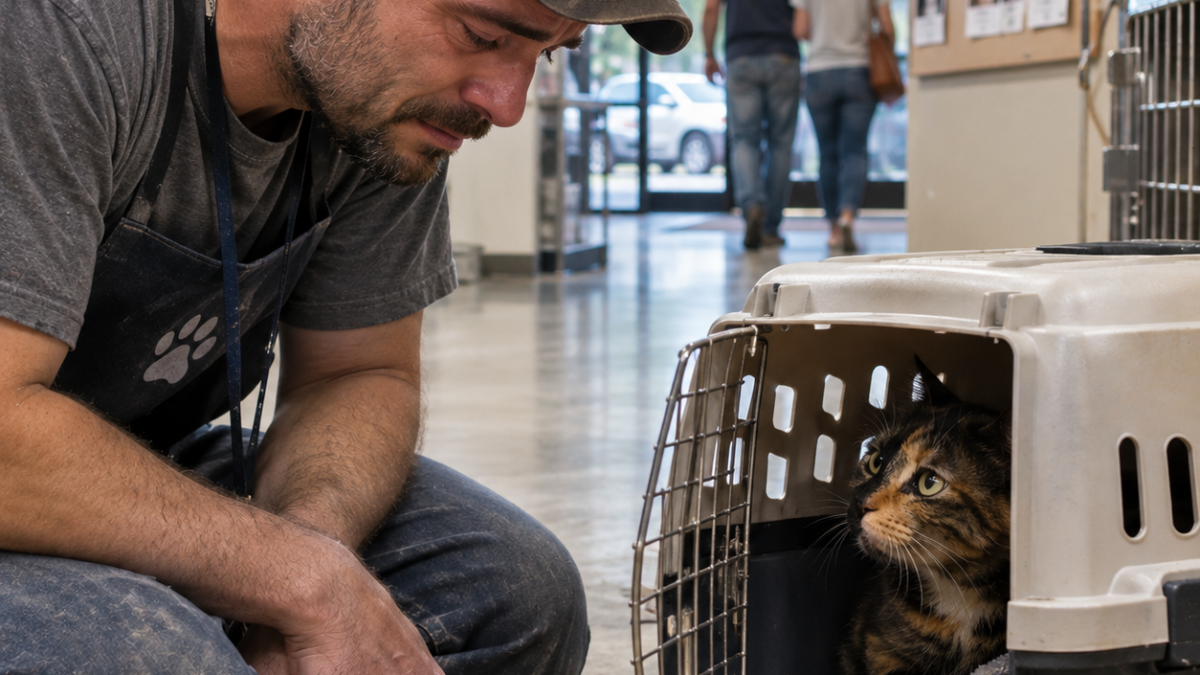
Olive remained in the carrier on the counter.
I crouched so my face was level with the door.
For a few seconds, neither of us moved.
Then she looked directly at me.
Steady.
One amber eye catching the fluorescent light.
I had the irrational feeling that she remembered me.
Of course she did.
I had handled her.
Fed her.
Sat near her kennel.
I had been the person who placed her into this same carrier five days earlier.
The person who closed the door.
The person who handed her to strangers.
“I’m sorry,” I whispered.
Olive didn’t turn away.
That made it worse.
I carried her past the main adoption room.
Our cat area was loud that day.
Kennel doors clicking.
A vacuum cleaner somewhere near the lobby.
Two kittens wrestling against wire.
A volunteer calling for towels.
Someone laughing.
A dog barking from the opposite wing.
Normally, a returned cat went back into an available kennel.
Process mattered.
We had forty-seven cats in a space built comfortably for thirty-six.
But I couldn’t put her beneath those lights.
Not yet.
There was a small side room beside the staff office.
We used it for quarantine overflow, nursing mothers, frightened cats, occasional medical observation.
It was barely eight feet by ten.
One window.
A stainless-steel kennel bank.
A sink.
A folding chair.
I put Olive inside the lower kennel.
Blanket.
Water.
Food.
Litter box.
Then I opened the carrier.
She didn’t move.
I waited.
Five minutes.
Ten.
Finally, she stepped out.
One paw.
Then the other.
Slowly.
Carefully.
She walked to the back of the kennel and pressed herself against the blanket.
I left the carrier inside with the door open.
Sometimes familiar objects mattered.
Even unpleasant familiar objects.
At six that evening, most of the daytime staff had gone.
The shelter became different after hours.
Not quiet.
Shelters are never quiet.
But slower.
The fluorescent lights in the lobby were dimmed.
Voices disappeared.
You could hear individual sounds instead of one wall of noise.
Water filling bowls.
Keys against someone’s belt.
A dog turning circles in bedding.
I brought a towel into Olive’s room and sat on the floor.
I did not reach through the bars.
I didn’t shake treats.
Didn’t make kissy noises.
Didn’t say her name fifteen times.
I had learned enough over the years to know that humans often make frightened animals endure our attempts to comfort them.
We call it kindness because our intentions are good.
The animal only knows it cannot escape our hands.
So I sat.
Olive watched.
I thought about the family.
For about five minutes, I was angry with them.
Then I became angry with myself.
They had wanted an affectionate cat for two children.
I had given them Olive because she never hissed when the children approached her kennel.
That was my logic.
She tolerated them.
Therefore she might like them.
What kind of reasoning was that?
I remembered the mother asking, “Is she easy?”
And me saying, “She’s pretty low-key.”
Low-key.
Another lazy phrase.
What did it mean?
She didn’t knock things over?
She didn’t demand attention?
She didn’t complain when frightened?
Quiet animals make people comfortable because they do not force us to acknowledge their discomfort.
I rested my head against the wall.
“Sorry.”
One word this time.
Olive’s ears moved.
I stayed still.
She made a sound.
Barely anything.
Not a full meow.
A small breathy chirp.
I looked at her.
She moved one front paw forward.
Then the other.
Two inches.
Maybe three.
That was all.
But I felt something shift.
Not in her.
In me.
The next morning, my supervisor walked into the side room carrying a clipboard.
Her name was Melissa Grant.
She was forty-six.
Practical.
Competent.
Fast.
She had managed Jefferson County Haven for six years and could remember adoption numbers from three Christmases earlier without checking a report.
She cared about animals.
I want to say that clearly.
People become easier to hate when stories flatten them.
Melissa was not a cartoon villain.
She had bottle-fed abandoned puppies in her office.
Driven injured dogs to emergency veterinarians at midnight.
Paid for medications with her own money.
But she had also spent years inside a system where every empty kennel meant another animal could be pulled from an overcrowded municipal facility.
Numbers mattered.
That belief had become rigid.
She looked through the kennel door at Olive.
“How bad?”
“Not bad.”
“Daniel.”
“No aggression. Eating. Litter box normal.”
“Then why is she in my side room?”
“I want to observe her.”
“You observed her for three weeks before adoption.”
“Not outside the shelter.”
Melissa crossed her arms.
“We are at one hundred eleven percent capacity.”
“I know.”
“Two owner surrenders coming this afternoon.”
“I know.”
“Four cats from animal control tomorrow.”
“I know.”
“So give me a placement plan.”
“I need a couple days.”
“For what?”
“To understand her.”
Melissa sighed.
“Daniel, she’s shy.”
“That’s not enough.”
“What isn’t?”
“The word.”
She stared at me.
I continued.
“We keep writing shy like it explains everything.”
“It often does.”
“No, it describes what we see. It doesn’t tell us why.”
Melissa looked at Olive.
“She needs a quiet home.”
“That’s what I wrote last time.”
“And the family had two kids.”
I winced.
She noticed.
“So maybe don’t do that again.”
“I need better information.”
She checked her watch.
“Fine. Weekend foster observation. Forty-eight hours.”
“At my place?”
“You volunteered.”
“I did not.”
“You’re about to.”
I almost smiled.
She pointed the clipboard at me.
“Monday morning I want a useful profile or she goes back into general adoption.”
“That’s fair.”
“And Daniel?”
“Yeah?”
“Stop punishing yourself. Returns happen.”
She walked out.
At the time, I thought she was protecting me.
Maybe she was.
That Friday evening, Olive rode home with me in the same hard plastic carrier.
My duplex was in Homewood, a few miles south of downtown Birmingham.
Small.
Two bedrooms.
Screened porch.
Old hardwood floors that creaked near the hallway.
I lived alone.
My marriage had ended three years earlier, and although I didn’t think of myself as lonely, the house was certainly quieter than most.
I set the carrier in the living room.
Opened it.
Backed away.
Olive remained inside for seventeen minutes.
I know because I checked the clock once and then felt ridiculous for checking again.
Eventually one orange paw appeared.
Then her face.
Then the rest of her.
She stayed low.
Walked around the dining chair.
Stopped.
Listened.
Walked another three feet.
Stopped.
Then she saw the laundry-room doorway.
Her body changed.
Immediately.
Shoulders lowered.
Tail pulled close.
Pupils widened.
She did not enter.
She stared.
I stared at her.
Then the doorway.
I walked toward it.
Olive backed away.
I stopped.
The laundry room contained a stacked washer and dryer.
A vacuum.
Cleaning supplies.
Nothing unusual.
I gently pushed the door completely open.
Olive disappeared beneath a chair.
That night, she ate only after I went to bed.
Saturday morning, I began taking notes.
7:12 a.m. — Food eaten overnight.
7:45 — Remains beneath dining chair while I make coffee.
7:52 — Comes out after I sit.
8:03 — Retreats when neighbor’s child shouts outside.
8:16 — Recovers within four minutes.
9:21 — Walks toward kitchen.
9:22 — Washing machine starts. Runs beneath sofa.
I stared at that last entry.
Washing machine.
At eleven, I deliberately did laundry.
Not to scare her.
To observe.
I stayed far away.
The moment the machine began filling, Olive froze.
When the drum started turning, she flattened.
When it entered the spin cycle, she disappeared.
She stayed hidden almost two hours.
That seemed disproportionate.
At two, I sat at my laptop and opened our shelter database remotely.
Olive’s original intake record appeared.
Female domestic shorthair.
Approx. 3 years.
Stray.
Found near Fairfield Avenue.
No chip.
No collar.
Good body condition.
No visible injury.
Then foster notes.
Brief.
Very brief.
FOSTER 1 — 12 DAYS.
Eating normally.
Eliminating normally.
Shy but manageable.
Returned to shelter for adoption availability.
That was it.
I frowned.
Our foster coordinator usually wrote more.
I checked the employee history.
Entered by: R. Kelley.
I knew Rebecca Kelley.
She had left the shelter six months earlier.
I searched Olive’s paper file the next morning when I returned for supplies.
Nothing unusual.
Monday came.
Olive had not become affectionate.
She had not climbed onto furniture with me.
She had not purred in my lap.
She had done something more useful.
She had shown me patterns.
Loud appliances frightened her.
Children’s voices made her retreat.
Closed doors bothered her.
Fast footsteps caused her to flatten.
If I announced movements before making them, she recovered faster.
If I allowed her to see an escape route, she stayed visible longer.
If I sat outside on the screened porch in the evening, she eventually came near the threshold.
Sunday evening, she lay just inside the doorway for eleven minutes while I drank tea.
Not beside me.
Not touching.
But visible.
Monday morning, I rewrote her profile.
The original said:
OLIVE is a calm, quiet three-year-old beauty looking for a loving family! She may be shy at first but will blossom with affection. Great choice for someone wanting a low-key companion.
I deleted all of it.
Then wrote:
OLIVE builds trust slowly and through predictable routines. She prefers adults or older teens, quiet voices, open pathways, and the freedom to choose distance. She startles at sudden movement, closed interior doors, loud appliances, and fast footsteps. She does not need to be coaxed out of hiding. She needs people who are comfortable letting trust develop without demanding quick affection.
I read it twice.
Melissa read it once.
Then looked at me.
“You made her sound difficult.”
“I made her sound specific.”
“Adopters won’t read past closed doors.”
“The right one might.”
“The wrong one definitely won’t.”
“That’s the point.”
Melissa rubbed her forehead.
“We need homes, Daniel.”
“We need homes that last.”
“We also need space.”
“I know.”
“You cannot solve overcrowding by writing warnings on every animal.”
“And we cannot solve returns by hiding the parts people need to know.”
Her expression changed.
“Hiding?”
“I didn’t mean you.”
“Then be careful with that word.”
I nodded.
She handed back the paper.
“Post it.”
I did.
By Wednesday, Olive had received nine inquiries.
Seven were obviously wrong.
One family had toddlers.
Another wanted a cat “the kids could carry.”
A retired man wanted a lap cat.
A woman with four dogs wrote that she believed nervous cats just needed “confidence training.”
Then there was Janine Cole.
Her application was almost boring.
That was what made it interesting.
Age: 52.
Occupation: city archivist.
Home: one-bedroom bungalow.
Other animals: none.
Children: none.
Previous pets: one cat, deceased at seventeen.
Reason for adoption:
I miss having another living presence in the house, but I am not looking for an animal to fill a role immediately.
I reread that.
Then her final answer.
Question: What are you looking for in a cat?
Janine wrote:
I would rather understand what a particular cat needs than decide in advance what I need her to be.
I stared at the sentence.
Then I called her.
Her voice was low.
Measured.
Not cold.
She asked questions.
Not “Is she cuddly?”
Not “How long until she warms up?”
Not “Does she sleep with people?”
She asked:
“What time of day does she seem most comfortable?”
“What noises bother her?”
“If she hides, do you leave food nearby or keep feeding stations fixed?”
“Does she prefer elevated hiding or floor-level hiding?”
“Does she respond better when she sees what a person is doing?”
Then she asked:
“What helps her not flinch?”
I leaned back in my chair.
Nobody had asked that.
“She seems to do better when movement is announced.”
“What do you mean?”
“I tell her what I’m doing.”
Janine chuckled softly.
“Like narration?”
“Kind of.”
“Does she care about the words?”
“Probably not.”
“Tone and predictability.”
“Exactly.”
“Can I meet her?”
Normally I would have scheduled the shelter.
Instead I asked Melissa whether Janine could meet Olive at my foster placement.
Melissa gave me a look.
“You’re getting emotionally involved.”
“I’m getting accurate.”
“Same road sometimes.”
“She behaves more naturally there.”
Melissa sighed.
“Fine.”
Janine arrived Thursday at six.
Olive disappeared behind my dining chair when the front door opened.
Janine entered.
Took off her shoes without being asked.
Set her purse down slowly.
Then looked at me.
“Where should I sit?”
Not “Where is she?”
Where should I sit?
I pointed toward the armchair.
“Probably there.”
Janine sat.
Her body angled slightly away from Olive’s hiding place.
Hands relaxed.
No reaching.
No calling.
No smiling too brightly into the shadows.
We talked quietly for fifteen minutes.
Olive remained hidden.
Then twenty.
Twenty-five.
I began feeling something unpleasant.
Not disappointment in Olive.
Fear.
What if Janine decided this was too much?
What if another apparently perfect match disappeared the moment the cat failed to perform?
I started to say, “She usually—”
Janine lifted one hand.
Not sharply.
Just enough.
“Wait.”
One word.
I stopped.
She kept looking toward me, not toward Olive.
“We don’t need to make anything happen.”
That sentence entered the room like someone opening a window.
Wait.
I had used patience as a concept for years.
Give them time.
Let them adjust.
Be patient.
But patience in shelters often had an invisible deadline.
Come out within ten minutes.
Eat by morning.
Accept touch within a week.
Become adoptable within our available space.
Janine’s word had no demand attached to it.
Wait.
Not wait until she does something.
Just wait.
We did.
Another four minutes passed.
Then Olive stepped out.
She did not approach Janine.
She walked into the open space between us.
Stopped.
Looked toward the hallway.
Then sat.
Her back remained slightly tense.
She had an escape path.
Nobody blocked it.
Janine did not move.
Olive stayed for almost six minutes.
Then walked away.
Janine smiled.
Not at the cat.
At me.
“That seems like a lot.”
I swallowed.
“It is.”
After Janine left, I sat on the porch with Olive near the doorway.
The word would not leave my head.
Wait.
Something about it connected to the missing foster notes.
To the laundry room.
To the way Olive reacted to doors.
The next morning, I called Rebecca Kelley.
The former foster coordinator.
I found her number in an old staff contact sheet.
She answered cautiously.
“Daniel?”
“Sorry to bother you.”
“Is something wrong at Haven?”
“I’m calling about a cat.”
“That narrows it down.”
“Tortoiseshell. Olive. Intake about eight months ago.”
Silence.
Then:
“Oh.”
Not a question.
Recognition.
“You remember her.”
“Yes.”
“Why?”
Another pause.
“Is she okay?”
“She was adopted and returned.”
Rebecca exhaled.
“Of course she was.”
My grip tightened around the phone.
“What does that mean?”
“Who did you place her with?”
“A couple with two children.”
“Oh, Daniel.”
My stomach dropped.
“Rebecca, what am I missing?”
“Did you read her foster notes?”
“Yes.”
“All of them?”
“There were four lines.”
“No.”
I sat up.
“What?”
“There were three pages.”
I stopped breathing.
“About what?”
“Her first foster.”
“Who was it?”
Rebecca hesitated.
“Elaine Porter.”
My heart sank.
Everybody at Haven knew Elaine.
She wasn’t staff.
She was a donor.
More than a donor.
Elaine Porter owned Porter Development Group.
Her family foundation had funded the renovation of our dog wing.
Her name was on a plaque near the entrance.
She hosted an annual fundraising luncheon.
She fostered cats occasionally and posted polished photographs online about “giving back.”
Rebecca continued.
“Olive stayed with Elaine for twelve days.”
“What happened?”
“She was supposed to decompress in a guest room.”
“Did she?”
“No.”
“Why?”
“Elaine had grandchildren staying that week.”
My jaw tightened.
“How old?”
“Five, seven, ten. Something like that.”
“And?”
“They kept trying to find her.”
I closed my eyes.
“Where did Olive hide?”
“Laundry room.”
I said nothing.
Rebecca continued.
“She got behind the washer.”
My hand went cold.
“What happened?”
“The housekeeper couldn’t get her out. Elaine wanted the laundry done.”
“Jesus.”
“So they closed the door.”
“With Olive inside?”
“Yes.”
“How long?”
“At first just while the machine ran.”
“And later?”
Rebecca’s voice became quieter.
“She started using the laundry room as Olive’s room because the cat kept hiding there anyway.”
I stood up.
“How long?”
“About a week.”
“Was the washer running?”
“Yes.”
“Dryer?”
“Yes.”
“Children?”
“They’d open the door sometimes.”
I paced across my kitchen.
“What else?”
“Olive stopped eating when people were present. Started flattening whenever anyone reached for her. There was an incident with Elaine’s youngest granddaughter.”
“What incident?”
“She cornered Olive with a laundry basket.”
I closed my eyes.
“Was anyone hurt?”
“No.”
“Did Olive scratch?”
“No.”
“She didn’t even defend herself?”
“No.”
Rebecca’s voice cracked slightly.
“That was what bothered me.”
“What?”
“She just shut down.”
The phrase hit me.
“Why isn’t any of this in her record?”
“I put it there.”
“It’s gone.”
Silence.
“Rebecca?”
“I wondered.”
“You wondered what?”
“Whether Melissa deleted it.”
I stopped pacing.
“My supervisor?”
“Or someone with admin access.”
“Why?”
“Because Elaine complained.”
“About what?”
“Me.”
Rebecca laughed without humor.
“I told her she shouldn’t foster fearful cats.”
“And?”
“She called Melissa.”
“What happened?”
“The next day Melissa told me my notes were ‘too interpretive.’”
“Were they?”
“No.”
“What exactly did you write?”
“That Olive showed significant distress around laundry appliances, children pursuing her, forced handling, and closed confinement.”
I pressed two fingers against my forehead.
“That’s exactly what the adoptive family had.”
“I’m sorry.”
“You didn’t place her.”
“I should’ve checked after I left.”
“Why did you leave?”
Another silence.
Then Rebecca said:
“Olive wasn’t the only one.”
That sentence changed the size of the problem.
Rebecca had worked at Jefferson County Haven for four years.
During her final year, the shelter had grown quickly.
A viral fundraising campaign.
Corporate donations.
A new partnership with a regional pet supply chain.
The board set aggressive adoption goals because higher placement numbers helped with grant applications and donor reports.
Melissa began reviewing public animal profiles.
She removed words she believed scared adopters.
Trauma.
Severe anxiety.
Bite risk, unless medically documented.
Resource guarding.
Shutdown.
Panic.
“Her argument wasn’t completely crazy,” Rebecca said.
“Some staff did overstate things. A dog growled once and suddenly someone wrote aggressive. A cat swatted during a blood draw and got labeled bite risk.”
“That makes sense.”
“It did.”
“But?”
“But it became something else.”
Behavior descriptions got softer.
Then shorter.
Then incomplete.
“Fear of children” became “prefers calm environment.”
“Separation panic” became “loves company.”
“Does not tolerate restraint” became “independent.”
And Olive?
Olive became calm.
Quiet.
Low-key.
I had repeated those words without knowing where they came from.
I felt sick.
“Do you have copies?”
Rebecca hesitated.
“Copies of what?”
“The original notes.”
“I might.”
“Rebecca.”
“When I left, I downloaded some records.”
“Was that allowed?”
“No.”
I almost laughed.
“Do you still have Olive’s?”
“I’ll look.”
Two hours later, an email arrived.
Three scanned pages.
The first began:
OLIVE — FOSTER OBSERVATION.
Day 3: Hiding behind washer. Elaine reports grandchildren repeatedly attempting interaction despite instructions.
Day 5: Eating only overnight.
Day 6: Elaine relocated food/water/litter to laundry room.
Day 7: Cat exposed to washer/dryer operation while confined. Significant stress response. Trembling, flattened posture.
Day 9: Grandchild cornered cat using plastic laundry basket. No bite/scratch. Cat became immobile.
Day 12: Foster terminated.
Recommendation:
NO YOUNG CHILDREN.
NO CONFINEMENT NEAR LOUD APPLIANCES.
ALLOW OPEN ESCAPE PATHS.
MINIMAL FORCED INTERACTION.
QUIET ADULT HOME.
I read the page three times.
Then I opened our current record.
Quiet adult cat.
Good for calm family.
Shy initially.
No significant behavioral concerns.
My vision blurred with anger.
Not abstract anger.
Specific.
I had sent Olive into a house with two children because someone had removed the exact information that would have stopped me.
I printed both versions.
Then walked into Melissa’s office.
She was eating yogurt at her desk.
She looked up.
“What happened?”
I placed both papers in front of her.
Her eyes moved across the first page.
Then the second.
Her face changed.
Not surprise.
Recognition.
That hurt more.
“You knew.”
“Daniel.”
“You knew.”
“Close the door.”
“No.”
“Close the door.”
I shut it.
She stood.
“Where did you get this?”
“Rebecca.”
Her jaw tightened.
“She had no right to keep shelter records.”
“Why is this gone?”
“Daniel—”
“Why?”
Melissa looked toward the blinds.
Then back at me.
“Because the notes were inflammatory.”
“They were accurate.”
“That’s debatable.”
“Olive panics around washing machines.”
“That doesn’t prove causation.”
“She panics around closed interior doors.”
“Many cats do.”
“She shuts down around children.”
“Again—”
“You sent me into that adoption blind.”
“I did not place that cat.”
“I did, because your file said there was no significant behavior history.”
Melissa’s voice sharpened.
“Lower your voice.”
“No.”
She stared at me.
I had never spoken to her that way.
Maybe that’s why she softened.
“Sit down.”
“I don’t want to sit.”
“Daniel.”
I sat.
She exhaled.
“Rebecca’s notes caused problems.”
“For whom?”
“Elaine.”
I laughed once.
“You’re serious.”
“Elaine threatened to pull foundation funding.”
“So you deleted a cat’s history?”
“I archived an unverified interpretation.”
“Stop saying archived. It vanished from her placement file.”
“We were still telling adopters she needed a calm home.”
“With children?”
“You made that decision.”
There it was.
I looked at her.
Melissa realized immediately what she had said.
“You’re blaming me.”
“I’m saying you’re experienced.”
“With incomplete records.”
“You met the family.”
“Because the record told me the wrong things!”
She stood.
“So what do you want me to do? Put every ugly detail into every profile? Tell people every time someone dropped a pan near an animal? Every bad foster? Every stupid thing a previous owner did?”
“When it explains a known trigger? Yes.”
“You know what happens when profiles get too complicated.”
“Fewer fast adoptions?”
“Animals die, Daniel.”
Silence.
She pointed toward the kennel wing.
“You work here. You know what county shelters look like when they run out of room. Every animal we place frees capacity. Every week an animal sits here because somebody wrote a three-page psychological biography is another animal we cannot pull.”
I stared at her.
For one terrible second, I understood her.
That made me angrier.
“You think those are the choices?”
“I think rescue is choices.”
“No. This is lying.”
“I never lied.”
“You removed truth.”
“That is not the same thing.”
“It is to Olive.”
Melissa’s eyes hardened.
“Be careful.”
“About what?”
“Your job.”
The room went very quiet.
“You’re threatening me?”
“I’m reminding you that confidential records are confidential, and Rebecca stole internal documents.”
I stood.
“You should probably worry less about how I got them and more about what they prove.”
I walked out.
My hands were shaking.
That afternoon, I received an email.
SUBJECT: ADMINISTRATIVE MEETING.
Friday, 9 a.m.
Mandatory.
Janine came to visit Olive again that evening.
I almost canceled.
Instead, I told her everything.
Not donor names.
Not confidential details.
Enough.
She listened.
Olive remained beneath the chair.
When I finished, Janine said, “What are you going to do?”
“I don’t know.”
“Do you believe the records were changed in a way that put her at risk?”
“Yes.”
“Then you do know.”
I looked at her.
“That’s easy for you to say.”
“No.”
She shook her head.
“It’s easy for me to say because I’m not the one who can lose his job.”
I appreciated that.
She wasn’t pretending courage was free.
I rubbed my hands together.
“I work with these people every day.”
“I know.”
“Melissa has helped hundreds of animals.”
“I believe you.”
“She’s not evil.”
“I believe that too.”
“That makes it worse somehow.”
Janine nodded.
“The hardest things to confront usually aren’t done by monsters.”
Olive emerged from beneath the chair.
Janine glanced down.
Then away.
No reaching.
No invitation.
Olive walked toward the screened porch.
Stopped at the threshold.
Janine remained still.
After a few seconds, Olive lay down.
I smiled despite everything.
Janine whispered one word.
“Wait.”
Again.
Not to Olive.
To me.
Friday morning, I entered the conference room.
Melissa was there.
So was executive director Craig Talbot and one board member named Vanessa Reed.
Craig had been at Haven for eleven years.
He wore expensive glasses and spoke with the smooth calm of someone who spent a lot of time asking donors for money.
He gestured toward a chair.
“Daniel.”
I sat.
Craig folded his hands.
“We understand you accessed historical foster documents from a former employee.”
“I received them.”
“Those documents were taken without authorization.”
“They also show material information removed from an animal’s record.”
“That is your interpretation.”
I almost laughed.
“Is everyone going to keep using that word?”
Craig ignored it.
Melissa stared at the table.
Vanessa looked uncomfortable.
Craig continued.
“We are concerned about confidentiality.”
“I’m concerned about animal welfare.”
“Those are not mutually exclusive.”
“Then why are we only talking about confidentiality?”
Vanessa looked toward Craig.
He adjusted his glasses.
“The board has been informed that you accused your supervisor of lying.”
“I said records were changed.”
“You used the word lying.”
“Yes.”
“Do you understand the seriousness of that allegation?”
“Yes.”
“Do you have evidence that Ms. Grant personally altered the record?”
I looked at Melissa.
She still wouldn’t meet my eyes.
“No.”
“Then you made an unsupported accusation.”
“I have evidence the information existed and then didn’t.”
Craig leaned back.
“Daniel, shelters simplify profiles all the time.”
“This wasn’t a public profile. It was placement history.”
Nobody answered.
I continued.
“If an animal has a documented fear of children, that should be available to the counselor placing her.”
Vanessa said quietly, “I agree.”
Craig glanced at her.
She didn’t look away.
I felt a small shift.
Craig said, “Nobody disputes that relevant information matters.”
“Then restore it.”
“We’ll review the process.”
“Restore Olive’s file today.”
“Daniel.”
“Before another person sees her.”
Melissa finally looked at me.
“She isn’t available for adoption.”
“Good.”
Craig’s expression tightened.
“This meeting is not a negotiation.”
“No. It’s apparently a warning.”
Vanessa exhaled.
Craig said, “You are being placed on paid administrative leave pending review of the confidentiality breach.”
I stared at him.
“You’re suspending me?”
“Paid leave.”
“For receiving records?”
“For your involvement in a situation involving improperly retained confidential material and for confrontational conduct toward a supervisor.”
I looked at Melissa.
She looked sick.
Not triumphant.
That mattered later.
At the time, I was furious.
I stood.
“Olive is at my house.”
“She remains shelter property.”
My heart stopped.
Craig continued.
“You will return her by five today.”
“No.”
The word came out before I thought.
Everyone looked at me.
Craig’s voice cooled.
“That is not optional.”
“She is in an approved foster placement.”
“Your foster authorization is suspended with your employment status.”
“You’re going to put her back in the main room?”
“We will determine appropriate placement.”
I imagined fluorescent lights.
Doors.
Noise.
I imagined the kennel.
I imagined Olive returning to invisibility because I had made people angry.
Then Vanessa said:
“Wait.”
One word.
Again.
Craig turned.
Vanessa leaned forward.
“Why exactly are we moving the cat today?”
“Because Daniel is on leave.”
“Is there any allegation that his foster care has been inappropriate?”
“No.”
“Any safety concern?”
“No.”
“Medical concern?”
“No.”
“Then why destabilize the animal during an administrative review?”
Craig opened his mouth.
Vanessa held up a hand.
“Wait.”
That word again.
She looked at me.
“How long is the foster authorization?”
“Through Monday originally.”
“Then it remains through Monday.”
Craig said, “Vanessa—”
“I’m the board welfare liaison. I’m making the recommendation.”
He stopped.
Olive stayed with me.
I was suspended.
By lunchtime, everybody at the shelter knew.
That was the humiliation I hadn’t prepared for.
Not losing access.
Not the meeting.
The whispers.
A volunteer texted me:
What happened?
Another:
Did you steal records?
Someone else:
Melissa says you’re emotionally compromised over that returned cat.
I stared at the message.
Emotionally compromised.
That phrase spread quickly.
By evening, three volunteers had heard some version of it.
Daniel got attached.
Daniel overreacted.
Daniel is accusing people because his adoption match failed.
I wanted to defend myself publicly.
Janine told me not to.
“You have documents?”
“Yes.”
“You have Rebecca?”
“Yes.”
“Then wait.”
I laughed bitterly.
“You really like that word.”
“It’s useful.”
I paced my living room.
Olive watched from the hallway.
“What if waiting lets them control the story?”
Janine said, “Then tell the truth to the people who can change the outcome. Not everybody with a Facebook account.”
She was right.
I hated that.
Rebecca agreed to speak with Vanessa.
Then another former employee contacted me.
Then another.
One had screenshots of behavior records before and after edits.
A dog named Tucker.
Original:
Resource guards food around other dogs. One bite to foster dog during feeding incident. Feed separately.
Revised internal adoption note:
Prefers personal dining space.
A cat named Biscuit.
Original:
Repeated panic when held. Scratched foster’s face during restraint. Avoid carrying.
Revised:
Independent personality. Prefers affection on his terms.
A shepherd mix named Nora.
Original:
Severe separation distress. Damaged door. Broke tooth attempting escape from crate.
Revised:
Would love a family where someone is home often.
I understood the intention behind every softened phrase.
That was the danger.
They sounded compassionate.
Positive.
Marketable.
They also removed information people needed.
Vanessa began interviewing staff.
Then the board hired an outside consultant.
Craig stopped calling the problem a confidentiality issue.
Melissa took leave.
Elaine Porter found out her name had appeared in historical records.
She called the board.
Then she made the mistake that changed everything.
She demanded the records be destroyed.
Not corrected.
Not contextualized.
Destroyed.
Vanessa documented the call.
Three days later, Elaine posted publicly.
She did not name Olive.
She wrote about “ungrateful former shelter employees using confidential foster information to attack donors who have spent years saving animals.”
The post attracted hundreds of comments.
People praised her.
Then Rebecca replied.
Only once.
“I wrote the foster notes. They were accurate when I wrote them, and they remain accurate now.”
Elaine deleted the comment.
Someone had already screenshot it.
Local animal welfare groups began asking questions.
So did a reporter from a Birmingham newspaper.
The board announced a public meeting.
I did not want to attend.
Janine came with me.
So did Rebecca.
The meeting room was packed.
Donors.
Volunteers.
Adopters.
Board members.
Staff.
Local media.
Melissa sat near the front.
Craig sat at the board table.
Elaine Porter sat in the second row wearing a cream jacket and an expression I had seen many times on wealthy donors who were used to being thanked.
The board chair opened the meeting.
Spoke about transparency.
Process.
Community trust.
Then public comment began.
A volunteer defended Melissa.
Another defended the shelter.
A woman whose dog had come from Haven said none of us should forget how many animals the organization had saved.
She was right.
Then Rebecca spoke.
She explained the note-editing process.
Calmly.
No drama.
Then another former employee spoke.
Then an adopter named Maurice Turner.
He had adopted Nora, the shepherd mix.
He described coming home to blood on a crate because nobody had told him the dog had previously injured herself trying to escape confinement.
“I would still have adopted her,” he said.
That sentence silenced the room.
“I just would’ve prepared.”
He swallowed.
“I would’ve bought the right crate. Hired a trainer before bringing her home. Taken time off work.”
His voice shook.
“You didn’t protect the dog by hiding what she needed. You took away my chance to protect her.”
That sentence landed harder than anything I could have said.
Then Elaine stood.
She had not been called.
She simply stood.
“I think this has become absurd.”
The room quieted.
She turned toward Rebecca.
“You are describing normal foster adjustments as trauma.”
Rebecca didn’t respond.
Elaine continued.
“Animals are resilient. Sometimes people in rescue become so emotionally involved they assign human narratives to basic behavior.”
I felt Janine shift beside me.
Elaine looked toward the board.
“I fostered Olive.”
There it was.
Name spoken publicly.
“I gave that cat a safe home.”
Rebecca said from her seat, “You confined her beside running laundry machines.”
Elaine turned.
“She chose the laundry room.”
“You moved her food there.”
“Because she refused to come out.”
“You closed the door.”
“I have grandchildren.”
The room stirred.
Elaine’s face flushed.
“I was protecting them.”
“Olive never attacked them.”
“One child was frightened.”
“Because?”
Elaine hesitated.
Rebecca waited.
That pause became dangerous.
Then Elaine said:
“My granddaughter tried to get the cat out using a basket.”
People murmured.
Rebecca asked, “Did you report that?”
“I told you.”
“Yes.”
“Then what is your point?”
“That you later told shelter management the notes made you look abusive.”
Elaine’s face changed.
“That is not true.”
Vanessa spoke from the table.
“We have an email.”
Silence.
Elaine turned toward her.
Vanessa opened a folder.
“An email from you to Melissa Grant dated February seventeenth.”
Melissa closed her eyes.
Vanessa read:
“I will not continue supporting an organization that allows inexperienced staff to characterize donors as harmful based on ordinary household interactions. Either correct this narrative or consider my foster support and annual gift withdrawn.”
Nobody moved.
Elaine looked at Melissa.
That look told us everything before Melissa spoke.
The board chair asked, “Ms. Grant, did you receive this?”
Melissa nodded.
“Did you alter Olive’s record afterward?”
Long silence.
Then Melissa said:
“Yes.”
The room changed.
Not loudly.
Emotionally.
Elaine whispered, “Melissa.”
Melissa looked at her.
“No.”
One word.
Elaine stared.
Melissa turned toward the board.
“I altered it.”
Craig shifted in his chair.
Melissa continued.
“I removed the foster narrative from the placement-facing record.”
“Why?” Vanessa asked.
Melissa looked toward the floor.
“Because I was afraid Elaine would withdraw funding.”
Elaine stood.
“You are not putting this on me.”
Melissa looked up.
“I’m not.”
Her voice was tired.
“I made the decision.”
Elaine opened her mouth.
Melissa kept going.
“I told myself the notes were subjective. I told myself staff were overpathologizing normal cat behavior.”
She looked toward Rebecca.
“I told myself a lot of things.”
Then she looked at me.
“I also knew what I was doing.”
My anger changed.
Not disappeared.
Changed.
Melissa’s eyes filled.
“We had fifty-two cats on intake hold that month. County was euthanizing for space. Elaine’s foundation money paid two technicians and our vaccine budget.”
She looked around the room.
“I convinced myself I was choosing the larger good.”
Maurice spoke from behind me.
“And Nora?”
Melissa swallowed.
“Yes.”
“What about her?”
“I softened that record too.”
“And Tucker?”
“Yes.”
“Biscuit?”
“Yes.”
A woman in the back whispered, “Oh my God.”
Melissa’s shoulders dropped.
“It became normal.”
That was the most frightening sentence of the entire night.
Not malicious.
Not strategic.
Normal.
“I told staff positive language increased adoptions. It did.”
Her voice cracked.
“Our numbers improved.”
The board chair asked, “What about returns?”
Melissa didn’t answer.
Vanessa did.
“They increased twenty-three percent during the same period.”
People began talking.
Melissa closed her eyes.
I remembered Olive in the carrier.
Returned before her name was removed from the wall.
Green heart still beneath her photograph.
Successful adoption.
Five days.
Then back.
We had counted the leaving.
Not the staying.
Elaine pushed toward the aisle.
A reporter asked, “Ms. Porter, did you threaten to withdraw donations if foster notes weren’t changed?”
Elaine turned.
“I will not be publicly humiliated over a cat hiding in a laundry room.”
There are sentences people regret the moment they say them.
That was hers.
The room went silent.
She heard it too.
Tried to recover.
“That is not what I meant.”
But it was too late.
Rebecca looked at her.
“That cat was terrified.”
Elaine grabbed her purse.
“You people are unbelievable.”
She left.
No applause.
No shouting.
Just doors closing.
The board placed Melissa on administrative leave that night.
Craig resigned two weeks later after an audit showed that leadership had known behavior documentation was being systematically shortened.
Elaine Porter’s foundation withdrew funding.
That terrified everyone.
For about forty-eight hours.
Then something unexpected happened.
The community replaced it.
Small donations.
Twenty dollars.
Fifty.
Five.
A local veterinarian donated vaccine clinics.
A pet supply company covered food for six months.
A retired teacher mailed a check for thirty dollars with a note:
Please use this to tell the truth about one animal.
I still have a photograph of that note.
The investigation lasted almost three months.
The final report found no organized conspiracy to harm animals.
That mattered.
People online wanted villains.
The truth was harder.
There had been pressure.
Fear.
Good intentions.
Donor influence.
Bad incentives.
Staff exhaustion.
Leadership decisions.
Language slowly changed until nobody remembered what information had originally been removed.
But the consequences were real.
Animals were returned.
Adopters were unprepared.
Stress increased.
In two cases, injuries occurred that might have been prevented with proper disclosure.
The shelter implemented new rules.
Behavior notes could not be deleted.
Only amended.
Original entries remained visible.
Foster histories followed animals through adoption.
Known triggers had to be discussed with prospective adopters.
Adoption success would be measured at thirty and ninety days, not merely when an animal left the building.
That last change mattered most to me.
A green heart on a wall was no longer enough.
Melissa eventually resigned.
Before she left, she asked to meet me.
We sat at a coffee shop.
She looked older.
Not dramatically.
Just tired.
“I’m sorry.”
I studied her.
“For suspending me?”
“For Olive.”
That answer mattered.
“I made you place her without information you needed.”
“Yes.”
“I knew better.”
“Yes.”
She nodded.
No excuses.
Then she said, “I hated you for about three days.”
I almost smiled.
“Only three?”
“You made everything harder.”
“It needed to be harder.”
“I know.”
She looked down at her coffee.
“I think that’s what I hated.”
We sat quietly.
Then she asked, “How is she?”
I smiled.
“Changing.”
Olive had still not been formally adopted.
That had become my next problem.
Because by the time the investigation ended, Olive had lived in my duplex almost four months.
And I loved her.
Not the way I had expected.
She still didn’t sit in my lap.
Didn’t sleep on my bed.
Rarely allowed more than three or four strokes before walking away.
But she waited near the porch every evening.
She followed me from room to room at a distance.
She slept beneath the chair while I worked.
And sometimes, when I stood still long enough, she touched her nose to the back of my ankle.
Meanwhile, Janine visited every week.
Never pushing.
Never asking when Olive would “be ready.”
One Thursday evening, Janine sat on the porch.
Olive lay inside the doorway.
I watched them.
And something unpleasant appeared in my chest.
Jealousy.
That embarrassed me.
Janine had done nothing wrong.
Olive had done nothing wrong.
But suddenly the idea of Olive leaving hurt.
I had fought for her.
Risked my job.
Taken her home.
Learned every fear.
Every sound.
Every safe distance.
Surely that meant something.
Then I heard my own thought.
Surely she owes me.
I hated it.
That night after Janine left, I sat beside Olive on the floor.
Not close.
Just near.
“You’re not mine,” I said.
Olive blinked.
“I mean, legally you’re the shelter’s.”
She washed one paw.
“That isn’t what I mean.”
She ignored me.
I smiled.
“Helpful.”
The truth was simple.
Guilt had turned into attachment.
Attachment had started dressing itself as protection.
One more week.
Another observation.
Maybe Janine’s neighborhood was louder than she realized.
Maybe Olive needed more transition.
Maybe I should keep fostering.
Every reason sounded responsible.
None of them answered the real question.
Was I delaying because Olive needed more time?
Or because I did?
I called Janine.
“I think she’s ready.”
Janine was quiet.
Then:
“Are you?”
“No.”
She laughed softly.
“Okay.”
Adoption day was deliberately uneventful.
No lobby photo.
No ribbon.
No staff gathering.
No social-media post.
Janine came at seven in the evening.
Olive’s preferred time.
The carrier sat open near the wall.
Same towel she knew.
Same door.
Same room.
I sat on the floor.
Janine sat several feet away.
Olive entered from the hallway.
Stopped at the edge of the rug.
Looked at me.
Looked at Janine.
Looked at the carrier.
My heart was pounding so hard I was embarrassed by it.
I wanted to pick her up.
I didn’t.
Wanted to tell her goodbye.
I didn’t.
Wanted some proof I had mattered.
That thought hurt most.
Because wasn’t that what everybody had wanted from Olive?
Proof.
Proof she liked them.
Proof she was grateful.
Proof they had chosen correctly.
Proof now.
I lowered my eyes.
Olive walked toward me.
My throat closed.
She stopped beside my boot.
Raised one orange paw.
Touched the toe.
Once.
Then she turned.
Walked to the carrier.
Stepped inside.
On her own.
I covered my mouth.
Janine did not immediately close the door.
She waited.
One second.
Two.
Olive turned around inside.
Lay down.
Janine gently pushed the door closed.
No sharp snap.
No hurried movement.
Then she looked at me.
“You okay?”
“No.”
She smiled.
“Good.”
I laughed through tears.
“That’s a terrible answer.”
“It means you care.”
Before leaving, Janine asked:
“Do you want me to send updates?”
“Yes.”
“How often?”
“Constantly.”
She raised an eyebrow.
“Reasonably constantly.”
“Deal.”
The first text came at 8:11 p.m.
She came out of the carrier.
8:24.
Ate a little.
9:03.
Sitting near bedroom doorway.
11:17.
Still there. I’m going to bed. I told her goodnight.
I barely slept.
The next morning:
6:42.
Food gone. She used litter box.
Then:
She is under chair. Looks offended by sunrise.
I laughed.
The updates continued.
Not dramatic ones.
That was what made them beautiful.
Day four:
She stayed visible while the dishwasher ran.
Day seven:
Moved from hallway to living room while I was still sitting there.
Day eleven:
She sniffed my hand. No touching.
Day fourteen:
She sat on the opposite end of the couch.
I called Janine immediately.
“You’re lying.”
“I have photographic evidence.”
She sent the picture.
Olive sat on the farthest possible corner of the couch.
Janine’s leg was barely visible at the opposite end.
Four feet of cushion between them.
I cried anyway.
Three weeks after adoption:
She fell asleep in the armchair while I finished tea.
That sentence destroyed me.
Not because Olive had become affectionate.
Because she had fallen asleep.
Visible.
In a room with another person.
Sleep is vulnerability.
Animals understand that better than we do.
The cat who once stayed awake behind a washing machine had decided she could close her eyes in an open chair.
Nothing dramatic happened.
No music.
No miracle.
She simply slept.
I returned to Jefferson County Haven after the board reinstated me.
They offered me my same position.
I accepted under one condition.
“I want behavior matching.”
Vanessa frowned.
“What does that mean?”
“A formal program. Foster observations. Adopter interviews based on actual triggers. Follow-ups.”
“That sounds expensive.”
“Returns are expensive.”
She smiled.
“You learned how to talk to boards.”
“I’ve been traumatized.”
“Careful with that word.”
We both laughed.
I became the shelter’s placement and behavior coordinator six months later.
My desk moved closer to the kennels.
My work became slower.
Applications took longer.
People complained.
One man told me he didn’t understand why adopting a cat required “a psychological evaluation.”
I said it didn’t.
Then asked whether his three-year-old grandson visited often.
He admitted the child lived with him.
The cat he wanted hated children.
He got angry.
Left.
Returned two days later.
Adopted a fearless orange cat named Pickles who climbed into the grandson’s stroller during the meet-and-greet.
They sent Christmas pictures.
That taught me something.
Honest matching does not reduce adoption.
Sometimes it redirects it.
A woman wanted a quiet senior cat.
Instead of saying, “Great, here’s an easy one,” I asked what quiet meant.
She said:
“I work nights. I sleep during the day. I don’t have visitors.”
We matched her with a thirteen-year-old cat who hated doorbells and loved blankets.
Perfect.
A young couple wanted a playful kitten.
We asked about schedules.
They traveled constantly.
They adopted bonded adults instead.
Perfect.
Not every match worked.
Of course not.
Animals are not equations.
People change.
Circumstances change.
Illness.
Jobs.
Children.
Housing.
Life happens.
But returns dropped.
Then dropped again.
The biggest change was language.
We stopped calling animals easy.
That word disappeared from my profiles.
So did low-maintenance.
Good for anyone.
Perfect family pet.
Instead:
Needs.
Prefers.
Avoids.
Enjoys.
Recovers from.
Feels safest when.
Those phrases were less glamorous.
More useful.
About a year after Olive’s adoption, Janine invited me over.
I had never been inside her house.
I arrived at six-thirty.
She opened the door quietly.
“She’s probably going to hide.”
“Of course.”
“She may not remember you.”
That hurt unexpectedly.
“I know.”
Janine stepped aside.
Her house felt exactly as I had imagined.
Books.
Soft lamps.
No television blaring.
Blue rug.
Old wooden furniture.
A kettle in the kitchen.
I looked around.
No Olive.
Janine smiled.
“Told you.”
We sat.
Had tea.
Talked about work.
Twenty minutes passed.
Then I saw movement near the hallway.
Tortoiseshell.
Olive stood half hidden behind the doorframe.
My chest tightened.
She looked different.
Not physically.
Her coat was shinier.
Maybe heavier.
But mostly her posture.
Tail neutral.
Shoulders relaxed.
Eyes watchful but not wide.
Janine continued talking as if nothing happened.
Smart.
I looked away.
Olive came farther.
One step.
Two.
She walked toward the blue bath mat.
Sat.
Janine said quietly:
“That’s her spot when guests come.”
I smiled.
“She has a guest spot?”
“Apparently.”
Five minutes later, Olive walked past my chair.
I didn’t reach down.
She stopped.
Turned.
Sniffed my shoe.
Then kept walking.
My eyes burned.
“She remembers,” Janine whispered.
“Maybe I smell like shelter.”
“Let me have the sentimental interpretation.”
We laughed.
Later, while Janine rinsed mugs, Olive remained in the living room.
The faucet ran.
A cabinet closed.
She lifted her head.
But stayed.
Then Janine started the dishwasher.
Olive’s ears flattened.
Her body lowered.
I stopped breathing.
The dishwasher hummed.
Olive looked toward the hallway.
For two seconds, maybe three, she seemed caught between present and memory.
Then Janine said from the kitchen:
“It’s okay. I’m just doing dishes.”
Olive’s ears rose slightly.
She remained.
I had to look away.
Janine saw me.
“She still hates laundry machines.”
“Yeah?”
“She leaves the room when I wash clothes.”
“Does she hide?”
“Sometimes.”
“Long?”
“Not anymore.”
I nodded.
Healing did not mean she forgot.
It meant the memory no longer controlled every choice.
Before I left, Janine handed me an envelope.
Inside was a photograph.
Olive asleep on the armchair.
Belly angled sideways.
One paw hanging over the edge.
Completely exposed.
On the back Janine had written:
She doesn’t need to prove anything anymore.
That photograph still sits on my desk.
Three years later, Jefferson County Haven renovated the cat wing.
We removed the large adopted board.
People complained at first.
They loved those green hearts.
I understood.
But we replaced it with something I liked better.
A wall labeled:
STILL HOME.
Every month, adopters sent updates.
Thirty days.
Six months.
One year.
Photos.
Short notes.
Not every story was perfect.
Some animals struggled.
Some required trainers.
Medication.
Behaviorists.
Some adoptions ended.
We did not hide those either.
But success became something more meaningful than walking out the front door.
One afternoon, a family stopped in front of Olive’s photograph.
Janine had submitted the armchair picture.
A little girl pointed.
“She looks boring.”
I laughed before I could stop myself.
Her mother looked embarrassed.
“Sorry.”
“No, it’s okay.”
The girl asked, “Why is she just sleeping?”
I crouched.
“Because that was a big deal for her.”
“Sleeping?”
“Yep.”
“Why?”
I thought about how to explain it to a seven-year-old.
“Because she used to be scared.”
The girl looked at the photograph.
“She’s not scared there.”
“No.”
“How do you know?”
“She fell asleep.”
The girl studied Olive for several seconds.
Then nodded like that made complete sense.
Children understand more than we give them credit for when we tell them the truth.
That evening I sat in the side room near a new cat.
A gray female named Cricket.
She had been surrendered after her owner died.
She stayed at the back of the kennel.
Would not eat while watched.
Would not come forward.
A young volunteer stood behind me.
“What should we do?”
“Nothing.”
She laughed.
“Seriously.”
“Seriously.”
“How long?”
I thought of Janine.
“Wait.”
The volunteer sat down.
We waited.
Five minutes.
Ten.
Cricket didn’t move.
The volunteer shifted impatiently.
“Is this working?”
“I don’t know.”
“How can you tell?”
“We can’t.”
“So what are we waiting for?”
I smiled.
“Her.”
Twenty minutes later, Cricket took one step forward.
The volunteer gasped.
I put a finger to my lips.
Cricket stopped.
Then took another.
The volunteer’s eyes filled with tears.
I knew exactly how she felt.
Years have passed since Olive first came back through those glass doors.
I still think about that afternoon more often than people would expect.
The carrier on the counter.
The husband saying, “She’s too quiet.”
The wife saying the children thought Olive didn’t like them.
My own embarrassment.
My own guilt.
For a long time, I thought the turning point was discovering the missing records.
Then I thought it was Melissa admitting she changed them.
Then I thought it was Janine adopting Olive.
I was wrong.
The turning point happened earlier.
One word.
Wait.
It was the first thing anyone gave Olive without secretly expecting something in return.
Not wait so she would become cuddly.
Not wait so she would prove she was grateful.
Not wait because we were sure she would eventually become the cat somebody wanted.
Just wait.
Allow this animal to exist without performing reassurance for us.
That idea changed my career.
It changed our shelter.
And if I’m honest, it changed parts of me I had never examined.
Rescue had taught me to act.
Feed.
Clean.
Treat.
Move.
Place.
Save.
Action feels moral.
Waiting can feel like neglect.
But sometimes action is only our discomfort demanding relief.
Sometimes the most compassionate thing you can do is make a room safe enough that nothing has to happen yet.
Olive never became a dramatic rescue story.
She never climbed into Janine’s arms at an adoption event.
Never saved anyone from a fire.
Never sensed an illness.
Never became famous online.
She did something quieter.
She stayed visible.
She slept.
She learned that footsteps could pass without coming for her.
That doors could close somewhere else without trapping her.
That a washing machine could run and eventually stop.
That hands could exist nearby without grabbing.
That silence did not make her disposable.
Janine sent me one final photograph on Olive’s fifth adoption anniversary.
Morning sunlight.
Blue armchair.
Olive asleep.
Janine’s hand resting on the cushion beside her.
Not touching.
Olive’s paw stretched across the small gap between them.
The message underneath said:
Five years today. She still chooses the distance. Sometimes the distance is zero.
I stared at the photograph for a long time.
Then I walked into the cat room.
A couple was waiting to adopt.
They wanted a calm adult.
Once, I would have walked down the kennels looking for the quietest animal.
Instead, I sat with them.
“What does calm mean to you?”
The husband looked surprised.
“I don’t know.”
“That’s okay.”
His wife smiled.
“We have time.”
I smiled back.
“Good.”
Because that was the lesson Olive left behind.
Not every quiet animal is easy.
Not every frightened animal is broken.
Not every return means the adopter failed.
And not every fast adoption is a success.
Sometimes a cat hiding behind a washing machine is not rejecting a family.
Sometimes she is remembering another door that closed.
Sometimes the animal everyone calls difficult is simply the only one in the room telling the truth.
And sometimes the most powerful thing a person can say is not “Come here.”
Not “It’s okay.”
Not even “I love you.”
Sometimes it is one word.
Wait.








