They Returned an Old Cat Because He Was “Too Old”—Then He Put One Paw on My Shoe and I Promised He’d Never Be Left Behind Again
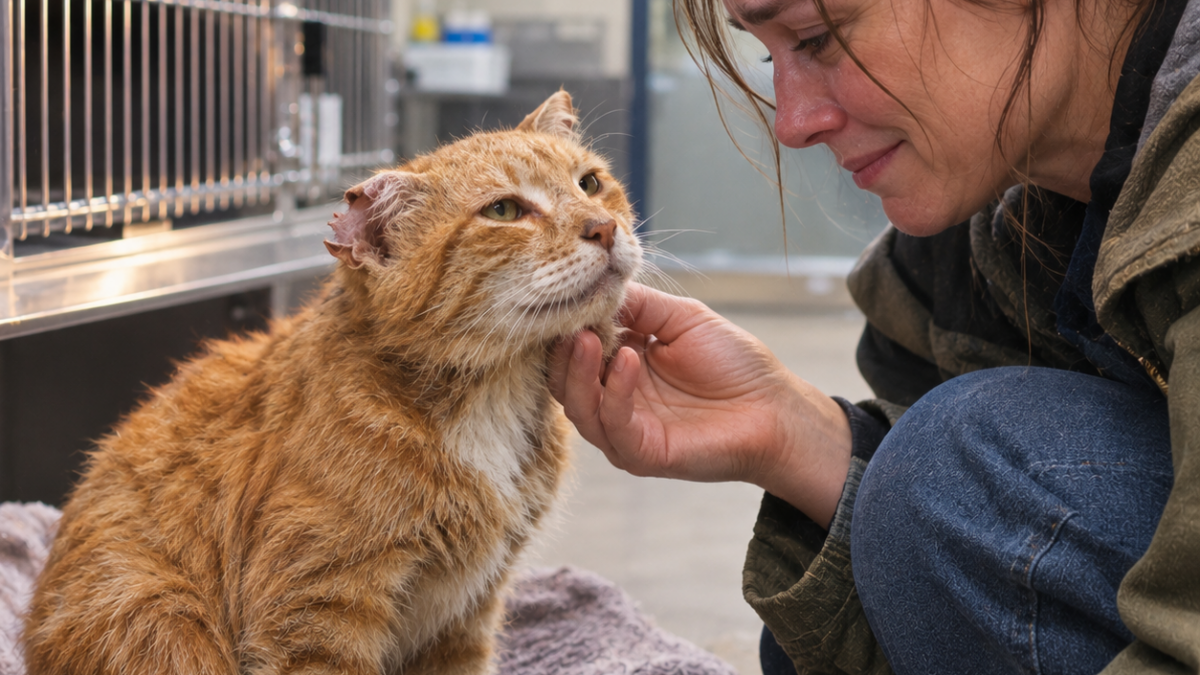
They Returned an Old Cat Because He Was “Too Old”—Then He Put One Paw on My Shoe and I Promised He’d Never Be Left Behind Again.
Oli had spent seventeen years believing one woman was his home, and it took her less than a minute to tell the shelter he was no longer really her cat.
He never hissed, fought, or begged when she walked away—he simply kept staring at the door, waiting for the voice he loved to come back and correct the cruelest sentence he had ever heard.
I had gone there determined to leave with nothing, but when that old orange cat finally put one trembling paw on my shoe, I realized the person being tested in that room was not him.
The day I met Oli, I was not looking for a cat.
I need to make that clear because people always want stories like this to have destiny in them.
They want me to say I woke that morning with a feeling.
That something pulled me toward the shelter.
That I saw a sign.
That I knew before I opened the door that my life was about to change.
None of that happened.
I had a bag of canned cat food in the trunk of my car.
That was the whole reason I went.
The food had belonged to my neighbor, Mrs. Alvarez, whose little tortoiseshell cat had died two weeks earlier. She could not bring herself to throw the cans away, and when she found out I sometimes donated blankets and supplies to the county shelter, she handed me the bag.
“Give these to somebody who needs them,” she said.
That was all.
I planned to drop the food at the front desk, sign whatever donation form they wanted, and drive home.
My apartment was quiet.
My life was quiet.
I had worked hard to make peace with that.
At least that was what I told people.
The truth was less flattering.
I had not made peace with quiet.
I had organized it.
There is a difference.
I was forty-nine years old and had spent the previous three years building a life in which very little could surprise me.
I woke at 6:15.
Coffee at 6:20.
Shower.
Work.
Grocery store on Thursdays.
Laundry Saturday morning.
Dinner usually something I could cook in one pan.
I owned exactly four sets of sheets because four seemed manageable.
I kept my keys in the same ceramic dish every night.
I paid bills the day they arrived.
My calendar was color-coded.
Nobody depended on me.
I depended on nobody.
That had not always been true.
My mother had needed me for almost eight years.
First it was little things.
Driving her to appointments.
Changing lightbulbs.
Sorting medication.
Then came the larger things.
Bathing.
Lifting.
Hospital stays.
Emergency-room calls at midnight.
Dementia.
A broken hip.
The slow humiliation of watching a woman who had once run an entire household forget what a spoon was for.
I loved my mother.
I also became exhausted in ways I was ashamed to admit.
When she died, people told me I would miss taking care of her.
I did.
PART2:
I also slept for twelve straight hours the night after her funeral.
That guilt stayed with me longer than grief did.
So I built a careful life.
No obligations I could not predict.
No pets.
No needy houseplants.
No relationships that came with complicated families.
No promises that could turn into hospital bracelets.
I knew that sounded cold.
It did not feel cold from the inside.
It felt safe.
That was why I did not want a cat.
Not a kitten.
Not an old cat.
Not anything whose breathing I might one day count in the dark.
I carried Mrs. Alvarez’s bag of food into the shelter just after four on a Tuesday afternoon.
The building was small and tired.
Not dirty.
Just worn in the way places become worn when they survive on donations and overworked people.
The parking lot had two potholes big enough to deserve names.
A handmade sign near the entrance said DONATIONS WELCOME in blue marker.
Inside, the air smelled like disinfectant, paper towels, animal fur, and something faintly medicinal.
A young man at the front desk was talking on the phone.
He held up one finger.
I waited.
PART3:
Behind him, a dog barked twice.
Another answered.
Then another.
The young man covered the phone.
“Donation?”
I lifted the bag.
“Cat food.”
“You can leave it by the wall.”
I did.
That should have been the end.
Then I heard a woman in the hallway.
“No, that’s not really my cat anymore.”
The sentence was delivered without anger.
That was what bothered me.
If she had sounded cruel, maybe I could have dismissed her.
If she had shouted, complained, insulted the animal, I could have placed her neatly into a category.
Bad person.
Problem solved.
But she sounded tired.
Distracted.
Almost embarrassed.
Like she was explaining why an old appliance could not be returned to the store.
Another woman answered.
Her voice was gentle.
“Mrs. Dalton, I just need to be completely certain you understand what surrender means.”
“I understand.”
“Once you sign, he legally becomes the shelter’s responsibility.”
“Yes.”
“And we cannot promise—”
“I know.”
A pause.
Then the first woman said, “He’s too old.”
Something in me tightened.
The second woman spoke more carefully.
“He is seventeen.”
“He’s not like he used to be.”
That sentence stopped me.
Not like he used to be.
I had heard those words before.
Different rooms.
Different voices.
Doctors had said things like that about my mother.
Friends had said it.
People at church had whispered it when they thought I could not hear.
She’s not really herself anymore.
She’s changed.
She used to be so sharp.
I used to hate those sentences.
As if the person my mother had become was less legitimate than the person she used to be.
As if decline canceled identity.
As if slower meant less.
The woman in the hallway continued.
“He wakes me up. He cries at night. He has accidents sometimes.”
“We can help you with some of that.”
“I’ve tried.”
“Has the veterinarian checked him recently?”
“I can’t keep doing vet bills.”
“I understand.”
“No, I don’t think you do.”
Her voice sharpened slightly.
“I have a job. I have a grandson staying with me. My husband is gone. I can’t rearrange my whole life around a cat who can’t even jump onto the couch anymore.”
The shelter worker was silent.
Then she asked, “How long have you had him?”
Another pause.
“Seventeen years.”
I closed my eyes.
Seventeen years.
I do not know what I expected after hearing that.
Maybe anger.
Maybe disbelief.
Instead, I felt something much worse.
Recognition.
Seventeen years meant this woman had known him as a kitten.
Had watched him grow.
Had fed him thousands of meals.
Had probably complained about hair on furniture.
Taken pictures.
Bought toys.
Said his name in empty rooms.
Maybe he had slept beside her through illnesses and arguments and deaths and ordinary Tuesdays.
Seventeen years is not ownership.
It is history.
The young man at the front desk finished his call.
“Sorry about that.”
I was still looking toward the hallway.
“Is everything okay?”
He followed my eyes.
His expression changed.
“Owner surrender.”
I nodded.
I should have left.
Instead, I asked, “Can I use the restroom?”
“Down the hall. Second door.”
I was not going to the restroom.
I told myself I was just curious.
Curiosity has caused plenty of damage in my life.
The hallway opened into three small exam rooms.
One door stood partly open.
Inside, an orange cat sat on a folded towel in the back corner.
That was Oli.
I did not know his name yet.
The first thing I noticed was how small he looked.
Old cats often seem to shrink.
Not because they become physically tiny, although sometimes they do.
They shrink inside their own bodies.
Oli’s orange coat had faded into a dusty color.
The fur around his cheeks was thin.
His spine made a gentle ridge beneath his coat.
One ear had a notch near the tip.
His hips showed when he shifted.
There was a shaved patch on one front leg from recent bloodwork.
He had pale green eyes.
Beautiful eyes.
Tired eyes.
He sat with his paws folded beneath him.
Not crying.
Not trying to escape.
Just watching the doorway.
I stood there.
A shelter worker came around the corner.
She was maybe fifty-five, with dark hair turning silver and reading glasses hanging from a cord around her neck.
She saw me looking.
“That’s Oliver.”
“Oli?”
“That’s what his owner calls him.”
Owner.
Present tense.
For another few minutes, at least.
“What happened?”
She gave me the professional answer first.
“Senior surrender.”
I looked at her.
She sighed.
“I’m Denise.”
“Claire.”
“Are you interested in adopting?”
“No.”
The answer came too quickly.
Denise smiled slightly.
“Okay.”
“I’m serious.”
“I believe you.”
“I only brought food.”
“Still believing you.”
I looked back at Oli.
“How old?”
“Seventeen.”
“I heard.”
Denise’s expression changed.
“You heard that?”
“Some.”
She leaned against the wall.
“He has early kidney disease. Arthritis. Needs dental work. Probably some mild cognitive changes.”
“What does that mean?”
“He gets confused sometimes. Especially at night.”
“That’s why he cries?”
“Could be.”
I looked at him.
“Is he in pain?”
“Some. His joints. Possibly his mouth.”
“Can it be treated?”
“Managed.”
That word.
Managed.
A word people use when they cannot promise cure.
“Why didn’t she manage it?”
Denise looked at me carefully.
“People have limits.”
“She had him seventeen years.”
“Yes.”
“And now she has limits?”
“I’m not defending her.”
“It sounds like it.”
“I’m explaining that if I spend my time hating everyone who surrenders an animal, I won’t have anything left for the animal.”
That shut me up.
Denise nodded toward Oli.
“He needs calm right now.”
I lowered my voice.
“Sorry.”
“You’re allowed to be angry.”
“I’m not angry.”
“You look angry.”
“I’m judgmental.”
“That too.”
Despite myself, I smiled.
Then I heard footsteps.
The woman entered.
She was in her early sixties.
Brown coat.
Short gray hair.
Expensive handbag.
She held a cat carrier in one hand.
She looked ordinary.
That disturbed me too.
Cruelty is easier when it has a face you expect.
She put the carrier against the wall.
Oli lifted his head.
I watched his whole body change.
His ears came forward.
His eyes widened slightly.
His front paws unfolded.
He knew her.
Of course he knew her.
Seventeen years.
He shifted forward.
The movement was slow because his hips hurt.
For one terrible second, I thought he would try to walk to her.
The woman looked at him.
Not long.
Maybe one second.
Then looked away.
Denise said, “Mrs. Dalton, if you want a minute with him—”
“No.”
Oli stood.
His back legs trembled.
“Are you sure?”
The woman’s jaw tightened.
“I can’t do this again.”
Again.
I did not know what that meant.
Maybe she had already cried in the car.
Maybe she had almost changed her mind.
Maybe she had been carrying guilt for weeks.
I did not know.
Oli took one step.
Mrs. Dalton noticed.
Her face changed.
Something flickered across it.
Pain, maybe.
Then she turned.
Oli stopped.
The door closed behind her.
He remained standing for several seconds.
Then slowly lowered himself back onto the towel.
He stared at the door.
The room felt smaller.
Meaner.
Denise exhaled.
“She signed?”
Another worker nodded from the hall.
“Yes.”
“Okay.”
Denise looked at me.
“You don’t have to stay.”
I knew.
I stayed.
I crouched a few feet from Oli.
My knees complained immediately.
“Hey, buddy.”
No response.
His eyes remained fixed on the doorway.
I waited.
The vent hummed overhead.
A phone rang somewhere near reception.
A dog barked.
Oli kept staring.
There was something unbearable about how gentle he remained.
No hissing.
No scratching.
No rage.
He had just watched seventeen years walk out a door.
Still, he sat quietly.
Maybe that was what broke through all the defenses I had spent three years building.
Not abandonment.
Not age.
Gentleness.
I knew what it felt like to be valued for a version of yourself that no longer existed.
My mother had known it more deeply.
When she was younger, she was funny.
Sharp.
Independent.
The woman who could stretch fifty dollars through an entire week and still bring soup to a neighbor.
Near the end, she could not recognize me every day.
Some people stopped visiting.
They said it was too hard.
They said, “She doesn’t know I’m there anyway.”
I understood why.
I also hated it.
She was still there.
Different.
But there.
Oli was still there.
Old.
Thin.
Confused sometimes.
But there.
Life in this country can be ruthless about decline.
Everything has to be faster.
Newer.
Efficient.
Upgrade the phone.
Trade the car.
Remodel the kitchen.
Replace the appliance instead of repairing it.
We use words like outdated and obsolete and high-maintenance until we forget those words do not belong on living things.
I put my hand on the floor.
Oli glanced at it.
Then back at the door.
“That bad, huh?”
One slow blink.
I remained there.
Five minutes.
Ten.
Maybe fifteen.
My feet went numb.
Denise walked past once.
She did not disturb us.
Finally, Oli stood.
His legs trembled.
He took one step.
Stopped.
I did not move.
Another step.
His claws clicked softly against the linoleum.
He came close enough to sniff my shoe.
I held my breath.
Then he lifted one front paw.
Placed it on the toe of my sneaker.
That was all.
People have asked me since then if he chose me.
I do not know.
Maybe my shoe smelled interesting.
Maybe his balance shifted.
Maybe he was simply tired and used me as furniture.
I do not need magic to make the moment matter.
That old cat rested one paw on my shoe.
And something inside me opened.
I nearly cried.
Instead, I whispered, “Well, that’s not fair.”
Oli looked up.
His paw remained there.
I thought about money.
Kidney disease.
Dental surgery.
Medication.
Vet appointments.
Litter accidents.
Night crying.
The grief of loving an animal already near the end of his life.
Mostly, I thought about the end.
I knew exactly what attachment cost.
That was why I had stopped buying it.
Denise returned.
“You okay?”
“No.”
“That’s usually how it starts.”
“I am not adopting this cat.”
“Okay.”
“How expensive is kidney disease?”
Denise smiled.
I pointed at her.
“Do not do that.”
“Do what?”
“That face.”
“What face?”
“The I-know-how-this-ends face.”
She became serious.
“Claire, you don’t owe him anything.”
I looked at Oli.
He still had one paw on my shoe.
“That was an unfortunate sentence.”
Denise crouched beside me.
“Listen to me.”
I did.
“He is seventeen.”
“I know.”
“He may have months. He may have years. We don’t know.”
“I know.”
“His medical care will cost money.”
“I know.”
“He may pee outside the box.”
“I know.”
“He may wake you up.”
“I know.”
“You said you don’t want a cat.”
“I do not.”
“Then don’t take him because you feel sorry for him.”
That bothered me.
“Why?”
“Pity is useful for five minutes.”
She nodded toward Oli.
“He needs commitment.”
I looked at her.
That sentence stayed with me.
He needs commitment.
Not rescue.
Not emotion.
Not a heroic impulse.
Commitment.
The boring part.
Morning medicine.
Cleaning litter.
Paying bills.
Driving to appointments.
Changing plans.
Showing up after the emotional moment has passed.
My entire body resisted.
Then Oli slowly removed his paw.
He turned.
Walked back toward the towel.
He looked even smaller than before.
I remembered sitting beside my mother’s hospital bed three weeks before she died.
She had been confused that day.
She kept asking where my father was.
He had been dead twelve years.
Eventually she looked at me and asked, “Are you leaving too?”
“No.”
“Promise?”
“Yes.”
I stayed six hours longer than planned.
I missed dinner.
Canceled an appointment.
Drove home after midnight.
At the time, I had resented it.
That memory had made me ashamed for years.
Standing in that shelter room, I understood something I had refused to understand.
Love does not become false because it tires you.
Commitment does not mean you never feel burdened.
It means the burden is not the only thing you see.
I stood.
Denise waited.
I said, “What paperwork?”
She smiled.
I pointed again.
“Not one word.”
“Wasn’t going to say anything.”
“You’re enjoying this.”
“A little.”
“Terrible person.”
“Probably.”
The adoption could not happen immediately.
Oli needed a full medical evaluation because of his age and recent surrender.
That gave me forty-eight hours to change my mind.
I almost did.
That first night, I sat in my apartment with my laptop.
Senior cat kidney disease.
I searched.
Then arthritis.
Then feline cognitive dysfunction.
Then dental surgery risks for elderly cats.
Then average lifespan of orange tabby.
Then I closed the computer because the internet had successfully convinced me Oli was either going to live three more years or die before breakfast.
At 10:40, I called Denise.
She answered.
“Everything okay?”
“Can I change my mind?”
“Yes.”
I was silent.
She waited.
“What happens to him?”
“We keep looking for a home.”
“What are the odds?”
“I’m not going to manipulate you.”
“I asked.”
“Not great.”
I closed my eyes.
“How is he?”
“He ate a little.”
“Still watching the door?”
Silence.
“Yes.”
That hurt.
“I hate you.”
“I know.”
“I’ll be there Thursday.”
“Okay.”
I hung up.
Thursday afternoon, I brought Oli home.
The shelter veterinarian had examined him.
Stage-two chronic kidney disease.
Arthritis in both hips.
Significant dental disease.
Mild anemia.
Some hearing loss.
Possible early cognitive dysfunction.
The report was two pages.
I read it three times.
At the bottom, someone had written:
Quality of life currently fair to good with appropriate supportive care.
Fair to good.
I hated how much hope I could squeeze out of four words.
Denise helped place the carrier in my car.
“You have my number.”
“I know.”
“First few days, keep things quiet.”
“They’re always quiet.”
“Give him one room.”
“I prepared the bedroom.”
“Low-sided litter box?”
“Yes.”
“Water in multiple places?”
“Yes.”
“Food?”
“Yes.”
“Steps for the bed?”
“Yes.”
Denise looked at me.
“You bought steps?”
“They were on sale.”
“You’ve known him forty-eight hours.”
“Do you want me to return them?”
“No.”
She smiled.
“Go home.”
The drive took twenty minutes.
Oli did not make a sound.
At home, I carried the carrier into my bedroom.
Opened the door.
Then backed away.
He remained inside for seven minutes.
I know because I timed it.
At minute eight, one orange paw appeared.
Then his head.
He sniffed.
Stepped out.
His hips wobbled slightly.
He examined the litter box.
Water.
Food.
The folded blankets I had placed beside the bed.
Then he walked to the bedroom door and looked down the hallway.
“You can.”
He glanced at me.
“You live here.”
The sentence felt strange.
I had not told anything it lived with me in years.
Oli explored the apartment at the speed of continental drift.
Living room.
Kitchen.
Bathroom.
Back to living room.
He stopped beside the couch.
Looked up.
Prepared to jump.
I panicked.
“No.”
He ignored me.
His back legs pushed.
He made it halfway.
Then slid.
I caught him.
He stiffened violently in my arms.
“Okay.”
I lowered him.
“I’m sorry.”
His eyes were wide.
I sat on the floor.
For one second, I thought I had ruined everything.
Then he walked away.
I ordered another set of pet steps.
By midnight, my minimalist apartment had begun to resemble an assisted-living facility for one elderly cat.
That first night, Oli slept on the blankets.
I slept badly.
At 2:13, I heard him cry.
A strange, low sound.
I turned on the lamp.
Oli stood in the hallway.
“Hey.”
He cried again.
I got up.
He looked around as if he had forgotten where he was.
The veterinarian had warned me.
Disorientation.
I crouched.
“It’s okay.”
Oli stared.
Then slowly came toward me.
I picked him up.
This time he did not stiffen as much.
I placed him on the bed.
He stood near my feet.
Turned once.
Lay down.
I stared at the ceiling.
“Well.”
Oli began purring.
Very faintly.
I had forgotten what a cat purring in the dark sounded like.
It filled the room without making it noisy.
The next morning, I woke with him pressed against my calf.
I did not move for twenty minutes because I did not want to wake him.
That destroyed my schedule.
Coffee at 6:40.
Shower at 7:02.
I left for work eleven minutes late.
Nobody died.
That was lesson number one.
My life could bend.
The first weeks were difficult.
I wish people told rescue stories honestly about that part.
Love did not solve kidney disease.
Oli disliked the prescription food.
He hated liquid medication.
He urinated beside the litter box twice.
He vomited on my rug.
At 3:00 one morning, he walked into the bathroom and screamed at the bathtub.
I stood there in pajamas.
“What did it do?”
Oli stared at the tub.
I looked at it.
“It does look suspicious.”
Eventually he followed me back to bed.
Some nights he slept six hours.
Other nights he woke confused.
I put small night-lights around the apartment.
That helped.
I bought washable pads.
A heated bed.
Elevated food bowls.
A water fountain he ignored for two weeks and then suddenly decided was the only acceptable source of hydration.
I learned to warm his food.
Not hot.
Just warm enough to release the smell.
His appetite improved.
His arthritis medication helped.
Three weeks after adoption, he attempted to run from the kitchen to the living room.
It was less a run than an aggressive shuffle.
I applauded.
He looked offended.
Slowly, Oli’s personality emerged from underneath fear.
He was demanding.
That surprised me.
At the shelter, he had seemed almost invisible.
At home, he discovered opinions.
Breakfast should occur at 5:52.
Prescription food became acceptable only if warmed for exactly a few seconds.
The blue blanket was better than the gray blanket.
He disliked closed doors.
He hated my vacuum cleaner with the intensity of an ancient blood feud.
He enjoyed television if birds were on-screen.
He loved rotisserie chicken more than life itself.
And he followed me everywhere.
Kitchen.
Bathroom.
Closet.
If I sat on the couch, Oli came.
If I stood, he stood.
If I showered, he waited outside the bathroom.
At first, I worried it was anxiety.
The vet said some of it probably was.
Then she smiled.
“Some of it is probably because he likes you.”
That embarrassed me more than it should have.
“He has poor judgment.”
“Clearly.”
“Can cats transfer attachment that fast?”
“They can form new attachments.”
“Does he miss her?”
The vet did not pretend.
“Probably.”
That hurt.
“Can he love me and still miss her?”
She looked at me like I had asked something much larger than a veterinary question.
“Yes.”
Of course he could.
Humans do that too.
The first time Oli voluntarily climbed onto my lap happened during week five.
I was reading.
He stood beside the couch.
Looked at the steps.
Looked at me.
Climbed.
Walked across my legs.
Turned three times.
Lowered himself.
I stopped breathing.
His body was lighter than it should have been.
Warm.
Fragile.
Real.
He placed his head against my stomach.
Then sighed.
An actual sigh.
I put the book down.
My hand hovered above him.
I had become afraid of touching good things too firmly.
Finally, I stroked his back.
Oli began purring.
That was when I cried.
Quietly.
Not because I was sad.
Not exactly.
I cried because trust from an old animal feels different.
A kitten trusts because the world has not taught it enough reasons not to.
An old animal has evidence.
Oli knew doors could close.
He knew arms could put him into a carrier and take him somewhere unfamiliar.
He knew the voice he had heard for seventeen years could disappear down a hallway.
Still, he climbed onto me.
That is courage.
A month later, I learned the part of his history that changed how I saw his former owner.
Denise called.
“Do you have a minute?”
My stomach dropped.
Whenever someone asks that after you adopt a seventeen-year-old cat, you assume death has somehow found a new administrative route.
“What?”
“Oli’s previous veterinarian sent records.”
“Okay.”
“There are a lot.”
“How many?”
“Seventeen years.”
Of course.
I went to the shelter after work.
Denise had printed the summary.
Oli had been adopted as a kitten from a barn litter.
His original name had been Oliver.
He had lived with Mrs. Dalton, whose first name was Barbara, from eight weeks old.
Vaccinations every year.
Dental cleaning at eight.
Urinary infection at ten.
Arthritis noted at fourteen.
Kidney disease beginning at sixteen.
The records were ordinary until they were not.
At fifteen, Oli had been brought in for appetite loss.
The veterinarian’s note said:
Owner reports husband recently deceased. Cat sleeping on deceased spouse’s side of bed. Increased vocalization.
I stopped reading.
Barbara’s husband had died.
Another note six months later:
Owner struggling with medication administration. Discussed quality of life and supportive options. Owner tearful.
Then:
Owner reports grandson moved into home following daughter’s substance-treatment admission.
Another:
Financial limitations discussed.
Another:
Client declined dental procedure due to cost.
Another:
Client reports feeling overwhelmed.
I sat in the shelter office with the papers in my hand.
My anger became less comfortable.
Denise watched me.
“She wasn’t just throwing away an old cat.”
“No.”
“Still surrendered him.”
“Yes.”
“But.”
“But people are complicated.”
I remembered the way Barbara had said, I can’t do this again.
Again.
Maybe her husband had been ill before he died.
Maybe caregiving had already hollowed her out.
Maybe her daughter was struggling.
Maybe her grandson needed her.
Maybe Oli’s decline arrived in the middle of all of it.
I hated that understanding her made the story less clean.
Clean stories are easier.
Good person.
Bad person.
Victim.
Hero.
Life rarely cooperates.
“She should have looked at him,” I said.
Denise did not argue.
“At the end.”
“I know.”
“He stood up.”
“I saw.”
“She should have touched him.”
“Yes.”
That was the part I could not excuse.
Limits are real.
Money is real.
Caregiver exhaustion is real.
But seventeen years deserved a goodbye.
I carried that resentment for months.
Then Barbara came back.
It was a Saturday adoption event.
I had begun volunteering at the shelter twice a month.
Mostly because Denise claimed she needed help.
Mostly because I discovered I liked being useful somewhere that could not follow me home.
That was a lie.
Three foster cats eventually followed me home temporarily.
But that came later.
I was changing bedding in the cat room when Denise appeared.
Her expression told me immediately.
“What?”
“Barbara Dalton is here.”
I froze.
“Why?”
“She wants to know how Oli is.”
My entire body tightened.
“No.”
“Claire.”
“No.”
“She’s not asking to take him.”
“Good.”
“She asked if she could see a picture.”
“No.”
Denise studied me.
“You don’t own his history.”
That made me furious because it was true.
“He belongs to me.”
“Yes.”
“He is safe.”
“Yes.”
“She left him.”
“Yes.”
“And now she wants to feel better.”
“Maybe.”
“No.”
Denise crossed her arms.
“You don’t have to meet her.”
“I don’t.”
“You don’t have to give her anything.”
“Good.”
“But I think you should know she’s been sitting in her car for forty minutes.”
I hated Denise.
I really did.
I walked to the reception area.
Barbara Dalton sat near the door.
Same short gray hair.
Different coat.
She looked smaller than I remembered.
When she saw me, she stood.
“You’re the woman who was there.”
“Yes.”
Her eyes dropped.
“You took Oliver?”
“Oli.”
“I called him both.”
I did not respond.
“How is he?”
“Alive.”
The word came out sharper than intended.
Barbara flinched.
“I deserved that.”
I expected defensiveness.
That would have been easier.
She sat back down.
“I know you probably think I’m awful.”
I remained standing.
“You want me to tell you I don’t?”
“No.”
That surprised me.
She twisted a tissue in her hands.
“I just wanted to know if he was all right.”
“He has kidney disease.”
“I know.”
“Arthritis.”
“I know.”
“He needed dental work.”
Her eyes closed briefly.
“I know.”
“I paid for it.”
“I’m glad.”
“Are you?”
Barbara looked at me.
“Yes.”
Her eyes were wet.
“He stopped sleeping with me after my husband died.”
That was not what I expected.
“What?”
“He slept on Frank’s side.”
She looked down.
“Every night.”
I thought of Oli sleeping against my leg.
Barbara continued.
“My husband had lung cancer for two years.”
There it was.
Again.
“I took care of him at home. Toward the end, Oli barely left the bedroom.”
She smiled faintly.
“Frank pretended he hated that cat.”
I almost laughed.
“He doesn’t seem believable.”
“He wasn’t.”
Barbara wiped her eyes.
“After Frank died, Oli started crying at night.”
“Because he was old.”
“I know that now.”
“You knew then.”
She nodded.
“Yes.”
That honesty took some of the fight out of me.
“My daughter relapsed,” she continued.
“My grandson came to live with me. He was nine. Then I lost my job.”
She laughed bitterly.
“Apparently sixty-two is an excellent age to discover your employer has decided to restructure.”
I sat down.
Not close.
But down.
Barbara looked toward the cat room.
“Oli started missing the box. Then the vet said his teeth were bad. Kidney food. Blood tests. Medication. I would wake up and hear him crying, and all I could think was Frank dying in the bedroom.”
Her voice broke.
“I started resenting him.”
That confession was ugly.
Real.
“I hated myself for it.”
I said nothing.
“One night, he cried for two hours. I yelled at him.”
Her face crumpled.
“I had never yelled at that cat in seventeen years.”
I looked at her.
“He hid under the table.”
She began crying.
“My grandson came out and asked why I was mad at Oli.”
She pressed the tissue to her mouth.
“I realized I was becoming someone I didn’t recognize.”
“Then you brought him here.”
“Yes.”
“You told them he wasn’t really your cat anymore.”
Barbara closed her eyes.
“I know.”
“Why?”
“Because if I said he was still mine, I was going to take him home.”
The anger inside me shifted.
Not disappeared.
Shifted.
“So you said something cruel enough to make yourself leave.”
She nodded.
“I thought if I made him less important, I could do it.”
“That didn’t make him less important.”
“No.”
“He heard you.”
“I know.”
“You didn’t look at him.”
“I couldn’t.”
“That was cowardly.”
“Yes.”
No defense.
No anger.
Just yes.
I hated that too.
She whispered, “Did he wait by the door?”
My throat tightened.
I did not answer.
She knew.
Barbara cried silently.
Eventually she asked, “Does he seem happy?”
I pulled out my phone.
I had hundreds of pictures.
Of course I did.
Oli sleeping in sunlight.
Oli wrapped in a blanket.
Oli glaring at his medication.
Oli beside the water fountain.
Oli asleep against my leg.
I hesitated.
Then showed her one.
Barbara touched the screen with one finger but did not take the phone.
“He always liked sun.”
“Yes.”
“His left ear gets cold first.”
I looked at her.
“What?”
“In winter.”
She smiled through tears.
“Frank used to rub it.”
I had noticed the ear.
I had not known.
Barbara looked at the picture again.
“Thank you.”
I almost said, You don’t get to thank me.
Instead I said nothing.
Then she asked the question I had been afraid of.
“Can I see him?”
“No.”
Immediate.
Barbara nodded.
“Okay.”
“You surrendered him.”
“I know.”
“I don’t want to confuse him.”
“I understand.”
“He has routines.”
“Good.”
“He follows me.”
Barbara smiled.
“He always did that.”
Something strange happened then.
For the first time, I saw Oli as more than the old cat who had been abandoned.
He had seventeen years I knew almost nothing about.
A kitten chasing shoelaces.
A young cat climbing curtains.
A middle-aged cat sleeping beside a sick man.
A companion in a grieving house.
Barbara had failed him at the end.
That did not erase everything before it.
People want love to be pure.
It rarely is.
Sometimes people love deeply and still fail.
Sometimes they fail because they are weak.
Sometimes because they are exhausted.
Sometimes because they are selfish.
Sometimes all three.
Barbara stood.
“I won’t come back.”
I surprised myself.
“You can ask Denise how he is.”
She looked at me.
“Are you sure?”
“I said ask.”
A small smile.
“Thank you.”
I pointed at her.
“Don’t make me regret this.”
“I won’t.”
She left.
I sat there for a long time.
Denise came out.
“How’d it go?”
“I hate nuance.”
She laughed.
“I know.”
“Life would be easier if terrible people wore signs.”
“Usually they’re too busy being normal.”
I looked toward the hallway.
“I still think what she did was wrong.”
“You can.”
“I also understand it.”
“You can do that too.”
“Very annoying.”
“Growing as a person usually is.”
“Go clean something.”
Months passed.
Oli became stronger.
Not younger.
That distinction mattered.
His kidney disease remained.
His hips remained stiff.
His hearing got slightly worse.
But he gained nearly a pound.
His coat improved.
The dental procedure removed five painful teeth.
Afterward, his appetite exploded.
The veterinarian laughed.
“He probably hasn’t eaten without pain in a long time.”
I felt sick.
Then happy.
Then angry.
Then grateful.
Old-animal love contains several emotions at once.
Oli began greeting me at the apartment door.
Not every day.
Most days.
I would hear his slow steps.
Then he appeared around the corner.
His tail rose.
Not straight.
A little crooked.
The first time he did it, I sat on the floor beside the door and cried into his fur.
He tolerated this with dignity.
My life stopped being neat.
I bought a washable rug because he had an accident.
Then another.
I kept medication in the refrigerator.
My work schedule changed so I could take him for blood tests.
I canceled dinner once because he had diarrhea.
I spent $312 at an emergency vet because he sneezed strangely, only to be told he had inhaled dust.
My sister laughed so hard on the phone she had to put me on speaker for her husband.
“You spent three hundred dollars on a sneeze?”
“It was a suspicious sneeze.”
“What does that mean?”
“You weren’t there.”
“Claire.”
“He’s old.”
“So are you.”
“I’m hanging up.”
Oli changed my apartment.
Then he changed me.
I started talking out loud.
Not because I was lonely.
Because he listened.
Or appeared to.
“Terrible meeting today.”
Oli blinked.
“Exactly.”
“I think Kevin is incompetent.”
Oli yawned.
“You’re right. Not worth discussing.”
I bought a small chair for the window because he liked watching birds.
Then a heated pad.
Then a blanket because the heated pad looked uncomfortable.
At some point, I realized I had become the sort of woman who referred to a corner of the living room as “Oli’s area.”
I resisted this for several minutes.
Then accepted it.
He slept beside my leg every night.
Not at first.
At first, the foot of the bed.
Then closer.
Then one morning I woke and discovered his face resting against my calf.
After that, he rarely slept anywhere else.
It occurred to me that he might be making up for lost time.
Maybe I was too.
There was one thing I had not expected.
Caring for Oli reopened the part of my life I had sealed after my mother died.
I had thought caregiving itself had damaged me.
It had not.
Helplessness had.
Watching someone decline and believing I was responsible for preventing the impossible.
With Oli, I learned another way.
The vet never promised cure.
She taught me comfort.
Hydration.
Pain management.
Nutrition.
Warmth.
Observation.
Good days.
Bad days.
She taught me that care was not always a war against death.
Sometimes care was simply making today gentle.
That lesson changed the way I remembered my mother.
For years, I had replayed all my failures.
The time I lost patience while changing her clothes.
The night I complained to my sister that I could not do it anymore.
The morning I sat in my car for ten minutes before going into the nursing facility because I did not want to see another decline.
I had treated those moments as proof that I had failed her.
Oli taught me something I wish somebody had told me then.
Love can be tired.
Love can be frustrated.
Love can need help.
Love can even wish the responsibility would end.
That does not mean the love itself is gone.
The danger comes when exhaustion convinces you the living thing in front of you has become only a burden.
Barbara had reached that edge.
Then crossed it.
I understood her.
I also understood why I had been so angry.
It was not only about Oli.
I had been angry at every person who had stopped visiting my mother because she was no longer easy company.
At every doctor who spoke about her while she sat in the room.
At every stranger who called her “sweetie” like age had turned her into a child.
At myself for sometimes wanting one day where nobody needed me.
Oli carried all of that into my apartment without knowing it.
Then he lay in the sunlight and asked for lunch.
Animals are useful that way.
They drag you back into the present.
About eight months after I adopted him, Oli became ill.
Not dramatically at first.
He skipped breakfast.
That was enough for me.
By then, I knew every variation of his appetite.
He sniffed the food.
Turned away.
I warmed it.
Nothing.
Chicken.
Nothing.
His favorite treat.
Nothing.
“Okay.”
I called the vet.
Bloodwork showed his kidney values had worsened.
He was dehydrated.
He spent the day receiving fluids.
I sat in the waiting room with my heart beating too hard.
The vet came in.
“We can stabilize this.”
The word can nearly made me collapse with relief.
“But?”
She sat beside me.
“But this is progressive.”
“I know.”
“We should talk about what your goals are.”
“My goal is for him not to die.”
“I know.”
“I realize that’s not medically useful.”
“No.”
She smiled gently.
“It’s emotionally accurate.”
I looked at my hands.
“How do I know when I’m keeping him alive for me?”
That was the question.
The one every person loving an old animal eventually fears.
The vet answered carefully.
“We look at comfort. Appetite. Hydration. Mobility. Interest. Connection. More good days than bad.”
“He still follows me.”
“Good.”
“He sleeps with me.”
“Good.”
“He yells about chicken.”
“Very good.”
“He hates his medicine.”
“Excellent.”
I laughed despite myself.
“Why excellent?”
“An opinion is often a good sign.”
Oli came home that evening.
Subcutaneous fluids became part of our routine.
The first time, I thought I would faint.
A needle beneath his skin.
A bag hanging from a cabinet.
Oli sitting on a towel while fluid formed a small pouch beneath his shoulders.
“I’m sorry.”
He looked offended.
“I know.”
Treat.
Forgiveness.
Routine.
Barbara heard through Denise that Oli had declined.
She sent a card.
Not to me.
To the shelter.
Denise passed it along.
Inside was a photograph.
Oli as a kitten.
Bright orange.
Huge ears.
Sitting on a man’s shoulder.
Barbara had written:
This was his first Christmas. Frank said we were not keeping him. That lasted three days.
I stared at the photo for an hour.
Then I put it beside Oli’s bed.
That night I looked at the old cat sleeping under the blanket and tried to see the kitten.
He was still there.
Not visually.
But time does not replace us with new people.
It accumulates.
Oli was the kitten.
The young cat.
The companion beside a dying man.
The confused senior.
The abandoned animal in an exam room.
The cat on my bed.
All of him counted.
A week later, I wrote Barbara a short note.
He still loves warm chicken.
He still sleeps on the right side.
His left ear does get cold first.
I did not sign anything else.
I gave it to Denise.
Barbara replied a month later.
Thank you for letting me know he is still himself.
That sentence made me angry all over again.
Then sad.
Because that had been the entire point.
He was still himself.
Old age had not transformed him into a lesser version.
He needed more.
He moved slower.
He sometimes forgot why he entered a room.
He had accidents.
He slept more.
He cost money.
He was still Oli.
My mother had still been my mother.
I was still me even after caregiving and grief had changed my shape.
Barbara was still the woman who had loved Oli for seventeen years and the woman who had abandoned him in the same lifetime.
Human beings are terrible at being only one thing.
Oli lived another year.
Then another.
Nobody expected that.
Especially not the shelter.
At nineteen, he became locally famous after Denise posted a picture of him for Senior Pet Month.
THE CAT WHO WAS “TOO OLD” JUST TURNED 19.
The post traveled farther than any of us expected.
Hundreds of comments.
People shared pictures of their twenty-year-old cats.
Seventeen-year-old dogs.
Three-legged animals.
Blind animals.
Old horses.
A woman wrote that she had adopted a fifteen-year-old beagle and only had him eleven months.
Best eleven months, she wrote.
That stayed with me.
Another person commented:
I could never adopt an old pet. Losing them too soon would break me.
I understood.
I had thought the same thing.
But the logic is backwards.
We do not reduce grief by refusing love.
We only guarantee the animal experiences one more rejection before death.
Not everyone can adopt a senior animal.
Money matters.
Time matters.
Health matters.
Circumstances matter.
But age alone?
Age is not a moral defect.
At nineteen, Oli’s world grew smaller.
He no longer cared about the kitchen unless food was involved.
He stopped jumping entirely.
The pet steps became ramps.
He slept twenty hours a day.
His hearing faded enough that I had to touch the bed gently before touching him or he startled.
But he still followed me some mornings.
Still pressed against my leg at night.
Still purred when I warmed his food.
Still sat in afternoon sunlight like he had personally negotiated peace with the universe.
One Tuesday in late October, I came home early.
Oli did not meet me.
I found him in his window bed.
Awake.
But different.
People who live with animals understand that word.
Different.
His breathing was too slow.
His eyes looked far away.
I sat beside him.
“Hey.”
His ear moved.
I called the vet.
They saw us immediately.
The drive felt endless.
I kept one hand on his carrier.
“You do not get left behind again.”
I had said that the first day.
Now the sentence hurt.
At the clinic, bloodwork confirmed what I already knew.
His kidneys were failing badly.
The veterinarian gave us options.
Hospitalization.
Aggressive fluids.
Medication.
Maybe days.
Maybe weeks.
No promise of comfort.
Or home hospice.
Comfort medication.
Fluids if tolerated.
Food if wanted.
Time.
I chose home.
That decision nearly destroyed me.
All the way back, I worried I was giving up.
Then I remembered Barbara.
Was I becoming her?
Was exhaustion turning into surrender?
At home, Oli stepped from the carrier.
Walked slowly toward the bedroom.
Climbed the ramp.
Lay on my bed.
His bed.
Our bed.
I sat beside him.
He put one paw on my leg.
The same gesture.
The exam-room floor came back to me.
A trembling old paw on my shoe.
The smallest question in the world.
Will you stay?
“Yes.”
I whispered.
“I’m staying.”
For five days, the world became very small.
Oli ate chicken from my hand.
Drank a little.
Slept.
Walked to the window once.
I carried him when his legs were weak.
My sister came over.
Mrs. Alvarez visited.
Denise stopped by after work and sat on the floor beside him.
Even Barbara asked through Denise if she could come.
That decision took me hours.
Finally, I said yes.
One condition.
“If Oli seems stressed, she leaves.”
Denise agreed.
Barbara arrived Saturday afternoon.
She stood in my apartment doorway.
For a moment, neither of us spoke.
Then she saw him.
Oli lay on the heated bed beside the window.
Barbara covered her mouth.
“He’s so thin.”
“He’s dying.”
She nodded.
Tears came immediately.
“Can I?”
I looked at Oli.
Then at her.
“Slowly.”
Barbara knelt several feet away.
“Oli.”
His ear moved.
Her face collapsed.
“Oliver.”
He lifted his head.
Not much.
But he did.
Barbara began crying.
“I’m sorry.”
I stood near the kitchen.
Every protective instinct in me screamed to stop this.
Then Oli did something.
He stood.
Barely.
Barbara held completely still.
He walked three steps.
Stopped.
Then another.
He reached her knee.
Sniffed.
Barbara extended one shaking hand.
Oli touched his nose to her fingers.
She sobbed.
“I’m sorry.”
Again.
“I’m so sorry.”
Oli rubbed his cheek once against her hand.
I had expected anger.
Jealousy.
Some primitive sense that he belonged to me now.
Instead I cried.
Because forgiveness looks different when the creature offering it does not understand pride.
Oli did not need Barbara to suffer enough.
He did not need an explanation.
He smelled someone who had once been home.
He remembered.
That was all.
Barbara sat on my floor for thirty minutes.
She told me stories.
Oli once stole an entire chicken breast from the counter.
Oli fell into a bathtub as a kitten and refused to enter the bathroom for six months.
Oli slept on Frank’s chest every morning after his cancer diagnosis.
Oli hated thunderstorms until he became hard of hearing.
Oli had once disappeared for two days and was found sleeping in the neighbor’s garage.
I wanted those stories.
That surprised me.
They gave him back parts of himself I had never known.
When Barbara left, she touched his head gently.
“Thank you for seventeen years.”
Then she looked at me.
“Thank you for the rest.”
I could not answer.
She left.
Oli slept for the remainder of the afternoon.
That night, he pressed against my leg.
The next morning, he would not eat.
Monday, he stopped drinking.
The veterinarian came to my apartment.
I had asked if that was possible weeks earlier.
I did not want Oli’s last experience to be another carrier.
Another exam room.
Another unfamiliar table.
He was on the blue blanket by the window.
Sunlight touched his back.
I sat on the floor.
His head rested in my lap.
The vet explained every step.
I barely heard her.
I kept one hand on Oli’s chest.
He was purring.
Very faintly.
I leaned down.
“You were never too old.”
My voice broke.
“Do you hear me?”
One ear moved.
“You were never too much.”
I cried into his fur.
“You were never inconvenient.”
That was not entirely true.
He had been inconvenient constantly.
That was the beautiful part.
Love is inconvenient.
Life is inconvenient.
Need is inconvenient.
That does not make any of them worthless.
I kissed the top of his head.
“You were still you.”
The veterinarian gave the first medication.
Oli relaxed.
His breathing slowed.
His head became heavy in my hand.
I whispered the same promise I had made almost two years earlier.
“You do not get left behind.”
Then, because the meaning had changed, I added:
“You can go.”
He died with his paw resting against my wrist.
For several minutes after, nobody moved.
The apartment was silent.
Not the old safe silence I had built before Oli.
Not peaceful either.
This was absence.
Real absence.
I had forgotten how physical it feels.
The veterinarian gave me time.
After she left with his body, I sat beside the empty blanket until dark.
At 5:52 the next morning, I woke automatically.
Breakfast time.
I reached for the lamp.
Then remembered.
That was the worst moment.
Not the death.
The routine without its purpose.
I walked into the kitchen.
His bowl was still there.
Water fountain humming.
Medication in the refrigerator.
Ramp beside the couch.
Old cats do not leave quietly.
They leave infrastructure.
I sat on the floor and cried until I could not breathe.
For weeks, I kept expecting him.
At the bathroom.
Beside the couch.
At the bedroom door.
I would warm food before remembering there was nobody to feed.
I kept the night-lights on.
Then one by one, I turned them off.
Not all at once.
That mattered.
Grief is not a cleanup project.
A month after Oli died, Denise called.
“I have something.”
I drove to the shelter.
She handed me a small box.
Inside was Oli’s paw print.
A clipping of orange fur.
His old shelter intake card.
And a photograph.
The first photograph anyone had taken of him after surrender.
He sat on the folded towel.
Small.
Dusty.
Watching the door.
I stared at it.
Then Denise handed me another photo.
Oli at nineteen.
In my window.
Sun on his face.
Eyes closed.
Two versions of the same old cat.
One waiting for a life to return.
One resting inside the life he had found.
“I hate you,” I told Denise.
“I know.”
She hugged me.
I let her.
Then she said, “There’s one more thing.”
“No.”
“You don’t even know what it is.”
“No animals.”
She laughed.
“I wasn’t going to ask.”
“You were thinking it.”
“Maybe.”
“I need time.”
“I know.”
And she meant it.
That was the gift.
No pressure.
No empty kennel shown strategically.
No tragic story.
Time.
Three months later, I returned to volunteer.
The senior room had a new cat.
Black.
Twelve years old.
Diabetic.
Her owner had died.
I cleaned her litter box.
Refilled her water.
Sat beside her.
She ignored me.
Perfect.
The next week, she hissed.
Progress.
The week after that, she sat three feet away.
I did not take her home.
Not then.
Healing does not require immediate replacement.
Eventually, though, I fostered her.
That became another story.
Oli’s story remained his.
I kept one photograph on my windowsill.
The one where he sits in sunlight.
Sometimes people visiting my apartment ask about the old orange cat.
I tell them.
Not every detail.
Usually just:
“He was seventeen when I adopted him.”
They always react.
“Seventeen?”
“Yes.”
“You knew you wouldn’t have long.”
I used to answer defensively.
Now I simply say:
“I had almost two years.”
Almost two years of a warm body against my leg.
Almost two years of 5:52 breakfasts.
Almost two years of medication arguments.
Sunlight.
Vet visits.
Purring.
Accidents.
Expensive bloodwork.
Ridiculous worry.
Love.
People talk about time as if its value depends on quantity.
It does not.
Some of the most important things in my life lasted minutes.
My mother recognizing me for the last time.
Oli placing a paw on my shoe.
Barbara apologizing beside his bed.
The final purr beneath my hand.
Minutes.
They changed years.
I think about the sentence that brought me into that exam room.
“He’s not really my cat anymore.”
For a long time, I considered it the cruelest part of the story.
I do not anymore.
The cruelest belief was underneath it.
That age had somehow made Oli less himself.
That decline had canceled history.
That need could erase worth.
Barbara believed it for one terrible moment because she needed to believe it to walk away.
I had believed versions of it too.
About my mother.
About myself.
Maybe that is why Oli found the exact weak place in me.
I thought I was afraid of caring for something old because I understood loss.
The truth was that I was afraid old age would demand more love than I had left.
Oli proved the opposite.
He did not empty me.
He reopened me.
He taught me that tenderness is not a limited resource you protect by refusing to spend it.
He taught me that being needed does not automatically mean being trapped.
He taught me that care can be inconvenient without being unbearable.
He taught me that you can understand why somebody failed and still name the failure.
He taught me that forgiveness does not rewrite what happened.
Most importantly, he taught me something I wish we understood better.
Old does not mean almost gone.
A senior animal is not simply a younger animal with less time.
An elderly person is not simply a younger person who has become inefficient.
We remain ourselves all the way through.
Changed.
Slower.
Scarred.
Complicated.
But ourselves.
Oli was still the kitten who stole chicken.
Still the cat who slept on Frank’s chest.
Still the companion who comforted Barbara after her husband died.
Still the frightened animal watching the shelter door.
Still the old man who screamed at my bathtub.
Still the cat who discovered heated blankets.
Still the stubborn patient who hated medication.
Still the creature who placed one paw on my shoe.
Still Oli.
Near the end of her life, my mother once asked me a strange question.
She was having a clear afternoon.
Those became rare.
We were sitting beside a window at the nursing facility.
She looked at her hands.
Wrinkled.
Thin.
Then looked at me.
“Do I seem old to you?”
I laughed.
“You are eighty-four.”
“That wasn’t my question.”
I did not understand what she meant then.
Now I do.
Inside ourselves, we remain continuous.
The world sees decline from the outside.
We experience life from the inside.
Oli probably did not know he was a seventeen-year-old cat.
He knew hunger.
Warmth.
Pain.
Voices.
Sunlight.
Familiar smells.
Fear.
Comfort.
The difference between a hand that left and one that stayed.
That was enough.
I sometimes wonder whether Barbara forgave herself.
I hope she did.
Not because what happened did not matter.
Because shame is useless if it teaches nothing.
She visited the shelter once after Oli died.
We spoke for maybe ten minutes.
She brought his old kitten collar.
Tiny blue thing.
A bell attached.
“I found it in a box.”
She handed it to me.
“You should have it.”
I shook my head.
“No.”
Her face fell.
Then I said, “You should.”
She looked surprised.
“You knew that part of him.”
She held the collar.
Tears appeared.
“Are you sure?”
“Yes.”
She nodded.
Before leaving, she said, “I think about what I said that day.”
“I know.”
“I wish I could take it back.”
“You can’t.”
“No.”
I looked at her.
“But it wasn’t the last thing he heard about himself.”
Barbara cried.
So did I.
Because that was true.
The last things Oli heard were different.
You are not too old.
You are not too much.
You are loved.
You can rest.
You can go.
Maybe animals do not understand sentences the way we do.
That does not matter.
They understand tone.
Presence.
Hands.
The body beside them.
The door that stays open.
The person who remains.
The first day I met Oli, I promised him he would not be left behind again.
I thought keeping that promise meant giving him a home.
It meant more.
It meant staying through medication.
Confusion.
Accidents.
Cost.
Fear.
Decline.
And finally death.
That is the part people leave out when they talk about senior adoption.
You are not promising forever.
Nobody can.
You are promising the end will not be lonely simply because it came sooner than you wanted.
That promise will hurt.
It will also matter.
I walked into the shelter carrying a bag of food I did not need.
I had no intention of bringing anything home.
Then I heard someone say an old cat was no longer really hers.
I looked into a room.
Saw a faded orange body on a folded towel.
Watched him listen for footsteps that did not return.
Then he stood on trembling legs.
Walked toward me.
Placed one paw on my shoe.
The smallest question in the world.
I answered it without knowing how much the answer would cost.
Or give back.
Years later, I can finally say I am glad I did.
Not because I saved Oli.
That version makes me uncomfortable.
He did not need a hero.
He needed somebody willing to accept that love at the end still counts.
I gave him warmth.
Food.
Medicine.
Sunlight.
A soft bed.
A lap.
A home.
And Oli gave me something I had spent years refusing.
The courage to let another living thing matter enough to hurt me.
That is not weakness.
I know that now.
It may be one of the bravest things we ever do.
Because everything we love becomes inconvenient eventually.
People age.
Animals slow down.
Bodies fail.
Memories blur.
Needs increase.
The easy version disappears.
And that is when love stops being a feeling we enjoy and becomes a choice we make.
Oli deserved that choice.
My mother deserved it.
Barbara’s husband deserved it.
Someday I will too.
So will you.
Being old does not make a heart worth less.
Being slower does not make a life smaller.
Needing tenderness does not make anyone disposable.
And no living creature should have to remain young, useful, easy, or convenient just to deserve a place where someone means it when they say:
You still belong here.








